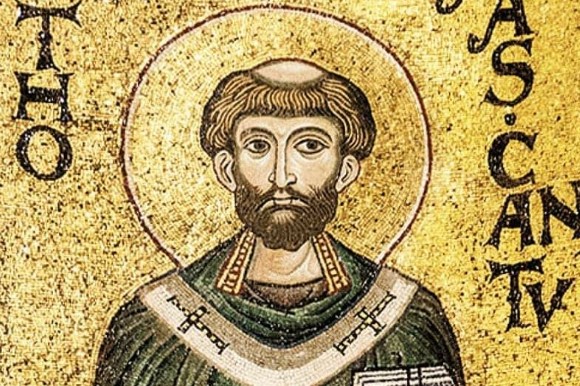
St Thomas Becket, c. 1178-89. Monreale Cathedral, Sicily.
Thomas Becket, Archbishop of Canterbury, was murdered on 29 December 1170 – eight hundred and fifty years ago. I wanted to mark the occasion. I’m not going to talk much about him, or about his relationship with King Henry II, the man who has always been blamed for his death, but I wanted to look at one of the many images that resulted from his murder. Some would say ‘his martyrdom’, as he died as a result of his attempts to defend The Church. Among other problems, he resisted the king’s attempts to weaken the Church’s ties to Rome, and to give the king more authority over its affairs – exactly what Henry VIII would achieve three and a half centuries later. Whatever the precise nature of their disagreement(s), and whatever ensued, Thomas was canonised in February 1173, little more than two years after his death. Clearly the church wanted Thomas: canonisation would have acted as a warning to Christian monarchs not to get above themselves, as they would certainly never get above God.

This image, in mosaic, comes from the Cathedral of Monreale, just outside Palermo, in Sicily. Although plans for this grandiose building, high on a hill overlooking the Sicilian capital, might have been afoot as early as 1166, construction probably didn’t get going until 1174, and was completed – along with the majority of the interior decoration – by 1189. As this detail comes from the apse, behind the high altar, it would have presumably have been one of the first parts of the decoration to be completed – it would be safe to date it to the late 1170s or early 1180s in any case, and possibly within a decade of the Saint’s canonisation. This seems remarkably quick, given the distance between Canterbury and Palermo – but the cult of St Thomas spread for many reasons, not least of which were the multitude of miracles performed in his name. In this detail we see him with his right hand held in one of several gestures of blessing, holding a book in his left hand. It has a gold cover, and is encrusted with jewels. He certainly owned such books, and insisted on taking a particularly special one with him when he went into exile. A recent hypothesis attempts to identify it among the manuscripts in the library of a Cambridge college – you can read about that here (thanks to my sister Jane Wickenden for bringing this to my attention).
Thomas is bearded and has taken the tonsure: to prevent worldly vanity, the crown of the head was shaved – it was a sign of humility, and of obedience to the church, and was done to mark entry into certain religious orders. As a practice it continued as late as 1973, when it was abolished by Pope Paul VI. His name is inscribed on either side of his head: ‘THO’ to the left, and ‘MAS’ to the right. The ‘SCS’ is short for ‘Sanctus’ – Saint – whereas the ‘CANTVR~’, is an abbreviation for ‘Canterbury’ in Latin – the ‘Civitate Cantuariae’, or ‘City of Canterbury’, according to The Domesday Book of 1080, a century before the mosaic was made.
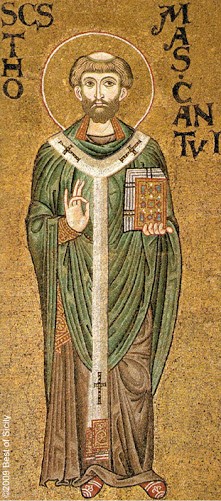
This mosaic is no mere detail – it is a full length image of the saint. There is no suggestion that this is anything like a ‘portrait’, though. It is a ‘representation’, giving people a visual image as a focus for their devotions, especially if they should wish to ask this man to intercede on their behalf. But why would anyone in Sicily want to do that? Surely there were enough local saints to go round?
To understand the reasons behind his inclusion, we need to know a bit more about the cathedral itself, and its patron. It was built for William II of Sicily, who ruled from 1166-1189. He had effectively been planning the building since his coronation, and it was sufficiently completed by the time of his death for him to be buried there. He was only 12 when he succeeded his father, and reached his majority in 1171, following the regency of his mother. He married in 1177 – at the age of 23 – to the eleven-year-old Joan of England, sister of Richard I, ‘the Lionheart’, thus becoming the son-in-law of the villain of the piece, Henry II. Not only does this show William’s standing within European politics, but it also explains the presence of an English saint in a Sicilian cathedral. Who better to ask for a hand in getting God’s forgiveness for his father-in-law’s sins, than the man best placed to forgive him? Perhaps the inclusion of St Thomas shows that William was aware of Henry II’s faults, but knew that, with the right approach, he would not be found guilty by association. In actual fact, the connection is more direct, and the mosaic helped to get William out of an awkward bind: he was friends with both sides. When Thomas fled England in 1164 to avoid the wrath of the King (taking his book with him), some of his family and friends also thought it would be safer to keep out of the way – and ended up in Palermo at the court of King William II. Both kings were Norman, after all, so there were bound to be connections. Subsequently Thomas wrote to the Palermitan court in gratitude for the hospitality shown to his kin. The marriage had been planned before the murder, but delayed, first because Joan was too young, and then because of the murder. Only after 1174, when Henry II was forced to do penance at Thomas’s tomb – already one of the great pilgrimage destinations of Europe – was the royal match back on the cards.

St Thomas is in good company. He stands in between St Sylvester – Pope when the Old St Peter’s was founded in Rome (later elaborations, extent by the time of the mosaic, suggest that he cured the Emperor Constantine of leprosy, and was given the rule of Rome in return) – and St Lawrence, an early church deacon, martyred in 258: later images would never show him without his grill. Just round the corner is St Nicholas – who later morphs into Father Christmas. It could so easily be a seasonal selection of saints: Silvester’s feast day is 31 December (nearly there…), and Thomas’s is today. St Nicholas doesn’t quite fit in, though – he is celebrated on 6 December – early for Christmas, although not for Advent. However, St Lawrence proves that this isn’t a calendar, as such: his feast day falls on 10 August.

Not only is Thomas in good company, but he is in a remarkably prominent position: in the apse behind the High Altar. You can see Sylvester and Thomas just to the right of the window. At the top of we see the Pantocrator – the ‘ruler over all’ – or ‘almighty’ – with Jesus holding an open bible in his left hand and blessing with his right, just as Thomas does below (and while we’re here, note the early appearance of the pointed arch – this is an influence from Islamic culture: Sicily was refreshingly multi-cultural). Directly below the Pantocrator, the Virgin Mary sits enthroned, wearing the Imperial purple. The colour makes the connection to Byzantium clear, and, if you could see them, the inscriptions confirm this. Unlike the saints around Thomas, they are in Greek, rather than Latin. The Christ Child is enthroned, in his turn, upon Mary’s lap, and the pair are flanked by the Archangels Michael and Gabriel. On either side of them stand Sts Peter and Paul – the two heads of the Church after Christ: St Thomas stands directly underneath St Paul. The mosaic emphasizes the nature of the Apostolic Succession – authority passes from Jesus, via Peter, to the later Popes.
I could keep pulling back from here, showing you more and more gold, and more and more splendour – apparently something like 2,200 kg of gold was used for the mosaics which, with the exception of the high wainscoting, cover every wall in the cathedral. However, I’ll just leave you with one last view of the chancel, with Thomas still clearly visible (once you know where he is) just above the High Altar (wherever church liturgy has decided it should be). I for one am looking forward to the British Museum’s exhibition Thomas Becket: murder and the making of a saint which will open, after some delay, on 22 April. It will have many beautiful things – but, for obvious reasons, not this mosaic. You’ll just have to go to Sicily to see it. There are many other reasons why I’m looking forward to 2021 – and I’ve just updated the diary page if you want to see what they are. Meanwhile I shall wish you a continued Happy Christmas. We’re only on day five after all, and there are a few more than five gold rings in this mosaic. Just try and count the haloes.
















 dr richard stemp