Day 96 – Clara Peeters

Clara Peeters, Stil Life with Cheeses, Almonds and Pretzels, c. 1615, Mauritshuis, The Hague.

There’s just time for a couple more reflections on art/in art before tomorrow evening. So far we’ve thought about mirrors as a symbol of both Vanity and Prudence (Picture Of The Day 92), and for their ability to create an image, which, like a painting, can both fascinate and enchant (POTD 94). Even though Narcissus’s name has become synonymous with vanity, in Ovid’s tale he was at first unaware that he was looking at himself – he just saw another person, conjured up as real and worthy of his love – which in its own way witnesses to the power of art . In today’s picture we can see several more ‘values’ attached to mirrors, or at least to reflections: they are used to create a greater degree of naturalism, and also function as a type of ‘certification’ – a guarantee that something has been witnessed – and even, as a form of self-validation.

Clara Peeters, Stilleven met kazen, brood en drinkgerei, c.1615 Paneel, 34,5 x 49 cm

This Still Life painting was created by an expert, there can be no doubt about that. Every surface is perfect, and seems to represent every object more accurately than any photograph could. It is also subtly, but brilliantly composed. I would say it’s highly realistic, but how often would you put your butter on your cheese? Or leave a table quite so crowded, with your valuable Chinese porcelain sticking over the edge? Everything has been manipulated, everything has been very deliberately arranged, to show off its qualities, and to show the artist’s skill. There are three different cheeses on a pewter dish, and on top of these is the butter. Some pretzels line up with the front edge of the table, and to their right a knife is sticking out, next to a porcelain dish with almonds, dried figs and dates – with other almonds and dates scattered on the table. A Venetian glass stands in front of a bread roll, part of which is cast in shadow, and next to this there is an earthenware jug with a pewter lid. The background is dark and featureless, so that the foreground objects seem to glow, almost mysterious and magical.

On the far left we can see that the pewter dish is shiny enough to reflect the largest cheese, with another reflection on the rim at the right. A darker cheese sits in front, and casts a shadow – the light is coming from the left – onto the larger one. Both are – or were – round, and the larger one has a smaller, rectangular cheese sitting on top. All three have rinds, and all three have been hacked into with a sizeable knife, the different surfaces giving a sense of their different textures. Yet another texture is visible in the scrapings of butter which sit on an earthenware dish atop the smallest cheese – they have been cut from the pat with a serrated implement, and curl over each other in a mound of golden goodness. In a wealth of detail, the most brilliant piece of observation must be the plug that has been taken out of the largest cheese with a circular gouge, the result of the cheese inspector taking a sample to check that the produce comes up to the standards required by the Cheesemakers’ Guild. A cylindrical hole emerges from the cut surface, although the ‘plug’, with its circular section of rind, has been reinserted. The right-hand edge of this cheese is in shadow, contrasting with the light shining onto the earthenware jug behind it, pushing the cheese forward, and pulling our eye back to the jug.

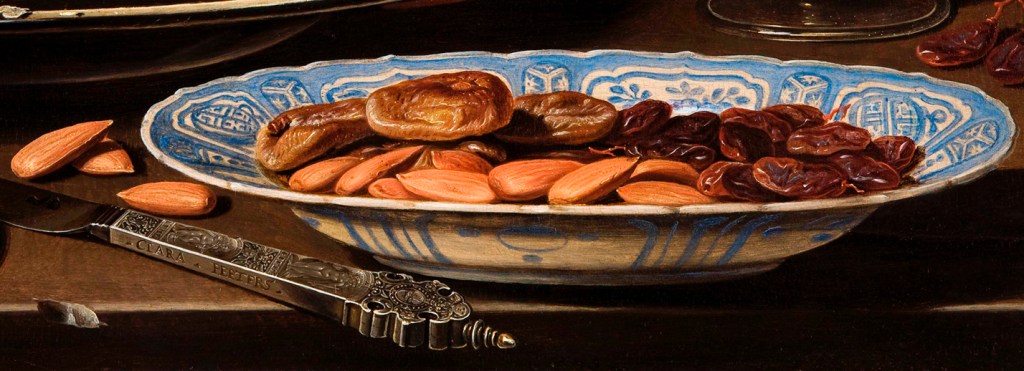
Both the dish and the knife are expensive objects. The former, in its delicate blue and white, with subtly scalloped edges, was a highly prized import. It would have been made in China towards the end of the Ming dynasty, during the reign of the emperor Wanli (1573–1620 – so contemporary with this painting). Wanli (or Wan-Li) porcelain became highly fashionable in the Dutch Republic, ultimately leading to the establishment of the Delft Porcelain Manufactory – still producing the familiar blue and white Delftware today. It fetched enormous prices at auction: one feature of this painting is that it contrasts everyday foods (cheese) with luxurious objects. Here it contains dried figs, dates and almonds – which, like the dish itself would have been imported, and considered a luxury. Like the cheeses, each has been displayed to show it off to its best advantage, and to show the artist’s ability with form, texture, and even, I think, density. 

The knife is also an expensive item, but it would have been produced locally. Known as a bridal knife, because they were made to be given at weddings, it is decorated with personifications of some of the virtues of the bride herself: these two are ones we have already met (POTD 42, 45 & 59). To our right (so nearer the end) is a woman carrying a cross – which would identify her as Faith even without the Latin word Fides inscribed underneath. Closer to the blade is another woman, pouring liquid from one jug into another, the standard representation of Temperance – she is watering down the wine. The inscription below only has space for the first four letters, Temp, as in English. But most importantly, surely, it also bears the name of the artist – Clara Peeters. This is her signature. She has put her name on the most prominent object, on the edge of the table and sticking out into our space, almost as if she is inviting us to pick it up and inspect it, a trick played by artists since the earliest days of trompe l’oeil painting.

We know very little about Clara Peeters – there are almost no documents that mention her – so most evidence comes from her work. About forty paintings can be identified, all of which are Still Lives, at a time when the genre was only just coming into its own – so she was one of the innovators. One of the few documents in which she is mentioned says that she came from Antwerp, and although she never became a member of the artists’ guild there, at least six of the panels she used were certified in Antwerp (like the cheese, everything was subject to guild regulations – unless you worked for a Royal Court). Even some of the knives in her paintings have the hallmark – and name – of the City of Antwerp on their blades. Some have suggested that putting her name on a bridal knife implies she was married, but there’s nothing else to support that – or, for that matter, to say that she wasn’t. Nor is there any evidence of when she was born or died – apart from the dates on eleven of her paintings, which range from 1607 – 1621. Presumably, if she was working in 1607, she can’t have been born much after 1590 – the latest date suggested for her birth. The Mauritshuis, which bought this painting in 2012, suggests ‘1580/90’, whereas the Prado, which owns four of her works, and hosted a monographic exhibition in 2017, is more specific, with ‘1588-90’. Both have to content themselves with ‘after 1621’ for the date of her death. 

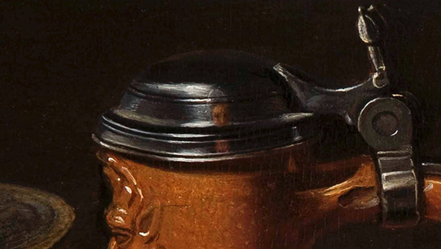
There is another, really expensive import, on the right of the painting: a Venetian glass. Peeters has perfected the depiction of every different technique used by the Murano masters – there must be names for these, but I know next to nothing about glassware. It is beaded and stippled, though, and has gold incorporated into the glass in various places. This is where we see the importance of reflection for naturalistic depiction, as each reflection is slightly different according to whether the glass is plain or patterned, clear or golden, concave or convex. The light also catches the meniscus of the wine, and reflects from the back of the glass. There is a rhombus of light, the reflection from a window, which is presumably behind our right shoulder – so not the window from which the majority of light falls onto the objects in the painting. I can’t help thinking that there is something in between the window and the glass, though, as there is a shadow in the middle of the reflection. These highlights contrast with those on the earthenware jug, a local product but, given the lowly material, still of superb craftsmanship, notably in the stylised faun’s head on the vessel’s neck. The pewter lid is also depicted in all its intricacy, and has an even more important reflection – or even two.

A third of the way from right to left of the pewter lid, just emerging from the shadow, is a face, with a second, more distorted version, in the rim underneath. This is the artist herself, and these tiny, reflected self portraits were one of her ‘hallmarks’. I suspect that the shadow in the reflection of the window is her too. She was not the first artist to do this. Ever since the two figures were seen in the mirror of the Arnolfini portrait, it has been assumed that Jan van Eyck was one of them– although there is absolutely no way we can be sure. However, in his Virgin and Child with Canon van der Paele painted at more or less the same time, there is a standing figure reflected in the shield of St George, which is more likely to be the artist. However, we still can’t be certain it’s him. So why should we think this is Clara Peeters? Well, because she puts herself into quite a few of her own paintings, and the image is similar in each, given the limitations of representation – not only are the reflections small, but they are reflected on less-than-perfect surfaces.

Not only that, but in some paintings, the reflected figure is holding a palette and paintbrushes. The detail on the right comes from the painting on the left – the gilt goblet towards the back on the right has at least six self portraits, one in each of the raised circles. Not only does the inclusion of these images vouch for her powers of observation, and her skill at reproducing what she sees, but it also asserts her position as at the artist – another type of signature – and her position as a female artist at that. Given that her paintings were included in collections across Europe, as far afield as Amsterdam, Rotterdam and Madrid, it also suggests that she was a successful one. And that is hardly surprising – she was brilliant. She should be better known!

Day 95 – Lazarus

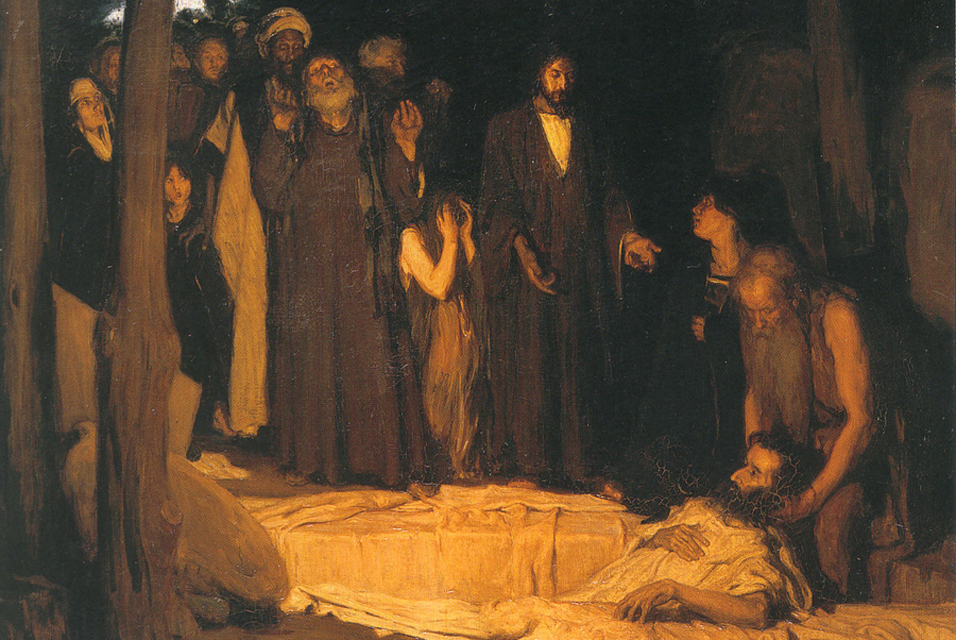
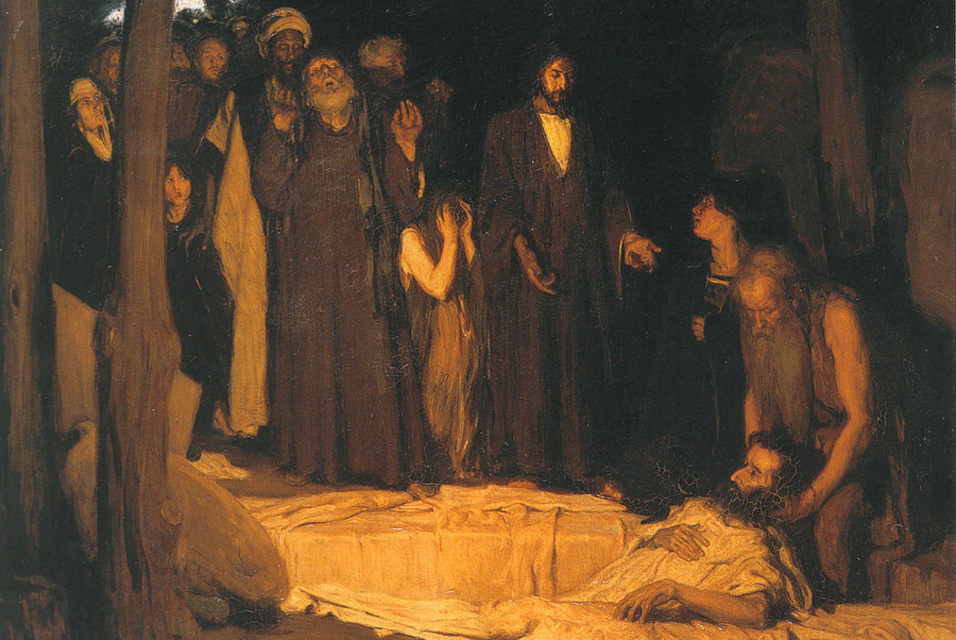
Henry Ossawa Tanner, The Resurrection of Lazarus, 1896, Musée d’Orsay, Paris.

We last saw Henry Ossawa Tanner painting a genre scene, The Banjo Lesson, in Picture Of The Day 81. Painted in 1893 during one of his few returns to the States after he had settled in France in 1891, he took it back with him to Paris, where it was accepted for exhibition at the annual Salon of 1894. This marked the beginning of his success, although, as yet, he was effectively unknown. The following year, two more genre paintings were accepted, but it was with Daniel in the Lion’s Den, painted in 1895 and exhibited the following year, that he really made his mark: Daniel was awarded an honourable mention by the jury.

That year, 1896, he painted The Resurrection of Lazarus, which, yet again, was exhibited the following year, as was the fashion. The Salon jury awarded it a third-class medal, and it was purchased by the French government for the Musée de Luxembourg, which, at the time, was the national collection of modern art: it is now in the Musée d’Orsay. Tanner had arrived. He was effectively the most successful American artist of his time in Paris.

The story of the resurrection of Lazarus is told in John 11:1-44 – I’ll just quote 38-44 below. He was the brother of Martha and Mary, friends of Jesus, and when he was sick, they sent for their friend. However, by the time Jesus got there Lazarus was already dead. Martha went out to meet him first, followed by Mary, who, when she saw him, ‘fell down at his feet’. Jesus asked, ‘Where have ye laid him?’ and was taken to the grave: 

It was a cave, and a stone lay upon it. Jesus said, Take ye away the stone. Martha, the sister of him that was dead, saith unto him, Lord, by this time he stinketh: for he hath been dead four days. Jesus saith unto her, Said I not unto thee, that, if thou wouldest believe, thou shouldest see the glory of God? Then they took away the stone from the place where the dead was laid. And Jesus lifted up his eyes, and said, Father, I thank thee that thou hast heard me. And I knew that thou hearest me always: but because of the people which stand by I said it, that they may believe that thou hast sent me. And when he thus had spoken, he cried with a loud voice, Lazarus, come forth. And he that was dead came forth, bound hand and foot with graveclothes: and his face was bound about with a napkin. Jesus saith unto them, Loose him, and let him go.

When we look at Tanner’s depiction of the story, it does not worry too much about the details of the text, apart from taking place in ‘a cave’. Jesus stands looking over the grave, which is dug into the ground and lined with white material, in excess of any standard shroud. Rather than ‘coming forth’, Lazarus is just managing to sit up, his left arm tense, the fingers and wrist arched, resting on the side of the grave, while his right rests on his chest. He eyes are open, but his facial expression is fixed, staring forward – what else would you do under the circumstances? He is tended to by an old man, who could easily be a hermit, presumably one of the people Jesus instructed to ‘Loose him, and let him go’ – in which case, the ‘napkin’ around his face has already been removed. 

The roof of the cave is propped up by a number of posts – there is one behind the ‘hermit’, and another two on the left of the painting, which frame our view. At the base of these two posts are what could be the stones ‘laying upon’ the tomb – although in the background, behind the right of the two posts, and above the heads of the crowd who have followed Jesus, Mary and Martha into the tomb, we can see light coming from the mouth of the cave, the sort of opening that could have had a stone rolled in front of it. Jesus’s gesture is not grand, or dramatic, but contains its own humility – the arms held slightly out, the hands almost pointing, almost ready to accept Lazarus, as he looks down towards him. 

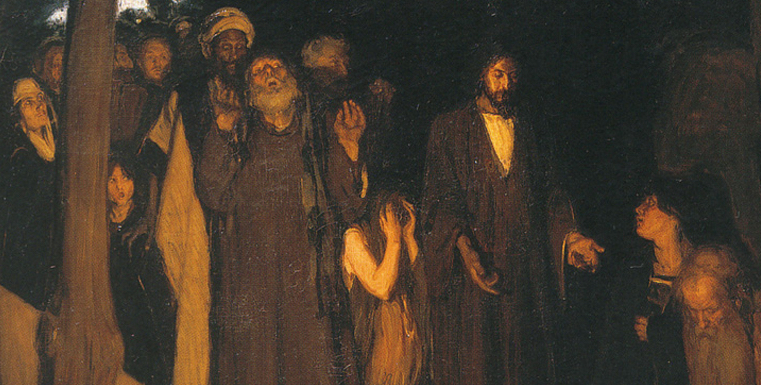
Mary and Martha kneel on either side of Jesus. My guess is that the figure on our right is Martha, looking up towards him, calm and dutiful, whereas the grief-stricken figure, head in hands, is Mary. Both have ‘fallen down at his feet’, although the text only suggests that Mary did this – but that was before they had got to the tomb anyway. However, it was at that point that ‘Jesus saw her weeping’. Mary weeps often in the New Testament – it is one of the things that defines her. And if anyone who knows either of the Magdalene Colleges (Oxford or Cambridge, although I’m sure there are others) and wonders why they are pronounced Maudlin, it is the same word. ‘Maudlin’, meaning miserable comes from the medieval French version of ‘Magdalene’ – it’s not so far from Madeleine – and derives from images of the Magdalene weeping. Plus there is the hair, which is scrunched up on either side of her head, between her hands, in Tanner’s image, but we should talk about the Magdalene’s hair another day. There is no sign of the smell, something which many artists were careful to portray. As we shall see on Saturday, Giotto makes it quite visible.

All these thing aside, this is a very unconventional portrayal of the subject, and very different from the version we will see on Saturday. But then Tanner’s upbringing didn’t incline him to ‘traditional’ religious art. His father, Benjamin Tanner, was a minister, and then a bishop in the African Methodist Episcopal Church, and had wanted his son Henry to go into the ministry. Having realised that this would not happen, he welcomed the change in direction of his son’s career as an artist, from painting genre scenes, to biblical narratives, as he was fully aware of the power of art.  As he himself said, 

By the presentation of visible objects to the eye, divine truths may be most vividly photographed upon the soul… In representation man does not, like the great Originator, create his own fiat, his world of mental objects. What he reproduces or constructs anew is in some way dependent upon what he has personally experienced.

If Henry did not want to preach, he could still minister through his art. Henry himself was dubious about the quality of much religious painting, if not downright damning:

It has very often seemed to me that many painters of religious subjects (in our time) seem to forget that their pictures should be as much works of art (regardless of the subject) as are other paintings with less holy subject… There is more ‘bogus’ sentiment in poor pictures – pictures in which the artist has tried to convince the world that nothing else was necessary – because he has nothing else to give. Religious art has come to mean an uninteresting, inartistic production. Who is to blame that this is true? The large number of painters of very mediocre attainment… have painted religious pictures because they have found that the selection of such subjects has enabled them to draw more attention to themselves than would their mediocre rendering of any other subject.

Some more cynical critics have suggested that Tanner had done just that. The genre paintings that were accepted in the Salons of 1894 and 1895 did not get him known: ‘History Painting’ – i.e. the depiction of important narratives – was how you made your mark, and it was how he made his. Although his father may have welcomed the development, not everyone did. Members of the black community regretted his decision to move away from African American subject matter, as seen in paintings like The Banjo Player (POTD 81). However, his approach was more subtle. In some way’s Tanner’s interpretation of Lazarus is not so very far from some of Michelangelo’s ideas on the tomb of Julius II, not that I think this was necessarily Tanner’s intention. It is interesting, but probably coincidental, that the Louvre, in Paris (where Tanner spent most of his adult life) is home to Michelangelo’s Dying and Rebellious Slaves. One interpretation of these is that they represent the human soul, enslaved to the body. For Tanner, Lazarus has been a slave to death – and now he is free. As a result, some critics relate Tanner’s interest in the story of the Resurrection of Lazarus to the end of slavery in the United States (the Emancipation Proclamation took place in 1863) . Others suggest it has a more personal significance – that Tanner himself was effectively returning to Jesus, he was ‘born again’ if you like, like Lazarus – and indeed, he wrote a letter to his parents in 1896 expressing his guilt abut his distance from the church.

But had he really moved so far from the idea of genre painting, one description of which would be ‘normal people doing normal things’? I’m not so sure. His biblical paintings are framed as if they are totally normal – no grandiloquent gestures, no superhuman, idealised people – just normal people doing normal things. Not the blonde-haired blue-eyed Jesus you might see in so much Western art, but someone who could so easily be from the Middle East.

And if we look among the crowd, it is a remarkably mixed group, a black man prominent among them. It suggests he is interested in a more universal, multicultural message. This would certainly fit in with his father’s own preaching, a good case in point being Bishop Tanner’s interpretation of the famous passage in Isaiah 11:6:

The wolf also shall dwell with the lamb, and the leopard shall lie down with the kid; and the calf and the young lion and the fatling together; and a little child shall lead them.

In one of his sermons, Bishop Tanner suggested that this statement prophesied a time when, ‘men of all races, nations, and communities shall show how good and how pleasant it is for brethren to dwell together in unity’. This crowd, unified in it’s astonishment, would seem to embody this very idea.

The one mysterious feature of the painting, not immediately apparent as such, is the lighting. If the mouth of the cave is in the far background, where is all the light in the foreground coming from? If you look at the way all of the people in the crowd are lit, you can only come to one conclusion: it is coming from the grave itself. This miraculous glow, a creamy light in the darkness, is a key feature in the palette of one very particular western European artist, whose chromatic and tonal range stretches from creams, through gold to the deepest browns and black: Rembrandt van Rijn.

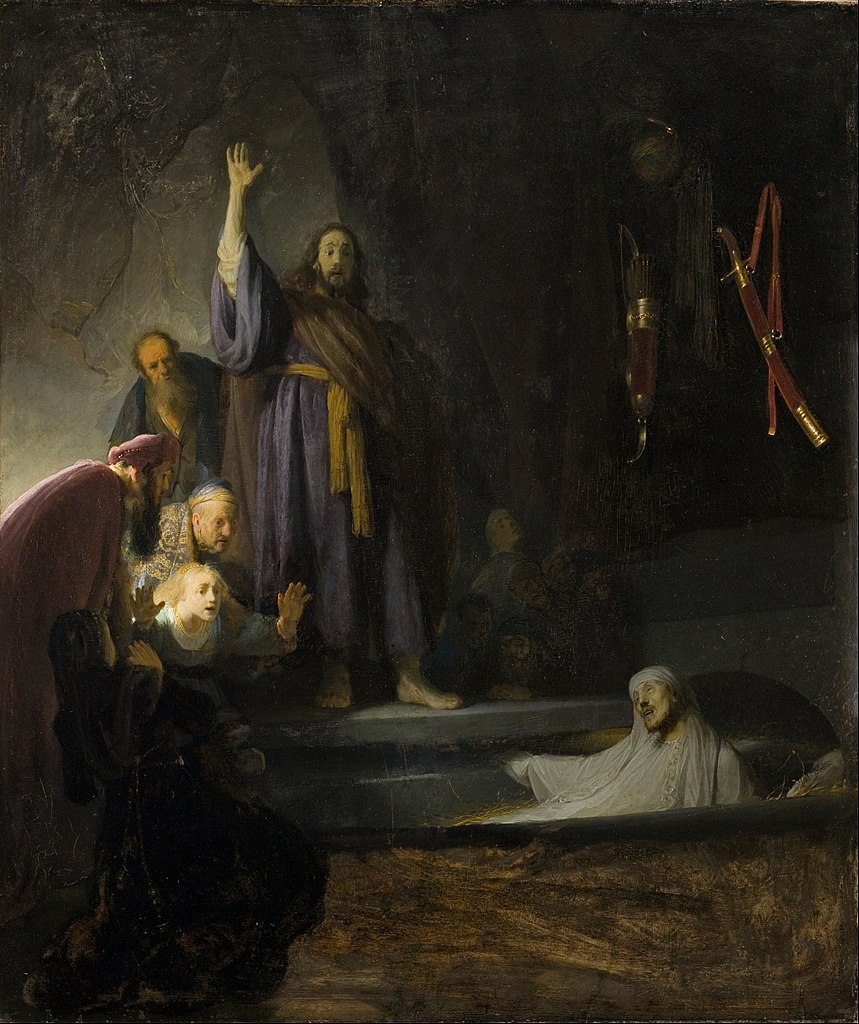
Indeed, it is a painting by Rembrandt which is closest to Tanner’s conception of the work. Painted around 1630-32, it is relatively early, and so does not use the archetypal Rembrandt palette. It is now in the Los Angeles County Museum of Art, but I’d love to know where it was in 1896, because the man who bequeathed it to LACMA hadn’t been born then. I don’t know if Tanner knew it.  But with Lazarus just managing to sit up, Christ standing above him, the apex of a pyramid formed with the two sisters on either side, it is remarkably similar.  One day soon the libraries will open, and I might be able to find out.

Day 94 – Narcissus

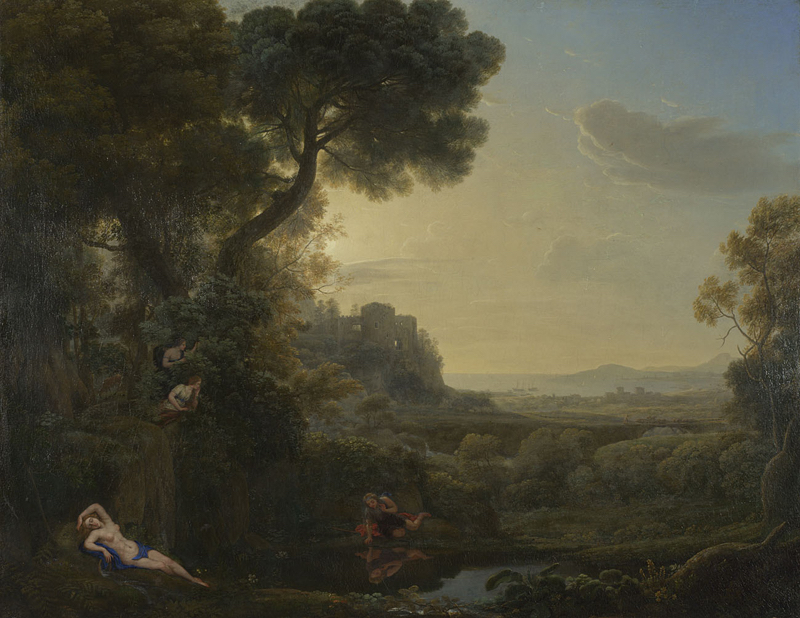
Claude, Landscape with Narcissus and Echo, 1644, National Gallery, London.

I last talked about Claude, one of the great innovators of landscape painting, when we were exploring the story of Psyche, and if you want to more about him, and why I think this artist who produced all his work in Italy was not really French, you might want to read (or re-read) Picture Of The Day 46. Today, I am adding to a mini-series on reflections, in preparation for my talk on Velázquez this coming Wednesday – although I doubt that this painting will make it into the talk!

Claude, 1604/5?-1682, Landscape with Narcissus and Echo, 1644, Oil on canvas, 94.6 x 118.7 cm https://www.nationalgallery.org.uk/paintings/NG19

The story of Narcissus and Echo is told by Ovid in his Metamorphoses, although the version I shall tell you is very much my own, honed by a couple of decades telling it to school groups in the National Gallery. Claude’s telling of the story might seem almost incidental. After all, the four characters depicted in the foreground take up relatively little space on the surface of the painting. The composition is typical Claude: dark trees take up the upper left-hand corner, with a shorter, lighter tree on the far right of the painting, still dark against the sky. These trees, growing in the middle distance, frame a view of the distant landscape, itself composed in a similar way, with a castle, darker than the luminous sky on the left, and a mountain, not as high, on the right. The foreground is the darkest part, getting gradually lighter as our eyes move towards the horizon. We are almost compelled to look to the distance, drawn towards the light. However, as so often with Claude, the sun is far higher than you might expect, above the castle, about a third of the way across the painting from the left.

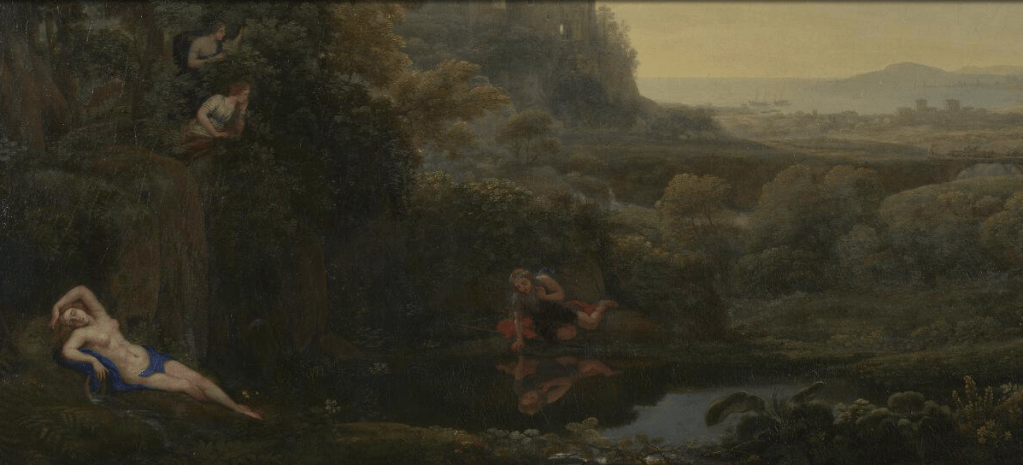
Even if we get in closer the figures are not exactly prominent – we have to seek them out amidst the gloom. It is almost easier to see the port on the shoreline, two ships out to sea, with smaller vessels gathered around. A bridge crosses the mouth of the river, just to the left of what could be a castle. Closer to us a shepherd, following his flock, is about to cross another bridge going over a gully (on the far right of this detail). The river presumably winds its way as far as the foreground of the painting, although its route is lost behind hills and vegetation. The woman lying naked at the bottom of the picture rests her right arm on a jug pouring water – she is the source of this stream, and so the goddess of the river which flows down to the sea. Without her we would not have the pond with its mirror-like surface. Curiously X–rays have shown that Claude did not paint her naked – she has been subsequently undressed, her naked body painted over Claude’s clothes. Why not remove her? Well, the X–rays cannot specify how much of the original clothing remains, and were the nude removed, there might be precious little underneath – and by now she is part of the history of this painting. 

Above the River Goddess, in the foliage, there are two women looking down. The higher of the two seems content to look, holding back the branches to get a better view. The lower of the two lifts her left hand to call out.

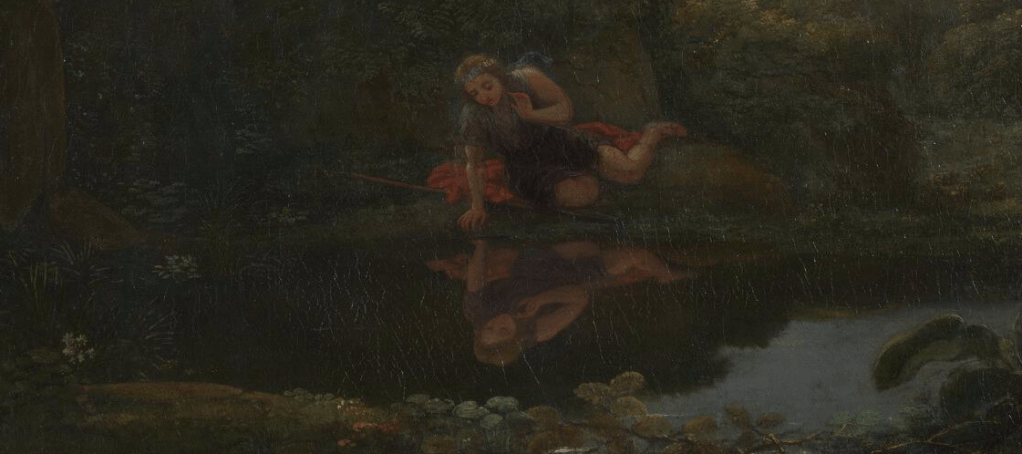
They have come to see this man, leaning on one arm, peering down to look at the pond, his left hand raised – looking in awe at his own reflection. This is Narcissus, one of those people who was so unbelievably beautiful that absolutely everybody fell in love with him. But, of course, just because you look good on the outside doesn’t mean that you are good on the inside – and he was incredibly vain. Girls would go up to him and declare their love, at which he would just look down his nose at them, and say, ‘But you’re not good enough for me’. And before long this little corner of the Ancient World was literally littered with love-sick maidens. The gods and goddesses got together and decided to teach Narcissus a lesson, sending Cupid to make him fall in love with someone who would make him very unhappy. Cupid did as he was told, and shot him with one of his best golden arrows, so that Narcissus would fall in love with the next person he saw. Inevitably, because he was so incredibly vain, the next person he saw was his own reflection. Bewitched, he had no idea what was going on, and fell instantly and desperately in love. He said ‘Hello’. He said ‘You’re beautiful’. He even got as far as ‘I love you’ before realising that there was no reply. The beautiful boy was silent. So he tried ‘Why don’t you talk to me?’ but still got no response. So he reached out – and instantly knew he was onto a good thing, because as he reached out to his new-found love, the love reached out to him. In his enthusiasm Narcissus went to grab him, but a strange thing happened – he realised he was wet, in a pond, and the boy had vanished. This was not one of the side effects of love that he had been warned about. Still, he pulled himself together, climbed out, sat down, dried off… and when he looked back, the boy had returned. This time he was more cautious, reached out slowly – and the boy reached slowly back. He was clearly very timid, though: just as they touched, he disappeared. He must have run away. ‘I’ll wait till he comes back’, thought Narcissus. And then when he did, he just looked down, lifted his hand to hear the boy speak (in case he was very quiet) but he didn’t want to scare him away again so he stayed very still. He just… looked. And… waited… And…
Meanwhile, one of those girls who had fallen in love with him decided to take matters into her own hands, and headed out into the countryside to find him. Not only that, but she took one of her friends along for moral support – you know, the way girls do. Maybe the ‘my friend really fancies you’ approach would work. But in the end, she couldn’t wait, and called out to him herself. There was only one problem with that – she couldn’t speak. Or rather, she couldn’t speak any more. She used to speak a lot. You probably know one of these people – they seem to be able to talk constantly without drawing breath, and certainly without listening to a word that you ever say. She made the mistake of doing this to Juno once, when the Queen of All the Gods was on her way to stop Jupiter from indulging in one of his affairs, and Juno got so angry that she cast a spell on her. She could no longer speak – unless someone spoke to her first. And even then, she could only repeat what she had just heard. So you’d go up to her and say ‘Good Morning’ – ‘Morning, morning’ would be her reply. This was Echo. So here she is, desperately in love with Narcissus, who has already rejected her, and she wants to shout out to him – but she hasn’t heard anything so she can’t. And he’s not paying her any attention. I mean, even the River Goddess has taken off all her clothes, and he’s not paying her the blindest bit of attention either. He’s only interested in himself. What a Narcissist! Still – he says ‘Hello’.

So Echo replies ‘Hello! Hello!’. 

‘You’re beautiful’

‘Beautiful! Beautiful!’

‘I love you’

‘Love you – love you!’

‘Why don’t you talk to me?’

‘Talk to me! Talk to me!’ 

And there they were – stuck in the forest, she was transfixed, he was transfixed, though gradually with the dawning realisation that this was his own reflection, and it could never love him back. And the gods realised that, even if they had taught him a lesson, their plan had backfired. They didn’t want the countryside littered with the lovelorn, so they decided to make them fit in – and changed them – transformed them – metamorphosed them into something that did. Narcissus became… a narcissus. Next Spring, when the daffodils come back out, just have a look at them – they really do look as if they are looking down at their own reflections going ‘you’re gorgeous’. And in the detail above, on our side of the pond, just to the right of the River Goddess’s feet, Claude has painted some narcissi. And Echo? What happened to her? Well, she was so much in love that she simply pined away. She faded, and became invisible, and now she hangs out with the wind in all the sad and lonely places – caves and tunnels mainly – and whenever you call out to her, she will call back to you.

Claude, Landscape with Narcissus and Echo, 1644 https://www.nationalgallery.org.uk/paintings/NG19

As I said before, the elements of this story seem tiny compared to the painting as a whole. You could cover Narcissus and his reflection with one hand, and it would turn into Landscape with nude and two women peering – no narrative at all.  And yet, as in The Enchanted Castle (POTD 46), the whole painting exudes the same bitter-sweet sadness, the same melancholy as the story. That was Claude’s great skill.

He does this with the placement of the sun, up in the sky, behind one of the smaller branches of one of the larger trees. It lights the clouds across the sky from the left, and the ones just above the castle, from above. Even in the detail of Narcissus, we see it lighting his left shoulder and leg, and even the side of his right arm, with which he props himself up. It is this Autumnal light which unifies the whole painting, and casts the melancholy mood. Narcissus might be small within the painting, but the whole painting tells his story. 

And the moral of the tale? It seems a little simplistic to settle on ‘don’t be vain and don’t talk too much’. This story speaks very powerfully about the power of speech – and the magic of art. We can fall in love with an image, but shouldn’t we get to know what is beneath the surface? If art is the mirror of nature, should we be wary of falling for its spell? Is the artist really reflecting what he sees, or creating a world of the imagination? And is what he creates any more ‘real’ than the reflection in a mirror? I think the answers to these questions will be different for each of us, depending on what we want art to be. I’ll leave it up to you.

Day 93 – A Baptism and a Wedding

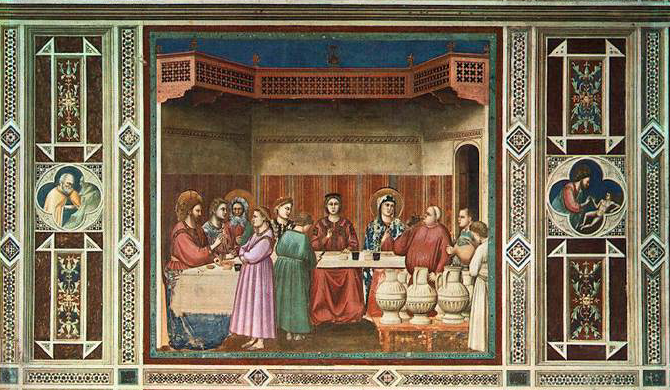
Giotto, The Baptism and The Wedding at Cana, c. 1305, Scrovegni Chapel, Padua.

Bother. Oh bother. I hate it when I get things wrong. Last week I said that we would start today with The Baptism of Christ, saying that it was opposite Christ among the Doctors. But it isn’t, it’s next to it.  Here is the opened-up scale model of the chapel which I first showed you for Picture Of The Day 45 – it was made for an exhibition in Australia, apparently.

OLYMPUS DIGITAL CAMERA

There are six paintings in The Story of Joachim and Anna (POTD 66 & 73) at the top of the South wall (on the left of this photo – you can only see the last two scenes of the six), but only five in The Childhood of Jesus (POTD 87) because of the windows. And I tried to include six. Well, that’s what comes of trying to rush… I mean, covering six images in one blog, what was I thinking? I’ll add some dodgy edits to last week’s entry. Anyway, The Childhood of Christ ends with The Massacre of the Innocents, more-or-less opposite which, on the North Wall, is Christ among the Doctors – even as a boy he had started his Mission. So, the first three scenes in the middle tier of the North wall should look like this:

We have Christ Among the DoctorsThe Baptism of Christ, and The Wedding at Cana. The first was discussed last week, and the Baptism is fairly straightforward – nothing compared to the Baroque complexities of Juan de Pareja’s version (POTD 89), although it’s more complicated than it might appear at first glance.

Jesus stands in the centre of the image, up to his elbows in the River Jordan, and completely naked. This was not unusual in Medieval painting, although Giotto is not exactly explicit. It was not unusual for Jesus’s genitalia to be visible, because this would emphasize the theological point that he was both God and man. But Giotto doesn’t feel compelled to drive the point home – there is so much humanity in his painting anyway. There is more interest, I would say, in the swirling water, and, just in case we didn’t realise that it is water, there is a fish swimming beside Jesus’s calves. God the Father appears on high with quite surprising foreshortening – yes we’ve seen Uccello do this upside down (POTD 37), but that wasn’t until 140 years after after Giotto was painting. A glow of white light radiates all around – but there are clear signs that paint has been lost. The blue sky, painted a secco, is not in a great condition, and the Holy Spirit has vanished completely – but I can’t imagine that he wasn’t originally there. Last week, and even the week before, we saw how important the ‘landscape’ can be for the narrative, and here is no exception. The rocks on either side, effectively forming a valley through which the Jordan flows, focus our attention down towards Jesus. They also act as a background for the secondary characters, whereas the protagonists – John the Baptist and God, in the persons of the Holy Trinity (even if we can’t see the Spirit) – appear against the sky.

The Baptist wears his traditional camel skin and pink cloak, and reaches over to Jesus from the shore, while angles stand on the other side of the river, holding onto Christ’s blue robe and red cloak. If you remember, Pareja had added a third angel, but here, Giotto has two additional figures standing in the background, one only visible because of a hint of a halo and a slice of his neck. John the Baptist also has two attendants, one of whom is a Saint, the other isn’t. For their identity we must see what happened after the account of the baptising of the multitudes in the Gospel according to John 1: 35-37 & 40:

Again the next day after John stood, and two of his disciples; And looking upon Jesus as he walked, he saith, Behold the Lamb of God! And the two disciples heard him speak, and they followed Jesus… One of the two which heard John speak, and followed him, was Andrew, Simon Peter’s brother.

St Andrew is the one with the halo. Giotto depicts him as he is often seen in Italian art, with a long white beard and white hair, wearing green. He is considered to be St Peter’s older brother. In the other Gospels St Peter is considered to be the first disciple, whereas John makes it quite clear that Andrew was the first, which makes the Scots happy. Andrew also makes his way into The Wedding at Cana

This isn’t entirely surprising, as the John’s Gospel – the source for Andrew’s presence at the Baptism – is the only one of the four to recount this particular miracle, always seen as Jesus’s first. The young man in between Jesus and St Andrew could be the second of John the Baptist’s followers, who is not named in the quotation above, and who did not end up following Jesus – hence the lack of halo. But then that begs the question as to what he is doing at the wedding. Andrew’s glance seems to suggest that he too is curious. The account of the wedding takes up about a third of a chapter, but I’m going to quote it in full – John 2: 1-10:

1 And the third day there was a marriage in Cana of Galilee; and the mother of Jesus was there:

2 And both Jesus was called, and his disciples, to the marriage.

3 And when they wanted wine, the mother of Jesus saith unto him, They have no wine.

4 Jesus saith unto her, Woman, what have I to do with thee? mine hour is not yet come.

5 His mother saith unto the servants, Whatsoever he saith unto you, do it.

6 And there were set there six waterpots of stone, after the manner of the purifying of the Jews, containing two or three firkins apiece.

7 Jesus saith unto them, Fill the waterpots with water. And they filled them up to the brim.

8 And he saith unto them, Draw out now, and bear unto the governor of the feast. And they bare it.

9 When the ruler of the feast had tasted the water that was made wine, and knew not whence it was: (but the servants which drew the water knew;) the governor of the feast called the bridegroom,

10 And saith unto him, Every man at the beginning doth set forth good wine; and when men have well drunk, then that which is worse: but thou hast kept the good wine until now.

It’s intriguing that Mary was there, and is mentioned first, but was not named – and also that Jesus’s disciples were also ‘called to the marriage’ – even though Giotto only shows St Andrew (well, there is limited space, I suppose, in these paintings). It is also interesting how Mary tries to take charge, only for Jesus to be downright rude to her, even if he does end up doing what she wants anyway.

On the left Jesus is giving very clear instruction to one of the servants, whose body language is not good. Crossed arms – and the facial expression – clearly indicate that he (I’m going for ‘he’) is not open to Jesus’s suggestion. But Mary (who clearly has some clout) has said ‘do whatever he saith unto you’ – and so the servant is listening attentively.

John recounts, ‘there were six waterpots of stone’ – and Giotto has painted all six. On the far right, a servant pours water into one of the pots (her – I’m going for her – face is turned away from us, a very delicate profil perdu), while the Governor of the Feast (I think we’d say Master of Ceremonies – or MC) has already drawn some of the wine, in a silver flagon – which has tarnished and now looks black. Mary raises her hand – as if to instruct him, maybe, or to find out how it is going. Her halo is gold – but it is also built up with a technique known as pastiglio. The wall is plastered, and for true fresco, painted while still wet. But you can add more layers of plaster to make a sculptural effect. In this photograph the fresco is lit (artificially) from below, and Mary’s three-dimensional halo casts a shadow on the wall above. From the floor of the Chapel it makes the halo look like solid light. 

The MC is one of my favourite characters in the entire chapel – a man who knows good wine because he has clearly sampled a lot of it – his belly is every bit as round as the waterpots which his form so clearly echoes. I’m also glad that he has brought his son along to help, and, in the fullness of time, I’m sure he would want him to take over the family business. Both have the same snub nose, narrow eyes, square forehead, rounded jawbone and protruding upper lip. The lad hasn’t developed the paunch yet, though.

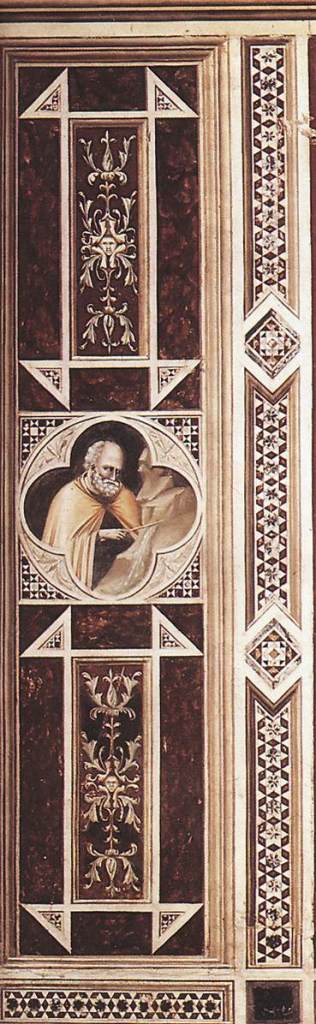
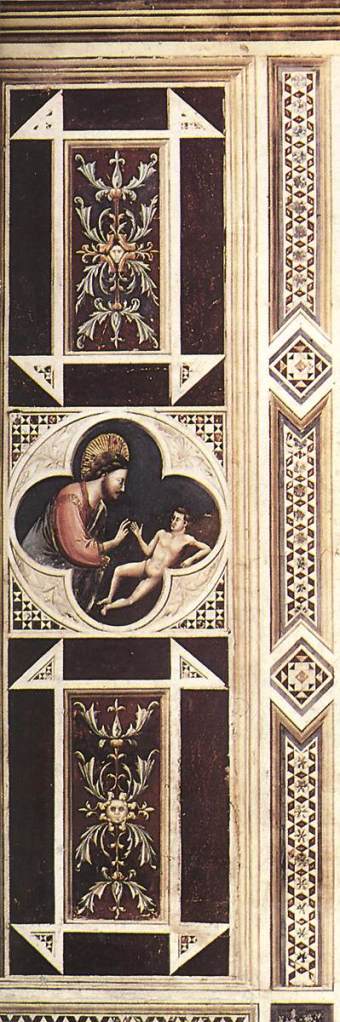
This is not a great picture, I know, but it gives us a reminder of where we are, looking at the North Wall of the Scrovegni Chapel. At the top tier we see The Birth of the VirginThe Presentation of the Virgin to the Temple, and The Suitors bringing the Rods (POTD 73 & 31), and then below, Christ Among the DoctorsThe Baptism and The Wedding at Cana. Whereas the South Wall has windows, the North Wall does not – leaving space for decorative panels in between the different scenes. Notice how the top tier is decorated in a different way to the lower two, and elements of the decoration keep it quite separate. That is because the top tier involves Mary, and the material is not biblical. The middle and bottom tiers are drawn directly from the bible, though, and concern Jesus himself. Of the decorative strips, those in between the biblical scenes contain important references. Here are the details which occur between the first three scenes in the middle tier.

On the left, we have Circumcision, and on the right, Moses bringing forth Water from the Rock. Both relate to the Jewish scriptures – the Old Testament – and both imply that, as a result of Christianity, the old order has changed. Circumcision is followed immediately by The Baptism – and the implication is that, for men to enter into the Jewish faith they had to be circumcised, seen as an act of ‘making clean’, whereas in Christianity, this ritual has been replaced by Baptism. Circumcision is represented as a symbolic act, rather than using an Old Testament narrative, whereas the small scene showing Moses comes from Numbers 20:11. The Israelites were in the wilderness heading for the Promised Land, but had no water. Moses was instructed by God to strike a rock with his staff, and water sprang forth, thus providing for his people. In the Old Testament, Moses provides water for physical sustenance. In the New, Jesus not only turns that water into wine, but also, later, tells us that the wine is his blood – thus providing spiritual sustenance. And not only that – as the account tells us, he has kept ‘the good wine until now’ – a phrase which theologians interpreted as referring to Jesus himself. The Wedding at Cana is not only Jesus’s first miracle, but it also hints at the events of the Last Supper.

When seen next to each other it should be clear how the interpretation of The Wedding at Cana is enhanced by the image of Circumcision which precedes it: the new order has replaced the old. You will see that there is another decorative panel on the right, and you might be able to see what that is. If not… well, I’ll tell you net week. In the meantime, it’s worthwhile remembering the Jesus was not advocating abstinence. Christian teetotalism is a myth. Cheers!

Day 92 – Vanity vs Prudence

attributed to Ginevra Cantofoli, Vanity, n.d., Private Collection.

Occasionally I like a bit of a challenge, and today’s painting certainly qualifies. It was sold on the art market in 2009 (I think) as an undated work by the 17th Century Bolognese artist Ginevra Cantofoli, about whom there is almost no information available, and is now in a private collection. However, the main authority on women artists in Bologna in the 17th Century, Babette Bohn, is dubious about the attribution. But I’ve never let anything like that get in the way of a good story… So why do I want to look at it? Well, it’s a rather beautiful painting, I think, and deserves some attention, whoever it is by. I’m also interested in any artist I’ve never heard of before. I came across it because I’m also getting interested in mirrors: I’ll be delivering a Zoom talk about Velázquez and his interest in reflections this coming Wednesday evening (contact Art History Abroad if you’re interested!).  

We see a woman in a delicate lavender dress, belted at the waist, with a low cut neckline that has a richly embroidered border. A form of cape, made from the same lavender material, is pinned to her shoulder, and wraps around her waist in copious spiralling folds. A dark blue headdress, decorated with gold, is just visible as it touches her forehead, curving over her hairline, and holding down a plait which circles her head. Her blonde hair falls down the side of her face in waves, with a few strands lying on her pale flesh. This is not the strictly controlled coiffeur of the plait, but seems freer. Her left shoulder is brought forward, as if she were previously looking at the mirror, but she has now turned towards us, creating an interesting twist through the body – the turn of her head counteracts the reach of her left arm.

It is not entirely clear whether she is holding the mirror up, or resting her hand on it – the lower edge seems to rest on a shelf, implying that she could be twisting it towards us, allowing us to see an alternative view of her face, in profile, from a slightly low angle as a result of the position of the mirror. She looks at us, with an almost sphinx-like expression, challenging us, perhaps – or simply inviting us – to make up our own minds about what we see.,

Her left hand reaches across her body, fingers open and palm downwards. Underneath are a few golden elements, two of which look like jewelled pins – my guess would be that they are hair pins she has just taken out, and has dropped onto the table – which would explain why the curls to the left of her head flow more freely. 

Mirrors function in different ways in paintings, and are a good example of the complexities of symbolism. It is not always possible to pin down a single meaning for an individual object: context is everything. We’ve come across mirrors before. One was held by Prudence, one of the four Cardinal Virtues, at the lowest level of the decorations of the Scrovegni Chapel (Picture Of The Day 59). Prudence – the ability to make wise decisions based on experience – is often seen as relying on self knowledge, and hence the need for self reflection. Here is another example, in a painting by Elisabetta Sirani.

Elisabetta Sirani, Caritas, Fortitudo, Prudentia, Private Collection, Modena.

Not only do we have two women artists today, but in this painting we have three Virtues – it being an Allegory of Charity, Justice and Prudence. Giotto’s Justice was also discussed in POTD 59, whereas his Charity, one of the three Theological Virtues, appeared in POTD 45.  In all three cases Sirani’s choices for the Virtues are more traditional than Giotto’s, but that is undoubtedly because there had been more time for ‘tradition’ to develop. Charity, or ‘Love’, is shown with three children, one clambering over her shoulder, one breast-feeding, and another reaching up to play with the baby. I have often thought that ‘Charity’ in these cases should be re-named ‘Long Suffering’ – but it is undoubtedly Love! The central Virtue of the painting (in more ways than one) is Justice, holding her sword aloft in her right hand, with the scales of Justice put to one side in the other. She looks out to her left, into the middle distance, as if contemplating a judgement, whereas the other two both look towards her – as if to say, be charitable in your judgements, and make the right choice. Prudence points to her mirror with her right hand, and rests her left, which is holding the mirror firmly, on a sizeable tome – presumably containing all the knowledge needed to make a wise and cautious decision.

As I said when discussing Elisabetta Sirani (POTD 62 ), the study of her work is enormously enhanced by the log book that she herself kept, which lists around 200 different works (by comparison Artemisia Gentileschi, a far more famous 17th Century artist, was not as productive: about 120 works are known). In it, she lets us know that this Allegory was commissioned by Cardinal Leopoldo de’ Medici, one of her most important patrons. Apparently he was so happy with it that he gave her a cross, studded with 56 diamonds, as a reward. These three virtues were chosen as being those especially exemplified by the Medici family, who in the 17th Century were the Grand Dukes of Tuscany (you will notice that Modesty was not one of the Virtues that they claimed). Sirani signed the painting – rather presumptuously perhaps – on the hem of Justice’s bodice.

As well as being a very productive artist, and keeping good records of her works, Sirani was also important as a teacher. According to contemporaries, her most gifted student was Ginevra Cantofoli.  A couple of decades older than Sirani, her family had no previous connection to painting (unlike Sirani herself, who had learnt from her father). One of our main sources of information about her is Carlo Cesare Malvasia, the 17th Century version of Vasari in Bologna, who published his Lives of the Bolognese Painters in 1678. He heaps special praise on the women: not only does Bologna have great artists, he says, but has more talented female painters than anywhere else. He lists a number of paintings by Cantofoli, some of which are still in the churches for which they were painted. However, he does not always heap praise on her in particular. She may have been the best of Sirani’s pupils, but Malvasia describes at least one of her paintings as cattiva – i.e. ‘bad’ – and suggests that Sirani would often design and then correct Cantofoli’s work, citing at least three examples that he knew of.  If the Vanity is by Cantofoli, it would rank among her best works, and Babette Bohn is not convinced it is by the same hand as the verifiable paintings. 

It might be worthwhile comparing it to a self portrait in the Brera, the main art gallery in Milan. This is Cantofili painting a copy of what, in Bologna, was an especially famous painting, the Madonna di San Luca – a 12th Century work which, for a very long time was believed to have been painted by none other than St Luke himself (who, as you may have noticed, was not alive during the 12th Century). The composition of the two paintings is not entirely dissimilar – with the main character’s head tilted in one direction, balanced by another face on the other side of the picture, which, in both cases, is an image – one a reflection, the other a painting. Each also has an arm crossing the foreground. The faces are not entirely dissimilar either, sharing a sweet simplicity, a quality also apparent in the lack of articulation of the hands in the foreground of each. However – and this is tricky as the Brera painting is clearly in need of a clean, and a better photograph – the self portrait does not come across as being equally elegant, or for that matter refined. The subtle shifts in tone and colour in the Vanity are unmatched in the relatively drab draperies of the Self Portrait. I’m really not an expert, though – but as Bohn is not convinced, I would also hesitate to accept the attribution. 

Whoever painted it, though, it is a rather glorious image – but why is it Vanity rather than Prudence? Both have a mirror, after all. There are two things, at least, which sway the balance. First, there is nothing to say that this woman is about to make a decision based on knowledge or experience – no book, as in Sirani’s version, no desk, as in Giotto’s. And secondly, she is beautifully attired, with fine clothes and jewellery, some of which she appears to be discarding, as if she has realised that her focus on physical appearance and finery is ‘vanity’. In this respect, we are more likely to understand the concept in terms of Vanitas rather than ‘vanity’. As a modern concept, ‘vanity’ is about excessive pride and interest in one’s own appearance. In its origins, though, this was seen as ‘vain’ because it wouldn’t last. This is the way we use the word in the phrase ‘all that attention to your looks will be in vain’ – because we can’t always stay as we were when we were young (no, not you, of course, I know you are eternally youthful). As such ‘vanity’ refers to the vanities of worldly existence, all of which will pass away (in Christian terms). We should be relying on eternal values, rather than fleeting, superficial ones.

This then creates a problem, especially for a female artist. ‘Vanity’, in Italian, is a feminine noun – La Vanità – and so the personification is specifically a woman with a mirror. If any woman were to want to paint herself, she would have to look into a mirror to do so – and so the act of self-portraiture, for women, implies that they are embodying Vanity. Not only that, though: women were supposed to be meek, modest, and mild, keeping themselves to themselves and always averting their eyes. The female gaze had always been seen as a threat to men – but for an artist it was essential. This attitude was just one of the things that held women back: if they weren’t allowed to look at things, how could they possibly paint them? And even though Justice and Prudence are also represented by women – La Giustizia and La Prudenza – both of these qualities, in society, were part of a man’s realm. 

However, if you were really clever, as a woman, you could represent yourself as La Pittura – Painting – which Artemisia, of course, did (POTD 69). She uses a mirror in order to see herself – so for self-knowledge, and not for vanity. After all, art is seen as a mirror onto the world around us… which is what I will be thinking about this coming Wednesday. It is a symbolism used both by Jan van Eyck in his Arnolfini Portrait, and also by Velázquez in Las Meninas. As it happens, the latter was probably influenced by the former, as the Arnolfini Portrait was part of the Spanish Royal Collection in the 17th Century. But more of that on Wednesday (although no more about the Arnolfini – I’ve said enough about them already!)

Of course, the mirror does something else in the painting by Cantofili (?). As well as identifying the woman as ‘Vanity’, it also allows the artist to show us one woman from two points of view: full face, and in profile. This is a ploy sometimes used for portraits, allowing us to see more of the sitter. This painting could even be a self-portrait. It also confronts the nature of painting, a framed image of the world, just like the reflection in the mirror. We can see that it is a mirror, because the image is so much like the woman herself. But that, in itself, lends credence to the full-faced image, which is, in a different sense, a ‘mirror’ onto nature, a true reflection of someone’s appearance. I don’t know what the frame of this painting looks like, which is a pity. I would love it to be framed in the same style as the painted mirror, though.

Day 91 – Another Flight

Workshop of Goossen van der Weyden, The Flight into Egypt, about 1516, National Gallery, London.

I am so sorry about yesterday. I was expecting it to happen at some point, but I didn’t know when. Basically other things just got in the way, and I was in no position to write – especially as I was doing the Cummings Commute, from work in London to lockdown in Durham. I’m sure this will happen again, but I’m going to carry on (as if yesterday didn’t happen), until I get to Picture Of The Day 100. After that, I will keep going as and when I can. I will probably write a few times a week, but we’ll see! Meanwhile, let’s get back to the art, and a third Flight into Egypt, following on from Picture Of The Day 85 and 87. During the former I said that the source for these images was biblical – Matthew 2:13-14 – but that there could also be additional outside sources. This painting from the National Gallery is a good example, as it includes two stories that were not in Juan de Pareja’s version – although there is no guardian angel, included by both Pareja and Giotto.

Workshop of Goossen van der Weyden, The Flight into Egypt, about 1516 Oil on oak, 80.2 × 69.7 cm https://www.nationalgallery.org.uk/paintings/NG1084

The focus of the painting is the Virgin Mary, feeding the Christ Child and sitting on a gloriously hirsute donkey. They are passing in front of a dark wood, travelling along a path which leads along a shallow diagonal to the bottom left-hand corner of the painting. Mary’s dark blue clothes stand out clearly from the grey of the donkey, and, together with the dark green of the trees, the blue helps to focus our attention on her face, which is pale and flawless, and on her breast. Mary has already played her part in our salvation by bearing Jesus, but continues to do so by nourishing him. His tiny head – the same size as the breast – and the white cloth in which he is wrapped (perhaps a precursor of the shroud) makes his image shine out from the darkness.

The donkey is placid and dutiful, it needs no leading. Although Joseph is a few steps ahead, and holds a rope tied around the donkey’s head as a halter, there is no tension – he is guiding, but not compelling. He holds the rope in his left hand, which is held behind his back – this means that we can see his hand, and can tell that he is in control. The loop of the rope also echoes the folds of his red robe, and the shape of the gourd, which has been hollowed out as a water flask – one of his most common attributes, or symbols. Others include a flowering rod, or staff, a reference to the story of the betrothal of the Virgin, but that is not included here (for the story, see POTD 31). In this painting he is a walking stick, another of his attributes, as is the bag slung over it. They have come to a sharp bend in the path, and Joseph is already round the corner. In between his feet and the donkey’s is a small water trough, with water flowing out to form a stream crossing the path. This is undoubtedly a reference to Jesus as the water of life, and to the idea of Baptism – the washing away of sin. The turn in the path is a clever compositional device – not only does it make the painting more interesting to look at, it also enhances the sense of movement and directs our attention to the two scenes which play out in the background. 

Soldiers emerge from one of the gates of the city – Jerusalem – heading towards a small village – Bethlehem. One group is crossing the bridge which leads out of the city, while another has already made some headway. The latter group, closest to Joseph’s nose (on the picture surface, at least), has a leader on a white horse, others hold spears, and a few have flaming torches. At the point where the buildings emerge from behind the trees, flames are visible: they have set fire to the village.  On the green a woman stands with her arms in the air, a soldier attacks another woman to the left, while on the right a third woman runs away from another soldier. This is the massacre of the Innocents: Herod’s soldiers have come to find Jesus and to kill him, and so as not to be outwitted, they kill all the children under the age of 2 (Matthew 2:16). Pareja included this story in the background of his painting, although it was far too small to be seen with any clarity, whereas Giotto dedicated an entire painting to it. 

Closer to us is a ripe field of grain, unusual for January, you might think, particularly as we would appear to be in Northern Europe rather than the Holy Land. The crops are being harvested by a man with a scythe, who is addressed in a somewhat operatic fashion by a soldier, fully clad in 16th Century armour, who gestures towards the right of the picture. This story, which grew up during the middle ages, and is included in the background of more than one National Gallery painting, is written down in a text called La Vie de Nostre Benoit Sauveur Ihesuscrist – ‘The Life of Our Blessed Saviour Jesus Christ’ – which was written some time around 1400. One of the episodes it relates tells how, when the Holy Family were fleeing Bethlehem, they passed a man sowing his crops. Jesus (who was, remember, less than a month old) took a handful of the seeds and scattered them, whereupon they grew to head height. When one of Herod’s soldiers asked the farmer if he had seen a family passing by, he replied, ‘yes, when I was sowing seed’ – but as the crop was already fully grown, and ripe, the soldier calculated that it must have been some long time before, so it couldn’t have been the Holy Family. 

On the far right of the painting, in a dead tree, is a monkey (in the dark at he top right of this detail). There are several references here! One is the old idea that ‘art is the ape of nature’ – although in this context the monkey is unlikely to be a comment about the nature of picture making. It is more likely to represent man at his most animalistic, his most uncivilised: a monkey is like a man but without the manners, and so could be a symbol of the sinners that Jesus has come to save, washing them clean with the water of life. And the dead tree? Quite possibly a reference to Ezekiel 17:24: 

And all the trees of the field shall know that I the Lord… have made the dry tree to flourish…

This can be interpreted in more than one way – either as a symbol of Mary’s virginity (Mary is the ‘dry tree’ which ‘flourishes’ with Christ’s birth), or as a prophesy of the Crucifixion (the Cross is sometimes described as a tree, and Jesus as the fruit of the tree) – or, for that matter, both. Both is almost always possible when interpreting symbols! However, the main reason why I chose to talk about this painting this week, given that we have already seen two flights into Egypt, is the detail to the left of the dead tree.

A column rises from a hollow cubic base, and at the top stand two legs and a pair of buttocks. Tumbling down is a torso with an arm, and on the ground are a head, a hand, and a commander’s baton, a symbol of worldly authority. This illustrates another anecdote from La Vie de Nostre Benoit Sauveur Ihesuscrist, which tells us that, as Jesus entered into Egypt, the pagan idols all crumbled, and fell to the ground: the triumph of Christianity is acknowledged by the end of pagan statuary. At some point in history a statue was erected to someone who, given his staff of office, was some sort of figure of authority, but to God this was an idol, it represented someone unworthy of respect, and he has toppled it. Statues have always been toppled. It is part of the history of mankind.

Day 90 – Sofonisba, too

Sofonisba Anguissola, Self Portrait, 1556, Łańcut Castle, Poland.

I promised you more about Sofonisba Anguissola, and so today I bring you several of her paintings – I am only focussing on this particular self portrait because it makes the perfect companion to both the double portrait of Bernardino Campi painting her, which she painted (Picture Of The Day 77), and the self portrait by Caterina van Hemessen (POTD 28). The latter was the first self portrait that is known of an artist at their easel, and, as far as I know, this is the second.

I am fairly sure that Hemessen’s self portrait shows her painting her own self portrait, whereas Anguissola is painting a Madonna and Child. Apart from that difference, and the position of the palettes, the works are rather similar. We see the artist seated on the right side of the image, looking towards us, paintbrush in their right hand, and mahl stick in their left.  Sofonisba holds hers with a refined elegance, resting it on the unpainted edge of her canvas, and using it to support her right wrist, poised to continue painting the Christ child’s left arm – which, to my mind, looks finished anyway. We again have to ask, as we did with her before, who is she looking at and why? She can’t be looking at Mary and Jesus, for obvious reasons, and it is unlikely she would be looking at a model (this painting is more likely to have been based on drawings). It seems likely that she is just looking to us, so that we can acknowledge her skill. Her choice of a religious image is interesting, as all of her surviving works are portraits. But here she is showing us that she is available to fulfil religious commissions as well, painting in a subdued, mannerist style. The long right arm of Jesus, curving round his right flank, and the strong twist of his head is reminiscent of paintings by Bronzino, who was at the height of his powers when Sofonisba was painting this self portrait. Setting the holy characters in front of the base of a classical column also shows that she was au fait with the work of her contemporaries. 

Unlike the other female artists we have seen, Sofonisba was not the daughter of a painter. Her father, Amilcare, was a nobleman from Cremona, although not an especially wealthy one. He seems to have been strongly influenced by Baldassare Castiglione’s Book of the Courtier, which, as well as discussing the character of the ideal courtier (male), implies that women should also receive an all-round education. Amilcare made sure that this is precisely what his six daughters got. 

Sofonisba was the eldest of seven children, and in 1546, when she was 14, both she and Elena, the second daughter, were effectively apprenticed to Bernardino Campi (who we saw in the double portrait, POTD 77), living with him for three years, and only leaving because he moved to Milan. Elena gave up painting when she became a nun, but Sofonisba continued to study with Bernardino Gatti, a student of Correggio, and became sufficiently adept that she ended up teaching three more of her sisters – Lucia, Europa and Anna Maria. Lucia died around the age of 30, but some of her paintings survive, while the other two gave up on marrying.

In 1554 Sofonisba headed down to Rome, where the story goes that she was introduced to Michelangelo. She is supposed to have shown the elderly master a drawing of a girl laughing, which he admired, but then challenged her to draw someone crying, which is supposedly more difficult.

Sofonisba Anguissola, Asdrubale bitten by a Crayfish, c. 1554, Capodimonte, Naples.

The drawing shows her one brother, Asdrubale, being bitten by a crayfish. Michelangelo apparently recognised her talent, and offered her more advice, even informal tuition. However, I really need to look into this incident – Michelangelo was a notorious old grump, and the idea that he would be interested in the work of a young woman seems inherently unlikely. However, if it turns out to be true, then how much more remarkable a man he was! Whatever the origins of this fragile drawing, though, it is significant that it shows members of Sofonisba’s own family. Her most famous works show that however good her education, and whatever her talent, as a woman she was, as often as not, restricted to the domestic sphere. In her self portrait of 1556 she may have shown herself painting a Madonna and Child, and a rather fine painting it would be if she actually executed it, but most of her paintings are portraits, and a substantial number are of her own family, or herself.

Sofonisba Anguissola, The Game of Chess, 1555, National Museum, Poznan.

Here are three of her sisters, for example, in a charming group portrait which is signed and dated 1555 – an inscription runs around the edge of the chess board:

Sofonisba Anguissola virgin daughter of Amilcare painted these three sisters and a maid from life 

Clearly the education was paying off! I still can’t get my head around chess (but then, it might help if I actually wanted to…) From from left to right we see Lucia, Europa and Minerva, the 3rd, 5th and 4th daughters respectively. Minerva appears again, and very well dressed, in another family portrait, painted about 3 years later.

Sofonisba Anguissola, Portrait of the Artist’s Family, 1558-9, The Nivaagaard Collection, Copenhagen.

This is the only surviving portrait of Sofonisba’s father Amilcare. As befits the head of the family he is seated between his son and daughter. He looks out towards us, acknowledging Asdrubale with a protective gesture, his left hand on his back.  Asdrubale himself is standing by his father’s side and ready to take over the responsibilities of the family – however young he might be. He looks up to Dad (in more ways than one, I suspect) holding his father’s right hand, which rest on his lap, with his own, thus communicating the continuation of the dynasty. He is a little gentleman, and as such has the right to bear arms – the hilt of his sword projects from under his left wrist. 

Despite the family setting, Sofonisba’s reputation grew, and grew quite remarkably. In 1559 she was invited to Madrid by Philip II, to act as an attendant to the Infanta, and lady-in-waiting to Philip’s third wife, Elizabeth de Valois, whom she also taught to paint. She adapted her style to the more formal requirements of the Court, although tragically much of the work she carried out in Spain was destroyed by the devastating fire of 1734 which led to the complete rebuilding of the Alcázar – now the Palacio Real. In 1579 Sofonisba returned to Italy, and would have settled back in Cremona had she not met the captain of the ship – a Genoese nobleman – and married him (as it happens she was already widowed, Philip II having provided the dowry for her first marriage to a Sicilian nobleman). In 1624 she was visited by the young Anthony van Dyck, who found her mind to be very sharp – she was 92 at the time. He sketched her in his notebook, and wrote down her advice. He had arrived just in time, as she died the following year.

Sofonisba Anguissola, Self Portrait, 1610, Gottfried Keller-Stiftung, Winterthur, Switzerland.

Fourteen years before van Dyck’s visit, at the age of 78, she painted this remarkable self portrait. She was clearly one of those artists whose work just kept getting better. Vasari, whose second edition of ‘The Lives’ was published while she was in Spain, was clearly impressed:

Sofonisba worked with deeper study and greater grace than any woman of our times at problems of design, for not only has she learned to draw, paint, and copy from nature, and reproduce most skillfully works by other artists, but she has on her own painted some most rare and beautiful paintings.

Day 89 – The Baptism

Juan de Pareja, The Baptism of Christ, 1660s, The Prado, Madrid.

Yesterday we saw Velázquez’ beautiful portrait of Juan de Pareja, and last Thursday, Pareja’s own Flight into Egypt (Picture Of The Day 85 & 88). Today, I want to look at his Baptism of Christ. As only ten of Pareja’s works have so far been identified, talking about two of them might seem excessive, but, as I said, I want to look at it… I find him fascinating. I’m also beginning to think, with admittedly no time or resources for much research, that his three decades working as an assistant came to fruition in the last decade of his life, when he was finally free to paint for himself, and his style must have developed very quickly. The Flight into Egypt was lovely, I thought, entirely charming, but there was something awkward, maybe even a little staid about it. In the Baptism of Christ he really lets rip, and whereas the earlier work (it is dated 1658) is more like a Venetian painting from the first half of the 16th Century (apart from the Spanish fashion, that is), this is a truly Spanish 17th Century painting. 

We are fully into the baroque, with movement, drama, contrasts of light and shade, strong diagonals both across the picture surface and into depth, and just a few more details than you really need. It’s glorious! The main element of the narrative is treated as the Epiphany it really was, with a flash of light singing out from the darkness on either side. Back in the day the Feast of the Baptism of Christ was celebrated on the same day as the Feast of the Epiphany (6 January), until the church separated them to allow for more celebrations. In one, the Wise Men recognise the boy born to be King, and kneel down before him, and in the other we have the acknowledgement that Jesus is the Son of God. The Central axis, shifted onto a diagonal, shows all three members of the Holy Trinity, God the Father, Son and Holy Spirit, in white. While the Father is in white from head to foot, with a long white beard, the Holy Spirit, as a dove, sports pure white feathers. Although Jesus only wears a white loin cloth, his skin is pale – reflecting his high status. He is certainly far paler than the very swarthy John the Baptist, who has, after all, spent some time in the wilderness by now. The areas of the painting on either side are far darker, but there is a transition into the shadows, with the angel in white on the left, and a lamb, whose head is white, with the body getting gradually darker, to the right.

The Baptism of Christ is described, with variations, in the three synoptic gospels, Matthew, Mark and Luke, but I’m just going to quote from Matthew to make things simpler. This is Matthew 3:1-4, in which John is seen as fulfilling the prophecy of Isaiah (the King James Version calles him Esaias), as the ‘voice crying in the wilderness’: 

In those days came John the Baptist, preaching in the wilderness of Judaea, And saying, Repent ye: for the kingdom of heaven is at hand. For this is he that was spoken of by the prophet Esaias, saying, The voice of one crying in the wilderness, Prepare ye the way of the Lord, make his paths straight. And the same John had his raiment of camel’s hair, and a leathern girdle about his loins; and his meat was locusts and wild honey.

The scene of John ‘preaching in the wilderness of Judaea’ is depicted in the top left-hand corner of the painting, way into the background. Many people have gathered, and some have even climbed up into the trees to get a better view. John stands with his back to one of the trees, our attention drawn towards him by the light that shines on him from our left. He is near to the patch of blue sky, and one of the two men with bright white turbans points towards him. He is shown wearing the ‘raiment of camel’s hair’ which was his habitual garb. Many artists were not entirely sure what ‘camel’s hair’ would look like, but he is usually dressed roughly in some form of animal skin, with more of his arms and legs showing than would be appropriate for civilised society – and certainly for the churches in which the paintings were displayed. However, just in case ‘camel’s hair’ looked too low-status he is often given a royal-red cloak, as he is in the main image here. I have deliberately stretched this detail further out to the right than necessary, because I love the way that one of the angel’s wings runs parallel to one of the trees – the composition of the painting runs across both diagonals, as we shall see.

Matthew 3:5-6 continues the story:

Then went out to him Jerusalem, and all Judaea, and all the region round about Jordan, And were baptized of him in Jordan, confessing their sins.

Pareja includes this too, in the bottom right-hand corner. One person kneels as he is baptised, while others, scantly clad, await their turn sitting on the rock just below, or standing to the right. There are also some women, lining up with children, next to a waterfall coming down the adjacent hill. In this detail you can see the reed cross that the Baptist often carries – it is often made out of bamboo – and here there is a scroll wrapped round it saying ‘Ecce Agnus Dei’ – ‘Behold the Lamb of God’. This is actually a quotation from the Gospel of St John 1:29:

The next day John seeth Jesus coming unto him, and saith, Behold the Lamb of God, which taketh away the sin of the world.

In the main image Pareja has combined this with the Baptism itself, just to drive the point home. Jesus is there, and there is a lamb off to the right, and there is the scroll saying ‘Behold the Lamb of God’ – we are not left in any doubt as to what is going on. Why a lamb? Well, I’m sure I mentioned this around Easter (POTD 21 & 22), but Easter falls at the same time as Passover, and it was the Passover meal – during which a sacrificial lamb is eaten – which was being celebrated at the Last Supper. From a Christian viewpoint, Jesus becomes the sacrificial Passover lamb.

All three of the synoptic gospels then have some version of the following – although I am going to quote from Matthew again, in this case 3:16-17:

And Jesus, when he was baptized, went up straightway out of the water: and, lo, the heavens were opened unto him, and he saw the Spirit of God descending like a dove, and lighting upon him: And lo a voice from heaven, saying, This is my beloved Son, in whom I am well pleased.

There are many things about the Baptism of Christ that make it important. It is one of the sacraments in which Jesus himself participated, which is why it is one of the two sacraments followed by both Protestant and Roman Catholic churches alike (the Catholics have five more). But also, embodied within one or two verses is the doctrine of the Holy Trinity – the ‘Spirit of God’ is mentioned, as is a voice saying ‘This is my beloved Son’, which implies that the words are spoken by the Father. Not only that, but it says, quite specifically, ‘the Spirit… descending like a dove’, which explains why, in 99% of images of the Holy Spirit, it is shown as a dove. 

There is no mention of any accompanying angels in any of the biblical narratives of the Baptism, and yet they had become part of the iconography of its representation. This was how you showed it. Necessary to paintings of the Baptism were Jesus, John the Baptist and the River Jordan, although the Holy Spirit is almost always there, and God the Father is implied, even if he is not visible. But some members of the angelic host are usually present as well, and very often they assist by holding Jesus’s clothes, his red robe and his blue cloak, as they do here. Pareja has added a third angel, who has no specific wardrobe-related role, but he may be alluding to the Holy Trinity by deliberately including three angels. If he was really clever (or if his patron was), he could have been alluding to the three angels who visited Abraham back in the Old Testament. Early Christian theologians interpreted Abraham’s three guests as representing the Holy Trinity, and the Orthodox Church, which had an interdiction against representing God directly, chose to show the New Testament Holy Trinity by reference to this story (I must show you the most famous example of that some time). As it is, Pareja had dressed them with great refinement. On the right, the angel holding Christ’s blue cloak has a paler blue collar on his off-white/pale primrose robe. This delicately coloured garment is cut down the leg, with a gold-embroidered hem, and reveals a delicate coral pink lining, which echoes both Jesus’s pink cloak held by a second angel, and the fluttering red sash the latter wears as a belt. Like the Guardian Angel in Pareja’s Flight into Egypt (POTD 85), the second angel has pseudo-Roman peep-toe boots. The third angel is behind a tree, so we can’t see his clothes too well, but he does have rather fine sandals. 

The angels complete a diagonal of sanctity, which starts with God the Father, passes through the Holy Spirit and Jesus, and broadens out to the right-hand angel. Along the other diagonal we have John the Baptist – he is preaching in the top left, baptising Jesus in the centre, and dealing with the multitudes at the bottom right. It is a masterful construction, remarkable for its ability to include a wealth of both narrative detail and theological significance. It also seems a remarkable leap from the relatively straightforward depiction of the Flight into Egypt we saw last week. It’s not entirely clear when it was painted: you can see Pareja’s signature on the rock at the bottom left of the detail with the angels, and a date which could read 1667, and yet the Prado is unspecific, saying just ’17th Century’. I’ve also seen 1661 suggested, which could be another reading of this inscription. As Pareja died in 1670 it must certainly have been before then – which is why I have suggested ‘1660s’. He was certainly an artist who knew what he was doing – if only there were more paintings by him – or that he had had more time to practice his craft freely.

Day 88 – Juan de Pareja

Diego Velázquez, Juan de Pareja, 1650, Metropolitan Museum of Art, New York.

I used this portrait as an illustration last week when I talked about Juan de Pareja’s own painting of The Flight into Egypt (Picture Of The Day 85), but I wanted to look at in its own right, because it is rather wonderful – and also because it gives a good opportunity to talk about both artist and sitter.

It was painted in 1650 in Rome, when Velázquez was visiting Italy for the second time. He was there at the behest of King Philip IV of Spain, and he had been sent to acquire paintings and sculptures for the Alcázar in Madrid. He was accompanied by Juan de Pareja, who had been in his service since the early 1630s. They sailed from Málaga to Genoa, and then travelled through Milan to Venice. There he bought paintings by Titian, Tintoretto and Veronese – all of which seem to have influenced Pareja’s own work, although they were, in any case, already in plentiful supply back in Spain. From there they headed to the Este Court in Modena, and thence to Rome. While there he was commissioned to paint Giovanni Battista Pamphili, better known as Pope Innocent X. ‘In order to get his hand in’ (as Jennifer Montagu phrased it in an article in the Burlington Magazine of November 1983) he practiced by painting ‘a head’ of his assistant. This was the term used by Antonio Palomino, who wrote one of the first biographies of Velázquez, published in 1724. From our point of view this masterful painting is far more than just a head – it is a fully finished portrait – but that was the term they used. Indeed, Palomino went on to say that it was included in an exhibition held in the portico of the Pantheon on 19 March 1650, and that, “it was generally applauded by all the painters from different countries, who said that the other pictures in the show were art but this one alone was ‘truth’.” 

The comment speaks for itself in many ways, although it does include much ‘art’. It is a herald of Velázquez’ late style, which contemporary Spaniards called the maniera abreviada , the ‘abbreviated style’. When you look closely, there is the most remarkable freedom in the handling of the paint, however detailed it may appear from a distance.

All of the details are there, we know how every item of clothing fits, where and how it is attached – and yet it is nothing but a mass of paint. Velázquez’ style had been developing a greater freedom ever since his earliest days of minutely detailed precision (POTD 20), but added to that we might be seeing a way of making a virtue out of necessity. You don’t always get long with a Pope, and Velázquez needed to be sure that he would be able to paint him quickly, and from life, rather than relying on a pre-existing model (a very common practice for ‘state’ portraits) – hence the need to practice on Pareja. However, the challenges were very different, but even here he might have been rehearsing. 

Apparently the Pope had quite a high, reddish, complexion – but was also to be shown wearing his scarlet biretta and mozzetta – the hat and cape – while seated on a red throne against a red curtain.  Although completely different in appearance, Pareja was also portrayed with a limited palette, but this time of mid- to dark-browns. It is a far subtler portrait, as a result, and I think a far more beautiful one, however brilliant Innocent X may appear – although of course I’m more than happy for you to disagree!

The gentle highlights on the forehead, nose and cheeks give us a real sense of form, while a softness around the mouth and eyes – and especially the double catch-lights that make the eyes seem so moist – create a sense of inner sadness, which may be projection on my part. Pareja may have been very happy at this point. 

He was born in Antequera, not so far from Málaga, in 1606, just three years before the Moors were expelled. His mother, Zulema, was mixed race, and in part of African descent, while his father (after whom Juan was named) was a white Spaniard. Pareja came to Madrid in the early 1630s, probably entering Velázquez’ service soon after the latter returned from his first visit to Italy in January 1631.

In Velázquez’ service he must have learnt how to paint, although Palomino says that the master wouldn’t allow him to do so because of his status, adding that in the Classical world only free men were allowed access to such sophisticated practices. However, he goes on to say that Pareja did paint in secret, and arranged for one of his own paintings to be in the master’s studio one day when King Philip IV visited. The King was so impressed that his insisted he should be freed, and allowed to practice in his own right. Sadly, this charming story is manifestly not true. A document in the archives in Rome, dated 23 November 1650 – published by Jennifer Montague in the article cited above – is a notarial act granting Pareja his freedom, ‘In view of the good and faithful service the slave has given him and considering that nothing could be more pleasing to the slave than the gift of liberty’ – provided that he stayed in Velázquez’ service for a further four years. This was quite a common clause, apparently, as was the ‘ownership’ of slaves by artists (and, I assume, other members of Spanish society).  Francesco Pacheco, Murillo and Alonso Cano all had enslaved assistants, for example.

Pareja’s earliest dated painting is The Rest on the Flight to Egypt which we saw on Thursday (POTD 85), and that was not painted until 1658 – four years after his ‘freedom’. It could be that other, earlier paintings have been lost – only ten survive, as far as we know – or it could be that he really didn’t start painting on his own until he was free. But however much he might have relished his liberty, he did not go far, as I said last week. He continued to work as Velázquez’ assistant until the master died in 1660. He then became the assistant to Juan Bautista del Mazo, Velázquez’ son-in-law, and remained part of that household until his own death in 1670, even though Mazo himself had died three years earlier. I hope to look at another of his paintings tomorrow.

Day 87 – The Childhood of Christ

Giotto, The Childhood of Christ, c. 1305, Scrovegni Chapel, Padua.

So, as we continue to explore the Scrovegni Chapel we hit the middle tier of frescoes on the side walls. With the Last Judgement at the West End (Picture Of The Day 38), and the Annunciation and Visitation at the East, spanning the chancel arch (POTD 80), we start near the altar on the South Wall with the Nativity – the birth of Christ. If each tier on each wall represents a chapter, then this is the third chapter, after the story of Joachim and Anna, and the Birth and Betrothal of the Virgin.

We start Jesus’s story as he is handed into the scene by a midwife. If we remember that the altar is to the left of this painting, and that during Mass the bread becomes the body of Christ, it is almost as if she could have taken the child, newly ‘born’, from the altar. With the help of a reclining Mary, the midwife places the child into the manger. The word comes from the French manger, ‘to eat’, which takes us back to the Mass – with Christ’s body on the altar, to be eaten by all the communicants. A ‘manger’ is a food bowl, after all, which could be why the ox and ass look a little perturbed. Joseph sleeps. Well, he had had a long walk to Bethlehem, leading the donkey, and anyway, for Giotto, he definitely was an old codger (POTD 31 & 85). Meanwhile the angels somersault over the roof of the stable, eventually telling the shepherds the glad tidings of great joy.

Notice how one, large rock forms the background for the stable, while another, cut off on the right, defines the space of the shepherds (one of whom has had the elbow of his tunic patched…). The gap in between, where we see the blue sky, helps to suggest that they are really some way off, and allows space for an angel to fly down to speak to them.

Mary is lying down. It wasn’t until the early 15th Century that we see Mary kneeling in adoration of her newly born son, an image derived from the visions of St Bridget of Sweden. Up until that point the Nativity was painted, almost with out fail, with Mary and Jesus lying alongside one another. I’m not surprised, as I have always imagined childbirth to be extremely exhausting. I also wanted to point out a technical detail: Mary’s blue cloak is in a bad way. Artists loved to use ultramarine, extracted from lapis lazuli, because of the intensity of its blue – and patrons loved them to use it too, as it was enormously expensive – more so than gold, even – and it showed their wealth. That was fine when painting in egg tempera (or, for that matter, oil), but for true fresco the pigments were mixed with limewater before being painted onto the wet plaster. However, ultramarine reacts with limewater, so you cannot paint it in true fresco. Consequently, ultramarine could not be used until the plaster was dry, and painting a secco like this meant that the paint did not bond with the wall, and was likely to flake off. Giotto painted Mary’s cloak red in true fresco first, because, with the blue painted on top, it would give it a slightly more royal purple tinge. However, as the blue has worn away, the red has been revealed. And before we move on, look at the way that the ox is looking up at Mary!

The angels above the stable are also a delight: they are torn between worshipping God in Heaven (1st, 2nd and 4th from the left), worshipping the Christ Child (3rd), and getting on with announcing to the shepherds (5th) – the effect, as I suggested before, is that they appear to be having the best time, looping the loop above the stable in celebration of the birth of our saviour. The upward swoop of the two on the left matches the hill behind them, and, as I pointed out earlier, the fifth angel fits nicely into the gap between the hills. The blue of the sky has suffered the same fate as Mary’s cloak, painted a secco with ultramarine, and much of it has now gone.

In the next image it is almost as if the camera has panned to the left as the Wise Men arrive – the stable is more or less at the same angle, although it is now at the right of the image, and the bed, stable, ox and ass have been removed, and replaced by a stepped throne on which Mary sits, Jesus, still swaddled, on her lap.

The Holy family are joined by two angels, one of whom bears the gift of gold.  The eldest Magus, who brought it, kisses Christ’s foot, having placed his crown at the foot of the throne, a sign of his humility. The three magi represent the three ages of man – old, middle aged and young, as shown by grey beard, brown beard and beardless – but not the three continents (I alluded to this briefly in POTD 70): they are all white. The black king does not appear until the early 15th Century – but more of that another day perhaps. The star is looking more than usually like a comet, as opposed to the camels, which look less than usually like camels… but then, I don’t suppose Giotto had ever seen one.

The third scene is the Presentation at the Temple, described in Luke 2: 21-38. Luke described many of the features that Giotto includes – the offering of two turtle doves, the High Priest Simeon, and the prophetess Anna. It had been predicted that Simeon would not die until he had seen the Messiah, and here he receives him, recognising him with the words, ‘Lord, now lettest thou thy servant depart in peace, according to thy word: For mine eyes have seen thy salvation‘ (Luke 2:29-30) – the words of the Nunc Dimittis in the Anglican Evensong.

Notice also how Giotto uses the same ciborium in most of his representations of the temple – Joachim had been thrown out, Mary accepted in, and now we are back. The twisted, Solomonic columns (also known as barley-sugar columns) were associated with the temple of Jerusalem, and the Vatican is supposed to have some of the originals: Giotto would have been aware of this, having designed a mosaic for St Peter’s at the end of the 13th Century. This is a different part of the temple, I have assumed, from the inner altar where the bachelors waited to see who would be chosen to marry Mary, but the altar cloth is the same. When looking around the chapel, these echoes may not be immediately obvious, but inevitably they will add to the sense that the paintings are somehow familiar: memories of the images we have already seen must linger in the back of our mind somewhere.

There is no stopping the story – the Holy Family must leave, after Joseph’s dream warning him that Herod was coming for Jesus. Unlike Pareja’s version of The Flight into Egypt (POTD 85) Joseph leads the way on foot, although the Guardian Angel is here, flying above, watching over them and pointing the way. This time they are accompanied by two midwives (we only saw one briefly at the Nativity) and two servants (previously unseen).  

Mary sits side-saddle on the donkey, who is looking inordinately proud to be carrying her. I would even say it was smiling. The ultramarine blue of Mary’s cloak has almost completely worn off here. Rather than the red underpainting we saw in the Nativity, the colour left behind is a pale pink (the red is her robe, under the cloak). Originally, therefore, it would not have looked as rich as in the Nativity – a reminder that this is not as significant an event as the birth of the Son of God. See how – as so often – the landscape expresses the drama of the event, the rocks forming a background for Mary and Jesus, and enhancing the momentum towards the right of the painting. The Holy Family were fleeing, of course, to avoid Herod and his men, who, as we mentioned on Thursday, ‘slew all the children that were in Bethlehem, and in all the coasts thereof, from two years old and under’ (Matthew 2:16). 

The grief of the mothers is almost unbearable – all sense of decorum is lost as their hair becomes uncovered. They reach for their children, grabbed by the soldiers, killed, and piled in an undignified heap on the floor. One, in green at the top left, seems to imagine holding her baby once again with her now functionless hands. Tears streak their faces – Giotto used some unconventional technique here to make the flowing tears almost three dimensional, apparently – and their faces crumple in sorrow. On the right a soldier lifts his hand above his shoulder, but apart from some black marks it is hard to see why. Although the hilt of his sword looks gold, the blade would have been made of silver leaf, and sadly, as we shall see again, silver tarnishes. Not only has most of it come off, but what little remains is now completely black.

To end this chapter we must jump twelve years, to the point at which Joseph and Mary lose Jesus in Jerusalem, only to find him in debate with the Doctors in the the temple. Many weeks ago we saw how Pinturicchio set this discussion outside the building (POTD 40), but for Giotto they are securely seated inside, with Joseph and Mary arriving from the left. This is how the event is described in Luke 2:41-47: 

Now his parents went to Jerusalem every year at the feast of the passover. And when he was twelve years old, they went up to Jerusalem after the custom of the feast. And when they had fulfilled the days, as they returned, the child Jesus tarried behind in Jerusalem; and Joseph and his mother knew not of it. But they, supposing him to have been in the company, went a day’s journey; and they sought him among their kinsfolk and acquaintance. And when they found him not, they turned back again to Jerusalem, seeking him. And it came to pass, that after three days they found him in the temple, sitting in the midst of the doctors, both hearing them, and asking them questions. And all that heard him were astonished at his understanding and answers. And when they saw him, they were amazed: and his mother said unto him, Son, why hast thou thus dealt with us? behold, thy father and I have sought thee sorrowing. And he said unto them, How is it that ye sought me? wist ye not that I must be about my Father’s business?

What I find astonishing about Giotto’s depiction is that the building takes up almost the entire picture space – we see cut away walls and roof, leaving just a sliver of sky at the top, and the projecting walls of the side aisles on the outside – but basically the ‘fourth wall’ of the temple is as close as is possible to the frame of the picture itself. Jesus is ‘sitting in the midst of the doctors’ – right in the very centre – and his gesture implies that he is deeply involved in the discourse. 

In this chapter of the Scrovegni story, we started with the Baby Jesus being handed in to the scene of the Nativity – pictorially being ‘delivered’ – and we end with him finding his place in the centre of the image, firm and secure about his Father’s business. From here we will have to jump another 18 years or so, when he will begin his Mission in earnest. Directly opposite this painting, we will see Jesus in the centre of the image once more, but standing upright in the River Jordan at his Baptism. But that will be next week.