Day 68 – Psyche, a coda

Antonio Canova, Psyche revived by Cupid’s Kiss, 1787-93, Louvre, Paris.

I know, Cupid and Psyche are living happily ever after, but I couldn’t leave them without one last look back, and without one last, truly beautiful image of Psyche. This is a sculpture by Antonio Canova, the great master of neo-classical simplicity. 

As often with Canova, there are two versions of Cupid and Psyche. This one is in the Louvre, and was originally commissioned by Colonel John Campbell. He was a Welsh politician and art collector, who, after the death of his father when he was just 15, and his grandfather when he was 24, found himself remarkably well off, and he headed off on the Grand Tour at the relatively late age of 30. He travelled to Italy and Sicily for the next five years. It was while he was there that Campbell commissioned this sculpture from Canova, who was four years younger than him – 30, when this sculpture was commissioned in 1787. However, it seems that Campbell never received it. Joachim Murat, Napoleon’s brother-in-law, acquired it in 1800, and after his death in 1824 it passed to the Louvre. A second version was commissioned by Prince Nikolai Yusupov in 1796. They were a highly sophisticated family. They had a superb art collection, and a rather fantastic palace in St Petersburg, which even had its own theatre. The palace and theatre are still there, but after the Revolution, the Canova ended up in the Hermitage.

I could have talked about this sculpture two weeks ago, when discussing Sir Anthony van Dyck’s Cupid and Psyche (Picture Of The Day 54), as the two works represent the same moment – but let’s face it, they are rather different, and both deserve a moment to themselves. We’ve got to the point in the story when Psyche was carrying out the last of her tasks, and had collected some of Proserpina’s ‘Beauty’ to take to Venus, but she opened the container and fell into a death-like sleep. Now Cupid has awoken her with one of his arrows, and they embrace… In many ways, it’s that simple, and the sculpture itself looks effortless. But ‘effortlessness’ turns out to be the result of a lot of hard work. The main aim of neo-classicism was not to be bold, and daring, and original, trying to find new solutions to problems, but to look for something essential, an idea that looks as if it has always been there, and then to pare it down even further, to simplify it and to make it clear. This might appear to be a somewhat disingenuous intention, especially as this particular sculpture manages to be both original and daring. Cupid reaches around Psyche, and, as she sits up, he supports her head in his right hand, while his left goes around her torso. She stretches up to hold his head, her arms forming a loop, in a similar way to his, which curl around her. The two are encircled by each other, two halves of the sign for eternity, promising the continuity to come. She lies on one hip, he kneels, balancing with one foot lower down the rock, her body forming a continuous line with one wing, his extended leg with the other. Their bodies form a pyramid, which, with his wings, becomes a cross – ‘X’ marks the spot. The wings themselves are carved so thinly, and the arms are entirely free from their bodies: this really is daring carving, puncturing a single piece of Carrara marble and turning it into the softest of flesh.

And it is thin – look how translucent those wings are. The excavation of the forms really pays off when Canova’s sculptures are lit well, and preferably, by natural daylight. The light falls on different surfaces, emphasizes some features, and blurs certain boundaries: the play of light and shadow defines everything this sculpture is about, caressing the surfaces, touching the sculpture lightly as they touch each other. But how do you work out such a complex composition? As any couple will understand, it’s not always easy knowing where to put all four arms, and when there are wings as well…

It’s always best to start with a drawing – although that might seem counterintuitive for a three-dimensional object like a sculpture. Canova’s work is conceived to be seen in the round, although there is usually a principal viewpoint. That is what he is developing in this drawing. You can see that the basic composition is already in place: the long curve from Psyche’s right foot – at the bottom right of the pyramidal composition – up to her right hand above Cupid’s head; the fact that her hips are twisted towards us, so we get as full a view of her body as possible; and the framing of their faces by the loop of her arms. We also see the full extension of Cupid’s right leg as he leans over her, kneeling on his left knee, with his left arm reaching around her torso. There is even a sketched suggestion of the drapery underneath her. The only thing that Canova was to change was the position of the wings. In the drawing they spread out across them, almost like a protecting canopy. They are more horizontal than in the sculpture, where they are far more awake and alert. You could even argue that in the drawing they represent Psyche’s lethargy, whereas in the sculpture they are far more vital: they are Cupid’s wings, after all, and reflect his energy at this point in the story.  They also come to have a more defining role in the composition, with its overlapping diagonals, continuing the lines of the two bodies, and bringing the couple together.

Having decided on your basic compositional structure on paper, you then have to check that it would really work in three dimensions – hence the use of clay. Often the small clay models were fired – thus making them terracotta – which meant they could be kept. There was always more than one reason to do this. Canova was aware that a sculpture could only be owned by one person – but that it was always possible to make a second version. So it was enormously useful to hold onto all of the developmental stages in case you wanted to go back and reassess the finished product. The best place to see this is the Museo Canova in Possagno, the small town in the Veneto where he was born, which has a remarable display of sketches, working models and plaster casts. Another reason to ‘save’ the bozzetto (POTD 42 & 51) was that Canova, like many artists since the 16th century, was very well aware of his development as an artist, and the process of evolution of each individual piece – and that the process itself was saleable. Terracotta bozzetti were collectable in a similar way to drawings.

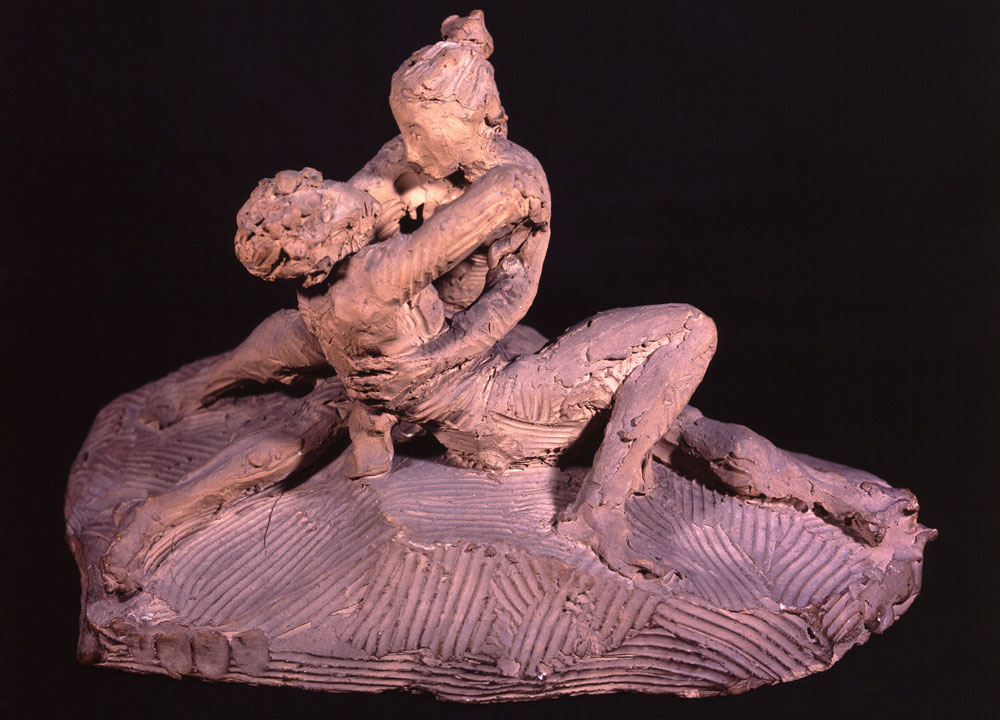
However, looking at the bozzetto above, you realise pretty quickly that this is not the finished composition. It is the female figure – Psyche – who is sitting more upright, and has the male – Cupid – in her arms. Although one of his legs is extended, and the other bent, he is sitting on the ground, rather than kneeling. It is more as if she is caring for him, rather than him waking her up. Indeed, it could be that this predates the drawing – and that, when commissioned to carve a sculpture showing Cupid and Psyche, Canova originally thought of a different episode in their story: this looks more like Cupid swooning – although without the wings. They really would be tricky in clay. It could be that he abandoned his idea, and went back to the drawing board – so the drawing might have come after this terracotta. That aside, it does at least show you what the process of development would be: the creation of a rough, terracotta model of a potential composition. The limbs are built up with small pieces of clay, and modelled by hand, or with a number of different tools. The most obvious here was something like a comb, a toothed spatula, which has been used to scrape the base into its current form. There could easily have been several bozzetti like this. Each would not necessarily have taken too long to make, and, being clay, were relatively cheap. Clay is also extremely malleable, so adjustments can be made as you look, and, working on a small scale, you can turn the model around in your hands and check every angle to see that all possible viewpoints work. In this way you would eventually arrive at a definitive composition. The next stage would be to turn the bozzetto into a stone sculpture.

Having decided on the composition, and how it would work in every detail, Canova would then make a full-scale model in plaster. This one was made for Prince Yusupov’s sculpture – as I said, the sculpture itself is in the Hermitage in St Petersburg. However, the plaster modello has ended up in the collection of the Metropolitan Museum of Art in New York. It might look as if it is not in a terribly good condition – or that the complexions of both Cupid and Psyche have suffered from some terrible skin disease, as it is covered all over in small spots. These are, in fact, metal pins, which have been inserted into the surface of the plaster, and there are more pins where the surfaces are more complex – notably on Cupid’s left hand, just below Psyche’s breast. These are measuring points for the stonemasons. Yes – Canova didn’t carve the marble himself. Don’t feel disappointed – the same is true of many, many sculptors. Rodin did not carve The Kiss, for example, and even Bernini had a helping hand with the leaves on Apollo and Daphne (POTD 56). The stone masons were expert at replicating the precise appearance of the modello, as it was primarily a mechanical exercise. To do this, they used a pointing machine, which measures the height, depth and distance from left to right of each pin that has been inserted, and helps them carve the marble to the same depth at each point. If you’d like to see how it works, there is a good video from the Smithsonian Institute, Carving a Marble Replica using a Pointing Device – other longer videos are available!

However, this process does not complete the work – it is just roughing out the forms – the finish would have been done by Canova himself, and he insisted on doing this in private, so that no one could see his secrets. How, precisely, did he get that wonderful silky finish? That’s where the real skill lay…

I’m including this photograph as a real lesson in looking at sculpture. It is solid, it is three dimensional, and you can move round it. But all too often, with Canova especially, people only bother to look at the ‘front’ – they never get beyond the ‘principal viewpoint’. It was only when I went round the ‘back’ of the Three Graces that I realised what a brilliant artist he was – he has thought about every point of view. There are several clues to that in this photo. It is only from this side that you can see the vase lying behind Psyche that would originally have contained Proserpina’s ‘beauty’ – and lying next to it, to the right, and pointing towards her, is the arrow that Cupid used to wake her. It is only from this angle that you can see his quiver, for that matter, still full of arrows – that crowd is lucky he’s busy at the moment or there could be mayhem. And quite apart from those details, the sculptural mass of the composition, the way the two forms stretch in towards each other, his, taut and leaning down, hers, limp but reaching up, can only be appreciated fully from this side, without the complexity of the interlocking arms and the incidental distractions of their faces. And here’s the real clue: just under her right foot, projecting beyond the base, there is a handle sticking out, and that would originally have been used to turn the sculpture round. OK, so now there is no one to turn the sculpture for you, and you have to make the effort yourself, but do. Walk around, look at every possible viewpoint, get closer and further away. And never worry about going round ‘the back’. You might learn something.

Day 67 – Psyche VII: ‘Celebration!’

Raphael, The Council of the Gods and The Wedding Banquet of Cupid and Psyche, 1518-19, Villa Farnesina, Rome.

Oh dear – I was wondering last week if we were nearing the end of the story of Cupid and Psyche (Picture Of The Day 43, 44, 46, 53, 54, 60), on what has gradually evolved into ‘Psyche Sunday’, and I fear that things are not yet resolved. Mercury had flown down from Olympus, leaving nothing to the imagination, Psyche had been gathered up by him to be taken to meet ‘the family’, and now – well, it’s all over bar the shouting. 

Just a reminder of where we are: in the loggia of the Villa Farnesina, with Raphael’s scheme sadly incomplete, but still entirely enchanting. Last week we talked about the paintings in the pendentives, and today we will look up to the ceiling itself and the two fictive tapestries. Both are ‘hung’ in the pergola, garlanded with fruit and flowers, with the chords tugging at the decorative borders so that their edges are scalloped. They are arranged so that, as we enter the loggia and look up, we see them the right way round – the ‘ground’ in the tapestries is towards the villa. Psyche has been summoned by Jupiter to appear before the gods, but she has not yet been accepted. If I’m right, though, and it’s all over bar the shouting, let’s look at who’s shouting!

One of the things I realised when I wrote my book about the Renaissance was that Raphael was very good at cataloguing. If you want to see all the Greek and Roman philosophers, look at The School of Athens. If you are interested in Christian Theologians you’ll find them on the opposite wall in La Disputa. All of the Sibyls are in his fresco in the Chigi Chapel – yes, same Chigi – in Santa Maria della Pace. And if you want a painting with all of the Olympian gods, then this is it. Well, most of them are here. To be honest, as with most meetings, not everyone is really that involved. At the moment the debate is going on between Venus and Cupid, who are both putting their arguments to Jupiter at the far right of the image. 

The King of the Gods and Goddesses has his right foot up on the globe: we are not so much under his thumb, as ground down under his heel. He sits with elbow on knee and chin on hand, the ultimate gesture of ‘the thinker’, made explicit by Rodin centuries later. With one knee up, foot forward, the other down, foot back, and one mature, muscular shoulder also forward, he could easily be a reconstruction of the Torso Belvedere (POTD 48) – or simply inspired by the prophets and sibyls painted by Michelangelo on the Sistine Ceiling. He has a robe of royal purple wrapped around his legs, with his eagle sitting between them, happily joining in (well, he had helped Psyche with one of the tasks – POTD 53). To our right of him, in blue and yellow, with a peacock behind her in the bottom right-hand corner, is his consort, Juno, Queen of the Gods and Goddesses. On the far right, standing at full height, wearing a feathered helmet which takes her to the full height of the ‘tapestry’, a spear in her left hand which goes out of view, is Minerva, Goddess of War and Wisdom. Her tall, straight figure closes the composition at the right, and she looks down, thus directing our attention to the focus of the debate. Juno does the same, as does a third woman, with a crescent moon in her hair. This is Diana, the Chaste Goddess of the Hunt, and Goddess of the Moon. I’m afraid I’m only going to use the Latin names today – ‘when in Rome’, as they say – and I’m also simplifying their areas of responsibility. These changed over the millennia of Greek and Roman history in a way that is too complex to capture simply. All three are looking down towards Cupid, who, as in previous episodes, is not the chubby baby beloved of many, but the sort of adolescent who is bound to fall in love – what he believes is true love – and the sort of love that he knows adults are bound not to understand. His wings identify him, as he gestures towards Jupiter, trying desperately to tell Jupiter what true love is (as if either would know…). Next to Jupiter is another bearded, mature man who clasps a three-pronged spear, or trident. This is Neptune, the God of the Sea. And besides him a man with a two-pronged spear, or bident – Pluto, God of the Underworld, with Cerberus, the three-headed dog at his feet. It’s a bit like having the head of the UK Government, with the heads of the governments of Scotland and Wales… Jupiter ruled over everything, not just the sky. Imagine if the Head of the UK Government was as much of a philanderer as Jupiter, though, and tried to advise someone on love. I mean, what do you do when someone has broken the rules?

Neptune and Pluto look distrustfully at a topless woman. This is Venus, Goddess of Love and Beauty, here only defined by her nudity. Well, at least she’s covered up a bit. As much as the men have, anyway. The other three women present are entirely decently clad, though – you can’t be inappropriately clad in Council. Or use the wrong tone. Venus points a finger of blame at Cupid, and tries the ‘innocent eyes’ trick with Jupiter. But will it succeed?

Behind Venus, and keeping an eye on her (well, they’d had an affair) is Mars, God of War, in his armour. His shield rests on the floor, in between him and Apollo, God of the Sun and inspirer of the muses, who has clearly spent a lot of time at the gym, and just as much time tending to his long blonde hair. His left hand rests on what is probably meant to represent his lyre. He points to Venus – or maybe to Mars – while looking to our left. Raphael does this to move our attention along the composition, but Apollo is clearly telling somebody something. He is either conveying the latest developments in the debate, or simply gossiping about Mars’ and Venus’ affair. Next to him is another blonde ephebe. This is a Greek word for a young man in military training, usually about 18-20 years old, although it comes to stand for ‘young man’, or ‘youth’, or, for that matter, ‘pretty boy’. He has vine leaves and grapes in his hair, which indentifies him as Bacchus, God of Wine. However, Raphael does this for ease of identification, as traditionally Bacchus would have ivy in his hair. Titian gets that right! To our left of Bacchus is another mature man with grey hair and beard, huge muscles and a large club. He could, just like Jupiter, be a reconstruction of the Torso Belvedere. And like Jupiter he rests his chin on his hand. Well, like father like son, I suppose – this is Hercules, Jupiter’s favourite illegitimate son, although he seems strangely old to be the latest arrival in Olympus. To the left of him, dressed in what could be workman’s clothing, with a big pair of tongs over his shoulder, is Vulcan, the God of Fire, who worked in the forge making all the armour and weaponry. There are also two River Gods lounging on the ground – that’s what they do – and the one on the right has his arm over a lion. I can’t for the life of me think which river he represents. There used to be a sculpture of the River Tigris in Rome, which had a tiger, but that got re-carved to look like a she-wolf, thus re-purposing it to represent the Tiber. Raphael could have been thinking of that. A century or more later, Bernini would use a lion as a symbol of the Nile, but this is not the Nile.

The River God on the left is leaning on a sphinx – so that must be the Nile. To the left of Vulcan we see Janus, God of doorways and boundaries, looking back to the past (the old face on the right) and forward to the future (the young face on the left) – and the future is Psyche. Mercury, in his winged helmet, has just arrived with her, and hands her a welcoming drink. In the other hand he holds his caduceus – his staff of office. There are all sorts of tales about this, but it basically identifies him as the Messenger of the Gods. He carries it in the same way that Gabriel used to carry a messenger’s staff, until that got swapped for a lily (but I don’t think I’ve mentioned that yet). He would use it to part the clouds, when flying on a mission, and once, when he saw two serpents fighting, he ‘zapped’ them with it, and they curled up around it and died… Meanwhile, an amoretto clings to Psyche’s legs. That’s not Cupid, remember, he’s at the other end of the fresco. Or ‘tapestry’, rather.  What does she get to drink? It is ambrosia, the food of the Gods (whatever happened to rice pudding, by the way?) The fact is, while we have been looking at them all and chatting away amongst ourselves, they have been discussing her, trying to calm down the disagreement between Venus and Cupid, and generally trying to placate Venus, which was never easy. However, despite what seemed like insurmountable difficulties they have decided that Psyche can stay! So she gets to drink ambrosia, and to be immortal. There’s nothing left but to celebrate.

And it is the wedding feast that we see in the ‘tapestry’ on the left – the same gods, although not as easy to identify: tridents and bidents have been left at the door it seems – although not clubs – and war has been banished (so no Mars). But there are a few additions. Some of them are seated at the banqueting table, as wine is poured and garlands are brought, while on the left, others have already broken away to the ‘mingling’ phase of the party.

Cupid and Psyche are seated at the far right of the image, still very much in love and peering into each others eyes, while the Three Graces appear at the top right to anoint them, thus auguring their future success and happiness. Jupiter is next to them, dutifully ensconced with his wife Juno who is holding on to him firmly – although, as she looks away he accepts a drink from Ganymede, his cupbearer. Well, that’s one word for it, I suppose, but that’s another story. But this is the banquet – what about the marriage itself? Well that was painted by Giulio Romano in the centre of the ceiling of the Sala di Psiche in the Palazzo Te in Mantua (POTD 42). The most extreme version of da sotto in su I know, we look right up past them, their whole bodies foreshortened, as they stand on clouds above our heads, surrounded by all the Gods. They reach across the space between them and hold hands, with Mars and Mercury flanking Cupid – you can see right up Mercury’s skirt. Way up in the sky Jupiter is holding a thunderbolt, and next to him is Juno, who is also, somewhat ironically, the Goddess of Marriage and Childbirth. She raises her hands in blessing, and they were indeed blessed: in due time Psyche gave birth to a daughter, called Pleasure. The shouting is over: Psyche, representing the head, and Cupid, the heart, are now safely together, and when your head and your heart are in the same place and want the same things, then you can be sure you will live happily ever after. 

Day 66 – Joachim and Anna

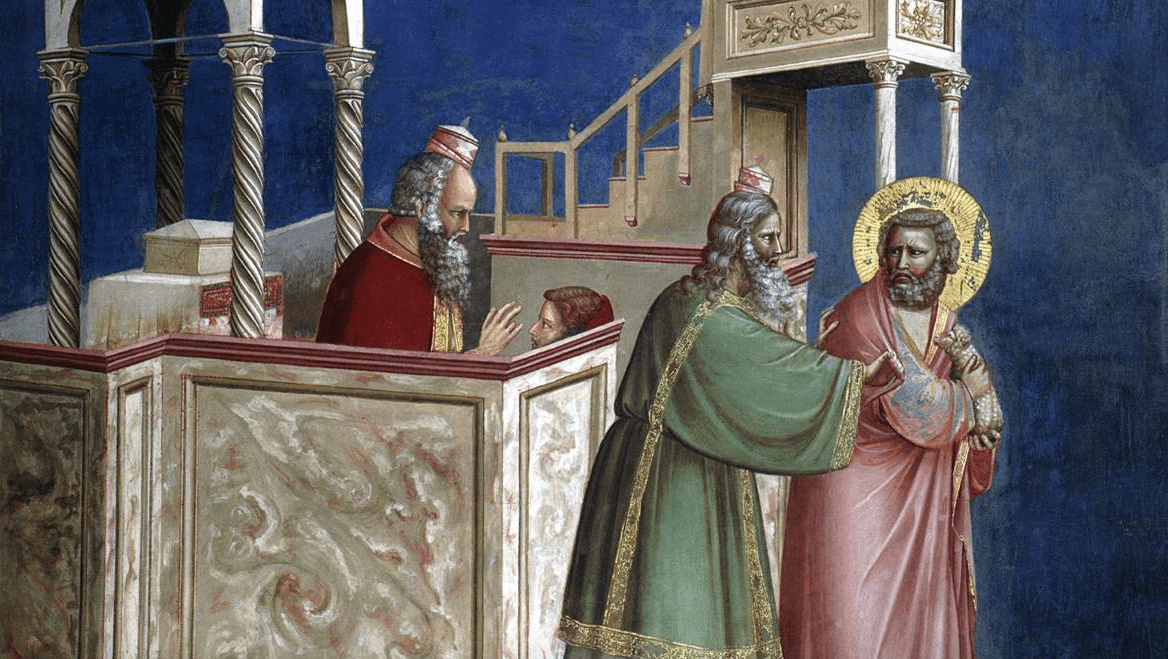
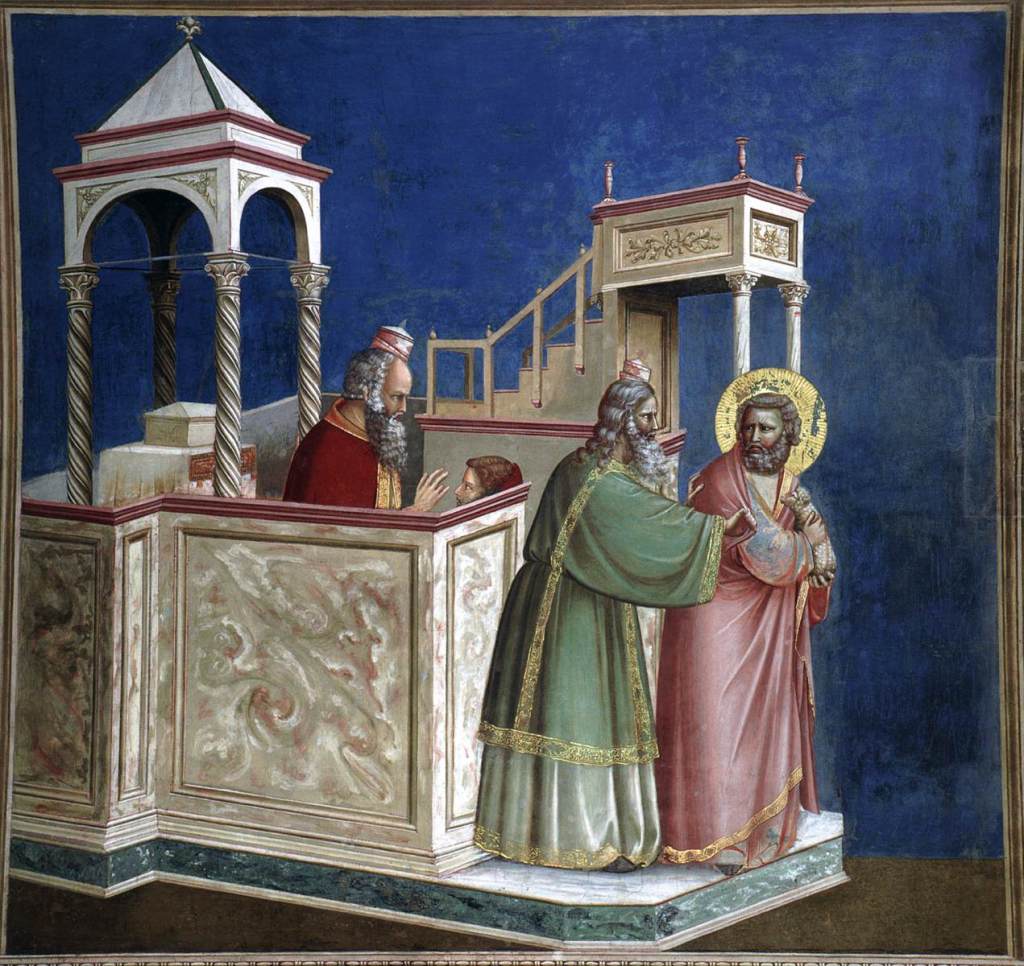
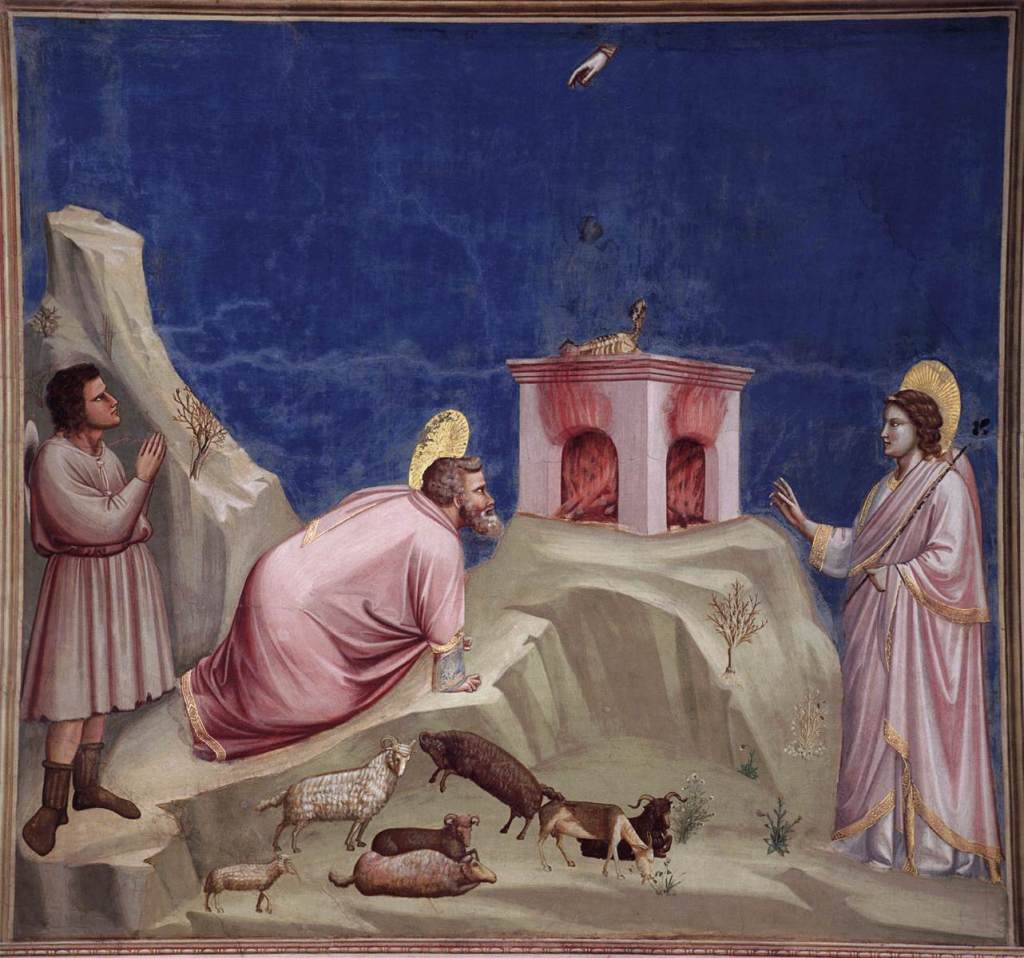
Giotto, The Story of Joachim and Anna, c. 1305, Scrovegni Chapel, Padua.

Time to get going with the stories! From the past few weeks we know, when looking down the chapel towards the altar, that the Last Judgement (Picture Of The Day 38) is behind us, with the Virtues at the bottom of the walls on our right (POTD 45 & 59), while the Vices are opposite them on our left (POTD 52 & 59). 

Well, the story starts at the far end of the top tier of the right-hand wall as we look towards the altar. As we mentioned last week there are windows on the right but not the left (that is where the Scrovegni Palace used to be), but they don’t reach to the top of the walls – which means there is more space for the narrative. There are six scenes at the top level (you can only see four in this photo), although we’ll only have time for the first five this week. The story progresses in an anti-clockwise direction – from left to right – and all movement in the paintings moves from left to right too. We start with the story of Joachim and Anna, who will become the parents of the Virgin Mary – although at this point, they have no idea what’s coming.

Indeed, the story starts with childlessness and rejection. It may be obvious to us that Joachim is holy, given his big golden halo, but he is turned away from the Temple because, as an elderly man with no child, he must be cursed by God. When looking at the fresco in situ, the painted temple would be seen in relation to the altar of the Chapel itself, as it faces the same direction. Both are to our left, when looking directly at the wall, which is on the right in the photo above. The Temple acts as a closure to everything that went before. Joachim can only leave. He may look over his shoulder, but his body is already facing right. Indeed, he is already at the right-hand side of the picture: the story has already begun. He doesn’t have far to go, but then, he cannot go far, he doesn’t have the energy. He just steps through to the next scene, out into the countryside, with two sceptical shepherds and their flock of indifferent sheep. He couldn’t face going home. He wraps his hands in his cloak and looks down in shame, although he is still facing towards the right. The rocks form a plateau behind his head, which connects him to the shepherds, even if there is a gap between them. The high rock seems to close off the painting to the right, as if there is no way out. The sheepcote itself is a dead end – and is a reflection of the screen around the Holy of Holies in the Temple: the sheepcote’s door is opposite the gap in the screen. The rock on the right is also a reflection of the tabernacle, which closes the left-hand side of the first picture. In both, the animals are eloquent.

In the first, Joachim clasps the sacrificial lamb he has taken with him, cuddling it more like a pet, or a comfort blanket. Like him, it is rejected, although if it knew, it would probably be far happier about the fact. Joachim’s face wrinkles with betrayal and incomprehension, while the priest frowns, pushing Joachim’s back, pulling at the hem of his cloak: he didn’t want to have to do this, but he had hoped it would be easier. He’s been at the job a long time, and has a longer, greyer beard than Joachim’s – it’s quite soft by the look of it. There are white lines along the folds of his green sleeve, suggesting that it has faded with service.

The only sign of hope as Joachim seeks solace in the open air is the sheep dog, who approaches him, looking up with concern, and lifting a paw in an act of consolation. The sheep remain unmoved.

Meanwhile, Anna is at home, kneeling in prayer, facing to the right. She too is holy – and it is fascinating to see that Giotto has started to think of a halo as a solid object, a three-dimensional form which looks different from different angles. In other places in the chapel it is simply a flat disk, gilded to reflect the natural light and represent the glow of sanctity. He’s good at the observation of everyday life though, Giotto: look at the bench by the bed, and the chest under the window – not to mention the curtain hanging from the rail above the bed – so he must have stopped to think how he would observe a halo if he could, or for that matter, an angel flying through a window. It’s a master class in foreshortening. 

This is an annunciation – though not the Annunciation – as the angel has come to tell Anna that she will have a daughter. Oh the irony: as yet, she doesn’t know that their childlessness is the very reason that Joachim has not come home. Anyway, it must have been something of a surprise. Looking at the wrinkles on her face she was – as Zacharias would later say of his wife Elizabeth when the birth of their son John the Baptist was announced – ‘well stricken in years’. However, they clearly have a comfortable life, living in a fine house with a pediment, and able to afford a rich red robe with gold decoration, and even a servant, spinning on the patio in far plainer clothes.

Joachim settles on a course of action. If he is cursed by God, God must be appeased – and so he sacrifices a lamb (possibly the same one we saw earlier) on an open air altar.  The shepherd on the left is dressed in earth tones, like the background, with the downward swoop of the rocks drawing our attention to Joachim, who kneels (facing to the right) on an upward sloping rock. He is in pink – as is the angel on the right and the altar in between them – the colour creates a relationship between them, their mutual gaze full of tension. They form a pyramid with a hand that appears from Heaven – it is God: Joachim’s sacrifice has been accepted, and the angel has come to tell him so. Given the relief, he can now sleep. And as there is no movement in sleep, he doesn’t need to face to the right – although the angel does: it is the angel who is moving the story forward. The curves of the angel’s materialising body and outstretched arm are echoed in the rocks below. Joachim sleeps outside the sheepcote that we saw in the second image, with the same rock behind: Giotto always has a very secure sense of place. The other rocks may look different, but then, the dynamic of the scene is different too. Two shepherds look on as the angel flies in to greet Joachim while he sleeps – he is dreaming, and the angel tells him to meet his wife by the Golden Gate. But will he go? Well, I’ll have to talk about the Immaculate Conception first, and that may take some time – so we’ll find out next week. But just in case you were wondering if all this is all that remarkable – well, so far this week there has been some good and straightforward story telling. The further into the story you get, though, the more complex are the relationships between the paintings. And we’ve only just begun!

Day 65 – Venice

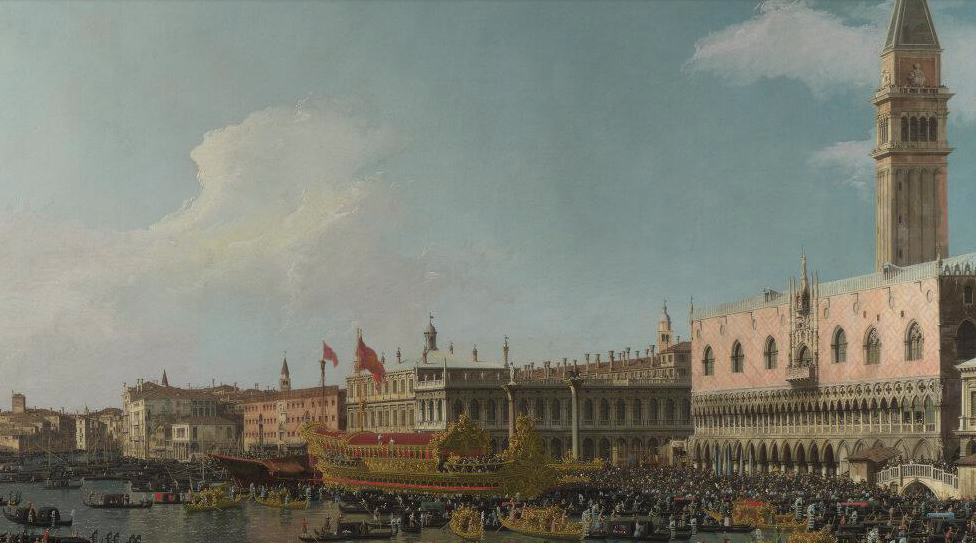
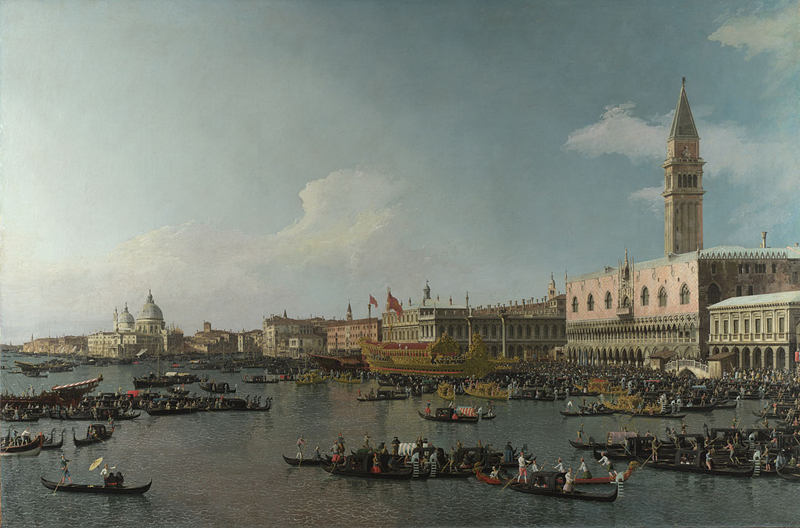
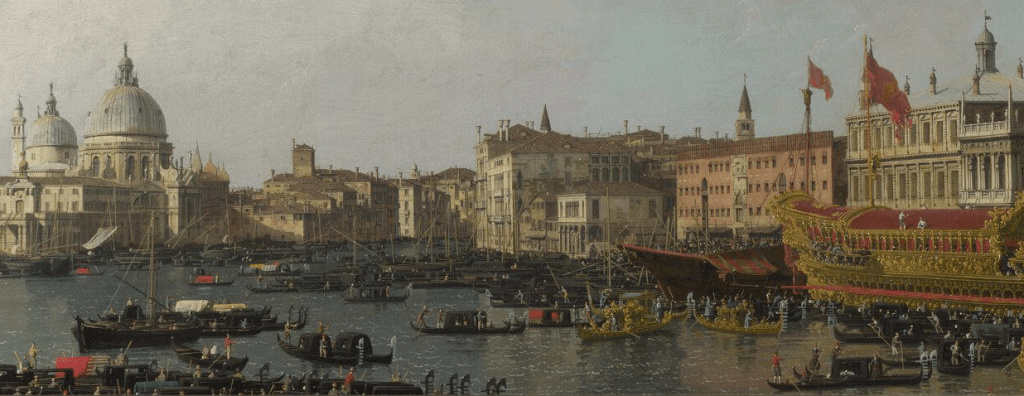
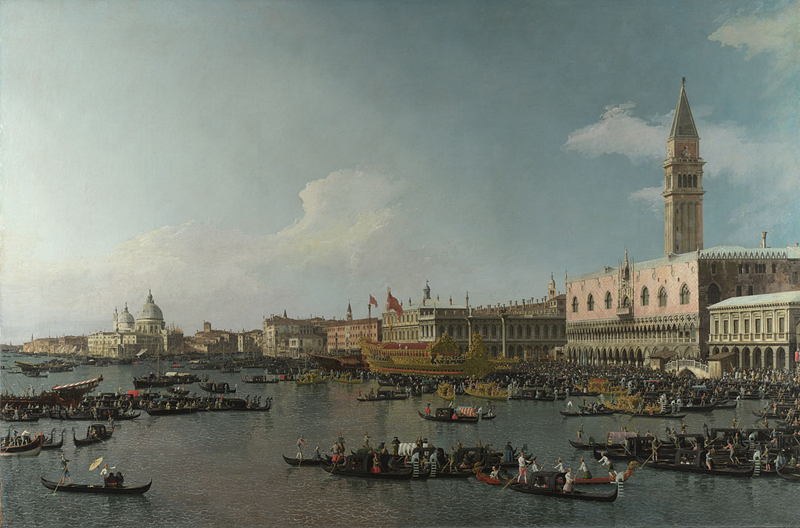
Canaletto, Venice: The Basin of San Marco on Ascension Day, about 1740, National Gallery, London.

Yesterday was Ascension Day, and in Venice that always used to be one of the great days of the year. The celebration, known in the Venetian dialect as the Festa della Sensa, was associated with two historical events. On 9 May in the year 1000 the Venetians defeated the Slavic pirates who were threatening the Dalmatian coast, thus allowing the Venetians to begin their domination of the Adriatic Sea. The second took place in 1177, when the Doge welcomed both Pope and Holy Roman Emperor, who signed a treaty ending years of dispute between the two powers. In gratitude the Pope gave the Doge a ring he had blessed as a reward, a sign of Venice’s dominion over the sea. This was commemorated every year during the Festa della Sensa, which was also known as the Sposalizio del Mare – or ‘Marriage of the Sea’. The Doge was rowed out into the Venetian lagoon, where he threw a ring overboard, symbolically marrying the sea to La Serenissima – ‘The Most Serene Republic’, as Venice was known. The two were interdependent – Venice relied on the sea for its defence, for its trade, for its food, and the sea needed Venice… well… to defend it from everyone else, I suppose. I’m not sure that anyone had actually ever asked the sea if it wanted to marry Venice, but given that the relationship contained within it the age-old assumption that marriage is equivalent to domination, it seems unlikely.  All that aside, this is what the Festa looked like around the year 1740.

Canaletto, Venice: The Basin of San Marco on Ascension Day, about 1740 https://www.nationalgallery.org.uk/paintings/NG4453

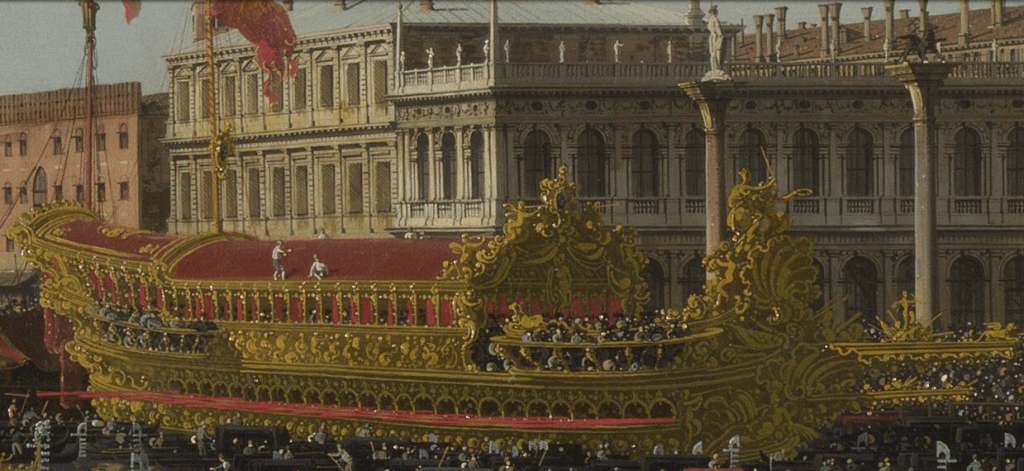
This is surely Venice as we see it now – or, at least, Canaletto’s great skill was always to capture Venice in a way that makes us think that this is how we see it now, although, in all probability, it never looked quite like this even when he painted it. But the wonderful thing is, most of these buildings are still there, and still look the same. Even the campanile, or bell tower, of San Marco looks the same, and that fell down at the beginning of the 20th Century. They rebuilt it, though, as a replica of the original. During the ceremony, the Doge would leave his palace on foot, and walk the relatively short distance to the Molo, or quay. He would progress to the State Barge, or Bucintoro, which is that great, gold galleon next to the quay in the middle of the painting. OK, I know it’s not a galleon, but I like alliteration (you might have noticed). When Enobarbus described Cleopatra’s vessel, he could have been describing the Bucintoro:

The barge she sat in, like a burnish'd throne, 
Burned on the water: the poop was beaten gold…

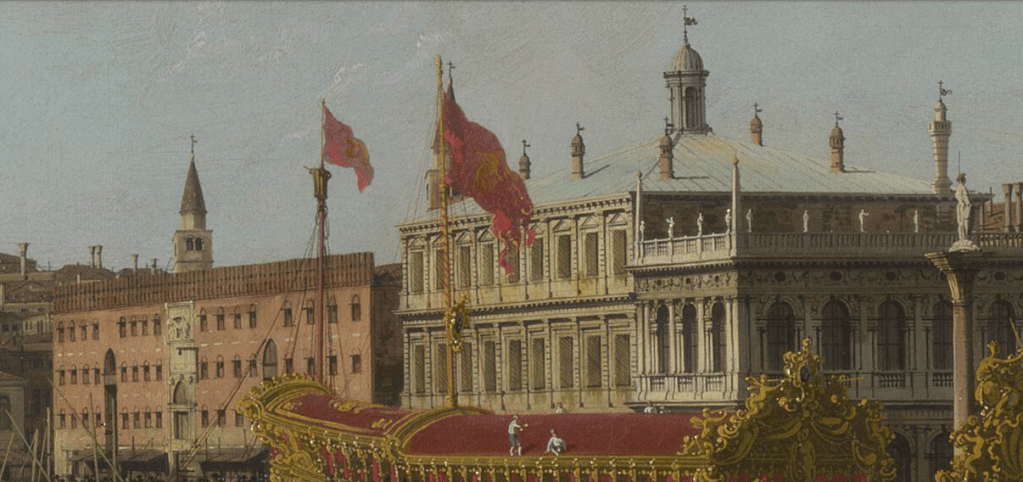
Nobody is entirely clear where the name bucintoro  (the ‘c’ is pronounced as in ‘butcher’) comes from, but a burcio was a traditional vessel used on the Venetian lagoon, and oro means gold. It could have been that. the English translation is ‘Bucentaur’, but I’ve never known it used in print. Canaletto paints the bucintoro with the dazzling shorthand of his mature style, using two tones of ochre, a darker one for the ground, and a lighter for the carved decoration – which is elaborate: there are figures all the way along. Towards the prow there are angels blowing trumpets, and, atop a vast shell, two figures carry a sword and a wreath, both in some way representing Venice: the figure with the sword is almost certainly Justice, one of the chief virtues Venice claimed. Remembering that Portia’s speech starting ‘the quality of Mercy is not strained’ occurs in a courtroom in Venice, I do wonder if Shakespeare ever got there… it has been suggested. To get to the bucintoro the Doge would have passed between the two columns which are visible behind the prow, the one on the right topped with the winged lion of St Mark, since 829 the main patron saint of Venice, and that on the left the earlier patron, that saint who killed a dragon, what was his name? Oh yes! Of course, St Theodore. And if you’ve never heard of St Theodore, you aren’t the only one. The theory is they sent people off to Alexandria to bring back the remains of St Mark, because a better-known saint would bring in more pilgrims. For which, read tourists. It seems to have worked. Behind the barge is the Biblioteca Marciana – the library of St Mark’s – and to the left of that, slightly set back, but also built out of stone, the Mint.

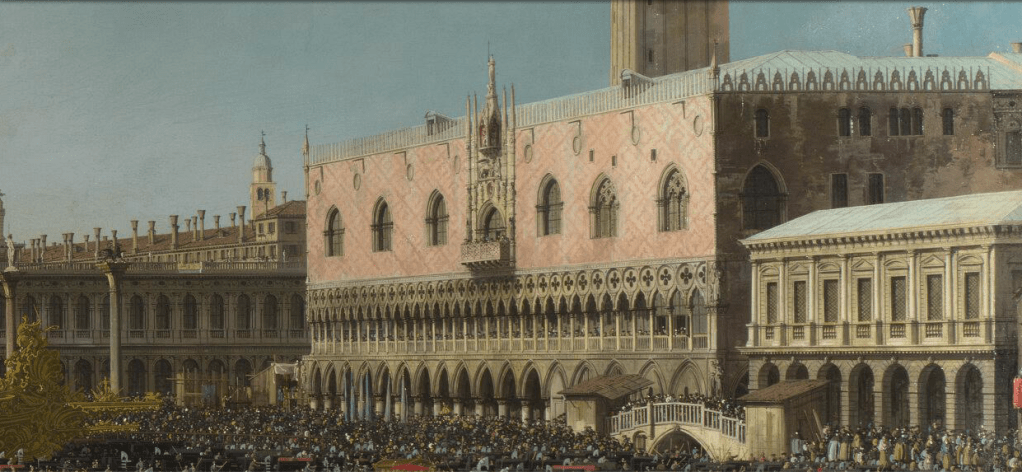
The Doge’s Palace is, of course, one of the most famous buildings in Venice. It started life as a defensive castle more or less at the mouth of the Grand Canal, its chapel dedicated to St Mark. The present façade dates to the 15thCentury. The arcade at the bottom is called the broglio, and you might hang around there to chat to your friends, or even to plot. If you did, in the broglio, that would be an imbroglio – one the many words we owe to Venice. The bridge on the right crosses the little canal, or rio, which goes under the Bridge of Sighs – people sighing because it leads to the prison, the plain, bulky, and impenetrable building on the far right of the painting. And to the left of the Palace, just next to the far end of the broglio, you can just see the temporary wooden structure erected for spectators eager to see the Doge leaving the Palace (the door is around the corner there, opposite the base of the campanile) and heading to the Bucintoro.

On the far right of this detail is the column topped by the statue of St Theodore. Just above him and to the left is a rather large chimney: that is the chimney of the Mint, where the furnace would melt the metal for the coin of the republic to be struck. The Italian word for Mint is ‘Zecca’, a word which comes from the Arabic ‘sicca’, meaning the die used to strike a coin, or even the coin itself. Being on the sea, the trade with ‘the East’ was always hugely important for Venice, and much of their dialect – and, for that matter, Italian as a whole – reflects this. They made some very small coins there, and, as you may know from tortellini, Italian diminutives use the ending ‘-ino’. So a very small coin, from the Zecca, was called a Zecchino – which is where we get the word ‘sequin’. Beyond the Mint is a red brick building which, however many times you have been to Venice, you will not remember. It is the grain store, and you won’t remember it because it spoilt Napoleon’s view from the apartments on St Mark’s Square across the lagoon – so he had it knocked down. There is now a fairly non-descript garden in its place. For now, let us leave it there, and imagine what it would be like to approach Venice from the sea. The first building you would pick out would inevitably be the Doge’s Palace, its grand, imposing bulk getting more solid the further up it goes, almost as if it was itself floating on the waves. It is the source of power. To the right is the prison – so if you, as a visitor, do wrong, that is where you would end up. Would that be true Justice – which was, as we’ve said, one of Venice’s favourite Virtues? Well, yes, because on the other side of the Palace is the Library – so the Justice of the ruling class is based on the knowledge held in the Library. Next to that, is the Mint – they are a wealthy state – and then the grain store – they are also a well-fed state. And not only that, they are watched over by St Mark, who rests just behind the Palace in the Basilica which developed from the small castle chapel. So as you approach you see a powerful, just, and knowledgeable state, wealthy, well-fed, and strong, ready to punish any threat to its stability. You’d be on your guard when you stepped off your boat.

Just to the left of the mouth of the Grand Canal we see the wonderful Church of Santa Maria della Salute – St Mary of Good Health – built at the request of a grateful public to thank the Virgin Mary for saving them from the plague of 1630-31. However it took 50 years to build, partly because in the 17th Century, Venice was not especially wealthy. Its heyday had long gone, starting with the Fall of Constantinople, over which it had had a tight hold, in 1453. By the 16th Century the Portuguese had the most important trade routes, only to be pipped at the post by the Spanish. By the 17th Century it was the Dutch, and the British in the 18th… By the time this view was painted Venice had no real trade, but, as it was a merchant city to its very core, it had to sell. 

Canaletto, Venice: The Basin of San Marco on Ascension Day, about 1740 https://www.nationalgallery.org.uk/paintings/NG4453

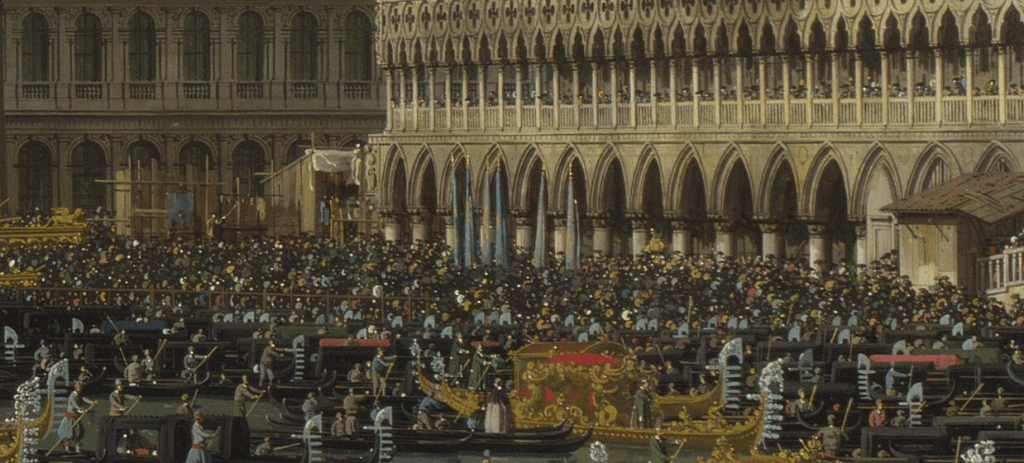
So it sold itself. And the great ceremonies which had held society together for centuries became the great tourist attractions, and Canaletto painted them for the Grand Tourists to take back home with them. There are more views of Venice by Canaletto in one room of the National Gallery in London than you will find in all of the public collections in Venice put together. He even painted the tourists themselves – look at the boat in the bottom left: just under the yellow parasol a tour guide is pointing out the main features of the city to his attentive clients. That could have been me! And if you think tourism is bad now (well, not just now, of course) then look at this.

All across the pavements of the Molo, and in the arcade above the broglio – every dot a different face, every dash another hat. I love this detail: if you were to get in even closer, you would think it was the work of an abstract artist of the 1950s – it has both a wonderful sense of freedom, and an unnerving precision. And if you think tourists are bad now – well – back then they had no fear.

Day 64 – Ascension

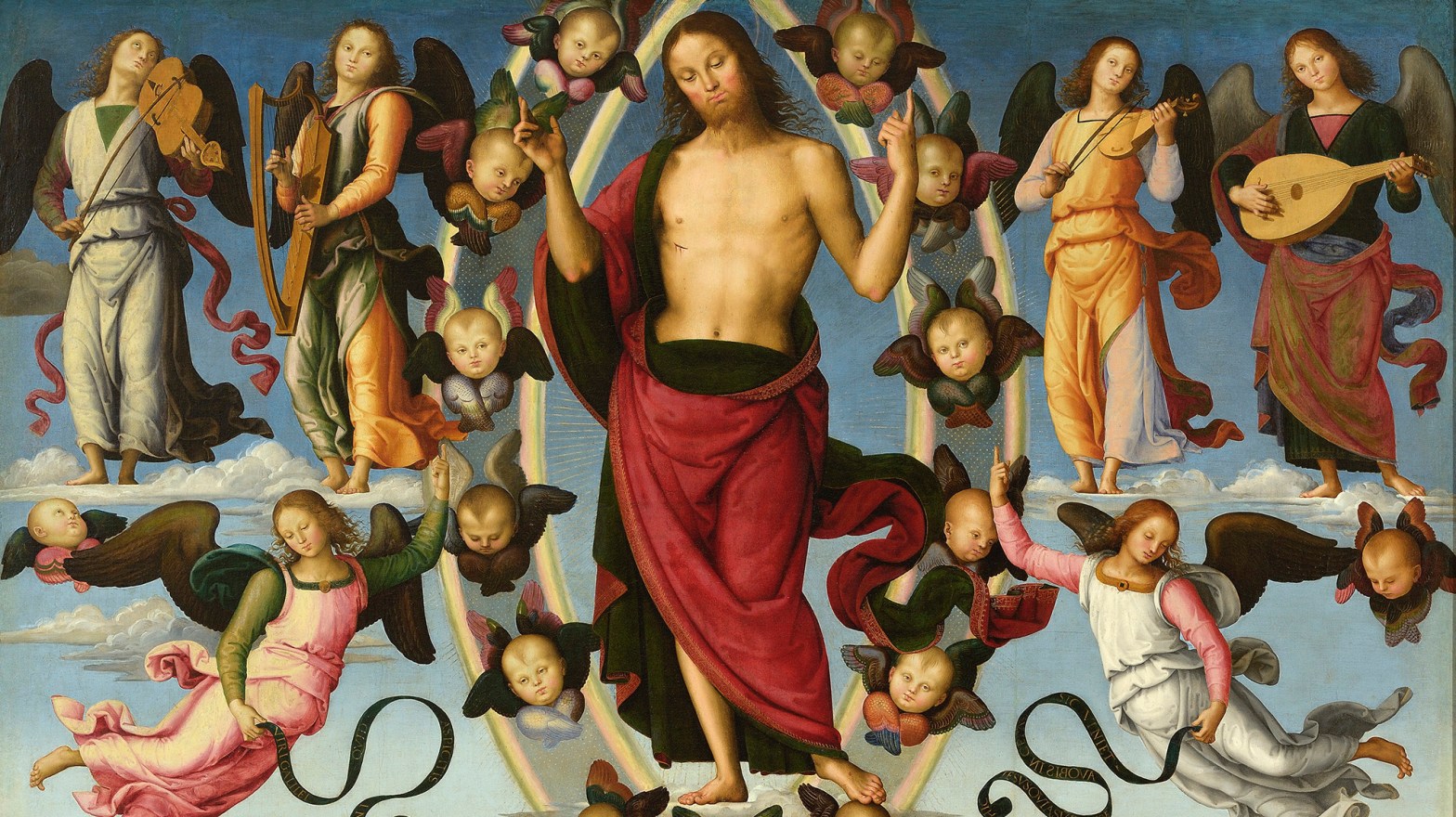
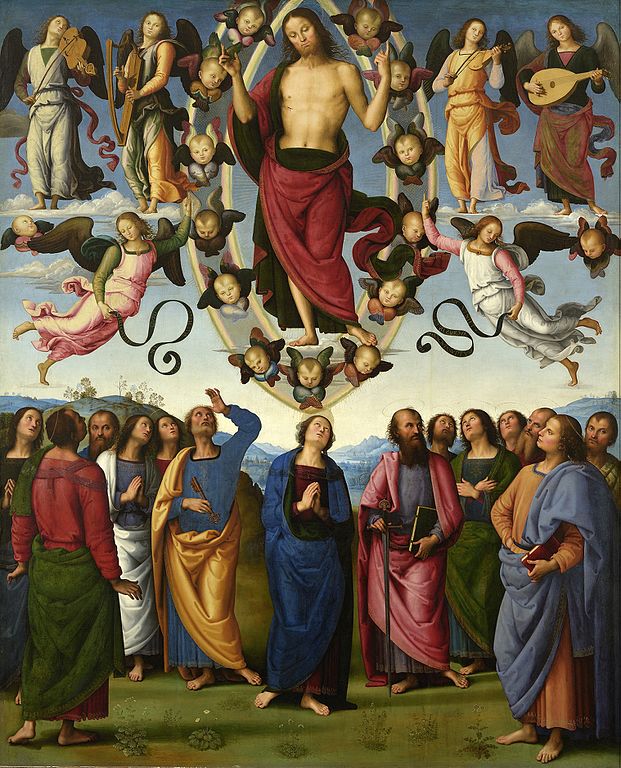
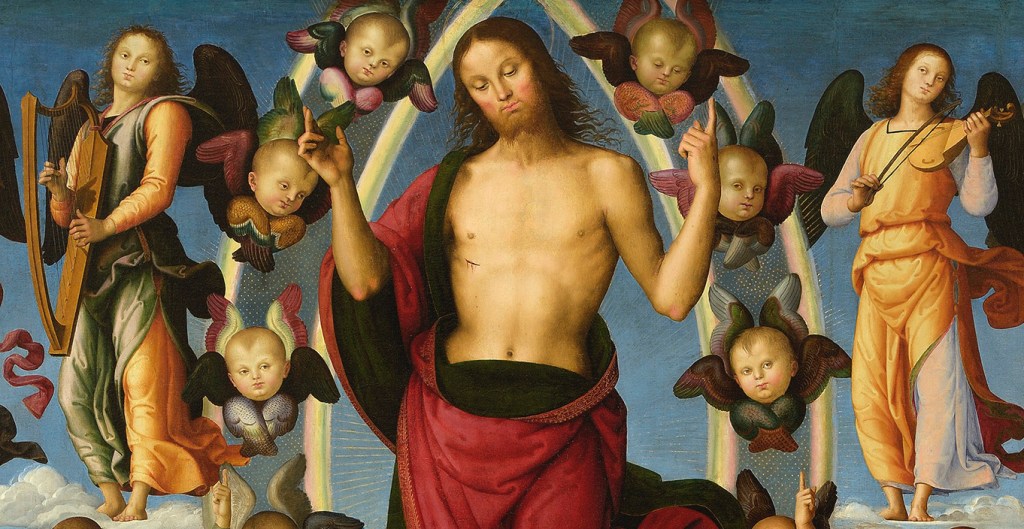
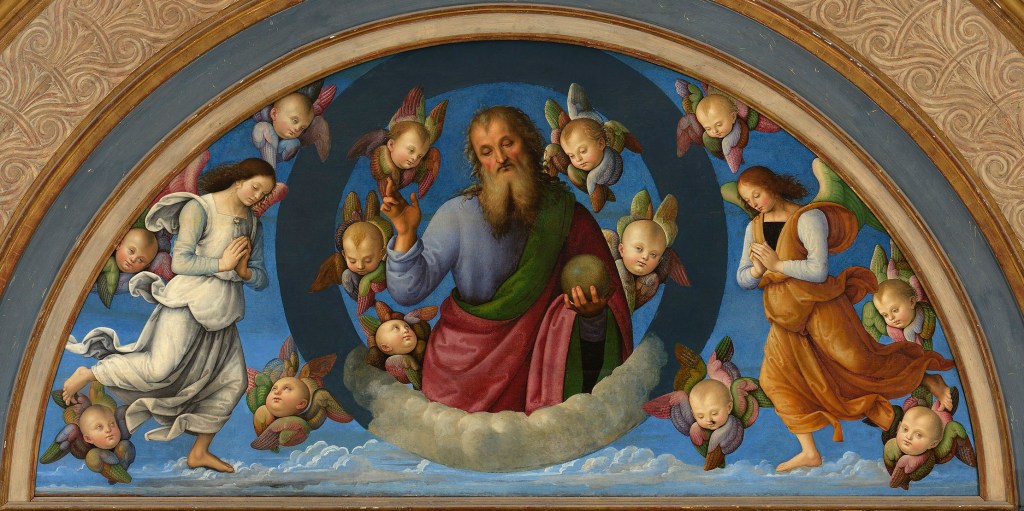
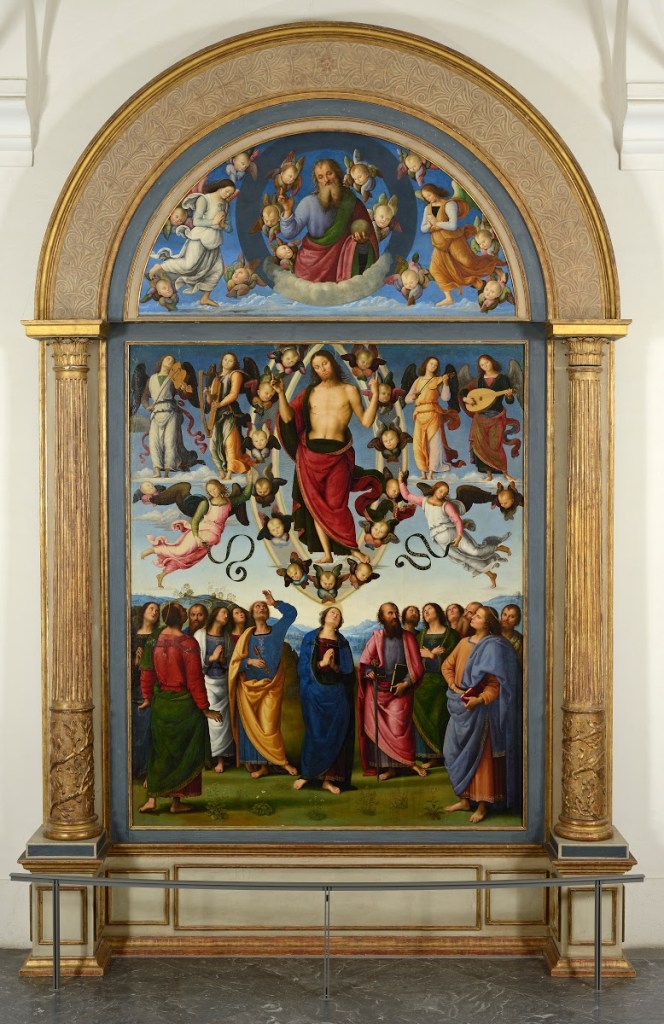
Pietro Perugino, The Ascension of Christ, 1495-98, Musée des beaux-arts, Lyon.

Today is the Feast of the Ascension, forty days after Easter, when Jesus went up into Heaven – Jesus himself makes three references to it, before it has happened, in the Gospel of St John, and it is described in both the Gospel of St Luke and the Acts of the Apostles. This is what is says in Luke 24, verses 50-51:

And he led them out as far as to Bethany, and he lifted up his hands, and blessed them. And it came to pass, while he blessed them, he was parted from them, and carried up into heaven.

When Pietro Perugino came to paint this event for the Benedictine monks of San Pietro, just outside the walls of Perugia, he chose to show Jesus doing just as Luke says, still in the act of lifting up his hands and blessing them. But he also chose to paint fourteen people standing on the ground, which intrigues me. Luke does not say how many people were there, although the Ascension follows on, with a few intervening episodes, from the Supper at Emmaus (Picture Of The Day 30), after which the two pilgrims went and found ‘the eleven gathered together, and them that were with them’.  That was, theoretically, forty days before the Ascension, according to the Acts of the Apostles, which likewise does not specify who was there, but the ‘eleven’ mentioned by Luke were the remaining apostles, given that Judas had committed suicide. So how come there are fourteen here? Are the other three ‘them that were with them’?

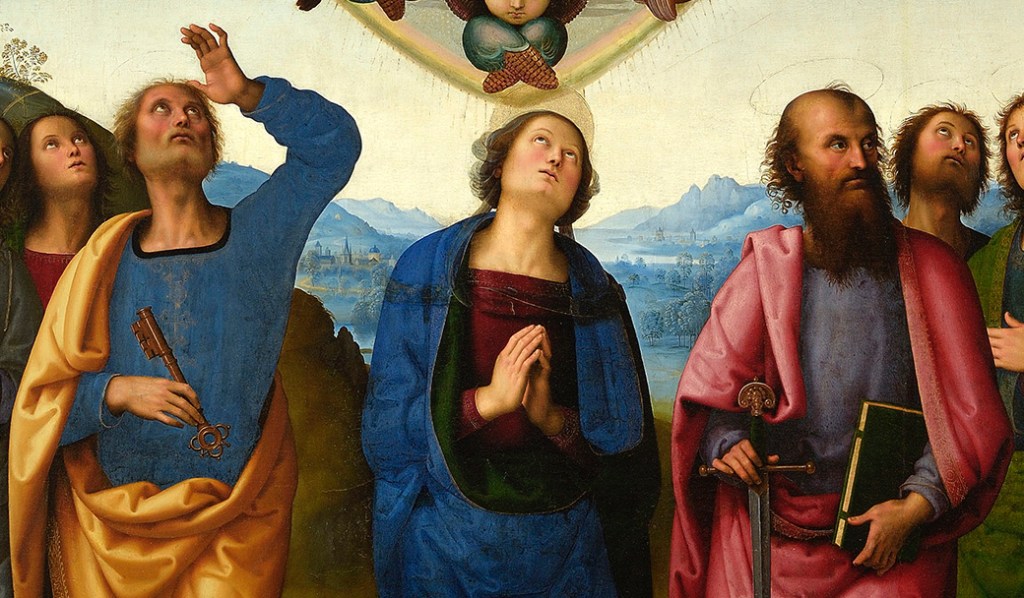
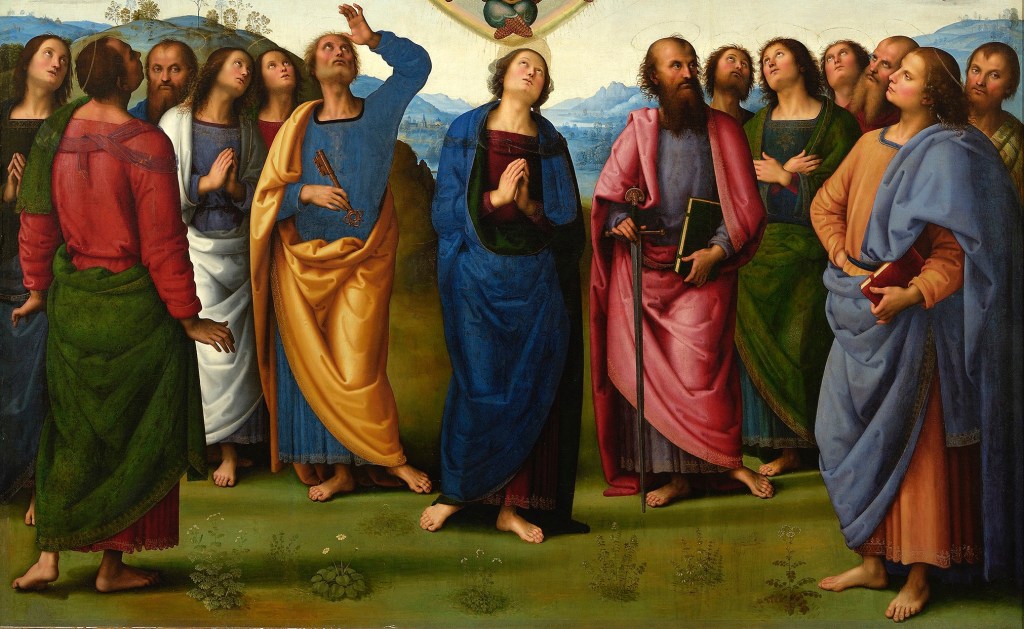
The central figure is, of course, the Virgin Mary. There is nothing in the Bible to say that she was there – but then, there is no reason to suppose that she wouldn’t be, and it became a standard part of the iconography of the Ascension (i.e. the way that it is depicted) to include her. And, being Mary, she must be in the middle. She looks up towards her son, although she is awkwardly placed to do so, as her halo appears to be in front of the mandorla (the almond-shaped glory – see POTD 42) within which Christ stands. The Apostles have given her space, making her more prominent, and her head stands out clearly against the pale sky behind her. Perugino has painted a typical Umbrian bowl landscape (an idea he would pass on to Raphael – see POTD 23), with the horizon level to the right and left, and curving down in the centre, just like a bowl: it frames Mary’s head perfectly. The detail of this landscape is enchanting. Delicately picked out to the left of the Virgin’s right shoulder is a small town with turrets, towers and a domed church, and there is another chapel on a distant hill.  Standing next to Mary, to our left, we see a man in yellow and blue, with short grey hair and beard, holding a key – this is St Peter, in his typical colours, and he is holding the key to the kingdom of Heaven. To our right of Mary, with a long dark beard and receding hairline, wearing a red cloak and holding a sword, is St Paul. That is, figuratively, a two-edged sword – it represents both his persecution of the Christians as Saul, and also, his own martyrdom by beheading. The only problem with St Paul being there is that the Ascension happened in Acts chapter 1, whereas Saul was not converted until chapter 9 – so he shouldn’t be there yet. The painting is clearly a ‘statement’, rather than a narrative, and shows us the status he would later have as one of the two leaders of the Church after Christ.

The formal, symmetrical arrangement – with everyone facing front – is a clue to that. None of them are really in a good position to see Jesus, and only two have shifted to get a better view. On the left, an apostle in red and green has his back to us, and looks up at Jesus: he is a repoussoir, and is there to make us look into the picture, and up to Jesus. On our right, the man in yellow and blue closes off the composition, and redirects our attention back into the painting. In case we weren’t feeling entirely present, two of the apostles are looking out at us, just to make sure that we are paying attention (they are examples of Alberti’s ‘chorus’ figure – POTD 32). But even with the unwarranted – but symbolic – addition of Paul, and the understandable inclusion of Mary, there is still one person too many. The last must be St Matthias, appointed to replace Judas – but even that shouldn’t work, as he wasn’t chosen until the end of Chapter 1, and the Ascension is towards the beginning. This just goes to confirm the suggestion that this painting is not a simple ‘narrative’, but a theological statement about the implications of the Ascension, in which the presence of the apostles, with the addition of Mary and Paul, is vital. It basically represents Jesus saying  ‘now over to you’. The monastery for which this was painted was dedicated to St Peter, who has precedent among the other figures here, as he does in Giotto’s Last Judgement (POTD 38), given that he stands at the right hand of God – or, as Jesus has now ‘gone up’, at the right hand of the Mother of God. As all popes claim their authority from Jesus’ charge to Peter – ‘And I will give unto thee the keys of the kingdom of heaven’ – the painting is an essential statement about the nature of the papacy and, if we include the apostles, the priesthood. Basically, this painting represents the beginning of ‘The Church’.

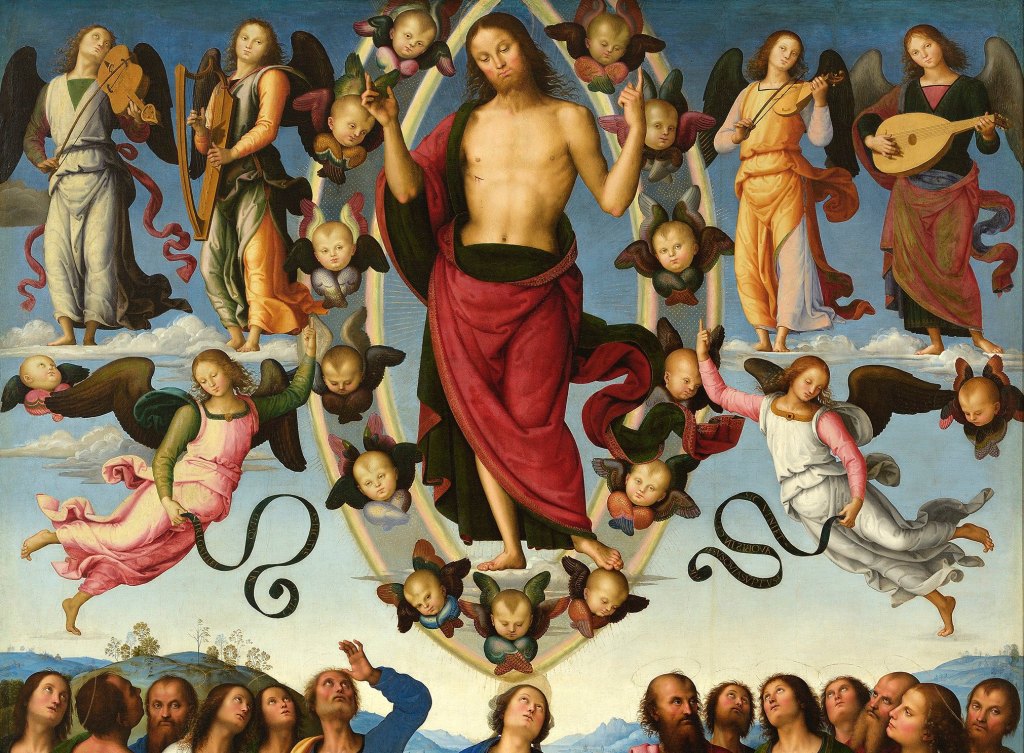
The upward gazes of the people on the ground are essential, as otherwise there is nothing to connect them with everything in the sky. Mary’s halo may overlap the mandorla, and her head might be in front of the sky – but the men have their feet firmly on the ground, and their heads are in front of the distant hills. Only Peter’s arm reaches up, otherwise Earth and Heaven are separate. Even the lowest angels have their feet poised delicately on tiny clouds some way above the horizon – they then lean precipitously far forward, looking down to the onlookers and pointing up. How do you communicate a sense of movement in something so balanced and orderly? You point. Their gestures tell us to look up to Jesus, and also that Jesus himself is heading upwards. If we didn’t get the hint, then we can read their scrolls, waving like ribbons, both of which carry inscriptions relating to the Ascension. Or we could, if we had the time…

Four angels at the top of the painting stand on slightly more substantial clouds, playing music to accompany Christ’s departure. He stands within the mandorla, his right foot planted firmly on a cloud, and his left resting delicately, if slightly comically, on the head of a cherub, his big toe curving comfortably round its scalp. He wears the most striking red robe – this is hardly the shroud-cum-toga we have seen before (e.g. POTD 24 & 25), although it does remind me of the surprising red loincloth in Raphael’s Mond Crucifixion (POTD 23). Maybe it was an Umbrian thing, but it certainly refers to the Byzantine use of the Imperial purple – Jesus is King, after all.

Perugino is never given enough credit. Look at the angel on our left, playing the harp. The foreshortening on that harp is breathtaking. And look at the shadow of his plucking hand on the wooden frame. He was very good. The mandorla, too, is beautifully constructed, and seems to be made of concentric rainbows. The colours are not in the right order, and green seems to predominate, but notice how the colours are reversed – this is exactly what happens with a double rainbow – I feel sure that Perugino must have seen one. But why a rainbow? I suspect it might be something to do with the account of the Ascension in the Acts of the Apostles. This is Acts 1:9-11:

…while they beheld, he was taken up; and a cloud received him out of their sight. And while they looked stedfastly toward heaven as he went up, behold, two men stood by them in white apparel; Which also said, Ye men of Galilee, why stand ye gazing up into heaven? this same Jesus, which is taken up from you into heaven, shall so come in like manner as ye have seen him go into heaven.

I love the idea that, after he’d had gone, they were still standing, staring into the sky in disbelief, and then two angels came along and told them off… They then also said that he would come back, ‘in like manner as you have seen him go’. There is, of course, a description of Jesus’ return in the Book of Revelation. In chapter 4 verse 3 it says, ‘and there was a rainbow round about the throne, in sight like unto an emerald’. So, if he is going to come as he went, he must have gone surrounded by a rainbow ‘like unto an emerald’ – which might just explain the predominance of green.

Luke says of Jesus, ‘he lifted up his hands, and blessed them’ – and that is precisely what he is doing. Both hands are raised – you can see the wounds from the nails in each – and while the right is blessing, the left points in the direction of travel. This could be an explanation to the onlookers or an instruction for the angels – but it also ensures that we know where to look next.  And that is at the painting which was – and fortunately still is – above this one.

Jesus is pointing up to his Father – who is looking down, also blessing, while peering through a dark blue ring. I suspect various untoward things have happened to this painting in the past. Indeed, I know they have. If I could get into a library and find the right book, I could look it up, but I suspect there was an additional framing element around God, and the dark blue represents its absence, with clouds added on, and the wings of cherubim extended to disguise the fact that something is missing. The Ascension was originally part of a polyptych with fifteen panels – this lunette was above the Ascension, there were two prophets in roundels, one on either side, and eleven predella panels running along the bottom. All but one of these survive, scattered between the Vatican and various French museums. It was broken up when the choir of San Pietro in Perugia was restructured in the 16th Century, although the paintings remained within the monastery, only to be ‘requisitioned’ by Napoleon’s troops many years later. However, in 1816, after Waterloo, they were due to go back to the Pope – but Pius VII decided he would give them to Lyon, in gratitude to the City for its kindnesses in years gone by.  

This is how the two panels in Lyon are exhibited today. The frame is relatively recent, as the lunette spent some time in Paris, and only returned to Lyon in 1952, but there is no doubt that the two panels should be seen in this configuration. The central axis, from Mary through Jesus and up to God, is of prime importance, as is the sense of ceremony evoked by the symmetry of the composition, and by its planar disposition. The arrangement of the angels in the sky in particular is like a filigree screen, although there are subtle, and telling, variations in depth. Mary stands in front of Peter and Paul, who are further forward than the other apostles – with the exception of the two framing figures, who funnel our attention inwards and up. Around Jesus, the two lower angels are in front of the mandorla, whereas the four musicians are further back, a subtlety of placement that contradicts our initial sense that everything is on one plane. It makes the whole thing shimmer, a magical vibration that disrupts the fabric of time. Here is some music to listen to while you look: Ascending into Heaven, by Judith Weir.

Day 63 – Ecstasy

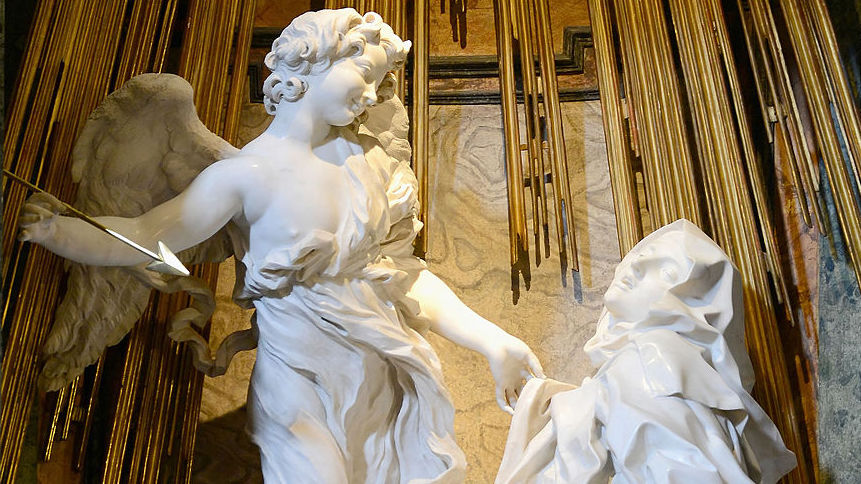
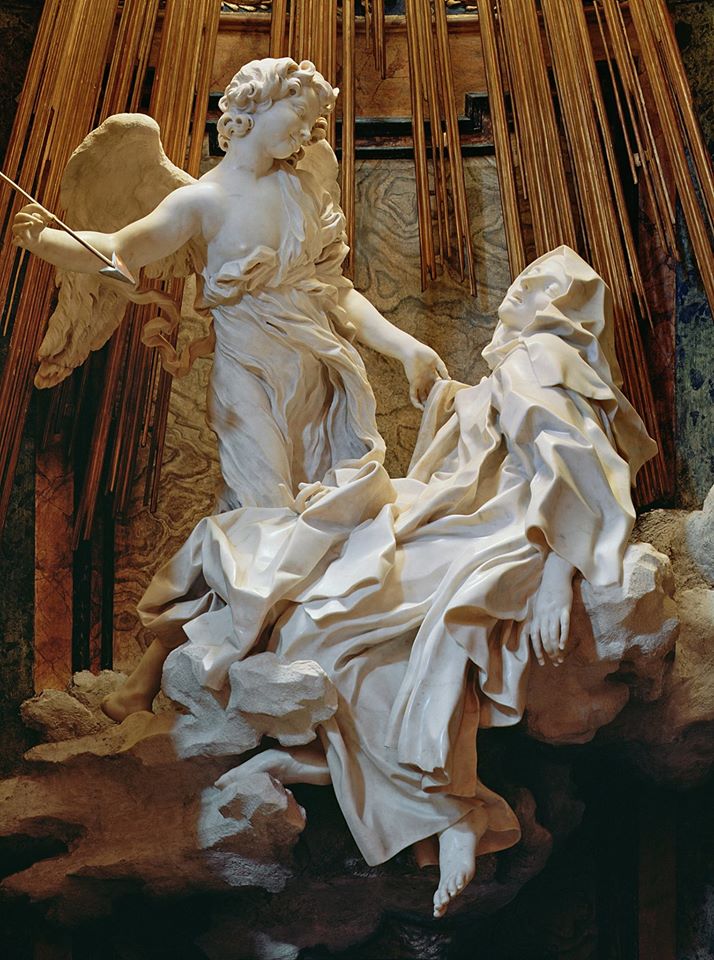
Gian Lorenzo Bernini, The Ecstasy of St Theresa, 1647-52, Santa Maria della Vittoria, Rome.

I’ve said it before: the Baroque is theatrical. Well, the audience is gathering… 

Already the Cornaro family have bagged the best spots in the boxes on either side of the stage – those Venetians like a bit of theatre. They are the relatives of Cardinal Federico Cornaro, who was Patriarch of Venice from 1631 until 1644, which is when he resigned the post, and participated in the conclave which elected Pope Innocent X. Unlike Popes before and after, Innocent didn’t like Bernini, leaving the artist free to work for Cornaro, who commissioned his funerary chapel in 1647. It took five years to finish, which fortunately wasn’t too long: Cornaro died the year after completion. He’s second from the right on the right hand side. Bernini smartly gets him to chat to the person on his left – so he is looking out towards us, and we can see him better than any other figure.

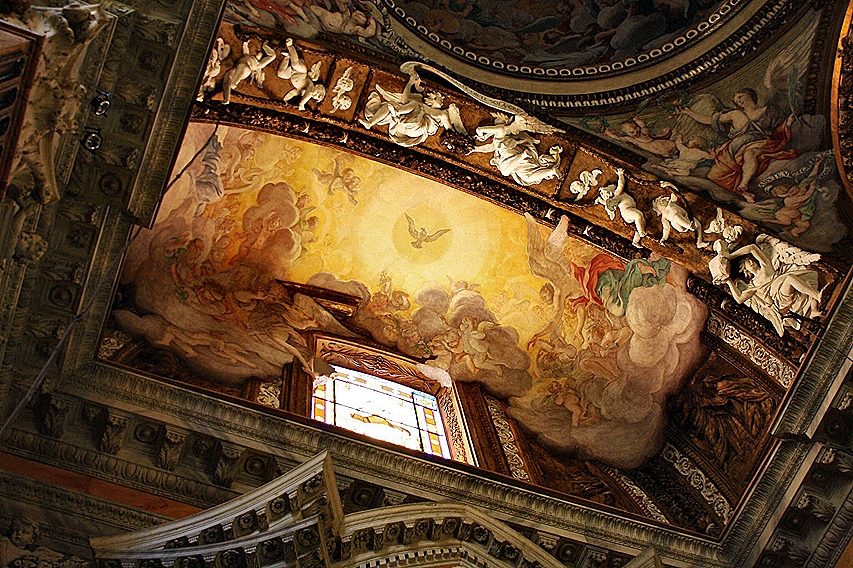
The audience are seated, as I said, although others have taken to the air. Bernini was a master of Gesamtkunstwerk, a German word meaning ‘all the arts together’: sculpture, architecture and painting all contribute to this ensemble, and Bernini was a dab hand at each. Not that he had to do all three by this stage in his career, as he had a vast workshop with many assistants, and they’ve really raised the roof for this one. We can see the Holy Spirit descending in a glory of golden light, surrounded by the heavenly host, who are flying in or already in attendance, floating on the clouds which cover the vault and even obscure part of the window. The entrance arch to the chapel is also thronging with angels, modelled in stucco (a form of plaster).

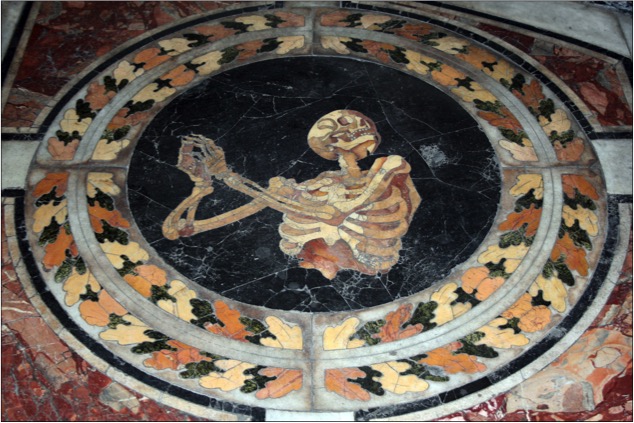
There is even another audience member looking up from the pit: a skeleton raising its hands in prayer, reminding us that this is, after all, a funerary chapel. Its gesture – with hands together but elbows apart, was one which Bernini used to create interesting views when you were likely to get a number of different views of a sculpture – but it works equally well to create a sculptural effect here – particularly as the hands go to our left, while the skeleton looks up to our right, remarkably vivacious for one so dead. Maybe this is intended not only as a memento mori but also as a memento resurrectionis (or whatever that would be in Latin). The pietra dura, or ‘hard stone’, inlay of the pavement adds to all the other materials on view – from the stained glass, the frescoed ceiling, the stucco angels and the polychrome marble architecture, to the white Carrara marble sculptures. Don’t make the mistake of thinking of this as just a sculpture – it is far more than that: it is everything. But where do we fit in? With the boxes, the gods and the pit already taken, where do we find a space to watch the spectacle? Where else but the orchestra stalls.

So here we are, looking up to the drama itself. Bernini has already drawn back the curtain, and through the proscenium arch we see a woman reclining on a cloud, and a young man with wings holding a golden arrow. If we weren’t in a church you would swear he was Cupid. Some people still swear, to be honest. Bernini seems to have created a bubble in reality, the pairs of twinned columns supporting a triangular pediment which curves out towards us, while the back wall of this visionary space curves away. A supernatural light streams down from above along golden beams of light. If you are patient, you can even find a place in the front row.

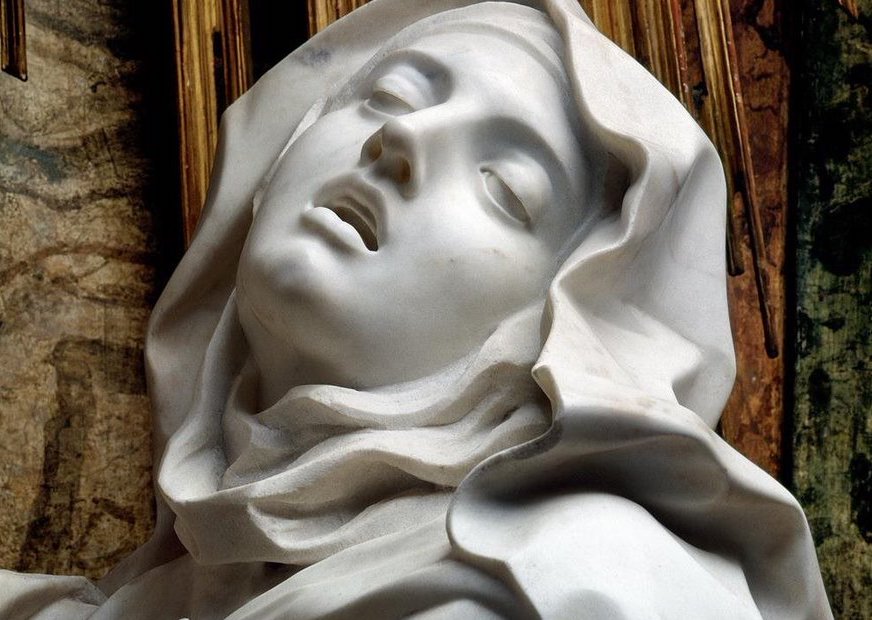
This vision we are witnessing is part of a sculptural – or even architectural – altarpiece. Its function is made clear by the relief of the Last Supper on the front of the altar itself: this is where the Mass, as instituted at the Last Supper, is performed. And here, it would have been a funerary mass, performed for the soul of Federico Cornaro. The relief is cast in gilded bronze – two more materials that Bernini has brought into play. The members of the Cornaro family on either side are effectively donor portraits, familiar from many Renaissance paintings, but given new life, as they now have solid form. The angel is young, and smiles down at St Theresa, holding the arrow delicately in his right hand, while lifting her robe with his left. She seems unaware of his presence, eyes closed – or almost closed – lips parted, left hand and foot hanging down from the edge of the cloud on which she appears to be transported in ecstasy, her right foot poised on the cloud itself. As ever with Bernini the quality of the materials is so very specific. The angel’s dress is thin, and finely wrinkled, a light cotton presumably, like the surplices worn by choir boys, although curiously off the shoulder. Her habit is thicker, with fuller, more rounded folds, the textile equivalent of her heavy limbs – my guess would be wool. The cloud looks oddly rough – but how else would you get the nebulous, formless sense of an object without substance?

St Theresa of Ávila, a visionary Spanish nun of the 16th Century, had only recently been canonised – well, only 25 years before the commission, on 12 March 1622. At the same ceremony Pope Gregory XV also welcomed St Ignatius Loyola, founder of the Jesuit order, into the Canon of Saints. Both were important for the Counter Reformation because of both their faith and their deeds. However, Gregory is sure to have had an ulterior motive. Canonising two Spanish saints the year after the 12-year truce in the 80 years war between Spain and the Protestant Netherlands had ended was surely not coincidental: he was promoting two more top rank soldiers for the Church Militant in the fight against the Protestant threat. Theresa’s visions had a number of impacts on the History of Art – but no one could have foreseen this particular sculpture as one of them. On first sight, one is left asking how Bernini could dream up such a sensuous subject for the focus of our contemplation of the Divine – but fortunately, Theresa wrote an account of her life and experiences, so we can find out for ourselves. These extracts are from David Lewis’s 1904 translation, which you can find here – you need to go to Book XXIX.

Our Lord was pleased that I should have at times a vision of this kind: I saw an angel close by me, on my left side, in bodily form… He was not large, but small of stature, and most beautiful – his face burning, as if he were one of the highest angels, who seem to be all of fire: they must be those whom we call cherubim. Their names they never tell me; but I see very well that there is in heaven so great a difference between one angel and another, and between these and the others, that I cannot explain it.

So there we have it, ‘small of stature, and most beautiful’.  But then, even in heaven there is ‘so great a difference between one angel and another…’ – a statement which always reminds me of Goneril’s line in King Lear, spoken as her thrusting young lover Edmund departs, and just before the arrival of her rather ineffectual husband: 

Oh, the difference of man and man!
To thee a woman’s services are due.

But maybe that’s a distraction? There are, after all, nine choirs of angels – remind me to tell you about them another time. But why was this particular angel there? This is how the vision proceeds:

I saw in his hand a long spear of gold, and at the iron’s point there seemed to be a little fire. He appeared to me to be thrusting it at times into my heart, and to pierce my very entrails; when he drew it out, he seemed to draw them out also, and to leave me all on fire with a great love of God. The pain was so great, that it made me moan; and yet so surpassing was the sweetness of this excessive pain, that I could not wish to be rid of it. 

And this is the ecstasy in which we see her, the angel about to thrust, and she, moaning at the sweetness of the excessive pain. On seeing the sculpture in 1739 the French connoisseur Charles de Brosses cynically remarked, ‘If that is divine love, then I know it well’. I can see his point, and yet… the couple float so miraculously, they seem suspended in stasis outside of our world, protected by the architectural forms that wrap around them, holding them in an embrace, lit by the magical, manipulated light: they are divine. Yet we are allowed to see them, witnessed as they are by sculptural donors, carved and painted angels, and a pietra dura skeleton. We too have our place, transfixed along the altar rail. The last word goes to Theresa:

The soul is satisfied now with nothing less than God. The pain is not bodily, but spiritual; though the body has its share in it, even a large one. It is a caressing of love so sweet which now takes place between the soul and God, that I pray God of His goodness to make him experience it who may think that I am lying.

Day 62 – Portia

Elisabetta Sirani, Portia wounding her Thigh, 1664, Cassa di Risparmio, Bologna.

One of the questions I have been asked several times while teaching – although not often – is ‘How do you know that? Is it the artist’s idea, or is it your interpretation?’ and it can be a difficult question to answer, because, after a couple of decades of study and experience you sometimes realise you don’t actually know where the ideas originally came from. And that is a good thing, as it makes you go back to the original source. With this particular painting we are lucky that the artist, Elisabetta Sirani, was particularly thorough: she kept a record of everything she painted.

This is what she wrote about today’s picture:

A Portia in the act of wounding herself in the thigh, when she desired to know of the plot that worried her husband, an overdoor painting, and in the distance in the other room women, who are at work, for Simone Tassi.

This is particularly useful, as it tells us not only the subject of the painting – Portia – but also where the painting was going to go – over a door – and who had commissioned it. The patron, Simone Tassi, was a keen collector of her work: when he died, he owned 66 paintings of which at least five were by her, more than any other single artist in his collection. He had 16th and 17th century paintings (i.e. ‘modern’ art), the most famous of the ‘moderns’ being Guercino. Like so many of the successful women artists, Sirani was initially trained by her father, who was himself one of the leading students of Guido Reni. Neither Guercino nor Reni are especially famous today, but they were leading members of the School of Bologna. As home to Europe’s oldest University (and so, some would say, the World’s), Bologna had a well-informed and liberal outlook, and women were more likely to succeed there than anywhere else. By the time Elisabetta was 16, her father was no longer able to work – gout was to blame, apparently – and she took over the workshop. However, she died at the age of 27 – no one knows why – but in her frustratingly short career she produced around 200 paintings. Today’s is one of her last.

21st Century museum displays are generally clearer than those of centuries past, with paintings given plenty of space, and hung roughly at eye-level. The idea of sticking paintings above a door might seem unusual, but it was common practice, going back to the 15th Century at least. Given the high-ceilinged rooms that anyone commissioning paintings would have had, there would always have been a bit of dead space above the door. It might seem like a way of marginalising an image, but as people always have to use doors they would regularly look in that direction – even if only when leaving – so it could be quite a good place to have your paintings seen, as long as you knew how to make your work stand out. And of course, Sirani did. The format is right, for a start: ‘landscape’, probably the width of the door itself, and not too high, so that the top would not be in shadow. The principal figure is in the foreground, making her big and bold and easy to see – especially as she is dressed in a rich red. And there is also quite a lot of lighter flesh, grabbing our attention to the most significant parts of the painting – face, hands and leg. The heel of the foot is cut off too, as if the top of the door frame – or for that matter the frame of the picture itself – has got in the way, giving us the sense that we are looking up at this woman from below. The subject also works conceptually as an overdoor painting, given that it includes people in different rooms – the door itself could almost be part of the narrative. 

Portia was the wife of Brutus, the friend of Caesar who seemed least likely to plot against him. As Sirani says, she wanted to know more about the ‘plot that worried her husbandand having become aware that something must be afoot, she wanted her husband to trust her – so she puts herself to the test. Her story is reported by Plutarch in his Parallel Lives dating from the beginning of the second century. This is from the Loeb edition of 1918:

Porcia [sic], being of an affectionate nature, fond of her husband, and full of sensible pride, did not try to question her husband about his secrets until she had put herself to the following test. She took a little knife, such as barbers use to cut the finger nails, and after banishing all her attendants from her chamber, made a deep gash in her thigh, so that there was a copious flow of blood, and after a little while violent pains and chills and fever followed from the wound. Seeing that Brutus was disturbed and greatly distressed, in the height of her anguish she spoke to him thus: “Brutus, I am Cato’s daughter, and I was brought into thy house, not, like a mere concubine, to share thy bed and board merely, but to be a partner in thy joys, and a partner in thy troubles. Thou, indeed, art faultless as a husband; but how can I show thee any grateful service if I am to share neither thy secret suffering nor the anxiety which craves a loyal confidant? I know that woman’s nature is thought too weak to endure a secret; but good rearing and excellent companionship go far towards strengthening the character, and it is my happy lot to be both the daughter of Cato and the wife of Brutus. Before this I put less confidence in these advantages, but now I know that I am superior even to pain.” Thus having spoken, she showed him her wound and explained her test; whereupon Brutus, amazed, and lifting his hands to heaven, prayed that he might succeed in his undertaking and thus show himself a worthy husband of Porcia.

Sirani clearly read this text attentively, even down to details like the little knife’ used ‘to cut the finger nailsThat is not a large dagger she is holding in her right hand, but something smaller, taken from the case she holds in her left, which must be some form of 17th Century personal grooming kit (the story may be ancient, but the dress is modern). Placed at the bottom of the painting, this would have been clearly visible, even above the door, especially as it’s grey and silver geometric forms contrast with the richly coloured background of the red and gold brocade. The latter is lovingly depicted with short brushstrokes of creams and oranges, revealing the lustre of the gold threads and the undulations of the fabric. The brocade contrasts with the sleeve of the white blouse, which is applied freely with laden brushes, a bravura display of painterly skill. 

Petrarch tells us that Portia had taken care to banish all her attendants from her chamber – and we can see them in the background, through two doorways, a baroque sewing circle, with the oldest doing nothing but gesturing, a stereotypical gossip. Although we shouldn’t dismiss them – after all, Sirani talks of women ‘who are at work‘. Nevertheless, the artist has taken care to distance Portia from her companions not just physically, but also in terms of character: she is determined, she is active, and she is strong. The knife is firmly clasped, pointing downwards, although her thigh is already wounded and blood already flows. The threatened repeated stabbing is made more dynamic by painting the knife in front of a doorframe, the vertical lines of its architectural form catching the light like the knife, and connecting the weapon with the wound. In all of this, her face remains placid.

It is the red that dominates – her dress, the dress of the woman spinning in the background and the chair all circle round the wound, which seems to show three puncture marks, already, at least. The gold plays a complementary role, grabbing our attention at the bottom of the image, and echoing in the chain across her shoulder, at a diagonal which emphasizes the disarray of her dress, while also drawing our eye back down to the blood. And she signs the painting, subtly, with an equivalent yellow, along the bottom of the back of the chair, just above the tassels.

It would be great to know who chose the subject. Did Tassi commission a Portia from Sirani, or did he ask for any painting, and she wanted to do this? Either way, it makes its point. Men can get on and do things, whether they are good at it or not (I’m sure you can think of one or two examples just now), but women have to prove their worth. After Sirani’s father became incapacitated she was the family’s principal breadwinner, and also had to care for her younger siblings.  She even trained two of her younger sisters to paint, and earned money by teaching: she set up the first school for women artists. It’s hardly surprising she died young – stress-related illnesses are the most commonly cited hypotheses. But there are questions about her status as a proto-feminist: yes, a strong woman, trying to take her place in a man’s world, but also, a woman in her chamber, her skirts lifted and her shoulder revealed. It’s a heady mixture. But it does make the point that this woman is truly determined. And by this woman, I mean these: Portia – and Elisabetta.

Day 61 – …the Virgin and Child

Sir Peter Lely, …the Virgin and Child, 1664. National Portrait Gallery, London.

Last Monday we looked at Sir Anthony van Dyck’s Cupid and Psyche painted for Charles I (Picture Of The Day 54), which I suggested was quite possibly more than a little sacrilegious from a Catholic point of view. My precise words were ‘It’s entirely outrageous’. So this Monday, I wanted to balance that out with something altogether respectable from the Stuart Court, this painting of the Virgin and Child, glowing with health and happiness, by Sir Peter Lely. 

Like most great British artists of the time, Lely wasn’t British at all, having been born in the Netherlands in 1618. He trained in Haarlem, and was accepted as a Master of the Artists’ Guild there in 1637. It seems more than likely that he would have known Judith Leyster (POTD 34), who became a Master of the same guild four years earlier, when Lely would have been 15 and presumably already well into his apprenticeship. He arrived in London some time around 1643, and his talent meant that before long he was painting portraits for Charles I. Then, when Charles, for obvious historical reasons, had no head for portraits, he carried straight on painting Oliver Cromwell. With the Restoration in 1660 Charles II knew that, to be accepted as King, he had to look like a King, and people had to know what that looked like – so one of the first things he did on his return to England was to appoint two Royal Portraitists – Lely became Principal Painter in Ordinary in 1661.

Painting the Virgin and Child seems like a curious choice for Lely, a Dutch artist, who grew up and trained in Protestant Haarlem, and who was now working in a Protestant court – even if both old King and new had Catholic wives. It’s an especially lush image, though, the rich blue of Mary’s cloak glowing with the clarity and wholesomeness of a Madonna by Sassoferrato, the Italian Baroque artist whose work constituted a Raphaelesque revival. The parallels with Raphael can be seen here too: the Madonna and Child lean towards each other, creating the pyramidal composition typical of the High Renaissance. This is strengthened at the base by the blue horizontal of the cloak, reaching from Mary’s knees to the folds by her hips. Her posture – upright back and horizontal left leg – echoes the verticality of the fluted classical column and the horizontal cornice or capital on which Jesus rests his feet. All of these compositional devices serve to frame him better. He must be supported by his Mother’s left hand, as his feet barely touch the surface. They reach towards each other with touching affection, but look out to us, subtle smiles on their lips – and maybe a slightly sleepy look in Mary’s eyes. Well, I’m sure that even holy babies can keep you awake.

I first saw the Virgin and Child at the end of January in the British Baroque exhibition at Tate Britain, which sadly closed a month before it was due to, for obvious reasons.  A pity – it was a revelation. The Lely was hung next to the painting on the right here, and not so far away from the one on the left. The latter is the not-so-obviously Catholic (from this portrait, anyway) Catherine of Braganza. She arrived from Portugal in 1662 to take up her position as Queen, and she and Charles were married twice – a secret, Catholic ceremony followed by a public, Protestant one. This might make it look as if Charles had appointed two Court artists before one wife, but the contract had already been signed the year before – not that she was present at the time. But then, negotiations had begun during the reign of Charles I: by the time he was beheaded in 1649 she was still only 10. When finally married, at the advanced age of 23, her dowry included Tangiers and what was then called ‘The Seven Islands of Bombay’ – the British Empire started here, effectively. She was allowed to practice Catholicism, and even had her own Chapel. She also had her own artist, Jacob Huysmans, who painted both of these portraits. Again, as a great British artist, he was Flemish – and so Catholic – having been born in Antwerp in 1633.

Catharine’s portrait shows her in that guise favoured by more than one Queen, the Shepherdess. After all, she would be able to look after her flock: Charles’s subjects were now her own. It was painted early in her reign, and is packed full of symbols of her hoped-for fecundity – the ducks in the bottom left, the lambs, the flowers carried by the cherub, the cherubs themselves (there are more in the background), and especially the orange blossom in her hair. She calmly strokes the head of a particularly docile lamb, the implication being that she is equally meek and mild: this sweet girl provides no militant Catholic threat. OK, so it’s a very low-cut dress, but her first official portrait was so square-laced it looked as if she would never fit into Charles II’s court.

But what is its relationship to the other painting? It depicts John the Baptist as a rather gawky teenager, complete with long, lustrous and above all healthy Stuart hair. You wouldn’t get hair like that on a diet of honey and locusts. He has the softest of camel skins wrapped around his right arm, with an off-the-shoulder blouse of the subtlest royal purple, matched with a pale pink cloak. In the crook of his left arm is a bamboo cross wrapped round with a small scroll bearing the greeting ‘Ecce Agnus Dei’ – ‘Behold the Lamb of God’ – with which John greeted Jesus. Another docile lamb (clearly one of Huysman’s specialities) sits cross-legged beside him. His right hand points, as if illustrating the word ‘Behold’, but he doesn’t seem to have the energy to lift it up high enough to point at the lamb. Typical teenager. Despite this diffidence, I suspect that somewhere in the background Huysman’s inspiration was Caravaggio. And however you interpret whatever I’ve just said, I do think it’s a rather elegant painting, and really rather surprising when you read what has been painted in the top left hand corner: ‘Duke of Monmouth’. Who was he? You may well ask. He was James Scott, and in case that doesn’t help, he was the son of Lucy Walter. Still not helping? He was the eldest illegitimate son of Charles II, and this was painted at the earliest in 1663 just after Charles had ennobled his son, and even gone as far as bestowing him with the Order of the Garter. Evil to him who evil thinks! From this point onwards he was regularly seen in the company of the King and Queen – a thorn in her side, perhaps, but it’s a very clever portrait. According to the Bible, John the Baptist was asked if he was the Messiah, to which he replied that he was a voice crying in the wilderness ‘Prepare ye the way of the Lord’. The relevance to the contemporary situation would have been clear: the Duke of Monmouth was not the King’s legitimate heir – but one was on the way, thanks to Catherine. Having him painted by Huysmans – her artist – makes it look like she was totally happy about it. Tragically, despite several pregnancies, none of Catherine’s children lived. She must have led a very difficult life.

But why did the curators of the British Baroque exhibition hang the portrait of Monmouth, dressed up as John the Baptist, next to Lely’s Virgin and Child? Is it simply to fulfil the promise of the scroll, ‘Behold the Lamb of God’ by putting a painting of Jesus next to it? Come to think of it, it is a little unusual for Jesus and Mary to have such dark shiny hair – unless you’re in Spain – you could even argue a family resemblance with John the Baptist, I suppose. Well, maybe I should give you the full title of this painting. Naughty of me not to have done so before, really:

Barbara Palmer (née Villiers), Duchess of Cleveland with her son, probably Charles FitzRoy, as the Virgin and Child

So yes, that’s the reason – like James, Duke of Monmouth, as St John the Baptist it is another portrait of someone playing a role, someone in fancy dress, a genre which was rather popular in portraiture during the Stuart dynasty. But who was Barbara Villiers? The favourite mistress of Charles II in the 1660s. And Charles FitzRoy? Well, ‘Fitz’ comes from the French ‘Fils’ meaning ‘son’, and ‘Roy’ comes from ‘Roi’, meaning ‘King’ – Charles, son of the King. So this is the King’s favourite mistress, and one of his illegitimate sons (to be honest they don’t even know which one) dressed as the Virgin and Child. And if that’s not ‘entirely outrageous’ I don’t know what is. 

Day 60 – Psyche VI: ‘Resolution?’

Workshop of Raphael, The Story of Psyche, 1518-19, Villa Farnesina, Rome.

I had no idea this rom-com would involve so many episodes! But it is a great story, with some lovely paintings associated with it. And even if Apuleius didn’t tell it exactly as I am – well, my version seems to match the paintings… This week we move from Mantua to Rome – having stopped off in between somewhat out of the way in Stuart England. Cupid and Psyche are re-united, and both are awake, so now all they have to do is to get everyone else on their side. But before they do that, let’s put this cycle in context.

Raphael’s frescoes were designed for a garden loggia in what is now called the Villa Farnesina, built by the Sienese artist and architect Baldassare Peruzzi for banker Agostino Chigi, also from Siena, between 1506 and 1510. It is, like the Palazzo Te which houses Giulio Romano’s Psyche Cycle, a suburban villa, i.e. outside the city walls. It seems very close to the centre of Rome these days, but even now you pass through one of the gates in the city walls on your way there. It is in the Trastevere, the part of Rome which is, as its name suggests, ‘beyond the Tiber’. The easiest way to get there is over the charming pedestrian Ponte Sisto, built for Pope Sixtus IV (who, as well as the Sistine Bridge, was also responsible for the Sistine Chapel), to facilitate the movement of pilgrims through Rome during the Jubilee Year of 1475.  Sixtus’s nephew, Julius II, collaborated with Agostino Chigi to have two roads constructed, one from either end of the bridge, but both heading, more or less, towards the Vatican – thus enabling the pilgrims to get there even more quickly. It also freed up plots of land which people could build on. In other words, it was a property scam. One of the lots on the Trastevere side was taken by Chigi himself, out in the countryside, by the river, a perfect place to get away from the city and have fun – and he really did. The stories of excess consumption, and conspicuous display, are legion. But back to the art.

Nowadays you enter though the back door, in the middle of a rational, calm and orderly façade. No sense of the heavy stonework, or rustication, associated with the defensive palaces of the city. But you should have entered here, through the garden, and into the garden loggia – those big, reflective glass windows wouldn’t have been there in the five central arches. The River Tiber (‘Il Tevere’) is on our left, and at the back left corner of the Villa there was another loggia, but that was closed in during the 17th Century.  We are going to enter through the central door, head to the right-hand end of the loggia and look back.

This is the view you would have, with the frescoes designed by Raphael and executed by his workshop covering the ceiling. They should have carried on down the walls, but stopped at the bottom of the vaulting. Not even the lunettes are part of the original scheme. Work seems to have broken off when they had to move the scaffolding from the ceiling to the walls in 1519, probably because Raphael was busy – and then ill: he died the following year. It does, however, include the pendentives – the triangular elements hanging down as part of the vaulting. If you look at the end wall, the central pendentive shows Venus pointing out Cupid to Psyche, a painting which I included in ‘Psyche I’ (Picture Of The Day 43).

In context, you can see that Venus could so easily be pointing at any beautiful woman arriving in the loggia from the garden. There are two theories about the reason why this story was chosen to decorate the loggia… one is that it celebrates Chigi’s recent marriage, in which case, it would complement the beauty of his young wife, who must have been, like Psyche, more beautiful than Venus. The other theory is that, as a suburban villa, it was a place to get away – and entertain your mistress, which is precisely what Federico II was supposed to have done in Mantua. As it happens, Chigi’s marriage, which took place in 1519, was to his mistress, and the Pope legitimised their four children… so both versions are true, although the decoration was started before their marriage. As Giulio Romano was a member of Raphael’s workshop while it was being painted, I wonder if he suggested the subject to Federico II, Marquis of Mantua, for the Palazzo Te? It’s an intriguing thought… Another intriguing coincidence: Pope Julius II, who commissioned and prayed underneath Michelangelo’s Creation of Adam, would have dined under these frescoes.  Indeed, his friendship with Chigi was so great that the latter was granted the right to use the Pope’s family coat of arms, which is in the middle of the ceiling. In Mantua, when Holy Roman Emperor Charles V visited in 1530, he chose the Sala di Psiche as the room for a slap-up banquet. And promoted Federico from Marquis to Duke. What is it about this story that made it so attractive to the two most powerful men in Europe?

The conception of Raphael’s frescoes is delightful, even if the walls were never finished, meaning that we don’t see most of the story that we’ve heard so far. As a loggia, it would have been open to the garden – and Raphael continued this idea with the conceit that we are still in the open air, but covered by pergola hung with two tapestries. Their edges are scalloped from the tension of the ties with which they are attached, and in the gaps between the tapestries and the pergola we can see the sky. In the pendentives and the vaulting above the lunettes it is only sky, which is nevertheless inhabited by episodes from the story and by amoretti carrying symbols of the Olympian gods. The garlands themselves, wrapped around the frame of the pergola, were painted by Giovanni Martine da Udine and contain over 170 different species of fruits and flowers, beautifully observed, and occasionally obscene. The pendentive with Venus and Cupid is to the left of this photograph, and we saw the two at the top right last week (POTD 53) – they show Psyche returning with water from the Styx (top right) and Venus, surprised at receiving it (top, right of centre). I’m going to look at the four along the bottom first, and then the two at the top left. Notice how Cupid is pointing down in the bottom left pendentive: Psyche has entered the loggia, it seems, and he is pointing her out to three women. 

The three women are all naked (what was the Pope to think?) and although nudity is usually associated with Venus they can’t all be her. They are her companions, the Three Graces, and are seen alongside her in paintings such as Botticelli’s Primavera. Basically, Cupid is working on his mother by trying to get everyone else on his side. Earlier Psyche had unsuccessfully tried to get the help of Juno (there’s a Giulio Romano painting of that in the Palazzo Te, which I didn’t manage to include), and she had also sought the help of Ceres. It was Ceres who suggested that she should go and ask Venus about Cupid, as it happens – not without a little malice, I suspect. As Cupid is talking to the Graces, one of them looks earnestly down at Psyche, while the other two are enchanted by Cupid. However all three look as if he’s in for a rough ride – they know what mum’s like, after all. In the next pendentive we see Ceres, with cereal in her hair, and Juno, with a peacock at her feet (see POTD 32).  Venus is on the left – typically naked. Whatever they have said or done to Psyche in the past, they now plead on her behalf, but the Graces were right: Venus sneers and looks unconvinced. In all of the pendentives Raphael’s design is superb: he uses the triangular format to full advantage, with wings, drapery or legs extending to the extremities. It’s a real pity he didn’t get to do more of the painting. Scholars argue about which bits he did, or if he did any at all, with some grudgingly conceding his participation in a few bits of the Graces… although I’ve never been convinced. 

Finally, Venus gets a summons from the big boss, Jupiter, and flies on her chariot to see him. Each of the gods was supposed to have had ‘mythical’ creatures pulling their chariots: Juno had peacocks, and Venus had doves (or sometimes, swans), for example. I know that neither peacocks nor doves are mythical, but their use as beasts of burden is. I love the way that Raphael has given Venus a team of four in hand, each pair with their own yoke. Jupiter sits comfortably on his eagle – although the poor squashed bird doesn’t seem too happy about it – and holds his thunderbolt like a sceptre, filling the top right corner of the pendentive. He has the demeanour of the father of a spoilt girl – he knows she’s behaved terribly but he really can’t be cross with her – and she behaves accordingly. We’re two sentences before she gets to ‘it’s not fair!’ I think… But why is she there?

Well, because Juno and Ceres had a word with Jupiter, presumably. But also, definitely, because Cupid did. He has come hot-foot from finding Psyche in a sleep-like death on the road out of the Underworld. He has woken her, declared his love, and has now come to tell Jupiter all about it so he can get him on side. If Jupiter was behaving like an indulgent dad with Venus (and some genealogies suggest he was her father, although her foam-born origin says otherwise), he is doing the same – but more so – with Cupid. The Eagle has been banished to the top right of the fresco, and takes the thunderbolt in its beak, while Jupiter grabs Cupid’s face, and pulls it close to his, trying to look as angry as possible. He’s a very naughty boy. But maybe a little closer than a grandson should be. Which might be a sly nod to some of the rumours about Julius II. Whatever, Cupid got his way, and Jupiter sent Mercury, messenger of the gods, to fetch Psyche and bring her to Olympus. He leads the way, looking back at her superhuman beauty, while she crosses her arms with modesty and wide-eyed innocence. 

This fresco should precede the last one, really. It is at the far end of the loggia, opposite Venus and Cupid pointing to… whichever dinner guest was deemed the most beautiful. It represents Mercury swooping down among the gathered assembly to scoop up an unsuspecting maiden and take her up to meet the immortal gods. I love his total abandon, cloak flying out behind, with a look of direct engagement in his eyes: you – yes you! – are the most beautiful person here! His arms are thrown out in a gesture of triumph, almost, as if to say ‘ta-dah!!! I’m here!’ His right hand holds a trumpet to herald his arrival, and his left leads out attention to an oversized courgette in the garland above, a fig hung over one end, and another, split, fig in close relationship to it at the other. I’ll let you look up a detail yourselves, because I couldn’t possibly. What would the Pope say?

Day 59 – Virtues vs Vices

Giotto, The Cardinal Virtues, and opposing Vices, c. 1305, Scrovegni Chapel, Padua.

We have spent the last two Saturdays looking at the Theological Virtues, and their opposing Vices (Picture Of The Day 45 & 52)– and this week we will put together the remaining imagery along the lowest level of the Scrovegni Chapel.

All eight of the images we will look at today are contained within this one photograph, although it is hard to pick them out. The Last Judgement (POTD 38) is behind us, and we are looking towards the altar. At the very bottom left and right you can see the lowest level of the frescoes, trompe l’oeil paintings of marbled panels framed in green, passing two side altars which mark a transition from the main ‘body’ of the chapel, originally accessible to the public congregation, to an area associated with the patrons themselves, the Scrovegni. Just before the chancel arch there is a door on the left, which originally gave access to the Scrovegni Palace – nowadays this is where you enter. Destroyed in the 19th Century, the Palace used to run alongside the left side of the chapel, which is why there are no windows there. The light comes from the windows on the opposite side – the side of the Virtues, interestingly enough – and from behind us, where there is a window just above Jesus in the Last Judgement. Before you get to those side altars, though, and directly under the decorative strip which crosses the blue sky of the ceiling – which marks a point half-way along the chapel – there are two imaginary sculptures – Justice on our right, and Injustice on our left. Remember that Hell is behind our left hand looking in this direction, while the Blessed, going up to Heaven, are behind our right. The next Vice and Virtue are on the walls next to the side altars, with two more pairs beyond.

Justice – we’ll see her below – is in the middle of the seven Virtues painted on the right-hand wall and serves to balance them all. Reading from left to right, are Prudence, who is at the foot of the Chancel arch, FortitudeTemperance and Justice. They are the Four Cardinal Virtues, sometimes seen as the ‘secular’ set. They were identified by Plato as the virtues exhibited by members of the ideal Republic, and they were brought into Christian theology by Sts Ambrose and Augustine, two of the Doctors of the Church we mentioned yesterday (POTD 58). 

Prudence makes sensible decisions based on knowledge and understanding – expressed here by her self-knowledge. She sits at a desk – so is undoubtedly learned – and in her left hand she holds a convex mirror, essential for reflecting on herself and learning from her past experience. You have to be careful with symbols though – if you spend too much time looking at a mirror, you would be considered vain. Indeed, the mirror is also a symbol of Vanity. Hers is a measured existence, and in her right hand she holds a pair of compasses, perfect to plot the right course, and to chart all possibilities. Plato associated Prudence with reason, and with the ruling classes. Both Prudence and Fortitude next to her look to the right. They are looking towards the Last Judgement, but also towards anyone entering the Chapel through the West door – presumably they want to catch the visitors’ eyes, and recommend their own personal qualities. I am intrigued to think what Prudence could see in her mirror – apart from her own face, that is. A glimpse of the altar, maybe? Or, if she tilted it up a little, the Virgin Mary, painted towards the top of the adjacent wall. I’m sure it is a deliberate choice to have her looking towards the Last Judgement while reflecting on the altar…

I wouldn’t want to pick a fight with Fortitude. Plato associated her with man’s spirited nature, and with the warrior class. Giotto makes her a doughty dowager, armed for war: I’d keep out of the way of that stick. She holds a full-height shield which has spear heads embedded in it, and you can also see the bolts of the handle she is holding on the other side. It is decorated with a lion, which, in other manifestations, would be one of her main symbols, and she puts the ‘her’ into Hercules: she is wearing the pelt of the Nemean Lion, slain by the ancient hero as one of his labours. Its muzzle is over her head, while the legs are tied around her neck and waist. I’d feel safer, though, with TemperanceFortitude’s pacifist sister. Associated with moderation or self-restraint, she has sheathed her sword, and is altogether self-contained. In other images she waters down the wine – not a virtue I’ve ever been guilty of, I’m afraid. Plato thought that, in his ideal Republic, this quality should be possessed by the farmers and craftsmen – the producing classes – and I can’t help thinking that it smacks of an economy that the rulers need not have worried about…

Justice is unlike the other virtues – indeed, of the Cardinal Four, she is the chief, ruling the interaction of the classes, as far as Plato was concerned. She sits enthroned, and balances the entire wall, sitting as she does at the centre of the Chapel. The three trefoil sides of her gothic throne, and its sky blue background, make me think of Mary, Queen of Heaven – and Justice here is crowned. This was certainly an elision seen in Venice, which is not so far away. She holds the pans of her scales in either hand – but not the beam or connecting cords. And that’s because she, herself, is the balance. However, this concept was original enough, and unusual enough, for someone to find it uncomfortable, to the extent that they tried to sketch in the rest of the expected scales. In her right hand an angel leans forward to reward the good (sadly lost in a damage to the fresco), and in her left, a second prepares to strike a kneeling malefactor, distributive and retributive justice respectively. 

Opposing these four we see Injustice (he’s below), Anger, Inconstancy and Foolishness. Looking at this wall, the Last Judgement – and the entrance – are towards our left, and that is the direction that most characters look. From the right, this time, so moving away from the altar, Foolishness looks foolish, its that simple. Waving a stick, with a crown of feathers, and ragged clothes, this could be a medieval Fool, perhaps, but not a witty one, not with the insight we see in Shakespeare. Inconstancy – lacking the solidity, the firmness, the dependability of Fortitude, rides a wheel along a sloping marbled floor, out of control and, thus, completely unreliable. Anger – or Wrath – the only Vice who is also a Deadly Sin – rents her clothes, and lets her hair run free. They are a pretty unattractive bunch, which is probably just as well: we wouldn’t want to be like them. Let’s compare Injustice with his opposite.

She sits comfortable, serene and secure, in the decorative elegance of her ecclesiastically-flavoured throne: she embodies the scales of Justice. He looks away – towards the final Judgement, with a billhook and sword, but his domain is overgrown – no husbandry here. His throne is a fortified gateway to a walled city, but the walls are crumbling with Injustice’s neglect, and the floor is eroding away.  These two pivotal personifications each have a predella – an image often seen at the bottom of an altarpiece, illuminating the image above. In both cases they are painted to look like relief sculptures. 

Hers, above, shows a courtly couple out hunting with their dogs, safe in the ordered countryside; a group of ladies dancing; and well-provisioned travellers arriving from the right. His, below, shows a pair of soldiers opposite the courtly couple; the dancers face a rape; and a traveller has been murdered. If any of you know Ambrogio Lorenzetti’s Allegory of Good and Bad Judgement in Siena, these tiny paintings say what Lorenzetti says, some 33 years later, across one and a half walls. 

So now we know where we stand – and as we enter through the West Door (which, sadly, we no longer do) we have the same view as Jesus, although somewhat lower. We can bless the Virtues on our right hand, and condemn the Vices on our left – the former will lead us to Heaven, the latter to Hell, all laid out behind us. But to get to Heaven the Virtues will not suffice – we must be forgiven. And so we need Jesus… but if he is to be born, he must have a Mother, so she must be born. But first, she must be conceived… so that is where we shall start next week!  Don’t worry, it’s perfectly respectable. Immaculate, even.