186 – Morisot and Motherhood

Berthe Morisot, Le Berceau, 1872. Musée d’Orsay, Paris.

My series of talks, Women Artists, 79-1879 (the first 1800 years) comes to an end on Monday, 6 February with Week 5 – Getting Real. The title refers to the artistic movement known as Realism, which may or may not be relevant to Rosa Bonheur (a problem I will consider on Monday). Realism was, in many ways, an essential stepping stone to Impressionism, and it is there that the series will end. But why grind to a halt in 1879? Well, it’s not a stop, it’s a pause. As it turns out, it is also a beginning. What followed was a greater, if faltering, acceptance of women within the world of art. At least, the situation was slightly better than before, but that is not saying much. However, there were enough women working in the 20th Century to allow for another series of five two-hour lectures on them alone. Don’t worry – I’m not planning to do that, as you can see in the diary! The precise reason for the date? Well, you can find out below, or sign up for the talk on Monday. For now I’d like to look at one of the works of one of the Greats (pace Nochlin), Berthe Morisot. It’s what she did (or didn’t do) in 1879 that is relevant.

A woman sits behind a cradle – the ‘Berceau’ of the title – and looks down at the child lying within. Her chin rests on her left hand, with her right hand lying at the foot of the cradle. A curtain hangs over what we assume to be a window behind her, and the cradle is similar curtained. It sits at the bottom of the painting, its length parallel to the picture plane.

It’s actually not entirely clear what the curtain at the top left represents – it could be in front of a window, but, as the woman does not appear to be contre jour – literally ‘against the day’, but meaning ‘backlit’ – that is by no means certain. Nor is it clear why there would be a fold in this curtain, apart from its function for the composition of the painting, leading our eye down towards the sleeping child, just like the woman’s gaze. On the far right a metal pole rises and curves round in a brief and broadly curving spiral, and it is from this that the fabric hanging around the cradle hangs. In addition to the white, muslin-like fabric, there is a pink decoration as well. To modern eyes this might, still, signify that the child is female, but had the blue/pink gender stereotype already been fixed in the late 19th Century? It certainly hadn’t in the 18th.

The woman’s hand is not just resting on the end of the cradle, but also holding the curtain, thus screening us from the sleeping child behind. The tiny head is turned towards us, the eyes shown as sketchily drawn lines, tight shut, fast asleep. The little right arm is bent at the elbow, so that the hand rests just behind the head. There is a lot of white at the bottom of this painting – the whole extent of the bassinette, not to mention the veil-like fabric enclosing the child. Not every artist is as good with white in all its coloured variety as it picks up the reflected shades from surrounding objects, and is modelled itself by different coloured lights and their resulting shadows, but Berthe Morisot was one of the artists who was. Throughout there are delicate hints of blue and pink, particularly along the lacey trim of the canopy.

This can only be the child’s mother – an assumption you probably made from the outset. She is just one in a long line of theme and variations played on a subject which starts with the Virgin Mary. Our secular Madonna nods to her immaculate predecessor in the muted grey-blue stripes of her bodice. Like any happy couple the mother and child mirror one another, the bent arm and head-on-hand pose reflected from adult to baby. The hem that comes down on the diagonal above the mother’s head – parallel to her left arm – is cut off by the opposing diagonal of the falling canopy. The diagonals frame the mother beautifully, as well as suggesting a rocking motion – left to right, right to left – which could echo the movement of Le Berceau itself. Although our view of the child is veiled, the mother has privileged access, able to see her baby directly behind this cloth: we are witnessing a private moment of contemplation.

The accepted practice of the Impressionists was to paint en plein air (‘outside’) in front of the motif (the subject, effectively), spontaneously depicting what they saw when they saw it, and trying to capture their initial sensations. And yet this is an interior, and the expert composition suggests that nothing was left to chance. But then, it was also painted before the Impressionist movement officially started – or at least, two years before the first exhibition of the group that would later become known as The Impressionists took place. However, by 1872 many of the ideas were already current, and the ‘movement’ went in many different directions. As it happens, this painting was included in the 1874 exhibition, and that is significant. You could argue that the Impressionists, however diverse in their styles and intentions, formed the first artistic group to include a woman from the outset. How did Berthe Morisot get there? Well, incredibly supportive parents for a start. She and her two sisters, Yves and Edma, were all given lessons by Geoffroy-Alphonse Chocarne and Joseph Guichet. Berthe and Edma continued, inseparable, copying works in the Louvre, and having their works accepted at the official salon – although their mother complained that the paintings were hard to find (and indeed, oone year, for one of her daughters, she failed). They got to know Manet and Monet, and before long Berthe was studying plein air painting with Corot. There was a problem though: young ladies could not go out unchaperoned, and Berthe would later write to Edma, telling her how frustrated she was by her inability to head out on her own, constantly waiting for the maid to be ready to accompany her. But at least there was a maid – the Morisot’s were well off – which is one of the things that enabled Berthe’s career. Edma married in 1869, and her artistic career fell by the wayside. As Madame Pontillon, she continued to model for Berthe – and this is her, with her daughter Blanche, Berthe’s niece. Berthe formed a firm friendship with Edouard Manet, and some believe they were in love – but he was a married man. However, in 1874 she married his brother Eugène, also an artist: there couldn’t have been a more supportive background.

The group exhibited in 1874 as ‘The Anonymous Society of Artists, Painters, Sculptors, Engravers etc.’ and ‘Mlle MORISOT (Berthe)’, as she was listed in the catalogue, was represented by nine works (as was Monet), four oils, two pastels and three watercolours. Le Berceau was no. 104 in the catalogue. There were seven subsequent exhibitions, in 1876, ‘77, ‘79, ‘80, ‘81, ‘82 and ‘86. Of the ‘famous’ Impressionists, Monet and Renoir only exhibited in four: they got fed up with being counter-cultural. Only Camille Pissarro exhibited in all eight, and next to him, in terms of ‘loyalty to the cause’, was Berthe Morisot, who was represented in seven. Which one did she miss? The fourth exhibition, in 1879. And why did she miss it? Her daughter Julie had been born on 14 November 1878, and she was too ill. I don’t quite understand it, as there must have been a ‘back catalogue’ to choose from, and someone else could have helped. Admittedly, of course, there was no obligation to exhibit (and, as an independently wealthy woman, she really didn’t need to – but that wasn’t the point). All I can say for now is… it wouldn’t have happened to a man. Not that it stopped her in the long run, and indeed Julie, and her relationship to Julie, and for that matter her husband’s relationship to Julie, became some of the major subjects of her work. And Julie herself also became an artist. Although many women’s careers were curtailed by marriage and children – Edma Morisot Pontillon being a case in point – that was not always the case. Lavinia Fontana had eleven children, and ended up painting for the Pope. Mary Beale had three. Sadly, one died in infancy, but the other two worked as her assistants – at least for a while. And Berthe Morisot went on to contribute to the remaining four Impressionist exhibitions. Even if she wasn’t represented in 1879, two other women were: Mary Cassatt and Marie Braquemond, both for the first time. So as well as being a ‘hiatus’ (and definitely not an end), 1879 was also a form of beginning.

One last question: what did Edma Morisot, Madame Pontillon, think of motherhood? I’ll leave you to decide: the interpretation of art is, ultimately, a personal thing. But however you read this expression, the delicacy with which it is painted, and the complexity of thought it allows, are what persuade me that Berthe Morisot was a Great Artist, and the ideal conclusion to this series of talks on Monday. But please remember: however many women I may have been able to discuss, some in depth, others fleetingly, there are many more I wasn’t able to include – so watch this space! And keep an eye out for the Berthe Morisot exhibition which will open in Dulwich in April.

185 – To finish the King.

Rosalba Carriera, King Louis XV of France, 1720-21. Gemäldegalerie Alte Meister, Dresden.

If I’m honest, it’s not been the best week. To start off with, last week I said I would be doing a play in February: I’m not. It’s a long story, but not something I needed to lose my head about, though, and fortunately neither I, nor today’s subject, did (that was his grandson). Here we have Louis XV as painted (see below) by Rosalba Carriera, one of the most successful, innovative and influential artists of the 18th Century, about whom I will be speaking on Monday 30 January when I ask if her work, and that of her contemporaries, constitutes A Vindication of the Arts of Women?

It is a bust-length portrait of King Louis XV, who must have been ten when it was painted (see below). He had succeeded his great grandfather Louis XIV five years earlier, and, until he reached his majority (at the age of 13) in 1723, his great-uncle, Philippe II, Duke of Orléans, was regent. The painting is often listed as Louis XV as Dauphin, which is odd, as he was Dauphin (heir to the throne, the French equivalent of the Prince of Wales) from the age of two until he became King at five. He is clearly older than that here. The Gemäldegalerie Alte Meister (‘Painting Gallery of Old Masters’) in Dresden, which has the best collection of Carriera’s work, and to which this painting belongs, correctly calls him King. I say ‘painting’ advisedly, as pastels have always, traditionally, been called paintings, even if they are done with crayons rather than brushes. My primary school training (painting is with brushes, drawing with pencils and crayons) fights against it, but there you go. Pastels are, like paint, a pigment supported in a medium. The pigments are the same, but for pastels the medium is gum arabic (or an equivalent), mixed with a ‘filler’, often kaolin (a type of clay). The medium supports and protects the pigment, as well as fixing it to the support, just as it does in a paint, and the technique is used, as it is with a paint, to colour broad areas of the support – which, for pastels, is a thick, prepared paper. Rosalba Carriera was the early master of the developing medium – but more about that on Monday.
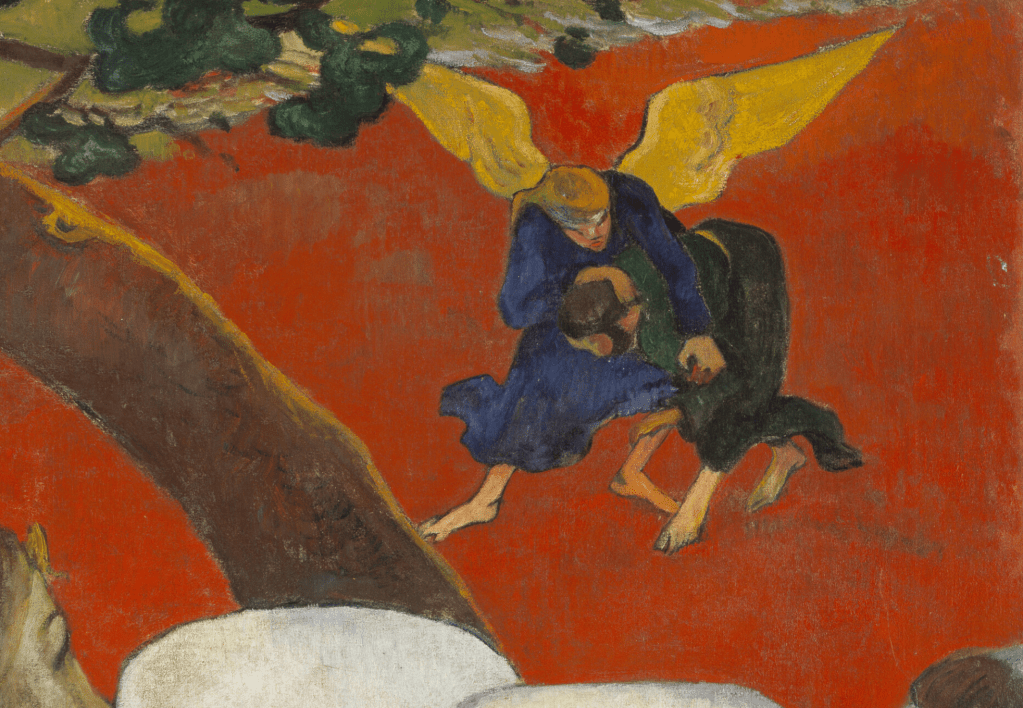
Her control of the technique was second to none, and you can see that here in the subtle variation of tones across the King’s face, modelling the form in three dimensions while not making it too solid and sculptural. It is possible to blend different coloured pastels together, either with the fingers or rolls of paper (a process known as ‘stumping’), but you cannot mix them freely on the surface as you can with oils. This means that, if you want a greater degree of subtlety, you need a large number of different crayons covering the whole range of hues and tones (colours and shades). As well as her subtlety of tone, Carriera was also remarkably adept at suggesting that you can see things which aren’t actually there – the hair for example. The locks on the right of the image were built up on a very deep brown, which is just shading – there is nothing especially ‘hair-like’ about it: it’s almost plain, unmodulated black. But then the swift strokes of auburn on top of it, tipped with touches of butterscotch, give it all the lustre of youth and build it into vibrant curls. All of this encourages the mind’s eye to fill in details for the almost black shadows which, in reality, have no detail. The King’s eyes are given catchlights with the smallest dab of a white crayon, and the mind expands these to fill the whole surface of the eye, white and all, with a liquid glow. The catchlights also help to focus the eyes on us – or maybe, looking just past us.

The lace of the stock is also a marvel of abbreviation. Using a white crayon again, she would have run the length of it across the surface, creating a white haze, almost like a semi-transparent gauze. Then, using a sharpened end, she would have drawn in a few loops of white around the edges to create the sensation of lace. For the water silk of the sleeve the orange/red base was elaborated with darker red lines, and some of the spaces then filled with freely drawn white lines of different strengths to suggest different intensities of reflected light. Where there is less reflection, the base shows through more.

The King’s status is made clear at the bottom of the painting. Wrapped around his back and across his left arm is an ermine-lined cape, telling us that he is King. He is also wearing a light blue ribbon, and a Maltese Cross-shaped badge. These are the accoutrements of the Order of the Holy Spirit, established by Henry III of France in 1578: by this point he considered the older Order of St Michael to be somewhat devalued. In French ‘blue ribbon’ is cordon bleu. The order was supposed to have had such lavish banquets that before long the their nickname – ‘Les Cordons Bleus’ – became synonymous with haute cuisine. Well, that’s one theory. The badge shows the Holy Spirit in the form of a dove mounted on the Maltese cross, the details of which are all symbolic (with numbers relating to the gospels and the beatitudes, for example), although Carriera, for probably obvious reasons, shows it only schematically.

Rosalba’s fame had spread from Venice as early as 1700, and she was invited to Paris by some of the leading lights in the arts. Notable among them was Pierre Crozat, a great patron, who is seen as especially important for his promotion of the work of Antoine Watteau (whose portrait Carriera painted). While in France she wrote a fascinating journal made up of regular entries which are, by turns, succinct and intriguing, informative and amusing. This has been transcribed and translated into English by Neil Jeffares, whose exhaustive Dictionary of pastellists before 1800 is (a) the go-to resource for anyone interested in the subject and (b) available for free online. For the Dictionary, click on Dictionary, and for the Journal, click on Journal.

Carriera was in Paris for nearly a year, and she makes many references to her encounters with the King, whether seeing him dine, inspect the troops, or sit for a portrait. For example, on 14 June 1721, she ‘Began the small portrait of the King’. Then six days later, (20 June), ‘Thursday, in heavy rain, went to the King, and began his large portrait’. She went back the next day: ‘I went to the King’s with a terrible headache; then went to the table of the Duke Governor, who took me by the hand, and said: “you must have been nice for the King to be so patient”. It’s hard to imagine. A ten-year old head of state of what was arguably the most powerful nation in the world, sitting still for long enough to have his portrait taken… particularly with everything that might happen (see 25 June). She was back again the next day (22 June): ‘Went with others to the King’s’. It seems to have become almost habitual. My favourite entry, though, is undoubtedly three days later: ‘25. Went with my brother-in-law to finish the King, who suffered three small accidents: his gun was dropped, his parrot died, and his dog fell ill.’ I can’t imagine how the poor little Sun King coped with it all. I’m not sure how Rosalba Carriera coped with it all either: she must have had the patience of a Saint (she does seem to have been quite religious). The ‘brother-in-law’, by the way, was Giovanni Antonio Pellegrini, one of the great men artists of Venice (why does that sound stranger than ‘women artists’?), who had married her sister Angela, and had previously spent a number of years decorating some of the Stately Homes of England.

So far we have mentioned two portraits of the King – one small, one large – but there are others. On ‘First of August, Thursday. I had orders from the King to make a small portrait of him for the Duchesse de Ventadour, and on the same day I began another small portrait also of the King’ and two days later she ‘ordered ivory for the miniature of the King’. Again, on 19 August, ‘Started the small portrait of the King’. There are also references to copies… It’s hard to say which version this is, but it could be one of the four ‘small’ portraits mentioned on 14 June, 1 August (two examples) or 19 August. The last three could be the ones later referred to as copies – it’s hard to tell. Still, they were all made in 1720 so it seems safe to say he was 10. But we can’t be 100% sure.

Overall the portrait has an extraordinary sense of confidence, and even, swagger – for a 10-year-old, whose father and grandfather were both dead by the time he was two. His chest faces to the front left, with his left shoulder towards the front right, thus defining two diagonals going back in space. He turns his head to look out towards us, even if he doesn’t appear to be entirely focussed on us. Affairs of state weighing on his young shoulders, perhaps. Or a dead parrot. His stock traces a diagonal from top right to lower left, and is paralleled, however briefly, by the ermine at the bottom right corner. The blue ribbon echoes this on the opposing diagonal, the lines of both stock and ribbon also being echoed by the locks of hair falling over both shoulders. These short, overlapping diagonals, the tumbling curls of the hair, the delicacy of handling and the delicacy of colour are all features which alert us to Carriera’s importance for the development of the Rococo. I think it’s a fantastic portrait, and I am lucky enough to have seen it in the flesh three or four times now (some of you might even have been there). I also think that Carriera will be a great introduction to the women of the 18th Century on Monday.
184 – A Mother by a Sister and a daughter

Andrea de Mena y Bitoria, Mater Dolorosa, 1675. Hispanic Society of America, New York.

As I think I’ve said during the talks recently, I keep finding more women who were artists. Apparently there are people who think that these artists are being ‘discovered’ more and more nowadays, but don’t be fooled – they have all been known about for a long time, it’s just that, for all sorts of reasons, people stopped talking about them – and that seems to have happened way back in the late 19th and early 20th Centuries. So in this case, it’s just a sign of my ignorance. Not only that, but I almost missed the fact that today’s sculpture was made by a woman: in Italy Andrea is a man’s name, the equivalent of Andrew, whereas in Spain (with which I am less familiar), as in England, it is given to women. Andrea de Mena carved and painted this delicate sculpture in 1675 – and so it deserves inclusion in this Monday’s talk A Baroque Abundance (23 January, 5.30-7.30pm). Indeed, she adds to that very ‘abundance’ of women artists in the 17th Century. We will also, of course, discuss the now-famous Artemisia Gentileschi, her superb Dutch counterpart, Judith Leyster (who may be well known, even if she does not have the same celebrity status) and many (many) more.

Where did I come across Andrea de Mena? Well, in the Royal Academy exhibition Spain and the Hispanic World, which I will talking about in-person for Art History Abroad this Tuesday, 24 January. I will then repeat the same talk online on Monday 13 February (booking is now open). Today’s sculpture will feature!

This is an incredibly delicate sculpture. According to the Hispanic Society of America’s ‘Collection Search’ it is 17cm high, and I am assuming that this refers to the bust, rather than including the base, although the entry is not specific. I’ll take a ruler the next time I go to the exhibition. The materials are listed as  ‘Wood, polychrome’ – meaning, quite simply, that it is carved out of wood and then painted in different colours. The colours themselves are entirely traditional for the subject, and indeed, our identification of the subject is entirely based on the colours: a red dress, a white head-dress, and a blue cloak hung over the head – this must be the Virgin Mary, Mother of Jesus. She looks up, her chin slightly lifted, with her eyes shaded and partly closed. Her eyebrows slant down towards either side of her face, her lips are slightly parted and even more slightly downturned on either side. She is looking up, of course, at her son on the cross, her restrained grief plain for all to see, hence the title in Latin: Mater Dolorosa, ‘the grieving mother’. When the title is given in English – as it is for an equivalent sculpture at the Fitzwilliam Museum in Cambridge (see below) – that it is listed as ‘the Virgin of Sorrows’. Within this difference – ‘mother’ and ‘virgin’ – the entirety of Mary’s unique status is made clear.

If we get closer, we can see that the materials are more complex than suggested. She appears to have real tears, not to mention real eyelashes. Her flesh tones are painted with the same delicacy we would expect of an oil painting on canvas, with a slight flush of the cheeks, the red of the mouth and a shadowing around the eyes that speaks of sorrow rather than shape. You might also notice that a tiny flake of paint has become detached from the tip of the nose, and carefully restored so as not to disturb the otherwise perfect – immaculate – complexion. The cheeks are ever so slightly hollowed, and there is a tiny dimple in the chin, while the face is framed by deep shadow, a result of the deep cutting of the cloak.

Remember that this is wood cut with a mallet and chisel. Both the blue cloak and white headdress – which has delicate stitching along the hem – are carved to a couple of millimetres of thickness (or thinness, rather): it would have been so easy to break through these membranes with one slip of the chisel. They are carved deeply around the head and neck to create the deep shadows which enhance the depth of Mary’s sorrow. Whereas the catalogue photograph (below) is lit evenly, as befits a catalogue, for clarity’s sake, in the exhibition the lighting is superb, and more dramatic: the shadows are deep and the tears glint in the light. You might argue – and you would be right – that Andrea de Mena did not have electric lighting to achieve these effects. However, the deep cutting of drapery was common, especially for Baroque sculptors who wanted to capture the drama of painterly chiaroscuro, which is best exemplified, of course, in the work of Caravaggio. And daylight coming through a window – or candlelight, or lamplight at night – would achieve similar results in any century. But how did Andrea de Mena, an artist of whom I had not previously heard, achieve such mastery? And, for that matter, how do we even know that she did? Well, for one thing, she signed it.

The label painted onto the base of the sculpture starts ‘Soror Andrea’ – Sister Andrea. She was a nun. ‘Soror Andrea in M. Cisterçiensi F.t’ – Sister Andrea made this in the Cistercian Monastery (don’t get hung up on the English usage that monks live in monasteries and nuns live in convents: the words are effectively interchangeable). The last line reads (well, I hope it does, this is my transcription, as I can’t find an official one anywhere), ‘Malace anno 1675’. Málaga, in the year 1675. So, Andrea de Mena y Bitoria was a nun in the Cistercian monastery in Malaga. We also know, given that I’ve given you her full name, who her father and mother were: Mr de Mena and Ms Bitoria respectively. Which is why I nearly missed that she was a woman. My response, when I read the name on the label, was, ‘ah yes, de Mena – but I don’t remember that being his first name’. Not that I am that familiar with Pedro de Mena’s work, but I do remember a fantastic sculpture of his being bought by the Fitzwilliam Museum a few years back, and have talked about it when discussing sculptural materials. Compare and contrast:

Andrea learnt from her father before she entered the monastery (or convent…), but seems to have carried on working as an enclosed nun. Her technique and style are both remarkably similar to that of her father. The Fitzwilliam’s list of materials is revealing: ‘polychromed wood, human hair and glass’. Actually, they are listed on the Art Fund website, and a page on a Cambridge University site goes on to clarify that the eyes and tears are made of glass, with the glass of the eyes being painted from behind. The eyelashes are made of human hair, and the teeth from ivory. The differences between the two sculptures are mainly in tone – and age. Pedro really captures the sense that, as a result of her purity, the Virgin never aged: this could easily be the 15-year-old mother of a 33-year-old son. Andrea’s work shows a more mature, but by no means old, woman. However, this comparison is by no means ideal, as I suspect Andrea’s version has been conserved since the photograph on the right was taken. In the flesh it certainly has more life than this image would suggest.

The survival of Andrea’s signed works means that her name lives on. Of the women who did work in the world of art, we probably know only a fraction, as women were not allowed to sign legal documents – which meant it was hard, if not impossible, for them to set up business independently (for this and much of what follows I am indebted to a paper by Casey Gardenio-Foat, ‘Daughters of Seville: Workshops and Women Artists in Early Modern Andalucía’ in Woman’s Art Journal, Spring/Summer 2010, Vol. 31, No. 1, pp. 21-27). However, within the family sphere this legal constraint was not a problem, and it made sense for artists to train their children – whether sons or daughters – as this provided them with what was effectively free labour. What was so remarkable about Luisa Roldán, about whom I wrote about a few weeks ago (see 182 – The Rest of Christmas), was that she set up her own studio outside of her father’s house, outside of the court (although she did become a court artist) and outside of a convent. She wasn’t the only one of Pedro Roldán’s daughters who worked in the family business. All three of her sisters also sculpted, and all three of them married other members of the workshop – and all three couples continued to work in the studio until Pedro’s death. Luisa married yet another member of the workshop, Luis Antonio de los Arcos, against her parents’ wishes. Was he not suitable? Not a good man? Worse than that, not a good artist? Not at all. It seems likely that they didn’t want to lose her talents if they set up a workshop on their own. The same was probably true of Jacopo Tintoretto’s reluctance to let his daughter, the artist Marietta Robusti, go and work for Philip II of Spain. As it happens, Luisa Roldán’s signed works are all dated after her marriage, while the early work is lost among the production of the family workshop. Roldán’s husband Luis was the nominal head of the workshop, as he could sign the contracts, but he worked, effectively, as his wife’s assistant. She carved the sculptures, he painted them, she signed them.

Andrea de Mena, who carved and painted this Mother, was also a Sister. Both Andrea and her sister Claudia entered the Convent of St Anne in Málaga in 1672, when Andrea was 18. They both trained with their father. But wait a moment – is it really fair to define them by their relationships? Does this diminish their achievement? Some people might think it does: should we not talk about them in their own right, rather than in terms of their relationships to the men in their lives? And yet Hans Holbein Jr – the famous one – would have been nothing without his father. And Lucas Cranach the Elder – well, he was better than his son, as it happens (although the quality of his work diminished with time). And as for the Brueghels… too complicated! So we do it with men too. And anyway, we know so little about Andrea. After she and Claudia, daughters of Pedro de Mena, entered the convent (and the sisters became Sisters), they are known to have carved statues of Sts Benedict and Bernard, but, if these sculptures survived, no one has ever identified them. The only undisputed works are this Mater Dolorosa and its companion, an Ecce Homo, in exactly the same format. We know, therefore, that she was still working as a sculptor three years after entering the convent, but we only know that because she signed and dated them – but we only know that Andrea made them because she signed them. What else did she do? And where is it now? No one knows. At least we can treasure what little is left, as I’ve said before. Both sculptures have found a home with the Hispanic Society of America, and both have a temporary residence in the Royal Academy. Anas we’re talking about them, if you ever thought that young women could not possibly be as gruesome as old men, well, see below and think again. We will see these two jewels, briefly, when I talk about this exhibition on 13 February, and they will also feature (equally briefly) alongside the abundance of Andrea’s artistic ‘sisters’ on Monday. And let’s keep looking for the others.
Looking back at Catharina

Day 28 – Catharina van Hemessen, Self Portrait, 1548, Öffentliche Kunstsammlung, Basel.

I got back from Paris last night after a 36-hour art attack on the city, and was very glad to catch the Musée d’Orsay’s Rosa Bonheur exhibition in its final week. I will talk about it – and her – in the final week of Women Artists, 79-1879, which started last week – details about the remaining weeks can be found view the links in the diary. But before then, I want to introduce Catharina van Hemessen, who will feature the second talk, which is taking place this Monday, 16 January, from 5.30-7.30pm: A Renaissance for Women? I’ve introduced her before, but that was back in April 2020, within the first month of lockdown, and so the first month of this blog. As I’m still rushing around (even if I only two days out), what better time for a re-post? So here she is, painting herself painting herself.

It is no coincidence that the first self portrait to show an artist painting – at least, the first that we know of – was painted by a woman. Everyone knew men could paint. All the famous artists were men after all – or we used to think they were: see Picture of the Day 14, 15, 16 and 17. Catharina van Hemessen was painting at a time before the first art schools – the academies – had been founded. In her day you became an artist by becoming an apprentice. Women couldn’t do this, because it meant going to live with a strange man when you were still, effectively, a child. Men, who were known to be artists, didn’t need to show that painting is what they did. They had other concerns – being respectable, for example. So the vast majority of male self portraits show them dressed up, showing off their status and not their craft. Even Rembrandt, who painted more self portraits then anyone else before, and for several centuries after, only rarely showed himself holding a paint brush. X-ray analysis shows that, fairly often, he actually painted them out.

But women needed to let people know that they could do it – and what better way than by showing themselves in the act of painting. As a result there is a disproportionately large number of self portraits of artists painting which were executed by women. And Catharina was clearly proud of her work: a direct translation of the inscription on this example would be, ‘I, Caterina de Hemessen, painted myself, 1548’, and then, ‘Her age 20’. 

Catharina didn’t have to go and live with a strange man to become an artist, because she was already living with one. An artist, that is, not a strange man. Her father, Jan Sanders van Hemessen, had two daughters – but with no sons, who could he train to become his assistant, and take over the family business? Catharina was indeed trained by dad, and collaborated on a number of religious works. However, most of her own work seems to have been in the field of portraiture. Only 10 of her signed works survive, two of which are religious, and the rest, small-scale portraits. Other paintings have been attributed to her for stylistic reasons. There may well have been more religious works, but so much was destroyed in the waves of iconoclasm that passed through the Netherlands in the second half of the 16th century that it is hard to know. Her father’s work is full of bluster and posing, and is rather wonderful because of it. Hers is far more delicate, and really focuses on the details.

Look at the specificity with which she depicts the five paint brushes in her left hand, their shadows crossing her thumb, and on the way the paints have been worked across the palette, with the different shades of white and off -white she has blended to produce this painting. These tones can be seen in her headdress, the flesh tones and the white, chalk ground of the framed panel. She has also carefully observed the structure of the easel – the pegs which hold the shelf at the right level, and the unused holes beneath them, as well as the light and shade defining the form of the picture frame. And yet, she is only 20, she is still learning her craft.

The depiction of fashion would become one of her strong points. Above is a detail from her Portrait of a Woman in the National Gallery. The subtle patterning of the chemise is remarkable, as is the delicate lacing which ties it at the neck. The headdress, wired to hold it in place towards the back of the jaw, includes a semi-transparent veil, which reveals the slightly unruly wavy red hair. Painted just three years after the self portrait, the structure of this face is far more secure, the eyes deep within the sockets, shadowed bags beneath. Admittedly the unknown woman doesn’t look especially healthy – but you can’t fault the way she has been painted. A highlight along the ridge of the nose, and another at the rounded tip, define its form. The cheekbones, brow and slightly pouting mouth receive the same attention.

In  1554 Catharina married Christian de Morien, a musician – he was an organist in Antwerp Cathedral – and in 1556 the couple moved to Spain with her patron, Mary of Austria, a niece of Catherine of Aragon, and sister to Charles V. None of her paintings are dated later than 1554, though, so it is possible that she stopped painting when she got married – which is a tragedy, as she would only have got better.

I have always assumed that this self portrait shows her painting someone else – because her own face is in the top right, whereas the one she is working on is in the top left. But looking at it this morning I realised that this is exactly how she would have seen the self portrait when looking at it in a mirror. Rather than looking at us, she is, of course, intently looking at her own reflection. She has either adapted the composition to show herself painting with her right hand – or she could have been left-handed. For various technical reasons, most artists in self portraits appear to be looking over their right shoulders – but here she appears to be looking over her left. Which makes me think she was left handed. I tried explaining this once during a lecture, and failed to communicate why this should be so, until someone pointed out I could use the reflection in one of the windows in the lecture room to explain. I can’t do that here, so here’s a challenge: have a look in a mirror and work out why a right-handed artist would end up looking as if their right shoulder is closer to you. I will come back to this and explain what I mean at some point if it doesn’t make sense! 

If I’m right, and the painting in the painting is this painting, then not only was Catharina the first artist to paint herself painting, but she was also the first artist to paint herself painting herself.

183 – Another Epiphany

Elisabetta Sirani, Study for ‘The Baptism of Christ’, c. 1658. Graphische Sammlung Albertina, Vienna.

Happy New Year! And Happy Christmas (yes, as I write, this is the Twelfth Day), and (given when I am writing) may I wish you a Happy Epiphany for tomorrow? The Wise Men will arrive and recognise Jesus as The Boy Born to be King. Thirty years later, Jesus will go to be baptised and John will recognise him as the Lamb of God: a second Epiphany. Back in the day both the Feast of the Epiphany and the Feast of the Baptism of Christ were celebrated on 6 January (so was the Feast of the Wedding at Cana, but that’s another story), hence my choice of image for today, a drawing of The Baptism by Elisabetta Sirani. Nowadays the Baptism is celebrated on the first Sunday after Epiphany, which this year is Sunday 8 January, coincidentally the anniversary of Sirani’s birth, which took place in Bologna on 8 January 1638. I first learnt about her two months into lockdown (see Day 62 – Portia), and she continues to fascinate me: her body of work is extensive, and yet she died at a mere 27, when so many artists today have not even started. She will, of course, feature in Women Artists, 79-1879 in Week 3, dedicated to the Baroque. I have now posted details of all of the talks, accessible via the diary, although tickets for Weeks 3-5 will go on sale after the talk on first talk, Women Artists 1: Following Fathers and Painting as Sisters, on Monday 9 January, 5.30-7.30pm.

In many ways this drawing is entirely conventional – a product of its time. Essential to the story are the central figures of Jesus and his cousin, John the Baptist, engaged in the act of ritual purification by which he is defined. Not essential to an illustration of the story, but usually there for reasons which will become clear, are the figures of God the Father, looking down from above, and, in a broad beam of light, the Holy Spirit, descending in the form of a dove. Even less important – but common from an early period – are the onlookers, including those who have been, and those who are waiting to be, baptised, as well as the Pharisees and Sadducees grumbling in the background. What makes this particularly of its time is the number of onlookers – a far larger assembly than you might expect – and the way in which they are depicted stylistically (but more of that below).

If we start by focussing on the essentials, we can see that Jesus is kneeling on a rock, and apparently not in the water itself. Without checking every other baptism I’ve seen, I can’t think of any others like it. Also unlike many other depictions of the story he is wearing some form of drapery. In most images he wears only a loin cloth, and in some early paintings, even less, and is visibly naked. Sirani clothes him in something like a toga, but with no tunic underneath. This may well be due to the fact that it was considered unsuitable for a woman to depict (let alone look at) naked men – and a man in a loin cloth was, to all extents and purposes, naked. This drapery also strengthens Jesus’s relationship to John the Baptist, who is similarly attired – although the quality of his drapery is different. This could be in line with the biblical description of him wearing camel skin, or it may simply be that Sirani is giving Jesus a higher status. Notice how she draws attention to him by using a darker shade of ink for the shadows, a strength of contrast which is only equalled in the Baptist’s head: we are made aware of John’s presence, but it is Jesus who stands out. The figures in the background look further away not only because they are smaller, and because we can see the ground between them and us, but also because the ink is paler, and the details are not heightened with darker lines. It is a form of atmospheric perspective. As I hope this will show, Sirani’s drawing technique was extremely accomplished. You may be able to make out some faint, wispy lines – between the Baptist’s legs, and in the drapery across Jesus’s right thigh, for example – which give a clue to the development of this image. The materials quoted are ‘pencil, ink, and brown wash over black chalk on paper’. The initial sketch would have been in black chalk (what remains of this are the wispy lines), and this sketch which would then have been refined with pencil (although not in the form we have today, with graphite embedded in wood: the modern pencil was invented by Conté in 1795). The brown wash would have followed, and after this came further definition from the darker ink.

God the Father peers down from Heaven with his right hand raised in blessing. He is flanked by two angels, the one on our right supporting the robe which billows over God’s left arm. The Holy Spirit flies below them, looking suspiciously like an owl in this tiny sketch, but it’s only meant to be an indication. None of these characters have any definition from the darker ink, pushing them further away, and also making them more ethereal, as if seen in a vision. The beam of light, broadening as it descends, is not actually there at all, but represented by a gap in the clouds: we see it simply because it has not been painted whereas what surrounds it has.

The presence of these figures – God the Father and Holy Spirit at least – is what makes this episode so important. According to Luke 3:22 (and there are equivalents in the other synoptic gospels) immediately after the Baptism, ‘… the Holy Ghost descended in a bodily shape like a dove upon him, and a voice came from heaven, which said, Thou art my beloved Son; in thee I am well pleased.’ In one verse we have the doctrine of the Holy Trinity (not to mention an explanation of the Spirit’s appearance in art). Not only was Jesus the Boy Born to be King, and the Lamb of God, but also, the Son of God. Another revelation, another Epiphany.

I think the brilliance of Sirani’s draughtsmanship is made clear in this detail – admittedly most of the drawing – where we can see how she pushed the figures forward using the darker ink, without losing focus on Jesus. The gathered dramatis personae are framed, and so also contained, by the details of the landscape, a steep hill to the left, with mountains in the distance, and crossed trees on the right. These remind me of Titian’s sadly lost Martyrdom of St Peter Martyr, now known only through copies. The hills and trees, together with the heads of the onlookers, form the curved outer edge of an arc around the appearance of the first and third persons of the Trinity, and make an entirely coherent, if busy, composition.

There is a great description of Sirani’s drawing technique by a contemporary admirer, Carlo Cesare Pittrice:

‘I can truthfully say, having been present many times when some commission for a painting came, she quickly took the pencil and placing the pensiero [‘thought’, or in this context, ‘idea’] down quickly in two marks on white paper (this was the great master’s only method of drawing, which was practiced by few, not even by her father himself, if I don’t lie), dipped a small brush in ink wash; from this quickly appeared a spirited invention that seemed to be without drawn or shaded strokes, and heightened together all at once’
(quoted by Babette Bohn in ‘Elisabetta Sirani and Drawing Practices in Early Modern Bologna’, Master Drawings, Vol. 42, No. 3).

This ‘heightening’ Malvasia mentions is precisely the definition of forms using darker ink which I have discussed. As we can see from this detail, it is also used to created drama, through what we now see as a typically baroque chiaroscuro – the contrast of light and shade. The figure leaning against the rock on the left has details of both the drapery and anatomy heightened in this way, but he also casts a shadow onto the figure to the right, who is pulling on his hose (leggings), having just been baptised. The dark shadow initially makes this seated figure hard to read. The leaning figure is in quite a complex position, with one leg crossed over the other, the right hand behind his back, and the left resting on a stick in front of his chest. He also looks out towards us over his right shoulder – a position so convoluted in fact, that it seems that Sirani was clinging on to some mannerist tendencies from the 16th Century. Indeed, it has echoes of another figure, which I have up-ended to make my point.

And yes, I have now made reference to both Titian and Michelangelo in this one drawing. It is not impossible that Sirani was deliberately quoting these masters to demonstrate her knowledge of great art, and so her qualification for her job. Her fluency and skill cannot be doubted, and, given that there are few pentimenti (changes) that are clearly visible here, we could assume that she already knew what she was going to draw. It therefore seems likely that this is a modello, following on from other compositional studies (which no longer survive), a modello being a drawing presented to the patron for their approval. She received the commission – to paint The Baptism of Christ for the church of San Gerolamo della Certosa in Bologna – from Daniele Granchi, the prior of the monastery, in February 1657. The contract allowed two years until completion. However, the finished work is signed ELISABETTA SIRANI F MDCLVIII – 1658 (‘F’ stands for fecit which means, in this case, ‘she made’). She completed this painting in less than two years, and it measures, approximately, 4 x 5m. She was twenty years old.

Clearly there have been some changes compared to the presentation drawing. There are more angels, for example, both in the sky and on earth, including the two kneeling to our left of Jesus. One of them carries Jesus’s red robe, usually worn under the blue cloak, which, given the colour in the painting, we can see is the drapery Sirani has given him in the drawing. The other angel, to our left, carries a towel with which to dry the Son of God. How do I know it’s a towel? Well, it’s a guess, based on the fact that there are two more towels hung up to dry on the tree to the right. Notice how Jesus’s bright white towel grabs our attention, and falls from the angel’s arm thus leading our eyes straight to the signature. This is right at the bottom of the painting, and so closer (given how the painting is hung in its original location) to our eyeline. This was Sirani’s first important public commission in Bologna, and it made her name. She wanted us to know who she was – and her strategy worked. When she died seven years later, there was public lamentation.

The group on the right has also been extensively altered when compared to the drawing. The mother has lost one of her children, but gained a mother of her own, and the onlookers are altogether more animated. All of these alterations might have been made at the suggestion of the patron, having seen out drawing which was created for this purpose, but some might have been made by Sirani herself. They would clearly have needed further studies, and at least two have survived.

This elegant drawing for the group on the right is held in the Snite Museum of Art at the University of Notre Dame in Indiana. It includes most, but not all, of the figures who would finally be painted, and uses a slightly different way of creating depth. The foreground figures are fully realised in terms of shading, whereas the semi-naked man further back only has a sketched outline. It is this definition without tone which distances him, as opposed to the tone without definition which we saw in the modello.

This highly finished red chalk drawing is for the man leaning at the front left. Rather than the Michelangelesque muscularity seen in the modello, he adopts a more relaxed pose in the finished work, and looks in, towards the action, rather than out towards us. It is one of at least 27 drawings by Sirani in the Royal Collection, which also boasts several more attributed to her less securely. She appears to have left about 200 drawings in total. We know a lot about her because she kept extensive records of everything she painted: about 200 works in a career spanning around a decade, of which about 120 survive. The three types of drawing I have illustrated show that she had a thorough grounding in academic techniques. She learnt these from her father Giovanni, who was himself a student of one of Bologna’s leading artists, Guido Reni. However, by the time Elisabetta was sixteen, Giovanni’s hands were so crippled with gout that he could no longer work – meaning that she had to support the whole family. She did this through her work, and also by teaching. As well as her two younger sisters, at least twelve other women appear to have studied with her. Given everything I have said, you may be wondering why so many people (not you, clearly) have never heard of her… Well, where do I start? I start on Monday, of course. Like so many women, Elisabetta learnt from her father, and the same is true of the women mentioned by Pliny in his Natural History nearly two millennia ago – hence the first part of the title of my first talk, Following Fathers and Painting as Sisters. We won’t get to Elisabetta until Week 3, of course, but there are plenty of other women who were masters of their art to consider before then.

182 – The Rest of Christmas

Luisa Roldán, The Rest on the Flight into Egypt, c. 1690. The Hispanic Society of America, New York

Happy Christmas! And yes, it is still Christmas – as I write it is only the fifth day of twelve, and on the Fifth Day of Christmas… but that doesn’t matter right now. As far as the Catholic Church is concerned, today is the Feast of St Thomas Beckett, whereas yesterday was ‘Childermas’, the Feast of the Holy Innocents. As I discussed during the Childhood of Christ course, the Massacre of the Innocents itself could have happened a full two years after Christ’s birth, but more of that later. As it is, I’m already looking forward to 2023, and I will be starting the year with a five-part series Women Artists, 79-1879 (the first 1800 years), the first two talks of which, on Monday 9 and Monday 16 January respectively, are already on sale. I’m also looking forward to some of the great exhibitions coming up: the Royal Academy will host an exhibition dedicated to Spain and the Hispanic World, while the Victoria and Albert Museum will show the sculptures of Donatello. I will talk about these exhibitions in person as part of Artemisia’s London programme (see the diary), and will also give online talks about both (dates to be decided). And so, to tie all of this together, trying to stay in the present, while also looking forward, here is something for the Fourth Day of Christmas, by a woman, which is both Spanish, and a sculpture: The Rest on the Flight into Egypt by Luisa Roldán.

Mary is sitting in front of a tree with her left foot firmly on the ground, providing support for the Christ Child who is seated on her left knee. He looks upward toward his heavenly father, while leaning towards his earthly equivalent, Joseph, who kneels before him, leaning in and proffering a fruit. An angel kneels on the other side with yet more fruit gathered in the folds of the otherwise simple white-lined pink slip. Three cherubs fly among the branches of the tree, while a donkey looks on from behind. Together they form an insistently pyramidal composition.

The angel kneels on his left knee (further back), although the front, right leg is also bent, even if the knee does not rest on the ground. The right foot stretches back towards the bottom left of the sculpture, with the big toe slightly bent as it rests on the ground. The pale pink flesh is subtly differentiated from both the pink slip and its white lining (or is that yellow, or cream?) and the split in the drapery reveals enough flesh to show Roldán’s superb understanding of anatomy, without any risk of appearing inappropriate. The angel’s clothing must have something like an apron attached – otherwise it is not clear what forms the drapery in which the fruit has been gathered. In front of the angel’s knees are three white flowers with yellow centres, probably meant to be daisies, a symbol of Christ’s innocence, but also associated with Easter as they first flower in the spring. Indeed, in French they are called pâquerettes: ‘little Easter flowers’. In front of Joseph’s knees are his gourd, or water flask – important for any traveller – and two bags, which, as it happens, are not overly packed with other essentials for the journey, such as clothing and food, presumably. A small, even insignificant lapdog rests its front feet on one of the bags. I don’t remember the presence of a similar creature in other representations of this theme, but dogs are always welcome as symbols of faith, or fidelity (hence the name ‘Fido’). Like the angel, Joseph’s weight is on his left knee – although as he is on the other side of the group, this is at the front. His right knee (at the back) is more raised than the angel’s. His left foot, with the toes more bent, as at the far right of the sculpture. Between them, the two feet – the angel’s right and Joseph’s left – form the bottom corners of the compositional pyramid, a structure which is also hinted at by the diagonals formed by the lapdog and the right hand bag, and echoed by the dark pink triangle of Mary’s dress which is visible under her blue cloak.

This pyramid is continued by the backs of both the angel and Joseph, and reaches its apex, via the cherubs on either side, with their companion at the top (nb: the white garland, which you can see in this photograph, and which I initially read as part of this sculpture, is actually is in the display case half-way down the gallery). I would love to know what type of tree this is supposed to be. I asked the Ecologist, but after the briefest of glimpses he walked away with the comment that ‘it might as well be a cabbage’, which can be translated to mean that it doesn’t have any features which could lead to a positive identification. Presumably it is the source of the fruit which both Joseph and the angel are holding, and I’ve seen suggestions online that they are both pomegranates and figs. Personally, I’d like them to be dates, as there is a fantastic story in the apocryphal Gospel of the Pseudo-Matthew in which a date palm kindly bends over to allow the Holy Family to gather its fruit, but I can’t convince myself that it is. Some of the leaves could almost be fig leaves – but, in a similar way, I can’t convince myself that the fruits look like figs. I suspect that it’s meant to be an apple, with the implication that Jesus has come to take Original Sin upon himself, and that Roldán wasn’t too worried about the specific nature of the Forbidden Fruit. After all, the sculpture is only 41cm high, and 46cm wide – so each individual fruit is probably less than 5mm in diameter. Given that this is polychrome terracotta the detail is superb, and the anatomy and draperies are wonderfully delicate: beautifully modelled and subtly coloured.

This is a sculpture, of course, and designed to be seen from a wide angle. From the left, we get a better sense of Joseph’s humility, with his left hand placed on his chest, a sign of his devotion and awe. He is a very young Joseph, compared to others, and this is probably due to one of Luisa Roldán’s compatriots, if not her contemporary, the 16th Century Spanish visionary, St Theresa of Avila. Her respect for St Joseph was one of the things that led to him being seen as young man, almost of an age with Mary, rather than the doddery old codger of medieval myth. We also get a far clearer view of the angel’s multi-coloured wings from this angle. But then, seen from the right, we notice the adoration in the angel’s eyes as he looks up towards the Immaculate Virgin. We just catch the donkey emerging from behind Mary’s right arm, its profile adding to the strength of the composition. In both of these views – from left and right – we get a stronger sense than we do from the front of the isolation of Virgin and Child: they really are on their own, God and Mother of God as they are, in categories of being quite apart from everyone else.

What is absolutely clear is that that this is a sculpture in high relief, and that Roldán never intended this piece to be seen from behind. The tree is completely formless, even incoherent, while the backs of Joseph and the angel tempt us to go round to the front. The cherubs at the top match their colours symmetrically – the blue harmonising with Joseph’s mauve, and the red with the angel’s pink. Luisa Roldán knew what she was doing, having trained with her father, the sculptor Pedro Roldán, and married one of his other students – against Roldán senior’s will, apparently. She was the first Spanish woman to set up her own studio outside of a convent, the first documented female sculptor, and her husband worked for her: she carved or modelled the sculptures, and he coloured them. I’ll talk more about her in week three of Women in Art, which is about the 17th Century, as that is when her career started.

When the event she is depicting, The Rest on the Flight into Egypt, is supposed to have happened is not at all clear. Immediately after the Wise Men departed – avoiding a return to Herod’s court – Joseph was warned in a dream to take Mary and Jesus away, as Herod would be after the baby’s life. When Herod realised that the Wise Men hadn’t come back, he sent his men to kill all the baby boys aged two and under in Bethlehem and thereabouts – hence the suggestion above that the Massacre of the Innocents might have happened two years after Jesus was born. But The Flight into Egypt could have happened immediately after the Wise Men had left, although, as they didn’t arrive until Epiphany – 12 days after Jesus was born at the earliest, if not a year and 12 days, or two years and 12 days – it wouldn’t have been on the 4th day of Christmas, despite the ‘celebration’ of the Feast of the Innocents then. Indeed, as The Presentation in the Temple should have happened on Candlemas – 2 February – the Holy Family surely can’t have headed off to Egypt before then? However, all this book-keeping of the dates and the order of events is immaterial, really, it’s the thought that counts. And the idea that Jesus was safe, and sound, and cared for, with a guardian angel, loving adults, and something to eat, is all that really matters in the end. Luisa Roldán depicts these qualities with a beautiful delicacy and telling intricacy – and more than a little sleight of hand to make it all fit together. I look forward to showing you more of her work on 23 January, but before then I will look back to the classical past and on through the mysteries of the medieval in the first talk, Following Fathers and Painting as Sisters, on Monday, 9 January, from 5.30-7.30pm. Until then, enjoy the remaining seven Days of Christmas – and have a Very Happy New Year!

181 – Candlemas comes early

Jacques Daret, The Presentation in the Temple, c. 1434-35. Petit Palais, Paris.

Theoretically I should have written about this painting last week, as I talked about the theme – The Presentation in the Temple – in Monday’s talk. This coming week, Week 4 of The Childhood of Christ, I will include a lot of paintings of The Virgin and Child – which I blogged about last week. But you can blame Sofonisba Anguissola for that: I wanted to talk about her with a month left for you to catch the exhibition in Nivå. (However, if you can’t make it by 15 January, all is not lost, as it will transfer to the Netherlands, where it will be on show at the Rijksmuseum Twenthe from 11 February – 11 June). This week, on Monday 19 December, the talk is entitled …to Epiphanies, and is effectively the conclusion of last week’s talk. From Jesus’s biblical, and non-biblical, boyhood, we move on to the beginnings of his mission, with two further ‘revelations’ or ‘Epiphanies’ which let the world know who he really was. It will be my last talk this year, but the first two of my New Year’s series 79-1879: Women Artists (the first 1800 years) are already on sale. Part 1 will be on Monday, 9 January, and Part 2 a week later. Having said all that, I did want to look at the last of Jacques Daret’s surviving paintings, the fourth remaining panel from the Arras Altarpiece, having seen the others in posts 178 and 179. So here it is.

For those who weren’t at Monday’s talk, and as a recap for those who were, The Presentation in the Temple is a fairly common subject in western European Medieval and Renaissance art, but is actually an elision of what should be, according to Jewish law, two separate ceremonies. But I’ll explain that as we go along. In Daret’s version the Presentation takes place in a centrally-planned octagonal structure as an evocation of the Temple of Jerusalem. It is an undoubtedly theatrical depiction, the space packed to bursting by the seven adults who squeeze into the structure, which is open on the three sides facing us, the audience, thus allowing us access to the action. With variegated, predominantly red columns in each of the corners, supporting low rounded arches, it is meant to represent the ‘Old Order’ (Judaism and pagan cults, as seen by Christianity). Round arches were seen as ‘old fashioned’. In Arras, as in the rest of Northern Europe (unlike Early Renaissance Italy), ‘modern’ architecture was gothic, with pointed arches, and was used to represent the ‘New Order’ (Christianity). However, with its stained glass windows and prominent altar, in what could be read as an apse, the building could equally well be a church, even if the Hebrew script on the altar cloth tells us it must be Jewish – a synagogue, or, as I have already said, the Temple. In addition, all of the imagery is taken from the Jewish scriptures – even if the Temple wouldn’t have been included such decoration. Mary holds Jesus, naked but for a transparent veil, over the altar, as she presents him to the priest Simeon, who has been living in the knowledge that, according to prophecy, he would not die until he had seen the Messiah. But who are the other people?

On the far left is Joseph, dressed in the same types of clothes as he wears in the Nativity and Adoration of the Magi, if in slightly different colours: a third actor has taken over this role (click on the second blue link if you want to remind yourself what I mean). He holds a white dove in his left hand. Next, going to the right, is a respectable women, holding a spiralling, lit candle, and wearing simple clothes, which include a headdress: it is not unlike the outfit Mary is wearing. The Virgin wears her traditional blue, and is given extra status by the beams of holy light around her head. The gold script on the hem of her cloak comes from a canticle for the Feast of the Purification of the Virgin, a text which is scattered across three of the surviving four panels from the Arras Altarpiece. This feast was derived from the Book of Leviticus, Chapter 12, which expounds God’s instruction to Moses that, after the birth of a child, a woman should be considered ‘unclean’. On the 8th day after the birth of a boy he should be circumcised (a requirement echoed in Luke 2:21), and after a further 33 days, as an offering to conclude her purification, the woman should give a lamb and a dove, or, ‘if she is not able to bring a lamb’, then two doves, or young pigeons. This explains the basket with two pigeons held by the woman to our right of Mary. She is dressed in a modest – if bright red – dress, appropriate (for the fifteenth century) for a girl who is not yet of marriageable age. We can tell that as her hair is uncovered, and flows freely over both shoulders. As yet, no one has worked out who she is, although the doves she is holding must relate to Mary’s purification, as she herself is unmarried. She also holds a lit, spiral candle.

The remaining three adults are dressed very differently to those on the left of the painting. Or, to put it another way, they look different to those below God’s right hand, if we were to imagine him sitting up above the Temple looking towards us. Those on our left (God’s right) represent the New Order, while those on the right (God’s left), the Old (see above…). From left to right we see Simeon, the Priest, who is marked out by the V-necked robe with long, full sleeves, the collar, sleeves and hems of which are elaborated with gold and pearls: far more elaborate than the clothing of the group on the other side of the altar, and not at all ‘European’ (clearly none of these characters were European, but the cut and elaboration of the robe marks Simeon out as ‘foreign’, and certainly ‘different’ to the original audience for this painting). Next to him is an old woman, who is given the standard symbol of ‘otherness’, an exoticizing turban. She also has an inscription on her collar which is meant to look like Hebrew. Given the radiance around her head, she is also considered to be holy. This is Anna, who, according to Luke 2: 36-38, was 84 years old and spent all her time at the Temple. After Simeon had praised God in thanks for His revelation of the Messiah, ‘she, coming in that instant, gave thanks likewise unto the Lord, and spake of him to all them that looked for redemption in Jerusalem.’ Her sanctity is the result of her recognition, in an effectively prophetic way, that this baby was indeed the very source of that redemption. She too carries a candle, as does the women on the far right. Anna’s candle is plain yellow, and, unlike the two we have seen before, not twisted, whereas the one held by the woman in red is white, and is decorated with a series of ring-shaped markings at regular intervals along its length. She also carries a basket containing two doves – which might suggest that she, too, has come for purification. Her hair is dressed in a single, long plait which falls down her back – a style used by artists contemporary to Daret to imply that she, too, is ‘exotic’. Her headdress has the same implication.

Even if the people on God’s right (including the woman behind the altar) represent the new order, and those on his left, the old, they have all come to the Christian faith: all of the women hold candles, except Mary, who has no need of a candle, for she holds the Light of the World: in his song of praise to God, Simeon recognises Jesus as ‘a light to lighten the Gentiles and the glory of thy people Israel’ (Luke 2:32). These candles represent that light, which, curiously, is the one word from the Canticle for the Purification that Daret does not include. But then, Jesus is there in person: he is the Light, and he is the Word (and I am immensely indebted to a paper by Penny Howell Jolly, ‘Learned Reading, Vernacular Seeing’, published in The Art Bulletin of September 2000 for this and many other brilliant revelations). The candles are also included because, at some point in the late 7th Century, Pope Sergius I added a candlelit procession to the observance of the Feast of the Purification, from which derives its more common name: Candlemas. This is celebrated forty days after the birth of Jesus, on 2 February, and marks, for a number of Christian denominations, the end of Christmas.  Clearly Sergius’s procession had not been instituted at the time of the original event, in the first century, and so it irrelevant to the people in this painting, but in this case Candlemas has come early…

Who, exactly, are the women? They don’t appear in most images of The Presentation. I would assume that the modest, respectable lady next to Mary is the midwife Zelomi, who believed straightaway in the virgin birth, while the flashier, more recent ‘convert’ on the far right, the one who needed proof, is Salome (again, see 178 – No crib for a bed for a reminder). The woman at the back remains a mystery, but is probably related, according to Howell Jolly, to local tradition. Other elements clearly are: Joseph holds a single dove, for example, which has nothing to do with the Purification of the Virgin, nor to the Presentation of Christ, but more of that later. As I suggested, the two ceremonies should, in Jewish law, be two different things. According to Numbers 18:15-16, the firstborn of any species should be deemed holy to God, and the first born human, if a boy, should result in an offering of five shekels ‘from a month old’. So the Presentation should have happened about 30 days after Jesus was born, whereas according to Leviticus, Circumcision should happen after a week (or eight days, the eighth day being the same day of the week as the first) and then 33 days more for the Purification – forty days in all. Remembering that the French for ‘forty’ is ‘quarante’, and in Italian it is ‘quaranta’, this is just one source of the word ‘quarantine’. But it is ten more days than required for the presentation: they shouldn’t happen at the same time. Nevertheless, the two are elided in the Gospel According to St Luke, and so they are elided in art – and with no appearance of the shekels.

But how does Josephs’ dove relate to local tradition? According to Howell Jolly (but cutting a long story short) a plague in Arras, back in 1105, ended shortly after the faithful were rewarded with a vision of the Virgin Mary holding a lit candle, which she gave them in order to cure the plague. For centuries the candle survived as a relic, and, although it is lost today, the container it was stored in – the reliquary – survives. It looks like a candle, and has similar ring-shaped markings to the one Salome holds. She and Joseph are placed symmetrically, each holding something white: they are balanced, as if part of the same event. In a ceremony celebrating the miracle of La Sainte Chandelle, (as it was known) at the Abbey of St Vaast (the church for which this image was painted), ‘a man of note’ was required to present a white dove at the altar. This is the role that Joseph is playing: it is a very local, and very specific reference which, outside the original context, we would have no way of knowing. I love it when art historians can work out what is going on in an obscure image – and Penny Howell Jolly’s article is one of the best example of this that I’ve read in a long time!

The differentiation of character between those present continues right down to the ground. Joseph wears black shoes, and his stick rests on a violet, a symbol of humility – in this case, his. To our right both Simeon and Salome wear red shoes, and richly jewelled gold hems encircle the bottoms of their robes. Simeon’s even has bells on, a tinkling echo of the biblical description of Aaron’s robes as High Priest.

Meanwhile, the decorations of the temple are also, inevitably, packed with meaning. In the capitals here we see, from left to right, the Creation of Eve, The Creation of Plants, and God introducing Adam and Eve to the Garden of Eden, whereas in the stained glass window we see Noah trimming his vine.

The central window shows Noah, who has grown grapes, made wine, got drunk and fallen asleep, exposing ‘his nakedness’ in the process, while the capital shows, I think, the creation of the animals.

Finally, on the right, one of the capitals depict the Fall: Eve gestures towards Adam, who follows her suggestion and takes a good bite of the forbidden fruit. On the right, they are being expelled from Paradise as a result. In between, at the back, God appears to be having a chat with a few more animals, but Anna’s radiance is getting in the way, so I’m not entirely sure what he’s saying. The window shows Noah’s Ark. In what way can this odd combination of imagery be relevant?

According to St Augustine, in his The City of God, written in the first quarter of the fifth century, Noah’s growing of the vine was a foretelling of the incarnation: Noah was, after all, the one good man through whom all men were saved, so he would be an apt prefiguration of Jesus. Augustine interprets The Drunkenness of Noah as being like the mocking of Christ.  It also contains, he says, a ‘mystery’, which I take to be why Noah got drunk in the first place. Nevertheless, having got drunk, he falls asleep, ‘and was uncovered in his tent… And Ham saw the nakedness of his father’ (Genesis 9:21-22). So Noah is naked, and humiliated, and rather than showing some respect, pitying his father, and covering his father’s nakedness, Ham reveals it to his brothers – hence the connection to the mocking, where Christ is likewise stripped and humiliated. Directly below the image of the ‘naked’ Noah, is the naked baby Jesus: the incarnation, prefigured by the vine, has been fulfilled. Noah was saved by his presence in the Ark, seenin the right-hand window, and, believe it or not, Mary, the ‘vessel’ who bore Jesus, was seen as an equivalent for the ark, which becomes a symbol of our salvation, and thus Mary’s role in our redemption. Notice how it is specifically the creation of Eve which is depicted in one of the capitals, rather than that of Adam, and that her creation is followed on the other capital at the front by The Fall and then The Expulsion from Paradise. As so often, the message carved into the capitals is ‘through a woman we fell, and through a woman we are redeemed’.

‘But how is related to The Purification of the Virgin? you might ask. ‘And while we’re at it’, I hear the more astute among you are saying, ‘Mary was immaculate, free of original sin. What need had she to be purified anyway?’ Good question, and one that was answered by theologians and mystery plays alike. And that is entirely the point. Even though she was pure, and free of original sin, she still followed the law. In the same way Jesus, perfect in every way, was subject to both circumcision and baptism, even though neither ritual act of purification was necessary. Both Jesus and Mary are role models: if they followed the law, when they did not even need to, then so should anyone who actually has original sin. Which means, for the original viewers, you.

To be honest, having checked, I’m slightly surprised to find that this is not the longest post I’ve written, but I’m sure it is one of the more complex. It’s amazing how specific a small, and apparently obscure painting can be, and this is just one of the four that survive from a total of six. The ones we have seen were, if you remember, topped by an Annunciation divided between two panels, one at the top of each wing of the altar when it was closed. When the wings were opened they revealed a sculpture of The Coronation of the Virgin, (now lost, like the Annunciation), the story which is the culmination of a story which starts with Mary’s Immaculate Conception. As I’ve said before, it’s such a pity that so much has been lost, but wonderful that so much remains. IOf course, I should have said all of this last week, as this Monday’s talk will go in a different direction – although it will head towards The Baptism of Christ. I do hope you can join me for my last talk of this year – but if not, let me wish you a Happy Christmas now, whatever your beliefs. And I would also like to wish you a fulfilling year ahead, packed with as much great art as you would want.

Sofonisba and Michelangelo: a second bite

Sofonisba Anguissola, Asdrubale bitten by a Crayfish, c. 1554. Museo di Capodimonte, Naples.

I made it back safely from Copenhagen yesterday, having seen a wonderful exhibition: this is just a quick re-post to tempt you to come and find out more about it with my talk Sofonisba in Denmark tomorrow, Wednesday 14 December at 6pm. This drawing isn’t in the exhibition, which is a pity, so all the more reason to think about it again today. Other beautiful gems are included, though, so I do hope you can make it. If not, I will also cover Sofonisba (more briefly, and with different paintings) in my five-part course in the New Year, 79-1879: Women Artists (the first 1800 years). The first two talks will go on sale after the talk tomorrow, with the others to follow in January. Details are in the diary!
I have talked about Sofonisba before (see Day 77 – Sofonisba Anguissola and Day 90 – Sofonisba, too) but I am being drawn back again – drawn by a drawing, as it happens – because I want to examine a myth and ponder an influence. The myth is about the relationship between the first internationally famous woman of Italian Renaissance art, and the great genius Michelangelo. Almost anything you read about her will say something like ‘In 1554 Sofonisba headed down to Rome, where the story goes that she was introduced to Michelangelo.’ I know that, because that is precisely what I said on Day 90 of Lockdown 1. I also said, in the same post, ‘However, I really need to look into this incident – Michelangelo was a notorious old grump, and the idea that he would be interested in the work of a young woman seems inherently unlikely. However, if it turns out to be true, then how much more remarkable a man he was!’ That was on 16 June last year, and, nearly a year later, I’ve finally got round to it. If you want a reminder, I discussed Sofonisba’s background and her training as an artist back then – I won’t go into it here. I also included this drawing as an illustration, but said relatively little about it. Subsequently I have found a new, post-restoration image which is far clearer, and shows the drawing to be far more delicate, than the photograph I posted last year suggested.

We see a small boy crying. His mouth is open with the lips pulled back, and his cheeks look slightly puffed from the tension. His eyes are screwed up: the emotion is unmistakeable. Drawing this is not as straightforward you might think: it is all too easy to make someone crying look as if they are laughing – and vice versa. Film and T.V. often play on this potential confusion, creating double-takes, where you think you are seeing one emotion, and then are shown that it is the other. But here, we definitely see crying, it is clear from the face, and also from the gestures: the tension in the boy’s right hand, flicked back at the wrist, is one more sign. The left hand seems relaxed by comparison. He has short curly hair, and wears a 16th Century doublet. It has a slashed trim at the shoulders, and wrist-length sleeves which are slightly drawn back to reveal the cuffs of an undershirt, also seen in a modest collar. An older girl has her right arm around his shoulder, and looks at the boy with concern – and a hint of something else. A smile, maybe? Or perhaps she is impressed by the volume of sound this small human can create. Her hair is pulled back from her forehead, above her ears, and is held in place by a plait fixed around the crown of her head. She wears a chemise under a fairly low-cut bodice, with sleeves attached just below the shoulder, and holds something in her left hand.

If we look closer, we can see that it is a small basket. Her index finger stretches along the woven handle, and the basket itself, presumably wicker, or similar, can be seen vaguely below. The boy’s left hand hovers above hers, the back of it horizontal, with the thumb and one of the fingers – the ring finger, as far as I can see – hanging down. And from this bent ring finger hangs the crayfish which gives the drawing its title: Asdrubale bitten by a Crayfish. Now, Asdrubale Barca fought in the Second Punic War, and was the younger brother of the more famous Hannibal. They were both sons of Amilcare Barca. But we’re not dealing with classical history here. Even so, after the Carthaginians had crossed the alps with their elephants, one of the notable battles was near modern-day Cremona, where the 16th Century nobleman Amilcare Anguissola lived. He was presumably named after the warrior, and passed on the tradition by naming his only son after the younger of the brothers – Asdrubale – and by naming his eldest daughter (the eldest of six) after the tragic Carthaginian heroine Sofonisba. So the drawing shows us the artist’s brother – and, presumably, one of her five sisters, usually identified as Europa, the youngest.

One of the reasons why the drawing seems more than a little vague in parts is because it is not in a particularly good condition – large areas of the original paper on which it was drawn have been lost. The ground itself is a light, creamy brown. In order to strengthen it, the remains of the drawing have been mounted on another piece of paper, which is paler in appearance, and looks mottled. If you can distinguish these two background colours, then you will see that everything beneath Asdrubale’s right elbow is missing, as are half of the skirts of his doublet. The original paper ends just above the crown of his head, and cuts across the top of his sister’s, with some of her hair undoubtedly missing. There is also a lacuna between their heads, which goes very close to her right eye. Some of the basket is missing, too. This is a great shame, but given the high proportion of 16th Century drawings which must have been destroyed in their entirety, it is still a remarkable survival – and in all probability it had travelled widely, making that survival even more remarkable.

The story goes – as I was saying – that after her initial training with two ‘Bernardini’ – Campi and Gatti, probably from 1546-49 and 1551-53 respectively – she headed down to Rome, where she was lucky enough to receive instruction from none other than Michelangelo. It seems too good to be true, and is exactly the sort of anecdote that was made up just to make an artist look better, and more interesting. However, in this case it was, in some way, true – although the interaction may have been through correspondence. Letters from dad – Amilcare Anguissola – survive in the Buonarroti archives in Florence. I am quoting them here from an article written by Charles de Tolnay, the chief Michelangelo scholar of his day, back in 1941. So this is old news, it’s just not mentioned much now. On May 7, 1557, Amilcare wrote,

‘…we are much obliged to have perceived the honourable and affable affection that you have and show for Sofonisba; I speak of my daughter, the one whom I caused to begin to practice the most honourable virtue or painting… I beg of you that since, by your innate courtesy and goodness, you deigned by your advice in the past to introduce her (to art), that you will condescend sometime in the future to guide her again… that you will see fit to send her one of your drawings that she may colour it in oil, with the obligation to return it to you faithfully finished by her own hand… I dedicate Sofonisba (to you) both as a servant and daughter…’

A second letter, written just over a year later (15 May 1558), includes the following:

‘…I place among the first of so many obligations that I owe to God, that I am alive during the lifetime of so many of my children and that such an excellent gentleman, the most virtuous above all others, deigns to praise and judge the painting done by my daughter Sofonisba.’

So there we have it – I was entirely wrong: Michelangelo had not only seen Sofonisba’s work, but also praised it. How happy I am to know that! It doesn’t change my opinion that Michelangelo was, undoubtedly, ‘a notorious old grump’ – from time to time – but he was also, undoubtedly, generous with his time and advice – as de Tolnay goes on to say: ‘The correspondence between Amilcare Anguissola and Michelangelo… presents new evidence for the generous character of the artist’.

But does the correspondence have any bearing on this particular drawing? Well, yes, it does. Indeed, in some respects, it was well known for a drawing of its time. There is a reference to it in a letter from Tommaso de’ Cavalieri, the young nobleman with whom Michelangelo seems to have fallen helplessly in love some 30 years before. On 20 January, 1562, Tommaso sent two drawings to Cosimo de’ Medici, who at that point was Duke of Florence (he would become Grand Duke of Tuscany seven years later). One of the drawings was a Cleopatra by Michelangelo, and the other – well, in a letter accompanying the two drawings he wrote,

‘since I have one drawing done by the hand of a noblewoman of Cremona, named Sofonisba Angosciosa [sic], today a lady of the Spanish court, I send it to you with this one and I believe that it may stand comparison with many other drawings, for it is not simply beautiful, but also exhibits considerable invention. And this is that the divine Michelangelo having seen a drawing done by her hand of a smiling girl, he said that he would have liked to see a weeping boy, as a subject more difficult to draw. After he wrote to her about it, she sent to him this drawing which was a portrait of her brother, whom she has intentionally shown as weeping. Now, I send them such as they are, and I beg your excellency to consider me as a servant, which, in truth, I am.’

What a wonderful combination of drawings! A pairing of people being bitten, moving from the mundane to the mythic. It seems that Sofonisba’s family name – Anguissola – was difficult even then, and I find it rather charming that Cavallieri’s spelling implies that she was ‘anguished’ – the literal translation of Angosciosa. His comment that the drawing shows ‘considerable invention’ was high praise indeed. No one doubted a woman’s ability to copy someone else’s ideas: it was the ability to come up with your own that would be respected, and so his use of the word ‘invention’ was a recognition of Sofonisba’s artistic talent. Cavalieri’s letter is not the only mention of the drawing. Vasari was also knew it, describing it as, ‘a little girl laughing at a boy who cries, because, she having placed a basket full of crayfish in front of him, one of them bites his finger; and there is nothing more graceful to be seen than that drawing, nor more true to nature.’ These comments were included in the second edition of the Lives of the Artist in 1568, as an addition to the ‘Life’ of Properzia De’ Rossi, the only woman to get her own ‘life’ in the first edition of 1550. Vasari goes on to say that he has a copy of the drawing in his own collection – so he must have thought highly of it.

Somebody else seems to have been impressed by this drawing – or at least, by the idea of it – and this is what reminded me to look into the story of Michelangelo and Sofonisba. Compare these two images:

The Boy Bitten by a Lizard will, of course, be the starting point of Caravaggio: A life in three pictures this Monday, 24 May at 2pm and 6pm. It bears a remarkable similarity – in some details – to Sofonisba’s drawing. The precise cause of the pain may be different, perhaps, although both boys have been bitten. A lizard, hiding among the cherries, has bitten the boy reaching for the fruit. The expression of pain, the flexing of one wrist and the bent finger of the other hand – held on an equivalent horizontal – are remarkably similar, even if the hands are reversed. There is only one problem with that. In the 17th Century Sofonisba’s drawing could still have been in the Medici collection in Florence. I have read different ideas about how the drawing got from the Medici collection to that of the Farnese, but there is no evidence that Caravaggio had been to Florence. However, it could have been in the collection of Fulvio Orsini in Rome in the 1590s. But even if Caravaggio hadn’t seen the original drawing, that is not necessarily a problem. One theory has it that the painter was surprisingly literate, and that he often attempted to reproduce images of which he had only read descriptions but never seen (more about that on Monday). In this case, he would have read about the drawing in Vasari’s Lives. However, the response to the pain seen in the two hands and wrists is so similar, it does seem likely that he had seen some visual evidence of it. If Vasari had a copy of the drawing (OK, so some people think that he had the original), maybe there were more in circulation. There are, as it happens, several painted versions of Sofonisba’s composition around: as I say, it was a well-known drawing. It has been suggested that one of the versions – drawn or painted – found its way into the studio of the Cavaliere d’Arpino, one of the first artists with whom Caravaggio worked in Rome. It seems unlikely that we will ever find out precisely what the connection between the two is – or indeed, if there really is one. Maybe this similarity is a coincidence. Maybe this is simply how boys behave when they’re bitten when they’re young – or when they forget the conventions that suggest that ‘real men don’t cry’. But that opens up a whole new topic of conversation better suited to a different forum, and I’m certainly not going to go into it now. So, until I come back to Sofonisba on Wednesday, have a great day – and don’t play with your food. Some of it bites.

180 – Virgin and Virgin and Child

Sofonisba Anguissola, Self Portrait at the Easel, c. 1556. Museum Zanek, Łańcut.

Greetings from Copenhagen! And welcome to a first: I’m doubling up this week, in more ways than one. My series on The Childhood of Christ reaches Week 3, From Epiphany… this Monday, 12 December at 6pm. We will cover everything in Jesus’s childhood from the moment the Kings depart up until the return of the Holy Family from Egypt, at which point Jesus carries on his life as an apparently normal, if supernaturally powerful, very naughty boy. Expect dragons, mobile plants, living toys, and excessive revenge. No, none of them are in the bible, but I’m going to show them to you anyway. And in addition to that, on Wednesday, 14 December I will be reporting back from Copenhagen, having seen Sofonisba in Denmark. So two lectures in one week. To introduce both talks I want to look at a painting which will cover both The Childhood of Christ and Sofonisba Anguissola, so here is a self portrait in which she shows herself painting The Virgin and Child.
I’m doubling up the doubling up, though: I have written about this painting before. This is the first time I have repeated myself without actually re-posting the old blog. That was Day 90, and this is post 180 (so double again, although the numbering doesn’t include the Advent Calendar, the Lenten penance, or the various re-posts…). However, I’m not even going to read Day 90 – Sofonisba, too: I’ll leave that to you, if you have time on your hands. Instead, I’m going to write something completely (?) new.

Sofonisba stands – or is seated – in front of her easel. She looks out towards us, as if to make sure that we are aware of what she is doing: she is painting. Not unusual as an artist, perhaps, unless, of course, you are a woman in the 16th Century. Not only that, but a woman who is not the daughter of an artist, which was – up until the 18th Century at least – the most common route for women to become artists. She is probably, of course, really looking at a mirror, so that she can paint her own appearance, although it would be possible to argue that she has already done that. Another self portrait survives showing her in a similar position, and wearing much the same outfit – although in that one she is holding a book. She might have copied that portrait, omitting the book: elsewhere there is evidence that she painted from other images, either paintings or drawings (I’ll come back to that on Wednesday). But would she really have dressed like this while painting? It’s possible – there is nothing too flowing or floaty which could get caught in the wet paint. But we have no evidence, so we can only hypothesize. What we see is a woman who is modestly dressed, with a clear eye and a steady hand.

Her hair is centrally parted and plaited, with the plaits bound up in a snood, the black, net-like threads ensuring that none of her hair escapes, giving a sense of control and containment which matches her self-contained demeanour. A small black collar is buttoned underneath the short, frilled collar of her chemise. The subtle handling of light and shade softly models the forms of her face. She has painted the eyes slightly larger than they would be for ‘natural’ proportions, giving us a feeling that she is watching intently, observing us as she might have observed the models she has been painting – or for that matter, the drawing on which the picture she is painting might have been based. The picture itself sits on a standard easel, just visible at the top of this detail, but clearer in the image above. Given that the self portrait is painted on canvas, we could assume that her Virgin and Child is too. She leaves the edges of the canvas blank, as they will later be covered by a frame. The fact that she is painting the Virgin and Child is important. There were very few women painting in Sofonisba’s day, and very few Still Life paintings. Later, that would be the genre which women were ‘allowed’, although portraiture was also a viable option. They would, it is often said, be all but excluded from ‘History Painting’ – the depiction of instructional and uplifting narratives – but these genres of academic excellence had not yet been codified during Sofonisba’s lifetime.

The first self portrait which shows the artist in the act painting – or, at least, the first to survive – was painted by a woman (see Day 28 – Catharina van Hemessen). As far as I can tell, Sofonisba’s is the second. Whereas Catharina is painting a portrait (and, in all probability, she shows herself in the act of painting herself), Sofonisba chooses what could be interpreted as a more noble endeavour: painting the same subject as St Luke, who was fabled to be the first artist to depict the Virgin Mary. She also shows how important Mary was for Christian theology by finding a symbol for her strength. She is seated in front of a high, rectangular pedestal, topped by a cornice, which supports the circular base of the column. As well as a symbol of Mary’s role as a true pillar of the church, this also shows us that Sofonisba was aware of the latest developments in renaissance architecture.

Sofonisba did not always sign her paintings, and so several works attributed to her are still subject to debate. However, when she did, they often follow a similar formula, exemplified by the portrait I mentioned earlier, in which she is wearing what is probably the same outfit. Written in the book she is holding is the phrase, ‘Sofonisba Anguissola Virgo se ipsam fecit’. The apparently bold assertion of her own virginity merely states that she was unmarried – a maiden – and lived in the paternal home. But basically it could be translated as, ‘Sofonisba Anguissola, Virgin, made herself’. The making is important.

The black collar is part of a buttoned cape, which fits tightly around her upper arms, and has a hem that is slashed like the tops of the brown sleeves. It is a sensible, modest, and well-fitting ensemble: she may be a woman doing a man’s job, but she is not a brazen hussy. She rests her right wrist on a mahl stick, which is itself resting on the unpainted edge of her canvas, thus enabling her to paint detail securely and with accuracy: it is a sign of her diligence. She is just about to add a stroke to Jesus’s left arm, which is resting on his mother’s lap. In this sense, what she is doing echoes what the Virgin has done: Mary ‘made’ Jesus, and Sofonisba is ‘making’ him again. Or, to put it another way, Mary may be the mother of Jesuss, but Sofonisba is is the ‘mother’ of this picture. She is also, of course, painting a male nude, something which was inconceivable for a female artist even as late as the early 20th century, although given Christ’s perfection, the innocence of his youth, and the modesty of his stance, posed discreetly as he is behind his mother’s leg, there is apparently nothing untoward in this depiction.

I can’t help reading her left hand, holding the end of the mahl stick, as a sign of her sophistication: the little finger is crooked. However, parallels to the elegant drinking of tea would be more than a little anachronistic. In this detail we can see the unpainted lower edge of the canvas resting on the easel, and in front of it, to the left, is her palate. On it we see black, red and white paint, and a variety of mixtures, mainly grey and pink. Oddly, though, there is very little blue, despite this being the colour of Mary’s cloak. The bottom right corner of the palette might show the ochre which is the basis of the yellow lining of the cloak, but that’s not entirely clear. To the right of the palette is a quill, used for the drawing on which the painting was based, presumably. There is also what I assume to be a palette knife. Once the paint had been mixed, this was used to transfer the paint to the palette – and in later centuries, to apply the paint to the canvas. There is also another brush.

I’m intrigued by the image she is painting. Some of her paintings of the Virgin and Child do survive, and are included in the Danish exhibition (I will show you them on Wednesday), but none look like this. Where do the ideas come from? Perhaps we can answer that by considering how it compares to the work of her contemporaries.

Sofonisba studied with two artists, both called Bernardino. Her first master was Bernardino Campi, and then, when he moved away, she was taught by Bernardino Gatti. I can’t find a Virgin and Child by either which resembles Sofonisba’s, but to me this Pietà resonates in some way. It was sold at auction in February last year, when it received an attribution to Bernardino Gatti. Although in one we see Christ as an adult, and in the other he is a child, there is something about the way the arms fall which strikes me as similar. Notably, the right forearm of the child and the left of the adult seem to curve slightly, and have the same somewhat ‘arch’ flexing of the index finger.

However, as well as looking to her own teachers, there also seems to be an echo from the work of the Florentine master Agnolo Bronzino: this one is in the National Gallery. Compare the long, slim fingers of the Virgins, for example, and the depiction of the loving relationship between mother and son: the way they lean together and look intently into each other’s eyes suggests that they share a similar ethos.

I have no doubt about the function of this self portrait. It is a declaration of the artist’s ability – and of her integrity. If I wanted a portrait of myself looking respectable, this would be the woman to go to. And if I wanted a painting of the Virgin and Child, this would also guarantee the quality I would get: technically skilled, intricate, intimate, and up to date. Having said that, I realise now, despite the number of times I have talked and written about Sofonisba (even before this, I have dedicated three posts to her), I have never seen any of her paintings in the flesh – so I can’t wait to see the exhibition tomorrow! And, as I’ve said, I will report back on Wednesday. Before then, though, on Monday I will consider some of the lesser known of Jesus’s exploits – while also untangling some potentially confusing biblical episodes. I hope you have as good a week as I am planning!

179 – Surviving treasures

Jacques Daret, The Adoration of the Kings, c. 1434-35. Gemäldegalerie, Staatliche Museen zu Berlin.

It’s December 1st – let the Advent Calendars be opened! I wrote one in 2020, and if you want something to read every day, and weren’t with me two years ago, I wrote about a single detail from Gossaert’s glorious Adoration of the Kings for all the days leading up to Christmas. If you do fancy it, click on An Advent Calendar – 1, and once you’ve read it, bookmark the page. Then tomorrow, you can go back, click on Next Post: An Advent Calendar – 2 which you’ll find to the bottom right of the first post, and so on… And if you haven’t read last week’s blog (178 – No crib for a bed), you might want to do that now, as today I will make certain assumptions. I enjoyed looking at one of the panels from Jacques Daret’s Arras Altarpiece, and thought it might be a good idea to look at the others. There are two more today, and a fourth in two weeks’ time. This occurred to me because Monday’s talk (5 December at 6pm), From Shepherds to Kings, will cover the Adoration, one of the four panels to survive. In many respects the next talk will be far more straightforward than last week’s, but it will be interesting to see how the Church celebrates the time between the arrival of the Shepherds (arguably Christmas day itself) and the arrival of the Kings. Although celebrated on the 6th of January (or the evening of the 5th), the precise date of the latter – well, let’s just say that it’s open to debate. One more thing before we get going: a newsflash! I’m adding in a mid-week talk to cover the Sofonisba Anguissola exhibition which is currently on in Nivå, just outside Copenhagen. I’m getting very excited about going to Copenhagen for the first time, and about seeing the work of this remarkable 16th Century woman: I’m bound to want to report back. As everything else is already scheduled, Sofonisba in Denmark will take place on Wednesday 14 December, at the usual 6pm. There are bound to be Christmas parties on, I know, but if you are free it would be lovely to know that you’re there! Meanwhile, back to the Kings.

Mary is seated as if enthroned at one end of the stable – the open, triangular ‘gable’ frames her and acts as a marker of her high status. It’s not entirely clear what she’s sitting on, to be honest, but it appears to be covered with a rich, royal red. At the apex of the ‘gable’ are beams of light emanating from the star, ‘right over the place,’ to quote the carol, ‘where Jesus lay’, although he is now standing, supported by his mother, and holding one hand up to the eldest king. OK, so in theory he is only 12 days old at this point, but he was the Son of God, so anything is possible, including standing up. Mary wears her most usual colour, blue, although as we saw on Monday (and maybe I’ll do a talk about this one day), the precise colours she wears can vary. Here it is a blue cloak over a blue dress. The eldest king is wearing red – often the most expensive fabric, and one associated either with royal courts or with wealthy merchants. That he is a king is vouchsafed by the broad cuffs of his sleeves and the hem of his robe, made of ermine, a pure white creature with a black tip to its tail, the fur of which was often reserved for royalty. His crown – an elaborate red hat – has been taken off and lies on the floor at his feet, a sign of respect for the boy born to be king. Behind him stand his two companions, a middle-aged man with long dark hair and a dark beard, and a young man, with no beard at all. Joseph stands to the left, and also wears red, not because he is part of a royal court (although that could be argued, as step-father to the second member of the Holy Trinity), but as a sign of his status (for the same reason). As in the Nativity, which we saw last week, notice how he is, nevertheless, slightly excluded from the proceedings. The king kneels in front of Mary and Jesus, who (if we adjust for the point of view) are in the centre of the opening to the stable, whereas Joseph is ‘outside’, cut off from the action by the same rough-hewn tree trunk which excluded him before. And this is something I love about these paintings: it is the same stable, but seen from a different angle. I really hope these two pictures end up next to each other, but it depends on the type of device you are using, I think.

In the Nativity we are alongside the stable, whereas the point of view for the Adoration is a diagonal, from what was the front right. The rough-hewn, slender trunk at the corner is the same, with a y-shaped cleft at the top, supporting the horizontal beam which runs along the bottom of the sloping roof. The diagonal beam which forms part of the ‘A’-frame at the end projects beyond this cleft in both images, and the same bevelled branches are attached top and bottom of the slender trunk to make it more secure. The back wall of the stable has an open window divided into three by two vertical beams – it can be seen next to the midwife Zelomi in the Nativity and above the head of the eldest king in the Adoration. If we were watching this in the theatre, a high budget production would place the stable on a revolve, but with less money a couple of stage hands would have to run on and trundle it round the requisite 45˚. And yet, even if the stable is the same, there is a major difference. One of the actors appears to have been replaced by his understudy.

Compare these two images of Joseph. All that really remains the same is the shape of the face, and arguably the purse – green, with diagonal decorations, slung on a dark leather belt.  The coat has been removed, yes, but everything else looks different. The robe has changed from purple (in the Nativity) to red, and the hat, which he has now put back on, has a more blue-ish tinge. It is worthwhile remembering that these paintings are now in two different museums, have different histories, and have probably been given different conservation treatments. Not only that, but different cameras were used to take the photographs, under different lighting conditions. So a few variations in tone and hue would be understandable, but not a shift from purple to red. And what would definitely not happen is a change in age. In the Nativity Joseph had white hair and a white beard, in the Adoration all this has miraculously gone brown – he has regained his lost youth! Now, given some of the stories which surround the birth of Jesus, this would not surprise me, but I have never come across a story which includes Joseph’s rejuvenation. What seems more likely is that this is a studio production – everything of any scale was – and that different members of the workshop painted the two Josephs. The general shapes and overall details of props and costume remain the same, but colours are different.

The gesture which Joseph uses, with his right hand cupped to the side of his head, is not familiar to me, but the same gesture is employed by the middle-aged king. Admittedly the latter is on the verge of removing his crown, but nevertheless it is similar, and I imagine it could be an expression of awe. Unless, that is, Joseph has decided he shouldn’t have put his hat back on after all. He is wearing a common form of medieval headgear called a chaperon, made up of three elements – the patte, which could be a relatively simple cap, although it could become more elaborate, surrounded by a bourrelet, which is a round, effectively donut-like form, and a liripipe (or cornette), which we see as a long tail which hangs down as far as Joseph’s knees. Chaperons are commonly seen in portraiture: several of Jan van Eyck’s sitters wear them, for example. Meanwhile, as we saw before, the eldest king has placed his crown on the floor. With his left hand he passes the gift of gold to Joseph, who is, likewise, reaching out to take it with his left. I have seen him given this practical responsibility – of looking after the gifts – more than once. With his right hand the king holds the child’s tiny arm, preparing to kiss Jesus’s hand as a further acknowledgement of his respect.

If you look back to the full picture, you will see that the youngest king has removed his hat, and holds it by his side. The middle king wears a turban, topped by crown-like elements. The turban was commonly used as an ‘exotic’ feature, to mark the king as ‘other’, and to explain that he was not European. However, there is no black king here: it was really at about the time this image was painted that the the black king starts to appear. Within a few decades he would become a constant presence. The gospels do not say where, exactly, the kings came from. But then, the gospels do not mention kings at all. According to Matthew 2:1,  ‘there came wise men from the east to Jerusalem’. It doesn’t even mention how many. So why three, and why kings? Well, they brought three gifts, and the number three is significant because of the Holy Trinity. That’ll do for a start. But then, they were also seen as representing the three known continents (Europe, Africa and Asia), although not all three are ‘east’ of Jerusalem. They are also frequently interpreted as representing the three ages of man: old, middle-aged (or ‘mature’) and young. As for their identification as kings – well, you’ll have to wait until Monday for that to be explained.

In the same way that the Nativity shows us the next bit of the story – the Annunciation to the Shepherds – so does this Adoration. Way away in the distance at the top right we can see soldiers on horseback emerging from behind a hill, and, on the far right, they have gathered in front of a wooden building, where you might be able to discern frenetic activity. The scale is tiny, and the image unclear, but these are Herod’s men. The kings were warned not to tell Herod of Jesus’s whereabouts, and the jealous monarch has realised that they have not reported back. He sent his men out to kill all the infant males – an episode known as the Massacre of the Innocents – and that is what is taking place in and around the wooden building.

The Nativity and Adoration, together with this Visitation (the story was covered in Monday’s talk), were all painted for the outside of the wings of an altarpiece dedicated to the Virgin in the Abbey of St Vaast in Arras, now known either as the Arras Altarpiece or the St Vaast Altarpiece, for obvious reasons. It was commissioned by the man who had been abbot there since 1428, Jean de Clercq, Daret’s great patron. It is him kneeling between St Elizabeth and his own coat of arms in this Visitation. He kept remarkably good account books, which record Daret’s activities over a period of about 20 years – but sadly the results of almost all of this have been lost. When open the wings revealed a sculpture of The Coronation of the Virgin above a series of sculptures of the twelve apostles. Although he did not carve them, Daret was paid to paint this ensemble, and to build and decorate the structure which framed and supported all the figures. On the inside, the wings were painted blue and decorated with gold fleur-de-lys. When closed, they were surmounted by an Annunciation group (presumably with Gabriel above the left wing, and Mary above the right), but that is now lost. The four surviving panels – the Visitation, Nativity, Adoration of the Kings which we are looking at today, and the Presentation in the Temple which I will come back to – made up the remainder of the wings. We know this thanks to a description from 1651, but sadly, some time later, and probably in the 18th Century, the whole structure was dismantled, and everything, apart from the four painted panels, was lost. This is a great pity – but it is a reminder that the vast majority of paintings from the 15th Century and before have been lost. We are so lucky to have the elements which survive – and I don’t know about you, but I don’t think I’ve seen them all yet: there is still so much more to look forward to! Some of these treasures will inevitably be included on Monday