147 – Inspiring Devotion

Marie Spartali Stillman, How the Virgin Mary Came to Brother Conrad of Offida and laid her Son in his Arms, 1892. National Trust Collections, Wightwick Manor and Gardens, Warwickshire.

On Monday I will be talking about Lucy and Catherine Maddox Brown, whose work was once described as having Uncommon Power  – a description which has been used as the title for a small exhibition dedicated to their work at the Watts Gallery in Surrey. They were taught by their father, the ‘Unofficial Pre-Raphaelite’ Ford Maddox Brown, and while it was not unusual for female artists to be the daughters of successful men – certainly during the renaissance and baroque eras – it did not follow that the parent was also interested in teaching other women. Not so with Maddox Brown: a number of women frequented his studio, and it is about one of them that I would like to talk today: Marie Spartali. Or rather, it is one of her works which I would like to consider.

We find ourselves in the middle of a forest of fairly young trees, a landscape in which, from the title of the painting, we would expect to see at least three people – the Virgin Mary, Brother Conrad of Offida, and the Christ Child – and they are clearly visible on the right of the image. Mary stands as far right as possible, wearing a full, pink dress, and blue cloak, and holding her Son in front of her. White lilies, symbols of her purity, grow at her feet. Both mother and child look down towards the man we must assume is Brother Conrad, as it is to him that the Virgin Mary has come. Dressed from head to foot in brown, with a rope belt, he kneels at her feet, and reaches up towards them – an act of humility and devotion, but, from the title, we can assume that he is already hoping for the honour of holding the Christ Child. And indeed, we know Conrad’s hope will be fulfilled, as the title tells us that Mary will lay ‘her Son in his Arms’.  But these three are not the only ones present. On the far left is another figure in brown. He could not be further away in this painting, and is also half-hidden by a tree, suggesting that maybe he should not be there. Nevertheless, he holds his hands together in prayer, and leans towards the miraculous visitation. The brown habits and rope belts tell us that these men are Franciscan friars – from the Order of Friars Minor, founded by St Francis – and it is indeed a story which Marie Spartali has taken from one of the devotional biographies of the Saint, I Fioretti di San Francesco (‘The Little Flowers of St Francis’). Most authorities now believe it was written by Ugolino Brunforte (c. 1262 – 1348) some time in the 14th Century – over a century after Francis himself had died.

The image is painted on paper in watercolour and bodycolour (any sort of opaque, water-soluble pigment – watercolour is transparent), with the addition of gold paint. It is intricately detailed, showing every leaf of the dense thicket. (It’s not clear what the trees are: I’ve just asked the Ecologist. They could be holly, not all of which is prickly, or bay, but they’re not willow, as I originally thought, because they’re not by a stream). The simplicity and innocence of Brother Conrad’s devotion is shown by the simple clarity of his face, and his open gesture, stretching his arms full length towards the child (notice the subtle highlights on the top of the sleeves). Both Mother and Child look towards him, their heads lowered, Jesus’s expression being one of determined love, his mother’s perhaps more reserved. But that is not surprising. She knows what is in store, and her head is neatly framed by the Cross at which Conrad was presumably praying before she appeared: you can see in other details that his prayer book is lying open on the ground beside him. The cross itself is a humble as the friars – a tree trunk and a sawn section of a branch tied together with the same rope used for the friars’ belts. Jesus’s head and arm lie in front of the vertical of the cross, an unmistakable reference to his fate. Indeed, the way in which he is held seems to echo some images of the Descent from the Cross, when the dead Christ’s arms fall down to one side of his inert body. Here, however, he stands – almost miraculously, almost weightlessly – on his Mother’s left hand, her right supporting his stomach as he leans towards the devoted friar. For Mother and Child this gesture of their love for the faithful is effortless. Mary’s divinity is different to that of Jesus. His halo is a simple loop, formed from the gold paint, which floats above his head. Hers is a radiant burst made up of beams of light of different lengths. The gold also picks out the hems of the blue cloak, which is slung over her right shoulder and held up by her right arm, so that it falls beneath the Christ Child and makes his pale form stand out. We can also see short brushstrokes of gold defining the shape of the pink sleeve: this is no ordinary occurrence, and in the right light, both Mother and Child would glisten. According to the story, they appeared in a ‘great light exceeding bright’.

The Fioretti tells us that the other figure is Brother Peter, who followed Conrad ‘by stealth’. It’s such a lovely story that I am quoting it in full:

The holy Brother Conrad of Offida lived in the House of Forana, in the Custody of Ancona. He went one day into the wood to meditate on God, and Brother Peter followed him by stealth, for to see what might befall him.

Brother Conrad began to pray, most devoutly beseeching the Virgin Mary to beg of her blessed Son this grace, that he might feel a little of that sweetness that Saint Simeon felt on the day of the Purification, when he held in his arms the blessed Saviour Jesu. And when he had made this prayer, the Virgin Mary of her pity heard him; and behold: there appeared unto him the Queen of heaven with her blessed Son in her arms, with a great light exceeding bright, and coming near unto Brother Conrad, she laid in his arms her blessed Son: who taking Him with great devotion, embracing and kissing Him and pressing Him to his breast, was melted altogether and dissolved in the love divine and consolation unspeakable.

And in like manner Brother Peter, who from his hiding-place saw all that befell, felt in his soul exceeding sweetness and consolation. And when the Virgin Mary had departed from Brother Conrad, Brother Peter gat him back in haste to the house, that he might not be seen of him: but thereafter, when Brother Conrad returned all joyful and glad, Brother Peter said unto him: “ O what heavenly great consolation hast thou had this day!” Quoth Brother Conrad: “What is this that thou sayest, Brother Peter? and what dost thou know of that which I have had?”

“I know full well, I know,” said Brother Peter, “how the Virgin Mary with her blessed Son hath visited thee.” Then Brother Conrad, who being truly humble desired to keep secret the favours of God, besought him that he would tell it unto no one; and from that time forth so great was the love between these twain, that they seemed to have but one heart and soul in all things.

That Brother Peter was an upright and trustworthy man – despite his ‘stealth’ – is clear from the way he echoes the upward growth of the tree behind which he is barely hidden (an oak, as it happens), although as the tree grows left he leans right. He wears sandals: St Francis told his friars they should not wear shoes, much as Jesus tells his disciples in Matthew 6:28-29 not to worry what they wear:

And why take ye thought for raiment? Consider the lilies of the field, how they grow; they toil not, neither do they spin. And yet I say unto you, That even Solomon in all his glory was not arrayed like one of these.

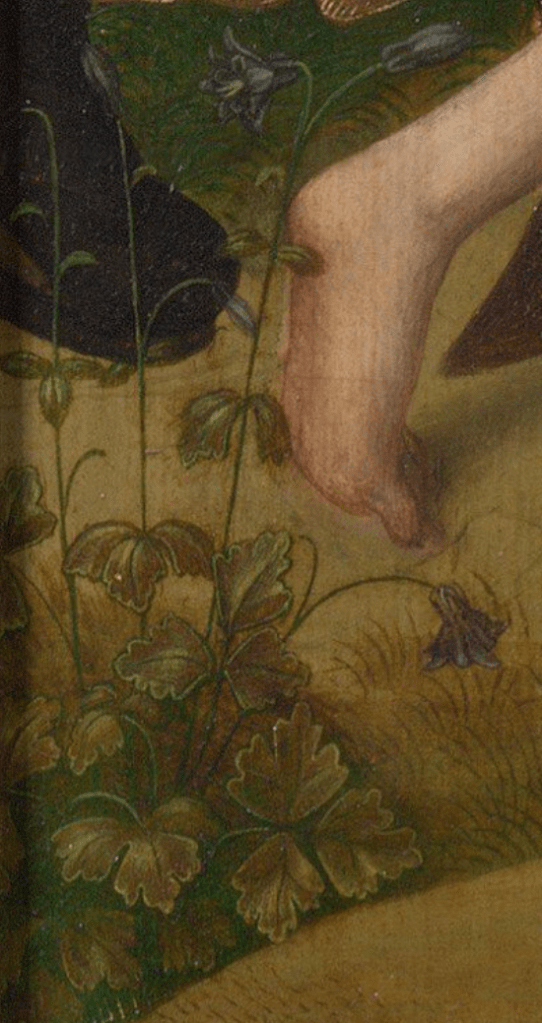
… and there are plenty of flowers growing beautifully here to underline that point. Brother Conrad’s humility is such that he does not even seem to be wearing sandals: the hem of his habit falls over his heels, but this leaves his unshod toes clearly visible. The woodland is beautifully structured. Further back, and to the right of Brother Peter’s tree is another, and at the same distance back and to the right we see a third stand of trunks. Then to the right, and coming forward is fourth.

Coming forward and to the right again we see Brother Conrad – he is as sturdy (in his faith) as these trees growing in the wood, and he kneels between that fourth clump and the Cross, which is itself often described as the ‘Tree’ on which Jesus died – with Jesus as the fruit of the tree.

If we look back to the whole image, we can see that these trees are arranged in an unmistakeable ‘V’ shape, leading back into the woods from Brother Peter, and then forward to Brother Conrad. It is one of the devices which emphasizes the distance between to the two friars. Not only are Peter and Mary at the extremes of the painting (although Spartali makes sure that both Mary and Jesus are higher than Peter), but this ‘V’ creates an open space in the middle of the painting. I do not think it is a coincidence that the diagonal formed by the heads of Mary, Jesus and Conrad lands at the base of the painting directly beneath the central cluster of trees, the point of the ‘V’.

It is just to the left of this central growth that the brightest elements of the distant landscape can be seen – the sky around a church on the horizon. This helps to tells us the extent of Conrad’s devotion. Not only is the church well lit – the source of his enlightenment – but it is also far: in his humility he has retreated far from the world, not wanting his prayers to be witnessed, or to ‘show off’ the strength of his belief. As a result, he has been duly rewarded. The expression on Peter’s face also reminds us that, as the story tells us, he ‘felt in his soul exceeding sweetness and consolation’ – although I can’t help thinking that Spartali has also added in a little hint of guilt, acknowledging that perhaps he really shouldn’t be there spying on his Brother.

I think this image is remarkably beautiful, telling a charming story with clarity and delicacy – both in terms of emotional truth and detailed naturalism. It has all the hallmarks of the Pre-Raphaelite ‘greats’ – but sadly, the artist is little known. Having trained with Ford Maddox Brown, Marie Spartali – part of the Greek business diaspora in London – married the American journalist William Stillman against her father’s wishes. When Stillman was posted to Florence, she inevitably went with him, and there they lived from 1878-83, socialising with the Anglo-American ex-pats, among whom the most interesting must surely have been John Singer Sargent. From ’86-’96 they lived in Rome (I’m not sure where they were in between!), and in 1892, when today’s picture was painted, they spent some time near Perugia – and so not far from Assisi where St Francis himself is buried. In all that time she continued to visit England, and to send paintings around the world, often – like Evelyn de Morgan, who I wrote about way back in April 2020 (see Day 41 – Night and Sleep) – supporting her husband with the income from her sales. There would have been plenty of opportunities for her to see art, and to be inspired – and there are many influences on this painting, as there are for any good artist who will acknowledge their work as part of a greater whole. The story itself is not so terribly far from the story of the stigmatisation of St Francis, which took place at Mount La Verna, in a ‘secret and solitary place’, according to St Bonaventura. On that occasion St Francis was accompanied by Brother Leo, and although Leo was not physically present, but nearby, he gave the first account of the stigmatisation, and many artists paint Leo as if he were in full sight when it happened. Spartali could have seen the fresco by Giotto in the Upper Church in Assisi, although I am showing you the version by Domenico Ghirlandaio from Santa Trinità in Florence (1483-5). Not only is the format similar to that of her painting, but in other works she seems to draw on Ghirlandaio for details of renaissance clothing.

The wooded landscape itself is derived from Giovanni Bellini, and his Assassination of St Peter Martyr (about 1505-7) – presented to the National Gallery by Lady Eastlake in 1870: Spartali could easily have seen it there.

Giovanni Bellini The Assassination of Saint Peter Martyr about 1505-7 Oil on wood, 99.7 x 165.1 cm Presented by Lady Eastlake, 1870 NG812 https://www.nationalgallery.org.uk/paintings/NG812

And the last thing I would suggest is a source for the rather precarious way in which Mary holds Jesus. I am sure it is inspired by a Botticelli in the Palazzo Pitti – again, somewhere she is bound to have visited while she was in Florence. In this case Jesus embraces his cousin John – and it is as if Spartali ‘wound back’ the event (as well as reversing it), to depict the moment just before the child was lowered into Brother Conrad’s arms.

Two last images: the first, a portrait of Marie Spartali-Stillman by Ford Maddox Brown (1869, Private Collection). He is said to have had an unrequited passion for her, but I really can’t speak to that. He does, however – unlike many other male artists painting their female colleagues – show her as a competent, practicing artist. She sits beside her easel on which we can see one of her own works, her palette and mahl stick leaning up against it. This is, to my mind, one of her early works, The Lady Prays-Desire (1867, Private Collection) – the other image I have posted. However, some people wonder if the painting on the easel could be her first publicly exhibited work, Korinna (also 1867, now lost), but I really can’t believe that she would have replicated this precise chin-on-curled-finger pose in two contemporaneous images. Nor that in both the centrally-parted red hair would have been held back by black ribbons.

This is a good place to leave her. After all, she said, ‘it was Madox Brown who encouraged me to become an artist and who taught me to paint. I can never feel sufficiently grateful for his having given this immense interest to my life’. We will look at the work of two of his other students – his daughters – on Monday. If you would like to know more about Marie Spartali-Stillman, I can recommend the catalogue of the National Portrait Gallery’s exhibition Pre-Raphaelite Sisters. There is also a catalogue to an exhibition held at Delaware Art Museum in 2015, Poetry in Beauty: The Pre-Raphaelite Art of Marie Spartali Stillman, although this is now only available second hand at considerable expense. If you want to do some homework for Monday’s talk – or reading afterwards – the catalogue Uncommon Power has a number of thoroughly researched and well-written essays on various aspects relating to the Maddox Browns and female artists in Victorian England. Or you could just join me on Monday!
146 – You’ve been framed

Rembrandt van Rijn, Portrait of Nicolaes van Bambeeck, 1641. Musées Royaux des Beaux-Arts, Brussels.

At the end of last week’s talk I said that the Royal Collection contained some of the best portraits ever painted. I’m not going to talk about them today – I will leave that until Monday, as they are included in the exhibition Masterpieces from Buckingham Palace, which will be the subject of this week’s talk. There will be more portraits – of a very different type – in the following week as well (Monday 31 January), when we move on to consider a pair of Pre-Raphaelite Sisters who painted, according to one contemporary critic, with Uncommon Power. Thank you to those who were there last week – and for those who were not, my problem with Constable’s rainbow has finally been solved. I’m now assuming that everyone else knew what was going on – but as Stephen pointed out to me in a comment on last week’s post, ‘isn’t it simply that the sun sets at around 310 degrees around the summer solstice, so a low sun (the rainbow appears ‘tall’) would be in the right place to form this rainbow?’ Yes! Of course! Why didn’t I think of that, and why did no one else tell me?! Having learnt as a child that the sun rises in the East and sets in the West, I have never moved it from these fixed points – despite being aware of the declination of the Earth. Sunrise and sunset are only due East and due West on an Equinox. So, my end of term school report would be, ‘Physics: fine; Geography and Astronomy: poor’. Even the Physics turned out to be ‘not so good’, which is one of the reasons why I am now an Art Historian! Enough. Time to move on. Today I am going to look at a portrait which is not entirely unconnected to those in the Royal Collection – Rembrandt’s painting of the wealthy wool merchant Nicolaes van Bambeeck.

Soberly dressed, as good citizens of Amsterdam were wont to be in the 17th Century, with a black hat and cloak, the painting is perfectly presented in a black ebony frame, itself beautifully carved, and highly polished. Bambeeck himself looks entirely serious, as sober as his monochrome outfit, all black and white – with the exception of the calf-skin (?) gloves. These harmonise with the sandy-coloured background, the stone of the pilasters seen on the right, and the diffuse golden light which illuminates the sitter with a healthy glow. His starched collar shines brightly in its puritanical whiteness, and the same stiff cleanliness must surely also apply to the two cuffs, although we can’t be certain as they are painted in different depths of beautifully graded shadow. However, sober as he appears here, Bambeeck was not always so serious. He was also depicted as the Ensign (or flag bearer) in one of the many groups of voluntary city guards which existed in The Netherlands at the time, The Company of Captain Reinier Reael and Lieutenant Cornelis Michielsz Blaeuw.

Bambeeck is the one on the far left – holding the flag – with Reael and Blaeuw sitting next to him. This group portrait is one of many such images, a genre in its own right in The Netherlands, and in most of the paintings the sitters are – how can I phrase this politely? – well, they have far fuller figures. As a result, this particular group has come to be known as The Meagre Company. It was commissioned from Frans Hals in 1633, but he didn’t like the idea of travelling to Amsterdam (from nearby Haarlem) in order to paint it. A long dispute ensued, and after three years the Company hired Pieter Codde to finish the work. Bambeeck’s was the only figure Hals completed in its entirety. Although the Haarlem master planned the whole painting, and executed some of the portraits, and a few of the fabrics, it gets less like his style the further to the right you go.

That this is indeed Bambeeck can be seen by comparing details from the paintings by Hals and Rembrandt.

The angle of the face is slightly different, but that is nothing compared with difference in temperament. Hals gives us a smug, fashionable socialite, Rembrandt a contemplative scholar. But that nose is unmistakable – long, with a rounded, but almost beak-like tip, coming down below the nostrils, with a kink in the bridge.

So who was Nicolaes van Bambeeck, other than an embodiment of the styles of Holland’s two leading painters? Well, his family had originally come from Flanders, but fled to Holland after Nicolaes’s grandfather was executed by the Duke of Alva in Brussels in 1568. Alva had been sent by Phillip II of Spain to crush the rebellion in the Low Countries, but his heavy-handed tactics – exemplified by executions such as that of Bambeeck grand-père – led some of the Netherlandish provinces to break away from Spanish rule, resulting in the Eighty Years War and the establishment of the Dutch Republic as an independent nation state in 1648. Bambeeck’s father – also Nicolaes – married in Leiden in 1598, and moved to Amsterdam, where he died in 1615, leaving mother as the richest woman on her street. Nicolaes himself married in 1638, and at first the couple lived with his mother-in-law, in a house which just happened to be diagonally opposite Rembrandt’s. Within two years, they were well enough acquainted for Bambeeck to lend the artist money. He also lent money to Gerrit Uylenburgh, an art dealer, son of Hendrick (one of Rembrandt’s business partners) and cousin of Rembrandt’s wife Saskia. It was a close-knit group.

Bambeeck’s money came from trade – he was a cloth merchant, dealing mainly in Spanish wool, although he doesn’t seem to be showing off the latter in either of these portraits. But then, as I said last week, I’m not an expert on clothing.

Nevertheless, the focus in the portrait – by dint of the brilliant illumination – is the cotton collar, starched and smooth, with sharp pleats to give it its form, and minutely stitched hems. It is trimmed with copious quantities of lace. Collars had been fashionable since the 1630s, taking over from the ruff as they allowed for longer hair (as we saw when looking at Hals a few weeks back) and lace was always in favour. It may have been modestly coloured, perhaps, in chaste white, but it was hugely expensive, both to make and to clean. Note the way that, over the left shoulder (on our right), the edge of the lace just curls up and catches the light, not so very far from the signature at the top right of this detail.

The space itself is poorly defined – but then, excessive detail would distract us from looking at the sitter. Bambeeck’s face is at the height of some architectural detailing, part of two pilasters which mark a corner of the space in the background at the right. This is precisely where Rembrandt chose to paint both signature and date (1641). The whole is contained by the sober black frame – perfectly matching the blacks and greys of the costume – and just catching the light thanks to its perfect polish. The sitter wears his right glove, but has taken off the left one, and holds it in his right hand, allowing us to see his sophistication and elegance (gloves were that significant), but also, from the condition of his hand (if we could see it – sorry) that he is not a manual labourer, but a successful businessman who never needs to get his own hands dirty. He rests his right arm on a parapet – much as Rembrandt himself does in his Self Portrait at the age of 34 (which also has a semi-circular top), or for that matter, like the subject of Titian’s Portrait of Girolamo (?) Barbarigo, which was Rembrandt’s source for this motif, after he had seen the painting on the art market in Amsterdam. Both paintings are now, coincidentally, in the National Gallery in London.

But why did I trim the detail to cut off Bambeeck’s hand like that? Well, because it is precisely at this point that the painting gets truly interesting. He is resting his right arm on the parapet, yes, and he rests his left hand on it too. But is this really a parapet? And if so, of what is it made?

Well, it’s not a parapet at all. It is a picture frame – a beautifully polished black ebony picture frame. We see three glints of light reflecting off it in the bottom left-hand corner, defining its inner edge and two mouldings. But this is not the actual picture frame, as the edge and one of the mouldings are interrupted by the hem of Bambeeck’s satin cloak with its black lace trim, and then by the fingers of his empty left glove, which also cross the lower moulding. In the right corner the reflections are not so bright – although the form of the frame is still perfectly defined. The fingers of the subject’s left hand curl around it. The surface of the painting has dissolved, and the transition between our space and the space occupied by Nicolaes van Bambeeck becomes invisible – he is here with us, in one of the most brilliant trompe l’oeuil games that I know. He really could reach out and shake us by the hand (although maybe we would prefer it if he took the other glove off first). All of this should make you realise – if you hadn’t before – that the light glinting off the frame at the top right is not reflecting off the frame at all, as it is, of course, part of the painting.

The capital of the pilaster on the fictive frame sits just above the architectural detailing in the background. The bright white reflections draw our eyes towards them, and the upturned brim of the hat also seems to point the way. Just below this, this most bravura display of skill, is where Rembrandt tells you who he is, as if to see ‘Look at this! See what I can do!’ And of course, this is just above the subtly illuminated section of curling lace. ‘Put your name by the best bit’ – something else he could have learnt from Titian. The brilliance of the illusion is the result of Rembrandt’s ability to make paint look like polished ebony. This is precisely why paintings like this really should always be seen in their frames – even virtual reality can’t create such an effect: see how well the painted reflections match the reflections from the three-dimensional frame. From a photograph it is still hard to work out exactly which is which.

I said earlier that, three years before this was painted, Nicolaes van Bambeeck had married, but I didn’t tell you to whom. Her name was Agatha Bas, and she was the daughter of the mayor of Amsterdam, arms dealer Dirck Bas. Together with today’s painting Bambeeck commissioned a portrait of his wife as a pendant, and below you can see a detail from it: it is, of course, one of the Treasures from Buckingham Palace which I will be talking about on Monday. The two portraits seem to have stayed together until at least 1802, but by 1814 they had been separated. I shall reunite them in a few days’ time, when we will see what equivalent surprises Agatha has up her sleeve. Or rather, just beside it.
Return to the Rainbow

John Constable, Salisbury Cathedral from the Meadows, 1830-31. Tate Britain, London.

I’ve been meaning to come back to this painting for a long time, having originally written about it in May 2020 as Picture of the Day 47, and now is the time to do it, given that I will be talking about the Royal Academy’s Late Constable exhibition this Monday, 17 January at 6pm. Today I am basically just re-posting an old blog, but I needed to correct a mistake I made, which is all the more embarrassing, because somewhere, in an admittedly obscure publication, I committed this error to print. But more of that when we get there. After Late Constable, I will move on to Treasures from Buckingham Palace and then some Pre-Raphaelite Sisters but there are more details about them on the diary page. Or there will be. Soon. I’m a bit busy… Meanwhile – what was I thinking about Constable near the beginning of the pandemic? Let’s have a look (queue the ‘going back in time’ music…):

Sometimes a painting is asking to be talked about. I heard on the radio – yesterday morning I think it was – that the foundation stone of Salisbury Cathedral was laid on 28 April 1220 – 800 years ago last Tuesday. This, in itself, made me think about today’s painting, but then I was reminded of it again yesterday while writing about the Pathetic Fallacy (Picture Of The Day 46). Having said that, it was already in my mind, I suppose. Last week I was challenged to include three words in my blog – ‘crepuscular’, ‘vicissitudes’ and ‘antidisestablishmentarianism’. I succeeded with the first two in POTD 41 and 42. This is the only painting I can think of for the third.

Salisbury Cathedral from the Meadows 1831 John Constable 1776-1837 Purchased by Tate with assistance from the National Lottery through the Heritage Lottery Fund, The Manton Foundation and the Art Fund (with a contribution from the Wolfson Foundation) and Tate Members in partnership with Amgueddfa Cymru-National Museum Wales, Colchester and Ipswich Museum Service, National Galleries of Scotland; and Salisbury and South Wiltshire Museum 2013 http://www.tate.org.uk/art/work/T13896

On October 23, 1821, Constable wrote to his friend, John Fisher, saying that, ‘It will be difficult to name a class of landscape in which the sky is not the key note, the standard of scale, and the chief organ of sentiment’ – by which he meant that the sky would set the emotional tone of the painting. This is, as close as you could reasonably want, a statement acknowledging something that would not be named for another 35 years: the Pathetic Fallacy. It was defined, and discussed at length, by John Ruskin in the third volume of his Modern Painters, published in 1856. We use the word ‘pathetic’ in such a different way now. Back then it was related to feeling, as in pathos, and not to being weak. It was a mistake, or fallacy, Ruskin said, to attribute feelings (pathos) to inanimate objects – such ideas would be the imaginings of an unhinged mind. However, he did go on to say that, poetically speaking, this was not a bad thing, as long as the emotion it produced was genuine: ‘Now, so long as we see that the feeling is true, we pardon, or are even pleased by, the confessed fallacy of sight, which it induces’. Even if it gets the name of an error, the Pathetic Fallacy is one of the essential tools of the artist’s – and poet’s – craft.

It came into play a decade after Constable’s letter, when he worked on this particular painting. His wife Maria had died in 1829, and Fisher wrote to him suggesting that he might want to paint Salisbury Cathedral as a way of occupying himself during his grief – effectively a form of therapy – saying, ‘I am quite sure that the “church under a cloud” is the best subject you can take’. 

Before I go any further, I should clear up a potential source of misunderstanding. Constable had two friends called John Fisher, one of whom was also a patron, and both of whom lived in Salisbury. One, the patron, was Bishop of Salisbury, and the other, with whom Constable corresponded more regularly, and in whom he confided, was the nephew of the Bishop, and was an Archdeacon at the Cathedral. This can only have led to confusion in the 19thCentury, and it still does today.

Constable’s letter of 1821 had been written after a summer of ‘skying’, as he called it – going out onto Hampstead Heath and painting the sky, so he could get better at it, and it would become easier, and more natural for him.  He was already familiar with the weather. He was the son of a corn merchant who owned mills, and young John often had to man them himself. You need to know when a storm is coming, because if you don’t disable a windmill it could be destroyed. As a result he was entirely adept at reading the weather. By the autumn of 1821, he was also adept at painting it. He favoured a contrast of light and dark, of blue sky and cloud, so that the ground itself would be a patchwork of sunlight and shadow. But the sky in today’s painting is more than usually stormy: he really does seem to have taken Fisher’s suggested title, the “church under a cloud” to heart. Indeed, so bad is it, that lightning is striking the roof of the North Transept – the part of the church to the left of the crossing if you are looking at the High Altar.

Salisbury Cathedral from the Meadows 1831 John Constable 1776-1837 http://www.tate.org.uk/art/work/T13896

Is this an autobiographical reference? I would say ‘yes’, particularly given that Fisher had suggested this very subject in his letter of August 1829. But other things were going on at the time, things in which both Johns – Constable and Fisher (Jr) were particularly interested. In 1829 the Catholic Emancipation Act was passed, and both thought this might pose a threat to the Church of England, the Established Church. Not only that, but debates were already underway for what would become the Reform Bill of 1832, one result of which was to give the vote to a large number of nonconformists. Another threat, perhaps, to the Established Church. Indeed, one subject for debate was that the church should actually be disestablished, a notion strongly contested by both Constable and Fisher, who were both ardent supporters of antidisestablishmentarianism. The church was under more than one cloud. In the painting it appears as a physical storm, with lightning striking the roof of the church. Constable himself was undoubtedly going through ‘Stormy Weather’ after the death of his wife. And ‘The Church’ as a whole – not just this building – was going through its own political storm, a result of changes in political thought. Would the Established Church survive? 

The answer would seem to be given to us by the rainbow. As we saw in POTD 37 the rainbow is a symbol of hope and optimism, given to Noah as a sign of God’s covenant that he will never again destroy the earth, as he had with the deluge. Constable acknowledges this symbolism, and with it, tells us that not only will he personally be alright – he will survive his grief – but also that he knows that the church will ride the political storm. However, the rainbow was not part of Constable’s original plans for the painting: it was not in his first sketches. It is an idea which came to him later on. It is certainly not something he witnessed first hand. No one ever has – nor ever could. [Or that’s what I thought when I first wrote this post – and I’m going to leave the next paragraphs so you can see what I said first time around…]

Salisbury Cathedral from the Meadows 1831 John Constable 1776-1837 http://www.tate.org.uk/art/work/T13896

How can I be so sure? Well, it comes down to the geography of the church, which is, as churches should be, orientated: the altar faces the East (POTD 38). The North Transept sticks out to the left of the building – where we see the lightning strike – and the façade of the Cathedral that is so clearly visible (Constable was a master at manipulating light) is at the West End. The rainbow forms an arc of a circle (following the science of optics it cannot do otherwise), which appears to stretch from Northeast to Southwest, given that it cuts across the Cathedral on a diagonal. I don’t know if you know this, but you only get a rainbow when it is both rainy and sunny, and if you are looking at a rainbow, then the sun must be behind you. The sunlight travels over your head into the rain, and the light reflects back from the back of the raindrops. As it enters and leaves each raindrop it is refracted, each wavelength of light being refracted by a different amount, thus splitting white light into a rainbow. The light then comes back towards you, and makes it look as if the rainbow is in front of you. Here’s a diagram, thanks to the Met Office:

So, if we are looking at the rainbow as Constable has painted it, the sun must be behind us, i.e. in the Northwest. But Salisbury, and indeed, the whole of Europe, is in the Northern hemisphere, and so the sun never gets anywhere that is not South. It is impossible to see a rainbow in this position. But that doesn’t matter. This isn’t science, this isn’t a photograph, this is art – and the rainbow expresses hope. After all, the spire of the Cathedral passes in front of the darkest area of cloud and then up into the light. Again, this is a symbol of optimism.

Nowadays Salisbury Cathedral has gained something of a reputation as the must-see building for any self-respecting Russian spy, and they are not wrong – it is a fantastic building. The spire is the tallest in the country, and the cloister and cathedral close are also the largest in the land. The main body of the church is remarkably coherent stylistically, having been completed in a mere 38 years – not long for a building of this size that was started 800 years ago. It is well worth the visit, and, once we can travel again, I would recommend that you go. We are all “under a cloud” at the moment, but like Noah, like Constable – and like Salisbury Cathedral – we will get through it. 

By the way, Constable was not being careless when he chose to paint the rainbow here. It’s worthwhile remembering that other myth about rainbows – that there is a pot of gold at its end. Even if this is, in itself, unscientific (were there no ground in the way a rainbow would form a complete circle, and so it wouldn’t have an ‘end’) there isn’t gold at the end of this rainbow, but lead. Or rather, a house, called Leadenhall. Which is precisely where Archdeacon John Fisher lived. I’ve said it before: art is alchemy, turning base metal into gold. Constable is not only showing us his gratitude to Fisher, he is also reminding us where true value lies. The gold at the end of the rainbow is friendship.

OK – so that’s what I said back in April 2020. But compare and contrast the following:

When I set up these blogs I see the images in a certain way, but I know that sometimes they shift: I do hope you are seeing them side by side. I am incredibly grateful to Brian Plummer – a resident of Salisbury and one of the trustees of the Salisbury Museum – who both took and sent me the photograph on the right. Clearly Salisbury has changed a bit in the last two centuries, but this is the cathedral seen, if not from exactly the same place, at least from exactly the same angle. To the right of the lamppost, and just above the trees, you should be able to see the very tops of the pinnacles of the façade, which is in the same relationship to the spire as it is in the painting… and a rainbow can be seen very clearly arcing around them. I still can’t entirely explain how this is possible! The physics are right (in case you didn’t know, I was an entrance scholar in physics when I went to university…), and the Met Office diagram confirms the fact: if you are looking at a rainbow then the sun must be behind you. Or rather, if you are looking at the centre of a rainbow while facing it flat on, the sun must be behind you. But you could then turn away from it, and still look over your shoulder to see it… the sun wouldn’t be behind you then. That’s not a very good explanation, but it must be something like that. We humans don’t exist as infinitesimal points in space, after all, and we also have a tendency to move around and look all around us as we go. It doesn’t get away from the fact that Constable would never have stood outside painting one of his ‘six footers’ in the rain, nor does it take away from the idea that the rainbow in his painting is primarily a symbol. He may well have seen a rainbow here, or hereabouts, and then adjusted it to curve so beautiful around the other forms in the composition to land on Fisher’s house…

As it happens, this painting doesn’t make it to the Late Constable exhibition, although a sketch of it does. I am looking forward to talking about it on Monday. And I’m looking forward to going back to Salisbury (I still haven’t made it since the lockdowns) to try and work out precisely how this is possible.
145 – Me, myself, and I?

Laura Knight, Laura Knight with model, Ella Louise Naper (‘Self Portrait’), 1913. National Portrait Gallery, London.

Happy New Year! And as this is the first blog of the year, let us start with a woman who could count several ‘firsts’ to her name: Laura Knight. Or, if you prefer, Dame Laura Knight: in 1929 she was the first female artist to receive this honour. Seven years later, she was also the first woman to be elected to full membership of the Royal Academy, and in in 1965 she was the first woman to have a solo exhibition there. I will be talking about her more this Monday, 10 January, as an introduction to the MK Gallery’s exhibition Laura Knight: A Panoramic View. Further talks in January will include Late Constable, some Masterpieces from Buckingham Palace and a pair of Pre-Raphaelite Sisters of Uncommon Power. As ever, the details of all of these – and other things – are on the diary page. I am also hoping to deliver some in-person visits to London museums and galleries, focussing on the National Gallery where I am most at home, but I think I’ll wait for Covid numbers to calm down a bit before I start, so… maybe in February? Watch this space! But whatever follows, let’s look at a rather brilliant painting.

It’s a remarkably original choice for any artist – a self portrait seen from behind: she is focussing on what she does, not what she looks like. Knight appears sensibly dressed, with a mid-length red jacket over a grey skirt, and what I would interpret as a striped foulard around her neck (although, as you probably realise, I am not an expert on women’s dress). As it happens, it’s not a jacket, per se, but a favourite cardigan, which she called ‘The Cornish Scarlet’. She had bought it at a jumble sale in Penzance for half a crown (or 2/6, or 12.5p, depending on your age), and it appears in a number of her paintings. Nowadays it would be classed as ‘vintage’ and cost a whole lot more. She also wears a black hat with a colourful ribbon almost hidden by the upturned brim: all respectable women should wear a hat when in public. Her hair appears to have been plaited and pinned up. If she hadn’t turned her head to the right, we wouldn’t be able to tell who she was – and it is not clear why she has turned so far: certainly not to look at the model, as she looks past her, to something out of the frame. She is holding a paint brush in her right hand, and, from the bend of her left elbow, we can imagine that she is holding a palette in her left. The model, who is completely naked, stands with her back to us on a striped rug, which is itself on a raised platform. While her feet are more or less parallel to the picture plane, she is turned to the left, allowing us a partial view of one breast. She raises her arms around her head, with her right and left hands resting on her hair and right arm respectively. Behind her is a red screen – maybe a folding screen, although the right-angled section to the left has a trim not seen in the plain vermillion area behind her – this could even be a brighter cloth hanging over the screen, but the construction is not entirely clear. In front of it, though, to the left, and behind the image of the artist, is the canvas that Knight is currently working on. Having seen the model herself, here we see her painted image, and, to the left of her, the part of the red screen that the artist has completed so far.

The inflection of Knight’s right wrist means that her hand is held away from her hip, so that she will not get paint on her skirt. It also serves to draw attention to this hand, and to the gold ring on the fourth finger. It looks like a wedding band, even if it is on the right hand (I don’t think she was looking in a mirror to see what her own back looked like: the clothing itself does not reflect her appearance, and she may well have got someone else, possibly even the same model, to model for the back – so I don’t think that this is her left hand as seen in a mirror). She was born Laura Johnson in 1877, taking her husband’s name when she married artist Harold Knight in 1903, at the age of 26. They were both born in Nottingham, and met at the Nottingham School of Art, where Laura’s mother taught.

In some of her early works she experimented with the pointilliste technique of George Seurat, and she continued to return to it when it suited her – as it does here in the separately coloured brushstrokes which define ‘The Cornish Scarlet’. In this case, the brushstrokes are perhaps closer to the Impressionist tache (meaning blot, patch or stain) – a short, broad mark which emphasizes the making of the image. The brushstrokes do not allow us to confuse the painting of the cardigan for the thing itself, it is undoubtedly a painting. What you are looking at, the brushstrokes say, is the work of an artist. How appropriate that she uses this technique as part of her own image, given that she is the person who made it.

If the depiction of herself – or at least of her clothing – focusses on colour, the depiction of the model is all about form. Look how the precise tonal shifts tell us the exact structure of the feet, the slight lift of the right heel from the rug, the width of the Achilles tendon, and the structures of the muscles and the backs of the knees.

Looking at this detail I am more convinced that there is a cloth hanging over the screen – the vermillion appears to wrap around the dark frame. And the painting of this cloth is entirely different to that of the cardigan – extremely ‘painterly’, with long, broad, flowing brushstrokes painted wet-on-wet and blending in with each other. Although not part of the image that she has painted of herself, the use of a different ‘style’ of painting is surely another way in which she is inviting us to enjoy her skills as an artist, demonstrating as it does her ability to choose the brushstroke according to the nature of the material she is representing: here the vermillion cloth is broad, and flows downwards, just like the paint. The subtle but precise modulation of flesh tones continues, defining the curve of the spine and flexion of the muscles, as well as delineating the model’s long, slim fingers. Compared with the impressionistic image seen in Knight’s unfinished painting of the model, this might start to appear like photorealism – but the brushstrokes never let us forget that it is a painting. The canvas she is working on is still clearly unfinished, though. She may have started to paint the model’s shadow on the screen, but not the lit area: the white background remains, and is precisely what allows Knight’s bold profile to stand out so clearly.

When first exhibited in 1913, at the Passmore Edwards Art Gallery in Newlyn, Cornwall (where the Knights were then living), this self portrait – then called The Model – was well received. But later it was apparently turned down by the Royal Academy for their Summer Exhibition, and instead was seen in London at the Grosvenor Gallery, where reviews were mixed, to say the least. The Telegraph Critic, Claude Phillips, called it ‘harmless’ and ‘dull’ (which it is not!) – but he seems to have been in two minds, as he also called it ‘vulgar’, saying that it ‘repels’. As a work which, he had decided, was ‘obviously an exercise’, he thought it ‘might quite appropriately have stayed in the artist’s studio’. So what was his problem with it?

I think that if we focus on this central section we might get a good idea. One of the first things to remember was that women had little or no access to life drawing classes. At Nottingham, the men and women (or girls – Knight studied there for around six years from the age of 13) had been segregated, and the women did not draw from the nude. The model in this painting is Laura’s friend, and fellow artist in Newlyn, Ella Louise Naper. So for one thing, this is a bold statement declaring that women should receive the same education as men. However, the way it is painted also creates some surprising juxtapositions. The light comes from the left – you can see Naper’s shadow on the screen to her right – and, given that Knight turns to the right, her profile is entirely in shadow. However, it still stands out clearly thanks to the brightly illuminated canvas. The negative space created by the artist’s profile – the brilliant white patch of canvas – is similar in form to the equivalent area in red around the model’s left side, with a startling echo from Knight’s nose to Naper’s breast. And, as Naper is standing on a platform, her brightly-lit buttocks are more or less on a level with Knight’s shadowy face, surely enough to make any self-respecting (male) critic blush.

As a whole, the contrast between the two women is intriguing. One clothed, the other naked; one has both arms down, the other up; the artist on the left is turned to the right, the model on the right is turned to the left. Their poses echo each other, inverting only the arms, with Naper’s right arm hiding her profile. Laura Knight, despite the shadow on her face, is the one we can identify, but the various echoes and inversions could lead us to think about substituting one figure for another, reminding us, perhaps, that the artist herself could easily look like this if she weren’t wearing clothes. I suspect it is this that made men uneasy. It was one thing for them to paint naked women – they could tell the difference between artist and subject, but in this painting, the difference is not so clear. That, and the fact that Knight’s acknowledged skill was clearly a threat to their supremacy, of course.

One last question: what painting is Knight actually working on? We know that it is not finished, but we only see part of it. Nevertheless, what we do see is entirely consistent with the idea that the work she is painting is the finished self portrait itself, if we assume that we only see around 40% of it – the section which includes the vermillion cloth. Laura Knight herself is taking a break from painting herself painting herself painting a model – her painted image in this painted image is beyond the frame. Having said that, I do have a sneaking suspicion that she would finish the red screen first.

This complexly-conceived portrait is not in the exhibition in Milton Keynes, but there are many more remarkable paintings which are: do try and get to see them in person! But if you can’t, I will be talking about many of them on Monday. One of them – one of her masterpieces, I think – is Ruby Loftus Screwing a Breech-ring. As Zoom is not very good with videos I won’t be able to show you a wonderful newsreel clip from 1943, so click on the link in blue if you want to do some homework! If nothing else, it’s worth watching to see Knight being handed a cigarette by the presenter, and both of them lighting up in the Summer Exhibition itself. Not to mention, of course, how remarkably accurate her portrait of Loftus is. But more about that on Monday – I do hope you can join me!

144 – Make a joyful noise

Geertgen tot Sint Jans, The Glorification of the Virgin, about 1490-95. Museum Boijmans van Beuningen, Rotterdam.

I have a new favourite artist (those of you who follow me on Instagram might have noticed), although sadly a dozen of his works seem to have survived, maybe a couple more or less. This does mean that I can look at all of them when I offer Some Light for the Solstice this Tuesday, 21 December – the Solstice itself. That will be the last talk this year, and I’ll start again with Laura Knight on Monday, 10 January. That week, on the Thursday, I will also talk about Dürer and the Art of the Garden for my friends at Art History Abroad. As ever, as well as these links, details are (or in this case, will be shortly) in the diary. For those at the Dürer talk last week I said I’d come up with some book suggestions. Have a look at those listed on this UK Bookshop link – I’d recommend the book edited by Christof Metzger (the one with the big, coloured wing) and Jeffrey Chipps Smith’s volume in the Phaidon Art & Ideas series (white, with a Hare).

My new hero is none other than Geertgen tot Sint Jans, an artist whose name, which seems unpronounceable (unless you are Dutch, of course), must have contributed to his relative lack of fame. Well that, and the fact that so few of his works have survived, of course. We know almost nothing about him, but what there is I will go into on Tuesday. For anyone who has joined me recently after my talk for Members of the National Gallery, first of all: welcome! And then, yes, this is more or less the same talk, but somewhat edited, with extra added paintings – but you have heard most of it before! The focus for the talk will be the National Gallery’s Nativity at Night, but today I’d like to have a close look at what may be a small painting (it measures 24.5 x 20.5 cm, smaller than an A4 sheet of paper – or for that matter, smaller than US letter size, if you’re over there), but it is, nevertheless, one of the noisiest I know.
The painting is a Madonna and Child, a common-enough subject, but it is unlike any other I have seen, even if it does draw on familiar elements. Mary, dressed almost entirely in red, as she often is in the North of Europe, holds the Christ Child in her arms as they both look down to our left. They are surrounded by a brilliant glow of light which gradually diminishes in a series of concentric oval forms, leaving the corners of the painting in deepest darkness. Jesus truly is, in the words of Simeon during the Presentation at the Temple, ‘A light to lighten the Gentiles, and the glory of thy people Israel,’ (Luke 2:32). Neither the light nor dark is uninhabited, though – imagery is spread across the surface. Mary is poised on a crescent moon, although we cannot see how (this is a vision, after all) – it could be that she stands behind it, with her legs disappearing in the celestial effulgence. Her red robes fall over the moon, with a creature clinging on underneath. We are seeing how the Virgin Mary was associated with the Woman of the Apocalypse, ‘a woman clothed with the sun, and the moon under her feet, and upon her head a crown of twelve stars,’ (Revelation 12:1), the description which would be used to furnish the iconography for images of the Virgin of the Immaculate Conception (for a full explanation, if you still need one, see Picture Of The Day 71 and POTD 72). This was a doctrine particularly associated with the Franciscans (in the 15th Century at least, when this painting was made), although elsewhere in the painting there is evidence that it might be better associated with the Dominicans.

Mary does not wear a ‘crown of twelve stars’ though (this was interpreted as referring to the twelve apostles – or for that matter, the twelve tribes of Israel, between them representatives of the ‘gentiles’ and ‘thy people Israel’), but a very elegant, filigree, medieval crown which, in essence, is very similar to the Crown of an English Queen in the Munich Residenz. It rests on a garland of roses – a single red one at the front is then flanked by a number of white (five, maybe?) before another red, and so on, to form a ring – not unlike a rosary. Now, as it happens (though not by coincidence), to the left and right of the holy couple, in the middle, orange/red ‘sphere’, we can see an angel on either side who is holding a rosary. These are made of a number of red beads separated by larger white beads: the connection to Mary’s garland is made clear by the use of identical – if inverted – colours. There was a ‘Confraternity of the Rosary’ in Haarlem, the city in which Geertgen worked. He painted an altarpiece for them which is now lost, although the composition is known through copies: I may have time to look at those on Tuesday. Today’s painting could be another commission associated with that Confraternity, or with one of its members. We simply don’t know where it was until the middle of the 20th Century when it ‘appeared’ on the market in the States. However, the rosary was an aid to prayer specifically associated with the Dominicans. Indeed, Dominican belief was that that Mary herself had introduced the founder of the order to the concept, and paintings regularly show her – or Jesus – handing the rosary to St Dominic. These are all clues which could help us to work out the origins of this jewel-like piece, although, as yet, we don’t have the full story.
In the central ‘sphere’, yellow/gold angels place the crown on Mary’s head, and below them on either side their fellows – cherubim and seraphim – continue the eternal tasking of praying and praising, with their arms raised or hands joined in prayer. Immediately above the crown the orange/red angels hold banners saying ‘laus’ – Latin for ‘praise’ – although each iteration of the word has a line above it, the implication being that these are abbreviations. In this case the full word would be ‘laudamus’, or ‘let us praise’. It works with either reading, or, most probably, with both. Below them are the two angels holding the rosaries, and then two more holding two of the ‘instruments of the passion’ – the ‘tools’ used to torture Christ before and during his crucifixion. Easter is never very far away from Christmas. On the left we see the cross itself, and on the right, the column to which Jesus was tied for the flagellation. In the top left and right of this detail, we see the edges of the third ‘sphere’ with ethereal angelic forms in a deep violet lit with yellow. If you thought it was quiet in heaven, the angel at the top right holds a set of bagpipes. Now, I do love the bagpipes but (and here I must apologise to my Scottish friends) I love them more the further away they are. I live in Durham now, and I prefer the (slightly more local) Northumberland pipes. Opposite the bagpiper the angel plays a fife and drum – more stirring, almost military music, it would seem.

However, this is not an overall ‘theme’, which, in terms of music if nothing else, is inclusivity. Every possible instrument is shown. At the top we see a large shawm (although without its protective cylinder, apparently) and a lute. Going down to the left from these is a vielle (an early form of violin) and a ‘flat hand bell struck by a beater’ and then the ‘long pipe and snare drum’ which earlier I called the fife and drum – I’m quoting from an article by Emanuel Winternitz in the Musical Quarterly of October 1963. In the top left corner is an organ, with the organist joined by another angel who is pumping the bellows. At the top right is another keyboard instrument which Winternitz identifies as – possibly – a clavicytherium (whatever that is…). Next to this are an angel with a number of small bells hung from a string and another playing a harp. The bagpipes are below, and further down there is a curved trumpet.

Continuing down from here, on the left are a hurdy gurdy, an angel with a pair of claw bells and another with a ‘small clapper’, while going up on the right we can see ‘large clappers’, and a triangle hung with metal rings. The orange/red angels on the left hold the cross – we saw the top of it before – and, below that, the spear which pierced Christ’s side. On the right is the sponge with which Jesus was given vinegar during the crucifixion, and above this is the full length of the column. Clinging to the underside of the crescent moon we see the grotesque form of some sort of lizard, its mouth open hissing, its long, thin tongue flicking over the edge of the Virgin’s robes. As God says to the serpent in Genesis (3:15), ‘And I will put enmity between thee and the woman, and between thy seed and her seed; it shall bruise thy head, and thou shalt bruise his heel’. Mary is seen as ‘the woman’, and Jesus ‘her seed’: perhaps he has lifted his heel out of the way. But this creature is referred to again as the dragon over which St Michael and the angels were victorious: ‘And the great dragon was cast out, that old serpent, called the Devil, and Satan, which deceiveth the whole world’ (Revelation 12:9). A similar form clings to the underside of the rosary with which Veit Stoss frames The Annunciation in Nuremberg which I discussed back in May last year (Picture Of The Day 70).

At the bottom in the middle sphere are the crown of thorns (on the left), and, on the right, the three nails which were driven through Jesus’ hands (one nail each) and feet (one for both feet), together with the hammer used to commit this barbaric act. Below this, an angel holds two hand bells, but must be deafened by the coiled trumpets on either side. In the bottom left corner one figure plays the clavichord, while another kind soul (quite literally in this case) holds the music. The focus required to play the dulcimer – a stringed instruments struck by ‘hammers’ – is evident in the bottom right corner from the angel’s downturned face. Nearby was can also see a double shawm and a ‘pot’. I don’t know how this works, but it looks like the angel is jangling cymbals over a small cauldron, presumably a version of a kettle drum. In the centre, flying up from below, the last musician blows a cromorne, which Wikipedia defines as ‘a French woodwind reed instrument of uncertain identity’. It certainly requires a lot of puff: look at his cheeks!

Notice how, for the outer sphere of angels, the music continues all around, and for the inner sphere there is a similar continuity of prayer and praising. For the middle sphere, though, there is a difference between top and bottom, a division between ‘good’ and ‘evil’. The top four angels hold the banners saying ‘praise’ and/or ‘let us praise’, with a threshold marked by the pair holding the rosaries. Below them are the instruments of the passion, curving down beneath the moon into the zone of the dragon. The way to heaven is through prayer, assisted by the rosary, and this leads us upwards towards praising.

At the centre of it all, Jesus is also part of the music. He has a claw bell in each hand, holding them delicately between thumb and forefinger, each one shining with a silvery light reflected from above. He may be lifting his heel away from the ‘old serpent’, but he could equally be dancing for joy – one leg kicked up, arms swinging from side to side, wriggling with delight. He and his mother, as I have said, look down to our left, but why down there? Well, surely they are looking towards the angel who returns their gaze, the angel who is also playing claw bells. Jesus is leading the way, encouraging the music, conducting even, the source of all the joy and light, the origin of the harmony of the spheres, and all this for the glorification of his own mother. Similar bells can be seen hanging from a cradle in the collection of the Musée Cluny in Paris, dated to the beginning of the 16th century, no more than two decades after this beautiful image was painted.

Bells were used as talismen, as it was believed that their ringing would keep infants safe from evil spirits, as well as imitating the music of the angels at the Nativity. But this is no normal cradle – it is called a Berceau: repos de Jésus, and is neither the cradle of a normal, human baby nor a toy. It is a sacred object, a sculpture, probably made for a nun, to encourage her devotion. Writings recommend that the owner should think of the cradle as their heart, a place where Jesus should safely repose, with the pillars that support it on either side representing the Old and New Testaments. As you rock the Christ Child in his cradle (sadly, if there was an ‘original’ figure, it has gone) the bells would ring. The angels look down from above, the child is safe, and so are our hearts. In the painting, however, it is Jesus himself who rings these bells – and leads the heavenly host in making the most astonishing sound, music like you have never heard. These instruments would never have been played together, the rough and ready with the more refined. As a whole, this must be a remarkable cacophony, but a positive one, a fulfilment of the invocation in the first verse of Psalm 100: ‘Make a joyful noise unto the Lord, all ye lands,’ with the operative word being ‘noise’!

Whatever your beliefs – and I, for one, put my faith firmly in art – I wish you a very happy Christmas, and look forward to the light on the other side of the solstice. For more of this artist’s delicate, detailed, and delightful paintings, please do join me this Tuesday.

 143 – A new Dürer

Albrecht Dürer, The Virgin and Child with a Flower on a grassy Bench, c.1503. Agnews, London.

It’s not every day that a new drawing by a great master comes along, nor that, when it does, you have a chance to buy it. Sadly, it might just be beyond my reach, but instead I will – and did – have a close look. It’s a perfect way to start thinking about one of the greatest German artists, about whom I will be talking on Tuesday (14 December) in an introduction to the National Gallery’s monumental exhibition Dürer’s Journeys. As ever, details of this and subsequent talks and travels are listed on the diary page of my website. I showed you this image last week, to give you more of a chance to go and see the original first hand at Agnews in London (6 St James’s Place), but as today (Friday 10 December) is the last day that you will be able to do this with any ease, if you haven’t been, by now I am imagining it will be too late.

A pity, it was quite magical to ring on the door bell, and be welcomed in. Along the corridor on the right a dark room opened up with this gem glowing on the opposite wall. The drawing shows the Virgin Mary seated on a grassy bench, effectively a raised flower bed, common to gardens at the time, if their frequency in religious paintings of the 15th and 16th Centuries is anything to go by. As a result, Mary is effectively seated upon the earth – or humus ­– implying that this is a form of ‘Madonna of Humility’ – and yes, ‘humility’ literally means ‘down to earth’. It is a standard form of iconography, although in its usual formulation, Mary shown seated on the ground. However, as the ground is raised in this example, it is also a version of another common image, the ‘Madonna Enthroned.’ Interpreted this way, the drawing is a rather clever elision of the two. This is not Dürer’s invention – a painting in the style of Martin Schongauer in the National Gallery, dated, rather broadly, 1469-91, demonstrates as much. However, it is a theme that Dürer returned to often: together with the ‘Schongauer’ I am showing you an engraving dated c. 1495 from the British Museum.

The bench is constructed, it would seem, from two planks – a relatively narrow one at the top, and below it a hefty slab of wood, sawn from an enormous trunk. They are held in place at either end by a post. Each is a humble affair, a short length of a modest branch – but the attention to naturalistic detail is superb. The upper plank is broken, and has been repaired, the curving edge of the break echoing the fall of the Virgin’s draperies.

Most unusually, the Christ Child’s body faces away from us, and he turns back to look at his mother over his right shoulder. With his left leg in front of his right, it is almost as if he is starting to walk away from her – but maybe I am just reading forward some two decades to when Dürer travelled to the Low Countries and saw Michelangelo’s Madonna of Bruges, in which Jesus is stepping down from his mother’s lap, while simultaneously clinging to her hand. Dürer’s child holds the long stem of a flower, undoubtedly a reference to the Passion, but it is evoked with such brilliant spontaneity – and so few lines – that there is no possibility of identifying which species Dürer intended it to be. Mary supports her son with her right hand, and he leans gently on it – or perhaps she is preventing him from leaving. She holds a cloth which wraps around her hand, under his arm and around his back, but she doesn’t touch his flesh – like a priest holding a monstrance. The other end of the cloth is held in her left hand – his swaddling clothes, perhaps, but also a foreshadowing of the shroud. Her left forefinger is marked with curious rings – curious, that is, until you realise (and it took me a while) that Dürer is telling us that the end of the finger is in the shadow, as is what we see of Christ’s face, the lower half of his back and his delightfully pudgy bottom, which seems to rest ever so softly against Mary’s fully-lit hand. Her head tilts to one side, as if musing on her experience, as she did after the visit of the Shepherds at the Nativity: ‘…Mary kept all these things, and pondered them in her heart,’ (Luke 2:19).

There are two faint, parallel, vertical lines on the left of the detail above, the one further left rising from the angular fold at the edge of Mary’s drapery, next to the grass. These are part of the watermark in the paper, vital for authenticating the drawing, as we shall see below.

You have probably read about it already, as there have been articles in much of the press and across social media. It was bought at a house clearance sale for $30, only later to be identified as an original, and authenticated by Christof Metzger, a curator at the Albertina in Vienna (which has one of the world’s best collections of drawings), who will include it in his forthcoming catalogue raisonné of Dürer’s work. There were various barriers to this identification, not the least of which was that it only cost $30 – how could it be the real thing for that price? And then, by the time it was bought it had been covered in a coloured wash, which might have been added to give a sense of aging to the paper, to make it seem more like an ‘antique’. This would be a clear sign that it was a forgery, made with the intention to deceive. However, this ‘wash’ has been successfully removed, and although the sheet was cut down at an unknown date, it is in a remarkably good condition. It is drawn with pen and ink on a fine linen paper which has a watermark made up of a trident – which explains the two vertical lines (a third is ‘behind’ the drawing) and a ball, or ring, an emblem used by the Fugger family in Augsburg who owned (among other things) a paper mill. There are more than 200 sheets of this paper used by Dürer which survive. The trident can be seen more clearly above the drapery in the lower left half of a drawing in the British museum, which I am showing you to the right of the Agnews version of the same subject.

The form of the signature – the monogram ‘AD’ – is almost identical, with the horizontal of ‘A’ and the ‘D’ doubled in both examples, and similar flourishes at the top left and right. Together with the similarity in the theme, this has suggested a date of c. 1503 for the newly-authenticated drawing.

What was the purpose of this study? It might have been Dürer playing around, trying out ideas – throughout his career he created over 100 images of the Madonna and Child in different media. Or it could have been him developing those ideas for a larger work. Agnews suggest that the Madonna with a Multitude of Animals (seen on the left below), which Metzger has dated to 1506, is one possibility, although, as far as I can see, the National Gallery’s Madonna with the Iris would be another. Although designed by Dürer, it seems to have been painted by members of his workshop while he was away in Venice. But I will talk more about that painting when I discuss Dürer’s Journeys this coming Tuesday.

In the meantime, Agnews will sell the drawing by private sale, not at an auction, so if you are interested you’d better get in there quick. You could see it this afternoon, if you can be that spontaneous, and you might even get in at the weekend, although as the National Gallery is hosting a Dürer conference the world’s experts would probably get in the way. It will then go on show at Colnaghi in New York from 20-30 January next year, so if you are Stateside you could see it there. One thing though – start saving now. It may have been bought for $30, but one estimate of the sale price is in the region of $50 million.

142 – Getting carried away

Nicolas Poussin, The Ecstasy of St Paul, 1649-50. Musée du Louvre, Paris.

On the whole I try not to get carried away by things, although, as I’m sure most of you know, my enthusiasm does mean that I rarely have the discipline to edit my presentations adequately – hence my now standard length of an hour and five minutes… I will try and keep them within the promised sixty minutes in future. Honest. My next attempt will be an introduction to Poussin and the Dance, on Tuesday 7 December, an entirely delightful exhibition at the National Gallery in London which dispels so many of the preconceptions people have about this, the most worthy of French (?) Baroque (?) masters. Not only will I explain those two question marks, I will also cover the full range of material within the exhibition, looking at the apparently effortless complexity of some of Poussin’s compositions, which is shared by the remarkable disposition of limbs in today’s painting. After that, on Tuesday 14 December, we will follow Dürer’s Journeys, another superb offering from the National Gallery, a talk which will also include a nod to the beautiful drawing currently for sale at Agnews (see below…). And there are other talks: full details are listed in my diary. But now it is time for some of us – or, at least, St Paul – to get carried away.

Poussin, NicolasFrance, Musée du Louvre, Département des Peintures, INV 7288 – https://collections.louvre.fr/ark:/53355/cl010062554https://collections.louvre.fr/CGU

A few years after his arrival in Rome in 1624, Poussin was commissioned to paint the Martyrdom of St Erasmus for St Peter’s, but this was to remain one of only a handful of church commissions. So few were they – and so out of tune was he with the Roman Baroque – that the entry on the website of the Met in New York goes so far as to says, ‘The large, theatrical saints in ecstasy and scenes of apotheosis so popular at the time clearly struck no responsive chord in Poussin,’ and yet it is precisely this sort of work – today’s painting, and an Assumption of the Virgin in the National Gallery of Art in Washington – which have always been among my favourites. They are completely airborne, not the earthbound, weighty things that his works, at their most stolid, can be – works which, I’m sure it goes without saying, do not include his elegant depictions of dance! We see St Paul raised aloft by three angels, his usual attributes of book and sword left behind, with the remarkable combination of legs, arms and wings (eight, eight and six of these respectively, although not all are visible) acting as a form of mandorla (Italian for ‘almond’), the shape in which the spiritual glow of an assumption or ascension is usually depicted.

The painting is an illustration of a passage from St Paul’s Second Epistle to the Corinthians, where, in Chapter 12, verses 1-5, he reluctantly describes one of his own visions:

12 It is not expedient for me doubtless to glory. I will come to visions and revelations of the Lord.
I knew a man in Christ above fourteen years ago, (whether in the body, I cannot tell; or whether out of the body, I cannot tell: God knoweth;) such an one caught up to the third heaven.
And I knew such a man, (whether in the body, or out of the body, I cannot tell: God knoweth;)
How that he was caught up into paradise, and heard unspeakable words, which it is not lawful for a man to utter.
Of such an one will I glory: yet of myself I will not glory, but in mine infirmities.

That this is St Paul is confirmed, as I have said, by the attributes left behind in the stark, classical portico. There is a sword, hilt resting on a doorstep, and blade sloping diagonally to the floor, crossing over, and just touching, the edge of a book. The shadow of the sword, going from left to right, cutting across floor and book, suggests that the light is coming from almost directly overhead – from Heaven – which in turn implies that the shadow which covers one end of the book and a fair proportion of the step must be that of the Saint and his accompanying angels. It is a two-edged sword, in both meaning and function. It stands for the way in which he, as Saul, persecuted the early Christians, but also represents his later martyrdom (in common belief, at least) by beheading. It is also, undoubtedly, a reference to his instruction, in Ephesians 6:10 to ‘Put on the whole armour of God,’ which culminates, in verse 17, with ‘the Sword of the Spirit, which is the word of God’. The ‘word of God‘ itself is lying on the floor beneath the sword: the bible. He often holds this book in recognition of the vital role his epistles play in church teaching, but also to represent his own tireless evangelising.

An additional confirmation of his identity is provided by the colours he wears – red and green – although these are not depicted with the same canonical regularity as St Peter’s yellow and blue.  I always take a while to work out what is going on in this extraordinary tumble of figures. It is almost as if the angel on the right, in blue, is leaning back while sitting on a cloud, with the angel in yellow – on the left – sitting on his right knee, and also leaning back. Their legs then alternate. Looking from left to right we see two right legs and two left, with the addition of the blue robe of the right-hand angel falling between the right and left legs, echoing their shape as if it were a fifth ankle, heel and foot, like a pointed blue shoe. As these two angels bear Paul upwards he appears to be resting on the hip of one and chest of the other, his right leg uppermost, supported by the yellow angel’s extended right hand. This dazzling display of legs is rendered all the more remarkable by the flashes of light and shadow which tends to break up their integrity, making them not only more difficult to decipher, but also, surprisingly perhaps, more real. The right wing of the left angel and the left wing of his companion on the right frame this remarkable display, as they look up, in light and shadow respectively, in the direction they are going. The left wing of the yellow angel can be seen pointing downwards at the back, and forms its own counterpoint with the ends of ivory and gold ribbon – something like an ecclesiastical stole – which flutter out behind it.

The topmost angel only serves to guide the way. He points upwards, to heaven, while delicately holding St Paul’s left hand. There is no real support here: he doesn’t seem to bear any weight – nor does he need to look in the direction of travel, but gazes out with an almost visionary fixation. His wings echo those of his companions beneath, whereas the bend of his right arm parallels the open, accepting gesture of the saint. Paul himself appears in his prime. Unlike St Peter, who is always shown with short grey hair and beard (whether as Christ’s first disciple, or more than thirty years later, at his own death) Paul is identified by dark hair and beard. However, his hair is often thinning, and the beard longer and straighter. Here they are thick, and full-bodied – lustrous even. Maybe this is Poussin taking on board the comment, in 2 Corinthians 12:2, that this rapture happened ‘above fourteen years ago’.

Seen as a whole I find the composition truly remarkable. Intricate, accurate, and almost apparently effortless. The whole grouping is surrounded by an even array of heads, wings, arms and legs radiating in all directions, into and out of the fictive space defined by the painting, in its form a sort of sacred sea urchin. And despite this complexity, the internal logic holds: the way in which they are arranged and support one another, the positions they occupy in space, indeed everything we see, is entirely coherent. St Paul, comfortably borne aloft, looks upwards towards the light. Just above him we can see the edge of a cloud which is outlined by highlights which look just a little like lightning – and this reminds me of another painting of St Paul seeing the light which Poussin must have known.

In Caravaggio’s Conversion of Saul – painted for Santa Maria del Popolo in Rome in 1601, 23 years before Poussin arrived from Paris, and 48 years before his own masterpiece – it is the leg of the horse which defines the light coming down from heaven. Is it just me, or do the diagonals of the leg look almost exactly the same as the highlighting of the clouds? I wonder if Poussin was thinking of this? The gesture of the saint is not entirely different, after all, even if he is being carried towards the light, as opposed to being thrown back by it.

Poussin, NicolasFrance, Musée du Louvre, Département des Peintures, INV 7288 – https://collections.louvre.fr/ark:/53355/cl010062554https://collections.louvre.fr/CGU

It was the second time Poussin had painted the subject. The first, dating from 1643, just a few years before, was for his friend – and patron – Paul Fréart de Chantelou. It was a direct response to a commission for a painting to hang with one of Chantelou’s prized possessions, Raphael’s equally astonishing Vision of Ezekiel. Poussin seems to have been worried that his painting would not stand up well to the comparison with the great renaissance master, and asked that the two paintings should never be shown together. He even went so far as to suggest that his work might serve as a cover for the Raphael, as a sort-of warm-up act, if you like. Today’s painting was the result of another commission, from writer Paul Scarron, who in 1643 had published A Collection of Some Burlesque Verses. Poussin hated Scarron’s work, and tried to put him off. However, the commission came via Chantelou, and so eventually the painter relented. At first Scarron was offered a bacchanalian subject, but, for whatever reason, this was not what he wanted, and the commission evolved into this inspirational image of the poet’s name saint, Paul. For his second essay on this theme Poussin developed a composition which came far closer to Raphael’s Ezekiel than the earlier version, perhaps because this time, there was no chance of a direct comparison.

Poussin’s compositional skills can not be denied, and he deployed them in equal measure when painting dancers – just one of the reasons why the exhibition Poussin and the Dance is such a delight. I do hope you can join me on Tuesday, and then, the following week, for Dürer’s Journeys. If there’s time in between I may blog about the charming drawing below, but it’s going to be a busy week (see the diary). However, I wanted to show it to you today, to give you a chance to see it in person. Having been bought at a clearance sale for $30 it has only recently been authenticated as an original, and is on display at Agnews (6 St James’s Place) from 10-6 Monday-Friday until 10 December. Do go and see it if you can get into London – just ring on the bell and ask to see the Dürer. I did earlier in the week, and it is a wonderful experience – they are most welcoming, and very generous with their time and expertise. It really is worthwhile spending the time with just one drawing – although there are also other treasures on show. While you’re there, if anyone has a spare $50 million…  

141 – a rose, By any other…

Allan Ramsay, Margaret Lindsay of Evelick: The Artist’s Wife, 1758-60. Scottish National Portrait Gallery, Edinburgh.

Context is everything. You’re a very sophisticated lot, and I’m fairly sure that most of you will have completed the above quotation from Romeo and Juliet, that tale of star-crossed lovers. It comes from Act 2, scene 2:

What's in a name? That which we call a rose,
By any other name would smell as sweet.

This is, of course, Juliet, lamenting that the boy she has just fallen in love with (and will later marry against her parents’ will) comes from the family of her own family’s sworn enemies. Be that as it may, I wasn’t planning to end the quotation with the word ‘name’. I do want to talk about a rose, though, the rose held between the thumb and forefinger of Margaret Lindsay of Evelick, who, as it happened, married artist Allan Ramsay against her parents’ will. It is so carefully and so delicately painted that I want to question if it could be ‘a rose, By any other’ artist? I suspect not, but we will have to look more closely at Allan Ramsay’s work to find out. However, it has been borrowed, and given back, by artist Alison Watt, whose work I will be looking at this Tuesday, 23 November at 6pm (details of this, and subsequent talks, can be found on the diary page of my website). The exhibition A Portrait Without Likeness is effectively a conversation between Alison Watt and Allan Ramsay, between his works and hers, and includes today’s painting as well as another portrait by Ramsay – of his first wife – not to mention Watt’s responses to, or meditations on, or conversations with these and other works by Ramsay. It is a beautiful, focussed exhibition, and I do hope you can join me to look at some of the best of contemporary painting, and the most technically accomplished of contemporary art. Meanwhile, back to the rose…

We see the artist’s second wife, Margaret Lindsay of Evelick, as if caught in the act of arranging flowers. She holds a rose in her left hand, her left elbow apparently resting on the table which supports a large, ceramic vase containing the other flowers. Her right elbow may also be on the table, but the forearm is tucked away, and lost in the abundant lace of the cuff. She looks out towards us – or towards her husband – as if temporarily distracted from her task. The appearance is one of spontaneity, but, as everyone will tell you, it is anything but. She leans into the picture, with her face arriving just to the right of the midway point, one of the features of the composition which suggests her interest in what she is doing. The line of her body runs, more or less, along the diagonal of the painting, from bottom left to top right, and her left forearm – with the hand holding the rose – lies parallel to this. Her right arm lies parallel – again, more or less – to the other diagonal, and continues the line of shadow that comes in from the top left. This interest in geometry, with the zig-zag shape formed by the body and arms, creates a harmony within the painting, but is not too rigid to render it mechanical: it is still a human experience. The panelling, or open door – it is not entirely clear what this is – cuts down vertically, and is another feature that pushes her towards the flowers. It also means that her head is neatly framed – again, evenly, but not too rigidly – by the deep and dark space behind her, so that her face rings out, ensuring that it is the focus of the painting.

The floral arrangement stands out against the background too. There is a wonderful equivalence between face and flowers, as if Ramsay is saying (in the words of Heinrich Heine, set to music by Robert Schumann), ‘Du bist wie eine Blume’ – ‘you are like a flower’. A dark gap at the top of the arrangement would be, I think, the ideal place for the last rose, and there it would have an equivalent position to the pink ribbon with which the sitter’s braids, one of which curves around and frames the back of the head, are tied. Even the colours of her face are drawn from exactly the same palette as those of the roses, with the highlight which defines the ridge of her nose, and the silvery lustre on her lower lip being just the same as the tones which model the petals of the flowers. The blue feather, on the other hand, matches the blue patterns on the vase, more flowers, and leaves, which climb around the white ceramic form – Chinese, maybe, or one of the many imitations of the popular imported vessels.

The arm and hand holding the rose were based on a drawing which is also in the exhibition. In the painting they are given prominence by a pool of light which falls onto the vase, neatly framing the hand and pushing it forward as a result of its similar tonal value, a halo against the shadowed section of the vase. This is counterintuitive, perhaps, and the opposite of the head, which is brought forward by the contrast with the dark background. Her lace shawl is remarkably freely painted, with dashes of white and grey defining its structure and allowing us to see the rose-coloured dress beneath, with small dots of black standing in for the shadows it casts. What we are looking at is perfectly clear, even though the painting is entirely evocative, rather than slavishly precise.

The same is true of the rose. It droops, and the stem appears to be broken, something which Watt comments on in the catalogue of the exhibition, noting that we will never know why. For her, ‘it has come to represent the mysteriousness of painting itself’. The part of the stem which Margaret holds remains undefined: a thin, edgy white line passes behind the tip of her middle finger, and then appears, slightly higher up, behind her thumb. However, there is no green here, almost as if this was where Ramsay was going to paint the stem, but, for whatever reason, didn’t. Maybe he realised that the idea was enough. Then beyond the leaves, which are thinly painted over the vase and hand, and faded a little with time, the stem, more fully realised, continues at a different angle, until it reaches the delicately painted and delicately coloured petals. I’m prepared to believe that a rose, by any other artist, wouldn’t look as delicate, or as fragile.

And, as we have returned to Juliet’s words, ‘What’s in a name?’ Here are two photographs I took in the exhibition last week. OK, so one of them is out of focus, but you should still be able to read it.

The first is a label which was attached to the frame at some point in the past, but not as far back as the 18th Century when the work was created. All we learn is that this is ‘The Artist’s Wife’, the name of the artist in question, and his dates. This woman is entirely defined by her husband, there is nothing else we can know about her. The second, even if blurred, is stencilled on the wall of the current exhibition, with her name, ‘Margaret Lindsay of Evelick’, and her dates. Thank goodness we live in more enlightened times: she has – or had – an independent existence after all. The words ‘of Evelick’ tell us that she was from the landed gentry. Her father, Sir Alexander Lindsay of Evelick, was a well-respected baronet, who presumably wanted ‘the best’ for his daughter. Presumably that would be what suited him best. Ramsay met Margaret on a return trip to Edinburgh in 1751 – his studio practice has been based in London since 1738, and his first wife, Anne Bayne, had died in childbirth in 1743. The couple fell rapidly in love. Knowing that her father would never approve, they eloped the following year, and were married in the Canongate Kirk in Edinburgh. Her father never forgave Ramsay, nor did he forgive his daughter for marrying beneath her, and against his will (but fortunately, unlike Romeo and Juliet, nobody died). Between 1754 and 1757 the couple travelled together in Italy, and in all probability this portrait was painted soon after their return, showing, as it does, Ramsay’s later, more delicate style.

It is currently on show at the Scottish National Portrait Gallery as part of the exhibition A Portrait Without Likeness (this is a link to the exhibition itself), near to Ramsay’s portrait of Anne Bayne (his first wife), and separated by two paintings by Alison Watt – both of them variations on the theme of the rose. I do hope you can join me on Tuesday to have a closer look.

140 – A Blog about a Dog

William Hogarth, The Painter and his Pug, 1745. Tate Britain, London.

I’m not much of a dog person, but I have developed a fondness for William Hogarth’s pet pug, not least because rejoiced in the name of Trump (no relation). This portrait – if that’s what it is – features in the exhibition Hogarth and Europe, currently at Tate Britain in London, which I will be talking about this Tuesday, 16 November at 6pm GMT. By then I will know what I am doing for the rest of the year (and even, conceivably, the beginning of next), but I will certainly be talking about Alison Watt’s beautiful and luminous exhibition A Portrait Without Likeness the following Tuesday, 23 November. The exhibition – which I was very happy to see yesterday – is effectively a conversation between her paintings and portraits by the elegant 18th Century Scottish artist Allan Ramsay – who will, of course, feature heavily in the talk. But that’s the week after next – let’s get back to Trump.

The Painter and his Pug 1745 William Hogarth 1697-1764 Purchased 1824 http://www.tate.org.uk/art/work/N00112

I questioned, above, whether this really is a portrait. It would seem so obvious that it is a self portrait that we don’t stop and question what genre of painting it actually is. After all, Hogarth is not presenting us with a direct image of himself, but shows us a painting within a painting. The image of Hogarth is, in itself, an object. The likeness of the artist is painted on an oval canvas, and rests, unframed, on a pile of three books. If you get in close, you can see light reflecting from the nails which pin the canvas to the oval stretcher. Next to the painting lies a palette resting on some fabric, and a red curtain hangs down from the top right corner, falling behind the dog. This is a collection of objects – canvas, books, palette, cloth: surely it is really a still life, with the dog featuring in the way that birds, insects, or even the occasional frog do in earlier still lives (see, for example, Picture of the Day 27). But then you could simply suggest that this is a portrait, pure and simple, of Trump, the proud and upright pug seen to the right. He is more real than the image of Hogarth, who, in this case, would have been included as one of the ‘attributes’ of the subject, Trump, telling us more about him: not just what our hairy hero looked like, but more about his background. For a dog, that would include the appearance of the owner, an aspect of the canine character that is usually omitted from the genre of pet portraiture. If this is indeed a portrait of a fully rounded hound, then we would expect the other objects to include further references to his occupations – nowadays, I suppose, that would include balls, mangled toys, and possibly even a dog chew or two. But no such luck – there is no other hint of animal husbandry. There are, however, books.

The Painter and his Pug 1745 William Hogarth 1697-1764 Purchased 1824 http://www.tate.org.uk/art/work/N00112

It seems highly unlikely, judging by what little I know about dogs, that Trump could read, and even if he could, it would surely only be the cleverest canine that would enjoy Shakespeare, Swift and Milton (specifically Paradise Lost), the very words written in gold lettering on the spines of the books. These clearly relate more to the owner than the owned, and appear to be the influences or inspirations that Hogarth is claiming for himself. Indeed, as the painting rests upon the books it would seem to suggest that they are the very foundations of his art.

The Painter and his Pug 1745 William Hogarth 1697-1764 Purchased 1824 http://www.tate.org.uk/art/work/N00112

Another way of looking at it is that his painting, on top of Milton, Swift and Shakespeare as it is, represents the very apogee of artistic achievement. But why does he limit his own appearance to a painting, while showing us the ‘real’ Trump? Maybe he wants to say that he is his art – this is not just what he looks like, but his very essence, as if to say, ‘we are what we do’. The palette says the same, in a subtler and more sophisticated way. This is not, it would seem, the palette of a working artist – there is no paint on it (even though he included grey-scale daubs in an engraved version), nor are there any brushes (although technical analysis shows that once there were, stuck through the thumb hole of the palette). Instead there is an inscription: ‘The LINE of BEAUTY’, after which comes, in fainter script, ‘And GRACE’. Further to the right is his signature – or at least his initials – and the date, ‘W.H. 1745’. This is as much the painting of a theoretician as of a practical painter. In 1753, eight years after the completion of this work, he would publish The Analysis of Beauty, a summation of his thoughts on art, expressed in essence by the Line of Beauty – the S-shaped curve we see on the palette. It implies not only a sense of flow in any depicted form, which he says is more interesting and varied than rigid, straight lines would be, but also gives a sense of liveliness and movement to a painting. It also, he believed, echoed the way in which our eyes look around an image.

The Painter and his Pug 1745 William Hogarth 1697-1764 Purchased 1824 http://www.tate.org.uk/art/work/N00112

As ever, things are never that simple. He was still formulating his ideas when this self portrait was completed in 1745, and painted out the words ‘And GRACE’ – only for them to be revealed again as the overpainting gradually became transparent. Even the line itself is not as simple as it may appear. An S-shape, yes, but one that casts a shadow on the palette. It is, in the world of the painting, a three-dimensional object, like a gold wire floating impossibly above the palette, resting with the lightest touch at either end. It is, in a way, a statement of the power of art to create things we do not know, or which can not exist within our physical world. In his book he would describe the line of beauty as being two dimensional, whereas the line of grace was three-dimensional – suggesting that this is the latter. However, it seems that he hadn’t settled on this distinction by the time painting was completed, and so tried to cover ‘And GRACE’. This still leaves us with Trump. Why is he here? And why is he ‘more real’ than Hogarth himself, given that the artist is ‘relegated’ to a painted image?

X-ray analysis tells us that Hogarth had initially planned a more formal portrait to feature in this ‘still life’. In all probability it was more like the miniature by André Rouquet, which is included in the exhibition I will be talking about on Tuesday. However, that formality – fully bewigged and dressed with cravat, waistcoat and jacket – was relaxed to show the artist in his cap and house coat, the way you would meet him ‘at home’, rather than dressed to the nines in performative fashion when out in Society. This is the man himself. And he was, of course, a man who loved dogs. He had a succession of pugs – Pugg, Trump and Crab are known by name, but Trump was the favourite, and gained the most renown. Apparently Hogarth often remarked how similar they were, and in this painting the proud pooch becomes an emblem of Hogarth’s pugnacious nature. The scar on the artist’s forehead, of which he was rather proud, might even imply that he (like Trump?) was a bit of a bruiser, although as it happens it was the result of an accident in his youth, rather than the trophy of a fight.

Trump himself became a well-known character. He may well appear in four other paintings, and nowadays he even has his own Wikipedia page, if you want to see what they are. Not only that, but he was modelled in terracotta by the great French sculptor, and friend of Hogarth, Louis François Roubiliac – whose terracotta bust of the artist (which, like the miniature above, belongs to the National Portrait Gallery) is also in the exhibition. Sadly the original Trump has been lost. Wedgwood made a version in black basalt based on a cast he got from a plaster shop owned by a man called Richard Parker. That doesn’t seem to have survived either: I certainly can’t track down a photograph. However, the Chelsea Porcelain Factory also released a white version, probably based on a similar, commercially available, plaster cast.  So here is Roubiliac’s Trump in a version by the Chelsea Porcelain Factory, now in the V&A. That’s what I call celebrity.

One question remains: in the exhibition Hogarth and Europe, how does our painting relate to the rest of the continent? Presenting the artist as a typical British Bulldog (or rather, Pug), and resting on three of the great British authors, there wouldn’t seem to be anything ‘European’ about it, until you realise that The Line of Beauty – that sinuous S-shaped curve – is, in itself, one of the founding compositional principals of Rococo art and design. As so often, Hogarth may have expressed disdain for everything ‘overseas’, but he was a great lover of its art. But is that even what Tate Britain’s exhibition is about? That in itself is a complex issue, so let’s think about it on Tuesday.

The Painter and his Pug 1745 William Hogarth 1697-1764 Purchased 1824 http://www.tate.org.uk/art/work/N00112

Revisiting Vermeer

Johannes Vermeer, The Milkmaid, c. 1660. Rijksmuseum, Amsterdam.

I am currently in Dresden, where yesterday I saw one of the most perfect exhibitions – Vermeer: On Reflection – at the Gemäldegalerie Alte Meister: thoughtful, thorough, purposeful, explaining everything you would want to know through a remarkable collection of truly superb works of art. As I am lucky enough to come back here next week, bringing a group with me, and in between will be giving a talk about the exhibition (a room by room introduction of the ideas it covers and the paintings it includes), I’m afraid I find myself a bit short of time, so I am revisiting a blog from February this year, in which I talked about the Dutch master’s Milkmaid – which is always worth a second look. And after that, a third, and a fourth, and so on. The exhibition was planned as a result of the exciting new discoveries about one of the Gemäldegalerie’s own paintings, A Girl Reading a Letter at an Open Window, and places it even more firmly within Vermeer’s oeuvre, showing, room by room, how it connects not just with the artist’s own development but also with the concerns of his contemporaries. It also traces the source of the imagery, and does as much as it can to explain the inexplicable: the remarkable allure of this most focussed of artists. If you would like to know more, then please do join me on Tuesday, 2 November at 6pm GMT (remember that, in the UK at least, the clocks go back on Sunday!). In subsequent weeks (all Tuesdays for the rest of the year) I will talk about exhibitions in England and Scotland – Hogarth and Europe at Tate Britain on Tuesday 16 November, and Alison Watt: A Portrait Without Likeness (Scottish National Portrait Gallery) on Tuesday 23. A couple more will follow. But for now, as The Milkmaid is not in the Dresden exhibition, let us look at it again.

The last time I posted this blog I was having trouble deciding whether I find this painting disarmingly beautiful or beautifully disarming – I’m sure there’s a difference. But also, I was wondering, if it is one, or other, or even or both of these things, what is it that creates this impression? I suppose because it is a painting that, for whatever reason, I do find very beautiful, and this always makes me try to analyse where that beauty lies – a process which can all-too-easily kill the simple pleasures of looking. It is disarming, I think, because at first glance it looks so simple, and yet it is hypnotically compelling. Vermeer paints everything with such apparent honesty and conviction that we remain convinced that there must be something more profound going on than the simple act of pouring milk. To try and work out if there is, I’m going to start at the top and work my way down.

I’ve always loved the way Vermeer paints walls. It’s never a case of getting out the roller and covering the whole surface with white matt. What we see is subtly modulated, with every square centimetre differentiated from every other. The setting – a corner of a room with a window on the left – was not his invention: it had already been used by artists for about 10 years by the time he picked up on it, it seems, and from then on he used it regularly, often returning to the same, or similar, corners. With the window a little way in from the back wall, the corner itself is left in shadow. The light passes through the glass at a diagonal, and illuminates the back wall away from the corner, the illumination getting ever brighter as we move to the right. Two nails are driven into the wall, and the higher of the two, further to the right, is in the light. It casts the sort of diffuse shadow that suggests this is large window, far higher than the part of it we can see in the painting. On the left a wicker basket – used for shopping, presumably – hangs from a similar nail, with a highly-polished copper pail hanging from another on the back wall. Above the basket we see what is probably a small picture: it’s too high to be a mirror. To the left of the nail from which the basket is hanging one of the panes of glass has been broken – there could easily be a a breeze coming through – and in the pane below this the glass is cracked, with the broken edge catching the light. If you go down one more pane, and two to the left, another of the small plates of glass threatens to fall into the room. The attention to detail is breathtaking.

The fall of light from left to right illuminates the maid’s face, showing its bold, simple forms: a down-to-earth presence, whose broad features would have been interpreted as indicative of her lowly status. The light also charts the very specific folds of her simple linen headdress, especially to the left of her face, where the sharp fold at the level of her forehead gradually opens out, so that, as it gets lower, less light falls on the fabric. As the hem curves forward the lower edge is left in shadow.

The light is one of the features which creates the attention-grabbing boldness of the central figure, and renders her monumental. Her right shoulder (on our left), the top of her right arm, and especially the back of her right hand – the one holding the handle of the jug – are brilliantly illuminated, making them stand out against the shadows on the wall. On our right, the shadow which forms the curve of her left shoulder, and the right side of her left arm, stand out against the brilliantly illuminated wall behind. Vermeer enhances this by painting the thinnest of white lines around the edge of the sleeve as it comes down from the shoulder. The reversed contrasts of light and shade push her towards us, making her more immediate, more entirely present. Not only that, but the perspective pulls our eyes towards her. The horizontals of the window frame and the leading which holds the glass in place form orthogonals receding towards a vanishing point, placed at the crook of the maid’s right arm. As the vanishing point is theoretically our point of view, this means that our attention is focussed on the action of holding the jug and pouring.  

The colour is also subtly vital. Her bodice is yellow, and she wears a blue apron. For me this is still a surprising colour for an apron (even given that I know nothing of the history of aprons), especially as Vermeer has used that most prized of pigments, ultramarine. The bodice uses lead-tin yellow, another good, traditional pigment, but nowhere near as expensive. For the sleeves – which are rolled up – he mixes the two to create green. It is almost a lesson in basic colour skills: yellow mixed with blue makes green – and in this case, the specific yellow of her bodice mixed with the distinctive blue of her apron makes this particular green.

The attention that the maid gives to the act of pouring also demands our attention: if she takes it this seriously, then so should we. This is not a haphazard act, but a careful, determined action, the support given to the milk jug by her left hand helping to make sure the liquid flows at precisely the right speed.

The measured flow of the milk has made people think that she is doing something specific, and one suggestion is that she is preparing a bread pudding. There is plenty of bread on the table, after all, and some of the pieces next to her bowl appear to have been broken. You have to put in exactly the right amount of milk, apparently, or the pudding would either be too soggy, or the bread would dry out and become too hard and crunchy. This is simple fare, made from wholesome ingredients with good honest labour. Again the light plays a major part, showing us the deep, sculptural folds in the sleeves and apron, and the form and textures of the bread and basket – and yet it does not do so with the highly focussed detail of a fijnschilder – or ‘fine painter’ – the name for artists like Gerrit Dou whose every surface is an almost microscopic exploration of precise surface textures, and yet not a single brushstroke is visible. As if he were a precursor of Seurat and the divisionists, Vermeer builds these objects up through a myriad of dots and dabs of paint. You don’t believe me? Look at this.

When talking about Vermeer it is hard to get away from the theories which try to explain his peculiarly focussed vision by suggesting that he used a camera obscura – basically a form of pinhole camera that projects an image onto a surface and allows you to trace the outlines. However, this would only provide the outlines, and not the colours or textures. Admittedly, the images a camera obscura produces can sometimes include some of the effects he uses – the bright, blurred highlights, for example. Although, if you think about it, you only get bright highlights on shiny objects, not on matt loaves of bread. This may well be the sort of effect you could see with a camera obscura, and that may be where he got the idea – but he would never have seen the particular highlights painted here. They are part of the magic of the image, and create the wonder – and some of the texture – of this fresh bread, the bounty of this work-a-day basket. As it happens, the construction of the perspective also suggests that he didn’t use a camera obscura: it isn’t traced, but drawn. Technical examination has revealed a pin hole in the canvas itself, at the crook of her right arm – the vanishing point. Vermeer would have inserted a pin, and tied a piece of thread to it. This could be covered in something like charcoal dust, pulled taut, and then snapped against the canvas to ‘draw’ lines onto it. It was a common way of working out perspective, as the lines drawn inevitably lead to the vanishing point.

When we get down to the bottom of the painting the lesson in colour continues. Under the apron the maid’s skirt is red – so she is wearing muted versions of the three primary colours, yellow, blue and red. This particular shade also harmonises well with the brick-red floor, and the ceramic pot, one of the truly revealing details in this painting. It is part of a footwarmer – a wooden box, with a perforated top – and the pot would have held hot coals. A practical object perhaps, given that we are presumably in a cold kitchen, ideal for keeping and using dairy products, although it is very small compared to the size of the room. In any case, footwarmers were used when seated. Behind it is the wainscoting, made of Delft tiles – local produce, of course, as it was in Delft that Vermeer lived and worked. Three tiles are visible, and the imagery of two of them can be read. On the left is cupid, wings to the left, firing his bow and arrow to the right, and to the right of the footwarmer, there is a man with a walking stick. Are these relevant? Probably. Have a look at this picture from the Sinnepoppen, an emblem book published by Roemer Visscher in 1614.

Any emblem has three elements, ‘pictura’, ‘inscriptio’ and ‘subscriptio’ – or picture, heading, and explanation. For the title of his book, Visscher invented a new word – where ‘sinne’ means the ‘sense’ of the emblem, and ‘poppe’ means the image. By creating a word that combines two elements from which we can determine the meaning, he is echoing the function of an emblem precisely. Neither the pictura nor the inscriptio gives the full sense on its own – they have to be considered together. The relationship between them – what, together, they mean – is explained in the subscriptio. In the example above, ‘Mignon des Dames’ means “the ladies’ favourite” – as in sweetheart, or lover. The subscriptio goes on to explain that modern ladies love nothing so much as a foot warmer, as it provides them with constant warmth. Any man who wanted to pay her court would find himself playing second fiddle to this household object. They can be seen often in Dutch 17th Century genre paintings, but even Visscher’s explanation doesn’t fully account for their presence. That is because Visscher wants you to be as clever and inventive as himself, and is always expecting you to make connections and take the meaning further. Think about it: when seated, the hot coals would fill the user’s skirts with warmth. Presumably, any potential lover would have to prove as reliable if he wanted any degree of success. Combined with the image of cupid shooting an arrow towards the source of heat, the implications are that our maid could easily be the subject of inappropriate attentions, welcome or otherwise. It’s worthwhile bearing in mind that it was usually assumed that milkmaids were sexually forthcoming.

Having said all that, from this point on you can make up your own mind. And that’s not because I don’t want to tell you what is going on here, or because I don’t know what is going on here, but because Vermeer’s great genius includes the ability to leave things open. Is it coincidence, for example, that her skirt plays with the same tonalities as the earthy floor and the glowing coals, which we can imagine but not see? Does it imply a heat within? Or does the fact that she is standing, at work, rather than sitting down enjoying the welcome updraft, suggest that she is a figure of virtue, rather than potential quarry, worthy of pursuit? It’s possible that the very title of this painting is incorrect, as it happens. A milkmaid would work outside, with the cows, milking. The woman in the painting is really a kitchen maid (although in some households they did double up, apparently). But then, kitchen maids often had the same reputation. I cannot get away from the care with which she pours, and I suspect that Vermeer is questioning the assumptions we make about the people, and objects, depicted by his contemporaries. The first assumption is that milkmaids – or kitchen maids, for that matter – were bound to be ‘up for it’. After all, in this case, she seems entirely focussed on her work. The tile with cupid and the footwarmer might imply sexual impropriety – but do either have any effect here? In other hands the jug itself might seem suggestive. Artists like Jan Steen regularly show women holding vessels with open apertures towards men who reciprocate with any number of phallic equivalents, from bulging bagpipes to pistols cocked. And yet here the act of spilling – which could be a sign of incontinence – of sexual incontinence, that is – is entirely controlled, and measured. If our maid represents anything, then maybe, for Vermeer, she could be a modern-day Temperance. Compare her with this print by Jan Saenredam, made in Haarlem in 1593, based on a design by Hendrick Goltzius.

This is the most common representation of Temperance – although not that we saw painted by Giotto, who has her sheathing her sword (see Day 59 – Virtues vs Vices), or for that matter, the version painted by Ambrogio Lorenzetti in his Allegory of Good Government, in which she watches the first known image of an hour glass. In Saenredam’s personification she carefully pours liquid from one vessel to another – usually interpreted as watering down the wine, a true sign of Temperance, as opposed to complete abstinence. This careful, measured pouring is precisely what our maid is doing. And if she is Temperance, then maybe we could interpret another of Vermeer’s paintings, Woman Holding a Balance, as a personification of Justice. The comparison here is also from the series designed by Goltzius in 1593, but this time executed by different student, Jacob Matham. I don’t have time to say more about this painting now, unfortunately, but, as it is in the Dresden exhibition, I will include it in Tuesday’s talk, Vermeer: On Reflection.

Before then, though, what conclusions can I draw about The Milkmaid? Is she awaiting an assignation, or, conversely, distracting herself from temptation by concentrating on her work? Is she a figure of virtue, expounding the positive values of honest labour? Could she be a personification of Temperance? Vermeer’s focus, his attention to detail, the care with which he has structured the composition, combined colours, balanced tones, and modulated light, not to mention the dignity he gives to his subject, an apparently commonplace maid made monumental, suggests that there must be more than meets the eye. What is this painting about? What is going on? Well, there is a woman pouring milk. What more do you need?