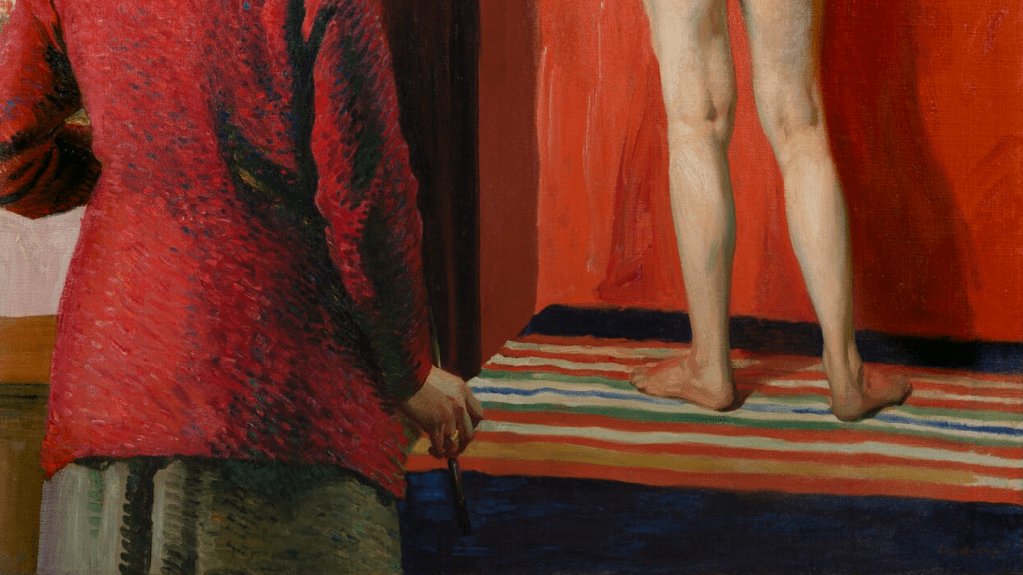
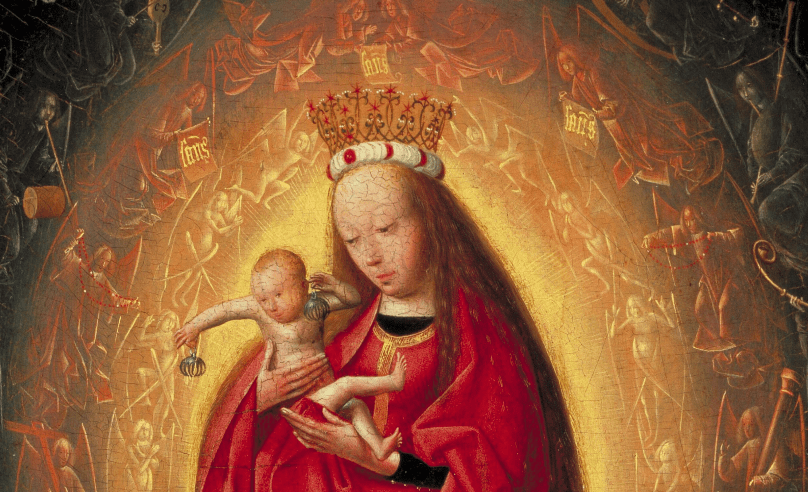
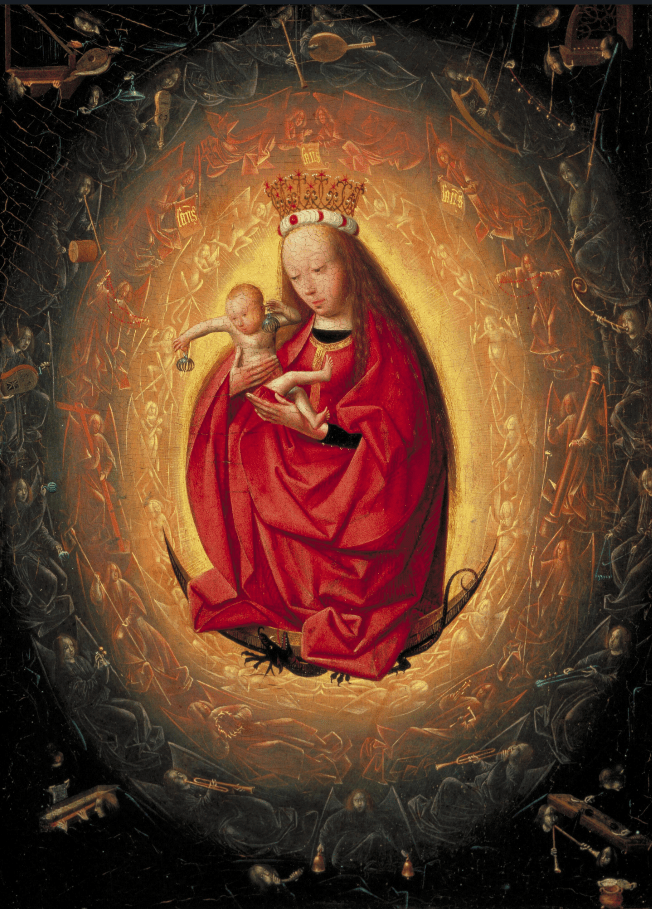
141 – a rose, By any other…

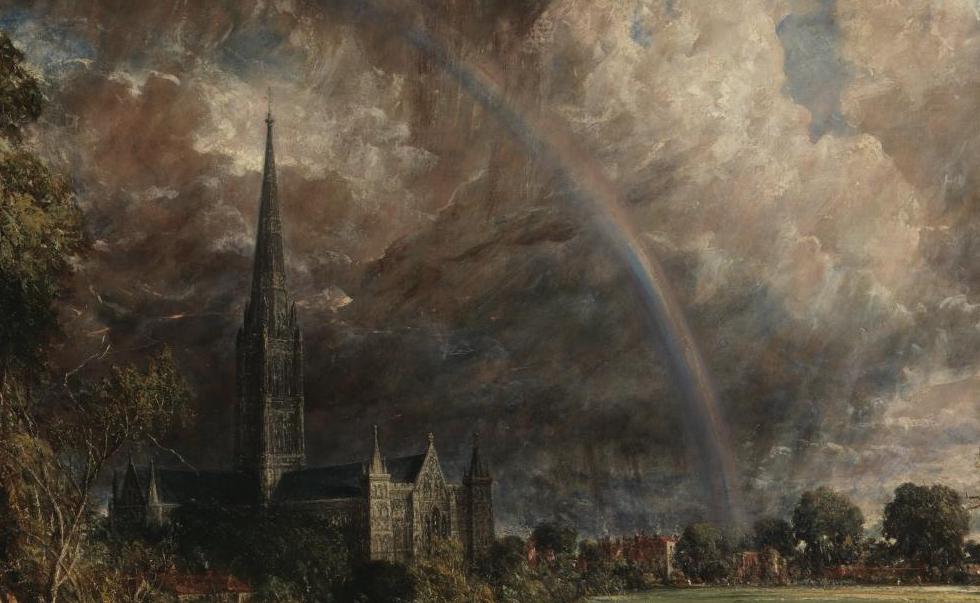
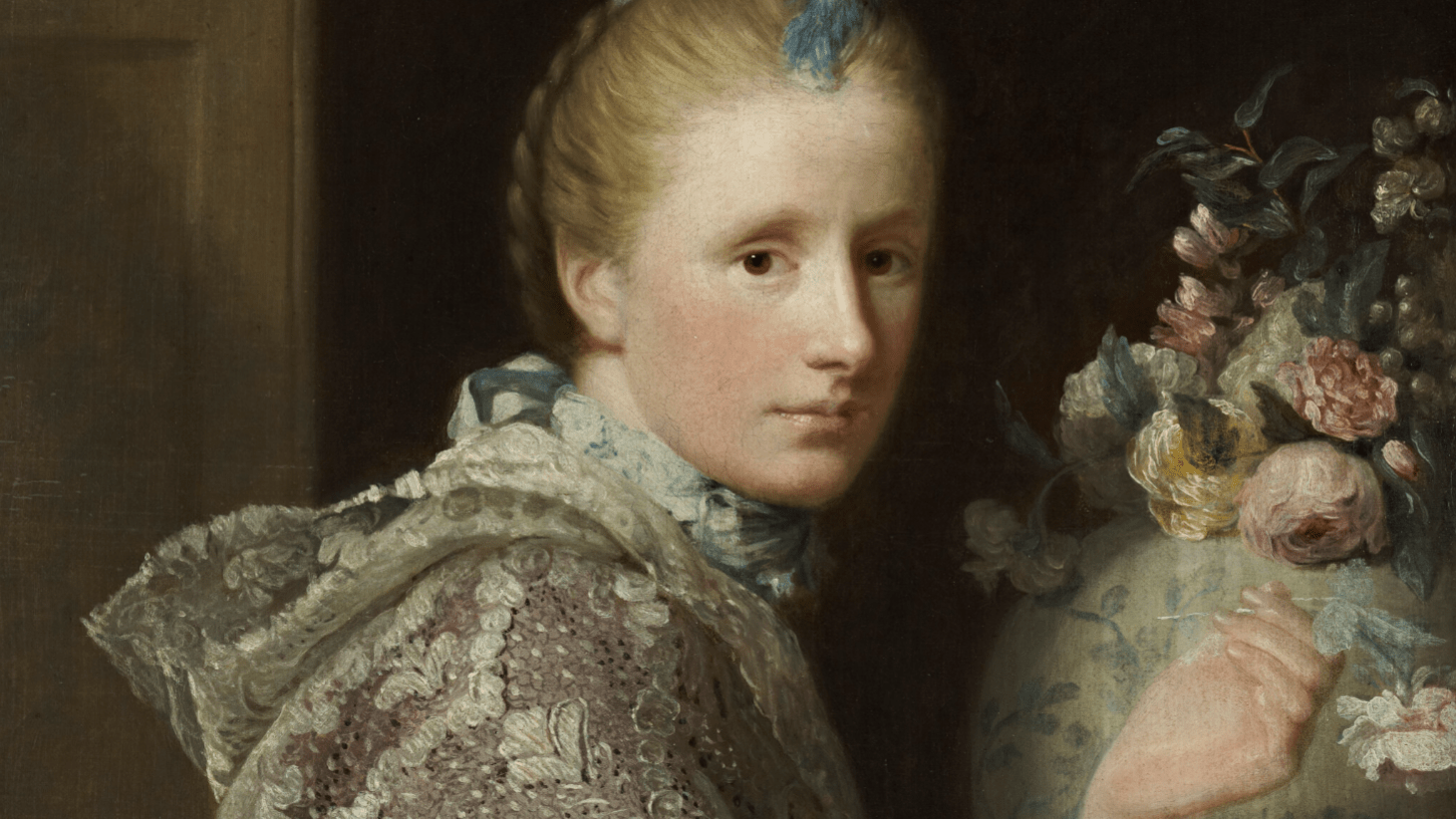
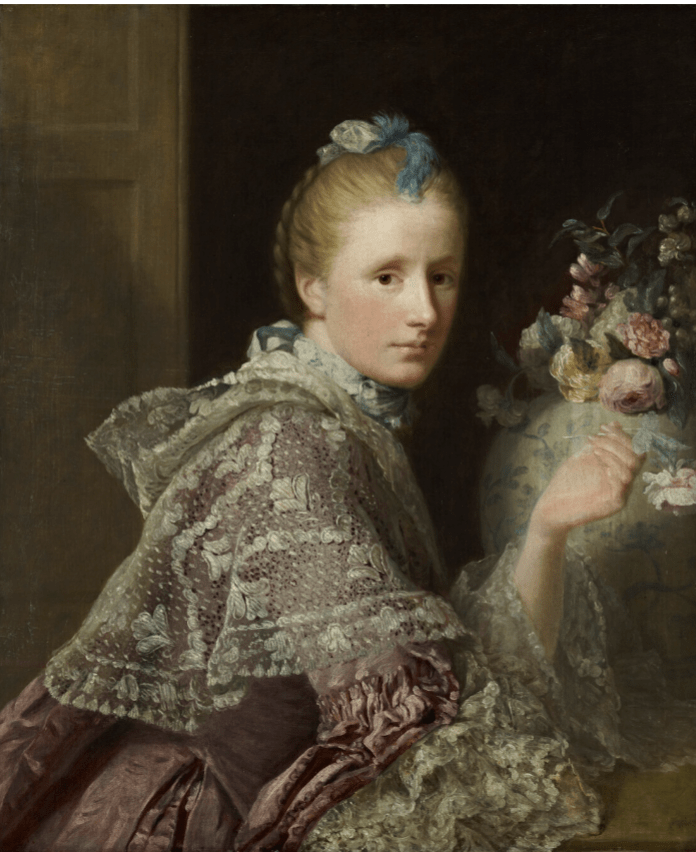
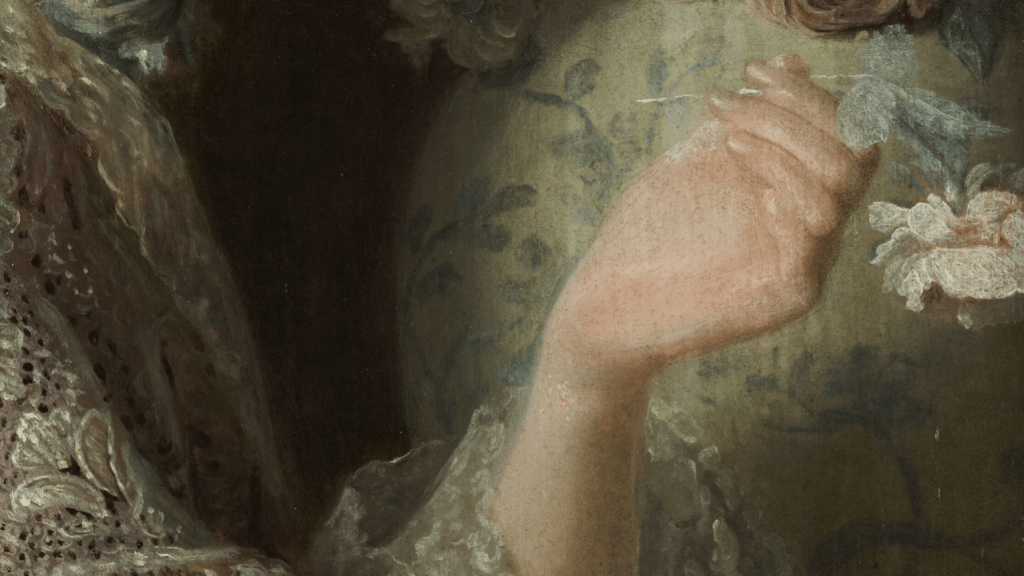
Allan Ramsay, Margaret Lindsay of Evelick: The Artist’s Wife, 1758-60. Scottish National Portrait Gallery, Edinburgh.

Context is everything. You’re a very sophisticated lot, and I’m fairly sure that most of you will have completed the above quotation from Romeo and Juliet, that tale of star-crossed lovers. It comes from Act 2, scene 2:

What's in a name? That which we call a rose,
By any other name would smell as sweet.

This is, of course, Juliet, lamenting that the boy she has just fallen in love with (and will later marry against her parents’ will) comes from the family of her own family’s sworn enemies. Be that as it may, I wasn’t planning to end the quotation with the word ‘name’. I do want to talk about a rose, though, the rose held between the thumb and forefinger of Margaret Lindsay of Evelick, who, as it happened, married artist Allan Ramsay against her parents’ will. It is so carefully and so delicately painted that I want to question if it could be ‘a rose, By any other’ artist? I suspect not, but we will have to look more closely at Allan Ramsay’s work to find out. However, it has been borrowed, and given back, by artist Alison Watt, whose work I will be looking at this Tuesday, 23 November at 6pm (details of this, and subsequent talks, can be found on the diary page of my website). The exhibition A Portrait Without Likeness is effectively a conversation between Alison Watt and Allan Ramsay, between his works and hers, and includes today’s painting as well as another portrait by Ramsay – of his first wife – not to mention Watt’s responses to, or meditations on, or conversations with these and other works by Ramsay. It is a beautiful, focussed exhibition, and I do hope you can join me to look at some of the best of contemporary painting, and the most technically accomplished of contemporary art. Meanwhile, back to the rose…

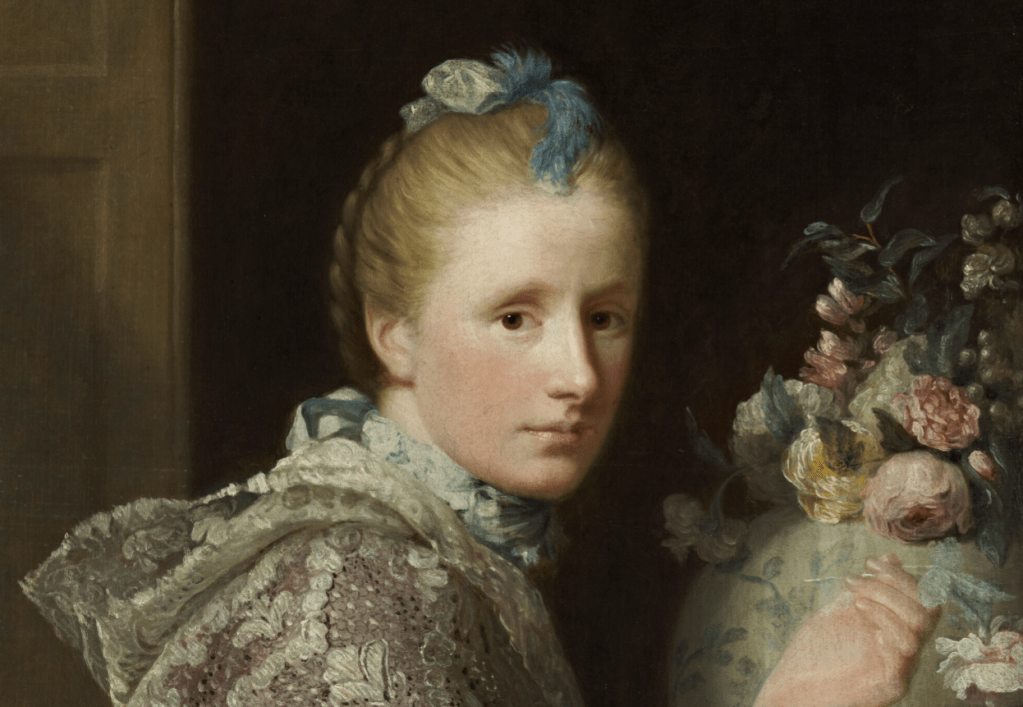
We see the artist’s second wife, Margaret Lindsay of Evelick, as if caught in the act of arranging flowers. She holds a rose in her left hand, her left elbow apparently resting on the table which supports a large, ceramic vase containing the other flowers. Her right elbow may also be on the table, but the forearm is tucked away, and lost in the abundant lace of the cuff. She looks out towards us – or towards her husband – as if temporarily distracted from her task. The appearance is one of spontaneity, but, as everyone will tell you, it is anything but. She leans into the picture, with her face arriving just to the right of the midway point, one of the features of the composition which suggests her interest in what she is doing. The line of her body runs, more or less, along the diagonal of the painting, from bottom left to top right, and her left forearm – with the hand holding the rose – lies parallel to this. Her right arm lies parallel – again, more or less – to the other diagonal, and continues the line of shadow that comes in from the top left. This interest in geometry, with the zig-zag shape formed by the body and arms, creates a harmony within the painting, but is not too rigid to render it mechanical: it is still a human experience. The panelling, or open door – it is not entirely clear what this is – cuts down vertically, and is another feature that pushes her towards the flowers. It also means that her head is neatly framed – again, evenly, but not too rigidly – by the deep and dark space behind her, so that her face rings out, ensuring that it is the focus of the painting.

The floral arrangement stands out against the background too. There is a wonderful equivalence between face and flowers, as if Ramsay is saying (in the words of Heinrich Heine, set to music by Robert Schumann), ‘Du bist wie eine Blume’ – ‘you are like a flower’. A dark gap at the top of the arrangement would be, I think, the ideal place for the last rose, and there it would have an equivalent position to the pink ribbon with which the sitter’s braids, one of which curves around and frames the back of the head, are tied. Even the colours of her face are drawn from exactly the same palette as those of the roses, with the highlight which defines the ridge of her nose, and the silvery lustre on her lower lip being just the same as the tones which model the petals of the flowers. The blue feather, on the other hand, matches the blue patterns on the vase, more flowers, and leaves, which climb around the white ceramic form – Chinese, maybe, or one of the many imitations of the popular imported vessels.

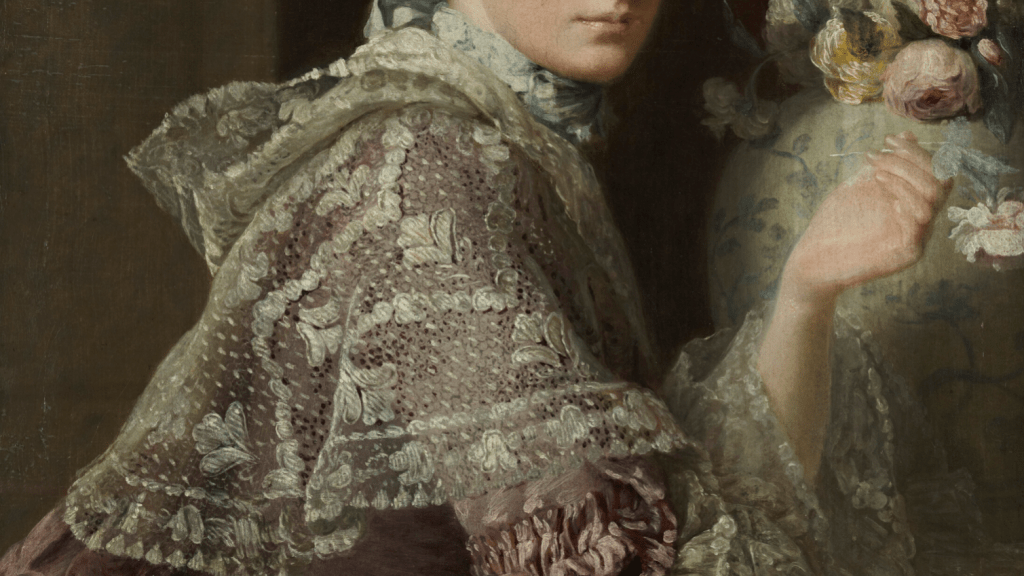
The arm and hand holding the rose were based on a drawing which is also in the exhibition. In the painting they are given prominence by a pool of light which falls onto the vase, neatly framing the hand and pushing it forward as a result of its similar tonal value, a halo against the shadowed section of the vase. This is counterintuitive, perhaps, and the opposite of the head, which is brought forward by the contrast with the dark background. Her lace shawl is remarkably freely painted, with dashes of white and grey defining its structure and allowing us to see the rose-coloured dress beneath, with small dots of black standing in for the shadows it casts. What we are looking at is perfectly clear, even though the painting is entirely evocative, rather than slavishly precise.

The same is true of the rose. It droops, and the stem appears to be broken, something which Watt comments on in the catalogue of the exhibition, noting that we will never know why. For her, ‘it has come to represent the mysteriousness of painting itself’. The part of the stem which Margaret holds remains undefined: a thin, edgy white line passes behind the tip of her middle finger, and then appears, slightly higher up, behind her thumb. However, there is no green here, almost as if this was where Ramsay was going to paint the stem, but, for whatever reason, didn’t. Maybe he realised that the idea was enough. Then beyond the leaves, which are thinly painted over the vase and hand, and faded a little with time, the stem, more fully realised, continues at a different angle, until it reaches the delicately painted and delicately coloured petals. I’m prepared to believe that a rose, by any other artist, wouldn’t look as delicate, or as fragile.

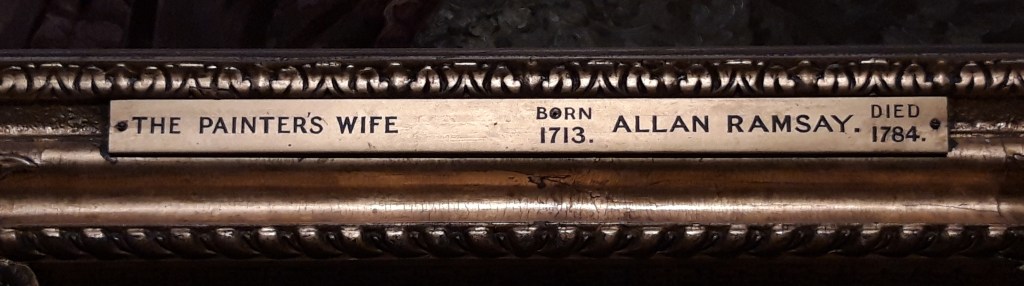
And, as we have returned to Juliet’s words, ‘What’s in a name?’ Here are two photographs I took in the exhibition last week. OK, so one of them is out of focus, but you should still be able to read it.

The first is a label which was attached to the frame at some point in the past, but not as far back as the 18th Century when the work was created. All we learn is that this is ‘The Artist’s Wife’, the name of the artist in question, and his dates. This woman is entirely defined by her husband, there is nothing else we can know about her. The second, even if blurred, is stencilled on the wall of the current exhibition, with her name, ‘Margaret Lindsay of Evelick’, and her dates. Thank goodness we live in more enlightened times: she has – or had – an independent existence after all. The words ‘of Evelick’ tell us that she was from the landed gentry. Her father, Sir Alexander Lindsay of Evelick, was a well-respected baronet, who presumably wanted ‘the best’ for his daughter. Presumably that would be what suited him best. Ramsay met Margaret on a return trip to Edinburgh in 1751 – his studio practice has been based in London since 1738, and his first wife, Anne Bayne, had died in childbirth in 1743. The couple fell rapidly in love. Knowing that her father would never approve, they eloped the following year, and were married in the Canongate Kirk in Edinburgh. Her father never forgave Ramsay, nor did he forgive his daughter for marrying beneath her, and against his will (but fortunately, unlike Romeo and Juliet, nobody died). Between 1754 and 1757 the couple travelled together in Italy, and in all probability this portrait was painted soon after their return, showing, as it does, Ramsay’s later, more delicate style.

It is currently on show at the Scottish National Portrait Gallery as part of the exhibition A Portrait Without Likeness (this is a link to the exhibition itself), near to Ramsay’s portrait of Anne Bayne (his first wife), and separated by two paintings by Alison Watt – both of them variations on the theme of the rose. I do hope you can join me on Tuesday to have a closer look.

140 – A Blog about a Dog

William Hogarth, The Painter and his Pug, 1745. Tate Britain, London.

I’m not much of a dog person, but I have developed a fondness for William Hogarth’s pet pug, not least because rejoiced in the name of Trump (no relation). This portrait – if that’s what it is – features in the exhibition Hogarth and Europe, currently at Tate Britain in London, which I will be talking about this Tuesday, 16 November at 6pm GMT. By then I will know what I am doing for the rest of the year (and even, conceivably, the beginning of next), but I will certainly be talking about Alison Watt’s beautiful and luminous exhibition A Portrait Without Likeness the following Tuesday, 23 November. The exhibition – which I was very happy to see yesterday – is effectively a conversation between her paintings and portraits by the elegant 18th Century Scottish artist Allan Ramsay – who will, of course, feature heavily in the talk. But that’s the week after next – let’s get back to Trump.

The Painter and his Pug 1745 William Hogarth 1697-1764 Purchased 1824 http://www.tate.org.uk/art/work/N00112

I questioned, above, whether this really is a portrait. It would seem so obvious that it is a self portrait that we don’t stop and question what genre of painting it actually is. After all, Hogarth is not presenting us with a direct image of himself, but shows us a painting within a painting. The image of Hogarth is, in itself, an object. The likeness of the artist is painted on an oval canvas, and rests, unframed, on a pile of three books. If you get in close, you can see light reflecting from the nails which pin the canvas to the oval stretcher. Next to the painting lies a palette resting on some fabric, and a red curtain hangs down from the top right corner, falling behind the dog. This is a collection of objects – canvas, books, palette, cloth: surely it is really a still life, with the dog featuring in the way that birds, insects, or even the occasional frog do in earlier still lives (see, for example, Picture of the Day 27). But then you could simply suggest that this is a portrait, pure and simple, of Trump, the proud and upright pug seen to the right. He is more real than the image of Hogarth, who, in this case, would have been included as one of the ‘attributes’ of the subject, Trump, telling us more about him: not just what our hairy hero looked like, but more about his background. For a dog, that would include the appearance of the owner, an aspect of the canine character that is usually omitted from the genre of pet portraiture. If this is indeed a portrait of a fully rounded hound, then we would expect the other objects to include further references to his occupations – nowadays, I suppose, that would include balls, mangled toys, and possibly even a dog chew or two. But no such luck – there is no other hint of animal husbandry. There are, however, books.

The Painter and his Pug 1745 William Hogarth 1697-1764 Purchased 1824 http://www.tate.org.uk/art/work/N00112

It seems highly unlikely, judging by what little I know about dogs, that Trump could read, and even if he could, it would surely only be the cleverest canine that would enjoy Shakespeare, Swift and Milton (specifically Paradise Lost), the very words written in gold lettering on the spines of the books. These clearly relate more to the owner than the owned, and appear to be the influences or inspirations that Hogarth is claiming for himself. Indeed, as the painting rests upon the books it would seem to suggest that they are the very foundations of his art.

The Painter and his Pug 1745 William Hogarth 1697-1764 Purchased 1824 http://www.tate.org.uk/art/work/N00112

Another way of looking at it is that his painting, on top of Milton, Swift and Shakespeare as it is, represents the very apogee of artistic achievement. But why does he limit his own appearance to a painting, while showing us the ‘real’ Trump? Maybe he wants to say that he is his art – this is not just what he looks like, but his very essence, as if to say, ‘we are what we do’. The palette says the same, in a subtler and more sophisticated way. This is not, it would seem, the palette of a working artist – there is no paint on it (even though he included grey-scale daubs in an engraved version), nor are there any brushes (although technical analysis shows that once there were, stuck through the thumb hole of the palette). Instead there is an inscription: ‘The LINE of BEAUTY’, after which comes, in fainter script, ‘And GRACE’. Further to the right is his signature – or at least his initials – and the date, ‘W.H. 1745’. This is as much the painting of a theoretician as of a practical painter. In 1753, eight years after the completion of this work, he would publish The Analysis of Beauty, a summation of his thoughts on art, expressed in essence by the Line of Beauty – the S-shaped curve we see on the palette. It implies not only a sense of flow in any depicted form, which he says is more interesting and varied than rigid, straight lines would be, but also gives a sense of liveliness and movement to a painting. It also, he believed, echoed the way in which our eyes look around an image.

The Painter and his Pug 1745 William Hogarth 1697-1764 Purchased 1824 http://www.tate.org.uk/art/work/N00112

As ever, things are never that simple. He was still formulating his ideas when this self portrait was completed in 1745, and painted out the words ‘And GRACE’ – only for them to be revealed again as the overpainting gradually became transparent. Even the line itself is not as simple as it may appear. An S-shape, yes, but one that casts a shadow on the palette. It is, in the world of the painting, a three-dimensional object, like a gold wire floating impossibly above the palette, resting with the lightest touch at either end. It is, in a way, a statement of the power of art to create things we do not know, or which can not exist within our physical world. In his book he would describe the line of beauty as being two dimensional, whereas the line of grace was three-dimensional – suggesting that this is the latter. However, it seems that he hadn’t settled on this distinction by the time painting was completed, and so tried to cover ‘And GRACE’. This still leaves us with Trump. Why is he here? And why is he ‘more real’ than Hogarth himself, given that the artist is ‘relegated’ to a painted image?

X-ray analysis tells us that Hogarth had initially planned a more formal portrait to feature in this ‘still life’. In all probability it was more like the miniature by André Rouquet, which is included in the exhibition I will be talking about on Tuesday. However, that formality – fully bewigged and dressed with cravat, waistcoat and jacket – was relaxed to show the artist in his cap and house coat, the way you would meet him ‘at home’, rather than dressed to the nines in performative fashion when out in Society. This is the man himself. And he was, of course, a man who loved dogs. He had a succession of pugs – Pugg, Trump and Crab are known by name, but Trump was the favourite, and gained the most renown. Apparently Hogarth often remarked how similar they were, and in this painting the proud pooch becomes an emblem of Hogarth’s pugnacious nature. The scar on the artist’s forehead, of which he was rather proud, might even imply that he (like Trump?) was a bit of a bruiser, although as it happens it was the result of an accident in his youth, rather than the trophy of a fight.

Trump himself became a well-known character. He may well appear in four other paintings, and nowadays he even has his own Wikipedia page, if you want to see what they are. Not only that, but he was modelled in terracotta by the great French sculptor, and friend of Hogarth, Louis François Roubiliac – whose terracotta bust of the artist (which, like the miniature above, belongs to the National Portrait Gallery) is also in the exhibition. Sadly the original Trump has been lost. Wedgwood made a version in black basalt based on a cast he got from a plaster shop owned by a man called Richard Parker. That doesn’t seem to have survived either: I certainly can’t track down a photograph. However, the Chelsea Porcelain Factory also released a white version, probably based on a similar, commercially available, plaster cast.  So here is Roubiliac’s Trump in a version by the Chelsea Porcelain Factory, now in the V&A. That’s what I call celebrity.

One question remains: in the exhibition Hogarth and Europe, how does our painting relate to the rest of the continent? Presenting the artist as a typical British Bulldog (or rather, Pug), and resting on three of the great British authors, there wouldn’t seem to be anything ‘European’ about it, until you realise that The Line of Beauty – that sinuous S-shaped curve – is, in itself, one of the founding compositional principals of Rococo art and design. As so often, Hogarth may have expressed disdain for everything ‘overseas’, but he was a great lover of its art. But is that even what Tate Britain’s exhibition is about? That in itself is a complex issue, so let’s think about it on Tuesday.

The Painter and his Pug 1745 William Hogarth 1697-1764 Purchased 1824 http://www.tate.org.uk/art/work/N00112

Revisiting Vermeer

Johannes Vermeer, The Milkmaid, c. 1660. Rijksmuseum, Amsterdam.

I am currently in Dresden, where yesterday I saw one of the most perfect exhibitions – Vermeer: On Reflection – at the Gemäldegalerie Alte Meister: thoughtful, thorough, purposeful, explaining everything you would want to know through a remarkable collection of truly superb works of art. As I am lucky enough to come back here next week, bringing a group with me, and in between will be giving a talk about the exhibition (a room by room introduction of the ideas it covers and the paintings it includes), I’m afraid I find myself a bit short of time, so I am revisiting a blog from February this year, in which I talked about the Dutch master’s Milkmaid – which is always worth a second look. And after that, a third, and a fourth, and so on. The exhibition was planned as a result of the exciting new discoveries about one of the Gemäldegalerie’s own paintings, A Girl Reading a Letter at an Open Window, and places it even more firmly within Vermeer’s oeuvre, showing, room by room, how it connects not just with the artist’s own development but also with the concerns of his contemporaries. It also traces the source of the imagery, and does as much as it can to explain the inexplicable: the remarkable allure of this most focussed of artists. If you would like to know more, then please do join me on Tuesday, 2 November at 6pm GMT (remember that, in the UK at least, the clocks go back on Sunday!). In subsequent weeks (all Tuesdays for the rest of the year) I will talk about exhibitions in England and Scotland – Hogarth and Europe at Tate Britain on Tuesday 16 November, and Alison Watt: A Portrait Without Likeness (Scottish National Portrait Gallery) on Tuesday 23. A couple more will follow. But for now, as The Milkmaid is not in the Dresden exhibition, let us look at it again.

The last time I posted this blog I was having trouble deciding whether I find this painting disarmingly beautiful or beautifully disarming – I’m sure there’s a difference. But also, I was wondering, if it is one, or other, or even or both of these things, what is it that creates this impression? I suppose because it is a painting that, for whatever reason, I do find very beautiful, and this always makes me try to analyse where that beauty lies – a process which can all-too-easily kill the simple pleasures of looking. It is disarming, I think, because at first glance it looks so simple, and yet it is hypnotically compelling. Vermeer paints everything with such apparent honesty and conviction that we remain convinced that there must be something more profound going on than the simple act of pouring milk. To try and work out if there is, I’m going to start at the top and work my way down.

I’ve always loved the way Vermeer paints walls. It’s never a case of getting out the roller and covering the whole surface with white matt. What we see is subtly modulated, with every square centimetre differentiated from every other. The setting – a corner of a room with a window on the left – was not his invention: it had already been used by artists for about 10 years by the time he picked up on it, it seems, and from then on he used it regularly, often returning to the same, or similar, corners. With the window a little way in from the back wall, the corner itself is left in shadow. The light passes through the glass at a diagonal, and illuminates the back wall away from the corner, the illumination getting ever brighter as we move to the right. Two nails are driven into the wall, and the higher of the two, further to the right, is in the light. It casts the sort of diffuse shadow that suggests this is large window, far higher than the part of it we can see in the painting. On the left a wicker basket – used for shopping, presumably – hangs from a similar nail, with a highly-polished copper pail hanging from another on the back wall. Above the basket we see what is probably a small picture: it’s too high to be a mirror. To the left of the nail from which the basket is hanging one of the panes of glass has been broken – there could easily be a a breeze coming through – and in the pane below this the glass is cracked, with the broken edge catching the light. If you go down one more pane, and two to the left, another of the small plates of glass threatens to fall into the room. The attention to detail is breathtaking.

The fall of light from left to right illuminates the maid’s face, showing its bold, simple forms: a down-to-earth presence, whose broad features would have been interpreted as indicative of her lowly status. The light also charts the very specific folds of her simple linen headdress, especially to the left of her face, where the sharp fold at the level of her forehead gradually opens out, so that, as it gets lower, less light falls on the fabric. As the hem curves forward the lower edge is left in shadow.

The light is one of the features which creates the attention-grabbing boldness of the central figure, and renders her monumental. Her right shoulder (on our left), the top of her right arm, and especially the back of her right hand – the one holding the handle of the jug – are brilliantly illuminated, making them stand out against the shadows on the wall. On our right, the shadow which forms the curve of her left shoulder, and the right side of her left arm, stand out against the brilliantly illuminated wall behind. Vermeer enhances this by painting the thinnest of white lines around the edge of the sleeve as it comes down from the shoulder. The reversed contrasts of light and shade push her towards us, making her more immediate, more entirely present. Not only that, but the perspective pulls our eyes towards her. The horizontals of the window frame and the leading which holds the glass in place form orthogonals receding towards a vanishing point, placed at the crook of the maid’s right arm. As the vanishing point is theoretically our point of view, this means that our attention is focussed on the action of holding the jug and pouring.  

The colour is also subtly vital. Her bodice is yellow, and she wears a blue apron. For me this is still a surprising colour for an apron (even given that I know nothing of the history of aprons), especially as Vermeer has used that most prized of pigments, ultramarine. The bodice uses lead-tin yellow, another good, traditional pigment, but nowhere near as expensive. For the sleeves – which are rolled up – he mixes the two to create green. It is almost a lesson in basic colour skills: yellow mixed with blue makes green – and in this case, the specific yellow of her bodice mixed with the distinctive blue of her apron makes this particular green.

The attention that the maid gives to the act of pouring also demands our attention: if she takes it this seriously, then so should we. This is not a haphazard act, but a careful, determined action, the support given to the milk jug by her left hand helping to make sure the liquid flows at precisely the right speed.

The measured flow of the milk has made people think that she is doing something specific, and one suggestion is that she is preparing a bread pudding. There is plenty of bread on the table, after all, and some of the pieces next to her bowl appear to have been broken. You have to put in exactly the right amount of milk, apparently, or the pudding would either be too soggy, or the bread would dry out and become too hard and crunchy. This is simple fare, made from wholesome ingredients with good honest labour. Again the light plays a major part, showing us the deep, sculptural folds in the sleeves and apron, and the form and textures of the bread and basket – and yet it does not do so with the highly focussed detail of a fijnschilder – or ‘fine painter’ – the name for artists like Gerrit Dou whose every surface is an almost microscopic exploration of precise surface textures, and yet not a single brushstroke is visible. As if he were a precursor of Seurat and the divisionists, Vermeer builds these objects up through a myriad of dots and dabs of paint. You don’t believe me? Look at this.

When talking about Vermeer it is hard to get away from the theories which try to explain his peculiarly focussed vision by suggesting that he used a camera obscura – basically a form of pinhole camera that projects an image onto a surface and allows you to trace the outlines. However, this would only provide the outlines, and not the colours or textures. Admittedly, the images a camera obscura produces can sometimes include some of the effects he uses – the bright, blurred highlights, for example. Although, if you think about it, you only get bright highlights on shiny objects, not on matt loaves of bread. This may well be the sort of effect you could see with a camera obscura, and that may be where he got the idea – but he would never have seen the particular highlights painted here. They are part of the magic of the image, and create the wonder – and some of the texture – of this fresh bread, the bounty of this work-a-day basket. As it happens, the construction of the perspective also suggests that he didn’t use a camera obscura: it isn’t traced, but drawn. Technical examination has revealed a pin hole in the canvas itself, at the crook of her right arm – the vanishing point. Vermeer would have inserted a pin, and tied a piece of thread to it. This could be covered in something like charcoal dust, pulled taut, and then snapped against the canvas to ‘draw’ lines onto it. It was a common way of working out perspective, as the lines drawn inevitably lead to the vanishing point.

When we get down to the bottom of the painting the lesson in colour continues. Under the apron the maid’s skirt is red – so she is wearing muted versions of the three primary colours, yellow, blue and red. This particular shade also harmonises well with the brick-red floor, and the ceramic pot, one of the truly revealing details in this painting. It is part of a footwarmer – a wooden box, with a perforated top – and the pot would have held hot coals. A practical object perhaps, given that we are presumably in a cold kitchen, ideal for keeping and using dairy products, although it is very small compared to the size of the room. In any case, footwarmers were used when seated. Behind it is the wainscoting, made of Delft tiles – local produce, of course, as it was in Delft that Vermeer lived and worked. Three tiles are visible, and the imagery of two of them can be read. On the left is cupid, wings to the left, firing his bow and arrow to the right, and to the right of the footwarmer, there is a man with a walking stick. Are these relevant? Probably. Have a look at this picture from the Sinnepoppen, an emblem book published by Roemer Visscher in 1614.

Any emblem has three elements, ‘pictura’, ‘inscriptio’ and ‘subscriptio’ – or picture, heading, and explanation. For the title of his book, Visscher invented a new word – where ‘sinne’ means the ‘sense’ of the emblem, and ‘poppe’ means the image. By creating a word that combines two elements from which we can determine the meaning, he is echoing the function of an emblem precisely. Neither the pictura nor the inscriptio gives the full sense on its own – they have to be considered together. The relationship between them – what, together, they mean – is explained in the subscriptio. In the example above, ‘Mignon des Dames’ means “the ladies’ favourite” – as in sweetheart, or lover. The subscriptio goes on to explain that modern ladies love nothing so much as a foot warmer, as it provides them with constant warmth. Any man who wanted to pay her court would find himself playing second fiddle to this household object. They can be seen often in Dutch 17th Century genre paintings, but even Visscher’s explanation doesn’t fully account for their presence. That is because Visscher wants you to be as clever and inventive as himself, and is always expecting you to make connections and take the meaning further. Think about it: when seated, the hot coals would fill the user’s skirts with warmth. Presumably, any potential lover would have to prove as reliable if he wanted any degree of success. Combined with the image of cupid shooting an arrow towards the source of heat, the implications are that our maid could easily be the subject of inappropriate attentions, welcome or otherwise. It’s worthwhile bearing in mind that it was usually assumed that milkmaids were sexually forthcoming.

Having said all that, from this point on you can make up your own mind. And that’s not because I don’t want to tell you what is going on here, or because I don’t know what is going on here, but because Vermeer’s great genius includes the ability to leave things open. Is it coincidence, for example, that her skirt plays with the same tonalities as the earthy floor and the glowing coals, which we can imagine but not see? Does it imply a heat within? Or does the fact that she is standing, at work, rather than sitting down enjoying the welcome updraft, suggest that she is a figure of virtue, rather than potential quarry, worthy of pursuit? It’s possible that the very title of this painting is incorrect, as it happens. A milkmaid would work outside, with the cows, milking. The woman in the painting is really a kitchen maid (although in some households they did double up, apparently). But then, kitchen maids often had the same reputation. I cannot get away from the care with which she pours, and I suspect that Vermeer is questioning the assumptions we make about the people, and objects, depicted by his contemporaries. The first assumption is that milkmaids – or kitchen maids, for that matter – were bound to be ‘up for it’. After all, in this case, she seems entirely focussed on her work. The tile with cupid and the footwarmer might imply sexual impropriety – but do either have any effect here? In other hands the jug itself might seem suggestive. Artists like Jan Steen regularly show women holding vessels with open apertures towards men who reciprocate with any number of phallic equivalents, from bulging bagpipes to pistols cocked. And yet here the act of spilling – which could be a sign of incontinence – of sexual incontinence, that is – is entirely controlled, and measured. If our maid represents anything, then maybe, for Vermeer, she could be a modern-day Temperance. Compare her with this print by Jan Saenredam, made in Haarlem in 1593, based on a design by Hendrick Goltzius.

This is the most common representation of Temperance – although not that we saw painted by Giotto, who has her sheathing her sword (see Day 59 – Virtues vs Vices), or for that matter, the version painted by Ambrogio Lorenzetti in his Allegory of Good Government, in which she watches the first known image of an hour glass. In Saenredam’s personification she carefully pours liquid from one vessel to another – usually interpreted as watering down the wine, a true sign of Temperance, as opposed to complete abstinence. This careful, measured pouring is precisely what our maid is doing. And if she is Temperance, then maybe we could interpret another of Vermeer’s paintings, Woman Holding a Balance, as a personification of Justice. The comparison here is also from the series designed by Goltzius in 1593, but this time executed by different student, Jacob Matham. I don’t have time to say more about this painting now, unfortunately, but, as it is in the Dresden exhibition, I will include it in Tuesday’s talk, Vermeer: On Reflection.

Before then, though, what conclusions can I draw about The Milkmaid? Is she awaiting an assignation, or, conversely, distracting herself from temptation by concentrating on her work? Is she a figure of virtue, expounding the positive values of honest labour? Could she be a personification of Temperance? Vermeer’s focus, his attention to detail, the care with which he has structured the composition, combined colours, balanced tones, and modulated light, not to mention the dignity he gives to his subject, an apparently commonplace maid made monumental, suggests that there must be more than meets the eye. What is this painting about? What is going on? Well, there is a woman pouring milk. What more do you need?

139 – Cavalier attitudes

Judith Leyster, The Last Drop (The Gay Cavalier), c. 1629. Philadelphia Museum of Art, Philadelphia, PA.

Famously, Frans Hals’ painting, The Laughing Cavalier, is neither laughing, nor a cavalier – I will talk about what he is and who he might be this coming Monday, 25 October at 6pm in the context of the Wallace Collection’s small (but perfectly formed) exhibition Frans Hals: The Male Portrait. In subsequent weeks in November I will talk about more exhibitions – Vermeer: On Reflection (in Dresden) on Tuesday 2, Hogarth and Europe (Tate Britain) on Tuesday 16, and Alison Watt: A Portrait without Likeness (Scottish National Portrait Gallery) on Tuesday 23 – all of these are now on sale. But for now, I’d like to talk about another painting which does not show a cavalier, by someone who could be considered one of Hals’ greatest rivals – although she was also one of his admirers – Judith Leyster. It seems only fair to look at the work of a woman, as the Wallace’s exhibition has an almost ‘dare to be square’ attitude – which is acknowledged by the director of the museum in his preface to the catalogue – given that it focuses on paintings of white men by a white man, with no suggestion that there might be any other type of person in the world. You could argue, I suppose, that as the curator of the exhibition is a woman, that the male bias is actually OK. But as far as I know, no one has suggested that it isn’t! Anyway, it’s a good excuse to talk about Judith Leyster – not that she needs an excuse. She was a great artist – we should talk about her more often.

Today’s picture is in the collection of the Philadelphia Museum of Art, and their online catalogue calls it by the title, or titles, that I have used above: The Last Drop (The Gay Cavalier). It’s worth remembering that neither of these would have been used by Leyster herself. Apart from the fact that she was Dutch (and so anything she called the painting would have been in Dutch), artists simply didn’t give paintings titles back then – it was more common to describe what was depicted – ‘two drunk men with a skeleton’, for example. I have talked about the issue of names before – way back at the beginning of the blog, I think, with paintings like The Fighting Temeraire (which is actually just part of Turner’s title). So many paintings – The Laughing Cavalier included – have been given nicknames relatively recently (by which I mean the late 19th or early 20th Centuries), and even though they often have little or nothing to do with the subject of the painting, they have stuck irrevocably. I don’t know when today’s picture got the two titles it now has, but only the first is accurate. None of the people represented is dressed as a cavalier – although you could argue that the skeleton might have been one when alive. However, The Last Drop is entirely to the point.

Clearly, The Last Drop doesn’t only refer to this particular drink, even if the seated man on the left is on the verge of draining his stoneware tankard dry. This is also the last drop he will ever drink. There may be a small reserve of liquid in the very bulbous body of the vessel, but short of tipping it up vertically, there is not much more he could do to finish it off. It doesn’t really matter, though, as Death is watching eagerly to see if is time to finish him. The skeleton itself is an unmistakable Memento Mori ­(literally: ‘remember death’) – but it (or is it he? I’m going for ‘he’) is also holding other symbolic objects. Held aloft in his right hand is an hour glass, with the last few grains of sand trickling through. Time is nearly up, and the skeleton smiles gleefully as he displays the hour glass as evidence that soon it will be time for him pounce. As if a skeleton on its own wasn’t enough, he has a second skull in his right hand, clutching a lit candle with it, as he bends over to check that the drink – and so, it seems, the man’s life – is finally done. When it is, the candle will presumably be snuffed out, and the drinker, too, will ‘snuff it’, if I can use that most disrespectful of terms for death. Meanwhile, the candle sheds an unnatural glare around the profile of the drinker. Apart from that harsh light, the man is already in the shadows. Almost inevitably it reminds me of ‘the Scottish Play’ (and, if you can get a return, try and get to see the production at the Almeida Theatre, which is on until 27 November – tickets for the last set of performances go on sale today, 21 October). Here is ‘the’ speech from Macbeth, Act 5 Scene 5:

Tomorrow, and tomorrow, and tomorrow,
Creeps in this petty pace from day to day,
To the last syllable of recorded time;
And all our yesterdays have lighted fools
The way to dusty death. Out, out, brief candle!
Life's but a walking shadow, a poor player,
That struts and frets his hour upon the stage,
And then is heard no more. It is a tale
Told by an idiot, full of sound and fury,
Signifying nothing.

The hourglass tells us that the man on the left is at the last hour of his recorded time, and that the brief candle will soon be out. But this man has not drunk alone.

His standing companion has clearly had more than one too many, judging by the garish expression on his face – not to mention his all-too-evident teeth, which are rarely, if ever, seen in paintings of respectable people. Here too the expression is enhanced by the harsh lighting, and neatly framed by the brilliant highlights around the rim of his hat, and also by the bravura painting of the turned up trim of his collar. The sleeve is wonderfully handled too, with free, slashing brushstrokes of barely-mixed lighter and darker reds modelling the folds in the odd, baggy garment. Rather than the skeleton’s hourglass, this chap holds a smoking pipe aloft – another symbol, like excessive drinking, of a dissolute lifestyle, and also, of death. Like life, smoke is insubstantial, fleeting, and is gone before you know it.

That we are near the end is confirmed by the fact that this drink too (like the fun) is finished. Nothing remains in the upturned tankard, every last drop is drained. And as for the costume, it is extraordinary. Such a large, voluminous jacket, which is worn over a dark blue unbuttoned doublet. Underneath that is a white blouse, also unbuttoned, revealing far more of the reveller himself than the strict rules of 17th Century Holland would have allowed.

The tankard is maybe too brilliantly lit for an object which is at that distance from a candle, but I’m sure that this is a choice by the artist to make the whole painting seem more garish and more glaring, thus emphasizing what is important, and what is at stake. But it is also done to catch your eye – it draws your attention for more reasons than one. In 1903 this painting was attributed to Frans Hals, who was, after all, the master of the freely handled brushstroke. However, in that year someone noticed the letters ‘JL’ written on the mug – the signature of Judith Leyster (1609-60) – just to the left of the handle, where it joins the body of the vessel and is so brilliantly illuminated. If people had seen it before, they had failed to identify it, probably because until 1893 (just ten years before) she had fallen into obscurity, only to be rediscovered when her signature was identified on a different painting. The ‘JL’ is usually followed by a star, as her name, Leyster, means ‘Lodestar’ – another name for the pole star, the one used by sailors as a fixed point for navigation. She was famous in her lifetime, and even praised, punningly, as the ‘leading star’ in art. In 1633 she was the first woman to join the Haarlem artists’ guild – indeed, she was the first woman in Western Europe to be admitted to any painters’ guild. It was probably to celebrate this that she painted the wonderful self portrait which I wrote about during lockdown 1, on Day 34 of ‘Picture of the Day’. Leyster probably trained with Frans Hals, although there is no firm evidence for that. However, she did witness the baptism of one of his children in 1631: they were clearly (at that stage) on very good terms. Her status as a ‘Master’ meant that she was allowed to teach, and in 1635 she took on three pupils, although one of them subsequently left her to work under Hals. She sued the older master, and although the student’s mother paid Leyster punitive damages (but only half of what she asked for) and Hals also paid a penalty, Leyster too was fined by the guild for not having registered the student in the first place… But, as the saying goes, all publicity is good publicity, and work picked up… at least until the following year, when she married fellow artist Jan Miense Molenaer. There are hardly any works by her dated after 1636, the year in which she married. It could have been that, as a mother of five, she simply didn’t have the time to paint. Although it could also have been that, as a man, Molenaer was in a better position to sell the paintings, and so she worked as one of his assistants – a member of the workshop, but not its leader. It’s not that he was taking credit for her work, but that it was financially expedient for her to work this way. But back to the painting: why is the standing reveller dressed in this unusual manner?

His unusual garb ties the painting inextricably to another by Leyster, the Merry Company, now in a private collection, which was sold by Christie’s in 2018 for a little shy of two million pounds. They are of a similar size, and although the Merry Company is a little smaller, it has probably been cut down.  Seen next to each other like this, the similarities are clear. The two revellers in our painting are seen at a later stage of merriment – the plumed hat has been lost, and the man in red is now wearing the blue hat of his companion. He has also lost his blue belt, allowing his jacket to fall open – and the blue doublet has also been unbuttoned. He also seems to have grabbed a different tankard, while the seated figure drinks from the same vessel he had earlier. Their drinking started in daylight, and has continued well into the night – they have lost their more soberly dressed companion, but their debauchery has summoned Death. The moral is clear: it’s all very well to have some fun – but don’t take it too far. The baggy costumes – so unlike the closely tailored fashions of the 17th Century – are derived from Italian theatre, the Commedia dell’Arte, and had been adopted as carnival costumes by the 16th Century. So this could be vastenavond – the Dutch word for the night before Lent (literally ‘the evening before fasting’) – or, in other words, Carnival.

The Merry Company must have been significant for Leyster, as she quoted from it in her Self portrait. Surely there were reasons for this choice: technical analysis has shown that originally a female figure was depicted on the canvas, which Leyster covered with the fiddle player later on. It could be that she wanted to show that she was the master of at least two different genres – portraiture and the one annoyingly known as genre painting (i.e. normal people doing normal things). She was the only woman to paint genre scenes, after all. However, the reason for this choice might be more sophisticated. In Het Schilder-Boeck – ‘The Book of Painters’ – written by Karel van Mander in 1604, the author refers to a Dutch proverb, stating that ‘the more a painter he becomes, the wilder he gets’. By including the wild fiddler from The Merry Company, Leyster could be replacing ‘he’ with ‘she’.

I’d love to know what happened to the red hat with its oversized plume, though. It must have been lost somewhere along the way. Maybe it was picked up by Frans Hals, or taken by the wayward student, as Hals painted a young man wearing a very similar hat – and holding a skull – in one of his works in the National Gallery. If you want to see what I mean, click on that link, as it’s not a portrait, so I probably won’t be talking about it on Monday.

138 – Transfigured

Apse Mosaic, c. 549. Sant’Apollinare in Classe, Ravenna.

This coming Tuesday, at 6pm, I will be Revealing Ravenna – or at least, talking about the remarkable mosaics, putting them in their historical and religious context, and explaining why the best Byzantine art is in Italy, rather than in Istanbul. And the following week I will be lucky enough to visit them in person. But seeing as I know not all of you can come with me, and not all of you will be free on Tuesday, I thought I would write about one of the mosaics today – particularly as this one will not really get much of a look in, because it’s not really in Ravenna. In subsequent weeks I will start what is effectively a new ‘series’, talking about the increasing number of exhibitions which are opening in museums in London, across Britain, and even Europe-wide. Once more I’m doing this because I know that not all of you will be able to get to all of them – but also, in case you are able to go, to serve as an introduction. So far only one of them is on sale – Frans Hals: The Male Portrait, inspired by the exhibition at the Wallace Collection. That talk will be on Monday 25 October. Gradually, once I’ve been able to check everything out, I will release tickets for Vermeer: On Reflection (2 November), Hogarth and Europe (16 November), and Alison Watt (23 November). These will all be on Tuesdays, because I will be teaching a course for the National Gallery on Mondays – but more about that when that too is confirmed. There will be details about everything on the diary page, of course. Meanwhile, back to Ravenna.

I have not often visited the church of St Apollinare in Classe for the simple reason that it is a little out of the way – although maybe not as far as I used to think. Although it is one of the suburbs of Ravenna today, Classe (two syllables, clas-sé) was originally the port of the Roman city, its name coming from the Latin for ‘fleet’ – classis ­– and it was about 4km away. Each time I go, I am struck by the simple majesty of the building, although this is the result of complex historical processes which turn out not to be not simple at all. The church itself has a standard ‘basilica’ structure, with a central nave and two side aisles, separated by arcades, which lead to three apsidal endings. Originally the walls of the nave would have been covered with mosaics, but these have been lost. They were replaced with frescoes in the 18th Century, of which only the roundels with portraits of the bishops of Ravenna have survived, just above the arcades. The upper part of the walls, and the walls of the side aisles, have been stripped back to bare brick – wonderfully evocative, but decidedly modern in ethos. But at least they do not distract from the central apse, which is the true treasure of the church.

The church was dedicated to St Apollinare (five syllables – A-pol-lin-ar-é) in 549 – which gives us the approximate date for the mosaic within the apse. It was founded by Ursicinus, bishop from 533-536, and was dedicated by Maximian, who had also managed to get a promotion, being Archbishop from 546-556. Apollinare himself was said to have been the first bishop, having been converted to Christianity by none other than St Peter, although the ‘life’ which reports his deeds and martyrdom was, in all probability, written by Maurus, Archbishop from 642-71. There is no concrete historical evidence that Apollinare ever existed, if we’re honest, and Maurus almost certainly wrote his ‘life’ to make the diocese of Ravenna look more important, and to emphasize its apostolic origin. Indeed, one of the major subjects of the mosaics is the apostolic succession.

In the semi-dome of the apse we see Apollinare, dressed as a bishop, and with his arms raised. This is the attitude taken by an orant – someone at prayer – a common image in early Christian art. Walking towards him are a number of sheep: six on each side, making twelve in total, like Jesus’s apostles. But why are they sheep? Well, the earliest images of Jesus show him as ‘the Good Shepherd’, and indeed, priests and vicars today still refer to their congregation as their ‘flock’. Here Apollinare’s flock is the same size as Jesus’s. Apollinare therefore stands in for Jesus. If not Christ’s vicar on Earth, he is at least Christ’s vicar in Ravenna – and this is precisely what the apostolic succession is all about. In John, Chapter 21 Jesus appears to his followers after the Crucifixion and asks Peter the same question three times. The third time is in John 21:17,

He saith unto him the third time, Simon, son of Jonas, lovest thou me? Peter was grieved because he said unto him the third time, Lovest thou me? And he said unto him, Lord, thou knowest all things; thou knowest that I love thee. Jesus saith unto him, Feed my sheep.

He has already, in Matthew 16:18-19, told Peter that he will give him the keys of heaven:

And I say also unto thee, That thou art Peter, and upon this rock I will build my church; and the gates of hell shall not prevail against it. And I will give unto thee the keys of the kingdom of heaven: and whatsoever thou shalt bind on earth shall be bound in heaven: and whatsoever thou shalt loose on earth shall be loosed in heaven.

Either of these quotations, taken separately, would serve to affirm Peter’s position as the first leader of the church after Jesus. Together, the message is reinforced. Peter takes Jesus’s place, and then, according to the belief current in Ravenna, Peter both converted Apollinare and appointed him bishop: so Apollinare takes Peter’s place, in Ravenna at least. In the mosaic he leads 12 sheep as Jesus led the 12 apostles. Above his head is a blue circle, set with stars and a jewelled cross. Three more sheep stand on the ground, two people appear in the golden sky, and a hand appears from the clouds. But I’ll come back to these details later.

About 120 years after its dedication, the church was partially remodelled, and additions were made to the mosaics above the arch of the apse. We see Christ blessing in the centre, surrounded by the symbols of the four evangelists. On the left the eagle stands for St John, the angel is the symbol of St Matthew, and the lion – as anyone familiar with Venice will know – is St Mark. This leaves the ox to represent St Luke. The most handy mnemonic to remember these is that plant which makes such good hand cream – the ALOE. If the letters stand for Angel, Lion, Ox and Eagle they are in the right order for the canonical arrangement of the gospels – Matthew, Mark, Luke and John. Below these symbolic beasts, and once more against a golden sky, twelve sheep have left the gates of two jewelled cities – Bethlehem and Jerusalem – processing towards Jesus in the same way that their equivalents do towards Apollinare just below.

And further down again, below Apollinare, there are four figures depicted in the mosaics between the windows. They are all bishops, all of whom were Apollinare’s successors. In traditional accounts, he was the first Bishop of Ravenna, his episcopacy lasting until his martyrdom in 79 CE. From left to right the first of the chosen few is Ecclesius, the 24th Bishop, in position from 522-532, who founded the church of San Vitale (home to some of the glorious mosaics I will discuss on Tuesday). He is followed by St Severus (c. 308-c. 348), the 12th bishop; Bishop Lacuna (dates unclear); and Ursicinus (533-536), 25th Bishop and the founder of this particular church. OK, so there never was a Bishop Lacuna, it’s just that I can’t get a good enough detail to be able to read his name and tell you who he is. These four bishops show us, in abbreviated form, how the apostolic succession continues – Jesus appointed Peter, Peter appointed Apollinare, and he is followed by a number of successors in turn, down to the present incumbent. But what exactly is going on above Apollinare’s head?

Most striking is the jewelled cross in the blue circle. In the apse mosaic of San Vitale, Jesus sits atop a similar blue circle: it can be seen to embody the cosmos, over which he rules. The cross needs no explanation, although the jewels with which it is embossed express its value, as they do for the cities seen on either side of the mosaic in the additions. There are twenty of them in the cross: four on either arm (reminding us, perhaps, of the four evangelists), leaving 12 going from top to bottom – a reference, perhaps, to the 12 sheep, and so to the apostles. In the very centre we see, as an apparently minute depiction, the face of Christ. To the left and right of the cross are the letters alpha and omega, the beginning and the end of the Greek alphabet, as God proclaims more than once in the Book of Revelation. This is chapter 1 verse 8:

I am Alpha and Omega, the beginning and the ending, saith the Lord, which is, and which was, and which is to come, the Almighty.

Underneath the cross are the words SALVS MVNDI – ‘the health of the world’ – or, to put it more explicitly, ‘salvation’ – and above we see (although not very clearly) ἸΧΘΥϹ – ‘ichthys’, the Greek word for ‘fish’. The fish was one of the earliest symbols for Jesus, and is derived from an acronym. The letters stand for the Greek words meaning ‘Jesus Christ, Son of God, Saviour’. Nowhere in this image is Jesus explicitly named, nor, with the exception of the tiny image of his face, is he visible. But what of the three sheep, and the two people in the sky? Should we see the sheep as three of the apostles, by comparison with the others below? And if so, who are they? They are not named. However, the two half figures in the sky are. The one top left is labelled ‘Moyses’ – or Moses. The top right inscription is harder to read, but it is Elijah. The presence of these two Old Testament prophets is the key to the understanding of the mosaic. Here is Matthew 17:1-3 (and helps to know that ‘Elias’ is just another version of ‘Elijah’):

And after six days Jesus taketh Peter, James, and John his brother, and bringeth them up into an high mountain apart, And was transfigured before them: and his face did shine as the sun, and his raiment was white as the light. And, behold, there appeared unto them Moses and Elias talking with him.

This is The Transfiguration, itself transfigured. The three sheep represent Peter, James and John. Matthew says that ‘his face did shine as the sun, and his raiment was white as the light’, but in this mosaic Jesus is transfigured into pure symbol, whether as the cross, or as the words: ‘alpha and omega, salus mundi’, ‘ichthus’. Too perfect to represent, Jesus becomes entirely transcendent. Later on (17;5) Matthew tells us that, ‘a bright cloud overshadowed them: and behold a voice out of the cloud, which said, This is my beloved Son, in whom I am well pleased’. The disembodied hand is that of God himself, and is the visual equivalent of the ‘voice out of the cloud’. And how better to represent ‘a bright cloud’ than with the light reflecting from a gold mosaic?

In the context of the church the meaning of the mosaic becomes clear. At the top, Jesus is seen as if in Heaven, blessing the congregation. His word is conveyed by the four evangelists beside him, and preached by the twelve apostles who process towards him – albeit in ovine form – from Bethlehem and Jerusalem. Below, in the apse – on Earth – he is transfigured. Seen in the presence of Moses and Elijah, and witnessed by Peter, James and John, this is the Son of God. In a direct line below him, Apollinare takes his place, having been appointed by St Peter, where, praying, he leads his own flock. His role is then taken by successive Bishops and Archbishops, whose throne would originally have been in the apse, directly behind where we now see the relatively modern altar (the same was true for all churches, although the only English cathedral to have its cathedra in this original position is in Norwich). Everything – the mosaics, the architecture and the original fixtures and fittings – would have combined to say that the apostolic succession continues to this day.

The steps leading up to the altar date from the restructuring of the church in the 670s. By raising the floor a crypt could created beneath the high altar for the display of the relics of Sant’Apollinare, allowing pilgrims to pay homage without disturbing the celebration of the mass. In the mosaic Apollinare appears directly above his own relics, as well as directly above the modern-day Bishop, who would be, in a more worldly and less symbolic way, presiding over his own flock. There should be no doubt as to the authority of this man – it descends from Christ, is justified by his suffering on the cross, and has been passed down from the first Bishop, himself installed by St Peter.

By the 9th Century the harbour silted up and the importance of Classe diminished. Not only that: pirates patrolled the nearby coast, and they would not be cowed even by the direct display of God’s authority. To protect Apollinare’s relics from the raids, they were moved to a church in the centre of Ravenna. Built as the chapel of the palace of King Theoderic, and dedicated to Christ the Redeemer in 504, in around 540 it was re-dedicated to St Martin and then, in 856, it was re-dedicated a second time, to Sant’Apollinare. Today it is known as ‘the New Sant’Apollinare’, or Sant’Apollinare Nuovo. The changes of dedication are reflected in subtle changes to the mosaics, which take on an added complexity. But I’ll be talking about all that on Tuesday.

137 – The little Lord Jesus, Asleep…

Cosmé Tura, Virgin and Child, 1480s. Gallerie dell’Accademia, Venice.

Having spent a fair amount of time in my youth in Ferrara, when I was researching my PhD about the sculptures there, I grew inordinately fond of the idiosyncratic school of painting that flourished alongside my far scarcer sculptures. The paintings themselves are remarkably sculptural, we know that some of the painters designed three-dimensional works. I have always thought that at least two of them may also have carved, or at least modelled, themselves. They are Cosmé Tura – the great genius of the 15th Century Ferrarese school, about one of whose works I will write today, and Francesco del Cossa, who softened Tura’s style, and then moved on to Bologna – quite possibly because he didn’t like the way he was treated in Ferrara. It is one of his paintings – an Annunciation – which is the inspiration for my talk on Monday at 6pm, How to wear your halo – and the Significance of the Snail. Details of this are (a) on this link and (b) listed alongside details of everything I’m up to on the diary page of my website. Apart from the fact that it is a Ferrarese painting, the main reason for my choice today is the nature of Jesus’s halo, given that the ‘History of the Halo’ will form a considerable segment of Monday’s talk…

For obvious reasons, when I am taking people around the Accademia in Venice, home to this gem, I focus on the Venetian paintings. It is the strong point of the collection, after all, and I always assume that that is precisely what visitors will want to see. However, it does mean that I rarely get to talk about this image, for which I have a particular soft spot – a Ferrarese Madonna and Child in its original frame. Little is known about its origins, and nothing is known about the patron or the location for which it was intended. Before it was purchased by the Italian State for the Accademia in 1896, the painting’s history is a blank – so we have to rely on the evidence before our eyes. Stylistically it would appear to date from the 1480s, but to explain that would entail a book-length discussion of the work of Cosmé Tura. Let’s just go with his dates – which the National Gallery in London gives as ‘before 1431 – 1495’ – making this a fairly late work. By 1460 he had a salary from the Ferrarese Court (under Marchese, later Duke, Borso d’Este) making him, effectively, the unofficial ‘court’ artist. It has been suggested that the unusual stylisation of his work, with its angular twists, turns and sharp inflections, relates to the complex line of thought followed by the Ferrarese scholars – although, to be honest, Borso was far more interested in partying that listening to erudite conversation. That was more the concern of his predecessor, half-brother Leonello d’Este.

There might be some clue as to the original patron, and/or intended location, from the section of the painting at the top. The frame is a piece of miniature architecture. Two pilasters, decorated with what are referred to as candelabra, are topped by classically inspired capitals, sitting somewhere between Ionic and Corinthian – but this is an early renaissance form, as the full ‘classical language’ of architecture had not yet been fully formulated by renaissance architects. Nevertheless, the two pilasters support a full entablature, made up of an architrave (the ‘beam’ at the bottom), a frieze (decorated with stylised leaves, some of which seem almost anthropomorphic) and a cornice – the three flat strips at the top. In its turn, the entablature supports a segmental pediment, with rosettes sitting to the left and right and at the summit. The pediment itself is also painted with two angels in red holding onto a sun-like symbol. This is the ‘Name of Jesus’, a monogram formulated by the ardent 15th Century Franciscan preacher St Bernardino of Siena. As seen here it looks like ‘yhs’ – with a line through the ‘h’ – but ‘ihs’ would be a more usual formation, being derived from the first three letters of ‘JESUS’ in Greek (ΙΗΣΟΥΣ). The line through the ‘h’ tells us that the monogram is an abbreviation, but also, conveniently, forms a cross with the vertical of the ‘h’. Taking the idea from the biblical text, ‘At the name of Jesus every knee shall bow’ (Philippians 2:10, cue communal hymn singing), Bernardino used this sign to unite warring factions, and to inspire devotion. It would therefore make sense if this painting had been commissioned for a Franciscan church – and there is indeed a San Francesco in Ferrara, and there was from as early as 1232. But then, there was also a church – and convent – dedicated to San Bernardino himself. It is not there anymore, though – it was destroyed in 1825. At one point (1509) the convent was acquired by none other than Lucrezia Borgia (who was, among other things, the second wife of Duke Alfonso I of Ferrara) as a gift for her niece, who eventually, in 1543, became the abbess – but that’s another story.

Looking down to the main image – as indeed the two angels in the pediment are – we can see what, at first glance, could be a standard depiction of the Madonna and Child. However, that first glance would have to be a very quick one. The original gilt frame holds a separate wooden panel which has its own trompe-l’oeil frame painted in pink, a bit like a window frame looking out into the countryside (more of that below). Mary is seated on the window sill, her left knee bent, with her shin lying across the sill and her foot hidden behind the frame to our left. Her blue cloak falls over the frame, linking our space to hers, making the image more immediate. The weight of the Christ Child rests on her knee, with one of his feet planted on the cloak where it lies on the window sill – his foot is therefore protected from what could be cold, and potentially dirty, Verona marble. The other foot floats, almost unnaturally, in the air. He is completely naked – a common feature in 14th and 15th century images, although it went out of fashion with the strictures of the Counter Reformation in second half of the 16th Century. His nudity stressed not only his humanity, but his masculinity – he was both God and Man… Nevertheless, for the time being he is fast asleep, his right hand resting on his left shoulder, and his head almost weightlessly resting on that hand. The left hand hangs down limply, almost as it would in a Pietà. Mary looks down at him with tender affection, holding onto him gently with her left hand, and resting the fingers of her right hand even more gently on his shoulder.

When we look closer, we can see more details of the painted frame – the light is coming from the left, lighting up the inside of the right hand frame, but leaving the underside of the top section in shadow. However, you can’t see the inside of the frame on the left. This implies that, in its original location, when the painting was first seen, we would have been standing to the left of it, looking over towards it on our right. Tura seems to have taken the words of Leon Battista Alberti to heart. When writing down an explanation of how to do perspective, Alberti said, ‘I draw a rectangle which is considered to be a window through which I see what I want to paint’. He didn’t actually say ‘paint a window frame’, but more than one artist decided to play this game – Tura, in this instance, was one of them. It’s impossible to pinpoint the vanishing point with just one orthogonal (a line in a perspective scheme that is supposed to be at right angles to the picture plane) but, judging by the diagonal at the top right of the fictive frame, the vanishing point, and therefore our view point, would appear to be – roughly speaking – at the bottom left corner of the painting. This implies that not only would the painting have been to our right, but also quite high up. Mary’s halo barely fits in between her head and the painted frame, which of course begs the question, ‘What, exactly, is a halo?’ – just one of the questions I want to try and answer on Monday. Well, in this case, it seems to be a thin, flat sheet of gold which reflects some elements of Mary’s headdress. Jesus’s halo certainly appears to be solid – Mary’s veil rests on it, with several folds bunching together, wrinkling over the top, and falling over the other side. But if they are sheets of gold, how do they stay up? I’m not going to answer that question today.

Behind Mary’s head a vine has been strung up behind the window frame – or just happens to be growing there – with a bunch of grapes hanging from it on either side. Grapes make wine, of course, and Jesus will offer wine to his apostles at the Last Supper, saying ‘Drink ye all of it; For this is my blood of the new testament, which is shed for many for the remission of sins.’ (Matthew 26:27-28). This eucharistic reference strengthens the echo of the Pietà which we have already seen. But then, so does the goldfinch at the top right, which is a symbol of the passion of Christ. It looks down towards Jesus, echoing Mary’s gaze. The bird at the top left might also add to this meaning – but no one is really sure what it is doing there. The Accademia website says that it is another goldfinch, but it isn’t. It’s rather like a treecreeper, but with a red flash on its wing. In fact, it’s a wallcreeper – or Tichodroma muraria. As for its symbolism – well, I have no idea, although as it clings on hard, it could, like ivy, stand for steadfastness and fidelity.

Further down the painting an intriguing image comes into focus. Apart from the blissful sleep of the child, and his mother’s delicate touch, not to mention the curious folds of the veil going over the solid halo, there are gold patterns surrounding the Virgin’s shoulder. Sadly these have worn away a little – but I hope you can make out the image of a woman in the sky, her head tilted towards the baby much as Mary’s and the goldfinch’s are. This is the astrological sign Virgo – the Virgin. Apt, you would agree, but unusual. Throughout history the Church has had an ambivalent attitude towards astrology. Even when it was indistinguishable from astronomy there were those who thought that, even though God had placed the stars in the sky, the stars themselves could not govern our fates: astrology was superstition and should be discouraged. However, there were also those who thought that God had deliberately placed the stars in the sky as yet another way of communicating his message – which would mean that astrology had a certain validity. Above right of Virgo are also Sagittarius, Pisces and Aquarius, apparently (I can’t make them out here, to be honest), although these are not in the right configuration, and their combined significance has yet to be deciphered. It should be said that he court of Ferrara was especially interested in astrology. One of the city’s great treasures is the Room of the Months, each of which is governed by the appropriate astrological sign – not to mention the three relevant Decans, really obscure personifications – but more of them, briefly, on Monday!

Whatever the implications of these details, the overall symbolism of the painting is clarified when we look at the sill on which Mary is resting. Our attention is drawn towards it by the rich flashes of the deep blue cloak falling over it, and it would in any case have been more immediately present, as it would have been roughly at our eyelevel. It bears an inscription which reads

Sviglia el tuo figlio dolce madre pia
per far infin felice l’alma mia

‘Wake your son, sweet holy mother, so that my soul will finally be happy’

Now, as I’m sure you know, when visiting a mother with a young baby, it is always a bit disappointing if the baby is asleep, as it means that you can’t play with it and have a cuddle. But for the mother, it is a godsend, as her child is finally quiet. However Mary is on the verge of waking her child just for us – her right hand is poised to touch his right shoulder ever so gently, and wake him up without alarm. His little left hand, hanging for all the world as if he is dead, will come to life, and so will he. And our souls will finally be happy, because this reminds us that, in roughly thirty-three years’ time, the dead Christ, lying in a not entirely dissimilar way on his Mother’s lap, will also come back to life. The sleeping Baby Jesus is a symbol both of the death and of the resurrection of Christ – and this applies to any painting in which you see Jesus asleep.

The solidity of the halo is a mystery, though. Surely a halo is just a visual embodiment of the light of God, and the glow of sanctity? Or does this very solidity imply that the light and the sanctity are real? That, however spiritual, they are both solid and dependable? I don’t know the answer – but it is a possibility. The talk on Monday may provide alternative explanations…

136 – At Home with Uncle Gianni

Bernardo Bellotto, Venice: Upper Reaches of the Grand Canal facing Santa Croce, about 1738. National Gallery, London.

This Monday, 20 September, I will be putting the National Gallery’s small but perfectly formed exhibition Bellotto: The Königstein Views Reunited into context with a lecture I have entitled Bellotto – The Journey to Dresden, so today I thought I would have a look at one of his earliest views, painted before that journey had even begun. However, I’m having a bit of trouble focussing… I was lucky enough to get home from Rome on Sunday (and I really mean that – I was very lucky to go, I know, but it was so complicated getting out of that country and back into this, that I count myself lucky to be here!). Subsequently my dear friends at Art History Abroad have invited me to go to Portugal the week after next with next to no preparation, which has thrown me into a bit of a flurry. Yes, I should have been in Stockholm now, but I’m not, so I’ll go to Portugal instead. If anyone fancies a spontaneous trip to Porto and the Douro Valley click on the link and have a look. This means that I will not be giving a talk on Monday 4 October (not that I said I would), although the following Tuesday, 12 October (I don’t know where I’ll be on the Monday) I will repeat my talk about The Mosaics of Ravenna. You may have heard it already when I did it for AHA, but as I am finally off to Ravenna the following week (where is the year going?) it seems like a good idea. It will be more or less the same talk, though (if a bit more focussed) so please don’t come along if you want something new! Before then, though, I will talk about the Ferrarese artist Francesco del Cossa – not to mention halos and snails – on Monday 27 September (How to wear you halo – and the Significance of the Snail), and before that, Bellotto. So today, before the The Journey to Dresden, let’s think about Bernardo Bellotto at home with his uncle Giovanni Antonio Canal, or Gianantonio Canal, or simply, Canaletto. And no, I don’t really think he was called Uncle Gianni…

Bernardo Bellotto Venice: The Grand Canal facing Santa Croce about 1738 Oil on canvas, 59.7 x 92.1 cm Salting Bequest, 1910 NG2514 https://www.nationalgallery.org.uk/paintings/NG2514

Personally, I think this is a lovely painting. It’s unassuming enough, I suppose, and perhaps there isn’t really much to distinguish it from so many of the views of Venice which now enrich the walls of museums across the world, but it was the only Bellotto that the National Gallery had until its purchase of The Fortress of Königstein from the North just four years ago. Which is strange, perhaps, given that Bellotto was every bit as good as his uncle, and the National Gallery owns at least 14 of his paintings. Why did the British value Bellotto so far below his uncle? Who can say? But it is worthwhile remembering that, while Canaletto spent most of his time working in his native city – the haunt of many a Grand Tourist – Bellotto did not. And the little time Uncle Gianni was out of the country, he was in England – hence his pre-eminence here, perhaps. Not only that, but we do have a tendency to narrow our gaze. You want a view of Venice? You want Canaletto! He’s the main man, he’s the famous one, get the best. Only I’m not convinced that he always was the best: I’d rather have a Bellotto – or a Guardi.

So, what do I like about this painting? Well, it’s charming, it’s clear, well painted, well composed, and it sparkles with light, and with the life of Venice. As with so many of the vedute – or ‘views’ – it appears to assume an impossible point of viewing. We seem to be at the same height as the people on the bridge we can see on the right of the canal – only we also seem to be in the middle of the Grand Canal, and there is not, nor there never was, a bridge just here – although there is, admittedly, a kink in the canal. More of that later. We face the church of Santa Croce directly (it’s on the right), with its simple, apparently neo-classical façade. Now, however often you have been to Venice, I can guarantee that you have not been to this church. How can I be so sure? Well, it was destroyed in 1810: a communal garden now takes its place (see the photograph below). We can see gondoliers on the water, and people walking along the fondamenta – the canal-side path. A be-wigged aristocrat in red stands in the shadows at the foot of the steps to the church, and a hooded figure emerges from the left-hand door. Further back two people cross the bridge, and beyond that we can see the dome of San Simeon Piccolo, completed by architect Gianantonio Scalfarotto in 1738 as a neo-classical echo to Longhena’s baroque Santa Maria della Salute at the other end of the Grand Canal. The date of this church gives us a clue to the date of the painting. In the distance is the campanile (bell tower) of San Geremia – St Jeremiah. In the western church it is not usual to call an old testament prophet ‘Saint’, although it is in the orthodox church. The name of this, and other, Venetian churches reminds us of Venice’s connections with Byzantium. The view – with the exception of the absent church – is not altogether different today.

On the other side are three – or, arguably, four – more churches, only one of which survives.

From left to right they are the convent of Corpus Domini, which is more-or-less hidden by the surrounding wall. Further back it the taller renaissance façade of the Scuola dei Nobili – strictly speaking, a confraternity, although, as they all did, the complex would have included a consecrated chapel. This is followed by Santa Lucia, and finally, Santa Maria di Nazareth, known universally as the Scalzi, being the home of the Discalced (or ‘barefoot’) Carmelites. Its late-baroque façade was designed by Giuseppe Sardi and completed in 1680. This is the only surviving church from those on the left of the painting. Nowadays it is a familiar view, as it is, after San Simeon Piccolo, the second church you would see when emerging from the railway station. And if you have been to Venice by train, you may remember that the station is called Venezia Santa Lucia – which is the main reason why the buildings have changed so much here. In 1861 the Austrian overlords destroyed Santa Lucia (the church) to build the first railway station, at the end of a new land bridge. This was then re-built between 1936 and 1952 (the war slowed things down, of course) to a final design by Paolo Perilli.

This is the best photograph I can find of Bellotto’s view now – with the station on the left, the Scalzi covered in scaffolding, and the campanile – and dome – of San Geremia in the distance. But this is telling – hardly hint of the right bank of the canal, and only a glimpse of the portico of San Simeon. The vedutisti ­– the artists who painted the vedute – were experts at combining viewpoints, and this was something that Bellotto would have learnt as an essential part of his training. What we see in the images may look real, but we would have to look from side to side to see it all in one go.

Just visible in the background of this photograph – crossing in front of the brightly-lit palazzo – is a relatively ‘new’ bridge, built by the Austrians across the Grand Canal. This helped to connect the station to the city, and facilitated the movement of troops, who were needed to control the revolting Venetians. In 1848 there had indeed been a revolt, when the locals briefly took control of their own city. It didn’t last long: the Hapsburgs took back command the following year, and remained so until 1866 when Venice joined the newly-united (or, at least, uniting) Italy – even if most of them still don’t believe they really are the same as other Italians. Perhaps the best way to understand our painting is to look the other way. Here is a comparison with a painting by Canaletto, which also in the collection of the National Gallery: The Grand Canal with S. Simeone Piccolo painted shortly after the Bellotto, in around 1740. In case you were worried, the final ‘e’ of ‘Simeone’ is not a typo – nor is its absence above: the ‘e’ is Italian, but not Venetian, like ‘Canal’, Gianantonio’s family name. It was because he was the son of another Canal – Bernardo – that he was called ‘little Canal’, i.e. ‘Canaletto’.

Canaletto Venice: The Grand Canal with S. Simeone Piccolo about 1740 Oil on canvas, 124.5 x 204.6 cm Bequeathed by Lord Farnborough, 1838 NG163 https://www.nationalgallery.org.uk/paintings/NG163

We can see some of the same buildings – San Simeon is on the left, with the far simpler bulk of Santa Croce in the distance, just before the kink in the canal which means that the fondamenta curves round to our right – providing the viewpoint for Bellotto’s painting. Then on the right we can see the baroque façade of the Scalzi, and the projecting mass of Santa Lucia. Compare that with the view today – at least of the right-hand side of the canal, from more or less this point of view (where now the really is a bridge).

Enough said.

Apart from the skill, and the beauty of the painting, I love the historical content of Bellotto’s work – the documentation of the life and fabric of the city. I have little doubt that both of these paintings were created – in part, at least – to document one of the city’s latest landmarks – San Simeon Piccolo. The Bellotto is also interesting because he would have been young at the time it was painted. Born in 1722, he was the third child of asset manager Lorenzo Antonio Bellotto and Fiorenza Domenica Canal. He was named after his maternal grandfather, Bernardo Canal, a theatrical scene painter. He trained, of course, with his uncle, Canaletto (Fiorenza’s brother), and already by the age of 16 he was registered as a member of the Fraglia dei Pittori – the Venetian painters’ guild. It was around this time – 1738 – that our veduta was painted. He was sixteen. How could he have got to this level so quickly? Well, manual skill can easily be learnt with enough application and an early start, but the conceptual skill? He had help. His painting was based on his own preparatory drawing, now in the Hessisches Landesmuseum, Darmstadt. Sadly, I can’t find an image of it – but not to worry, as Bellotto’s own drawing was actually based on one by his uncle, which is now in the Royal Collection. Compare and contrast:

The composition is almost exactly the same, of course, plus or minus the odd gondola, although Bellotto makes the distant campanile slightly more prominent. This is how you learn – by copying the master. You study his original sketches, see how he combines them into a coherent composition, and copy that compositional drawing, just to make sure that it has all sunk in. I would like to see Bellotto’s version of the drawing, though, as I’d like to see how he sketches the sky. I have no doubt that both artists were right handed. Apart from the obvious fact that most people are, and always were, and, if they weren’t, were often made to be, in Canaletto’s sky the lines go from top right to bottom left – the default direction for right handed people sketching. For Canaletto, this is not a regular angle, though, with the lines varying from 45˚ to the horizontal at the top right and left, and varying across the centre to something more like 25˚. You get a similar variety of brushstrokes in the skies of Canaletto’s paintings. However, one of the stylistic features of Bellotto – to my mind, at least, I’ve never heard anyone else mention it – is that the brushstrokes in the blue of the sky are often an almost obsessive 45˚- which I hope you can see in this detail. It looks as if there is an almost imperceptible rain.

The detail also shows the thickness of the paint in the clouds. This three dimensional ‘paste’ is given the Italian name impasto, and is one of the ways in which Bellotto’s paintings differ from those of Canaletto, who does not use impasto to the same degree. Other differences include larger canvasses, more magisterial views, and a cooler, more silvery palette – but these are the sorts of things I will be talking about on Monday, when I discuss Bellotto’s development after the early years in Venice, not to mention his journeys through Europe which led him to Dresden, and beyond, and then back again… I do hope you can join me then! As for everything else – well, as ever, it should be on the diary page.

135 – Say it with flowers

Carl Larsson, Azalea, 1906. Thielska Gallery, Stockholm.

On Monday (6 September) I will be lecturing about two great Swedish artists from the late 19th and early 20th Centuries, Anders Zorn and Carl Larsson, both of whom (and I know I’ve said this before) deserve to be better known. Aside from their enormous technical skill, the rich use of colour and original compositions are combined in what are, quite simply, wonderful paintings, easy on the eye and a pleasure to behold. On the whole, they communicate a sense of ease and well-being which was not necessarily that of their humble origins. Because of their outlook on life, and their interests in both tradition and innovation, I have called the talk How it was and how it could be – although you’ll find it listed on Tixoom (where you can book tickets) as Two Swedish Masters. But more about them on Monday at 6pm – today I want to talk about Mrs Larsson, although, perversely perhaps, I will do so by looking a painting by her husband, Carl.

According to that well-worn phrase, ‘Behind every great man is a great woman.’ I can’t help finding the motto a little tired. We now know that often the women weren’t behind the men. Often they were alongside, or even up in front – it’s just that the other men failed to notice them, and as some of those same men did much of the communicating (writing books, lecturing, etc, etc) even the other women didn’t get to know about the Great Women who were supposedly backing up the supposedly Great Men. You might, at first glance, assume this is the case with Mrs Larsson, who is half hidden in this work behind an Azalea – the star of the show. Like many a star of stage and screen, this plant has found its place in the spotlight, close to the audience in the middle of the stage – or, in theatrical terms, downstage centre. But then, the Azalea is what this painting is all about, surely? The title tells us as much, doesn’t it?

Azaleas are actually a type of Rhodedendron – a surprisingly broad genus – and, as such, it should really be a more sprawling bush. However, this would appear to be a ‘standard’ variety, with the attractively-grouped blooms growing from a tall slim stem. It could have been pruned, or even grafted, to make it look like this. A little further back, and to our right, we see Mrs Larsson wielding a pair of shears: maybe she is responsible for its current form. It is not entirely clear, given the scale, whether she is looking out towards us, or at the plant itself – I suspect it’s the latter, though, as her irises are in the far corner of her eyes – she is looking to her right, and a little downwards. Maybe she has just finished tending to it, and, and having walked away, she has looked back, over her shoulder, to check that its appearance is satisfactory. The light floods in to the back of the room through the expansive window, placing her, as the French say, contre jour, ‘against the daylight’, a bravura display of skill from Carl Larsson, using the luminosity of the watercolour medium to full effect. The light filters around one side of her face, leaving the other in shadow. It plays similar across the blooms, with those at the top catching the light, the translucency of the petals making them glow. The lower flowers are more in shadow, allowing Larsson to show off a range of pinks, from the palest tint to almost red. In this light – literally and metaphorically – his wife’s face appears another in the collection of blossoms. She has tended to the flowers, making sure they appear perfect, and he places her perfectly among them.

But is that how he saw her? One of the beautiful things in life, and nothing more? Merely part of the decoration? After all, she’s not front and centre – that position is given to the plant. Admittedly I haven’t helped by calling her ‘Mrs Larsson’ because, of course, she did have her own personality. Mr Larsson was more than aware of the fact. Ultimately, I think that is what this painting is about. Carl had been born into abject poverty (more of that on Monday), but, despite this, his artistic talent was recognised at an early age, enabling him to train at the Royal Swedish Academy of Arts. After a period working as an illustrator (an experience which was to prove invaluable throughout his career), he headed off to Paris, and settled in a Scandinavian artists’ colony just outside the city a few years later. It was there that he met Karin Bergöö, a more recent graduate from the Academy. Previously she had studied at the Swedish Craft School, and came from a wealthy and progressive family: she had lived independently in Stockholm, with an allowance, from the age of 14. A year after Karin and Carl met, they returned to Stockholm and married. Following a couple more sojourns in France, they settled in Sundborn, near the town where her father, a successful businessman, had been born. He gave them a small, almost derelict cottage, called Lilla Hyttnäs – which, roughly translated, means ‘the small cabin on the isthmus’. They already had two children, and went on to have six more. Most women’s careers would have foundered at this stage, and, according to the standards imposed by the traditional rigours of the ‘fine arts’ – which insist on the primacy of oil on canvas – Karin’s did. She did not become a professional artist, unlike her husband. As a mother, she was all but restricted to the domestic sphere: it was this which became her ‘canvas’. She designed furniture, and interiors; she wove and embroidered; and she made her own and her children’s clothing. The pinafores she is often seen wearing in Carl’s paintings (she was also his chief model) were her own design, practical and comfortable. To this day they are known as karinförkläde – ‘Karin’s aprons’ – by the women of Sundborn. And, I believe, even much further afield.

On the left of the painting, behind the Azalea, we can see a loom set up with a partially woven textile. The curving lines in bold colours – blue, white, pink and red – framed by a similarly brightly coloured border of rectangles, is typical of Karin’s work. It is not dissimilar to the panel underneath the window of the dining room of Lilla Hyttnäs, their home, now a museum celebrating their work and their life together. Indeed, it might even be Carl’s interpretation of that particular work in progress. The loom itself is delicately depicted, with its bench outlined clearly beside it. In the background we also see a printing press, for the production of engravings. Or am I seeing it this way because I want to see this as the home of an artistic couple? Maybe it’s a sewing machine, and maybe one of you can tell me! Either way, it is part of the artistry.

Karin’s creativity is central to this painting. Although she, as a figure, is to the right of the composition and in the middle ground, she is certainly not marginalised: figuratively she is absolutely central to the composition, in the same way that she was at the centre of Carl’s life and work. She created the environment in which they lived together, and she nurtured the children – in the same way that she nurtures the plants. She was not ‘behind’ him, but beside him, inspiring him, enabling him, and encouraging him on – a sounding board and a critic. She made the family and home what they were, and these in turn became his core subjects, as we will see on Monday. The Azalea in this painting is not just a plant, it is a symbol of their life together, well-ordered, perfectly structured, luminous, and, ultimately, beautiful. Carl acknowledges here that this is the fruit of Karin’s particular genius. We cannot see witness this act of creation: Carl, sitting at his easel, is not in view. But while he holds his paint brush, and she, her shears, I can imagine their eyes meeting across the blooms.

Psyching myself up

Jean-Honoré Fragonard, Psyche showing her Sisters her Gifts from Cupid, 1753, National Gallery, London.

I was going to write a new post today, but it turns out I’m still in acting mode. After two weeks in Sidmouth playing three different roles in the four playlets that make up Neil Simon’s California Suite we have half a week at the New Theatre Peterborough. Thank you so much to those of you who joined us on the South Coast – and if anybody would like to see the show in Peterborough, it is only 50 minutes from London on the train (and there is a matinee at 2.30 on Saturday…). Then I will psyche myself up to get back into lecturing mode for Tuesday evening (31 August), when I will be telling the story of Cupid and Psyche, illustrated with art from across the ages (most notably, of course, the decoration of the Villa Farnesina by the workshop of Raphael). Then the following week, on Monday 6th September at 6pm I will be talking about Two Swedish Masters – Anders Zorn and Carl Larsson – both of whom deserve to be better known. Those of you who were with me during lockdown 1 will have read my lengthy musings on the story of Psyche – but as an introduction (and while I’m still trying to get my head in gear) – I thought I’d repeat a post from April 30th last year… So here is Psyche showing her Sisters her Gifts from Cupid by Fragonard. 

Jean-Honoré Fragonard, 1732 – 1806 Psyche showing her Sisters her Gifts from Cupid 1753 Oil on canvas, 168.3 x 192.4 cm Bought, 1978 NG6445 https://www.nationalgallery.org.uk/paintings/NG6445

The story of Psyche is a wonderful one, and sufficiently long to be shared over a couple of days…  It is peppered across Greek and Roman myth, but the version that is best known isn’t myth at all, but part of a late Roman novella, The Golden Ass, written by Apuleius in the second half of the second century AD. It tells of a man, Lucius, who, as the result of a freak magic-related accident, is turned into a donkey (if you think you’ve heard this before, yes, this is probably the origin of the Bottom sub-plot in A Midsummer Night’s Dream). He wanders the world trying to regain human form, and on his journeys hears various stories, which are recounted as part of the novella. The longest and most thoroughly told tale is the story of Cupid and Psyche, which became a particular favourite in the Renaissance. It is illustrated in full by Giulio Romano in the Palazzo Te in Mantua, and Raphael started a cycle in the Farnesina in Rome, although sadly it was never completed. I will come back to both, though, as well as throwing in other interpretations as the mood takes me!

Luca Giordano, Psyche Honoured by the People c.1695-7, Royal Collection Trust.

Psyche was a mere mortal, but as a girl, was said to be more beautiful than Venus herself, the Goddess of Beauty. She was so beautiful, in fact, that people started worshipping her instead of Venus. Gods never like a threat to their status, and Venus was no exception. 

Workshop of Raphael, Venus and Cupid, 1518, Farnesina Palace, Rome.

She sent her son Cupid to make Psyche very unhappy, by making her fall in love with a monster (another feature of the story which is echoed in the Dream, perhaps?), but when he saw her he understood what all the fuss was about. Leaning closer to get a better look, he accidentally pricked himself with one of his own arrows, and fell madly in love with her. Knowing that his mother would have been furious, he knew he had to get her out of the way, so he got his good friend Zephyr, the wind (who we have already seen in Picture Of The Day 8 and POTD 37) to pick her up and carry her off to his castle. Once there, she was brought food by invisible servants, played music by invisible musicians, and showered with gifts from who knows where. He came to her at night, in the dark… and the earth moved. Clearly she was happy to be there, and he told her that she could stay, on condition that she never tried to find out his name or see what he looked like. This suited Psyche, although she was a bit concerned that her sisters might be worried about where she’d got to, so she persuaded Cupid, much against his better judgement, to get Zephyr to bring them to the castle so they could see that she was alright.

On arrival she shows them all the gifts she has been given – some of these are scattered on the ground: a basket of roses, tipped up for inspection by the sister in red, and in front of that an elaborate golden bowl, with turquoise fabric lying in and around it. There is a pipe and a tambourine – evidence of the magical music, perhaps – and leaning against the frame of Fragonard’s painting is another frame, an oval one, with a blue ribbon tied onto the loops at the back so that it can be hung. We will never know what this is – a mirror, perhaps? Or a painting? Also lying on the ground is a quiver full of arrows – this should be a clue. Psyche is not the sort to go out hunting (unlike Diana and her virgin nymphs), so these must belong to Cupid. If only she had noticed them, and stopped to think what they were doing there!

She seems to have been given a vast amount of fabric. One sister, blonde, who is facing us, holds up a length that is a very pale lemon yellow and white, with a sky blue border, while the redhead with her back to us in shadow clasps what appears to be cloth of gold. The fabric pours across the floor and over the step on which this woman is kneeling. As this woman is in the left foreground, and in shadow against a lighter background, she should really be a repoussoir, encouraging us to look further into the image, but she looks off to her left, and directs our attention away from Psyche, the focus of the story. I can only imagine that Fragonard is implying that these bolts of brocade are spread far across the floor, way beyond the edge of the painting.

Jean-Honoré Fragonard, 1732 – 1806 Psyche showing her Sisters her Gifts from Cupid 1753 Oil on canvas, 168.3 x 192.4 cm Bought, 1978 NG6445 https://www.nationalgallery.org.uk/paintings/NG6445

Fine fabrics would appear to be the stuff of the sisters’ dreams, they are so well attired themselves. The primrose yellow of the standing blonde woman is one of my favourite colours in any painting – don’t ask me why – but Fragonard makes it ring out by surrounding it with different yellows and turquoises. Despite this, there is no doubt that Psyche is the most important person here. Her brilliant white drapery – it could hardly be called it a robe, as it barely covers her, despite its length and breadth – shines out between the shimmering yellow and the deep red. She is the only person seated, her feet resting on a splendid cylindrical cushion, in turquoise velvet, with gold tassels. Her hair is being coiffed by one of her more attentive sisters, who looks over her shoulder to see a swarm of amoretti  – ‘little loves’ – bringing yet more jewelry and roses. It is almost as if they are embodiments of the rich perfumes emanating from the large, gold censer on the far right. 

Her chair is elaborately carved and gilded, and next to the cherub’s head at the end of the arm is a cushion in delicate pink, with feathery gold embroidery appliqued freely and plentifully as if it were the cherub’s wings. All this appears to be taking place in a fantasy setting – well it is rather fantastic! A stage set, perhaps, or the courtyard of a grand palace, with a terrace that has been strewn with rich materials for a tête-à-tête – en plein air – as it were. Fragonard has himself changed his mind about how it is represented, as there is a ghost-like vase hovering above right of the two standing sisters. This is what is known as a pentimento – or change of mind – which has, through the aging of the paint, become visible again.

What do Psyche’s sisters feel about all the attention she has been getting? Well, flying through the sky is a woman with snakes in her left hand and a flaming torch in her right, looking down at the two standing sisters. This is Eris, the Goddess of Discord – the Goddess of Arguments. I’ve always assumed that she has the snakes to freak people out, and the torch to heat up the arguments. Of course, the sisters were jealous! They wanted to know who he was, this wonderful lover, and what did he look like? Psyche couldn’t answer. As he only came at night, she had never seen him. When they pointed out to her that he could be a monster, she lost the calm that she is so clearly enjoying in this painting, and got into an argument (Eris always gets her way in the end). She then told Zephyr to take them away again. But what should she do next? Well – you can look up the ‘Psyche’ archive, or join me for the talk on Tuesday!

134 – Displaced Angels

Raphael, The Sistine Madonna, 1512-14. Gemäldegalerie Alte Meister, Dresden.

I am constantly reminded of something that, when I first heard it, was attributed to Mark Twain: ‘I am sorry to have written such a long letter: I didn’t have time to write a short one’. Since then I have heard it attributed to any number of other authors, and really, I don’t have the time to research a short conclusion – so I shan’t. I was reminded of this during my lecture last week. Having tried to cover the life of short-lived artist Caravaggio in three talks, I thought four would be ideal for Raphael, who lived one year less (he died at 37, unlike Caravaggio, who lived to the ripe old age of 38). And yet, and yet… there is always more to say. So today I want to think about one of the glorious paintings which I just haven’t had time to include in the lectures. Why so busy? Well, that’s enough about me. There are two more talks in the Raphael series, though. Tomorrow, Monday 19 July, at 6pm I have re-named Telling Tales and Spinning Yarns, and then next Monday, 26 July, I will discuss the last phase of his prodigious career in the talk Competition and Collaboration. And then no more talks for at least a month. It’s not a holiday, but a break from art for acting. So if you like theatre, and find yourself on the South Devon Coast (Sidmouth, to be precise) or near Peterborough, I will be appearing in three of the four one-act plays which make up Neil Simon’s California Suite. But for now, back to Raphael.

You are aware of the concept of fallen angels, I presume, but have maybe not come across a displaced angel… but these two have certainly been cut adrift. You can find them in almost any large Italian town, staring up from the pavement and accompanied by an assorted array of different posters of varying standards and sensibilities. However, should the police appear, they will be whisked away, caught up in the sheet on which they have been reclining. Perhaps they serve a function as the guardian angels of street vendors, alerting them to the imminent arrival of rain or sun, thus explaining the supernatural ability of these outcast men (they are always men) to appear beside you with an umbrella or an array of sun glasses within seconds of the downpour or subsequent brilliant glare. And yet, despite their ubiquity, these angels are far from home: far from their original home, that is, and even further from their current place of residence. They are seen completely out of context, and few people – from among those likely take them home – would be able to tell you what they are and where they really live. And that is because no one on their holidays in Italy would have seen them: they too are on holiday, from Dresden. I should say that I do find them entirely charming, both leaning on the window sill, it seems (although as often as not, as here, that has been cropped out of the image), looking up at we know not what, one with his chin on his crossed arms, the other resting his head on his hand, that typical gesture of thought. Both are on the verge of boredom, it seems, and yet they still hold the possibility of being entertained. What is it that they are contemplating? And is their interest sustained by the possibility that things will get better or worse? Well, let’s put them into context.

They come from Raphael’s Sistine Madonna, which he completed in 1514, a painting which is now one of the highlights (if not the highlight) of the Gemäldegalerie Alte Meister in Dresden. Despite the name, it was not painted for the Sistine Chapel, nor was it painted for Pope Sixtus IV, after whom the chapel is named, as he died in 1484, the year after Raphael was born. However, it was painted for his nephew, Julius II, the Pope who commissioned Raphael to paint his Rooms in the Vatican Palace, and commissioned Michelangelo to paint the Sistine ceiling. The ensuing disputes between the two great artists will feature in next week’s talk. Julius died the year after he commissioned the painting, and the year before it was completed, during the papacy of Leo X, the Pope who asked Raphael to design him a nice set of tapestries (the subject of tomorrow’s talk). However, the painting never had a home in Rome: it was commissioned for the Church of St Sixtus in Piacenza. More of that later, though, let’s have a look at the painting.

We see the Madonna standing on the clouds in a form of contrapposto – her weight on her right leg, the left leg bent, with the heel lifting off the ground, for all the world as if she is walking towards us, carrying her child – or, in theological terms, as if she is carrying her child towards us for the salvation of all the world. Her blue cloak is blowing to the right and the golden veil billowing as a result of a breeze. Two saints, male and female, kneel at her feet, the man looking up at her while gesturing to us, the woman exchanging glances with the angel on our left. The heavenly vision has been revealed to us thanks to a pair of green curtains, which have been drawn back to frame the Virgin on either side of the painting.

Tied visibly on our right, and behind the frame on the left, the bunching of the curtains means that the rings with which they are hung are unevenly spaced – a touch of naturalism to help us believe the supernatural. The slim rod bows from the weight, revealing more sky at the top of the painting, suffused with ethereal members of the heavenly host – pale blue cherubim and seraphim merging with the clouds. Both Mother and Child look out at us – or do they look just past us? – wide-eyed, even concerned. Jesus sits cross-legged, like the monarchs of medieval manuscript illumination, preparing to judge us – to condemn, or have mercy. The motif of the curtain is also medieval in origin. In Matthew’s account of the crucifixion – Chapter 27:50-51 to be precise – we read:

50 Jesus, when he had cried again with a loud voice, yielded up the ghost.
51 And, behold, the veil of the temple was rent in twain from the top to the bottom; and the earth did quake, and the rocks rent…

This event – the rending of the curtain – is interpreted as the revelation of divine truth, and here too, in this painting, the truth is revealed, as Mary presents us with her child, our saviour. Note how the curtains are at a level to frame the standing Virgin, but would not necessarily hang low enough to cover the saints. Like us, they are witnesses to this vision, this revelation, not part of it.

On the left is St Sixtus, who, as Pope Sixtus II, was the Bishop of Rome from 257-258, at which point he was martyred under the Emperor Valerian along with the better known St Lawrence. He puts his left hand on his chest, and gestures towards us with his right hand. On the right is St Barbara, a saint whose life spanned the late third and early fourth centuries. Like St Sixtus, she also puts her left hand on her chest and, given the implied symmetry, not to mention the turn of her body, may well be using her right hand to indicate her attribute, the model of the tower in which she was imprisoned by her pagan father. This can be seen over her shoulder at the bottom of the visible section of the curtain. She is dressed in a complex, but elegant, fashion, with overlapping yellow and blue puffed sleeves, and a blue/violet cloak with a green lining. The diagonal of the green continues up through the flicking cloak of the Virgin, leading our eye towards the Christ child’s left foot – which is notably at the eyeline of both martyrs. They are ideally placed to kiss it, a sign of their humility and obeisance.

But then, if the painting were in place on an altar, the Virgin’s own feet, so delicately poised on the weight-bearing clouds, would be at the right height for us to do the same. Sixtus’s cope, the hem of which is subtly embroidered with saints seated in shell-topped niches, hangs down below him, linking us to the more heavenly realm. He has placed his triple tiara – the headgear worn by popes up until the 1960s (when they also tried, unsuccessfully, to remove St Barbara from the Canon of Saints) – on the same ledge on which the cherubs lean. Their melancholy gaze (which, like the startled look of Madonna and Child, probably results from the inevitability of Christ’s death, combined with a subtle hint of the awe that his revelation entails) leads our eye back up to the top of the painting.

Visually, this is a masterpiece in direction and redirection. The angels, closest to us, look up towards St Barbara, and she gestures back to her tower. Rising from this, the curtain takes us up to the Virgin. The green lining of Barbara’s cloak takes our eyes to Christ’s foot, at the same level as her head and that of St Sixtus. He looks up to the Madonna and Child while she looks down, a different form of contrapposto which Raphael uses to keep us attentive, and to keep our eyes exploring, travelling across the surface of the painting, discovering every detail. Sixtus is interceding on our behalf, looking up to Jesus, begging him for mercy for us, miserable sinners – and pointing back towards us, making us reflect on our own existence, and reminding us that we too should pray. His cope hangs down close to us, we could even reach out and touch the hem of this garment, just as the woman with ‘an issue of blood’ did in Luke 8:43-48 when she thought Jesus wasn’t looking. The golden cope catches our eyes, and leads our attention back up to Sixtus’s face, and so back to Mary and Jesus. Its red lining echoes the visible section of Mary’s dress, both forming curved arrows which, like so much else, point up towards Jesus: there is constant upward motion. If you join the heads of the saints to Mary’s head, and the hands of the saints to Christ’s foot, you will have two parallel arrows pointing upwards, framed by the hanging curtains, echoed at the bottom by the angels – all leading us up towards the un-depicted God the Father, imagined as looking down from heaven. This upward motion is part of the inspiration for this painting.

On the left is a late 15th Century drawing by one of the followers of Perugino, part of the collection of the Albertina in Vienna. It shows us what the fresco Perugino painted on the altar wall of the Sistine Chapel looked like. The chapel is dedicated (not that you’d know it now) to the Assumption of the Virgin, and this image was painted in fresco as an altarpiece, only to be destroyed when Michelangelo created his Last Judgement.

At the bottom of the drawing we see Sixtus IV kneeling with his triple tiara sitting on the ground, much as it does in Raphael’s painting. He is confirmed as St Peter’s successor by the man himself, who places his left hand on his head, and taps him on the shoulder with one of the keys to the Kingdom of Heaven, almost as if knighting him from behind. At the bottom of the mandorla – or almond-shaped glory – surrounding the Virgin Mary are three winged cherubim heads, looking up in much the same way that Raphael’s two angels do. St Paul stands on the right, resting one hand on his sword, and looking out towards us. It is all but impossible that Raphael did not know the original painting.

As a Franciscan, Sixtus IV – born Francesco della Rovere – had a strong belief in the doctrine of the Immaculate Conception (for which, see Day 71 and Day 72). In 1473 he made the Feast of the Immaculate Conception, which had previously been a purely private affair, into a fully public, official celebration. Six years later he dedicated the chapel which bears his name on the Feast of the Assumption (which is a logical outcome of the Immaculate Conception), that is, on 15 August, 1483 – hence the subject of Perugino’s fresco. But why didn’t he become Pope Francis? Why did he choose a different name? St Francis was a worthy model, after all, and according to his followers, alter Christi – ‘another Christ’. Admittedly, most cardinals, on being elected to the Papacy, do choose a new name as a sign of their new life. The Conclave of 1471, at which he was elected, started on 6 August, which just happens to be the Feast of St Sixtus – hence his chosen name. But that doesn’t explain why his nephew, Julius II, commissioned this painting for a distant city. However, in 1512 the warrior Pope had captured the city of Piacenza and absorbed it into the Papal States. This made up in some way for the loss, the previous year, of Bologna, an the event which he mourned by refusing to shave. That’s how he got the beard with which we are familiar from Raphael’s innovative and influential portrait. Indeed, he looked more than a little like Raphael’s image of the 3rd Century martyr St Sixtus, who is indicating us. But then, that figure could feasibly also represent Julius II, the donor, showing Jesus the new city he has captured for God… It is also relevant that Piacenza had a church dedicated to St Sixtus, which boasted relics of the man himself, as well as some of St Barbara, which is why they are the saints featured in the painting. And as if this wasn’t enough, Julius was all too aware that he owed everything to his uncle, and did everything he could to commemorate him, and thus, the della Rovere family from which they both came.

The painting stayed in its intended location in Piacenza until 1754, when it was bought by Elector Frederick Augustus II of Saxony (also known as Augustus III of Poland) – the avid collector who amassed new fewer than 157 pastels by Rosalba Carriera – from which point on it became, for the Germans, the most perfect painting ever created. Among others, it was praised by Winckelmann, Goethe, Nietsche and Thomas Mann. And there is a whole subsequent history to go into, not to mention the peculiar presence of the charmed and charming angels all over Italy – but I really don’t have time to go into all of that right now. However, looking at that drawing again has made me realise that I will have to add another slide (or two) to tomorrow’s talk. I’m sorry, I won’t have time to write a short one.