An Advent Calendar – 9

‘A Dove’ –

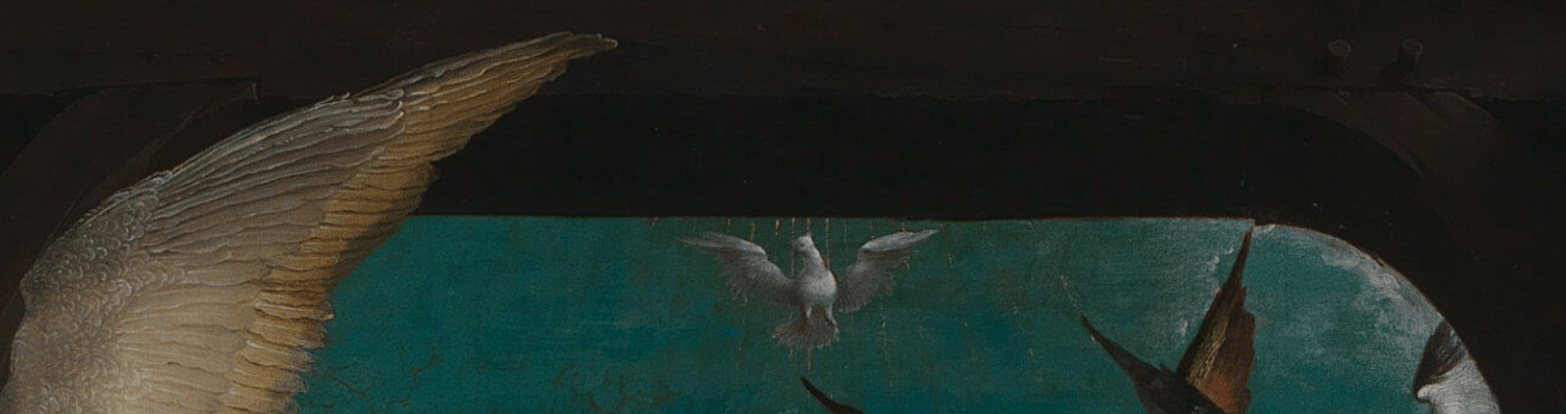
Not just any dove, of course, it is the Holy Spirit. And this is a remarkably rare sighting of it in the Nativity. I can’t, off the top of my head, think of another example, although apparently there are a few, particularly in paintings from Antwerp in the early 16th Century. It flies aloft, directly above the Christ Child, and has golden beams of light descending around it – these are a continuation of the glow of the star, which is just above the wooden beam which frames the top of this detail.

This leads to the suggestion that the star might, in some way, represent God the Father, given that God the Son is down on earth, and God the Holy Spirit flies in between. However, there is nothing in the bible, or in any text I am aware of, that suggests God was present in the star – so this would be a unique instance of this symbolism, and, consequently, we might assume that no one would have understood it in this way – although the light from heaven might have made it clear.

The dove does fit in remarkably well amid the panoply of wings belonging to just a few of the heavenly host, companions of the angels we saw the other day, and they in their turn fly comfortably among the ruins. I love the way in which the wing on the left echoes the curve of the bracket which supports the beam at the top of the detail, carved from a naturally curving branch, I assume. I’m also impressed by the way in which the artist has thought about the pegs which hold it in place – they are flush with the beam, unlike the equivalents on the right, which project, casting visible shadows.

The flight of the Holy Spirit looks almost heraldic, the wings lifted more or less symmetrically, its head turned to our left, and the legs projecting down in front of the fanned tail behind. It has the air of presiding over events at a suitable distance. It may well be practicing for a future Epiphany. Its first appearance as a dove occurs during the Baptism of Christ, which is recounted in all the three of the synoptic gospels, Matthew, Mark and Luke. The accounts are similar in each, but I’m going to quote from Luke, as the relevant part is condensed into just one verse. Immediately after the Baptism Luke says that, ‘the Holy Ghost descended in a bodily shape like a dove upon him, and a voice came from heaven, which said, Thou art my beloved Son; in thee I am well pleased’ (Luke 3:22). In one verse of the bible (it’s two in Matthew and Mark) the whole doctrine of the Holy Trinity is embodied. It may well be worthwhile pointing out that the Baptism of Christ also counts as an Epiphany – a moment of great revelation. For the Wise Men it was seeing the Boy Born to be King. At the Baptism, it was the public revelation that Jesus was the Son of God.  Many years ago, both Epiphanies were celebrated on the same day.

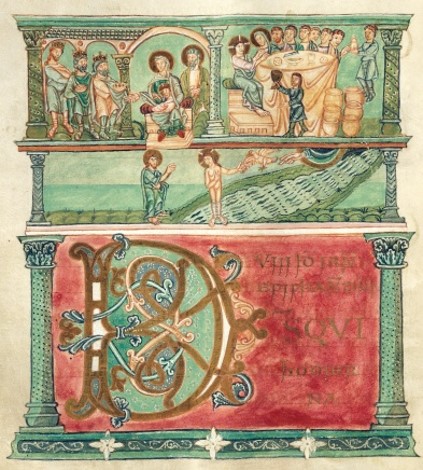
This is a detail from the 10th Century Liber Sacramentorum Fulda, a ‘Book of Sacraments’, with the liturgies – and illustrations – of the feasts that should be celebrated on each day. The Adoration of the Magi is illustrated top left, and The Baptism of Christ stretches across the bottom (apologies, it is unsuitably cropped, but see below). Top right is The Wedding at Cana, Jesus’s first miracle, and so another Epiphany, which was also celebrated on 6 January. Gradually the church spread them out, so each could be the focus of a separate day. Cropped as it is, the descent of the Holy Spirit is clearly visible: the shared celebration of the Adoration of the Magi and the Baptism of Christ could, possibly, explain the presence of the Holy Spirit in this painting. Either that, or the patron was more than especially keen to get as much theology into the painting as possible.

Adoration of the Magi, Marriage at Cana and Baptism of Christ
from Liber Sacramentorum Fulda, 10th century. Seminary Library, Udine.

An Advent Calendar – 8

‘Dogs’ –

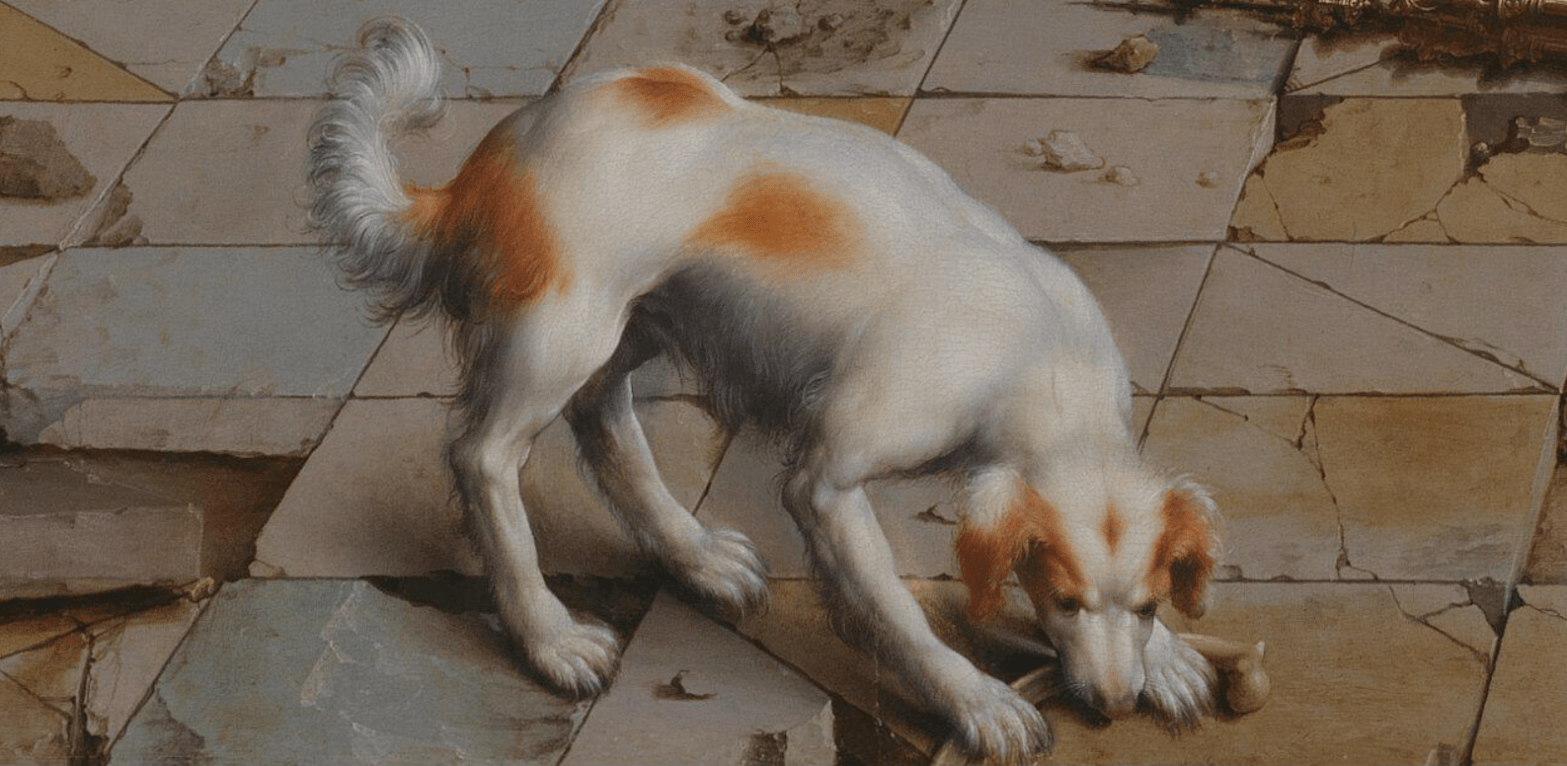
Nowhere in the bible does it mention the presence of dogs at the birth of Jesus, and, as far as I am aware, they are not mentioned in any of the apocryphal sources either – but as I haven’t read them all, I could easily be wrong. They are here as an assumption, the assumption being that wealthy people – such as kings – will travel with their dogs. This was, indeed, commonly the case. When Pope Innocent III summoned bishops to the Fourth Lateran Council in 1215, he pointed out that their retinues should not include birds and hunting dogs – it was simply not appropriate. When Borso d’Este, Marquis of Ferrara, went to Rome to visit the Pope some 555 years later, he travelled with 700 men, 120 of whom were on horseback, and they took their dogs and cheetahs. But then, he wasn’t a bishop on the way to reform the church. And he came away with a promotion, returning home as the first Duke of Ferrara. The Three Kings in Gentile da Fabriano’s Strozzi Altarpiece (1423) – the main panel of which illustrates the Adoration of the Magi – do travel with dogs and cheetahs, as do the Magi in Benozzo Gozzoli’s frescoes in the chapel of the Medici Palace in Florence painted three decades later. In our painting we only have two dogs – no cheetahs – so maybe it’s not so grand. However, although I’m not a dog person by any stretch of the imagination, I am fairly sure this is not a sheep dog.

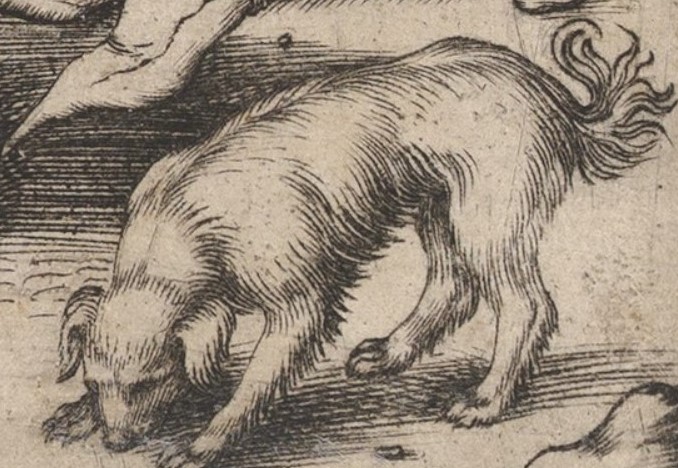
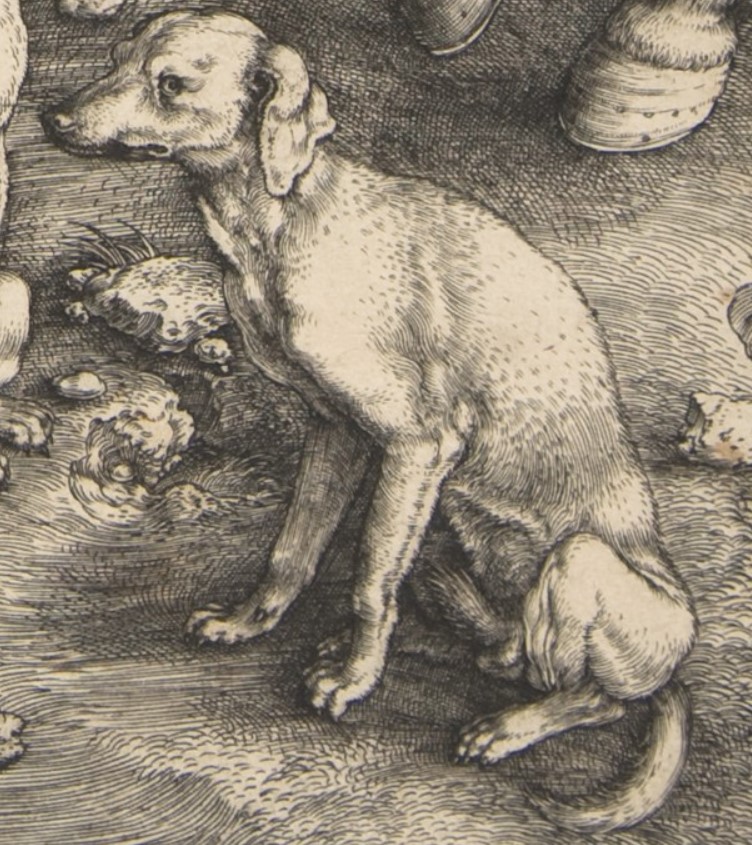
It’s probably a hunting dog, and, true to its doggy instincts, it’s having a go at a bone. It could be a symbol of Fidelity – dogs often are – but here it doesn’t need to be. It is half-way in between the two plants we saw yesterday and is included for at least two reasons – maybe three: 1) to enhance the status of the people in the painting we haven’t seen yet 2) to communicate the idea of ‘Faith’ – although I doubt this dog’s name is ‘Fido’ (Latin for ‘I trust/believe/confide in’) and 3) to tell us that the man who painted it knows about art. Why would I think no. 3) is the case? Well, because it is not his dog – it is a dog he has borrowed from somebody else – namely Martin Schongauer. Compare and contrast:

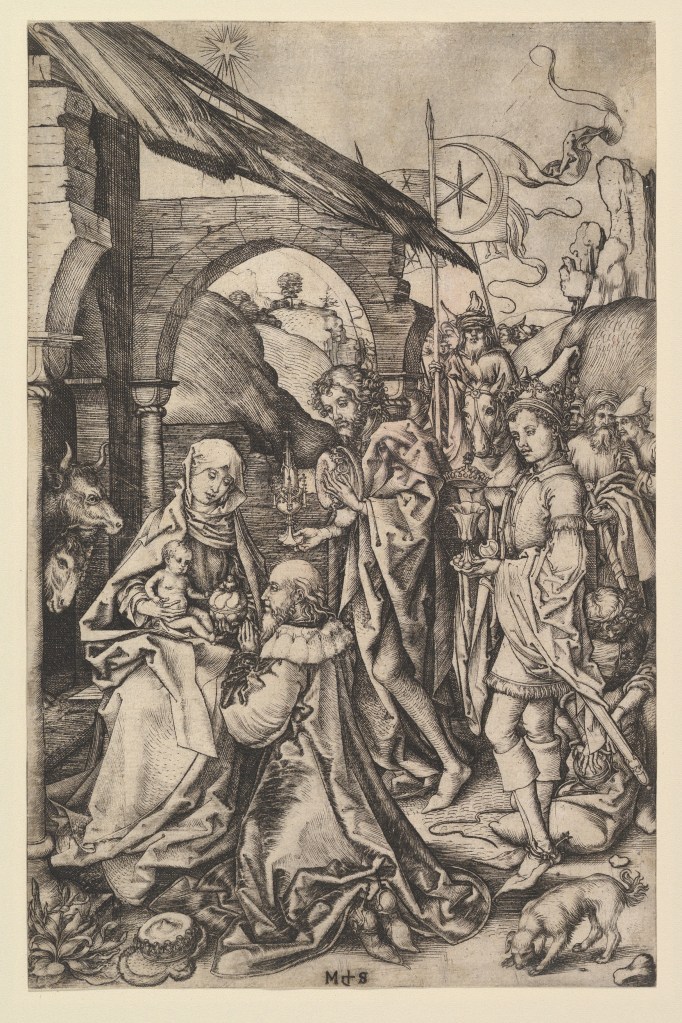
Yes, they are facing the opposite way, which is odd. It is something you would expect if the print were made from the painting, but the print dates from around 1470-75, roughly forty years before the painting, so maybe our artist is just playing a game. If he is, it is quite a sophisticated one, something along the lines of ‘This dog is taken from a print, which reverses the imagery, so when Schongauer engraved the plate, this is what he would have seen’. It’s quite a leap of the imagination. Of course, it may have been swapped round simply because it looks better in the composition this way. The other difference is that our painted dog has a bone. As with so many other things in this painting, it might be symbolic – looking forward to Easter, and Christ’s death, as Christmas inevitably does – but it might just be a dog doing what dogs do. This is the image that Schongauer’s dog comes from, an Adoration of the Magi:

Martin Schongauer, The Adoration of the Magi, 1470-75. Metropolitan Museum of Art, New YOrk.

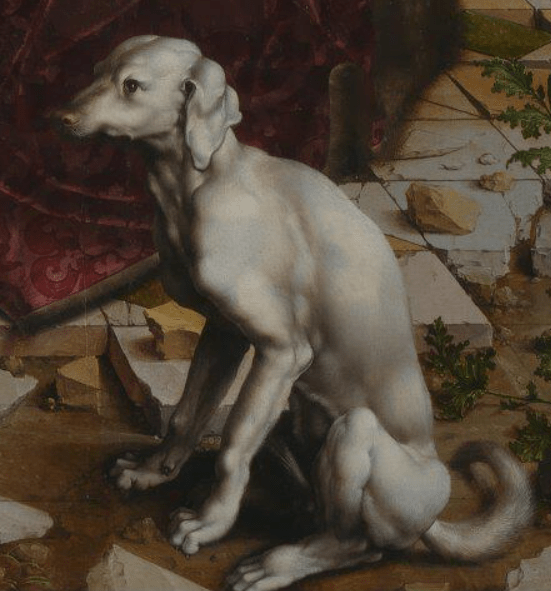
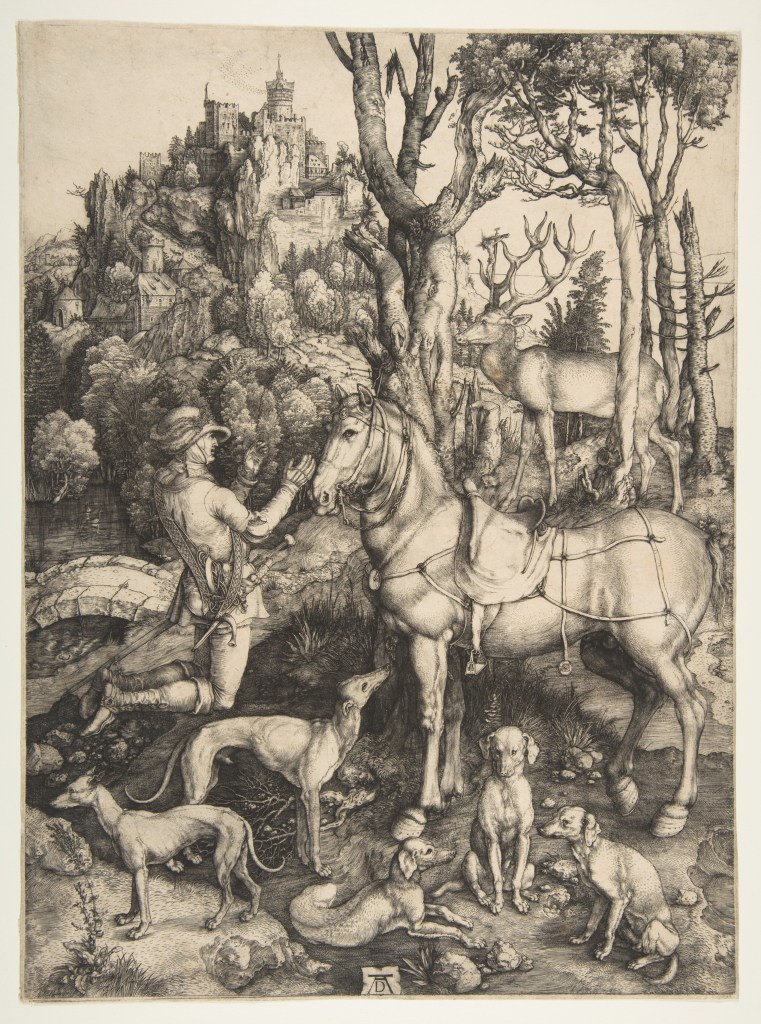
I don’t know whether our artist wasn’t very good at dogs, or didn’t have any dogs to hand to use as models – or was just particularly keen to showcase his knowledge of the work of the men who had inspired him most – but the other dog is taken from a print as well. Compare and contrast these two:

The orientation is the same – it is just the tail that is different – and both dogs occupy similar positions in their respective images. This one is by Albrecht Dürer, and is taken from his St Eustace:

Albrecht Dürer, St Eustace, c. 1501. Metropolitan Museum of Art, New York.

St Eustace was out hunting – or rather, the Roman general Placidus was out hunting – when he saw a crucifix between a stag’s antlers. The stag spoke to him – with Jesus’s voice – and this inspired the general to convert to Christianity, and to be baptised, taking the name of Eustace. It’s Dürer’s largest print, and was hugely influential: the inclusion of one of the dogs in our painting is just one example of that.

As well as reasons 1) – 3) above, we can add reason 4) for the inclusion of this sheepish looking dog – it allows the artist to show yet more textures and shapes to the painting, and so keeps us looking at it more, thus keeping us involved and helping to convey its message. And there are plenty more materials, textures and forms to look at before we get to Jesus.

An Advent Calendar – 7

‘The Floor’ –

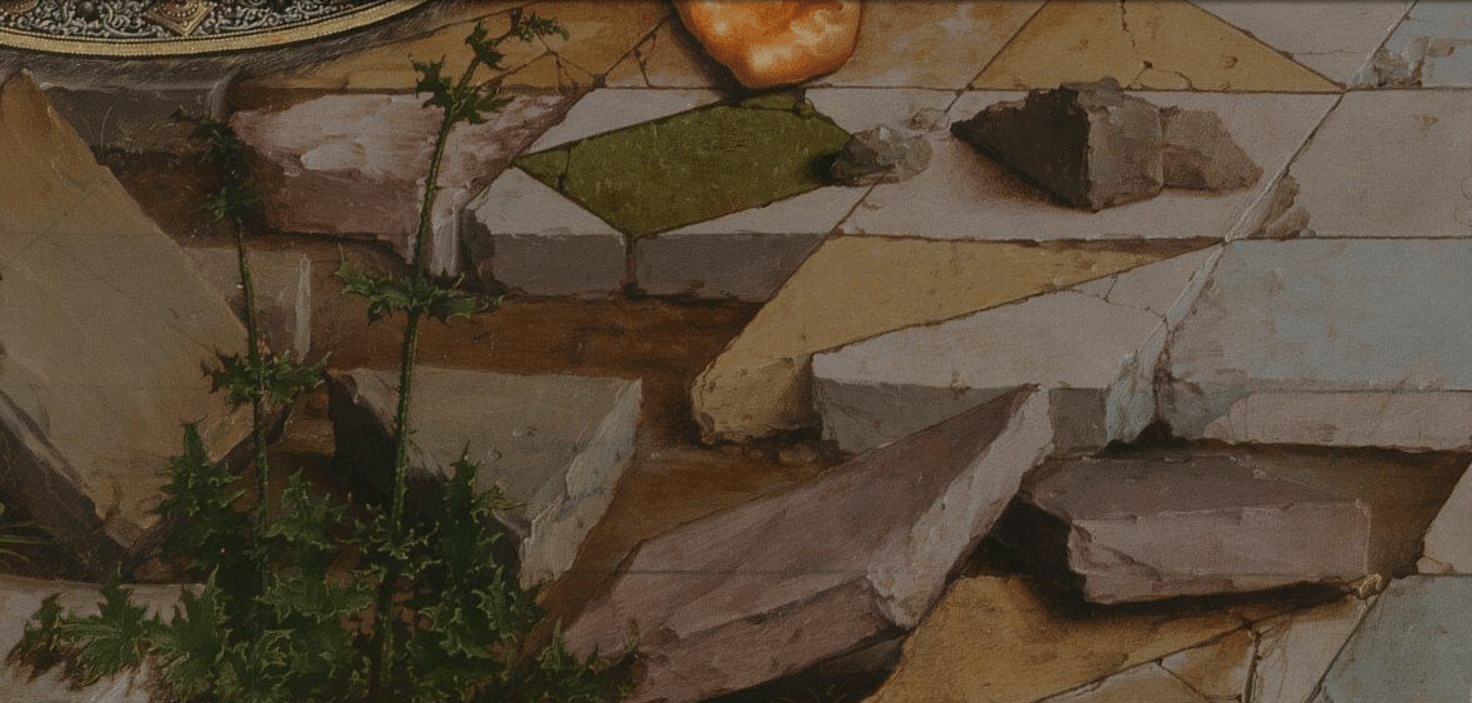
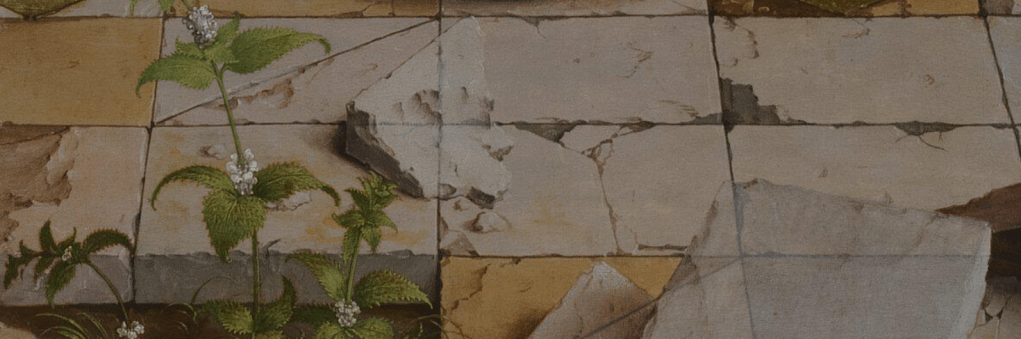
Looking down, we see that the floor is in the same condition as the walls – in a chronic state of decay, and in desperate need of repair. It is part of the setting of this religious drama, and, like the rest of the scenery, it is symbolic of the old order which will make way for the new. Having said that, when it was first laid down it must have been a first-rate pavement, with square stone tiles, which were reasonably thick, in a number of different colours. Some of these were split across the diagonal, making up the square with two triangles, and in others a smaller square has been set at 45˚, with smaller triangles filling in the corners.

The tiles are chipped and cracked, some have come loose, and some seem to have gone missing altogether. It looks as though they were laid directly onto the bare earth, and plants have grown up between them, in the same way that they are growing from the tops of the walls. This one is a Field Eryngo (Eryngium campestre – thanks, as ever, to the Ecologist for the identification). As far as I know, it is not symbolic of anything in particular, but it does look rather spiky. It’s close relative, the Sea Eryngo, is also called ‘sea holly’, just to make the point – and I suspect that the spikes are related to the Fall. God warned Adam and Eve, after he had found them ashamed, and clad in fig leaves, ‘cursed is the ground for thy sake; in sorrow shalt thou eat of it all the days of thy life; Thorns also and thistles shall it bring forth to thee’ (Genesis 3: 17-18) – so, it seems, there was nothing spiky before the fall, and this plant certainly looks prickly even if it wouldn’t do much harm.

On the other side of the painting there is White Dead-nettle (Lamium album), which again is probably not in itself symbolic. However, as it does look remarkably like a stinging nettle, it might again represent the potential dangers – or at least, inconveniences – of the natural world which resulted from the sin which Adam and Eve introduced into it – and so remind us of our need for redemption, and the Baby Jesus, who is present elsewhere in the painting.

As you can see especially clearly in this detail, it is not just the painted building that is in a state of decay: the painting itself is too. This is visible in the other detail, but it is more obvious here: some of the tiles have become transparent. What the artist appears to have done was to lay out the perspective of the floor – all the parallel lines which go towards the vanishing point, and those at right angles to them – and then to paint the tiles themselves. He may then have decided it just didn’t look enough of a mess, so he painted some more tiles on top. Over time, these have become see-through. What happens (here comes the science bit) is that the oil dries as the result of a process called concatenation: individual oil molecules bond together to form chains with other oil molecules. As they do this, the refractive index of the oil increases (the refractive index is a measure of the degree to which light is ‘bent’ as it passes from one transparent medium to another – think of a straw sticking out of a gin and tonic for example – though why you’d drink gin and tonic with a straw I don’t really know). The refractive index of some pigments – white, for example – is relatively low, and as concatenation increases the refractive index of the oil gets closer and closer to the refractive index of the pigment, so the light refracts less and less, and the paint gradually becomes transparent. It’s a sign of age, and there’s nothing that can be done about it. As a phenomenon it can be interesting, as it allows you to see where artists have changed their minds – ‘repented’ of what they had done before – but that’s just a way of explaining the Italian term for these visible changes: pentimenti. Sadly, even though Jesus has come to ‘rebuild’ the old order, returning this painting to how it looked when it was first made would presumably not be part of his brief.

An Advent Calendar – 6

‘A Relief‘ –

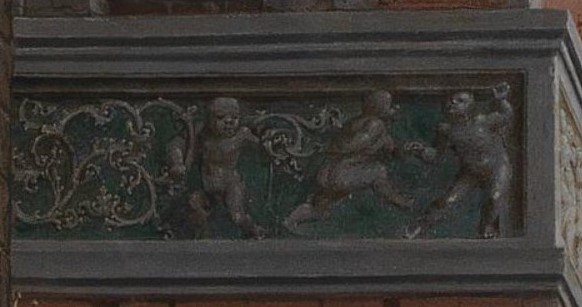
Today’s window opens up to reveal a relief carving, which functions as part of a frieze that continues around the corner of one of the walls. On the 3rd, one of the elements of the ruins was a very tall, round-topped arch – we can see that arch springing from the base of the frieze on the right of the detail. And yesterday, we saw a capital, which is on the other side of the tall arch from this relief – they occupy a similar position within the painting, and must, therefore, be equivalent in some way. Whereas the capital was on top of a red, highly polished, cylindrical column (of circular cross-section), this relief supports the two grey stone bases of two square, red marble columns. I’m not sure what the significance of this parallel is, but it might simply reflect the way in which buildings were constructed. Certainly, in England, cathedrals such as Salisbury and Durham have similar architectural details picked out in dark, fossiliferous limestones (rather than red) – Purbeck and Frosterley respectively, in these cases.

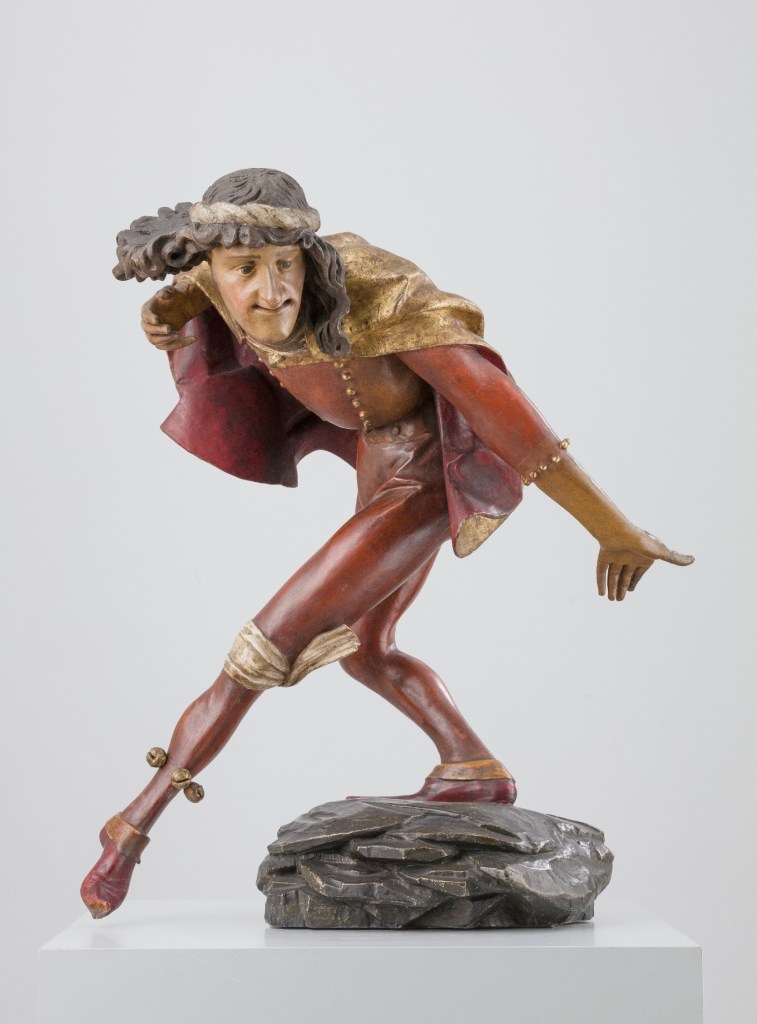
The relief itself, on the side facing us, shows a stylised plant – some sort of vine – and three boys dancing. In Italy they would be called putti. A putto is, quite simply, a ‘boy’, from the Latin putus (an alternative to the more familiar puer, I believe). They are not cherubs – they do not have wings – so there is nothing to suggest that this relief is supposed to be religious in and of itself. The lack of ‘religiosity’ is perhaps enhanced by the dancing itself, which is a little grotesque. Looking at them up close they really reminding me of something – a late-15th/early-16th century drawing of boys – or possibly cherubs – dancing, probably from Germany, but I can’t quite place it. If anyone has any ideas, please let me know! However, they do remind me of Erasmus Grasser’s wonderful Morris Dancers, carved for Munich Town Hall in 1480. Compare these two with today’s relief, for example (OK, I cheated a little, and flipped the one on the left – I couldn’t find a photo taken from the other side).

I must write a full blog about them one day. I’ve always liked the sound of Grasser: they tried to stop him from becoming a member of the guild, describing him as a ‘disruptive, promiscuous and disingenuous knave’. And yes, you’re right, Morris Dancing in Germany! It clearly isn’t as English as we thought it was: the word itself is derived from ‘Moorish’ after all – more cultural influence from elsewhere…

As for the vine – well, I confess that I was expecting it to look more like a grape vine when I was picking out the detail, but not because of the sacramental significance. However, having said that, the reference could be entirely relevant. Have a look at this mosaic, for example.

It can be found in Rome – or rather, just outside the city walls (but well within the 20th Century suburbs) – and it shows a grape harvest. Surely a display of Bacchic revelry? Well no, it comes from the 4th Century Mausoleum of Costanza, next to the church of St Agnes ‘outside the walls’ – and so it is an early Christian mosaic. The fact is, when Christianity was legalised in 313 and Christians were finally allowed to build public places of worship and to decorate them, they had very little experience of doing so – and based their building designs, and their decorations, on the prevalent Roman styles. So this could easily be read as a celebration of Bacchus, the God of Wine, or it could also celebrate the Blood of Christ, and, for that matter, the Christian community as being at one with Jesus (as in Christ’s statement in John 15:5, ‘I am the vine, ye are the branches’). The meaning of the mosaic could vary according to its context, if it weren’t for the fact that, in this case, its context is fixed by its location within a church. Not so with today’s detail. Like yesterday’s capital, it is there to remind us that the old order – in this case the Roman Empire – will pass away. But it can also be read as evidence that the new order – Christianity – will continue. And it may well be for this reason that the whole frieze is in such good condition, and is supporting the two square columns. For this relief, much thanks…

An Advent Calendar – 5

A Capital

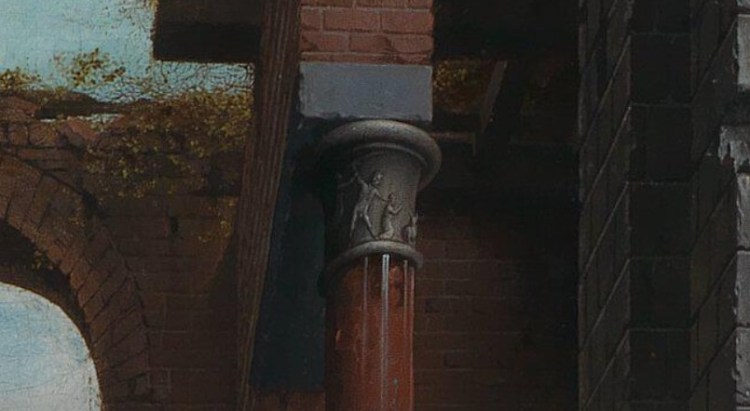
Today we are looking at another column, and like the one yesterday, it might be made from Rosso di Verona, although seeing it like this, I doubt it. It’s a deeper red, for one thing, and it has dark, almost black veins in it. Not only that: it has a very high shine, and Rosso di Verona cannot be polished so finely. The light reflecting off the column appears as vertical white lines, and, apart from the degree of polish, the highlights tell us that, miraculously, the column is not worn or eroded. Despite the change and decay we see all around, it is perfectly smooth and shiny, and, judging by the way in which the artist has painted the reflections, almost perfectly cylindrical.

But that’s not what interests me today, apart from the fact that it implies that there is something special about this column: why has it survived so well? Why is our attention drawn towards it? I’m assuming the intention is, in turn, to draw our attention towards the grey capital at the top. This capital is historiated – by which I mean it is decorated with figures that are significant in some way, rather than being purely, well, decorative. Four figures are visible. Directly above the brightest highlight on the column is a kneeling person, facing to the right with their hands raised in prayer. Behind them (to our left) and directly above the less prominent highlight on the column is a standing figure with its legs far apart. One hand – the left – is on the kneeling person’s shoulder, and the other is raised in the air. A slightly curved line is carved just below the top of the capital – a sword, which the standing figure is holding. But the raised arm is grasped firmly by the hand of a third figure, round to the left, and in the shadows. This figure seems surprisingly high up, and its legs curve round underneath it, rather than touching the ground. Sketched in at the very top left you might just be able to decipher a wing: it is an angel. And then, at the base of the capital, on the far right, is a small creature. Again, it is above one of the highlights on the column, a sign that the column – and the light reflecting off it – are there to draw our attention to these figures. This is the story of Abraham and Isaac, told in the Book of Genesis, Chapter 22:1-13:

And it came to pass after these things, that God did tempt Abraham, and said unto him, Abraham: and he said, Behold, here I am. And he said, Take now thy son, thine only son Isaac, whom thou lovest, and get thee into the land of Moriah; and offer him there for a burnt offering upon one of the mountains which I will tell thee of. And Abraham rose up early in the morning, and saddled his ass, and took two of his young men with him, and Isaac his son, and clave the wood for the burnt offering, and rose up, and went unto the place of which God had told him. Then on the third day Abraham lifted up his eyes, and saw the place afar off. And Abraham said unto his young men, Abide ye here with the ass; and I and the lad will go yonder and worship, and come again to you. And Abraham took the wood of the burnt offering, and laid it upon Isaac his son; and he took the fire in his hand, and a knife; and they went both of them together. And Isaac spake unto Abraham his father, and said, My father: and he said, Here am I, my son. And he said, Behold the fire and the wood: but where is the lamb for a burnt offering? And Abraham said, My son, God will provide himself a lamb for a burnt offering: so they went both of them together. And they came to the place which God had told him of; and Abraham built an altar there, and laid the wood in order, and bound Isaac his son, and laid him on the altar upon the wood. And Abraham stretched forth his hand, and took the knife to slay his son. And the angel of the Lord called unto him out of heaven, and said, Abraham, Abraham: and he said, Here am I. And he said, Lay not thine hand upon the lad, neither do thou any thing unto him: for now I know that thou fearest God, seeing thou hast not withheld thy son, thine only son from me. And Abraham lifted up his eyes, and looked, and behold behind him a ram caught in a thicket by his horns: and Abraham went and took the ram, and offered him up for a burnt offering in the stead of his son.

For Christians, this story, telling of Abraham’s decision to sacrifice his ‘only son Isaac’ because of his love for God, was seen as a pre-figuring God the Father’s decision to sacrifice his only begotten son, Jesus, because of his love for humankind. The interpretation gains strength from the phrase, ‘God will provide himself a lamb for a burnt offering’, as Jesus was greeted by John the Baptist with the words, ‘Behold the Lamb of God, which taketh away the sin of the world’ (John 1:29). The inclusion of this relief sculpture, with Isaac kneeling in prayer, Abraham’s arm raised and ready to strike, the angel preventing him, and the ram, caught in a thicket (or so we must imagine), to the right, reminds us that Jesus, the little baby depicted at the base of the column, was born to die; that he was the Messiah prophesied in the Jewish scriptures; and that we are now at the beginning of the ‘new order’. It’s a lot of weight for a small carving to bear, but that is what makes this column so special: its weight-bearing capacity – whether that is physical or allegorical.

An Advent Calendar – 4

Architecture as History

This is a window – but it’s not just a window, it’s a biforate window – which means that it’s a window with two openings (from the Latin bi- for ‘two’ and foratus, meaning pierced). There might be quite a few words today. For example, this biforate window uses stilted arches. The central division is made up of a column – you can just see the very top of it, a warm orangey-red, at the bottom of the detail. The shaft of this column is topped by a capital (from the Latin caput, meaning ‘head’), carved with stylised leaves (though not the acanthus of the classical Corinthian order [or ‘style’]). Above the capital is a square slab, known as the impost. Now, above the impost there is a vertical, square, cylindrical element before the arches on either side start to curve out towards the edges of the window. The point where an arch starts to curve, is the point where the arch is said to spring. A stilted arch is one which springs some distance above the impost. Effectively, it is an arch on a stilt.

All very well and good, you might say, but so what? Well, the nature of the arch can tell us the age of the building, and the types of buildings used in a painting can tell us more about where it was made – and when. In Italian Renaissance paintings the ruins (see yesterday) depicted in paintings of the Nativity tend to be ruins of classical architecture. They are saying that the birth of Jesus means that the Roman Empire is destined to fail… although they are also saying that the artists really admired classical architecture. Indeed, their contemporaries who were architects were trying to emulate, and even surpass it. Modern buildings, for the Italians, had round-topped arches, just like the ones they saw in ancient Roman ruins.

However, in the North of Europe the artists – and architects (although I should probably say ‘builders’ – precisely when ‘architects’ take over is not entirely clear) – had different interests. Buildings were still being constructed with pointed ‘Gothic’ arches way into the 16th Century. So modern buildings had pointed arches, whereas old buildings had round ones. But these were not classical buildings – they were Romanesque, with full, broad, round arches, with rounded edges, a bit like classical architecture, but after Christmas when they’ve eaten and drunk too much and could do with going on a diet and doing a bit of exercise. In the UK we might call it Norman, as it was the Normans who really introduced the Romanesque to Britain, in cathedrals such as Durham and Canterbury and Rochester and Lincoln and Winchester and Ely and Peterborough and… so on. But stilted arches are arguably ­Pre-Romanesque, with examples going back to the 9th century – although they do continue through to the 12th, in some cases. So the painting shows us not just an old building, but a very old building, as far as the Gothic-loving audience would have been concerned. The ruined state of it might suggest as much, but the architectural style confirms it. No wonder Jesus has come to rebuild!

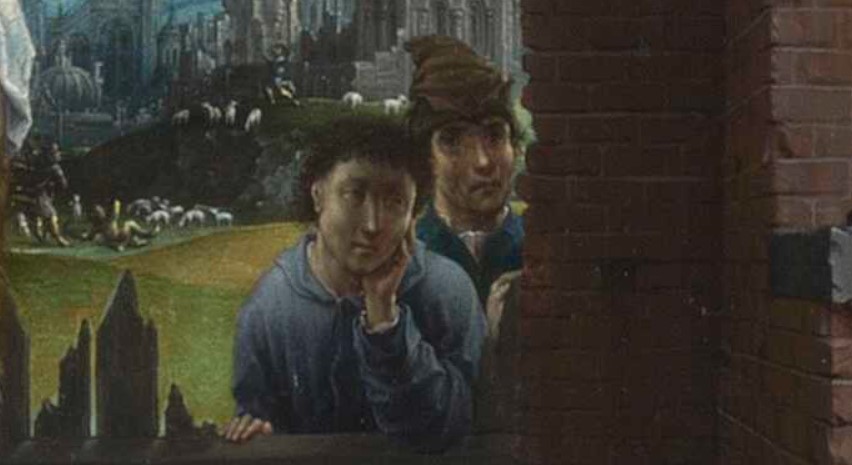
However, it is clearly loved. You may be familiar with the notion of tree huggers – but how many of you have ever hugged a column? I have been known to, in moments of architectural excitement, and it’s a useful thing to do as a group if you want to work out how large some particularly impressive classical examples are. But whether the man you can see below is hugging the column because of his admiration for Pre-Romanesque architecture, or because he loves what could be Rosso di Verona – a wonderful, orangey-red stone rich in the fossils of ammonites, and transported all the way from the eponymous Italian city – so well out of the way either of Bethlehem or the original home of this painting – or, maybe, because he wants to squeeze through the biforate window to get a better view of the Christ Child, I’ll let you decide.

An Advent Calendar – 3

Ruins

Rest assured, ruins are not mentioned in any biblical account of Christmas – but nevertheless, they are a common feature in paintings. I’ve written about them recently, as it happens, long after Christmas, when Jesus, Mary and Joseph had already returned from their flight into Egypt, and were settling down to what could have been normal family life (115 – Role Models).

But if ruins weren’t mentioned, what are they doing there? After all, we know full well that Jesus was born in a stable, don’t we? We do, but we’re wrong – at least as far as the bible is concerned. There’s no mention of a building at all – apart from the building where Christmas didn’t take place (‘the inn’). Early apocryphal gospels suggest that the holy birth took place in a cave, and there are plenty of paintings which show that, mainly from the 13th and 14th centuries, although the idea does survive into the Renaissance in a few examples. All the bible says is that Mary ‘…brought forth her firstborn son, and wrapped him in swaddling clothes, and laid him in a manger; because there was no room for them in the inn.’ (Luke 2:7) The fact that a manger is a food bowl (from the French, manger, ‘to eat’) tells you what a remarkable story this is, even if you don’t believe it. Let’s face it, the Son of God, who is God (it’s a mystery) becomes a human baby and they put him in an animal’s feeding trough – what greater humility could there be? Anyway, the assumption must have been, because the ox and the ass were there as well (more of them another day), that this manger must have been in a stable. But no – here the birth has taken place amidst ruins.

There are several reasons for this. And now I’m going to quote from myself to save time (apologies if you’ve just read 115, I’m repeating myself): ‘In Nativity scenes the symbolism is quite specific: it relates to at least two texts in the bible, and early Christian theology. During the Sermon on the Mount (Matthew 5:17) Jesus says, ‘Think not that I am come to destroy the law, or the prophets: I am not come to destroy, but to fulfil,’ and in John 2:19 he also says, ‘Destroy this temple, and in three days I will raise it up.’ In St Augustine’s The City of God, written in the early 5th Century, the author suggests that as Christianity continued to grow, the Roman Empire would fall. All three of these ideas add up to the same thing – Jesus hadn’t come to destroy the old order, whether that be Judaism or Rome, but to rebuild it – and that is the idea that the ruins represent.’ Not only that – ever since the fall, when Adam and Eve had failed to resist temptation, the world had been in a state of decay. We grow old and die, and buildings crumble into dust.

They are quite splendid ruins. We see the edge of a stone structure on the far left, and, leading away from that, the remains of a brick wall with a doorway in it. A stone lintel was set in place to support the wall above it, but that has cracked in any case, and only a few courses of bricks survive. The rest of the wall fell away long enough ago for plants to have sprouted all the way along the top. This wall seems to be an addition to the one further back, as the bricks are not meshed with those of the far wall – and we can see that other alterations have taken place. There is a bricked up window, for example: both the bricks and mortar are paler in colour, less weathered. The corner of this wall is made up of stones, larger and on the whole greyer than the bricks, and these have cracked, chipped and broken away. The cornice above has survived better, and continues beyond the monumental semi-circular arch beyond. The rounded arch is significant, but we’ll find out why tomorrow!

What it comes down to is that in this painting, as in the bible, there is something old and something new – the building is old, and represents the old order. Jesus is new, and has come to rebuild, to put the world to rights.

An Advent Calendar – 2

Angels

Angels have just as much as a right as the star to be present at the Nativity. They are mentioned in all four gospels, as it happens, although Mark only mentions them when Jesus is tempted by the devil, and John has one stirring the waters of the pool of Bethesda, and more appearing at the resurrection. It’s only in Matthew and Luke, then, that they are connected with Christmas.

For Matthew, the angel (which one is not specified) is tasked with communicating with Joseph. When the recently espoused old man found out that his young wife was pregnant, and knew, in the way that you would, that the child was not his, ‘Then Joseph her husband, being a just man, and not willing to make her a public example, was minded to put her away privily. But while he thought on these things, behold, the angel of the Lord appeared unto him in a dream, saying, Joseph, thou son of David, fear not to take unto thee Mary thy wife: for that which is conceived in her is of the Holy Ghost.’ (Matthew 1:19-20). Then after Jesus was born, the angel – or an angel – returns: ‘…the angel of the Lord appeareth to Joseph in a dream, saying, Arise, and take the young child and his mother, and flee into Egypt, and be thou there until I bring thee word: for Herod will seek the young child to destroy him.’ (Matthew 2:13). A third visitation followed some years later: ‘But when Herod was dead, behold, an angel of the Lord appeareth in a dream to Joseph in Egypt, Saying, Arise, and take the young child and his mother, and go into the land of Israel: for they are dead which sought the young child’s life.’ (Matthew 2:19-20). However, what is sometimes assumed to be a fourth visit was not necessarily from an angel. Having been told to return to Israel, there is an intervention to tell him, effectively, that he was going the wrong way… he had already been worried: ‘But when he heard that Archelaus did reign in Judaea in the room of his father Herod, he was afraid to go thither: notwithstanding, being warned of God in a dream, he turned aside into the parts of Galilee’ (Matthew 2:22). While we’re at it, it was not necessarily an angel that told the Magi to avoid Herod, as Matthew again says they were ‘warned of God in a dream‘ (Matthew 2:20). Direct intervention is a posibility.

Notice that Joseph had as many as four dreams. This is surely one of the reasons why he is painted asleep so often – he would have to be, to receive all these divine revelations. And apart from that, he was very old. It doesn’t say so in the bible, but it does in the Golden Legend, written in the 1260s (see Day 31 – The Suitors Praying), and that idea probably came from the Protevangelium, a second century text that didn’t make the final cut, as far as the bible was concerned.

However, Matthew does not mention angels at the Nativity – that is down to Luke. Not only does Luke talk about the angel’s appearance at the Annunciation – nine months before Christmas when the whole thing started – but he is also very specific about the angels at the Nativity, in this passage which you probably know very well, Luke 2: 8-14:

And there were in the same country shepherds abiding in the field, keeping watch over their flock by night. And, lo, the angel of the Lord came upon them, and the glory of the Lord shone round about them: and they were sore afraid. And the angel said unto them, Fear not: for, behold, I bring you good tidings of great joy, which shall be to all people. For unto you is born this day in the city of David a Saviour, which is Christ the Lord. And this shall be a sign unto you; Ye shall find the babe wrapped in swaddling clothes, lying in a manger. And suddenly there was with the angel a multitude of the heavenly host praising God, and saying, Glory to God in the highest, and on earth peace, good will toward men.

Today’s angels are just two of the ‘multitude of the heavenly host’. People usually get the number of angels in this painting wrong, as it happens, and draw conclusions from their miscounting – I’ve done it myself – but more of that another day.

How would an artist know what to paint? We should assume that none of them had ever seen a real angel, after all (I could be wrong, of course). Like most angels painted in the North of Europe in the early 16th Century, it is likely that these were inspired by carved, wooden angels (see, for example, Day 70 – The Annunciation, again). Certainly, the way their long robes fly around them suggests the crisp lines and taut folds that can be created by a skillful chisel, and held up by the tensile strength of wood, rather than flowing fabric fluttering in the wind. While we’re at it, these robes were clearly designed to be flown in: they would be completely impractical for the solid ground. You’d trip over the hems before you’d even taken one step.

The colours are a delight – slightly misty as they are flying at some distance: the artist clearly had an awareness of atmospheric perspective. I particularly like the combination of blue and rose-pink in this detail. Why does everyone think that angels should be in plain white from top to bottom these days? It’s a relatively recent development (sorry, I haven’t researched this one – if you know when ‘white’ became the new ‘glorious’ for angels, please let me know – my guess would be the 19th Century), and I far prefer the rainbow colours of old. Their gestures are also wonderfully expressive – one is in prayer, hands joined at the fingertips, and the other is astonished, hands out in awe at the wonder of the incarnation. God has become a little baby. How beautiful.

An Advent Calendar – 1

It’s been a long time since I had my own advent calendar, so I thought this year I would make one, and send it to you. Each day I will send you a detail of a painting. They will all be from the same painting, but I won’t tell you what it is until we get to Christmas. I’m sure many of you will recognise it though (sorry, no prizes for getting it right!). Some days I might even expand the ‘window’ it into a full blog entry, in the way that sometimes there are bigger pictures, but that’ll be a surprise (for you and me alike!) if it happens. I’m starting with

The Star

The star is one of the first signs of Christmas, and to those who didn’t know Mary and Joseph, the first sign that something remarkable was going to happen, so it makes sense to start here. It is also one of the relatively few things we associate with Christmas, and with images of the Nativity, that is actually mentioned the bible – although only in the Gospel According to St Matthew. When the wise men get to Herod’s court, they ask him ‘Where is he that is born King of the Jews? for we have seen his star in the east, and are come to worship him.’ (Matthew 2:2). However, perturbed he was, Herod told them that his men suggested that the ‘new king’ might be found in Bethlehem, and the Magi took this advice: ‘When they had heard the king, they departed; and, lo, the star, which they saw in the east, went before them, till it came and stood over where the young child was.’ (Matthew 2:9) – or, in the words of ‘The First Noel’,

This star drew nigh to the northwest,
o'er Bethlehem it took its rest;
and there it did both stop and stay, 
right over the place where Jesus lay.

There has been a lot of conjecture about what this ‘star’ might have been – Giotto paints it to look remarkably like a comet (see Day 87 – The Childhood of Christ), and it is widely believed that this reflects the apparition of Halley’s comet in 1301. As it happens, Halley’s Comet was also visible in 11BC, and there was another very bright one seen in 5BC – and it does seem possible for other historical reasons that Jesus may well have been born 4 or 5 years before himself (the calendar probably wasn’t set up that accurately – there’s no ‘year 0’ for a start…). Alternatively there was a bright nova – a new star – recorded in 4BC. Here’s a link to an article about The Astronomical Explanations written by Victoria Gill for the BBC back in 2012.

This star certainly isn’t a comet. It radiates the most brilliantly from an undefinable centre, beams of light spreading in all directions, and causing faint, circular haloes as it passes through drops of water vapour. It bursts through the clouds, illuminating their inner edges, and in some cases stretching beyond them. It is unlike any star that has ever been seen – but then, Jesus was only born the once.

116 – Typical!

Typical! You take a subject as sensitive and emotive as the penitence of Mary Magdalene, a woman struck with remorse at her sinful past, an existence spent earning money from the debauchery of the flesh, and you turn it into an excuse for men to stare at a display of the very flesh that has caused her downfall, a voluptuous, sensuous image that contradicts the very nature of the profound changes in this woman’s life, and that goes as far as to question the title of the painting itself. In short you objectify her. Typical indeed, and only to be expected from a paternalistic society in which men paint for men, for their own private pleasure. But before you get too outraged, there is just one small problem with this attitude…

Elisabetta Sirani, The Penitent Magdalene, 1663. Musée des Beaux-Arts et d’Archéologie, Besançon.

The problem is, that it was painted by a woman – Elisabetta Sirani. It questions the notion that art might be gendered – or, to put it another way, that women might paint women in a different way than men would. It is one of the paintings I’ll include in my online talk this Wednesday evening, 2 December – Purity, Temptation, Sin and Repentance: Four Women on the Path to Redemption – there’s plenty of time to sign up if you’re around. I’m not saying that painting isn’t gendered, by the way, but… well, it’s complicated.

Sirani was a very successful artist. I have talked about her before, back in May, with Picture Of The Day 62 – Portia, but, in case you don’t have time to read up about her there, here’s a brief reminder. She was born in 1638 in Bologna – and that was where she seems to have spent her entire life. It’s quite possible she never left the city. I say entire life, but she died, tragically young and under unexplained circumstances, at the age of 27, leaving behind over 200 paintings. Like her older contemporary, Artemisia Gentileschi, she was trained by her father, who was an artist, and like Artemisia her earliest surviving work was painted when she was 17. By 20 Elisabetta was already enormously successful, and soon after she founded an academy for women artists. Her early death was mourned by artists and intelligentsia alike, and she was buried in great pomp in San Petronio, Bologna’s most important church, alongside the city’s most famous artistic son, Guido Reni, who had trained her father.

If we can believe what we see in this painting, having repented and mended her ways, Mary Magdalene has retreated to a cave to read the bible and contemplate Christ’s sacrifice on the cross, while meditating on death, and mortifying the flesh. This should not be in doubt. The bible stands open at the left of the painting on a ledge which also supports a candle stick. We can just see the base of the candle, though not the flame itself, which illuminates the scene with a supernatural brilliance.

The precise fall of this light is beautifully traced across the painting, while a second light source, the moon, silvers the edges of the cave, and can just be glimpsed in the sky outside. Within, the candle illuminates the underside of the right arm of the delicately carved and coloured crucifix, against the base of which the bible is leaning. The wound in Christ’s chest is lit, revealing a dash of red blood, as are the side of his face around the eye socket, and his halo. The light even flicks across the edges of the titulus attached to the top of the cross, on which the letters I.N.R.I. (Iesus Nazarenus Rex Iudeorum – Jesus of Nazareth, King of the Jews) are summarily sketched. It also casts a shadow from the surprisingly low-slung loincloth, and defines the firm thigh muscles of the saviour’s tautly bent right leg. It’s not just the Magdalene who is sensuously depicted. The candle illuminates Mary’s chest and neck, models the contours of her face with delicate sensitivity, and casts a shadow onto the wall of the cave behind her. Her golden hair glows around her face, falling copiously over both shoulders.

A strand of hair crosses her chest, and lies between her breasts, while another wraps around her left arm, and under the knotted cat o’ nine tails. She holds the whip in her right hand, the end of its handle resting provocatively close to her left nipple (the other nipple is caressed by a shadow from her pink robe, which frames, but doesn’t clothe, her torso). Her left hand is poised on top of a skull, the symbol of her meditations upon death and of the transience of flesh, which sits almost too comfortably in her lap.

To understand the extreme sensuality of this painting, surely it would be useful to know more about the life of Mary Magdalene? The problem is that none of it is in the bible. What we are looking at is a fiction, but one that was believed for well over a millennium. If we do go as far as to read the bible, we will find the first mention of the Magdalene in Luke’s Gospel, at the beginning of Chapter 8. Here are the first two verses:

And it came to pass afterward, that he went throughout every city and village, preaching and shewing the glad tidings of the kingdom of God: and the twelve were with him, And certain women, which had been healed of evil spirits and infirmities, [including] Mary called Magdalene, out of whom went seven devils…

Immediately before this, in chapter 7, Jesus was at dinner with the Pharisee Simon, when the following episode occurred – I’ll give you verses 37 and 38, and the very last verse of the chapter, verse 50:

And, behold, a woman in the city, which was a sinner, when she knew that Jesus sat at meat in the Pharisee’s house, brought an alabaster box of ointment, And stood at his feet behind him weeping, and began to wash his feet with tears, and did wipe them with the hairs of her head, and kissed his feet, and anointed them with the ointment…. And he said to the woman, Thy faith hath saved thee; go in peace.

Of course, there is no connection between this episode, and the fact that, immediately afterwards, in the next chapter, Mary Magdalene is mentioned for the first time. Or is there? Well, if you keep reading, and presuming you’ve already read Matthew and Mark, after Luke you would get to the Gospel According to St John. And this is what you would read in Chapter 11, verses 1 & 2:

Now a certain man was sick, named Lazarus, of Bethany, the town of Mary and her sister Martha. (It was that Mary which anointed the Lord with ointment, and wiped his feet with her hair, whose brother Lazarus was sick.)

Now, Luke doesn’t say that his ‘woman… which was a sinner’ was called Mary, but she has done exactly the same thing – so maybe she was called Mary, and maybe indeed she was the sister of Lazarus and Martha. However, in the next chapter (12), in the first three verses, John tells us:

Then Jesus six days before the passover came to Bethany, where Lazarus was, which had been dead, whom he raised from the dead. There they made him a supper; and Martha served: but Lazarus was one of them that sat at the table with him. Then took Mary a pound of ointment of spikenard, very costly, and anointed the feet of Jesus, and wiped his feet with her hair: and the house was filled with the odour of the ointment.

So, is John’s mention of the event in Chapter 11 referring to what would happen later in Chapter 12, or what we might already have read in Luke 7? Mary would certainly become associated with precious ointment. Mark’s Gospel, chapter 16, verse 1, tells us that after the Crucifixion,

And when the sabbath was past, Mary Magdalene, and Mary the mother of James, and Salome, had bought sweet spices, that they might come and anoint him.

And this is why Mary always has a jar with her after she has visited Jesus’s tomb in paintings of the Noli me tangere, which is recounted in John 20 – have a look back to the version by another of Italy’s great 17th Century women, Galizia Fede: 104 – Don’t touch!

Basically, we are discussing the identities of three people: (1) Luke’s ‘woman… which was a sinner’ from Chapter 7; (2) ‘Mary, called Magdalene’ from Luke, Chapter 8, and (3) Mary, sister of Martha and Lazarus, from John, Chapters 11 & 12. However, way back in 591, the year after he became Pope, Gregory the Great delivered a homily for Easter in which he conflated these three women, and Mary Magdalene was identified as the sister of Martha, a former sinner who had repented, only to became one of Christ’s most ardent followers. It wasn’t until 1969, under Pope Paul VI, that the Roman Catholic Church finally recognised them as three separate people. But for the History of Art that is almost irrelevant: from 591 – 1969, as far as the Roman Catholic Church was concerned, Mary Magdalene was a repentant sinner. And for most people, that meant a repentant prostitute. That effectively includes the whole of European art since the fall of the Western Roman Empire (less a century or so), which includes everything in the National Gallery in London, for example. For that matter, it also includes today’s painting from the Musée des Beaux-Arts et d’Archéologie, Besançon. But why would a woman like Elisabetta Sirani, who knew all too well the problems that women faced, choose to paint the Magdalene like this?  Well, I’m afraid I’ll have to leave you to think about that. People are more complex than we might expect. I’ll talk about just some of the complexities this Wednesday, 2 December, at 6.00pm UK time: Purity, Temptation, Sin and Repentance: Four Women on the Path to Redemption – I look forward to seeing you there, or somewhere else, sometime soon!