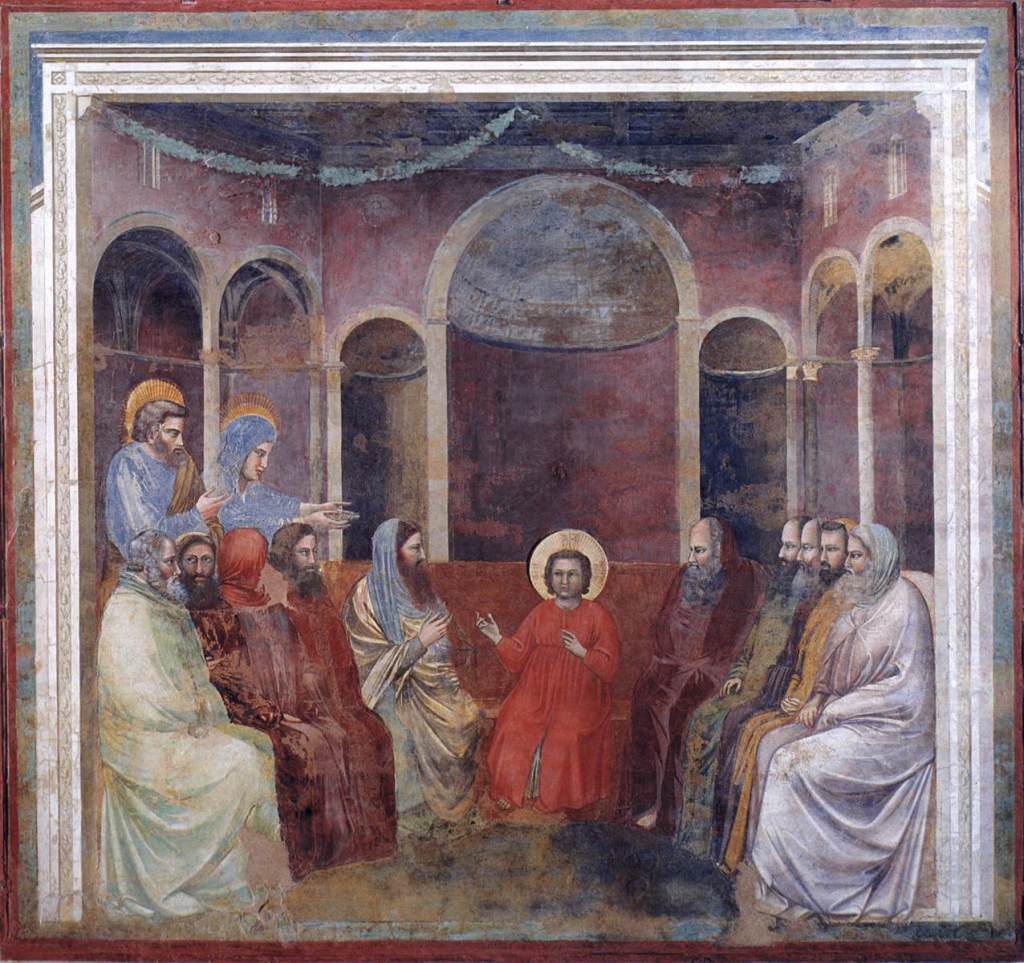
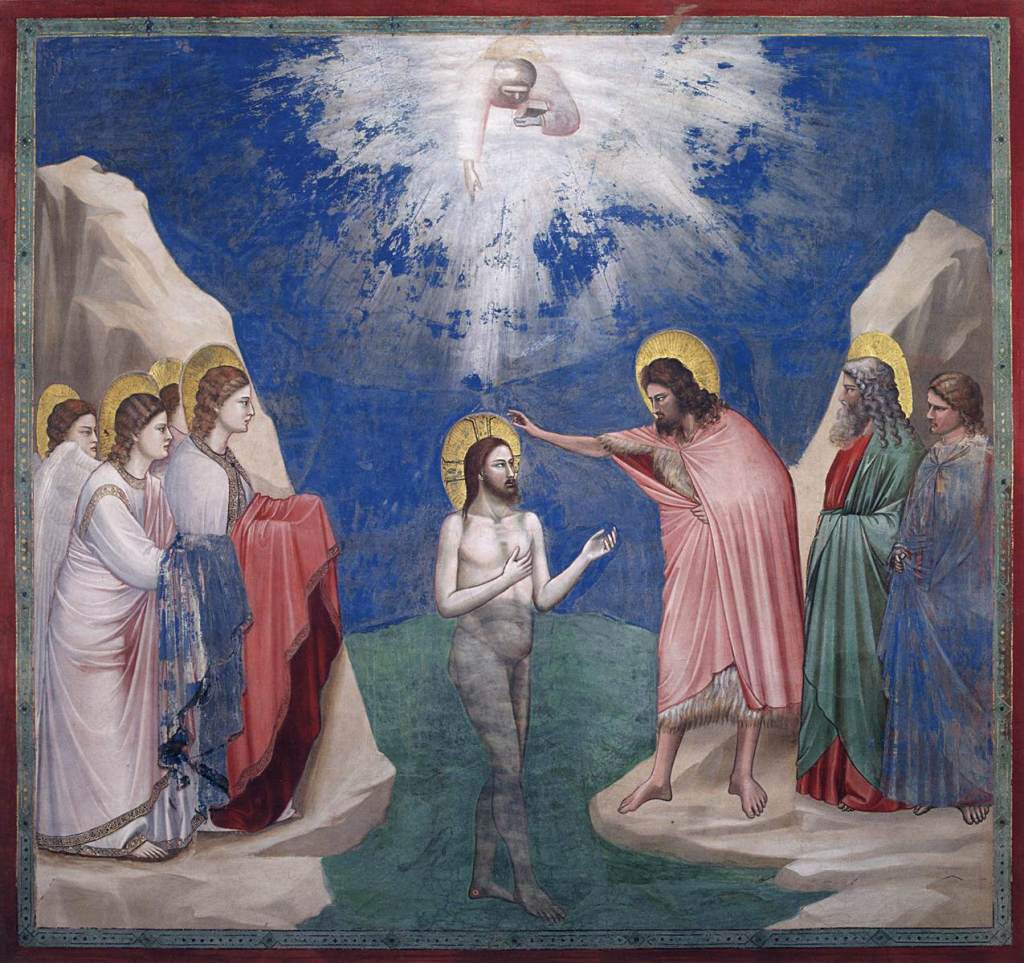
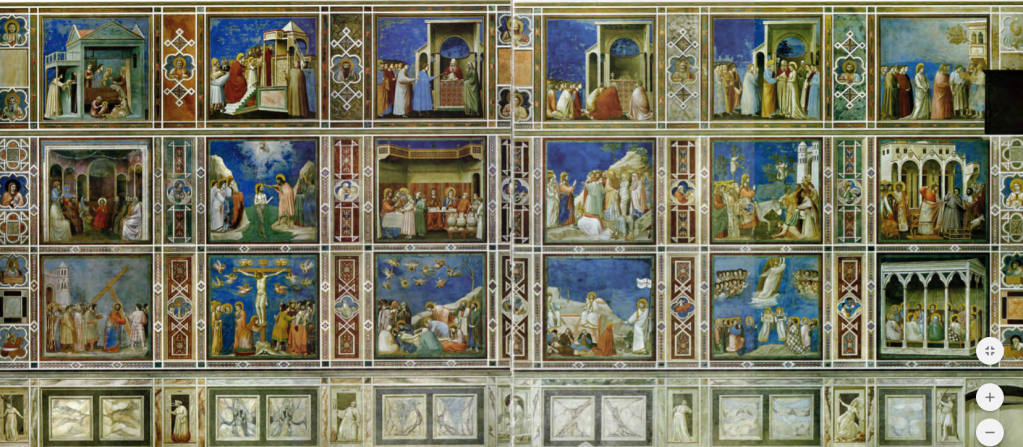
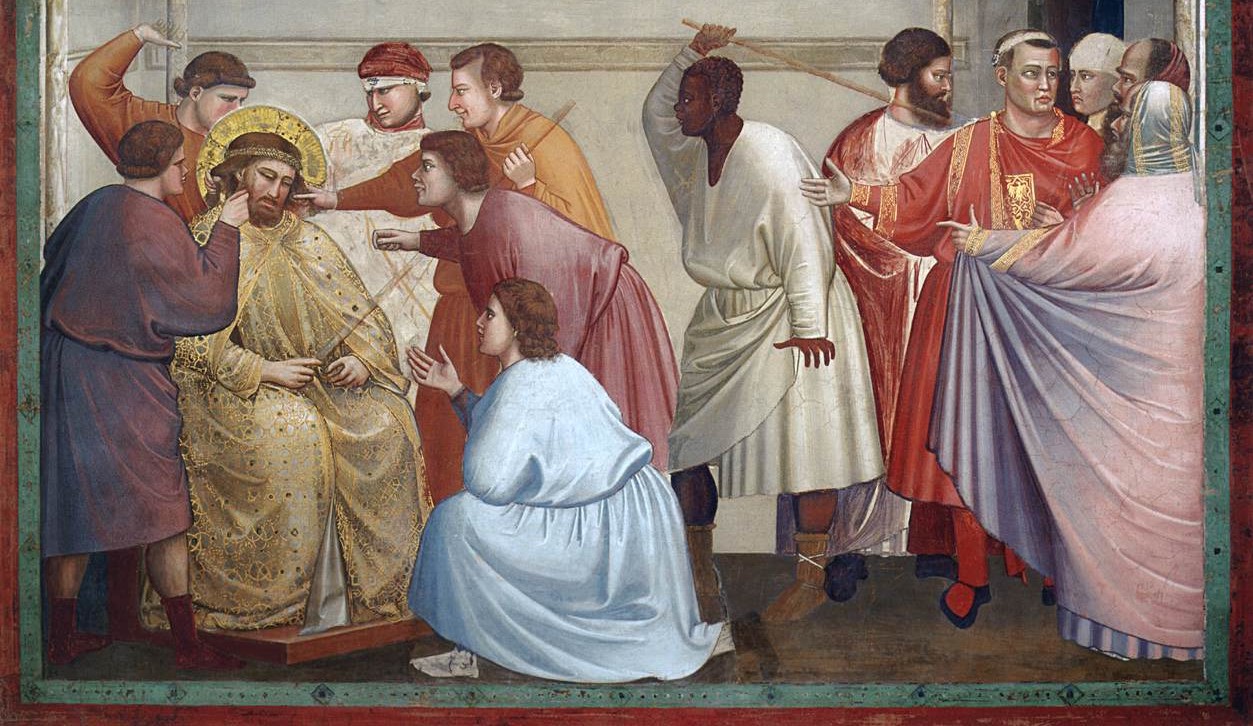
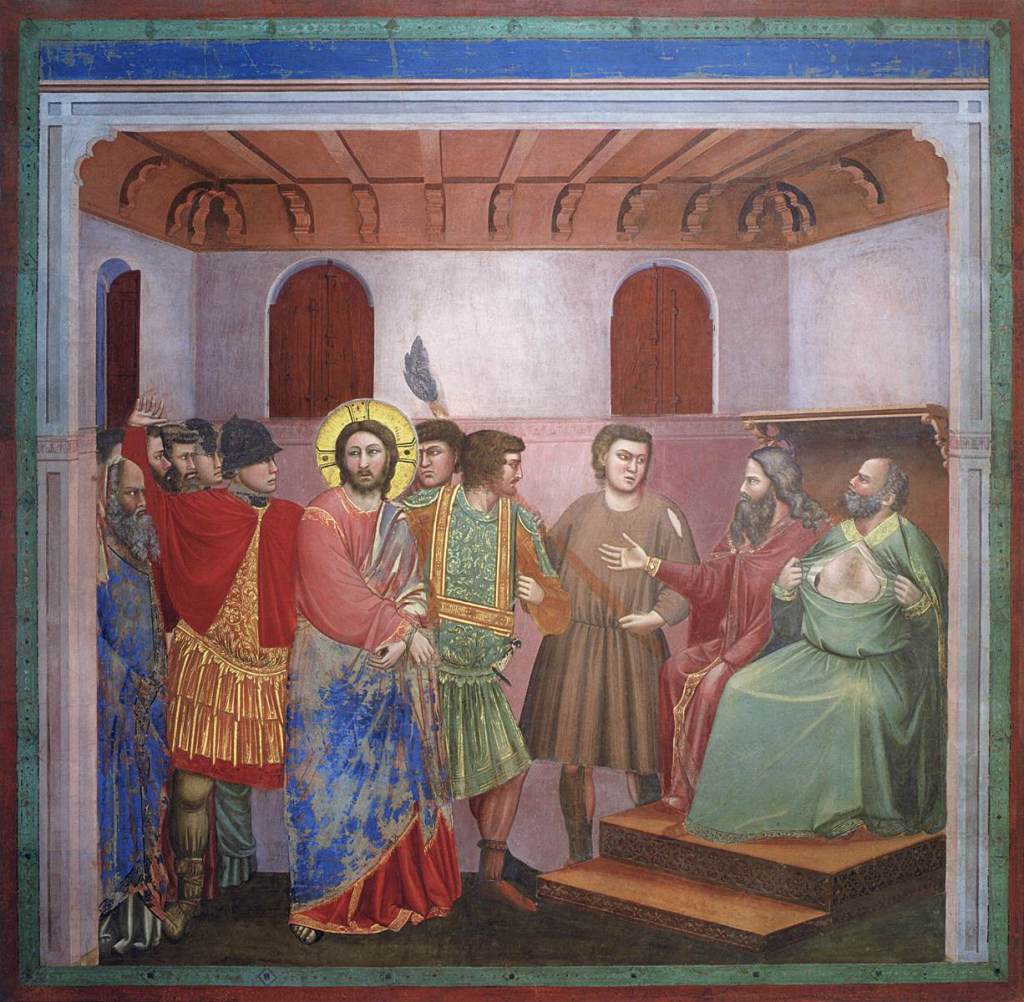
106 – The Arrest of Christ

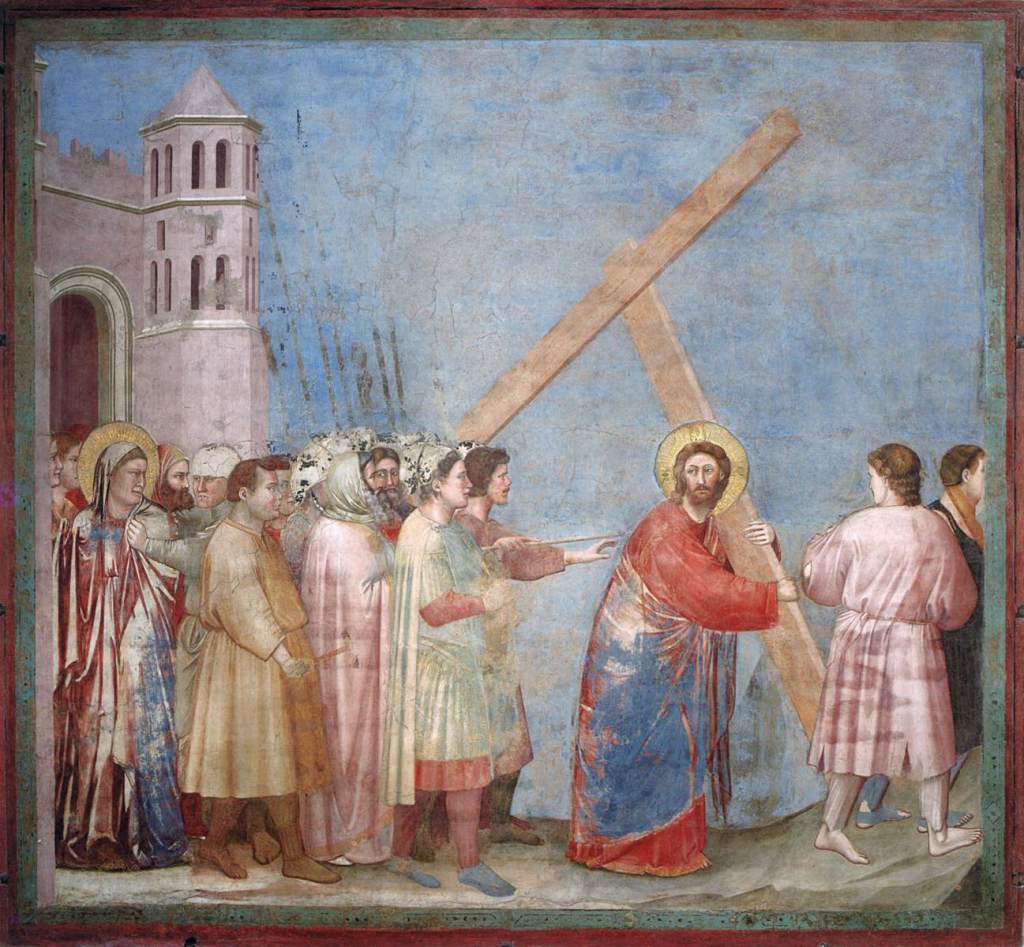
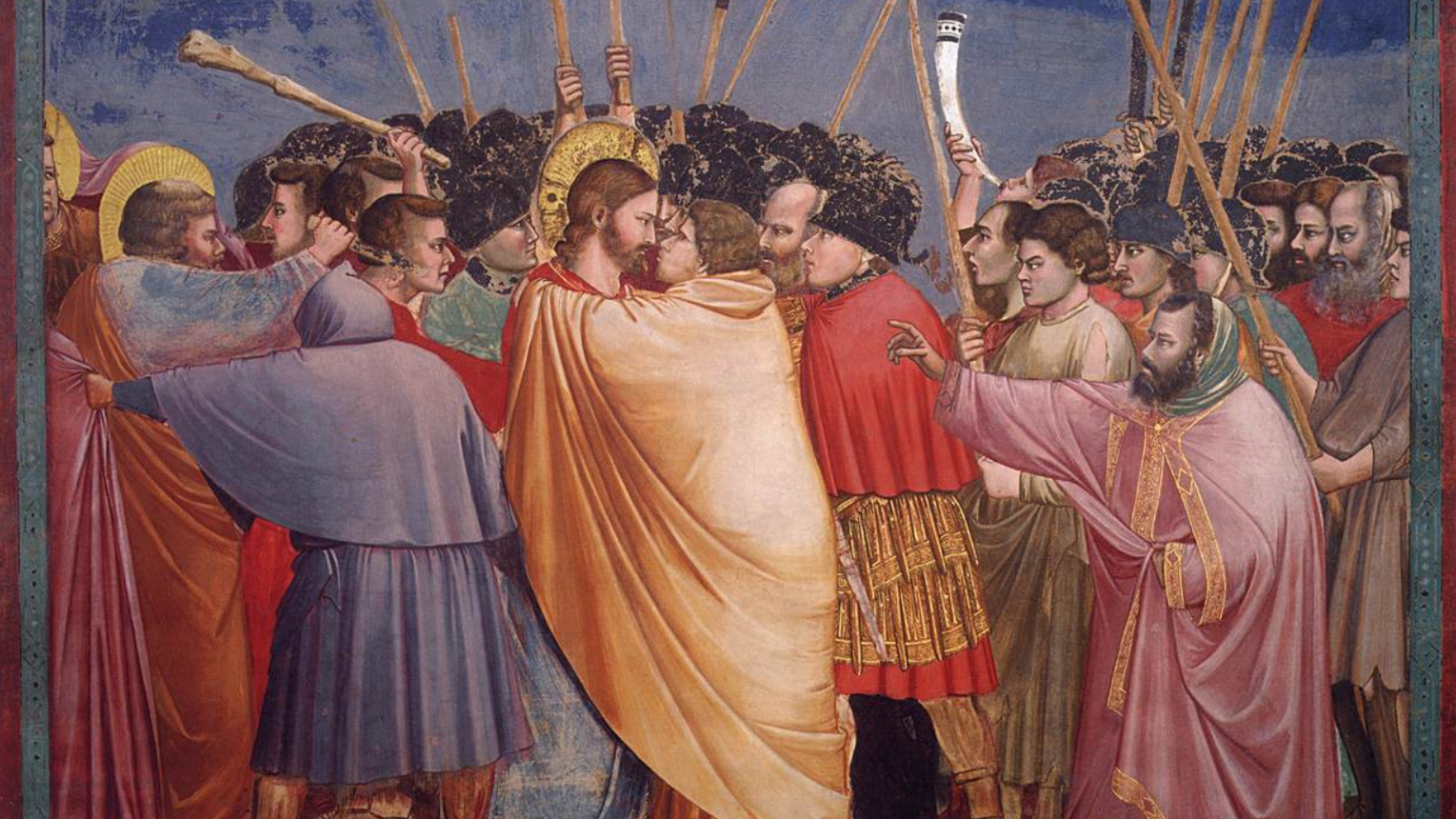
Giotto, The Arrest of Christ, c. 1305, Scrovegni Chapel, Padua.

Happy Saturday! If you’re new to the blog, (a) Welcome! And (b) this is just one in a long series about Giotto’s decoration of the Scrovegni Chapel in Padua: at the bottom of this page you will find a link labelled ‘Scrovegni’ Chapel’, which will bring you up to date!

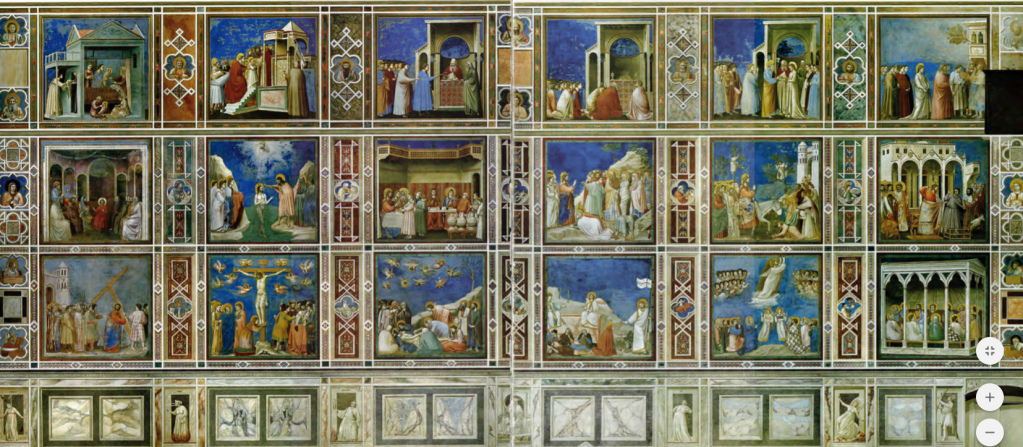
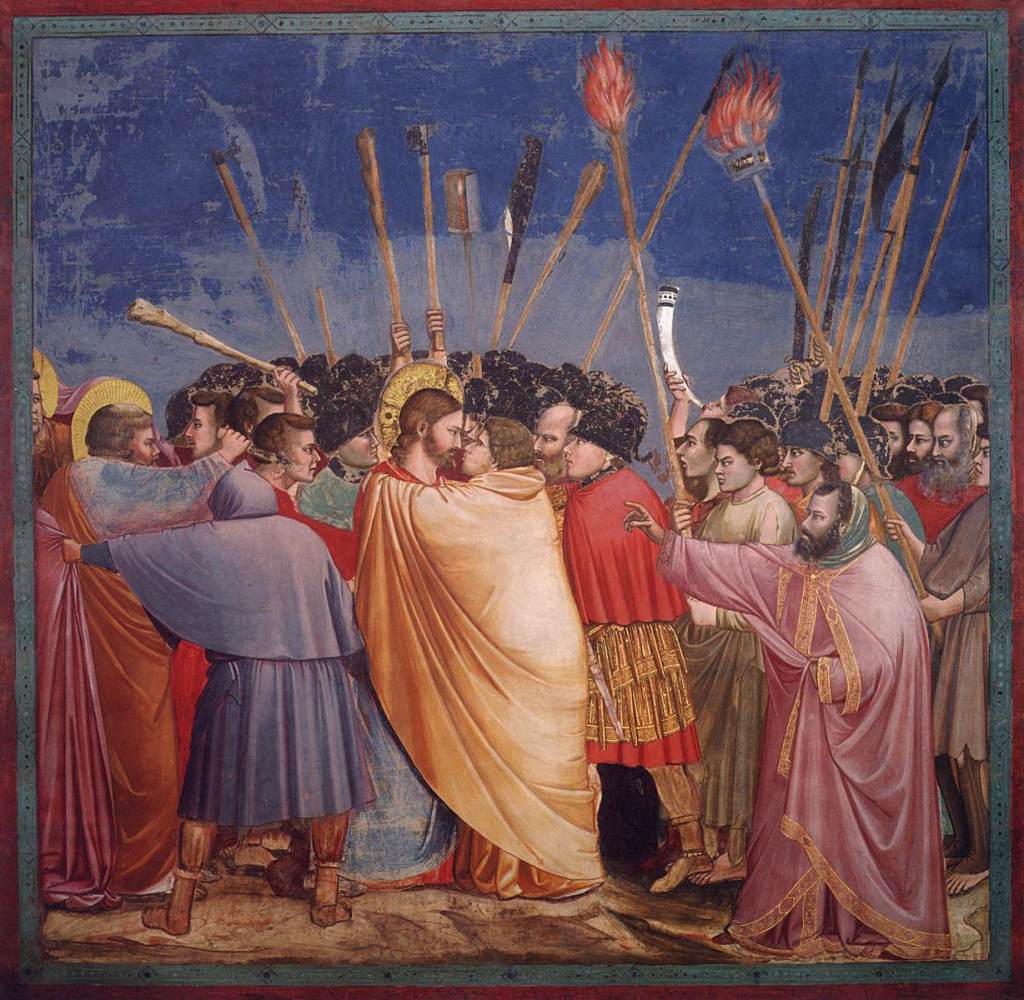
We are halfway along the lower tier of the South Wall of the Scrovegni Chapel, so halfway through the penultimate chapter of this story. The Arrest of Christ follows on directly from Christ washing the Feet of the Disciples (105). As we shall see next week, at this point in the narrative certain episodes are omitted, so that Giotto can end this chapter – let’s call it ‘The Beginning of the End’ – on the South Wall, and start the next chapter – ‘The End and a New Beginning’ – on the North. Last week we discussed the reasons why Giotto swapped The Last Supper with the washing of the feet, and the first thing I’d point out is that he hasn’t included the Agony in the Garden: in most Passion cycles, Christ heads out to the Garden of Gethsemane after the Last Supper, and prays for deliverance from the suffering that will follow. He is usually accompanied by three of the apostles, Peter, James and John, and, in the background, you can often see Judas arriving with the soldiers, ready for the arrest. However, Giotto cuts to the chase. Only, of course there is no chase: Jesus gives himself up almost willingly, and in the Gospel of St John he even identifies himself. This is John, 18: 3-5:

Judas then, having received a band of men and officers from the chief priests and Pharisees, cometh thither with lanterns and torches and weapons. Jesus therefore, knowing all things that should come upon him, went forth, and said unto them, Whom seek ye? They answered him, Jesus of Nazareth. Jesus saith unto them, I am he. And Judas also, which betrayed him, stood with them.

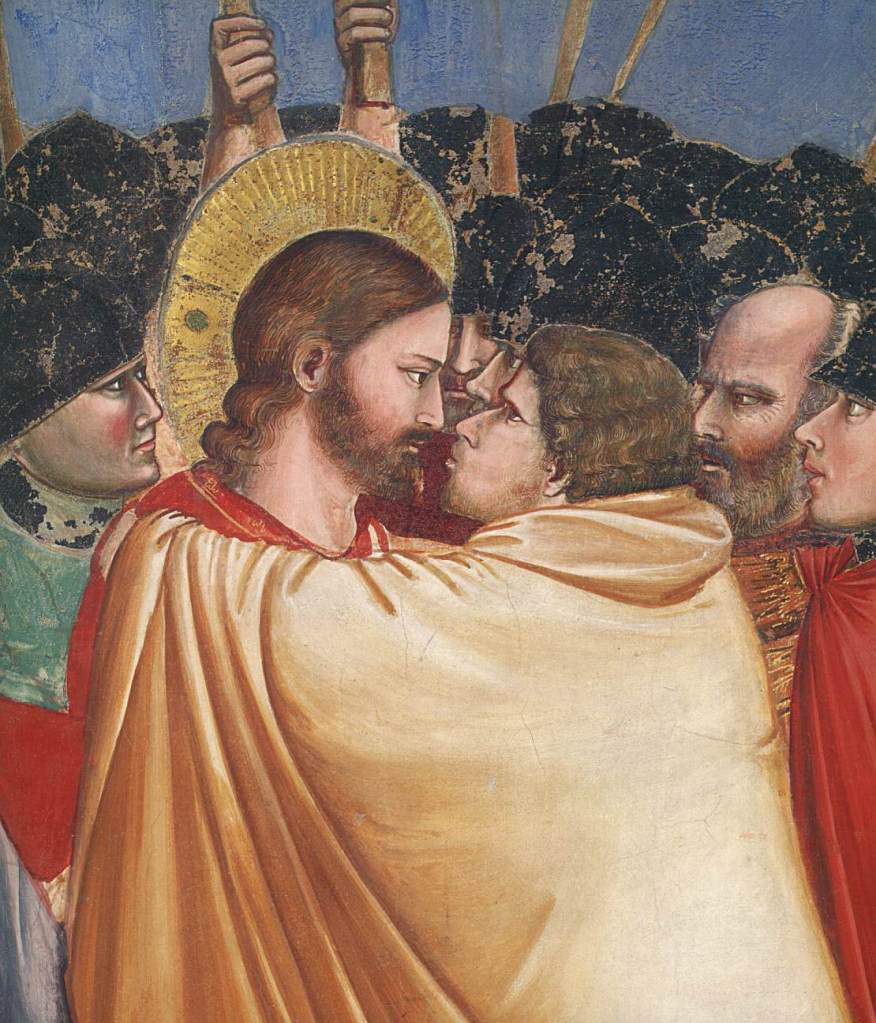
As I pointed out last week, John’s Gospel is the source for much of the material in the Scrovegni Chapel, and it does not include the narrative of the Agony in the Garden, which might be why Giotto doesn’t paint it here. John does not include what is potentially the bitterest detail of the betrayal, though – that Judas identified Jesus with a kiss. For this we have to look to the three synoptic gospels, Matthew, Mark and Luke. Giotto somehow manages to make the kiss particularly repellent.

It’s the way that Judas is puckering his lips, I think, that puts me off. He has thrown his arms around Jesus, enveloping him in his yellow cloak, and goes straight in, looking more as if he is going to head-butt him than kiss him. The kiss, a gesture of mutual friendship, acceptance, tenderness and intimacy is used here for violent ends – the act itself is betrayed. Jesus remains impassive, long-suffering, and looks straight ahead, knowing what is to come. His golden halo shines out from the dark mass of helmets, such a crowd of soldiers to arrest one peaceful man, the silver leaf of their helmets – like the halos of the apostles in the Last Supper – now tarnished to black.

Seeing the full image you realise how fully Jesus is engulfed by Judas’s poisonous presence, the yellow ringing out loud and clear in the centre of the image. The dark aura created by the helmets, together with the porcupine-like array of clubs, batons and torches, focus our eyes on the lighter, placid, Jesus.

The ‘lanterns and torches and weapons’ are specified in the text, but they are also there for another reason. The sky is blue, as it is in every other image in the chapel, but it is after the Last Supper, and, although not depicted, after the Agony in the Garden. By this point it must be night. However, a black sky would have been unprecedented at the time. The first nocturnal scene in Western Art is always said to be in Santa Croce in Florence, and painted some 30 years after the Scrovegni Chapel. In any case, a black sky would have looked unbalanced here, in the context of the whole. But why else hold flaming torches, unless it were night? Quite simply put, the torches tell us that it is. I think this was probably quite a common ploy in painting, and it was also a tool used later by Shakespeare, whose plays were performed, on the whole, in the open air in daylight. For example, in Act 5, Scene 3 of Romeo and Juliet – the very last scene – almost every character mentions artificial lighting in some way. The lines include, ‘Give me thy torch, boy’ (Paris), ‘Give me the light’ (Romeo), ‘What torch is yond…?’ (Friar Lawrence) and ‘There, where the torch doth burn’ (Page) – and these are just some of the examples. They are effectively stage directions, constantly reminding the actors that it is night time and that they are in a dark place, so they should remember to do ‘dark’ acting. But, of course, the lines also serve as a reminder to the audience that it is night time. Indeed, Shakespeare was so aware of this convention that he could even make fun of it. At the end of A Midsummer Night’s Dream, the mechanicals include the character of ‘Moonshine’ in their performance of Pyramus and Thisbe, to tell the court that it is night. Not only that, but when Pyramus (played by Bottom) enters, his first lines are:

O grim-looked night! O night with hue so black!
O night, which ever art when day is not!
O night, O night, alack, alack, alack…

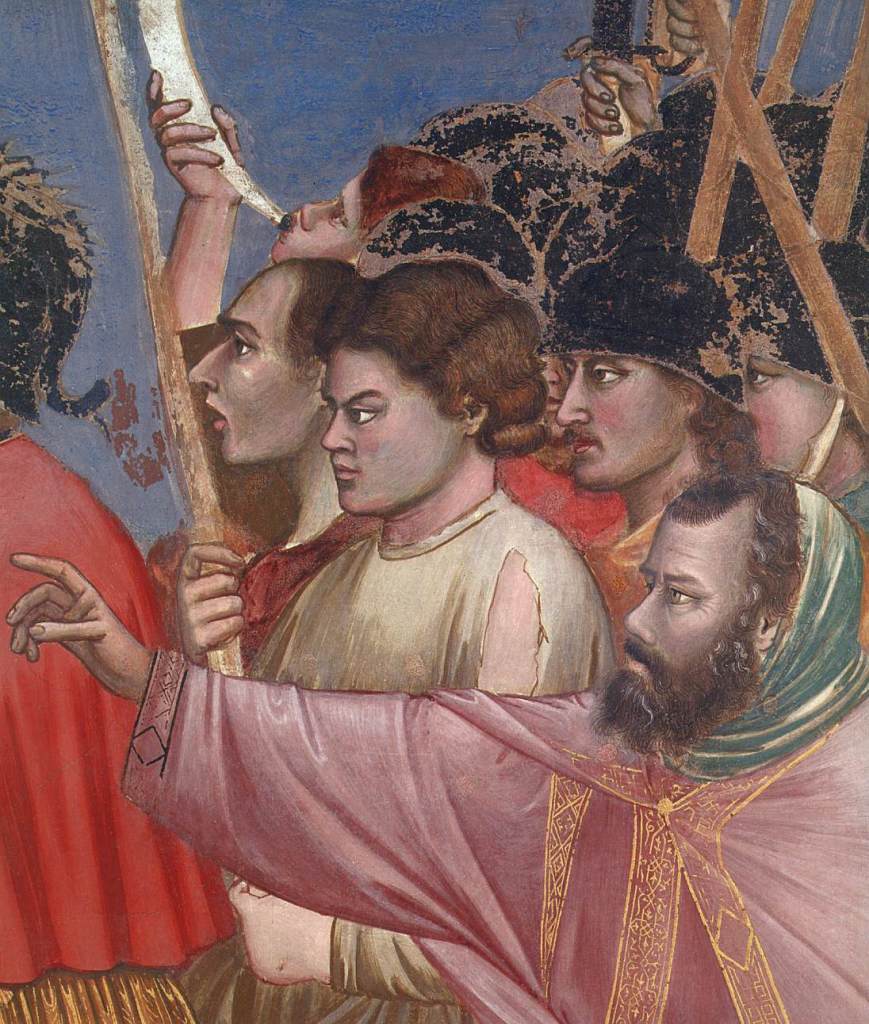
…so there should be no excuse for not knowing the time of day. For Giotto, the torches and lanterns perform the same function, but with far greater subtlety. On the right of the image there are yet more soldiers, with yet more weapons – spears and halberds (the ones that look like spears with axes attached) – and some wonderful character studies.

In the foreground, in pink and gold (implying some connection to the ruling classes, perhaps), with his head covered, is presumably one of the chief priests that Luke mentions. He is clearly an authority figure, given his secure stance, and the commanding gesture, which orders the arrest. Above his out-stretched arm we see a young man, one of the torch bearers, an intense look created by a slightly lowered chin and raised, dark eyebrow – I’m hoping this boy has realised he would rather not be there. Behind him, and in contrast to his full head of hair and healthy good looks, is a scrawny looking man, with receding hairline, pointed nose and open mouth, his chin has dropped in astonishment – he’s almost more of a caricature. Meanwhile, there is a lot going on on the other side of the picture.

All four gospels mention the fact that one of the servants of the high priest had his ear cut off – you can see it quite clearly detached, falling down, in this detail. Luke adds that Jesus went on to touch this man’s ear, and heal it, whereas John tells us it was Peter who did this, and that, ‘The servant’s name was Malchus’. Above Malchus’s head a young man holds a club aloft, on the verge of striking Jesus – both he and Malchus face to the right in profile. Above Peter’s arm, another figure faces to the left – someone’s head, behind Peter’s halo, is covered in a pink cloth (someone not wanting to be seen in the presence of the arrested man, perhaps?) and underneath Peter’s outstretched hand, clasping the silver leaf knife, is another arm reaching out to the left. All of this mayhem relates to details reported in the bible. Once Jesus had been arrested Matthew adds, ‘Then all the disciples forsook him, and fled’. Mark also mentions this – and adds another detail. This is Mark 14:50-52:

50 And they all forsook him, and fled. 51 And there followed him a certain young man, having a linen cloth cast about his naked body; and the young men laid hold on him: 52 And he left the linen cloth, and fled from them naked.

Now, Giotto doesn’t have anyone running away naked – it would be inappropriate in a chapel, perhaps, unless you were one of the sinful souls in hell (POTD 38). However, in the foreground, and so very prominent, there is another ‘soldier’ with his back to us. I say ‘soldier’, as he is not the most official-looking person. He doesn’t seem to be wearing any armour, but has a dark cloak and hood, and an equally dark skirt. He has baggy brown leggings and boots. His is the arm reaching in the opposite direction to Peter’s, and he holds a pink cloak – although we can’t see its owner. It could belong to the ‘certain young man’ who is currently outside the frame, about to abandon this cloth and flee naked. A second apostle, identified as such by a halo, appears over Peter’s shoulder – the man in profile above Peter’s hand is presumably trying to grab him – while the head covered in pink could be yet another apostle about to flee. The small gap between Peter’s head and the heads of the soldiers speaks of this separation. Do you notice how Peter and the second apostle now have gold halos? It’s almost as if they’ve had a promotion since the Last Supper, when their halos were silver – though here I suspect it is as much to distinguish them from the silver helmets of the soldiers.

Oh dear! As so often I had hoped to cover more – three of the images – but as so often I got distracted… so the homework I set you last week will have to wait until next! Just as a warning, I will be on holiday – but I’ll try and get writing before I go! Have a great week. And don’t go hugging and kissing people – especially if your intention is dishonorable.

105 – Wash one another’s feet

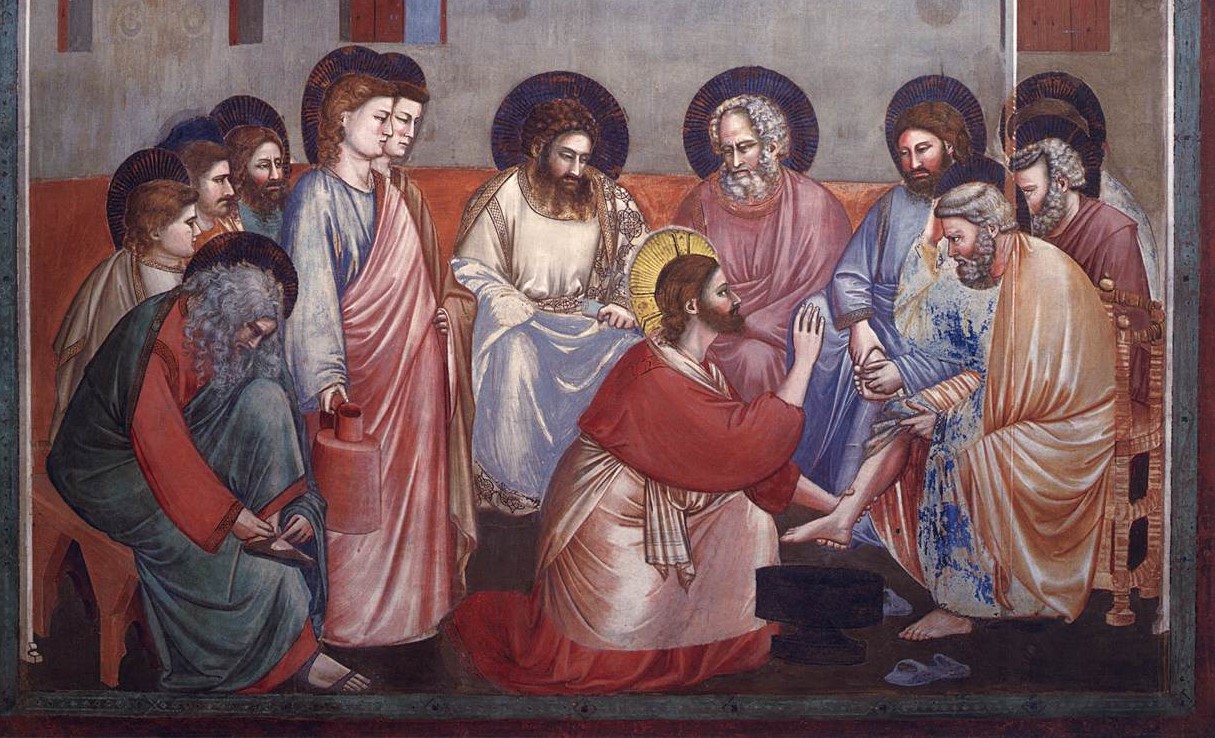
Giotto,  Christ washing the Feet of the Disciples, c. 1305, Scrovegni Chapel, Padua.

After a socially distanced Jesus and Mary Magdalene, we arrive at the issue of washing our hands, something I know that, by now, we are all more than used to. Not that we didn’t do it before, of course. I imagine relatively few of us would have had our hands washed by others, though, and I’m sure I can exclude the feet, too. And yet that is the subject of today’s picture.

We are in exactly the same room as we were last week (103), a simple, rectangular room, cut away on two sides so that we can see in, with two windows on each remaining wall, those most clearly visible open to the same degree in each picture. The roof has terracotta tiles, and the eaves are decorated with carved friezes, pinnacles and two stone birds, as well as mosaic elements bracketing the supports and hanging down in the centre. The walls are lightly patterned in the same way in each image (I’ll show you them together below) with geometric motifs, mainly circles. The main difference, then, is the action – the dining table has been cleared away (one advantage of such open walls), as has the bench at the front. Or rather, as we’ll find out, they haven’t yet been moved in. The benches at the back and left walls remain, and there is a new seat at the front left, on which St Andrew sits fastening his left sandal. Opposite him, on the far right, on another ‘new’ chair, is St Peter, looking grumpy (again) and looking at Jesus, who kneels before him, holding one of his legs. Two younger apostles stand behind Jesus, one of whom holds a large jug of water, with seven more apostles seated around the benches against the walls.

As so often in the Scrovegni Chapel the details are drawn mainly from the Gospel of St John – this is 13:4-5:

4 He riseth from supper, and laid aside his garments; and took a towel, and girded himself. 5 After that he poureth water into a bason, and began to wash the disciples’ feet, and to wipe them with the towel wherewith he was girded.

You can see in this detail that he has ‘laid aside’ his blue cloak (not that it’s visible anywhere in the picture), and is just wearing the red robe that we usually see underneath, and is ‘girded’ with a white towel around his waist. The ‘bason’ – or basin – was applied, like the haloes, with silver leaf, and, like them, has now tarnished. Peter has removed his sandals – one lies just beneath his left foot, and the other is tucked behind the ‘bason’ (I’m quoting the King James Version as always) in a lovely example of naturalistic depiction. Also rather lovely is the delicate way with which Jesus holds Peter’s leg, and some more naturalistic observation – the precise fall of light and shade on Peter’s calf. Giotto then starts to play: the apostle behind has removed his sandals, has one foot up on his knee, and is scratching between the toes. His other foot remains on the ground, with the toes poking out just under Peter’s right foot – in the same way that Jesus’s fingers do a little further up. Jesus’s blessing hand is neatly framed by this apostle’s knee. Peter lifts up his worn blue robe with his left hand to keep it dry, and scratches his head with his right – he is clearly confused. Indeed, in John 13:6 he asks Jesus, ‘Lord, dost thou wash my feet?’ – the confusion which leads to the gesture. A few verse on it continues:

8 Peter saith unto him, Thou shalt never wash my feet. Jesus answered him, If I wash thee not, thou hast no part with me. 9 Simon Peter saith unto him, Lord, not my feet only, but also my hands and my head.

There is more that is relevant both before and after these verses, of course, but I have always loved this particular part of the exchange. The character of St Peter is so clearly defined in the Gospels as entirely human, and this is one of the best examples. First he says ‘Thou shalt never wash my feet’ but as soon as Jesus says, ‘If I wash thee not, thou hast no part with me’, he jumps straight in with, ‘Well, do everything then’ – he is so impulsive, so desperate to be part of Jesus’s life.

As in The Last Supper the corner pillar clearly caused Giotto some problems. By the looks of it, it was probably painted a secco after everything else, so he could paint Peter and be secure about his position without the pillar getting in his way. Whatever the reason, it has now gone, and has left some gaps in the halos. Either it has flaked less from the halos, or it has affected the way in which they have tarnished. It creates a certain amount of confusion, which is only compounded by Giotto’s rather sophisticated layering of forms. The apostle over Peter’s shoulder has part of his profile hidden by Peter’s halo, and the next apostle back has his entire face eclipsed by the halo of the second apostle – you can just see his hair, framed by his own halo, appearing behind it.

St Andrew, on the far left, can be identified by his clothes and hair, and from his appearance in earlier paintings in the cycle, as he was last week (103). This is such a brilliant piece of painting, I think, with Andrew sat in profile, bending over as his lifts his left foot over his right knee to attach his sandals, his long, wavy white hair and beard tumbling down, the stool he is sitting on carefully depicted in three dimensions. I also love St Bartholomew’s manspreading pose – he sits there in his white robe and patterned cloak with both hands planted on his thighs, one holding a scroll, the other wrapped in his cloak. Three apostles sit against the end wall, in between Andrew and Bartholomew. If you look at their three halos, they are not all the same – those left and right have radiating lines, with a clear, crisp circular edge. The one in the middle has an aura which is dark and nebulous – not tarnished silver leaf like the others. There is just a hint of yellow above Andrew’s halo, and he has a rather large nose. This is Judas, portrayed as he was at the Last Supper. And, if you think about it, it is rather surprising that he should be there, after the Last Supper…

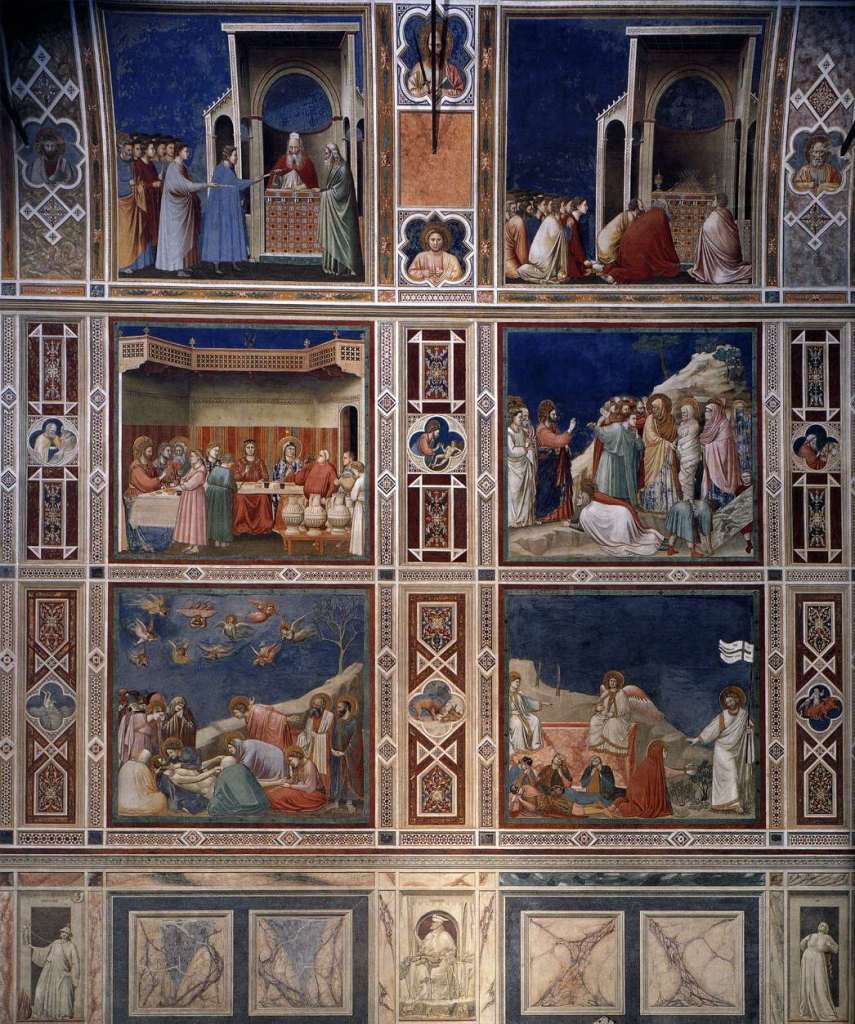
This is how the two images appear on the wall, albeit with a window in between. And, if you think about it some more, they really shouldn’t be in this order at all. Today I have quoted John 13:4-9. Last week, I quoted John 13:23. The events depicted in the picture on the left happened after the events depicted on the right. Jesus washes the disciples’ feet before the Last Supper itself, with its revelation that one of the number will betray him, prompting Judas’s departure. So why has Giotto painted them this way round? Surely, he can’t have got it wrong? No! Of course not! This is Giotto, remember. And this is where the image I showed you last week is really useful… so here it is again.

As I said last week, the altar in the chapel is to our left. Giotto deliberately painted the Institution of the Eucharist – the Last Supper – as close to the altar as he possibly could. Seen from this point of view, when approaching the altar, the Washing of the Feet precedes the Last Supper and reminds the congregation of the need to be pure before partaking in communion, thus relating the Washing of the Feet to the Sacrament of Confession. Just above the Last Supper is the Nativity, and I remember suggesting when we looked at that (POTD 87) that it was as if the body of Christ had been taken from the altar in the chapel. And above that, Joachim is turned away from the altar in the Temple (POTD 66). These three scenes are all included at the far left of the wall not only because that is where the narrative flow would have them, but also because they have a direct relationship to the sacramental nature of the real altar in the chapel to our left. And, actually, the ‘narrative flow’ would not have the Last Supper just here, as it has been swapped with the Washing of the Feet. But there is another, truly brilliant justification of this swap, and one that I have only just noticed. Look at what is above the Washing of the Feet:

OK, so I’ve cut out the window, but this is how the first scenes at the left of the south wall fit together. The Nativity is above the Last Supper, as we have already discussed, but like this it is more clear that the Christ Child is directly above the adult Jesus, and that both are as close to the altar as they can be. And I can’t help but notice that Mary’s loving gaze gives her the same angle of the head, and profile, as that of the sleeping St John, the disciple ‘whom Jesus loved‘. In the next pair, Jesus is directly below the eldest Magus – and both are kneeling. In the Adoration of the Magi the wise men recognise Jesus as the Boy Born to be King – and fulfil the prophecy in Psalms 72:10-11:

10 The kings of Tarshish and of the isles shall bring presents: the kings of Sheba and Seba shall offer gifts. 11 Yea, all kings shall fall down before him: all nations shall serve him.

It was because of these verses that the Magi – the Wise Men – were promoted to the status of Kings – the Nativity story doesn’t mention kings at all. Well, these verses and others in Isaiah, including Isaiah 60:3: ‘And the Gentiles shall come to thy light, and kings to the brightness of thy rising‘. However, Jesus turns all this on its head in John 13:14-15:

14 If I then, your Lord and Master, have washed your feet; ye also ought to wash one another’s feet. 15 For I have given you an example, that ye should do as I have done to you.

Giotto finds the perfect expression for this idea by placing the King kneeling before the infant Christ above Christ kneeling in front of Peter. So here’s your homework for the week: what are the connections between the bottom tier and the middle tier that we will see next week? You’ll need to look at the photo of the South wall above – which is admittedly small. I’m not guaranteeing that there are any, but I have a sneaking suspicion we’ll find something!

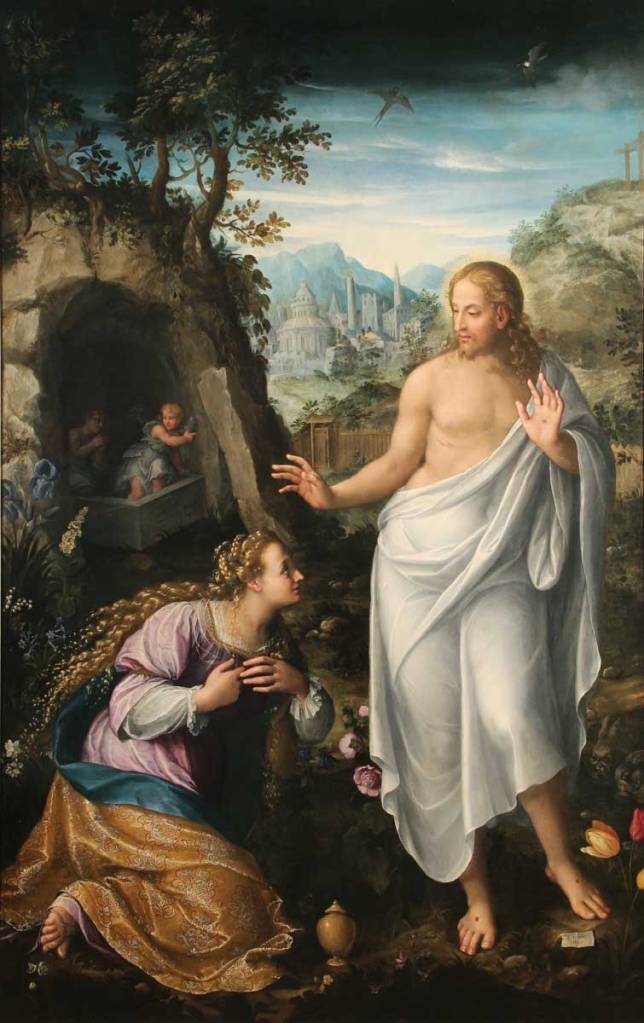
104 – Don’t touch!

Fede Galizia, Noli mi tangere, 1616, Pinacoteca di Brera, Milan.

Great news this week, which I know some of you will have heard already. But just in case you haven’t, I’m glad to let you know that the National Gallery has managed to completely re-schedule the Artemisia Gentileschi exhibition. And not only that, but they will be allowing it a full 3 ½ months, from 3 October – 24 January: click on her name for more information. To celebrate, I should really talk about one of her paintings – but instead, I’m going to suggest you look back to my earlier blogs about Judith and Holofernes (Picture Of The Day 17) or the Self Portrait as the Allegory of Painting (POTD 69). I thought this would be a good time to talk about another 17th Century woman, though: Fede Galizia. She too was supposed to have an exhibition dedicated to her work this year, but, after research through a number of contradictory websites, I’ve just emailed the Castello del Buonconsiglio in Trento and they got back to me 20 minutes later to say that it has been postponed until next summer. I’ll try and remember to remind you nearer the time! I’m still going to look at this painting, though!

I should have talked about this subject earlier, as it really is an ideal painting for lockdown (it turns out there are so many). The title, Noli mi tangere, translates as ‘Don’t touch me’, and even if we are not as locked down as we were, it still seems wise not to go around touching other people unnecessarily, particularly when you don’t initially know who they are. The story comes from John 20:13-17. It is Easter Sunday, and Mary Magdalene has gone to the tomb and found it empty. She tells Peter and John, who go straight to the empty tomb to see if Mary is talking sense, and, once they have reassured themselves that she was right, they return home. At this point, Mary, in tears as so often, looks back into the tomb to see two angels:

13 And they say unto her, Woman, why weepest thou? She saith unto them, Because they have taken away my Lord, and I know not where they have laid him. 14 And when she had thus said, she turned herself back, and saw Jesus standing, and knew not that it was Jesus.15 Jesus saith unto her, Woman, why weepest thou? whom seekest thou? She, supposing him to be the gardener, saith unto him, Sir, if thou have borne him hence, tell me where thou hast laid him, and I will take him away.16 Jesus saith unto her, Mary. She turned herself, and saith unto him, Rabboni; which is to say, Master. 17 Jesus saith unto her, Touch me not; for I am not yet ascended to my Father: but go to my brethren, and say unto them, I ascend unto my Father, and your Father; and to my God, and your God.

I’ve always thought that ‘Don’t touch me’ was an unusual request, and somewhat understated under the circumstances, but the explanation, ‘for I am not yet ascended to my Father’ would seem to make sense. Jesus is in neither one place nor the other, and, as both God and Man, having triumphed over death, there must still have been an uncertain sense of transition. Nevertheless, a little further down the chapter – verse 25 to be precise – he does issue Thomas with the instruction, ‘Reach hither thy finger, and behold my hands; and reach hither thy hand, and thrust it into my side’. I’m sure this issue has been explored extensively by theologians, but I have not found a justification why Thomas could touch Jesus but Mary Magdalene could not – unless, within Jewish law at the time, the female touch was considered unclean. And, while we are on the edges of the potential misogyny involved, it is worthwhile noting that we are also at the centre of one of the most significant moments which is conveniently ignored by some members of the church: Mary Magdalene was the first witness to the Resurrection, and was instructed by Jesus, ‘…go to my brethren, and say unto them, I ascend unto my Father…’. Not only did she see the resurrected Christ before anyone else, but she was also told by Jesus to tell the others what was going on. So I really don’t understand the objection to the ordination of women. Having said that, and despite the fact that this is painted by a woman, that’s not what this particular picture is about, of course.

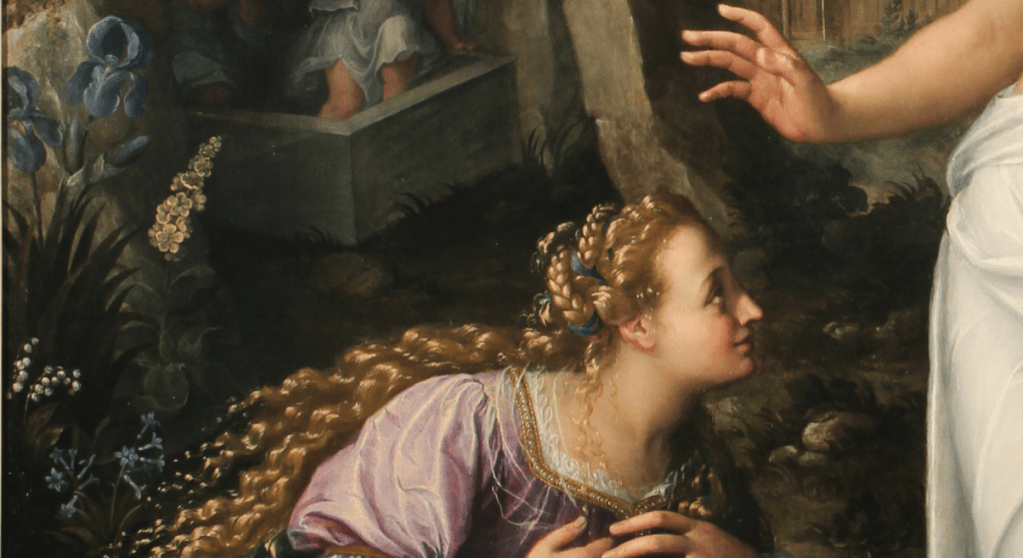
We see Jesus standing on the right. Galizia gives us no explanation for Mary’s confusion – there is no hat, no hoe, nothing whatsoever which would suggest that Jesus could be a gardener, so why the mistake? We will have to assume that she was blinded by her tears. Jesus wears the shroud as a toga (as he does often at the Resurrection, POTD 25), his head glowing with sanctity around his beautiful and notably blonde hair. Both hands are held out towards the Magdalene so as to keep her at a distance, but also to display the wounds, which are also clearly visible in his chest and feet. Mary kneels beside him, richly dressed in a pink robe, with a white chemise underneath, and a golden-yellow brocaded cloak that is lined with a deep blue. Her hair – as blonde as Jesus’s but many times longer – is elaborately plaited around her head, and flows freely down her back and under her left arm. It is pointedly not covered: she shows every sign of being a well-to-do courtesan, and one who has not, as yet, entirely repented of the vanities of human life (POTD 100).

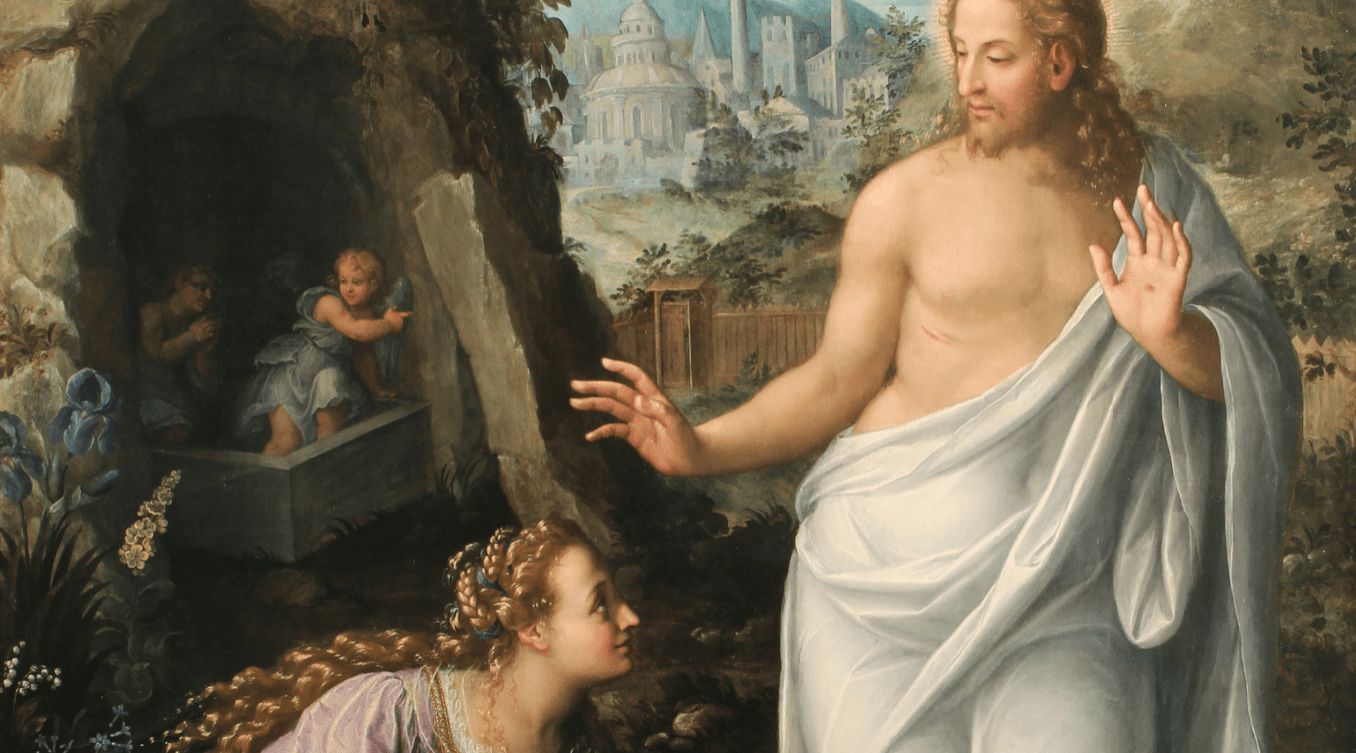
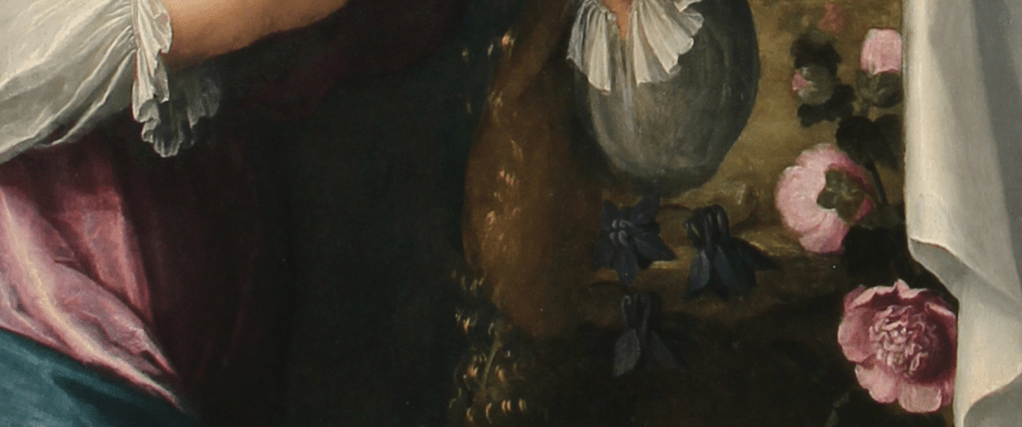
On the left we see the opening to the tomb, at roughly the same height as Jesus’s head – I’m sure this is deliberate, as it serves to emphasize that he has triumphed over the darkness within. Two cherubs stand within the sarcophagus, not exactly the ‘two angels in white’ one would imagine from John 20:12, nor are they still sitting. The one on the left appears to be kneeling in prayer, while his companion points towards Jesus – or to the stone which has been moved out of the way, perhaps. Above Jesus’s right hand we see a garden gate, reminiscent of the type that is depicted in Northern Renaissance images of the Garden of Gethsemane – you can just about see one in Riemenschneider’s relief on the right of the Holy Blood Altarpiece (POTD 22). Beyond that is Jerusalem. We are still ‘without a city wall’ (the far away ‘green hill’ is at the top right of the painting), and the city gate can be seen at the end of a curving road. Within the city are a couple of details which remind us that this was part of the Roman Empire – a column, like that of Trajan, topped by an indistinct golden statue, and a form of obelisk. There is also a large circular building, the Temple of Solomon, the image of which was derived from the Dome of the Rock, which, during the middle ages, people mistook for the Temple itself. On the far left we see some of the wonderful botanical details Galizia included, and I am indebted to the Ecologist for their correct identification.

They include an iris (Iris x germanica) at the top, with a great mullein, or Aaron’s rod (Verbascum thapsus) to the right of it, with a spike of yellow flowers, and large leaves below. Down to the left is lily-of-the-valley (Convallaria majalis) with its white, bell-like flowers, and the delicate blue flowers are perhaps spring squills (Scilla verna). In this detail we can also see the brilliance of Galizia’s depiction of fabrics, with the transparent veil around the Magdalene’s shoulders, the embroidered hem of the robe, and laced edging of the chemise, as well as a deep blue ribbon, matching the lining of her cloak, which is wound around the plaits in her hair.

Under Mary’s left elbow we see deep blue columbine, or aquilegia (Aquilegia vulgaris), and double hollyhocks (Alcea rosea) – notice how, colouristically, they are perfectly matched with the pink robe and deep blue lining.

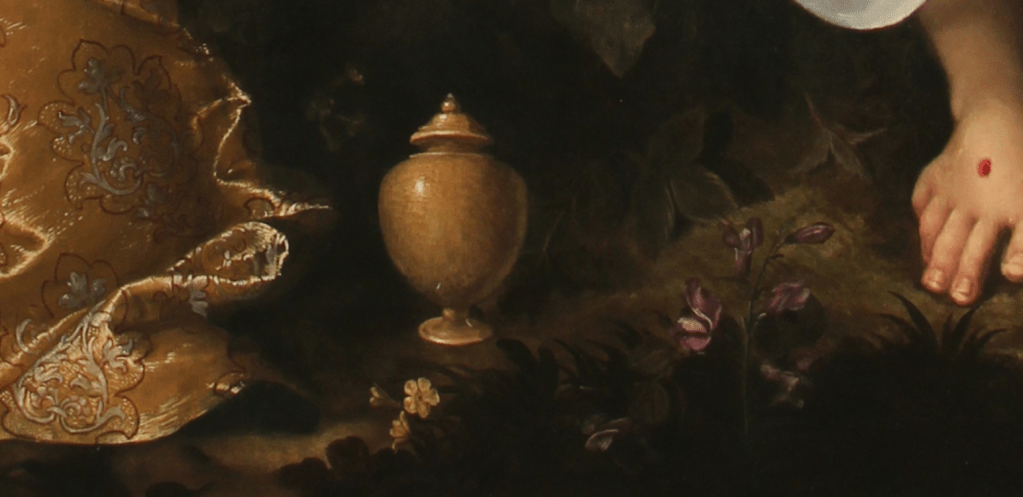
At the very bottom of the painting are some snapdragons (Antirrhinum majus) and what in all probability are buttercups (Ranunculus sp.) – the shape and colour of the flowers is certainly indicative, as is the shine on the petals. However, without the leaves it is impossible to tell which species of buttercup this is, and none of the leaves visible here would appear to belong to these flowers, anyway. Here too Galizia has been careful to match the colours – the buttercups are related not only to the rich brocade of the cloak, but also to the Magdalene’s signature jar of ointment, apparently ceramic with a slightly crazed glaze. According to Mark 16:1 and Luke 24:1 the holy women took spices to the tomb: it makes sense, therefore, that Mary has this jar with her.

There are some narcissi to the left of the Magdalene, just where the long strands of wavy hair seem to evaporate, and some anemones at the bottom left, under her toes. On the far right are some tulips of different colours, just below a pair of slightly sulky rabbits. Below Christ’s left foot, which is delicately poised on a stone, is a small piece of paper bearing Fede Galizia’s name, and the date – 1616.

It is not at all clear whether these flowers are symbolic or not. Some of them have appeared in paintings from the Renaissance onwards. The iris is related to the Virgin Mary’s suffering, while the buttercup has connections with sin. The columbine, its name deriving from a word for ‘dove’, is associated with the Holy Spirit. But some of them are just there for the ride – if Mary Magdalene mistook Jesus for the gardener, maybe this is the evidence. After all, several of these plants are not the wild varieties. The double hollyhock is definitely a cultivar, and the snapdragons are also a garden variety. Tulips were famously cultivated, and their bulbs would be traded at over-inflated prices in the Netherlands a few years after the Noli mi tangere was painted. They are certainly not all spring flowers, even if the narcissi, tulips and squills are.

It is the context of the garden which is most important, I think, and, added to that, perhaps, the fact that Fede Galizia was famed as a painter of Still Life. She had made it her speciality to paint things in intricate, naturalistic detail, and is not wasting an opportunity here. Like many other women artists, she had been trained by her father, Nunzio, who was born in Trento – which is why they will be hosting an exhibition. Fede herself was born in Milan, though, sometime around 1578. In 1590, when she must have been at least 12, though possibly a bit more, the artist and author Paolo Lomazzo, wrote his Idea of the Temple of Art, in which he said that ‘this girl dedicates herself to imitating the best exponents of our art’. As it happens, he was a friend of Nunzio, but this wasn’t just a favour for a friend – she clearly had talent and her career took off. She was much in demand as a portrait painter, perhaps as a result of her attention to detail, but also received several commissions from churches: today’s picture was painted for the High Altar of the Church of St Mary Magdalene in Milan, which was destroyed after the Napoleonic suppressions of 1798.

The flora in this painting works in a number of ways – some of the flowers definitely remind us of Spring, and so Easter, and refer to the Resurrection. Others have a more ‘generic’ religious relevance, referring to the Virgin’s suffering (a major part of which was seeing her son crucified), or to sin, as a result of which Christ’s sacrifice was necessary.  But how about the fauna? Well, rabbits, and their ability to reproduce, are associated with new life, and fecundity – but they also refer to the Resurrection.

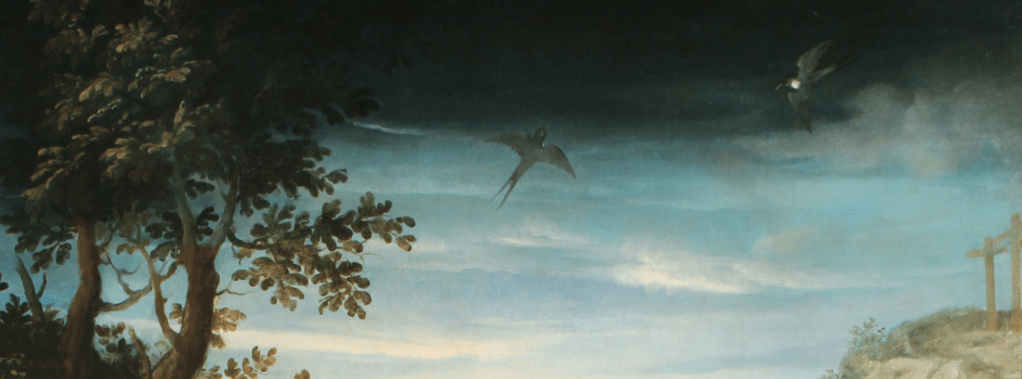
Meanwhile, at the top of the painting, a pair of swallows are flying through the sky. They live with us throughout the Summer, but then disappear – only to come back in the Spring. It was thought that they lived in the mud during the winter (well, medieval observers couldn’t track their migrations), as if they were being buried and then coming back to life. Inevitably, therefore, they are also a symbol of the Resurrection. And, just in case we’d missed the point, at the top right of the painting we see that green hill far away, with two of the three crosses still visible and still standing. The reminder of Christ’s death is there, in the background, and it would be as well not to forget it. Although he is clearly once more in rude health, it would be wise not to get too close. Please remember that as you head back out into the world!

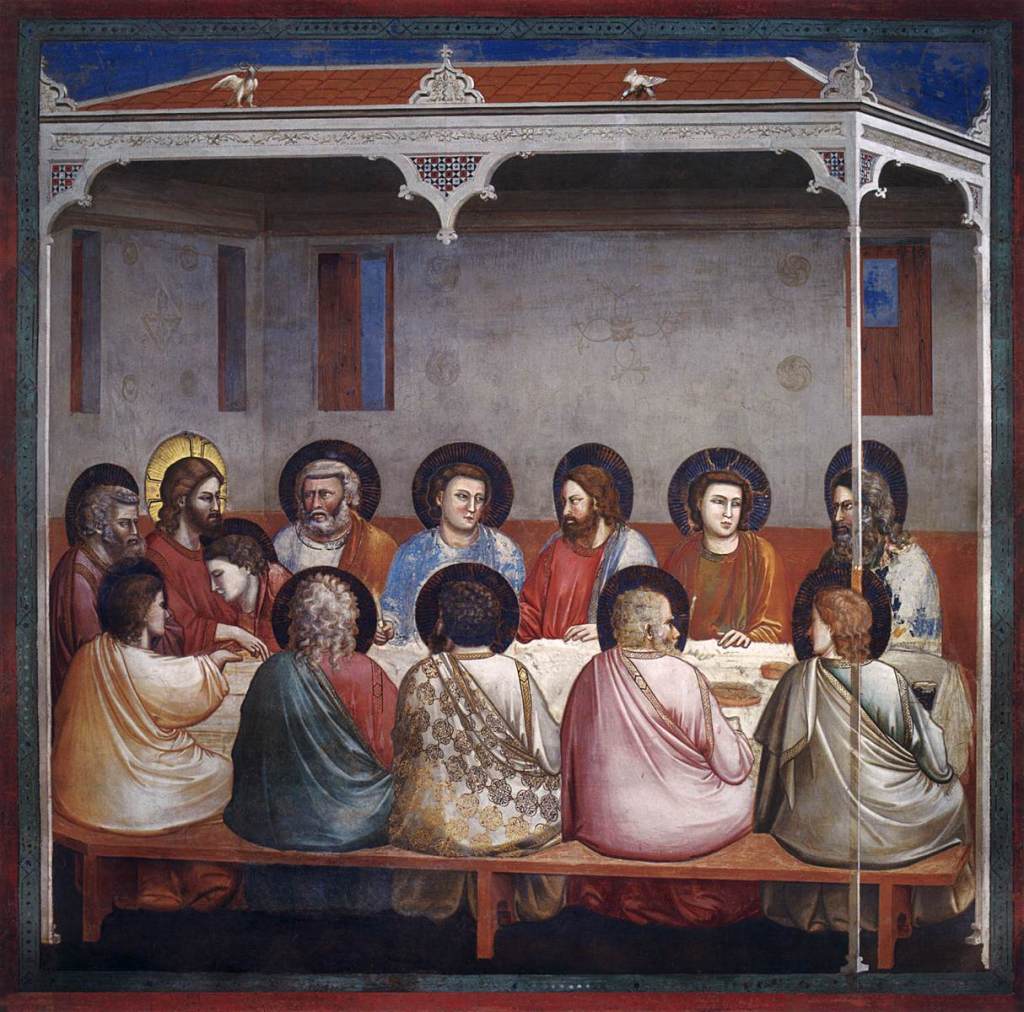
103 – The Last Supper

Giotto, The Last Supper, c. 1305, Scrovegni Chapel, Padua.

I know, it’s supposed to be Scrovegni Saturday, not Scrovegni Sunday, but it’s been one of those weeks. Apart from anything else, this is the first thing I’m typing on a new laptop, the old one having gradually wound down throughout lockdown. I’ve spent the last 3 months without a ‘z’ or an ‘x’ – can you imagine what it’s been like writing about Velázquez?! Still, I don’t have that problem now, and even accents seem more accessible. But you don’t need to know any of this… and Giotto never had those problems in the first place.

Giotto’s Last Supper is an entirely original composition, I think, although to be honest I don’t know many which precede it. However, last week I said that Giotto’s images in the Scrovegni Chapel did a lot to establish what would be the standard iconographic formulae for a number of stories – but this is clearly not the case with the Last Supper. You will know what to expect – I would post an image of Leonardo’s version, but I imagine it is more or less seared onto your retinas already. As it happens, Leonardo was himself drawing on one of the very well established formulae – but one which had a very specific context. Most images of the Last Supper were painted in the Refectories of monasteries – the room in which the monks, or nuns, would eat. If you imagine a large, medieval dining hall, with rows of tables leading along it – actually, don’t imagine, just look at this photograph of the dining hall of the monastic institution I spent a decade at, Clare College, Cambridge.

Three rows of tables lead the full length of the room, and then, up a step, is the high table, at right angles to the others, where the Master and Fellows sit. Now, if this were still a monastic institution, as it was in its origins, then it would have been the Abbot, or Prior who sat in the centre of the High Table, with other senior monks seated on either side of him. The wall at the back is panelled in wood, inset with an oval portrait of Lady Clare, founder of the college. Imagine that, instead of this, there were a painting of the Last Supper. Jesus and the Apostles would be sitting at a table even Higher than the one physically present. It is an arrangement that not only emphasizes the hierarchy of the Church and of the monastery itself, but which also reminds everyone present, while they are eating, of that most important of meals.

This is, therefore, the context of Leonardo’s version (yes, I ended up posting it anyway…) and although he introduced a number of innovations, the function of the painting is basically the same as all those that came before, with the exception, of course, of the one we are looking at today. But then Giotto’s version is not an independent painting in a refectory, it is part of a narrative cycle. And rather than being on the end wall of the room, it is at the side. The equivalent ‘end wall’ here would be the ecclesiastical East end of the chapel, where the High Altar is located.

Giotto’s Last Supper is at the left of the South wall. I’ve only just found this image – and it’s worth having a quick look. At the top we see the Story of Joachim and Anna (Picture Of The Day 66), taking up six fields, with decorative panels in between, including images of saints and prophets – this is very much the rhythm of the North Wall opposite. Underneath this, in the middle tier, we have The Childhood of Christ (POTD 87), with five fields, framed by the six windows, and, at the bottom, is The Passion of Christ. We are starting with The Last Supper at the bottom left, between the two windows. The High Altar of the chapel is to our left as we look at this wall.

What this means is that the altar is to the left here too, and Jesus, at the far left of the image, is seated at a part of the table which is in line with – or at least parallel to – the altar. In effect, he institutes the Eucharist as if he were seated behind the altar. He is also seated in the position that the Prior would in a monastic setting, given just one table and only 12 monks. So the orientation of the image is essentially the same as other examples you might know – although it doesn’t have that unnerving sense that the group has booked a table for 26 but only sat on one side. This turns out to be one of the rather glorious things about Giotto’s painting. We see the five apostles on the far side of the table perfectly clearly, but we only see the backs of those on ‘our’ side. However, when you think about it, it’s not ‘just’ the backs. We see their bottoms spreading across the wooden bench with a very human weight, and we see their legs, in shadow, under the bench and a little further away: Giotto continues to show his brilliance in the depiction of space and in his awareness of the humanity of the situation. However, it does create an interesting problem – that of the halo. A halo, as I’m sure I’ve said before, is meant to represent the glow of sanctity, and using metal leaf allows real light to be reflected, creating a glow around the head.  However, whereas the apostles on the far side have their haloes in the ‘traditional’ location, as if floating above their heads, the nearer ones sit their with what look like black plates floating in front of the faces.  Why are they black? Well, Giotto is implying that they do not have the same status as Jesus, whose halo is made of gold leaf: theirs are fashioned from silver. And whereas gold does not tarnish – it is pure and unchanging, just like God – silver does, and what were silver haloes are now black. But why the odd placement? Well, if he’d placed the haloes like plates behind their heads, we wouldn’t have seen them at all – we would seen a row of bodies and haloes, whereas, when silver, this would have created the glow around their heads. It was clearly important that we should see their heads, even if not their full faces. If you look at the apostles at the far right of the table, the one at the back can be seen in profile, with the corner post of the ‘cut-away’ room passing across his face. But his companion on our side of the table has clearly been repainted – and the post disappears. The church was clearly not happy with having part of his face obscured – even if both he and the chap to his left are both seen in a rather brilliantly depicted profil perdu.

As so often it is probably impossible to identify each of the apostles – generically we could name all twelve, and Giotto may well have known which was which, but we are given few clues. Traditionally Jesus would sit with Peter at his right hand and John at his left – this is one of the things that Leonardo changes – and so does Giotto. Peter is facing us, at the back of the table at the far left. As so often, he can be identified from the short grey hair and beard, and the yellow cloak over a blue robe (although, as in the rest of the cycle, much of the blue has worn off). I would hesitate to identify the remaining four figures at the back. Likewise, I couldn’t say who the two at the front right are – although the other three are more obvious. In the centre, with his back to us, wearing a cloak that is white and elaborately patterned, is St Bartholomew. I don’t know where this comes from, but he was often shown with a patterned cloak such as this. To the left of him is St Andrew, with long, curly, grey hair, wearing a red robe and a green cloak. He can be identified from his appearance at the Baptism and the Wedding at Cana (POTD 93)

There is a fascinating grouping of characters at the head of the table. Jesus is, of course, in the centre, and has (or had) an apostle sitting on either side of him. I say ‘had’ because one has keeled over with apparent exhaustion, and is fast asleep on his chest – it is a wonderful image of untroubled sleep. This is a direct reference to the Gospel according to St John, 13:23, ‘Now there was leaning on Jesus’ bosom one of his disciples, whom Jesus loved’. Now, it doesn’t actually say he was asleep, but that is how he is usually shown, and it also doesn’t say who it was – although it is always assumed to have been St John the Evangelist himself, the youngest of the apostles. Jesus has just announced that he will be betrayed, and Peter has asked who it would be. Peter isn’t actually visible in this detail – as we have seen he is seated at the back, on the left – although his right shoulder just creeps into this detail, in blue. He is sitting around the corner from John (if the latter would sit up). As I’ve said, he would usually be sitting at Jesus’s right hand, but in his place we have someone else I would hesitate to identify. I suspect Peter has been moved to give him a greater visibility from our point of view. The only person who remains to be identified is the man in yellow at the front left – the man who has his hand on the table, next to Jesus’s. It is, of course, Judas, and while this gesture could be a reference to the ‘sop’ which Jesus gave to Judas in John 13:26, I think it is more likely to be drawn from Luke 22:21: ‘But, behold, the hand of him that betrayeth me is with me on the table’. Judas is often shown in yellow – both robe and cloak – and here has an odd shadowy presence. My suspicion is that he was painted without a halo, and some later restorer, not knowing any better, tried to add one on. Or maybe Giotto deliberately wanted to give him a dark aura by painting this shadow around his head – this is something I must look into! When the other haloes were silver, it would have been really obvious – either as an absence of light, or as an excess of dark.

Enough for now! Next week we will consider why, in order to move the story forward, Giotto resorted to a flashback.

102 – Jesus… and Judas

Giotto, The Entry into Jerusalem, The Expulsion of the Money-changers from the Temple and The Betrayal of Judas, c. 1305, Scrovegni Chapel, Padua.

Welcome back to Scrovegni Saturday! We are, in some ways, approaching the beginning of the end, as we head towards the end of the sequence of Jesus’s life in the middle of the walls, and soon will start on the sequence of the Passion. We’re already at Palm Sunday, which we covered on the day itself with the beautifully detailed panel by Tilman Riemenschneider (Picture Of The Day 18) – and if you want to have another look at that you can just click on the link in the brackets.

Giotto’s painting shares many features in common with Riemenschneider’s relief carved some two centuries later. But then, the way in which important biblical stories were depicted – the iconography – had often been developed some long time before Giotto. Nevertheless, Giotto’s examples did much to establish these formulae, and acted as important precedents for many subsequent artists. Rather than sitting on a triumphant horse as he approaches one of the gates of the city, Jesus sits upon a donkey, thus showing his humility. People climb trees in the background to get a better view, and to tear down branches. One boy in a butterscotch-coloured robe waving his branch among the crowd on the right, while others take off their robes to spread them in the path of the donkey. People seem to be pouring out of the city gate to see what is going on, creating a diagonal paralleled by the line of a hill which leads up from the forehead of the donkey, leading us ever onward from left to right, and up to the gate.  Much of this imagery is taken from the account in the Gospel of St John, and takes place just after Jesus has eaten with Mary, Martha and Lazarus. It is clear that many people were there because of the ‘celebrity’ Jesus had gained by bringing Lazarus back from the dead – and, according to verse 9, Lazarus was likewise a ‘draw’. However, for the sake of brevity, I am only quoting John 12:12-14 and 17-18:

12 On the next day much people that were come to the feast, when they heard that Jesus was coming to Jerusalem, 13 Took branches of palm trees, and went forth to meet him, and cried, Hosanna: Blessed is the King of Israel that cometh in the name of the Lord. 14 And Jesus, when he had found a young ass, sat thereon… 17 The people therefore that was with him when he called Lazarus out of his grave, and raised him from the dead, bare record. 18 For this cause the people also met him, for that they heard that he had done this miracle.

Christ is followed by his apostles – I can only see 10 haloes, but the other two, one of whom would arguably not have a halo, can be imagined as ‘offstage’ at the moment, and just about to enter. One of the features which Giotto includes, which we did not see in the Riemenschneider, is a second animal, small, and sketchy. I presume it was painted a secco, and may have been an afterthought. It could have been a member of the church who wanted to tie the different biblical accounts together. This creature is mentioned in Matthew 21:1-2:

1 And when they drew nigh unto Jerusalem, and were come to Bethphage, unto the mount of Olives, then sent Jesus two disciples, 2 Saying unto them, Go into the village over against you, and straightway ye shall find an ass tied, and a colt with her: loose them, and bring them unto me.

The accounts are similar in Mark 11 and Luke 19, but they only mention one of the beasts. Another feature that isn’t included in John’s account is the spreading of garments – which is included in the three synoptic gospels. This is Matthew 21: 6-8:

6 And the disciples went, and did as Jesus commanded them, 7 And brought the ass, and the colt, and put on them their clothes, and they set him thereon. 8 And a very great multitude spread their garments in the way; others cut down branches from the trees, and strawed them in the way.

You can see that the ass has clothes spread over it as a saddle – this looks like St Peter’s yellow cloak, and Peter himself is resting his left hand on it, looking decidedly grumpy. But then, his clothes are in a rather poor state of repair – the a secco blue has worn really badly in this part of the fresco.

So far only one person has put his cloak down, just in time for the ass to tread on it, but it is significant that this particular fabric was painted red in true fresco, with ultramarine added a secco – just like Jesus’s own blue cloak. This implies that it was an expensive garment, and that Jesus was not only worthy of practical respect, but a respect that was also given a financial value. If we wanted to be picky, we would point out that, unlike pigments, blue fabrics were not as expensive as red ones – but as Giotto is expressing his ideas through paint, he is not concerned with such practicalities. The practicalities that do interest him include how you remove garments in order to be able to spread them. Just behind the boy laying his ultramarine cloak on the ground is another who is bending over, having pulled his green robe over his head. Behind this second boy a man is pulling at his left sleeve with his right hand – you can see that his left arm, visible in the sleeve, is almost withdrawn, with the elbow more or less next to his waist. He leans slightly, but is not as bent as the boy in front, and certainly not prostrate like the boy with the ultramarine. Between them they form a step-by-step guide to removing and spreading your garment, a form of animation, if you like.

This image is a good example of the way that Giotto did not cut corners. Although we have seen examples of him repeating forms and ideas – buildings reoccur from one painting to another, for example – they are never exactly repeated. The image of Jesus is very similar in The Raising of Lazarus (left) and The Entry into Jerusalem (right) – but there are subtle variations. In both cases Jesus appears solemn, upright and authoritative, driving the narrative forward. The position of his hands is similar in each, although the angles are slightly different. It’s not unusual for an artist to re-use his cartoons – the large-scale drawings made in preparation – but, if Giotto did, he has subtly adjusted the composition while painting.

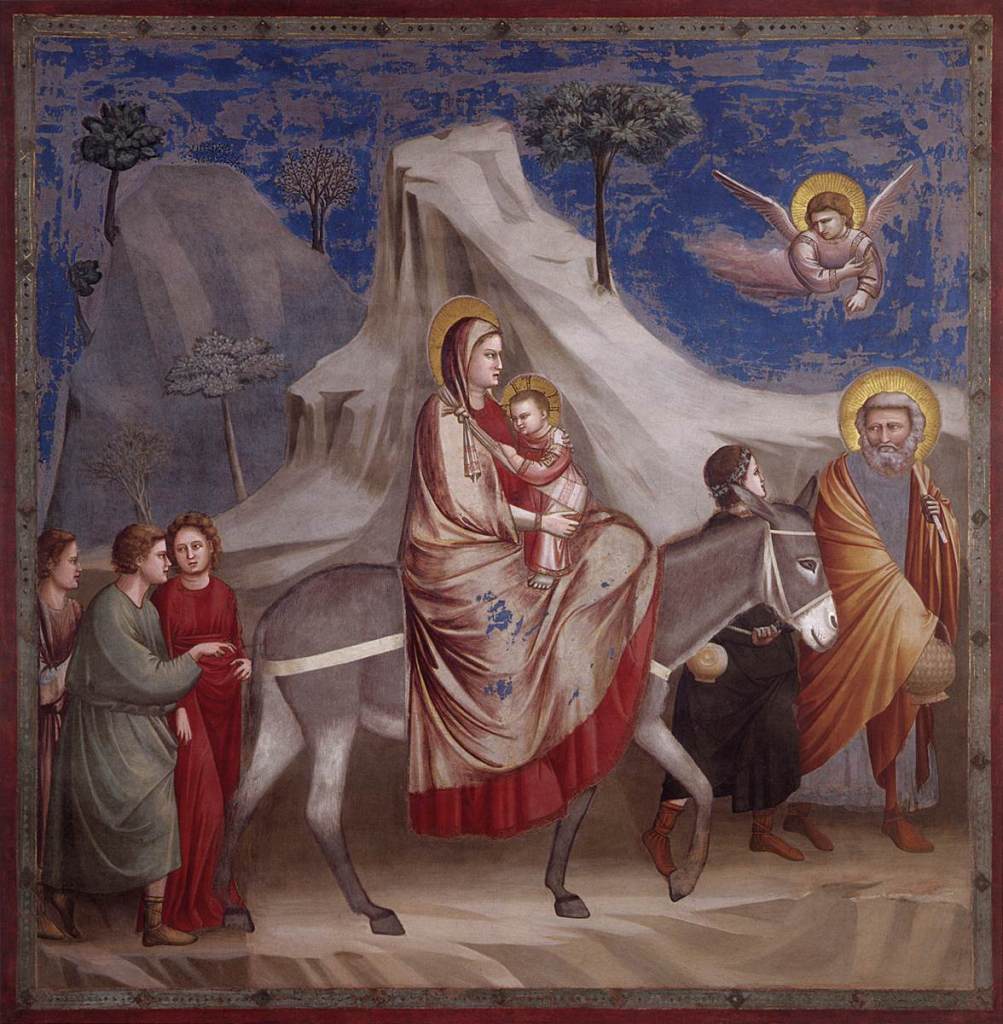
Likewise, the ass on which he rides into Jerusalem (right) is related in some way to the donkey on which, 33 years before, he had fled into Egypt. But again – it is not the same. Although they look similarly proud of their role in Jesus’s story, the earlier donkey has perkier ears, for one thing – but then, he is saving Jesus’s life, unlike his younger relative, who bears Jesus onward to his death.

The first thing Jesus does on his arrival is to chase the money-changers from the temple, as we saw in El Greco’s painting from the National Gallery (POTD 19). It is always worthwhile remembering, when looking at Giotto’s buildings, that a systematic way of painting in perspective wasn’t developed until the 15th Century. Even so, more than a century before that, Giotto could give us a real sense of solidity and space. He has painted a portico in front of the temple, or in the temple courtyard, and because it is at an angle, the individual piers which support the arches, framed by green half columns, stand in front of the three doors in the more shadowed inner wall of the portico: we can tell that we are not directly in front of this building.

This ability with spatial representation is shown most brilliantly in the cages that were previously used for animals – the man shying away from Jesus carries one, and there is another sitting on the ground. Jesus’s actions seem relatively calm – even measured – and the response of the money-changers is nothing like the chaos which ensues in El Greco’s later painting, but it is enough to cause the sheep to try and escape. It is also enough to scare the children. 

This is an entirely charming detail, I think, and one I haven’t seen elsewhere. One of the apostles is comforting a child, clearly upset by the unprecedented drama in the temple precinct.

The Expulsion of the Money-changers from the Temple brings us to the end of another chapter in the Scrovegni story, which could be entitled Christ’s Mission – although, as ever, Giotto keeps the story going by taking us round the corner. And the sheep seem to lead the way…

They leap round the corner, and straight into the devil, who looms over the shoulder of Judas, persuading him to take the bag containing the thirty pieces of silver, his fee for betraying Jesus. The priest in red holds his hands close to Judas’s – that touching gesture of that says, ‘I understand your concerns, but it really won’t be a problem’. And to the right, two more priests discuss the fact that the problem will be sorted – as the one in green points towards this untoward transaction with his thumb. We’ve actually seen this painting before, back in POTD 80, but I didn’t tell you what it was. 

With Judas in yellow and the priest in red, they mirror Anne and Mary on the other side of the chancel arch in The Visitation. As 2 July used to be the Feast of the Visitation (up until 1969, since when it has been celebrated on 31 May) this would seem apt – we’ve only missed it by a couple of days. The handmaids also echo the two priests, in paler versions of their clothes, while Anne’s servant is opposite to the devil.

What is the theological connection between the two? It is one of opposites. On the right Jesus is on his way into the world, and the unborn John the Baptist’s movement in the womb acknowledges the fact, whereas on the left, Judas’s betrayal seeks to take Jesus out of the world. Anne recognises Jesus will come, Judas guarantees that he will go. And remember, along the base of the wall running along the right hand side, below Anne, are the seven Virtues, while on the left hand side, under Judas, are the seven Vices, connecting all the way to heaven and to hell in the last Judgement on the wall behind us. Judas grasps the moneybag which is also held by Envy – one of the seven Vices (POTD 52) – as well as by several of the damned in hell (POTD 38). Thus Judas’s betrayal of Jesus is connected to the life of the patron’s own father. As I’m sure you will remember, Enrico Scrovegni commissioned the decoration of the chapel partly to atone for his father’s sin of usury (again, see POTD 38). This is, as I’m sure I’ve said before, the most coherent decorative scheme I know. And there’s plenty more to come! But for now, it’s worth noting that the planning it must have taken to get to the right point in the story so that Judas’s acceptance of the thirty pieces of silver was placed in this significant position in the chapel must have been remarkable. It allows Giotto to start the next chapter with The Last Supper, on the bottom tier of the right wall between the furthest two windows – and that is where we will start net week.

101 – Spinning a Yarn

Diego Velázquez, ‘Las Hilanderas’, 1655-60, The Prado, Madrid.

Had Picture Of The Day not ended on a Saturday, then this would have been POTD 100 – for reasons which should eventually become clear. But I couldn’t shift Scrovegni Saturday, now, could I? And had I got my skates on during the Velázquez lecture (thank you to all those who could make it), this should have been the last painting I discussed, but, as you may have noticed, I tend to go on a bit. Anyway, here we are, a few days later, with ‘No. 101’.

This painting is, I suspect, almost as complex in its ambitions and implications as the far more famous Las Meninas. Like it’s illustrious predecessor (this is probably one of the last paintings that Velázquez completed) it is very much about the nature and power of art. I’m using the Spanish title, simply because Las Hilanderas sounds so much better than ‘The Spinners’ – and also doesn’t put me in mind of a 1960s folk group. There is another title – The Fable of Arachne – but neither really explains what is going on, nor is either entirely accurate. There is, after all, only one person spinning: the old woman at the front left. 

As it happens, Velázquez has illustrated three stages in the production of thread. The woman in the centre, wearing the red skirt, is reaching down to the ground for a ‘clump’ of wool. In her left hand is a carder – not unlike the working end of a broom, but with metal spikes. Carding wool is the process of separating the fibres, and lining them up.  Once done, the carded wool would be handed to the woman on the left, who attaches it to her distaff, leaning against her left shoulder. She is pulling out separate fibres with her left hand, and feeding them onto a thread on the spinning wheel, spinning them together to create an even, strong yarn, which will then be wound onto a reel. The woman on the right is then winding the spun yarn from a reel, or skeiner, onto a ball. It’s not clear what the girl on the far right is doing – possibly taking the balls elsewhere, or bringing the wool for the start of the process.  The woman on the far left is pulling back a curtain. At first glance it is not clear why – but I shall come back to her later! There is also a cat, playing with one of the balls of wool, probably because that is one of the essential functions of a ball of wool – to be played with by a cat (I think that’s what’s called a circular argument). 

Being brilliant, Velázquez manages to show us these stages in wool production while also creating a wonderfully balanced composition – with an old woman weaving on the left facing front, and a young woman winding on the right facing back. They are framed by younger women leaning in on either side, and in their turn, they frame the woman facing towards us, about to start carding the wool, in the centre. Even for Velázquez’ late style this central woman is remarkably freely painted, her face little more than a blur or blob. It’s intriguing to realise that one Spanish word for blob, blot, stain, or mark is borrón, whereas borra can be the sort of rough wool you would use as stuffing. As borrón can be used for the very painterly brushstrokes that Velázquez uses I would love to think – as several scholars have – that this is a deliberate pun.

Meanwhile, in the background, we have moved from raw material to finished product. The wool has been woven into tapestries, which hang on the walls of a brightly lit adjoining room, up a couple of steps almost as if it is a stage. The scalloped edges at the top confirm that these images are fabric, hanging from the walls, and tell us that they are attached in the corners of the room, and half way across the walls. As many tapestries do, they have decorative borders and a pictorial centre. There are five people in this room, who in some way seem to echo the five women in the foreground.

The two who frame the group on the left and right look into and out of this subsidiary scene respectively, with the woman on the far right apparently aware of our presence: she looks out at us as we look in at her past the women in the foreground. She is rather like Alberti’s ‘chorus’ figure who we have seen several times before (e.g. POTD 37), inviting us in, or warning us off. A woman in a blue dress and red shawl has her back to us, while the woman in the centre faces front. She is standing with her back to the tapestry, gesturing to a person wearing armour – a helmet and breastplate – and holding a shield. This is Minerva – Goddess of War and Wisdom – or Athena, if you prefer the Greek names. But as this is a tale from Ovid’s Metamorphoses, I will stick with the Latin. In her role as Goddess of Wisdom, Minerva was also inspiratrix of the arts, and, as it happens, a dab hand at weaving. But then, so was Arachne – the woman gesturing towards her. In fact, Arachne was so good that she even boasted that she was probably better than Minerva – she certainly claimed all the credit for herself, and denied that she owed anything to the goddess. Minerva was clearly not going to be happy about this, and, disguising herself as an old woman, came down from Olympus and challenged Arachne to a competition. They both wove tapestries. Minerva’s showed the twelve Olympian gods enthroned in their palace, with examples of the Gods’ punishment of overreaching mortals as a warning to the presumptuous Arachne in the corners. Arachne, on the other hand, wove the loves of the Gods – notably the many examples of Jupiter’s infidelities and dalliances with mortals. This angered Minerva, but she could not fault the craftsmanship – while she appreciated Arachne’s work, she was also envious of her talent. She was, as people might say nowadays, conflicted. And this made her even more angry – she shredded the tapestry and attacked Arachne with her shuttle. The poor girl couldn’t cope with this, took a rope, tied it into a noose and tried to hang herself. But Minerva prevented her – she grabbed the rope, with Arachne hanging from it, and transformed her into a spider – an arachnid, of course – hanging from its thread, destined to spin forever.

It has been suggested that the two most important characters in the foreground – the old woman spinning and the young woman winding – are in fact Minerva and Arachne. However, I don’t think that this is necessarily the case – they could easily be contemporary workers whose activities are effectively ennobled by comparison with ancient myth. Nevertheless, the links between the foreground and background are clear, and Velázquez cleverly charts the development from fluffy lumps of wool (or was that blots, or blobs of paint?) through carding, spinning and winding, to the end product, a glorious, faultless work of art, both appreciated and abhorred by none other than Minerva. The process of moving from craft to concept, from technical skill to intellectual complexity, was one of the major developments in art during the Italian Renaissance. However, in Spain, artists had never really had the same respect. As with Las Meninas, Velázquez is making great claims for his art, the art of painting, in this particular work. From mere blobs of paint he can tell a tale – or, to put it another way, spin a yarn – which shows how dangerous art can be. It can rouse great emotions, it can teach us who we are and what we are capable of, it can stop us being complacent – which is why so many regimes have sought to bend it to their own will. I will leave you to contemplate our present government, and its current dealings with the arts.

But, of course, there is more to it than that. There’s a girl pulling back a curtain, for a start. I can’t see that the curtain has any real function in this space, so what is she doing it for? I’m sure it relates to the tale, told by Pliny the Elder in his Natural History, about the competition between Zeuxis and Parrhasius, to determine who was the best painter. The rules were simple – each paints a painting, and then they decide which one is better. Once the works were completed, they went first to Zeuxis’ studio, where his painting was displayed behind a curtain. He had painted some grapes, and they were so good that when the curtain was drawn back birds flew down to peck at them – what could Parrhasius do that would be better than that? They headed off to Parrhasius’ studio, and he invited Zeuxis to go over and have a look. So Zeuxis went over to draw back the curtain, only to find out that it was a painting of a curtain. Zeuxis may have fooled the birds, but Parrhasius had fooled a person – and an artist at that. And Velázquez has done the same to us. Why is the girl pulling back the curtain? Well, she isn’t. There is no curtain. There is no girl, for that matter, it’s just a painting. But he’s so good that we end up talking about these things as if they are real. Did he know the story? Oh yes. All artists did by the 17th Century. I can’t help thinking that by pulling back the curtain, the girl is referring to the competition between Zeuxis and Parrhasius in order to reveal the story of another competition, the one between Minerva and Arachne – so are we to assume that Velázquez was also in competition with someone? Before I answer that question, let’s stick with the fabric. Surely there is also a comparison between the plain fabric of the curtain, and the elaborately pictorial fabric of the tapestries. And, if we wanted to take it even further, we could even stop and think about the fabric on which this is all painted – the canvas – but we won’t.

In another section of the Natural History Pliny praises a work by the artist Antiphilus called,  ‘the Spinning-room, in which women are working with great speed at their duties.’ You could argue that it was this painting that Velázquez was trying to recreate with Las Hilanderas – he is putting himself into competition with Antiphilus. Pliny was making the point that it takes great skill to recreate the sensation of movement in paint – he also refers to a painting of a four-horse chariot by Aristides, in which the horses were running. Inevitably, although Pliny doesn’t mention the fact, the wheels would have been spinning – and this is undoubtedly the effect that Velázquez is trying to achieve with the spinning wheel in his own work, the blurred, concentric lines creating the sensation of movement. By including the references to Pliny, and illustrating one of Ovid’s tales, Velázquez places his own work, in terms of craft and of concept, in relationship to the art of the ancients – but would he, like Arachne, be daring enough to challenge the gods? I’m just going to quote eight lines of the wonderful 18th Century translation of the Metamorphoses which I referred to when talking about Boucher’s Pygmalion (POTD 79) – and here is a link there to a contemporary translation as well. We are a little way into Book VI, where Ovid describes Arachne’s tapestry:

Arachne drew the fam'd intrigues of Jove, 
Chang'd to a bull to gratify his love; 
How thro' the briny tide all foaming hoar, 
Lovely Europa on his back he bore. 
The sea seem'd waving, and the trembling maid 
Shrunk up her tender feet, as if afraid; 
And, looking back on the forsaken strand, 
To her companions wafts her distant hand. 

The first of Jupiter’s exploits mentioned by Ovid is the Rape of Europa, and if we look at the tapestry as painted by Velázquez, the version that Arachne has woven is the one painted by Titian for Philip II. The Titian, now owned by the Isabella Stewart Gardner museum in Boston, and currently in the exhibition just about to re-open at the National Gallery, was copied by Rubens: Rubens’s version is displayed next to Las Hilanderas in the Prado, just to make the point. Rubens’s own painting of The Fable of Arachne – in which he too quoted Titian’s Rape of Europa – can be seen in the shadows on the back wall in Las Meninas – with the added justification that a copy of it, by Velázquez’ son-in-law Mazo, was actually in the room in which Las Meninas is set.

Not only can Velázquez chart the development from raw material to finished product, from unformed wool to refined tapestry – using blobs of paint to spin his yarn – but he can also acknowledge and recreate the works of the classical masters, while putting himself in the same tradition as Titian and Rubens – his own ‘gods’ of painting. Like Arachne, he challenges the gods, but unlike Arachne, he wins. From a purely personal point of view, I now relish the fact that the work that he quoted is a painting by Titian which I saw just a few days before lockdown, one of the last paintings that I saw – and it will be one of the first that I see when the National Gallery re-opens this week. It was, as you may recall, Picture Of The Day 1.

Titian, The Rape of Europa, 1562, Isabella Stewart Gardner Museum, Boston.

Day 100 – A New Life

Giotto, The Raising of Lazarus, c. 1305 Scrovegni Chapel, Padua.

We looked at The Raising of Lazarus a few days ago, in the dark and mysterious painting by Henry Ossawa Tanner in the Musée d’Orsay (Picture Of The Day 95). Admittedly his work is titled ‘Resurrection’ rather than ‘Raising’, but that might be a result of translation from the French – the story is the same, whatever, and the names of specific events, like the titles of certain paintings, tend to get fixed within the language. 

It’s interesting to note that Giotto does not spend too much time on Christ’s adult life – his teaching, and many miracles, are passed by, abbreviated along one wall into the most significant events. So far on this wall we have Christ Among the Doctors, The Baptism and The Wedding at Cana (POTD 87 & 93) – just a hint at his early life (the end of childhood?), the start of his mission and his first miracle. We then jump to the most significant miracle, perhaps: the promise of new life.

With the implacable movement of the Scrovegni narratives, Jesus arrives from the left of the pictorial field followed by some of the apostles – I can see four haloes, but there could well be others behind them, out of the frame. Two have already sprung into action – the one with yellow and blue is St Peter, but the other I would hesitate to identify. Jesus raises his hand in blessing, clear against the clear blue sky, in the middle of the space between himself and the crowd of onlookers. John 11:38 describes the nature of the grave: ‘It was a cave, and a stone lay upon it’. Giotto creates a hill for this cave, and as always, the landscape comments on the action. The hill leads up to the right, driving forward the narrative and lifting our eyes, a metaphor for the raising of Lazarus. Christ instructs them, ‘Take ye away the stone’ – which they have, with two rather small workmen holding the stone at an angle equivalent to the slop of the hill in the bottom right corner. However, just after this instruction (and before it is carried out), ‘Martha, the sister of him that was dead, saith unto him, Lord, by this time he stinketh: for he hath been dead four days.

As I said the other day, Giotto makes this ‘stink’ visible – the woman on the far right covers her face with her blue cloak, and the apostle to the right of Lazarus has wrapped his cloak around his face. According to John 11:33-34, Jesus cried with a loud voice, Lazarus, come forth. And he that was dead came forth, bound hand and foot with graveclothes: and his face was bound about with a napkin. Jesus saith unto them, Loose him, and let him go’. And this is how we see Lazarus – although the napkin has already been loosed allowing us to see Lazarus’ deathly pallor. The crowd to the left throw their hands up in amazement.

Before I talk about the two women prostrate at Jesus’s feet I’d just like to point out a technical detail. As we have seen before, in The Nativity for example (POTD 87), Jesus’s robe was painted red in true fresco, with the ultramarine blue painted a secco – meaning that it much of it has worn way. On the right of this detail you can see Peter’s robe, which was not painted at all when wet, and only has a blue a secco layer. Originally, when all the paint was still there, Jesus’s robe would have looked far richer in colour, with the red showing through to make the blue look deeper, even purple, while Peter’s would have been a less intense blue. Not only would this have helped to emphasize their relative status, but it would also have drawn our attention to Jesus – while still making Peter look important.

And after some painting technique, I’d like to get technical with the bible. Who are the two women prostrate at Jesus’s feet? At first glance, it would seem to be straightforward: Mary and Martha, sisters of Lazarus. According to John 11:5, ‘Jesus loved Martha, and her sister, and Lazarus’ – they were friends. They lived in Bethany, and, according to verse 2, which is entirely in brackets in the King James Version, ‘It was that Mary which anointed the Lord with ointment, and wiped his feet with her hair, whose brother Lazarus was sick’. This particular verse ties in with others, in Luke’s Gospel, 7:37-38:

And, behold, a woman in the city, which was a sinner, when she knew that Jesus sat at meat in the Pharisee’s house, brought an alabaster box of ointment, And stood at his feet behind him weeping, and began to wash his feet with tears, and did wipe them with the hairs of her head, and kissed his feet, and anointed them with the ointment.

The chapter ends at verse 50, with Jesus’s statement of forgiveness ‘And he said to the woman, Thy faith hath saved thee; go in peace’. Almost immediately after this, in the second verse of the next chapter, Mary Magdalene is mentioned for the first time, ‘Mary called Magdalene, out of whom went seven devils’ – we are not told any more about this, but Mary appears regularly thereafter as one of Jesus’s followers, being present at the Crucifixion, and being the first witness to his Resurrection. After the entombment of Christ, Luke 23:55-56 and 24:1 says 

And the women also, which came with him from Galilee, followed after, and beheld the sepulchre, and how his body was laid. And they returned, and prepared spices and ointments; and rested the sabbath day according to the commandment. Now upon the first day of the week, very early in the morning, they came unto the sepulchre, bringing the spices which they had prepared…

The ointment with which the ‘woman… which was a sinner’ washes Christ’s feet, this ointment in Luke 23, and the ointment in John 11:2 were all linked together. So were the statements that Luke’s sinner was ‘stood… behind him weeping’, that Mary (sister of Martha) was ‘weeping‘ in John 11:33, and the later statement in John 20:11 saying ‘Mary stood without at the sepulchre weeping’, to suggest that Luke’s sinner, Mary Magdalene, and Mary the sister of Martha, were all one and the same woman, often to be seen weeping with a jar of ointment. This isn’t a new idea by any means – it was Pope Gregory the Great who connected the three women in a sermon back in 591. And that is how the Catholic church continued to see Mary Magdalene right up until 1969 when Pope Paul VI recognised them as three separate people. The Orthodox Church had always seen them as separate, and many Protestants rejected the connection as well: Calvin certainly did, although Luther continued to believe in the composite identity. Nevertheless, as almost every image of ‘Mary Magdalene’ that you will see from Western Europe, from medieval to baroque and beyond is the product of the Catholic Church, it is the penitent prostitute that is depicted.

It helps us to separate the two women here, even though we cannot see either of them clearly. The woman in the foreground, with her head covered, is Martha, and behind her, hair still visible and wearing red, is her sister Mary, assumed to be Mary Magdalene, the ‘scarlet woman’ (sorry, younger generation, I can’t explain).

That got a bit technical I know, and I’m going to do the same again, although not quite in so much detail. I mentioned on Wednesday (POTD 97) that Hercules was a ‘type’ of Christ, and realised that, although I’ve hinted at this form of interpretation, I had never thoroughly explained it. It relates to the setting of the Wedding at Cana which we saw last week (POTD 93).

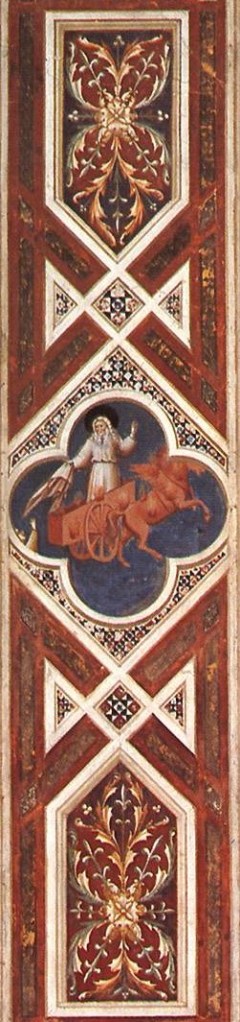
The picture is framed by two decorative strips, which look like inlaid marble, with a scene in the centre of each. I suggested that you might recognise one of them.

Here they are on a larger scale. On the left is Moses bringing forth Water from the Rock and on the right, The Creation of Adam – it’s not entirely unlike Michelangelo’s more famous version painted some two centuries later.

And this is how it relates to The Raising of Lazarus. The message is quite straightforward – God gave Adam life, and Jesus gives Lazarus new life. This is why the story of Lazarus is so important – it isn’t just Lazarus who has new life: the Christian message is that everyone has new life in Jesus. We are ‘born again’, to use the evangelical catchphrase. In the earlier example, Moses provided water, while Jesus turns it into wine – and later, wine becomes his blood. In both cases we are seeing typological interpretations of the Jewish scriptures. For Christian theologians it was vital that Jesus was the prophesied Messiah, so they combed through every verse of the Old Testament to find any potential relevance to Christianity – and even things which were not prophecies were seen as predicting something in the New Testament. So Moses as a whole was the type of Jesus. The word comes from printing – think of movable type. A metal letter ‘t’, say, is covered with ink and printed – and a ‘t’ appears on the page. It is something which creates the image of itself. So Moses, leader of his people, who gave them the Ten Commandments from Mount Sinai, is a precursor of Jesus, the leader of his people, who gave the Sermon on the Mount. In both, the ‘Mount’ is important. But it wasn’t just the Old Testament to which this form of interpretation could be applied. It was assumed that the classical civilisations had partially misheard God’s message and got it wrong. Nevertheless, they thought, Aristotle’s Prime Mover was bound to be the Christian God (POTD 98), and for that matter, Jupiter, King of all the Gods, must have been a misunderstanding for God the Father, while Juno, Queen of the Heavens, could easily be a foretelling of Mary, Queen of Heaven – or so they reasoned. The fact that Giotto uses small details to include this form of interpretation, giving greater depth to the meaning of the chapel as a whole, is a sign of his genius. I’m sure it’s not entirely his idea – Enrico Scrovegni would have had a suitable theologian on hand to tell Giotto what to paint – but Giotto was the one who decided what it would look like, and precisely how it would all fit in. These are the details which are all too easy to miss – but which, like salt, bring out the full flavour. And there are many more…

But for today, enough, already. And enough for a while, I’m afraid. This marks the end of Picture Of The Day, but clearly not of pictures… I will continue to blog from time to time – after all, we’re not even two thirds of the way around the stories of the Scrovegni Chapel – so Scrovegni Saturday will keep going. This website will function as a mailing list, as well, and I’m going to try to be more conscientious about updating the ‘diary’ page – I’ll let you know when I do! In the meantime, thank you all for your interest, for your support, and for all of your kind comments. And, like Lazarus, I’m wishing a great new life for all of us after lockdown. He and his sisters all ended up in the South of France, as it happens, but that’s another story. There are always many more.

Day 99 – Paradise

Giovanni di Paolo, Paradise, 1445, Metropolitan Museum of Art, New York.

Since yesterday, nothing drastic has happened – and so I give you a vision of Paradise, the rabbits, more numerous since the days of Adam and Eve, still nibbling peaceably at the grass. I don’t know about you, but back in the middle of March I can remember the last couple of friends I bumped into, or arranged to meet, in London, and not knowing how to greet them. There were a couple of awkward, slightly distanced hugs, and then a couple of bows… and then I was whisked away to Durham, and I’ve been here more or less ever since. Soon the demands of work will drag me back down to London, and soon we will be able to meet up with friends again. I know we can meet some, at a distance, already. But when will we start making physical contact? When will we shake hands, or hug, or kiss, and will it be one cheek or two? And will it look anything like Giovanni di Paolo’s Paradise?

Here we are at the end of time, and the resurrection of the body has brought these people together for the first time in centuries, if not millennia – for who knows when it will be? The people are spread across the surface like a medieval tapestry, with a screen of golden trees against a clear blue sky defining the limit of the garden, which is verdant, and growing with over-sized flowers. People meet in couples, or, in one case, a threesome, dressed to the nines, or with the humility of monastic orders. A large number of the men wear black and white, the habit of the Order of Preachers, better known as the Dominicans – which is the first clue about this painting: it was probably made for a Dominican church.

Some of the characters can even be identified. The two Dominicans greeting each other in the middle here – they’ve gone for the slightly distanced embrace – are none other than St Dominic himself, founder of the order, and St Peter Martyr. It’s a tiny detail, but there is a splash of red – blood – on the head of the man on the right. St Peter, a friend and follower of St Dominic, was killed when heretics attacked him in the woods outside Milan, hacking into his head with a knife. To the right we have St Anthony Abbot and two Dominican nuns. Now, you must forgive me if I can’t help thinking that Giovanni di Paolo, the strange and original genius of the Sienese Renaissance, wasn’t always being entirely straight laced. After all, what exactly are these three doing? It looks to me as if St Anthony is actually pushing the middle nun away – and that her companion is trying to hold her back. Seeing as one of the stories in which artists could exercise most fantasy was The Temptation of St Anthony, would I be wrong in suggesting that here temptation has been offered yet again, and, as ever, the good Saint has sailed through the test with flying colours (to mix my transport metaphors). To the left of the detail, we have the fashionable youth of the afterlife – men in their must-have red tights (like Tobias, in Picture Of The Day 4), including one with a chaperon (the fashionable headgear often seen in paintings by van Eyck), and two women in the same dress (houppelandes) – though fortunately, not the same colour. Imagine the embarrassment – all eternity in the same outfit! What becomes apparent quite quickly, though, is that Paradise is not for the poor.

There are more identifiable figures in the arc of characters spanning the middle of the painting. The Dominican on the left, who has a little bird whispering in his ear, was, in his life, inspired by the Holy Spirit. This is something that would usually identify St Gregory the Great, but he was a Pope – so this can’t be Gregory. As a Dominican it must be the Blessed Ambrogio Sansedoni, revered in Siena, even though he never made it into the canon of the Saints. There is clearly a good team dealing with hospitality in Paradise, as no one is left to themselves. Anyone who might have been more – heremitic, shall we say? – during their life has been greeted by an angel. Sansedoni certainly is, and so is the Pope, further to the right (sadly we don’t know which one this is). The two angels frame St Augustine, who is meeting his mother, St Monica, for the first time since she passed away in Ostia, as they were heading off to Africa. I hesitate to discuss the relationship between the cardinal, in his scarlet robes, and the extremely fashionable blonde boy in his spotless white hose, in case I say something that is entirely irrelevant to the painting.

The deer wandering into the garden at the top left tells us that the man in white is St Giles – it ran to him while being hunted, and the poor Saint was rewarded with an arrow in the leg. But it was a sign that St Giles was, during his lifetime, already closer to Paradise than the rest of us, as the animals were not afraid of him. It is for the same reason that the rabbits sit so peacefully, and do not scamper away: in Paradise everything is at peace. It is only the sinful they need fear. The other anonymous couples greet with differing degrees of intimacy, from holding wrists at arm’s length to full on hugging. There are even two – a monk and a merchant I’d say, towards the top right – whose greeting would now be interpreted as ‘namaste’ – with the hands joined in prayer, and a slight nod. I tried it a couple of times, but I’m not sure it was me. And then, in the top right corner, a young man and an angel, hand in hand, are going for a walk beyond the frame. But don’t be fooled – they are not leaving the picture, it’s just that the picture has left them. A golden glow emanates from behind the angel’s head and in front of the hem of his skirt. It emerges from behind the black cloak and white robe of another Dominican, who has been cut off, ultimately, if not in his prime. Although this now looks like the edge of the painting, it wasn’t: the panel was cut down at some point, and the golden frame painted all round the surviving section to disguise the fact. 

Originally these two panels – yesterday’s and today’s – belonged together, and would have been adjacent like this. I don’t have access to the full conservation history, so I don’t know if they were originally on the same plank of wood, or on separate sections. Nevertheless, the conception of ‘Paradise’ is the same in each, a flowery meadow screened off from the blue sky by a row of golden trees. In the second panel Paradise is more extensive, because there is nothing else to show – there is no need to include the four rivers, or, for that matter, the rest of the cosmos. It does make the trees look further away. They are smaller, after all, although on the whole Giovanni isn’t too worried about perspective: the people at the top are more or less the same size as the people at the bottom, one of the features that gives the ‘tapestry-like’ appearance. The trees are also painted in the same way, with gold leaf applied over the paint, much of which has worn off in the Paradise panel. But even together, this was not the full extent of the painting.

This is a reconstruction of the known remaining elements of the Guelfi Altarpiece, painted for the Church of San Domenico in Siena. The main panels have found their way to the Uffizi in Florence, and are signed and dated 1445. In the centre, as so often in Italy, are the Madonna and Child. They are flanked by Sts Peter and Paul, with Sts Dominic and Thomas Aquinas (another Dominican) on the outside. As it happens, the name is inaccurate – the polyptych was originally painted for a chapel dedicated to St Dominic, hence his inclusion in the main part of the altarpiece. Only later was it moved to the Guelfi Chapel, which was dedicated to St Anthony. If you want to know more about its origins, the Met catalogue entry is available online. The altarpiece was still intact, and already in the Guelfi Chapel, in 1649, when it was described in detail. The structure is a common one, with the upper elements of the altarpiece supported by a wooden box, which helps to stabilise the heavy wooden panels on which the Saints are painted. But, as an extra surface, this box could also decorated with a strip of paintings, known as the predella. The 1649 account described the predella as illustrating the Last Judgement, the Flood, and the Creation of the World. You might think that the last of these is the only bit that survives, but Paradise was originally part of the Last Judgement – however, for whatever reason (wet rot, dry rot, woodworm, theft or fire – there are always candles on an altar), most of it has been lost. However, we are lucky that Giovanni di Paolo regularly repeated compositions with which he was happy. Here is another predella panel, now in the Pinacoteca in Siena, which he painted for an unidentified polyptych.

The depiction of Paradise on the left is similar, if broader, to today’s picture – and you can see that the top right of it does lead into the golden light of heaven, as the glow behind the hand-holding angel suggests it would. We also see the resurrection of the body in the centre, with souls being ushered into Paradise on the left (at Jesus’s right hand, POTD 38), and thrust into hell on the right. Given that our painting should have been accompanied by The Flood, we must assume that this missing scene would have been on the far right, balancing The Expulsion from Paradise. Thematically they are linked: Adam and Eve are created, but fall, and are expelled. As a result mankind is sinful – so bad in fact that God decides to scrap the human race and start again, with Noah and Mrs Noah (POTD 37) as the new Adam and Eve. It’s such a pity that this does not survive – but at least we have these two gems. And, I suspect, because they have been separated from their original setting, they actually get far more attention than they would have done as part of a larger ensemble – they work almost better on their own. I’m sure that’s not true of all of us though – and I look forward to seeing as many of you as possible in person soon!

Day 98 – Out of Eden

Giovanni di Paolo, The Creation of the World and the Expulsion from Paradise, 1445, Metropolitain Museum of Art, New York.

I alluded yesterday (Picture Of The Day 97) to the medieval conception of the Universe, in relation to the tapestries across the top of the walls in the tower of The Lady of Shalott – so what better than to clarify that idea. And the best way to do that would seem to be by considering the way we have been thrown out of our usually comfortable worlds, and are now looking forward to an expected return, and the chance, finally, to meet and greet old friends. However, as I don’t know what lifestyle all of you used to live, I’m just going to assume that, compared to the worse aspects of lockdown, it was paradise. And that is where I shall assume we will return – although that return will come tomorrow.

Over two days I will look at two small paintings which were part of a larger whole. Today, we have a panel which shows The Creation of the World and the Expulsion from Paradise. On the left we have the entire cosmos, constructed like a multi-coloured onion in concentric layers, with God on the outside. His hand is pointing into the sky. It’s not uncommon to see this from our point of view, with the ‘Hand of God’ poking out of the blue – a good example would be Giotto’s Sacrifice of Joachim (POTD 66). In this case he is presumably creating something or other – possibly the plants, as I can definitely see some trees, but no birds or animals, which would make this Day 3 of creation. On the right of the painting we cut to ‘some time later’ – Adam and Eve have been created and tempted and are now being expelled from the Garden of Eden, pushed out by an angel past a row of trees bearing golden apples. Beneath them are four dark streaks – the four rivers of Eden, as mentioned in Genesis 2:10-14, where they are named as Pison, Gihon, Hiddekel and Euphrates. Although the third of these is usually interpreted as the Tigris, neither of the first two has been identified, although Gihon is recognised by some as the Abay River, or Blue Nile.

This is the detail which most fascinates me – the structure of the universe. I am comparing it with a diagram from Andrew Borde’s The First Book of the Introduction of Knowledge, published in 1542, as it is relatively clear. It expounds medieval cosmology, but it is based on the Ptolomaic world view, dating to c. 150 CE, which in itself goes back to Aristotle (384-322 BCE). Giovanni di Paolo had definitely seen a very similar diagram! At the centre we have the Earth, which contains two of the ‘four elements’, earth and water. The Earth is surrounded by the two remaining elements, ‘aer’ and ‘fyre’, as Borde spells them, equivalent to the pale blue and bright vermillion rings in Giovanni’s painting. Next comes ‘the Mone’ – or Moon – the planets Mercury and Venus, and the Sun. Giovanni paints their spheres pale blue, darker blue, a blue half way between the two, and a very pale yellow, with a rather worn representation of the Sun at the top of the relevant circle. The grey ring in the painting is occupied by Mars, followed by Jupiter and Saturn with two more blue circles. Outside these, occupying a far thicker and darker band, we see the signs of the zodiac – this is the sphere of the fixed stars, which I mentioned yesterday.  Finally there is a thin, dark blue ring. This is the ninth sphere, named by Borde as ‘the Crystalline Heaven’. He then adds two more which are not in the painting – ‘the First Moveable’ and ‘The Empyreal, Heaven, The Abitation of the Blessed’. There was some debate about the outer limits of the known cosmos (as there is today), and not everyone split the ‘ninth’ sphere into three as Borde does, referring to the single ninth sphere as the Primum Mobile or Prime Mover – or, as Borde has it, ‘the First Moveable’. Aristotle said that it was this which gave the movement to the inner spheres (he had as many as 55), which resonate in harmony – the Music of the Spheres. It wasn’t hard for Christian theologians to make the leap and suggest that Aristotle’s Prime Mover was in fact God, the source of all life, and to point out that we don’t hear the Music of the Spheres because the sin which Adam and Eve introduced into the world has created discord, and put everything off kilter. 

So, the Earth is made up of the four elements, and outside these were the seven ‘wanderers’ (‘planet’ comes from the Greek word meaning ‘wanderer’, and would have included the five ‘planets’ known to the ancients together with the Sun and the Moon). These seven were set into the first seven crystalline spheres, and the fixed stars (including the signs of the zodiac) were in the eighth. I suspect that originally the painting would have had an image of each of the planets on the appropriate sphere, but that the gold leaf has worn off – only the Sun and zodiac have lasted, presumably because they were bigger. The ninth sphere – the Prime Mover – effectively marks the edge of the cosmos, with Heaven on the outside, and that is where God can be found in this painting. Given that there were nine spheres, and, it was believed, nine choirs of angels, it made sense that each sphere would be moved by a different choir of angels – which is why, in the tapestry at the top of the wall in The Lady of Shalott yesterday, each planet is held by a figure with a halo. 

God himself is everything we would expect him to be – long grey hair, long grey beard, flying effortlessly through the sky. He wears a blue robe – which makes more sense than ever up above the sky. He also has a pale cloak, with touches of pink and blue – I suspect it used to be a purplish colour, but has faded. He is surrounded by blue heads with long blue wings, streamlined away from the direction of travel – these are the highest choir of angles, the Seraphim. We have met them before, I know, but I can’t for the life of me remember when! The ‘Empyrium’ which God inhabits is painted a glowing yellow, enhanced by the gold leaf of the halo, and by the golden beams of light radiating in all directions – he is like another Sun, being the source of all energy. The apples and leaves of the trees in Paradise are similarly gilded. 

The yellow is focussed around God’s head, and gradually fades into blue, becoming the blue of the sky on the other side of the painting. Thus, although God is shown in the act of creation, outside the cosmos, he is also looking across the sky to the sinful Adam and Eve, pointing to the world and telling them where to go – out of Eden. This explains his slightly grumpy look, I think, which is not consistent with his general demeanour during creation, when he regularly saw ‘that it was good’.

The angel also has gilded wings and a halo – which would not, in itself, be surprising, were it not for that fact that that is all he has. It could be the only naked angel I know – before Michelangelo’s far more manly ignudi, at least. The standard interpretation is that he is showing his compassion for Adam and Eve, but I don’t really buy that. I think this shows that he was in a state of grace, so had no shame, so wouldn’t have worried about clothes anyway. But then Adam and Eve don’t seem that bothered either, if we’re honest. They are looking back the way they’ve come, but without a huge amount of longing or regret. If anything, they seem a bit clueless, a bit like those people who you meet on your daily walk (I’m assuming you’ve been going on daily walks) who are apparently completely unaware that there’s a pandemic going on, strolling along without a care in the world, happily chatting away to each other, getting in your way, and failing on every level to comprehend the need for social distancing. They have been thrown out of Eden without their fig-leaf clothes (Adam and Eve, that is, not the people on your walk) although fortuitous leaves protect their very modest modesty. The same is true for the angel, who is blessed with a strawberry flower. This truly is Paradise – a word derived from Old Iranian, meaning ‘garden’ – and all of the flowers could be seen as symbolic in different ways. The strawberry, for example, doesn’t have a hard stone or thorns – and as such it is seen as a pre-lapsarian fruit, i.e. dating from before the fall. It was only at this point, according to the Bible, that thorns developed, to get in our way and make life tougher. Consequently the strawberry is, in itself, a symbol of Paradise. The lily to the right of the angel represents Mary’s virtue, and the rose (between Adam and Eve) represents her love. Mary herself was referred to as ‘a rose without thorns’ as she was free from Original Sin.  The carnations left and right are also symbols of love, but also give a nod to the idea of incarnation – which, with Mary, and thanks to Adam and Eve, will now be needed. The rabbits continue to nibble at the grass, unconcerned with all that is going on around them, and they will stay there, in Paradise, until we return… which, unless something drastic happens, will be tomorrow.

Day 97 – The Mirror Crack’d

William Holman Hunt, The Lady of Shalott, 1886-1905, Wadsworth Atheneum, Hartford CT.

Finally, after 97 days, I’ve found the perfect expression of the lockdown. I’m beginning to understand how this Lady feels. I suspect we’ve all been going through this for a while now – “I am half sick of shadows,” said the Lady of Shalott. I mean, imagine it, stuck at home on your own for you don’t know how long, faced with an undefined threat, and the only experience you have of the outside world is the luminous image on a single surface. It could be the television, I suppose, or your computer screen. Or it could just be a mirror. At least we know what the threat is, and why we might be socially distanced, or self isolating. The Lady of Shalott did not. I am certainly half sick of shadows, but yesterday the news came that, somehow, museums and art galleries will be able to re-open in a week and a half, and we will be able to see the real things, again, rather than looking at pictures of the pictures…

William Holman Hunt, one of the founders of the Pre-Raphaelite Brotherhood in 1848, kept going in a similar vein for the rest of his life, his paintings paying close attention to naturalistic detail, and drawing their inspiration from good literature. Among the Pre-Raphaelite ‘heroes’ were the Bible, Dante, William Shakespeare, and Alfred Lord Tennyson, and their interest in the romance of the medieval past springs to a considerable degree from his. The Lady of Shalott is a case in point. Like several of Hunt’s later works it took years to complete, had a complex evolution, and exists in more than one version. I am showing you the example in the Wadsworth Atheneum in Connecticut, as I prefer its symbolism to that of the painting in the Manchester City Art Gallery – I also prefer the richer, deeper, brooding colours.

For his poem Tennyson adapted the Arthurian legend of Elaine de Astolat, written in Italian in the 13th Century as La Damigella di Scalot. Shalott, as it happens, is on the way to Camelot, which proves invaluable for the rhyme scheme, and there, in a tower on an island, a mysterious lady dwells, the victim of an undefined curse.

There she weaves by night and day 
A magic web with colours gay. 
She has heard a whisper say, 
A curse is on her if she stay 
          To look down to Camelot. 
She knows not what the curse may be, 
And so she weaveth steadily, 
And little other care hath she, 
          The Lady of Shalott. 

Basically, she is not allowed to look out of her window towards Camelot, and so she spends all her time weaving, her only knowledge of the outside world coming from a mirror, reflecting the world outside. And she weaves what she sees:

But in her web she still delights 
To weave the mirror's magic sights,  
For often thro' the silent nights  
A funeral, with plumes and lights
          And music, went to Camelot:  
Or when the moon was overhead,  
Came two young lovers lately wed:  
"I am half sick of shadows," said 
          The Lady of Shalott.

By this stage Tennyson has already told us that, ‘She hath no loyal knight and true’, so the sight of newly married lovers must have been particularly galling – and she no longer wanted to live her life vicariously, seeing a reflection of what was going on in the world outside. I suppose we at least have rested safe in the knowledge that there was precious little going on out there anyway. But even for the Lady things were going well, or well enough, until Sir Lancelot passed by on his way to Camelot, the perfect example of knighthood and of manhood – and she could no longer live by shadows, she had to see him, the real thing, and not some pale reflection:

She left the web, she left the loom, 
She made three paces thro' the room, 
She saw the water-lily bloom, 
She saw the helmet and the plume, 
          She look'd down to Camelot. 
Out flew the web and floated wide; 
The mirror crack'd from side to side; 
"The curse is come upon me," cried 
          The Lady of Shalott. 

…and this is the moment that William Holman Hunt depicts, the moment at which the unknown curse is unleashed. If you don’t know what happens next, I shan’t tell you, although one day I might show you a painting. However, you can read it for yourself. Tennyson wrote two versions – I’ve been quoting from the second version, published in 1842, but I’ll also give you a link to the first version of 1832, both curtesy of the Poetry Foundation. Feel free to compare and contrast.

We see the chaos that ensues when the curse is enacted. The Lady is tied up, wrapped around by the thread which now seems to have a life of its own. She appears almost trapped in her loom, a curious structure, with a circular frame resting on a series of elaborate legs, more like an unconventional museum railing to keep you away from a sculpture. The floor is paved in a geometric pattern fitting these legs – the whole room is defined by the curse, and the Lady has lived her life through its mysterious logic. I do not know how many legs there are, but I’m sure there must be twelve, the weaving governing every hour of her days and nights like a clock face. She is barefoot, but there are overshoes – or pattens – on the floor. Together with the circular mirror in the background, reflecting an unseen presence behind us, these are an unmistakable reference to Jan van Eyck’s Arnolfini Portrait, a major influence on the Pre-Raphaelite Brotherhood from its foundation four decades before this painting was started. There are also irises, used in Christian art as a symbol of Mary’s suffering, their meaning coming from the old name ‘Sword Lily’, and the prophesy, to Mary, that ‘a sword shall pierce through thy own soul also’ (Luke 2:35). Two doves are flying away – they were the mythical birds of Venus, Goddess of Love, and I suspect that this is why Hunt included them. For Noah the Dove represented hope for the new world after the flood, and in the New Testament, the dove represents the Holy Spirit (POTD 89), but I am fairly sure that the dove did not become a symbol of peace until the 20th Century (if you can trust Wikipedia, which I often do, it dates to 1949, and a drawing by Picasso – which I can believe). If they are Venus’s doves, I think that, rather than love being freed, it is put to flight – but read the poem yourself and see! There is also a curious silver lamp. At its base you might be able to make out a crouching monkey – and we have already seen the monkey as a symbol of human baseness and ignorance in POTD 91. At the top of the detail, the lamp has a series of owls – sorry, they are hard to see, but I haven’t been able to find a high-resolution image. The owls represent the wisdom of enlightenment, embodied by the lamp, away from the darkness and ignorance symbolised but the monkeys at the base. Sunlight falls across the floor of the room, and over the weaving, which seems to unravel in front of our eyes. The shafts of light which fall onto the image – the art that the Lady has made from her isolated experience – are significant. To the left of her legs, we see a maiden in profile, and the back of a knight, moving away – surely our heroine and Sir Lancelot. And on the right, a figure bowing next to a golden cup – presumably the Holy Grail, the goal of the Arthurian quest.

At the top of the painting we see that the room has been decorated with the Lady’s work. The semi-circular section beneath the vaulting is decorated as a stylised sky, with a blue background and the heavenly bodies – the sun, moon and planets, as well as a globe with sparkling dots representing the crystalline sphere of the fixed stars. All of this reflects the medieval understanding of the structure of the universe, in which each of the heavenly bodies was governed by one of the nine choirs of angels, including one which moves the fixed stars on their daily rotations (fixed, as opposed to the wanderers, or ‘planets’ that is). This stylised reality is contrasted with nature itself – a blue sky with clouds seen through an opening at the top of the wall, through which it is just possible to see two doves flying – possibly the same doves at a later stage of their flight, or maybe two others. But all this just avoids the obvious – the most glorious Pre-Raphaelite hair in the most extravagant disarray. It flies out around her as if she is experiencing some form of whiplash, the power and energy of the curse electrifying every extremity of her body. It is wild, and unnatural, and fantastic – in both the contemporary and original sense of the word – and becomes a fabric in its own right.

The tension in her body as she tries to free herself from the thread is remarkable, like some sort of tarantella – a dance supposed to cure you of the bite of a tarantula. Remembering how spiders weave, and trap their prey, what could be more relevant? And remembering how Arachne wove, before Minerva turned her into a spider, another layer of significance is added. Both wrists bend back, the fingers curl, the arms held in front and behind, I cannot think she is doing anything else but dancing to free herself. Notice how the flashes of sunlight just catch the fingers looping the thread. Her body and face are in shadow – far more brilliant is the reflection in the mirror behind her. The Lady’s tower appears to be modelled on a Venetian 15th Century Palazzo, not unlike the Doge’s Palace, or the Ca’ d’Oro – or at least, the window is. In the mirror we see the window with its wide open spaces, and just inside the room we can see, reflected, the lamp, the loom and the weaving, with the light falling across it. And outside, in brilliant sunlight, Sir Lancelot, a Knight in Shining Armour, his sword raised, heading off into the distance, through the landscape described in the first stanza of Tennyson’s poem: 

On either side the river lie 
Long fields of barley and of rye, 
That clothe the wold and meet the sky; 
And thro' the field the road runs by 
          To many-tower'd Camelot; 

The mirror is framed in a similar way to the two images on either side – more of the Lady’s work – drawing the connection we have made before today about the relationship between mirrors and art: both are forms of imagery, the implication being that a great artist will make work that mirrors the world around us. And I suspect that the Lady of Shalott was a great artist, depicting her world with the honesty of long-suffering experience. However, here Hunt has chosen to represent things she would not have seen in the mirror – they are her own personal reflections. On the left, the image is easy to understand – the Madonna and Child, white against a blue background, with the baby Jesus lying on the grass – it could almost be a glazed terracotta relief by Luca della Robbia, popular, and copied, in Victorian England. On the other side the image is not so obvious – a naked man with a halo reaching up to take an apple. This is not Adam though, there are three women asleep at the foot of the tree. To the left of this youthful, muscular man we see a lion’s head: it is Hercules, with the skin of the Nemean Lion, taking the golden apples from the garden of the Hesperides (the sleeping women). But why the halo? Well, Hercules was seen as a type of Jesus (bother – I haven’t talked about typology yet) – let’s just say that he was seen as prefiguring Jesus, in that he was a hero who carried out a number of labours that involved good triumphing over evil. It’s not quite that simple, but let’s not worry about that right now. And of course, being a work of art, it will never be that simple. Even if he is a symbol for Jesus, there are also, inevitably, parallels with the tree of knowledge of good and evil, and the forbidden fruit, and the idea of temptation to which the Lady has just succumbed – particularly as this Hercules is such a fit, and handsome, and, let’s face it, naked young man, who just happens to be looking towards the Lady of Shalott as he takes the apple.
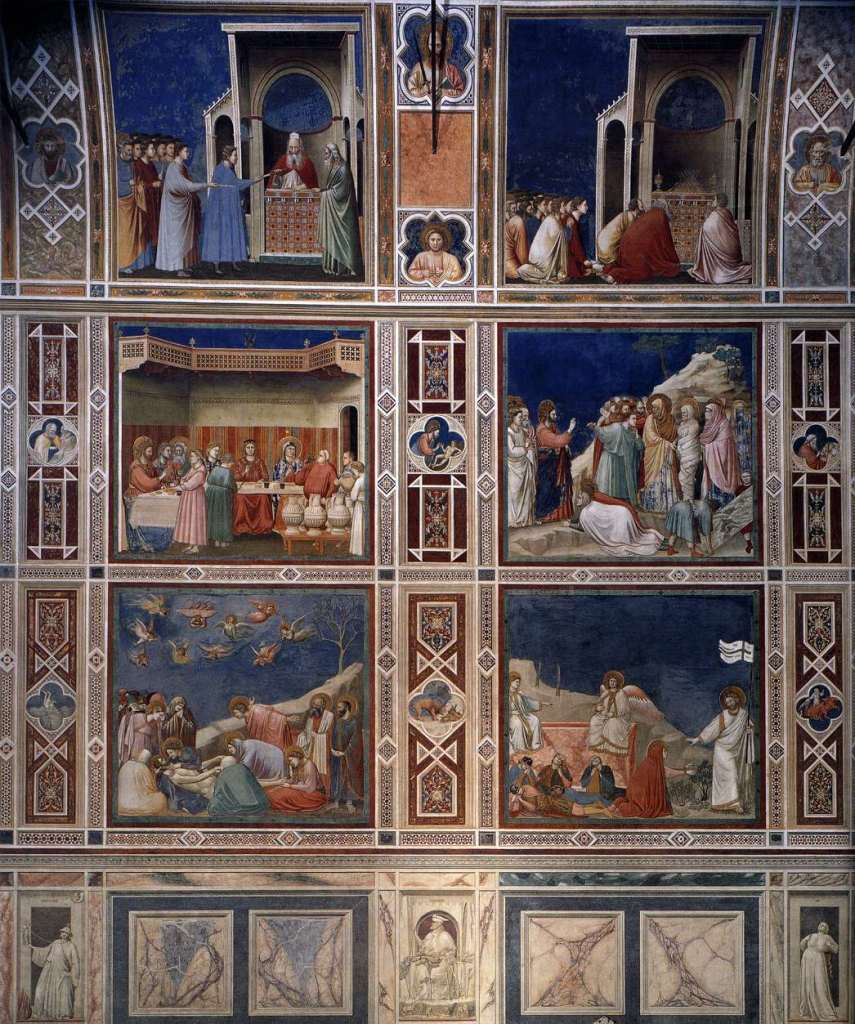
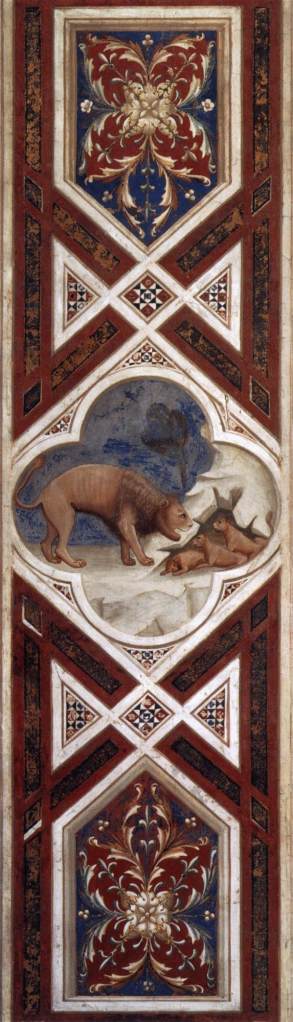
In between the images of the infant Jesus and the triumphing hero, we see the far more brilliantly illuminated mirror, reflecting the reality of the world, and the departure of Sir Lancelot. And we see the threads, creating their tracery through the room like a spider’s web. And we see other lines, as if etched across the reflecting surface, signalling the triggering of the curse: 

Out flew the web and floated wide; 
The mirror crack'd from side to side; 
"The curse is come upon me," cried 
          The Lady of Shalott. 

Soon, we will be freer to go out into the world to see real things. Please be careful. 
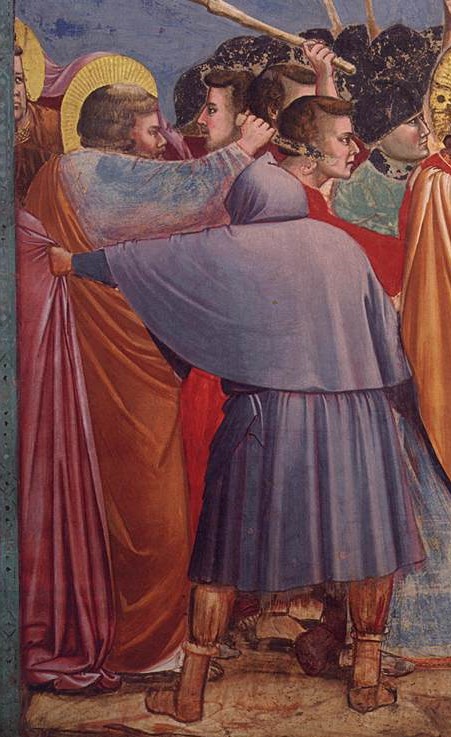
Oh, and, if you’re free this evening at 6.00 and are not half sick of shadows, there is still time to sign up for my talk Reflecting on the Power of Art about Diego Velázquez.