195 – Behold!

Dante Gabriel Rossetti, Ecce Ancilla Domini! (The Annunciation), 1849-50. Tate.

Today’s painting is the very first thing you will see if you visit The Rossettis at Tate Britain, the exhibition I will be introducing this coming Monday, 15 May at 6.00pm. It’s the perfect choice to start this exhibition, as I will explain below, and a fascinating work in its own right – hence my choice today. On 22 May I will talk about Carpaccio: Paintings and Drawings, covering both the exhibition at the Doge’s Palace in Venice, and also the other paintings by the Venetian master that can be found elsewhere in the city. I’m currently in Dublin to see Lavinia Fontana – it’s a superb exhibition – and I hope to talk about that on 29 May, but I won’t put it on sale until I’m sure that I’ll be in the country that day. However, as you’ll know, I’m already lined up for The ‘Other’ Vermeers – the ones that aren’t in the Rijksmuseum’s sold-out show – the day after that finishes, 5 June. See the diary for more!

Even if the subtitle of this painting weren’t (The Annunciation) the subject would be clear. The angel Gabriel arrives from the left and announces to the Virgin Mary that she will be the Mother of the Son of God. Initially ‘troubled at his saying’ (Luke 1:29) – and that was only at his initial greeting – Mary accepts her role in the divine plan with the words, ‘Behold the handmaid of the Lord; be it unto me according to thy word’ (Luke 1:38). In the Vulgate, from which the King James Version was translated, this is given as ‘ecce ancilla Domini fiat mihi secundum verbum tuum,’ giving Rossetti the title for his painting. However, he adds an exclamation mark: Ecce Ancilla Domini! This could be translated as Behold! The Handmaid of the Lord. The exclamation mark makes it imperative. Whereas the sentence in the bible implies that Mary accepts her position as the Lord’s Handmaid, Rossetti is effectively insisting that we behold her.
When the painting was first exhibited – at the Old Portland Gallery on Regent Street in April 1850 – it was not well received. One reason was that, unlike all precedents, Gabriel has no wings. Both he and Mary wear white, partaking of the same purity, humility and simplicity, which is also expressed by white of the walls. Gabriel is dressed in a simple robe, a length of white cloth with a hole for the head, like the most basic of chasubles (‘a sleeveless outer vestment worn by a Catholic or High Anglican priest when celebrating Mass’). His right arm is unclad, and its muscularity suggests a very corporeal presence, a physicality that is heightened when seeing his body between the hems of the garment.

Gabriel’s head appears against the blue sky – suggesting that, as an angel, he belongs to the heavenly realm. His divinity is made clear by the halo, but that was a late addition, painted three years after the work had been completed: initially his association with the blue of the celestial realm was more direct. He holds a lily, a symbol of Mary’s purity, with the stalk nearest to her, as if he is inviting her to take it. She looks at it with a mixture of curiosity and concern, uncertain whether to grasp it or not. Had she not been shying away, her head – haloed from the outset – would sit comfortably in front of the blue fabric hanging behind her. If she were to take the lily, thus accepting her role, she would have to lean forward, and her head would be framed by the blue cloth. Both angel and virgin would have blue as a background, but, as yet, it is not certain whether or not she will fulfil her destiny to become Queen of Heaven. Above the bloom closest to Gabriel – and of the same order of size and shade of white – the Holy Spirit, in the form of a dove, bridges the gap between the sky and the cloth, between the celestial and symbolic blues.

In many medieval and renaissance images of The Annunciation there is a bed in the background, but here Mary is actually seated upon one, a simple white mattress on a rush mat, with a simple white cushion. Her white robe reaches beyond her feet, she is chastely covered, making her look like a newly married bride in her nightgown. As the male, wingless figure approaches, she shies away. Notice how he casts a dark shadow across the foot of the bed: the promised birth is a death foretold.

Gabriel’s body could be seen below his elbow, and indeed we can also see the full length of his leg. He is all but naked, which seems surprisingly shocking. At the foot of the bed is a strip of red fabric – like a stole, perhaps – which has been embroidered with a white lily. This ties in with myths not included in the bible in which Mary grew up in the temple with other virgins, spinning thread and weaving the veil of the temple. Mary was given responsibility for the red thread, the colour of royalty, the colour of incarnation, the colour of blood. And the lily is inverted – not so much a symbol of purity here, but perhaps one of death (although I suspect that lilies didn’t really gain that symbolism until the 20th Century).

At the very bottom of the painting we see the red cloth hanging to the ground in front of the foot of the bed. The rush matting under the mattress is painted in great detail. Gabriel does not set foot on Earth, but is held aloft on flaming feet – an innovation of the artist’s. His signature appears underneath the left foot: ‘DGR/March 1850’: Dante Gabriel Rossetti, the name by which we know him. He was christened Gabriel Charles Dante Rossetti. His father, Gabriele, who had fled Naples in 1824 under penalty of death, having incurred the wrath of King Ferdinand II, was a scholar of Italian literature, with a particular interest in the author of The Divine Comedy. But compare young Gabriel’s signature here with that on a slightly earlier painting, The Childhood of Mary Virgin (1849).

The Girlhood of Mary Virgin 1848-9 Dante Gabriel Rossetti 1828-1882 Bequeathed by Lady Jekyll 1937 http://www.tate.org.uk/art/work/N04872

The signature reads ‘Dante Gabriele Rossetti/PRB    1849’. His second given name, Charles, was for his stepfather, with whom he did not get on. It might also have seemed too ‘English’. For either, or both of these reasons – or for simplicity’s sake – he removed it. He added an ‘e’ to Gabriel, thus making himself look more Italian – and indeed, he was named after his father Gabriele. And, although friends and family alike called him Gabriel, he put ‘Dante’ – his third given name – first because, well… he put Dante first, as an author and authority. ‘PRB’ stands for ‘Pre-Raphaelite Brotherhood’, the movement founded by Dante Gabriel and six other young men, including his brother William Michael Rossetti, in 1848. (Just so you know, the red you can see in the above detail is part of the same piece of fabric as the one at the foot of the bed in (The Annunciation): in this painting Mary is still working on it. It is in The Rossettis, so I will show you the whole thing on Monday.)

In his painting Ecce Ancilla Domini! Dante Gabriel seems to aspire to the simplicity Fra Angelico achieves in his paintings for the cells of San Marco in Florence. Even the window frame in front of which Gabriel (the angel) appears looks like the recess for the window in the cell. But this seems to be a coincidence, as he had never been to Italy. During the Autumn of 1849 he and William Holman Hunt – another founder member of the Pre-Raphaelite Brotherhood – travelled to France and Belgium, where they saw works by Jan van Eyck and Hans Memling in Bruges. It could be from these that he derived the awkward perspective. It’s not something we notice now, after a century of modernism and abstract art, but in 1850 it was the aspect of the painting that came in for most criticism: the failure to create a coherent space, with a properly foreshortened bed in it.

However none of the above really explains why this is such a good painting to open The Rossettis – but they are almost all there. Painted by Dante Gabriel Rossetti (1828-1882), the models were his brother William Michael Rossetti (1829-1919) and his younger sister, the poet Christina Rossetti (1830-1894). The only sibling who is not represented here, in the first image in the first room, is the eldest, Maria Francesca (1827-76). She was an author, and became an Anglican nun, but there is precious little of hers that can be included in the exhibition, sadly – and the same is true for the other siblings. The bulk of the display constitutes the largest collection of works by Dante Gabriel to be seen together for years. It is quite glorious, and the influence of the family is constantly felt. And there is one more Rossetti – Mrs Dante Gabriel Rossetti – or Lizzie Siddal, as she is better known. Generally thought of as a milliner and model who nearly met her demise posing as Ophelia for John Everett Millais, she has been increasingly recognised as an artist and an important influence on Dante Gabriel. This exhibition states that argument better than ever before. But more about that on Monday.

194 – Visionary, too

Hilma af Klint, Tree of Knowledge, No. 1, 1913-15. Glenstone Museum, Potomac, Maryland.

Tate is currently hosting a remarkable exhibition, Hilma af Klint & Piet Mondrian, about which I will be talking this Monday, 8 May at 6.00pm. It is remarkable, I think, in that it combines two artists who never met, and who, in all probability, didn’t even know each other’s work. From that point of view, I have never known another exhibition like it. However, they had so many things in common, starting with an early romantic approach to the landscape and evolving towards their own, idiosyncratic and highly individual forms of abstraction, inspired by what would nowadays be seen as occult – or at least, esoteric – theories, which were nevertheless much in vogue at the time. But more about all that on Monday, of course. Thereafter, we will see The Rossettis at Tate Britain, Carpaccio (in Venice), and Lavinia Fontana (Dublin), all of which will take us up to The ‘Other’ Vermeers at the beginning of June. It will all be in the diary soon. But today I want to look at Hilma af Klint herself – or, at least, one of her intricate and intriguing works. Or, rather, part of one of her works…

To give it its full title, this is Tree of Knowledge, The W Series. This is the full series – eight works in watercolour on paper, as exhibited by David Zwirner before it travelled to its new home, Glenstone, in Maryland, USA. As such, it is one of the very few works by the Swedish master not held by the Hilma af Klint Foundation (and the reason why this should be the case will be one of the things we will discover on Monday). What we see in the photo above are Nos. 1, 2, 3, 4, 5, 6, 7a and 7b. She often created series of paintings, rather than individual works, and, having amassed a huge number of them during her nearly eighty years, af Klint catalogued them, giving each series or group a letter or number: Tree of Knowledge, The W Series is actually one of the simpler titles. Today, though, I just want to focus on No. 1.

By the time Tree of Knowledge, No. 1 was painted, af Klint had already created what could be considered the first abstract work of art, and had done that in 1906, some five years before both Kandinsky and Malevich claimed to have been responsible for this major innovation. However, throughout her career she continued to shift between two modes, and this image certainly contains both abstraction and representation, as well as, mid-way between the two, stylisation. As a ‘tree’, it is clearly highly stylised – but in the bottom circle, we can see what could be a root system. I say ‘circle’, but the darker brown oval looks like a foreshortened circle on a horizontal plane, making this a diagrammatic representation of a three-dimensional form, in which lighter brown circle is a sphere. A white trunk grows up into a mottled area, the canopy of leaves. Sets of concentric blue and yellow lines flow up from a red ‘node’, spread out, and loop back around two birds, and continue to loop up and around towards the top of the tree.

To understand why the subject itself was of interest, I’d like to compare it to a couple of other images of trees.

What I’m showing you – and to be honest, where they sit on your screen depends on whether you have a phone, tablet, laptop or desktop – is Lucas Cranach’s Adam and Eve (1526) from the The Courtauld, London; the af Klint; and Yggdrasil, The Mundane Tree (1847), by Oluf Olufsen Bagge, which is illustrated in a superb entry by Nabila Abdel Nabi in the exhibition catalogue – which I can recommend highly. The fact is, trees are not only important for our existence, but, as such, play a vital part in many religions and numerous myths. Christianity has the Tree of Knowledge (…of Good and Evil), under which Adam and Eve are standing in the Cranach. It also has the Tree of Life, later identified as the Cross, with Jesus as the Fruit of the Tree. Norse myth has Yggdrasil, the ‘world tree’. I’m just going to quote what the Encyclopedia Britannica (online) says about it:

Yggdrasill, Old Norse Mimameidr, in Norse mythology, the world tree, a giant ash supporting the universe. One of its roots extended into Niflheim, the underworld; another into Jötunheim, land of the giants; and the third into Asgard, home of the gods. At its base were three wells: Urdarbrunnr (Well of Fate), from which the tree was watered by the Norns (the Fates); Hvergelmir (Roaring Kettle), in which dwelt Nidhogg, the monster that gnawed at the tree’s roots; and Mímisbrunnr (Mimir’s Well), source of wisdom, for the waters of which Odin sacrificed an eye. After Ragnarök (Doomsday), the world tree, though badly shaken, was to be the source of new life.

This description does not correspond exactly to what we see in Bagge’s illustration, but the format is telling, and it gives some idea of where af Klint was coming from. She is illustrating neither the biblical Tree of Knowledge, nor Yggdrasil, but is using a similar format to explain some of her own beliefs.

In the ‘root system’ we see yellow, red, and blue roots: like Mondrian, af Klint had an abiding interest in the three primary colours. For her, they had specific symbolism. Yellow was related to the masculine, and blue to the feminine, while red was associated with love. In 1904 she had joined the Stockholm Lodge of the Theosophical Society (Mondrian would also join the society – in Amsterdam – five years later). Theosophy, usually considered to be an esoteric religious movement, was founded in the States in 1875. It drew on Eastern religions to promote the idea of the evolution of humanity and of the human spirit. At the bottom of the trunk, the red ‘node’ (as I described it above) can be seen as two joined spirals, or two shells, which grow out from separate centres and then combine. Both shells and spirals were used regularly by af Klint to represent the idea of growth and development, and therefore evolution. From these shells issue the two interweaving strands of yellow (male) and blue (female) lines.

At the crown of the tree is a golden chalice. Gold, as in so many world views, represents the divine, and the source of light. The aim of alchemy was to turn base metals into gold, to ‘redeem’ them from their ignoble state: it used much the same language as Christianity. The chalice is rimmed by small white forms, two of which, contained within a figure of ‘8’ – a symbol of eternity – are also seen in the pink centre. Pink, like red, implies love, but in another form. Amongst the ‘leaves’ of the tree further pairings in white, blue, yellow and pink can be seen. The chalice stands on the top of the series of loops which have grown up from the roots, and contained within this top loop is a white bird.

Below this single bird are two more – one white, one black, the basic opposition of light and dark, and potentially, of life and death. In the lowest loop the two have separated, as if the white bird is being chased away, while the colour of the loops has gradually changed, from top to bottom, from white, through cream, to yellow and blue. However, we should probably be reading from the bottom up – as the opposites gradually combine to create unity and light, as they aspire towards the chalice and its divine radiance. To explain at least part of what this is about, I am going to quote from the website of the contemporary Theosophical Society in America:

The three basic ideas of Theosophy are (1) the fundamental unity of all existence, so that all pairs of opposites—matter and spirit, the human and the divine, I and thou—are transitory and relative distinctions of an underlying absolute Oneness, (2) the regularity of universal law, cyclically producing universes out of the Absolute ground of Being, and (3) the progress of consciousness developing through the cycles of life to an ever-increasing realization of Unity.

Hilma af Klint’s work is continually dealing with these opposites, their ‘fall’ from unity, and their evolution towards a renewed harmony. This can all be related in her paintings to the Fall in its Christian sense, and to mankind’s salvation, which is a return to harmony with God. As such, we could read the tree from bottom to top and from top to bottom – there is a continuous cycle at play.

She was not alone in seeking a diagrammatic representation of esoteric ideas: Bagge’s illustration of Yggdrasil is another example, and in the catalogue Nabil Abdel Nabi also draws a parallel to one of the illustrations in Carl Jung’s The Red Book, written, in secret, in 1922. This is Illustration 135.

Again we see a tree, which, like Yggdrasil, has three roots, while the leaves seem to be a source of light. The whole is contained within an egg shape, symbolic, in all probability, of new life, ‘possibly evoking the cosmic egg, or world egg, which features in the creation stories of many Indo-European cultures’, according to Nabi, who sees the Tree of Knowledge as existing within a similar egg-like form. The series as a whole was sufficiently important to Hilma af Klint for her to paint it twice.

If you were really observant, you might have noticed that the previous illustration was slightly different to the one I have used so far, which is the first of this pair, the one now at Glenstone. The second (also seen in the previous pairing) belongs to the Hilma af Klint Foundation. It is less precise, suggesting it was the first to be painted: she is working out her ideas, settling on the colour scheme, and using pencil to sketch the different possibilities for the composition. Once decided upon, the second version (the first illustrated here) is more precise, clearer, and more luminous. It is the second set which belongs to Glenstone, and it was only discovered relatively recently. One of the great advocates of Theosophy – meaning ‘Divine Wisdom’ – was Rudolf Steiner. However, like the beliefs of the movement itself, he too evolved, and broke away from Theosophy to found Anthroposophy, ‘Human Wisdom’, which sought (seeks) to align the original aims of Theosophy with aspects of Christian belief, all backed up by what is described as a scientific method. Af Klint met Steiner when he visited Stockholm in 1908. It was not a happy occasion for her, as he did not approve of her method. Nevertheless, as her viewpoint changed, she too shifted her allegiance towards Anthroposophy and made the second set of Tree of Knowledge as a gift for Steiner. It was probably intended to decorate the Goetheanum, the home of Anthroposophy in Dornach, Switzerland, the entirely original design of which was due to Steiner himself. However, the watercolours were passed on to Steiner’s successor as the head of the movement, and from that collection, sold to Glenstone very recently: Zwirner exhibited them just last year before they headed to their permanent home.

The original series is owned by the Hilma af Klint Foundation, and is the one I will show you on Monday. The reason for the Foundation’s existence, and why we have known so little about this undoubtedly original artist until now, will be just some of the issues we will consider. We will also discover why such esoteric beliefs – shared by Hilma af Klint & Piet Mondrian alike – made sense in the context of the late 19th and early 20th century world view, at a time in which the unseen became manifest. And, apart from all that, we will look at some truly wonderful, life-affirming paintings.

193 – Visionary

Paul Gauguin, Vision of the Sermon (Jacob Wrestling with the Angel), 1888. National Galleries of Scotland, Edinburgh.

From Shaping Impressionism last week, I am moving on to After Impressionism, the big blockbuster of a show at the National Gallery which I will introduce this Monday, 1 May at 6.00pm, hence my discussion of Paul Gauguin today. ‘Why are they calling it After Impressionism rather than Post-Impressionism?’ you might ask – well, that’s one of the things we will cover on Monday, but basically Post-Modernism is a term that was invented in 1910 by Roger Fry as a title for an exhibition that included artists whose ideas differed from those of the Impressionists, but who didn’t necessarily have a lot in common. Since its first use the term has become somewhat limited in scope, referring mainly to artists who lived or worked in France, but excluding much else. The curators want to give a far broader sense of the rich variety of art in the years after the last Impressionist Exhibition of 1886 and up until the outbreak of the First World War in 1914. It’s a tall order, and the scope of the exhibition is quite breath-taking as a result. But I shall limit myself to my usual ‘hour’ (i.e., 75 minutes). In the following weeks we will see Hilma af Klint & Piet Mondrian, The Rossettis, and, already on sale, The ‘Other’ Vermeers on 5 June – but details of all of these are on the diary, of course.

The curators of After Impressionism focus on three ‘Pivotal Figures’ who played ‘a central role in forging avant-garde art in Europe at the turn of the 20th Century’. One of them was Paul Gauguin. This particular painting is a good example of what was so new about art ‘after Impressionism’. For a start, the colour is striking – strident even – with a vivid, virulent red taking up much of the canvas. I was talking last week about the liberation of the brushstroke from its descriptive function, and in Gauguin we see that colour, too, is no longer describing visual appearance. This is neither red floor nor red sky – indeed, it is hard to specify where one stops and the other begins. Instead of describing, the colour being used for its visual impact and emotive force. People are gathered in the foreground and along the left-hand side of the image, a tree cuts diagonally across the surface, and in the top right we see Jacob Wrestling with the Angel, the subtitle of the painting.

The story comes from Genesis Chapter 32. The full story is told from verses 22-32, but I’m just giving you the central section:

And Jacob was left alone; and there wrestled a man with him until the breaking of the day. And when he saw that he prevailed not against him, he touched the hollow of his thigh; and the hollow of Jacob’s thigh was out of joint, as he wrestled with him. And he said, Let me go, for the day breaketh. And he said, I will not let thee go, except thou bless me. And he said unto him, What is thy name? And he said, Jacob. And he said, Thy name shall be called no more Jacob, but Israel: for as a prince hast thou power with God and with men, and hast prevailed. And Jacob asked him, and said, Tell me, I pray thee, thy name. And he said, Wherefore is it that thou dost ask after my name? And he blessed him there.

You’ll notice that it doesn’t say ‘Angel’ anywhere, but there is one mentioned in Hosea 12:3-5, which refers to the same episode. However, this is not the subject of the painting.

The title (rather than the subtitle) of the painting is Vision of the Sermon: this is not a religious painting, but a painting of a religious experience. The vision is being experienced by the people in the foreground, a group of Breton women and their priest, who is on the far right. He has preached a sermon on this text so vividly that the scene has come to life before them. It could almost be a metaphor for the creative act: the priest has, through his words, brought the episode to life to the extent that the congregation believe they can see it. Gauguin has painted it – and there it is, before our eyes.

The priest frames the image at the right: his face looking down and towards our left stops our attention from straying beyond the picture frame. The women next to him look in, and, like Eugène Manet last week, are acting as repoussoirs, pushing our eyes back towards the vision. Gauguin only shows their shoulders and the very tops of their backs, as if we are there with them, pushing in closer to get a better view. The woman on the left of this detail looks to our right, again directing our attention towards Jacob and the Angel: she and the priest act like a pair of brackets for this small section of the congregation. However, they are cut off from the vision by the tree growing at a diagonal, which seems perfectly placed to frame the woman’s profile. We can tell that Jacob and the Angel are further away because they are smaller, but apart from that we cannot see how far – the unmodulated red gives no sense of traditional perspective. Indeed, it is flat on the surface of the painting.

The left flank of the painting is also framed by the gathered congregation, huddled together nearer to the foreground group, and kneeling on the ground in the top left corner. There is also a cow whose position is impossible to define, but it speaks of the bucolic nature of the scene. Gauguin had tired of the sophistication of Parisian life, just as the Impressionists had earlier tired of the artificial requirements of the official Academy. He headed out to visit an artists’ colony in Pont-Aven, in Brittany: he was looking for somewhere which had not reached the same levels of industrialisation as the French capital. He wanted something innocent, and unsophisticated, where people were living a far more down-to-earth lifestyle. A romantic view of the peasant life, perhaps, and not a little condescending. And if it wasn’t exactly what he was looking for – well, you’d never know that from the painting, in which traditional costumes are on show as if they were worn every day. It was in Pont-Aven that he got to know Émile Bernard, who many consider to be the true originator of the style that Gauguin is using here. Its aims would be summed up best by Maurice Denis in 1890, two years after today’s painting was completed:

‘It is well to remember that a picture before being a battle horse, a nude woman, or some anecdote, is essentially a flat surface covered with colours assembled in a certain order’

We are seeing what now seems like the implacable movement of painting towards abstraction, where the elements of colour, line and form stand for themselves rather than representing aspects of the world we see and live in, those things that all artists since the Renaissance had sought to emulate. Gauguin even said that his paintings were ‘abstract’, but he was not using the word in the same way that we do now, meaning art with no visual reference to objects in the visible world. This particular style was called Synthetism, as the artists wanted to synthesize three things: what something looked like, what the artist felt about it, and the purely aesthetic concerns of colour, line and form (as in the statement quoted above).

Common to the style are strong, bold outlines filled by plane areas of colour. In this example the outlines are perhaps not as bold as in others – but they can be seen clearly around the headdress of the woman on the right in this detail, and they also define the headdress and profile of the woman to her left. There is a limited amount of three-dimensional modelling in the face of the woman on the left, but the red background is implacably flat. The effect is sometimes referred to as cloisonnism, as in cloisonné enamel, in which the cloisons (or ‘compartments’) of single-coloured enamel are separated by gold borders. It is not dissimilar to the appearance of stained-glass windows, in which the coloured glass is separated by black leading.

Jacob and the Angel are seen as if in a compartment of their own, cut off by the tree to the left and the branches and leaves at the top. The brilliant yellow wings and rich blue robe stand out against the red background, making the angel appear other-worldly. The red, both hot and exciting, could easily represent his power, and the energy of the struggle. Jacob and the Angel appear clearly before us, and yet, however much we see them, Gauguin himself was entirely convinced that they were not there.  In a letter to Vincent van Gogh, whom he had met in Paris in November 1887, he said, ‘For me the landscape and the fight only exist in the imagination of the people praying after the sermon.

Art has truly been stood on its head. No longer are artists painting what they see, or what they imagine one could see, thus making the natural world visible, however tempered its appearance might be by their own feelings. Instead, they are finding visual equivalents for what they feel or think, things which do not, and never did exist in the world around us. The choice of colour, line and form represents the artist’s inner world, rather than representing the shared visual world. As a result, the way a work of art is made becomes one of the things that it is about: how paint is applied, and which paints are used, for example, become some of the ‘subjects’ of art.

There is some modelling of form here, yes, but on the whole the whites, blacks, browns – and of course, the red – constitute flat planes defined by lines which, although inflected, are also two-dimensional patterns on the canvas. Where did these ideas come from? Well, one of the major sources was Japan.

On the right is Utagawa Hiroshige’s, The Residence with Plum Trees at Kameido, from the series One Hundred Views of Famous Places in Edo, printed in 1857. This is a photograph of a print the Art Institute of Chicago, but there is another version in the Van Gogh Museum, Amsterdam, which was owned, and copied, by Vincent van Gogh himself. Many artists were influenced by Japanese prints: Monet and Van Gogh, yes, but also Paul Gauguin and Émile Bernard, not to mention the other Synthetists. I don’t know whether Gauguin had seen this particular print before he painted Vision of the Sermon, but if not, there are several, if not many others, in which a dark tree cuts diagonally across the foreground. It is clearly a red sky in the Hiroshige, and it is distinguished from the ground, which is green, whereas for Gauguin there is no distinction. Western European Art was heading forward at a remarkable rate, and these developments constitute what was probably the biggest change in outlook since the Renaissance. In order to innovate they were not looking back, but nor were they necessarily looking forward. Instead, they were looking elsewhere, drawing on art from the rest of the world to find new ways to paint. As so often, they did not fully understand what they were looking at: they liked elements of the forms they saw, the use of line and colour, without having any real sense of what the art meant for the society which was producing it. But it gave them ideas which fuelled their vision of what art should be – and, whatever else we might think about him, Gauguin truly was one of art’s great visionaries.

192 – Role reversal

Berthe Morisot, Eugène Manet on the Isle of Wight, 1875. Musée Marmottan Monet, Paris.

Last week I talked about a traditional, old fashioned couple, where the man was in the driving seat. This week, we will see woman take the reins: Madame Manet, better known by the name she called herself – as she never let go of the reins – Berthe Morisot. She is the subject of the Dulwich Picture Gallery’s current exhibition, Berthe Morisot: Shaping Impressionism, about which I will be talking on Monday, 24 April at 6pm. If they had staged the equivalent exhibition about one of her colleagues (Claude Monet, you might have heard of him) people would be queueing round the block, but they aren’t, so I can only assume that they don’t know what they are missing. You lot are, however, far more sophisticated, and if you have any sense you’ll hotfoot it to South London in case the hoi polloi find out that she was (a) a far more ardent supporter of the Impressionist cause and (b) arguably a greater innovator.

Thank you to everyone who came to The Ugly Duchess on Monday – and apologies for (and thank you for putting up with) the technical difficulties. If any of you weren’t free, or were, and would like a second attempt at an interruption-free talk, I will be repeating it for ARTscapades on Thursday 18 May at 6pm – I’d offer you all free tickets, but they are a charity, raising money to support our under-funded museums… It’s also worth bearing in mind that they record their talks, so if you’re not free on the 18th, you can catch up with the recording over the following couple of weeks.

After Shaping Impressionism I will talk about After Impressionism at the National Gallery (on 1 May), and the following week head from nature to abstraction with Hilma af Klint & Piet Mondrian – keep an eye on the diary for what comes next.

The painting shows an interior, although the focus is not on the room itself, but on the outside world, the view through the window. In some ways, the real subject of the work is the act of looking, and, because this is a painting, it is also about the act of painting what we see when we look. Our eyes are directed towards the view by the various framing devices – the window frame, for example, which draws our attention to the exterior landscape in the same way that the frame of a painting gives the art a heightened status and proclaims it to be something worth looking at. The view is also framed, to the left and right, by the gauze curtains which hang down on either side. We are also encouraged to look out by the actions of the man on the left of the painting who, sitting on a chair that looks as if it is facing towards us, turns to look over his left shoulder and out of the window. He functions as a repoussoir – literally, something that ‘pushes back’ – thus ‘pushing’ our eyes ‘back’ to the landscape out of the window. However, the amount of landscape we see is relatively small compared., to the size of the painting – the framing elements take up a lot of space. Although the curtains do not entirely block the view, they do restrict it, and the man’s white jacket enhances the drape’s ability to obscure. The predominantly vertical form of the jacket also echoes the fall of the curtain on the right hand side. There is a similar horizontal pairing, with the wall below the window echoed by the row of small, framed glass panels at the top. It may be the weather, or the fact that there are few features visible in the sky, but at first glance these panes of glass might even appear to be opaque. There are many grid-like elements here – not just the verticals of the curtains and jacket, or the horizontals of wall, window sill and upper row of windows panes – but also the posts and rails of the picket fence which marks the boundary of the garden, the two people on the promenade beyond it, and even the masts (and hulls) of the boats in the background.

If you’ve read the title of the painting then it comes as no surprise to learn that this is Eugène Manet, and that he is on the Isle of Wight. He was an artist, but he was not the Manet – that was his elder brother, Édouard. It is August 1875 (in this painting), and the previous December – the 22nd, to be precise – he had married another artist, Berthe Morisot, who had always wanted to go to England. This is them on their honeymoon. Or rather, this is him on their honeymoon, because she is standing behind the easel painting. What is now known as the First Impressionist Exhibition had taken place in Paris from 15 April – 15 May 1874. Morisot had exhibited alongside Monet, Renoir, Degas et al, and had in many ways ‘arrived’ on the scene – although she had exhibited regularly at the annual salon over the previous decade, so in many ways had ‘arrived’ even before her now more famous peers. What seems to have happened is a commonplace for male artists going back to the medieval times: you finish your training, you make your mark, you settle down and get married.

This detail alone shows how fundamental she was to the shaping of Impressionism. Notice how freely it is painted, with the bold, apparently haphazard brushstrokes nevertheless making coherent sense of the shape and structure of Eugène’s jacket. The sunlight shining through the window glances across the front of the collar, shoulder and sleeve, and purple/blue shadows define the unlit sides. This colour choice alone shows Morisot’s mastery of Impressionist colour theory. If sunlight is considered to be a yellowy orange, then the absence of light should be represented by the colours which are opposite on the colour wheel, the complementary colours. Opposite yellow and orange are purple and blue, he colours she uses for the shadows. However, the back of his jacket also includes a lighter peachy colour. There is just a thin sliver of wallpaper visible in the detail above (and just below), edging the left-hand side, but you can see the same peach-coloured paper with orange/red dots under the windowsill in the full painting illustrated above (and in other details below). The light has reflected off the wallpaper and onto Eugène’s back. This explains the peach-coloured brushstrokes: it is reflected light.

The composition is so very specific here: Eugène’s face is neatly framed by the bottom element of the window frame and the top of the fence – allowing him the maximum available view: his view is framed as ours is. He appears to be looking towards the girl standing with her back towards us, although he may well be looking further to the right. The girl herself is depicted on the canvas directly underneath the vertical element of the sash window. Impressionists were ‘supposed’ to be painting what they saw when they saw it, grabbing each moment spontaneously as it came – but that didn’t stop them adding in the artfulness, and arranging things to create richer harmonies: jackets like curtains, hat ‘ribbons almost lining up with the horizontals of the window frames, girls continuing the verticals of the same… that sort of thing.

In the detail above it is clearer that the lower half of the window has been slid upwards (which is, of course, how a sash window works): there are two horizontal framing elements, with the darker one further in, and similarly, there is a lighter, outer vertical element to the right of its darker, inner equivalent.

I read somewhere that Eugène looks relaxed in this painting – but I really don’t agree. The chair faces us, and if he were relaxed, and sitting comfortably, he would be too. But his legs (or at least one of his legs, Morisot is unconcerned about his precise posture) slide over the edge of the chair, and he has to turn through about 120° in order to see out of the window. Not only that, but look at the contorted position of his fingers – the fourth, ‘ring’ finger is buried between those on either side: there’s quite a bit of tension there. And Morisot’s own account of painting him confirms this. She learnt to paint alongside her sister Edma, one of whose paintings is included in the Dulwich exhibition. However, Edma married, and dedicated herself to her family, leaving painting behind. She often modelled for Berthe, both before and after marriage, and the two continued a lively correspondence. During her honeymoon Berthe wrote to Edma from Globe Cottage in West Cowes, on the Isle of White,

“…I began something in the sitting room with Eugène; poor Eugène is taking your place; but he is a much less accommodating model; he’s quickly had enough…”

There is a strong sense that he’d prefer to be outside exploring, rather than being confined to the domestic sphere. You could even suggest that the sketchy style of painting might result from his reluctance to pose for too long. Compare the way in which he is painted in the above detail with the precise focus of the plant pots and their saucers, especially given the brilliant precision in the way the light and shade is defined – notably around the tops of the pots: clearly the plant pots were not in a hurry to get away.

However, this has nothing to do with the willingness or otherwise of the model – it is a fundamental aspect of Morisot’s style. Where precision is needed, she can supply it. If evocation will convey something more eloquently, that is what we see – see below! The plant pots themselves might be models of exactitude, but as for the plants – well, the stems are clear, but the leaves and flowers blend with those of the plants in the garden, and they become indistinguishable. But pictorially, that isn’t a problem. Certainly when looking at the picture as a whole we take it all as given.

The curtain on the right is also the model of Impressionist ellipsis – so much is missed out that is not necessary. The curtain is defined by a few thin white brushstrokes of different densities, which express the depth and positions of the folds. They are either painted on top of the painting of the fence, or of the foliage, or, in the bottom right, over blank canvas. The contrast between the intensity of colour in the garden and the pallor of the curtain over the windowsill could hardly be more marked.

We can see this again towards the top of the curtain. Almost more than any of her Impressionist colleagues Morisot has liberated the brushstroke from its descriptive function, so that dots, dashes and lines evoke the the appearance of the form rather than enumerating each of its material qualities. This detail is also an important indicator of the precision of the viewpoint she has chosen. Just separated from the curtain by a sliver of the landscape is a women in a lavender dress and white apron. She is a woman in service – the nanny of the little girl we have seen before. She has a black belt – which could equally well be a continuation of the boat behind her – and a black hat, which protrudes above the raised window frame. But how frustrating that we can’t see her face. Or is that, in fact, a deliberate choice on the part of the artist?

There is, in fact, a remarkable role reversal in the painting. In Western European society – and indeed in many other societies across the world – it was usually the woman who was restricted to the domestic sphere, while men could travel freely outside. In this painting, whether consciously or otherwise, Morisot explores another possibility: the women have gone out, while the man remains at home. However, it also touches on one of Berthe’s problems as an artist who had, until recently, been an unmarried woman: she wasn’t allowed to go out painting on her own, even if she was just heading to the Louvre to copy the works of others. She had to be chaperoned, just as the little girl is here. Indeed, she even wrote to Edma speaking of her frustration. As a little girl, being chaperoned is not entirely surprising, but as a fully grown woman? At least this girl has the possibility of exploration, and, even given the rapid brushstrokes with which she is painted, we can tell from her clothes that her parents have substance. They can afford a nanny for one thing. Morisot even seems to be showing her awareness that the girl’s future is dependent on the unacknowledged work of a faceless multitude – and maybe that is why the nanny’s face is hidden behind the frame.

However, much of what see derives from the artist’s continued determination to work, and to work unchallenged. There is more than one role reversal here. It is often implied that Eugène gave up his career to support that of his wife, which, if it is true, is admirable, but it does nothing to undermine her own strength of purpose. She certainly didn’t give up her name, and continued to work as Berthe Morisot long after she became Madame Manet. But it wasn’t always easy. When painting en plein air she had a number of strategies to avoid being harassed. For one, she would often start work as early in the morning as possible so as to achieve as much as she could before there were too many people around. The choice of painting the view from the living room was also, in all probability, a pragmatic one. Inside her own space she will not be confronted by curious observers. However, it does mean that she is still constricted to the domestic sphere – even if, in this case, she is the maker rather than the model, an active participant in the world of art, rather than its passive subject.

And talking of subject, I’m am intrigued about the subject of this painting: what is it actually about? What is Eugène looking at? The girl? The nanny? The boats of the Cowes regatta? Is the act of looking out an act of looking forward? Is he imagining the future of his own family? Three years and three months after this painting was finished, the artist’s and the model’s daughter Julie was born, and Berthe would go on to paint the relationship between father and child which few artists – if any – had ever thought to explore. Maybe they are both thinking about that.

191 – In the driving seat

Jan Gossaert, An Elderly Couple, about 1520. National Gallery, London.

Today’s painting is one that I have loved for years, but rarely get to speak about, so it was a great pleasure to see it in the National Gallery’s exhibition The Ugly Duchess, about which I will be talking this Monday, 17 April at 6pm. The subtitle of the exhibition is Beauty and Satire in the Renaissance, and the couple we will be looking at are not exactly beautiful, but neither is the painting in any way satirical – even if we could approach it with a subtle sense of humour. This begs the question, ‘why is it included?’ Well, you’ll either have to go to the Gallery, or come along on Monday to find out (although there are hints below)!  The phrase ‘small, but perfectly formed’ could have been coined for this exhibition. Every work plays a vital role, the ideas are expressed clearly and succinctly, and there is no padding with irrelevant art: a lecturer’s dream. In subsequent weeks I will give a mini-history of early modernism, with an Impressionist (Berthe Morisot in Dulwich), some Post-Impressionists (After Impressionism at the National Gallery), and, following on from the last works exhibited in the latter, abstraction (Piet Mondrian and Hilma af Klint at Tate Modern) – details via these links, and on the diary, of course.

So what is it I like about this painting? Its directness and apparent honest, the precision of depiction, and the wealth of telling details. A brilliance of technique, inevitably, with exact descriptions of texture and form, resulting from a masterful disposition of light and shade, a superb control of colour, and a penetrating analysis of character. Of course, I have no way of knowing if any of this is an accurate portrayal, as we don’t even know who this couple were, let alone if they looked – or behaved – anything like they appear to. But Jan Gossaert, that great and still neglected master of early 16th Century Netherlandish painting, convinces us that they did. I for one certainly believe him, and believe in this grumpy elderly man – soberly, but wealthily dressed – and his plain and respectful (if not entirely submissive) wife.

There is no flattery here, I think, nor is it caricature, but a direct and uncompromising description of an aging face. The determined closure of the mouth, with bottom lip projecting and upper curling in suggests that many, if not all of the teeth have gone. There are wrinkles, if not large bags, under the hollowed eyes, thoughtful lines between the brows, and slightly sagging jowls. He’s not in a bad shape, for what we might presume to be his age, but there is no vanity here – he hasn’t even bothered to shave for his portrait. The stubble is grizzled, and the hair grey. Strands have fallen out: one hangs down the left side of the neck while a second curls over the fur collar. These details alone put the portrait high in my ranking. Although the act of being portrayed implies a certain regard for posterity, we, the viewers, are not especially important to the sitter: he does not match our gaze, but looks upwards, to the right, as if there is still more to be achieved in what remains of his life.

His achievements so far? It’s hard to say, but a certain wealth. The thick fur collar, which he grasps as if to bring it to our attention, must have cost a fair penny. The subtly decorated walking stick, with its carefully depicted, finely-etched silver top, presumably didn’t come cheap either. But there is no excessive adornment: no rings on the fingers, for example, which are clean, with neatly cut nails, and which are beautifully articulated. Each one is different – look at the phenomenal care with which Gossaert has traced the fall of light and shade on every joint, defining every knuckle and arthritic swelling.

The artist’s skill at the depiction of light is also evident in the portrayal of the wife, notably in the shadow cast across her forehead by her plain white headdress. This nevertheless allows the definition of her right eye socket (on our left) thanks to a small passage of apparently reflected light which traces its outline. Her eyes are downcast, looking to our left, and her slightly protruding lips show that, unlike her husband, she still has her teeth. Her simple jacket has a thin fur lining, and is modestly clasped over her chest (certainly in comparison with The Ugly Duchess, as we shall see on Monday) over a simple white chemise. There is apparently no adornment at all, although her headdress was originally pinned in place by two gold pins. Sadly these were covered many years ago – for no apparent reason – by an unknown picture restorer. The headdress disappears behind the husband’s left shoulder: she is slightly behind him, as she has been for many years, one assumes.

The merciless depiction of the couple’s age is only heightened if we look at the one prominent piece of elaboration in the entire painting: the man’s hat badge.

It depicts a naked couple – man and woman – who gaze into each other’s eyes. The man’s arm appears to be around the woman’s shoulders, and they walk along together, almost as if in a dance. Their show of unity, and their physical form – however sketchily rendered on this tiny scale – couldn’t be a stronger contrast to the Elderly Couple, helping to make the painting as a whole a striking portrayal of the passage of time, if not exactly a memento mori. The naked man holds a staff, and the woman a cornucopia – a horn of plenty. It is not entirely clear who they are, but they could be Mars and Venus, gods of War and Love respectively, which would cast a whole new light on the aging man and woman. Alternately, they could be Mercury and Fortuna, ‘the gods of trade and prosperity’ (I am quoting from Lorne Campbell’s exemplary catalogue of Sixteenth Century Netherlandish Paintings in the National Gallery – the entry for this painting is online, if you click on that link). The latter seems more likely to me, as the man was clearly enriched by trade, but does not appear to be blasé about his good luck. Evoking Mercury and Fortuna would seem entirely appropriate. It implies that the man’s prosperity is not only the result of a successful business strategy, but also reliant on good fortune – which he is not about to risk with an unnecessary display of finery.

All in all the couple behave as they should, and certainly in compliance with all the gender stereotypes of the era. The man is at the front, in charge, and looking up and out towards whatever the future has to offer. By means of contrast, the woman is in his shadow (even if her white headdress makes her presence clear), just behind his shoulder, and looking modestly down. They may not appear to communicate, but there is some sense that they are part of a shared enterprise. And they know their place. In the UK we drive on the left side of the road. Back in the day, it would have been the man who drove, with his fair lady in the passenger seat to his left. Why should this be? Well, everyone was, or was supposed to be, right handed, and with the gentleman to his lady’s right, it meant that he could easily draw his sword and defend her. Not the usual response to road rage, I know, but that is where the relative positions in a car come from. Or for that matter, from the Last Judgement (see Giotto’s version, for example, in Day 38 – Enrico Scrovegni). The blessed are at Christ’s right hand, the damned at his left: the ‘right’ is the better place to be, and so it is the perfect position for the man. Looked at from our point of view – as if looking through the windscreen of a car – that means that the man should be on the left and the woman on the right, just as they are. The man is in the driving seat in this painting. As I said above, they know their place – unlike The Ugly Duchess. But more about that, as I’ve also said before, on Monday.

190 – Leading a still life

Giorgio Morandi, Still Life, 1936. Magnani-Rocca Foundation, Mamiano di Traversetolo, Parma.

Thank you to everyone who signed up for my two Vermeer talks: it made it so worthwhile to have such an eager audience. However, if you weren’t free, I will be delivering another introduction to the Rijksmuseum’s Vermeer – in person this time – at the Dutch Centre in London on Wednesday 26 April: it would be great if you could come along and say hello! Contrary to my concerns in the last ‘Third Anniversary’ post, my next online talk will be this coming Monday, 3 April, as originally planned, and, as planned, I will look at the wonderful Italian artist Giorgio Morandi. Why was I concerned? Well, I’m currently in Bucharest. I should have been on holiday in Lisbon, but I only managed two days of that before being torn away for a few days filming: I still don’t know when I’ll be back in the UK. However, it will be in time for the talk on Monday, by which time I will have listed more of the following talks in the diary.

Like Vermeer, who was born, worked and died in the same city – Delft – Morandi also led a relatively still life, by modern standards. He too passed his entire career in one place – Bologna, in Northern Italy – although, unlike Vermeer, he did occasionally travel abroad. Coincidentally, Morandi also claimed Vermeer as one of his major influences, particularly during the time-frame of today’s painting. But that’s not the reason for the talk: it is an introduction to the exhibition of the Magnani-Rocca Foundation’s collection of works by the Italian master – fifty in all, including paintings, drawings and etchings – which is currently on show at the Estorick Collection, in North London. It’s been so successful that the catalogue has already sold out once, and the exhibition has been extended until 28 May.

At first glance the connection to Vermeer might not seem obvious, but listen carefully and you might just hear it: quiet, isn’t it? Both artists created paintings of stillness, order, beauty, and calm. These qualities are evoked through a harmonious palette, with muted colours and gently graded tonal values, absolute precision in the positioning of individual elements to create unexpected but satisfying compositions, and a slight softness around the edges. There is visually enough to let us know where we are, but nothing too bold to bring us up short. And the colours themselves allow a comparison – the blue and yellow on the left of this Still Life are so similar to those worn by The Milkmaid or The Girl with a Pearl Earring, for example. But although Vermeer often included Still Life details in his paintings, Morandi rarely painted the human figure. Still Life was his focus, together with regular forays into the landscape. But even in the outside world he treated every building, hill or tree much as he would a bottle, bowl, vase, or tin.

Morandi enrolled in Bologna’s Accademia di Belle Arti – the Academy of Fine Arts – at the age of 17, in 1907. Two years later his father died, and the family – his mother, three sisters and a younger brother – moved into a house on the via Fondazza. He was still there when he graduated from the Accademia in 1913, and it was there that his career developed, flourished and brought him fame. He was still there when he died, at the age of 74, in 1964. I lived on the same street for six months a quarter of a century later, although I’m sad to say I was barely aware of the fact at the time. However, in retrospect, being nestled in one of the least frequented arcs circling the medieval city centre seems entirely appropriate for this, the most focussed of artists. During his lifetime his style formed, evolved, crystallised and then gradually evaporated as he got ever closer to visualising the essence of things. Most of his time in the studio appears to have been taken up with the meticulous arrangement of an ever-growing collection of household objects – they had to be reasonably mundane, or they didn’t really interest him. After that, the actually painting didn’t take so long. By then he knew exactly what everything looked like, and precisely what its relationship to everything else was: he had already spent so long considering those very details, after all. Roberto Longhi, one of Italy’s most important art historians in the 20th Century, described this process as ‘a meditated slowness’. Throughout his oeuvre objects appear and reappear, stepping forward into the limelight, or shyly peering from behind a bolder form, for all the world like characters in a long-running serial.

In this detail we see what is described as ‘a spherical toy’ standing directly in front of two blue bowls stacked on top of each other. The left edge of each element, the ‘toy’ and the ‘two bowls’, lies on the same vertical line, a precision of placement that reminds me of Vermeer’s decision to place a hand, or a flask at the bottom corner of a picture frame, or a book just in front of a chair leg. There is some harmony at work there which creates that longed-for quietude. In the same way, the white rim of the lower bowl is at the same level as the ‘label’ on the unevenly-topped white vessel, which I recognise from a painting in the Tate collection. Its shape has always slightly unnerved me. The curvature of this vessel is mapped subtly by a change in colour, left to right, from a cold, bluish white, through the lightest of pearly pinks, to a duller fawn-grey. The bluish white is probably the colour of the bowls bleeding into that of the vessel. Morandi painted wet on wet: he didn’t wait for one colour, or layer of paint, to dry before continuing with the next – a reminder that the painting, although careful, didn’t take so very long.

The modelling of the tall white vase – one of the leading actors in the subtle drama of Morandi’s career – reminds me of Vermeer’s painting of sleeves, with dabs and dashes of pure white functioning as highlights, puffing out from the shadows of the folds. This bottle has almost human proportions, with full hips – or a voluminous skirt – waisted below a billowing blouse, the torso gradually tapering towards an impossibly long, slim neck. One of the great skills for an artist to acquire is concision, and I suspect that Morandi didn’t paint the shadows at all. They appear to be cast – given that the light is coming from the left – by the body of the object itself, and also by the groove which forms the ‘waist’. But the colours of the shadows are so close to those of the background, I suspect that he was probably painting the vase on a mushroom-coloured ground, only reinforcing the precise shape of the vase with more strokes of the same colour later. The white highlights, indicating the individual swelling forms running vertically, certainly appear to be painted on top of a colour midway between the mushroom and the white. The painting of the highlights of these elements leaves their own shadows behind.

The small bowl in the right foreground is painted a far ‘higher’ white – or, more simply put, it is brighter. This helps to push it forward. The dark shadows underneath both it, and the vase behind it, separate them from the table top, making them just that little bit clearer than might, in ‘reality’, have been expected. This adds a slightly visionary status to the image. The same is true of the way in which the brilliant white edge at the left of the bowl stands out against the vase, which is itself slightly darker than perhaps it should be at that point. If you stare at something for long enough the image burns itself onto your retina and starts to become other-worldly. I think this happens often in Morandi’s paintings, with similar visual phenomena seen in his drawings and etchings as well – we’ll see several examples on Monday. The visual impact of that small, brightly lit bowl even appears to have a physical impact on the vase, the front right curve of which appears slightly dented.

The artist is always aware of the geometry of his forms: the shadow on the inside of the small white bowl is mapped out horizontally, whereas on the outside, to the right, another shadow scans down a diagonal from top right to bottom left, concentric to the right-hand edge of the form. The abstract values of these shadows – horizontal and diagonal – add to the artist’s pleasure in the composition, I think. His signature sits at the very bottom of the canvas, scanning the visible section of the base of the bottle. ‘Morandi 36’ is painted in thin, dark salmon paint, almost like an emanation – a thin wisp of ectoplasm – from the pale pink of the table. Or am I seeing things?

Still Life 1946 Giorgio Morandi 1890-1964 Presented by Studio d’Arte Palma, Rome 1947 http://www.tate.org.uk/art/work/N05782

The white vessel, toy and vase reappear in one of Tate’s two paintings by Morandi (they also have two etchings). This Still Life was painted in 1946, ten years after the Magnani-Rocca painting (which is one from a collection of seventeen), and has a more ethereal, lighter mood. I think this is because the blue bowls have left the stage, their departure followed by the entrance of two more predominantly white forms. One, centrally placed in front of the vase, has a brick-red rim, the other, spiralling fuchsia stripes. The ‘toy’ stands downstage right again (at the front left, from our point of view), and notably, again, in front of another object, this time the unevenly-topped white vessel. And this is precisely where it stands – although on the other side of the image – in an etching in the V&A. As printmaking reverses appearances, though, the position is effectively the same. Dating to 1946, the same date as the second painting, this etching shows us how slowly the drama unfolds. In the intervening decade all that has happened is that the blue bowls have left the stage. The small white bowl is still there, but the ‘new’ forms have not yet entered: there can’t be long to go!

I both admire and respect Giorgio Morandi’s patience and skill. As a printmaker he was an autodidact, learning from old manuals, and relying on his own abilities, rather than using professional printing studios, as most printmakers would. Everything was etched and printed in the house on via Fondazza. His control of the medium was superb, and in 1930 he became Professor of Printmaking at the Accademia di Belle Arti, a position he held for 26 years. But then, I also admire and respect his constant search for stillness and calm. As reported in a superb review of the Estorick’s exhibition in The New European, Morandi once refused an invitation to exhibit his works because the curator’s flashy ideas made the artist worry that his paintings would be denied ‘that tiny degree of quiet that is vital for my work’. As ever, he was using the full force of understatement. I am always happy to spend the time to seek out that deafening ‘tiny degree of quiet’. I think it is something that would do us all the world of good amidst the wittering noises of the 21st century, the 24-hour news, social media, the traffic. Time for some slow looking, I think.

Three years on…

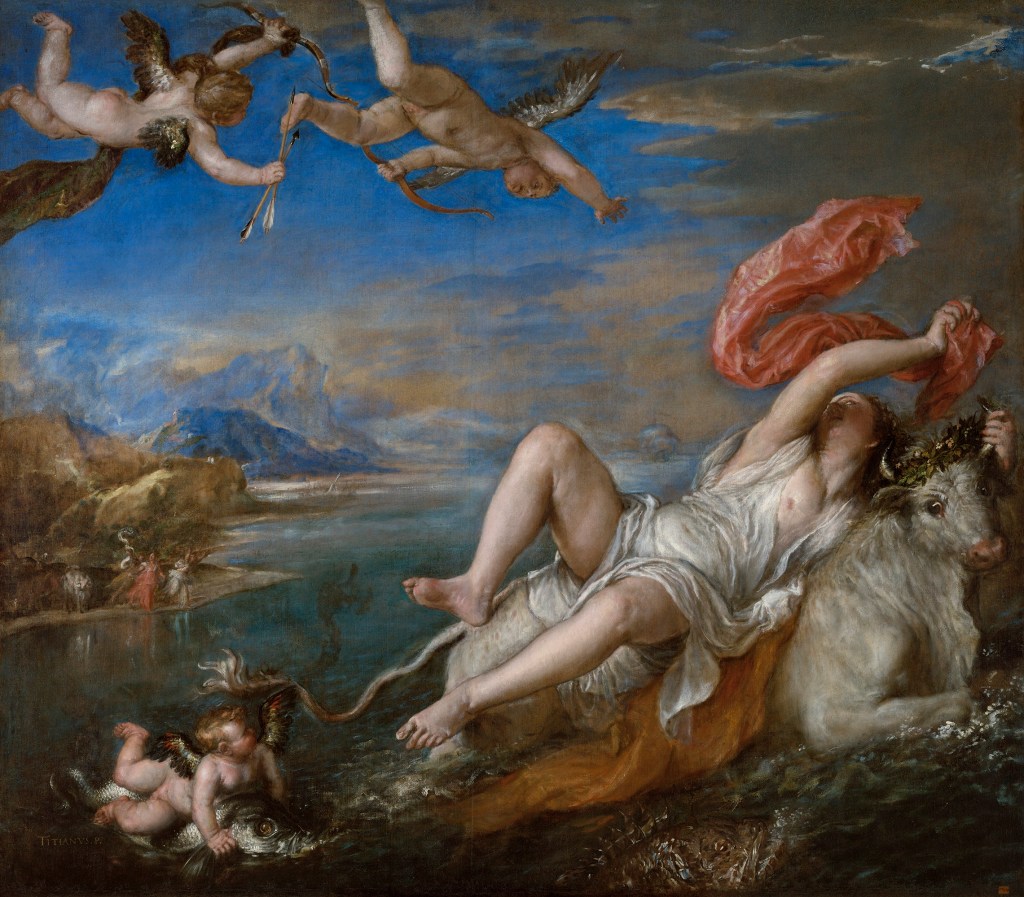
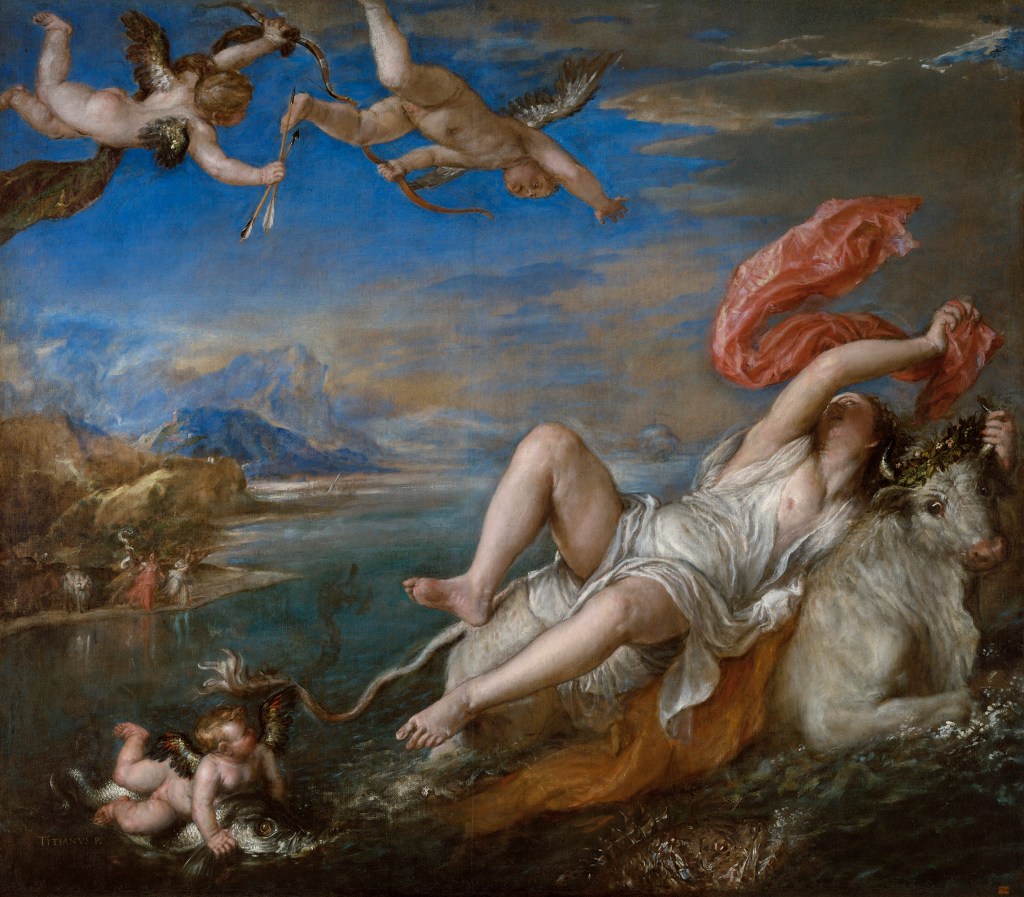
Day 1 – Titian, The Rape of Europa, 1562. Isabella Stewart Gardner Museum, Boston.

So – it’s three years since I started writing this blog! On the 17 March I walked into London to see the National Gallery’s Titian, and, realising that all the museums were closing, all the theatres were shut, and all my work had been cancelled, I realised there was no reason to be in London. On the 18 March I was rescued by a Knight in Shining Armour (actually, a Ford Focus) and taken up to Durham, where I’ve lived ever since (with regular forays back to London, after the first five months had elapsed…). The next day, 19 March, I started posting on my Facebook Page, then transferred to WordPress – hence the first comment after this paragraph. So thank you to all of you, my loyal followers – by now there are now nearly 1,500 of you! People sometimes ask me why I don’t send out a mailing list of all of my talks and courses – well, it’s all on the diary, and with every post there is a link to the diary in the first paragraph – so, if that’s what you want, just click on that! And I always mention upcoming talks, with links to them, in the first paragraph… so the first paragraph is my newsletter, for those who want a newsletter, and then after that follows the blog, if you’re the sort of person who likes more extensive reading. Having said that, things are always open for change, and I’m having one of those ‘up in the air’ moments when I’m not sure what’s happening next. I may have to change the date of the Morandi talk. If you’ve booked already – thank you! – I’ll get back to you with options if I do need to postpone it. If you haven’t – hold fire… I should know what’s going on soon. Meanwhile, I’m in Amsterdam again… and off for a second visit to Vermeer (I know, it’s hard work, but someone has to do it). But back to what almost seem like more innocent days, with my first post from three years ago.

after 2019 cleaning

Originally posted on 19 March, 2020

In these extraordinary times, I’m going to attempt to write about a painting every day – but where to start? Having made a pilgrimage on foot to the National Gallery on Tuesday to catch the wonderful Titian exhibition just after it opened and immediately before it closed again, I am choosing the Rape of Europa from the Isabella Stewart Gardner Museum in Boston.

The painting is one of six Poesie which Titian made for the man who would become King Phillip II of Spain. They must rank among Titian’s greatest achievements. Not only do they show his phenomenal technique, his astonishing ability to manipulate paint and to form worlds out of colour, but they also demonstrate his brilliance as a storyteller. Drawing on classical mythology, and mainly the Metamorphoses of Ovid, he enters into a common Renaissance debate about the arts: which is better, poetry or painting? Although drawing much of his imagery from Ovid’s text, these are not illustrations.  He adapts the stories, reworks them, finding the perfect way to spin his yarn on canvas. He retells the tales with brushstrokes rather than words. 

Why this one, of the six? Well, although I have been to the Isabella Stewart Gardner Museum at least three times, I can’t in all honesty say I stopped to look at this painting – there are so many other wonders there, and at the time I was either in my early stages of studying art history, and knew nothing, or was obsessed with the Ferrarese paintings in the collection. I’ve come to know the Titian better through talking about the Poesie – particularly when the National Gallery acquired, with the National Galleries of Scotland, the two Diana paintings – and while teaching courses on the art of the 16th Century. I also love the fact that Velazquez knew it in the Royal Collection in Spain, and quoted it in the background of one of his own works. However, before Tuesday, I couldn’t swear that I had seen the original before, so in that respect, it is new to me.

In this work we see how, in his endless and unquenchable lust, in order to get his hands on the beautiful nymph Europa, Jupiter has transformed himself into a bull. He persuaded Mercury to drive a herd of cows down to the beach, and frolicked among them, flirting with Europa, who happened to be there with her companions. She was gradually entranced by his winning ways, and, as she clambered upon his back, he sidled from shore to sea, going from the shallows through the waves, without her realising what deep water he was getting her into. Her companions – and the unwitting herd – can be seen in the distance, helpless on the shoreline.

It’s a problematic story – it is after all a story of rape. Is she entirely unwilling? In this instance it isn’t all that clear, although in other encounters Ovid is explicit about the dread and terror Jupiter’s victims experience. Like Jupiter, Titian seduces us. His means: rich colours and lushly applied brushstrokes, underplaying the horror with a touch of the absurd. I’d never noticed before how cupid rides his fish in much the same bizarre and awkward way that Europa rides the bull, one arm clinging on, waving (not drowning), a leg flying free.

The other fish was a revelation, a new favourite, and I’d like to nominate it as the Best Fish in Art, a category of which I was previously unaware (although I do have two suggestions for the Best Cabbage). Its scales are evoked with flicks of white and blue paint, making it glimmer at the bottom of the painting, as if is merging with the sea, appearing and disappearing, painted with similar brushstrokes and tones to the sea itself, part of the watery world over which Europa is now conveyed.

Eventually she will get her feet back on dry land – on the continent of Europe, which took her name. And eventually we will be able to see these paintings again, brought together for the first time, to be seen as Titian himself never did, all in one room. I am a least glad that these paintings, long separated, must be enjoying some quiet time together, but I am looking forward to seeing them all again when we have got to the other side.

The Milkmaid Returns (again)

Johannes Vermeer, The Milkmaid, c. 1660. Rijksmuseum, Amsterdam.

The Milkmaid, to whom I want to return today, rejoices in a room to herself in the Rijksmuseum’s stunning Vermeer. Brilliantly reviewed, and now completely sold out, the exhibition will be the subject of my talk this Monday, 13 February at 6pm which I have called Vermeer: Amsterdam ’23. If you are lucky enough to have secured a ticket for the exhibition, I hope this talk will be a good introduction. If you haven’t, I will give you a (virtual) guided tour of the paintings, so you’ll know what is there, with the added advantage that no one will get in your way! Spoiler alert: I will only talk about the Vermeers in the exhibition. The will be no comparative materials, just Vermeer, just looking, in line with the clean-cut design of the display itself. Second spoiler alert (and a date for your diaries, perhaps): on 5 June, the day after the exhibition closes, I am thinking of celebrating its success by talking about the ‘other’ Vermeers – the ones which, for one reason or another, didn’t make it to Amsterdam this year. Trust me, there’s always more to be said! And there will be plenty more before then, of course. On 3 April, for example, I will talk about the Estorick Collection’s fantastic display of paintings, etchings and drawings by Giorgio Morandi from the Magnani-Rocca Collection – you can find more details on the blue link.

Last week I mentioned that one of the women waiting for the ferry in the foreground of the View of Delft looked familiar. Wearing a yellow bodice and blue apron, she is remarkably similar to The Milkmaid. I wrote about her first on 14 February 2021 (during lockdown 3?), and re-posted the blog in the September of the same year when I was in Dresden for the exhibition Vermeer: On Reflection. The Milkmaid was not in that exhibition, but as she has the honour of a room to herself in Amsterdam, I thought I would use this as an opportunity, for the first time, to give her the admittedly dubious honour of re-posting a blog for the second time…

When I first posted this blog I was having trouble deciding whether I find this painting disarmingly beautiful or beautifully disarming – I’m sure there’s a difference. But also, I was wondering, if it is one, or other, or even or both of these things, what is it that creates this impression? It is a painting that, for whatever reason, I do find very beautiful, and this always makes me try to analyse where that beauty lies – a process which can all-too-easily kill the simple pleasures of looking. It is disarming, I think, because at first glance it looks so simple, and yet it is hypnotically compelling. Vermeer paints everything with such apparent honesty and conviction that we remain convinced that there must be something more profound going on than the simple act of pouring milk. To try and work out if there is, I’m going to start at the top and work my way down.

I’ve always loved the way Vermeer paints walls. It’s never a case of getting out the roller and covering the whole surface with white matt. What we see is subtly modulated, with every square centimetre differentiated from every other. The setting – a corner of a room with a window on the left – was not his invention: it had already been used by artists for about 10 years by the time he picked up on it, it seems, and from then on he used it regularly, often returning to the same, or similar, corners. With the window a little way in from the back wall, the corner itself is left in shadow. The light passes through the glass at a diagonal, and illuminates the back wall away from the corner, the illumination getting ever brighter as we move to the right. Two nails are driven into the wall, and the higher of the two, further to the right, is in the light. It casts the sort of diffuse shadow that suggests this is large window, far higher than the part of it we can see in the painting. On the left a wicker basket – used for shopping, presumably – hangs from a similar nail, with a highly-polished copper pail hanging from another on the back wall. Above the basket we see what is probably a small picture: it’s too high to be a mirror. To the left of the nail from which the basket is hanging one of the panes of glass has been broken – there could easily be a a breeze coming through – and in the pane below this the glass is cracked, with the broken edge catching the light. If you go down one more pane, and two to the left, another of the small plates of glass threatens to fall into the room. The attention to detail is breathtaking.

The fall of light from left to right illuminates the maid’s face, showing its bold, simple forms: a down-to-earth presence, whose broad features would have been interpreted as indicative of her lowly status. The light also charts the very specific folds of her simple linen headdress, especially to the left of her face, where the sharp fold at the level of her forehead gradually opens out, so that, as it gets lower, less light falls on the fabric. As the hem curves forward the lower edge is left in shadow.

The light is one of the features which creates the attention-grabbing boldness of the central figure, and renders her monumental. Her right shoulder (on our left), the top of her right arm, and especially the back of her right hand – the one holding the handle of the jug – are brilliantly illuminated, making them stand out against the shadows on the wall. On our right, the shadow which forms the curve of her left shoulder, and the right side of her left arm, stand out against the brilliantly illuminated wall behind. Vermeer enhances this by painting the thinnest of white lines around the edge of the sleeve as it comes down from the shoulder. The reversed contrasts of light and shade push her towards us, making her more immediate, more sculptural, more entirely present. Not only that, but the perspective pulls our eyes towards her. The horizontals of the window frame and the leading which holds the glass in place form orthogonals receding towards a vanishing point, placed at the crook of the maid’s right arm. As the vanishing point is theoretically our point of view, this means that our attention is focussed on the action of holding the jug and pouring.  

The colour is also subtly vital. Her bodice is yellow, and she wears a blue apron. For me this is still a surprising colour for an apron (even given that I know nothing of the history of aprons), especially as Vermeer has used that most prized of pigments, ultramarine. The bodice uses lead-tin yellow, another good, traditional pigment, but nowhere near as expensive. For the sleeves – which are rolled up – he mixes the two to create green. It is almost a lesson in basic colour skills: yellow mixed with blue makes green – and in this case, the specific yellow of her bodice mixed with the distinctive blue of her apron makes this particular green.

The attention that the maid gives to the act of pouring also demands our attention: if she takes it this seriously, then so should we. This is not a haphazard act, but a careful, determined action, the support given to the milk jug by her left hand helping to make sure the liquid flows at precisely the right speed.

The measured flow of the milk has made people think that she is doing something specific, and one suggestion is that she is preparing a bread pudding. There is plenty of bread on the table, after all, and some of the pieces next to her bowl appear to have been broken. You have to put in exactly the right amount of milk, apparently, or the pudding would either be too soggy, or the bread would dry out and become too hard and crunchy. This is simple fare, made from wholesome ingredients with good honest labour. Again the light plays a major part, showing us the deep, sculptural folds in the sleeves and apron, and the form and textures of the bread and basket. Yet it does not do this with the highly focussed detail of a fijnschilder – or ‘fine painter’ – the name for artists like Gerrit Dou whose every surface is an almost microscopic exploration of precise surface textures, without a single brushstroke being visible. In contrast to the fijnschilder, and as if he were a precursor of Seurat and the divisionists, Vermeer builds these objects up through a myriad of dots and dabs of paint. You don’t believe me? Look at this.

When talking about Vermeer it is hard to get away from the theories which try to explain his peculiarly focussed vision by suggesting that he used a camera obscura – basically a form of pinhole camera that projects an image onto a surface and allows you to trace the outlines. However, this would only provide the outlines, and not the colours or textures. Admittedly, the images a camera obscura produces can sometimes include some of the effects he uses – the bright, blurred highlights, for example. Although, if you think about it, you only get bright highlights on shiny objects, not on matt loaves of bread. This may well be the sort of effect you could see with a camera obscura, and that may be where he got the idea – but he would never have seen the particular highlights painted here. They are part of the magic of the image, and create the wonder – and some of the texture – of this fresh bread, the bounty of this work-a-day basket. As it happens, the construction of the perspective also suggests that he didn’t use a camera obscura: it isn’t traced, but drawn. Technical examination has revealed a pin hole in the canvas itself, at the crook of her right arm – the vanishing point. Vermeer would have inserted a pin, and tied a piece of thread to it. This could be covered in something like charcoal dust, pulled taut, and then snapped against the canvas to ‘draw’ lines onto it. It was a common way of working out perspective, as the lines drawn inevitably lead to the vanishing point.

When we get down to the bottom of the painting the lesson in colour continues. Under the apron the maid’s skirt is red – so she is wearing muted versions of the three primary colours, yellow, blue and red. This particular shade also harmonises well with the brick-red floor, and the ceramic pot, one of the truly revealing details in this painting. It is part of a footwarmer – a wooden box, with a perforated top – and the pot would have held hot coals. A practical object perhaps, given that we are presumably in a cold kitchen, ideal for keeping and using dairy products, although the footwarmer is very small compared to the size of the room. In any case, footwarmers were used when seated. Behind it is the wainscoting, made of Delft tiles – local produce, of course, as it was in Delft that Vermeer lived and worked. Three tiles are visible, and the imagery of two of them can be read. On the left is cupid, wings to the left, firing his bow and arrow to the right, and to the right of the footwarmer, there is a man with a walking stick. Are these relevant? Probably. Have a look at this picture from the Sinnepoppen, an emblem book published by Roemer Visscher in 1614.

Any emblem has three elements, ‘pictura’, ‘inscriptio’ and ‘subscriptio’ – or picture, heading, and explanation. For the title of his book, Visscher invented a new word – where ‘sinne’ means the ‘sense’ of the emblem, and ‘poppe’ means the image. By creating a word that combines two elements from which we can determine the meaning, he is echoing the function of an emblem precisely. Neither the pictura nor the inscriptio gives the full sense on its own – they have to be considered together. The relationship between them – what, together, they mean – is explained in the subscriptio. In the example above, ‘Mignon des Dames’ means “the ladies’ favourite” – as in sweetheart, or lover. The subscriptio goes on to explain that modern ladies love nothing so much as a foot warmer, as it provides them with constant warmth. Any man who wanted to pay her court would find himself playing second fiddle to this household object. They can be seen often in Dutch 17th Century genre paintings, but even Visscher’s explanation doesn’t fully account for their presence. That is because Visscher wants you to be as clever and inventive as himself, and is always expecting you to make connections and take the meaning further. Think about it: when seated, the hot coals would fill the user’s skirts with warmth. Presumably, any potential lover would have to prove as reliable if he wanted any degree of success. Combined with the image of cupid shooting an arrow towards the source of heat, the implications are that our maid could easily be the subject of inappropriate attentions, welcome or otherwise. It’s worthwhile bearing in mind that it was usually assumed (by men, of course) that milkmaids were sexually forthcoming.

Having said all that, from this point on you can make up your own mind. And that’s not because I don’t want to tell you what is going on here, or because I don’t know what is going on here, but because Vermeer’s great genius includes the ability to leave things open. Is it coincidence, for example, that her skirt plays with the same tonalities as the earthy floor and the glowing coals, which we can imagine but not see? Does it imply a heat within? Or does the fact that she is standing, at work, rather than sitting down enjoying the welcome updraft, suggest that she is a figure of virtue, rather than potential quarry, worthy of pursuit? It’s possible that the very title of this painting is incorrect, as it happens. A milkmaid would work outside, with the cows, milking. The woman in the painting is really a kitchen maid (although in some households they did double up, apparently). But then, kitchen maids often had the same reputation.

I cannot get away from the care with which she pours, and I suspect that Vermeer is questioning the assumptions we make about the people, and objects, depicted by his contemporaries. The first assumption is that milkmaids – or kitchen maids, for that matter – were bound to be ‘up for it’. After all, in this case, she seems entirely focussed on her work. The tile with cupid and the footwarmer might imply sexual impropriety – but do either have any effect here? In other hands the jug itself might seem suggestive. Artists like Jan Steen regularly show women holding vessels with open apertures towards men who reciprocate with any number of phallic equivalents, from bulging bagpipes to pistols cocked. And yet here the act of spilling – which could be a sign of incontinence – of sexual incontinence, that is – is entirely controlled, and measured. If our maid represents anything, then maybe, for Vermeer, she could be a modern-day Temperance. Compare her with this print by Jan Saenredam, made in Haarlem in 1593, based on a design by Hendrick Goltzius.

This is the most common representation of Temperance – although not the one we saw painted by Giotto, who has her sheathing her sword (see Day 59 – Virtues vs Vices), or for that matter, the version painted by Ambrogio Lorenzetti in his Allegory of Good Government, in which she watches the first known image of an hour glass. In Saenredam’s personification she carefully pours liquid from one vessel to another – usually interpreted as watering down the wine, a true sign of Temperance, as opposed to complete abstinence. This careful, measured pouring is precisely what our maid is doing. And if she is Temperance, then maybe we could interpret another of Vermeer’s paintings, Woman Holding a Balance, as a personification of Justice. The comparison here is also from the series designed by Goltzius in 1593, but this time executed by different student, Jacob Matham. I don’t have time to say more about this painting now, unfortunately, but, as it is in the Amsterdam exhibition, I will include it in Monday’s talk, Vermeer: Amsterdam ’23.

Before then, though, what conclusions can I draw about The Milkmaid? Is she awaiting an assignation, or, conversely, distracting herself from temptation by concentrating on her work? Is she a figure of virtue, expounding the positive values of honest labour? Could she be a personification of Temperance? Vermeer’s focus, his attention to detail, the care with which he has structured the composition, combined colours, balanced tones, and modulated light, not to mention the dignity he gives to his subject, an apparently commonplace maid made monumental, suggests that there must be more than meets the eye. What is this painting about? What is going on? Well, there is a woman pouring milk. What more do you need?

189 – Vermeer… of Delft

Johannes Vermeer, View of Delft, c. 1660-61. Mauritshuis, The Hague.

As I start writing, I am on the verge of flying to Amsterdam. By the time you read this, though, I will have spent the day in Delft, visiting the viewpoint from which Vermeer saw his native city, seeing the streets he lived and worked in, and the churches where he was christened and where he was buried. I will also have been to the Prinsenhof Museum to see the exhibition Vermeer’s Delft, which will be the subject of my talk on Monday, 6 March at 6pm. It puts Vermeer’s paintings into context, looking at the history and culture of the town in which he spent his brief life, including its art and its science – the developments in optics, which might explain his fascination with perspective, for example. However, there will be relatively few Vermeers, as they are all at the Rijksmuseum in Amsterdam. I will talk about his own paintings in a talk entitled Amsterdam ’23, looking in detail at what is said to be the ‘greatest Vermeer exhibition ever’. If you’re not free on Mondays, I will give both talks as one study evening for ARTscapades on Tuesday 7 March. By Monday, I might also have worked out what I am doing next (don’t tell anyone, but I know – I just need to be sure – and will post details in the diary as soon as I am). Meanwhile, what better today, in order to introduce both upcoming talks, than to look at the city itself, in a view painted by its most famous son.

One of the aspects of Vermeer’s work which is most attractive is the pervading sense of calm he communicates, a perfect balm for our twenty-first century lives which are, for some of us, all too rapidly reaching pre-pandemic levels of business. As it happens, the calm is sometimes only on the surface, like the proverbial swan, for which all the action is taking place under water. But in this painting, started on a late spring day in 1660 (although some have argued it’s early autumn), it is calm throughout – both above and below the reflecting surface of the ‘Kolk’, the triangular harbour just to the south of Delft. Admittedly the clouds are lowering at the top of the painting – but that is just an artistic device to frame the view and encourage us to look into the lighter distance, where the rooves of the houses, and the spire of the Nieuwe Kerk – the ‘new’ church – shine in the sunlight. All is well in this fair city. On the far right two barges are moored in front of the Rotterdam Gate, to the left is a bridge, allowing boats through the ramparts and into the city centre, and to the left again, is the Schiedam Gate. It might help to look at a detail of a contemporary map, published by Joan Blaeu in 1649.

Flowing out of this detail on the far right is the river Schie, which had been diverted to form a moat around the defensive walls of Delft early in the city’s history. Two separate branches of the river can be seen coming along the bottom left, and vertically down from top centre. On the right edge of the picture, just below the river, are three houses: it is assumed that Vermeer made his initial observations and sketches for this painting from an upstairs window of the house on the left. At the right-angled corner at the ‘top left’ of the Kolk (north-east: south is to the right here) you can see a canal going under a bridge between the Rotterdam gate, with its two towers, above it, and the Schiedam gate, a more compact structure, below. If you came out of the Rotterdam gate, over the small bridge, and turned left, the first right would take you along the ‘Weg na Rotterdam’ – the way to Rotterdam. The Schie could also take you there, as well as to Schiedam, as we will see below. Inside the city three canals lead away from the bridge. The lower one is the ‘Oude Delft’, the old Delft, the name coming from ‘delven’, as in ‘to dig and delve’: the canal was dug out, to drain the marshy land, and to provide a transportation route, in the earliest days of the settlement. By the 17th Century it was the poshest place to live.

On the right of this detail is the Schiedam gate. There is a clock at the top of the stepped gable. It’s hard to read, and probably only has an hour hand – with a counter-balance – but tells us that it is somewhere around 7 o’clock. From the direction of the light we know that it is morning. In the centre of the detail there are two towers. On the right is the Parrot Brewery. Much of Delft’s wealth had been derived from beer, but the business was starting to wane: neither the brewery, nor its tower, survives. To the left is the top of the tower of the Oude Kerk – the Old Church – in which Vermeer was buried on 15 December 1675. The church still stands, as does the tower, just as we see it here. Reaching to the left side of the painting is a long building with a red-tiled roof: this is the Delft chapter of the Dutch East India Company, called the V.O.C. from its name in Dutch: Verenigde Oostindische Compagnie – the United East India Company. They didn’t need to say they were Dutch – they knew that. Founded in 1602, the Company’s success brought wealth to the seven Dutch provinces during their war of independence with Spain. That wealth enabled them to win the war, and in 1648 the Dutch Republic finally become an independent nation state. This new-found freedom led to enormous civic pride, which in its turn led to an interest in celebrating the country itself, not just in terms of landscape paintings, but also with a wealth of cityscapes such as the one we are looking at today.

Further to the right, the tower of the Nieuwe Kerk is given particular prominence, brilliantly lit by the morning sun, and standing proud of the other buildings. But however accurately Vermeer appears to have painted this view, he has been artful in the way he has shown things – the very nature of art not being to reproduce exactly what you see, but to make it look better, or more significant, or more interesting. He made the whole view of the city more frieze-like, for example, and played down the projection of the Rotterdam gate to achieve this. He has also shifted the tower slightly and changed its proportions to make it stand out. It is also worth pointing out that you can see through the upper section of the tower – the belfry – because there are no bells there. They were re-hung between 4 May 1660 and the summer of 1661, which provides one of the clues for dating this painting. However, the prominence of the tower might have another significance – a political one. William the Silent, the leader of the Dutch revolt at the start of the Eighty Years’ War in 1568, was assassinated in Delft in 1584, and buried in the Nieuwe Kerk. He was given the title Father of the Fatherland, and his magnificent mausoleum became a place of Protestant pilgrimage, effectively a tourist destination for the proud, newly-independent Dutch. The tomb appears in many paintings of the period, all of which include gatherings of contemplative onlookers. It seems likely that Vermeer is suggesting that the sun shines on this notable place for good reason: the Father of the Fatherland has illuminated the nation as a whole. However, it is also worthwhile pointing out that this was the church in which he was christened, next to which he grew up, lived, and worked, and in which many members of his family were buried.

Putting the Nieuwe Kerk back into its context, we can see that it stands above the right-hand end of the Kapel bridge, which connects the Schiedam gate (to the left of this detail) to the Rotterdam gate (on the right here), the distinctive twin towers of its barbican topped by conical rooves. A wooden drawbridge to its right crosses the moat around the town, and in front of it are moored two boats. They have been identified as herring buses, and have been cited as evidence of global cooling. The 16th and 17th centuries saw what has been called the ‘little ice age’, one result of which, it seems, was that herring swam further south, into the warmer waters, and so could be fished by the Dutch. It’s even been suggested that the herring were an additional source of revenue which helped to enhance the Republic’s enormous wealth, one product of which was the Golden Age of Dutch art. However, this is not the right time of year for fishing herring, which gives us another clue to the date when Vermeer made his initial studies. The boats are here for refurbishment – the masts have been removed, among other things – and usually they would be nearer to the sea. They worked in and out of Delfshaven, the harbour which was created for the express use of the citizens of Delft in 1389 in order to allow them direct access to the river Maas (or Meuse). Now a district of Rotterdam, Delfshaven it is one of the few areas near that once-powerful port to have survived the destruction of the Nazis in 1940, and that one canal maintains its old world charm. Time was not so kind to Delft’s defences. The Rotterdam gate was destroyed in 1836, two years after the Schiedam gate had met a similar fate.

The detail on the left shows the Rotterdam gate, and on the right we can see the River Schie (marked ‘1’) flowing south, and dividing into three branches – just so you know where it is possible to go: Schiedam and Rotterdam, as the names of the two gates suggest, with Delfshaven in between. Technical analysis has shown that Vermeer originally painted the reflection of the Rotterdam Gate far more sharply. As he completed the painting he made it more diffuse, and also stretched it to the bottom of the painting, creating a visual bridge into the heart of the city. The gate itself was originally painted in bright light, but Vermeer later cast it in shadow, presumably so that our eyes would be led into the sunlit centre of the city, and especially towards the brilliantly lit tower.

You might wonder how this all looks today? Well, every building has more or less changed. The Oude Kerk is the same, but you can’t actually see it from this spot now (unless you were in a taller building) and although the tower of the Nieuwe Kerk looks similar, the original burnt down in 1872 and was rebuilt, taller, and more pointed, by P.J.H. Cuypers, who was coincidentally the architect of the Rijksmuseum. But if you really want to know, here is a photograph I took the last time I was there, in 2015.

One last thought. The people gathered on the quay are heading to one of the three destinations mentioned above. The boat behind them is a recently-instituted passenger ferry. The well dressed group of three would have sat in the covered cabin, whereas the more down-to-earth women, each with an apron, would have travelled in the open air.

I can’t help thinking that I recognise one of the two women on the right. She is wearing a yellow jacket and blue apron, and I think she may be heading off to buy some milk… I could, of course be wrong – but in case you don’t know what I’m referring to, well… tune in next week!

It’s taken a while to write this, and by now I’ve got back from Delft: it still looks pretty much the same. And the exhibition is superb. It is entitled Vermeer’s Delft, and I suspected that it would be more about Delft than Vermeer – but no! It is all about him – covering his life and the life of the city, the people he met and artists he would have known. There are various objects like the ones he painted, and some he might even have owned, not to mention a number of fantastic loans I was really happy to see, as well as some curios that I would never have imagined. It is also beautifully designed. As it happens, I have discussed the View of Delft without much reference to Vermeer or his techniques at all – just to the city. The exhibition has a far more balanced view, though, so I do hope you can join me on Monday.

Donatello, take 2…

Donatello, The Feast of Herod, c. 1435, Palais des Beaux-Arts, Lille.

Well, I’m just off out to talk about Donatello, so I’m afraid I don’t have the time to write a new post now. Instead, I’m going to revisit a post from 6 May 2020: it was Picture of the Day 49. Re-reading it, I was surprised that I said that I ‘kept coming back to him’, as this was only the third post about one of the most important artists in the Renaissance – but then, it was only day 49. After that, I have only written about him twice more, with an extended double post dedicated to the same work, 154 – A Feast for the Eyes and 156 – Second helpings at the Feast, about a different Feast of Herod. They were published last April and May when I was talking about the Florentine outing of the Donatello exhibition. It turns out that the version currently at the Victoria and Albert Museum, Donatello: Sculpting the Renaissance, which I will be talking about this Monday 27 February at 6pm, could hardly be more different. The V&A have taken it as a rewarding opportunity to re-evaluate its holdings of Italian Renaissance sculpture – the best outside Italy – and the exhibition includes works which were not seen in either Florence or Berlin, which hosted its own variation of the original in the interim, but more about that on Monday. After that, I will give two talks related to Vermeer (that link goes to the first talk which – spoiler alert! – is more contextual, and will include relatively few actual Vermeers – they will all be in Vermeer 2), and then a slight pause. But for now – Donatello! This is what I said ‘back in the day’:

There must be something about Donatello that means that I keep coming back to him (Picture Of The Day 25 and 35) – it’s probably the simple fact that he was very good. One of the best, in fact. And this particular image – not his most famous work by any means – has been sitting in my mind for a while for all sorts of reasons. One is that I have mentioned Alberti quite a few times, and I might even have said that he was the first person to write down how to ‘do’ single vanishing point perspective. The technique was worked out by Brunelleschi, best known as an architect, around 1415, and first used in paintings by Masaccio in the years 1425 and 1426. However, a relief carved by Donatello in 1417 suggests that he’d got a pretty good handle on it already, although the relief is fairly worn now, after centuries outside, and only a little bit of it could be classified as ‘in perspective’. But by the time he carved this masterpiece, there is no doubt that he knew what he was doing. 

It is generally dated to ‘c. 1435’ – which is, coincidentally – and I really think it is a coincidence – the year that Alberti wrote On Painting. Both Alberti and Donatello presumably learnt the technique from Brunelleschi anyway. The other reason it has been in my mind is that this is one of the finest exhibits in the Palais des Beaux-Arts in Lille, which is the next place I am scheduled to travel should we come out of lockdown – and as we’re not due to go until December, I’m hoping it may yet be possible [Ha! We finally went in December 2022, two years late…].

When talking about the Resurrection (POTD 25) – one of the reliefs on the South Pulpit in San Lorenzo in Florence – I said that it broke all of the rules, and that is something you can only really do if you know what the rules are. Otherwise you are just doing your own thing. Donatello really did know the rules, some of which he had effectively written himself. The Feast of Herod is a type of sculpture known as rilievo schiacciato (pronounced rill-ee-AY-voh skee-atch-ee-AH-toh), which means flattened, or squashed relief. It was effectively invented by Donatello himself, although he may have been influenced by some of the passages in low relief by his one-time master Lorenzo Ghiberti in his first set of doors for the Florentine Baptistery. Donatello perfected a technique in which the depth of the carving doubles as an indicator of distance. Anything in the foreground is carved in higher relief, and the further away an object is supposed to be, the lower will be the depth of the carving, until objects in the distance will appear as if scratched into the marble background. The effect is similar to atmospheric perspective, whereby the air, dust and haze in between us and distant objects make them look fainter (and this was before atmospheric perspective has developed in painting). There was no precedent for this type of carving at all. Classical relief carving was well known: there were, and still are, Roman sarcophagi to be seen all over Italy. And by the time this particular sculpture was made Donatello had spent some time in Rome itself, where, in addition to the sarcophagi, relief sculptures could be seen all over the triumphal arches and columns. However, it is only ever carved in what we would think of as high relief. Figures appear like statuettes that have been sliced down the middle and stuck onto a flat background, whereas Donatello’s figures move in and out of space as his chisel moves through the marble like a hot knife through butter. There is hardly any real space here, it is a matter of millimetres deep: what we are looking at is an illusion. And, in accordance with the laws of perspective, it is not just the depth of relief that decreases the further back into the imaginary space you go, but any other measurement too. Simply put, things get smaller.

At the top is a photograph of the whole sculpture, measuring a mere 50 x 71.5 cm, taken relatively recently, after it was cleaned. The next photograph, and the details below, were taken before cleaning. I am using them because the translucency of the marble means that, after cleaning, it can be hard to see how delicately it has been carved. The light refracts through surface of the marble, and reflects back out again, creating a wonderful, luminous quality, but confusing the eye. Here, however, the patina allows you to see how remarkable, and how delicate, the detail is. The subject is The Feast of Herod, and Donatello shows it, as so often, as a continuous narrative – more than one part of the story is depicted. Herod had been condemned by John the Baptist for having an affair with his sister-in-law Herodias, and for his pains, John was thrown into prison. During a feast, Herodias’ daughter Salome danced so beautifully that Herod promised her whatever she wanted. Unlike any young girl nowadays, she doesn’t seem to have had a strong opinion of her own (although Oscar Wilde thought differently), so she asked her mother. Herodias was still smarting from the Baptist’s tirades, and told her exactly what to ask for: the head of John the Baptist on a plate. In the centre of the image – indeed, her head is almost exactly in the centre of the panel – we see Salome dancing in quite a frenzy – waving a veil between her raised arms, with her left leg kicked back into the air.

The floor she dances on is marked out with the thinnest of scratches, defining, in perfect perspective, a geometrically patterned tiled floor. Behind her head a pillar supports two arches. To the left of the pillar we see figures standing in conversation in front of a diagonal grid. On the right a flight of stairs goes up diagonally, with a child asleep on the bottom step, and a man in a toga standing and looking to the left. However, he isn’t looking towards Salome. Like the soldiers, standing slightly aghast, and the ragged-looking man who rests on the soldier’s back, his right hand on the soldier’s shoulder, they are ignoring her dance, and looking towards the left of the image. It is as if the dance is a flashback – or as if she is dancing on in triumph, unaware of the consequences. 

On the left we can see what has grabbed the attention of the onlookers. A woman, sitting with her back to us on a bench which runs parallel to the bottom of the image, has shied away in horror. This allows us to see, just to the left of her, a man kneeling down, placing a platter – bearing the head of John the Baptist – onto the edge of the table. The man on the far left – possible Herod himself – places both hands on the table and pushes himself back. The woman next to him – possibly Herodias – puts her hand to her face and looks away. Be careful what you wish for. The other three people at the table seem to be unaffected by it all.  In this detail alone there are the most remarkable things: the solidity of the bench, and the fact that we can see the woman’s feet – and Herod’s – underneath it. The ‘wall’ behind them, carved with decorative details at the right end, which, just a little to the left, are cut across by a straight, vertical line. There is a fabric hanging in front of the ‘wall’, which appears to show a circle enclosing a seated woman with a person on either side. The circle itself is supported by two more people. If this weren’t The Feast of Herod I would suggest it was a tapestry showing the Madonna and Child with Angels. And even given its location, it still could be. Whatever it is, the image is repeated twice: it occurs again just to the left. 

So much of this detail is completely unnecessary. The ‘wall’ appears to be at the base of a temple-like building. It supports three fluted columns, which in turn support an entablature, made up of architrave, a plain frieze, and a cornice, all of which is topped by a triangular pediment. Donatello’s studies of Roman ruins have really paid off. The pediment even has relief carvings itself, showing two reclining figures. I’m not sure how Donatello knew that pediments included reclining river gods in the corners, nor why he thought it necessary to include them here. Nor was there any real point in showing two more reliefs at the back wall inside the ‘temple’ – pairs of legs can just be seen emerging from behind the entablature.  And off to the right there is a building at an angle, with one corner towards us. This is an idea he got from a Giotto fresco in Santa Croce in Florence: he would use it again ten years later in Padua. But, like everything else I have just mentioned, it doesn’t need to be there. It doesn’t add to the story, it is simply Donatello showing off, because he can.

It clearly impressed the most important ‘collectors’ in Florence. After Lorenzo ‘the Magnificent’ de’ Medici died in 1492 an inventory was taken of everything in his possession, and one of the items listed was a ‘Panel of marble with many figures in low relief and other things in perspective, that is, of St John, by Donatello’. It has always been assumed that this was the very relief mentioned. It was valued at at 30 florins, and kept in the same room as paintings by Giotto, Fra Angelico and Filippo Lippi, as well as two other reliefs – showing the Madonna and Child – by Donatello. This must have been the room where Lorenzo kept his special treasures. It might originally have been owned by Lorenzo’s grandfather, Cosimo il Vecchio, who had come back from exile in 1434 and effortlessly taken over the reins of power just as the relief was being carved. Or maybe it was acquired by one of his sons. Piero ‘the Gouty’ was a lover of fine things – given his medical ailments he couldn’t lead a very active life. He had a small study with a glazed terracotta ceiling made for him by Luca della Robbia – all that remains of that is now in the V&A. This sculpture would have looked good in there. And to be honest, if not there – apart from in a private collection – we really don’t know where this would have gone. 

The fact is, nobody has any idea what this relief is for. You might say that it doesn’t need to be for anything, it is art. As Oscar Wilde once said – in his preface to The Picture of Dorian Gray – ‘All art is quite useless’. He meant that art has no function, it is simply required to be beautiful. That description fits this sculpture perfectly. However, the attitude is fine for the 19th Century, and is indeed the central tenet of the Aesthetic Movement, but this is an object from the 15th Century. Everything was made to go somewhere or to do something – an altarpiece, a private devotional panel, a cupboard door, some wainscoting, an over-door panel, a clothes chest, a tray for sweets, a portrait to remember someone by. These are some of the functions of paintings from the 13th, 14th and 15th Century in the National Gallery, for example. But if this was carved simply to impress, because it looked good, and because it showed off Donatello’s technique – if it was a collector’s item – then this is quite possibly Western Europe’s first ‘Work of Art’.