180 – Virgin and Virgin and Child

Sofonisba Anguissola, Self Portrait at the Easel, c. 1556. Museum Zanek, Łańcut.

Greetings from Copenhagen! And welcome to a first: I’m doubling up this week, in more ways than one. My series on The Childhood of Christ reaches Week 3, From Epiphany… this Monday, 12 December at 6pm. We will cover everything in Jesus’s childhood from the moment the Kings depart up until the return of the Holy Family from Egypt, at which point Jesus carries on his life as an apparently normal, if supernaturally powerful, very naughty boy. Expect dragons, mobile plants, living toys, and excessive revenge. No, none of them are in the bible, but I’m going to show them to you anyway. And in addition to that, on Wednesday, 14 December I will be reporting back from Copenhagen, having seen Sofonisba in Denmark. So two lectures in one week. To introduce both talks I want to look at a painting which will cover both The Childhood of Christ and Sofonisba Anguissola, so here is a self portrait in which she shows herself painting The Virgin and Child.

I’m doubling up the doubling up, though: I have written about this painting before. This is the first time I have repeated myself without actually re-posting the old blog. That was Day 90, and this is post 180 (so double again, although the numbering doesn’t include the Advent Calendar, the Lenten penance, or the various re-posts…). However, I’m not even going to read Day 90 – Sofonisba, too: I’ll leave that to you, if you have time on your hands. Instead, I’m going to write something completely (?) new.

Sofonisba stands – or is seated – in front of her easel. She looks out towards us, as if to make sure that we are aware of what she is doing: she is painting. Not unusual as an artist, perhaps, unless, of course, you are a woman in the 16th Century. Not only that, but a woman who is not the daughter of an artist, which was – up until the 18th Century at least – the most common route for women to become artists. She is probably, of course, really looking at a mirror, so that she can paint her own appearance, although it would be possible to argue that she has already done that. Another self portrait survives showing her in a similar position, and wearing much the same outfit – although in that one she is holding a book. She might have copied that portrait, omitting the book: elsewhere there is evidence that she painted from other images, either paintings or drawings (I’ll come back to that on Wednesday). But would she really have dressed like this while painting? It’s possible – there is nothing too flowing or floaty which could get caught in the wet paint. But we have no evidence, so we can only hypothesize. What we see is a woman who is modestly dressed, with a clear eye and a steady hand.

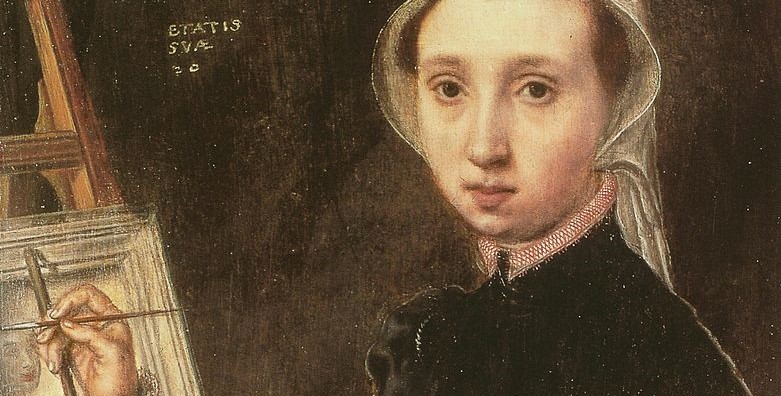
Her hair is centrally parted and plaited, with the plaits bound up in a snood, the black, net-like threads ensuring that none of her hair escapes, giving a sense of control and containment which matches her self-contained demeanour. A small black collar is buttoned underneath the short, frilled collar of her chemise. The subtle handling of light and shade softly models the forms of her face. She has painted the eyes slightly larger than they would be for ‘natural’ proportions, giving us a feeling that she is watching intently, observing us as she might have observed the models she has been painting – or for that matter, the drawing on which the picture she is painting might have been based. The picture itself sits on a standard easel, just visible at the top of this detail, but clearer in the image above. Given that the self portrait is painted on canvas, we could assume that her Virgin and Child is too. She leaves the edges of the canvas blank, as they will later be covered by a frame. The fact that she is painting the Virgin and Child is important. There were very few women painting in Sofonisba’s day, and very few Still Life paintings. Later, that would be the genre which women were ‘allowed’, although portraiture was also a viable option. They would, it is often said, be all but excluded from ‘History Painting’ – the depiction of instructional and uplifting narratives – but these genres of academic excellence had not yet been codified during Sofonisba’s lifetime.

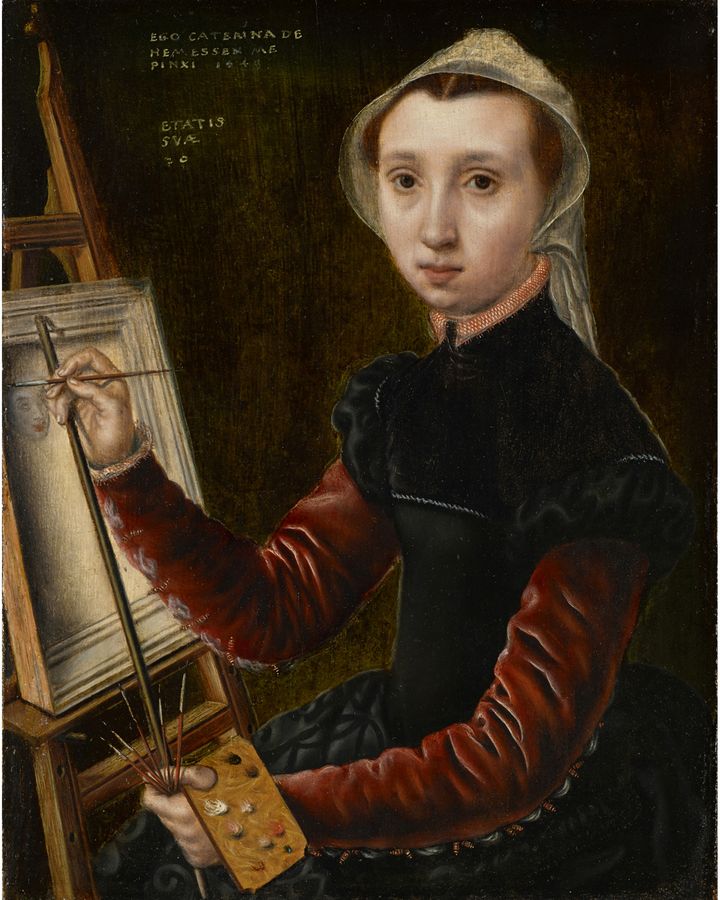
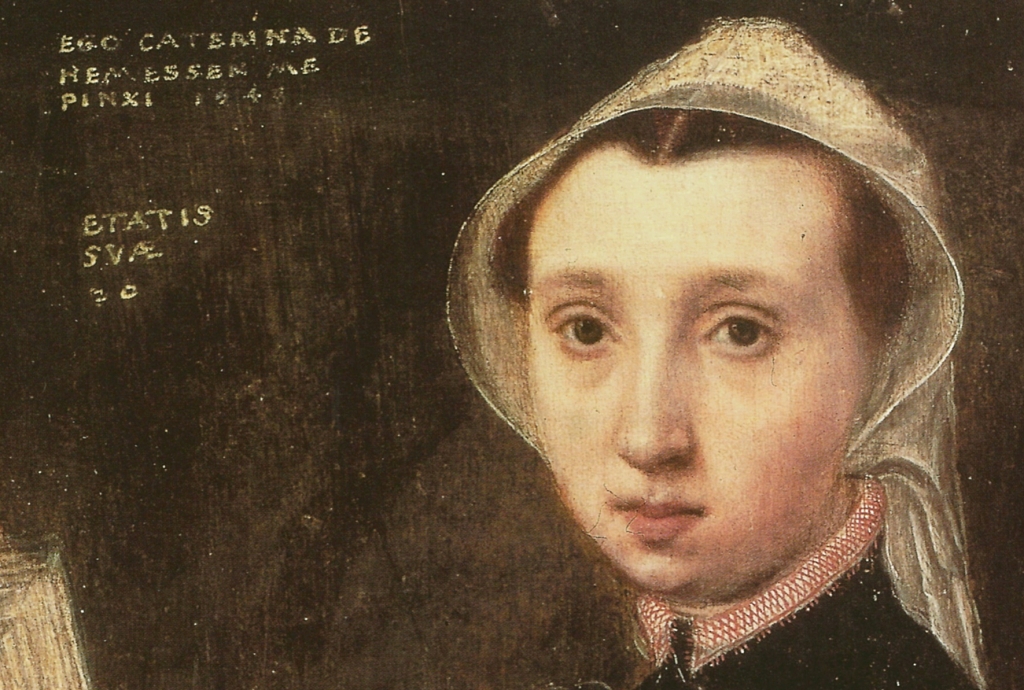
The first self portrait which shows the artist in the act painting – or, at least, the first to survive – was painted by a woman (see Day 28 – Catharina van Hemessen). As far as I can tell, Sofonisba’s is the second. Whereas Catharina is painting a portrait (and, in all probability, she shows herself in the act of painting herself), Sofonisba chooses what could be interpreted as a more noble endeavour: painting the same subject as St Luke, who was fabled to be the first artist to depict the Virgin Mary. She also shows how important Mary was for Christian theology by finding a symbol for her strength. She is seated in front of a high, rectangular pedestal, topped by a cornice, which supports the circular base of the column. As well as a symbol of Mary’s role as a true pillar of the church, this also shows us that Sofonisba was aware of the latest developments in renaissance architecture.

Sofonisba did not always sign her paintings, and so several works attributed to her are still subject to debate. However, when she did, they often follow a similar formula, exemplified by the portrait I mentioned earlier, in which she is wearing what is probably the same outfit. Written in the book she is holding is the phrase, ‘Sofonisba Anguissola Virgo se ipsam fecit’. The apparently bold assertion of her own virginity merely states that she was unmarried – a maiden – and lived in the paternal home. But basically it could be translated as, ‘Sofonisba Anguissola, Virgin, made herself’. The making is important.

The black collar is part of a buttoned cape, which fits tightly around her upper arms, and has a hem that is slashed like the tops of the brown sleeves. It is a sensible, modest, and well-fitting ensemble: she may be a woman doing a man’s job, but she is not a brazen hussy. She rests her right wrist on a mahl stick, which is itself resting on the unpainted edge of her canvas, thus enabling her to paint detail securely and with accuracy: it is a sign of her diligence. She is just about to add a stroke to Jesus’s left arm, which is resting on his mother’s lap. In this sense, what she is doing echoes what the Virgin has done: Mary ‘made’ Jesus, and Sofonisba is ‘making’ him again. Or, to put it another way, Mary may be the mother of Jesuss, but Sofonisba is is the ‘mother’ of this picture. She is also, of course, painting a male nude, something which was inconceivable for a female artist even as late as the early 20th century, although given Christ’s perfection, the innocence of his youth, and the modesty of his stance, posed discreetly as he is behind his mother’s leg, there is apparently nothing untoward in this depiction.

I can’t help reading her left hand, holding the end of the mahl stick, as a sign of her sophistication: the little finger is crooked. However, parallels to the elegant drinking of tea would be more than a little anachronistic. In this detail we can see the unpainted lower edge of the canvas resting on the easel, and in front of it, to the left, is her palate. On it we see black, red and white paint, and a variety of mixtures, mainly grey and pink. Oddly, though, there is very little blue, despite this being the colour of Mary’s cloak. The bottom right corner of the palette might show the ochre which is the basis of the yellow lining of the cloak, but that’s not entirely clear. To the right of the palette is a quill, used for the drawing on which the painting was based, presumably. There is also what I assume to be a palette knife. Once the paint had been mixed, this was used to transfer the paint to the palette – and in later centuries, to apply the paint to the canvas. There is also another brush.

I’m intrigued by the image she is painting. Some of her paintings of the Virgin and Child do survive, and are included in the Danish exhibition (I will show you them on Wednesday), but none look like this. Where do the ideas come from? Perhaps we can answer that by considering how it compares to the work of her contemporaries.

Sofonisba studied with two artists, both called Bernardino. Her first master was Bernardino Campi, and then, when he moved away, she was taught by Bernardino Gatti. I can’t find a Virgin and Child by either which resembles Sofonisba’s, but to me this Pietà resonates in some way. It was sold at auction in February last year, when it received an attribution to Bernardino Gatti. Although in one we see Christ as an adult, and in the other he is a child, there is something about the way the arms fall which strikes me as similar. Notably, the right forearm of the child and the left of the adult seem to curve slightly, and have the same somewhat ‘arch’ flexing of the index finger.

However, as well as looking to her own teachers, there also seems to be an echo from the work of the Florentine master Agnolo Bronzino: this one is in the National Gallery. Compare the long, slim fingers of the Virgins, for example, and the depiction of the loving relationship between mother and son: the way they lean together and look intently into each other’s eyes suggests that they share a similar ethos.

I have no doubt about the function of this self portrait. It is a declaration of the artist’s ability – and of her integrity. If I wanted a portrait of myself looking respectable, this would be the woman to go to. And if I wanted a painting of the Virgin and Child, this would also guarantee the quality I would get: technically skilled, intricate, intimate, and up to date. Having said that, I realise now, despite the number of times I have talked and written about Sofonisba (even before this, I have dedicated three posts to her), I have never seen any of her paintings in the flesh – so I can’t wait to see the exhibition tomorrow! And, as I’ve said, I will report back on Wednesday. Before then, though, on Monday I will consider some of the lesser known of Jesus’s exploits – while also untangling some potentially confusing biblical episodes. I hope you have as good a week as I am planning!

179 – Surviving treasures

Jacques Daret, The Adoration of the Kings, c. 1434-35. Gemäldegalerie, Staatliche Museen zu Berlin.

It’s December 1st – let the Advent Calendars be opened! I wrote one in 2020, and if you want something to read every day, and weren’t with me two years ago, I wrote about a single detail from Gossaert’s glorious Adoration of the Kings for all the days leading up to Christmas. If you do fancy it, click on An Advent Calendar – 1, and once you’ve read it, bookmark the page. Then tomorrow, you can go back, click on Next Post: An Advent Calendar – 2 which you’ll find to the bottom right of the first post, and so on… And if you haven’t read last week’s blog (178 – No crib for a bed), you might want to do that now, as today I will make certain assumptions. I enjoyed looking at one of the panels from Jacques Daret’s Arras Altarpiece, and thought it might be a good idea to look at the others. There are two more today, and a fourth in two weeks’ time. This occurred to me because Monday’s talk (5 December at 6pm), From Shepherds to Kings, will cover the Adoration, one of the four panels to survive. In many respects the next talk will be far more straightforward than last week’s, but it will be interesting to see how the Church celebrates the time between the arrival of the Shepherds (arguably Christmas day itself) and the arrival of the Kings. Although celebrated on the 6th of January (or the evening of the 5th), the precise date of the latter – well, let’s just say that it’s open to debate. One more thing before we get going: a newsflash! I’m adding in a mid-week talk to cover the Sofonisba Anguissola exhibition which is currently on in Nivå, just outside Copenhagen. I’m getting very excited about going to Copenhagen for the first time, and about seeing the work of this remarkable 16th Century woman: I’m bound to want to report back. As everything else is already scheduled, Sofonisba in Denmark will take place on Wednesday 14 December, at the usual 6pm. There are bound to be Christmas parties on, I know, but if you are free it would be lovely to know that you’re there! Meanwhile, back to the Kings.

Mary is seated as if enthroned at one end of the stable – the open, triangular ‘gable’ frames her and acts as a marker of her high status. It’s not entirely clear what she’s sitting on, to be honest, but it appears to be covered with a rich, royal red. At the apex of the ‘gable’ are beams of light emanating from the star, ‘right over the place,’ to quote the carol, ‘where Jesus lay’, although he is now standing, supported by his mother, and holding one hand up to the eldest king. OK, so in theory he is only 12 days old at this point, but he was the Son of God, so anything is possible, including standing up. Mary wears her most usual colour, blue, although as we saw on Monday (and maybe I’ll do a talk about this one day), the precise colours she wears can vary. Here it is a blue cloak over a blue dress. The eldest king is wearing red – often the most expensive fabric, and one associated either with royal courts or with wealthy merchants. That he is a king is vouchsafed by the broad cuffs of his sleeves and the hem of his robe, made of ermine, a pure white creature with a black tip to its tail, the fur of which was often reserved for royalty. His crown – an elaborate red hat – has been taken off and lies on the floor at his feet, a sign of respect for the boy born to be king. Behind him stand his two companions, a middle-aged man with long dark hair and a dark beard, and a young man, with no beard at all. Joseph stands to the left, and also wears red, not because he is part of a royal court (although that could be argued, as step-father to the second member of the Holy Trinity), but as a sign of his status (for the same reason). As in the Nativity, which we saw last week, notice how he is, nevertheless, slightly excluded from the proceedings. The king kneels in front of Mary and Jesus, who (if we adjust for the point of view) are in the centre of the opening to the stable, whereas Joseph is ‘outside’, cut off from the action by the same rough-hewn tree trunk which excluded him before. And this is something I love about these paintings: it is the same stable, but seen from a different angle. I really hope these two pictures end up next to each other, but it depends on the type of device you are using, I think.

In the Nativity we are alongside the stable, whereas the point of view for the Adoration is a diagonal, from what was the front right. The rough-hewn, slender trunk at the corner is the same, with a y-shaped cleft at the top, supporting the horizontal beam which runs along the bottom of the sloping roof. The diagonal beam which forms part of the ‘A’-frame at the end projects beyond this cleft in both images, and the same bevelled branches are attached top and bottom of the slender trunk to make it more secure. The back wall of the stable has an open window divided into three by two vertical beams – it can be seen next to the midwife Zelomi in the Nativity and above the head of the eldest king in the Adoration. If we were watching this in the theatre, a high budget production would place the stable on a revolve, but with less money a couple of stage hands would have to run on and trundle it round the requisite 45˚. And yet, even if the stable is the same, there is a major difference. One of the actors appears to have been replaced by his understudy.

Compare these two images of Joseph. All that really remains the same is the shape of the face, and arguably the purse – green, with diagonal decorations, slung on a dark leather belt.  The coat has been removed, yes, but everything else looks different. The robe has changed from purple (in the Nativity) to red, and the hat, which he has now put back on, has a more blue-ish tinge. It is worthwhile remembering that these paintings are now in two different museums, have different histories, and have probably been given different conservation treatments. Not only that, but different cameras were used to take the photographs, under different lighting conditions. So a few variations in tone and hue would be understandable, but not a shift from purple to red. And what would definitely not happen is a change in age. In the Nativity Joseph had white hair and a white beard, in the Adoration all this has miraculously gone brown – he has regained his lost youth! Now, given some of the stories which surround the birth of Jesus, this would not surprise me, but I have never come across a story which includes Joseph’s rejuvenation. What seems more likely is that this is a studio production – everything of any scale was – and that different members of the workshop painted the two Josephs. The general shapes and overall details of props and costume remain the same, but colours are different.

The gesture which Joseph uses, with his right hand cupped to the side of his head, is not familiar to me, but the same gesture is employed by the middle-aged king. Admittedly the latter is on the verge of removing his crown, but nevertheless it is similar, and I imagine it could be an expression of awe. Unless, that is, Joseph has decided he shouldn’t have put his hat back on after all. He is wearing a common form of medieval headgear called a chaperon, made up of three elements – the patte, which could be a relatively simple cap, although it could become more elaborate, surrounded by a bourrelet, which is a round, effectively donut-like form, and a liripipe (or cornette), which we see as a long tail which hangs down as far as Joseph’s knees. Chaperons are commonly seen in portraiture: several of Jan van Eyck’s sitters wear them, for example. Meanwhile, as we saw before, the eldest king has placed his crown on the floor. With his left hand he passes the gift of gold to Joseph, who is, likewise, reaching out to take it with his left. I have seen him given this practical responsibility – of looking after the gifts – more than once. With his right hand the king holds the child’s tiny arm, preparing to kiss Jesus’s hand as a further acknowledgement of his respect.

If you look back to the full picture, you will see that the youngest king has removed his hat, and holds it by his side. The middle king wears a turban, topped by crown-like elements. The turban was commonly used as an ‘exotic’ feature, to mark the king as ‘other’, and to explain that he was not European. However, there is no black king here: it was really at about the time this image was painted that the the black king starts to appear. Within a few decades he would become a constant presence. The gospels do not say where, exactly, the kings came from. But then, the gospels do not mention kings at all. According to Matthew 2:1,  ‘there came wise men from the east to Jerusalem’. It doesn’t even mention how many. So why three, and why kings? Well, they brought three gifts, and the number three is significant because of the Holy Trinity. That’ll do for a start. But then, they were also seen as representing the three known continents (Europe, Africa and Asia), although not all three are ‘east’ of Jerusalem. They are also frequently interpreted as representing the three ages of man: old, middle-aged (or ‘mature’) and young. As for their identification as kings – well, you’ll have to wait until Monday for that to be explained.

In the same way that the Nativity shows us the next bit of the story – the Annunciation to the Shepherds – so does this Adoration. Way away in the distance at the top right we can see soldiers on horseback emerging from behind a hill, and, on the far right, they have gathered in front of a wooden building, where you might be able to discern frenetic activity. The scale is tiny, and the image unclear, but these are Herod’s men. The kings were warned not to tell Herod of Jesus’s whereabouts, and the jealous monarch has realised that they have not reported back. He sent his men out to kill all the infant males – an episode known as the Massacre of the Innocents – and that is what is taking place in and around the wooden building.

The Nativity and Adoration, together with this Visitation (the story was covered in Monday’s talk), were all painted for the outside of the wings of an altarpiece dedicated to the Virgin in the Abbey of St Vaast in Arras, now known either as the Arras Altarpiece or the St Vaast Altarpiece, for obvious reasons. It was commissioned by the man who had been abbot there since 1428, Jean de Clercq, Daret’s great patron. It is him kneeling between St Elizabeth and his own coat of arms in this Visitation. He kept remarkably good account books, which record Daret’s activities over a period of about 20 years – but sadly the results of almost all of this have been lost. When open the wings revealed a sculpture of The Coronation of the Virgin above a series of sculptures of the twelve apostles. Although he did not carve them, Daret was paid to paint this ensemble, and to build and decorate the structure which framed and supported all the figures. On the inside, the wings were painted blue and decorated with gold fleur-de-lys. When closed, they were surmounted by an Annunciation group (presumably with Gabriel above the left wing, and Mary above the right), but that is now lost. The four surviving panels – the Visitation, Nativity, Adoration of the Kings which we are looking at today, and the Presentation in the Temple which I will come back to – made up the remainder of the wings. We know this thanks to a description from 1651, but sadly, some time later, and probably in the 18th Century, the whole structure was dismantled, and everything, apart from the four painted panels, was lost. This is a great pity – but it is a reminder that the vast majority of paintings from the 15th Century and before have been lost. We are so lucky to have the elements which survive – and I don’t know about you, but I don’t think I’ve seen them all yet: there is still so much more to look forward to! Some of these treasures will inevitably be included on Monday

178 – No crib for a bed

Jacques Daret, The Nativity, c. 1434-45. Museo Nacional Thyssen-Bornemisza, Madrid.

If you have ever enjoyed the obligation of seeing your child, or a friend’s child, or relative’s child – or anybody’s child for that matter – in a school Nativity play (now curiously abbreviated to ‘their Nativity’ as if you were about to watch their birth), you may have wondered at the twists and turns of the narrative that call for quite so many random characters, creatures, and I suspect even inanimate objects to pay homage beside the manger. ‘Jesus wants me for a snowflake’ must be the song on every with-it teacher’s lips. But trust me, whatever you have seen is nothing compared to what the medieval mind was able to imagine. Dragons? Animated trees? Toys coming to life? Jesus being grounded? Trust me, it’s all out there, and we’ll see all of these in Week 3 of my series The Childhood of Christ which starts this Monday, 28 November – the first Monday in Advent – with Until the Nativity. Of course, there will also be the usual wholesome ox and ass, even if they don’t get a mention in the gospels. Today’s painting includes more than one such apocryphal story, although I’m only going to tell you one of them for now…

I wanted to look at this painting because it is one of the few known works attributable to Jacques Daret. Don’t worry if you’ve never heard of him: although a surviving account book from the 15th century lists many of his paintings, only four survive, all panels from an altarpiece originally made for the Abbey of St Vaast in Arras, Flanders (now France). Daret was born in Tournai, Flanders (now Belgium), and studied with Robert Campin, who had settled there in the first decade of the 15th Century. Daret was a member of Campin’s studio for 15 years, and coincided with another student who is named in the archives as Rogelet de la Pasture. If you were to translate that in to what is presumably old Flemish, that would be Rogier van der Weyden, a more familiar name, I imagine, and another great artist who was a native of Tournai. And why am I interested in Jacques Daret? Well, I was in Tournai last week, and I’ll be going again next… Sadly they don’t have any of his works there: two are in Berlin, one is in Paris and today’s is in Madrid.

As foretold, it shows the Nativity, or, to be more precise, The Nativity of Christ. He is lying on the floor, waving his arms and legs and looking up at his mother, who can be identified easily thanks to the traditional blue cloak, which spreads around her as she kneels on the ground, and from her immaculate complexion, and flowing blonde hair (I know, this is supposed to take place in the Middle East, but fair-skinned and blonde she is – more about that another time, probably Monday, although I must have discussed it elsewhere already). To the left are the ox and ass in their stall, and beams of light come down from God the Father up in Heaven. If these are the only things in the painting you can identify, don’t worry – we’ll get there. There are two more women, who I really doubt have ever made it into any school Nativity play, and a wealthy-looking man. They are all gathered in and around a rickety-looking stable, apparently made of re-purposed wood and rough-hewn branches which prop up a decaying roof, attached at the back to a crumbling wall. At the top of the painting is a smattering of angels, but we’ll come back to them. I want to focus on Jesus.

He has been left on the ground, without as much as a bottle of hay to keep him warm and comfortable. As if the idea of placing him in a manger – a food trough – was not enough to show God’s humility in taking on human form, here he is completely exposed and vulnerable. This exposure is only enhanced by the way in which he is surrounded by expensive-looking fabrics, with the hem of Mary’s cloak meandering to the left, the purple skirts folded over the knees of the woman at the back, and on the right, a rich array of different, costly materials. In case we’d missed who this is, golden beams of light – the glow of sanctity – emanate from him in every direction, not unlike the beams of light that reach down to us from his Father in Heaven. The woman on the right has a red brocade dress woven with gold thread, and a fur-lined overskirt of green brocade. She also has two belts – a wide purple one around the overskirt, both ends of which hang behind her, the longer of the two falling to the bottom of the painting. It terminates in a simple knot, and has gold studs, or embroidery, as a ‘simple’ decoration. The red dress is gathered at the waist by what looks like a black and gold plaited belt, and there is sheathed knife tucked under her left knee. Golden, pearl encrusted cuffs circle the ends of the short sleeves of her red dress. From these emerge fuller blue sleeves. Her hands hang limply, their light colour and the angle of the fingers directing our attention towards the similarly pale baby. He looks up at his mother, as I have said, but what is his expression? Slight surprise, and concern, perhaps? There is a little questioning as well. ‘What, exactly, is going on?’ he could be asking. As for the waving arms and legs – well, they’re not, really, are they? They are placed very specifically. One foot over the other, and two hands raised, with both palms clearly visible. This looks like a non-verbal means of communication, an explanation of his purpose here on earth. In approximately thirty-three years’ time nails will be driven through those hands and feet in almost exactly that configuration. We are always being reminded of where the story is going. Flat on the bare ground, he could equally uncomfortably be lying on an altar as a sacrificial victim.

The focus is so intently on Jesus. Mary and the two women look at him almost demurely, whereas the Ox and the Ass stare with determined focus – as if to show that they can. They recognise their maker, which is why, as we shall see on Monday, they are there in the first place – even if they aren’t mentioned in the gospels. The only ‘creature’ whose gaze is not certain is the man, who may well be looking timidly towards Mary. He is, as you have probably realised, Joseph, but unlike most Josephs you will have seen. He is imagined not as a poor carpenter, but a successful merchant: he would be more than capable of making, or having made, and selling you for a good price, a far more sturdy stable. He wears a purple robe under a lined, brown cloak, together with a fashionable black hat. This he has removed, as a sign that he is in a holy place, and a specifically Christian one at that (were he Jewish, which of course he was, he would have been required to put one on). He also has a finely decorated purse attached to his belt, green, with embroidered ribbons appliqued in diagonals – a sure sign of wealth – and he holds a candle, which seems to have little effect – but more of that on Monday, too.

As far as the stable is concerned, this is not the product of a skilled workman: we are making do with what is available. The notches and peg holes in the vertical on the left suggest that it has been used for something before, while the support on the right is little more than the trunk of a tree felled young (are we looking forward to the Crucifixion again, and Jesus’s untimely demise?). It is cracked, with some branches sawn off (one of which, about a third of the way up, was sawn off some time before the tree was felled, allowing more growth to accumulate around the stump), and some bark still clinging on, a marvel of naturalistic detail. There are also two smaller, rough-hewn branches which have been trimmed, bevelled, and attached to keep it upright. Notice how the three women, as well as the ox and the ass, are all framed neatly between the two uprights, whereas Joseph is standing just to the right – effectively ‘outside’ this humble shelter.

And the two unknown women? Well, they are the midwives, clearly. You can’t have a birth without midwives, even if they weren’t mentioned in the bible. However, the fact that they weren’t there is a result of the way in which the bible was edited. Some of the gospels didn’t make the final cut (and when we hear some of the stories they tell in Week 3 of The Childhood of Christ you will realise why). The midwives are mentioned in at least one of them, the so-called ‘Gospel of the Pseudo-Matthew’ (that’s a link to the whole thing, if you want to read it all). In chapter 13 Joseph goes to look for a midwife, but the miraculous birth occurs while he is gone. He returns with not one but two, who he introduces to Mary. The first, Zelomi, goes in to the stable (which I think we must imagine as being more enclosed than this one), examines Mary, and realises that, even after the birth, let alone after conception, she is still a Virgin, causing her to cry out in amazement. This brings the second midwife, Salome, into the room:

And hearing these words, Salome said: Allow me to handle thee, and prove whether Zelomi have spoken the truth. And the blessed Mary allowed her to handle her. And when she had withdrawn her hand from handling her, it dried up, and through excess of pain she began to weep bitterly, and to be in great distress, crying out, and saying: O Lord God, Thou knowest that I have always feared Thee, and that without recompense I have cared for all the poor; I have taken nothing from the widow and the orphan, and the needy have I not sent empty away. And, behold, I am made wretched because of mine unbelief, since without a cause I wished to try Thy virgin.

And while she was thus speaking, there stood by her a young man in shining garments, saying: Go to the child, and adore Him, and touch Him with thy hand, and He will heal thee, because He is the Saviour of the world, and of all that hope in Him. And she went to the child with haste, and adored Him, and touched the fringe of the cloths in which He was wrapped, and instantly her hand was cured. And going forth, she began to cry aloud, and to tell the wonderful things which she had seen, and which she had suffered, and how she had been cured; so that many through her statements believed.

This is where we are in the story. Zelomi is at the back with hands which are both expressive and beautifully articulated. Salome’s withered limbs droop down towards Jesus, about to touch him and be healed.

I am now beginning to wonder whether Jesus is really looking at his Mother, or rather, perhaps, to the longest beam of light which crosses Zelomi’s green sleeve, and red overskirt, reaching as far as its incredibly plush fur lining. This, the longest ray, is pointing directly towards Jesus – and maybe it is this that the new-born is fixing – the radiance of God the Father. Our course will end in Week 4 with Jesus’s first biblical miracle, turning water into wine. But already, in the apocryphal texts, minutes after his birth, the miracles are happening – and Jesus could well be looking up to Heaven in the knowledge that they won’t stop any time soon. No peace for the perfect.

Meanwhile, at the top of the painting, we continue to look ahead. In the distance, on the far right, an angel is announcing the great tidings of glad joy to the shepherds (we’ll talk about them in Week 2), while more angels – and birds – gather on the roof. This angel is happy to point to the baby Jesus, while holding his voluminous and magnificently flowing robes. Just to the left is a goldfinch, a frequently-seen symbol of the Passion of Christ. It was believed that goldfinches ate thorns, and that one went to eat from the Crown of Thorns. A drop of blood fell from the Saviour’s forehead, and left a permanent red stain, which you can see to this day around the Goldfinch’s beak. At the top are two swallows – barn swallows, presumably (or stable swallows, I suppose). Migration was not fully understood until we travelled far enough and fast enough and could track where the birds went in the winter. But it was clear to the medieval mind that they went away and came back again. Jesus did the same, but far more quickly – and so the swallow became a symbol of his death and resurrection.

At the other end of the roof there are three more angels in even fuller and more swirling robes. They are on the verge of singing. I say ‘on the verge’ as they appear to be holding their song sheet (such scrolls are often are inscribed with the words ‘Gloria in excelsis Deo’, although I can’t see anything here) – and yet their mouths are shut. There are also two things I don’t remember seeing before in paintings of the Nativity. I’m sure I have, I just don’t remember. First – icicles, hanging from the beams and the thatch. In the deep mid-winter frosty winds made moan, even in the Middle East. Second, at the top left, a great tit: yellow breast with a black stripe running down the centre, and a black head with white cheeks. It’s unmistakeable. And it’s there because – well, because it wanted to join in, maybe. I see them a lot in my garden, and I bet Jacques Daret did too. I can’t for the life of me imagine what it’s symbolism could be, simply because it doesn’t occur often enough to be commented on. For us now, though, it’s a symbol, as much as anything, of the observational skills of the artist, and the growing interest in naturalistic detail; of looking at the world around us and painting things which we know are there. And if we know that the great tit is real – then the angels must be too. Its presence helps us to believe. The tit is looking in to the centre of the picture, as is the goldfinch and at least one of the swallows. Even if they are not looking down, their gaze focusses us inwards, towards their maker. Not only that, but the beak of the goldfinch is directly above the forehead of the baby on to which – in thirty-three years’ time – a crown of thorns will be driven. I don’t think that’s a coincidence.

177 – Taking Germany by storm

Gabriele Münter, Portrait of Anna Roslund, 1917. New Walk Museum and Art Gallery, Leicester.

I love exhibitions which truly have something new to offer, and Making Modernism at the Royal Academy is, for me at least, one of those – so I’m looking forward to talking about it this Monday, 21 November at 6pm. My only problem will be the usual one – too much to say! I found that on Wednesday morning when I took 40 minutes of an hour’s tour in the first room – with two more rooms to go. But don’t worry, I really will edit down and show you the best! The exhibition focusses on four superb women artists who were not only innovative, but also highly successful. And yet they are relatively unknown today. Käthe Kollwitz is probably the most familiar of the artists, and I was also aware of (but not familiar with) Paula Modersohn-Becker’s work. I knew Gabriele Münter’s name, but I don’t think I’d ever seen any of her paintings. Marianne Werefkin, on the other hand, is completely new to me – and a great discovery. There are also three ‘guest’ artists – but more of them on Monday. The following week I will move on to The Childhood of Christ, which I will discuss over the four Mondays in Advent – but can more details about those talks can be found via the links in the diary. Art History Abroad have now announced their tour schedule for the first half of 2023, including a trip I am taking to Amsterdam to see the Vermeer exhibitions in Amsterdam and Delft. But for today I want to look at the ‘Poster Woman’ of Making Modernism, Anna Roslund, as painted by Gabriele Münter. I would say ‘Poster Girl’, but recently had my wrist slapped for my careless use of language…

Munter, Gabriele; Anna Roslund (1891-1941); Leicester Museums and Galleries; http://www.artuk.org/artworks/anna-roslund-18911941-80902

I’m afraid I can tell you relatively little about Anna Roslund herself, but we get a strong sense of her character just by looking at this portrait. Apart from anything else, how many women have you ever seen smoking a pipe? I know there are some famous examples in history, but I can’t for the life of me remember who they are. ‘Women smoking’ is something one didn’t used to see (a long, long time ago), and ‘women smoking a pipe’ make up an even smaller sub-group.  This bold gesture is combined with an open pose, left arm resting on the arm of the chair, with her head resting on her left hand. The right arm is tucked in, holding the pipe to the mouth. Add to that the strong, bold colours of the outfit, royal blue and black, heightened by the bright red of the pom-pom (?) in front of her chest, and you have a strong sense of individuality, the image of self-confidence.

Anna Roslund has the clearest, light-blue, piercing eyes, and a stylish haircut, apparently bobbed with a fringe (although we can’t see what it’s like behind), which makes me think more of the 1920s than 1917. She is clearly a serious, thoughtful woman, her head tilted to one side and her eyes gazing into the middle distance some way above our left shoulders. Like Rodin’s Thinker, with his chin on his fist, or Dalí’s Narcissus, who we saw last week, his chin on his knee, the head leaning on the hand adds to the sense of contemplation, albeit in a different way. Each finger is clearly demarcated (although the little finger is oddly truncated – I don’t know whether that was an anatomical fact, or an artistic abbreviation), and there is a clear space through to the light background. Presumably, given the curtain, this is a view through a window, with broad, light brushstrokes of white and pink over a darker ground, giving an idea of a light, but cloudy sky. The curtain itself, in a deep turquoise, is angled parallel to the tilt of the head, and completes the ‘virtual’ pyramid which gives this composition – and Anna Roslund – stability, and strength of presence. Another note of stability is the horizontal of the arm, marked strongly by the contrast between the upper edge of the blue sleeve and the light background (and see how the thumb and fingers echo shapes of the arm and head).

Roslund is clearly comfortable in this chair, and I love the way in which the curve of her right shoulder, clad in blue and enhanced by a subtle black outline, echoes the curve of the left arm of the chair – it is as if she is a completion of the chair on that side. The chair itself, with the yellow arm given texture and form by the darker brushstrokes, is painted in a similar technique and colour to Van Gogh’s more famous example, a symbolic self portrait (having said that, having posted the pictures, the chair looks more violet than it did in the file on my laptop!). Indeed, as we shall see on Monday, Münter was an admirer of the Dutchman’s work, even naming her house in the country ‘The Yellow House’, as a nod to his home in Arles.

The arms of the chair curve round and in before flaring out again, as if hugging the sitter. The right arm (seen on our left) is more brightly illuminated, and, as a result, appears to be a different colour (but with colour, everything is relative – see above). The left arm (on our right) reminds me of the roads you see in some Dutch landscape paintings, which start in the bottom corner of the painting, and lead you into the middle ground, as if the artist is expecting you to go on a journey with him (I don’t think there was a woman who painted landscapes in the Dutch Golden Age). I think the same is true here: Münter is using these arms, particular the one on our right, to lead our eye into the painting – and also, as the corners of the pyramidal composition.

I’m not an expert of women’s dress (nor of men’s, for that matter), but the blue top appears to continue as an open overskirt, framing the sleeker black skirt. Either that, or she is sitting on a blue cushion of the same hue as her blouse. Whatever it is, this blue, and the uncovered section of the seat of the chair, both form triangles pointing up towards Roslund’s face. Her left leg is crossed over her right – again, a confidence in her body language which we might not think of as ‘lady-like’ for the first half of the 20th Century.  The black outlines to the blue blouse might relate to the clothing itself, or they may be the result of Münter’s interest in Bavarian folk art, particular reverse glass painting (painted on one side of the glass, to be seen from the other), which often had rich, jewel-like colours separated by black outlines, a cloisonné effect not unlike stained glass windows.

Munter, Gabriele; Anna Roslund (1891-1941); Leicester Museums and Galleries; http://www.artuk.org/artworks/anna-roslund-18911941-80902

So who was this remarkable, stylish, self-confident, thoughtful woman? Well, a musician and author at the forefront of the Danish Avant Garde, but that is as far as I can get, I’m afraid. Münter met her while living in Copenhagen during the First World War. However, I can tell you that Anna Roslund had a sister called Nell, who was an artist, and who married a man called Herwath Walden in 1912. And it is this that makes the portrait a key image for Making Modernism, one theme of which is the nature of artistic communities and the resulting dissemination of ideas. From 1910 Walden published a weekly journal dedicated to modern art (monthly from 1914-1924). It was called Der Sturm – ‘The Storm’ – the title expressing Walden’s conviction that that was how modern art was going to take Germany. His focus was on Cubism and Futurism (he effectively introduced these movements to the German public) and also on the burgeoning German Expressionist movement. In 1912, the year in which he and Nell Roslund married, they opened an art gallery in Berlin under the same name. Both Gabriele Münter and Marianne Werefkin were exhibited regularly, as was Dutch artist Jacoba van Heemskerck, one of the ‘guests’ in the RA’s treasure trove of an exhibition. Münter’s introduction to today’s sitter came via her gallerist, effectively. It might even have been this connection that took her to Copenhagen.

One question remains: if these artists were so successful when they were alive, why is their work so little known today? One reason, for the British at least – apart from the fact that the men they were associated with took all the limelight – is that there is very little of their work in public collections (Kollwitz excepted – but hers are works on paper which are rarely on display). This portrait is one of the few which has been borrowed from a British institution. It forms part of Leicester’s notable collection of German Expressionism, one of the rich seams of great art which, when you find them, are a surprising, but rewarding, feature of our regional museums. As to how they came to acquire this remarkable body of work – well, that’s another story. For now, though, I can highly recommend Making Modernism at the Royal Academy as a way of discovering – or, if you know them already, familiarizing yourselves with – some great and unjustly neglected artists.

176 – All change!

Salvador Dalí, Metamorphosis of Narcissus, 1937. Tate.

Salvador Dalí was a Surrealist, obviously, and, some would say, the Arch-Surrealist. In 1934 he even claimed a form of ‘über-Surrealism’ when he explained that ‘The difference between the Surrealists and me is that I am a Surrealist’ – a typically Surreal statement. As such, like all members of ‘Modernist’ movements, we would probably expect Dalí to turn his back on the art of the past and everything it stood for. However, on Monday I will be talking about one of his paintings of the Crucifixion, putting it (briefly) into the context of the rest of his career, and comparing it to a work by El Greco. Both are on show together at the Spanish Gallery in Bishop Auckland in a display entitled Dalí/El Greco: Christ on the Cross – a micro-exhibition which is well worth a visit if you’re in the area before Sunday 4 December. Having discussed both works I will also introduce the Gallery itself (briefly) for those who haven’t been. I’m saying ‘briefly’ to myself as a reminder not to get carried away when I’m prepare the PowerPoint. Dalí, El Greco and the Spanish Gallery will be on Monday 14 November at 6pm, and if you can make it you’ll see whether or not I succeed! Other talks up until Christmas are, of course, in the diary, and there will be more news about my plans for the New Year soon. As I’m talking about Dalí and Christianity on Monday, today I thought I’d have a look at him confronting another pillar of Old Master Painting: classical mythology. So here is the Metamorphosis of Narcissus.

‘Metamorphosis of Narcissus’, 1937, Salvador Dali (1904-1989). Purchased 1979 http://www.tate.org.uk/art/work/T02343

The story is probably well-known to you – or, if not the story itself, the general idea: Narcissus was in love with himself. Only that’s not exactly what happened. Let’s start by looking at the painting, though. There are two main forms set in a landscape. To the left of centre is a person crouching or sitting in the water at the edge of a lake. The right knee is strongly bent, and appears to lie across the surface of the water, where it is reflected in the mirror-like surface. This would only be possible if the figure was completely immobile, and had been still for some time: any movement and ripples would disrupt the reflection. The left knee is raised, and the chin of what must be the head (even if there are no facial features) rests on the knee. A chin resting on a hand implies thought – just think of Rodin – but here we can see that a knee can perform the same function: this figure is deep in contemplation. The shoulders are hunched, and frame the head, both being caught in the brilliant sunshine which streams down from the top left of the painting. The right arm is barely visible, bent back behind the form, with the hand probably resting, unseen, on the shore of the lake. The left hand is dipped into the water, though. We can see the articulation of the wrist, and the flare of the hand, but the fingers are out of sight. The arm frames the figure, and is bent at the elbow, with the joint itself in deep shadow. Like the right leg, the left leg and arm are both reflected in the lake. The hair, which seems to blend with the flesh of the forehead, is pulled back in a topknot, which blows in the breeze above the left shoulder. The head itself is furrowed and rough: to me it looks a bit like a walnut.

The ‘figure’ on the right is remarkably similar in form, but looks more like a sculpture, or statue, carved out of white marble. Standing on the shore of the lake, and a little closer than the human figure, it represents a hand holding an egg, delicately poised between the tips of thumb, index and middle fingers – it is a right hand. The ring and little fingers are both bent. A flower is growing from the egg.

If we take this detail out of context, the brilliance of Dalí’s conception becomes clear, if it wasn’t already. No longer are we distracted by the placement of the figures. It is irrelevant that the hand is closer to us than the human figure, as the head and the egg are at the same height, and appear to be the same size, on the picture surface at least (perspective would suggest that, as it is further away, the head is actually larger). However, now that we are looking closer we can see that the index finger does not touch the egg, but is at a small remove, the gap being equivalent to the area of shadow cast on the left shoulder by the head. In between the finger and the egg is a root – perhaps a development of the hair which has otherwise disappeared. Dalí is showing us metamorphosis –  a change of form. However, in order to do so he is also using a staple technique of medieval and renaissance art: continuous narrative. This allows an artist to tell a story by showing the same character more than once in different time frames. Here we see Narcissus both before and after his transformation, or rather, perhaps, shortly after the metamorphosis has commenced, and when it is all but complete. But why does this happen in the first place? And how? The origins of the story are, of course, Greek, but it is told at its fullest in Ovid’s Metamorphoses, a treasure trove of source material for classical myth which was used by artists across the centuries. Using these stories Ovid set out to show how everything changes: the world we live in is in a state of flux, and everything we know now was once something else. As such, it is a sort of origin myth, with explanations of the creation of many plants and animals, among other things, and story of Narcissus is just one of these – or maybe two, as his fate was tied in to that of Echo.

Long story short: Narcissus was so beautiful that everyone fell in love with him: men, women and minor deities alike. Beautiful on the outside, he was less than perfect within, and he treated all his suitors with bitter disdain. Eventually one of them begged the gods to let him know the same pangs of unrequited love that they endured, and the plea was answered by Nemesis, the goddess of retribution. This is how the story progresses, in a prose version I’ve just found on the internet (click on this link for the whole of Book 3, and if you start with line 339 you’ll get the story of Echo as well):

There was an unclouded fountain, with silver-bright water, which neither shepherds nor goats grazing the hills, nor other flocks, touched, that no animal or bird disturbed not even a branch falling from a tree. Grass was around it, fed by the moisture nearby, and a grove of trees that prevented the sun from warming the place. Here, the boy, tired by the heat and his enthusiasm for the chase, lies down, drawn to it by its look and by the fountain. While he desires to quench his thirst, a different thirst is created. While he drinks he is seized by the vision of his reflected form. He loves a bodiless dream. He thinks that a body, which is only a shadow. He is astonished by himself, and hangs there motionless, with a fixed expression, like a statue carved from Parian marble.

So he himself waits, motionless, like a marble statue – hence the stillness of Dalí’s figure, and the appearance of its equivalent, the hand. Important for the story, though, is that Narcissus did not know what – or who – he was looking at. As far as he was concerned it was a beautiful boy in the water, who actually reached out to touch and even kiss him – but who shied away at the moment of contact. Only later did he realise that it was his own reflection, and that his love was doomed, like that of those he rejected, never to be requited. In Ovid’s telling of the story, Narcissus weeps, and the tears disrupt the reflection, but still he continues to watch the effects of unrequited love on his own behaviour, and body:

‘As he sees all this reflected in the dissolving waves, he can bear it no longer, but as yellow wax melts in a light flame, as morning frost thaws in the sun, so he is weakened and melted by love, and worn away little by little by the hidden fire. He no longer retains his colour, the white mingled with red, no longer has life and strength…’

Eventually his sisters, the Naiads, lamenting his death, prepare a funeral pyre, but there was no body. They came upon a flower, instead of his body, with white petals surrounding a yellow heart.’ So Narcissus is transformed into a flower: a narcissus, a type of daffodil. It’s Latin name is Narcissus poeticus – which is, of course, entirely apt – and this is what Dalí shows, with poetic (and surreal) ambiguity, emerging from an egg.

The lower half of the painting shows how ingeniously Dalí mapped one form onto another. The bent right leg becomes the ring finger, and its reflection is the little finger. The thumb is continued down to the wrist by its own reflection – and there is subtlety here: the surface of the water is mapped onto the hand with a crack in the marble. This gives the impression that the metamorphosis is ongoing, and that the stone will eventually break up and wear away. This feeling of decadence – literally a state of deterioration or decay – is enhanced by the ants which are swarming up from the ground and along the thumb. Ants are frequently included in Dalí’s art as symbols of death and decay, apparently the result of him seeing them on the bodies of decomposing animals when he was young. The scrawny dog has a lump of raw meat in its mouth. A scavenger, it might even be imagined as eating the flesh of the dead boy.

If we’re talking symbols, Dalí uses the egg as a sign of hope – of new life, or rebirth – hence its place as the origin of the flower. Like the rest of the hand further down the thumbnail is cracked – another sign that the transformation is continuing, and that eventually only the flower will survive. On either side of the hand are more elements of continuous narrative. The myriad figures to the left of the hand, stretching and writhing, are usually interpreted as Narcissus’s suitors, suffering the pangs of rejection, while to the right a figure stands on a plinth looking down: Narcissus admiring his own perfection. He’s been placed on a pedestal, either by the suitors, who have put him there metaphorically, or by himself: he has set himself apart, whether metaphorically or not. Placed on a grid like a chess board there is perhaps a sense of strategy at play here. And directly above this statuesque figure – a hint at what is to come – there is an echo of the finger tips holding the egg in a distant mountain. Maybe there are more people like Narcissus out there, suffering a similar fate.

Dalí did not always elucidate every detail of his work – probably just as well, given how much detail each painting contains – and as often as not he is providing poetic suggestions which give full rein to our own interpretative powers – and to our imagination. However, it is interesting to consider what his interest in this particular story was, and how it relates to his practice at the time. It is one of the fullest realisations of a technique he called the paranoiac-critical method. One of the main symptoms of paranoia is the ability to find links between things which, in reality, have no rational connection. Although not paranoid himself, Dalí had what was an extraordinarily active imagination, and, after letting himself go on more than usual flights of fantasy, he would re-form his ‘paranoid’ imaginings into a concrete image – the ‘critical’ side of the paranoiac-critical method. One of his suggestions about this particular painting was that you should stare at it in an unfocussed way until the two primary forms combine. A bit like ‘magic eye’ images – which rely on the left and right eyes focussing on two different elements of the image to allow the brain to resolve a single, three-dimensional design – he was basically suggesting that we let our focus go so that our left eye sees the left form and our right looks at that on the right. At that point the two forms would merge into one, and Narcissus’s transformation would be complete: the human figure  would ‘disappear’ within the hand.

‘Metamorphosis of Narcissus’, 1937, Salvador Dali (1904-1989). Purchased 1979 http://www.tate.org.uk/art/work/T02343

In 1938 the Catalan artist was taken to see one of his heroes, the Austrian psychoanalyst Sigmund Freud: both were in London. Dalí had read The Interpretation of Dreams years before, and Freud’s interest in the subconscious was one of the driving forces of his art – as it was for all Surrealists. On the visit he took this painting, Metamorphosis of Narcissus, with him, like a proud schoolboy eager to impress the teacher. Sources relating to Dalí tend to stress the positive outcome of this meeting, quoting Freud’s letter to Stefan Zweig, the Austrian author who had introduced the artist to the thinker, in which the psychoanalyst said:

I really have reason to thank you for the introduction which brought me yesterday’s visitors. For until then I was inclined to look upon the surrealists – who have apparently chosen me as their patron saint – as absolute (let us say 95 percent, like alcohol), cranks. That young Spaniard, however, with his candid and fanatical eyes, and his undeniable technical mastery, has made me reconsider my opinion.  

Elsewhere, though, he said, ‘In classic paintings, I look for the unconscious – in a surrealist painting, for the conscious.’ Some suggest this was said directly to Dalí, thus completely undermining one of the cornerstones of the entire Surrealist movement. I shall leave you to look into Freud’s own theories about the story of Narcissus and its relationship to homosexuality for yourselves – the theory has long been discredited, even if this may well be the reason why Dalí chose this myth in the first place. For now, I am happy to enjoy the painting’s appearance. In any case, I would prefer to move on to Dalí’s interest in Christianity, which is precisely what I shall do on Monday.

Second Impressions

Mary Cassatt, The Tea, about 1880, Museum of Fine Arts, Boston.

Things have been building up with all the exhibitions opening over the past few weeks, and I’ve run out of time – so, time for a re-post! But what to choose? Would would be relevant to the National Gallery’s third exhibition to open this autumn, Discover Manet and Eva Gonzalès, which will be the subject of my next talk on Monday, 31 October at 6pm GMT (remember that the clocks change in the UK on Sunday)? It is, I would suggest, the best of the three. Definitely the smallest, it is also the most focussed, beautifully coherent, with a number of fantastic paintings which you have probably never seen, by artists of whom you might not have heard, but which are truly wonderful. It is also far-reaching for an exhibition based on one painting – the portrait by Edouard Manet of his only formal student, Eva Gonzalès. As well as this painting, the exhibition also explores the nature of their complex relationship, looks at how the portrait relates to paintings of other women artists, including a superb selection of self portraits, as well as exploring the possibilities for women in the arts in the late 19th Century. All this is supported by a brilliantly written catalogue, which I would certainly recommend. This was sponsored by ARTscapades, a superb organisation who raise money for the arts, and if you’re not free on Monday, I will be repeating the talk for them on Tuesday… After that, of course, my talks until the end of the year are all listed in the diary.

So, what to choose? I could have gone for one of my favourites from the selection of self-portraits in the exhibition, the complex ‘manifesto’ by Laura Knight, which I discussed back in January, or an alternative self portrait by other women exhibited, including Vigée Le Brun or Angelica Kauffman. Or I could have gone for paintings related to Manet’s portrait which are cited in the catalogue but not exhibited, such as the self portrait by Adélaïde Labille-Guiard or the allegory of painting by Artemisia Gentileschi (which I no longer believe is a self portrait). Indeed, thinking about this has given me an idea for the new year (spoiler alert!) when I will deliver a series of five (I think) talks, introducing women artists over the centuries. More of that in December…

In the end I’ve chosen one of my earliest posts, Picture of the Day 15, which was originally ‘published’ in the second week of lockdown, on 2 April 2020, on my Facebook page, before I’d even started this blog. It is a painting by Mary Cassatt, one of the great Impressionists – and even if Eva Gonzalès chose, like her master, not to exhibit with the young rebels, her work can certainly be associated with this diffuse ‘movement’. Enough introduction. This is what I said over two years ago, and reading it through again today, I think I would probably agree with myself (although there are only two cups).

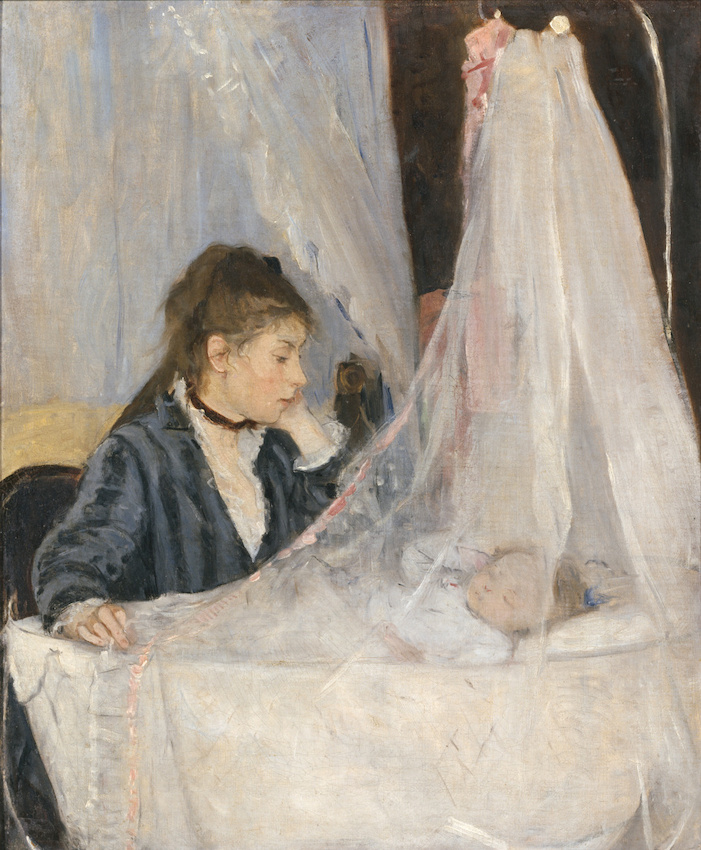
A change of mood: let’s calm things down a little, and have a nice cup of tea, brought to us by Mary Cassatt, and the good people of Boston. There are some paintings which just make me want to stop, and look, and say, ‘Isn’t that lovely!’ And this is one of them. It’s so carefully composed, and harmoniously coloured.  The two women, the tea service, and the vase in front of the mirror – or is it a painting? – are evenly spaced across the surface. The rich red of the tablecloth, with its thin, decorative border matches the floral patterning of the upholstered sofa shared by the two women, as well as the stripes of the wallpaper. The blue, presumably Japanese vase, with its gilt fittings, together with the frame of the painting (or is it a mirror?) echoes the colours of right-hand woman’s outfit, while also, together with the carved marble fireplace, describing the richly appointed lifestyle that was Cassatt’s milieu. The antique silver tea service is another indicator of this. There is such a focus on these still life details, with the carefully but freely painted teapot, sugar bowl and cup, the reflections on their surfaces and their reflections in the tray, that we might assume that this tea service is the real the subject of the painting. It is more prominent than the women, a third character in this domestic drama. 

Mary Cassatt came from a wealthy Pittsburgh family, and left the States just after the Civil War, like so many other Americans – she could almost have been in a Henry James novel.  She wasn’t the only woman to exhibit with the Impressionists, but she was the only American. She joined them in 1877 at the invitation of Edgar Degas, so often maligned for his misogyny. I suspect he got grumpier as he got older (I know the feeling), and so a lot of the misogyny was general misanthropy.

You can see what he liked about her work from this image. The composition of The Tea is not so very far from some of his own: two people in a room, drinking, a tray on the table, the table taking up most of the foreground space, the same tones and colours as the walls – a description that would fit both The Tea by Cassatt and Absinthe by Degas, painted three or four years earlier. The connection is purely coincidental, I suspect – or rather, it is part of what makes them both Impressionists: they have common interests and concerns.

The Impressionists didn’t set out to be the most famous and successful artistic movement of the 19th Century – they just wanted their work to be seen. At the time there was only one main art exhibition per year – the annual ‘Salon’ – held by the Académie des Beaux-Arts, and therefore officially sanctioned. If you wanted to get known, to be accepted and to sell work in France, you had to be seen there. But the paintings of a group of young artists who hung around in the circle of Edouard Manet in the Batignolles district of Paris were rejected. In true 1950s American movie fashion, they decided to ‘put on a show right here’ – ‘here’ in this case being the studio of the photographer Nadar at 35, Boulevard des Cappucines. This was in 1874. But what should they be called? Well, they marketed themselves as ‘The Anonymous Society of Painters, Sculptors, Engravers, etc.’ It was never going to catch on. 

Although there were bad reviews, they were not really as bad as everyone always says. One critic did try and suggest a name for the group, saying that, as the word ‘Impression’ had been used by one of the artists – Claude Monet exhibited a landscape called ‘Impression: Sunrise’ – you could do worse than calling them ‘Impressionists’, as they really did capture the impression you had on first seeing things. The exhibition was definitely not a financial success, and they didn’t follow it up the following year. However, in 1876 they put together a second exhibition, under the same name and, in 1877, a third. This was the first that Cassatt contributed to – she was delighted to be involved. On receiving Degas’ invitation she said, ‘I accepted with joy… I hated conventional art’. This was the moment, she thought, at which she ‘began to live’. It was also the point at which the ‘Anonymous Society of Painters, Sculptors, Engravers, etc.’ decided to cut to the chase and call themselves Impressionists.

They weren’t really a group, as such, and they didn’t really have a single style, although some of the more prominent artists did share similar interests. A lot of them painted outside, to capture the freshness of the moment – although Degas never did: he based a lot of his work on photography. Some of them were interested in bourgeois society, and the life of the city. Cassatt certainly fits in here. However, someone like Pissarro preferred peasant life and chose to live in small towns some way outside the capital – like Norwood, where he stayed during his years in London. But with all of them there is a sense that they stand on the outside looking in – voyeurs, perhaps. Or anthropologists. They loved people watching, and Cassatt’s great advantage was that she was a woman. Not only did she know how women behaved, but she had access to spaces and rituals that men could not have experienced. Had The Tea been painted by Renoir it would have been very different. The women would have been more buxom, for a start. And probably more girly – looking at the artist and smiling. Even giggling. Or languishing with bedroom eyes. Not Cassatt, though – she’s too good for that. She knows what it’s really like.

The similarities with L’Absinthe relate to her attempt to make the image look real – almost like a snapshot. The table gets in our way, and distances us from the women, although, in an apparently contradictory way, it also bridges the gap between us and them, leading our eye into the painting. Cassatt has portrayed the scene just as she saw it, without bothering to tidy it up, to move the table out of the way, or to make sure we can see both of the women clearly. In fact, she goes out of the way not to show us the women, choosing, very carefully, the moment at which one of them is drinking her tea, so that the cup is almost completely covering her face. This is the point at which you realise that the Impressionists’ claim to be painting what they saw, when they saw it, just as they saw it could not possibly be true. This isn’t ‘fly on the wall’ observation, it is careful calculation. How long would you spend with a cup tipped up like that? And how long would it take to paint? More than a few minutes, certainly.

The women are dressed rather differently, one in plain brown, her right hand leaning on her cheek, the other resting her saucer on her left hand, which is clad in a delicate primrose-yellow glove. The other gloved fingers lightly hold the cup to her mouth, little finger aloof, as she looks away from her companion. As well as gloves, she wears a hat – she is a guest in the other woman’s house and has recently arrived from the outside world. Her rich, deep blue coat, like the accessories, points to her wealth. The woman in brown is presumably as wealthy – look at her room – but, as she is at home, she does not feel the need to make the point (all those Working From Home bear this in mind). Cassatt was the master (or mistress?) of gesture and character, of setting and mood. Why did she want to paint the guest in the act of drinking? Why cover so much of her face? And why is she looking away? The cup is tipped quite high – she must have nearly finished. And not a moment too soon – the hostess has nothing more to say to her, it seems. And, possibly, she is thinking to herself, ‘I hope that’s the last sip’. The patient, long-suffering expression seems to say as much. And why is there so much focus on the tea service? Maybe we are also present in this room, a third, unseen person, and like the woman in blue we have looked away, we’re focussing on the silverware, as there really is nothing more to say, nothing more to do.  Talking of which, I really wouldn’t want to keep you any longer. But do feel free to linger, and enjoy the colours, the careful composition, the contrast between reclined relaxed hostess and upright, edgy guest, and that wonderful, tense, long, dramatic pause…

Having said all that way back when, I can now add that Eva Gonzalès was every bit as good in her observation of behaviour, and was also at the forefront of innovation in the genres of art. I do hope you can get to the exhibition at the National Gallery, or, at least, join me for the talk on Monday.

175 – Solid and durable

Paul Cézanne, Mont Sainte-Victoire, 1886-87. The Phillips Collection, Washington, D.C.

Mont Sainte-Victoire was undoubtedly Paul Cézanne’s favourite landscape motif. He painted it over 80 times, but, to keep a handle on things, today I’m just going to look at one. However, my next talk, on Monday, 24 October at 6pm, will be an introduction to Tate Modern’s exhibition – Cezanne – and that includes a whole room dedicated to the subject (Tate have omitted Cézanne’s accent, as apparently, in Provence, where Paul grew up, it was not used). It is a monumental exhibition, and if you are planning to go, you might want to plan to go twice. Talking of planning, my Zoom talks are already lined up for the rest of the year – so do check out the diary to see what is on the cards. In November I will pay a visit to The Spanish Gallery in Bishop Auckland, and I am also looking forward to the exhibition of ground-breaking paintings by early-20th-century German women at the Royal Academy, Making Modernism. Throughout Advent I will be hanging around the Wallace Collection – and elsewhere – thinking about The Childhood of Christ in Art. But for dates and details, as I say, you’ll need to check out the diary.

I’ve long been fascinated by Cézanne’s stated wish to ‘make of Impressionism something solid and durable like the art of the museums’. His misgivings were that, in capturing a fleeting impression, the work itself might end up being ephemeral, too closely related to a specific moment in time. His repeated studies of Mont Sainte-Victoire were therefore completely different to Monet’s various series, with which he aimed to show how different his motifs looked at different times, in different weathers, and in different moods. Cézanne was in search of the timeless and unchanging, something universal, which would last. But how to achieve that? He wanted to rely on his sensations – a French word which translates as ‘feelings’ – although ‘feelings’ in terms of ‘sensations’, I suspect. So, effectively, he did want to paint what he felt, as a result of what he saw – he wanted to convey the impressions he had when looking at something (just like the Impressionists) – but he wanted to make it last. Not only that, but the image had to make coherent sense on a two dimensional surface – the painting – while holding true to the three dimensional nature of the motif. Put like that, it seems like a tall order – so it’s hardly surprising he tried so many times to ‘get it right’. Did he ever succeed? And if so, how?

The paintings of Mont Sainte-Victoire are so familiar that it is perhaps hard to stop and look at them properly, or to see them afresh. In this example, as in so many, the Mountain – in reality a limestone ridge stretching over 18km – takes its familiar position on the horizon, rendered blue by the aerial perspective as if enough sky has got in between us and the distance to render it celestial – the colour of the sky (indeed, for Italians, celeste is a different colour from blue, in the same way that, in English, pink is different from red). The view is framed by two trees, one of which leans into the picture and spreads its branches across the sky, while the other is close enough to the artist that we can see neither its base, nor canopy. The lower two thirds of the painting is taken up with farmland, with the upper third being mountains, hills and sky, together with the aforementioned branches. The palette is extremely limited: greens, blues, and sandy browns.

This detail, from the bottom of the painting, is almost all of the ‘farmland’, the lowlands before we get to the foothills. At the top right you can see a railway viaduct – but, without knowledge of the location, it could have been an aqueduct. Quite apart from the fact that it was there, Cézanne may well have painted it to make Provence look a little more like the Roman Campagna. Indeed, it is the sort of thing you can find in some of the paintings of Poussin. In another of his aspirational statements – although one that some doubt he ever made – Cézanne is supposed to have claimed that he wanted ‘to redo Poussin all over from Nature’. This implies that he wanted to paint classical landscapes – in terms of harmony, proportion and monumentality – by looking at the real thing, rather than using his imagination, as Poussin did. In this detail we see him seeking out these harmonies. There is a long, straight track leading from behind the brow of the hill at the bottom right, which rises on a low diagonal toward the top left of the detail. Indeed, if we were to continue this line in either direction, it would stretch to the bottom right-hand corner of the painting, and reach the top left-hand corner of this detail. I cut the detail here deliberately, to show how the top of this diagonal would coincide, more-or-less, with a continuation of the viaduct, were it to stretch all the way across the painting. To the right of this straight track two dark lines – hedges perhaps? – run parallel to the same diagonal. Was this ‘harmony’ really there? Or was the ever-observant Cézanne simply enhancing the classical possibilities of his motif, idealising what he saw to make it more ‘timeless’?
Another way to harmonise the image was to make certain aspects of the painting consistent across the whole surface. Let’s focus in on the bottom right hand corner.

The predominant colours here are green and a neutral off-white. But only the green is painted: the ‘off-white’ is the colour of the primed, but unpainted, canvas – the ‘ground’. This might imply that the work is unfinished, but no, it is a technique Cézanne learnt from the Impressionists: you don’t have to cover every bit of the canvas with paint. Indeed, if you leave some gaps, and providing that your ground is light, it will add a sense of luminosity to your painting. After a certain stage in his career Cézanne did this with practiced regularity: look out for it in the following details. As well as adding luminosity, the repetition of these light areas across the whole surface of the painting lend it a sense of unity. The track – so important for structuring the composition and leading our eye into the distance – was also left ‘unpainted’, although as it emerges from the foliage at the bottom of the hill the artist has decided to emphasize its presence by heightening it with a brighter off-white paint. However, by the time we get to the top left corner of this detail, we seem to be back to the unpainted ground, ideal to represent the track, which is, after all, bare, and free of vegetation. The brushstrokes in this detail are quite scrubby, but many of them are short diagonal strokes going from top right to bottom left. These are Cézanne’s ‘constructive’ brush strokes, themselves derived from the Impressionist tache (blotch, patch or stain), which made up the tesserae from which many of their mosaic-like images were formed. In other, slightly earlier, works, Cézanne’s constructive brush strokes are far more consistent – ‘monotonous’ would be the correct word (but without the implication that they are boring), because they are all the same. The artist uses them, as the word suggests, to build up the entire image, and they also become another way of unifying the surface. The brushstrokes have the same function in this painting, but are used more freely – a sign that Cézanne is relaxing into his technique.

If the unpainted ground and constructive brush strokes can unify the surface – thus making the image coherent on the canvas – how can he imply a sense of distance, while still holding onto this cohesion? The answer is in the palette. The same sandy browns are used from the foreground slopes, through the middle ground (omitted above) and all the way into the foothills of the mountain. The greens – of different shades – are similarly disposed. Notice how the dark bottle green of the shrub in the bottom right – just above the largely ‘unpainted’ section – can also be seen in trees next to the farmhouse on the left of the upper detail here, and all the way over to the viaduct, recurring in shrubs which are growing at almost evenly spaced intervals. Every point where this bottle green can be seen is therefore related to every other one in our eyes, and therefore also in our mind. The same is true of the lighter emerald and jade hues, not to mention the sandy browns, and their more orangey variants, as seen in the cuboid farmhouses to the left and nearer the viaduct, which are exactly the same colour as one of the fields at the lower left.

The leaves of the pines at the top of the painting use the same bottle green, thus tying the foreground at the top to the foreground at the bottom – and to the middle ground, in the middle of the painting. But Cézanne also ties the foreground into the horizon by emphasizing the apparently concentric growth of the branches around the curves of the distant hills. There is unity across the surface, and also in depth. Like Lucian Freud (although in reality, of course, Freud was like him) Cézanne was a very considered painter. He would look at the motif and determine what it was he was seeing, then look to the painting and his palette and mix exactly the right colour for a particular brushstroke, before applying it. He was painting exactly what he saw as he saw it, looking directly at the section of the motif he was painting. One effect of this was to deny a sense of perspective. All the branches appear to be growing parallel to the picture plane, even if we do try and make sense of this by pushing some of them further back into the space. The branches and leaves form a two-dimensional filigree across the surface of the painting, and the darkness of the branches echoes the darkness of the edges of the distant hills. Atmospheric perspective does apply though, as somehow there is a softening of the brushstrokes – and undoubtedly a lightening of the tones – for the distant fields.

Another result of this painstaking approach was that every additional brushstroke altered what had already been painted. We do not see digitally, but by comparison. Adding a dark brushstroke would make the previously painted areas look lighter, and so adjustments had to be made continuously. Inevitably, like a game of patience, there were times when both Cézanne and Freud realised that the combination of brushstrokes meant that the painting would not have a ‘solution’, and remained unfinished.

Looking back at the whole painting, you can see colours calling to each other across the painting. For example, the tree framing the painting on the left has one visible branch – even if its connection to the trunk cannot be seen – which appears to reach down to the bottle green of the tree lower down the slope at the bottom right; the nearer face of all the cuboid buildings ring out with the same yellow/orange notes; the brushstrokes of the grass at the bottom echo the leaves of the trees at the top, and even there the constructive brushstrokes of the leaves seem to harmonise with those of the sky, as if tree and sky move together in harmony with the wind. A patchwork of dabs and dashes summons up this whole world, compelling us towards the might of the distant mountain. To answer at least one of my questions at the end of the second paragraph, I think this counts as a success – and this is only one painting. There are six alternative views in the Tate’s impressive exhibition – and that is only one room. Elsewhere Cézanne approaches Still Life and the human figure with an equivalent rigour. Don’t miss it.

174 – Freudian

Lucian Freud, Painter and Model, 1986-7. Private Collection.

I think it is an unacknowledged sign of ageing that more and more I am aware of a succession of artists’ retrospectives. The exhibition to celebrate Lucian Freud’s 80th Birthday, for example, at the relatively-recently renamed Tate Britain in 2002. Or the 90th Anniversary exhibition in 2012, the year after his death, at the National Portrait Gallery. And now, at the National Gallery, the celebration of the centenary of his birth. Nevertheless, with each iteration I have seen something new, and something which has come as a surprise. In this embodiment of the great artist’s work, apart from a number of paintings that I have never seen before, I have been really impressed by something I have always been aware of: Freud’s admiration for the delicacy of touch, and for the profound nature of the relationships between people, animals, and even things, that touch implies. I will talk about this more thoroughly on Monday 17th October at 6pm when I introduce the exhibition Lucian Freud: New Perspectives. If you’re not free, or fancy hearing the talk in person at the National Gallery on Thursday 20th, have a look for details in the diary. Today, though, I want to focus on something else: a painting in which the artist gets to grips with the nature of painting itself.

Called Painter and Model, we see a woman standing on the left wearing a brick-red painting smock, covered in paint, and holding a paintbrush between both hands. She is effectively in profile, looking down towards the bottom right corner of the painting, with her pale face standing out against a dark wardrobe which occupies the back left corner of the space. On the right is a battered leather sofa, the colour of which is strikingly similar to the woman’s smock. Lying on it, on his back, is a naked man. If her head is framed by the wardrobe, his is placed against the far arm of the sofa, and is seen full face, rather than in profile. Binaries, and contrasts, are always an important aspect of Freud’s work. The man’s left forearm lies along the back of the sofa, while the right rests on the seat, with the hand just sticking over the edge. His right leg, extended, stretches down so that the heel of his right foot is resting on the floor. The lower half of this leg, and the foot, cast intense, dark shadows on the meticulously detailed floorboards. His left leg is bent, and leans against the back of the sofa. His left foot is tucked up behind the near arm, and can’t be seen. Lying on the floor in the foreground is some of the paraphernalia of painting – tubes of paint, and paintbrushes of different sizes. The walls are in an appalling state of repair – painted yellow, but re-plastered with pink plaster, which nevertheless still seems to be showing signs of damp, presumably the initial cause of the repairs, and which has not yet been repainted. A blind has been pulled down over the window, and crumples untidily as if in need of replacement itself. The top of the walls are deep in shadow, but brightly illuminated further down, with the boundaries marked by uneven half shadows, probably cast by an uneven lampshade.

Lucian Freud was renowned for making what might seem to be unreasonable demands of his models. Once his career was established, he became a man of habit, and would paint regularly, either during the day, in natural daylight, or after nightfall, in artificial light. This is clearly a night-time painting – the stark shadows tell us as much. He would work on more than one painting at a time, with the daytime models making way for those arriving in the evening. They would return every day at the allotted time for weeks or months, or even, in some cases, for years. In order for him to discover something ‘unexpected’ and create something new, he would often pose them in unusual positions, or in surprising relationships to one another. It might seem that he was being entirely controlling, making the models obey his whim. And yet, of course, they didn’t have to be there. Often they were friends or family, but above all, they were people he was interested in. If he wasn’t interested, he couldn’t paint. Nevertheless, as a substantial number of his models were women, and, moreover, women who were naked, he was sometimes criticized as a voyeur.  I’m sure this painting was intended to confront this claim, as it turns the idea of ‘the male gaze’ on its head.

In terms of the title, Painter and Model, it is surely clear which is which. The woman on the left is the painter, the naked man is the model. In this one bold gesture Freud manages to subvert the whole history of the Western European nude, in which, we imagine, a fully clothed man paints a naked woman, and in the process, he objectifies her. It is the man here who becomes the object, subject to the whim of the female artist. She is standing, upright and secure, whereas he is supine, passive and vulnerable – apparently a complete reversal of gender stereotypes. Of course, it’s a little bit more nuanced than that. Or, to put it in other words, it’s nowhere near that simple. I’m intrigued, for example, that the painting is called Painter and Model rather than Artist and Model, but paint is clearly of the essence. And, whether Painter or Artist, is the woman really the one who is in control? One of the problems for women over the course of Western European Art History was the nature of the female gaze, because, quite simply, it wasn’t allowed. ‘It’s rude to stare’, as I’m sure many of you were told by your parents, and it was particularly rude for women to stare. You were supposed to stand with your hands politely held in front of you, and look modestly down. And if you’re looking ‘modestly down’ all the time, then you can’t look at things to paint them. Women weren’t allowed into life drawing classes until the 20th Century (on the whole): for them to look at a naked man was considered to be inappropriate. But in this painting we see Freud reconsidering the whole issue. Or do we? Maybe we should have another look at the painting. Even in this detail, although more pointedly if we look at the whole image (above and below), it becomes clear that the woman is standing in precisely that appropriately ‘modest’ feminine way, hands held in front of her body, and her face looking down towards the floor. She is not staring at the man, not even gazing at him, despite his unabashed nudity. Indeed, the male gaze is still fully active, but it is the naked model in the painting – the man – who is gazing – even staring – at us. The model seems to be more in command, and more commanding, than the painter.

It becomes more complex when you realise that, given the title of the painting, the woman on the left is both painter and model. Although she holds a paintbrush, she is modelling for Freud as a painter. And she is painted – in more ways than one. First, she is one of the subjects of the painting, one of the models that Freud has painted, but second, her smock is covered in paint. She appears to have used the fabric to clean her brushes in between different brushstrokes, as Freud used to, either on the walls of the studio or using the rags which can often be seen lying on the floor in the background of his paintings. So, Freud has painted her, and she has ‘painted’ herself. Look again, and you will her smock covered with the yellow of the walls, the light greys of the damp and of the window frame, and the darker shades of the wardrobe and of the shadowed areas of the sofa, with the smock itself more or less the colour of the sofa. Indeed, the smock is effectively Freud’s palette, an inchoate mass of paint like that from which he has formed this image.

We add yet another layer of complexity when we realise that both models were also artists. On the right is Angus Cook – described as ‘model and artist’ in the National’s exhibition, although I can find little about his work online. One source describes him as a poet, and there are also some of his texts about art. Above all, he was part of a nexus of friends and lovers, several of whom feature in Freud’s work. On the left is Celia Paul, a respected artist in her own right. She came to Freud’s attention as a student at the Slade School of Fine Art, where he was a visiting tutor. They went on to have a ten-year relationship, with Paul often modelling for Freud, as she does here.

In the bottom half of the painting we can see five feet – three human, two sofa. It’s a sort of game, and one that Freud played in different ways in different works. Each foot has a different relationship to the floor (and Freud was always interested in relationships). The two carved wooden feet are connected by the sharp line of shadow cast by the edge of the sofa which, together with the glints of light on the curving bulges of these feet, reminds us that this was a night-time painting. Cook’s right heel rests on the floor, whereas Paul’s two feet are firmly and securely planted, the toes turned out a little from the heels. And yet, how secure are they?  A curious detail suggests that something might be awry.

Whose paints are these? Stop and think about it: have you seen an easel, or even a canvas? If Paul is the painter, what is she painting, and where, exactly, is the painting itself? Or is she just posing as a painter, for Freud? Are these her paints or his? And look – her right foot is planted on one end of a tube of paint. A tube of green paint. You can see that: the lid was not put back on the tube, and some of the green paint (more brightly coloured in the original than in this reproduction) is squeezing out. Am I wrong in seeing some form of sexual connotation here? Would I be right in going so far as to say that it seems a little bit, well, Freudian?

In case you didn’t know, Sigmund was Lucian’s grandfather. This must have had an impact on the boy, but more so on the student, and, as he came to a fuller understanding of the world, and of the significance of his grandfather’s work, on the adult artist. Both spent a lifetime analysing people lying on couches, for one thing. On Monday we might just find that there were other things that they had in common.

173 – Illuminating

Eadfrith, Chi-Rho page, The Lindisfarne Gospels (Cotton MS Nero DIV, f. 29r), c. 700. British Library London.

Today I’m going to look at one page of one book. It is, surely, one of the most spectacular pages of what is – according to every account you read – one of the most spectacular survivals from Anglo-Saxon England. However, England is not an accurate geographical designation, as the manuscript was the product of the kingdom of Northumberland, the largest kingdom in the British Isles at the time. Spreading North from the River Humber (how had I never realised that before?) it reached well into what is now undoubtedly Scotland. On Monday 10 October at 6pm I will flick through the whole book – or rather, turn the pages carefully (and virtually, in virtual white gloves) in a talk entitled The Lindisfarne Gospels. I will focus on the book itself before putting it into the context of the exhibition mounted by the Laing Art Gallery in Newcastle, but will discuss the Gospels as thoroughly as I can (given the time available) as, whenever you get to see it, you only ever see one opening, so it is hard to understand how everything fits together. For that matter, it is not entirely obvious exactly what is in it: it’s not just the Gospels! In the following weeks I will turn to Lucian Freud, Paul Cézanne (or Cezanne, as Tate would have it) and Eva Gonzalès (with a French accent, rather than a Spanish one…). Details can be found via these links, or as ever (together with details of an in-person repeat of the Freud), in the diary.

I suspect that, for most of us, the initial impact of this page is pretty much the same experienced by much of the congregation who may have had a distant view of it during religious ceremonies when it was first produced: bright, colourful, intricate – magical even – but ultimately, incomprehensible. And even if they had a chance to get closer, for the illiterate it would not have revealed its secrets. There are no pictures here to explain what is going on, but rather a celebration of the word itself, and, in this case, of the word made flesh: it is a celebration of the birth of Jesus himself, even if, to the uninitiated, that is by no means clear. However, the richness of the decoration, its elaborate sophistication and vibrant colours, not to mention the space it occupies on a single page, tell us how important the initiated knew this was. They also knew that the image, not to mentions the devotion, skill and time required to make it, would be one way to impress the illiterate with its significance: sometimes words are not enough.

The inscription at the top of the page says ‘incipit evangelium secundum mattheus‘ – which literally translates as ‘begins the gospel according to Matthew’. Almost all the letters are there, although in evangelium the ‘l’ and ‘i’ are combined and similarly, in secundum, so are the ‘u’ and ‘m’. However, the illumination seems to have got in the way of mattheus, so a small squiggle is added over the ‘u’, to imply an abbreviation, and there are also a couple of dots: the ‘s’ is implied. Above this inscription more words are written in smaller, darker letters. The first two read onginneð godspell – ‘begins the gospel’, in Old English, rather than Latin. A truly remarkable thing about the Lindisfarne Gospels is that, centuries after the book was first created, somebody wrote all over it. It isn’t the only manuscript this happened to. The entire volume (well, almost the entire volume) was translated into Old English, and the translation was added to the pages. I may have suggested that sometimes words are not enough, but sometimes words that people understand are valuable. In this case, they are also significant: this is the very first surviving version of the bible in English (even if it is Old). So – the book has been defaced, but we know a lot more about it as a result (more about that on Monday). The word onginneð is not so very far from ‘beginneth’ (‘ð‘ is effectively ‘th’) nor is godspell that far from ‘gospel’. Back in 1971 it was even used as the name for a musical based – albeit loosely – on the evangelium secundum mattheus. The ‘spell‘ is related to magic (the other ‘spell’, as in spelling a word, has a different etymology), and also to ‘spiel’, which is now slang parlance for a glib recitation, apparently recited often, showing a practiced stance or belief. The incantations of priests were often likened to magic spells, given that they were related to raising the dead, turning water into wine and the like. However, the curious thing about this inscription – which is not even the most visually striking element on the page – is that it is wrong. This is not the beginning of the gospel according to Matthew. It is chapter 1, admittedly, but verse 18: ‘Now the birth of Jesus Christ was on this wise: When as his mother Mary was espoused to Joseph, before they came together, she was found with child of the Holy Ghost.’ As the text was written in Latin, though, it would be as well to quote the Vulgate (St Jerome’s translation of the bible), of which this happens to be one of the purest versions:

Christi autem generatio sic erat: cum esset desponsata mater ejus Maria Joseph, antequam convenirent inventa est in utero habens de Spiritu Sancto.

Notice that ‘Christ’ comes first, as, for Christians, Christ surely should. And now look at this.

What we see, on the largest scale, is the word ‘Christ’ written in Greek, but represented with only the first three letters, chi, rho, and iota – or Χρι (the full word ‘Christos’ would be Χριστός). This abbreviation was effectively standard practice, and the combination of just the first two letters, chi and rho, was one of the earliest symbols of Christianity. It was adopted even before the cross, which was such a humiliating form of execution that, in the early days, it was deemed unsuitable for celebration. Like mattheus, therefore, this is an abbreviation, and, in the same way, I think there is a hint about that: you could read the elaboration of forms at the top right of the chi and above the rho as equivalent to the ‘squiggle’ above the ‘u’ in mattheu – a sign for an elision, or abbreviation, which would be used for centuries.

It is, therefore, the word Christ which is the most important thing on this page, vibrant with colour and apparently moving forms, wheels within wheels, stylised, elongated birds, writhing and threaded together, and knotwork. The whole form is surrounded by a series of small red dots, as if it were glowing. This is not, maybe, the beginning of the gospel of Matthew, but it is the first time in the bible, after the list of his ancestors, that Jesus appears. It is where he is born, the first mention of the incarnation – god made flesh. As such, as well as being called the Chi rho page, this is also sometimes referred to as the Incarnation page, and it was a fairly common feature of the most elaborately illuminated manuscripts. According to the gospel according to John, ‘In the beginning was the Word, and the Word was with God, and the Word was God.’ Here, in the gospel according to Matthew, we see the Word for the first time, and we see it as a word. It was clear to the early Christians that the Light of the World came into the world at this point, and that this was worth celebrating: let Salvation begin!

The letters underneath Χριστός make up the following one and a half words of the Vulgate: ‘autem gene’(‘ratio’is on the following line). The ‘u’ and ‘t’ are combined, as are the ‘e’ and ‘m’. After this, the ‘g’ is looped round the ‘e’, and the ‘n’ and ‘e’ also combined. This abbreviation may simply help to fit the words in, although it also adds to the almost magical nature of the text – as if this were an incantation to summon the birth of Jesus, the words transformed beyond their mundane import. The way in which they have been written shows what a brilliant visual sense Eadfrith, believed to be both scribe and illuminator of the gospels, had. Like most of the work, they were sketched out in lead point (a bit like starting with a light drawing using a modern-day pencil), and then outlined with red dots. They have an obvious presence on the page, but interrupt the background tone and colour of the vellum as little as possible. This allows Χριστός to ring out loud and clear at the top of the page: when shown to the congregation (or even, when opened in front of the officiating priest) the impact would be clear: Christ is here, visible, among us, the most important thing.

Without considering their impact on the whole page, these (partial) words, ‘autem gene’ might seem incomplete, as all the others here are filled in with black, and heightened with yellow, pink and green infills. The whole text is contained by the elaborate tail of the chi to the left, and a green-bordered frame which comes down from the top right of the page, wraps along the bottom and continues up on the left.

The second line of text continues after the ‘gene’with ‘ratio sic erat cum’. In the King James Version, this would be the end of the word ‘birth’, followed by ‘…in this wise. When…’. Although I said that all of the letters (after the first line) were filled in black, the letter ‘c’ of ‘cum’ is not. It’s not clear why – it might just be a mistake! Eadfrith, scribe and illuminator, was Bishop of Lindisfarne from around 698 until his death in 721, and some people think that his work on the volume was not complete at his death. The British Library wisely refuses to be too specific. Between the text and the illumination the gospels would have taken at least five years to complete, and possibly as much as ten – so the given date of the manuscript as ‘c. 700’ can only really be counted as the date it might have been started.

The final lines on this page are ‘esset desponsata mater ejus Maria Joseph’, or ‘…as his mother Mary was espoused to Joseph’, leaving the second half of the verse to the next page – or rather, the next side. Manuscripts, have ‘leaves’ rather than ‘pages’. This is leaf 29, or folio 29, and we are looking at the ‘front’ side of it, the recto (so this is f. 29r). The rest of the verse is on the ‘back’ of this folio, or folio 29 verso (f. 29v). Despite the technicalities, I think the amount of the verse that is included might explain why Eadfrith went to the pains of abbreviating the ‘autem gene’. It was, I think, quite simply, to get this much onto this one page. As a result we have all of the Holy Family present at Jesus’s birth: Jesus, Mary, and Joseph. And notice that Joseph only just makes it – the green frame has had to be thinned, and even broken, to accommodate the letter ‘h’. Or he might have done that to emphasize Joseph’s name, or even to imply a continuation of the verse onto the verso. But I suspect it is, practically, to fit it all in. Poor Joseph: always squashed into corners. But at least he’s there. Above the word ‘mater‘ is written ‘moder’ – the Old English form of ‘mother’ – but the rest of the translation has been squashed into the margin.

We’ve got to the end of the page, but before we go, let’s have a look back at the top – and get a little bit closer. You can all do this, in the comfort of you own homes, which is just as well, as the British Library doesn’t lend to private individuals. However, part of their remit, as a national institution, is to make their collection available as widely as possible, and they are attempting to digitize as much of their collection as they can. The Lindisfarne Gospels can be accessed if you click on this link. I’ll leave you to read it all cover to cover before the talk on Monday! But not before this:

It is truly astonishing.  The intricacy, the complexity and the sheer attention to detail – the time taken to write just one word – speaks of a faith and devotion so profound that it is hard to measure. And within this one detail we also have all of the common decorative techniques. On the left are the red dots, an influence from Ireland, and in the cross of the chi, we see a writhing mass of birds, biting their own elongated necks which are looped around and threaded through the equally elongated tails and the knotted legs of their fellows. Between the chi and the edge of the rho on the right are spiralling circular forms, often described as pin wheels, which would seem to derive from the La Tène culture, one branch of the broader Celtic tradition, as is the knotwork in the rho itself. It is open to debate as to whether these forms of decoration have symbolic significance within a Christian context. Most obviously, many of the pin wheels have threefold symmetry, and, at the heart of the word ‘Christ’, this must surely be an allusion to the Holy Trinity, with God present in Christ and Christ as a part of God. The knotwork could be interpreted as a reference to eternity – each is an endless loop – but also to the journey of the soul on a defined, if complex path. In some way this imagery must also function in like a mandala, encouraging contemplation and meditation. This is perhaps clearer with the manuscript’s glorious carpet pages, each a variation on the shape of the cross, but I will look at them – and, indeed, at all of the fully illuminated leaves – on Monday. All that, and many more remarkable details, too, not to mention the overriding structure. And, despite what I said above, you really don’t need to read it all before then!

172 – Incisive

Winslow Homer, The Army of the Potomac – A Sharp-Shooter On Picket Duty, 1862. Metropolitan Museum of Art, New York.

Today I want to look at an engraving as a way of introducing the work of a great painter: Winslow Homer. This is, of course, by way of an introduction my talk this Monday, 3 October, which is in itself an introduction to the exhibition at the National Gallery, Winslow Homer: Force of Nature. There follows a series of talks related to exhibitions which are mainly in London, and which are dedicated to The Lindisfarne Gospels (in Newcastle, 10 October), Lucian Freud (National Gallery, 17 October), Cezanne (Tate Modern, 24 October) and Edouard Manet and Eva Gonzalès (National Gallery again, 31 October). The blue links will take you to the relevant Tixoom page for information and booking, and they are also all listed in the diary.

Winslow Homer has been a revelation to me, as there is not a single painting by him in a British public collection. I haven’t been to the United States for well over a decade, but in the days when I went regularly I tended to focus on the Italian Renaissance, or on American works from the second half of the 20th Century. Having discovered his paintings, I now want to know more about Winslow Homer’s prints, even though, as far as I can see, he doesn’t seem to be classed as a printmaker as such, for reasons which may become clear. In 1855, at the age of 19, he became an apprentice at John H Bufford and Co., a lithographic printing shop in Boston. Two years later, his apprenticeship complete, he entered the profession which he was to follow for the next two decades at least: an illustrator for popular magazines and periodicals. However, the majority of his work was not in lithography but wood engraving. The technique is different from engraving on a metal plate. For the latter the design is gouged out of the plate using a tool called a buren, and when the plate is inked the ink fills the resulting grooves. This is what is known as intaglio printing (tagliare is Italian for ‘to cut’), which is different to Japanese wood blocks or linocuts (see, for example, Sybil Andrews’ Via Dolorosa in 161 – Negative Spaces), which are relief prints. In a relief print the lines are the result of ink sitting on the ridges between the carved out gaps. Wood engraving is a form of relief printing, so everything white has been cut out of the block, and everything black is printed from thin ridges which sit proudly at the top, on the original surface.

We see a man in uniform – a soldier – sitting in a tree, with his rifle trained on a target to our right. His position is precarious, perched on a diagonal branch growing from the trunk of a conifer growing on the right of the image. His left foot is in the crook of the branch, where it joins the trunk, and his left leg is slightly bent, leaving a gap between the branch and his knee. His right leg is more bent, and the foot hangs freely, offering neither support nor security. He grasps a small branch with his fully stretched left arm, which forms the only real horizontal in the image, affording him, and the composition, some degree of stability. The rifle rests on the same branch, next to his hand, tilted at a slight angle downwards, implying that the soldier is aiming at something on the ground at a considerable distance – although we cannot be sure how high in the tree he is. The marksman leans forward with his torso at roughly 45˚to the vertical, showing how intent and focussed he is on his activity, while the precarious position, and the fact that he is surrounded by foliage and branches – which stretch downwards almost more than up – creates a real sense of tension, which is only enhanced by the view of the sky we see through the branches and needles of the conifer in which he is sitting, some way above our heads.

A water bottle hangs from an offshoot of the branch the soldier is holding, knotted around it to keep it secure. The attention to detail is supreme, from the precise definition of the sole of the shoe, to the exact arrangement of the laces, threaded through holes and tied, defined by spaced, diagonal lines, suggesting that the laces are formed from strands of thread which are twisted together. The ends of the trousers are tucked into socks, or puttees, both garments depicted using regular parallel lines. The branches are created with shorter, curved lines, dashes and dots, which convey the rough, varied flakiness of the bark. Clouds in the sky are blank paper, with the clear blue, slightly darker than the clouds, is indicated by thin, horizontal lines. There is some sort of bird hovering high up, visible to the left of the soldier’s right foot, its distant presence adding a somewhat vertiginous feel to the danger inherent in the situation.

The sky under the left arm is one of the brightest parts of the print. It helps to emphasize the stability of this gesture, and to enhance the drive of the focus from left to right, towards the unseen target. The right hand, holding the rifle, and about to pull the trigger, is almost equally bright, only a few lines having been left on the surface of the wood to create the shape of the fingers and define the tendons on the back of the hand. Against the darker carving of the rifle, and emerging from the mid-tones of the sleeve, this hand and its imminent action become the main focus of the image. Near to this is the white of an eye, flashing from the dark socket, in shadow thanks to the soldier’s cap. We are looking at a sharp-eyed sharpshooter intent on his enemy. On top of his cap the letter ‘A’ tells us the company with which he served. The intricacy of detail and subtle variety in tone and texture which Homer has been able to achieve, creating the appearances of different materials, and defining the forms and positions in space simply by varying the length, density, and direction of the lines, show him to be a printmaker of the highest order. However, unlike, say, Dürer or Rembrandt, he is not necessarily celebrated as such. But why not? Well, the pictures I have shown you so far are from a print which has been cut out of its original context – so let’s put that back. This is another example of the image, also in the collection of the Met in New York.

The print was published as a page-sized illustration. Indeed, the detail below shows us that it was page 724 of Harper’s Weekly, published on November 15, 1862 (that was volume VII, in case you wanted to know).

Homer had worked for Harper’s more-or-less since its inception in 1857, and four years later, in October 1861, the periodical sent him to Washington D.C., where he was to become an artist-correspondent during the American Civil War. He joined the Union Army, representing the Northern States which were fighting to maintain the Union (as the name suggests), against the Southern Confederates, who had seceded. By the time the Civil War ended in 1865, the New York Tribune called Homer ‘the best chronicler of the war’, and this image, The Army of the Potomac – A Sharp-Shooter on Picket Duty, became one of his most celebrated works from that period.

The wood block was not necessarily carved by Homer himself . The hard-wood block was both polished and whitened, and Homer would draw his designs directly onto this pristine surface in pencil. Highly skilled craftsmen would then cut away all of the remaining white surfaces – effectively removing what would be left white in the print. This is equivalent to the way in which Dürer created his relief wood-block prints, such as the Small Passion series, although Dürer drew his designs onto paper, which was then attached to the block and cut through. As a result, although some of the blocks survive, Dürer’s original drawings do not. I suspect that Homer’s skills as a printmaker are accorded a lower status because he worked as an illustrator: it was only when he turned to painting that he would be called an artist. As it happens, it was with this very image that he made this step. Have a look at the caption of the image as it was originally published.

After the title, there is a parenthetical statement, ‘[FROM A PAINTING BY W. HOMER, ESQ.]’. In this detail, we can also see his signature, inscribed among the whorls of the bark, at the bottom right corner. At this point Homer was already known as an illustrator, but now his status as a painter has been revealed – even advertised – to an already eager public. The painting itself, quite possibly the earliest he completed, and certainly the first significant oil of his career, is the first on view in the National Gallery’s current exhibition.

Winslow Homer, Sharpshooter, 1863. Portland Museum of Art, Maine.

Its title is slightly different, reduced, simply, to Sharpshooter. However, the composition is fundamentally the same. The foliage is denser in the painting, so there is less open sky, but this is probably because the clarity needed for a monochrome print becomes less important when colour can be used to distinguish forms as well. However, details are omitted. There is no bird (too fiddly?), nor is there a water bottle hanging from the tree. The company letter ‘A’ has been replaced by a red lozenge. However, there is something about this painting which, at first glance, could appear oddly inconsistent with the evidence so far provided. It is dated 1863, and yet the wood engraving was published in 1862, claiming to be ‘from a painting by W. Homer’. However, this is by no means impossible, and his first painting could also be the first example of the artist changing his mind. In the following decades Homer would regularly complete a painting and exhibit it, only to rework it later, often to simplify, and so clarify, the image. He may well have decided that the water bottle didn’t read well enough in the painting, and although it was ideal for an engraving, the company letter could well have proved too intricate in paint: presumably he replaced it for reasons of clarity. Have a look at these two Union Army hats which I found on Pinterest. The first is a ‘Union Model 1858 Forage cap, circa 1861, with company letter “C”’, while the second is described as a ‘Civil War Bummers Cap’ (another name for a Forage Cap), with the ‘Original insignia of the 3rd Corps 1st Division, 3rd brigade, Army of the Potomac’. The brigade number here is not unlike the company letter in the print.

According to one war insignia website I have just found, from which you can buy a reproduction red badge of the Third Corps, Army of the Potomac, for a mere $4.95, the lozenge was adopted on 21 March, 1863 – so in time for the painting, but not the wood engraving. I imagine that it was adopted for the same reason that Homer included it in the painting: it is far easier to see from a distance than it would be to read a brass letter. This is one of the reasons that I love the History of Art. Some people mistakenly think it is about looking at pretty pictures, but in reality it can cover every human discipline, from religion to war (and let’s face it, often there hasn’t been much difference between these two). Whatever the subject, I always end up learning so much about the world by learning about the art it produces… In later years Homer showed that he was all too aware of the inhumanity of the action in this particular painting. We are looking intently at a single man, himself intent on seeking out and killing a single opponent. In 1896 Homer wrote to his friend George Briggs, saying, ‘I looked through one of their rifles once when they were in a peach orchard in front of Yorktown in April, 1862’. He included a sketch of this, and went on to write, ‘The above impression struck me as being as near to murder as anything I could think of in connection with the army & I always had a horror of that branch of the service’. The print I have been looking at today illustrated a report on the sharpshooters of the Army of the Potomac, which explained that, from 600 feet, the men were expected to be able to hit a target no more than 5 inches from the bullseye with ten consecutive shots. You can find some more information in a short article about the painting which was published in the Washington Post last year.

Conflict was to be a constant theme in Homer’s work, but although the Civil War was to be important for his development, and brought his name to a broad public, it did not remain a subject to be revisited for long. However, the repercussions of it did, particularly in regard to the Abolition of Slavery, which the victory of the Union Army helped to bring about. One of the things I will be exploring on Monday is the ways in which these repercussions played out, but I will also be looking at other manifestations of conflict which were essential to his work, especially in regard to the natural environment – just one of his concerns which make the paintings entirely relevant to us today, more than a century after his death.