131 – Memento Mori

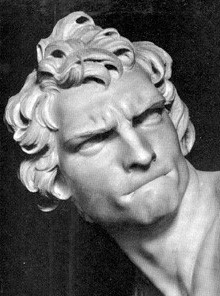
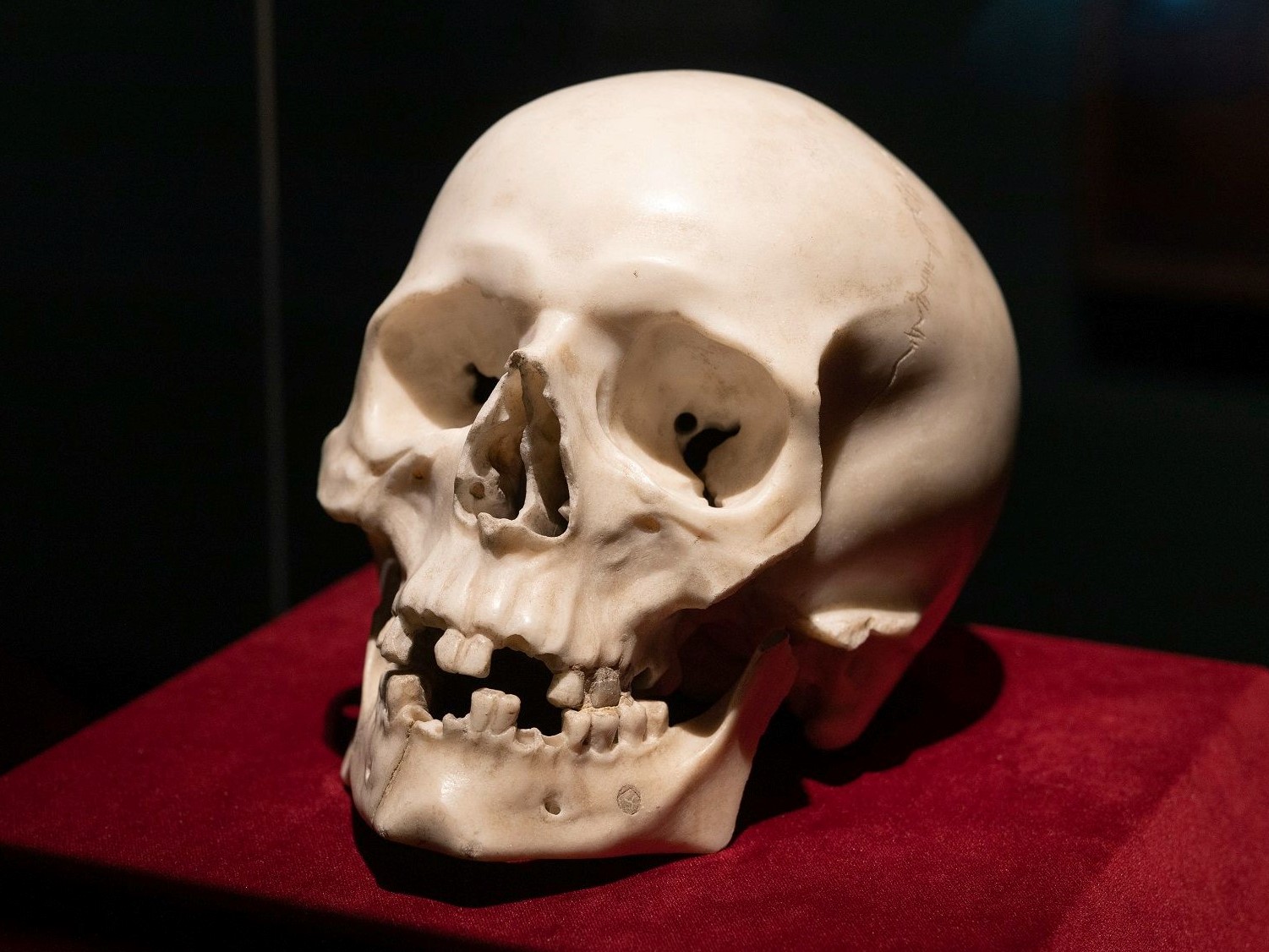
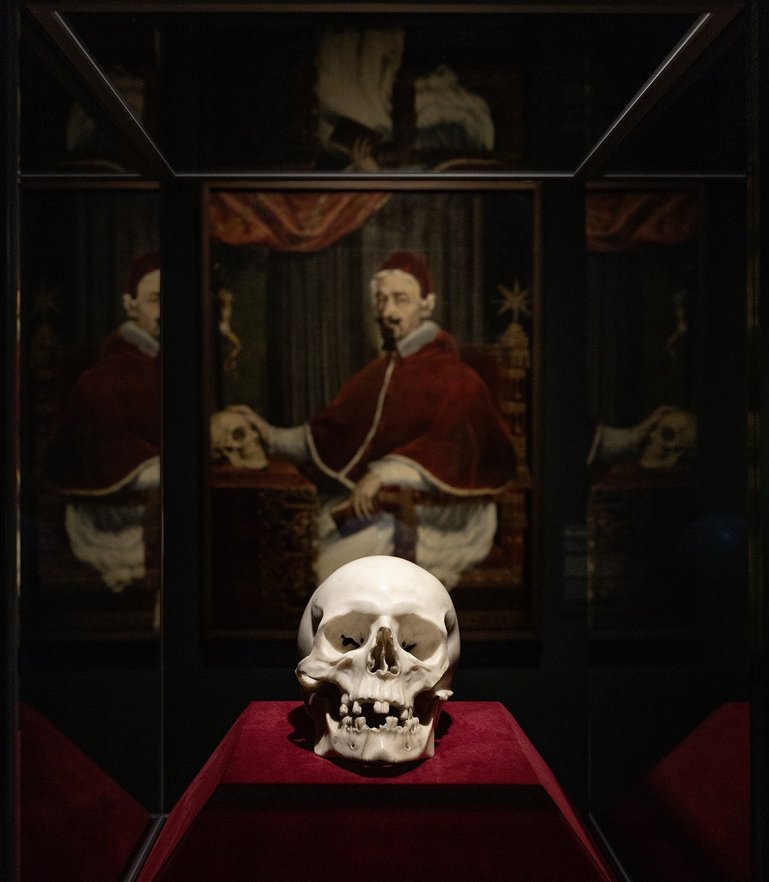
Gian Lorenzo Bernini, Skull, 1655.

It seems like it’s been a while since I wrote anything, but as I’m getting ready to talk again on Monday – the continuation of the series Caravaggio: A life in three paintings – I suppose it’s about time I got my brain in gear. It would make sense to focus on Caravaggio, I know, but I’ve been slightly distracted by a recently discovered sculpture by Bernini. Now, that doesn’t happen very often (I can’t remember it happening before), which is precisely why it was distracting. However, before you get too excited, I should warn you that it’s not his most dramatic work (and there are plenty to choose from), although it is brilliantly carved. It also appears to be entirely ‘autograph’ – i.e. he carved it himself. The question of originality is complex, but somehow we now have the feeling that artists should make all of their own work (this was not always the case with Rodin, for example, whose work I will discuss this coming Wednesday – for more details, see the diary). However, it would not have been possible for Bernini to execute all of the projects commissioned from him. These included sculpture, yes, but also architecture, and even, occasionally, painting. As a result he had a large workshop to help him out. Even the notoriously solitary Michelangelo had people helping him from time to time, but there were never that many – he rarely trusted others to get things right – and that is just one of the reasons why so many of his works remained unfinished. The fact is, in these cases, the artist knows exactly what the work should look like, and it is the assistant’s job to make sure that they recreate the master’s intentions with precision. But, as it happens, that is not the case today. For personal and political reasons, it seems likely that Bernini carved the work himself.

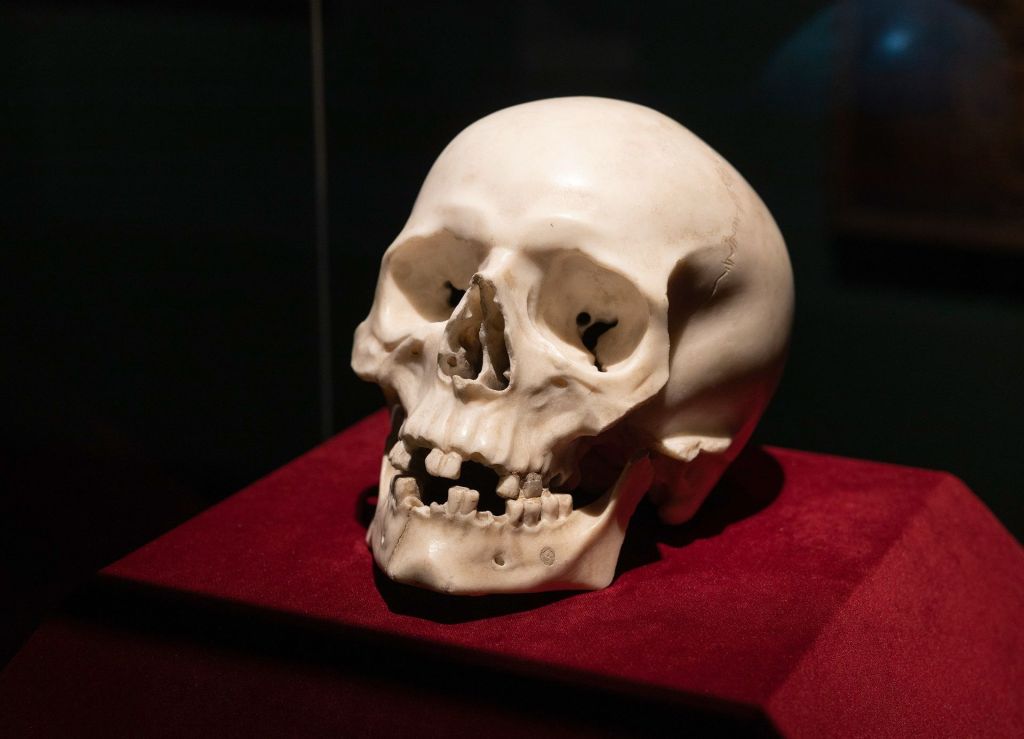
Die Sonderausstellung Bernini, der Papst und der Tod am 28.05.2021 in der Gemaeldegalerie Alte Meister von Staatliche Kunstsammlungen Dresden in Dresden. Foto: Oliver Killig

Now, if I didn’t know that this was carved out of the best carrara marble, and given that we are looking at a photograph, rather than the original, I think I would assume that this was not a sculpture, but a real skull. But then, I’m am art historian, not an anatomist. Indeed, it is probably because it is such a careful, naturalistic rendition – with no obvious stylistic traits, or period ‘flare’ – that it disappeared under the radar in the first place. The skull is currently being exhibited at the Ge,mäldegalerie Alte Meister – the ‘Old Master Painting Gallery’ – in Dresden, as part of an exhibition entitled ‘Bernini, the Pope, and Death,’ and it will be there until 5 September. Sadly I won’t get to Dresden until after the exhibition has ended, so I will miss the skull. Until now it has lived (if that word is appropriate) at Schloss Pillnitz, on the Elbe. Once out in the countryside, Dresden has expanded, and the Schloss now finds itself on the edge of the city, and easily accessible by public transport in about 50 minutes, so maybe I’ll try and make my way over there. The sculpture has been on display for years but nobody knew what it was. It had been included in the archaeological collection, where none of the curators would be likely to guess at its origins. However, when looking for illustrative material for an exhibition on Caravaggio, the art historians took over. Seeing the skull out of its display case made them realise precisely how impressive a piece of carving it was – and they decided to try and track down its provenance. They worked out that it had been part of the Chigi collection, which was acquired in 1728 by the Elector of Saxony, and King of Poland, Augustus the Strong, one of the world’s most impressive collectors. Apart from anything else, some of you may remember that he had no less than 157 pastels by Rosalba Carriera, all of which were exhibited in one room. Given that the collection, as bought, included 164 classical sculptures and a mere four from the Baroque, it is not surprising that the skull did not, for some long time, receive the recognition it deserved. When planning the Caravaggio exhibition, one of the curatorial team even joked, when they had found out that it came from Rome, that it could have been carved by Bernini. But you can’t just pull names out of a hat, and in order to find out who the true author really was – and, from my experience, with no expectation of ever finding out – they started scouring the archives. Among the correspondence which preceded the sale of the collection they found the phrase, ‘Una celebra testa di morto, opera del Cavalier Bernini’ – ‘A famous death’s head, the work of the Knight Bernini’.

The Chigi collection had remained with the family, having been put together by one of the nephews of Pope Alexander VII (Fabio Chigi). Further research revealed that the pope had commissioned the skull directly from Bernini in 1655, shortly after he was elected. Bernini worked under eight different popes, but not all of them were great patrons of the arts – or for that matter, interested in his work. Alexander VII’s predecessor, Innocent X (Giovanni Battista Pamphilj) had not been a great fan, and consequently, with a commission from the new pontiff, Bernini jumped to it and carved the skull himself, rather than handing a model to one of the assistants and letting them get on with the hard graft: it would be good to make the right impression. This choice paid off: Alexander VII turned out to be one of Bernini’s most ardent admirer’s and forthcoming patrons. It was not just the skull that Alexander commissioned in 1655 – there was also a life-size sarcophagus. The latter sat under the Pope’s desk, the former on top of it, both constant reminders that death comes to us all. Morbid, you might think, but given that, following the doctrine of Apostolic Succession, the Pope is St Peter’s successor, he is nominally in charge of the Keys to the Kingdom of Heaven. It was in his best interests to remember – and to remind us – that our actions will determine where we go after death. It was also relevant that, shortly after his election, there was an outbreak of the plague in Rome, and death visited every street. Alexander was quick off the mark – he insisted people wear masks, he introduced systems of self-isolation, and made sure people were quarantined. You know the drill. He might even have been painted holding this sculpture.

Guido Ubaldo Abbatini, Pope Alexander VII. with Bernini’s Skull, 1655/56. Sovereign Military Order of Malta, Rome.

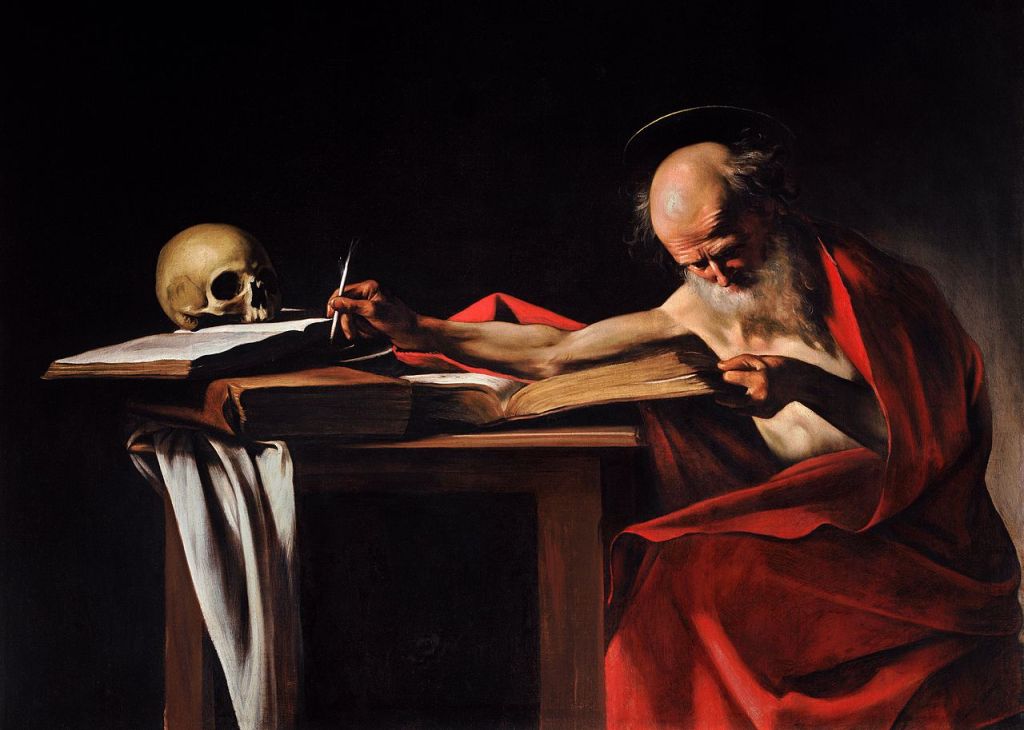
This portrait is by a student of Bernini, Guido Ubaldo Abbatini, and is also featured in the Dresden exhibition. The publicity confidently asserts that the Pope is resting his hand on Bernini’s skull. I haven’t read the catalogue, but I can only assume that it would point out the most obvious difference: the skull in the painting has, as far as we can see from this viewpoint, all of its teeth, whereas the sculpture does not – and I’m fairly sure that that would be clear from any angle. The skull also looks considerably happier than the pontiff himself, but that’s beside the point. I’m not convinced that you can be sure which skull is in the painting, but as I’m also not convinced that Abbatini was an especially observant artist (not that I know his work, I’m only judging by this painting), I don’t suppose there’s any reason to argue that it isn’t the sculpture. However, it could be any skull. After all, people in the 17th Century were wont to hold skulls. Look at Hamlet (1599-1601, first performed 1609). Look at St Jerome (in this case, c. 1605-6).

Caravaggio, St Jerome Writing, c. 1605-6. Galleria Borghese, Rome.

As a scholar, Jerome is associated with the idea of melancholy, just one aspect of his relationship to the skull. In this, one of the most densely packed, and deceptively simple, of Caravaggio’s mature works, that is just one of the ways in which it functions. Another implication is that, after death – as represented by the skull – the soul is free to contemplate higher things, which is precisely what Jerome is doing. It is a reminder that we only have a limited time – and so we (like Jerome) should get on with our work. Or ‘seize the day’, it could work both ways. The skull is also, of course, the seat of the intellect. In the painting we see Jerome hard at work, deep in thought, translating the bible from its original languages into a consistent Latin – the version now known as the Vulgate. There is a wonderful contrast between the dry cranium and the saint’s bald pate, both reflecting the light (representing divine inspiration). One is… well, dry… while the other, slightly oily.  The brilliant light illuminating the aged man’s chest makes his shadowed, arthritic hand, grasping the pages of the original text, stand out clearly, while the other hand holds a quill, hovering over a page nearer the skull, ready to write. The reach of Jerome’s arm, slightly bent at the elbow, echoes the open halves of the book. I have always been in awe of this ineffable metaphor, an embodiment (quite literally) of the act of translation – the writing arm following the form of the original volume, making the old new, and creating a parallel equivalent. The angle of the elbow and book is then inverted by the red fabric behind them, part of the cardinal’s robes in which St Jerome is loosely wrapped. The book lies above the right leg of the table, the skull above its left, and while Jerome, alive, is clad in red, it is a lifeless white fabric that flows down beneath the skull. With its poetry and pathos, naturalistic making and symbolic meaning, contrasts and echoes, rich colour and deep shadows, this painting ranks for me as one of the all-time greats. Sadly I will only have time for a quick nod to it when I return to Caravaggio: A life in three paintings, this Monday, 7 June at 2pm and 6pm – but then, in recompense, I will be spending more time with The Supper at Emmaus which is also up there with the best. And as for Bernini – well, I suspect he always had an eye on the works of the older painter, and in a couple of weeks I will compare them again, although when I do, it will be more directly.
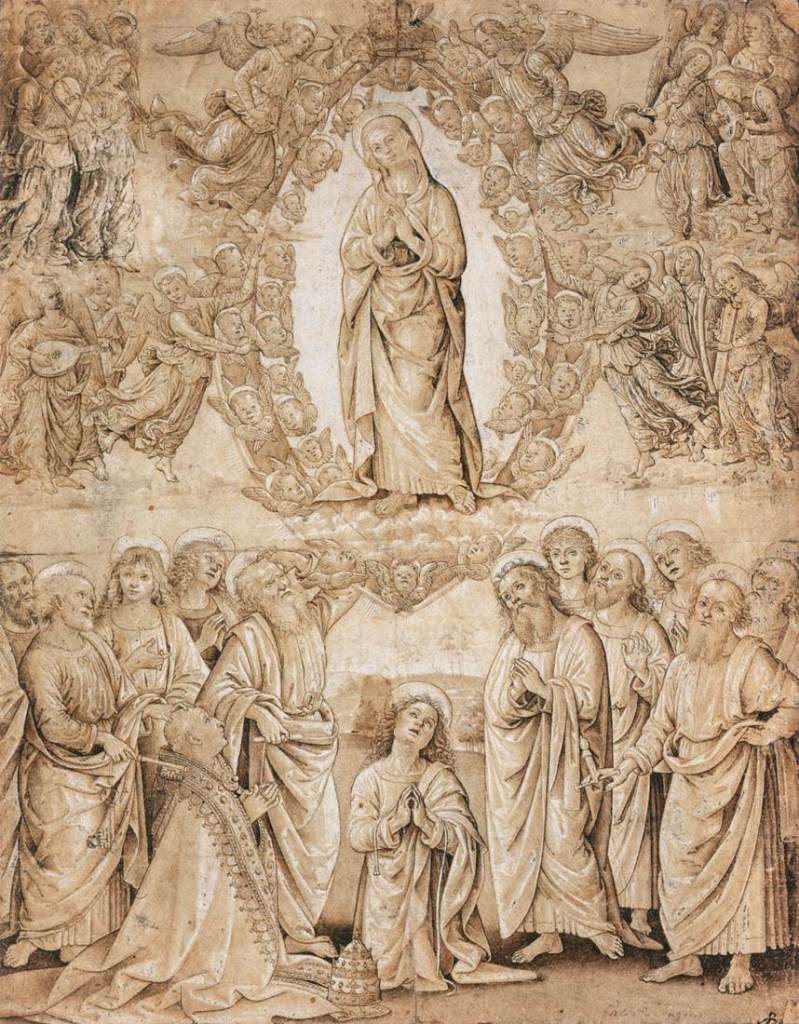
A view of Bernini, The Pope, and Death, in Dresden until 5 September.

130 – Sofonisba and Michelangelo

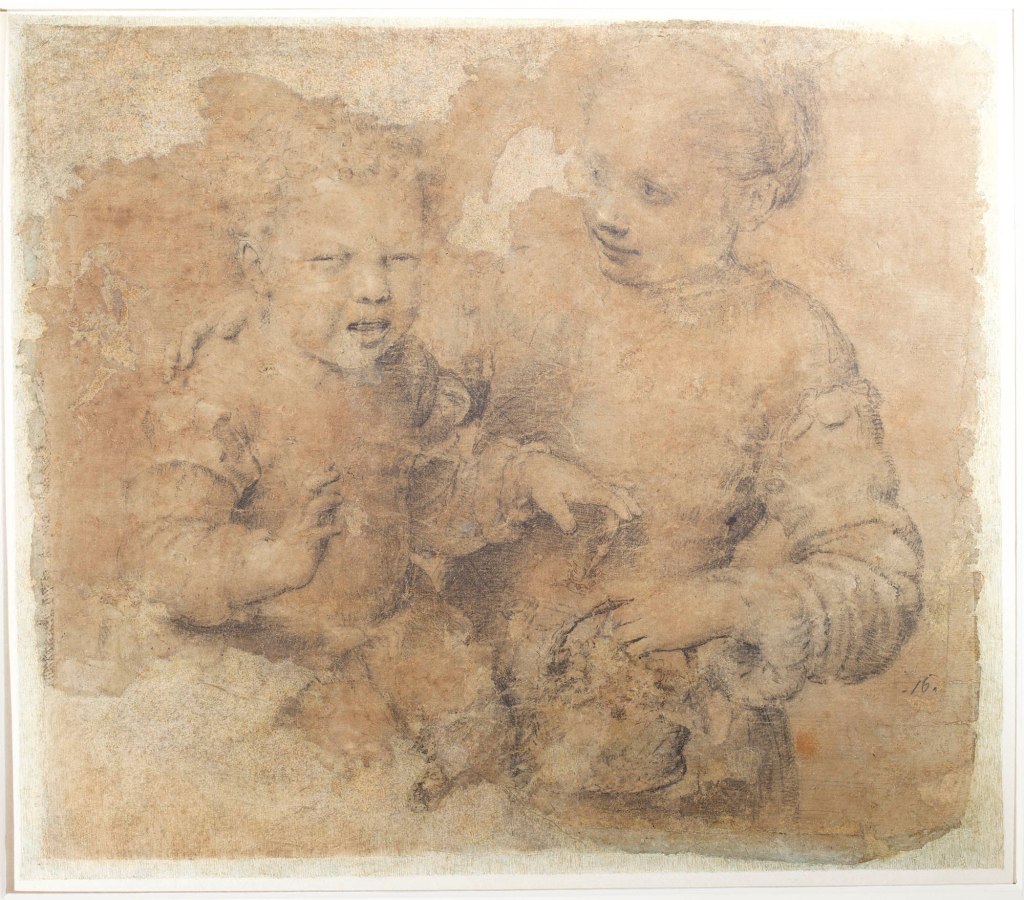
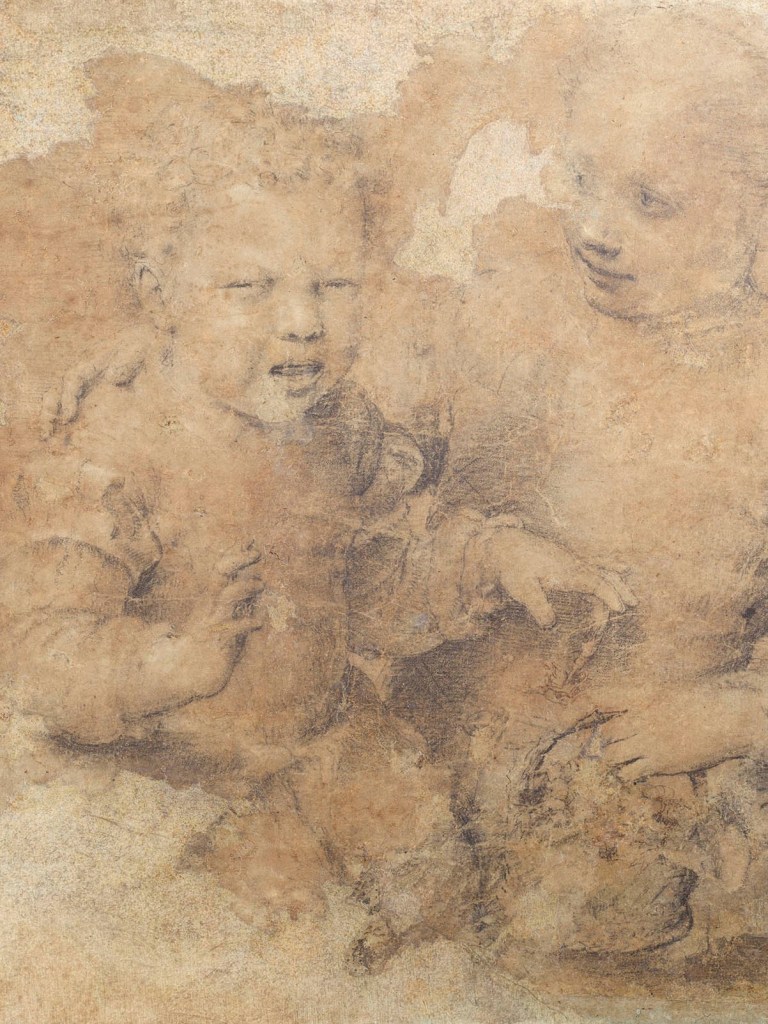
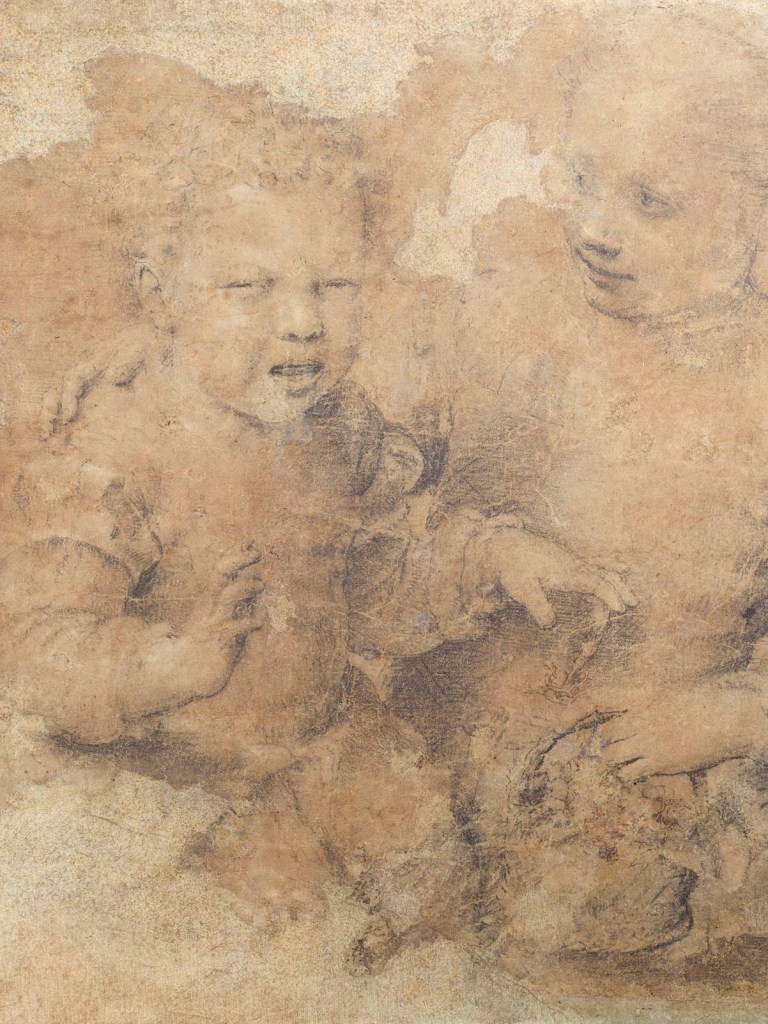
Sofonisba Anguissola, Asdrubale bitten by a Crayfish, c. 1554. Museo di Capodimonte, Naples.

I have talked about Sofonisba before (see Day 77 – Sofonisba Anguissola and Day 90 – Sofonisba, too) but I am being drawn back again – drawn by a drawing, as it happens – because I want to examine a myth and ponder an influence. The myth is about the relationship between the first internationally famous woman of Italian Renaissance art, and the great genius Michelangelo. Almost anything you read about her will say something like ‘In 1554 Sofonisba headed down to Rome, where the story goes that she was introduced to Michelangelo.’ I know that, because that is precisely what I said on Day 90 of Lockdown 1. I also said, in the same post, ‘However, I really need to look into this incident – Michelangelo was a notorious old grump, and the idea that he would be interested in the work of a young woman seems inherently unlikely. However, if it turns out to be true, then how much more remarkable a man he was!’ That was on 16 June last year, and, nearly a year later, I’ve finally got round to it. If you want a reminder, I discussed Sofonisba’s background and her training as an artist back then – I won’t go into it here. I also included this drawing as an illustration, but said relatively little about it. Subsequently I have found a new, post-restoration image which is far clearer, and shows the drawing to be far more delicate, than the photograph I posted last year suggested.

We see a small boy crying. His mouth is open with the lips pulled back, and his cheeks look slightly puffed from the tension. His eyes are screwed up: the emotion is unmistakeable. Drawing this is not as straightforward you might think: it is all too easy to make someone crying look as if they are laughing – and vice versa. Film and T.V. often play on this potential confusion, creating double-takes, where you think you are seeing one emotion, and then are shown that it is the other. But here, we definitely see crying, it is clear from the face, and also from the gestures: the tension in the boy’s right hand, flicked back at the wrist, is one more sign. The left hand seems relaxed by comparison. He has short curly hair, and wears a 16th Century doublet. It has a slashed trim at the shoulders, and wrist-length sleeves which are slightly drawn back to reveal the cuffs of an undershirt, also seen in a modest collar. An older girl has her right arm around his shoulder, and looks at the boy with concern – and a hint of something else. A smile, maybe? Or perhaps she is impressed by the volume of sound this small human can create. Her hair is pulled back from her forehead, above her ears, and is held in place by a plait fixed around the crown of her head. She wears a chemise under a fairly low-cut bodice, with sleeves attached just below the shoulder, and holds something in her left hand.

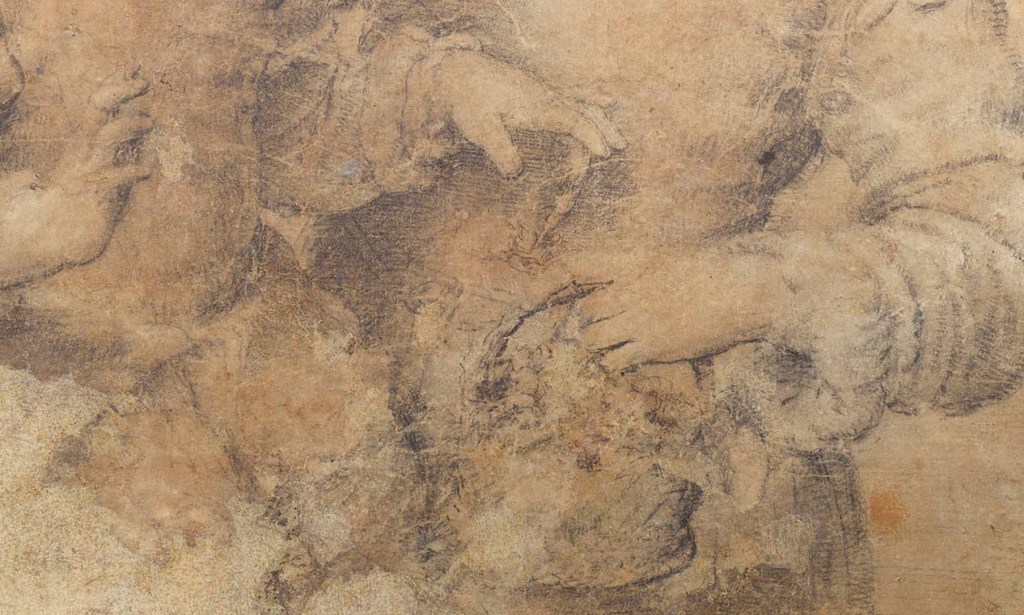
If we look closer, we can see that it is a small basket. Her index finger stretches along the woven handle, and the basket itself, presumably wicker, or similar, can be seen vaguely below. The boy’s left hand hovers above hers, the back of it horizontal, with the thumb and one of the fingers – the ring finger, as far as I can see – hanging down. And from this bent ring finger hangs the crayfish which gives the drawing its title: Asdrubale bitten by a Crayfish. Now, Asdrubale Barca fought in the Second Punic War, and was the younger brother of the more famous Hannibal. They were both sons of Amilcare Barca. But we’re not dealing with classical history here. Even so, after the Carthaginians had crossed the alps with their elephants, one of the notable battles was near modern-day Cremona, where the 16th Century nobleman Amilcare Anguissola lived. He was presumably named after the warrior, and passed on the tradition by naming his only son after the younger of the brothers – Asdrubale – and by naming his eldest daughter (the eldest of six) after the tragic Carthaginian heroine Sofonisba. So the drawing shows us the artist’s brother – and, presumably, one of her five sisters, usually identified as Europa, the youngest.

One of the reasons why the drawing seems more than a little vague in parts is because it is not in a particularly good condition – large areas of the original paper on which it was drawn have been lost. The ground itself is a light, creamy brown. In order to strengthen it, the remains of the drawing have been mounted on another piece of paper, which is paler in appearance, and looks mottled. If you can distinguish these two background colours, then you will see that everything beneath Asdrubale’s right elbow is missing, as are half of the skirts of his doublet. The original paper ends just above the crown of his head, and cuts across the top of his sister’s, with some of her hair undoubtedly missing. There is also a lacuna between their heads, which goes very close to her right eye. Some of the basket is missing, too. This is a great shame, but given the high proportion of 16th Century drawings which must have been destroyed in their entirety, it is still a remarkable survival – and in all probability it had travelled widely, making that survival even more remarkable.

The story goes – as I was saying – that after her initial training with two ‘Bernardini’ – Campi and Gatti, probably from 1546-49 and 1551-53 respectively – she headed down to Rome, where she was lucky enough to receive instruction from none other than Michelangelo. It seems too good to be true, and is exactly the sort of anecdote that was made up just to make an artist look better, and more interesting. However, in this case it was, in some way, true – although the interaction may have been through correspondence. Letters from dad – Amilcare Anguissola – survive in the Buonarroti archives in Florence. I am quoting them here from an article written by Charles de Tolnay, the chief Michelangelo scholar of his day, back in 1941. So this is old news, it’s just not mentioned much now. On May 7, 1557, Amilcare wrote,

‘…we are much obliged to have perceived the honourable and affable affection that you have and show for Sofonisba; I speak of my daughter, the one whom I caused to begin to practice the most honourable virtue or painting… I beg of you that since, by your innate courtesy and goodness, you deigned by your advice in the past to introduce her (to art), that you will condescend sometime in the future to guide her again… that you will see fit to send her one of your drawings that she may colour it in oil, with the obligation to return it to you faithfully finished by her own hand… I dedicate Sofonisba (to you) both as a servant and daughter…’

A second letter, written just over a year later (15 May 1558), includes the following:

‘…I place among the first of so many obligations that I owe to God, that I am alive during the lifetime of so many of my children and that such an excellent gentleman, the most virtuous above all others, deigns to praise and judge the painting done by my daughter Sofonisba.’

So there we have it – I was entirely wrong: Michelangelo had not only seen Sofonisba’s work, but also praised it. How happy I am to know that! It doesn’t change my opinion that Michelangelo was, undoubtedly, ‘a notorious old grump’ – from time to time – but he was also, undoubtedly, generous with his time and advice – as de Tolnay goes on to say: ‘The correspondence between Amilcare Anguissola and Michelangelo… presents new evidence for the generous character of the artist’.

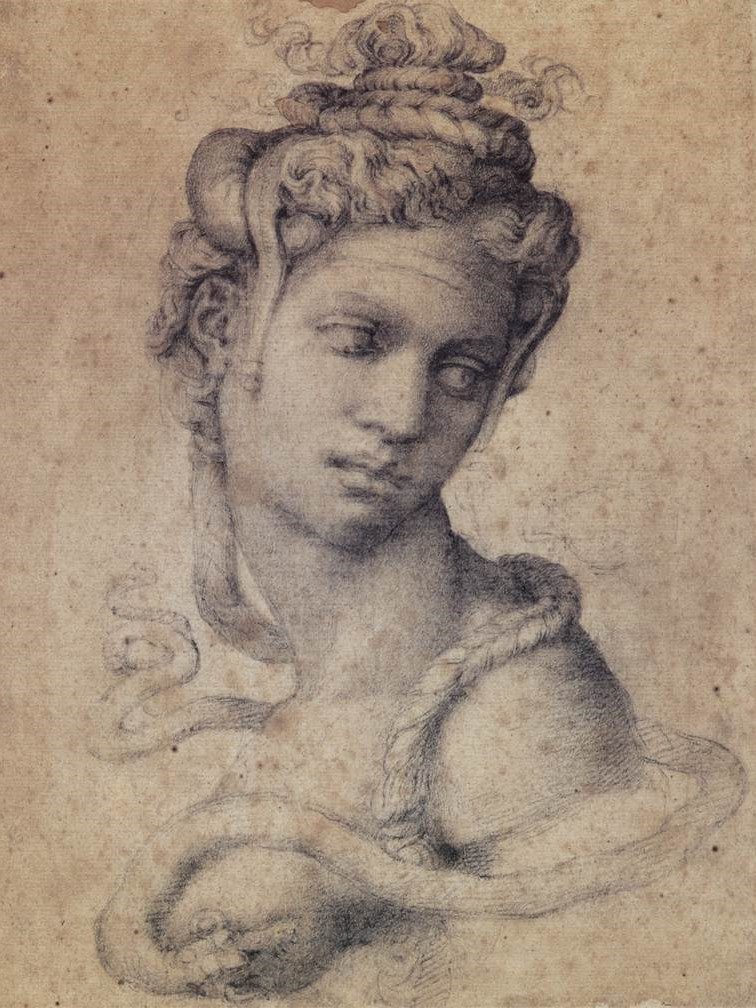
But does the correspondence have any bearing on this particular drawing? Well, yes, it does. Indeed, in some respects, it was well known for a drawing of its time. There is a reference to it in a letter from Tommaso de’ Cavalieri, the young nobleman with whom Michelangelo seems to have fallen helplessly in love some 30 years before. On 20 January, 1562, Tommaso sent two drawings to Cosimo de’ Medici, who at that point was Duke of Florence (he would become Grand Duke of Tuscany seven years later). One of the drawings was a Cleopatra by Michelangelo, and the other – well, in a letter accompanying the two drawings he wrote,

‘since I have one drawing done by the hand of a noblewoman of Cremona, named Sofonisba Angosciosa [sic], today a lady of the Spanish court, I send it to you with this one and I believe that it may stand comparison with many other drawings, for it is not simply beautiful, but also exhibits considerable invention. And this is that the divine Michelangelo having seen a drawing done by her hand of a smiling girl, he said that he would have liked to see a weeping boy, as a subject more difficult to draw. After he wrote to her about it, she sent to him this drawing which was a portrait of her brother, whom she has intentionally shown as weeping. Now, I send them such as they are, and I beg your excellency to consider me as a servant, which, in truth, I am.’

What a wonderful combination of drawings! A pairing of people being bitten, moving from the mundane to the mythic. It seems that Sofonisba’s family name – Anguissola – was difficult even then, and I find it rather charming that Cavallieri’s spelling implies that she was ‘anguished’ – the literal translation of Angosciosa. His comment that the drawing shows ‘considerable invention’ was high praise indeed. No one doubted a woman’s ability to copy someone else’s ideas: it was the ability to come up with your own that would be respected, and so his use of the word ‘invention’ was a recognition of Sofonisba’s artistic talent. Cavalieri’s letter is not the only mention of the drawing. Vasari was also knew it, describing it as, ‘a little girl laughing at a boy who cries, because, she having placed a basket full of crayfish in front of him, one of them bites his finger; and there is nothing more graceful to be seen than that drawing, nor more true to nature.’ These comments were included in the second edition of the Lives of the Artist in 1568, as an addition to the ‘Life’ of Properzia De’ Rossi, the only woman to get her own ‘life’ in the first edition of 1550. Vasari goes on to say that he has a copy of the drawing in his own collection – so he must have thought highly of it.

Somebody else seems to have been impressed by this drawing – or at least, by the idea of it – and this is what reminded me to look into the story of Michelangelo and Sofonisba. Compare these two images:

The Boy Bitten by a Lizard will, of course, be the starting point of Caravaggio: A life in three pictures this Monday, 24 May at 2pm and 6pm. It bears a remarkable similarity – in some details – to Sofonisba’s drawing. The precise cause of the pain may be different, perhaps, although both boys have been bitten. A lizard, hiding among the cherries, has bitten the boy reaching for the fruit. The expression of pain, the flexing of one wrist and the bent finger of the other hand – held on an equivalent horizontal – are remarkably similar, even if the hands are reversed. There is only one problem with that. In the 17th Century Sofonisba’s drawing could still have been in the Medici collection in Florence. I have read different ideas about how the drawing got from the Medici collection to that of the Farnese, but there is no evidence that Caravaggio had been to Florence. However, it could have been in the collection of Fulvio Orsini in Rome in the 1590s. But even if Caravaggio hadn’t seen the original drawing, that is not necessarily a problem. One theory has it that the painter was surprisingly literate, and that he often attempted to reproduce images of which he had only read descriptions but never seen (more about that on Monday). In this case, he would have read about the drawing in Vasari’s Lives. However, the response to the pain seen in the two hands and wrists is so similar, it does seem likely that he had seen some visual evidence of it. If Vasari had a copy of the drawing (OK, so some people think that he had the original), maybe there were more in circulation. There are, as it happens, several painted versions of Sofonisba’s composition around: as I say, it was a well-known drawing. It has been suggested that one of the versions – drawn or painted – found its way into the studio of the Cavaliere d’Arpino, one of the first artists with whom Caravaggio worked in Rome. It seems unlikely that we will ever find out precisely what the connection between the two is – or indeed, if there really is one. Maybe this similarity is a coincidence. Maybe this is simply how boys behave when they’re bitten when they’re young – or when they forget the conventions that suggest that ‘real men don’t cry’. But that opens up a whole new topic of conversation better suited to a different forum, and I’m certainly not going to go into it now. So, until I come back to the young Caravaggio on Monday, have a great weekend – and don’t play with your food. Some of it bites.

129 – The Calm before the Storm

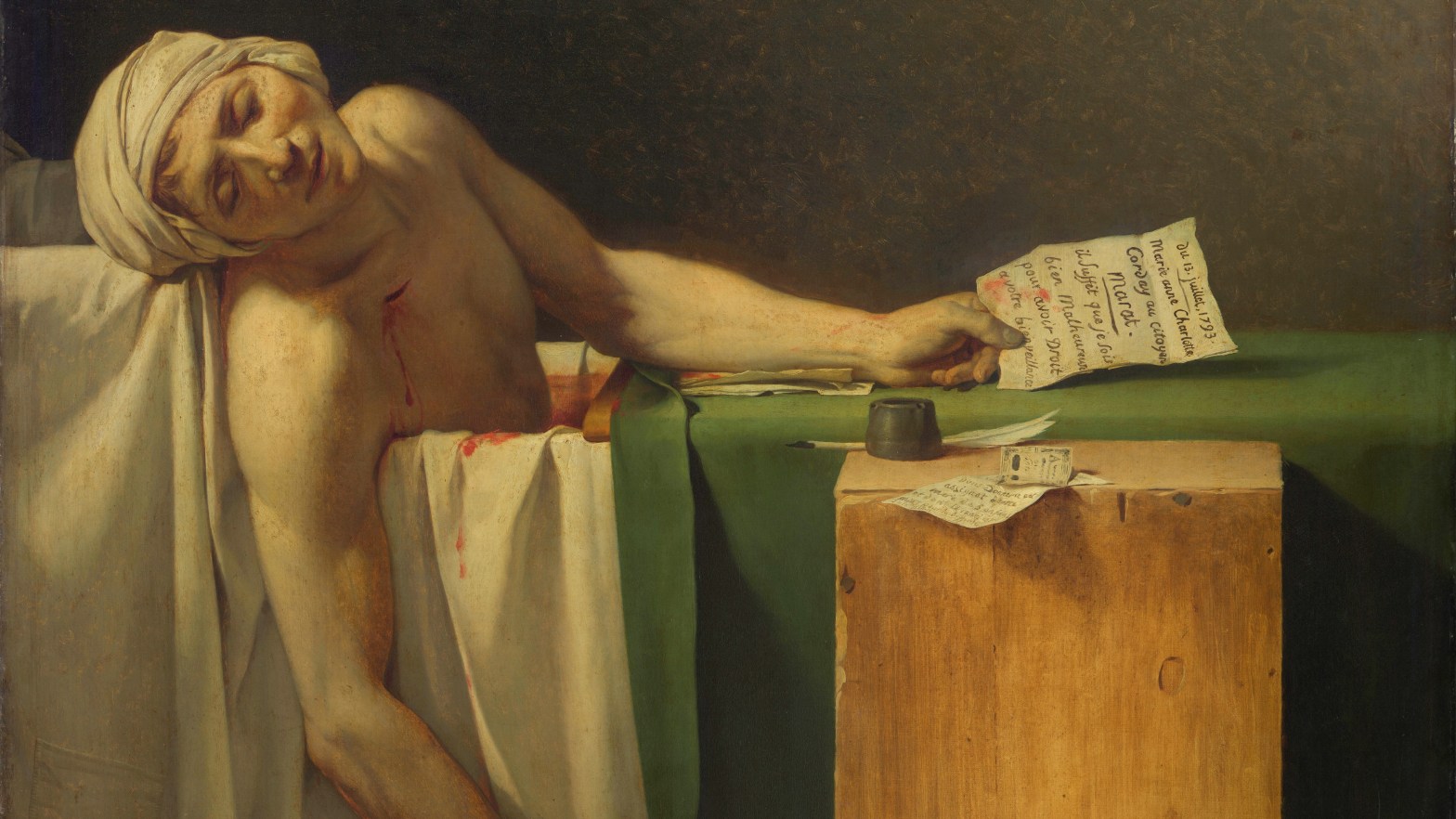
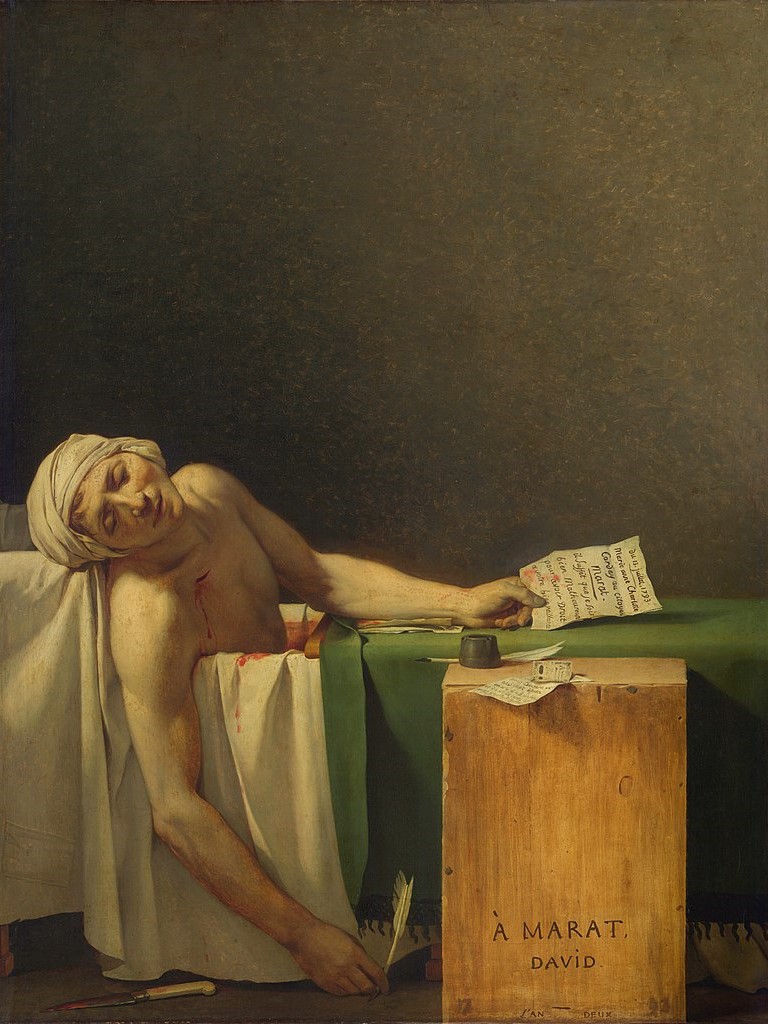
Jacques-Louis David, The Death of Marat, 1793. Royal Museum of Fine Arts, Brussels.

One more painting from the 18th Century before I head back to the Baroque – my next series of lectures is called Caravaggio: A life in three paintings, and will start on Monday 24 May (at 2pm and 6pm, as before) with the following talks on 7 and 21 June. Full details are on the diary page… and while you’re there, you can also find the updated details for trips to Rome, Stockholm, Ravenna and Dresden. But more of Caravaggio later – let’s get back to the 18th Century.

This is one of the great paintings of Western Europe, and it’s worth going to Brussels just to see it. It was painted by Jacques-Louis David – the High Priest of Neo-Classical painting – just as things were rapidly going from bad to worse with the French Revolution. Although it is not immediately apparent, we are looking at a man lying in a bath. This is Jean-Paul Marat, journalist, political thinker, and revolutionary, who suffered from a skin disease, and spent hours working in his bath as this was the only place where his symptoms were mitigated. However, true to the ideals of ‘noble simplicity and quiet grandeur’ on which Neo-Classicism was founded, David does not show us the effects of this illness: it would distract from the gravity of the scene, and the dignity of its protagonist.

The bath is surrounded by white sheets, and a board, just visible near Marat’s chest, rests on its sides, with a green, fringed rug lying over it. This functions as a desk, with the addition of a rough, wooden box on which are placed an inkwell, a quill pen and some papers. Marat, dying, if not already dead, holds a blood-stained piece of paper in his left hand. His right arm has fallen, and another quill is held in his right hand, as if he is about to write on the floor. To the left of his hand lies a bloodied knife.

The writing on the paper is clear enough to read:

du 13. Juillet, 1793. Marie anne Charlotte Corday au citoyen Marat. Il Suffit que je sois bien malheureuse pour avoir Droit a votre benveillance.

13 July, 1793. Marie-Anne Charlotte Corday to citizen Marat. Because I am so unhappy I have a right to your help’.

With this letter, Charlotte Corday gained access to Marat, who was at work in his bath, and then she stabbed him. They were both revolutionaries – although they were members of different factions. He was one of the Montagnards – one of its leaders, even – whereas she was a Girondin (although some believe she was an out-and-out monarchist). The difference between the factions was in approach. The former were hard liners, they wanted a Republic, and they wanted the king dead. The latter also wanted a Republic, but did not vote for the death of the king, and balked at the extreme tactics of the Montagnards. We are on the brink of the Reign of Terror, when the Girondins would be put to death, and then, soon after, the Montagnards would turn on their own. As a journalist and pamphleteer, Marat published his own writings, and was one of those most responsible for communicating the aims – and the propaganda – of the revolutionaries, and also for denouncing the Girondins. He might also have been the man chiefly responsible for the September Massacre of 1792, when over a thousand prisoners were put to death for fear that they might join the Royalist army in defeating the Revolution. Of this number, there were admittedly 200 Swiss soldiers, but the majority of those killed had no real interest in, or connection to, the politics of the day. It was because Corday believed Marat was responsible for this excess that she wanted him dead, and used her letter to get access to him, claiming that she knew about a counter-revolutionary plot amongst the Girondins. It was this, she claimed, that made her ‘so unhappy’.

David’s painted may be naturalistic, but it is not a realistic portrayal of events. This is not how things happened. Corday stabbed Marat, yes, but she left the knife in his chest. Here we see it lying on the floor, blade and handle both bloodied. The quill sits upright between Marat’s fingers, almost as if planted in the ground. He was working for the Revolution when he died – and that was the message David wanted to communicate: he was a good man, working for you. An ardent believer in the Revolution, David had voted for the King’s death. He also voted to close the Académie Royale de Peinture et de Sculpture – but that might have been a personal vendetta, as they had never been his greatest allies. He dedicated the painting ‘to Marat’ and added the date L’AN DEUX – ‘Year Two’. The monarchy had been abolished in 1792, and a Republic declared: this was year two of that Republic.

Stepping back we might – if we know the story – see another ‘edit’. Charlotte Corday stabbed Marat, left the knife in his chest, and waited by the bath until she was arrested. She did not leave. And yet David has focussed on Marat: there must be no distraction. The wooden box acts almost as a tomb stone, a bold statement of this man’s name, and witnesses how little time he had had to achieve his aims – it is only year two, after all. With the knife on the floor, we can see the wound in his chest, blood trickling down towards the white sheet. It might remind you of someone else whose chest was pierced.

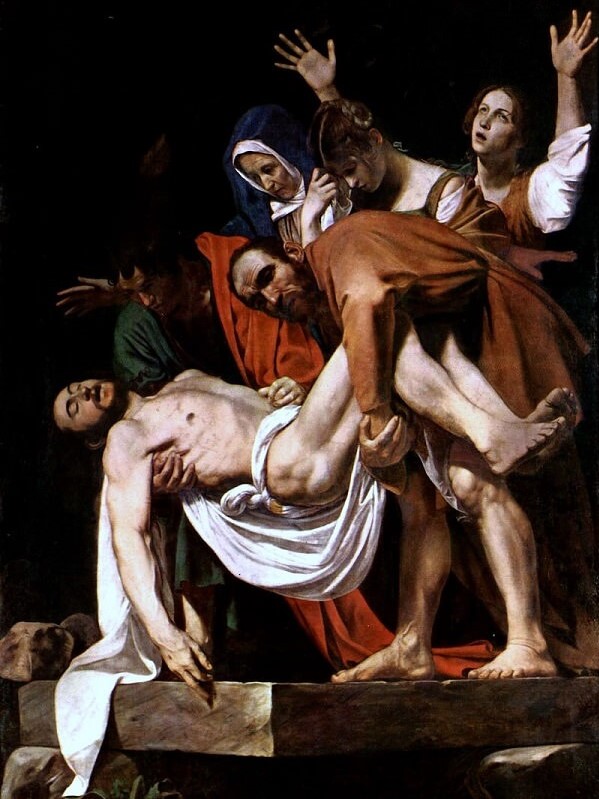
The similarity to Christ in Caravaggio’s Entombment is not coincidental. David, as the Revolution’s chief artist during the brief Republic, not only knew the power of painting, but also wanted to find new martyrs to inspire the people, and to reaffirm their faith in the machinations of political change. Marat was that martyr, and portraying him on this canvas, alone and at work, was a powerful and easily comprehensible masterstroke. Caravaggio echoes the fall of Christ’s arm with the tumbling shroud, and David echoes the shroud with the sheet in Marat’s bath.

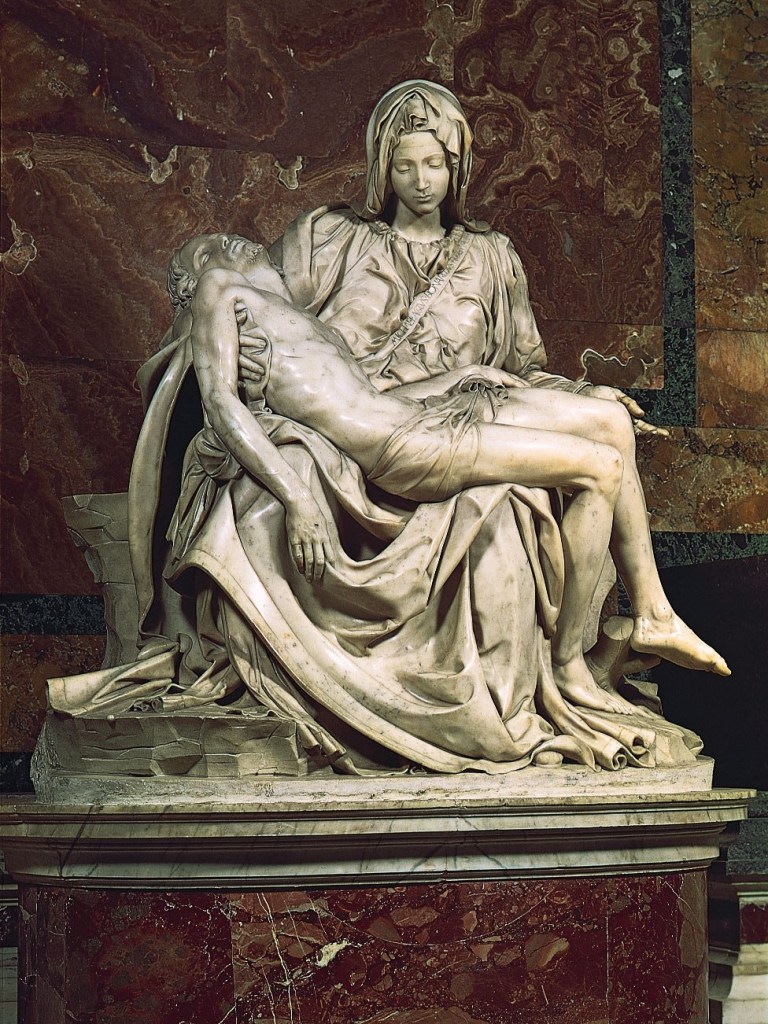
The fact that Caravaggio’s Christ depended from Michelangelo’s Pietà is also not a coincidence. As Mary shows us her dead son, David shows us the Revolution’s dead saviour. Marat did not have the time to fall from grace and be murdered by his own, unlike Robespierre soon after. How much more, David asks, not knowing what would follow, could he have achieved? For Michelangelo the pathos lies with Mary: no mother should see her son die before her. For David, it is the bath. The bath cradles him. Murdering a sick man in his bath can only be seen as an act of cowardice.

The light, entering from top left (much as Caravaggio’s light often does), enhances the ideal, sculptural form of Marat’s body, and imbues it with an ethereal glow. There is even the suggestion of a halo in the white headdress. But no angels fly down with a palm of martyrdom, as one does in Caravaggio’s Martyrdom of St Matthew, for example. Heaven is empty now, and the cool, grey background adds an oppressive solemnity to the scene, insistently focussing our attention on the inert body of this idealised man, on the white sheets sullied with his blood, on the sheet of paper, sullied with Corday’s lies, and on the fallen quill, Marat’s weapon of choice, which can no longer issue its compelling ‘truth’.

Such, it would seem, was the intention. Odd then that, once the Revolution had wrung itself dry, David should become court painter to the Emperor Napoleon. As a Revolutionary, though, and then a Son of Empire, it was not surprising that he should choose to go into exile after the Restoration of the Monarchy – even though he granted an amnesty, and offered the position of court painter to the new regime. He spent his last years – although less than a decade – in Brussels, dying there in 1825.

The Death of Marat was supposed to be one of three ‘Modern Martyrs’ – a second was destroyed in 1794, and the third was never completed. David reclaimed Marat in 1795, two years after it was painted. After Robespierre’s execution it didn’t have the same impact. The painting was still with his family as late as 1886, which is when they decided to give it to the city which had welcomed the great artist – if complex personality – as an honoured guest. That is why it is in Brussels to this day. I enjoyed seeing it last February, as rumours started to reach us of troubles in Italy – and a curious phenomenon called ‘lockdown’ – and I will certainly seek it out again. Whatever the reasons for its making, it communicates a profound sense of calm. Its echoes of Caravaggio have also inspired my next talks: I am looking forward to investigating the life of this remarkable artist through the National Gallery’s three paintings, each one representative of a different phase in his short life. I will probably also be blogging around the subject – Caravaggio and the Caravaggisti – over the next couple of weeks. But that remains to be seen.

128 – Unfinished Business

Johann Zoffany, The Academicians of the Royal Academy, 1771-72. Royal Collection Trust.

Two weeks ago I talked about Mary Moser, one of the two women who, in 1768, were founder members of the Royal Academy. Today I would like to talk about a portrait of her, which hangs next to another, which depicts her fellow founder Angelica Kauffman (who will be the last of my Three Women in the 18th Century this Monday (10 May) at 2pm and 6pm). They are not ‘real’ portraits, but details from a larger painting by Johann Zoffany, which is the nominal subject of this post. Angelica Kauffman is on the left – the rectangular canvas – with Mary Moser on the right, in an oval. The two still life paintings I discussed before (126 – Mary Moser) were also oval: I wonder if that is why the same format is used here? She was, as you may remember, famed for her flower paintings, which certainly explains why she has a large, yellow bloom attached to her bodice in Zoffany’s imagined portrait. In both, the bust-length image appears against a plain background. It might have become more elaborate: neither portrait has been completed. Today we are dealing with unfinished business.

Despite the fact that both paintings are ‘works in progress’, we can see that the two women are fashionably dressed, and elaborately coiffed. If I knew more about the history of hair I would probably go into raptures about the complexities of the crimping, curling, combing and powdering, and of the ribbons and bows with which they are bedecked, but I don’t – so just look for yourselves. Their barnets alone are a work of art (from Barnet Fair – hair), and could be a credit to one of the greater sculptors of the newly founded Royal Academy of Art, which is where they are supposed to be. For years it was assumed that what follows is a depiction of the Life-drawing Room in the first home of the Academy, Somerset House (now the home of the Courtauld Institute), but it is, in all probability, the invention of the artist, who was simply imagining a space suitable for such an august gathering.

Founded by George III in 1768, the Royal Academy of Art was the first British art school to receive the royal seal of approval. The idea was to promote the arts, and to train artists to be worthy of its status. Rather than just portraits of the great and the good, and of their land (i.e. landscapes), several of the Academicians, and especially its first President, Sir Joshua Reynolds, wanted British Art to aspire to the heights achieved by that of other nations. To realise their ambitions, not only should artists show an awareness of the work of others but they should also paint the highest category of painting – ‘History’. This was a narrative work, which could be based on history (usually classical), but which was more often inspired by myth (always classical), the bible, or the lives of the saints. And if what was commissioned didn’t match up to these exalted standards, the artists would just have to make sure that it did. Reynolds often based his portraits on the works of others, dressing sitters like mythological heroes, or theological virtues, for example. Zoffany does something similar here, basing the composition of his group portrait on one of the greatest works by one of the most famous renaissance artists.

Raphael’s The School of Athens (1509-11) in the Vatican Palace shows the major philosophers of the ancient world gathered together in one space, with Plato and Aristotle at the very centre, framed by the distant arch, wearing red and blue cloaks respectively. The other thinkers are arranged in a broad arc, a c-shape traced out on the floor, or a circle left open at the front to encourage us to look in. The image is flanked by two enormous sculptures of Apollo and Minerva, both inspirers of the arts, at top left and right, with smaller, square reliefs below.  Zoffany likewise arranges his academicians in an arc, although he doesn’t pull them so tightly together in the foreground. Almost all of the founder members are here, the most notable absence being Thomas Gainsborough. Zoffany also displays a number of casts of classical and renaissance sculptures on shelves and hanging from the walls at the back. In addition, there is an écorché figure – a sculpture of the human body with the skin removed to show the muscle structure – in the back right corner of the room: it stands against the wall with one arm raised.

Whereas for Raphael the incomplete building (not unlike the ‘new’ St Peter’s, under construction at the time) allows daylight to flood in, for Zoffany there is a single chandelier – or rather, a multiple oil lamp – hanging from the ceiling. Using a single light source like this serves to illuminate the models who are preparing for the life drawing class, while also casting deep shadows on the other side, thus enhancing their sculptural forms.

At the centre, in the place of Plato and Aristotle, on either side of a rectangular relief not unlike those in The School of Athens, are Sir Joshua Reynolds, the first President of the Academy, and William Hunter, who was not actually an artist. He was physician to Queen Charlotte, and served as the professor of anatomy at the Academy from 1678-82. He is also connected to the history of art through his own personal collection – which was, admittedly, mainly in the field of Natural Sciences – which he eventually bequeathed to the University of Glasgow where he had studied (he was born in East Kilbride, just 8 or 9 miles away). This collection forms the nucleus of the Hunterian Museum and Art Gallery.

Reynolds wears sober black and ostentatiously lifts his ear trumpet. He had spent two years in Rome in the middle of the century, and while there suffered from a severe cold, which left him partially deaf. Nevertheless, the more cynical suspected him of using the trumpet to draw attention to himself. I can only hope that Zoffany chose Reynolds and Hunter deliberately to stand in for Plato and Aristotle. Quite apart from the fact that they were the ‘leading lights’ of the Academy, Reynolds was always seeking out the ideal, and dressing his portraits in the guise of an unseen image which existed elsewhere, while Hunter, as an anatomist, was totally involved in the evidence before his eyes. This is the implication of the gestures that Raphael gives the ancients: Plato points up to a higher plane, while Aristotle’s level hand gestures to what we see down here on Earth.

Johann Zoffany, the German-born artist who, after ten years in Rome, arrived in England in 1760 at the age of 27, shows himself in the left foreground, palette in hand, looking out towards us. In some ways he takes the place of Pythagoras, kneeling, tablet in hand, in the left foreground of The School of Athens. Just above him, his left knee raised, while he simultaneously looks over his right shoulder, is Benjamin West, who would become the second President of the Royal Academy (we saw him ‘enthroned’ in the centre of Henry Singleton’s painting two weeks ago). He is leaning against a curving desk, which arcs around the back of the room, and which would have been used by the students when they came to draw. His complex pose is ultimately derived from the Michelangelesque exaggeration of contrapposto which Raphael gives to the philosopher sometimes identified as Parmenides, thought by some to be a ‘hidden’ portrait of Leonardo da Vinci as well. Behind West – with his head just to the right of West’s wig – is Tan-Che-Qua, a Cantonese sculptor who just happened to be in London when Zoffany was painting, and whose image was not to be missed.

On the other side of Zoffany’s work we can see what is taking up most people’s attention: two naked – or nearly naked – men. A life drawing class is being set up, even if precious few of the Academicians seem prepared to participate. Sitting with his legs extended on the left of this detail, Charles Catton the Elder, a painter (no, I hadn’t heard of him either) echoes Diogenes, sprawled across the floor to the right of centre in The School of Athens. The academicians all look towards the model raising his right arm while someone hooks it into a sling – so that the model can keep his arm up for the duration of the drawing exercise. That ‘someone’ just happens to be George Michael Moser, father of Mary – although I’m afraid to say I have beheaded him in this detail. The model who is ‘next up’ is sitting a little closer, and looks out towards us as he takes off his left stocking. His shoes and clothes lie abandoned on the floor next to him. Holding one ankle as it rests on the opposite knee, he adopts the pose of the Spinario, a classical Roman bronze of a boy taking a thorn from his foot.

The painting tells us everything that the Royal Academy thought that a good artistic training – in whatever discipline – should include: a knowledge of the classical past – seen in the plaster casts, and embodied in the pose of the Spinario; a knowledge of the works of the Old Masters (not only is the composition based on The School of Athens, but the figure standing on one leg in the centre of the back wall is a version of the Mercury by Giambologna); the use of sculptures to draw from, as a starting point – suggested first by Alberti in On Painting, written in the 1430s; a good knowledge of human anatomy, expressed through the presence of William Hunter, and of the écorché figure in the back corner; and, ultimately, life drawing. Without an understanding of the male physique, gained by careful observation, how could any promising artist master History painting, and its depictions of the righteous battles and noble acts of mythological and Christian heroes? But if life drawing was essential to become a great artist, what chance did women stand? How appropriate would it be for a woman to be present while such an exercise was takiing place? While it may have been acceptable for men to draw naked women, the women in question were usually little better than prostitutes, or actresses. But for a respectable woman to behold a naked man? Clearly this was not on. The attitude that this apparent regard for female decorum represents is embodied, I think, in the action of miniaturist Richard Cosway, who stands in the right foreground, proudly erect, his gaze directed firmly over his right shoulder and his right arm extended, with the hand resting on his walking stick… which is firmly planted on the truncated and supine bust of a classical female nude. Am I mistaken in seeing this as profoundly disrespectful?

The women are side-lined. They cannot be present at the life drawing class, so they cannot become great artists, and Zoffany can only include Kauffman and Moser as portraits, hanging on the wall. They become, as women had always been, the subjects of art, rather than the creative people who make it. And not only that – they are unfinished, incomplete. They owed their position as founder members of the Academy to their brilliance as artists, but their connections undoubtedly helped. Moser’s father was, as we have seen, also a founder member. Angelica Kauffman was a personal friend of Sir Joshua Reynolds. But their admission was, like these portraits, unfinished business: after them, no other woman was admitted until Dame Laura Knight became an Academician in 1936. She was the first woman to be elected, and that wasn’t until 168 years after the Academy had been founded.

You could argue, of course, that Zoffany didn’t have a choice. If he wanted to paint a life drawing class – which would not only show off his skill, but also demonstrate everything in which the Academy believed – it really wouldn’t have been right, at the time, for a woman to be present. However, the fact that Henry Singleton included both of these women in his group portrait The Royal Academicians in General Assembly – a meeting they did not, in reality, attend – shows that it might have been possible for them to be included in person (although admittedly nobody at the Assembly was naked). But Singleton also depicted their paintings, which speaks of a great degree of respect for the women and for their work. As it happens, the ceiling paintings by Angelica Kauffman – which are visible in their original location in Singleton’s group portrait – have just this week been reinstalled in the ceiling of the Front Hall of Burlington House, the RA’s current home. I will include all four of them this Monday as part of my discussion of Angelica Kauffman: Academician at 2pm and 6pm.

These two women may have been marginalised by Zoffany, and made subjects rather than makers, but maybe that wasn’t his fault. Now, however, the tables have turned. Of all the founder members depicted by Zoffany, they are among the few whose names are becoming better known, and certainly the two in whom people are now more interested. Kauffman in particular embodied the ideals of the Royal Academy more than many others, and in the process created some truly glorious History paintings: she was one of the most famous artists of her day. I look forward to talking to about her on Monday.

127 – Adélaïde Labille-Guiard

Adélaïde Labille-Guiard, Self Portrait with Two Pupils, 1785. Metropolitan Museum of Art, New York.

A slight change of plan – rather than talking about a painting by a man this week, as I had planned to – even if it does impinge upon one of my Three Women in the 18th Century – I wanted to talk about another of the remarkable women who isn’t one of my three subjects. Trust me, there are plenty more! Born as Adélaïde Labille in Paris in 1749, she married Nicolas Guiard at the age of 20, but, unlike most women of the time, she held on to her family name, thus becoming the double-barrelled artist we know (although not nearly well enough) today. And this is despite separating formally from Guiard when she was 30 (they divorced, finally, in 1793 when new laws came in), and later marrying the artist François-André Vincent at the age of 50, just four years before she died.

This is her undoubted masterpiece. We see her seated, at work on a medium-sized canvas, which is resting on an easel at the left of the painting. She fixes her eyes on us with a focussed, penetrating gaze – although the conventions of self portraiture remind us that she is fixing her eyes on herself, looking in a mirror, assessing her own appearance, in order to immortalise it on the canvas placed in front of her. Behind stand the two pupils of the title, fashionably but not showily dressed – like their ‘master’ – one looking towards us/the mirror, the other looking at the work in progress – which we would assume to be the finished painting we are now enjoying. However, as this triple portrait measures 211 x 151 cm, it must be substantially larger than the canvas on the easel.

Let’s start from the bottom up. This detail alone must surely qualify Labille-Guiard as ‘the best artist most people have never even heard of’ – just look at that floor! A highly polished parquet, not unlike the ‘parquet de Versailles’ introduced in 1684, it has rectangles of wood, set so as to look as if they have been woven, framing smaller squares, the whole unit being contained within a diamond (you can see this more clearly in another painting, below). One of these diamonds is set symmetrically within the portrait, with a corner at the front centre of the painting, and two sides leading our eyes diagonally back in both directions, left and right. Placed parallel to these diagonals are the easel on the left, and a stool on the right. The latter is giltwood, upholstered with red velvet, and on it are resting a roll of paper, a pink cloth and a porte-crayon, or, simply put, a crayon holder. The paper would be for preparatory drawings, or perhaps, for pastel paintings. There is an old tradition that Labille-Guiard studied for a while with Maurice Quentin de la Tour, the undoubted master of the art, although there is no firm evidence to support this. Nevertheless, she regularly exhibited pastels – hence the porte-crayon – until the mid-1780s, from which time she increasingly focussed on larger-scale oil paintings. The fabric of her dress is sublime, a steely blue, lined with ivory, the precise width of the hem visible where it lies on the ground, and a seam, as carefully painted as the original was no doubt minutely stitched, falling diagonally towards the front leg of the easel. And – miracle of miracles – the steely blue is reflected in the high finish of the parquet. The toes of one delicately clad foot rest on the cross bar of the easel, catching the light with a brilliant sheen, while the other foot is further back in the shadows.

Her palette rests in the crook of her left arm, which is itself resting on her slightly raised left thigh. Running across her lap is the mahl stick, used as a rest for the painting hand when working on delicate details. No need for that now, though, as she is blocking out some less-detailed area with a broad-handled brush. She holds at least six more brushes in her left hand. Behind the projecting brushes is the lid of a box which can be locked – the key hole can be seen just below the mahl stick. This would have contained all of her materials – pigments, oil, etc. We can see the back of the canvas, with lengths of wood nailed together to form the stretcher, and around the stretcher, as its name would suggest, is stretched the canvas, tacked along the edge at regular intervals. There is no waste of material: the canvas only just reaches the back edge of the stretcher in some places. Once the painting was framed, of course, this would not be seen. The student on the right – Marie Marguerite Carreaux de Rosemond, who was to die just three years after this portrait was completed – rests her left hand delicately on the back of Madame Guiard’s chair – giltwood, upholstered in green – with her right arm around her companion’s shoulder. This is Marie-Gabrielle Capet, Guiard’s favourite student, who lived with her both before and after the second marriage, and remained even after her death, caring for Monsieur Vincent. Capet has her left arm around Carreaux de Rosemond’s back – a real sense of sisterhood. Labille-Guiard has created a great team.

The ‘real’ and ‘imagined’ gazes in this painting intrigue me. At the back, in the shadows, is a full-length, standing female sculpture. I’m not entirely sure what she is holding, but I suspect it is a brazier, with a stylised flame reaching up. The figure is wearing classical robes, but I would assume this is a contemporary, neo-classical sculpture, rather than an original Roman figure (but I could be wrong). My guess would be that it represents Vesta, the goddess of the hearth and home. How perfect, for the homely, familial atmosphere the artist has created. And then there is a classical – or neo-classical – portrait bust. Labille-Guiard might be stating her qualifications for the job: a knowledge and understanding of the classical past, of tonal values, and of their ability to create three dimensional form. Plus, as a painter, she has the added advantage of colour, which the sculptures lack. The colour brings the people to life. Vesta looks from left to right, her gaze parallel to the picture plane, whereas the bust look diagonally out to the right: his gaze is at an angle of 45° to hers. Labille-Guiard and Capet look out to the front – at 90° to Vesta – whereas Carreaux de Rosemond looks more-or-less directly to the left – in the opposite direction to the standing sculpture, although somewhat further forward. In this way the gazes define the space around and behind them, looking across several different axes, while also communicating the very idea of looking and of sight – the sense on which painting relies (if not the only one it evokes). Within this nexus of glances – real and imagined – it is entirely fitting that Labille-Guiard and Capet have the same point of view. They both look towards us – the imagined mirror – and the older painter may well have hoped that her similarly minded pupil would one day inherit her tradition. Carreaux de Rosemond, on the other hand, looks at the latest masterpiece with almost incredulous admiration – there is even a sense of love in her expression, as her mouth falls open with unvoiced praise. Capet looks at us, Rosemond at the painting, and it is as if there is only one pupil, alternating her attention between the reality she sees in the world – us – and the identical fiction being created on the canvas. Reality and illusion look the same: Labille-Guiard must be a superb artist, we are told. But we are also being told what to do – Labille-Guiard and Capet look at us, so we look back at them: they draw us in. But then Carreaux de Rosemond is so clearly captivated by the work in progress that we want to turn our attention towards this breath-taking creation, and see it for ourselves – only to be frustrated by a view of the back and side of the canvas, and the blind stare of the portrait bust: like the marble, we cannot see what is being painted. But we want to, and, I suspect, even if frustrated, we are more than happy with what we can see: this masterful (and I use the word advisedly) portrait.

As for the precise nature of Madame Labille-Guiard’s gaze – well, it is enigmatic, even sphinx-like. She is fashionably clad in a straw hat, the like of which Élisabeth Louise Vigée Le Brun had portrayed herself wearing just three years before. Around the crown a ribbon of the same steely blue as her dress is tied in a large bow, and a white ostrich feather is pinned on. The pin is left visible as yet another display of virtuosa skill – enhanced still further by the slim shadow of the pin falling across the feather behind it. She wears gold earrings, one in the light, the other in shadow: this is another trick that Vigée Le Brun had deployed – although with pearl drop earrings – in her self portrait (see below). But what does Labille-Guiard expression communicate? What is she thinking? Is this a cold appraisal of her own appearance? Is she seeking approval in our eyes? Perhaps this is mock modesty as we show the same appreciation as Carreaux de Rosemond. Or maybe she is being ever-so-slightly flirtatious, lips slightly parted, teeth visible, light glistening on her lower lip. You’ll have to decide for yourselves.

It is a truly glorious painting, I think, and one in a long line of women showing themselves at work. I have written about several of these already, whether it be Catherina van Hemessen, Sofonisba Anguissola, Artemisia Gentileschi, Judith Leyster, or Labille-Guiard’s contemporary, Vigée Le Brun. But this has an added extra: she shows her self at work, seated at her easel, like the others, but with her pupils. Yes – she had pupils (so did Judith Leyster, as it happens, and she sued when they left her to be taught by a man – but that’s another story). Today we are looking a fantastic painting, a great work of art – but it is also a political statement. In 1783 both Vigée Le Brun and Labille-Guiard were admitted to the Académie Royale de Peinture et de Sculpture. Vigée Le Brun had initially been barred as she was married to the art dealer Jean-Baptiste Pierre Le Brun, and the oh-so-academic Academicians would have no truck with anyone associated with the market (laudable, perhaps, but under the circumstances, hypocritical: they all wanted to sell). Fortunately Vigée Le Brun was now close to the Queen, and, as an Académie Royale the Academicians could hardly fail to do what the royalty requested – and so Vigée Le Brun was ‘received’ as a full member – as was Labille-Guiard. However, the Académie insisted that from that point on they would only admit a maximum of four women. Labille-Guiard was not having it. Two years later she exhibited this painting at the annual Salon. It is effectively a manifesto, making clear that there were far more than four women who merited admission.

It was widely assumed that, as Vigée Le Brun and Labille-Guiard were two of the ‘four’, they must be rivals, and apparently there are stories to prove it. However, this supposed rivalry had another effect. According to a recently published book (which, like so many others, I haven’t had the chance to read), the myth of their rivalry meant that each woman’s work was only ever compared to that of the other, and not to that of their male contemporaries – yet another mechanism by which the work of women artists has been marginalised. If you are interested, here is a link to Friendship in Enlightenment France by Jessica L. Fripp. It grabbed my attention because this painting is on the cover.

Was there a rivalry between Vigée Le Brun and Labille-Guiard? I doubt it! They both had more than enough work: Paris was large enough for the two of them. It would be easy for them to go their separate ways – and before long, they did. As the French Revolution loomed both were criticised for the royal patronage they enjoyed, but Labille-Guiard stuck it out in Paris. Among others, she lost the patronage of the Mesdames de France – the elderly maiden aunts of Louis XVI – and was told to destroy several royalist portraits. She carried on painting though, but as she died in 1803 she never really made it through to the ‘promised land’ of libertéégalité, and sororité, and her name has all but been forgotten. Not so Vigée Le Brun: as painter to the Queen she was more heavily implicated – and so she fled France. But if you want to know more about that, then why not join me on Monday for Élisabeth Louise Vigée Le Brun: How not to lose your Head at 2pm or 6pm? Meanwhile, I shall leave you with a charming painting by one of the pupils – Marie-Gabrielle Capet – showing The Atelier of Madame Vincent. Labille-Guiard, under the name of her second husband, is more practically dressed now, but could be sitting at the same easel, on the same parquet floor, with the same paint box. She looks towards an elderly gent in a blue and gold cape, in the same way that previously she looked towards us. And Capet sits at her right hand, palette and brush ready, looking towards us – or at a mirror – to paint the present scene. À bientôt!

Marie-Gabrielle Capet, The Atelier of Madame Vincent, 1808. Neue Pinakothek, Munich.

126 – Mary Moser

Mary Moser, Spring and Summer, c. 1780. Royal Academy, London.

One of the artists I won’t be able to cover in my admittedly brief series Three Women in the 18th Century is Mary Moser, which is a great shame. Her fame is eclipsed by her contemporary Angelica Kauffman (who will, of course, be the subject of the third talk in the series, on Monday 10 May at 2pm and 6pm), even though they had so much in common. Both were trained by Swiss fathers, for one thing, but whereas Kauffman was born in Switzerland, Moser’s father had moved to London in the 1720s, and she was born there in 1744. George Michael Moser was the son of an engineer and metal worker, and it was as a metal worker that he too was most successful, designing and making candlesticks, watch cases and snuffboxes amongst other things. He also enamelled these objects, attracting the attention of Queen Charlotte, for whom he made a watch case enamelled with portraits of the Princes George and Frederick (who would grow up to be King George IV and the Grand Old Duke of York). But then, George Michael had already been drawing master to King George III when the latter was a boy: these connections would stand Mary in good stead. Dad was well-enough regarded to design and make the seal for the Society of Artists, even if that was destined to be a short-lived group. Its first exhibition was held in 1761, and, although it only lasted six years, its demise was rapidly followed by the foundation of the Royal Academy of Art in 1768. George Michael Moser was one of the founding members – but then, so too was his daughter Mary, and, at 24, she was the youngest. She was also one of only two women, the other, of course, being Angelica Kauffman – this is the other thing they have in common. So why is she not as well known? I suspect it is because, unlike Kauffman, who is well known for her portraits, her allegories, and her narratives, Moser was famed for her paintings of flowers.

These two are still owned by the Royal Academy, and are dedicated to Spring and Summer. The names are clearly derived from the flowers which are depicted. Spring includes a tulip (top right), two varieties of narcissus, and what I suspect is a hyacinth, before horticulturalists bred them to be more compact (I should really ask the Ecologist, but we’re in different towns right now). Many of you are probably gardeners, and will recognise most, if not all, of the species anyway. Chief among the Summer flowers are roses, at the heart of the composition, a poppy, slightly shaded to the right of centre, and a carnation, more shaded, at the top right.

It’s not just the flowers which give the paintings their titles. I think the compositions themselves also express the seasons. In Spring the blooms look relatively bright across most of the surface, and stand out against a dark background. For me, at least, it is the appearance of flowers and leaves, their brightness most evident when they are freshest, which is the surest sign that the darkness of winter is over, and in this painting they really do shine out against that darkness. In summer, though, there is perhaps even more of a contrast. The brighter, stronger sun creates deeper, darker shadows – which in all probability are lighter than those of spring, but, compared to the brilliant sun, they appear to be darker. In the painting of Summer this contrast is evident in the background – dark, even black, on the left, and far lighter on the right. A subtly sinuous vertical axis of light flowers, white, pale pink and cream, shines out in the dazzling light against the dark foliage, with some of the less illuminated blooms rendered visible by being set against the lighter ground.

Mary Moser, Spring (detail); https://www.royalacademy.org.uk/art-artists/work-of-art/O2361 (c) Royal Academy of Arts. Photographer: John Hammond

The genre of floral still life painting was developed in the Dutch Republic in the 17th Century, but Mary Moser was no fijnschilder. The direct translation of this word would be ‘fine painter’ – someone whose work we might describe, rather inaccurately, as ‘photographic’ in its naturalism. The paintings of a fijnschilder are intricately detailed, with almost no clue that the image has been painted: there is not a brushstroke in sight. Not so with Moser: this is clearly a painting. Most obviously, the highlight on the vase, where light reflects from its lustrous surface, is built up of several separate strokes of cream-coloured paint. There is no attempt to blend these lines, but that does not stop us from seeing an area of light, nor does it make us think that something striped is being reflected: the human mind developed to fill in gaps. Once you have seen her technique, you can begin to see that Moser built up the petals in a similar way, with individual brushstrokes placed over a base colour to create the effect of petals, without their minute and subtle variations. The skill lies in knowing how little, or how much, to do. Mary Moser clearly knew exactly what was needed, and as a result she was enormously successful. So why is she so little known today? I suspect it is quite simply because, although she did paint portraits and history paintings from time to time, she was best known for her flowers.

In terms of Academic values, Still Life came some way down the hierarchy of genres. At the top were ‘History’ paintings, from which the part of the word we want is ‘story’ – narrative images drawn from classical mythology, the bible or the lives of the saints, images which would inspire us by the nobility of the human spirit, or instruct us about the folly of others. After History came Portraiture – paintings of the great and the good, those destined to lead the way and show an example to others – and then Landscape – God’s creation, all the wonders of the world, which mankind was destined to rule. Penultimate, just before Genre painting (normal people doing normal things), was Still Life. The skill is purely aesthetic, you might think, the ability to reproduce appearances, which is, in any case, inherent in all the other genres, and to arrange forms and colours in an agreeable composition.

One of the problems of holding someone’s attention with a floral still life is that there is no narrative to hold on to, and, potentially no greater meaning. Of course, this is by no means always the case. Objects can carry symbolic meaning, and so a Still Life could easily be more fully packed with hidden messages than any narrative – I should show you an example of this one day! Nevertheless, Still Life artists were not as highly celebrated as those who focused on the ‘nobler’ genres, and so their names are more likely to have dropped out of the public imagination. So, in order to make amends in some way, let’s give our artist a face.

On the left is George Romney’s portrait of Mary Moser, painted around 1770-71, which was acquired by the National Portrait Gallery in London in 2003. It is said to show Mary’s professional status – she stands at her easel working in oils, unlike other women who painted flowers, who used watercolour, not an unusual feminine accomplishment at the time. Despite doing what could be classified as ‘man’s work’ – i.e. painting in oils – she is still clearly entirely feminine. The fact that she is depicted at work, rather than as ‘just’ a decorative object (the fate of many women) is also important, particularly at a time when few women of her class worked. On the right is a detail from a group portrait, The Royal Academicians in General Assembly, painted in 1795 by Henry Singleton – like Spring and Summer it is in the collection of the Royal Academy. Angelica Kauffman stands on our left, looking directly at us, while Moser looks towards her more famous companion. Behind them is an equestrian statue. You might assume it is a reduction of the Marcus Aurelius on the Capitoline Hill in Rome, judging by the other sculptures depicted in the painting, but it is actually a Study for an Equestrian Statue of George III by Academician Agostino Carlini. More importantly, hanging on the wall are Moser’s Summer and Spring – freely painted, which is hardly surprising given how small the detail must be, but recognisable nonetheless.

When you look at the painting as a whole it would be very easy to dismiss the appearance of these two women as ‘marginalised’ – they are, after all, pushed to the back of the gathering. However, they shouldn’t be there at all: Kauffman and Moser were not allowed to attend the General Assembly. So, despite this inexplicable bar, their inclusion in the painting is a sign of the great esteem in which they were held. They may be at the back, but they are more-or-less central, and just over the shoulder of the second President of the Royal Academy, Benjamin West, enthroned on his gold and red-upholstered chair. The women are perfectly placed to be seen. Not only that, but some of their paintings are also depicted – unlike the works of many of the Academicians who are present. We have seen the two by Moser hanging on the wall behind them: there are also two by Kauffman, Design and Composition, set into the coffering of the ceiling. If you want to know more about one of these – and another equivalent painting, Colour, then look back to Day 48 – Colour and Design. The fact is, the women are there, in the painting, their status acknowledged and their work on view: people could see them and know who they were. Next week we will look at a painting in which the situation is really rather different.

125 – Twin Sisters

Jean-Claude Richard, ‘Abbé de Saint-Non’, Two Sisters, 1770. Metropolitan Museum of Art, New York.

On Monday I will be talking about pastel painting, with a brief introduction to the technique and to its history, in the first of my talks about Three Women in the 18th Century – Rosalba Carriera and Power of Pastel. However, I won’t have the opportunity to include today’s image, which I came across while researching, so I shall talk about it today instead. However, I’m not going to cover aspects of technique or history today – nor explain the reasons for the success of pastel in the 18th Century – but if you are interested, there is still time to sign up for the talks on Monday 19 April at 2pm and 6pm BST. What I really want to think about today is the Rococo style: what is it about this image that makes me think of it as ‘Rococo’? The title of the painting (and yes, pastel images are called paintings) is Two Sisters, and we will take that on trust. They could equally well be cousins, or even friends, but as I really don’t know how old the title is, let’s not worry about it.

We see the siblings at play, the younger one seated on a wheeled, wooden horse with her legs towards us. Her right hand rests on the horse’s mane, while her left arm goes around her sister’s back, the hand resting on her shoulder. The more senior girl leans over the back of the horse, with one arm resting on her sister’s lap, holding on to the reins, which are made from a long, flowing, pink ribbon. Her other hand is just visible at the younger sister’s right hip, the right arm of the older girl passing behind her sister’s back. The pose of the elder sibling, leaning over the horse, enhances the sense of familiarity between the two – it does indeed make sense that they are known as sisters – but it also exaggerates the swell of the pink overskirts at the bottom of her tightly laced bodice, and reminds us that, even while the ideas of childhood derived from the writings or Rousseau were still emerging, the children themselves were still dressed as small adults.

Resting on the wooden platform to which the legs of the horse and the wheels are attached is a doll – Policinelle in French, or Pulcinella in Italian – one of the stock characters, or tipi fissi, from the Comedia dell’Arte. This in itself ties the image to the roots of the Rococo, given Jean-Antoine Watteau’s fascination with the theatre, with theatricality, and, in particular, with the Comédie Italienne (as it became known in Paris). In this image the doll reminds us that the girls are still children, although as it might have been discarded, and would find its limbs being dragged along the floor were the horse to be moved, maybe it also implies that nothing will last for ever, and that the girls will inevitably grow up. Is there any significance to the choice of comedia dell’arte character? Well, I’m afraid I’m going to leave you to do the research and make up your own minds. However, I will just let you know that Pulcinella was lazy, felt himself entitled, and always plumped for the winner in any situation – but only when he knew who the winner was. In his efforts to get to the top, he never got the girl, and ended up unwittingly helping others, rather than himself. I cannot see how this could be relevant here – so maybe it isn’t. In any case, this was never meant to be a ‘profound’ image – and its light-hearted nature is another box to tick if we are considering the Rococo. So too, is the colour, chiefly the candy-floss pink, stretching from the bows on the horse’s muzzle and ‘chest’, along the sinuous reins, to the bow on the elder girl’s shoe. Her over skirt is the same pink, as is the ribbon which adorns the hem of her underskirt. The underskirt itself appears to be a shot silk, the warp and weft of which seem to combine the very same pink with a jade green, creating a surprising iridescence.

The younger girl’s skirt is a lighter version of the jade green, and, as silk, it reflects the pink of the reins and of the older girl’s overskirt. Her bodice is a light cream. The similarity of the colours worn by the girls, together with their embrace, helps to unify these two children into a single unit, but whether this is as family or friends is almost beside the point.  To describe the colour palette, which is so much part of the inner harmony of the painting, as ‘pastel’ would seem tautological as it is, of course, a pastel painting. You could argue that the impulse given to French painting, and to pastel as a medium, by the success of Rosalba Carriera during her extended stay in Paris between 1720 and 1721 had led to the adoption of this light and airy palette in subsequent French 18th Century art. However, it was very much in place by the time she arrived in the paintings of Jean-Antoine Watteau, whose Embarkation for Cythera, the work for which he was granted full membership of the Académie Royale de Peinture et de Sculpture in 1717, already used very similar pinks, and equivalent blues. The lightness of the palette reflects the lightness of the mood in Paris during the Regency, which I mentioned last week.

Another feature of the painting which, to my mind, locates it in the world of the Rococo is the precise flow of the reins, curving down from the horse’s mouth and back up over the younger sister’s lap, thus forming a sideways ‘s’ shape, with the addition of a long, broad curve as it falls to the floor. As well as echoing the composition as a whole, the long, broad curve being parallel to the older sisters stance, it is also formed from the combination of ‘s’ and ‘c’ shapes so beloved of Rococo designers. On top of this purely formal element, this image has that ineffable charm, the sweetness of the Rococo, deemed by some to be ‘chocolate-box-y’, but which has me reaching for the chocolates. Some people can’t stand it – I find myself loving it more and more. However, I can understand some criticisms of this particular work. The elder sister’s right hand is every bit as small as her younger sister’s left, and her right arm is maybe a little too long. I’m not usually susceptible to this sort of complaint – I seem to remember having a tirade against the notion that the artist ‘got it wrong’ some time back. After all, it is possible that anatomical accuracy was not what the artist was aiming for. But the younger girl’s feet are also poorly defined, in a painting which looks like he was aiming for a greater degree of naturalism. But then that’s not entirely surprising, as the artist was not professionally trained. Indeed, he wasn’t professionally an artist at all, but a remarkably adept, and influential, amateur – which of course means that he was a ‘lover’ of art, rather than having the current meaning in which the word has come to imply that he was, simply, inept. As it happens, he was a rather interesting man.

This is him, Jean-Claude Richard, usually known as the ‘Abbé de Saint-Non’. The imaginative portrait, by Jean Honoré Fragonard, is, in its own way, entirely Rococo. OK, so the palette is darker, but that is because Fragonard has depicted Richard in fancy dress. Apart from the palette, it has the flickering brushstrokes, fragmented diagonals, and sense of fantasy which can also be seen as features of this evanescent style. Not all Rococo works of art have all of the features I have mentioned, but then for any style, not all of the boxes we use to define them will be ticked all of the time.

The artist of our Two Sisters was undoubtedly one of the fortunate in life, and was able to do as he wished thanks to an enormously wealthy father, Jean-Pierre Richard, who had purchased land to the North of Paris to create the his families estate. It was close to the modern-day village of Saint-Nom-la-Bretèche, which takes its name from a 9th Century bishop, Saint Nonne. Over time the saint lost his last ‘ne’, and then the ‘n’ mutated to ‘m’, meaning that, even though Richard’s title contains a memory of his estate’s history, he has no connection to St Non, the 5th – 6th Century Welsh saint who was the mother of St David.

Jean-Claude Richard did take minor orders – and his family had intended him to go into the church – but, although he held a degree in theology, he didn’t really get any further. OK, so he bought himself a benefice, but despite becoming ‘abbé commendataire’ of the abbey of Pothières, subsequently he seems to have paid little attention to the church. The Metropolitan Museum of Art, which owns today’s pastel, says that, ‘he became an amateur artist, writer, and traveler and a congenial figure in Paris society,’ a ‘career’ which I have to say I rather envy. It was while travelling in Italy in 1759 that he met Fragonard. The artist had won the coveted Prix de Rome in 1752, but didn’t travel to the Eternal City until four years later. He was still there when the Abbé arrived another three years after that, and, once their friendship had been formed, they made extensive forays around the Italian peninsular. This culminated in one of the Abbé’s great contributions, the Voyage Pittoresque de Naples et de Sicile, a richly illustrated travel book in four volumes, published between 1778 and 1786, almost entirely funded by the Abbé himself. Until relatively recently it was assumed that he had written it, but recent research has revealed that this was not the case. As an artist his production was varied. He was perhaps most interested in printmaking, and made important contributions to new technique of aquatint. He was certainly enormously influenced by Fragonard, and it turns out that the Two Sisters has a twin. Compare these two images:

As you would probably surmise, the Abbé’s pastel is a copy of Fragonard’s oil painting, which is dated (by comparison with the pastel) c. 1769-70, and which is, by one of those odd coincidences, also held by the Met in New York. You will probably also have realised that Fragonard’s work was cut down – we don’t know when, exactly, or why – so although the two images may appear to be the same size here, in reality they are not. From what we can see the differences are subtle. The Abbé doesn’t go with Fragonard’s brilliant yellow for the young girl’s dress, he sweetens her face, and Fragonard’s energetic drapery folds have been calmed. The pastel is the work of a skilled copyist, but not of such a brilliant artist. Having said that, even in the oil painting we can see that Fragonard’s anatomy isn’t entirely naturalistic – look at the feet, for example, which make the younger girl look somewhat doll-like. Perhaps that is part of the nature of the relationship, and it could explain why Pulcinella has been abandoned: who needs a doll when you have a younger sister?

Why did Saint-Non choose to copy the work in pastel? Well, I will say this much about the technique: one reason for its popularity was the apparent ease of execution. No messy oil paints – although the powdery nature of the pastels meant that they could be messy in their own way. You could buy the crayons already made at a time when oil paints wouldn’t be available in tubes for several decades. And it was far quicker: there was no need to wait for the oils to dry in between periods of work on the painting, and once the image was finished, that was it – again, no waiting. And we should be grateful. Not only is Saint-Non’s Two Sisters a charming object, but it is also important as a record of the intended appearance of Fragonard’s sadly truncated original. As for Fragonard – well, he too was a remarkably interesting character, but one who will have to wait for another day.

124 – A Sign of the Times

Jean-Antoine Watteau, L’Enseigne de Gersaint, 1720. Schloss Charlottenburg, Berlin.

I wanted to write about today’s painting last year, during the original ‘Picture of the Day’ – but somehow I ran out of days… But even if this is a year later than I had hoped, I’m glad, as I know so much more about it now, and there is no better way to start my ‘18th Century Spring’ as I am re-christening it (it is snowing outside as I write). It is a remarkable image in so many ways, and, in all probability, the very last painting of the man who, it could be argued, gave life to the art of the century: Jean-Antoine Watteau. Sadly his star has long-since waned, but he is due for a revival. Admittedly I am a relatively recent convert to his work, mainly because, until recently, I had failed to look. If I am honest, I have always found him hard to talk about, because the chief quality of his work is an inherent charm, and after that, after you’ve said ‘isn’t that charming,’ anything else you say runs the risk of counteracting the dream-like quality of much of his work, which is precisely where the charm itself lies. Like comedy, if you try to explain charm, it dies.

This, his last work, and one of his undoubted masterpieces, was a new departure. Watteau is known primarily as the originator of a new genre, the ‘fête galante’, in which people in elegant clothing – ball gowns, fancy dress and theatrical costumes – party in the countryside or in parkland settings. It is never clear whether the characters are actors, or ‘normal’ people in costume, or both, and it is never clear where, exactly, they are. The charm lies in this mystery, and in the romance, as couples mingle, flirt, and slip away into the hazy distance, for what ever purpose you, the viewer, imagine: Watteau never tells us. However, in this painting, we know exactly where we are. We’re in a shop. We know that from the title, which I have left in French deliberately, because ‘Gersaint’s shop sign’ is altogether too prosaic. But that is what it is. Or rather was – although not for very long: a shop sign. It was not commissioned by Edme-François Gersaint, a mere 26-year-old junior merchant when it was painted: Watteau volunteered the work, to keep himself busy, and ‘to warm his hands’, as he himself said. He was not well at the time. He had just returned from a few months – at the most, eleven – in England.

Rosalba Carriera, Jean-Antoine Watteau, 1721. Museo Santa Caterina, Treviso.

This is the only portrait we have of him, a pastel painted by Venetian artist Rosalba Carriera, when she was in Paris between April 1720 and March 1721. We know from a letter written to her, dated 20 September 1719, that Watteau was then in Paris. And according to her own journal entry from 20 August 1720 we know that, by then, he was back. In between those two dates he visited England. We don’t know why he went, but while he was there he got to know Dr Richard Mead, one of the leading physicians of the day, and a notable collector of art: at his death in 1754 he owned at least two of Watteau’s paintings, which may have been directly commissioned from the artist. We don’t know how or why they met, although as he was a specialist in tuberculosis, and as it was from this that Watteau was suffering when he returned to Paris in the late summer of 1720, the initial contact might have been a consultation. However, any medical advice Mead gave was not successful for long: Watteau died less than a year after his return. Carriera’s portrait thus dates from the final year of his life: he was only thirty-six. Artist and sitter were perfectly suited, though – the lightness of touch, both in mark-making and concept, and the lightness of the palette – pastel, in more ways than one – made them equivalents. She will be the subject of the first talk in my series Three Women in the 18th Century on Monday 19th April at 2pm and 6pm. If you would like to see more of her delicate and highly sought-after work, I do hope you will be able to make it – just click on the relevant time to book.

No wonder Watteau wanted to ‘warm his hands’: he was not well. He painted the image in a couple of weeks, and yet somehow managed to sum up the entire epoch. The painting suggests that we are out on the street, with the ‘fourth wall’ of Edme-François Gersaint’s shop removed so that we can see inside. In the foreground are the cobblestones of the road, with some straw, possibly for packing, lying to the left, and a dog – quoted from Rubens’s Marie de Medicis cycle – on the right. It is only this dog – and the hem of a lady’s skirts – which break the long line of the kerb stone which keeps us on the outside. But this same lady’s step, as she is handed into the shop by a young gallant, encourages us too to enter – with our eyes, at least.

Her luxurious pink silk dress shimmers in the daylight as she heads into the darkened space. It would be long enough to reach to the ground, were she on the level, but her step up allows us to catch a glimpse of her shoe, and just a hint of a green stocking. Despite the gentleman’s attentions she looks away from him, down to her left, as a painting – a portrait of Louis XIV – is boxed to be sent to its buyer – or perhaps, to be put into storage.

The Sun King had died five years earlier, when the reins of power were handed to his five-year-old great grandson – or rather, to the Duc d’Orleans, who would act as Regent until 1723, when the young Louis XV came of age. The whole court relaxed, packed up their formalities in Versailles and headed home to Paris. This collective sigh of relief, and the ensuing reminder of the pleasures of home living, resulted in a new, relaxed and even at times frivolous attitude to life and art, not to mention a renewed interest in interior decoration, and a style which we have come to know as the Rococo. Watteau was at the very forefront – as indeed was Rosalba Carriera, in Venice, for altogether different reasons. The idea of packing away the portrait – a bust-length image derived from Hyacinth Rigaud’s formal vision of le Roi Soleil from 1701 – is a metaphor that cannot be surpassed in poetic terms. The old, pompous, rigid rules are being dispatched to make way for newer, fresher ideas – and far more fun. This painting truly is a sign of the times.

On the right of the painting, the great and the good of Paris enjoy art as a sophisticated leisure activity. It is as if the inhabitants of the fêtes galantes had put on their day clothes, headed back into town, and are now set on taking art a seriously. However, if we look closely, well – plus ça change… The couple on the left of this detail are being shown a sizeable oval painting, and while the woman, standing on the left, may be paying close attention to the delicate portrayal of the branches and the foliage high up in the canopy of trees, her male companion, genuflecting in the face of high art, does so to get closer to a number of female nudes appearing en plein air. To the right of this painting three more amateurs – or ‘lovers’ – of art, dilettanti, ‘delighting’ in the finer things of life, pay close attention to a charming, smaller work. Or do they? We’ll see… The shop assistant might be none other than Madame Gersaint, wife of the proprietor, and daughter of Pierre Sirois, who just happened to be Watteau’s first dealer.

The shop was on the Pont Notre-Dame, which had been constructed between 1500 and 1507 as the first stone bridge across the Seine, leading from the Île de la Cité to the North Bank. Once the bridge was complete, a row of buildings was constructed along both sides, a total of sixty-eight identical houses which lasted from their completion in 1512 until they were destroyed in 1786. Gersaint moved into no. 35 in 1719 – the year before Watteau insisted he needed a sign – and years before he became one of the most innovative and influential dealers of the 18th Century. But he was by no means alone. The bridge was home to no fewer than 60 dealers in art and luxury goods at the height of its success: its importance to the 18th Century art market cannot be overestimated. Neither can its reputation. Members of the Académie Royal de Peinture et de Sculpture did not approve. According to a 19th Century historian of the by-then venerable institution, when it had been founded back in 1648,

It was decided that, upon pain of exclusion, all members of the academic body would refrain from having an open shop in which to display their works, from exhibiting them in the windows or other external parts of their residence, and from attaching to the latter any sign or inscription stating that they were on sale, and would do nothing that might confuse the honourable status of academicians with the mechanical and mercenary status of the masters of the community.

Or, as Gilles-André de La Roque said – more succinctly – in 1678:  “there is nothing but nobility in painting when it is practiced without trade.” And yet, look at what Jean-Antoine Watteau, Academician, has done: he has painted a shop sign! Arguably, as far as the Academy was concerned, the lowest form of art. While giving an important role to painting as something worthy of attention, he is also undermining the founding principles of the establishment to which he himself belonged. This was an entirely different ethos to that of the Guild of St Luke, which had been founded by artists to ensure that they got the right price for their work. The guild also freely admitted women, apparently, unlike the Academy. Indeed, as many women as men seem to have held leases on the Pont Notre-Dame, sometimes inheriting their positions – and sometimes their status as peintresse – if their husbands died.

This is art, though, and however much of a political statement it might be, it is also a great exaggeration. Inventories showed that Gersaint initially sold far more furniture than paintings – and there certainly wasn’t as much space inside as Watteau’s masterpiece implies. Nevertheless, the painting was enormously successful. We know that from an almost-contemporary review, written a dozen years after the painting was completed, which appeared in the Mercure de France in 1732:

This Piece, which is 9 feet 6 inches wide by 5 feet tall, has always been regarded as the Masterpiece of this excellent Painter. It represents the Shop of a Dealer, which is full of various Paintings by the greatest masters (…). This famous Sign was on display for only two weeks; it was admired by the whole of Paris.

In his memoirs Gersaint also acknowledged the importance of this un-commissioned painting, saying, ‘We know what a success the piece was […] it drew the eyes of all the passers-by; and even the most skilful painters came several times to admire it.’ Indeed, as the Mercure de France stated, it was only on view for around two weeks. Although the canvas was always rectangular, the painting originally occupied only a segment of the surface – an arched curve can be seen cutting off the top corners, running close to the bottom of the paintings at the top left and right. These, and others, were added some time between 1720 and 1732, possibly by Jean-Baptiste Pater, Watteau’s only student. The painting was initially acquired by a man called Claude Glucq, who passed it on to Jean de Jullienne, one of Watteau’s main patrons, and the man responsible for communicating the artist’s genius by commissioning an extensive series of engravings. Before long it came to the attention of Frederick the Great of Prussia, one of history’s most notable collectors, and that is how it comes to be at the Schloss Charlottenburg now: it was first exhibited there as early as 1748.

The original curved shape of the painting relates to its intended location, and its function as a shop sign. There are various ideas of how it was attached, and most of them draw on the fact that each of the premises had an arch of an almost identical size and shape. This is what the bridge looked like in 1684, at the festivities which were held to celebrate the return to health of King Louis XIV in the January of that year. You would think the painting would slot nicely into one of those arches, just where the chandeliers are hanging.

In case you were wondering, the bridge was never this wide – this expansive perspective was created by the anonymous printmaker in order to impress on the viewer the magnificence of the spectacle. A recent computer simulation has suggested that originally the bridge actually looked more like this:

Digital reconstruction of the Pont Notre-Dame in 1720, from https://www.journal18.org/issue5/virtual-explorations-of-an-18th-century-art-market-space-gersaint-watteau-and-the-pont-notre-dame/

While each arch might still look like a good place for a painting, when the painted area was made rectangular, the sides were cut down – the curve does not reach its full extent. If the missing sections of the canvas were to be replaced to complete the curve, it would be too wide for one of those arches – and would also block the upper part of the doorway. However, if it weren’t inserted into the arch, but onto the canopy above it, it would fit perfectly.

Digital reconstruction of Gersaint’s shop, from https://www.journal18.org/issue5/virtual-explorations-of-an-18th-century-art-market-space-gersaint-watteau-and-the-pont-notre-dame/

All of this comes from a brilliant article from which I have derived much of the above information. So, if you have the time, and would like to know more about the history of the Pont Notre-Dame and the Parisian art market, I would recommend Sophie Roux’s Virtual Explorations of an 18th-Century Art Market Space: Gersaint, Watteau, and the Pont Notre-Dame published online by Journal 18 – a journal of eighteenth-century art and culture.

But let us finish with the painting. I questioned, above, whether the customers on the right truly were ‘paying close attention to a charming, smaller work.’ Have another look, and see what you think.

Hanging on the wall behind them is what appears to be a 16th Century Venetian altarpiece – a Nativity with the Mystical Marriage of St Catherine of Alexandria, perhaps. It is notable that the rapt attention of the customers, who are looking at the painting held by Madame Gersaint, echoes the heartfelt devotion of St Catherine herself, kneeling before none other than the Christ Child. What has so absorbed them? What could the painting show? How exquisite can it be to inspire such attention? TO be honest, the more I look, the less I am convinced that this is a painting. Madame Gersaint has her left hand on a stand, which hinges from the top of the elegant 18th Century frame, and I’ve never seen a painting that has a stand like this. Admittedly, I’m not an expert on how paintings were displayed in the 18th Century, but everything else I’ve seen suggests that they were hung on walls, much as we would do today, and that would include small paintings, the size of this object. However, just next to the elbows of the two seated customers is a box with an open, hinged lid, containing a brush, and another, similarly-coloured round or oval object – there is another one of these just next to the black frame. This is surely a vanity case. Which makes me think that the black frame with a stand is probably a mirror, and that these people are completely wrapped up in themselves. Watteau really was a gorgeous artist, a clever, and subtle man. He may be advocating art as a sophisticated leisure activity. He may be promoting the art market over the pretensions of the Académie. But he wasn’t above poking fun at the self-absorption of the haute-bourgeoisie. Buyer, beware!

Rosalba Carriera, Jean-Antoine Watteau, 1721. Museo Santa Caterina, Treviso.

Now that Lent is over, I am hoping to blog about once a week – as long as other commitments don’t get in the way. And I will, of course, continue talking! I do hope some of you can join me for Rosalba Carriera and the Power of Pastel on 19th April – not to mention the other two of the Three Women in the 18th Century, full details of which are on the diary page, along with information about everything else I am up to in the coming weeks. In the meantime, I trust you are enjoying the changeable weather: I’m glad to say that it has now stopped snowing and the sun has come out…

Easter!

Andrea Bonaiuti, The Resurrection, 1365-8. The Spanish Chapel, Santa Maria Novella, Florence.

Happy Easter! Yesterday I referred to last year’s blog on The Devils in Andrea Bonaiuti’s Harrowing of Hell – and then I thought I ought to read it through, just in case there were any embarrassing typos. I’m glad to say that there weren’t, but I was surprised to see how much of yesterday’s material I had already covered. The focus changed, I suppose, from putting the Harrowing of Hell in context, to using the Crucifixion as a focus. I will do the same today, as last year I included this painting of the resurrection when talking about The Devils, and also referred back to it on Easter Day itself, when I talked about Donatello’s relief in San Lorenzo, which still continues to astonish me (see Day 25 – The Resurrection).

We have already explored the frescoes on this wall, starting at the bottom left, outside the walls of Jerusalem, then looking up to Calvary, and back down again to hell on the right, the position of the narrative on the wall effectively mapping, in relative terms, the supposed geographical locations of the settings. But for the resurrection, where should be go? Clearly, from hell, we must look up, and then look higher still than the Crucifixion: up onto the ceiling.

Once more I think that the use of the available space is remarkable – the resurrection, the culmination of the Easter story, and the confirmation of Christ’s triumph over death, is at the very top of the decoration of the chapel, as close to the apex of the ceiling as is possible. We can see the edges of the other images on the quadripartite vaulting, but we’ll talk about them another day.

Three Maries approach the empty tomb from the left, the soldiers still fast asleep in front of it, two of them with shields labelled SPQR (although the inscription on the red shield is hard to see). Two angels sit on the edge of the open sarcophagus, the lid having been tipped off to the back – you can see one corner of it next to the right angel’s wing. Christ is resplendent – and glorious – up above. There is no description in the bible of how Jesus emerged from the tomb, but what we see here is a combination of elements derived from all four gospels. Mark 16:1 says,

And when the sabbath was past, Mary Magdalene, and Mary the mother of James, and Salome, had bought sweet spices, that they might come and anoint him.

So – these are the three woman we see to the left of the image. All four gospels say that the stone covering the tomb had been taken away, and most say it had been rolled. The bible implies that Joseph of Arimathea’s tomb had been cut into a rock like a cave, with a stone rolled in front to close it. However, medieval artists knew that people were buried in sarcophagi, and that was what they were going to paint. By the time Bonaiuti was at work in the 1360s, this image was entirely traditional. Mark 16:5-6 goes on to say,

And entering into the sepulchre, they saw a young man sitting on the right side, clothed in a long white garment; and they were affrighted. And he saith unto them, Be not affrighted: Ye seek Jesus of Nazareth, which was crucified: he is risen; he is not here: behold the place where they laid him.

The angel who is gesturing, as if to say ‘behold the place where they laid him,’ is indeed on Christ’s right side, even if (1) Jesus is way above them, and (2) there are two ‘men’ in the painting, not just the one referred to by Mark. Matthew 28:3 also mentions only one angel, saying, ‘His countenance was like lightning, and his raiment white as snow.‘ However, Luke 24:4 says, ‘two men stood by them in shining garments.’ Bonaiuti draws on all of these accounts – the white clothes, which do indeed shine out against the relatively dull background; the gesture towards ‘the place where they laid him’; and, from Luke, the fact that there are two of them. But that is not the only source for this image. Compare these two details:

On the right is Giotto’s Resurrection from the Scrovegni Chapel, painted some 60 years before Bonaiuti’s version. I made the mistake last week of saying to a group that Bonaiuti had worked in the Scrovegni Chapel: I was thinking of Giusto da Menabuoi, another Florentine artist, and similarly on the edge of being considered obscure. But I can see why I made the mistake. It does look as if Bonaiuti had seen Giotto’s painting, as he combines the same elements. Both images show two angels sitting on the tomb, with the one on our left pointing to the risen Christ, at whose feet kneels Mary Magdalene. The pointing hand, illustrating the phrase ‘behold the place where they laid him’ could equally well, in the Bonaiuti, illustrate the phrase ‘he is risen,’ which is used in all three of the synoptic gospels. Giotto is being remarkably clever, combing the resurrection with the Noli me tangere (more of that later). It is almost as if, for Giotto, the two angels sitting on the tomb are a ‘flashback’, or as if they are talking to the three Maries who are ‘off screen’, as it were – as indeed they are in the detail I have taken from the Bonaiuti.

I have written about the episode traditionally called the Noli me tangere before, when I discussed Galizia Fede’s version (see 104 – Don’t touch!), not to mention Giotto’s painting in the Scrovegni which we see here (109 – Death and Resurrection). The title itself comes from John 20:17, and means ‘touch me not.’ According to John, Mary Magdalene finds the tomb open, and so goes to tell Peter and John, who run there only to find it empty, before heading back home.  John 20:11-12 then says,

But Mary stood without at the sepulchre weeping: and as she wept, she stooped down, and looked into the sepulchre, And seeth two angels in white sitting, the one at the head, and the other at the feet, where the body of Jesus had lain.

It seems clear that, however much Giotto and Bonaiuti drew from the synoptic gospels, everything they needed is here. In John’s account Mary then turns away from the tomb and sees the risen Christ, but does not know it is him. At the end of John 19 we were told that the tomb was located in a garden, which could explain what happens next in John 20:15-17,

Jesus saith unto her, Woman, why weepest thou? whom seekest thou? She, supposing him to be the gardener, saith unto him, Sir, if thou have borne him hence, tell me where thou hast laid him, and I will take him away. Jesus saith unto her, Mary. She turned herself, and saith unto him, Rabboni; which is to say, Master. Jesus saith unto her, Touch me not; for I am not yet ascended to my Father: but go to my brethren, and say unto them, I ascend unto my Father, and your Father; and to my God, and your God.

Notice that Mary Magdalene is the first witness of the resurrection. Notice, too, that Jesus instructs her to bear that witness to the apostles. Now, given these two observations, I really don’t understand the objection to having women in the priesthood. In fact, in all of the gospels it is the women who are told to tell the apostles that Christ is risen, although in Matthew, Mark and Luke it is the angels who give this instruction. So, if this ministry was valid, what is the problem now? But I’ll get off my soapbox and move on.

In both of the details, and in Bonaiuti’s image of the resurrected Christ above the tomb, Jesus carries the Cross of Christ Triumphant: the red of his suffering, in the shape of the cross, against the white of his purity. He also, in both appearances in Bonaiuti’s fresco, wears red and white, as do the angels sitting on the tomb: these are the colours of the resurrection. Bonaiuti shows the resurrected Christ carrying the flag in his right hand, with, in his left, a palm leaf, denoting his victory over death. In the Giotto, it is the flag itself which gives us this message. Written in the four white corner sections are the letters ‘VIC’, ‘TOR’, ‘MOR’ and ‘TIS’ – or Victor Mortis, ‘victor over death’. I was asked about this on Thursday, but couldn’t get back to the relevant slide to try and read it: thank you to the person who did!

In Bonaiuti’s telling of the story the resurrection seems effortless (especially when compared to Donatello’s version which I mentioned above). Christ floats in the sky, drapery only slightly ruffled by the breeze, a glorious mandorla of light around him which illuminates, ever so slightly, the trees growing on either side. The hills slope down towards the tomb, leaving Jesus beautifully framed in the middle of the blue sky, the apex of a triangle whose base is formed by the sleeping soldiers and sides by the attendant angels. He is at the very top, a joyous triumph at the end of the long, slow period of reflection that is Lent, and the unimaginable suffering of the Passion. A Happy Easter, indeed!

No more to say for now. I look forward to talking to some of you tomorrow, when we will be Getting Carried Away with Michelangelo at 2pm and 6pm, but after that I will take a break for a while, before my next blog… which, almost inevitably, will be about something from the 18th Century. But before then, I do hope you enjoy the rest of the long weekend, both today and tomorrow. Happy Easter!

Lent 46

Andrea Bonaiuti, The Crucifixion, 1365-68. The Spanish Chapel, Santa Maria Novella, Florence.

As I said on Thursday, the Master of Delft does not take us any further than Good Friday, and so, for the final day of Lent we will leave the Netherlands and head down to Italy, and to Florence, to consider one of the city’s rich array of decorative schemes which doesn’t receive nearly as much attention as it should. One corollary of this is that the available images are not the best, and most of these are pre-restoration – my apologies, but they should still all be legible. Now the paintings are clearer, and brighter, after the removal of layers of dust and soot, and the careful and subtle reintegration of small areas of loss. We are in Santa Maria Novella, the chief Dominican church of the city, or rather, in the monastery of which the church forms a part. If we have arrived by train we won’t have to go far – the station is ‘Firenze SMN’ – taking its name from the church, and directly opposite the ecclesiastical East End. Nowadays, you enter the complex through the side towards the station, as most of the buildings are now part of an extended museum, even though the Dominicans are still, somewhere, in residence. The room we are visiting is called The Spanish Chapel, as it was here that the Spanish community in Florence used to worship in the sixteenth century. They arrived in the retinue of Eleonora da Toledo, daughter of the Viceroy of Naples, who married Cosimo de’ Medici, the second Duke of Florence and later first Grand Duke of Tuscany, in 1539. However, originally it was the chapter house of the monastery, where the Friars would meet every day to read a chapter from the Rule of St Dominic. This part of the building was completed in 1355, and the frescoes were painted between 1365 and 1368 by Andrea Bonaiuti – although the ‘chancel’, a chapel dedicated to the Holy Sacrament, was redecorated in the 18th Century, which is when the stone arch that you can see in this detail was made. However, there would have been something similar in the 14th Century, as there are frescoed statues peeking out from behind the later arch.

Bonaiuti had a difficult challenge – to fit his fresco around the arch – and that is why I wanted to talk about this image today: to see how well he succeeded. The whole painting is surrounded by a decorative border, which unifies all of the imagery in this remarkable space (more of that another day). In between the patterns made up of stylised vegetation – recognisable to contemporary tourists from the Florentine ‘handmade’ paper available from shops on almost every street – we see prophets emerging holding scrolls, foretelling the coming of the Messiah and his inevitable suffering and death. At the very top you may just be able to pick out a bird on its nest – the Pelican in her Piety. It was believed that the pelican would peck at its own breast to feed its young with its flesh and blood (presumably a misunderstanding of the act of regurgitation), and the Christological significance is clear: in Christian terms Jesus feeds us with the sacrifice of his own body, and notably, the wound in his chest, from which, like the pelican in this symbolic image, the blood flows.

The fresco on this particular wall is, in essence, another Crucifixion. We see Christ, top centre, on his cross, facing forward, flat against the picture plane in much the same way as the Master of Delft was to paint it later: this is entirely traditional. So too are the two thieves, whose crosses are again angled, although both are turned inwards, so that the arms of the crosses lead our eye into the painting and towards the image of Jesus. They are surrounded by a vast multitude, too many to number or name – but let’s see what we can do! We shall start at the bottom left of the image.

You should recognise this, from the Master of Delft, as the Via Crucis, ‘the Way of the Cross’. It is also known as the Via Dolorosa, or ‘the Sorrowful Way’, or, more prosaically perhaps, the Road to Calvary. We see Jesus, in his red robe, though stripped of his blue cloak, carrying his cross and heading off to our right. He looks over his shoulder towards the only three people the crowd who have halos. Prominent in the foreground is Mary Magdalene, her head uncovered, but with her full-length red cloak covering her hair as it goes over her shoulders. To one side of her we see Mary, the mother of Jesus, in blue, and to the other side, St John the Evangelist. Behind them are some other women, presumably the ‘Daughters of Jerusalem’ Jesus speaks to, or some of the ‘many’ who followed him from Galilee. Next to the Magdalene are two small boys, one wearing white, with curly blonde hair, another, in darker clothes, sadly damaged, wearing a cap. We have seen them before, depicted several times by the Master of Delft, and we will see them again. The crowds have left the city gate, and so are now ‘without a city wall’, and they are turning to their left and walking up the ‘green hill’. Bonaiuti imagines the crucifixion as an important event in the life of the city, and the crenellations of the walls, the towers and loggias of the city, even the lookout from the barbican of the city gate, are crowded with the curious. Public executions would always bring out the crowds.

If we follow them up the road, we arrive first at the good thief’s cross. He faces inwards, and up. A small group of five angels, just above his left hand, accompany a sixth person in white, who is praying. The angel on our right gestures upwards, and looks back at the central, praying figure. This is the soul of the good thief, being accompanied to heaven. Below the cross we see the ‘Good’. On the right Mary Magdalene reaches up to Jesus on the cross. Next to her, St John the Evangelist looks back to the Virgin, supported by Mary Zebedee and Mary Salome, and they are accompanied by more of the female followers of Christ. The boys are nowhere to be seen. Amongst this mass of soldiers, many on horseback, the women, and John, look vulnerable, and indeed, a man on a lively brown horse, perched on the edge of the chancel arch, looks down at them as if they are a threat. Just to the right of the horse’s head is a man poorly clad in a pinkish-brown, with a pot in his left hand and a long pole in his right: he has offered the sponge soaked in vinegar to the thirsty Christ. A white horse looks over his shoulder. This steed bears a soldier in dark grey armour, looking up to the cross, hands raised in prayer. He has a halo, and a spear. This is the centurion who declared ‘Truly this man was the Son of God’ (Mark 15:39), here identified as St Longinus, the soldier who pierced Christ’s side with a spear.

When we turn our attention to the centre of the image, we can see that Longinus and the sponge-bearer are at the foot of the cross. This is topped by the titulus, and surrounded by mourning angels. To the right, one of the shields bears an inscription which should read ‘S.P.Q.R.’, although whichever member of the workshop painted this detail, they couldn’t fit it all in, leaving out the ‘Q’. Mind you, this is a good choice for the omission, as it only stands for ‘and’.  The initials are short for Senatus Populusque Romanus, ‘the Senate and People of Rome,’ referring to the ancient Roman Republic, although its use continued throughout the Empire until the reign of Constantine I. However, it was revived, and is still in use today. It can be found, among other places, on the drain covers of roman streets and pavements. Nowadays, however, Italians from other regions have realised that it actually stands for Sono Pazzi Questi Romani – ‘These Romans are bonkers’. At the foot of the cross stand two boys, one wearing white, with curly blonde hair, another, in red, wearing a cap. They have pushed their way to the front, as boys will. These children, present at the crucifixion, appear more and more from the 13th Century onwards, apparently, and, from imagery elsewhere in the Spanish Chapel, have been identified as the Jews and Moslems who would be converted to Christianity – even if Islam did not exist at the time of the crucifixion.

There is only threat and violence on the side of the bad thief. A soldier on horseback wields his club towards a group of onlookers who are fleeing towards the chancel arch. To the left of the bad thief’s legs another soldier, on a brown horse, also wields a club. The thief’s shins are bloodied, following the text in John 19:31-34. It is a result of crucifixion on the eve of the sabbath, and the need to get the bodies down before sunset:

The Jews therefore, because it was the preparation, that the bodies should not remain upon the cross on the sabbath day, (for that sabbath day was an high day,) besought Pilate that their legs might be broken, and that they might be taken away. Then came the soldiers, and brake the legs of the first, and of the other which was crucified with him. But when they came to Jesus, and saw that he was dead already, they brake not his legs: But one of the soldiers with a spear pierced his side, and forthwith came there out blood and water.

At the bottom right some of the men have taken hold of Jesus’s red robe, and stretch it out between them. The one on the left holds out a dice to his companion. Like the breaking of the thieves’ legs, this episode is not represented by the Master of Delft, but is recounted earlier, in John 19:23-24,

Then the soldiers, when they had crucified Jesus, took his garments, and made four parts, to every soldier a part; and also his coat: now the coat was without seam, woven from the top throughout. They said therefore among themselves, Let us not rend it, but cast lots for it, whose it shall be: that the scripture might be fulfilled, which saith, They parted my raiment among them, and for my vesture they did cast lots. These things therefore the soldiers did.

The ‘scripture’ here is Psalm 22:18, ‘They part my garments among them, and cast lots upon my vesture.’

If the good thief has angels to carry his soul away, the bad thief is tormented by devils. One sits astride the cross, threatening him with a barbed spear, while three more bring a large bowl, presumably containing something else with which to torture him, or simply to carry him away – down – to hell. Which is where we shall go next – down to hell.

The Apostles’ Creed states quite clearly that Christ, ‘was crucified, dead and buried, he descended into hell. On the third day he rose again from the dead.’ So what was he doing in hell? The painting does make it quite clear, but, as I talked about this at length last year on the equivalent day (though not the same date – Easter is a moveable feast), I am just going to direct you towards Day 24 – The Devils, while also pointing to the painted statue on the chancel arch which looks down from the top left of this post-restoration detail.

What I love about this fresco is the way that Bonaiuti uses the space available to him. Christ leaves Jerusalem at the bottom left, and follows the procession up the wall, and up the hill of Calvary, where his is crucified at its summit, just visible on either side of the 18th Century keystone. Way below his left hand is hell, as it will be at the Last Judgement, and this is where he now descends. It is a remarkably good use of the awkward format, and entirely appropriate, placing his body on the cross directly above the altar, where mass would take place, and the bread would become the body of Christ, as if lowered down from the cross. Good Friday was the first day, today, Easter Saturday is the second, so tomorrow is the third day, and ‘On the third day he rose again from the dead’. But what space has Bonaiuti left for the resurrection? Maybe we will find out tomorrow.

Looking forward, beyond Lent, and beyond Easter, things will get a little less godly (I’m afraid/I’m glad to say/neither of the above/delete as appropriate). On Easter Monday I will be talking about Michelangelo in love, and the fruits of his infatuation: some of his most beautiful drawings and poems. If you are interested, there is still time to book for Michelangelo Matters 3: Getting Carried Away at both 2pm and 6pm. The following series of talks, Three Women in the 18th Century, is also on sale, and you can find more details, together with links to Tixoom to book, on the diary page. Thank you, as ever, for all of your support. Until tomorrow, have a peaceful day.