It is Holy Week, and for the remaining days of Lent, I will say relatively little (apart, maybe, from Saturday), but leave you with the painting itself to explore. By now, if you have a good memory, you should find almost all of it familiar, although I am imagining that, if you haven’t located the painting before now, then it would be quite hard to work out, from the details themselves, where everything belongs. And if you did not know this picture previously… well, I am really not surprised! If anything, I have been impressed by the number of people that found it, a few in the first week, and several more during the second. It really is not well known.
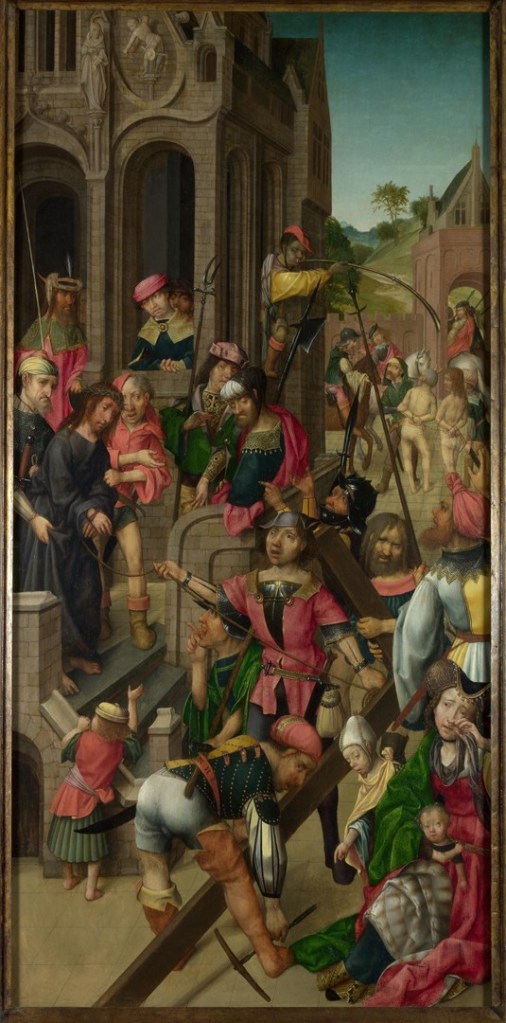
The Master of Delft, Christ presented to the People, about 1510. National Gallery, London.
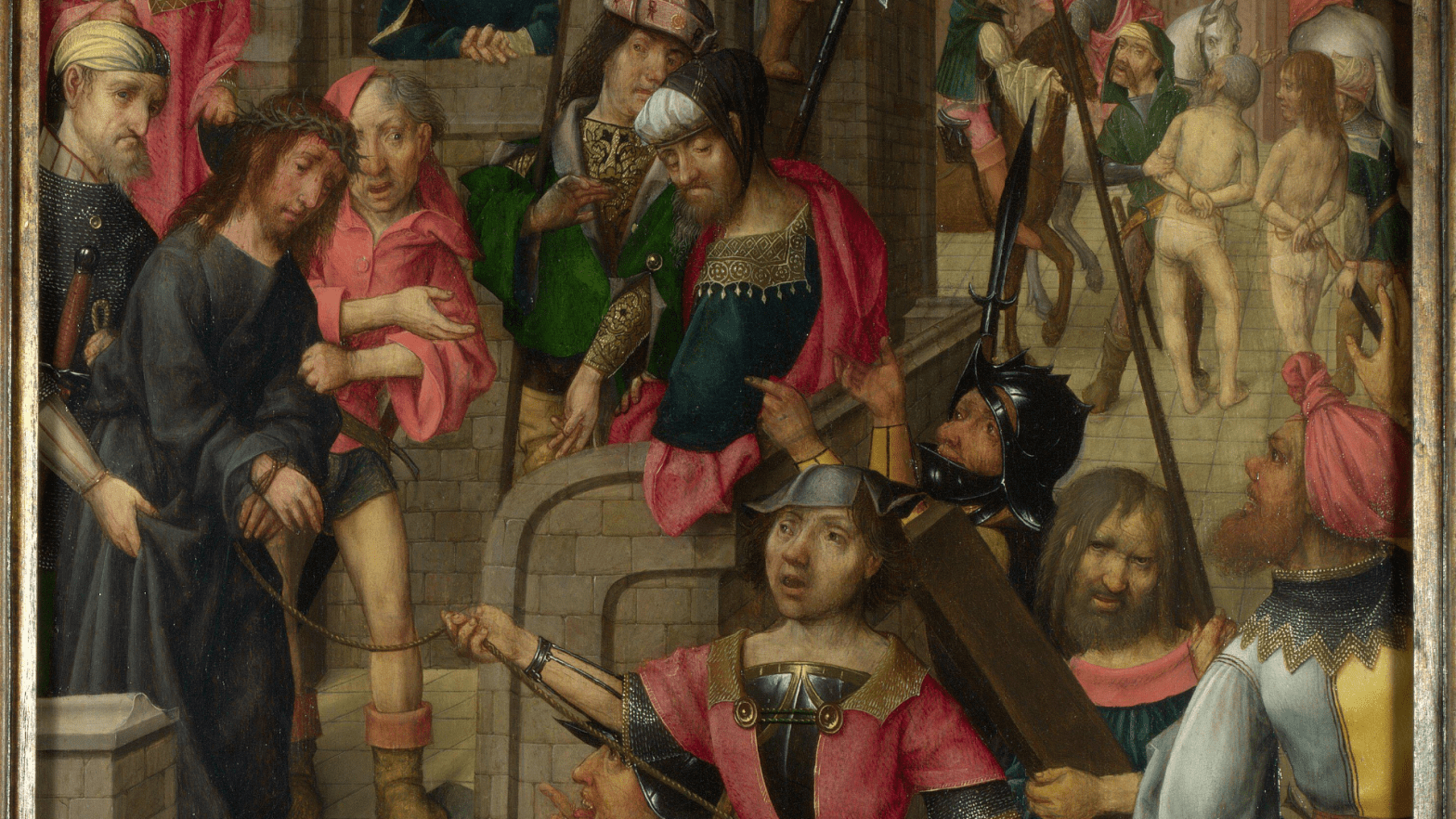
This is the left hand panel, known as Christ presented to the People. In its overall composition, it takes the form of an Ecce Homo. After the arrest, Christ is taken to Annas, and then to Caiaphas, and then to Pilate. He is sent to Herod (we haven’t even mentioned him), and back again to Pilate. Once it is decided that Barabbas will be freed, Jesus is first whipped, and then dressed in purple, crowned with thorns, and mocked a second time. John 19:4-5 tells us what happens next:
Pilate therefore went forth again, and saith unto them, Behold, I bring him forth to you, that ye may know that I find no fault in him. Then came Jesus forth, wearing the crown of thorns, and the purple robe. And Pilate saith unto them, Behold the man!
‘Behold the man!‘ – or Ecce Homo – is the name given to images like this. However, the narrative has gone a little further, as he no longer wears the purple robe. An ensuing discussion – with the mob heavily influenced by the chief priests – determines that Jesus will be crucified. And Pilate, against his will, submits to this. Although other gospels tell us that the purple robe was removed, and replaced with ‘his own clothes’, John omits this detail. Nevertheless, the precise moment that is painted by the Master of Delft is, I believe, that in John 19:16-17, who tells us what Pilate did next:
Then delivered he him therefore unto them to be crucified. And they took Jesus, and led him away. And he bearing his cross went forth into a place called the place of a skull, which is called in the Hebrew Golgotha
We see the beginning of this progress towards Calvary, with the movement determined in the composition by two overlapping diagonals. Jesus is at the top of the few steps which constitute the Scala Santa, with Pilate looking down at him from his place in the shadows, just above and to the left. The Palace looms above him, and the sculpted archer at the top, when seen in context, seems to be taking direct aim at the Roman prefect himself. The tall, shadowy arcade looks rather oppressive, despite the appearance of the bright yellow sleeve and red hat of the black trumpeter appearing from one of the further arches. Jesus, and the guard behind him, who holds up Jesus’s robe so he doesn’t fall down the steps, both look down, and their gaze directs us along the diagonal formed by the rope held in the hands of the soldier wearing a pink jacket, behind whom a man crouches to mock Jesus. The rope leads our eye to the cross. This could have already grabbed our attention, as it projects into our space, leading our eyes into the painting, and up to the right – the second diagonal. It is framed by the legs of the carpenter, whose rear side forms the lightest area in the foreground, and claims attention for itself, thus undermining any dignity his profession might have. The carpenter reaches down to reach his auger to make holes to guide the nails. The line of his back, of the auger, and of the cross lead us past the weeping woman and her two children, past the soldier with the full, silvery sleeves, to the two thieves, about to head out through the city gate and turn right to the green hill without the city wall. The weather is lovely. The grass and the trees are green, the sky is blue – and so are the distant hills.
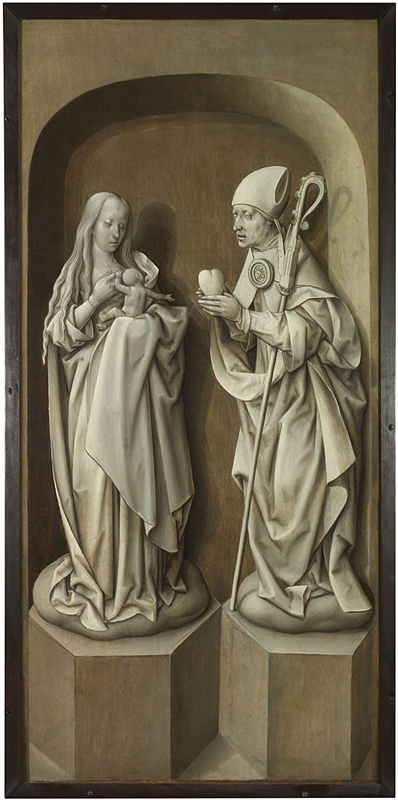
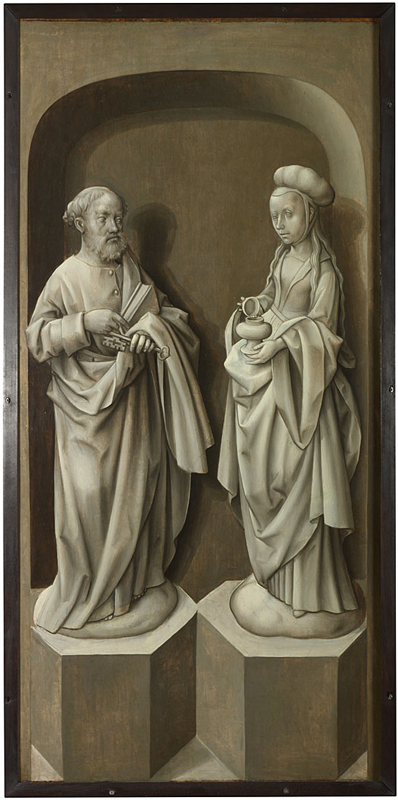
This is the same painting – although you would be forgiven for not recognising it. The work is a triptych – a painting on three panels – and for most of the time it would have been closed, only to be opened when mass was celebrated at the altar on which it was originally found. The ability to close altarpieces like this served several purposes, and one was purely practical: to keep dust off the richly coloured surface. The exterior panels were almost always far less colourful, and here, as so often, they are painted in grisaille – from gris, or ‘grey’, in French – a term for monochrome painting, which is usually intended to look like sculpture. As such, the exteriors of triptychs are not attention grabbing. When opened, the far richer colours would then draw people to the altar where mass was being celebrated, and conversely, when closed, the colour would be removed – ideal for a season so focussed on withdrawal and contemplation as Lent. This, of course, creates ambivalence. The richly coloured surface we have been contemplating throughout Lent should not have been visible. But by the time it could be opened – on Easter Sunday – then everything that has gone before is all but irrelevant, perhaps, as that is the day to celebrate the joy of the resurrection.
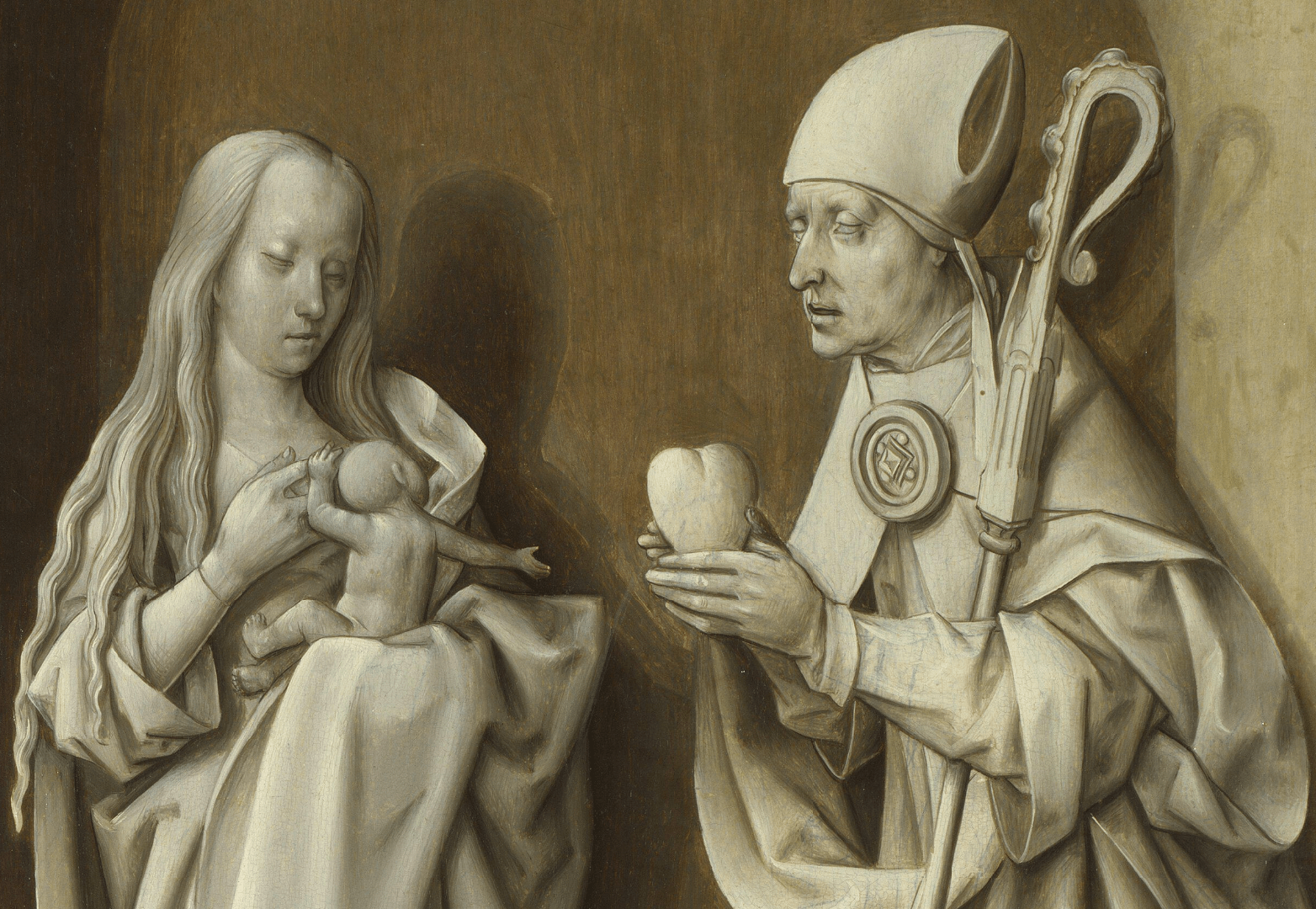
So what do we see here? There are four figures, conceived as stone sculptures, standing on irregular hexagonal plinths, casting shadows onto the backs of the niches in which they stand. The right side of each niche is more brightly lit than the left, which suggests that the main light in the chapel where this painting was originally located came from a window on the worshipper’s left. The ‘sculptures’ represent the Virgin and Child and St Augustine of Hippo on the left wing, and on the right are Sts Peter and Mary Magdalene. St Augustine can be identified because he is a bishop: he wears a mitre – the hat with two points – and carries a crozier, an episcopal equivalent of a shepherd’s crook, which indicates the care of his flock – all of the Christian souls in his diocese. He also wears a cope – the ceremonial cloak, or cape – which is fastened with an elaborate clasp, called a morse. But there have been many holy bishops. It is the heart that tells us this is St Augustine. It relates to a quotation from the the Book of Proverbs (23:26) in the Old Testament:
My son, give me thine heart, and let thine eyes observe my ways.
In a commentary on this text Augustine wrote,
“He says, give me. Give me what? Son, your heart. When it stays with you, it will go ill. You will be drawn to toys and to lascivious and harmful loves. Give me, he says, your heart. Let it be mine, and it will not perish.”
And this is precisely what Augustine is doing in this image – giving his heart to Jesus. Hence the presence of the Virgin and Child, as if any reason were needed. But why did the patron choose St Augustine to go on the outside of this painting? Quite simply because the Premonstratensians followed the Augustinian rule (see Lent 25).
The presence of St Peter, identified by the key he is carrying, one of the keys to the Kingdom of Heaven, is not so obvious, despite the fact that he was the first head of the Church after Christ. Nevertheless, his presence would remind the members of the convent that, after their allegiance to St Augustine, their ultimate responsibility (on Earth) was to the Pope. Also, given his status, Peter is hardly present on the inside of the altar, apart from a brief appearance, asleep, in the Garden of Gethsemane (Lent 10), so a dominant presence here is perhaps to be expected. The Magdalene, dressed differently compared to the interior scenes, but still holding her jar of precious ointment, clearly has a far more central role in the Easter story. She is, in some ways, the closest to Christ in the Master of Delft’s account. She is in the centre of the painting, at Jesus’s feet during the Crucifixion (Lent 32), and then again at the Deposition from the Cross (Lent 39). Given that many of the Canonesses would have been members of aristocratic families, being there against their will might, in some instances, have meant that their repentance from the ‘error of their ways’ would have been constantly required. Her strong female presence, opposite that of the Virgin Mary, would also have been relevant to all members of the convent, though. As for Mary, she too is central at the Crucifixion and the Deposition, serving to remind the Canonesses of their diverse losses, perhaps, and of the Christian endurance necessary to overcome them. Although ‘useful’ as a recipient of St Augustine’s heart, the Christ Child is also present simply to identify the Virgin: he is her chief attribute, or symbol. Indeed, many paintings called ‘Madonna and Child’ are, in truth, predominantly paintings of the Virgin, and Jesus is really there so that we know which female Saint we are looking at.
As for Lent itself – well, I hope you’re learning as much as I am! Cards on the table: I thought, ‘What painting is complex enough to cover the forty days of Lent,’ and this was the answer I came up with. So, on the first two days I planned all forty details. And then I gradually realised that it wasn’t going to stretch all the way to Easter, which, I must admit, was initially confusing. But why should it be ‘forty days’ in any case? Well, as a period of quiet and contemplation, it was made to commemorate Christ’s retirement to the wilderness for forty days. Admittedly, this was immediately after he had been baptised, so approximately three years before the crucifixion, but that is irrelevant. As a period of restraint – and of avoiding temptation – it is entirely appropriate. However, given that every Sunday is effectively a celebration of Christ’s resurrection, it was not deemed appropriate that these should form part of this period of sacrifice. So the Sundays between Ash Wednesday and Easter are theoretically not part of Lent… which is why Lent lasts 46 days rather than 40. And while we’re talking about it the name itself, ‘Lent,’ comes from an Old English word for the ‘Spring season’, which may itself derive from the idea that the days lengthen. And indeed they have – we have entered daylight saving – British Summer Time – and, as of today, we in England no longer have to stay at home. I, however, have planned a week which means I probably won’t leave the flat until Friday! I do hope that some of you are free to join me for some of this – starting with The Sistine Chapel, from ‘Beginning’ to ‘End’ today at 2pm and 6pm – BST! And tomorrow – back to the painting. Somehow.
If I have cliff-hangers, I left you with one yesterday. Admittedly, it would have left you hanging at the edge of a very low curb, but there you go. At least none of you would have had a sleepless night, especially good as, thanks to daylight saving, we in the UK – and Europe as a whole, I believe – have had one hour’s less sleep. But at the end of yesterday’s blog I asked ‘who are the two mourning women? And, for that matter, the third, whose head appears at the bottom right? I think we will have to leave them all until tomorrow…’ It is now ‘tomorrow’, so what is the answer? Well, I hate to disappoint you, but I don’t know. But I do have an idea…
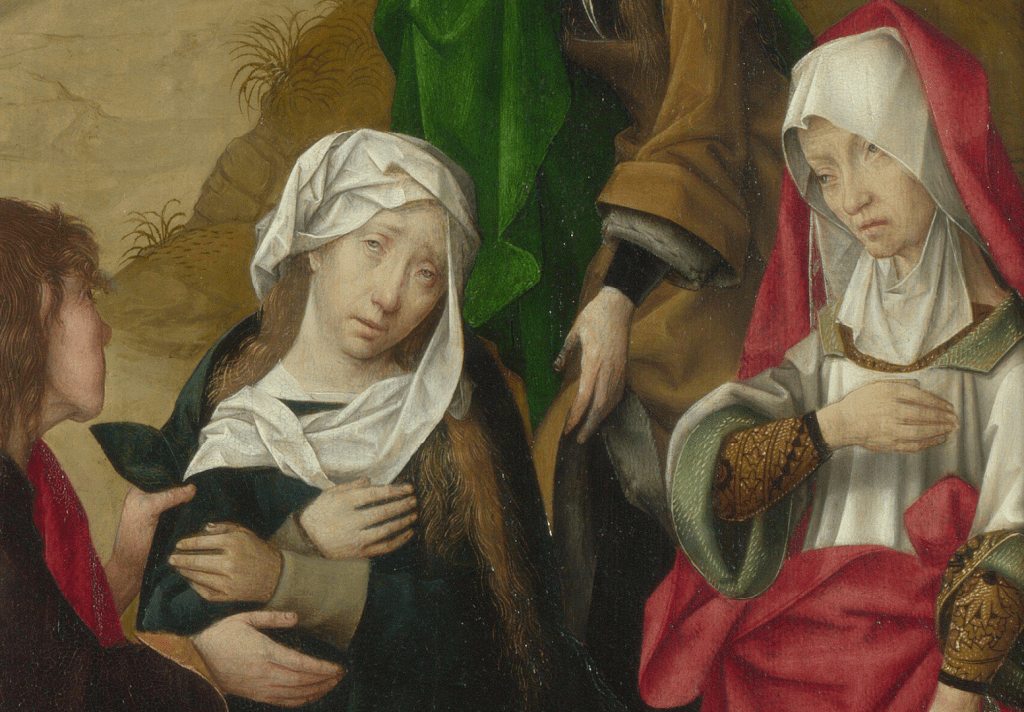
The two we have seen before are dressed much as we would have expected from the details we saw yesterday. The woman with outstretched arms at the left wears a cloth of gold gown, with very full, dark blue sleeves. She has a fur-lined green overdress, which is wrapped up and tucked into her belt to reveal both the fur lining, and the gold brocade of the dress underneath. Her companion at the top right reaches down towards the Virgin, dabbing tears from her face with her green cloak. Her dress is a relatively subdued light brown, although again it is fur-lined, worn over a simple black-sleeved bodice. Her hat is lilac, encased in what looks like a scimitar, beaten into a ploughshare, and then wrought further to become millinery. It is definitely meant to imply the exotic. Standing on the far right is the woman whose head we saw yesterday. She wears a white overdress, which to me looks a bit starchy, an impression belied by the cloth of gold over which it is worn, with similar brocade trims at the cuffs and lowest hem of the white dress. These additions, my sister informs me (thank you, Jane) were added because these were the parts of the dress which would be most likely to get dirty, and so could be easily replaced. Yet, however practical this might appear, the fact that this supposedly ‘disposable’ fabric was also of the most expensive, suggests a considerable amount of disposable income. This woman also wears a white headdress, or veil, including a bib tied around her neck – it is, effectively, a wimple, covering both her hair and her neck. Over all of this she wears a scarlet cloak, which would, in itself, have been a very expensive garment (if I haven’t said this before, although blue is famed as the most expensive pigment for painting, red was far more expensive than blue as a fabric). In her left hand she holds some sort of handled pot, or jar.
When seen up close, she is far older than any of the other women we have seen, with a wrinkled forehead, a pinched mouth and loose skin around her neck. She is pale with age, and indoor seclusion (the fate of many medieval and renaissance women), and also, undoubtedly, with grief. Not as pale, perhaps, as the Virgin, but then, not as grief stricken. The older woman holds her hand across her chest, a sign of her care and devotion, and her arm casts a shadow on her white overdress. She looks towards the Virgin, who looks out to us, much as she did in Lent 28, inviting our compassion – our ‘suffering with her’. She is cared for, as before, by St John the Evangelist, who rests his left hand on her shoulder, and holds out his right, an offer of further support. The four hands form a wonderful knot of sorrow and caring. His head is tilted at just the right angle to show us that he is genuinely moved, and exhibits true sympathy. As if to express this, the crook of his neck and the flick of the corner of her cloak almost interlock.
But who is the woman on the right? Well, let me quote from the National Gallery’s website:
‘Saint John and the Virgin appear in the foreground, surrounded by four women. If they are the same women who surrounded the Virgin in the foreground of the centre panel, they are wearing different clothes. The older woman on our right carries a small jar, the significance of which has not been explained.’
So, I was right. I don’t know, and neither does the gallery. They could be the same Holy Women, with different clothes – we have seen this before – but they could be others. After all, Mark 15:41 mentions ‘many other women which came up with him unto Jerusalem,’ and maybe these are some of them. But why include so many? And why are they so richly dressed? Is it, simply, that Luke 2:2-3 says that there were ‘certain women’ such as Mary Magdalene, Joanna, Susanna, ‘and many others, which ministered unto him of their substance?’ Maybe. But why the interest in them, in this particular altarpiece? As I said, I have an idea. It is mere hypothesis at the moment, but let’s see what you think. I have only said a limited amount about this altarpiece – but then, only a limited amount is known. It was commissioned by a Premonstratensian Canon, possibly Herman van Rossum, as we saw in Lent 25. He kneels in his white habit, facing right, just next to the Virgin Mary. The identification of the patron relies on the fact that he was the provost of the Koningsveld Convent, just on the edge of Delft, at the time that this altarpiece was made for it. Yes, it was made for a convent, full of the daughters of the great and the good who were ‘ministering unto [Jesus] of their substance’, and who would have had an especial devotion – and so care for – the Virgin Mary. But why would women ‘of substance’ be in a convent in the first place? Well, because of dowry inflation. The role of men in a large families is well known: the first son inherits, the second goes into the military, the third into law, and the fourth, the church. The options for women were different. The eldest would have a dowry, and so would find a husband more easily, but after that it became progressively more difficult, and many aristocratic women ended up in convents not because of a calling, but as a result of parental necessity. And while their fathers might not be able to afford a good dowry, they would have been well-dressed – like the women in this painting. There were – and are – Premonstratensian Canonesses, although they are often called Norbertine Nuns, after St Norbert who founded the Premonstratensian Order. For a while there were even mixed houses, with Canons and Canonesses in adjacent cloisters.
I can’t help noticing that the woman on the right is wearing a white dress and wimple, and faces to the left. In some way she balances the donor. Could she, perhaps, be a donatrix, or female donor? I do hope so! Maybe she is the abbess? I need to do more research, clearly, but abbesses could reach a high status, and at least one, the Blessed Gertrude of Aldenburg (d. 1297) was beatified (as her title suggests!) As for the ‘small jar’, I think the significance is quite clear, contrary to what the National Gallery says. After the crucifixion, when the body was laid in the tomb, Luke 23:55-56 tells us,
And the women also, which came with him from Galilee, followed after, and beheld the sepulchre, and how his body was laid. And they returned, and prepared spices and ointments; and rested the sabbath day according to the commandment.
I would suggest that the ‘small jar’ contains these spices and ointments.
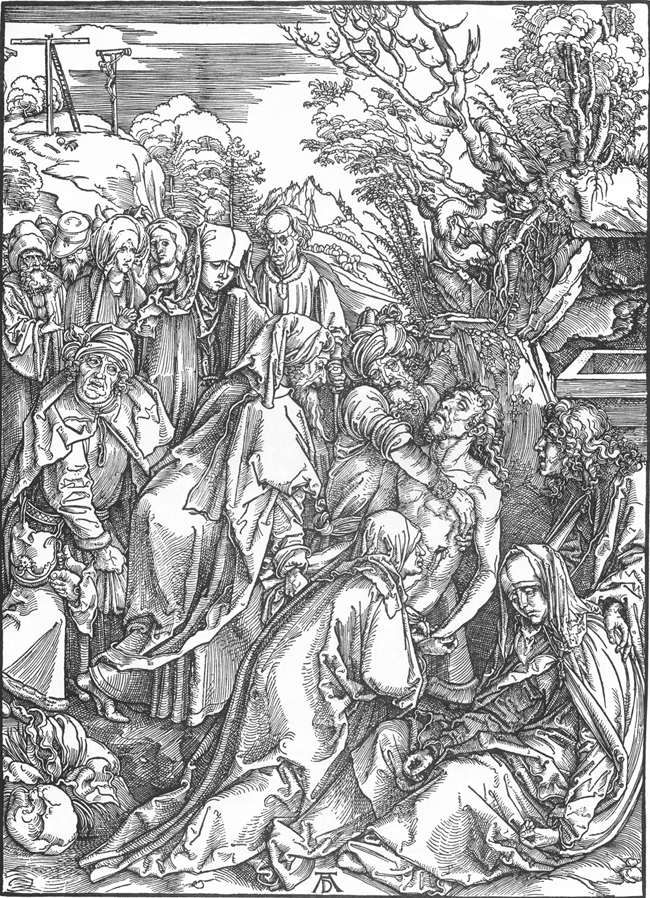
I must also hypothesize about what the group as a whole are doing here. They do appear in much the same way as they did at the foot of the cross, and the Virgin appears, once more, to be on the verge of fainting. This ties into an idea that had great currency in medieval and renaissance thought, but which did not, with a few notable exceptions, outlive the Counter Reformation: lo spasimo della Vergine, as it is called in Italian, or, less poetically, ‘the swoon of the Virgin’. Although not mentioned in the gospels, the Gospel of Nicodemus, which I have referred to a couple of times already, includes references to Mary swooning during the crucifixion. In art this can be shown on the Via Crucis, at the foot of the cross during the Crucifixion, during the Deposition from the Cross or the Entombment of Christ. Two of those are included in this painting. I should discuss this at length another time, but the Counter Reformation saw this weakness in the Virgin as suggesting a lack of faith in the resurrection, and also, as John 19:25 explicitly states, ‘Now there stood by the cross of Jesus his mother,’ the idea of her not standing was seen as contradicting the biblical evidence… so the depiction of lo spasimo was discouraged. Not so, during the period in which our work was painted. But how do we account for Mary kneeling at the foot of the cross during the Deposition, but also swooning in the foreground? Well, here’s another idea. Because of the short course I am teaching for the Wallace Collection this week (see the diary), I have been looking at Dürer’s Small Passion series – and then decided to compare it to the Great Passion. Here are his versions of The Crucifixion, The Lamentation over the Dead Christ and The Burial of Christ, which are dated 1497-8, from the Great Passion.
The composition of The Crucifixion is similar to that envisaged by the Master of Delft – and it could be that the latter was influenced by it, although this is quite a common form. But note how Mary swoons a second time at The Burial of Christ. To me, the group at the bottom of our painting looks for all the world like a Lamentation – but without the actual body of Christ. Maybe, this was to be imagined. Maybe there simply wasn’t the space for it, or it was deemed unnecessary, given the presence of the body in the Deposition. But whatever it is, it gives the artist another chance to invite us to share in the Virgin’s grief, and to show the women of substance caring for her, something with which the occupants of the convent could associate. And at their feet – well, at their feet on the right we see the plantain, strawberry and violet we saw in Lent 2, and on the left is the aquilegia which was the subject of the very first of these Lent posts. We are back where we started. Which must mean that we have seen the whole painting. Or have we? After all, it is only Palm Sunday: there is still a week until Easter, and six more days of Lent.
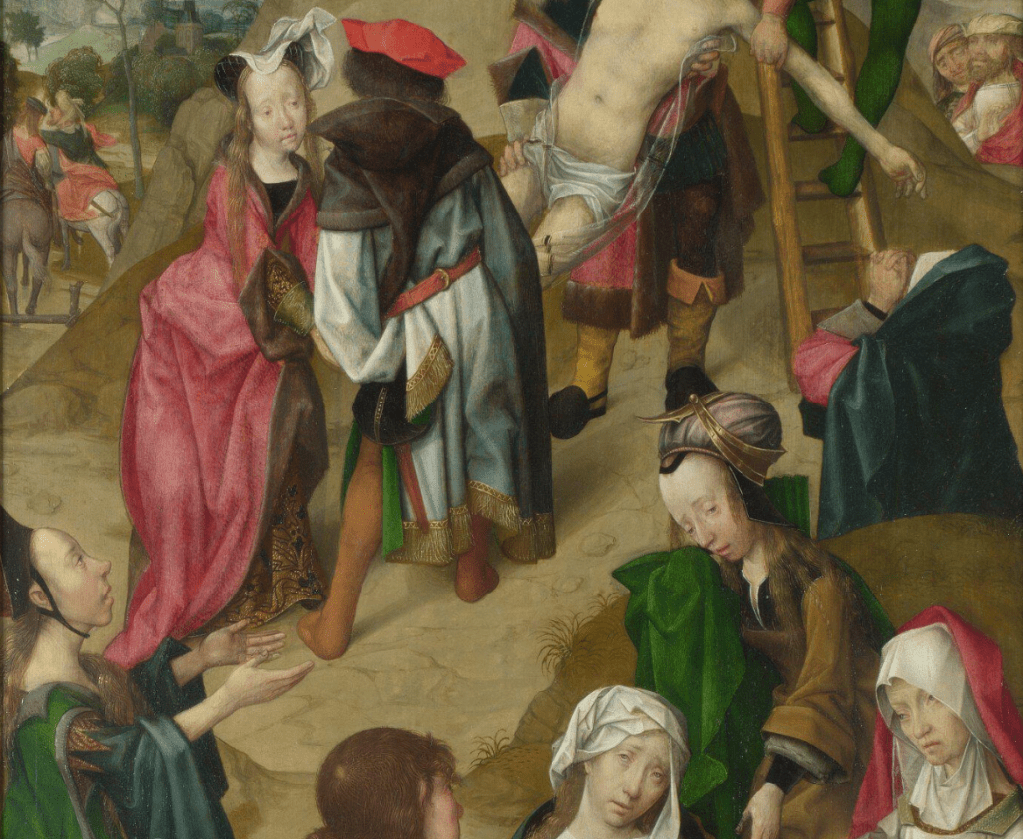
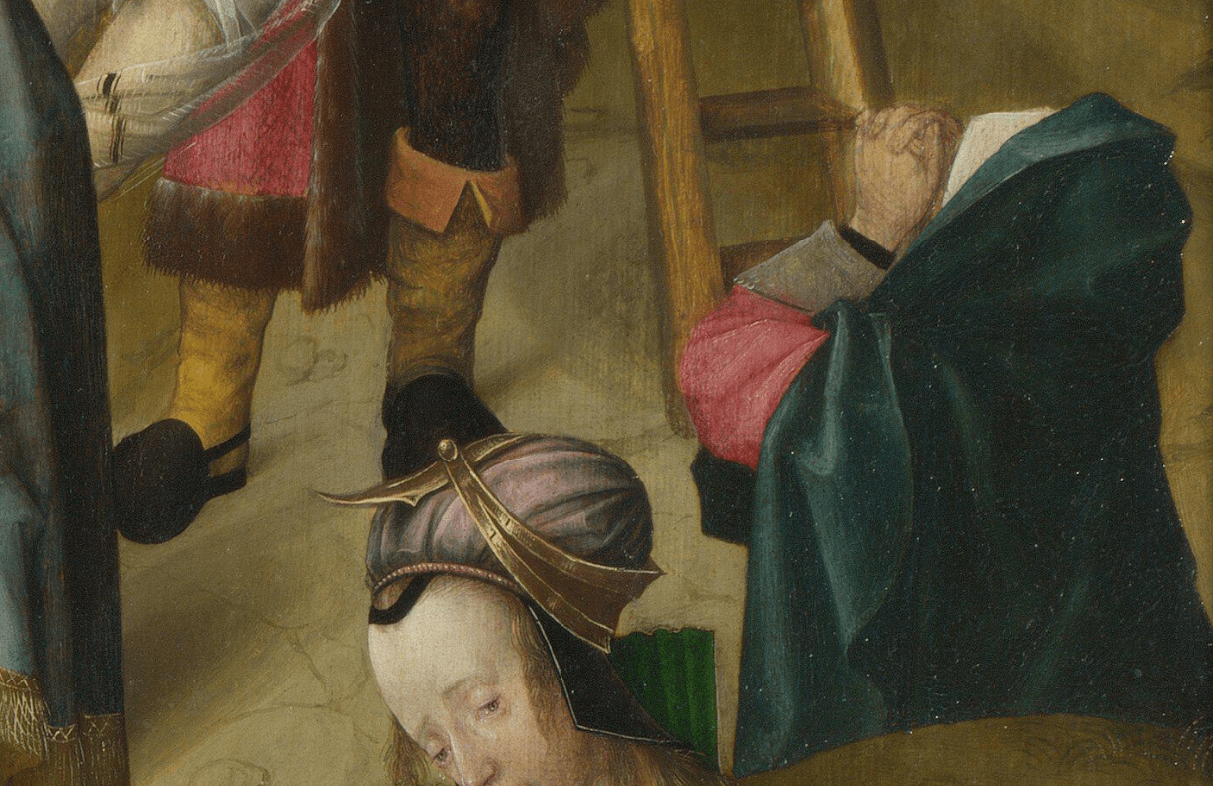
While there might still be some doubt that it is the Virgin who kneels near the foot of the ladder, there is none that the Magdalene finds her place once more at Christ’s feet, her preferred position, as was mentioned in Lent 32. Unlike other characters, whose costumes change, hers is the same. A red overdress, over a rich cloth of gold brocade, her headdress topped with a white veil, which, although wrapped loosely around her head, no longer flutters in the breeze. Her long red hair still falls on either side of her face, which is pale with sorrow.
Both the Magdalene and Nicodemus were associated with precious ointments, and both were reported as taking them to Christ’s tomb – a piece of circumstantial evidence which I would like to put forward as supporting my identification of the man with his back to us as Nicodemus: the two people who both bring ointments also share a task, and help in carrying Christ’s legs. When seen in this detail, there is a greater idea of the effort involved than was evident before. We can see that Nicodemus’ left leg is braced to take the strain, and his right might also be bent. The extension of the left leg also adds to the movement and structure of this detail, and shows us one of the ways in which the Master of Delft keeps our eyes moving around the painting. Nicodemus’ leg – and indeed his belt – are both angled in roughly the same direction, although by no means on the same alignment, as the diagonal created by Christ’s body. It is probably not a coincidence that his left foot is placed next to the hands of the woman at the bottom left – on the surface of the painting, at least, because, of course, she is considerably closer to us: the visual proximity of her hands and his foot is one of the links the artist makes to direct our attention.
Another way of looking at it is to see her outstretched arms, and her gaze, directed up to the right, as leading our attention into the painting, and towards the lifeless corpse. This line is subtly enhanced by the shadows of Nicodemus’ leg, and then of his body. Were we there in the picture, we could also follow the path alongside him to stand close to Christ: this path, in between the grassy knolls, is part of the same structural element. The other mourning woman, whose head appeared yesterday, looks down – her face pointing downwards along the diagonal described above, while her eyes are at a steeper angle, looking towards what is, undoubtedly, the head of the Virgin Mary. This is why I queried her position at the foot of the ladder: although we know that this is a continuous narrative, for some reason it surprises me that she should be represented twice at this point in the narrative – the Deposition from the Cross, in the first case, and then… well, I suppose we will see tomorrow. And who are the two mourning women? Or, for that matter, the third, whose head appears at the bottom right? I think we will have to leave them all until tomorrow as well.
Not far from the foot of the ladder which has been lent up against the cross is a woman kneeling in prayer. There is very little to tell us who she is, and yet, for anyone familiar with Western European painting, her identity is probably clear. We can also see feet descending the ladder, and the two men standing, holding the dead body, who we discussed yesterday. There is also another, mourning, woman, who we have not yet met. The first woman looks up towards Jesus, her hands clasped together, close to her face, and, given the tilt backwards of her neck, they are held rather high. She has pink sleeves, folded back at the cuff to reveal a grey lining, and what looks like the cuff of a black undergarment. She wears a blue cloak, which covers her head, and is folded back over the brow to reveal a white headscarf.
This combination of blue cloak over a red/pink dress will be familiar to most, if not all, as the clothes so often worn by the Virgin Mary. And yet this is not what we have seen in the other depictions of her which have occurred so far – but then, she has only appeared twice, in Lent 24 and Lent 28. Even though the view is very distant for the first of these, it is clear from both that she is wearing a blue dress, with a blue cloak. She does wear a white head covering in both, and in the latter we can see that at least one of the sleeves has a grey lining. But no red, and no sign of a dark undergarment in either. So maybe this is not the Virgin? But then, who else would it be? As we have seen, the clothes that some of the characters wear changes from one appearance to another, maybe this is another example. After all, the two thieves are dressed in different ways for each of their three appearances.
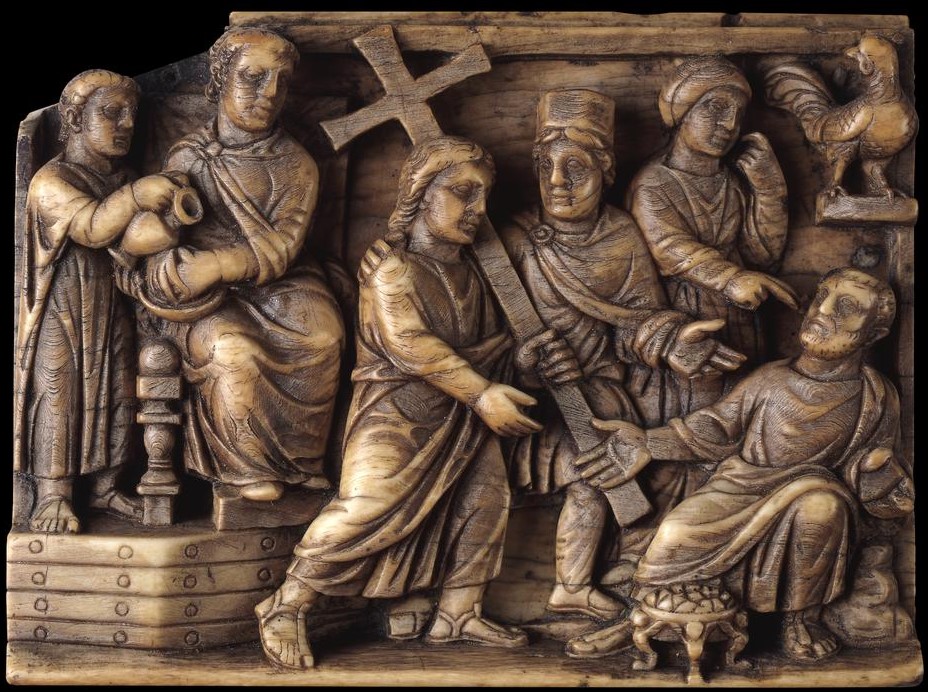
However, this detail does make me think about the presence of the Virgin at the crucifixion, thoughts which were prompted further by an admirable – and detailed – email which I received this morning. A big ‘Thank you’ to the sender, who pointed out – and the relevant texts have been quoted here previously, without me drawing the same conclusion – that in the synoptic gospels the Holy Women watch from ‘afar off’ whereas in the Gospel according to St John, Mary and John are stood at the foot of the Cross (see Lent 28). In fact, on re-reading the synoptic accounts, I realise that the Virgin is not even mentioned as present, contrary to what I said in Lent 28. This point was made in the email, as was the fact that the apostles are nowhere to be seen, with the exception of John, in the eponymous gospel. However, from the earliest days, it seems to have been John’s account that prevailed. The synoptic gospels mention Simon of Cyrene carrying the cross, but that is not what we saw in Lent 22, and Jesus can be seen carrying his own cross as early as the 5th century. Here are two panels from a casket, dating from the 420s, in the collection of the British Museum – and thanks again to my correspondent for reminding me about this wonderful artefact. In the first, we see Christ carrying his own cross, combined with scenes not included by the Master of Delft: Pilate washing his hands of Jesus’s death, and Peter’s denial of Christ, illustrated by the cockerel at the top right of the image, and a woman pointing at the cowering Peter.
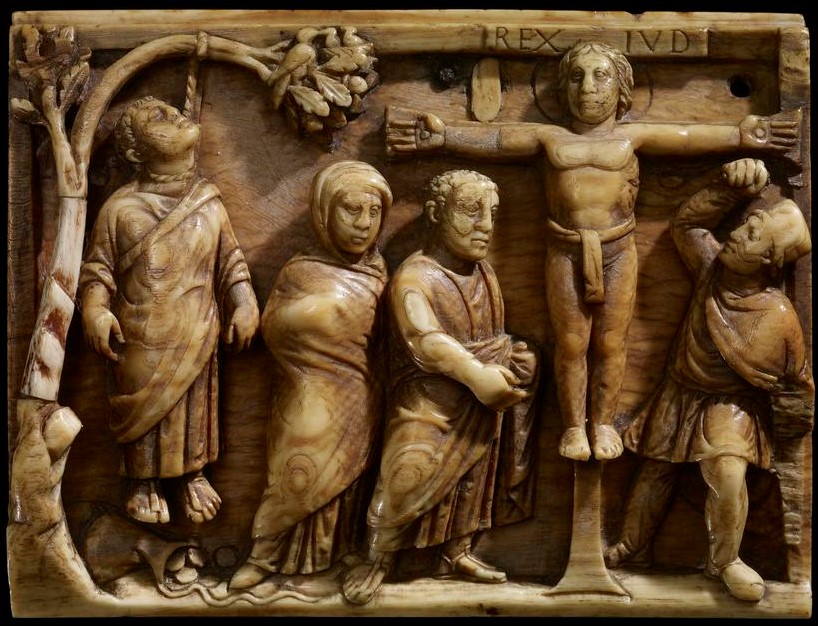
The second shows the crucifixion next to the suicide of Judas (Lent 13), with the thirty pieces of silver scattered on the ground beneath him. Longinus stands under the left hand of Christ, his lance lifted in his right hand to pierce the left side of Jesus’s chest (another theological debate, but one I don’t have the energy for, I’m afraid), and the Virgin Mary and St John stand at his right hand – in a similar way to our painting. So she is there from the start. Jesus himself appears strong, and upright – triumphant over death, and over the possibility of death. This idea continued, in some examples, until the late thirteenth century. However, by that time, the image of the suffering Jesus, expressively slumped, and even, sometimes, clearly dead, had started to take over, as the onlooker was invited to empathize with him, and to understand how great was his sacrifice. Mary, too, is strong in this early image, but that would change – we saw her fainting in Lent 28, and I suspect we will again. So I will talk about that another day.
Jesus is being lowered from the cross. The man we saw yesterday, holding on to the ladder with outstretched right arm, grasps one of Christ’s with his left, while another man, standing behind the dead body, supports the breathless rib cage with his left hand, and rests his right on Christ’s thigh. A third man, with his back to us, presumably supports the feet. And yet there is no weight. No pull on the arm, no stress on the supporting hand, no effort given to carrying the legs. It is an almost dream-like quality, the same feeling that the divine imperative transcends gross form and worldly gravity that we saw in the figure of the crucified Christ in Lent 35. This is a terrible task, and yet, for these men, it is what they have to do, it is inherent in their devotion, and it is therefore, in some mystical way, ‘easy’.
Jesus’s arms are extended, although not at the angle they were on the cross, and his fingers are curled, holding a memory of the extracted nails. Perhaps rigor mortis has set in. The mouth is still open, as if uttering its last breath. And the eyes – well the eyes are indistinct. Maybe open, maybe closed, but lifeless nonetheless.
The men perform their deed with delicacy, and the body is wrapped in a translucent veil. An attempt is being made not to sully this perfect form, shown to be precious by the way it is framed with the expensive, delicate fabric.
Who are these men? They are all reasonably wealthy, judging by their dress – richly coloured, with several layers. The man in the centre has a coat both lined and trimmed with fur, although it is the man on the left, with his back to us, who displays his wealth most overtly. His coat has long sleeves, used for show rather than practicality. One of them, its cuff trimmed with cloth of gold, is tucked up into the back of his belt for display – but this also allows us to see his ample purse, black, with a gold trim, strung onto another part of the belt, presumably. The red hat is another indicator of prosperity.
The bible does mention three men who were around at the time, although it is often difficult to distinguish them in art. The first is Joseph of Arimathaea. Here is Matthew 27:
When the even was come, there came a rich man of Arimathaea, named Joseph, who also himself was Jesus’ disciple: He went to Pilate, and begged the body of Jesus. Then Pilate commanded the body to be delivered. And when Joseph had taken the body, he wrapped it in a clean linen cloth, And laid it in his own new tomb, which he had hewn out in the rock: and he rolled a great stone to the door of the sepulchre, and departed.
Because it says quite specifically that Joseph took the body, it is he who is often credited with actually carrying it – so I would identify the man directly behind the body, looking out towards us, as Joseph of Arimathaea. There are similar references in Mark, Luke and John, the last of whom mentions a second man (John 19:38-39):
And after this Joseph of Arimathaea, being a disciple of Jesus, but secretly for fear of the Jews, besought Pilate that he might take away the body of Jesus: and Pilate gave him leave. He came therefore, and took the body of Jesus. And there came also Nicodemus, which at the first came to Jesus by night, and brought a mixture of myrrh and aloes, about an hundred pound weight.
With this mention of myrrh, the ‘prophesy’ of the Jesus’s death, inherent in the gifts of ‘gold and frankincense and myrrh’ brought by the wise men (Matthew 2:11), is fulfilled. The way the verse from John is written makes it clear that this it is a large amount of myrrh, which was, in any case, extremely expensive. This implies – to me at least – that the wealthy man with his back to us is Nicodemus. However, some assume that the wealthier of the two would be the man with the tomb ‘hewn out in the rock’ – which would make Joseph the man with his back to us, and Nicodemus the one in the centre, judging by their dress alone. And the third man? Well, it could be another onlooker, an unnamed follower of Jesus, but it could also be Simon of Cyrene, who is sometimes shown among the mourners. He was the man who, when Jesus was led away from Pilate’s palace, was charged with carrying Christ’s cross, as mentioned in all three of the synoptic gospels. For example in Matthew 27:32,
And as they came out, they found a man of Cyrene, Simon by name: him they compelled to bear his cross.
There is also a woman, kneeling at the foot of the ladder in prayer. But I will take a closer look at her tomorrow.
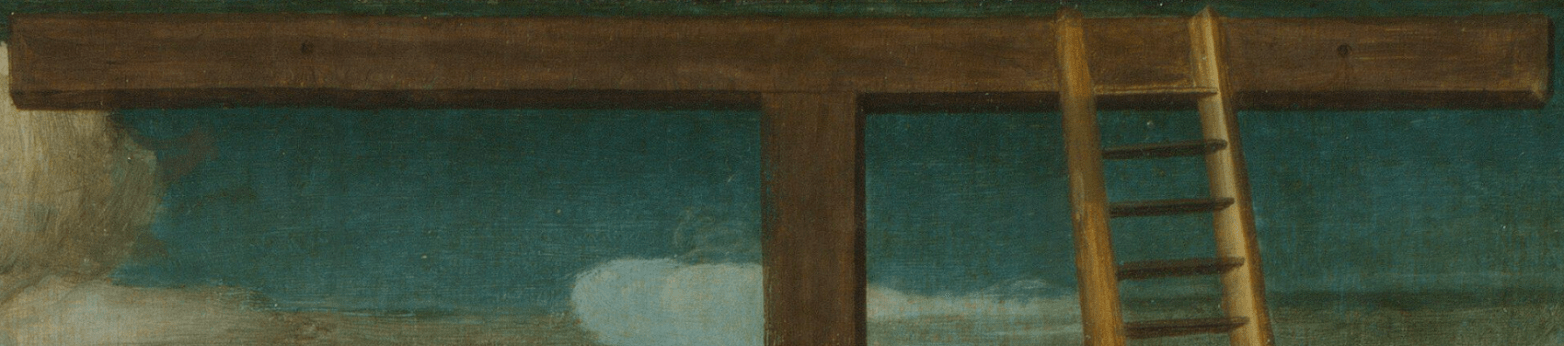
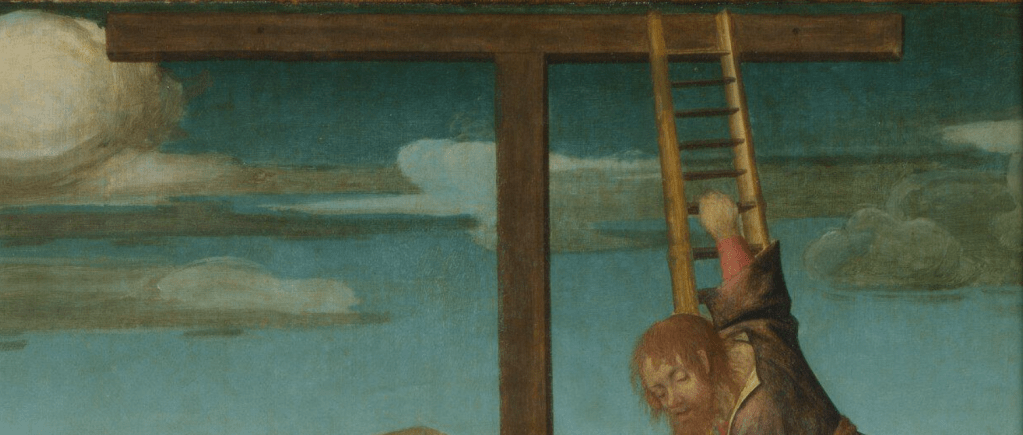
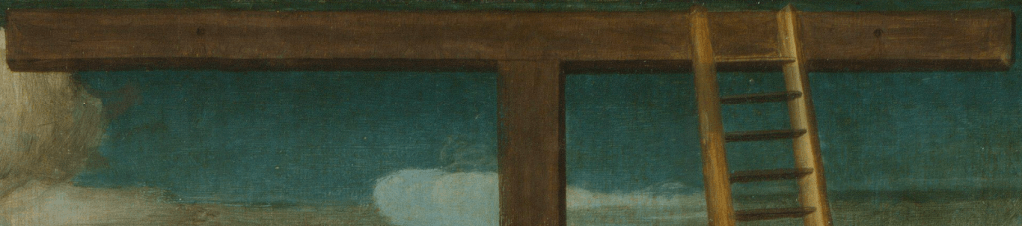
There is something particularly bleak about today’s detail, I feel. It is empty, devoid of life, despite the person clinging to the ladder, whose aim, anyway, appears to be downward, to get out of view. The tau cross is revealed in all its simplicity, and even the titulus has been taken away. Only the holes for the nails – prepared by the auger we saw in Lent 9 – remain. The sky itself seems silent. A ladder is perched against one arm of the cross, and a bearded man descends, hanging on with his right hand, looking down.
It is still Good Friday. It has been Good Friday since Lent 14, when we knew we were at the Praetorium, the palace of Pontius Pilate – although earlier posts also belong to this day. But then, let’s face it, the earliest episode we have seen, the Agony in the Garden (Lent 10) was on the evening – arguably the night – of Maundy Thursday, the night before. Everything is packed into one intense day. There was haste to take down the body, because it was Friday, the eve of the Sabbath, and nothing could be done after sunset. Here’s John, 19: 28-31,
After this, Jesus knowing that all things were now accomplished, that the scripture might be fulfilled, saith, I thirst. Now there was set a vessel full of vinegar: and they filled a spunge with vinegar, and put it upon hyssop, and put it to his mouth. When Jesus therefore had received the vinegar, he said, It is finished: and he bowed his head, and gave up the ghost. The Jews therefore, because it was the preparation, that the bodies should not remain upon the cross on the sabbath day, (for that sabbath day was an high day,) besought Pilate that their legs might be broken, and that they might be taken away.
The legs were to be broken to speed the deaths of the victims – and John goes on to explain that the thieves were subjected to this treatment, but, as Jesus was already dead, his body was left intact. The sponge soaked in vinegar is just one of many details from the gospel accounts that does not make it into this painting, however rich, and complicated, and busy it is. We also do not see the distribution of Christ’s garments, for example, when lots were drawn to allocate the seamless robe. There is too much in this story to fit onto a single surface – although the artist does what he can. There are other artists who find different ways to include yet more details. As for ‘the scripture’ that ‘might be fulfilled,’ the reference is probably to Psalm 69 (in the King James Version), verse 21:
They gave me also gall for my meat; and in my thirst they gave me vinegar to drink.
This was not an act of compassion, but of contempt. There is still a way to go until we can escape this downward spiral.
But to lift our spirits, something to look forward to, and something which is related to a Master of Delft, if not The Master of Delft. Next week is an absurdly busy one for me, but if you still have an evening free, and missed my recent lecture on Vermeer, I will be talking about him again next Tuesday evening. Even if you caught the last talk, this will be different, as, rather than looking at the paintings in his paintings, I will focus on the ways in which he represents music. I’m particularly looking forward to it, as my short talk will be followed by a performance by The Strand Consort of some of the works of Dutch 17th Century composer Jan Pieterszoon Sweelinck, live from the Dutch Centre in London. You can book via this link: Not how many but how well: Music, and the Paintings of Johannes Vermeer. The talk will begin at 7.30pm BST (yes, the clocks change in the UK on Sunday) this Tuesday, 30 March.
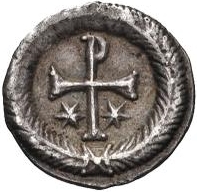
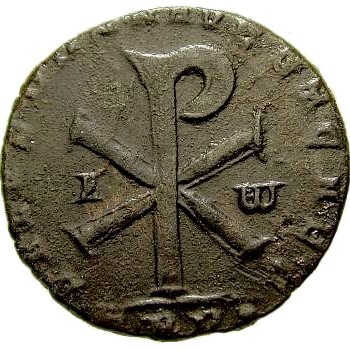
The cross on which Jesus is crucified in the painting is slightly more sophisticated than those of the Good and Bad Thieves. It is made out of planks of wood, which have been sawn into a rectangular cross-section, whereas those of the thieves are made from the unworked trunks of young trees. But none of them are ‘cross’ shaped. They form the letter ‘T’, the Greek letter Tau, and indeed they are known as the Tau cross. There is no description of the appearance of the cross in the bible, as far as I am aware, but this image is the result of the word used for ‘cross’ in early Greek versions of the testaments – σταυρός (stauros). And no, I don’t speak Greek. As Casca says in Shakespeare’s Julius Caesar, ‘but, for mine own part, it was Greek to me’ (the ‘all’, with which we are all so familiar, crept in later…). Anyway, the literal translation of ‘stauros’ is ‘stake’, and implies that the instrument of torture and execution was stuck into the ground. An early Christian symbol, the staurogram, is a combination of the letters ‘tau’ and ‘rho’, an abbreviation of the word ‘stauros’, and was probably seen by the faithful as an abstracted image of Christ on the cross, with the ‘tau’ as the cross, and ‘rho’ as Christ – the loop effectively represents his head. As such, it is close to the chi rho, a far more familiar early Christian symbol, which is also formed from two letters, the first two of the word ΧΡΙΣΤΟΣ (Christos). Again, the visual reference to the crucifixion is apparent, even though neither actually shows the cross, that most humiliating form of execution. Here are two coins which use the symbols, from c. 570 and c. 350 respectively.
With the addition of the titulus crucis the cross looks a bit more like the Latin cross, the form which I would assume is the one most familiar to most people. As well as having a more sophisticated cross than the two thieves, Jesus is also crucified in a different way. We noted yesterday that the nails go through the palms of his hands, but there is also a single nail driven through both of his feet. The three nails would later receive their own form of reverence, as would the five wounds of Christ – the wounds in the hands, feet and chest.
If you look back to Lent 30 and Lent 31, you will see that both thieves are presented to us at a slight angle. The Bad Thief turns his back on us, and on Jesus, with his right hand slightly further away than his left – his cross appears to slope down to the right as a result. The same is true of the Good Thief’s cross, although because he looks forward, like Jesus, it is his left hand which is further away. Jesus is presented frontally – the top of the cross is horizontal, and the arms reach out symmetrically. This means that he seems to be slightly less a part of the world of the picture. The two thieves are angled into the space, and subject to the laws of perspective, but by depicting Jesus parallel to the picture plane, he is as much a part of our world as theirs, and as much a part of eternity as any one moment, timeless, and other-worldly. You could even imagine that he has been nailed to the panel on which the image is painted.
He is also granted more respect. Rather than the thieves’ skimpy thongs, he wears a more dignified – even if only slightly – loin cloth, a single piece of cloth wrapped once around and tied as a simple knot, the two ends blowing in the same breeze that lifts the Magdalene’s headdress. We know that the artist thought about Jesus’s appearance on the cross – he had to, in order to paint him – but theologians did too. The nature of his loin cloth is even discussed in popular devotional literature. One of the most important, and influential, of such texts were the Meditations on the Life of Christ, written, possibly, by John of Caulibus, a Franciscan Friar, for one of the Poor Clares – a Franciscan Nun – some time around the year 1300. In it, the reader is asked to imagine being present at any number of biblical events, and even to imagine their own participation, the aim being to evoke an emotional response, an instinctive understanding of the bible stories which could be far more profound than an intellectual appreciation. Here is a description of what happened at the crucifixion, concentrating on one aspect of the Virgin Mary’s feelings at seeing her son crucified:
She is saddened beyond measure, and embarrassed, because she sees him completely naked. They did not allow him even a loin cloth. She rushes up and gets close to him; she embraces him and covers him with her head covering. O in how great a bitterness is her soul now!
A manuscript in the library of Corpus Christi College, Oxford, dated c. 1350, even has an anonymous illustration of this episode.
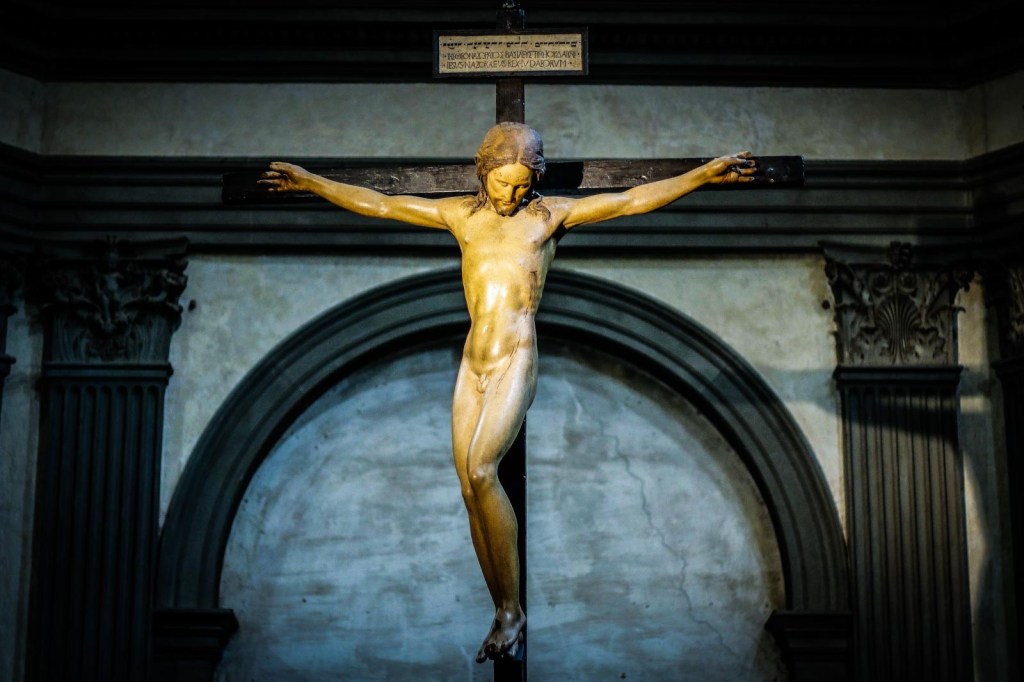
It was Roman practice, apparently, to crucify people naked – this was part of the humiliation – but out of consideration not only for the dignity of Jesus, but also for the viewer, he is almost always clad in some way. But not always: Michelangelo, for example, when he was only 17, left Jesus naked when he carved a crucifix for the Prior of Santo Spirito in Florence.
It is not clear why Jesus is naked. It may be because the young sculptor had, reportedly, been carrying out dissections on the human body while he was staying at the monastery. Or possibly, it was because he was already formulating his ideas about the relationship between nudity and being in a state of grace, which I believe would inform his later work, notably in the Sistine Chapel.
Talking of Michelangelo, thank you so much to all of you who were able to join me yesterday for the first in the series of Michelangelo Matters. There are two more to go, over the next two Mondays, looking first at the Sistine Chapel as a whole (and the ignudi, or ‘nudes’ as one part of the decoration), and then at some of the master’s most exquisite drawings. You can find details of these talks on the diary page. Because I was busy yesterday with the lectures, I didn’t have time to write today’s post in advance, as I sometimes do, and then this morning I had to have my eyes seen to (i.e. I had an appointment with the optician). And I’ve just had a lengthy meeting with Art History Abroad… so apologies for today’s delayed posting! Let’s see what happens tomorrow. After all, we’ve arrived at the Crucifixion, what else can there be?
You may be thinking, ‘We are there too soon,’ but part of the function of Lent is the preparation for the inevitable. It is a period of self-denial, of prayer and of repentance, but we have all given up so much over the last year, we are all living within such restricted circles, that I am not convinced that we need to do any more. But for Christians this is a time in which prayer and contemplation is specifically about Christ’s sacrifice, so the Crucifixion would be remembered daily. It could even be considered odd that this is the first time we have seen the crucified Christ, given that we have already arrived at day 34 of my Lenten discipline. As I’m sure you know, there are forty days in Lent, reflecting Jesus’s forty days in the wilderness, and just in case you were wondering, given that we are at day 34, how this could possibly last until Easter – which is just under two weeks away – I should point out that the forty days of Lent last for 46 days. But I will explain that in detail next week!
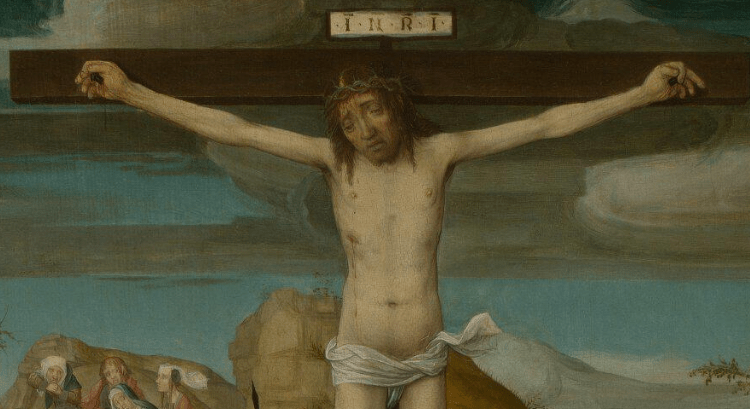
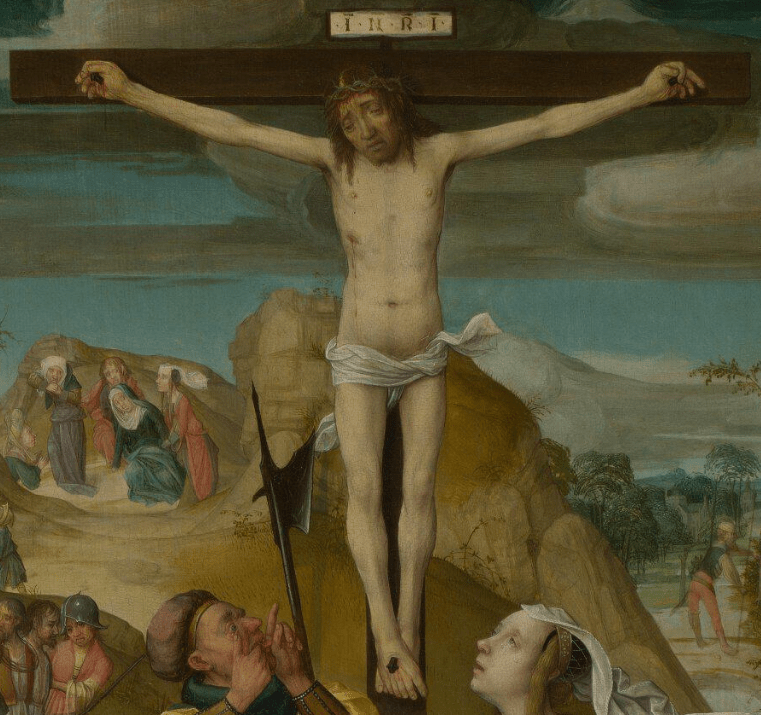
Jesus is crucified as we would expect – and as we have learnt to expect from all the images we have seen of him in the past. A nail has been driven through the palm of each hand, and, however physiologically impossible that would be, it was the tradition and not to be altered. There is no sense of the weight of the body, the pull on the arms which could dislocate the shoulders, the lifting of the rib-cage which eventually causes suffocation. You could argue that there is nothing too unbearable to look on, or we would avoid it altogether – but there are other traditions that do not shy away from the anguish, from the extreme suffering, or from the grotesque, even. You could equally argue that this portrayal is a sign of Christ’s inevitable triumph over his suffering, and then, over death. We see now, given that it was not clear in Lent 32, that his chest has already been wounded, as described in John 19:33-34,
But when they came to Jesus, and saw that he was dead already, they brake not his legs: But one of the soldiers with a spear pierced his side, and forthwith came there out blood and water.
Whatever the physiological explanation for this phenomenon might be, the blood is, of course, the blood shed for us, which is commemorated during the celebration of the Mass, as instituted at the Last Supper, whereas the water can be seen as the water of life, the promise of life everlasting, as mentioned, for example, in the Book of Revelation 21:6,
And he said unto me, It is done. I am Alpha and Omega, the beginning and the end. I will give unto him that is athirst of the fountain of the water of life freely.
However, the painting contradicts the verses from John. They say that his chest was not pierced until after he had died – and yet he appears to be still alive, and suffering, in this painting. But think back to all of the images of the Crucifixion you have seen: they always include the wound to the chest, whether Christ is alive or dead. That is because, on the whole, images of the Crucifixion are not illustrations of a specific point of the narrative, but the result of a long evolution which means that they can encompass the entire story – the entirety of Christ’s suffering.
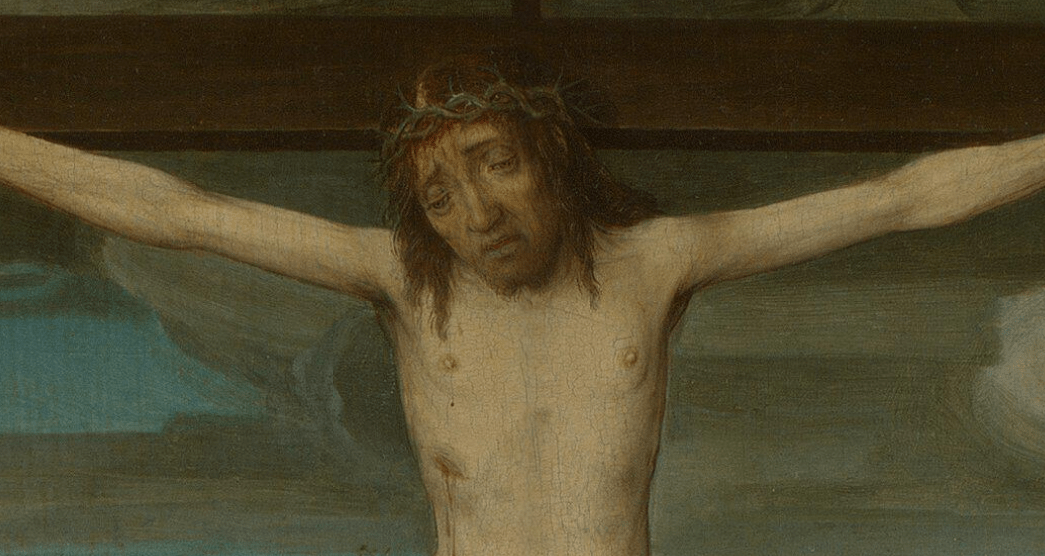
An essential part of this passion – which means ‘suffering’ – is the crown of thorns, originally thrust onto his head when he was mocked as ‘King’, as described in John 19:2-3,
And the soldiers platted a crown of thorns, and put it on his head, and they put on him a purple robe, And said, Hail, King of the Jews! and they smote him with their hands.
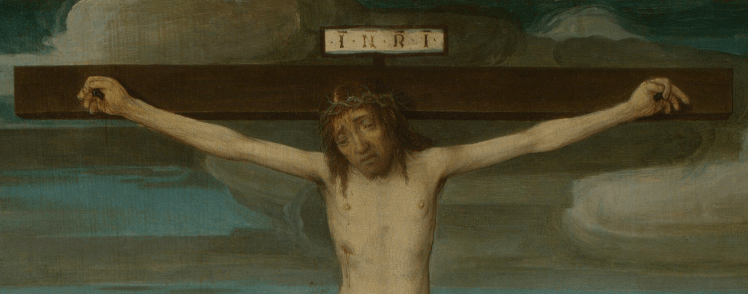
This was mockery which aimed to hurt both mentally and physically, but although the purple robe was removed, the crown remained. We saw it atop the Scala Santa (Lent 15) and on the Via Crucis (Lent 22). Now, still wearing the crown, and underneath the sign saying ‘Jesus of Nazareth the King of the Jews,’ it confirms his kingship, and his reign over suffering, and over death. Around his head the clouds gather (Matthew 27:45):
Now from the sixth hour there was darkness over all the land unto the ninth hour.
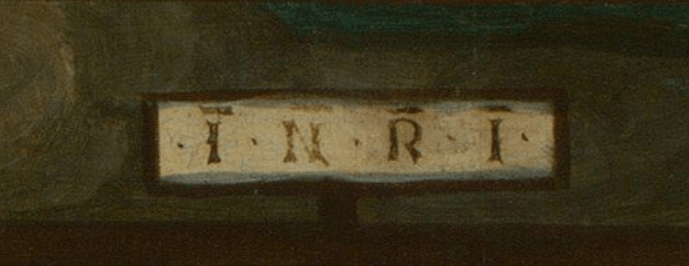
We have done exactly as I said we would – we have looked up, beyond the cross even, to the inscription attached to the top. If I think back over all of the years talking about art, the question I have been asked most often is, in all probability, ‘What does that say?’. Which surprises me. Well, it is the direct result of something mentioned in all four gospels, but which is described most thoroughly in John 19:19-22
And Pilate wrote a title, and put it on the cross. And the writing was Jesus Of Nazareth The King Of The Jews. This title then read many of the Jews: for the place where Jesus was crucified was nigh to the city: and it was written in Hebrew, and Greek, and Latin. Then said the chief priests of the Jews to Pilate, Write not, The King of the Jews; but that he said, I am King of the Jews. Pilate answered, What I have written I have written.
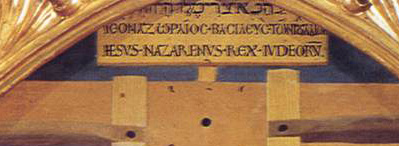
So this is ‘a title’, or in Latin, titulus – which is the word for any label, caption, or inscription, especially those naming figures or subjects in art. To clarify, then, this is the titulus crucis. It tells you who is on the cross – Jesus of Nazareth the King of the Jews, or, in Latin Iesus Nazarenus Rex Iudaeorum, abbreviated here to I.N.R.I. – the dashes above each letter tell you that they are abbreviations.
Now, John says that ‘it was written in Hebrew, and Greek, and Latin,’ although most artists only include the Latin abbreviation. However, there were some, with learned connections – i.e. their patrons were either scholars or priests, or had advisors who were – who included all three languages. However, relatively few artists would have had Latin, even, so they must have had the texts written out for them to be copied onto the paintings. One example is in Fra Angelico’s Descent from the Cross painted between 1432 and 1434 for the church of Santa Trinità in Florence. It was initially commissioned from Lorenzo Monaco – ‘Lawrence the Monk’ – who had completed the pinnacles before his death (c. 1425), and so it was fitting that Fra Angelico – ‘Brother Angelic’ – should take over. Both were Dominican friars, and so had access to some of the most learned scholars in Florence – i.e. their fellow Dominicans. The painting has made its way to the Museo di San Marco, effectively the Fra Angelico museum, housed in the monastery in which he and his workshop decorated all of the cells – including illustrations taken from De Modo Orandi which I mentioned yesterday. I’m afraid the detail isn’t clear, but it’s proved very hard to track it down!
Lorenzo Monaco and Fra Angelico, Descent from the Cross, before 1425 and 1432-34. Museo di San Marco, Florence.
The Jews objected to this wording because, for them, he wasn’t ‘King of the Jews’. They accused him of saying that he was, and this was his ‘crime’, according to them – even though Jesus didn’t claim the title for himself. In Mark 15:2,
Pilate asked him, Art thou the King of the Jews? And he answering said unto them, Thou sayest it.
It’s hardly an admission. When, in John 18:33, Pilate asks him the same question, his response, in verse 36, is ‘My kingdom is not of this world.’ In a similar way in which Pilate washes his hands of the responsibility for Christ’s death, he ends up refusing to confront the possible implications of the choice of words, resorting to ‘I have written what I have written.’ Whatever the historical Pilate was like, the character of the biblical version is both rich and complex.
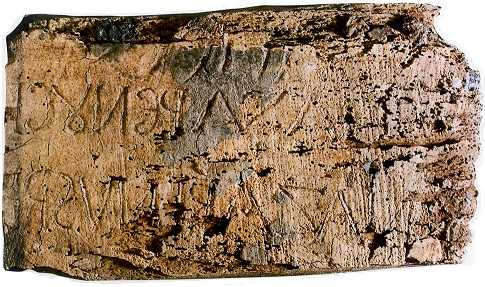
You may remember that it was/is believed that St Helena had brought the steps of the Praetorium (Pilate’s palace) back to Rome (Lent 16), and that they are now known as the Scala Santa. Well, another of the relics that came with them was the titulus crucis, which she gave to the Church of Santa Croce in Gerusalemme, founded by the Empress herself around 325 CE. Apparently, it’s still there! Although it went missing for a long, long time, its rediscovery in 1492, by a Spanish priest, on the very day that news arrived from Spain about its delivery from the Moor, was in itself seen as miraculous.
The titulus crucis and a transcription
It has been analysed by any number of experts in palaeography (the study of writing systems) who have all dated it to some time in the 1st to 3rd or 4th Centuries, with most of them preferring the 1st Century. Although it’s very hard to read, the first line is mostly destroyed, and the Greek and Latin are written backwards (maybe the ‘scribe’ was Jewish and used to writing right to left – would a forger think of that?), many people are convinced it is the real thing. OK, so radio-carbon dating suggests it was made some time between 980 and 1146. As the Cardinal Bishop of the church between 1124 and 1144 had sealed it in a box – the one in which it was found in 1492 – then you could argue that he was responsible for its production. It could, of course, be a copy of the original… For now, I shall leave you to ponder on it, knowing, at least, that it is there.















 dr richard stemp