Day 25 – The Resurrection

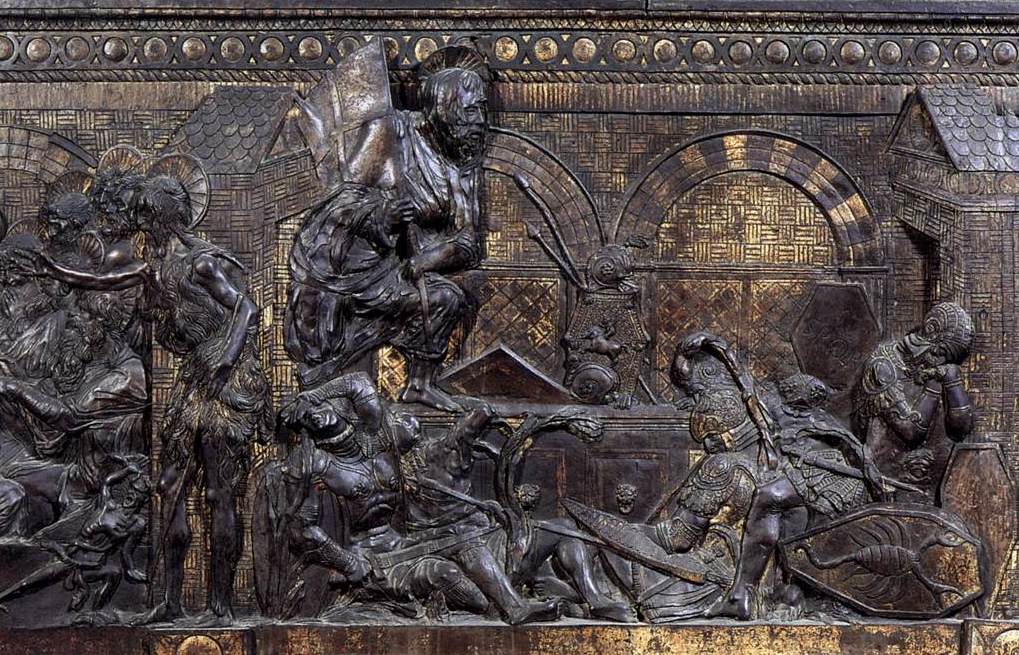
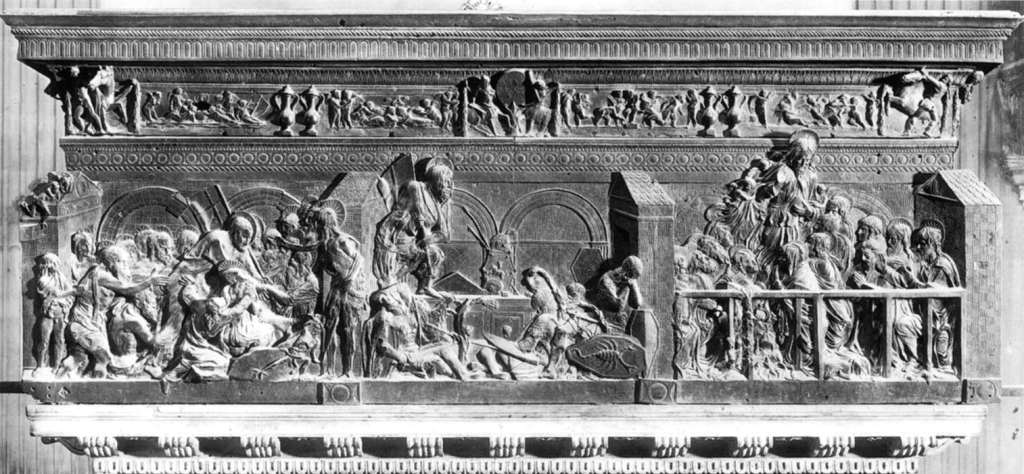
Day 25 – Donatello, The Resurrection, c. 1460-65, San Lorenzo, Florence.

Happy Easter! And to celebrate: my favourite image of ‘The Resurrection’. Why this one, of all the possible examples? Quite simply, because it’s not easy: this is a hard won victory. And because it breaks all the rules.

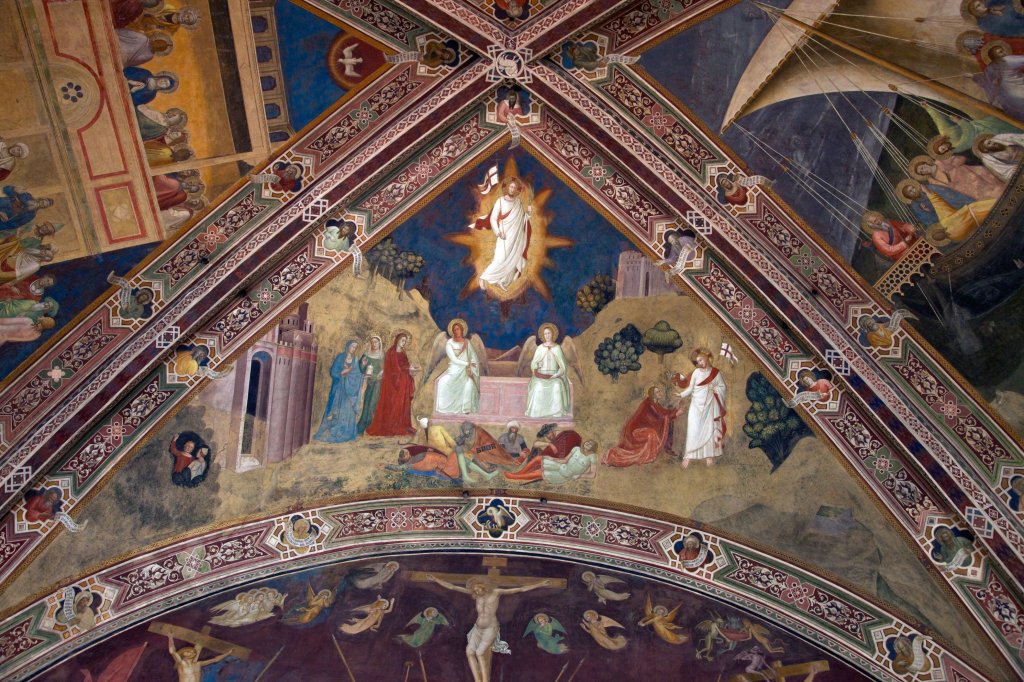
Most versions of the Resurrection make it look effortless. Jesus springs forth without a care in the world, just like all good comic book escapes: ‘in one bound he was free’. Here again is Andrea Bonaiuti’s version, which I ended with yesterday (#POTD 24).

CF541C The Resurrection, by Andrea di Bonaiuto, 1365-1367, Spanish Chapel, Basilica of Santa Maria Novella, Florence Italy

Two angels sit serenely on either side of the empty tomb, the soldiers sleep just as serenely on the floor, while the lid of the tomb looks as if it has toppled off, and is now lying where it fell, just behind the sarcophagus. Jesus floats effortlessly in the sky, the Flag of Christ Triumphant over his shoulder: it’s a red cross on a white background. No, he wasn’t English – but I’ll tell you about that another day. In other examples, the Resurrection is more explosive, with fragments of tomb flying in all directions. In yet more, Jesus appears above the still-closed tomb, apparently without even lifting the lid or disturbing its structure. Donatello sees it differently. This is hard work. He drags himself out, one foot on the edge of the tomb, grasping the standard with both hands as if he is going to use it to push himself up in that one final effort to escape the horrors of hell. He is still almost entirely wrapped in his shroud. Look back again at the Bonaiuti: as so often the shroud has been nonchalantly thrown round his shoulders as an improvised toga. For Donatello it clings to his limbs, wraps tight around his face, and slips off the shoulder with no hint of sensuality and every sign of inconvenience. And his face – this is the face of exhaustion – the face of someone at the end of their abilities. The suffering he asked his Father to free him from in the Garden of Gethsemane less than three days before is not yet over. One last push. Meanwhile, the soldiers sprawl on the ground, uncomfortable and unaware.

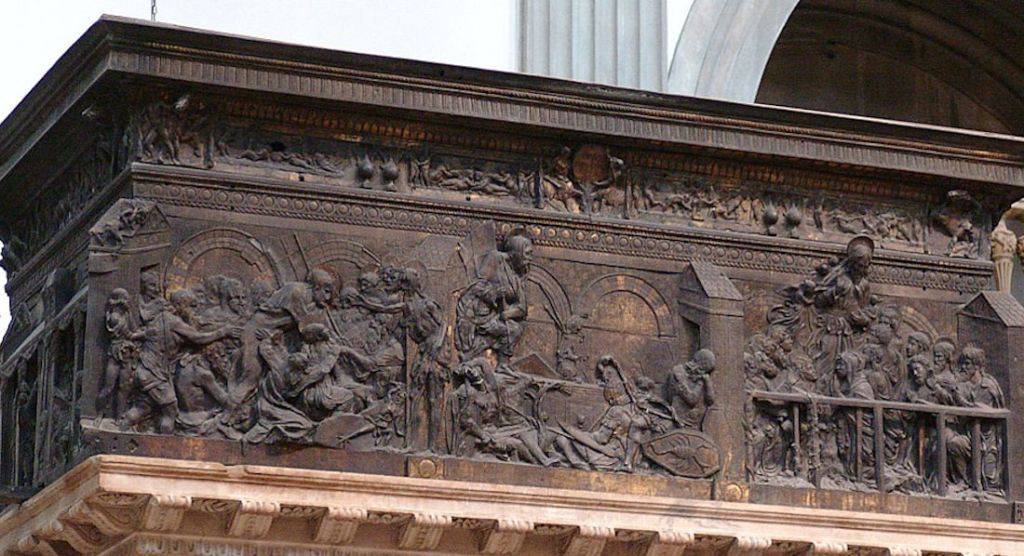
Like the pictures I’ve shown you over the past couple of days, it is part of a larger whole. It is just one image on a pulpit which was erected for the first time in 1515, some fifty years after Donatello died. Even then it didn’t take the form in which we see it today. There are actually two pulpits in San Lorenzo, both of which were constructed out of incomplete elements left behind at Donatello’s death in 1466. They were finished by his assistant, Bertoldo di Giovanni. If we’re honest, we don’t know what these reliefs were intended for. They are probably connected to Donatello’s great patron, Cosimo de’ Medici – not the Grand Duke of Tuscany I mentioned yesterday, but the man who cemented the power of the dynasty in the 15th Century. He was awarded the title of  ‘Pater Patriae’ – Father of the Fatherland. This is the old Cosimo – Cosimo il Vecchio. He and Donatello grew old together, and, some say, they became friends. Cosimo is supposed to have commissioned work from Donatello to keep him busy in his old age, although he himself died two years before the sculptor. Cosimo was involved in a complete re-building of the local church, San Lorenzo, and was buried directly in front of the high altar. The theme of death and resurrection seen in the pulpits would be ideal for a tomb, and one suggestion is that these bronze reliefs were commissioned for Cosimo’s own funerary monument. Another suggestion is that there was a plan for the church which involved two pulpits from the outset. However, even though the pulpits have been given the same form, the shape and format of the imagery is different on each, and gaps have been made up with later work: they were not meant to be part of structures quite like this.

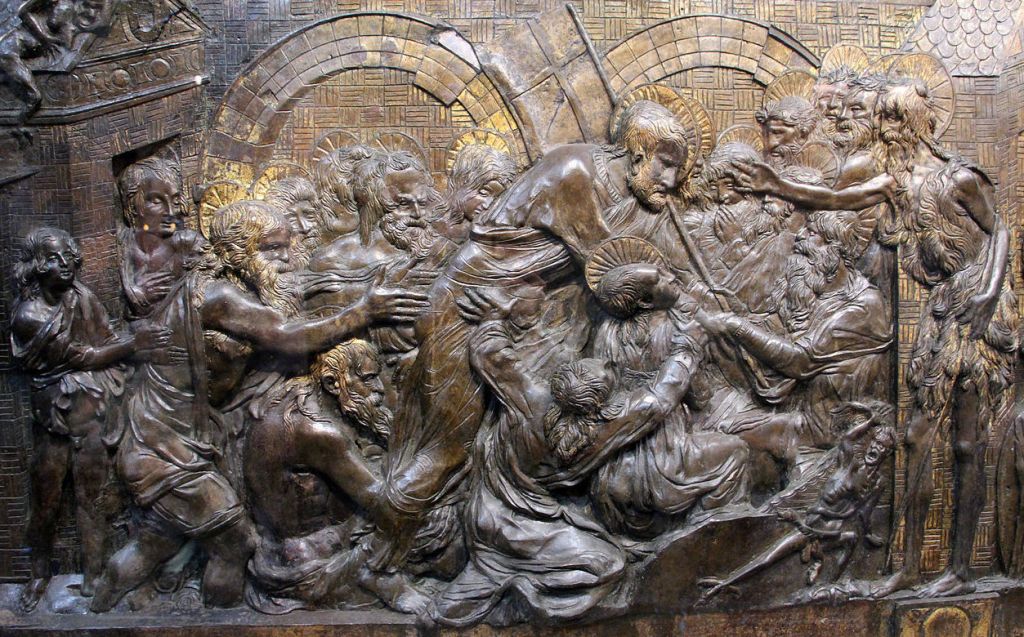
This scarcely matters for the consideration of this picture though. As you can see from the figure standing on the left, it is the continuation of a story – as it happens, the same story that we saw yesterday, ‘The Harrowing of Hell’ (#POTD 24). You might even recognise this figure, with his camel skin and his long, messy hair and beard: St John the Baptist.

He is reaching out to Jesus, who is struggling through the souls in hell. Working his way across the space, flag already over his shoulder, Jesus will get there. He grasps the hands of one of the souls, while others reach out to him. There is none of the orderly waiting we saw yesterday: it really is hell in here, with people reaching, grasping, striving, each with their own particular need. And Jesus keeps wading through the dead. John the Baptist reaches out to give him a helping hand, to pull him on, towards the gate on the far side of hell, opposite the one through which he entered. Donatello uses four buttresses to structure the narratives on this panel, which now makes up one side of the pulpit. There is one at either end, and two in the middle, dividing the surface into three: John the Baptist stands in front of the second from the left. These buttresses are shown in a rough perspective, as if our attention were focussed on the centre, on the Resurrection. 

Going from left to right the first three buttresses all have apertures in them, presumably doors. Jesus drags his way through hell, where he will step through the door behind John the Baptist. It is from this door that he hauls himself up, out of hell and onto the sarcophagus. Or rather, he will – he hasn’t done it yet. The perspective of the buttresses is centred, and implies that the focus of the relief is in the middle of the sarcophagus, where the two arches meet. This point is marked by a trophy, made up of a shield, two spears and two helmets, the sort of trophy used, typically, in monuments celebrating a victory. Jesus hasn’t got there yet. He won’t truly triumph over death until he makes it up onto the tomb, and stands, full height, in the centre of this relief. He’s nearly there.

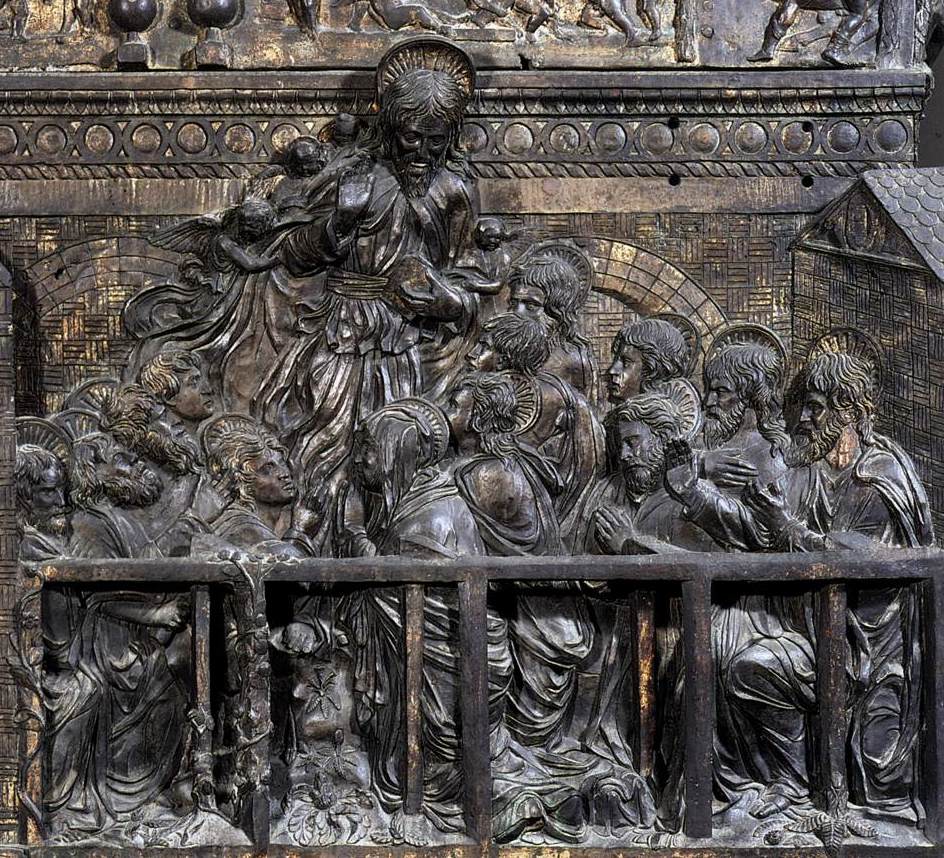
That’s what I love about this version: it’s so original. So unexpected. Not only that: it goes against every single idea we have about this era. The Renaissance, or at least the Early Renaissance, developed a sense of order, clarity, and balance, making images that look more like the world we live in and experience, with accurate anatomy, naturalistic scale and a measured perspective. In relief carving – or modelling like this – this was achieved by giving the foreground figures higher relief than those further back, the relief gradually getting flatter as things get further away, with some details in the background being effectively drawn in. In all cases, the space depicted is imaginary, not real. But not here! We can see this clearly in the next story that Donatello has included: the Ascension. This bit of the narrative won’t happen for another 40 days – but nevertheless, here it is.

Jesus is in a tightly crowded space, surrounded by thirteen other people. The Virgin Mary, with her head covered, is just to the right of him, and to the left of her is probably John the Evangelist: young, and beardless, with flowing hair. And the other 11? Well, the remaining Apostles, although by this stage Judas was dead. The new 12th Apostle was St Matthias, and he must be here, even though, according to the Bible, he wasn’t appointed until just after the Ascension. The figures are corralled in by a fence, which stands free of the rest of the sculpture – you can see its shadow cast on the figures behind. This isn’t imaginary space Donatello has created, this is real space, and there are far too many people crowded into it: no order, no rationale, but, instead, expression. Indeed, you wouldn’t really get anything else quite as ‘expressionistic’ as Donatello’s late style until the early 20th Century. Not only are the figures crowded too closely together, but it is also hard to see their relationship to the floor of the room. Donatello is manipulating the space, and manipulating the movement of the people in it. As they gather around Jesus, they emphasize his upward movement, while also making way so that we can see more of him, from his knees to his halo. Tiny angels help him upwards – another unprecedented feature: in most versions he can do this on his own. As it happens, he cannot leave any other way: the buttress on the far right is the only one of the four with no way out. As we saw yesterday, the only way is up. 

He is so much larger than the other figures. So much for proportion and perspective! In this case, size doesn’t tell us where he is, but how important he is. Donatello has returned to a medieval hierarchy of scale, where size is equivalent to status. And not only that, on his way to Heaven, Jesus is physically leaving the picture space, head and shoulders above the frieze marking the top of the wall, his head and halo standing free from the background, solid and sculptural. Look back at the Resurrection, though: this escape from the bounds of the picture frame started there.

As Jesus progresses from left to right, from the ‘Harrowing of Hell’, through ‘The Resurrection’ to ‘The Ascension’, he gets bigger, and higher, and the relief gets increasingly deep. In ‘The Resurrection’ his head is already above the arches, with his halo in front of the circles of the frieze. And by the time he gets to the Ascension, both head and halo are clear of the frieze altogether. Jesus has left the building. Or he will do, in forty days.

In the meantime, Happy Easter! We are still in the middle of it all. Maybe we are not yet quite in the middle, we’re still waiting, but we’re getting there. It’s not easy, the last step – and who knows when the last step will be? But we will get there, and before too long we will also be able to go out. That might even be within the next forty days.

Day 24 – The Devils

Day 23 – Andrea Bonauiti, The Devils, from The Harrowing of Hell, 1365-68, The Spanish Chapel, Santa Maria Novella, Florence.

It’s Easter Saturday – a day, it might seem, like any other, trapped between two extraordinary days – Good Friday, and Easter Sunday – and we wait, expectant and patient, while nothing happens. Or so it seems. Behind the scenes, in terms of Christian theology, a lot is being prepared. There’s always a slight sense of worry, a sense of foreboding, what if it doesn’t work out? We are all there now, all of us across the world, of all faiths and none, with a sense of waiting to see what happens next. Will the threat of the Coronavirus exceed our society’s ability to overcome it? Or will it beat us in the end? We know it will be the former, we have that faith. But how do we deal with the constant tension? As so often, humour is one way through: by belittling the threat, maybe we can make it seem small. So today, I bring you – the Devils! This is just a detail from an image which is painted as one section of a single wall in a large chapel which is just part of one of the most important churches in Florence: Santa Maria Novella. It’s a tiny detail in a massive whole, and yet, it was a little hint of encouragement for the people who would have seen it when first painted, and I hope it can be for us too.

The Spanish Chapel got its name in the 16th Century. It became the main place of worship of the Spanish Community in Florence, who arrived in the train of Eleonora of Toledo when she married Cosimo I Grand Duke of Tuscany. But before that it was – and remained – the Chapter House of the Dominican friary. The friars would meet here every day, where they would be read a chapter from the Rule of St Dominic, and at these meetings the daily administration of the friary would also be discussed. It was in Santa Maria Novella that Boccaccio’s protagonists were supposed to have met in the Decameron. They then fled the city of Florence to avoid the plague – and not just any plague: the Black Death. Yes, they were Socially Distancing, but in an unfeasibly large group of ten. And how did they pass their time in medieval lockdown? Well, they told good stories. One story each, every day, for ten days. A hundred stories in all. Were the stories solemn, sober, and respectful of those suffering loss? Oh no! They are some of the filthiest things you will ever have read, and went on to be one Chaucer’s biggest inspirations for the Canterbury tales. You get through the daily bread of endurance with the leaven of comedy.

The Chapter House was decorated a couple of decades after the Black Death, but there is still a measure of defiance, a hint of hope. You start by making fun at the biggest threat, and, for the medieval mind, this was the Devil. Here are his minions. Terrifying. The threat is palpable. Or rather – they are completely laughable. To the modern mind minions are banana-coloured, weetabix-shaped creatures, who wish to serve the meanest mind on the planet. But this is how the medieval mind saw them. And yes, one of them is yellow – but scrawny, ill-fed, its rib-cage prominent, its biceps sagging, a comical look of distress on its face. Behind, two of its companions, in red and grey, clasp their hands and bite their nails, looking for all the world as if they are gossiping at a WI meeting with no jam and too much Jerusalem. Another devil, oblivious to the wispy hellfire, looks to see if what it feared is really true, and, because it is, scuttles rapidly back to the relative safety of the inner reaches of hell. What has disturbed them so much? Well, Jesus has just knocked on the door. This always reminds of the bumper sticker subverting any number of evangelical Christian badges: Jesus is Coming! Look Busy! 

According to the Apostles’ Creed, 

Jesus… was crucified, died and was buried;
He descended into hell;
on the third day He rose again from the dead.

Before we go any further, I want to clear up one point. I’ve often heard people say, ‘after three days he rose from the dead’, and less often, ‘but Easter Sunday isn’t three days after Good Friday’. Well that’s not what the creed says. It says, ‘On the third day…’ Let’s count: Friday – first day; Saturday – second day; Sunday – third day. It’s that simple. Meanwhile, what was Jesus up to? What was going on backstage in the drama of Easter? Well, he descended into hell, it says so in the creed. But what did he do when he got there? The belief was – and maybe still is – that because of Original Sin, mankind was destined to everlasting damnation. Christ’s sacrifice means that mankind is saved, but what about those truly good people who died before Jesus? What hope did they have? Well, in this scene, known as ‘The Harrowing of Hell’, Jesus has come to get them.

Jesus dies, descends into hell, and knocks on the door. The devils scarper: that’s them cowering on the far right of the image, hiding as far away from the Gates of Hell as they possibly can.

Eventually, one brave devil heads to the door… but by this time Jesus has lost patience, and tramples the door underfoot. The devil is crushed underneath it (and look! It even had a key to unlock the door – or maybe this was a vain attempt to lock it once and for all?) 

At this point you realise that hell has a curious ‘first in first out’ policy. The first to greet Jesus is Adam, now enormously old with the longest of white beards – and Eve is kneeling just below in pink. And you thought they would be given the largest share of the blame! Don’t worry: there is hope for all of us. Behind Adam is a young man with a lamb. It’s not the Lamb of God, though, as that is not John the Baptist. It’s not initially clear where John has got to, which is odd, as he didn’t die much before Jesus (three years at the most). So who could it be? Again, on the ‘first in first out’ basis, it must be Abel, the son of Adam and Eve: the son who sacrificed of his best – a nice fat lamb – only to be murdered by his brother Cain. To the right of him is an old man with a wooden box with a dark hole in it: Noah, with a working model of the ark, in between Mrs Noah and one of his sons. But where is John the Baptist?

Oddly he’s made his way back in the crowd, wearing his camel skin robe, with the usual long, messy hair and beard. He might look as if he’s trying to thumb a lift out of hell, but he’s carrying on where he left off, working the crowd as Jesus’s warm-up act, and now that Jesus has brought the doors down (if not yet the whole house), he is once again exhorting ‘Behold the Lamb of God!’ Just above him you can see Moses – with rays of light glowing out of either side of his head, and a stone tablet with illegible script: the ten commandments. Bonaiuti clearly had no Hebrew. To the right of Moses is a man with a crown, and a zither – King David, still harping on the Psalms, which he is supposed to have written. ‘Out of the depths have I cried unto thee oh Lord’ (see #POTD 5) – and now, He is here in person.

‘The Harrowing of Hell’ is just part of the larger picture. It occurs at the bottom right of the Altar wall in the Chapter House (or Spanish Chapel). At the top we see the Crucifixion, and at bottom left the ‘via Crucis’. Christ, stripped of his blue cloak, is in his red robe, carrying the cross out of the city gate and up the hill to Golgotha. Bonaiuti is using the surface to perfection. With Jerusalem bottom left, he heads up the hill to Golgotha to be Crucified at the very top of the image, and then descends to hell at the bottom right: the gate of Jerusalem and the gates of Hell are equivalent. Although, if we look forward to the New Jerusalem, you realise that the earthly city is shown under Jesus’ right hand, on the side of the Good Thief, whereas hell is on his left, under the Bad. No wonder the devils are scared of Jerusalem. With this wall, we get to the end of a chapter – or the end of an episode – and fortunately, we have the box set. What could possibly happen next? Well, spoiler alert! He rises from the dead! But where can Bonaiuti go from here? He’s filled up the entire wall! In the immortal words of that little-known 80s gospel singer, Yazz, ‘The Only Way is Up’. You’d have to look up at the ceiling.

The Resurrection, by Andrea di Bonaiuto, 1365-1367, Spanish Chapel, Basilica of Santa Maria Novella, Florence Italy

Bonaiuti has planned his storytelling across the wall and through space to the ceiling, which I find remarkable. And this is only one wall, and a bit of the ceiling. This is one of the most remarkable rooms anywhere in the world, and yet so few people know it. But then, the rest of Florence is also remarkable. As is the rest of Italy. And currently, no one can see it. Today’s Italians are being incredibly patient, waiting for the chance to get out. At least they are not as cramped as these souls waiting in hell. But that won’t make the apparently endless waiting any easier, or bring back those who are lost, I know. The threat is real, very real, but in this fresco it is cowering in the bottom right hand corner, risible devils, insignificant in the larger scale of things. This virus might seem to be a greater threat to us in the 21st century, but it dissolves in soap… so… keep washing your hands, and avoid huddling together while we wait for the threat to pass. And tell good stories. At least one a day.

Day 23 – The Crucifixion

Full title: The Mond Crucifixion Artist: Raphael Date made: about 1502-3 Source: http://www.nationalgalleryimages.co.uk/ Contact: picture.library@nationalgallery.co.uk Copyright © The National Gallery, London

Day 23 – Raphael Sanzio, The Crucified Christ with the Virgin Mary, Saints and Angels, about 1502-3, National Gallery, London.

It is Good Friday – which, of course, every year, prompts the question, ‘Why is it Good’? Well, according to the OED, the first use of ‘Guode Friday’ was in 1290, and the word is used in reference to ‘a day (or season) observed as holy by the Church’ – and we all like holy days – or rather, holidays. They are really good, even if this year the long Bank Holiday weekend will be spent at home. So now you know, don’t ask again next year.

It is of course the day on which Christians remember the Crucifixion of Jesus – making the choice of subject matter for today’s #pictureoftheday obvious. But why Raphael? Well, I missed it on Monday, but that day marked 537 years since he was born – or, more significantly, 500 years since he died. Like Shakespeare he had the good sense to die on his birthday, thus cutting down the number of dates we’d have to remember and making him look More Significant. ‘Why don’t you just say Anniversary?’ you ask. Well, it isn’t the same day. In the 16th Century, everyone in Europe was using the Julian Calendar. The Gregorian Calendar was instituted by Pope Gregory XIII in 1582, but Britain didn’t fall into line until 1752 (after all, it was clearly a Popish plot) when we ‘lost’ 11 days. By now the Julian Calendar is 13 days behind the Gregorian Calendar, apparently… so… oh it really doesn’t matter.

Back to the painting, which is a brilliant example of Raphael’s early style. As an artist he was a sponge – anything that he saw and liked he absorbed, assimilated and regurgitated, and here he is giving us his Perugino. Born in Urbino, the son of court artist Giovanni Santi, Raphael was initially trained by his father. He was then apprenticed to Pietro Perugino, and his early works are almost indistinguishable from that of his master – compare the second image. This is Perugino’s Archangel Raphael with Tobias painted around 3 or 4 years before Raphael’s Crucifixion – if you want to know the story, see #POTD 4. 

If you compare the paintings, the standing figures in both have one foot firmly planted on the ground, with the heel of the other slightly lifted, making the knee on that side bend – a position known as ‘contrapposto’. The head is tilted to one side. The articulation of the angel’s fingers, especially the delicate curve of the thumbs, and exaggerated separation of the little fingers, is very similar to those of St Jerome, the figure kneeling on the left of the Crucifixion. The overall effect is feminine – or effeminate – and slightly fay. The landscapes are – or were – also similar, but you can’t really see that as the Perugino has been cut down, also losing Tobias’ and Raphael’s elbows, and most of the dog. It’s what is called an Umbrian bowl landscape – seen in Umbrian paintings, rather than in Umbria itself. On the left and right the horizon is higher, and more or less horizontal, dipping down to a lower central section, thus looking like a bowl. The distance is blue, the middle ground green and the foreground brown – an early example of atmospheric perspective (the effect that the atmosphere has on the way we see things as they get further away). This colour scheme is formulaic: if you were standing on green grass it wouldn’t look brown. Notice, in the Crucifixion, that they are also standing on a hill. Yes, that does have a narrative function, ‘There is a green hill far away’, after all (even if it is brown here), but it is also a way of coping with the progression from foreground via middle ground to background. It cuts out the transition between the first two stages, and brings the characters further forward. Raphael isn’t the only artist to do this.

Full title: The Mond Crucifixion Artist: Raphael Date made: about 1502-3 Source: http://www.nationalgalleryimages.co.uk/ Contact: picture.library@nationalgallery.co.uk Copyright © The National Gallery, London

The more astute among you will have noticed that I said that the man kneeling on the left of the Crucifixion is St Jerome. And the most astute will also have realised that St Jerome was not present at the Crucifixion, living, as he did, from 347-420 AD.  The other three were, according to the bible. Standing on the left is the Virgin Mary, and on the right, John the Evangelist. We know that, because the gospels mention them standing at the foot of the cross: this is the point at which Jesus, from the cross, commended them to each other’s care. Also, they wear their traditional colours, Mary in a blue cloak over a red robe, and John in red and green (his colour scheme is not so fixed as it is for other saints). Kneeling on the right is Mary Magdalene, who is also mentioned as present in the Bible. I’m glad she’s there, as she is a useful antidote to those who would rather believe bad fiction than standard Christian theology and art history. Mary Magdalene was not present at the Last Supper, and has never been depicted as being there. Yes, John looks very girly – with long flowing hair, and a smooth, beardless face, but that’s how the young Raphael depicted young men – as, of course, did everyone else, including Leonardo. Any self-respecting woman would have her hair covered, or at least dressed, and the Magdalene does indeed have ribbons in her hair. I know, you could argue she was not a self-respecting woman, but by the time she was kneeling at the foot of the cross, she was, having repented of her sinful ways. This is why she is paired with St Jerome. They are the two leading saints associated with the act of penance. Mary is repenting her sinful ways as a prostitute (there is no biblical evidence for that, by the way, but that is another story), whereas St Jerome is lamenting the fact that he had read so much classical literature. Not an ideal saint for the Renaissance, you might think, but renaissance scholars were adept at sidestepping minor inconveniences like this. According to his story, he retired to the wilderness as an act of penance for the folly of his youth, beating his chest with a stone and contemplating Jesus’ sacrifice on the Cross.  This painting was commissioned for an altar dedicated to St Jerome – so he is there by necessity. As a result, you could argue that the Crucifixion is really there because of him, in this case, rather than the other way around.

What we are seeing is an elision of two separate things. The Maries and John are physically present at the Crucifixion, whereas St Jerome is contemplating a Crucifix. Another way of looking at it is that everything in the painting, with the exception of St Jerome himself, is one big thought bubble: the Crucifixion, the Virgin, St. John, and Mary Magdalene are all part of Jerome’s contemplation. This goes to show that however realistic a painting might look, the visual elements are predominantly symbolic. And indeed, the more you look at it, the more you realise that the art is in the artifice. The figures are perfectly balanced – if not exactly symmetrical – from one side to the other. With the inner figures kneeling, the four heads take on a similar profile to the horizon, with those of the Virgin and John standing clear against the sky, and those of the kneeling figures seen against the rolling hills lower down. The colours of their clothes tie them together as well, with the Virgin’s dress, Jerome’s belt, and John’s cloak being the same shade of red. Exactly the same shade of red is used for Jesus’ loincloth, which, if you haven’t noticed it already, is remarkable.

Full title: The Mond Crucifixion Artist: Raphael Date made: about 1502-3 Source: http://www.nationalgalleryimages.co.uk/ Contact: picture.library@nationalgallery.co.uk Copyright © The National Gallery, London

Have you ever seen Jesus in anything other than a white loincloth? It is one of the features of this painting that suggests it was commissioned to replace a far older image, as the only other examples I know were painted in the 13th Century. The third image is a Crucifix by Cimabue in Arezzo, and is dated to around 1270. The colour is associated with Royalty, and goes back to the Byzantine tradition, when the Emperors wore purple – which is often shown as red. It is also, of course, associated with the blood that you can see in the Cimabue flowing from the wounds in Christ’s hands and feet. In Raphael’s version the angels gather Christ’s blood in chalices. This is the Holy Blood, which was the subject of yesterday’s image (#POTD 22).

Notice how, in Raphael’s painting, the angels are flying in the same plane as Jesus. No, I know what you’re thinking: they are on the same spatial plane – the picture plane – and their ribbons fly out parallel to the picture surface as well, as does one end of Christ’s loincloth. Raphael is using them to pattern the surface of the painting – they do not move in depth at all – and, as ever, this placing of things parallel to the picture plane makes them look more iconic, taking them out of the reality of this world. In the real world, we move in and out of space. Likewise, and most otherworldly, we see the sun and the moon in the sky, on either side of the Cross, depicted with gold and silver leaf resepctively. This is another feature of archaic images of the Crucifixion, and can be interpreted in several ways – all of which are valid. It probably derives from the biblical passage which states that the sky darkened when Christ died – we have night during the day, and see both heavenly bodies at the same time. But it is also prodigious – the two shouldn’t be seen so close together – and so it forebodes ill. In some cases they mark God’s anger at the death of his son. They also came to symbolise the Old and New testaments – St Augustine, a contemporary of St Jerome, promoted that interpretation.

In between the Sun and Moon we see the titulus, or ‘title’, which Pontius Pilate attached to the cross, saying ‘Jesus of Nazareth, King of the Jews’ in Hebrew, Greek and Latin. Sometimes, but only rarely, artists include the full inscription in all three languages. More often, as here, they only include the abbreviation I.N.R.I., which comes from the Latin inscription: Iesus Nazarenus Rex Iudeorum.

Raphael has produced a static, almost timeless image. However relevant to today, this lasts for all time, night and day. The angels gather the precious blood, too precious, indeed, to allow it to fall to the ground. The Virgin and St John stand witness with long-suffering devotion while Jerome and Mary Magdalene look on in humble, penitent adoration. The symmetry of the composition, its order and balance, are given strength by a pyramidal composition. The figures of Christ, Jerome and the Magdalene define a triangle – and no normal triangle at that. This is the golden triangle – the ratio of the long side to the short is the golden section, and if you were to bisect one of the lower angles, one of the resulting triangles would also be golden. The base is the length of a pentagon which would have its apex at the top of this triangle. 

The golden section occurs often in nature – usually in terms of growth – and is so remarkable that it was the subject of a book written around 1498 that was first published in 1509. The author, a Franciscan Friar by the name of Luca Pacioli, called it ‘De Divina Proportione’ or ‘About Divine Proportion’. This shape is, in itself, holy, it seems, and so is the painting – the angels and the angles tell us so. It is Good.

Day 22 – The Last Supper

Day 22 – Tilman Riemenschneider, The Last Supper, 1499-1505, St. Jacobskirche, Rothenburg ob der Tauber.

It is the beginning of Week 4 of #pictureoftheday and I bring you a whole new innovation: I finally have my own website, and if you want to, you can head to the ‘home’ page and subscribe to my blog:

http://www.drrichardstemp.com

Alternatively, of course, you can just keep reading it here. But if you know anyone who might like it, who is not on social media, please do tell them!

On with today’s picture! We are continuing, really, from #POTD 18, where I talked about Christ’s Entry into Jerusalem, a relief carving on the left wing of Tilman Riemenschneider’s Holy Blood Altar. The Last Supper here is another detail from this remarkable structure, which is enormous, and quite hard to understand from a photograph. Nevertheless, you can see one view of the whole thing here: 

As with most carved altarpieces like this the most important part is the central section, with carved wooden sculptures encased in what is effectively a box.  This section is called the ‘corpus’, as it is the main ‘body’ of the altar. This can be shut away with the two wings, which are hinged like doors. The wings were never decorated as richly as the corpus – sometimes they were just painted, a far cheaper form of decoration than carving, whatever the relative values are now, and sometimes, as here, they were carved, but in low relief. The wings would be kept closed to protect the corpus from dust, and opened during the Mass, or on special feast days. In particular, they would usually be kept closed during lent, a period of calm, quiet contemplation, where any notion of celebration of excess is supposedly put away. However, as the corpus of the Holy Blood Altar shows the Last Supper, which takes place during Lent, it might not make sense to close it off. In addition to this, the physical structure of the piece – the carpentry as much as the sculpture – implies that this might not have been possible.

The corpus is raised above the altar by what is often called a ‘predella’. In a painted altarpiece this would be a strip of pictures on the box which supports the main panel, but in this case it is more of an open framework designed to house a small crucifix, and two adoring angels. It was at the Crucifixion that Christ’s blood was shed. This is, of course, of huge importance given the name of the altar. The church of St James boasted a relic of the Holy Blood, and the altar was designed as an enormous reliquary. Above the corpus, effectively standing on the roof of the Upper Room where the Last Supper is taking place, there are two kneeling angels holding another cross. There is no figure of Jesus here, but there doesn’t need to be, as it is this cross which contains the precious relic. On either side we see the Annunciation. The Angel Gabriel, standing on the right, announces to the Virgin Mary that she will be the mother of God. But he announces the coming of the Messiah across the relic of the Holy Blood – so with the news of Jesus’ birth comes the inevitability of his future death. At the very summit of the filigree work decorating the superstructure is one last sculpture – Jesus himself, as the Man of Sorrows. He is dressed in a loincloth and wears the Crown of Thorns. He points to the wound in his chest from which the blood flowed. As he is directly above the relic, it is as if the blood flows down into the reliquary cross – and on, downwards, into the chalice at the Last Supper. Or it would, if we could see a chalice.

That is the point of this sculpture: it was at the Last Supper that Christ instituted the Eucharist. According to Mathew (26:26-28):

‘And as they were eating, Jesus took bread, and blessed it, and brake it, and gave it to the disciples, and said, Take, eat; this is my body. And he took the cup, and gave thanks, and gave it to them, saying, Drink ye all of it; For this is my blood of the new testament, which is shed for many for the remission of sins’.

Before the 10th plague of Egypt (see #POTD 21, yesterday), the houses of the Israelites were marked with the blood of a spring lamb, which was sacrificed and then eaten. The blood on the door told the avenging angel not to kill the firstborn of that household – the Jews would be saved. Jesus takes this symbolism for himself, and becomes, as John the Baptist announced, the Lamb of God, who takes away the sins of the world. In the Eucharist, the bread and wine become his body and blood. In Christian belief, Jesus becomes the Passover lamb, and his blood means that Christians will be saved.

Nevertheless, we are witnessing a slightly different point in the drama, just before the institution of the Eucharist. Jesus has announced that one of the number would betray him – and some of them are still discussing which one it will be. The man on the far right appears to be accusing his neighbour, who points to himself as if to say, ‘No, not me guv’nor’. The three above them are looking confused – and maybe a little guilty. The implication is that, whenever anyone does anything wrong, they are effectively betraying Jesus. However, they seem to be unaware that we have already reached the denouement. Judas has stood up and is ready to leave, clutching a moneybag containing the thirty pieces of silver – the blood money – in his left hand. He gets a fantastically central position – but not, apparently, a chair. Maybe he has kicked it away, and it has fallen out of the frame. 

Actually, it’s better than that. The whole sculpture is carved out of several different blocks of wood, all fitted together – and Judas is carved out of a block on his own. Look at the structure of the woodwork making up the floor of the room: can you see that his feet rest on a separate plank? Well, the whole figure can be removed, and tonight, in St Jacobskirche, maybe it will be. Judas will leave the building. This would then allow a better view of the youngest of the Apostles, John the Evangelist, asleep on Jesus’s lap. And a clearer view of Christ’s right hand, withdrawn, almost limp, as even he appears to be wary of blessing Judas.

This really is the perfect piece of drama. Looking again at the overall structure of the altarpiece, we see the Entry into Jerusalem in the left wing (#POTD 18), and, as I suggested then, the fact that you can only see the shoe on the donkey’s foot from the left-hand side implies we should be with the Apostles, following Jesus, through the gate and into the city. This takes us into the Upper Room, depicted in the corpus, where we see Jesus and the Apostles at the Last Supper. From here, Judas heads off to the high priests – and to the arresting soldiers – while Jesus goes to the garden of Gethsemane, depicted in the right-hand wing of the altarpiece. The drama continues from left to right, taking us ever closer to the point where blood – the Holy Blood – is actually shed.

Even within the Last Supper, the drama is palpable throughout the day. On Sunday I showed a picture of the windows of the Upper Room seen from behind the altarpiece – they let light in from the windows of the church itself. The biblical characters are illuminated with the same light as we are, they are in the same world as us, and we become part of their narrative. I had wanted to see this, Riemenschneider’s masterpiece, for thirty years, and I finally saw it for the first time last December. I was lucky enough to spend the whole morning with it. It was a beautiful, crisp, winter’s day, with milky sunshine and a blue sky. Sitting in front of the altar, it was at first evenly lit by a diffuse light. As the Earth revolved the sunlight fell first onto Christ’s hand – the one that had shared food with Judas, the one that appears unable to bless the departing traitor – and then, it fell onto Judas himself. He appears almost blinded by the light… and makes to leave.

Day 21 – The Finding of Moses

Day 21 – Nicolas Poussin, The Finding of Moses, 1651, National Gallery, London.

Originally posted on 8 April 2020

Happy Passover! It isn’t every year that Passover coincides exactly with Easter, but of course it is no coincidence when it does. It was the Seder – the ceremonial Passover meal – which brought Jesus and the apostles together in what became known as the Last Supper: more of that tomorrow. Passover this year must be especially significant, as it marks the last of the ten plagues of Egypt, when the Lord smote all the firstborn of the land. As we know, it is unlikely that the firstborn will suffer this year, but my heart goes out to all those who can’t be with their families, or who have suffered loss.

According to the Book of Exodus, to protect the firstborn of Israel, a lamb was sacrificed. The doors of Jewish households were marked with its blood as a sign that no Egyptians lived there, so that the avenging angel would know to pass over – hence the name of the feast. The lamb itself was roasted and eaten, and is still often part of the Seder. But no lambs for me today (I don’t eat meat) – instead I’ve stepped back in the story of Exodus to the Discovery of Moses. After all, it was him who was trying to persuade Pharaoh to let his people go, and it was Pharaoh’s refusal that led to the 10 plagues. 

I’ve chosen a painting by Poussin that is sometimes in the National Gallery in London. It was bought jointly with the National Museum Wales, so it spends half of its time in Cardiff – like the Tribes of Israel it is continually on the move, but, unlike them, it will probably never find the Promised Land. I’ve chosen it because it holds a special place in my heart, as a result of the following. One December I was booked to take a group of Year 2 pupils (so, aged 6-7) round the National Gallery, and asked to show them ‘Stories, but not Christmas stories, they come from Hampstead’. I’m not sure (a) why they didn’t say ‘It’s a Jewish school’ or (b) how I intuited this. Anyway, the day came, and this painting was in the first room we got to. I sat them down in front of it, and after my usual introduction asked, as I always did, ‘What can you see here’. Around half of them piped up, without hesitation, ‘It’s baby Jesus!’ Given that they were 6 or 7, I didn’t go into the fact that medieval Christian theologians had identified Moses as a ‘type’ of Jesus, and mapped all of his life story onto the Life of Christ, and I’m not going to do that here either. Well, not today anyway. I can’t remember how I got round this corner, but I probably said something like, ‘Well, yes, it does look like the baby Jesus, doesn’t it, but it’s actually the baby Moses’. Next question: ‘And where is the baby Moses’? Several little hands went up, but the first answer was, ‘Well, it’s a bit like a crib, and it’s a bit like a nest’. And I melted slightly in the middle – such a perfect answer.

He is, of course, in a basket of bulrushes. Pharaoh had decreed that all Hebrew boys should be drowned at birth, but Moses’ mother hid him until he was three months old, then made a basket of bulrushes in which she floated him down the Nile. Her daughter Miriam watched to see what would happen next. The basket caught in the reeds, and was discovered by none other than Pharaoh’s daughter, who had come down to the river to bathe. She decided to adopt the baby – at which point Miriam came out of hiding to ask if a wet nurse would be required. The end result was that Moses and his mother were surreptitiously reunited. 

Poussin’s paintings are often solemn, and always measured. The Princess stands aloof in a yellow toga, which modestly covers her head. She is placed about a third of the way across the painting. Two thirds of the way across is the peak of a rocky outcrop, on which reclines a river god with one arm around a Sphinx and the other gesturing towards the water. This is a personification of the River Nile, which we can see flowing across the back of the painting and down towards the bottom right. As if the Sphinx weren’t enough, an Obelisk rises directly above the Princess’s head, and two pyramids can be seen in the distance in the gap in the trees above Moses, just in front of an even further blue mountain. We are obviously in Egypt.

The Princess didn’t go out alone, of course. As it says in Exodus 2:5:

‘And the daughter of Pharaoh came down to wash herself at the river; and her maidens walked along by the river’s side; and when she saw the ark among the flags, she sent her maid to fetch it.’

It doesn’t say how many maidens there were, but Poussin includes nine – although one of them could conceivably be Miriam. The general assumption is that she is the maiden in white holding the basket. The maid sent to fetch the child is still clambering out of the Nile, looking in our direction as if she wants us to share in her adventure. Her legs mark the diagonal leading from the bottom right, which then passes through the heads of the two women kneeling with the basket and that of the Princess, until it reaches the tree at the top left – just another example of Poussin’s measured composition. The maidens themselves wear brightly coloured clothes which echo each other across the painting and surround the baby with an almost rainbow-like aura. Moses alone is naked – although pointedly placed above royal blue fabric – and stands out because of the pallor of his skin.

He reclines in his nest-like crib, already the little leader, waving up toward the Princess. I’m sure there’s a reference here to Jesus’ precocious ability to bless with his right hand. He looks like a chubby baby version of Michelangelo’s Adam on the ceiling of the Sistine Chapel, and, if he is Adam, the Princess, who gestures towards him, stands in for God. In her own way she gives him life, as her choice to adopt him means he will not die. 

Our continued well-being rests with young and old alike, and our ability to look after each other in different ways however distant or isolated. Traditionally, during the Seder, hands are washed at least twice, sometimes three times.  Whatever our beliefs, we should all take part in this ritual every day.

Day 20 – An Old Woman Cooking Eggs

Day 20 – Diego Velázquez, An Old Woman Cooking Eggs, 1618, Scottish National Gallery, Edinburgh.

Originally posted on 7 April 2020

Too early for Easter eggs, you might say, and were the examples in this painting made of chocolate I wouldn’t for a moment dream of talking about them before Sunday – but I suspect that by then I will have other things to talk about. And this painting has been waiting in the wings ever since someone suggested that, having talked about Great Cabbages, eggs would also be something to seek out. This one instantly sprang to mind, because the eggs in question are frankly miraculous… but let’s not get ahead of ourselves.

I don’t know how the home schooling was going up until the end of term, but now there is another challenge. No longer do the parents of co-habiting children and teenagers have to help them focus on their study, but now, instead, they must keep them entertained – and inside – while the weather is good. Of course, right now would be the best time to encourage their creative sides and take out the paint pots that may well have been abandoned as soon as they left primary school. If any of them end up producing anything like today’s picture, please let me know. After all, Velázquez was only 18 or 19 when he painted it. Unfortunately, if the paint pots were put away when your children were 10, I fear it might just be too late, as that was the age at which young Diego became an apprentice. He studied with a man called Francisco Pacheco, who was rather important in Seville, where Diego grew up. Not only would he later write a treatise on art, ‘Arte de la Pintura’, which has become an invaluable source for the understanding of Spanish painting in the 17th Century, but he was also involved with the Spanish Inquisition. I bet you weren’t expecting that. His job was to make sure that the religious images were not heretical. It’s hard to know what he taught Velázquez, beyond the technical aspects of painting, because, as an artist, he wasn’t especially original. One thing is for sure – as an author, and the man responsible for religious orthodoxy among artists, his greatest contribution was as a scholar, and this would prove invaluable to Velázquez when he reached the court of King Philip IV not long after today’s image was painted.

At this stage, however, it seems that we do not see the mind of the artist who would paint one of the most beautiful expositions on the nature of art, ‘Las Meninas’, but the hand and eye of a young man who is determined to show you absolutely everything he can do.

He can, quite simply, paint every material imaginable, catch form, colour and texture in what we would now see as an intense and precise photographic manner. And he does this with subject matter that earlier generations might have considered pointless. It is what, in the wider scheme of things, would be called a genre painting – normal people doing normal things – depicting, as the title tells us, ‘An Old Woman cooking Eggs’. In Spanish art genre scenes like this are called ‘bodegones’, from ‘bodegón’, meaning ‘tavern’ – although it could also mean ‘pantry’ or ‘wine-cellar’. Sometimes bodegones are set in taverns, but also in kitchens, and the term is also used to describe still life paintings, a genre which was on the rise at the time. It could also be described as a ‘low-life painting’, a genre we would usual associate with the Netherlands, although one of the most remarkable early examples is ‘The Bean Eater’, by the Italian Annibale Carracci, painted in the 1580s. Around the same time Carracci also painted ‘A Boy Drinking’, which has, sadly, recently been stolen from the Christ Church Gallery in Oxford. These paintings, produced when Carracci was in Bologna, predate Caravaggio’s early works, also low-life and genre scenes. However, it is the latter artist who influenced Velázquez. It’s worthwhile remembering that from the 15th Century Naples was under Spanish rule, and that in his short life Caravaggio lived their twice – when running away from Rome and on his ill-fated journey back – and he left paintings there both times. He influenced Spanish artists in Naples, and they took his style back to Spain. Prints would also have circulated, and it is possible that Velázquez saw these. They might have inspired the wonderful contrast between light and dark – the ‘chiaroscuro’ – and the intricate detail, but the colour must have been entirely his Velázquez’ own.

In addition to the Old Woman there is a somewhat sulky boy – it is a hallmark of Velázquez’ bodegones that the young should sulk, while the old show determination and a sense of duty. He has brought a melon and a flask of wine. The former is tied with some rough string to create a convenient handle, although, however convenient, he does not use it, preferring to tuck the melon under his arm as he holds the flask towards the Old Womn. The flask itself looks like a cross between a decanter and the sort of conical flask used for chemistry. It is mainly empty, allowing the young master to depict the brilliant light reflecting off the front of the flask and the slightly bubbly meniscus of the wine on both sides – all of these elements going towards a definition of the flask’s form. It also allows us to see the rich red wine, contrasting with the transparent glass, through which we see the boy’s white sleeve. We can also compare the sleeve when seen through glass, and compare it with the whiteness when it is seen directly: it is turned back around the cuff of the jacket, and unbuttoned. The button appears to be a pearl – this is no ordinary kitchen boy, but a servant in a wealthy household.

Lined up in front of the Old Woman are: an empty dish with a knife resting on it; some chilli; a brass pestle and mortar; a red onion; and two ceramic jugs with different coloured glazes and patterns. All have a place in the kitchen, but they are really there to show the artist’s skill at depicting the different shapes, colours, and textures – all of them difficult in their own way, and all of which he seems to have achieved effortlessly – even if they look like they are posing for the picture, rather than being used. Unusually I have done a huge amount of cooking and baking over the last couple of weeks, and, trust me, things in the kitchen never line themselves up like this. Had he just painted the table, and the objects on it, it would have been seen as one of the great early Spanish Still Life paintings. As it is though, this is just one element of a painting that transcends the humility of its genre.

It is probably not a coincidence that the boy appears to have arrived just as the eggs are cooking. Almost as if this is an instruction manual, Velázquez shows an uncooked, unbroken egg in the Old Woman’s left hand, perfectly defining the shape and texture of eggshell. He also shows what happens next. She has been stirring two eggs in the pan, but has lifted the wooden spoon with a delicate gesture, allowing Velázquez to show the perfect articulation of all five fingers, not to mention the tendons in her wrist. All of this contrasts with the boy’s smoother, firmer hands. She looks at him patiently, maybe waiting for him to pour some of the liquid into the cazuela, or casserole. I assume that’s what it is. It’s made of a glazed ceramic that has been chipped on the side closest to us, and underneath it you can just see the glow of hot coals.

And here is the miracle: Velázquez has caught the eggs just at the moment they cook – static as the image is, you can see them turning white.

A couple of Velázquez’ bodegones contain religious images in the background – Christ in the House of Martha and Mary, for example – and this has led people to question whether there is any religious significance to his other early paintings. In this case, what would be the significance of cooking eggs?  Eggs generally are seen as symbols of new life, which is hardly surprising, as they are the source of new life for birds – although there is a sense that an egg is like a stone, dead and lifeless, only to have new life break forth – so, the Resurrection. As a symbol it does seem to have entered the Christian tradition early on, although you see it rarely in Christian art. However, in terms of cooking eggs? This is the moment at which the transparent white becomes visible, so maybe it is a symbol of the incarnation, when spirit became flesh. At the Nativity, God himself became visible to human eyes for the first time in the person of Jesus. You could interpret in that way if you wanted to. You really could.

But you really don’t need to. Another miracle is happening here. After all, there are no eggs here, no melon, no rough string, no Old Woman even: this is just paint. Velázquez has mixed dirt, ground up stones and vegetable dyes with oil and turned them into everything we see. It is alchemy: the transformation of base substances into – well, if not gold, then at least brass. That is the miracle of art, and even as a teenager some four decades before he painted ‘Las Meninas’, Diego Velázquez already knew that.

Day 19 – Christ driving the Traders from the Temple

El Greco, 1541 – 1614 Christ driving the Traders from the Temple about 1600 Oil on canvas, 106.3 x 129.7 cm Presented by Sir J.C. Robinson, 1895 NG1457 https://www.nationalgallery.org.uk/paintings/NG1457

Day 19 – El Greco, Christ driving the Traders from the Temple, about 1600, National Gallery, London.

Originally posted on 6 April 2020

The Social Media are curious beasts – you know that people are out there, but you don’t always know where they are, or how present they are. So it’s been a great joy to see  ‘comments’ and ‘likes’ from people I haven’t seen in person or heard from for quite a while – thank you! One of them recently reminded me of a time we looked at El Greco together, so I’m going to do the same today. And as, in terms of Holy Week, Christ has just entered into Jerusalem, this painting would seem the obvious choice: one of the first things he does is to drive the Traders from the Temple. Like the Entry into Jerusalem (#POTD 20) it is an event that occurs in all four gospels.  According to Matthew 18:12-13:

‘Jesus went into the temple of God, and cast out all them that sold and bought in the temple, and overthrew the tables of the moneychangers, and the seats of them that sold doves, and said unto them, It is written, My house shall be called the house of prayer; but ye have made it a den of thieves’.

As so often, the text explains so much of what El Greco has painted, but not how he has painted it. He produced at least four versions of the subject, which are like a series of variations on a theme, with the basic elements in place, and different characters and props popping in and out – some have the doves, some, like this, an overthrown table lying in the foreground so it cannot be missed. But in all, Jesus is central, his right arm wrapped around his chest ready to unleash the most almighty blow to the recalcitrant traders, some of whom cling on, while others can’t get out fast enough. Within this melee, and despite the extremity of his gesture, Christ maintains an otherworldly calm – undoubtedly because, let’s face it, he is supposed to be otherworldly. However, his appearance here could only have been painted by this particular artist, with his own particular history. 

I’ve always been intrigued by his name. He was born Doménikos Theotokópoulos, and trained as an Orthodox icon painter. At the age of 26, in 1567, he moved to Venice, where it seems that the Italians couldn’t say Doménikos Theotokópoulos, so they called him ‘The Greek’ to distinguish him from the other artists whose names they couldn’t pronounce, or who didn’t have more than one name, like Paul from Verona (more about him another day). The Greek moved on to Rome three years later, and then, in 1577, headed to Spain where he passed the rest of his life. So what intrigues me about his name? If ‘El Greco’ means ‘The Greek’, what language is that? ‘Greco’ is Italian, whereas ‘El’ is Spanish – so he picked things up along the way. Or that’s what I always used to think. I’ve just found an English-Venetian translator on the internet, and lo and behold, as I had begun to suspect, ‘El’ is also ‘The’ in the Venetian dialect – which is still widely spoken today. Having said that, he wasn’t even Greek – he grew up on Crete, which at the time was part of the Venetian Republic. However, it was common parlance to call any member of the Orthodox church ‘Greek’.

Nevertheless, his history explains his style. His work is entirely idiosyncratic, and influenced very few of his peers – it didn’t really hit home until the 20th Century, Picasso’s blue period being just one of the modernist embodiments of his etiolated forms.  He combines the detached otherworldliness of Orthodox painting with the dramatic stylisation and rich colouration of the Venetian painting he saw on his arrival there. He was especially influenced by the work of Tintoretto, who uses similar contrasts of light and shade, expressive manipulation of human proportions, and exaggerated perspectives. For El Greco, it is so obvious that Christ is not truly of this world that his feet barely seem to touch the ground. 
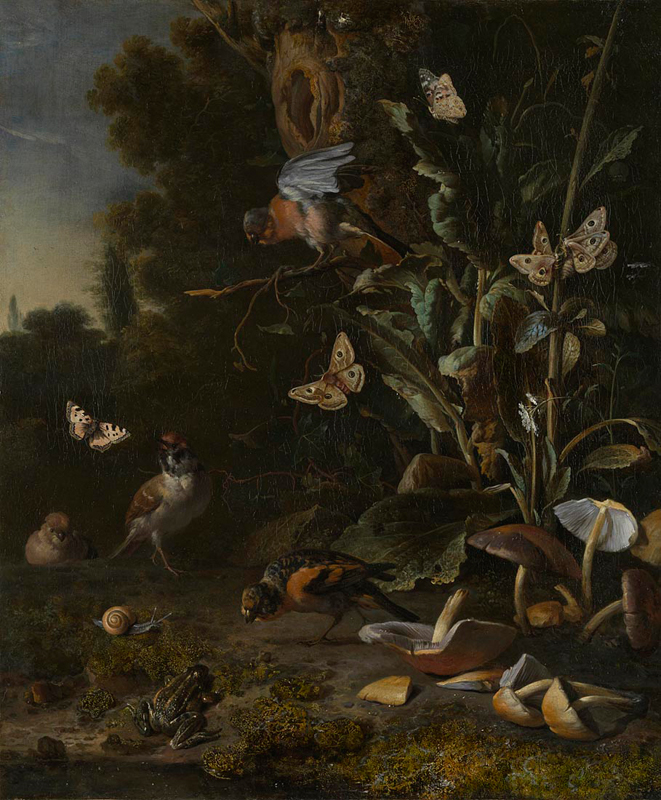
El Greco’s Venetian sojourn still clings on in the background. If you look out of the archway in the second picture, the buildings you can see could so easily be palaces on the Grand Canal. What you can also see in this detail is the relief sculpture with which the artist has decorated the Temple – completely against the descriptions in the Old Testament, and in contravention of the Second Commandment. It is very sketchily painted, but just clear enough to enable you to see an old man with his arm raised, a boy kneeling in prayer, and an angel flying above. It is the story of Abraham and Isaac. Having been given a son he had long longed for, some years later Abraham is asked for a sacrifice to prove his love of God. He promises anything, only to be told he should sacrifice his dearly beloved son. Reasoning that God had given him, and now should have him back, Abraham reluctantly agrees. He heads off with everything needed for the ceremony, to the accompaniment of his young son asking what beast they would actually kill. On arrival at the place appointed, he has raised his hand to strike the fatal blow, only for an angel to stop him, and point to a ram caught in a thicket. This would be a more suitable sacrifice now that Abraham’s love for God was proved. For Christians this story from the Jewish Scriptures had undoubted significance, as it tells of a Father prepared to sacrifice his Son, in the same way that God the Father was prepared to sacrifice his only begotten Son – the very essence of the Easter story. So it’s inclusion here is undoubtedly relevant. Indeed, it is doubly relevant. Muslims believe that the Dome of the Rock in Jerusalem marks the site where Abraham prepared to sacrifice Isaac. And the Dome of the Rock is built on the site of the Temple of Solomon – so it was here that the sacrifice was of Isaac was supposed to happen.
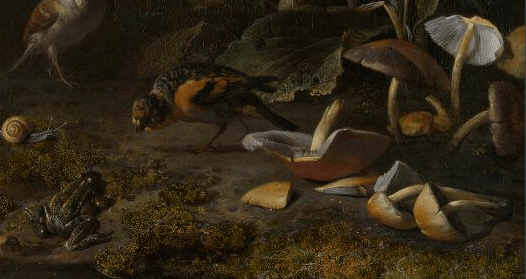
It’s not the only sculpture El Greco includes. The third picture shows the relief on the other side of the arch, and although it is again painted remarkably freely, it is still clear enough to identify. Like the other, it includes an angel. In this case it is the Archangel Michael (#POTD 5), and he is expelling Adam and Eve from the Garden of Eden. Again a reference to Jewish Scripture sheds light on the Gospel. For early Christians it was essential to prove that Jesus was the long-awaited Messiah, so they combed through the Old Testament to find every conceivable reference to events in the New, coming up with some that would be unexpected. It was clear to them that the expulsion of Adam and Eve from the garden of Eden was directly equivalent to the expulsion of the traders from the Temple – malefactors have no place in the House of God. El Greco makes this parallel explicit by arranging the figures themselves in parallel: the angle that Adam and Eve lean as they are beaten out of Eden is exactly the same as the sway of some of the traders as they shy away from Jesus’s blows. The implication is that the Temple is a manifestation of Heaven on Earth, and as such it has the same ethos as many churches: they are (or can be) a representation of Paradise. 

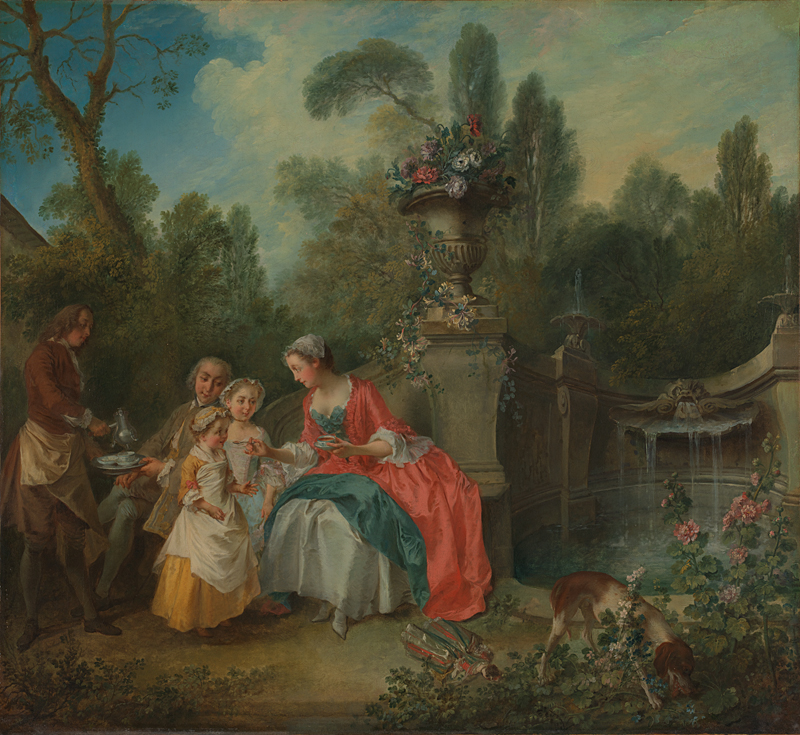
These two relief sculptures were invented by El Greco to add meaning to the story, but he makes reference to another sculpture, a real one, hidden away as one of the actors in the drama. Behind the man wrapped around with yellow fabric just to our left of Jesus, a figure has fallen to the ground, possibly female, with a blue skirt and white blouse. She is inappropriately dressed for the temple, and seems to lounge on her basket, her left hand wrapped around her head, as if she is shielding herself from Jesus. This pose is taken from a Classical sculpture of Ariadne in the Vatican museums: you can see it in the fourth picture. Not many people get to see it nowadays, as it is in a room just off the flow of the tourist tide, and roped off. I was once lucky enough to catch a glimpse when I was taking a group on what was called a ‘semi-private tour’, being led into rooms by the security guard accompanying us and not knowing exactly what would be in them. It was a pleasant surprise, as it used to be one of the most famous sculptures in Rome, near the top of the list of Things You Must See for the aristocratic 18th Century Grand Tourists and their middle class successors in the 19th Century. Dorothea sees it in George Eliot’s ‘Middlemarch’, although she was clearly unimpressed. When two observers find her, ‘She was not looking at the sculpture, probably not thinking of it: her large eyes were fixed dreamily on a streak of sunlight which fell across the floor’. Eliot’s point was presumably that Dorothea was not interested in art, and in the way that women have been objectified, but, as a more ‘natural’ creature herself, not to mention a modest Protestant, was more interested in the realities of the natural world. 

I do find myself increasingly looking out of the window at the gradually burgeoning trees, the emboldened birds – and the streaks of sunlight. But for El Greco, the choice of the Ariadne (once thought to be Cleopatra) as a model for this figure is a reminder that he had been to Rome, an indication that he was an artist and knew the art of others, and a subtle hint that this was a non-Christian tradition that was not worthy to remain in the temple. It’s odd to think that the churches – and museums – will all be empty this Easter, but it is far better to stay at home enjoying the streaks of sunlight. We are lucky that we can also enjoy great works of art online as well.

Day 18 – Christ’s Entry into Jerusalem

Day 18 – Tilman Riemenschneider, Christ’s Entry into Jerusalem, 1499-1505, St. Jacobskirche, Rothenburg ob der Tauber.

Originally posted on 5 April 2020

It’s Palm Sunday today, marking the beginning of Holy Week – so I’ll have a look at some of the Easter narrative over the next few days, as I’m not sure I can find any paintings of chocolate eggs (although someone did throw in a question about the best eggs in art a while back, so I might look for those!).

Today, though, I want to start with one of my favourite artists, but one I rarely get to talk about because there are so few of his works in the UK: Tilman Riemenschneider.  And I want to look at one of his most remarkable creations – ‘The Holy Blood Altar’ in Rothenburg ob der Tauber. This is just part of it – the left wing of what could be described as a triptych – and I’m starting with this wing because it is the most relevant to today: ‘Christ’s Entry into Jerusalem’.

Jesus is shown riding on a donkey, which suits Riemenschneider, as his style is ideally suited to the depiction of humility. We don’t know a huge amount about his early life, nor do we know where he trained. However, his first works show stylistic similarities to sculptures in Ulm, in southern Germany, and Strasbourg, now in France – so it could have learnt his craft in either, or both, of these. He spent the majority of his working life in and aroundWürzburg. He was enormously successful, until he found himself on the wrong side of a political dispute and ended his life in some disgrace, only for his name to be forgotten completely after his death. He wasn’t rediscovered until the 19th Century.

Much of his work has been dispersed, but of the few pieces that are still in the place for which they were made, the Holy Blood Altar is undoubtedly the most important. It is carved from limewood, like the majority of his work (he also carved stone), and unlike many similar sculptures at the time, it was meant to look like wood. Up until this point wooden sculpture had been painted to make it look like alive, even more ‘real’ than a two-dimensional image. The artists who applied the colour were often painters in their own right, although a few sculptors also painted their own work. In later generations, when painted sculpture was considered rather brash, the paint was removed. This was sometimes justified by the bad state of preservation, and the sculpture was either repainted, or stripped. However, when you remove the paint from a sculpture, traces remain in the cracks and joints, and even in the grains of the wood. However no such traces can be found on this relief. Not only that: it is actually painted, but with a wood-coloured paint. This was done to protect the sculpture and to cover any blemishes, although even at this resolution you might be able to see that it was subject to woodworm. No one is entirely sure why this shift from colour to monochrome occurred, but there are two main suggestions. The first is that the artists – or patrons – became wary of the images looking too real, and worried that they might contravene the second commandment, which says you should not to make any graven images. This was to be a concern of some Protestants in the coming decades. The other theory suggests a more sophisticated reason: that Riemenschneider was making enormous claims for his skill as an artist, by saying that he could make something look real – he could make you believe in it – even if it wasn’t the right colour. He could make wood look like fabric, or flesh, for example.

Here’s a great example, a detail from another altarpiece which has found its way down the hill from Rothenburg to the suburb of Detwang. It is part of the Resurrection, and shows the feet of two of the soldiers guarding Christ’s tomb. The lower foot is clad in hose – an item of clothing a bit like stockings, which were thickened round the feet to form a shoe. As a sign of his slovenly behaviour, this soldier has allowed his hose to fall down around his ankles. The upper foot has no shoe, allowing you to see the creases in the soles of the foot and at the back of the ankle, not to mention the veins running along the side of the calf muscle, which is beautifully tense. All around rough gouges of the chisel denote the grass on which the soldiers are sleeping, or, at this point, waking.

You can see similar details in today’s picture. It is the left wing of the altarpiece, only seen when the wings are open (having said that, there is some suggestion that they might never have been closed). Like almost every depiction of the ‘Christ’s Entry into Jerusalem’ he travels from left to right – the direction in which we in read. As this is the left wing, he is leading us through the gate, and into the central part of the altarpiece, leading us on to the next part of the story (but you’ll have to wait for that). 

According to the Gospel of St Mark 11:8, ‘Many spread their garments in the way: and others cut down branches off the trees, and strawed them in the way.’

You could argue that this is not what Riemenschneider shows. There is one person spreading a garment, and one person cutting down a branch – and he is very tiny. That’s hardly ‘many’. But then, in a panel of this format there isn’t much space for ‘many’ – so he shows us each activity symbolically, by showing a typical example.  It is quite common for the man in the tree to be tiny. It’s a primitive form of perspective, I suppose, but it is almost as if this, the act which gives today its name, has been slightly marginalised. The tree itself is wonderfully gnarly, though not like any palm tree I’ve ever seen. But I do like the idea that it is a tree carved out of wood (rather than the other way round).

Why would it be marginalised, though? Maybe because, although it was an act of recognition, and of respect, to ‘straw’ branches in the way, it is not as much of a sacrifice as spreading a garment. That is what the man at the bottom right is doing. It appears to be a rather fine, long-sleeved, full-length coat. It is even embroidered at the lower hem with what look like letters – although as far as I am aware these cannot be deciphered. The man has taken off his coat, but that has left him in his undergarments – a long sleeved jacket, the cuffs of which were clearly designed to be seen emerging from the coat, as they cover his wrists, and his hose. Basically, he is in his underwear, including his slightly sagging pants. This really is an act of humility, effectively debasing himself, knock-kneed, so that Jesus’s donkey doesn’t have to step upon the street.

The gate into the city is sturdily built from evenly cut blocks of stone, and is well protected with a portcullis. A throng of people await within. Above the gate is an oriel window, a look-out so that the city guards can see who is approaching and who they should admit. The design of this oriel, with three sides projecting over a triangular bracket, looks remarkably like a more martial version of the three windows you can see if you go round the back of the altar:

Jesus is followed by quite a crowd, who are packed in tighter than might be possible in such a narrow space. It’s quite hard to count how many people are there – because at the back you can only see the tops of their heads, and it’s hard to distinguish between the different haircuts. At the last count (and I may be being optimistic), I could see twelve. This would mean that they are the Twelve Apostles, and I have no doubt that they are, even if not all are present. Just behind the donkey is a young, clean-shaven man with long, curly hair: this is John the Evangelist, always shown as the youngest of the apostles. In between him and Jesus, the man with short curly beard and hair (well, what is left of it) is St Peter, effectively Jesus’s right-hand man. Most of the others you could argue about, although one up from John, with the long beard, is probably St Andrew, and above him, with the hat, is St James Major. He was associated with pilgrimage, and he wears a pilgrim’s hat. The journey to the Church of St James in Spain – Santiago de Compostela – was the major pilgrimage route in Europe, and the church in Rothenburg was on one branch of that route (Jakob is German for James, and Iago is Spanish) so it is a little surprising in this case that St James is so far back.

Jesus stands out from the crowd because he is not being crowded – there is a clear gap between his head and those on either side. He is also presented far more formally, with the donkey parallel to the surface of the image rather than angled to enter the gate with ease – it takes him out of the ‘real’ world and makes him appear more important. And yet, at the same time, it is kept real by the details – the donkey’s ears, for example, at different angles, or the bridle around the donkey’s muzzle, attached to the reins which are only just visible: Jesus holds them limply in his left hand, while he blesses with his right. 

There are things you can only see when you get closer, such as the lettering along the bottom of the man’s coat, and the tufts of hair on the donkey’s fetlocks and around its hooves. And best of all, the fact that the donkey is shod – I want to say it’s a horseshoe, banged in with nails, but this can only be a donkey shoe. It’s not something you can see from the front – you have to go to the side. If you were one of the apostles, following Jesus, you would see it. That’s one of the great things about sculptures – they work in three-dimensions. And it’s one of the great things about Riemenschneider that even on a relief carving like this he expects you to move around and look from different directions. In this case, he wants you to follow Jesus and become part of the drama. The carving in this panel is bubbling with excitement, it is over-packed with people and with details. It’s like an expectant crowd, waiting for the spectacle to begin, and to see that spectacle you must follow Jesus through the gate. Which in a few days, we will.

Day 17 – Judith Beheading Holofernes

Day 17 – Artemisia Gentileschi, Judith Beheading Holofernes, c. 1620, The Uffizi, Florence.

Originally posted on 4 April 2020

Today should have seen the opening of ‘Artemisia’ at the National Gallery – and there is still some hope that we may yet see it. But in the meanwhile, let’s enjoy this painting. By now, after a little light cannibalism thanks to Giulia Lama (#POTD 16) I’m sure you will be inured to violence, and to the fact that women were perfectly capable of depicting it. You will also probably know more about today’s artist than yesterday’s, and know more about her life than about that of many other artists. If you do, you will probably know why she wanted to paint this image – although in reality, it is unlikely that she chose the subject matter. It was probably a commission, and probably from the Medici family, who by the 17th Century were the Grand Dukes of Tuscany. It was their personal collection that formed the nucleus of ‘The Uffizi’, where the painting is today. The gallery found its home in what had been the administrative offices of the Grand Duchy – hence the name.

This was the second version of the subject she had painted. I always used to prefer the earlier version, painted around 1611-12, and currently in the Capodimonte in Naples, but that might have been because it was easier to see. It was presented in the centre of a wall, directly opposite the entrance to the room, at the end of a short enfilade – or succession of rooms. The hang of the Capodimonte is very clear – the most important paintings (if that means anything) are always at the end of a ‘vista’. You can identify their Caravaggio from 200m (nowadays that would be a supermarket queue of 100 people…) The Uffizi, on the other hand, displayed their ‘Judith and Holofernes’ at the left-hand end of a wall, in a corner which, as a result of the structure of the building, was at an acute angle – so you couldn’t even stand in front of it very easily. Now, following their re-hang, it can be seen far more easily and clearly, and reveals its full, gory glory.

The story of Judith comes from the eponymous book, which is either in the Bible, if you are Roman Catholic, or among the Apocrypha, if you are Protestant or Jewish. It tells the tale of a virtuous woman of the city of Bethulia, which is besieged by an army led by Holofernes. One night Judith creeps out of the city and approaches the enemy camp pretending to have defected. To cut a long story short, one night she dresses up in her finery and heads to Holofernes’ tent – at his invitation – and, as the story says, ‘Holofernes was so enchanted with her that he drank far more wine than he had drunk on any other day in his life’. So, at the appropriate moment, she took down his sword and chopped of his head.

It was a popular subject. Which is surprising, as most art was commissioned by men. But through her act Judith saved her people – and so she was seen as a precursor of the Virgin Mary, who, through her own personal sacrifices, saves her people. She is a model of Virtue triumphing over Vice. She was particularly important in Florence, for reasons I shall explain when I talk about Donatello’s ‘Judith’ – which, I’m afraid to say, is my favourite. Artemisia’s is definitely the best painting. I love Botticelli’s: he tells the story in two tiny paintings each the size of a large post-card. The first shows Holofernes’ troops finding the headless body in his tent. In the second we see Judith sashaying through the countryside followed by her maid Abra, who is holding the head on her own like a bag of laundry. They might just as well have been out shopping, returning home victorious having found the last bag of flour. It is beautiful, richly coloured, and elegantly drawn – but misses the fact that a man has just been beheaded.

It says something that Artemisia is even better than Caravaggio at depicting this scene – particularly as Caravaggio is one of my favourite artists. He must have been having an off day – or an off three months, the least time it would have taken, surely. It’s the one painting by Caravaggio that I really don’t like, simply because – well, I’m disappointed by him. He is so good at thinking about the most dramatic moment in a story, the most human aspect, and how that would work in real life, even if the situation itself is anything but real. But here… it just doesn’t work. His Judith might be very good at flower arranging, and could conceivably cope with cutting Holofernes’ hair (no help, as he isn’t Samson), but in terms of engineering alone this would never work. That sword simply would not go through that neck at that angle, while she lifts a limp lock of hair. And she really doesn’t want to get any blood on that pristine white blouse, does she? He is so young, so muscular, and so vigorous she doesn’t stand a chance. I suspect Caravaggio might have been distracted by the youthful vigour.

Artemisia, on the other hand, shows she knows exactly how to do it: wait until he is flat out on the bed (no, I didn’t mention the bed, but it’s clearly what Holofernes had in mind) and get your maid to hold him down. At this point it helps to have a younger maid. Notice how Abra is directly above Holofernes, and putting her full weight into it. His face is also central, as is Judith’s right hand holding the sword, which is cutting through the neck along the central axis of the painting. The full force of both women is going into this. Judith is really going for it – pulling with her right hand, and pushing the head in the opposite direction with her left. I bet Artemisia practiced this, a tearing, ripping action, assisted by the slice of the sword. And the blood – this is blood. Not those scarlet ribbons fluttering away from Caravaggio’s Holofernes.  It spurts out, dark against his brightly lit arm, runs across the clean white sheets, and trickles down the folds from one mattress to another. It’s the same colour as the royal red velvet bedspread, and the rolled-up under-sleeves of Judith’s dress. They are all in this together, besmirched with the same blood.

A couple of days ago (#POTD 15) I talked about the advantage Mary Cassatt had over some of the male Impressionists – she knew how women behaved when men weren’t around. And I’ve always thought that Artemisia has a similar advantage here. She understands female anatomy in a way that men couldn’t. She knew about breasts. So many male artists didn’t – Michelangelo being the most famous example. Now, I have very little experience, but I’m imagining that, if you’re wearing a bodice, pulling with you right arm and pushing with your left, this is exactly what will happen to your bust – please tell me if I’m wrong (particularly any actors (f) out there, or anyone else who has worn a bodiced gown). It just looks so… real.

One problem with looking at Artemisia’s paiintings is that we know too much about her. In general we tend to talk about the biography of female artists even more than that of the men: how did they get to be artists in the first place? What did they do? What happened to them? Well, Artemisia got there because her father Orazio was an artist, and initially she would have trained with him. He was a great friend of Caravaggio’s, and one of the first people to be influenced by his revolutionary style. He even leant Caravaggio a pair of wings, probably to use for the more-than-slightly unnerving painting ‘Love Victorious’. Artemisia then went to work as an assistant for one of Orazio;s other colleagues, Agostino Tassi, who raped her. Unusually, she took him to court, and even more unusually she won. But as it was his word against hers, she had to prove that what she was saying was true. So they tortured her, and she didn’t step down.

You can understand why she would have it in for men, but that is not why she painted this painting. She would have been commissioned. In any case, the situation is not entirely parallel, as Judith knew what she was doing. Not only that, but Artemisia got no help from her chaperone, who had an agreement with Tassi, and left the two of them alone together. But that’s not to say she didn’t understand Judith, or associate herself with the Jewish heroine. And she certainly defended herself with a knife. There are several, minor differences between the earlier version of the subject and this one. The composition has been slightly rethought, and Judith is dressed differently. Her hair is also more finely coiffured, and she wears a bracelet on her left arm.

This all fits in with a re-reading of the text, where it says that Judith dressed herself in all her finery and bedecked herself with jewels. It’s just that the bracelet is in such a prominent position, halfway along her brilliantly illuminated forearm. It matches her bodice in terms of colour, and lines up with a darker fold in the fabric, so it stands out more. Look at the detail – each section bears an image of a standing woman. It’s hard to see what this is, as the detail is so small, but it is probably the Greek goddess Artemis – the Romans called her Diana – the chaste, virgin goddess of the hunt. The goddess who, when Actaeon chanced to see her naked, turned him into a stag so he was hunted to death by his own hounds. The goddess after whom Artemisia was named. And yes, you’re right, those are not coral beads next to the bracelet, that is a stream of Holofernes’ blood. She knows what she wants, and she knows how to do it.

Day 16 – Saturn devouring his Child

Day 16 – Giulia Lama, Saturn devouring his Child, c. 1720-23, Private Collection (Sold at Christie’s, 2011).

Originally posted on 3 April 2020

Why do we talk about women artists so rarely? Apparently it wasn’t always the case. According to Grizelda Pollock, one of the first and most consistent feminist art historians, they were regularly included in dictionaries of art and artists until the beginning of the 20th Century, at which point they were all but written out.  This year, with Artemisia at the National Gallery, and Angelica at the Royal Academy, let’s hope they are being written back in, and not just as token representatives, but as vital and inventive artists.

The fact is, there always were fewer women who could make a career in the arts – they were not given the training. It helped if Dad was an artist, as in the case of Angelica Kauffman (#POTD 14), especially if his studio was very busy – or he didn’t have any sons to help him. But they wouldn’t get apprenticeships with another artist, as that would mean living with a man who was not a member of your family at the age of 11 or 12. When academies started to be founded in the second half of the 16th Century, women weren’t admitted, because women didn’t get an education anyway. The few women who did succeed usually had unusual fathers – i.e. fathers who were artists, or who believed that their daughters should be educated. Or the girls were amateurs, practicing the usual accomplishments any young lady should have – music, and some ability with a little delicate decoration – until they turned out to be outstandingly good at it and so broke through to the ‘mainstream’.

In any case, it was thought that they lacked the necessary intellect to understand something like perspective and didn’t have the necessary education to know about classical mythology, so they would never be able to paint great narratives. Women weren’t supposed to paint portraits of men, in case the men assaulted them, and landscapes weren’t a great idea because, out in the countryside, they might be attacked by brigands. So they were left with Still Life, because, on the whole, a still life won’t bite back. The most distasteful thought was that they might attend a life class. Drawing and painting the male nude became the foundation of artistic training, because without a thorough understanding of male anatomy an artist would never be able to paint a battle scene, or a martyrdom – those uplifting stories which were the apogee of art. It would be so inappropriate for a woman to draw a naked man. Ladies were supposed to avert their gaze, and not stare at anything.

So, that’s what we’re left with – pretty flowers, ladies having tea (#POTD 15), or the artist herself indecisive between painting and music (#POTD 14). I have yet to cover the pretty flowers. It’s all pretty girly really, lets face it. Just like today’s painting… 

Sadly we don’t know a huge amount about this image, and the attribution to Giulia Lama isn’t universally accepted. But I think few people doubt it now, particularly as her painting is getting better known. We also know relatively little about Giulia Lama herself. She was born in the Parish of Santa Maria Formosa in Venice, the daughter of an artist (it helps). One of her great works is in the church there, a Madonna and Child with Saints on an impressively grand scale. Her style is remarkably close to that of one the greatest, but underrated, artists of 18th Century Venice, Giambattista Piazzetta, whose works are the smoky colour of bitter toffee apples, if such a thing exists. His fame was eclipsed by that of Tiepolo, whose candyfloss colours are ideally suited to those of a sweet tooth – I love them both. 

Why was Lama’s style so similar to Piazzetta’s? At this point a discussion arises: was Lama a student of Piazzetta’s, or a colleague? Opinion is tending towards the latter: they may well have trained side by side in the school run by artist Antonio Molinari – which would make her the first woman to attend any sort of art school.

Today’s painting could almost be a manifesto overthrowing all the reasons why women couldn’t become artists. It’s a classical story, shows a male nude, and has fantastic foreshortening (basically perspective applied to a single object). And it is anything but ladylike – or, for that matter, for a classical narrative, anything but uplifting. It’s a man eating his own child! It is, of course, a story that proves that we don’t learn from history. Saturn made it to the position of Top God after his mother, Gaia (the Earth), got so upset that his father (Ouranos, the air) kept imprisoning their children that she gave him (Saturn – or Chronos, as he was known back then) a very sharp knife, and encouraged him to castrate his own father, which he did. The severed genitalia fell into the sea, which was therefore made fertile, and the result was Aphrodite – her name means ‘born from the foam’. Of course, the Romans called her Venus, which explains Botticelli’s famous painting (#POTD 8) – and stops it looking quite so charming.

Knowing how easily a god could be overthrown, Saturn didn’t want to take risks, and so eat each of his own offspring as they were born. Eventually his consort, Ops (Rhea, to the Greeks), lost patience with this, and handed him a stone, pretending it was the latest baby, smuggling the newborn to Crete, where it grew up to be Jupiter. As an adult, Jupiter returned, forced to Saturn to regurgitate his siblings, at which point they overthrew Dad. And you thought Eastenders was bad.

Precisely why Lama chose to paint this subject – or who commissioned her to do so, and why – we may never know. A contemporary account says that many churches wanted her to paint them an altarpiece, so highly was she respected, and as well as the one I’ve mentioned in Santa Maria Formosa there is another in San Vidal, just over the Academia Bridge. But that doesn’t explain this painting. Maybe she painted it simply because she could. She certainly seems to have been the first female artist to have studied the male nude – and she did so often: I’ve included two of her drawings, and they are superb. She uses black and white chalk in one and red and white in the other, the light and shade giving the body a sculptural feel, with short, stabbing strokes of the chalk, over broader areas of shading. They show a remarkable ability to articulate the limbs and arrange the body in complex ways, but with the slight exaggeration that creates movement and drama, the essence of all great Baroque art.

The same qualities can be seen in the painting, the limbs of Saturn creating diagonals across the surface, and into the depth of the painting. The legs continue the shallow diagonal of his grasping left forearm, while the body of the child, softer, lighter and therefore more succulent than that of his swarthy father, is parallel to the muscular upper arm. It marks the diagonal from bottom bottom to top left, whilst also creating depth for the composition. All this is set in bright sunlight, so they stand out clearly from the dark rock in the background, and allow for the deep dark shadows that define Saturn’s muscularity. It’s not pretty, and it really isn’t ladylike. In many ways, it isn’t even very nice. But it is brilliant – an astonishing bit of painting and a fantastic work of art.