156 – Second helpings at the Feast

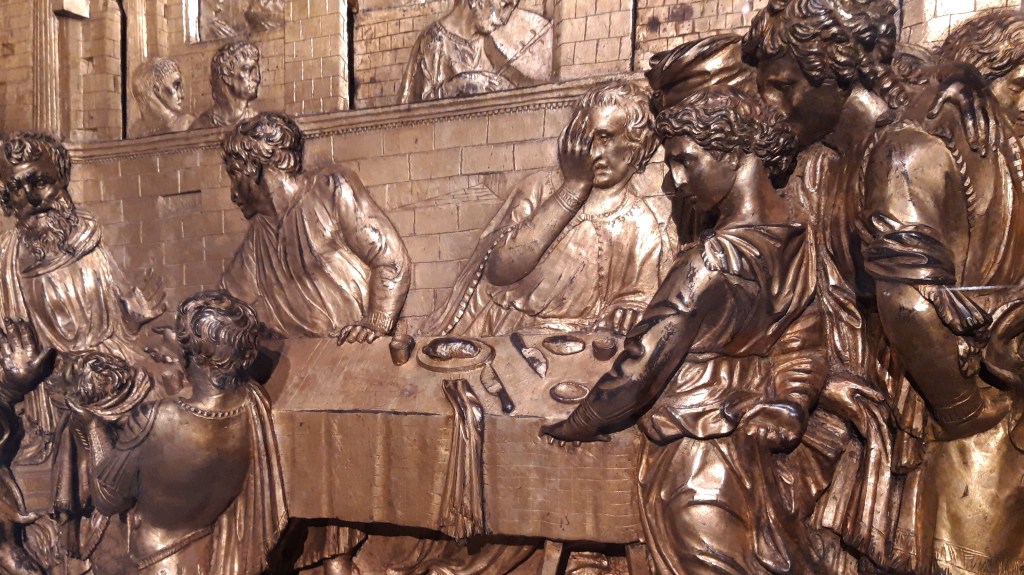
Donatello, The Feast of Herod, 1423-7. Baptismal Font, Battistero di San Giovanni Battista, Siena.

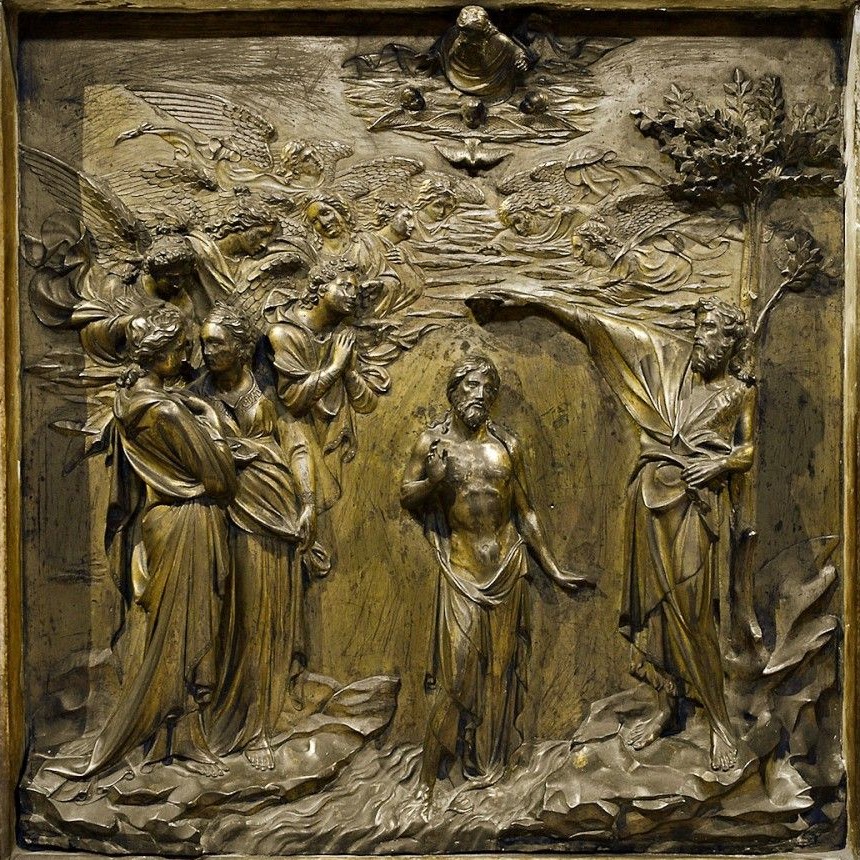
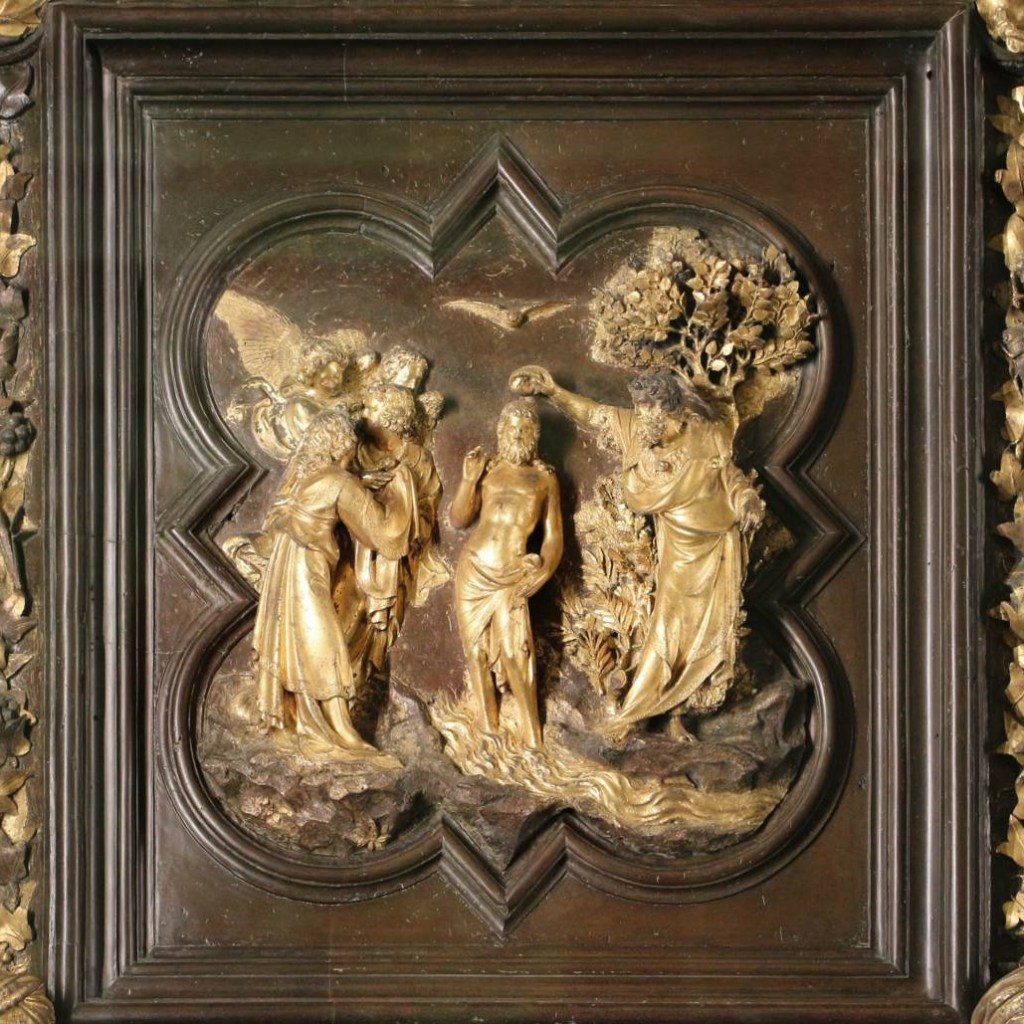
‘Please, sir, I want some more.’  OK, so it seems extremely unlikely that these words, said by Oliver Twist in the eponymous novel by Charles Dickens, and so often misquoted, nor indeed anything like them, would ever have been uttered at the Feast of Herod, an event that would have put even the hungriest off their food. And yet, I want to return to the Feast. This is, in part, because I want to return to the fantastic exhibition in Florence, Donatello: The Renaissance – and maybe I’ll find the time to do so. At least I will be able to revisit it in my mind’s eye when I deliver Part II of my introduction to this rich and inexhaustible display this coming Monday, 9 May at 6pm. Of course, even single works of art can be remarkably rewarding, and any painting or sculpture can benefit from repeated viewing: there is always more to see, and so there is always more to say. A month ago I looked at today’s gilded bronze relief, putting it in its context as part of the decoration of Siena’s Baptismal Font (154 – A Feast for the Eyes), and today I want to look at its immediate impact on local artists. As an aside, people have asked a number of questions about sculpture as a result of the Donatello exhibition, so I thought I would dedicate a series of four lectures to the subject, stretching across all the Mondays in June – but I’ll give you more information about them nearer the time. Before then I will talk about Women painting Still Life in the 17th Century on Monday 16 May. The talk will be entitled Forbidden Fruits, and is inspired by Colnaghi’s focussed display of the same title – click on one of the links for more information. To return to Donatello, I want to start by comparing his relief to its equivalent on the front of the font, The Baptism of Christ by Ghiberti (if you want the context, have a look back at A Feast for the Eyes).

When you walk into the Baptistery, Ghiberti’s relief is the first that you see, and this is, of course, a deliberate choice. Any separate baptistery is effectively a church dedicated to St John the Baptist, and it is where the Sacrament of Baptism – recognised as a sacrament by Catholics and Protestants alike – was, and is, celebrated. Nowadays, of course (and for many centuries, it should be said) Baptism can take place in any church. St John the Baptist is overtly defined by this act, the ritual purification which Jesus undertook at the beginning of his mission. Not that he needed purification (and John was aware of this), but he was, in every way, acting as a role model. As this particular episode defines John’s role in God’s plan, it must be in the prime position on the font – the first thing we see. This also means that the decoration of the font had to be planned with the other ‘chapters’ of the story arranged appropriately around it. But this is all slightly beside the point for this post. It the style of the relief which really interests me today. Notice how all of the figures stand out in relief against a flat background. Jesus is in the centre, of course, where he is framed by John on the right, and two full-length, standing angels on the left. John’s elongated right arm stretching out over Jesus’ head is a curious throwback to gothic ideas for Ghiberti, an artist who had made so many strides into the Renaissance, but it is remarkably expressive, and may well relate to Sienese precedents: the late 13th century sculptures by Giovanni Pisano for the façade of Siena Cathedral, for example. The four figures I have mentioned are in the highest relief, together with the foreshortened, half-length figure of God the Father at the top of the panel. Below the Father is the Holy Spirit: it was at this point in the narrative that the bible says ‘And the Holy Ghost descended in a bodily shape like a dove upon him, and a voice came from heaven, which said, Thou art my beloved Son; in thee I am well pleased’ (Luke 3:22). In one verse we have (a) an explanation why artists usually depict the Holy Spirit as a dove and (b) the whole doctrine of the Holy Trinity. Joining the two full-length angels and John is a multitude of the heavenly host, arcing up and over Christ. The figures go into lower relief as they get higher up and further away. Nevertheless, however low the relief, the figures are still built up from a flat background. Let’s compare this technique with Donatello’s in The Feast of Herod (as so often, I hope these two images end up next to each other for you, it’s easier to see…).

In Ghiberti’s panel, the representation of the ‘sky’ is indistinguishable from the material nature of the gilded sheet of bronze from which it is made. I get the feeling that, if we were to imagine this as a ‘real’ space, and if we were to walk past Jesus into the depth of the landscape, we would soon bump into a featureless gold barrier.  Donatello’s space doesn’t seem to be limited in the same way – it just keeps going. There is, eventually, a wall – through two sets of arches – but it is a wall which limits the progression of space, rather than the background of the sculpture. He is creating the same pictorial illusion as a painting does, and although Ghiberti hints at this idea with the ‘fading’ of the angels, his background remains a sheet of gilded bronze, rather than a brick wall at the back of the third room in. This difference may have resulted from the practical technique used: rather than building the image up from a flat background, Donatello appears to have dug into the depth of the wax, or clay, from which his original model would have been made – almost a carver’s technique, rather than a modeller’s.

Ghiberti’s relief had been commissioned in 1417, and he was supposed to have finished it, together with the next relief in the sequence (showing the arrest of the Baptist) within 20 months. However, they weren’t finished until 1427, the same year in which Donatello submitted his relief. Meanwhile, Ghiberti had started work on his second set of doors for the Florentine Baptistery. Compare these two panels, one from the first set of doors – the ‘North Doors’ (made between 1403-24) – and one from the second, the so-called ‘Gates of Paradise’ (1425-52). The format changed, and so did the style.  

Although the second example is still based on a flat background, it shows a far greater interest in painterly effects and the recession of space defined by linear perspective. Admittedly not all of the panels from the Gates of Paradise use linear perspective, but overall their interest in spatial illusion is far greater, and, to a large degree, I think this is because Ghiberti was influenced by the work of his former pupil (Donatello is documented in Ghiberti’s workshop from 1403 – 1407, at the beginning of the work on the North Doors). The change in format, from quatrefoils to rectangular, painterly fields, was also influenced by the experience in Siena – the overall design of the font being a collaboration, it would seem, between Ghiberti and Jacopo della Quercia, with the latter taking the lead. So let’s compare Donatello’s Feast of Herod with Jacopo della Quercia’s Annunciation to Zacharias. This is the story which starts the sequence, and is found at the back of the font – it is next to Donatello’s relief, which marks the end of this abbreviated biography.

Jacopo’s relief was modelled and cast in 1428-29 – the years immediately after Donatello’s was completed – and the influence is clear. You’ll have to take it on trust for now, but his other relief sculptures place mid-relief figures against a plain background. The insistent brickwork of the walls should be enough to show that he was keen to capture something of the remarkable originality of Donatello’s creation, and as if that isn’t enough, look at the two figures in profile on the left, visible in the adjacent room through the archway. Even if they are not exactly a quotation, they are certainly an interpretation of the figures seen through the arches on the left of the Feast. Jacopo even tries trimming the edges of his figures, as if they are disappearing into the wings. However, he hasn’t quite got it, and doesn’t commit to the idea as fully as Donatello – and he certainly doesn’t understand perspective. The projecting arch, which frames the altar, seems to be folded back, as if it were made of jointed cardboard and someone has pushed the front edge of the structure to the right, a flat-pack temple that could be collapsed into one plane. Don’t get me wrong – I love Jacopo della Quercia’s work, and when he’s doing his own thing (look up the Tomb of Ilaria del Carretto, for example, or the reliefs around the portal of San Petronio in Bologna) he is quite fantastic. But he’s not Donatello. Another person who wasn’t Donatello is Giovanni di Paolo, one of Siena’s leading painters.

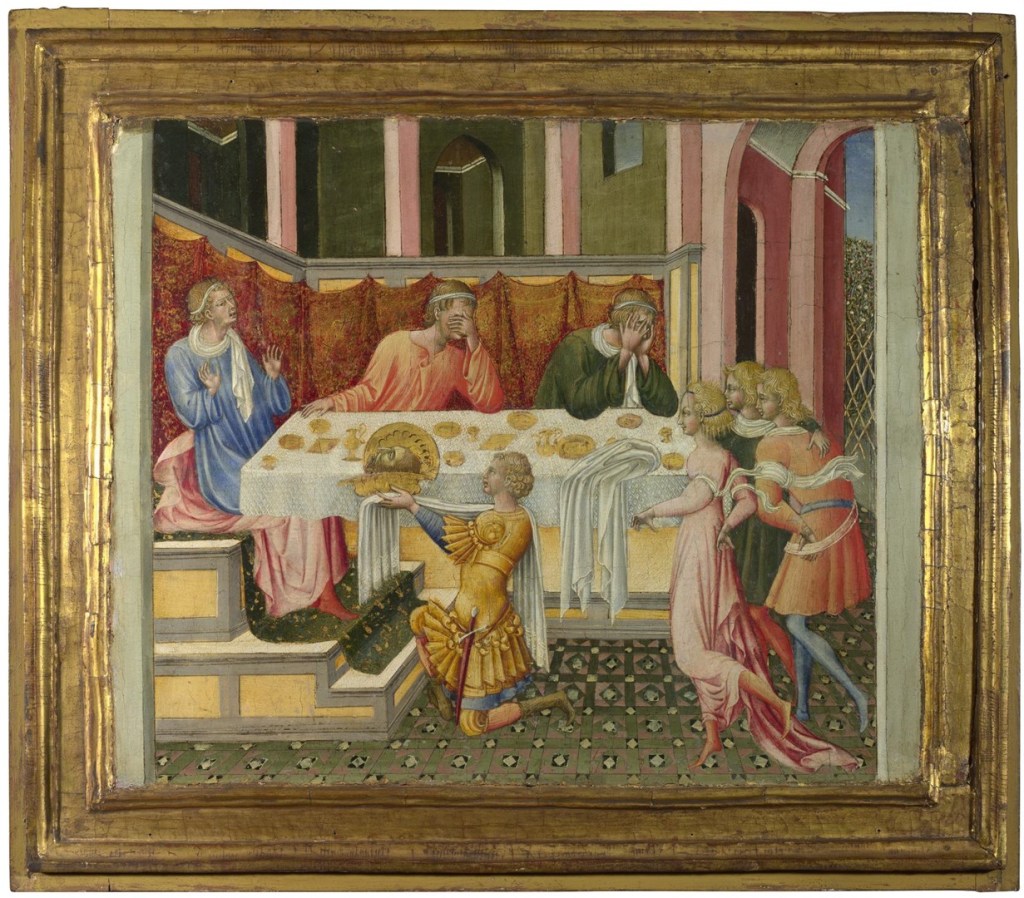
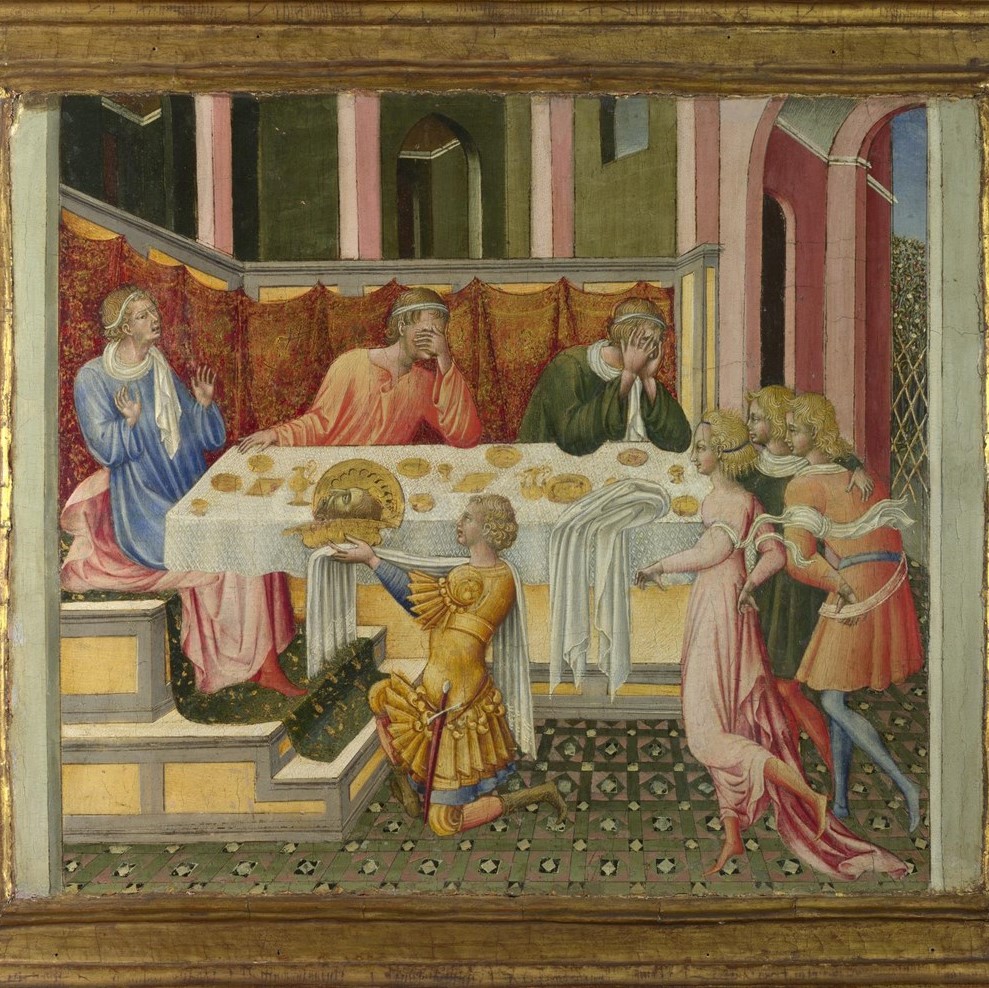
His Feast of Herod – one of four predella panels illustrating the Life of St John the Baptist painted in 1454 and now in the National Gallery in London – is so obviously inspired by Donatello’s relief that his failure to get anywhere close to it is almost inspiring. It has a naïve charm which makes it a wonder to behold. Compare and contrast!

Although excess ‘staffage’ has been thinned out, almost all the main characters have equivalents: Herod, the kneeling servant, one of the people behind the table, Salome and the two men behind her. The last pair is the most interesting feature for two reasons, I think. First, it’s not immediately clear in the Donatello that there are two men, until you notice the hand on the nearer man’s shoulder, and then pick out he headdress above Salome’s own head (you’ll have to zoom in, or look at the details below). Paolo has made it more obvious that there are two men, the one at the back with his arm around the other, and both enjoying the view. The second reason, and perhaps even more intriguing, is that he has also quoted from Jacopo. The nearer man, in the Donatello, has his hand on his hip. Jacopo’s equivalent figure, framing the right-hand side of the relief of the Annunciation to Zacharias, has his hand tucked into his belt. It is this detail that Paolo has picked up on. Paolo has noticed the tiles of the floor – but cannot reproduce them – and the spaces in the background – with which he struggles even more. On the right-hand side the opening up of the doorway into a garden – not based on Donatello – takes on an almost Escher-like impossibility. He has noticed the way that Donatello frames the narrative, with figures actively leaving the space on both left and right, and even though he doesn’t have the same transitional figures he clearly wants to hang onto this idea of framing, and has painted two vertical grey strips, like the proscenium arch in a theatre. It would be possible for the characters to exit stage left or right, even if none of them is currently doing so. But the borrowing that always delights me the most is the cloth hanging over the edge of the table. Donatello does it, Paolo likes it and wants to do it too, but gives it form without function. He really hasn’t understood why the cloth is there: not as a serviette, or anything to do with the feast, really, but as a marker of the perspective, leading our eyes back towards the vanishing point. That’s what it represents for Donatello, who makes the section of the cloth lying on the table inflect to the left accordingly. Paolo makes it go to the right, and misses the point entirely. It’s hardly surprising that the man at the back of the table behind it has got his head in his hands. Again, don’t get me wrong: it’s not bad art, it’s a very different thing. OK, so it’s not great art either, but it is entirely delightful – and an important example of the transmission of ideas.

Somehow, Donatello only managed to make great works of art, and there is a lot which I haven’t spoken about yet currently on view in Florence – so do join me for Donatello: The Renaissance II on Monday!

155 – Pre-Announced

Raphael, The Annunciation, c. 1506-7. Nationalmuseum, Stockholm.

I’ve said in two different lectures (to two different audiences) that I intend to write about this drawing, thus announcing the Annunciation. I’d not seen it before my first visit to the glorious Raphael exhibition at the National Gallery, but it grabbed my attention, and instantly became my new favourite drawing. Having said that, I’m not sure that I had an old favourite drawing, even if there are many that I love! I showed it during the talk last Monday, but didn’t talk about it much. As it was probably drawn while Raphael was in Florence, and on Monday 2 May at 6pm I will be talking about Raphael: The Triumph in Rome – the second of my two-part introduction to the exhibition – I won’t talk about it then either. So I’ll just have to do that now. The week after (9 May) I will return to Donatello, and on the way home on the train today I decided that the following week (16 May) I will talk about the Colnaghi exhibition which opened today, which includes the only known painting by the 17th century artist Caterina Angela Pierozzi. It’s only just been re-discovered, which is remarkable, as for years everyone has assumed that all her paintings were lost! But more of that nearer the time – let’s get back to Raphael.

The subject matter is unsurprising, perhaps – The Annunciation – but what is remarkable is the quality of the drawing and the degree of finish. This is not a ‘sketch’, nor is it a working-through of ideas, it is a fully-fledged composition with almost every detail thoroughly considered and all the concomitant problems effectively resolved. What is surprising about that? Well, what is it a drawing for? Raphael made other drawings like this for altarpieces – but no such painting exists. In the catalogue of Raphael drawings, written by Paul Joannides (my PhD supervisor) it is categorised as a ‘presentation drawing’, which means, effectively, that it was made as a drawing in its own right, to be given (i.e. presented, hence ‘presentation’) as an independent work of art. It was only during the Renaissance – at some point in the late 15th century – that drawing acquired this status. On the whole though, drawing was still used to make observations, to think through ideas, to develop forms, to plan compositions, and to transfer the ideas to the finished work.

There are other oddities. Usually the Annunciation takes place in a domestic setting – Mary’s room, usually her bedroom, or some private space where she has been contemplating the scriptures.  However, in this instance the characters appear to be in a large building, presumably a church – although as the events depicted took place nine months B.C., and churches wouldn’t be legal for another 313 years, that would be entirely anachronistic. So it could be a synagogue or temple, I suppose. The angel Gabriel kneels in humble reverence of God’s chosen vessel, holding the by-then (then being Raphael’s time) traditional lily, symbol of Mary’s purity, in his right hand. His left hand rests on his chest as a sign of his heartfelt awe in the face of such beauty and perfection. Mary turns to greet him, standing in a classical contrapposto with the weight on her left leg and the right leg bent, the drapery pulling tighter around her right knee, her thigh illuminated by the bright light shining down from above.

In between them we can see a large, semi-circular apse, the architectonic structure that makes this look like a church, which is exactly the place where we would expect to see an altar. However, there is none there. Nevertheless, directly behind Mary, and off-centre, there is a large flat block of stone (presumably) on slightly broader base. It is too tall to be an altar, and its function is not clear. This should make us realise that the drawing is not, perhaps, as fully resolved as we first thought. It could be the base of a large column, although there is no column there – which could be a metaphor for the promised arrival of the Messiah, a tower of strength, if not, exactly, a column. To the right of Mary you may just be able to make out the rising diagonal of a reading desk – the drapery falling from her left arm falls from it (and while we are there, notice how her left hand is on her breast, just like Gabriel’s). She has been kneeling there, reading, and presumably praying. When the angel appeared she stood and turned round to greet him – her body turning 90 degrees, with the head completing the full 180. The shadowy depth of the apse is conveyed in two ways. To the left, above the angel’s head, there are vertical lines, and then, overlapping these, are slightly curving diagonal strokes which appear to link the two figures, almost as if this is the energy binding them together. The slight curve shows us the way they were drawn, with Raphael holding the quill (this is a pen and ink drawing) and making long strokes like a compass, with his elbow at the centre of a circle and his hand tracing arcs around it at the full length of his forearm. Try this yourself, and if you are right handed – like Raphael – you will make this sort of curve, with the lines going from top right to bottom left (for the left-handed Leonardo, the diagonals go the other way). The angel’s wings are just sketched in, the right one fully visible, with the other crossing behind his head, so that the foremost curving outline (do wings have ‘elbows’?) projects to the right of his nose. Notice how, despite the subtlety of the shading, none of the three hands in the detail above (or, for that matter, Gabriel’s right hand in the previous detail) is shaded. They are defined by outline alone, forming bright highlights, this clarity serving to make them more expressive.

The arched top of the drawing is very subtly sketched in, and perfectly frames God the Father, who looks down at the action below while surrounded by clouds and a small delegation of the heavenly host. Equally spaced are five tiny heads of cherubim and seraphim, creatures so holy they do not need a body but appear just as heads with wings. They are disposed symmetrically, with one each at top left and top right, two more towards the bottom left and right, and a fifth, bottom centre of this detail – although, if you wanted to read the loops of cloud as further cherubim, I wouldn’t disagree. Then there are four winged youths, evenly spaced in a rectangular formation, hands held in prayer or resting on chest or cloud, with the Father central. He looks down to Mary, his right hand raised in blessing, the fore- and middle fingers separated, and thumb held apart – so delicately defined, for such a tiny detail. The left hand seems to hover, as if to calm – to calm the angel, perhaps? It’s as if he was worried about getting the words wrong, but I suspect he is following the divine instructions well, and is being reassured from above. Or maybe, to calm Mary – who, nevertheless, does not appear to be especially troubled at the angel’s saying.

The Father hovers above the apse. It is almost as if the roof of the church – or temple – has dissolved as he manifests his presence. Yet more cherubim and seraphim solidify from the clouds below the previous group, and below them all, at the centre of the semi-dome of the apse (but some way in front of it) is the Holy Spirit, a tiny dove with a tinier dove-sized halo, appearing against another, larger halo, the same size as the Father’s, but flat against the surface of the drawing rather than angled in space. Of course, it is not there at all. There is a circle drawn by the pen – quite firmly, as the light catches indentations made on the paper – but the halo itself is not there. That is just blank paper. It is possible that details like this halo – the glow around the Holy Spirit – were drawn first with a ‘blind stylus’ – i.e. a pointed object without any ink. The outlines were indented in the paper in a way that is almost invisible – and then traced over with pen and ink if they are deemed to be in the right place.

Overall, the position of God the Father directly over the circle enclosing the Holy Spirit looks like a practice run for the Disputa, one of the frescoes Raphael would later paint in the Vatican Palace (if you don’t remember it, there is a detail below, and I will show a full image on Monday). The position of the dove is slightly unusual, to my mind. If proceeding from the Father, I would expect to see it in between the Father’s head and Mary’s. However, I suspect its position speaks of an absence – or rather, of a future presence. The apse should contain an altar, and on the altar, during the Mass, at the Elevation of the Host, the bread becomes (in Roman Catholic belief) the actual body of Christ. And so Christ would eventually be physically present directly underneath the dove, forming a vertical axis of Father, Son and Holy Spirit. Again, this is equivalent to the monstrance containing the consecrated Host in the Disputa. I hope these two details appear side by side for you:

The space between Gabriel and Mary is, after all, full of grace. These are the words Gabriel is speaking in Luke 1:28. In the Vulgate, the Latin is ‘ave gratia plena Dominus tecum’. The King James version gives us ‘Hail, though that art highly favoured, the Lord is with thee,’ or, in the Douay-Rheims 1899 American Edition, about which I know little but seems a more accurate, and poetic, translation than some, ‘Hail, full of grace, the Lord is with thee’. Imagine these words written on the curving lines between Gabriel and Mary, and you will realise that the space between them is sanctified – it is, in itself, ‘full of grace’. This is the place where the Mass will one day be celebrated, and so where the body of the announced Messiah will be shared. Raphael is imagining Jesus between Gabriel and Mary, I think.

As for the function of the drawing – well, however highly finished it is, I don’t think it’s quite finished enough to be a presentation drawing. There are still ideas which aren’t clear enough. I’m fairly sure that it is the design for an altarpiece, in which anything that is not yet specific would be resolved by colour. So much survives by Raphael: he was remarkably productive given that he only lived 37 years. In part, that was because of his skills as a draughtsman, and because he was an incredibly generous man. For example, he designed altarpieces for other people to paint: I showed an example of this on Monday, The Holy Family with a Pomegranate, which was designed by Raphael, but painted by Domenico Alfani. And yet we shouldn’t be surprised if other things haven’t survived. Nevertheless, it seems likely that Raphael’s renown would mean that we would know about any altarpieces he painted himself, even if, by now, some no longer exist. But if this drawing were used by another artist the painting would not have had the same reputation, and neither its existence, nor its loss, would have been recorded in the same way. On the other hand, it could simply be that it was a project for an altarpiece that, for one reason or another (for example, the unexpected death of the patron) was never executed.

I don’t know the answer to this problem – but I don’t really mind. It’s such a beautiful drawing that I’m not too worried about what it was ‘for’. And trust me, it is far more impressive than the photos I have shown you would suggest. Let’s face it, I took them on my phone. So I urge you (I don’t do nearly enough urging, quite frankly) to go and see it for yourselves in the exhibition at the National Gallery in London before 31 July, when it will disappear back to the shadowed safety of the stores in Stockholm. But for now, I need to move on to pastures new. For Raphael, this meant leaving Florence, and led to his Triumph in Rome. And trust me, there will be many more delights – not to mention a number of curiosities – in the talk on Monday!

Revisiting Raphael

Raphael Sanzio, The Crucified Christ with the Virgin Mary, Saints and Angels, about 1502-3, National Gallery, London.

Happy Easter! And greetings from Vienna! I’m here with a group, and actually wrote this paragraph in London on Easter Monday: I’m sure I’ll have to do a bit of preparation before I go. However, the blog below was written on Good Friday two years ago – it was Day 23 of Picture Of The Day during lockdown. It seems apt to re-post it now, though, as the painting in question, Raphael’s Mond Crucifixion (named after the family who bequeathed it to the National Gallery), is the very first thing you see on the way into the truly beautiful Raphael exhibition at the National Gallery. You see it even before you get through the doors, as it happens. I will ‘introduce’ the exhibition in two talks. The first is on Monday 25 April at 6pm (and don’t worry, I get back from Vienna on Sunday evening), and the second will be a week later. I’ll need two talks, partly because there are so many wonderful paintings and drawings to see, but also because this is the first exhibition in the UK to cover all aspects of Raphael’s multi-faceted production. Obviously, he was a painter, and, as a result, he also drew. On the whole, people know that he also designed tapestries. But did you know he designed mosaics? And sculptures? Or that he was also an architect? Or, most surprisingly (to me at least) an archaeologist? But more of that over the next two weeks! Let’s look back to Good Friday two years ago.

Of course, every year, the name of the day on which Jesus was crucified prompts the question, ‘Why is that Good’? Well, according to the Oxford English Dictionary, the first use of ‘guode friday’ was in 1290, and the word ‘guode’ is used in reference to ‘a day (or season) observed as holy by the Church’ – and we all like holy days – or rather, holidays. They are really good, even if this year [remember we were in lockdown!] the long Bank Holiday weekend will be spent at home. So now you know, don’t ask again next year.

Raphael, The Mond Crucifixion, about 1502-3
http://www.nationalgalleryimages.co.uk © The National Gallery, London.

It is of course the day on which Christians remember the Crucifixion of Jesus – making the choice of subject matter for today’s Picture Of The Day obvious. But why Raphael? Well, I missed it on Monday, but that day marked 537 years since he was born – or, more significantly, 500 years since he died. Like Shakespeare he had the good sense to die on his birthday, thus cutting down the number of dates we’d have to remember and making him look More Significant. ‘Why don’t you just say Anniversary?’ you ask. Well, it isn’t the same day. In the 16th Century, everyone in Europe was using the Julian Calendar. The Gregorian Calendar was instituted by Pope Gregory XIII in 1582, but Britain didn’t fall into line until 1752 (after all, it was clearly a Popish plot) when we ‘lost’ 11 days. By now the Julian Calendar is 13 days behind the Gregorian Calendar, apparently… so… oh it really doesn’t matter.
Back to the painting, which is a brilliant example of Raphael’s early style. As an artist he was a sponge – anything that he saw and liked he absorbed, assimilated and regurgitated, and here he is giving us his Perugino. Born in Urbino, the son of court artist Giovanni Santi, Raphael was initially trained by his father. He was then apprenticed to Pietro Perugino, and his early works are almost indistinguishable from that of his master – compare the second image. This is Perugino’s Archangel Raphael with Tobias painted around 3 or 4 years before Raphael’s Crucifixion – if you want to know the story, see Picture Of The Day 4 – Tobias and the Angel

If you compare the paintings, the standing figures in both have one foot firmly planted on the ground, with the heel of the other slightly lifted, making the knee on that side bend – a position known as ‘contrapposto’. The head is tilted to one side. The articulation of the angel’s fingers, especially the delicate curve of the thumbs, and exaggerated separation of the little fingers, is very similar to those of St Jerome, the figure kneeling on the left of the Crucifixion. The overall effect is feminine – or effeminate – and slightly fay. The landscapes are – or were – also similar, but you can’t really see that as the Perugino has been cut down, also losing Tobias’ and Raphael’s elbows, and most of the dog. It’s what is called an Umbrian bowl landscape – seen in Umbrian paintings, rather than in Umbria itself. On the left and right the horizon is higher, and more or less horizontal, dipping down to a lower central section, thus looking like a bowl. The distance is blue, the middle ground green and the foreground brown – an early example of atmospheric perspective (the effect that the atmosphere has on the way we see things as they get further away). This colour scheme is formulaic: if you were standing on green grass it wouldn’t look brown. Notice, in the Crucifixion, that they are also standing on a hill. Yes, that does have a narrative function, ‘There is a green hill far away’, after all (even if it is brown here), but it is also a way of coping with the progression from foreground via middle ground to background. It cuts out the transition between the first two stages, and brings the characters further forward. Raphael isn’t the only artist to do this.

Raphael, The Mond Crucifixion, about 1502-3 © The National Gallery, London.

The more astute among you will have noticed that I said that the man kneeling on the left of the Crucifixion is St Jerome. And the most astute will also have realised that St Jerome was not present at the Crucifixion, living, as he did, from 347-420 AD.  The other three were, according to the bible. Standing on the left is the Virgin Mary, and on the right, John the Evangelist. We know that, because the gospels mention them standing at the foot of the cross: this is the point at which Jesus, from the cross, commended them to each other’s care. Also, they wear their traditional colours, Mary in a blue cloak over a red robe, and John in red and green (his colour scheme is not so fixed as it is for other saints). Kneeling on the right is Mary Magdalene, who is also mentioned as present in the Bible. I’m glad she’s there, as she is a useful antidote to those who would rather believe bad fiction than standard Christian theology and art history. Mary Magdalene was not present at the Last Supper, and has never been depicted as being there. Yes, John looks very girly – with long flowing hair, and a smooth, beardless face, but that’s how the young Raphael depicted young men – as, of course, did everyone else, including Leonardo. Any self-respecting woman would have her hair covered, or at least dressed, and the Magdalene does indeed have ribbons in her hair. I know, you could argue she was not a self-respecting woman, but by the time she was kneeling at the foot of the cross, she was, having repented of her sinful ways. This is why she is paired with St Jerome. They are the two leading saints associated with the act of penance. Mary is repenting her sinful ways as a prostitute (there is no biblical evidence for that, by the way, but that is another story), whereas St Jerome is lamenting the fact that he had read so much classical literature. Not an ideal saint for the Renaissance, you might think, but renaissance scholars were adept at sidestepping minor inconveniences like this. According to his story, he retired to the wilderness as an act of penance for the folly of his youth, beating his chest with a stone and contemplating Jesus’ sacrifice on the Cross.  This painting was commissioned for an altar dedicated to St Jerome – so he is there by necessity. As a result, you could argue that the Crucifixion is really there because of him, in this case, rather than the other way around.

What we are seeing is an elision of two separate things. The Maries and John are physically present at the Crucifixion, whereas St Jerome is contemplating a Crucifix. Another way of looking at it is that everything in the painting, with the exception of St Jerome himself, is one big thought bubble: the Crucifixion, the Virgin, St. John, and Mary Magdalene are all part of Jerome’s contemplation. This goes to show that however realistic a painting might look, the visual elements are predominantly symbolic. And indeed, the more you look at it, the more you realise that the art is in the artifice. The figures are perfectly balanced – if not exactly symmetrical – from one side to the other. With the inner figures kneeling, the four heads take on a similar profile to the horizon, with those of the Virgin and John standing clear against the sky, and those of the kneeling figures seen against the rolling hills lower down. The colours of their clothes tie them together as well, with the Virgin’s dress, Jerome’s belt, and John’s cloak being the same shade of red. Exactly the same shade of red is used for Jesus’ loincloth, which, if you haven’t noticed it already, is remarkable.

Have you ever seen Jesus in anything other than a white loincloth? It is one of the features of this painting that suggests it was commissioned to replace a far older image, as the only other examples I know were painted in the 13th Century. The third image is a Crucifix by Cimabue in Arezzo, and is dated to around 1270. The colour is associated with Royalty, and goes back to the Byzantine tradition, when the Emperors wore purple – which is often shown as red. It is also, of course, associated with the blood that you can see in the Cimabue flowing from the wounds in Christ’s hands and feet. In Raphael’s version the angels gather Christ’s blood in chalices. This is the Holy Blood, which was the subject of yesterday’s image (POTD 22).

Notice how, in Raphael’s painting, the angels are flying in the same plane as Jesus. No, I know what you’re thinking: they are on the same spatial plane – the picture plane – and their ribbons fly out parallel to the picture surface as well, as does one end of Christ’s loincloth. Raphael is using them to pattern the surface of the painting – they do not move in depth at all – and, as ever, this placing of things parallel to the picture plane makes them look more iconic, taking them out of the reality of this world. In the real world, we move in and out of space. Likewise, and most otherworldly, we see the sun and the moon in the sky, on either side of the Cross, depicted with gold and silver leaf respectively. This is another feature of archaic images of the Crucifixion, and can be interpreted in several ways – all of which are valid. It probably derives from the biblical passage which states that the sky darkened when Christ died – we have night during the day, and see both heavenly bodies at the same time. But it is also prodigious – the two shouldn’t be seen so close together – and so it forebodes ill. In some cases they mark God’s anger at the death of his son. They also came to symbolise the Old and New testaments – St Augustine, a contemporary of St Jerome, promoted that interpretation.

In between the Sun and Moon we see the titulus, or ‘title’, which Pontius Pilate attached to the cross, saying ‘Jesus of Nazareth, King of the Jews’ in Hebrew, Greek and Latin. Sometimes, but only rarely, artists include the full inscription in all three languages. More often, as here, they only include the abbreviation I.N.R.I., which comes from the Latin inscription: Iesus Nazarenus Rex Iudeorum.

Raphael has produced a static, almost timeless image. However relevant to today, this lasts for all time, night and day. The angels gather the precious blood – too precious, indeed, to allow it to fall to the ground. The Virgin and St John stand witness with long-suffering devotion while Jerome and Mary Magdalene look on in humble, penitent adoration. The symmetry of the composition, its order and balance, are given strength by a pyramidal composition. The figures of Christ, Jerome and the Magdalene define a triangle – and no normal triangle at that. This is the golden triangle – the ratio of the long side to the short is the golden section, and if you were to bisect one of the lower angles, one of the resulting triangles would also be golden. The base is the length of a pentagon which would have its apex at the top of this triangle. 

The golden section occurs often in nature – usually in terms of growth – and is so remarkable that it was the subject of a book written around 1498 that was first published in 1509. The author, a Franciscan Friar by the name of Luca Pacioli, called it ‘De Divina Proportione’ or ‘About Divine Proportion’. This shape is, in itself, holy, it seems, and so is the painting – the angels and the angles tell us so. It is Good.

154 – A Feast for the eyes

Donatello, The Feast of Herod, 1423-7. Baptismal Font, Battistero di San Giovanni Battista, Siena.

The Donatello exhibition in Florence is truly remarkable, an astonishing achievement, given that sculptures have been transported from churches and cathedrals across Italy, including several which have left their original settings for the first time since they were installed. Others have ‘simply’ been transported from the other side of the world – with institutions in the UK, Germany and the U.S. being particularly generous with their loans. The full range of the great master’s work in many different media is on show, and the curators succeed in their aim of showing that Donatello was undoubtedly one of the most important and influential artists of the Italian Renaissance. There is, of course, far too much to cover in one hour (I should have known this before) so the talk this Monday, 11 AprilDonatello: The Renaissance – will be ‘Part One’. Part Two, focussing mainly on the section of the exhibition that is at the Bargello, will be on Monday 9 May, but more news about that next week (keep your eye on the diary page).

In case any of you have been worried about my WiFi, I do apologise for the interruptions and distortions during a couple of recent talks when I’ve been in London. By the time I do another one ‘down South’ (probably not until May) I will have installed a new system, which will guarantee a flawless service! In the meantime, I would like to look at one of the most important exhibits in Florence, which, having been gloriously restored, has left its usual home in Siena, and can currently be seen at eye-level. Usually you would have to genuflect to get close enough to see it.

This is the best image that I can find on the internet, just so we know what we’re thinking about. It is a pre-restoration photograph of Donatello’s Feast of Herod, cast in bronze, and gilded, in 1427. I’ve already written about a later Feast of Herod by Donatello, carved in marble and currently in the Musée des Beaux-Arts in Lille (where I will be taking a group for Art History Abroad in December) – it shows a similar – potentially even greater – complexity in its depiction of space (see Day 49 – Donatello in Lille). But before we look at the bronze, I want to bear in mind that one of the problems with looking at sculpture in reproduction comes from its very definition: it is three dimensional. This means that, unlike painting, it cannot be encompassed in one single photograph. Even if this is a relief sculpture (which means that you can’t go round the back), as a high relief (in the foreground at least) you can see it from a more-or-less 160˚ angle. That, plus its usual setting, means that I am going to give you a number of different pictures to get some sense of its context. Some of them were taken by other people in the original setting – the Baptistery in Siena – while the rest I took last week at the exhibition. This is a view of the baptismal font itself:

It sits in the centre of the Baptistery, which is underneath the choir of the Cathedral (it is ‘downhill’ from the Nave: they built the baptistery as the foundation for an extension to the Cathedral, building out over the hill, so that the font is effectively in the ‘basement’ of the chancel). The basin of the font is hexagonal, with a tabernacle of the same shape rising from it on a column. Another column stands on the tabernacle, with a sculpture of John the Baptist perched at the very top. At each corner of the tabernacle there is a small dancing putto – or spiritello, as the curators of the exhibition would have them called – three of which were made by Donatello. The hexagonal basin is decorated with an almost-square bronze relief on each side, each one depicting a different episode from the life of the Baptist. In 1417 two each were commissioned from Ghiberti, Jacopo della Quercia and Turino di Sano – the first famed for the bronze doors of Florentine Baptistery, the second a rather wonderful Sienese contemporary and the last – well, a solid Sienese craftsmen. In 1423 Jacopo della Quercia passed the commission for one of his reliefs to Donatello, and it is that which we are considering today. The relief you can see in the picture above – the one at the front –  shows The Baptism of Christ (the most important episode in John’s life, so it is given the greatest prominence) and was one of the two made by Ghiberti. Going anti-clockwise (to the right here) is The Arrest of the Baptist, also by Ghiberti, and then The Feast of Herod. At each corner of the basin is a statuette of a Virtue – the one to the right of the Baptism is Donatello’s Faith (1427-9).

This is the basin as seen from the side – basically at knee-level. The Virtue on the left here is Donatello’s Hope (1427-9), which you can see twisting towards the front of the font on the far right in the previous image. Like the Feast of Herod this has also been restored, and can be seen in Florence, as can the Faith, which will be restored once the exhibition is over. This is an unprecedented opportunity to see these exquisite figures up close, and to examine them in the round: usually the font gets in the way. On the right of this photo is the Fortitude by Goro di Neroccio: you can just about tell her identity from the right shoulder, which has a hint of an epaulet from a suit of armour. And don’t worry if you’ve never heard of the sculptor – like Turino di Sano (one of whose reliefs was eventually completed by his son Giovanni) there are always more artists: it’s hard to keep up with them all!

So, finally, the relief itself, now that we know its context. Having said that, it is important to know that it is not an independent work of art in its own right, but part of one of the most remarkable collaborative projects of the Early Renaissance, and that it tells just one chapter of the story explaining the relevance of the object for which it was designed. It illustrates a the story of the Baptist’s death, as told in Mark 6:21-28. Prior to this he had been arrested and imprisoned as a result of his disapproval of Herod’s relationship with his own sister-in-law Herodias:

And when a convenient day was come, that Herod on his birthday made a supper to his lords, high captains, and chief estates of Galilee; And when the daughter of the said Herodias came in, and danced, and pleased Herod and them that sat with him, the king said unto the damsel, Ask of me whatsoever thou wilt, and I will give it thee. And he sware unto her, Whatsoever thou shalt ask of me, I will give it thee, unto the half of my kingdom. And she went forth, and said unto her mother, What shall I ask? And she said, The head of John the Baptist. And she came in straightway with haste unto the king, and asked, saying, I will that thou give me by and by in a charger the head of John the Baptist. And the king was exceeding sorry; yet for his oath’s sake, and for their sakes which sat with him, he would not reject her. And immediately the king sent an executioner, and commanded his head to be brought: and he went and beheaded him in the prison, And brought his head in a charger, and gave it to the damsel: and the damsel gave it to her mother.

Donatello creates a complex space to act as the stage on which this drama is enacted. In the foreground, on the right, we see Salome (who isn’t actually named in the text). She is still dancing, but already, on the left, the head is being presented on a charger by a kneeling soldier. We are looking at a typical example of ‘continuous narrative’, in which different elements of the same story occur in one static image. Herod, and the two boys next to him, both recoil from this horror – showing that Herod was, as the text says, ‘exceeding sorry‘. The figures in the foreground – the soldier and Salome – are in high relief, and are effectively statuettes attached to the background. A second plane of representation is formed by those behind the table, together with Herod, who are depicted in lower relief. The back of the room is constructed from a brick or stone wall topped by an arcade, with three full arches visible, and a partial arch leading off to the right. Behind are two more ‘planes’ which Donatello creates to people the narrative further. Through the central arch we can see a someone playing the viol for Salome’s soft shoe shuffle, and in the left arch two strong-looking men turn to look at the musician. Here is one of the pictures I took at the exhibition:

Behind the musician is another wall, with another arcade, and at the very back, is the fourth plane. In each of the successively distant levels the relief becomes shallower, a technique which Donatello invented to coincide with perspective. In paintings objects appear smaller, but also less distinct, as they get further away, corresponding to linear and atmospheric perspective respectively. In a relief like this, the shallowness of the most distant relief is an equivalent to atmospheric perspective. In the left-hand arch, we can see a soldier with the severed head of John the Baptist on the charger: he is coming from the prison where John has just been beheaded. Donatello is adept at using the perspective, and the architecture he invents to define it, to create appropriate spaces in which to stage different scenes from the drama. However, some of the spaces which he creates would seem to have no narrative function. For example, through the right-hand arch in this detail we can see an entablature, which appears to be a continuation of the further arcade. It is supported by a square column, one of two which frame a staircase going up to what must be – given the size of the figures in the very back space (an access corridor?) – a surprisingly low door. Is this actually the prison cell, perhaps? Or is it just Donatello showing off, because he can? He is certainly being very obsessive about the perspective – the two wooden beams projecting from the piers of the nearer arcade wouldn’t seem to have a function either, but they do serve to emphasize the depth of the imaginary space.

The same is true of the square tiles of the floor, divided into triangles. Some of these are stippled, while others go together to make plain diamonds. It is a bravura display of skill and technique, executed after the relief was cast, as part of the ‘cleaning up’ and finishing stage called ‘chasing’. It was presumably done to inspire wonder, to hold your attention, and to pull you into the depth of the relief, and so encourage you to engage with the story. The tiles lead your eye inexorably towards the vanishing point – as does the cloth falling over the edge of the table and the two knives to its right. We also see the feet of the people behind the table – one leaning in towards Herod, the other recoiling, hand across face in disgust. The detailing here, and the carefully layering, creating a convincing spatial arrangement, is another part of the design where I suspect that Donatello was deliberately showing off.

I hope this image is clear enough! I am always intrigued by the precise location of the vanishing point in any perspectival construction, and this is certainly no exception. The vanishing point is on the central axis of the image, but just a bit higher than the central point of the relief as a whole. Or rather, the vanishing point for the lower part of the image is there. The upper elements have a second vanishing point, slightly to the right of the lower one, and a bit higher – precisely at the top of the wall supporting the nearer arcade. What this means is that Donatello is not using single vanishing point perspective, as we usually assume, even though the technique was devised by his friend and colleague Filippo Brunelleschi. Maybe they were aware of its limitations already, or simply realised that you just wouldn’t see this discrepancy. Or maybe it just doesn’t matter precisely how you do it, as any perspectival projection is only an approximation to the way we see things. Nevertheless, I’m still fascinated by the position of the lower vanishing point. Bear in mind where it is – just above the elbow of the woman leaning in towards Herod – and have a look at the image as a whole again.

There is nothing there. There is nothing for us to focus on, even though the vanishing point is theoretically our point of view. We are looking at an empty space – a void. One person shies back from it, another leans away. Between Salome and the kneeling soldier there is an equivalent gap – an opening in the composition which allows us to see the detailed tiling and the feet under the table, and which gives us access to this space: it is our way in. It has been suggested that Donatello was effectively trying to show us the moral void which was the origin of this meaningless murder – and I am inclined to agree. Whatever Donatello’s precise motivation, this is an incredibly sophisticated use of a brand new technique, and underlines his importance for the development of the Renaissance.  

Inevitably there is yet more to say about this image – notably about its influence – and so, like the talks, I will divide this entry into two posts! The second part will follow in a month or so, after we have considered Raphael. I do hope you can make it to Florence to see the exhibition. If you can’t, don’t be too upset, as versions will arrive in Berlin in September, and London, at the V&A, in 2023 – although I suspect those embodiments will not be nearly so inclusive. However, in the meantime, it would be lovely if you could join me for Part 1 of Donatello: The Renaissance on Monday.

153 – Fly on the Wall?

Carlo Crivelli, Madonna and Child, c. 1480. The Metropolitan Museum of Art, New York.

Buona Festa! The ‘Festa’ in question is the Feast of the Annunciation, or, to give it its English name, Lady Day. It’s the reason why we (in the UK) have Mother’s Day this weekend, rather than in May like everyone else. I suppose I should write about a painting of the Annunciation today (as I did two years ago), although I’d rather look at something else, as I will include The Annunciation with Saint Emidius – briefly, at least – when I talk about the exhibition Carlo Crivelli: Shadows on the Sky this Monday, 28 March at 6pm. Today I want to talk about a painting which is not in the exhibition to explain why I think Crivelli is such a remarkable painter, and, as it is Lady day, it is a painting of Our Lady.

The curators at the Ikon Gallery in Birmingham wanted to include it in their exhibition apparently, but as it is painted on a wooden panel it is too delicate to travel. Wood is especially sensitive to fluctuations in humidity, among other things, and so it has stayed at home in the Metropolitan Museum of Art in New York. However, that does mean that we can get up close to the details without worrying that someone might think we’re going to touch the painting.

Mary stands behind a stone parapet with a cloth of honour hanging behind her. Not only does this frame our view of her, so that we see her more clearly, but it also speaks to her high status, being effectively a sign of royalty: it reminds us of her role as Queen of Heaven. Another cloth is hung over the ledge, and Jesus sits on a cushion placed on top of it. Behind the cloth of honour is a landscape: we are out in the countryside, with a track running from one side to the other. It is not entirely clear where Jesus and Mary are, when you stop to think about it: what is the function of this wall, other than as a support for the child? And if Mary is in the countryside, where are we, on this side of the wall? Crivelli is actually using the convention of Northern European portraiture, in which the sitter appears behind such a parapet, or balcony, which both distances them from us, but also, conversely, forms a bridge. linking us to them. It also explains why we can’t see their legs. In this case, it allows us to see a bust-length image of the Madonna, while also providing a convenient surface on which her son can rest. In other paintings such a structure takes on the appearance of an altar, or tomb, or even both, and although that doesn’t seem to be the case here, we shouldn’t discount the possibility that it provides at least a distant echo of Christ’s fate.

The cloth of honour is held up by broad red laces, bound at their ends with metal aglets. A garland of fruits and a vegetable hang from the same type of lace, in front of the cloth but behind the Virgin’s head. It is not clear what these are attached to – or even what they could be attached to – and originally they would just have appeared from behind the engaged frame. ‘Engaged’ in this context means that the frame was attached to the panel before painting commenced, and the paint surface would have been continuous from one to the other. You can tell it was engaged because there is a lip around the edge of the painted surface just next to the bare wood: it’s hard to know why anyone would ever have wanted to rip off the original frame, and is greatly to be regretted, although it did happen surprisingly often. The vegetable is a gourd, which, from its appearance in the Book of Jonah (who disappeared into the belly of a giant fish, only to be spat up on the third day) is often seen as a symbol of the Resurrection (given that Jesus disappeared into the belly of the Earth, only to return after the same time had elapsed). Whatever the fruits are – apples or peaches, I’m not entirely sure – they represent the forbidden fruit from the Book of Genesis (it never actually says ‘apple’). Either way, between gourd and fruit, we are looking at sin and redemption. The garland casts shadows on the cloth of honour – but not on the sky. It would be very unusual if it did, of course, but another garland, in one of the paintings I will discuss on Monday, does – hence the title of the exhibition, Shadows on the Sky. It is unique in the History of Art as far as I am aware, and worth thinking about in detail – but more about that on Monday. However, Mary’s halo also casts a shadow – which is very odd. A halo was originally a way of representing a glow of light expressing the figure’s sanctity – but how could light cast a shadow? What Crivelli has painted is definitely a gold disc, a solid object encrusted with jewels, capable of casting its own shadow. Mary’s headdress is elegant and delicate, with the concentric arrangement of the opaque and transparent layers over her forehead entirely typical of his work, in which shapes are often echoed as he thinks about the patterns formed on the surface of the painting as much as the imaginary depth he can create using perspective and tonal variation.

Jesus’s halo is a similar gold disc, although marked with a red cross (it is only Jesus, as ‘himself’, or as the Lamb of God, or the Holy Spirit – as a dove – who have cruciform halos like this). He holds a goldfinch in his hands, a symbol of his passion. The goldfinch was supposed to have eaten one of the thorns from the eponymous crown when a drop of Christ’s blood fell on its head – hence the red marking. As if to emphasize its own symbolism, the bird stretches its wings like a cross. Jesus is not sure whether to look, or to look away: his face is turned to our left, but his pupils are in the corner of his eyes, looking towards the bird. Mary has the long, slim, fingers typical of Crivelli’s etiolated forms – they are overlong even, adding an almost unnatural refinement to her delicate gestures, as if unsure of how to hold her own son. The open stretch between her right thumb and forefinger loops his waist in the same way – and with similar angular inflections – as the loop of fabric that rings his right arm, another one of those echoes of form.

It is at the very bottom of this small painting – measuring just 37.8 x 25.4 cm – that it gets conceptually complex. There is no problem with the cloth – a yellow water silk equivalent to the pink of the cloth of honour. Having been stored tightly folded, one of those folds is clearly visible as the central axis of the material. But it is also softly wrinkled, the subtle shading forming a counterpoint with the markings of the fabric. The child’s legs and the tasselled cushion cast shadows, those of the latter being remarkably crisp. They tell us that the light is coming from high up to the left, and from just in front of the painting. At one end the parapet is cracked, and at the other there appears to be the most enormous fly. Both are symbols of change and decay, but Jesus has come for our redemption – to free us from the sin, which, in some way, the fly represents, associated as it is with death and disease, in part because of the brevity of its own earthly existence. The cracks can be read like the ruins in the background of many paintings of the Nativity: Jesus has come to rebuild, rather than to destroy. But let’s look at the fly again – and compare it to Christ’s feet. They are of the same order of size. Can you imagine a fly the same size as a baby’s feet? Look again at the fly, and then at its shadow, and compare the shadow to that cast by the tassel. The light on the fly appears to be coming from the wrong direction… which suggests that it is not standing on the parapet at all. It appears to be standing on the surface of the painting, and casting a shadow onto the paint. If I were there in front of it, I’d be tempted to brush it away. It is a fly from our world – hence its disproportionate size – and Crivelli is playing with our perception. If he is good enough as an artist, he will trick us into thinking it is real – like the old story of the competition between Zeuxis and Parrhasius. Zeuxis painted grapes which were so real that birds flew down to eat them, but when he went to pull back the curtain in front of Parrhasius’ painting, he discovered that it was a painting of a curtain… so which was the better artist? Crivelli adds these details to keep us involved, to make us believe what we see (‘if it can crack, it must be real stone’), but also to remind us that this is a painting. Why do we want to know that it is a painting? Probably because that itself implies that the subject is worthy – that Jesus and Mary are worthy – to be represented, and so should be honoured accordingly. And also, of course, to show us how good he is. But how do we know who ‘he’ is? Well, because he tells us.

‘The work of Carlo Crivelli from Venice’, says the cartellino (a word which nowadays could now be translated as ‘tag’, but which means ‘a little cartello’ – itself a word which could be translated as ‘sign’, but means ‘little carta’ – or paper – so a cartellino is a little little paper…). The wording is Crivelli’s standard signature: he was keen to be known by his origins .Venice was, after all, one of the great centres of art, and its inclusion implies that he must have been good. However, nothing he painted there is known, and all that survives comes from the Marche, where he spent the last three decades of his life. He was not the only artist to depict a cartellino like this. There are so many, in fact, by so many different artists, that we can assume that they really did put their names onto pieces of paper and then physically attach them to the painting, rather than painting their names directly onto the finished work. Indeed, one suggestion why we don’t know the names of so many early Northern painters is that the original cartellini have simply fallen off. This might happen here: the cartellino is attached by blobs of red wax, although the blob at the bottom right has fallen off, leaving a red stain. But what is the paper supposed to be attached to? To the water silk? Or to the painted panel itself? I’ll leave you to have a look and decide for yourselves, but do bear in mind what would be more appropriate. Whichever it is, Crivelli had the most remarkable sense of the possibilities of painting, of illusion, and of crossing the boundaries between reality and imagination. This, together with his technical brilliance, is what has convinced me that he was such a great artist. We will talk about about these ideas, including trompe l’oeil and meta-trompe-l’oeil – ‘going beyond deception’ – on Monday when we look at the Shadows on the Sky. And if you still want an Annunciation for today’s Festa, you could always look back to Piero della Francesca, from two years ago (Day 7 – The Annunciation), or Veit Stoss (Day 70 – The Annunciation, again) or Giotto (Day 80 – Gabriel’s Mission)…

Day 1, Two Years On…

Another re-post – but why? Well, simply to celebrate the fact that this, my very first blog, was posted two years ago today. The day before I had been rescued from London, where my Borough alone had an unnerving 22 cases of Covid. We really had no idea what was coming. Three days later lockdown was announced. Up in Durham, knowing I had nothing to do, and that many others had nothing to do, I decided to go on ‘going on’ and write about a ‘Picture Of The Day’ every day for the next couple of weeks, by which time it would all be over… We really had no idea what was coming. It turned out to be 100 days, in the end. Initially I posted on Facebook, and then transferred the old posts – and then new ones – to this site. In an ever-evolving form we’re still here, with the now-irregular posts as much a newsletter as anything else. Zoom talks have been happening for just over a year, and finally I can even list live events. OK, so there’s just one ‘live’ talk so far – there will be more – but you can find details of that on the diary page, along with everything else that’s coming up. Thank you to all of you who have joined me on the way: I don’t know about you, but I’ve learnt a huge amount! Here’s to much more great art – and better health for all – in the years to come.

Day 1 – Titian, The Rape of Europa, 1562, Isabella Stewart Gardner Museum, Boston.

Originally posted on 19 March, 2020

In these extraordinary times, I’m going to attempt to write about a painting every day – but where to start? Having made a pilgrimage on foot to the National Gallery on Tuesday to catch the wonderful Titian exhibition just after it opened and immediately before it closed again, I am choosing the Rape of Europa from the Isabella Stewart Gardner Museum in Boston.

The painting is one of six Poesie which Titian made for the man who would become King Phillip II of Spain. They must rank among Titian’s greatest achievements. Not only do they show his phenomenal technique, his astonishing ability to manipulate paint and to form worlds out of colour, but they also demonstrate his brilliance as a storyteller. Drawing on classical mythology, and mainly the Metamorphoses of Ovid, he enters into a common Renaissance debate about the arts: which is better, poetry or painting? Although drawing much of his imagery from Ovid’s text, these are not illustrations.  He adapts the stories, reworks them, finding the perfect way to spin his yarn on canvas. He retells the tales with brushstrokes rather than words. 

Why this one, of the six? Well, although I have been to the Isabella Stewart Gardner Museum at least three times, I can’t in all honesty say I stopped to look at this painting – there are so many other wonders there, and at the time I was either in my early stages of studying art history, and knew nothing, or was obsessed with the Ferrarese paintings in the collection. I’ve come to know it better through talking about the Poesie – particularly when the National Gallery acquired, with the National Galleries of Scotland, the two Diana paintings – and while teaching courses on the art of the 16th Century. I also love the fact that Velazquez knew it in the Royal Collection in Spain, and quoted it in the background of one of his own works. However, before Tuesday, I couldn’t swear that I had seen the original before, so in that respect, it is new to me.

In this work we see how, in his endless and unquenchable lust, in order to get his hands on the beautiful nymph Europa, Jupiter has transformed himself into a bull. He persuaded Mercury to drive a herd of cows down to the beach, and frolicked among them, flirting with Europa, who happened to be there with her companions. She was gradually entranced by his winning ways, and, as she clambered upon his back, he sidled from shore to sea, going from the shallows through the waves, without her realising what deep water he was getting her into. Her companions – and the unwitting herd – can be seen in the distance, helpless on the shoreline.

It’s a problematic story – it is after all a story of rape. Is she entirely unwilling? In this instance it isn’t all that clear, although in other encounters Ovid is explicit about the dread and terror Jupiter’s victims experience. Like Jupiter, Titian seduces us. His means: rich colours and lushly applied brushstrokes, underplaying the horror with a touch of the absurd. I’d never noticed before how cupid rides his fish in much the same bizarre and awkward way that Europa rides the bull, one arm clinging on, waving (not drowning), a leg flying free.

The other fish was a revelation, a new favourite, and I’d like to nominate it as the Best Fish in Art, a category of which I was previously unaware (although I do have two suggestions for the Best Cabbage). Its scales are evoked with flicks of white and blue paint, making it glimmer at the bottom of the painting, as if is merging with the sea, appearing and disappearing, painted with similar brushstrokes and tones to the sea itself, part of the watery world over which Europa is now conveyed.

Eventually she will get her feet back on dry land – on the continent of Europe, which took her name. And eventually we will be able to see these paintings again, brought together for the first time, to be seen as Titian himself never did, all in one room. I am a least glad that these paintings, long separated, must be enjoying some quiet time together, but I am looking forward to seeing them all again when we have got to the other side.

Rethinking Artemisia Painting Painting

Artemisia Gentileschi, Self Portrait (?) as the Allegory of Painting (La Pittura), c. 1638-9, Royal Collection Trust, London.

This Monday 21 March at 6pm I will return to the exhibition Masterpieces from Buckingham Palace to have a look at some of the paintings which I couldn’t cover last time. When I did Part 1 – not that I knew then that it would be Part 1 – I posted about Rembrandt’s portrait of Nicolaes van Bambeeck, as Bambeeck’s wife, Agatha Bas, is the ‘poster girl’ of the exhibition. I didn’t get to talk about her in the end, but I will on Monday – so if you want to remind yourself about him, why not click on that blue link? I’d write about something new today, but as I am up against a deadline, and away for the weekend, I thought it would be as well to revisit one of the paintings which was not in the exhibition when it was first mounted: Artemisia Gentileschi’s Allegory of Painting. At that stage the painting had been promised to the Artemisia exhibition at the National Gallery, but after lockdown the Queen’s Gallery restaged the show, and was able to include it. However, by then, the Wallace Collection had mounted Frans Hals: The Male Portrait – which meant that the Royal Collection took their Hals out of the Treasures and lent it to the Wallace: it’s been an exhibition with flexible contents. I can’t be entirely sure what will be included when it opens on 25 March at the Queen’s Gallery in Edinburgh – so I will go by what I saw in London, and what is in the catalogue. In subsequent weeks I will talk about Three Renaissance Heroes – Crivelli, Donatello and Raphael – as exhibitions about all three are currently on, or about to open. Information about these talks (all of which are now on sale) can be found on the diary page – where you will also find information about an in-person talk at the National Gallery on 24 May, and a trip to Vienna from 21-24 April (there are now spaces again as a couple of people have dropped out).

Since I first wrote this post, I have changed my mind slightly about this painting – a result of seeing the Artemisia exhibition at the National Gallery. I am no longer entirely convinced that it is a self portrait – but I’ll tell you the reasons why on Monday.. In the meantime, this is what I said about the painting back in May 2020:

It’s a while since I last talked about Artemisia Gentileschi – way back in Picture Of The Day 17 – so I thought we should re-visit her to see how she’s getting on in lockdown. There is still no sign of the museums opening, though, and the exhibition at the National Gallery is still on hold – it is yet possible that it will open… You could, of course, order the catalogue directly from the National Gallery – it has great essays and superb illustrations.

This particular painting is always worth thinking about, as it shows just how brilliant Artemisia was – in many different ways. For one thing, it is a self portrait, so it gives us some idea of what she looked like. It’s perhaps not the best self portrait from this point of view, and that is because of the point of view: it is extremely unusual. She paints herself from high up, and from off to one side. It’s hard to know how she could have seen herself from this angle – it would take at least two mirrors set up in the right positions. It’s still not going to be easy though. Unlike some of the other self portraits we’ve seen of women painting – notably Judith Leyster and Elisabeth Vigée Le Brun (POTD 34 and 55 respectively) – she hasn’t bothered too much about her appearance. She may be wearing a rather wonderful green bodice, beautifully painted, but she has rolled up her sleeves and is wearing an apron. Who wouldn’t, while painting? Well, judging from most self portraits, most artists! And her hair is a bit of a mess! She has, however, put on some jewellery: a gold chain, with a pendant.

The pendant is the real clue to this painting’s meaning – it is a mask. It looks like a face, but is only the image of one, in the same way that this looks like Artemisia, but is only a portrait… This necklace is one of the ways of identifying this as an Allegory of Painting. Even in this detail we can see so much. Her left hand holds a few paintbrushes and a palette – one of the more ‘old fashioned’ rectangular ones, from our point of view. What is not so easy to identify is the object she is leaning on, the sort of stone slab used to mix her pigments – the coloured powders that give the painting its vitality – with the oil – the medium which binds the pigment; makes it liquid, so that you can actually paint; adheres the pigment to the support (usually, by this period, a canvas); and dries to protect it. Artemisia’s palette, brushes, and the stone slab form a stable foundation on which this portrait rests – they are the foundation of her art, after all – and it is here that she has chosen to sign the painting, using the initials A.G.F. – Artemisia Gentileschi Fecit – or ‘made this’, in Latin. Not only that, but she is showing us her technique. The left arm may now be a little worn with age, but it was always fairly thin – sketchy even – showing her skill at building up an image with an economy of means. Once the canvas was attached, taut, around the stretcher, she would have primed it, painting a dull brown ground layer of paint all across the surface: if you look at the areas of shadow between the green folds of the sleeve, that is the ground – particularly clear in the curving fold that comes up from the flash of white cuff, and curves down again just below the cord with which she has tied up her sleeve. This is something she could have learnt from her father, or directly from the work of Caravaggio, who often used this shorthand: not so much painting the shadow, as leaving it absent.

As for her hair, well, would you bother with that if you were hard at work? The fact is, this is another feature that helps to identify the subject of the painting. Artemisia is drawing on the Iconologia written by Cesare Ripa, an emblem book that describes the way in which personifications should be represented – a sort of ‘Handbook of Allegories’ . The first edition was published, without any pictures, in 1593, with a second illustrated edition following ten years later. ‘Painting’ is described thus:

A beautiful woman, with full black hair, dishevelled, and twisted in various ways, with arched eyebrows that show imaginative thought, the mouth covered with a cloth tied behind her ears, with a chain of gold at her throat from which hangs a mask, and has written in front ‘imitation’. She holds in her hand a brush, and in the other the palette, with clothes of evanescently coloured drapery.

Clearly, Artemisia has chosen some, if not all, of this description. Beautiful – well perhaps that was not for her to say – but with black hair, certainly. In other self portraits she has auburn hair with a wonderful sheen, beautifully dressed – whereas here it is ‘dishevelled, and twisted in various ways’, showing the distraction of the artistically inspired. The eyebrows are not arched – but this allows a wonderful passage of paint across the forehead: a thickly loaded brush was pulled across to pick out a highlight, emphasizing the light within, the power of her intellect. Or perhaps it was just showing us the form – like the little white fleck that shapes of the tip of her nose.  Her mouth is not covered with a cloth, of course. Ripa wanted to show that painting is mute, it speaks through the eyes, and not through the ears, but that wouldn’t make for a good self portrait. It also wouldn’t have allowed us to see the wonderful, pensive, slight parting of the lips (I almost expect to see the tip of her tongue. like you do with children when they concentrate). However, she does have the ‘chain of gold at her throat from which hangs a mask’. We don’t need the word ‘imitation’ – Ripa was always guilty of over-egging the pudding – the mask is sufficient. It is a symbol of imitation, yes, but it was also a symbol of deceit (POTD 32), and what is painting, if not deceit, trying to show us something that is not real?

Scholars have argued about the background of this painting – even though there is almost nothing there to argue about. There is vertical line, which is not so much a line as a change of tone. This could be the corner of a room, with two walls meeting. Or the lighter area might be a blank canvas, about to be painted. If it is, then we have an even more sophisticated possibility. Artemisia holds the paintbrush between thumb and forefinger just below the top left corner of this blank canvas, with the tip of the brush just about to touch very close to its left-hand edge. And what do we see in the self portrait just below the top left corner, very close to its left-hand edge? Well, the tip of the paint brush. Artemisia is about to start painting by depicting the very paint brush that we can see her holding. Which just shows us how clever she was. And it has to be ‘she’. Ripa tells us that ‘Painting’ is a beautiful woman – and that’s because, in Italian, ‘Painting’ is La Pittura, a feminine noun. Artemisia’s male contemporaries simply couldn’t have painted this. Apart from anything else, it would never have occurred to them.  

152 – One and a half princesses…

Thomas Gainsborough, The Three Eldest Princesses: Charlotte, Princess Royal, Augusta and Elizabeth, 1783-84. The Royal Collection.

This Monday, 14 March, I will be talking about Gainsborough’s ‘Blue Boy’ and the following week, I will be returning to the Masterpieces from Buckingham Palace which I didn’t get round to talking about the last time I tried… so what should I talk about today? Well, how about sticking with Gainsborough, and children (though maybe girls, to even out the gender balance), in a painting which is in the Royal Collection? It makes sense to me, at least. There are plenty to choose from, not least because poor Queen Charlotte had 15 children, and Gainsborough painted them all. Today I want to look at a portrait commissioned by the eldest of those children, George, Prince of Wales – the one who grew up to be King George IV.

This portrait was included in the truly splendid exhibition George IV: Art and Spectacle, and although that is long gone, the catalogue, which must be the definitive book on the patronage and collecting of the most acquisitive of monarchs, is still available – just click on the blue link above if you’re interested! Today’s painting does not usually hang in the Picture Gallery of Buckingham Palace (which is currently being refurbished), and so it is not part of the exhibition Masterpieces from Buckingham Palace which opens at the Queen’s Gallery at the Palace of Holyroodhouse in Edinburgh next week – so I’m very happy to look at it today.

The eldest Princess is Charlotte, Princess Royal – a title given to the eldest daughter of the monarch, which is currently held by Princess Anne. Charlotte was born in 1766, so she would have been at least 17 when this was painted, still a ‘child’ as she would not attain her majority until she was 21. Augusta (the middle of the three in age, but on the left in the painting) was probably 15 and Elizabeth (seated) 13. It’s hard to be precise, as it is hard to pin down when, exactly, Gainsborough painted it. We know that he received the commission in 1783, and that he planned to exhibit what was a high status work in the most significant venue – the Royal Academy annual exhibition – in 1784. But we’ll get to that story later.

The status of Charlotte, as the eldest, is communicated by her central position, and by her height. Whatever her actual height was, she is shown as the taller of the two who are standing. Her shoulders are parallel to the picture plane, which means that she occupies more space on the canvas than her younger sister Augusta, whose torso is turned towards the other two, foreshortening the view of her body, and thus taking up less of the width of the painting. It is subtleties like this which help to define the niceties of family relationships, niceties which were still apparent to Jane Austen writing at the beginning of the following century. This turn inwards also helps makes the trio more of an intimate group, and is echoed, in reverse, by Elisabeth, whose chair is turned to face outwards, thus angling her towards the other two. Although being seated in the presence of those standing is often a sign of power, they do not pay her any attention, and so it simply brings her lower down the picture plane, and decreases her status. Elizabeth may have been the youngest of these three, but there were three more: Mary born in 1776, Sophia, born the next year, and Aemilia, who arrived in 1783, by which time this portrait, too, had probably been conceived…

There is something about the gazes which also conveys status. Charlotte has her face turned directly towards us, and yet she looks off into the distance, focussing on serious issues rather than merely being seen and being pretty: with age comes responsibility. Augusta, on the other hand, free from the potential burden of getting married first, may have her face turned dutiful towards her older sister, but she looks out to us, almost slyly, almost flirtatiously. Both have powdered hair piled up on their heads, with one long lock falling over a shoulder, a fashion popular in the mid-1780s. Both also have strings of pearls wound through their hair, helping to give solidity and form to Gainsborough’s evanescent brushwork, which shows the fully developed freedom and apparent spontaneity which were hallmarks of his late style. On the left we see a lowering sky, on the right a curtain – and between a column. All three are typical of Van Dyck’s ‘Grand Manner’ portraits, signs of the wealth and status of his sitters. The column, in particular, suggests the strength of the British monarchy, while the swags of drapery imply both wealth and the opulent femininity of the monarchy’s women. Gainsborough was enormously influenced by the 17th Century Flemish master – as we will see time and again on Monday – and so much of this portrait, from the compositional elements, to the freedom and transparency of much of the painting, is derived from an appreciation of his work.

The delicacy of the palette could hardly come from any other century. Pinks and blues are common to 18th century paintings from across Europe. In France and Italy Boucher and Tiepolo used the same light and airy shades for skies and skin, sunsets and satins. The primrose yellow is another common feature, and can be seen, for example, in Picture Of The Day 43 – Psyche, the work of Fragonard. It is above all in the collars and cuffs, the jewels, the scarves and the shawls that Gainsborough’s delicacy is most brilliant and most evocative, although when you get closer to the paintings themselves the shimmering fabrics are all constructed with a similar build-up of flickering, almost-transparent brushstrokes. The echoing of the black belts with jewelled buckles of the outermost sisters helps to bring them closer together, while the interlinking of the arms and hands makes the trio seem like an enlightenment equivalent of the Three Graces. Having said that, it is hard to see where Elizabeth’s right hand is – or her arm, for that matter… Even her left hand is cut off oddly. Is this an awkward attempt to bring the sisters closer to us, by pushing them into our space?

No. Emphatically ‘No’. George commissioned this portrait from Thomas Gainsborough in 1783, and paid him a handsome 300 guineas for it. Gainsborough himself was happy with the result, and later claimed he had ‘painted the Princesses in so tender a light’ that it really shouldn’t been hung too high on a wall. This comment was made in response to the Royal Academy’s decision to hang the painting ‘above the line’. The ‘line’, as I have mentioned before recently, was an imaginary one, at approximately eye-level. ‘Below the line’ you could hang small cabinet paintings, which would allow them to be examined closely. ‘Above the line’ you might hang large, bold paintings that need some distance to be fully appreciated. Or you could hang paintings which you don’t think really deserve to be seen clearly up there. This may result in them being ‘skied’ – literally as close to the sky as possible, where you can’t see them very well. Obviously the best place to be was on the line, and that is presumably what Gainsborough wanted for his Princesses. The hanging committee wanted it skied, so Gainsborough withdrew it, and never exhibited at the Royal Academy again. Instead, he showed it in his studio in Schomberg House on the south side of Pall Mall before it went to its owner, and found its place in Carlton House, the home of the Prince of Wales (and later Regent), George, who hung it in the Saloon.

Regular visitors to Carlton House apparently said it was impossible to keep up with the interior décor – George kept redecorating and buying more things. By 1816, even though the painting was still at Carlton House, it was in store, catalogued as no. 244. Three years later, it was still in store, and no. 352: I suspect that reflects the rate of acquisitions. But worse was to happen. Here’s a copy of the painting by Gainsborough’s nephew and only student, Gainsborough Dupont – who was, possibly, the model for The Blue Boy. I’m also showing you a print of the original painting (although probably relying on some other source), dated to somewhere between 1860 and 1900.

I know what you’re thinking. As a copy, it’s very free and inventive: they have legs. Well, skirts. Sadly not. At some point early in the reign of Queen Victoria (she succeeded to the throne in 1837, but this story was not recounted for another 30 years) the artist Edwin Landseer saw the ‘inspector of palaces’ – a man called Saunders – cutting down the canvas so that it could be used as an ‘overdoor’ (which is exactly what it says – a painting which is hung above a door). Comparison with what is left of the original shows that he removed the bottom third of the painting, and a considerable slice from the top. As it’s still there, it’s possible to say with precision that he also added an 11cm-wide strip on the left: the join can actually be seen quite clearly with the naked eye, even in reproduction.

The painting may have been cut down in its prime, but how did the Princesses fare? Well enough, I suppose, for women of their age. Charlotte became Queen of Württemberg, and lived to see her 62nd birthday, while Augusta died at the age of 71 having never married. Well, not officially, anyway: she did have a lengthy ‘romance’ with Sir Brent Spencer, an Anglo-Irish officer in the British army. If they married ‘illicitly’ there is no record of it. Elizabeth, the toungest here, became Landgravine consort of Hesse-Homburg, and lived to be 69. Not bad innings, you could say, for the 19th Century, and they all lasted a bit longer than the painting. What remains of it is charming, and delicate, even if the composition is now a bit unsatisfactory. The Blue Boy is different. We don’t know for certain who the model was, so we can’t be sure what happened to him. But the painting is doing remarkably well, and in wonderfully good condition for one that has travelled so far. I’m looking forward to talking about it and its family – all the paintings it looks back on and forward to – on Monday.

151 – Mommie dearest

James Abbott McNeill Whistler, Arrangement in Grey and Black No. 1, 1871. Musée d’Orsay, Paris.

This coming Monday’s talk, White: Whistler’s Woman… is an introduction to the Royal Academy’s exhibition entitled Whistler’s Woman in White. This does not refer to one specific painting, though, but to a person, as the subtitle of the exhibition makes clear: Joanna Hiffernan, one of Whistler’s regular models, and much more…. Curiously I’ve just noticed that the catalogue has a slightly different title – Whistler and the Woman in White, but I’ll try and explain why that might be so on Monday 7 March at 6pm. It is interesting, however, that none of the paintings for which Hiffernan modelled was ever called The Woman in White. The first, completed in 1863 (although it was reworked later) was called The White Girl, for example, although it is now known by the title that Whistler gave it some years later: Symphony in White No. 1. Today I’d like to think about a painting with a similar title, Arrangement in Grey and Black No. 1. This may not be ringing any bells, but if I were to call it Whistler’s Mother I’m sure the reaction would be different.

This is one of those paintings that seems to have entered the public imagination as ‘famous’ and therefore even ‘important’. It has even been given that most dubious of labels, ‘iconic’. I’ve spent quite a bit of time over the past few years trying to work out what, exactly, gives a painting this status. There are relatively few paintings which could be said to have some sort of ‘celebrity’ in the world of art. The Mona Lisa is the best example, I suppose, followed by Van Gogh’s Sunflowers. But there are others, like Klimt’s The Kiss, Munch’s The Scream or Grant Wood’s American Gothic which are so readily identifiable that they accrue their own type of fame, or infamy, or even notoriety, and which leads to them being quoted, re-purposed and even parodied. Whistler’s Mother is no exception. Among other appearances, it is a key element in that unmissable classic Bean – starring Rowan Atkinson as the eponymous ‘Mr’, who, in this case, works as a security guard at the National Gallery. OK, so the painting is in the Musée d’Orsay in Paris, but that’s a minor detail: we are talking about a work of fiction. And yes, I’m wrong, it is miss-able, but when I saw it with a group of National Gallery educators it was very funny. But putting that aside, why is this painting, or any painting, for that matter, iconic?

Simplicity is of the essence, I think. You need to be able to take it all in, so that, even at a second glance, you recognise it. Before you’ve finished looking at it the first time, it is already familiar. I suspect that a strong 2-dimensional design plays an important part – and Whistler’s painting has that in spades. I know that the Mona Lisa has a distant, atmospheric landscape, and The Scream has a bridge in exaggerated perspective, but what you notice first in each is the single figure facing resolutely towards you. In this case, Mother sits in profile, looking to our left, with her feet up on a low rest. This makes her lap almost horizontal, a feature which I think is also relevant: it ties her into the rectilinear composition of the painting as a whole. She is parallel to the picture plane, which is in itself slightly unnatural, as we rarely choose to arrange ourselves in line with the walls of a room. It implies stasis, and deliberate choice: she is somewhat abstracted from reality.

Two images hang on the cool grey wall. A monochrome picture – a print, perhaps, with a white mount and a black frame – hangs in a landscape format in the space between Mother’s head and the dark grey curtain on the far left. There is another, similar frame and mount at the top right corner, although there is barely anything of it, little more than a sliver, which gives it a compositional power far stronger than the small percentage of the picture space it occupies would suggest. There is no way of knowing whether this picture is in landscape or portrait format, but what we see implies the latter. As such, the two images echo the composition of the human figure, the picture on the right paralleling the stiff back, while that on the left is equivalent to the sitter’s lap. The strong, black horizontal of the wainscoting also emphasizes, and gives weight to, the horizontal placement of the thighs. These parallels are enhanced explicitly through the colouration – or rather, the lack thereof. The black of the frames and the white of the mounts are the same as those of Mother’s dress and of the headdress, collar, cuffs and handkerchief, the last of which she holds placidly on her lap. The silver grey of her hair is linked to the grey-scale of the engraving. The curtain also echoes this tonal range, although not going to the extremes of deep black or high white. It is Japanese, or in Japanese style: the influence of Asian visual arts on Western European painting was profound in the second half of the 19th Century.

All of these details emphasize the two-dimensional nature of the painting, and of its design. Looking forward to the 20th century, we might be reminded of Mondrian’s contemplative abstractions. But then, looking back, Vermeer inevitably springs to mind, with his careful placement of human actors against backgrounds defined by the rectilinear forms of paintings, picture frames, mirrors and other furniture. The only hint that we are seeing a three-dimensional space – apart from our inherent understanding of the structure of the human body – is the rug on which both chair and footstool are placed, with its woven border leading from the bottom left corner of the painting ever-so-slightly to the right, and some other, parallel lines in the rug which lead towards the footstall. But there is nothing that really grabs our eyes, and drags them into the distance – there is no real distance after all. There is nothing we could call a repoussoir, pushing our gaze back into the space. It is all statement, on the surface, and instantly recognisable. It is this, I think, which makes the painting ‘iconic’ – like an orthodox icon, flat, abstracted from reality, to make it more ‘ideal’. And yet, it is just a little bit approachable, as the skirt hangs down in front of the rug, just possibly reaching into our space – almost as if Mother’s self-contained composure is, in some way, accessible, if we could only just touch the hem of her skirt…

She seems to be intently focussed, with slightly pursed lips, her head slightly lowered, perhaps due to old age. Anna McNeill Whistler was 67 when this was painted. Not so terribly old, you might be thinking, but things were different then. She was enormously proud of her son’s success, although also despairing of his failings – including his dubious morals. At one point, after Whistler had received a legacy from an aunt, Anna wrote to Jemie, as she called him, suggesting that he use the £100 ‘to bestow on your model’. Why should he do that? The letter continued, ‘…you promised me to promote a return to virtue in her. I never forget to pray for her.’ The fact that Joanna Hiffernan was a model was not a problem, but, as models effectively sell their bodies, it was only a small step away from prostitution. And, to put it bluntly, Hiffernan was sleeping with the artist, whereas Mother clearly wanted him to settle down with a respectable woman. His response? He gave Hiffernan power of attorney over his affairs while he was away for seven months, and signed a will bequeathing his entire estate to her. Not exactly filial obedience.

It is not known for certain how the painting came about, although the most common version of the story is that Whistler’s model for the day couldn’t turn up, so he asked his mother to stand in for her. However, standing in – or at least, standing – turned out to be a problem. Anna was getting on a bit, and not able to stand for long periods – hence the fact that she is sitting. I can believe the first part of the story, but not the second. Or rather, if the first part is true, he would instantly have decided to turn the canvas on its side. Everything about this painted is geared towards a seated figure, after all. Alternatively, the fact that he used his mother as a model could be related to a sense of filial duty, or it could also reflect the fact that money was scarce at the time. Three years earlier Anna had complained to a correspondent, ‘he must pay models for them every day a shilling the hour & they must be well fed!’ Presumably mother did not need to be paid.

I’m intrigued how one should categorise this painting. Although it is commonly called Whistler’s Mother, is it really a portrait? I have the same qualms about some of the paintings in the Royal Academy exhibition, about which I hold strong views (with which I will undoubtedly regale you on Monday). After all, Whistler called it Arrangement in Grey and Black – it is the abstract values that concern him, and if it hadn’t been his mother, it could have been a different model, perhaps. However, the same is not true of Arrangement in Grey and Black No. 2, which is subtitled Portrait of Thomas Carlisle.

The title claims it is a portrait, and there is a greater sense, I think, that Carlisle’s appearance and character are important here. Having said that, when today’s painting was first exhibited at the Royal Academy Annual Exhibition it was given the subtitle Portrait of the Painter’s Mother – probably because, even in 1872, the Academy was not ready for the developments of the Aesthetic Movement, with which Jemie was becoming firmly aligned. ‘Art for Art’s Sake’ would be the best short explanation of this term, but again, more about that on Monday. Nevertheless, there are aspects of Arrangement in Grey and Black No. 1 which show that identity is important.

Take this detail for example – the top right hand corner of the curtain, and the framed engraving. The circle on the drape contains a highly stylised butterfly formed from the letters J and W – for James Whistler. This is his signature (a clearer version can be found in No. 2 above) and it is placed close to the print. The forms of this image are so specific that you would think it would be possible to identify the original – and indeed it is. It is a simplified version of his engraving Black Lion Wharf, dating from 1859. The example I am showing you here comes from the Freer Gallery of Art in Washington D.C.

Whistler is identified as the maker of today’s painting by his signature on the curtain, and by its proximity to the engraving of which he was also the author. So we see his signature and some of his art while we are looking at another example of his art – the painting itself – which includes his mother. This is almost as much a self portrait of as it is a portrait of his mother, as if he were saying, ‘This is where I came from, and this is where I am now.’ On her arrival in London Anna was, apparently, surprised by her son’s ‘flamboyant bohemian lifestyle’. If her own lifestyle expounded the same rigidity with which she appears, metaphorically, in this painting (which, as it happens, it did), then that is not surprising. The modern, interior décor was presumably not to her liking.

The painting has an interesting, if coincidental, link with The Red Boy, the subject of my last talk. Lawrence’s portrait (and it is definitely a portrait – it was commissioned as such) has the curious distinction of being the first painting to appear on a British postage stamp. That was in 1967. Anna McNeill Whistler pipped young Charles William Lambton to the post, though – quite literally, in this case – as she appeared on an American stamp 33 years earlier, in 1934, ‘In memory and in honor’, as the inscription on the stamp itself says, ‘of the mothers of America.’  Such a pity she didn’t get on better with Joanna Hiffernan – but we’ll talk about her, and look at the paintings for which she modelled, on Monday.

RE: Lent

It is the first day of Lent – again – and somehow this year I appear to be busier than last. We must have been in some kind of lockdown. What this means is that I don’t have time for Lenten Penance (I know, that’s hardly the point, but…) so if you would like to repeat last year’s, or if you weren’t following the blog then, here is the first chapter. Alternatively, this is a link to the original. I will post a link to the second at the end… but after that, it’s up to you. My suggestion would be to click on one of the links (either this one, or the one at the end), and bookmark the page. At the end of the post is a ‘next post’ button – tomorrow, you can click on that, and re-bookmark that page. I’m afraid I think that’s the easiest way through. Meanwhile, other posts will continue as… well, I was going to say ‘normal’, but that word is so open to interpretation. And, of course, links to book for the next two talks – White and Blue – are here and on the diary page. So – here’s to Lent…

This year I will be giving up abstinence. Well, I say, ‘this year’. To be honest, it’s a sacrifice I’ve been making for the past two decades at least, but there seems no reason to give up giving up now – so much has been given up already over the past couple of years. Instead, I will perform an act of penance, which will be to write one or two paragraphs (but I hope no more! [spoiler alert: I failed miserably]) about a single detail from a single painting every day of Lent. Inevitably this means that your penance will be to get an email from me every day. Feel free to delete or ignore at will! As with Advent, I won’t say what it is. The painting is not as familiar, but still one I have enjoyed talking about in the past. If – and when – you recognise it, please do let me know. But try not to name it! Knowing me, it will become all too clear all too soon.

This is a columbine, or aquilegia – Aquilegia vulgaris, to give it its Latin name. It is a perennial herb from the family Ranunculaceae (the ‘buttercup’ family) which is found in the Northern hemisphere growing in meadows and woodlands. As a relatively common plant, it is regularly depicted in art: the artists painted what they knew, after all. Not only that, but it was the most common of plants which became symbolic. It was widely believed that God had made the world specifically for humans, and had also made everything in it to remind us of the fact – so there should be something to learn from everything we see. It could therefore be relevant that the two common names of this plant are both related to birds. ‘Aquilegia’ comes from ‘aquila’, or eagle, because the petals of the flowers were said to look like talons. At the other end of the ‘hawk/dove’ spectrum, ‘columbine’ means ‘dove’ – because the flower as a whole was said to look like five doves flying in formation. It is this aspect of the flower which is important: it is a symbol of the Holy Spirit.

The naturalistic representation of flora and fauna in Western art became more common towards the end of the 14th Century, and is especially favoured in the 15th and early 16th Centuries (and later, of course, in still life painting), which gives us a (very) rough time frame for our painting. However, the leaves are subtly shaded, the tonal values giving us a good idea of their three-dimensional form. This degree of naturalism is seen little before the 1420s, although it does exist, but nevertheless, we should definitely be thinking about the 15th or 16th Centuries. As a reference point, Jan van Eyck’s Ghent Altarpiece, completed in 1432, has a plethora of spectacularly naturalistic plants. Given that the flower is symbolic of the Holy Spirit, then this could well be a religious painting (it is Lent, after all), but despite this, it could be a naturalistic detail in a portrait, or mythological painting, I suppose. Let’s face it, Titian included one in the bottom right-hand corner of Bacchus and Ariadne (1520-23), next to some horsetail (Equisetum arvense) and an iris (Iris graminea) – see below.  As for the other things we see in today’s detail (see above) – well, they don’t do well out of being removed from their context. We’ll come back to them some other time, I presume, and in future posts I’ll just ignore everything that doesn’t seem relevant!

For tomorrow’s post, maybe click on this link now, and bookmark the page – so you can find it easily tomorrow!