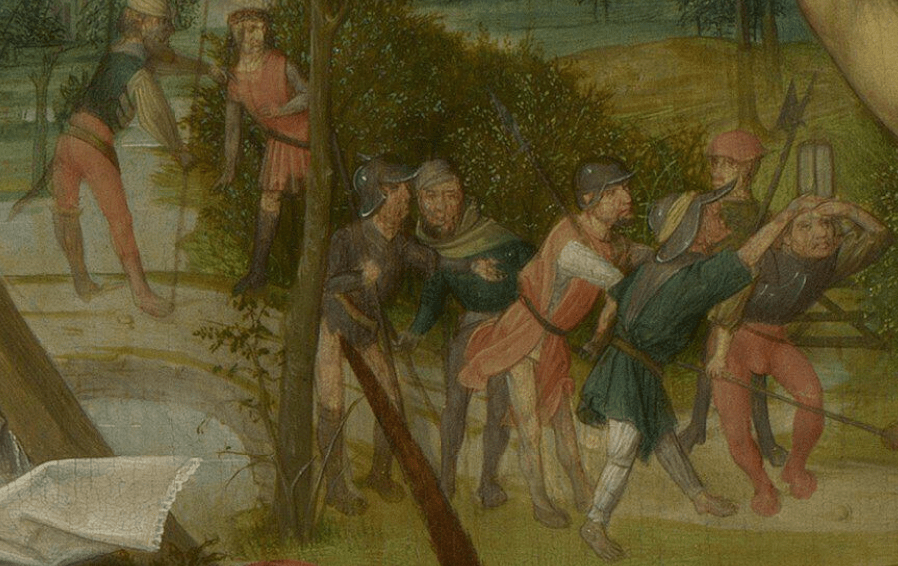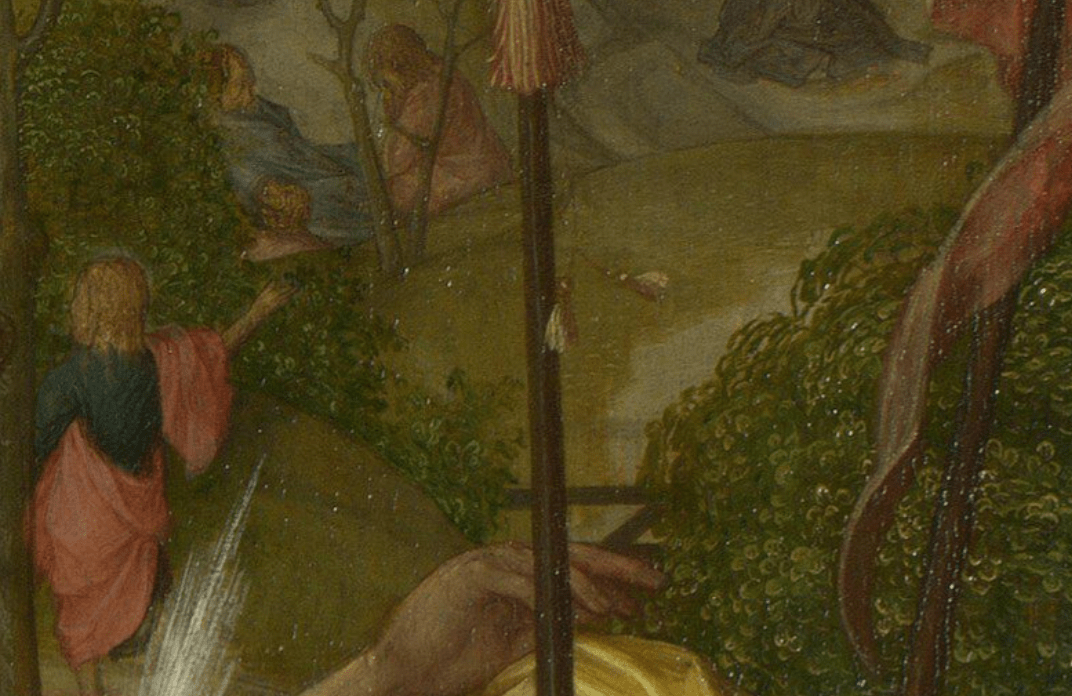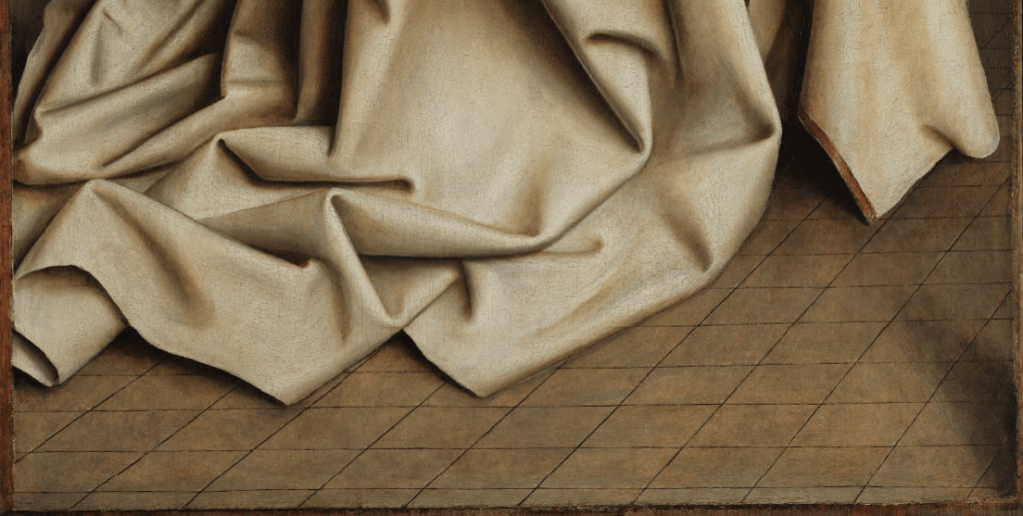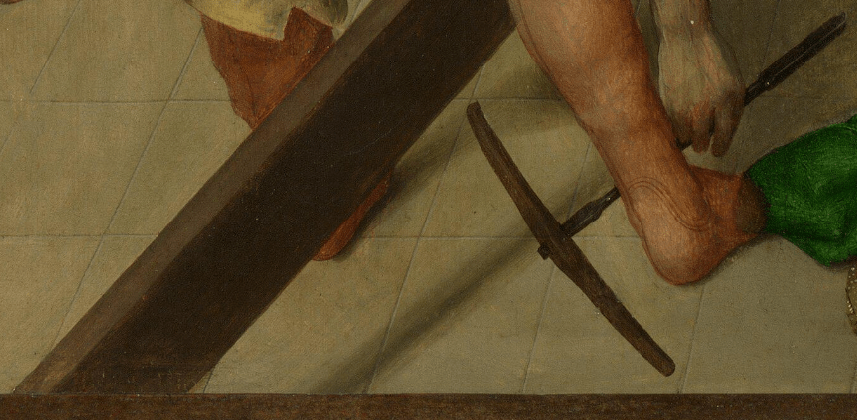
Lent 7

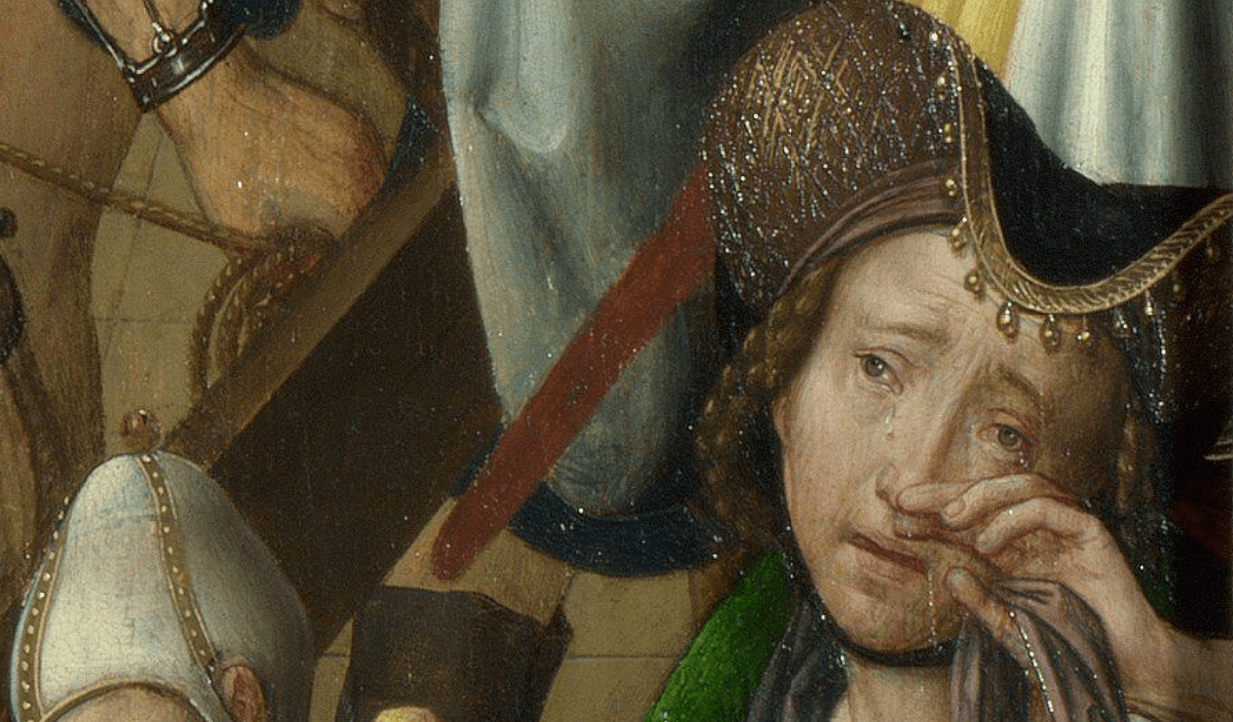
Our painting is one that can inspire grief. The woman who is the focus of today’s detail is weeping, although I suspect she is trying to do so silently, and to herself. Her brow is furrowed, and tears fall from her eyes, which are sparkling with fresh tears, and a little red. Her mouth is only a slightly open – no loud wailing, no grand display of lamentation here. She lifts a hand to her face, maybe to wipe the tears away with her fingers, or with her scarf, or maybe to hide her eyes. Given the proximity of that rope, and the sheathed sword running alongside her head, she probably doesn’t want to step out of line. Next to her is a child – I think it’s a child – with the most extraordinary headgear.

Of course, it is a child, but one of the features of this artist’s style is that he (or maybe she?) couldn’t do children. Or rather, it might be more art historically accurate to say that the artist painted children like small, gnarled adults (exactly like some babies, if we’re honest). It’s not that they ‘couldn’t do children’, but that they chose ‘to do children’ like this: we’re not in a position to hypothesize why. And as for the headgear – well, fashion is clearly important today. I’m not an expert on historical clothing, but it’s a fair guess to say that no one has ever worn anything like that child has on its head. This is just a hint that, as far as the artist is concerned, we are ‘elsewhere’, even ‘far away’.

The woman’s outfit does not seem so unusual, being familiar from many costume dramas on stage and screen, not to mention the occasional painting, of course. She wears what is called a reticulated headdress – i.e. her hair is caught up in a net. Have said that, it is made to look as if her hair is caught up in a net – that’s not her hair though, the headdress it is padded to look as if it is. As you can see, her own hair is tied into plaits which emerge on either side – although the plaits could, of course, be extensions. Now yesterday we were talking about court musicians in the early 16th Century, and the day before I said that I thought that parts of the palace dated to the same period. However, as far as I can tell, reticulated headdresses like this date to the end of the 14th and beginning of the 15th centuries. And that might not be a scarf, but an attachment to the hat – it does look to be more or less the same colour as the hat band. If it is, then it is a liripipe, an item of fashion that women adopted from the male chaperon at some time in the 1440s – still a long time before the 16th Century. The decorations – i.e. the tear-drop gold beads hanging from the gold band – are not a feature of European dress though. Basically, if this is an early 16th Century painting, as other indications suggest, then with these two hats the artist is saying, ‘A long time ago in a galaxy far, far away…’ just like the opening of Star Wars. So maybe we should be looking for a young rebel from out in the sticks fighting against an evil empire…

Meanwhile, thank you to all those of you who came to Going for Gold 2 yesterday. Both talks were sold out (hoorah! thank you again!) and there are just a few tickets left for next Monday’s lectures. As well as those, I’ve just updated the diary page with other talks that are coming up over the next few weeks and months, in case you are interested.

Lent 6

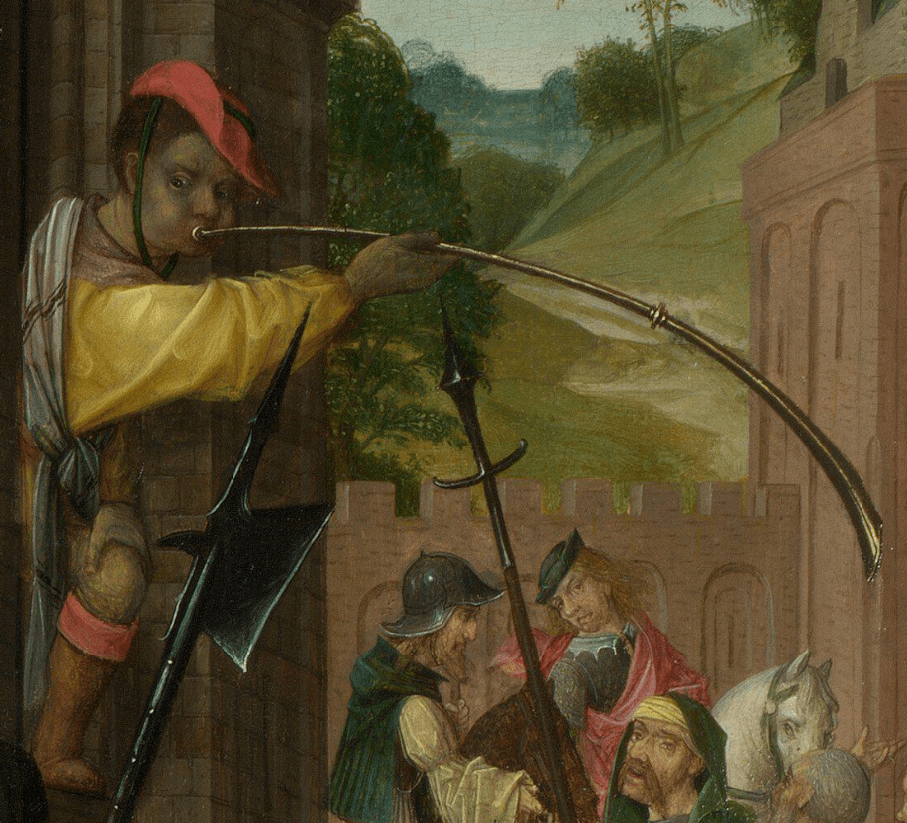
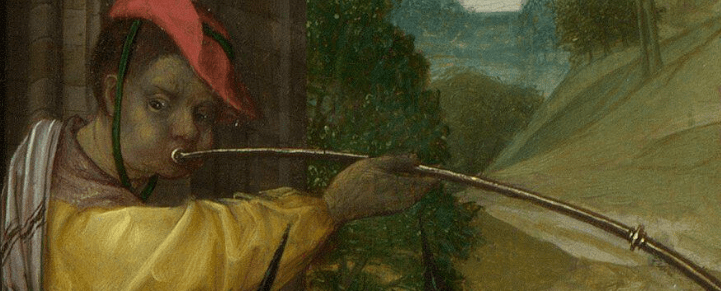
Whatever is going on, it is clearly important – a trumpeter is heralding important news. Given the shadows on the slopes – and the blue remembered hills in the distance – he leans out from the very palace we saw yesterday. Stepping up onto a parapet with his left foot, he rests his left hand on his knee. His right arm stretches straight to support the long, single arc of his instrument, which, in a subtle, but charmingly artistic detail, echoes the curve of the track leading through the landscape beyond what must be the city wall. The musician looks over his right shoulder at something – or someone – just to our left, as his cheeks puff out to sound the trumpet. His dress is some way between exotic – with a striped scarf going round his left shoulder and tied under his right arm, and a bright yellow, full-sleeved tunic – and standard, however bright the broad-brimmed red hat.

Two weapons – a halberd and some form of spear – are held by people who must be in between us and the musician. Whatever the event, ceremonial or ‘actual’, it requires the presence of guards, but as the two weapons are different, and not held upright, I would think that this is not a formal occasion.

What most intrigues me about today’s detail is the fact that the artist has painted a black trumpeter. Given that there are so few people of colour represented in paintings in the National Gallery (so now you know where it is!) I am amazed that I only became aware of this man’s existence when I began looking at this work in preparation for this Lenten series. But then, that is the value of looking at anything without preconceptions. If you think you know what is there, as I thought I did, you only see what you expect. By taking the details out of context, as we are, you get more of a chance to see everything that is needed to make a painting work. As my PhD supervisor once advised me (it may have been the only advice I got), keep looking until you’ve seen everything, and can’t possibly see any more. And then look again.

As it happens, there were a number of black musicians in Western Europe in the 16th Century, one of the most notable being John Blanke, a trumpeter in the courts of Henry VII and VIII. He is the only black Tudor for whom we have an identifiable image, and we know enough about him to know that he was well-paid, and well-respected. In 1512 he successfully petitioned Henry VIII for a promotion, and his wage was doubled. In the same year he got married, and the king gave him a wedding present: a new suit of clothes, including a hat and a violet velvet gown. There are two images of him that survive, dating from 1511, in the Westminster Tournament Roll, held by the College of Arms.

If you want to know more about him, you can find almost everything there is from the Historic Royal Palaces website, on a page entitled John Blanke: A black musician at the Tudor court. Or, for that matter, you could read the entry on the same website by independent art historian Michael Ohajuru, on The Black Presence at the Tudor court.

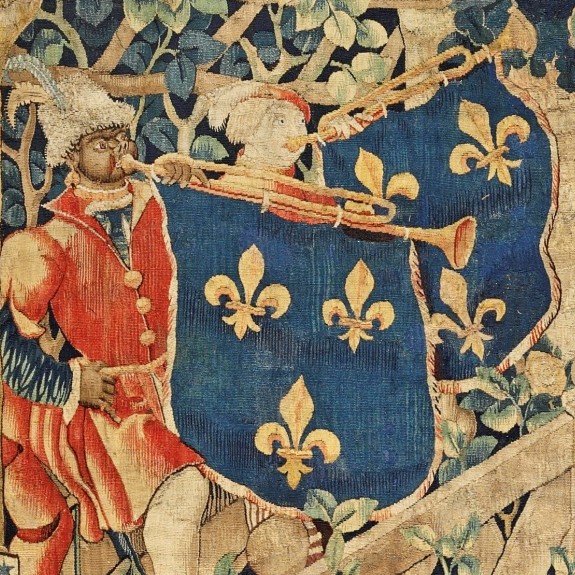
The English Court wasn’t the only one to have black musicians. I’ll leave you for today with a tapestry illustrating a wrestling match during the infamous Field of the Cloth of Gold, a meeting between Henry VIII and François I of France, which took place in 1520. I can’t for the life of me work out who owns this tapestry now – it was sold at Sotheby’s in 2014, and may have passed through Christie’s four years later. However, it is due to feature in an exhibition at Hampton Court between 1 April and 5 September this year to mark the 501st anniversary of the event (yes, a year late because… well, you know). At the top left is another black trumpeter, with the fleur-de-lis on his banner, as if François I, watching the bout at the top right, was all-too conscious of the need to keep up with the Tudors. Maybe our musician is playing for yet another monarch…

Lent 5

It turns out we have a sizeable palace, built from stone, and decorated with architectural detailing and sculptures, all of which imply wealth and status. The arcade at the bottom right of the building is lofty and spacious, and the tall, thin windows at the top left suggest that there is a grand interior hall. Whoever this palace belongs to, they clearly want to impress.

The architecture itself is giving off different messages. The broadly-curving, round-topped arches look more Romanesque than Renaissance, and are reminiscent of the type of architecture that Northern European artists (by which I mean German, Flemish or Netherlandish generally) would use to imply ‘pre-Christian’. The sort of buildings, in fact, that we saw in Jan van Gossaert’s Adoration of the Magi (c. 1510-15), if you were around before Christmas, and following my Advent series. Above what appears to be the doorway, at the bottom left, the rounded arch is topped by an ogee arch – i.e. an arch made of two mirror-image ogees, s-shaped, curved sections of masonry, consisting of a concave and a convex element. In this case, each ogee is a cyma reversa, as the convex element (of stonework) is above the concave, relative to the inside of the arch. At the top of the arch is a capstone, which here is topped with a stylised lily. This, when combined with the undulating leaf forms which top the ogee, is common in Venetian architecture in the 15th Century, but does occur elsewhere as well. Meanwhile, down the side of the building there is a more regular structure, with large, rectangular windows, including one in the pointed gable. These upper stories project slightly from the lower levels, and this section of the building, to my eye, at least, has a more 16th Century feel.

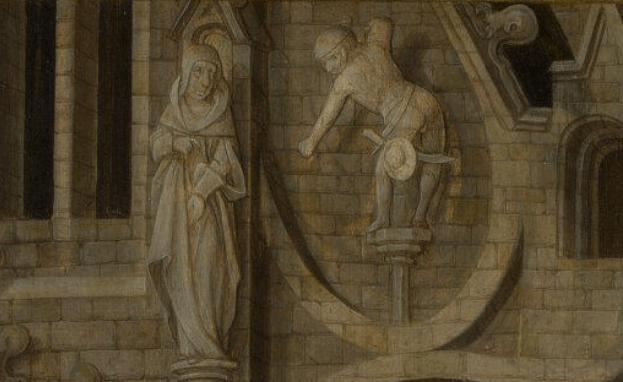
The sculptures also give off different messages. The larger of the two presents a standing male figure in a long robe, wearing a cowl, and some form of hat – although not the sort that makes him appear monastic. Next to him is a figure in a rather undignified posture. Rather than the elegant, upright stance of his neighbour, he is all angles, the posture suggesting the character of the person represented. It doesn’t help, to be honest, that as he bends down his buttocks are turned towards us, and surprisingly (under any circumstance, but especially as the sculpture is at such a distance), there is more than a hint of testicle. The character depicted is clearly not one to be respected by right-minded people. With right arm bent and left fully extended, he could easily be an archer, although any bow, had it existed, is missing – but that would happen easily with any stone sculpture open to the elements. He would appear to be shooting directly at the other sculpture, though quite what he is aiming at I shall leave you to decide.

His bow and arrow may have gone, but he still has a sword and buckler – a circular shield, common in the medieval period. The sword does not appear to be European. It is curved in a broad arc, the end being cut across in a straight line leading to a sharp point: it is a scimitar. Originating in the 9th century in central Europe, scimitars were perhaps best known as the swords faced by the crusaders, wielded by ‘the Turk’, or members of the Ottoman Empire. It is another suggestion that this building is not Christian, however familiar most of the individual features might be. But to find out who it belongs to, we may have to wait several days, or even weeks…

Lent 4

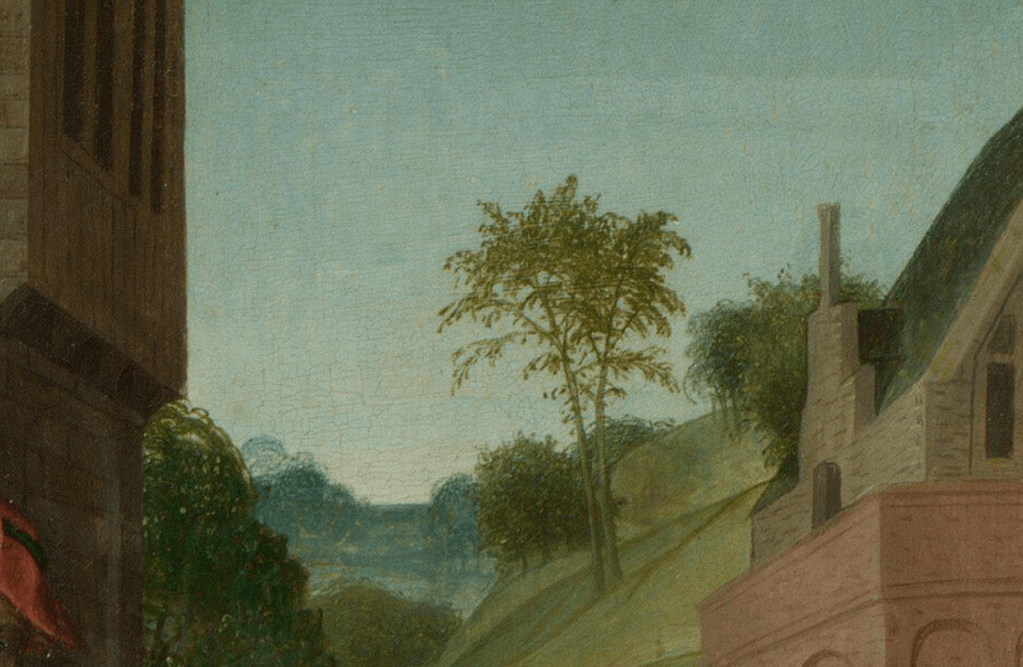
Well, it’s not all bad! After yesterday’s lowering clouds, the bright blue sky couldn’t be more welcome. The sun is shining, casting shadows on the pale green grass – although I’m not entirely convinced they are being cast in the right direction, given that, judging by the light on the different facets of the buildings, the light should be coming from the left. Having said that, on closer inspection, the lines of shadow are modelling the undulation of the hillside. The leaves of the tree are pale green – so it could be spring, or early summer. But beware, flowers can appear at any time in a painting, and so can leaves. As we are potentially dealing with the illustration of a text in which several people come back from the dead, new life would be valued in all its forms, and could be symbolic rather than naturalistic. And while we’re looking at it, you can see from the horizontal fluctuations in intensity running through the branches and leaves, that the tree was painted on top of the broader brushstrokes of the sky.

We’re not in the countryside, as the three previous details might have suggested. There are some elements, at least, of the built environment, solidly painted, and showing clear signs of perspective, although whether this is a rigidly determined single vanishing point perspective, or something approximated by eye, would probably be impossible to determine from the fragmentary evidence here. Nevertheless, this is some form of linear perspective, describing the way in which objects get smaller the further away they get, and parallel lines, leading away from the picture plane, converge. Even if the artist did use single vanishing point perspectives, a single system wouldn’t apply to the two buildings which are just visible, because they are not lined up. The front face of the one on the right doesn’t appear to be parallel to the picture plane, although the one on the left, from the sliver we can see, does. So the orthogonals of the two buildings – the lines leading into the distance, which, in a ‘classic’ perspectival scheme, would be at right-angles to the picture plane – would recede to different points.

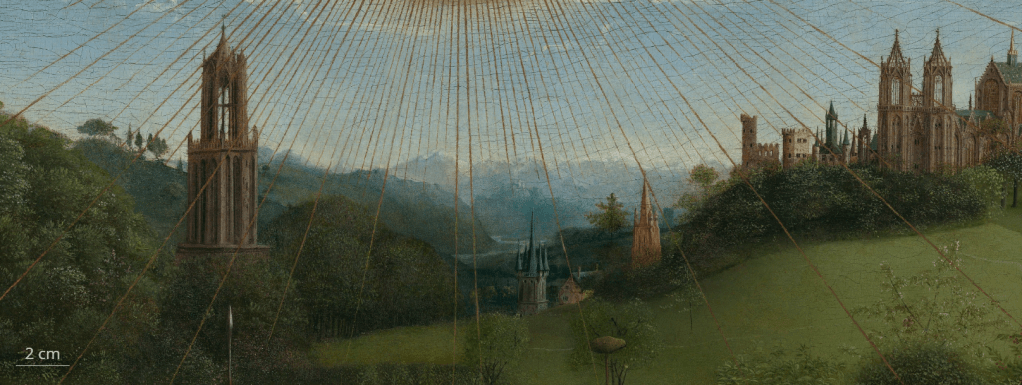
In addition to linear perspective, the painter also knows about aerial, or atmospheric perspective: the effect that the air, or atmosphere, has on the way we see things in the distance. They look paler, and slightly less distinct, as if the air itself, or any dust or mist in the air, were getting in the way. As well as being paler, and less distinct, the distant hills also look blue, almost as if the very sky has got in the way. It helps that, for most people, the colour blue tends to recede visually, so blue can, in itself, look more distant. Atmospheric perspective was known to the Romans, but none of the relevant murals had been discovered in time for the artists of the Early Renaissance to learn from them: they saw it themselves, looking at the world around them. Its first use is usually credited to Masaccio, painting in the Brancacci Chapel in the 1420s. However, in his relief of St George and the Dragon, carved almost a decade earlier, Donatello clearly shows his understanding of the phenomenon in the wispy depiction of the trees that appear as if sketched onto the marble in the background. And then, of course, van Eyck would employ it to magnificent effect, and with far greater refinement than Masaccio, in The Adoration of the Sacred Lamb from The Ghent Altarpiece, completed in 1432. I’m going to include a detail of it from one of my favourite websites, Closer to Van Eyck, simply because I can. Our painting can only have been completed after this.

Jan van Eyck, Detail from The Adoration of the Sacred Lamb, 1432. St Bavo’s Cathedral, Ghent.

Lent 3

Don’t know why
There’s no sun up in the sky
Stormy weather
Since my man and I ain’t together
Keeps raining all the time

When Harold Arlen and Ted Koehler wrote Stormy Weather in 1933 they probably weren’t thinking about the Pathetic Fallacy. The idea that the weather, and nature as a whole, could share the same emotions as us, the human occupants of the planet, was, of course, particularly prevalent for the Romantics in the first half of the 19th Century, when it wasn’t uncommon for clouds to be lonely, especially given that, not so far away, daffodils were clearly so gregarious. The term itself, ‘the Pathetic Fallacy’, was coined by none other than John Ruskin, artist, author and all-round thinker. I’d call him a Renaissance Man if he hadn’t been such an advocate of the pre-Raphaelites (so, an ‘Early Renaissance Man’?), or for that matter, of the Neo-Gothic. ‘Gothic’ was, for him, the only truly Christian form of architecture. But I digress. I had started, though, so I’ll finish. Ruskin introduced the term in Volume 3 of his Modern Painters, published in 1856, which is, I suspect, a little late to be relevant to our Lent painting, given that I have already suggested that the naturalistic details and particular form of modelling in light and shade suggest that it is a work from the 15th or 16th Centuries.

Having said that, I can’t help thinking that these clouds look a little ominous – i.e. ‘giving the worrying impression that something bad is going to happen’ – from ‘omen’, of course. Now, when we say that clouds look ominous, I think we usually mean that it is going to rain. It is possible, though, that this particular meteorological phenomenon could portend some other ‘bad’ event. The Pathetic Fallacy wasn’t the exclusive reserve of the Romantics, after all, going back centuries and lasting – via 1933 and ‘Stormy Weather’ – up until the present day. Here is a completely unnecessary list of the Top Weather Songs of the 21st Century, just to prove the point. Or maybe, as far as our painting is concerned, this is just what the weather was like when the artist went to work.  

Lent 2

Three more plants today – and we shall ignore the delicate black slipper and the cloth of gold hem, although the scale at which they are depicted does suggest that we are not looking at a landscape painting, even if the landscape could still play a significant part.

On the left is a broad-leaf plantain, Plantago major, which became known among the Native American peoples as ‘the white man’s footprint,’ because it followed the puritan colonials wherever they went. It was one of the first invasive species to reach the Americas after that most invasive of species, the European. As ‘plantago’ means ‘sole of the foot’ the nickname is entirely apt. It thrives in disturbed soil, and will grow almost anywhere – but especially along roads and paths – and as a result it is symbolic of the ‘well-trodden path’ to Jesus. So a religious setting for our painting seem likely – although it could be just a naturalistic observation.

In the middle is a wild strawberry (Fragaria vesca). This is not especially accurate in its details, but the division of the leaf into three and the five white petals of the flower make this identification secure. Any mention of the number three will inevitably call to mind the Holy Trinity, and the strawberry is also noted for being sweet, but having no thorns or hard stone. As such it wasn’t affected by God’s warning to Adam and Eve after they had eaten the forbidden fruit that, from that point on, the ground would be cursed: ‘Thorns also and thistles shall it bring forth to thee’ (Genesis 3:18). Somehow the strawberry missed out on this this curse, and so it is seen as a pre-lapsarian fruit (i.e. from before the fall), a symbol of purity and perfect righteousness.

The final plant is a violet, Viola odorata. Even if it isn’t in bloom, the heart-shaped leaves are a giveaway. And guess what? Violets also have a religious symbolism. The flowers appear to look down, as if they do not want to appear too bold: they are a symbol of humility, and specifically, the humility of the Virgin Mary. Not only did St Bernard of Clairvaux  (1090-1153) describe Mary as ‘the violet of humility’, but the colour of the flower is not dissimilar to the deep blue of the ultramarine in which she is so often dressed. You can see this colouristic echo in the detail below from The Wilton Diptych in which the verdant greenery and scattered flowers (accurately depicted, although not to scale) represent the heavenly paradise.

The Wilton Diptych is of course the subject of my next talk in the series Going for Gold, which picks up again on Monday (22 February) after a week’s break. There are still a few spaces left for the talk, which I will give twice, at 2pm and 6pm – follow any of the links for more information. In the meantime, it does look as if, for Lent, we do have a religious painting on our hands. However, as all three of these plants are still very common (in the right places), I’m still not 100% sure that this isn’t just naturalism being employed to draw us into some other type of story. We’ll see…

Lent

It is the first day of Lent, and this year I will be giving up abstinence. Well, I say, ‘this year’. To be honest, it’s a sacrifice I’ve been making for the past two decades at least, but there seems no reason to give up giving up now – so much has been given up this year already. Instead, I will perform an act of penance, which will be to write one or two paragraphs (but I hope no more!) about a single detail from a single painting every day of Lent. Inevitably this means that that your penance will be to get an email from me every day. Feel free to delete or ignore at will! As with Advent, I won’t say what it is. The painting is not as familiar, but still one I have enjoyed talking about in the past. If – and when – you recognise it, please do let me know. But try not to name it! Knowing me, it will become all too clear all too soon.

This is a columbine, or aquilegia – Aquilegia vulgaris, to give it its Latin name. It is a perennial herb from the family Ranunculaceae (the ‘buttercup’ family) which is found in the Northern hemisphere growing in meadows and woodlands. As a relatively common plant, it is regularly depicted in art: the artists painted what they knew, after all. Not only that, but it was the most common of plants which became symbolic. It was widely believed that God had made the world specifically for humans, and had also made everything in it to remind us of the fact – so there should be something to learn from everything we see. It could therefore be relevant that the two common names of this plant are both related to birds. ‘Aquilegia’ comes from ‘aquila’, or eagle, because the petals of the flowers were said to look like talons. At the other end of the ‘hawk/dove’ spectrum, ‘columbine’ means ‘dove’ – because the flower as a whole was said to look like five doves flying in formation. It is this aspect of the flower which is important: it is a symbol of the Holy Spirit.

The naturalistic representation of flora and fauna in Western art became more common towards the end of the 14th Century, and is especially favoured in the 15th and early 16th Centuries (and later, of course, in still life painting), which gives us a (very) rough time frame for our painting. However, the leaves are subtly shaded, the tonal values giving us a good idea of their three-dimensional form. This degree of naturalism is seen little before the 1420s, although it does exist, but nevertheless, we should definitely be thinking about the 15th or 16th Centuries. As a reference point, Jan van Eyck’s Ghent Altarpiece, completed in 1432, has a plethora of spectacularly naturalistic plants. Given that the flower is symbolic of the Holy Spirit, then this could well be a religious painting (it is Lent, after all), but despite this, it could be a naturalistic detail in a portrait, or mythological painting, I suppose. Let’s face it, Titian included one in the bottom right-hand corner of Bacchus and Ariadne (1520-23), next to some horsetail (Equisetum arvense) and an iris (Iris graminea) – see below.  As for the other things we see in today’s detail (see above) – well, they don’t do well out of being removed from their context. We’ll come back to them some other time, I presume, and in future posts I’ll just ignore everything that doesn’t seem relevant!

123 – Vermeer

Johannes Vermeer, The Milkmaid, c. 1660. Rijksmuseum, Amsterdam.

After spending a lot of time – in my head, at least – in medieval Italy and 16th Century Europe as a whole, I am looking forward to a foray into the 17th Century, and one of my favourite artists: Johannes Vermeer. In fact, I will be talking about him twice over the next couple of months, a wonderful coincidence about which I am very happy. The first time will be this Wednesday, 17 February, at 6.00pm. I will focus on the paintings in which Vermeer depicts other paintings, and what we can learn from their inclusion. Entitled The Art within the Art, there is still time to book for the talk with Art History Abroad – click on the link for more details. The second will be on Vermeer’s relationship to music, and I’ll tell you more about it another day, if that becomes relevant. As The Milkmaid includes neither paintings nor music, I thought I would take this opportunity to reacquaint myself with what I find to be a disarmingly beautiful image.

I’ve edited the last sentence several times, because I can’t decide whether this painting is disarmingly beautiful. Maybe it’s beautifully disarming – and I’m sure there’s a difference. But why is it either (or both) of these things? I suppose because it is a painting that, for whatever reason, I do find very beautiful, and this always makes me try to analyse where that beauty lies – a process which can all-too-easily kill the simple pleasures of looking. It is disarming, I think, because at first glance it looks so simple, and yet it is hypnotically compelling. Vermeer paints everything with such apparent honesty and conviction that we remain convinced that there must be something more profound going on than the simple act of pouring milk. To try and work out if there is, I’m going to start at the top and work my way down.

I’ve always loved the way Vermeer paints walls. It’s never a case of getting out the roller and covering the whole surface with white matt. What we see is subtly modulated, with every square centimetre differentiated from every other. The setting – a corner of a room with a window on the left – was not his invention: it had already been used by artists for about 10 years by the time he picked up on it, it seems, and from then on he used it regularly, often returning to the same, or similar, corners. With the window a little way in from the back wall, the corner itself is left in shadow. The light passes through the glass at a diagonal, and illuminates the back wall away from the corner, the illumination getting ever brighter as we move to the right. Two nails are driven into the wall, and the higher of the two, further to the right, is in the light. It casts the sort of diffuse shadow that suggests this is large window, far higher than the part of it we can see in the painting. On the left a wicker basket – used for shopping, presumably – hangs from a similar nail, with a highly-polished copper pail hanging from another on the back wall. Above the basket we see what is probably a small picture: it’s too high to be a mirror. To the left of the nail from which the basket is hanging one of the panes of glass has been broken – there could easily be a a breeze coming through – and in the pane below this the glass is cracked, with the broken edge catching the light. If you go down one more pane, and two to the left, another of the small plates of glass threatens to fall into the room. The attention to detail is breathtaking.

The fall of light from left to right illuminates the maid’s face, showing its bold, simple forms: a down-to-earth presence, whose broad features would have been interpreted as indicative of her lowly status. The light also charts the very specific folds of her simple linen headdress, especially to the left of her face, where the sharp fold at the level of her forehead gradually opens out, so that, as it gets lower, less light falls on the fabric. As the hem curves forward the lower edge is left in shadow.

The light is one of the features which creates the attention-grabbing boldness of the central figure, and renders her monumental. Her right shoulder (on our left), the top of her right arm, and especially the back of her right hand – the one holding the handle of the jug – are brilliantly illuminated, making them stand out against the shadows on the wall. On our right, the shadow which forms the curve of her left shoulder, and the right side of her left arm, stand out against the brilliantly illuminated wall behind. Vermeer enhances this by painting the thinnest of white lines around the edge of the sleeve as it comes down from the shoulder. The reversed contrasts of light and shade push her towards us, making her more immediate, more entirely present. Not only that, but the perspective pulls our eyes towards her. The horizontals of the window frame and the leading which holds the glass in place form orthogonals receding towards a vanishing point, placed at the crook of the maid’s right arm. As the vanishing point is theoretically our point of view, this means that our attention is focussed on the action of holding the jug and pouring.  

The colour is also subtly vital. Her bodice is yellow, and she wears a blue apron. For me this is still a surprising colour for an apron (even given that I know nothing of the history of aprons), especially as Vermeer has used that most prized of pigments, ultramarine. The bodice uses lead-tin yellow, another good, traditional pigment, but nowhere near as expensive. For the sleeves – which are rolled up – he mixes the two to create green. It is almost a lesson in basic colour skills: yellow mixed with blue makes green – and in this case, the specific yellow of her bodice mixed with the distinctive blue of her apron makes this particular green.

The attention that the maid gives to the act of pouring also demands our attention: if she takes it this seriously, then so should we. This is not a haphazard act, but a careful, determined action, the support given to the milk jug by her left hand helping to make sure the liquid flows at precisely the right speed.

The measured flow of the milk has made people think that she is doing something specific, and one suggestion is that she is preparing a bread pudding. There is plenty of bread on the table, after all, and some of the pieces next to her bowl appear to have been broken. You have to put in exactly the right amount of milk, apparently, or the pudding would either be too soggy, or the bread would dry out and become too hard and crunchy. This is simple fare, made from wholesome ingredients with good honest labour. Again the light plays a major part, showing us the deep, sculptural folds in the sleeves and apron, and the form and textures of the bread and basket – and yet it does not do so with the highly focussed detail of a fijnschilder – or ‘fine painter’ – the name for artists like Gerrit Dou whose every surface is an almost microscopic exploration of precise surface textures, and yet not a single brushstroke is visible. As if he were a precursor of Seurat and the divisionists, Vermeer builds these objects up through a myriad of dots and dabs of paint. You don’t believe me? Look at this.

When talking about Vermeer it is hard to get away from the theories which try to explain his peculiarly focussed vision by suggesting that he used a camera obscura – basically a form of pinhole camera that projects an image onto a surface and allows you to trace the outlines. However, this would only provide the outlines, and not the colours or textures. Admittedly, the images a camera obscura produces can sometimes include some of the effects he uses – the bright, blurred highlights, for example. Although, if you think about it, you only get bright highlights on shiny objects, not on matt loaves of bread. This may well be the sort of effect you could see with a camera obscura, and that may be where he got the idea – but he would never have seen the particular highlights painted here. They are part of the magic of the image, and create the wonder – and some of the texture – of this fresh bread, the bounty of this work-a-day basket. As it happens, the construction of the perspective also suggests that he didn’t use a camera obscura: it isn’t traced, but drawn. Technical examination has revealed a pin hole in the canvas itself, at the crook of her right arm – the vanishing point. Vermeer would have inserted a pin, and tied a piece of thread to it. This could be covered in something like charcoal dust, pulled taut, and then snapped against the canvas to ‘draw’ lines onto it. It was a common way of working out perspective, as the lines drawn inevitably lead to the vanishing point.

When we get down to the bottom of the painting the lesson in colour continues. Under the apron the maid’s skirt is red – so she is wearing muted versions of the three primary colours, yellow, blue and red. This particular shade also harmonises well with the brick-red floor, and the ceramic pot, one of the truly revealing details in this painting. It is part of a footwarmer – a wooden box, with a perforated top – and the pot would have held hot coals. A practical object perhaps, given that we are presumably in a cold kitchen, ideal for keeping and using dairy products, although it is very small compared to the size of the room. In any case, footwarmers were used when seated. Behind it is the wainscoting, made of Delft tiles – local produce, of course, as it was in Delft that Vermeer lived and worked. Three tiles are visible, and the imagery of two of them can be read. On the left is cupid, wings to the left, firing his bow and arrow to the right, and to the right of the footwarmer, there is a man with a walking stick. Are these relevant? Probably. Have a look at this picture from the Sinnepoppen, an emblem book published by Roemer Visscher in 1614.

Any emblem has three elements, ‘pictura’, ‘inscriptio’ and ‘subscriptio’ – or picture, heading, and explanation. For the title of his book, Visscher invented a new word – where ‘sinne’ means the ‘sense’ of the emblem, and ‘poppe’ means the image. By creating a word that combines two elements from which we can determine the meaning, he is echoing the function of an emblem precisely. Neither the pictura nor the inscriptio gives the full sense on its own – they have to be considered together. The relationship between them – what, together, they mean – is explained in the subscriptio. In the example above, ‘Mignon des Dames’ means “the ladies’ favourite” – as in sweetheart, or lover. The subscriptio goes on to explain that modern ladies love nothing so much as a foot warmer, as it provides them with constant warmth. Any man who wanted to pay her court would find himself playing second fiddle to this household object. They can be seen often in Dutch 17th Century genre paintings, but even Visscher’s explanation doesn’t fully account for their presence. That is because Visscher wants you to be as clever and inventive as himself, and is always expecting you to make connections and take the meaning further. Think about it: when seated, the hot coals would fill the user’s skirts with warmth. Presumably, any potential lover would have prove as reliable if he wanted any degree of success. Combined with the image of cupid shooting an arrow towards the source of heat, the implications are that our maid could easily be the subject of inappropriate attentions, welcome or otherwise. It’s worthwhile bearing in mind that it was usually assumed that milkmaids were sexually forthcoming.

Having said all that, from this point on you can make up your own mind. And that’s not because I don’t want to tell you what is going on here, or because I don’t know what is going on here, but because Vermeer’s great genius includes the ability to leave things open. Is it coincidence, for example, that her skirt plays with the same tonalities as the earthy floor and the glowing coals, which we can imagine but not see? Does it imply a heat within? Or does the fact that she is standing, at work, rather than sitting down enjoying the welcome updraft, suggest that she is a figure of virtue, rather than potential quarry, worthy of pursuit? It’s possible that the very title of this painting is incorrect, as it happens. A milkmaid would work outside, with the cows, milking. The woman in the painting is really a kitchen maid (although in some households they did double up, apparently). But then, kitchen maids often had the same reputation. I cannot get away from the care with which she pours, and I suspect that Vermeer is questioning the assumptions we make about the people, and objects, depicted by his contemporaries. The first assumption is that milkmaids – or kitchen maids, for that matter – were bound to be ‘up for it’. After all, in this case, she seems entirely focussed on her work. The tile with cupid and the footwarmer might imply sexual impropriety – but do either have any effect here? In other hands the jug itself might seem suggestive. Artists like Jan Steen regularly show women holding vessels with open apertures towards men who reciprocate with any number of phallic equivalents, from bulging bagpipes to pistols cocked. And yet here the act of spilling – which could be a sign of incontinence – of sexual incontinence, that is – is entirely controlled, and measured. If our maid represents anything, then maybe, for Vermeer, she could be a modern-day Temperance. Compare her with this print by Jan Saenredam, made in Haarlem in 1593, based on a design by Hendrick Goltzius.

This is the most common representation of Temperance – although not that we saw painted by Giotto, who has her sheathing her sword (see Day 59 – Virtues vs Vices), or for that matter, the version painted by Ambrogio Lorenzetti in his Allegory of Good Government, in which she watches the first known image of an hour glass. In Saenredam’s personification she carefully pours liquid from one vessel to another – usually interpreted as watering down the wine, a true sign of Temperance, as opposed to complete abstinence. This careful, measured pouring is precisely what our maid is doing. And if she is Temperance, then maybe we could interpret another of Vermeer’s paintings, Woman Holding a Balance, as a personification of Justice. The comparison here is also from the series designed by Goltzius in 1593, but this time executed by different student, Jacob Matham. I don’t have time to say more about this painting now, unfortunately, but I will discuss it on Wednesday when I explore The Art with the Art.

Before then, though, what conclusions can I draw about The Milkmaid? Is she awaiting an assignation, or, conversely, distracting herself from temptation by concentrating on her work? Is she a figure of virtue, expounding the positive values of honest labour? Could she be a personification of Temperance? Vermeer’s focus, his attention to detail, the care with which he has structured the composition, combined colours, balanced tones, and modulated light, not to mention the dignity he gives to his subject, an apparently commonplace maid made monumental, suggests that there must be more than meets the eye. What is this painting about? What is going on? Well, there is a woman pouring milk. What more do you need?

122 – Justice for Venice

Jacobello del Fiore, Justice enthroned between the Archangels Gabriel and Michael, 1421. Gallerie Accademia, Venice.

Great news! The Accademia in Venice, which houses today’s painting, is reopening on Monday 8 February, and the Vatican museums are already open – so things are looking up. Soon we will be able to get back and see things in the flesh, but for now, we will still be online. I’m really looking forward to my new, independent venture, which, like the Accademia, ‘opens’ on Monday: thank you so much to all of you who have already signed up. It is still possible to book for Monday’s talk, or for all three talks at the reduced rate, and will be until around noon on Monday, I suppose. Just click on Going for Gold for more details. Meanwhile, another glorious painting featuring a brilliant use of gold to get us in the mood.

This has long been my first stopping point whenever I visit the Accademia in Venice, whether I’m taking a group or heading in on my own. It is at the top of the stairs as you enter, and all too easy to miss, because it is behind you on the wall as you sweep into the vast hall, which is a surviving element of the Scuola della Misericordia – the Confraternity of Mercy – which was converted into the city’s art gallery under the aegis of Napoleon. The painting itself comes from the Doge’s Palace, and was painted for the one of the judicial offices. It is both signed and dated to the left of Justice’s sword: ‘Jacobellus de Fiore pinxit 1421’– although, as you’ll see from the next image, when the painting was restored a few years back it turned out that this version of the signature had been repainted. The original name and date were still there, though, underneath the repainting. According to myth, Venice was founded on the Feast of the Annunciation (25 March) in the year 421, which implies that this painting was commissioned to celebrate the first millennium of the maritime republic’s existence. It is a triptych, of sorts, although not an altarpiece. The secular virtue of Justice, one of the four cardinal virtues (see Day 59 – Virtues vs Vices), and the one most valued by Venice, is flanked by two angels.

In this painting Jacobello shows himself to be one of the great exponents of the ‘International Style’ of painting, which swept, as its name suggest, across the whole of Europe in the last quarter of the 14th century and first quarter of the 15th. Elements of the style include a rich use of material – and we see that in the elaborate carving and colouring of the frame, not to mention the apparent encrustations of gold – and the depiction of rich materials – the wonderful red and blue fabrics, for example. Although it can include naturalistic details (the lions aren’t bad for the 15th century), overall the effect is more decorative, and there is often a fascination, as there is here, with hems forming elaborately scrolling lines, which pattern the surface rather than describe the naturalistic fall of the fabric. They are often called ‘calligraphic’ lines, as they are so much like some of the forms of decorative handwriting, or calligraphy. Even the scrolls show this format, although I won’t bother you with the translations (which means… I haven’t been able to track them down). Justice carries her standard attributes of scales and sword, and, although she is ‘enthroned’ no seat is visible. She may well be perched on the backs of the lions. Their presence is the first hint that all is not as it seems in this apparently straightforward painting. Lions are commonplace in Venice, you might say, but you are thinking of the winged lion of St Mark: these have no wings (but you’re not entirely wrong – the echo of St Mark’s beast can never be entirely forgotten in Venice). The lion is also one of the symbols often used by another cardinal virtue – Fortitude. This could also be relevant. But they are also indicative of the Throne of Solomon, known as the sedes sapientiae – the Throne of Wisdom – one of the titles given to the Virgin Mary. And if we remember that Venice was founded on the Feast of the Annunciation, maybe we should bear that in mind. Or am I getting ahead of myself? As we look at the painting, on the right is the archangel Gabriel, and on the left, Michael. Let’s have a look at him first.

Michael is the divine representation of Justice. He is supposed to weigh the souls at the Last Judgement, and holds the same attributes as Lady Justice: the sword and the scales. He also holds a scroll in supplication to the virtue to ‘reward and punish according to merit and to commend the purged souls to the benign scales’ (that was the one I found). At his feet cowers a rather glorious dragon. We have a tendency to understand that, in the battle with the rebel angels, St Michael defeated Lucifer – which would be correct – however, the Book of Revelation (12:7-9) says,

And there was war in heaven: Michael and his angels fought against the dragon; and the dragon fought and his angels, And prevailed not; neither was their place found any more in heaven. And the great dragon was cast out, that old serpent, called the Devil, and Satan, which deceiveth the whole world: he was cast out into the earth, and his angels were cast out with him.

The text makes it clear that the dragon – or serpent – was the devil. Hence the dragon in this painting, and others, although elsewhere it can look a lot more human. It also explains the frequent confusion between Sts Michael and George, although it’s easy to tell the difference: Michael has wings, George doesn’t.

OK, so this isn’t the best photo, but it does give a far better sense of St Michael’s glorious armour. Like many other elements in the painting – the hilt of Justice’s sword, her breastplate, and the beam of her scales, for example – Jacobello is using a technique called pastiglio, the intention of which was to make it look like the objects were solid gold. Like the Duccio I was talking about earlier in the week (121 – A golden girl goes missing), this was painted on wooden panel, and prepared with gesso. Although the gesso is usually smoothed to a marble-like surface, it can also be modelled in three dimensions: it is effectively plaster, after all. This is what is done with pastiglio work. We think of paintings as being two dimensional, while sculptures occupy the full three dimensions. However, most paintings occupy depth as well, even if that is only because of the frame. For Jacobello, in this work, a lot of the surface of the painting, including all of St Michael’s armour, with the skirt and epaulettes, the front edges of his wings, and his halo, is in fact an elaborate relief sculpture.

Even given the brilliance of the gold, Jacobello manages to balance the bling with an original colour palette. Michael’s cloak, which wraps around his left wrist in full International Style splendour, is olive green, lined with a red lake. Somehow he manages to harmonize this with the graduation of the feathers on the wings, which move from cream, through mushroom and a greenish beige to salmon, vermillion and burgundy.

Rather gloriously, this is exactly the same palette as the dragon’s diaphanous, frayed, vegetal wings – or it would be, if only I could find better photos! The benighted creature flails helplessly with two of its clawed feet, hissing through its long snout, all too proud of its fine set of teeth. Like the gilded crest, they are built up in pastiglio – a rare example where the sculptural element is not gold, almost as if Jacobello had imbedded real teeth into the surface of the painting. And just in case we weren’t sure – and in case the dragon needed to know – the words ‘St Michael’ are painted just below the fluttering cape. So far, so good. Unless you’re a dragon.

Now compare these two images. I have already mentioned that Justice was highly valued in Venice, and indeed, it was the most highly valued of the seven common contenders. So it is reassuring to see another, very similar representation attached to the Doge’s Palace. OK, so she doesn’t have the scales, but as she’s having to hold her own scroll, we shouldn’t hold that against her. The carving is attributed to Filippo Calendario, said to be the architect of the palace itself, and dated to the 1340s. There’s only one small problem. On either side of the figure’s head, you may be able to read the word ‘Venecia’. This is not Justice – this is a personification of Venice. Or rather, Venice is the personification of Justice. As for the scroll, the inscription translates as, ‘Strong and just, enthroned I put the furies of the sea beneath my feet’. If you want to be sure about ‘the furies of the sea,’ I should to show you the whole relief.

You can see the waves rolling underneath the throne – above the head of yet another lion – and left and right are two of the ‘furies’ – the anger of the sea and an enemy of the state – both of which have been trampled underfoot. The inscriptions behind her head and on the scroll tell us that this is ‘Venice’, and that she is ‘just’. Maybe, rather than simply calling our painting ‘Justice’, we should call it ‘Justice/Venice’? But, as she is ‘strong and just’, and given that lions are often an attribute of Fortitude, I suppose ‘Justice/Venice/Fortitude’ might be a better fit. Oh, and then there was that reference to the sedes sapientiae – although ‘Justice/Venice/Fortitude/Wisdom’ does seem to be pushing it. Maybe we should move rapidly on to Gabriel, with whom we are probably all more familiar.

This is truly one of the most luscious images of the archangel I know. He moves (unusually) from right to left, cloak and skirts fluttering in the breeze, the pale outside of the cloak – a faded pink, I suspect – echoing the tautological scrolling of the scroll, and contrasting strongly with the vermillion lining, to emphasize the calligraphic hemline. The scroll and cloak are also echoing the form of the wings above, curving up and then down to a point, while the wings themselves heighten the colours of Gabriel’s garb: the yellow is ‘lifted’ to gold, and the vermillion taken down to a burgundy similar to that seen on St Michael. And at the very top, the suggestion that these are peacock’s wings.

How do we know this is Gabriel? Well, he holds the lily, the sign of Mary’s purity, and speaks as he would to the Annunciate herself. Indeed, if we didn’t know that that he was announcing something to Justice, and if this was the only part of the painting to survive, we would assume this it came from a depiction of The Annunciation. If it were, his scroll would say ‘Ave grazia plena: Dominus tecum’ (Luke 1:28, in the Vulgate) – ‘Hail, though are art highly favoured, the Lord is with thee’, according to the King James Version. However, what it actually says is, ‘My word announces the virgin birth of peace among men’ (I got a bit obsessed and finally managed to track this down). It is a deliberate allusion to the Annunciation.

And remember, Justice is sitting on the sedes sapientiae, the Throne of Solomon, flanked by two lions, just as the Virgin Mary does in the National Gallery’s earliest painting, Margarito d’Arezzo’s Virgin and Child Enthroned, dating to the 1260s. Venice was founded, according to the myth I mentioned earlier, on the Feast of the Annunciation, in the year 421. One thousand years later, this painting recalls the event, eliding it with the Annunciation, and interprets the foundation of Venice as the foundation of peace among men. The Venetian myth continues: Venice was never invaded – it was inviolate – and so it was a virgin state. So I’m afraid it is not as simple as saying that this image represents ‘Justice/Venice/Fortitude/Wisdom’, as it also represents the Virgin Mary. Let this be a lesson to anyone asking about symbols. ‘What does that mean’ is one of the most frequently asked questions about objects in medieval and renaissance art, and rightly so. ‘Does it mean (a) or (b)?’ would be the next question. Well, sometimes it means (a) and (b) – although sometimes it means neither. The object just fits in, making the image more believable, and more real: it is purely observation to enhance the naturalism. However, in this case, it means (a) and (b) and (c) and (d) and (e). And some – we haven’t mentioned the ‘Peace’ of La Serenissima yet…

There is another way of thinking about it, though. We could see it as a representation of ‘Justice/Venice/Fortitude/Wisdom/Mary’, as all of these elements are included. Or, we could see it as the locals would have done: this is a representation of ‘Venice’. The qualities which are wrapped up into this one personification are all the things that Venice was supposed to be, and all of the qualities that are displayed in the buildings around the Piazzetta and the multiple functions of the Doge’s Palace: Justice/Venice/Fortitude/Wisdom/Mary could be seen as equivalent to Courts/Council Chambers/Prison/Library/St Mark’s. As it happens, I’ve said this before, but in a different way, illustrating the ideas with a painting by Canaletto: head to Day 65 – Venice if you want to see how that works. And if it’s all too much to cope with, just enjoy the rich colours, the elaborate folds, and above all, the gold – look at the sun on Justice’s breastplate, shedding light onto the world, for example. That’s one of the attributes of ‘Truth’, by the way…

The Venetian Republic was truly remarkable, and clearly thought very highly of itself. Of course, Venice is still remarkable, and let us hope it longs continues to be so. I’m really looking forward to Jane da Mosto’s lecture for my friends at Art History Abroad this Wednesday, Caring for Venice – sadly I can’t watch it live, but they (unlike me) record their talks, so I’ll watch it later. If you’re interested in what is happening to save this, the most remarkable of cities, it would be an ideal opportunity to do so. Not only that, but a percentage of the ticket price will be heading towards the charity with which Jane (wife of Francesco da Mosto, Venetian architect and T.V. presenter) is involved: ‘We are here Venice’ (I think the name loses something in translation). But before then we launch Going for Gold: I hope to see you on Monday!

121 – A golden girl goes missing

Duccio, The Virgin and Child with Saint Dominic and Saint Aurea, and Patriarchs and Prophets, about 1312-15 (?). National Gallery, London.

First thing’s first – I’m giving my own talks! Rather than sheltering under the umbrella of another institution or organisation I’m doing my own thing. More of that after Duccio, but if you can’t wait that long, head to the diary page of my website for news of my series of lectures Going for Gold – which, as you will see, has determined my choice of painting for today. I was lecturing about Ambrogio Lorenzetti last week, and someone suggested a lecture on Duccio, and although I’m not quite going that far, I did want another look at this glorious triptych. It is a small devotional panel that could have been kept in pride of place in a bedroom, study or cell, or, for that matter, given the right members of staff, carried from place to place. On arrival at your destination, miles away from those you knew and loved, you could put it on a table, open it up, and, looking at the picture in front of you, speak to someone a long way away. As video artist Bill Viola pointed out some years ago, this is not unlike turning up to a hotel room, getting out your laptop, opening it up, and skyping your nearest and dearest. To be honest, I don’t think he said ‘skype’ as I don’t think that had been invented back then. And in any case it’s more like zoom. We’re clearly on Active Speaker view, with the Madonna and Child holding court, and thumbnails of patriarchs and prophets, also present at the meeting, lined up above. OK, so the saints on either side don’t quite fit this layout (it’s more like ‘gallery view’ with a limited number of participants) but you get the idea. This painting is about communication, and allowing the viewer to communicate with characters in whom they would have believed 100%, and who they would have believed were actively present and listening intently.

Duccio, The Virgin and Child with Saints Dominic and Aurea, about 1312-15 (?). Egg tempera on wood, 61.4 x 39.3 cm Bought, 1857 NG566 https://www.nationalgallery.org.uk/paintings/NG566

That doesn’t get away from the fact that it is a luxury object of the highest order. It would first require a carpenter to create the panels. There are three here – one in the centre, and two attached by hinges (these are not the originals, though). The panels would have been made, smoothed down, and the framing elements attached before painting began. The vertical and horizontal elements are carved out of wood, while the curving arch is modelled from gesso (see below): you can read the full details of the painting’s construction in Dillian Gordon’s admirable catalogue entry, which the National Gallery has posted online. Duccio’s workshop would then have prepared the panel with size, an animal-based glue, to stop the paint soaking into the wood, and it was common practice to cover the panel with canvas as well. This was then painted with gesso, made of gypsum (calcium sulphate), a bit like plastering a wall to make it nice and smooth (in the north of Europe chalk – calcium carbonate – was used, the choice of material being related to availability). Many layers of increasingly fine gesso would be added, and sanded down, before getting round to the painting. And even before that, any areas to be gilded – and there are many – would also need to be prepared by painting bole – a red, clay-based paint, often containing some form of glue – onto the gesso. This would show through the translucent gold leaf to make it look even richer. And finally the painting. Don’t worry about the expense of the gold – that’s very thin – the blue itself would have been more expensive, as it is the finest ultramarine. Derived from the semi-precious stone lapis lazuli, which, at the time, was only known in one source (modern-day Afghanistan) it was imported along the silk route and then over the Mediterranean – hence the name ultramarine: ‘from over the sea’. However, this is not what you would see of the triptych (a three-panelled painting) most of the time, as most of the time it would have been shut. I’ve never seen what this looks like, but the Museum of Fine Art in Boston has a triptych with exactly the same structure, and it looks like this.

The arched gable at the top is an additional panel, stuck over the panel bearing the main image, to make sure that, when the wings are shut, the painting as a whole is more or less flat. As a result, even when shut, the painting on the gable is still visible. The Boston example shows Christ in a mandorla, possibly representing the Ascension of Christ (or the Second Coming?). The central image is of the Crucifixion, meaning that the scene in the gable follows that seen when the wings are opened. In London, though, the order is different.

The figures gathered around the top are the ‘Patriarchs and Prophets’ of the modern title. There are seven of them, six of whom have scrolls. This in itself is usually enough to tell you that they are prophets, as anyone from the New Testament is far more likely to hold more modern technology, the codex (i.e. a book with pages you can turn), as opposed to an old-fashioned scroll (a book with one page that gradually unrolls).  The first reference to a codex occurs in the 1st century, and by the 4th there were as many codices as scrolls. This development is associated with the growth of Christianity, and so the symbolic division of scroll and codex between old and new testaments is entirely apt. What are the prophets prophesying? Well, the Virgin Birth, and the arrival of the Messiah on earth, naturally enough: prophesies which are realised by opening the wings. This is an interactive work of art, and the act of opening it up fulfils the promise of the exterior. The central image is King David – the crown tells us as much, but then so does the fact that his name is written next to him (or was, at least – some of it has worn away). Notice that he wears the same gilded blue and red as Mary: in the bible Joseph is of the House of David, and, according to the Golden Legend, so is Mary.

When you approach a set of double doors, do you ever hesitate, wondering which one might open first? Clearly the owners of this triptych had a similar problem.

Reverse of: ‘The Virgin and Child with Saints Dominic and Aurea‘ Bought, 1857 NG566 https://www.nationalgallery.org.uk/paintings/NG566

This may seem an odd statement, but both the Boston and London paintings have the same cunning ‘device’ – although in London (at least) this may not have been original, as early in its history the outside of the triptych was extensively repainted, possibly at the behest of the second owners of the painting. Nevertheless, above you can see the ‘back’ of the London painting when it is open. Each wing is decorated with geometrical patterns, five versions of more-or-less the same motif, a single large lozenge with four more small ones, one at each corner. At first glance each panel looks the same – but look closer.

Do you notice that the lozenges on the right are interlinked, but those on the left are separate? Well, if you want to open the triptych, you have to start with the wing where the lozenges are apart, and if you want to close it, you would start with the one where they are together. There is a rebate on the right-hand wing (as seen from the back), over which an equivalent rebate on the left-hand wing will shut, thus keeping the triptych closed.

Once open, this is the glory you see: Mary, as Queen of Heaven, in heavenly blue, and as ‘Star of the Sea’ (Maris Stella) – in ultramarine – with stars on her shoulder and forehead. There is a naturalness in the interaction of mother and child, a humanity of emotion, which is not common in earlier art – even if the appearance is anything but naturalistic. We are in a world of elegance and delicacy: her long, slim fingers are rendered longer and slimmer than is humanly possible, devoid of skeleton and articulation, as these would only get in the way of the decorative line. Mother and Child look into each other’s eyes, joined by their mutual gaze, and linked by Mary’s white veil. Jesus holds one end in his left hand, and grasps the hem, higher up, with his right, the crook of his arm echoing the flow of the fabric. He wears an almost-transparent tunic – we need to see that this is God made flesh – with a pale-Imperial-purple cloth wrapped around it, hems picked out by the thinnest line of sinuous gold – as are the hems of Mary’s blue cloak.

The Virgin may look a little off colour. The green faces of trecento Madonnas are well known, but are not what the artists intended (trecento means ‘three hundred’, and is the Italian word for the 14th century – the ‘thirteen hundreds’, to use the ugly modern form). Flesh areas were underpainted with a pigment called terra verde – ‘green earth’ – so that, when the flesh tones were painted on top they would have depth and life. Unfortunately, though, the pinks of the flesh tones have a tendency to fade – thus revealing the green underneath. Nevertheless, it has its own familiar charm – for me, at least. On either side we see angels, looking on in adoration. One prays, one holds his hands over his chest, but two seem to hold objects. Time has worn them away, but originally they would have held thuribles – the metal censers on chains that are swung to create clouds of ethereal odour during worship. The problem here is that, although it is possible to paint on top of gold leaf, the paint doesn’t always stick. This could have been a problem with the identification of the saints on either side.

One is well known, the other quite obscure. On the left we see St Dominic, the founder of the Order of Preachers – or Dominicans – wearing the habit of the order – a white robe and tabard, with a black hooded cloak on top. He holds a book in his left hand, to which he gestures with his right: these are the scriptures, which are to be correctly understood. St Dominic was particularly concerned with orthodoxy – the right belief – and so, with the defeat of heresy. The small, red, starred circle just to the right of his head is a reference to his godmother, who, when he was baptised, saw a star on his forehead which appeared to illuminate the entire world. It is a common attribute of the saint, and it is not unusual to see paintings of St Dominic with this star still firmly in place on his forehead. As for his companion – well, a female saint holding a cross is hardly specific…

It is just as well that Duccio painted the names of both saints onto the background. Even though that of St Dominic has all but worn away, his habit and the star tells us who he is. The other saint’s name has gone entirely. However, in this case the paint does seem to have stuck, and when it was brushed off, however that happened, it took the gold with it. What we can see, therefore, is a gap in the gold, revealing the orange bole underneath, and the letters ‘Au’, which, as if by some Divine Revelation, is the chemical symbol for gold. The very absence tells you what has gone. This is no mere coincidence, for this is St Aurea, the golden girl of Ostia, the port of ancient Rome. Because she was a Christian she was exiled there from the nearby capital of the Empire in the middle of the third century. When she refused to worship pagan idols a stone was tied round her neck and she was thrown into the sea. Inevitably she became the patron saint of Ostia, with a church dedicated to her. In 1981 excavations nearby discovered an ancient inscription reading CHRYSE HIC DORMIT – ‘Chryse sleeps here’ – chrysós being the Greek word for ‘gold’.

In 1303 a Dominican, called Niccolò da Prato, was installed as the Cardinal Bishop of Ostia. It therefore seems possible – as both St Dominic (Niccolò was a Dominican) and Saint Aurea (the patron of Ostia) are in this painting – that he commissioned this triptych. Another of Niccolò’s titular churches was dedicated to St Clement, and as the Boston triptych shows St Nicholas (his name saint) and St Clement on either side of the Crucifixion, it seems likely that he owned that painting too. With the infant Christ in one, and the Crucifixion in the other, they could have been used during different celebrations in the church’s calendar. Niccolò’s will, which was written in 1321, the year of his death, specifes that ‘three painted panels to be put on altars’ should be left to the Church of San Domenico in his home town of Prato. These could have been two of them (I’ll leave you to look up the Boston triptych yourselves).

Whatever the origins of this painting, there is no denying its beauty, nor the refinement of the application and decoration of the gold. But I’ll talk more about that during my first lecture, First Light, on 8 February. I was going to put more details here – but why not just look at the details I’ve already put on the diary page! I do hope you can make it.