160 – Painted by a madman?

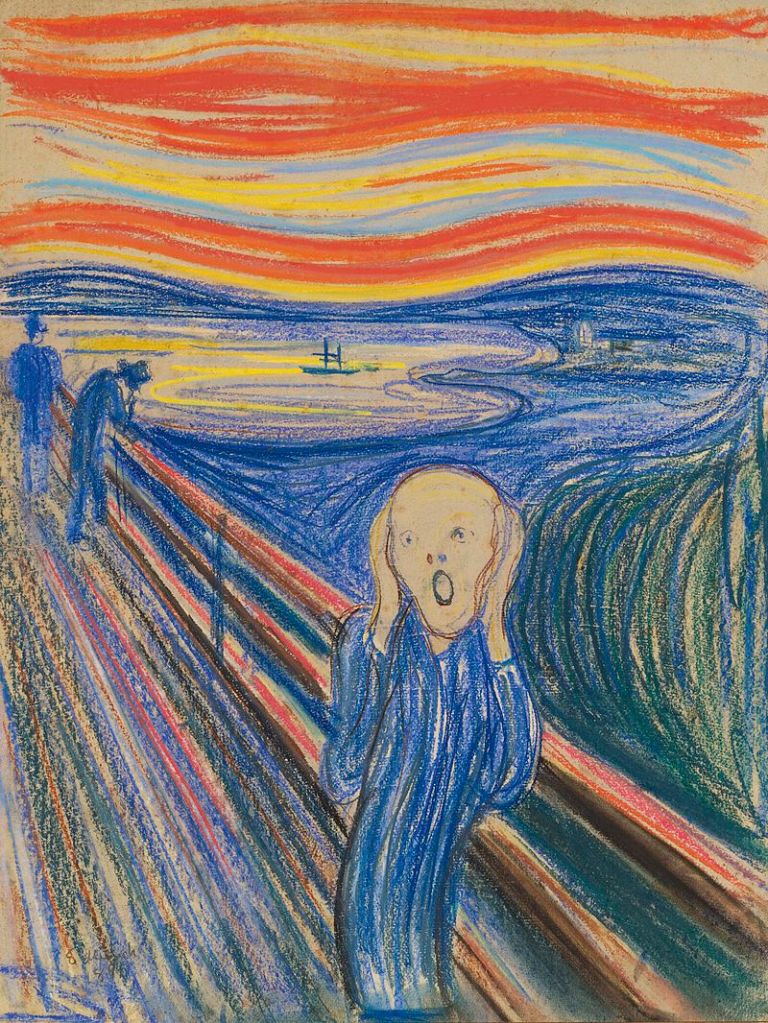
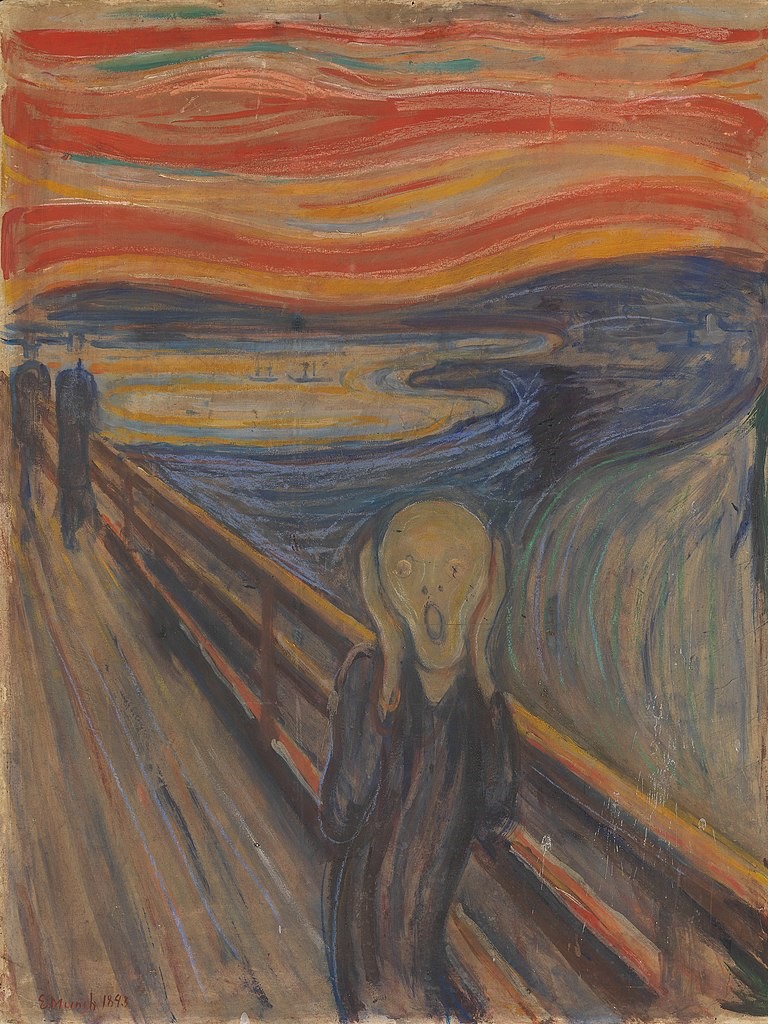
Edvard Munch, The Scream, 1895. Private Collection.

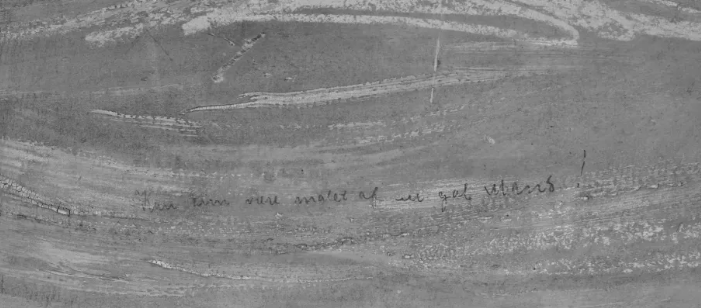
If you think I’m being rude – or insensitive – I should point out that the title of today’s post is simply a translation into English of words that Edvard Munch himself wrote on the first (or second) version of The Scream. An infrared photo of the offending text is at the very bottom of the post, if you want to check it for yourself… There are several versions of this image – two in paint, two in pastel, and a lithograph which survives in a number of different versions, some coloured, some not. I am looking at them today as an introduction to the talk I will be giving on Monday 4 July, Seeing and Feeling: Edvard Munch. This is the first of my ‘scattered’ series, Looking in Different Ways, which will include artists who have found news ways of looking at the world, or which are introductions to exhibitions which look at art in ways that you might not have expected. There are details of the talks I have planned so far on the diary page, and via the links to Tixoom you can find there.

The Scream is one of those images which needs no introduction, so familiar are we with it, and with all the versions, mainly satirical, that it has spawned. Let’s face it, it’s the only painting I can think of that has inspired an emoji 😱, and the film franchise, Scream, uses the face for the mask worn by the killer. Like the many pastiches of Munch’s masterpiece, this franchise is a ‘comedy’ hommage (French pronunciation) to the slasher genre it apes. I’m sure the irreverent approach is just a means to undermine the darker implications of the painting. It is so familiar, perhaps, that we no longer look at it properly. We think that we know what is there, and we just stop looking: familiarity breeds disregard. So let’s look again. I’m going to focus on Munch’s third version of the subject, the pastel painted in 1895, but will consider the development of the series (briefly) below.

When you look at this image (and try to look at it as if you’ve never seen it before), what is the first thing that you notice? My first response, when I started thinking about this post, was surprise at the brilliance of the colour. The colour is why I’ve chosen this particular version to focus on – the others have faded, or were, in any case, duller. The sky is an intense vermillion, the bold, wavy lines interspersed with buttercup yellow and a couple of bands of pale blue. It takes up just under a third of the height of the painting, with a clear horizontal line in a darker blue marking, as the adjective suggests, the horizon. The lowest band of the sky appears to be made up of undulations of this darker blue – although reference to other versions imply that these ‘undulations’ are based on distant hills, blue as a result of atmospheric perspective. The majority of the land and sea is formed from a mid-toned blue, although small amounts of the reds and yellows creep in, in the same way that there is some blue in the sky. Overall, therefore, we have warm colours in the sky and cold down on earth. This lower section is almost square in shape, cut across diagonally by a straight path, with a fence or railing running alongside it. The path is formed of a series of straight lines, individual strokes of the crayon, and the railing consists of three parallel bars. The lines of the path and the bars of the railing conform to a strict, if exaggerated, perspective, converging at a vanishing point on the horizon at the far left of the image. The depiction of the land and sea is all curves, contrasting with the rigid, linear depiction of the path – we are looking at geometric forms and abstract values, particularly contrasts: warm and cool colours, straight and curved lines, squares and triangles, horizontals and diagonals. These abstract values are given meaning by what is represented. The path is presumably a jetty, and we see the sea with a curving coastline forming a bay, and, judging by the greens interspersed on the right, some vegetation. There is an androgynous figure, just to the right of centre, cut off by the bottom of the image. Its mouth and eyes are wide open and its hands are clasped on either side of its face. Further away on the jetty two more figures – men, as they wear top hats and this is 1895 – are sketched out full length. There is a boat on the sea, and buildings on the land, just visible on the horizon.

Looking closer at the figure at the bottom we can see its alarm more clearly, although the precise nature of the expression of this skull-like face is not easy to define. What is the wraith-like figure actually doing? The body seems almost immaterial: it is wavy, rather than solidly vertical, and is made of strokes more like the sky than the earth, all of which gives it a sense of insecurity. Is this person screaming, or does the open mouth speak of surprise, shock or horror? And do the hands express surprise as well, or are they clasped over the ears to shut out sound? There seems to be an unbearable pressure here, either coming from within, or closing in from the outside. As suggested above, the perspective of the jetty is distorted. It seems to recede too quickly, or, rather than receding, it could be seen as rushing towards us, giving the impression that we are zooming in, focussing on a close-up of the protagonist in a moment of high drama. Even the vegetation pushes in, the curved lines echoing the bend of the inflected wrist, pressing claustrophobically on the fragile figure.

Compared to the heightened drama of the protagonist, the two characters in the background seem relaxed, nonchalant even. One walks away, another stops to lean on the railing. If there is an audible sound – a scream – they do not seem to hear it: they certainly do not appear to be reacting to it. The boat just off the shore is a common feature in Munch’s work, and may imply the possibility of escape – but this is a possibility that is all too distant.

The sky is searing, with rich and brilliant colours, although oddly only the yellows are reflected in the water. The railing along the jetty, and even some of the planks of the path do take on some of the reds, but the intense colour is really the preserve of the sky, and is its defining feature. However, the nonchalance of the two figures could suggest that there is nothing unusual about it. Or maybe it is simply that they do not see it – or, that they do not see it like this. But then, the character in the foreground is not looking at the sky: he (is it ‘he’?) may have turned away.

I think that everything I have said so far is visible in the painting, although I can’t help wondering that so much of what I ‘see’ is coloured (deliberate choice of word) by what I have always known. It seems like ‘always’, anyway. I can’t remember when I first became aware of Edvard Munch, let alone The Scream. However, although there are unanswered questions in the interpretation of the image, we do know what Munch himself thought about the painting, as he wrote about it on more than one occasion. His first account was written a year before he made the first image. In a diary entry dated 22 January 1891, he said,

I was walking along the road with two friends – the sun went down – I felt a gust of melancholy – suddenly the sky turned a bloody red. I stopped, leaned against the railing, tired to death – as the flaming skies hung like blood and sword over the blue-black fjord and the city – my friends went on – I stood there trembling with anxiety – and I felt a vast infinite scream through nature.

This makes considerable sense of the image: it is Munch and two friends. They have moved on, but he remains, ‘trembling with anxiety’. Maybe this explains the wavy forms of the torso, even if he is not now leaning against the railing. The sky is ‘bloody red’ and we get a sense of the ‘blue-black fjord and city’ even if the colour chosen is not quite as dark as that might imply. What is key here is the last phrase, ‘I felt a vast infinite scream through nature’. He is not screaming (it is ‘he’), but there is a scream, a scream that maybe he is trying to block out with his hands. However, this is problematic, as he doesn’t hear the scream, so he can’t silence it – he feels it. What is truly ground-breaking about this image is that it isn’t a picture of something seen, but of something felt – hence the title of Monday’s talk: Seeing and Feeling. We are at the very beginnings of Expressionism.

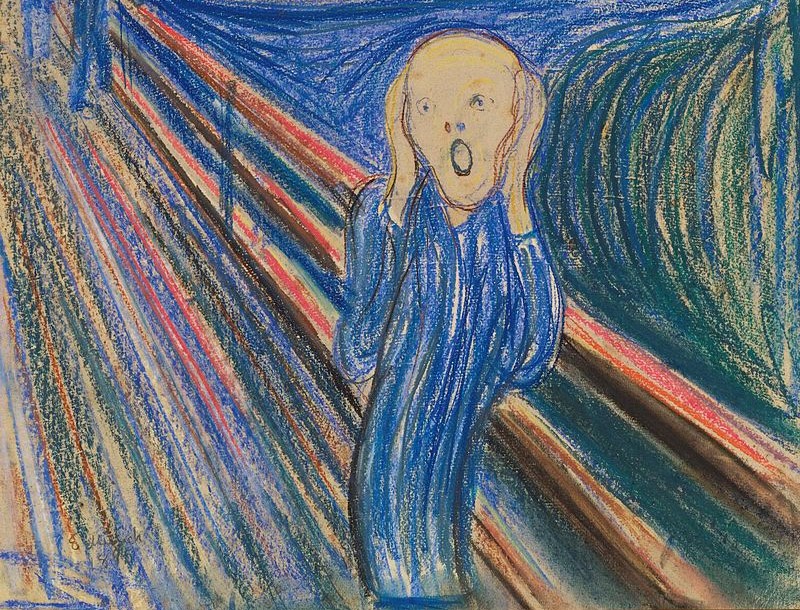
The year after Munch had this experience he tried to capture it visually twice, once in pastel – which may have been the first version, it’s not entirely clear – and once in paint, using both oil and tempera, with pastels as well. These two are both in Oslo, and are owned by the Munch Museum and the National Gallery respectively. The reason for thinking that the pastel is the earlier of the two is that, although the basic ideas are sketched out, the details are absent – no boats, and no buildings – features which do appear in what is, presumably, the later version.

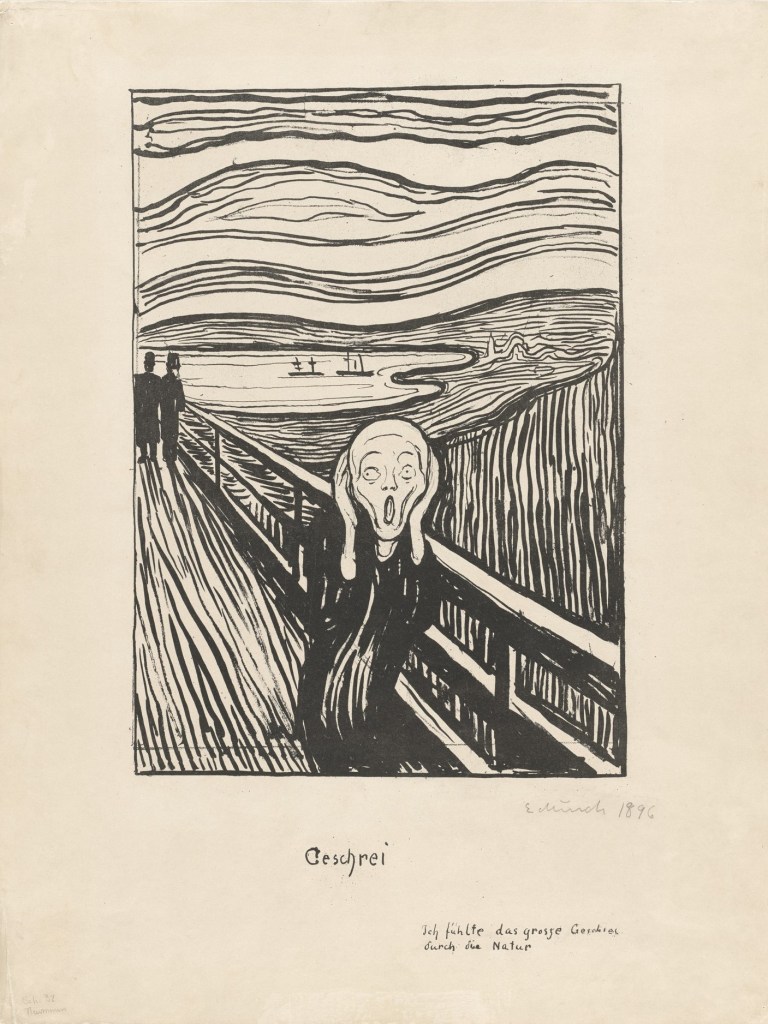
There were two more versions in 1895 – the pastel which I have discussed (the only one in which one of the ‘friends’ leans on the railing), and a lithograph. We don’t know how many prints were drawn from the original stone, but about 30 survive, some of which were hand coloured by Munch himself. They were published in Berlin, and bear the title Geshrei, i.e. ‘The Scream’ in German, although the literal translation of this would be ‘Screaming’ or ‘Shouting’, apparently (‘The Scream’ would be Der Shrei in German, or, in Norwegian, Skrik). There is also a phrase at the bottom right, ‘Ich fühlte das grosse Geschrei durch die Natur‘ (‘I felt the great scream through nature’). Often the image has been trimmed down, effectively cutting it out of the original ‘page’, meaning that the words do not appear – even if they were clearly important to Munch. This particular version, in the Museum of Modern Art in New York, was signed by the artist in 1896.

A final version was painted in tempera in 1910. This, too, is in the Munch Museum in Oslo, and, like the others (with the exception of the lithographs), is on cardboard. The first version in paint (1893) is the one which bears the inscription, ‘Could only have been painted by a madman!’ It is written in pencil on top of the paint, and recent analysis has confirmed that it is in Munch’s handwriting. It was probably his reaction – presumably ironic – to the public response to the painting when it was first exhibited in 1895. Typical of this was the comment of critic Henrik Grosch, who wrote that the painting was proof that you could not “consider Munch a serious man with a normal brain.”  The implications of this statement would have been more profound for the artist than Grosch would have realised – probably. I don’t know how aware he was of Munch’s family background. Born in 1863, Edvard was the second of five children. His mother died of tuberculosis when he was five, as did his elder sister when he was fourteen. He was a sickly child, and was often kept out of school, which created an enduring sense of isolation. One of his younger sisters was diagnosed with a mental health disorder at an early age, and by the time The Scream was exhibited, she was cared for in a local institution. For the rest of his life the artist was haunted by the possibility that he had inherited the same condition.

Somehow, through all of this, he seems to have captured the essence of what could be described as one of the defining features of the 20th and 21st Centuries: angst. A quick internet search defines this as ‘a feeling of deep anxiety or dread, typically an unfocused one about the human condition or the state of the world in general’. The painting would have been perfectly at home in Vienna at the time of Sigmund Freud, and appears to visualise the Existentialists’ post-war fear of ‘the Void’: if there is no God, what is the point? Or for that matter, an expression of man’s inhumanity to man, as seen in the holocaust, or again, the cold war fear of nuclear annihilation. It speaks of the inner horror of so many of Francis Bacon’s subjects – even if it isn’t one of the usually acknowledged sources – and, oddly perhaps, it seems to demand to be owned. Both paintings have been stolen – the 1893 version in 1994, and the later one ten years later. And in 2012 the 1895 pastel – the one we have looked at – was sold for $119,922,600 to a private buyer. That’s very nearly 120 million dollars, which at the time was the most ever paid for a single painting.

‘Could only have been painted by a madman!’? It was as much the fear of the implications of this phrase – even before he had written it – that must have inspired his initial experience, and the images that flow from it. This total honesty is what people have found hard to face, and yet, at the same time, it is so totally compelling. What else can have made it an early modernist Mona Lisa, ubiquitous and instantly understood? As we shall see on Monday, things were not always bad for Munch – indeed, the exhibition at the Courtauld, to which the talk is an introduction, ends on a note of positivity. Nevertheless, I can’t help feeling that his perceptive work can undoubtedly be a key to our understanding of the human psyche.

Some Virtues

Andrea del Verrocchio, Model for the Funeral Monument for Cardinal Niccolò Forteguerri, c. 1476, Victoria and Albert Museum, London.

The Sculpture course Form, Function, Material and Memory is rapidly drawing to a close. The last talk will be this Monday 27 June at 6pm, when we will consider Memory – Something to Remember. This will look at sculptures which were made with a very specific purpose: to remind us of those not present. The sculptures are all portraits of different types, including busts, full-length, and equestrian, or effigies on funerary monuments, which is just another form of portraiture. Today I am choosing to repost a blog about a sketch model for one of the latter, as, in its own way, it sums up all four talks. In its form it is a relief, its function was to show people (including the artist) would the finished monument would look like, it is a superb use of terracotta as a preparatory material, and the function of the finished monument was to keep the memory of someone ever present. Our usual heroes will feature, of course – Donatello, Verrocchio, Michelangelo, Bernini and Canova – but I will also introduce the brilliant French émigré Louis François Roubiliac. Before Monday’s talk, though, I have to pay a quick visit to Dresden, which is why I’m reposting. I’ll start afresh when I’m back, in preparation a whole new series – loosely titled Looking in Different Ways – which will start on Monday 4 July. All I know so far is that it will include talks on Edvard Munch, Mary Beale and Sybil Andrews, and Cornelia Parker, and may include more once I’ve seen more things and finished planning. There is more information on the individual links above, and in the diary. But back to the sculpture. What did I say about this lovely Modello when I talked about it towards the end of April 2020? It was still relatively early during the pandemic, someway into Lockdown 1:

Not exactly a request today, but I was asked to talk about some Virtues a while back, and this terracotta relief sprang to mind. I have since realised which Virtues had been requested, and why, and I will get back to them soon – but for now, a charming sketch which goes to show what a brilliant artist Andrea del Verrocchio was.   

Niccolò Forteguerri was born in Pistoia, not so terribly far from Florence, and rose through the church to become a Cardinal in 1460. It probably helped that his Uncle was Pius II, Pope from 1458-64. Niccolò was, therefore, his nephew, or, in Italian, nipote, from which, of course, we get the word ‘nepotism’ – jobs for the boys. He died in 1473, and was buried in Rome, in his titular church, Santa Cecilia in Trastevere, but his hometown decided that they wanted to remember him, and held a competition to design a memorial. We know little about the process, apart from the fact that in 1476 Verrocchio was commissioned to execute the monument following the design of a bozzetto – or sketch – which he had presented to the steering committee.  It is generally assumed that this is the very bozzetto that Verrocchio submitted.

(c) Victoria and Albert Museum

Made out of terracotta – which translates literally as ‘cooked earth’ – the relief is both wonderfully realised and beautifully sketchy. It is evocative, rather than precise, but allows you to see the disposition of all of the figures, as well as giving a wonderful sense of character and mood. It is full of vibrant movement and flowing draperies, light and airy, as if the characters were out in the open on a windy day, flying or coming in to land, above a platform on which a man is kneeling. 

We are very familiar with the idea of a sketch as a drawing, but anything that is done quickly, or remains apparently unfinished, can be considered a sketch. It could be an oil painting (remind me to show you one of my favourites!) or, as here, a sculpture. They are sometimes also called modelli – or models – as this is what they are – a small version of something which, when finished, will be far larger. Given the vicissitudes through which all art has past, the survival of a clay model from the 15th century is quite remarkable. Admittedly, it has not come down to us unharmed – there are a few repairs visible at the bottom of the relief  (the man’s praying hands are made from red clay, for example) – but it is still in a wonderful condition.

At the top of the image, Christ appears in a mandorla. The word means ‘almond’, and is used to refer to the almond-shaped ‘glory’ held up by the angels. The stress should be on the first syllable, by the way – MANdorla – as so often with three syllable words in Italian (Medici, Cupola… but not modello, where the stress is on the second syllable). In religious dramas, whenever anyone descended from heaven, or was assumed, they did so in a mandorla which was physically winched up or down, to or from the roof of the church…  

Jesus looks down, blessing those below with his right hand, while supporting an open book on his knee with his left: this is the image of Christ Pantocrator, or ruler over all (we’re all too familiar with ‘pan’ as a prefix these days), and is a slightly medieval feature of the monument. However, Verrocchio subverts this ‘medieval’ feel with a touch of proto-baroque humour. Although in other images Christ manages his own Ascension unaided [although on reflection in 2022, this is a vision of Christ, rather than an ascension – I got carried away by the mandorla] here four angels hold him aloft – although they do not seem entirely secure. The one at the bottom left may have lost his grip, and has had to adjust his hold, or maybe the one above him wasn’t pulling his own weight, I’m not sure what’s happened, but they are not entirely in control of the mandorla. It has tipped sideways, as you can see from the winged cherub’s head at the top, which is not directly above its companion at the bottom, but some way to the left. This slight shift, with its sense of movement and asymmetry, can be seen in almost all of Verrocchio’s output, a sense of drama which, as I have suggested, prefigures the Baroque in an unprecedented way. 

Moving to the bottom of the bozzetto it is the Cardinal himself who we see. He is kneeling on a sarcophagus, praying, and looking up to Jesus, either witnessing a vision of Christ, or the real thing – it’s up to you to decide [I got there in the end]. A woman steps towards him, although she is not fully on the sarcophagus. Under her feet is what could be a small rock, but is meant to be a cloud – this was the standard, accepted ‘sign’ for clouds in sculpture at the time. In her left hand, and close to Forteguerri – almost as if she is handing it to him – is a cross. In her right is a chalice, held above her shoulder. These are both items of Faith, and that is indeed who she is: a personification of Faith. Her movement towards him is swift, her right leg stepping across and in front of her left, her drapery flying out behind – again we have a wonderful sense of movement and of asymmetry. The dress of the figure on the right also billows out behind her. More obviously standing on clouds – she is further from the sarcophagus, after all – it is almost as if she is swooning, the rapid movement inward combined with a lowering of the body as she leans forward. Her arms are crossed over her chest, and she looks upwards, her gaze parallel to the Cardinal’s own. Her prayer, like all requests, wants fulfilment – that is what she hopes for. Indeed, she represents the virtue of Hope. Notice how Faith’s chalice, the direction of her gaze, and her cross, form a diagonal leading our attention to Forteguerri, while the angle of his head makes us look towards Jesus: Verrocchio expertly directs our eyes around the surface of the relief. Hope’s trailing left leg, and her gaze, create a diagonal which is continued by the leg of a third Virtue who appears above them.

Given that we already have Faith and Hope, this can only be Charity. Together they are the three Virtues named by St Paul in the thirteenth chapter of his first Epistle to the Corinthians. This is verse 13:

And now abideth faith, hope, charity, these three; 
but the greatest of these is charity.

As they are in the Bible, they are often known as the Theological Virtues. Now more often translated as ‘Love’, Charity, or Caritas, is the boundless love of – or for – God, and is expressed in a number of ways. Love is like a burning fire, which is why she carries a flaming torch in her right hand. The love for one’s children is unqualified, and a baby sits on her left. Charity is often surrounded by three – or more – babies, clambering all over her, and you’d have to be really loving to put up with that. Here she has just one, held safe in the crook of her left arm, the torch held as far away as possible. Unusually, she is winged. Verrocchio seems to be equating her with the angels. She flies above the other two virtues, perhaps in line with Paul’s assertion that she is the greatest.

Niccolò Forteguerri kneels on his sarcophagus awaiting the life to come. Faith offers him the consolation of the Cross, Hope echoes his own yearning for Salvation, and there truly is Love between him and Jesus. These three Virtues gather round him – flock to him, even – and reassure us that his soul will be with Jesus in Heaven. What better way to remember a man of whom the city of Pistoia could be justly proud? And even if we thought he wasn’t that great, maybe this monument could persuade us we were wrong – that is the often the function of memorials, if we’re honest.

Sadly the commission did not proceed smoothly. There was disagreement among the commissioning body in Pistoia, and at one point they tried to replace Verrocchio with Piero del Pollaiuolo. But Verrocchio went straight to the Boss – who at this point was Lorenzo ‘the Magnificent’ de’ Medici – who sorted things out. Nevertheless, the monument hadn’t been completed by the time the sculptor headed to Venice in 1483 to complete a more prestigious commission.  The sculptures were completed by his assistants in Florence, and were finally taken to Pistoia five years later. Some were deemed to be substandard, and were re-worked, meaning that the monument wasn’t erected until 1514, more than 40 years after Forteguerri had died. By this time, the Pistoiesi were probably asking ‘Niccolò who?’ And that wasn’t the end. In the 1750s the monument was moved, the figures altered and re-installed, bunched up and straitjacketed by an unimaginative Rococo frame. The kneeling effigy was replaced with a bust, and although it survives in the local museum, Verrocchio’s original intention is lost. There is ongoing scholarly debate about which bits of the sculpture Verrocchio had anything to do with, and to what extent the life, the energy, the vitality of the bozzetto ever made it into marble. What is certainly clear is that, in the monument as installed, Jesus is secure, the angels are fully in control. I can’t imagine that the church would have allowed any doubt of that. The flare is gone, the daring sway of the mandorla… but how wonderful that we still have this magical bozzetto to see in the V&A.

I mentioned this relief briefly during last week’s talk while I was talking about its Material – and inevitably it will feature again on Monday, when it will appear among the many portraits – of different genres – that we will consider when we look at the final topic, Memory. I do hope you can join me!

Psyche, a coda (a repeat)

Antonio Canova, Psyche revived by Cupid’s Kiss, 1787-93, Louvre, Paris.

So far in my series on sculpture I haven’t mentioned Antonio Canova, although I will this Monday, 20 June at 6.00pm, when I will discuss the very substance of art (or, at least, the different substances from which sculpture is made), in a talk entitled Material: Method and Meaning. As a result, it seems a good opportunity to re-visit one of the posts from the 100 ‘Pictures of the Day’ – particularly as I currently find myself very busy visiting exhibitions in order to find suitable subjects for future talks. When I know what they are I will of course post the details here and on the diary page. This is an ideal post to re-read, as it introduces many of the ideas I will cover on Monday – the materials of sculpture, their qualities, advantages and disadvantages, their ‘meanings’, and the techniques involved in turning them into sculpture. What follows was the 8th post dedicated to just one story – Cupid and Psyche – and if you want to have a look at the others you should start with Day 43 – Psyche – or it might be easier to click on the ‘Psyche‘ archive button, where all the posts appear in reverse order (sorry, I’m really not in control of this website). Meanwhile, at the end of the seventh post, I had left Cupid and Psyche living Happily Ever After… what could follow that? Well, this:

I know, Cupid and Psyche are living happily ever after, but I couldn’t leave them without one last look back, and without one last, truly beautiful image of Psyche. This is a sculpture by Antonio Canova, the great master of neo-classical simplicity. 

As often with Canova, there are two versions of Cupid and Psyche. This one is in the Louvre, and was originally commissioned by Colonel John Campbell. He was a Welsh politician and art collector, who, after the death of his father when he was just 15, and his grandfather when he was 24, found himself remarkably well off, and he headed off on the Grand Tour at the relatively late age of 30. He travelled to Italy and Sicily, where he spent the next five years. It was while he was there that Campbell commissioned this sculpture from Canova, who was four years younger than him – 30, when this sculpture was commissioned in 1787. However, it seems that Campbell never received it. Joachim Murat, Napoleon’s brother-in-law, acquired it in 1800, and after his death in 1824 it passed to the Louvre. A second version was commissioned by Prince Nikolai Yusupov in 1796. They were a highly sophisticated family. They had a superb art collection, and a rather fantastic palace in St Petersburg, which even had its own theatre. The palace and theatre are still there, but after the Revolution, the Canova ended up in the Hermitage.

I could have talked about this sculpture two weeks ago, when discussing Sir Anthony van Dyck’s Cupid and Psyche [Picture Of The Day 54 – but never edit on a train – I seem to have just deleted this when trying to copy a link, and now I can’t get it back. Ah well…], as the two works represent the same moment – but let’s face it, they are rather different, and both deserve a moment to themselves. We’ve got to the point in the story when Psyche was carrying out the last of her tasks, and had collected some of Proserpina’s ‘Beauty’ to take to Venus, but she opened the container and fell into a death-like sleep. Now Cupid has awoken her with one of his arrows, and they embrace… In many ways, it’s that simple, and the sculpture itself looks effortless. But ‘effortlessness’ turns out to be the result of a lot of hard work. The main aim of neo-classicism was not to be bold, and daring, and original, trying to find new solutions to problems, but to look for something essential, an idea that looks as if it has always been there, and then to pare it down even further, to simplify it and to make it clear. This might appear to be a somewhat disingenuous intention, especially as this particular sculpture manages to be both original and daring. Cupid reaches around Psyche, and, as she sits up, he supports her head in his right hand, while his left goes around her torso. She stretches up to hold his head, her arms forming a loop, in a similar way to his, which curl around her. The two are encircled by each other, two halves of the sign for eternity, promising the continuity to come. She lies on one hip, he kneels, balancing with one foot lower down the rock, her body forming a continuous line with one wing, his extended leg with the other. Their bodies form a pyramid, which, with his wings, becomes a cross – ‘X’ marks the spot. The wings themselves are carved so thinly, and the arms are entirely free from their bodies: this really is daring carving, puncturing a single piece of Carrara marble and turning it into the softest of flesh.

And it is thin – look how translucent those wings are. The excavation of the forms really pays off when Canova’s sculptures are lit well, and preferably, by natural daylight. The light falls on different surfaces, emphasizes some features, and blurs certain boundaries: the play of light and shadow defines everything this sculpture is about, caressing the surfaces, touching the sculpture lightly as they touch each other. But how do you work out such a complex composition? As any couple will understand, it’s not always easy knowing where to put all four arms, and when there are wings as well…

It’s always best to start with a drawing – although that might seem counterintuitive for a three-dimensional object like a sculpture. Canova’s work is conceived to be seen in the round, although there is usually a principal viewpoint. That is what he is developing in this drawing. You can see that the basic composition is already in place: the long curve from Psyche’s right foot – at the bottom right of the pyramidal composition – up to her right hand above Cupid’s head; the fact that her hips are twisted towards us, so we get as full a view of her body as possible; and the framing of their faces by the loop of her arms. We also see the full extension of Cupid’s right leg as he leans over her, kneeling on his left knee, with his left arm reaching around her torso. There is even a sketched suggestion of the drapery underneath her. The only thing that Canova was to change was the position of the wings. In the drawing they spread out across them, almost like a protecting canopy. They are more horizontal than in the sculpture, where they are far more awake and alert. You could even argue that in the drawing they represent Psyche’s lethargy, whereas in the sculpture they are far more vital: they are Cupid’s wings, after all, and reflect his energy at this point in the story.  They also come to have a more defining role in the composition, with its overlapping diagonals, continuing the lines of the two bodies, and bringing the couple together.

Having decided on your basic compositional structure on paper, you then have to check that it would really work in three dimensions – hence the use of clay. Often the small clay models were fired – thus making them terracotta – which meant they could be kept. There was always more than one reason to do this. Canova was aware that a sculpture could only be owned by one person – but that it was always possible to make a second version. So it was enormously useful to hold onto all of the developmental stages in case you wanted to go back and reassess the finished product. The best place to see this is the Museo Canova in Possagno, the small town in the Veneto where he was born, which has a remarable display of sketches, working models and plaster casts. Another reason to ‘save’ the bozzetto (POTD 42 & 51) was that Canova, like many artists since the 16th century, was very well aware of his development as an artist, and the process of evolution of each individual piece – and that the process itself was saleable. Terracotta bozzetti were collectable in a similar way to drawings.

However, looking at the bozzetto above, you realise pretty quickly that this is not the finished composition. It is the female figure – Psyche – who is sitting more upright, and has the male – Cupid – in her arms. Although one of his legs is extended, and the other bent, he is sitting on the ground, rather than kneeling. It is more as if she is caring for him, rather than him waking her up. Indeed, it could be that this predates the drawing – and that, when commissioned to carve a sculpture showing Cupid and Psyche, Canova originally thought of a different episode in their story: this looks more like Cupid swooning – although without the wings. They really would be tricky in clay. It could be that he abandoned his idea, and went back to the drawing board – so the drawing might have come after this terracotta. That aside, it does at least show you what the process of development would be: the creation of a rough, terracotta model of a potential composition. The limbs are built up with small pieces of clay, and modelled by hand, or with a number of different tools. The most obvious here was something like a comb, a toothed spatula, which has been used to scrape the base into its current form. There could easily have been several bozzetti like this. Each would not necessarily have taken too long to make, and, being clay, were relatively cheap. Clay is also extremely malleable, so adjustments can be made as you look, and, working on a small scale, you can turn the model around in your hands and check every angle to see that all possible viewpoints work. In this way you would eventually arrive at a definitive composition. The next stage would be to turn the bozzetto into a stone sculpture.

Having decided on the composition, and how it would work in every detail, Canova would then make a full-scale model in plaster. This one was made for Prince Yusupov’s sculpture – as I said, the sculpture itself is in the Hermitage in St Petersburg. However, the plaster modello has ended up in the collection of the Metropolitan Museum of Art in New York. It might look as if it is not in a terribly good condition – or that the complexions of both Cupid and Psyche have suffered from some terrible skin disease, as it is covered all over in small spots. These are, in fact, metal pins, which have been inserted into the surface of the plaster, and there are more pins where the surfaces are more complex – notably on Cupid’s left hand, just below Psyche’s breast. These are measuring points for the stonemasons. Yes – Canova didn’t carve the marble himself. Don’t feel disappointed – the same is true of many, many sculptors. Rodin did not carve The Kiss, for example, and even Bernini had a helping hand with the leaves on Apollo and Daphne (POTD 56). The stone masons were expert at replicating the precise appearance of the modello, as it was primarily a mechanical exercise. To do this, they used a pointing machine, which measures the height, depth and distance from left to right of each pin that has been inserted, and helps them carve the marble to the same depth at each point. If you’d like to see how it works, there is a good video from the Smithsonian Institute, Carving a Marble Replica using a Pointing Device – other longer videos are available!

However, this process does not complete the work – it is just roughing out the forms – the finish would have been done by Canova himself, and he insisted on doing this in private, so that no one could see his secrets. How, precisely, did he get that wonderful silky finish? That’s where the real skill lay…

I’m including this photograph as a real lesson in looking at sculpture. It is solid, it is three dimensional, and you can move round it. But all too often, with Canova especially, people only bother to look at the ‘front’ – they never get beyond the ‘principal viewpoint’. It was only when I went round the ‘back’ of the Three Graces that I realised what a brilliant artist he was – he has thought about every point of view. There are several clues to that in this photo. It is only from this side that you can see the vase lying behind Psyche that would originally have contained Proserpina’s ‘beauty’ – and lying next to it, to the right, and pointing towards her, is the arrow that Cupid used to wake her. It is only from this angle that you can see his quiver, for that matter, still full of arrows – that crowd is lucky he’s busy at the moment or there could be mayhem. And quite apart from those details, the sculptural mass of the composition, the way the two forms stretch in towards each other, his, taut and leaning down, hers, limp but reaching up, can only be appreciated fully from this side, without the complexity of the interlocking arms and the incidental distractions of their faces. And here’s the real clue: just under her right foot, projecting beyond the base, there is a handle sticking out, and that would originally have been used to turn the sculpture round. OK, so now there is no one to turn the sculpture for you, and you have to make the effort yourself, but do. Walk around, look at every possible viewpoint, get closer and further away. And never worry about going round ‘the back’. You might learn something.

Inevitably I will look at the backs of other sculptures on Monday – including The Three Graces – but I will also look at many different materials – from bronze and wood, to ivory and alabaster. I do hope you can join me then.

159 – Michelangelo, holding a candle…

Michelangelo Buonarroti, Angel, 1494-5. San Domenico, Bologna.

You would think that no one could hold a candle to Michelangelo – but everyone has to start somewhere, and the young sculptor must have learnt from someone. Indeed, today’s work is an example of the young genius responding – directly and overtly – to someone else’s work, while also enabling the good people of Bologna to burn the candle – or rather, candles – at both ends (in a manner of speaking). It also happens to be a very good example of one of the strengths of sculpture: it can be used for many different things. In this case, it is a candlestick, something that just wouldn’t work with a painting. It is, inevitably, one of the sculptures which will feature this Monday, 13 June, in the second talk in my series Sculpture: Form, Function, Material and Memory. Being week two, we will be looking at the function of sculpture, and asking What is it for? We will look at many of the potential uses of three-dimensional art – besides the ‘merely’ aesthetic, that is – with works varying from fountains to funerary monuments, and from candlesticks to coinage. Today’s work is a good example of this, given that’s its own function is just one element of a sculptural ensemble which in itself fulfils more than one role.

The angel kneels on his left knee, with his right foot firmly planted on the ground. The left is resting on its big toe, bending under the weight at the very edge of a scalloped base. A sizeable candelabrum rests on the angel’s right knee, and is held in place at its base by the left hand, with the right, wrapping round the shaft from behind, about half-way up. The top of the candelabrum is at the same level as the top of the angel’s head. Two wings project behind the figure, and we can see a space carved between the lower section of the candelabrum and the angel’s torso. He wears a long robe which forms full, rounded folds – even though the hem below the raised knee would make it appear very thin. Not only is it very delicately carved, but some of the folds are excavated deeply to create dark shadows. Some of the drapery falls over the base, and even over its edge, making the figure seem more ‘present’ in our space. The angel’s full, round face looks out, turning a little to his left, with slightly parted lips. He has a full head of curly hair piled on top of his head, but cut shorter at the back and sides.

He has a companion – another candle-bearing angel, kneeling on his right knee, with the left foot planted firmly on the ground, and the right resting on a bent toe at the edge of an identical base. The robe is perhaps simpler, and the folds, although similarly rounded, fall more directly downwards. Even so, one crosses the edge of the base in an equivalent way. The delicate hems of the sleeves suggest that this robe was also made from thin fabric. The wings are different, perhaps, but not as different as the face – longer than that of Michelangelo’s angel, more delicate too. This angel’s hair falls in luxuriant curls which spiral down on either side of the face and behind the neck – although as we can’t see the back of the sculpture (the photographs simply don’t exist) we can’t tell exactly how long it is. The hands do not seem to hold the candelabrum so firmly, with the fingers of the right hand merely resting on its base.

When seen side by side these two angels remind me of two very different altar boys, one refined, effete, polite, patient and following all the rules, the other a little bruiser, muscular, chunky even, getting into trouble but getting away with it, and probably there because his mum is a friend of the priest, but he’d really rather be somewhere else. The former is by Niccolò dell’Arca, the latter, Michelangelo. And while most people look to the famous artist’s work as a precursor of his late, great interest in the potential power of the male physique, I should really point out that he carved this sculpture when he was still only 19. He was still learning, and he was learning as fast as he could from Niccolò. The pose of the figure is a deliberate echo, as the less famous master had died leaving the work (after which he was named) incomplete. One of the missing figures was this angel. The pair was meant to kneel at either end of the Arca – the tomb, or shrine – of none other than St Dominic. Hence my suggestion that Michelangelo facilitated the burning of a candle at both ends…

This is the Arca in its entirety, almost a history of Italian sculpture in its own right, with some post-dating both of our angels. St Dominic died in Bologna in 1221, and was canonised thirteen years later. Compare that with St Francis who died five years after Dominic, and was welcomed into the Canon of the Saints within two years – eight years before Dominic. But then he was far friendlier, told good stories, and spoke to the animals. Dominic was more hard-line – and, as I said last week, particularly down on the heretics. Good for the church, some would say, but hardly endearing. As a result almost no one visits his shrine – the Arca – which means you’re bound to get it to yourself – although a friendly Dominican may well extol the good man’s virtues while you’re there.

In 1264 the Dominicans commissioned a sarcophagus from Nicola Pisano, although he was called away the next year, and it was completed by his workshop. The shrine would originally have stood in the middle of a chapel atop a group of caryatids, which are now believed to be dispersed among a number of different museums. The bold, Romanesque, almost classical figures in the scenes from the life of St Dominic (two on each side and one at each end) are set against a gold mosaic background. These scenes are separated by the Madonna and Child and Christ the Redeemer in the centre (front and back respectively) with a saint at each corner. In this detail you can just see the heads of the two angels at either end (bottom left and right).

Between 1469 and 1473 the Arca was remodelled by Niccolò, a sculptor from Puglia, and by this time as well as functioning as a tomb it had also became an altar, with the sculptures on the sarcophagus acting as an altarpiece. Niccolò added the tiled ‘roof’, and topped it with a remarkable superstructure. The four evangelists, in unconventional ‘oriental’ garb, stand on the four corners, with God the Father at the very summit above putti and garlands and any number of extravagant architectonic details. He also intended to carve eight saints to stand on the cornice of the sarcophagus – but only finished five – and two candle-bearing angels – but only managed one. It could be that he continued to work on the project until he died, but by 1494 there were still four figures missing. Nevertheless, it became his defining work. Referred to in documents as Niccolò da Bari and Niccolò d’Antonio d’Apulia, among other names, he is now universally called Niccolò dell’Arca – Nicholas of the Shrine.

So how did Michelangelo get involved? Well, Vasari tells us that, after the death of Lorenzo the Magnificent in 1492, the teenage Michelangelo carried on working for Lorenzo’s son Piero until 1494, when he left Florence abruptly, just weeks before the Medici family were deposed. He went to Bologna, then on to Venice, and then, ‘Being unable to find any means of living in Venice, he went back to Bologna.’ However, he failed to follow regulations, didn’t have the money to pay a fine, and ended up in trouble – a predicament he managed to get out of quite possibly because the Medici had connections in Bologna. Long story short: he carved three of the missing four figures, a great honour given that (a) it was one of the major monuments in Bologna, (b) he was almost totally unknown, and (c) he was not yet 20 when he started. The fourth ‘missing figure’ wasn’t carved until 1539, when it was assigned to Girolamo Cortellini. Before that, though – in 1532 – Alfonso Lombardi had added the predella-like section, the base of which is the same height as the bases on which the angels are kneeling. And centuries later, in 1768, the ensemble as we see it today was finally completed with the addition of the altar frontal, designed by Carlo Bianconi.

What I find fascinating is that Michelangelo was so keen to learn from Niccolò’s example. Although not as long, the hair is every bit as curly, and he attempts to carve each individual whorl just as deeply. He also strives to make the facial features every bit as delicate. Even the drapery (see above) is carved as thinly as possible, and made to flow in the same rounded folds – even if the flow itself is more complex. And yet he can’t quite get there, he can’t quite do it as well as Niccolò. I’d even go so far as to say he can’t hold a candle to him, in terms of delicacy and refinement, at least. But that’s because, ultimately, this is not the direction in which his art would go. From this point on he left delicacy behind, and took on determination, boldness, complexity, the depths of the inner life, torment, and ultimately, terribilità – one of those words it is almost impossible to translate. Indeed, the Mirriam-Webster dictionary online says, ‘an effect or expression of powerful will and immense angry force (as in the work of Michelangelo)’. His work defines the word. Admittedly Wikipedia’s definition is better, although again, somewhat circular: ‘Terribilità, the modern Italian spelling, (or terribiltà, as Michelangelo’s 16th century contemporaries tended to spell it) is a quality ascribed to his art that provokes terror, awe, or a sense of the sublime in the viewer’. We don’t yet see that here, but maybe (just maybe) it is on the way.

And yes, I do ‘prefer’ Niccolò’s angel. But I’m also carrying a torch for the Michelangelo.

158 – Never forget…

Gianlorenzo Bernini, An Elephant with an Obelisk, 1665. Piazza della Minerva, Rome.

This is the sculpture I was going to write about last week, before I ran out of time. Like Apollo and Daphne, it is a perfect introduction to the forthcoming course which starts this Monday 6 June, Sculpture: Form, Function, Material and Memory. The blue link will take you to my diary page, which has links to information about all four talks, but I will also include the same links in this post as they become relevant. Bernini’s Elephant has always been popular with tourists. It is wonderfully charming, after all – delightfully so – and even, seen in the right way, humorous, so what’s not to like? But how many people, I wonder, have ever really  stopped to think about it as a ‘sculpture’? Or, for that matter, as a ‘Work of Art’? I happen to think (surprise, surprise!) that it is one of the Roman genius’s late, great works, rather than ‘just’ a flippant amusement. Though when you come to think about it, what is wrong with amusement? It is an essential part of life. Perhaps the best way to explain why I find this work so interesting is to consider how relevant it is to the four lectures in the forthcoming series.

The first talk is called Form: Looking in Depth and will cover the shape of sculpture. Sculpture is three dimensional, the quality which supposedly distinguishes it from painting (even if many paintings have three-dimensional qualities), although not all sculptures take up space in the same way. There are relief sculptures, for example – both high and low relief – and sculptures which are fully in the round, like Apollo and Daphne last week, designed to be seen from every conceivable point of view. So how would this week’s work fit into a scale running from ‘relief’ to ‘fully in the round’? The photograph above suggests that, if nothing else, it looks very good from this side of the plinth. I can’t imagine anyone imagining that Bernini had conceived any other view as being the ‘front’ of the sculpture: this is undoubtedly the principle point of view. We can see clearly that this is an elephant standing on a plinth, supporting an Egyptian obelisk on its back. At the very top is a cross – just visible against the blue sky – which stands above a star, itself projecting from something that looks just like a jelly mould, or for that matter, the jelly itself (American readers: jello, not jam… um…). These are elements from the coat of arms of Pope Alexander VII, and suggest either that he was the patron of this work, or that the patron wanted to acknowledge his papacy. As he ruled from 1655-1667, we have a rough idea of the date of the work, although we needn’t worry: documentary evidence tells us that it was unveiled in 1667, and turned out to be Bernini’s last commission from this particular papal patron. But I’m getting ahead of myself. The elephant and obelisk stand in front of the Church of Santa Maria sopra Minerva in Rome, and are beautifully framed by the door of the church, the triangular pediment of the door frame, and the circular window in the façade – but only from this very specific view point directly in front of the sculpture. In front, that is, if the ‘front’ of the plinth is parallel to a supposed picture plane (as it is in this photograph). However, it is a sculpture, and you can walk round it to see it from different points of view!

But before we do that, let us think a bit more about the elephant. It is richly caparisoned, a word I hadn’t used before this week, when it was adopted in reference to a horse in Stockholm – thank you Fiona – and I assume the term can be applied to elephants as well. If not ‘caparisoned’, it does at least have a cloth over its back, which is fringed with large tassels and appliquéd with the star and jelly at the bottom centre, as well as branches bearing oak leaves and acorns on either side. This cloth must make the ‘saddle’ more comfortable. I say ‘saddle’, but I’m really not sure what to call it. As this is, presumably, an Indian elephant (it has smaller ears than its African cousins), it could even be a type of howdah. Decorated with an inscrutable mask, with eyes, nose, mouth and beard, this saddle/howdah serves to support the obelisk. The elephant looks off to its right, with its trunk curving across its right flank. In this photograph, we see again that the sculpture is beautifully framed by the doorway – which might imply that it was always meant to be here.

My main advice when looking at any sculpture – if it is freestanding – is to walk around it, and as you do so, to look for the most interesting points of view. Consider which are the better ways to look at it, and if there is a single ‘best’ viewpoint. For the elephant, the front – as discussed above – is definitely the best, but looking diagonally across the plinth we get the unavoidable feeling that the enormous beast is looking towards us. However, the carving of the eyes – making shadows which we read as pupils – suggests that the creature is looking over our heads. The trunk frames the right ear rather beautifully, and makes a nice counterpoint with the straight edge of the saddle. I’m sure that Bernini was interested in this point of view as well – although I’m not really sure what relevance it has. Sadly, this photograph shows us the damage which the poor pachyderm suffered back in 2016 – an unidentified vandal struck off the tip of its left tusk, although the severed section was abandoned nearby, and has now been skilfully reattached.

The drawing on the left (I hope it’s on the left, rather than above) shows Bernini’s design for a very similar monument – so similar, in fact, that you would think it was the same thing. But no – in place of the jelly and star, bees have alighted at the very tip of the obelisk. This is a study for a monument commissioned for the garden of Urban VIII (pope from 1623-44), and the bees have flown in from the coat of arms of the Borghese family to which Urban belonged. The drawing dates to c. 1632, but the project did not see the light of day for another 33 years, for a different patron and a different location. Bernini clearly wanted this point of view, from directly in front of the elephant (rather than from the side) to have an impact, as he designed the trunk to stick far out to our right, thus making the ‘image’ far more dramatic. The drawn elephant looks far fiercer than the docile, even friendly sculpture, and was probably intended to be trumpeting. The sculpture as executed is not as impressive from this angle, with the trunk tucked around to the side, and the position of the head, looking to our left, suggests that it might even look better if we moved in that direction, and indeed it does (as we have seen): a good sculptor can show you exactly where he wants you to be. Below the elephant, on the plinth, we see Alexander VII’s coat of arms – an oak tree top left and bottom right, and the ‘star and jelly’ top right and bottom left. Above this are the crossed keys of St Peter, and the triple tiara – the crown worn by popes until the 1960s – both of which emphasize Alexander’s status.

It was quite hard to find this photograph, and that’s simply because, apart from the elephant’s wonderfully wrinkly bottom, this view of the sculpture is just not that interesting. When leaving the church the view of the left flank of the creature is similarly unremarkable – indeed, I haven’t found a single photograph of that viewpoint. Even though this is a sculpture ‘fully in the round’ – i.e. it is a free-standing sculpture, and is carved on every side – it was not necessarily meant to be enjoyed from every point of view. There is one predominant viewpoint – the first photograph I showed you – almost as if Bernini were planning a sculpture that could just as easily have been a painting. You could argue that this is, in fact, a very (very!) high relief. It really doesn’t matter if you don’t go round the back: you don’t learn anything new, and indeed, you can guess what is there by looking at the ‘front’. This ‘frontality’ implies that the work was meant to emphasize a vista – a particular view from a particular angle – focussing the attention when the viewer approaches from a certain direction, like a punctuation mark at the end of the main approach. Bernini executed other sculptures which have a similar single, predominant viewpoint, and we will see some of them on Monday. However, there is a subsidiary viewpoint – looking the elephant fully in the face – which would imply that the viewer might be expected to approach from a different direction. It would be seen from this angle if you were to enter the Piazza della Minerva from the Piazza di Santa Chiara, but I don’t know if there is any reason why this particular approach should be favoured over any other. Maybe it’s just a result of the elephant turning round to see who’s coming.

The second talk in the series, on Monday 13 June, is called Function: What is it for? – a very good question as far as this particular sculpture is concerned. Is it simply there to amuse? If so, it certainly succeeds! But no, of course not. The point of the elephant is to support the obelisk, which was discovered in 1665 during excavations taking place near to the church. It is just one of a number of Egyptian obelisks which were taken from Egypt to Rome in the first centuries of the Roman Empire, and erected in prominent places to demonstrate Rome’s dominance over the ancient realm. After the fall of Rome, the obelisks gradually fell too, and by the 15th Century they were still there, supine among the rubble, or even buried. From the end of the 16th Century they were gradually re-erected to guide pilgrims towards the most important shrines, and Christian symbols were mounted on top of them to show the Church’s triumph over the pagan past. This obelisk was one of the last, and one of the smallest ever found, and is one of a pair: its twin is now in Urbino.

Apart from the Royal Collection drawing, others suggest that Bernini contemplated other means of holding the obelisk up – one features Old Father Time holding both a scythe and the obelisk, while in another it is Hercules who carries the weight. In the Piazza Navona, as you may well know, there is a different obelisk born aloft by the rocky structure of Bernini’s Four Rivers Fountain. It may be that the Pope was given a choice as to how he wanted the Egyptian treasure borne aloft – and if he was, he chose the elephant. But why?

The image was probably inspired by a print from a rather odd but surprisingly popular book published in 1499, the Hypnerotomachia Poliphili. It too shows an elephant and an obelisk, although in this case the obelisk appears to pierce the elephant. In some respects the sculpture is also related to the age-old notion of the ‘elephant and castle’ – which would bring us back to the howdah. But the simplest way of understanding it is as one thing on top of another – just like the church itself. The Christian building, dedicated to the mother of Jesus, was constructed on top of the ruins of the Roman temple of Minerva, hence the name: Santa Maria sopra Minerva – ‘Saint Mary on top of Minerva’. Minerva was goddess of war and wisdom, and it is no coincidence that the church which superseded the temple belonged to a Dominican Friary. A main aim of the Dominicans was to defend orthodox beliefs against the heretics, and consequently they were famously studious. You need the right arguments to defeat heresy, and the Dominicans saw themselves as the guardians of Christian Wisdom. Again, not by coincidence, the church is close to the original seat of ‘La Sapienza’ ­– ‘The Wisdom’ – the University of Rome, which was founded in 1303. So why an elephant? Well, we could assume that, as elephants never forget, they must be very wise.  Or, to put it in the words of one of the inscriptions on the plinth, ‘Let any beholder of the carved images of the wisdom of Egypt on the obelisk carried by the elephant, the strongest of beasts, realize that it takes a robust mind to carry solid wisdom.’ The obelisk may stand on the elephant, but at the very top is the cross, resting on symbols which represent the Pope – and before I forget, it is not a jelly, but a stylised representation of the hills of Siena. Back in the 16th Century the Sienese banker Agostino Chigi, whose coat of arms included the six hills of Siena topped by a star, became one of the best friends and closest colleagues of Pope Julius II. As a member of the Della Rovere family, Julius’s coat of arms included an oak tree (‘rovere’ is one of the Italian words for ‘oak’), and he granted Agostino Chigi the privilege of using the Della Rovere oak on his own coat of arms. Pope Alexander VII was also a member of the Chigi family, several generations down the line, which is why the hills, stars and oak branches appear on this monument. Soon after the obelisk was discovered scholars attempted to decipher the meaning of the hieroglyphs on the obelisk, and their assumptions went unchallenged. However, even if the elephant bears witness to the knowledge of the Egyptians, the hills, star and cross are at the very top. Christian wisdom, supported by the authority of the Pope, is uppermost, just as Mary is above Minerva. And why was the church dedicated to Mary? Well, one of her titles was sedes sapientiae – ‘the seat of wisdom’ – the name given to Solomon’s throne (Solomon himself was famed for his wisdom). As the Christ Child sat upon Mary’s lap, she was, herself, his throne – sedes sapientiae.

In the third talk, Material: Method and Meaning we will explore the very stuff from which sculpture is made. In this case there are at least three materials – the marble from which the elephant is carved, the granite of the obelisk, and the bronze of the cross and Chigi symbols. We will also discuss how sculptures are made, explaining the techniques of casting bronze, and of carving marble, for example. We will also discuss the advantages and limitations of the materials. It is unlikely that the elephant’s trunk would ever have projected as dramatically as the drawing suggests – it would be all too likely to break off. From the end view of the finished version, you can just see how the trunk as carved is actually attached to the saddle, although this join is disguised from the ‘front’. As it happens, it was not Bernini himself who did the hard work. He left the carving of the elephant to one of his main assistants, Ercole Ferrata, and, while we’re thinking about it, it was other people who dug up the obelisk. A fascinating way of thinking about this monument is that, as well as the traditional techniques of carving and casting, it also uses ideas associated with sculpture at the beginning of the 20th Century. Constructivism, for example, made sculptures by ‘constructing’ them from separate, pre-existing elements, precisely what has happened here. And then there was a new genre of sculpture, the ‘readymade’, invented by Marcel Duchamp when took objects from the everyday world (the most famous being a urinal) and gave them a new context. That is exactly what Bernini has done here with the obelisk. In the same talk (no. 3) we will also consider the reasons for using these materials: what does the use of marble, granite, or bronze ‘mean’? I’ll leave you to worry about that for a couple of weeks, but, as just one suggestion, granite is a remarkably durable stone, and so can, in itself, imply permanence and therefore power. With so much to cover, it’s going to be a busy week!

Finally, the fourth talk is called Memory: Something to remember. As it happens, even though elephants never forget, I will not be referring to this sculpture. The talk will really be concerned with portraiture: sculpture as a means of remembering those who are not present, whether in terms of those living or effigies of the departed on funerary monuments. Even if Bernini might have based his work on drawings of a real elephant which came to ROme in 1630, this could never be considered a portrait. However, I’ll let you know more about that talk another day. In the meantime, I hope you won’t forget the elephant, and can join me Looking in Depth on Monday.

Back to the Chase

Gian Lorenzo Bernini, Apollo and Daphne, 1622-25, Museo Borghese, Rome.

It’s got to that stage… I was wondering what to blog about this week as an introduction to my new lecture series, Sculpture: Form, Function, Material and Memory and I realised that a great choice would be Bernini’s astonishing Apollo and Daphne. Indeed, I was rather surprised that I hadn’t blogged about it before. That is, until I looked through the back catalogue and found that, fo course, I had. So I found another sculpture to talk about – but then life happened, it’s now Wednesday, and I’m off to Stockholm for a week tomorrow, with no time to write. What a perfect opportunity, then, to look at Apollo and Daphne again. Let’s face it, it’s been more than two years since I wrote this, and maybe it’s not surprising that I’ve forgotten what I’ve written about before. As I say, it’s got to that stage.

Why is it an ideal introduction to the series? Well, the first talk, on Monday 6 June (at 6pm, as ever) is called Form: Looking in Depth, and is about the shape of sculptures, and the space they take up – and this truly is a sculpture ‘in the round’, designed to be seen from every conceivable angle. It is definitely not, like many of Bernini’s works, a very high relief, with one predominant view point. It also has some of the most virtuosic use of marble. The third talk in the series, on Monday 20 June, is called Material: Method and Meaning. We will think about how you carve a marble sculpture – or cast a bronze – and why artists use these materials (or for that matter, wood, or clay, or wax, or…). But, apart from the material it is made from and the way it uses space, what is the point of the work? Lecture two, Function: What is it for? will cover just that. But then, for this particular sculpture – although not all the others by artists as diverse as Michelangelo, Canova, Verrocchio and Niccolo dell’Arca (and if you don’t know him you should) – you could just read the blog.

This truly is one of the marvels of marble carving – nothing can rival the delicacy of the leaves rustling in the breeze, the firmness of the roots thrusting into the ground, or the varied textures of tree and tresses – nor is there anything to match the scent of fear, and of confused compulsion, which the sculpture exudes.

And to think that Bernini was only 23 when he conceived this masterpiece! Not only that, but it was the third sculpture he completed for the most important patron of his youth, Cardinal Scipio Borghese, nephew of Pope Paul IV. He probably started work on it after finishing the Pluto and Proserpina, but then broke off to execute his David before completing Apollo and Daphne. Three larger-than-life-size masterpieces before he was 26, it’s quite remarkable. And this is the tour-de-force.

The story is well known, but just in case, here it is again. Daphne, daughter of the river god Peneus, had asked for something rather special: perpetual virginity. Her father thought this a strange request, suspecting she might grow out of her dislike of men, but she was adamant. After all, she said, ‘Diana’s got it – why can’t I have it’ – just like many teenagers nowadays (although, nowadays, they are more likely to want a new phone). So that’s what she got. Meanwhile, not so far away, Apollo came across Cupid playing with his bow and arrow, and laughed, and teased him: ‘You’re just a baby, playing with your toy bow and arrow set – wait until you’ve grown up, and get some real weapons – then you can have proper arrows like mine, which cause the plague’. Cupid wasn’t having this. He can be vicious when he wants, so watch out. He waited until the right moment and shot one of his best golden arrows at Apollo – so that Apollo would fall desperately in love with the first living thing that he saw. Cunningly, Cupid had waited until Daphne was nearby, and shot her with one of his worst leaden arrows. If you didn’t know he had leaden arrows as well – well, he does. This might explain any problems you’ve ever had chatting people up: a leaden arrow makes you hate the first thing you see. So of course Apollo sees Daphne, and goes up to her, she sees him coming and starts to walk away – already averse to the company of men, but now with a strange new compulsion. So he speeds up – and so does she. Before long, it is an all-out race, with him charging full pelt towards her, and her fleeing as fast as her feet will allow. She called out desperately to her father, pleading with him to save her honour, to protect her chastity, to change that beauty that would be her downfall. So he turned her into a tree. How many fathers would do that for their daughters nowadays?

The story is told in Ovid’s Metamorphoses – the changes of form. We live in a fluid world, were things are always in flux, and this is what Ovid explores. It’s not just the physical form, but our shifting moods and emotions as well. His description of Daphne’s transformation is wonderfully specific, and shifts from sensuous to serious: ‘a heavy numbness seizes her limbs; her soft breasts are surrounded by a thin bark, her hair changes into foliage, her arms change into branches; her foot, just now swift, now clings to sluggish roots.” Bernini must have read this carefully, but inevitably he riffs on the idea, and we see leaves growing from her fingers as well – although as yet, there is no bark on her breasts.

A while back I mentioned that I think that Donatello’s Judith and Holofernes is the first sculpture of the Renaissance to be conceived fully in the round (Picture Of The Day 35). By the time Bernini was born, the idea was old hat – but that doesn’t stop him from excelling. It is not possible to see this sculpture from enough different angles… here are just some suggestions.

It rewards continued inspection, looking at it from every possible angle, including stooping down and looking up, if you can. And if I could take in a step ladder, I would. It is also worthwhile getting as close to it as you can (wisely, there is a chain at some distance, this is a remarkably fragile piece) – or for that matter as far away, to get the overall feel of the piece. I would advise a variety of viewing distances for any work of art, to be honest – the further back you get, the more likely you are to be able to take in the overall composition. As it happens, the room in which this sculpture is exhibited is not very big.

Bernini has chosen the moment at which Apollo finally catches up with Daphne – his right foot is firmly planted on the ground, his left is trailing behind, as is his right arm. The left hand rests on her waist, but – almost as if the transformation has responded to his touch – he doesn’t feel flesh. Oddly, and ironically, her feet are not firmly planted – it is almost as if she was trying to fly away. But you can see the roots shooting out of her toes, and bark has grown up between her legs, leaving a tantalising gap between its rough exterior and her soft, shadowed thigh. It grows over her groin, and round her left hip, and that is where his left hand rests, delicately, his thumb and forefinger a matter of millimetres away from her stomach. But he doesn’t quite touch her. As his face approaches her right shoulder, she twists it away, elongating the stretch between her right foot and hand, but she looks round, involuntarily perhaps, to see how close he might be. Her mouth is open with an almost audible cry.

His cloak is wrapped around his left arm, and falls over the protecting bark, his fingers and the folds of the cloak contrasting with the rough and smooth of tree and flesh. The cloak then goes round his shoulder and flies out in a loop behind him, before wrapping around his hips, leaving a inviting gap just like her bark. If you stand at the right angle you can see the light from the window glowing through this cloak – in places it is so thin it is translucent.

When we get closer in, we learn more about their feelings. Bernini has carved their irises and pupils – eyes are always hard to capture in sculpture. Daphne is looking right round, her pupils in corners of her eyes, whereas he looks quite vacant. His lips are slightly parted – but do not seem to express worry, or determination, or even love or longing. He may still be running towards her, reaching out to grab her, but he is not even looking at her – his gaze misses the mark. And I think that is the unrealised genius of Bernini’s sculpture. Neither of these people know what they are doing. They are both bewitched by Cupid, he to run towards her, she to flee. They are acting under compulsion and do not understand their own actions. Her hair flies out behind her, between them and then up towards her fingers, where both hair and hands become leaves. There is just one delicate, stray curl above her right eyebrow. Similarly his hair flies back in the wind, soft and supple – no one could texture marble like Bernini. It is a soft and flowing variant of Apollo’s classical top knot.

Indeed, if we look again, it is clear that the figure of Apollo as a whole is based on the Apollo Belvedere, one of the classical treasures of the Vatican Museums: it has stood in the Belvedere Courtyard since 1511, and is not so far away from the Belvedere Torso which we saw Angelica Kauffman drawing in POTD 48. Bernini was keen to make his mark, not just by his conceptual and technical skill, but also by acknowledging his awareness of the art of others. An early work (and you thought this was early!), which is also in the Museo Borghese, is his Aeneas, Anchises and Ascanius, completed before he reached the ripe old age of 21. Aeneas, carrying his aged father on his back, is modelled on Michelangelo’s Risen Christ. His Pluto and Proserpina includes the three-headed Cerberus, modelled on a classical sculpture of a dog, which, like the Apollo Belvedere, is in the Vatican Museums. By breaking off work on the Apollo and Daphne to carve a sculpture of David he could only have been pitching himself against Michelangelo himself. The face of his David is a self portrait. Bernini casts himself as the giant-slayer, and the giant at whom he was taking aim was undoubtedly Michelangelo. With Apollo and Daphne he pitches himself against the ancients. 

All of this was exactly what his patron wanted – the next bright young thing, who not only had the most fantastic technique, and the most imaginative ideas, but also the intellectual grasp of the subject to make it doubly rewarding. But surely, neither this sculpture, nor the Pluto and Proserpina, were ideal subjects for a Cardinal of the Roman Catholic Church? The former is another fantastic sculpture – a monstrous act, but a fantastic sculpture – and like this, it is another pagan story. But this one is maybe worse, seeing how it flirts and tantalises with its strip-tease-like semi-concealment of the figures, and its tempting tactile values. It is just asking to be touched. To be caressed. To be enjoyed. So how could Cardinal Borghese possibly justify it? Well, there’s an inscription on the base – two in fact, one on either side. On one side, there is a quotation from Ovid – more or less the section I quoted above – and on the other, a moral verse, written by Maffeo Barberini, who would become Pope Urban VIII, the next Pope but one after Scipio’s Uncle. They are held by the eagle and dragon of the Borghese coat of arms.  

On the left, the Ovid. On the right, in a rough translation, it says: ‘If you chase the joys of fleeting beauty, you’re grabbing at leaves and picking bitter berries’. So that’s alright then – this is a moral sculpture, it teaches us a lesson, it warns us of the dangers of physical pleasure. Which might convince me if the sculpture itself wasn’t quite so sensuous. But then, like many Cardinals, Borghese knew how to have his cake and eat it…

There are several theories about how it would originally have been displayed. Is there a predominant view, for example? I’m not sure that there is. Several of Borghese’s sculptures were placed against a wall – this is clear in the David, the back of which hasn’t even been carved. But I can’t see how that would make any sense with this one. Every viewpoint is interesting. However, given that there were so many different, and interesting ways of looking at it, which would be the best view to see first? After all, anyone entering the room where it is exhibited will have their viewpoint determined by the position of the sculpture in relationship to the position of the door. And I favour this final position. Not the most striking perhaps – and this is not quite the right view. Maybe the top left one in the mosaic up above… but, basically, there is a viewpoint whereby you can only see Apollo – and leaves. He appears to be running headlong into a tree. I think that would be a great ‘first view’ as you really wouldn’t know what was going on. Only as you walk into the room and around the sculpture would you discover the story – you see Apollo first, and then the chase, and then the transformation. That sense of the viewer’s participation in the drama is one of the things that can make the Baroque so profound, and so profoundly exciting.

157 – Florid

Caterina Angela Pierozzi, The Annunciation Miniature, 1677. Colnaghi, London.

I’ve just read a wonderful article in the New York Times, A Messy Table, a Map of the World by Jason Farago, and I’m half inclined to post a link to that today (which I have) and leave it at that. It’s a richly illustrated piece, and works particularly well on a smart phone, but I can see that scrolling through on my laptop it functions just as well. The technology is ingenious: as you scroll through the text, the illustrations move to focus your attention on what is relevant – a bit like a lecture in print… He starts by posing a bold question: ‘When you visit a museum’s collection of European painting, do you skip by the still lifes and head for the showier stuff?’ Well, do you? I confess, I often do… He then goes on to demonstrate precisely why we shouldn’t. This is timely for me, as next week I’ll be talking about a group of still life artists of whom I suspect many of you will never have heard. They are all remarkably good, or, at least, remarkably interesting. And if one of them wasn’t the best artist ever, that wasn’t her fault: women just didn’t get the chances that their male colleagues had, and from which they could learn. That’s what I’ll be talking about next Monday 16 May at 6pm: Women Painting Still Life in the 17th Century. The overall title, Forbidden Fruit, is taken from a display at Colnaghi, ‘the first commercial art gallery in the world’ according to their own website. It’s a clever title, referring of course to Eve in the garden of Eden, although no reference is made to the fall or its consequences in Colnaghi’s small display, nor is it, as it happens, in any way relevant! None of the fruits on view were ever forbidden, and these women were remarkably successful – it’s just that we don’t hear about them so much today. Fortunately, things are changing. The title is not the only thing I disagree with (as you’ll see below), but don’t worry about that, as the art is superb. I’ve included a number of the paintings I will talk about at the very end of this post.
Today, though, I want to look at the piece which alerted me to Colnaghi’s show – a (relatively) recently discovered painting by Caterina Angelo Pierozzi. I thought I had heard of her – a well-documented female artist none of whose work was known. But I’m starting to think that that was someone else, partly because the text written by Colnaghi seems to be the only thing currently available. However, there are many women whose work is still to be discovered.

It’s called The Annunciation Miniature, not necessarily because of its size, even if it is relatively small at 14.6 x 19.4 cm. It’s really because of the technique, which is that of a miniaturist: tempera and gold leaf on vellum. The expensive materials tell us that it must have been a luxury item. It’s not really a still life either, as the main focus is on the Annunciation, although it is surrounded by a rather beautiful border of intertwined flowers.

As I’ve said, the painting is presented as a work by a previously unrecognised artist, but if none of Pierozzi’s work was known before the discovery of this piece in a French private collection about 18 months ago, how can we possibly know that this is really by her? Well, quite simply, in this case, because she signed it.

Her name is clearly visible in the gold border, which just begs the question, why is it a recent discovery? Presumably because the owner didn’t know that it was important. This detail shows, of course, the archangel Gabriel. His flat, gold halo has a medieval appearance, although the softness of touch – the delicate stippling with a minute brush – tells us that this is not a medieval painting, as does the subtlety of the modelling around the eyes, nose, mouth and neck. He wears the palest of pink robes (I suspect it has faded), with a green cloak, and ringing out against the dark background is a pair of brilliant blue wings – the left one projecting behind the head much as it did in Raphael’s Annunciation drawing a few weeks back (see 155 – Pre-Announced). He looks down with humility, the angle of his head contrasting with that of the Virgin’s – her eyes are turned upward towards Heaven.

Mary has the same flat, patterned halo, and also has a pale pink robe, which is even more faded, perhaps. On top of this, her traditional blue cloak, which unifies her pictorially with Gabriel’s wings, appears to be trimmed with ermine, speaking of her future coronation as Queen of Heaven. Her long, uncovered hair – referring to her youth and virginity – is picked out in individual strands, parted centrally and falling in waves over both shoulders. In the gold border we see that Caterina Angela Pierozzi (as identified under the angel) was Florentine, and that she made this image in 1677.

It is not a coincidence that both figures look medieval: Caterina has taken them from what was once one of the most famous paintings in Florence. However, its fame was not due to its art historical relevance, but because of its status as a miracle working image.

So famous is it, that an entire church is named after it: Santissima Annunziata, the Most Holy Annunciate (Virgin). The myth behind the painting is that, two years after the foundation of the church in 1250, one of the friars, a certain Fra Bartolomeo (no, not the famous one – he came two and half centuries later) set out to paint this Annunciation, but, worried that he wouldn’t be able to make the Virgin sufficiently beautiful, he left it unfinished and had a nap. When he woke up, there she was, in all her divine grace, presumably finished by an angel. All well and good, and who knows, potentially even true, apart from the fact that the story must refer to a different painting: stylistically, this one is dated about 100 years later – mid-14th Century – and was painted by an unknown follower of Giotto. Not that an angel might not have followed Giotto. Nevertheless, its status as a miraculous image remained undiminished, and it was particularly highly revered in the 15th Century, when numerous devotees, from the local Lorenzo ‘the Magnificent’ de’ Medici to the visiting Leonello III d’Este, Marquis of Ferrara, paid homage and left ex-voto images of themselves in wax. This led to at least one fire, and, a contemporary author worrying, given the weight of all the tributes, about the potential collapse of the church. In 1448 Piero ‘the Gouty’ de’ Medici, son of Cosimo il Vecchio, paid for a tabernacle to be built around the shrine. The curiously obstructive and asymmetric frame, which oddly doesn’t even focus on the Virgin, was stuck over it on a different occasion. Equally oddly, despite all this attention, and even a recent restauration (2020), there doesn’t seem to be a single good image of the fresco available.

Following on from Piero the Gouty, Medici interest in this painting continued well into the seventeenth century, with artists such as Alessandro and Cristofano Allori (father and son) commissioned to paint multiple copies for members of the ruling family and as diplomatic gifts. The illustration above is one of around 20 which Cristofano is known to have completed early in the 17th Century. It is painted with oil on copper, which, like vellum, was seen as another ‘luxury’ support.

That Pierozzi’s Annunciation is based on the fresco can be seen from a simple comparison between the two images of Mary, and could easily be another example of Medicean devotion: Caterina is known to have worked for the family. However, go back to the images above and look at the angel’s wings – Pierozzi has replicated neither the colour (reds and pinks in the original, rather than the vivid blue) nor the form (the left wing is lowered in both the fresco and copy, and does not project to the right of the halo). She did not reproduce exactly what she saw, whether she was looking at the original or a copy, and this is worthwhile bearing in mind for later.

So what do we know of Caterina Angela Pierozzi? At the moment, relatively little. Even the longest reference to her is relatively short, and comes from a biographical dictionary of artists written in 1702, which tells us that she was the niece of an artist, Fra Manetto Pierozzi. In an entry on the uncle, the author Filippo Baldinucci writes,

‘Caterina Angela Pierozzi, niece of said Fra Manetto, who having learned from her uncle the art of miniature, with praise she practises in it, and we have from her hand in the chambers of the Serenissimo Palace a painting of circa 2 braccia, in which is represented the Blessed Virgin in the act of sitting, there are St. Joseph, and St. Ann, and the baby Jesus, and a little St. John, who, with beautiful grace, and extraordinary naturalness, pressed on his chest his little apron, in which he holds tightly wrapped two kittens, almost as if he wanted to defend them from a little dog, which with a beautiful gesture seems to want to cause them harm, and so realistic are the gestures of the young boy and of the little dog, that more could not be desired’.

From archival references we learn that, as well as having an uncle who was an artist, she was also married to one, a certain Michelangelo Corsi, and that one of her works hung in a Medici Grand Ducal Palace. An inventory of 1692 states that it was a miniature showing a portrait of a woman holding ‘a small image of the Annunciation in her right hand, covered with crystal and adorned with a floral frame’. In many respects this sounds like a portrait of a woman holding today’s miniature, which itself has a remarkably elaborate frame.

I’ve taken the above quotations from the Colnaghi website, as this is currently the only source I can track down. However, Sheila Barker, Art History professor at the University of Pennsylvania and specialist not only in the Medici in the 17th Century, but also artists such as Artemisia Gentileschi and Giovanna Garzoni (who will be featured in Monday’s talk), has made significant discoveries about Pierozzi which will soon be published. Hopefully she will also counteract some of Colnaghi’s inaccuracies. I just happen to be married to a plant ecologist, and I asked him about the plants in this image. His comments went something like this:

‘At the very top left, that could be the bottom of a striped tulip, and below that is something a bit like a pheasant’s eye. The one with six blue petals is a bit like a gentian but they don’t have six petals. Then there’s something that’s a bit like a rose, and a bit like a peony, and coming down the right side, maybe a dead poppy head, but verging on a clematis,’ at which point he gave up and said, ‘they are all bits and pieces, really’.

On the far right of this section there is, admittedly, an upside-down striped tulip which is reasonably accurate, and going across the bottom (left to right) we have ‘one which is vaguely chrysanthemummy… that’s a bit like a peony, they are possibly cornflowers and something vaguely magnolia-like…’. Please remember, though, that this is not a botanical illustration. It is, I think, a beautifully painted garland, even if it is not an accurate representation of known flowers. And remember, I’ve never seen an angel, and yet I still believe that there is one depicted here. And yes, this is the point at which we should bear in mind that she didn’t even copy the angel accurately, so why should she reproduce real, as opposed to imaginary, flowers? Given Pierozzi’s obvious creativity, it was with some surprise that I read Colnaghi asserting that the Annunciation is surrounded by  ‘… a border of minutely rendered flowers, which include irises, tulips, hyacinths, peonies and lilies.’ Tulips, yes, peonies, maybe – but the others? Admittedly hyacinths looked different in the 17th Century (they have been bred so that the florets grow closer together), but they still looked nothing like anything here. In a later paragraph the text continues, ‘The flowers are beautifully rendered with botanical accuracy, and presumably Pierozzi had these floral specimens in front of her as she created the miniature,’ which is, to adopt a technical term sadly underused in academic art history, utter garbage. Further on they point to the visible under-drawing (you’d have to get very close to see it) and extol Pierozzi’s skill with disegno, i.e. drawing (basically), the defining feature of Florentine painting in the 16th Century. The only problem with this assertion is that line is not at all important for this particular work – it is a soft-edged, painterly image which is almost entirely defined by the colour of the forms… It is an undoubtedly beautiful image, it’s just that the description – over-stated to promote an important work for a successful sale (let’s just say ‘florid’) – is wrong.

It’s a fantastic discovery, and a superb painting – and I’d love to be able to mount it on the wall of my study. If you would like it, why not make an enquiry at Colnaghi?! However, if I’m honest, I’d equally like one of the other images I will be talking about next week. Just to whet your appetites here are works by Rachel Ruysch, Giovanna Garzoni, Clara Peeters and Fede Galizia – all of which will be featured in Forbidden Fruit on Monday (even if not all are in the Colnaghi show).

Fede Galizia

156 – Second helpings at the Feast

Donatello, The Feast of Herod, 1423-7. Baptismal Font, Battistero di San Giovanni Battista, Siena.

‘Please, sir, I want some more.’  OK, so it seems extremely unlikely that these words, said by Oliver Twist in the eponymous novel by Charles Dickens, and so often misquoted, nor indeed anything like them, would ever have been uttered at the Feast of Herod, an event that would have put even the hungriest off their food. And yet, I want to return to the Feast. This is, in part, because I want to return to the fantastic exhibition in Florence, Donatello: The Renaissance – and maybe I’ll find the time to do so. At least I will be able to revisit it in my mind’s eye when I deliver Part II of my introduction to this rich and inexhaustible display this coming Monday, 9 May at 6pm. Of course, even single works of art can be remarkably rewarding, and any painting or sculpture can benefit from repeated viewing: there is always more to see, and so there is always more to say. A month ago I looked at today’s gilded bronze relief, putting it in its context as part of the decoration of Siena’s Baptismal Font (154 – A Feast for the Eyes), and today I want to look at its immediate impact on local artists. As an aside, people have asked a number of questions about sculpture as a result of the Donatello exhibition, so I thought I would dedicate a series of four lectures to the subject, stretching across all the Mondays in June – but I’ll give you more information about them nearer the time. Before then I will talk about Women painting Still Life in the 17th Century on Monday 16 May. The talk will be entitled Forbidden Fruits, and is inspired by Colnaghi’s focussed display of the same title – click on one of the links for more information. To return to Donatello, I want to start by comparing his relief to its equivalent on the front of the font, The Baptism of Christ by Ghiberti (if you want the context, have a look back at A Feast for the Eyes).
When you walk into the Baptistery, Ghiberti’s relief is the first that you see, and this is, of course, a deliberate choice. Any separate baptistery is effectively a church dedicated to St John the Baptist, and it is where the Sacrament of Baptism – recognised as a sacrament by Catholics and Protestants alike – was, and is, celebrated. Nowadays, of course (and for many centuries, it should be said) Baptism can take place in any church. St John the Baptist is overtly defined by this act, the ritual purification which Jesus undertook at the beginning of his mission. Not that he needed purification (and John was aware of this), but he was, in every way, acting as a role model. As this particular episode defines John’s role in God’s plan, it must be in the prime position on the font – the first thing we see. This also means that the decoration of the font had to be planned with the other ‘chapters’ of the story arranged appropriately around it. But this is all slightly beside the point for this post. It the style of the relief which really interests me today. Notice how all of the figures stand out in relief against a flat background. Jesus is in the centre, of course, where he is framed by John on the right, and two full-length, standing angels on the left. John’s elongated right arm stretching out over Jesus’ head is a curious throwback to gothic ideas for Ghiberti, an artist who had made so many strides into the Renaissance, but it is remarkably expressive, and may well relate to Sienese precedents: the late 13th century sculptures by Giovanni Pisano for the façade of Siena Cathedral, for example. The four figures I have mentioned are in the highest relief, together with the foreshortened, half-length figure of God the Father at the top of the panel. Below the Father is the Holy Spirit: it was at this point in the narrative that the bible says ‘And the Holy Ghost descended in a bodily shape like a dove upon him, and a voice came from heaven, which said, Thou art my beloved Son; in thee I am well pleased’ (Luke 3:22). In one verse we have (a) an explanation why artists usually depict the Holy Spirit as a dove and (b) the whole doctrine of the Holy Trinity. Joining the two full-length angels and John is a multitude of the heavenly host, arcing up and over Christ. The figures go into lower relief as they get higher up and further away. Nevertheless, however low the relief, the figures are still built up from a flat background. Let’s compare this technique with Donatello’s in The Feast of Herod (as so often, I hope these two images end up next to each other for you, it’s easier to see…).

In Ghiberti’s panel, the representation of the ‘sky’ is indistinguishable from the material nature of the gilded sheet of bronze from which it is made. I get the feeling that, if we were to imagine this as a ‘real’ space, and if we were to walk past Jesus into the depth of the landscape, we would soon bump into a featureless gold barrier.  Donatello’s space doesn’t seem to be limited in the same way – it just keeps going. There is, eventually, a wall – through two sets of arches – but it is a wall which limits the progression of space, rather than the background of the sculpture. He is creating the same pictorial illusion as a painting does, and although Ghiberti hints at this idea with the ‘fading’ of the angels, his background remains a sheet of gilded bronze, rather than a brick wall at the back of the third room in. This difference may have resulted from the practical technique used: rather than building the image up from a flat background, Donatello appears to have dug into the depth of the wax, or clay, from which his original model would have been made – almost a carver’s technique, rather than a modeller’s.

Ghiberti’s relief had been commissioned in 1417, and he was supposed to have finished it, together with the next relief in the sequence (showing the arrest of the Baptist) within 20 months. However, they weren’t finished until 1427, the same year in which Donatello submitted his relief. Meanwhile, Ghiberti had started work on his second set of doors for the Florentine Baptistery. Compare these two panels, one from the first set of doors – the ‘North Doors’ (made between 1403-24) – and one from the second, the so-called ‘Gates of Paradise’ (1425-52). The format changed, and so did the style.  

Although the second example is still based on a flat background, it shows a far greater interest in painterly effects and the recession of space defined by linear perspective. Admittedly not all of the panels from the Gates of Paradise use linear perspective, but overall their interest in spatial illusion is far greater, and, to a large degree, I think this is because Ghiberti was influenced by the work of his former pupil (Donatello is documented in Ghiberti’s workshop from 1403 – 1407, at the beginning of the work on the North Doors). The change in format, from quatrefoils to rectangular, painterly fields, was also influenced by the experience in Siena – the overall design of the font being a collaboration, it would seem, between Ghiberti and Jacopo della Quercia, with the latter taking the lead. So let’s compare Donatello’s Feast of Herod with Jacopo della Quercia’s Annunciation to Zacharias. This is the story which starts the sequence, and is found at the back of the font – it is next to Donatello’s relief, which marks the end of this abbreviated biography.

Jacopo’s relief was modelled and cast in 1428-29 – the years immediately after Donatello’s was completed – and the influence is clear. You’ll have to take it on trust for now, but his other relief sculptures place mid-relief figures against a plain background. The insistent brickwork of the walls should be enough to show that he was keen to capture something of the remarkable originality of Donatello’s creation, and as if that isn’t enough, look at the two figures in profile on the left, visible in the adjacent room through the archway. Even if they are not exactly a quotation, they are certainly an interpretation of the figures seen through the arches on the left of the Feast. Jacopo even tries trimming the edges of his figures, as if they are disappearing into the wings. However, he hasn’t quite got it, and doesn’t commit to the idea as fully as Donatello – and he certainly doesn’t understand perspective. The projecting arch, which frames the altar, seems to be folded back, as if it were made of jointed cardboard and someone has pushed the front edge of the structure to the right, a flat-pack temple that could be collapsed into one plane. Don’t get me wrong – I love Jacopo della Quercia’s work, and when he’s doing his own thing (look up the Tomb of Ilaria del Carretto, for example, or the reliefs around the portal of San Petronio in Bologna) he is quite fantastic. But he’s not Donatello. Another person who wasn’t Donatello is Giovanni di Paolo, one of Siena’s leading painters.

His Feast of Herod – one of four predella panels illustrating the Life of St John the Baptist painted in 1454 and now in the National Gallery in London – is so obviously inspired by Donatello’s relief that his failure to get anywhere close to it is almost inspiring. It has a naïve charm which makes it a wonder to behold. Compare and contrast!

Although excess ‘staffage’ has been thinned out, almost all the main characters have equivalents: Herod, the kneeling servant, one of the people behind the table, Salome and the two men behind her. The last pair is the most interesting feature for two reasons, I think. First, it’s not immediately clear in the Donatello that there are two men, until you notice the hand on the nearer man’s shoulder, and then pick out he headdress above Salome’s own head (you’ll have to zoom in, or look at the details below). Paolo has made it more obvious that there are two men, the one at the back with his arm around the other, and both enjoying the view. The second reason, and perhaps even more intriguing, is that he has also quoted from Jacopo. The nearer man, in the Donatello, has his hand on his hip. Jacopo’s equivalent figure, framing the right-hand side of the relief of the Annunciation to Zacharias, has his hand tucked into his belt. It is this detail that Paolo has picked up on. Paolo has noticed the tiles of the floor – but cannot reproduce them – and the spaces in the background – with which he struggles even more. On the right-hand side the opening up of the doorway into a garden – not based on Donatello – takes on an almost Escher-like impossibility. He has noticed the way that Donatello frames the narrative, with figures actively leaving the space on both left and right, and even though he doesn’t have the same transitional figures he clearly wants to hang onto this idea of framing, and has painted two vertical grey strips, like the proscenium arch in a theatre. It would be possible for the characters to exit stage left or right, even if none of them is currently doing so. But the borrowing that always delights me the most is the cloth hanging over the edge of the table. Donatello does it, Paolo likes it and wants to do it too, but gives it form without function. He really hasn’t understood why the cloth is there: not as a serviette, or anything to do with the feast, really, but as a marker of the perspective, leading our eyes back towards the vanishing point. That’s what it represents for Donatello, who makes the section of the cloth lying on the table inflect to the left accordingly. Paolo makes it go to the right, and misses the point entirely. It’s hardly surprising that the man at the back of the table behind it has got his head in his hands. Again, don’t get me wrong: it’s not bad art, it’s a very different thing. OK, so it’s not great art either, but it is entirely delightful – and an important example of the transmission of ideas.

Somehow, Donatello only managed to make great works of art, and there is a lot which I haven’t spoken about yet currently on view in Florence – so do join me for Donatello: The Renaissance II on Monday!

155 – Pre-Announced

Raphael, The Annunciation, c. 1506-7. Nationalmuseum, Stockholm.

I’ve said in two different lectures (to two different audiences) that I intend to write about this drawing, thus announcing the Annunciation. I’d not seen it before my first visit to the glorious Raphael exhibition at the National Gallery, but it grabbed my attention, and instantly became my new favourite drawing. Having said that, I’m not sure that I had an old favourite drawing, even if there are many that I love! I showed it during the talk last Monday, but didn’t talk about it much. As it was probably drawn while Raphael was in Florence, and on Monday 2 May at 6pm I will be talking about Raphael: The Triumph in Rome – the second of my two-part introduction to the exhibition – I won’t talk about it then either. So I’ll just have to do that now. The week after (9 May) I will return to Donatello, and on the way home on the train today I decided that the following week (16 May) I will talk about the Colnaghi exhibition which opened today, which includes the only known painting by the 17th century artist Caterina Angela Pierozzi. It’s only just been re-discovered, which is remarkable, as for years everyone has assumed that all her paintings were lost! But more of that nearer the time – let’s get back to Raphael.

The subject matter is unsurprising, perhaps – The Annunciation – but what is remarkable is the quality of the drawing and the degree of finish. This is not a ‘sketch’, nor is it a working-through of ideas, it is a fully-fledged composition with almost every detail thoroughly considered and all the concomitant problems effectively resolved. What is surprising about that? Well, what is it a drawing for? Raphael made other drawings like this for altarpieces – but no such painting exists. In the catalogue of Raphael drawings, written by Paul Joannides (my PhD supervisor) it is categorised as a ‘presentation drawing’, which means, effectively, that it was made as a drawing in its own right, to be given (i.e. presented, hence ‘presentation’) as an independent work of art. It was only during the Renaissance – at some point in the late 15th century – that drawing acquired this status. On the whole though, drawing was still used to make observations, to think through ideas, to develop forms, to plan compositions, and to transfer the ideas to the finished work.

There are other oddities. Usually the Annunciation takes place in a domestic setting – Mary’s room, usually her bedroom, or some private space where she has been contemplating the scriptures.  However, in this instance the characters appear to be in a large building, presumably a church – although as the events depicted took place nine months B.C., and churches wouldn’t be legal for another 313 years, that would be entirely anachronistic. So it could be a synagogue or temple, I suppose. The angel Gabriel kneels in humble reverence of God’s chosen vessel, holding the by-then (then being Raphael’s time) traditional lily, symbol of Mary’s purity, in his right hand. His left hand rests on his chest as a sign of his heartfelt awe in the face of such beauty and perfection. Mary turns to greet him, standing in a classical contrapposto with the weight on her left leg and the right leg bent, the drapery pulling tighter around her right knee, her thigh illuminated by the bright light shining down from above.

In between them we can see a large, semi-circular apse, the architectonic structure that makes this look like a church, which is exactly the place where we would expect to see an altar. However, there is none there. Nevertheless, directly behind Mary, and off-centre, there is a large flat block of stone (presumably) on slightly broader base. It is too tall to be an altar, and its function is not clear. This should make us realise that the drawing is not, perhaps, as fully resolved as we first thought. It could be the base of a large column, although there is no column there – which could be a metaphor for the promised arrival of the Messiah, a tower of strength, if not, exactly, a column. To the right of Mary you may just be able to make out the rising diagonal of a reading desk – the drapery falling from her left arm falls from it (and while we are there, notice how her left hand is on her breast, just like Gabriel’s). She has been kneeling there, reading, and presumably praying. When the angel appeared she stood and turned round to greet him – her body turning 90 degrees, with the head completing the full 180. The shadowy depth of the apse is conveyed in two ways. To the left, above the angel’s head, there are vertical lines, and then, overlapping these, are slightly curving diagonal strokes which appear to link the two figures, almost as if this is the energy binding them together. The slight curve shows us the way they were drawn, with Raphael holding the quill (this is a pen and ink drawing) and making long strokes like a compass, with his elbow at the centre of a circle and his hand tracing arcs around it at the full length of his forearm. Try this yourself, and if you are right handed – like Raphael – you will make this sort of curve, with the lines going from top right to bottom left (for the left-handed Leonardo, the diagonals go the other way). The angel’s wings are just sketched in, the right one fully visible, with the other crossing behind his head, so that the foremost curving outline (do wings have ‘elbows’?) projects to the right of his nose. Notice how, despite the subtlety of the shading, none of the three hands in the detail above (or, for that matter, Gabriel’s right hand in the previous detail) is shaded. They are defined by outline alone, forming bright highlights, this clarity serving to make them more expressive.

The arched top of the drawing is very subtly sketched in, and perfectly frames God the Father, who looks down at the action below while surrounded by clouds and a small delegation of the heavenly host. Equally spaced are five tiny heads of cherubim and seraphim, creatures so holy they do not need a body but appear just as heads with wings. They are disposed symmetrically, with one each at top left and top right, two more towards the bottom left and right, and a fifth, bottom centre of this detail – although, if you wanted to read the loops of cloud as further cherubim, I wouldn’t disagree. Then there are four winged youths, evenly spaced in a rectangular formation, hands held in prayer or resting on chest or cloud, with the Father central. He looks down to Mary, his right hand raised in blessing, the fore- and middle fingers separated, and thumb held apart – so delicately defined, for such a tiny detail. The left hand seems to hover, as if to calm – to calm the angel, perhaps? It’s as if he was worried about getting the words wrong, but I suspect he is following the divine instructions well, and is being reassured from above. Or maybe, to calm Mary – who, nevertheless, does not appear to be especially troubled at the angel’s saying.

The Father hovers above the apse. It is almost as if the roof of the church – or temple – has dissolved as he manifests his presence. Yet more cherubim and seraphim solidify from the clouds below the previous group, and below them all, at the centre of the semi-dome of the apse (but some way in front of it) is the Holy Spirit, a tiny dove with a tinier dove-sized halo, appearing against another, larger halo, the same size as the Father’s, but flat against the surface of the drawing rather than angled in space. Of course, it is not there at all. There is a circle drawn by the pen – quite firmly, as the light catches indentations made on the paper – but the halo itself is not there. That is just blank paper. It is possible that details like this halo – the glow around the Holy Spirit – were drawn first with a ‘blind stylus’ – i.e. a pointed object without any ink. The outlines were indented in the paper in a way that is almost invisible – and then traced over with pen and ink if they are deemed to be in the right place.

Overall, the position of God the Father directly over the circle enclosing the Holy Spirit looks like a practice run for the Disputa, one of the frescoes Raphael would later paint in the Vatican Palace (if you don’t remember it, there is a detail below, and I will show a full image on Monday). The position of the dove is slightly unusual, to my mind. If proceeding from the Father, I would expect to see it in between the Father’s head and Mary’s. However, I suspect its position speaks of an absence – or rather, of a future presence. The apse should contain an altar, and on the altar, during the Mass, at the Elevation of the Host, the bread becomes (in Roman Catholic belief) the actual body of Christ. And so Christ would eventually be physically present directly underneath the dove, forming a vertical axis of Father, Son and Holy Spirit. Again, this is equivalent to the monstrance containing the consecrated Host in the Disputa. I hope these two details appear side by side for you:

The space between Gabriel and Mary is, after all, full of grace. These are the words Gabriel is speaking in Luke 1:28. In the Vulgate, the Latin is ‘ave gratia plena Dominus tecum’. The King James version gives us ‘Hail, though that art highly favoured, the Lord is with thee,’ or, in the Douay-Rheims 1899 American Edition, about which I know little but seems a more accurate, and poetic, translation than some, ‘Hail, full of grace, the Lord is with thee’. Imagine these words written on the curving lines between Gabriel and Mary, and you will realise that the space between them is sanctified – it is, in itself, ‘full of grace’. This is the place where the Mass will one day be celebrated, and so where the body of the announced Messiah will be shared. Raphael is imagining Jesus between Gabriel and Mary, I think.

As for the function of the drawing – well, however highly finished it is, I don’t think it’s quite finished enough to be a presentation drawing. There are still ideas which aren’t clear enough. I’m fairly sure that it is the design for an altarpiece, in which anything that is not yet specific would be resolved by colour. So much survives by Raphael: he was remarkably productive given that he only lived 37 years. In part, that was because of his skills as a draughtsman, and because he was an incredibly generous man. For example, he designed altarpieces for other people to paint: I showed an example of this on Monday, The Holy Family with a Pomegranate, which was designed by Raphael, but painted by Domenico Alfani. And yet we shouldn’t be surprised if other things haven’t survived. Nevertheless, it seems likely that Raphael’s renown would mean that we would know about any altarpieces he painted himself, even if, by now, some no longer exist. But if this drawing were used by another artist the painting would not have had the same reputation, and neither its existence, nor its loss, would have been recorded in the same way. On the other hand, it could simply be that it was a project for an altarpiece that, for one reason or another (for example, the unexpected death of the patron) was never executed.

I don’t know the answer to this problem – but I don’t really mind. It’s such a beautiful drawing that I’m not too worried about what it was ‘for’. And trust me, it is far more impressive than the photos I have shown you would suggest. Let’s face it, I took them on my phone. So I urge you (I don’t do nearly enough urging, quite frankly) to go and see it for yourselves in the exhibition at the National Gallery in London before 31 July, when it will disappear back to the shadowed safety of the stores in Stockholm. But for now, I need to move on to pastures new. For Raphael, this meant leaving Florence, and led to his Triumph in Rome. And trust me, there will be many more delights – not to mention a number of curiosities – in the talk on Monday!

Revisiting Raphael

Raphael Sanzio, The Crucified Christ with the Virgin Mary, Saints and Angels, about 1502-3, National Gallery, London.

Happy Easter! And greetings from Vienna! I’m here with a group, and actually wrote this paragraph in London on Easter Monday: I’m sure I’ll have to do a bit of preparation before I go. However, the blog below was written on Good Friday two years ago – it was Day 23 of Picture Of The Day during lockdown. It seems apt to re-post it now, though, as the painting in question, Raphael’s Mond Crucifixion (named after the family who bequeathed it to the National Gallery), is the very first thing you see on the way into the truly beautiful Raphael exhibition at the National Gallery. You see it even before you get through the doors, as it happens. I will ‘introduce’ the exhibition in two talks. The first is on Monday 25 April at 6pm (and don’t worry, I get back from Vienna on Sunday evening), and the second will be a week later. I’ll need two talks, partly because there are so many wonderful paintings and drawings to see, but also because this is the first exhibition in the UK to cover all aspects of Raphael’s multi-faceted production. Obviously, he was a painter, and, as a result, he also drew. On the whole, people know that he also designed tapestries. But did you know he designed mosaics? And sculptures? Or that he was also an architect? Or, most surprisingly (to me at least) an archaeologist? But more of that over the next two weeks! Let’s look back to Good Friday two years ago.

Of course, every year, the name of the day on which Jesus was crucified prompts the question, ‘Why is that Good’? Well, according to the Oxford English Dictionary, the first use of ‘guode friday’ was in 1290, and the word ‘guode’ is used in reference to ‘a day (or season) observed as holy by the Church’ – and we all like holy days – or rather, holidays. They are really good, even if this year [remember we were in lockdown!] the long Bank Holiday weekend will be spent at home. So now you know, don’t ask again next year.

Raphael, The Mond Crucifixion, about 1502-3
http://www.nationalgalleryimages.co.uk © The National Gallery, London.

It is of course the day on which Christians remember the Crucifixion of Jesus – making the choice of subject matter for today’s Picture Of The Day obvious. But why Raphael? Well, I missed it on Monday, but that day marked 537 years since he was born – or, more significantly, 500 years since he died. Like Shakespeare he had the good sense to die on his birthday, thus cutting down the number of dates we’d have to remember and making him look More Significant. ‘Why don’t you just say Anniversary?’ you ask. Well, it isn’t the same day. In the 16th Century, everyone in Europe was using the Julian Calendar. The Gregorian Calendar was instituted by Pope Gregory XIII in 1582, but Britain didn’t fall into line until 1752 (after all, it was clearly a Popish plot) when we ‘lost’ 11 days. By now the Julian Calendar is 13 days behind the Gregorian Calendar, apparently… so… oh it really doesn’t matter.

Back to the painting, which is a brilliant example of Raphael’s early style. As an artist he was a sponge – anything that he saw and liked he absorbed, assimilated and regurgitated, and here he is giving us his Perugino. Born in Urbino, the son of court artist Giovanni Santi, Raphael was initially trained by his father. He was then apprenticed to Pietro Perugino, and his early works are almost indistinguishable from that of his master – compare the second image. This is Perugino’s Archangel Raphael with Tobias painted around 3 or 4 years before Raphael’s Crucifixion – if you want to know the story, see Picture Of The Day 4 – Tobias and the Angel

If you compare the paintings, the standing figures in both have one foot firmly planted on the ground, with the heel of the other slightly lifted, making the knee on that side bend – a position known as ‘contrapposto’. The head is tilted to one side. The articulation of the angel’s fingers, especially the delicate curve of the thumbs, and exaggerated separation of the little fingers, is very similar to those of St Jerome, the figure kneeling on the left of the Crucifixion. The overall effect is feminine – or effeminate – and slightly fay. The landscapes are – or were – also similar, but you can’t really see that as the Perugino has been cut down, also losing Tobias’ and Raphael’s elbows, and most of the dog. It’s what is called an Umbrian bowl landscape – seen in Umbrian paintings, rather than in Umbria itself. On the left and right the horizon is higher, and more or less horizontal, dipping down to a lower central section, thus looking like a bowl. The distance is blue, the middle ground green and the foreground brown – an early example of atmospheric perspective (the effect that the atmosphere has on the way we see things as they get further away). This colour scheme is formulaic: if you were standing on green grass it wouldn’t look brown. Notice, in the Crucifixion, that they are also standing on a hill. Yes, that does have a narrative function, ‘There is a green hill far away’, after all (even if it is brown here), but it is also a way of coping with the progression from foreground via middle ground to background. It cuts out the transition between the first two stages, and brings the characters further forward. Raphael isn’t the only artist to do this.

Raphael, The Mond Crucifixion, about 1502-3 © The National Gallery, London.

The more astute among you will have noticed that I said that the man kneeling on the left of the Crucifixion is St Jerome. And the most astute will also have realised that St Jerome was not present at the Crucifixion, living, as he did, from 347-420 AD.  The other three were, according to the bible. Standing on the left is the Virgin Mary, and on the right, John the Evangelist. We know that, because the gospels mention them standing at the foot of the cross: this is the point at which Jesus, from the cross, commended them to each other’s care. Also, they wear their traditional colours, Mary in a blue cloak over a red robe, and John in red and green (his colour scheme is not so fixed as it is for other saints). Kneeling on the right is Mary Magdalene, who is also mentioned as present in the Bible. I’m glad she’s there, as she is a useful antidote to those who would rather believe bad fiction than standard Christian theology and art history. Mary Magdalene was not present at the Last Supper, and has never been depicted as being there. Yes, John looks very girly – with long flowing hair, and a smooth, beardless face, but that’s how the young Raphael depicted young men – as, of course, did everyone else, including Leonardo. Any self-respecting woman would have her hair covered, or at least dressed, and the Magdalene does indeed have ribbons in her hair. I know, you could argue she was not a self-respecting woman, but by the time she was kneeling at the foot of the cross, she was, having repented of her sinful ways. This is why she is paired with St Jerome. They are the two leading saints associated with the act of penance. Mary is repenting her sinful ways as a prostitute (there is no biblical evidence for that, by the way, but that is another story), whereas St Jerome is lamenting the fact that he had read so much classical literature. Not an ideal saint for the Renaissance, you might think, but renaissance scholars were adept at sidestepping minor inconveniences like this. According to his story, he retired to the wilderness as an act of penance for the folly of his youth, beating his chest with a stone and contemplating Jesus’ sacrifice on the Cross.  This painting was commissioned for an altar dedicated to St Jerome – so he is there by necessity. As a result, you could argue that the Crucifixion is really there because of him, in this case, rather than the other way around.

What we are seeing is an elision of two separate things. The Maries and John are physically present at the Crucifixion, whereas St Jerome is contemplating a Crucifix. Another way of looking at it is that everything in the painting, with the exception of St Jerome himself, is one big thought bubble: the Crucifixion, the Virgin, St. John, and Mary Magdalene are all part of Jerome’s contemplation. This goes to show that however realistic a painting might look, the visual elements are predominantly symbolic. And indeed, the more you look at it, the more you realise that the art is in the artifice. The figures are perfectly balanced – if not exactly symmetrical – from one side to the other. With the inner figures kneeling, the four heads take on a similar profile to the horizon, with those of the Virgin and John standing clear against the sky, and those of the kneeling figures seen against the rolling hills lower down. The colours of their clothes tie them together as well, with the Virgin’s dress, Jerome’s belt, and John’s cloak being the same shade of red. Exactly the same shade of red is used for Jesus’ loincloth, which, if you haven’t noticed it already, is remarkable.

Have you ever seen Jesus in anything other than a white loincloth? It is one of the features of this painting that suggests it was commissioned to replace a far older image, as the only other examples I know were painted in the 13th Century. The third image is a Crucifix by Cimabue in Arezzo, and is dated to around 1270. The colour is associated with Royalty, and goes back to the Byzantine tradition, when the Emperors wore purple – which is often shown as red. It is also, of course, associated with the blood that you can see in the Cimabue flowing from the wounds in Christ’s hands and feet. In Raphael’s version the angels gather Christ’s blood in chalices. This is the Holy Blood, which was the subject of yesterday’s image (POTD 22).

Notice how, in Raphael’s painting, the angels are flying in the same plane as Jesus. No, I know what you’re thinking: they are on the same spatial plane – the picture plane – and their ribbons fly out parallel to the picture surface as well, as does one end of Christ’s loincloth. Raphael is using them to pattern the surface of the painting – they do not move in depth at all – and, as ever, this placing of things parallel to the picture plane makes them look more iconic, taking them out of the reality of this world. In the real world, we move in and out of space. Likewise, and most otherworldly, we see the sun and the moon in the sky, on either side of the Cross, depicted with gold and silver leaf respectively. This is another feature of archaic images of the Crucifixion, and can be interpreted in several ways – all of which are valid. It probably derives from the biblical passage which states that the sky darkened when Christ died – we have night during the day, and see both heavenly bodies at the same time. But it is also prodigious – the two shouldn’t be seen so close together – and so it forebodes ill. In some cases they mark God’s anger at the death of his son. They also came to symbolise the Old and New testaments – St Augustine, a contemporary of St Jerome, promoted that interpretation.

In between the Sun and Moon we see the titulus, or ‘title’, which Pontius Pilate attached to the cross, saying ‘Jesus of Nazareth, King of the Jews’ in Hebrew, Greek and Latin. Sometimes, but only rarely, artists include the full inscription in all three languages. More often, as here, they only include the abbreviation I.N.R.I., which comes from the Latin inscription: Iesus Nazarenus Rex Iudeorum.

Raphael has produced a static, almost timeless image. However relevant to today, this lasts for all time, night and day. The angels gather the precious blood – too precious, indeed, to allow it to fall to the ground. The Virgin and St John stand witness with long-suffering devotion while Jerome and Mary Magdalene look on in humble, penitent adoration. The symmetry of the composition, its order and balance, are given strength by a pyramidal composition. The figures of Christ, Jerome and the Magdalene define a triangle – and no normal triangle at that. This is the golden triangle – the ratio of the long side to the short is the golden section, and if you were to bisect one of the lower angles, one of the resulting triangles would also be golden. The base is the length of a pentagon which would have its apex at the top of this triangle. 

The golden section occurs often in nature – usually in terms of growth – and is so remarkable that it was the subject of a book written around 1498 that was first published in 1509. The author, a Franciscan Friar by the name of Luca Pacioli, called it ‘De Divina Proportione’ or ‘About Divine Proportion’. This shape is, in itself, holy, it seems, and so is the painting – the angels and the angles tell us so. It is Good.