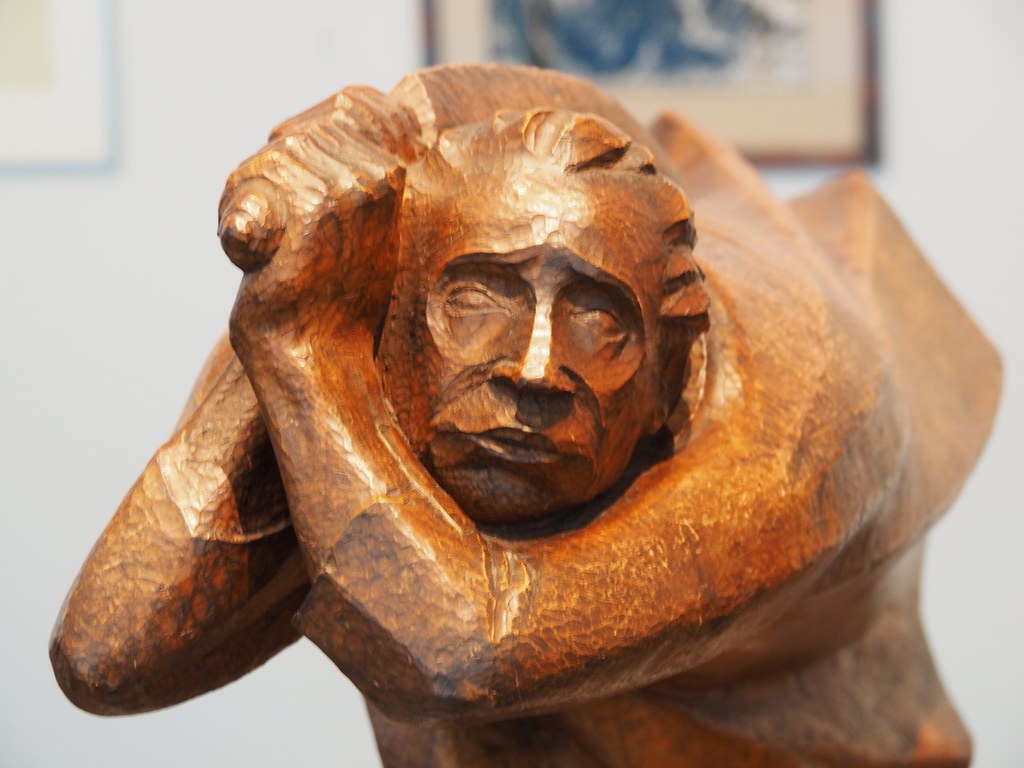
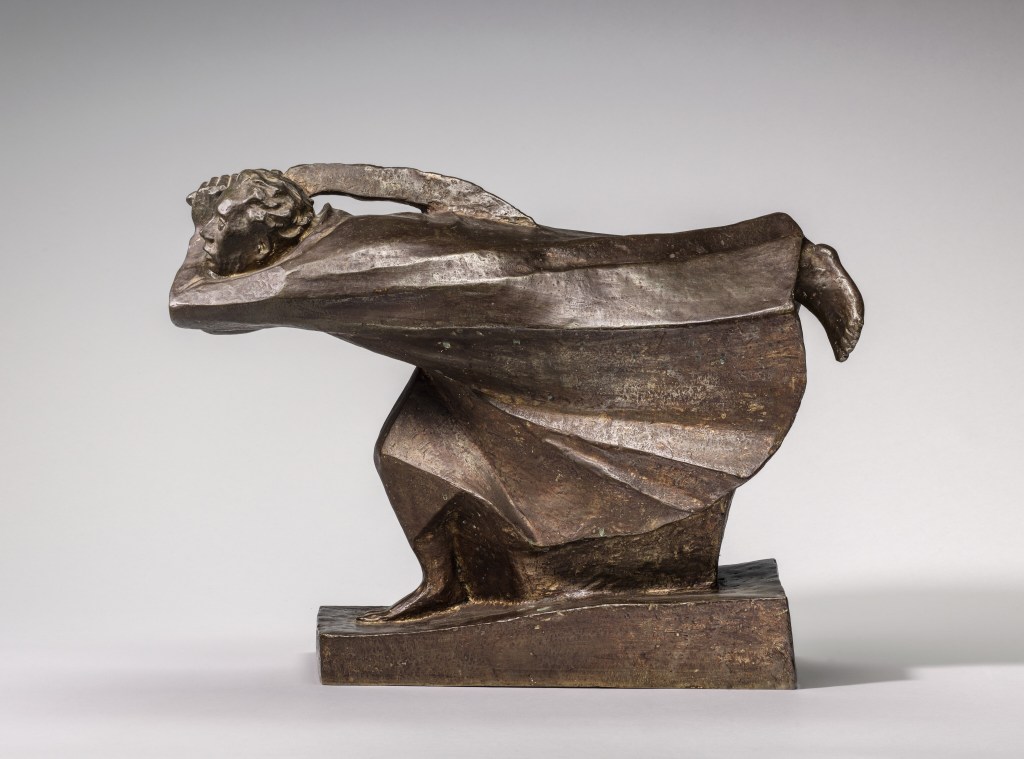
247 – In the midst of the doctors?

Marie Ellenrieder, Christ in the Temple, 1849. Royal Collection Trust.

My next stop on the journey through early modern German art will be The Nazarenes, this Monday, 12 May at 6pm. If you’ve never heard of them, don’t worry, but they are rather wonderful and should be known! Nevertheless, a striking feature of the History of Art is its ability to forget artists who were, in their day, remarkably successful. And the Nazarenes really were successful – especially in Britain. It’s just that very few paintings have made their way into public collections anywhere outside Germany. Not only that, but tastes changed very quickly after their initial success. John Ruskin’s Modern Painters would turn out to be an enormously important and influential book: amongst other things it includes an early defence of the paintings of Turner. However, when the first volume was initially sent to the publishers – the prestigious John Murray – it was turned down: apparently Murray said that they might have been more interested if it had been written about the Nazarenes. As Ruskin was concerned with nature, God and society, he would surely have been interested in their work, as they ticked at least two of these three boxes – God and society.  They would also turn out to be an important influence on British art, as we shall see on Monday. Apart from anything else, their clear, crisp colours and strong simple outlines are a balm for troubled eyes – and trust me, I should know. I must apologise for this post being rather late. I got back from Paris on Thursday, and meant to finish writing it yesterday. However, I went out for an hour or so to have an eye test and order some new glasses, but only got home some 10 hours, four nurses and three doctors later after minor laser eye surgery. I’m fine, it was a precautionary measure, but I lost a day’s work unexpectedly.

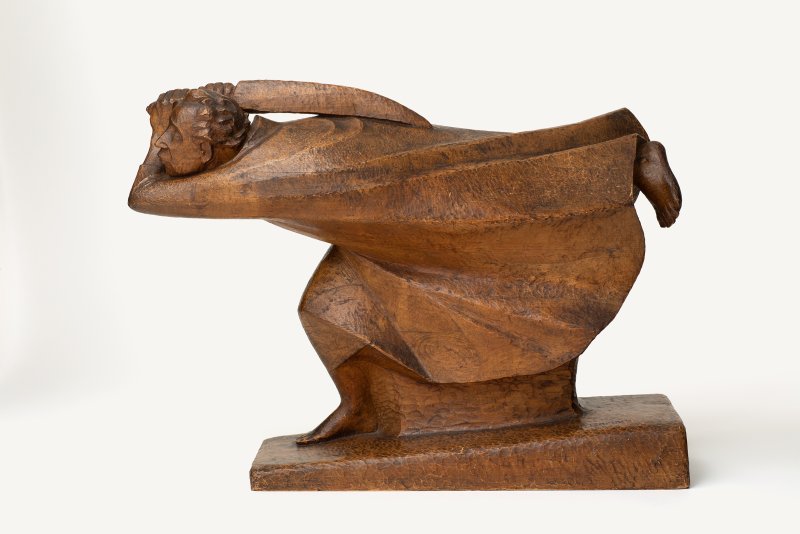
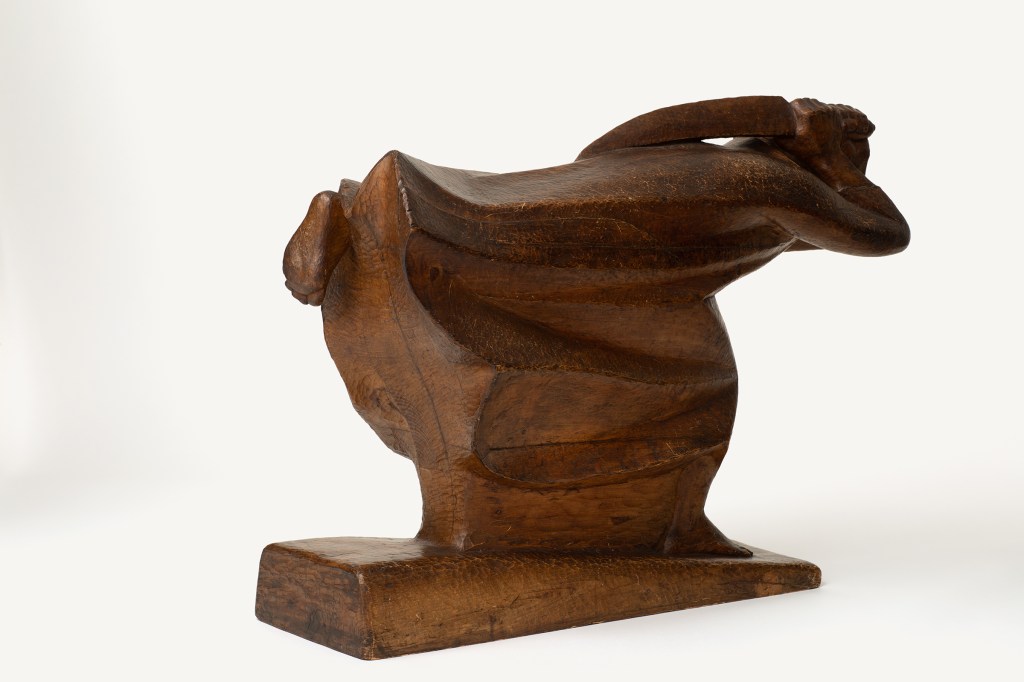
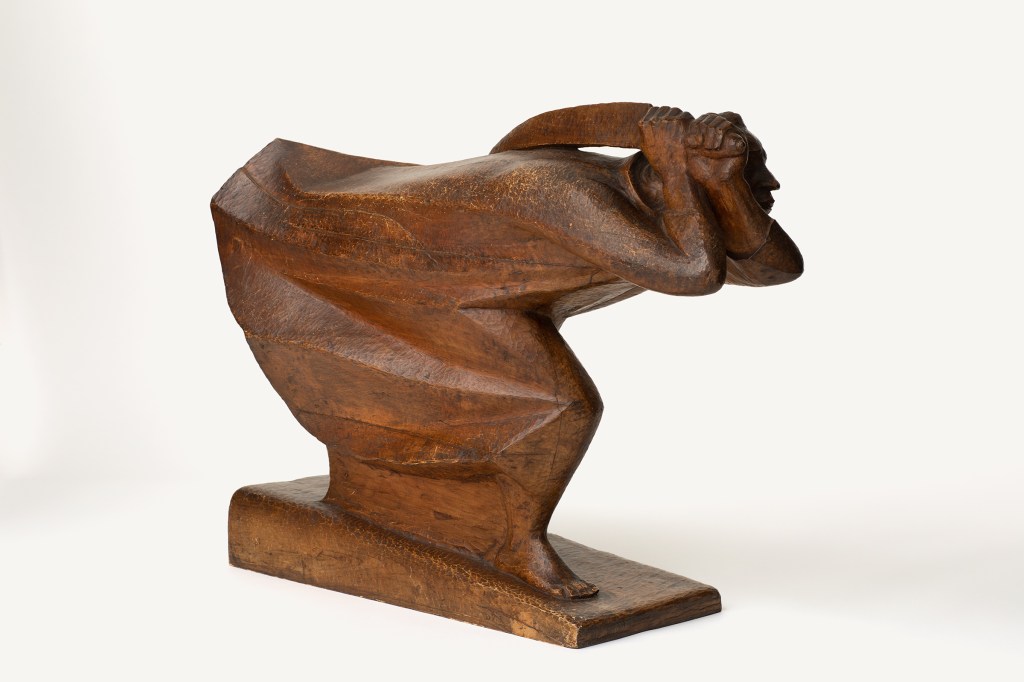
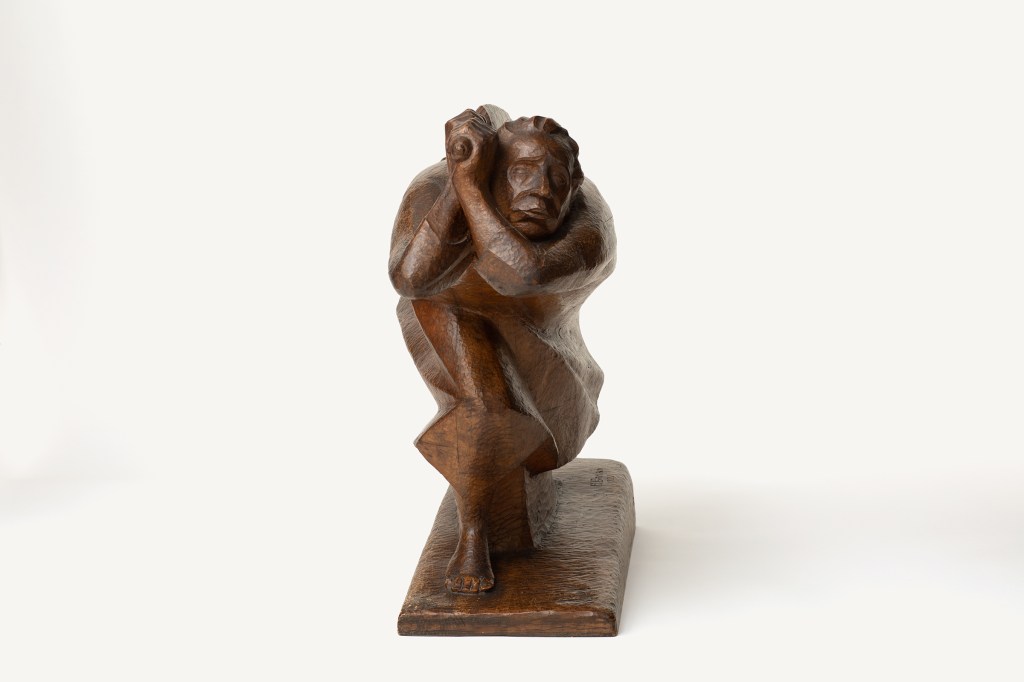
Today I want to write about Marie Ellenrieder. Strictly speaking, she wasn’t one of the Nazarenes, who, like the Pre-Raphaelites, were effectively a ‘Brotherhood’. However, she knew them, and her work is strongly influenced by theirs. I’ll go into more detail on Monday, of course. The following week (19 May) I will move onto German Impressionism, and then, to conclude this series, on 26 May I’m looking forward to enjoying the sculptures of Ernst Barlach – whose work will be the main Aspect of Expressionism I will be discussing. In Paris I saw two superb exhibitions dedicated to Cimabue and Artemisia Gentileschi, and I’ll be talking about them in June: do keep your eye on the diary for more details.

In light, crisp, clear colours Marie Ellenrieder is depicting a story whose consequences I discussed just a month or so ago, looking at Simone Martini’s Christ discovered in the Temple. As I said in that post, I think Martini was painting what happened next – after Mary and Joseph had found Jesus. When he was 12, according to the Gospel of St Luke, the family went to celebrate the Passover in Jerusalem. On the way home Mary and Joseph realised that Jesus was not with the rest of the group – so they returned to the city, and eventually, after three days, they found him in the temple, ‘sitting in the midst of the doctors, both hearing them, and asking them questions. And all that heard him were astonished at his understanding and answers’ (Luke 2:46-47). Ellenrieder has a very particular take on the story, and one that differs from the medieval and renaissance versions. Unlike ‘traditional’ images she does not show the moment of discovery, with Mary and Joseph to the side, or in the background, nor does she show a large group of doctors – there are usually at least four, or how could Jesus appear ‘in the midst’ of them? In Ellenrieder’s version he isn’t even in between the two who are present, one of whom isn’t paying him any attention anyway. In a similar way to Simone Martini, I think she is extending the range of the narrative, but whereas he takes the story beyond the moment of ‘discovery’, Ellenrieder has arrived to witness a scene beforehand. Jesus is only really communicating with one of the doctors, which makes me wonder if he has only recently entered the Temple. Let’s see if that makes sense!

The interaction between the old man and the 12-year-old boy is very direct, and very personal. It could be a scene of one-on-one tuition, although one in which the tables are turning. The man, with his long, white beard, is assumed to be both old and wise. On his lap rests a hefty tome with his right hand lying on top, the forefinger tucked into one of the pages to keep his place (there is also a bookmark ribbon marking another page). He looks towards Jesus, his left hand raised to emphasize a point in his argument. Jesus looks up towards him, holding an unrolled scroll, pointing towards the text with his right forefinger. His sanctity is evident – a simple gold ring circles his head as a halo – and his Christianity is subtly alluded to. Whereas the older man has his head covered by a russet-red hood, Jesus’s centrally parted and neatly combed hair is there for all to see. I don’t know when the tradition started – but long before Ellenrieder was alive – but Jewish boys would often start to wear a yarmulka (or kippah, or skull cap) at the age of three. Jesus is twelve – admittedly not yet thirteen, when he would be obligated to follow the commandments of the Torah, but the point is clearly made. In medieval and renaissance iconography, scrolls are usually used by characters from the Old Testament – i.e. Jews – whereas codices (books with pages that turn, rather than unroll) were not developed until the 2nd or 3rd century, and so are associated with Christianity. With Jesus pointing to a scroll, Ellenrieder could be implying that he has a profound understanding of the Old Order from an original text, rather than a ‘modern’ commentary. The glance that passes between the two suggests that this is the case. The old man’s head is tilted, and, to me at least, his gaze seems to imply a sense of doubt, with an idea coming into his head that had not been there before. The tentative positioning of his left hand is similarly not decisive – it is not the bold statement of an unequivocal truth, or the secure gesture of a well-practiced argument. The Doctor’s face is pale, his cheeks hollowed, and there are a few dignified wrinkles (the Nazarenes were not too worried about excessive lifelike veracity, but were more interested in communicating an idea as simply and directly as possible). Jesus has a perfect, porcelain complexion, unmarked but glowing with health – and youth. He looks up into the old man’s eyes with just a hint of a smile, showing conviction, understanding, and even love. His hand casts a shadow on the scroll: it is illuminated from above, as if by his Father in heaven. However, the words on the scroll are not legible. They are neither Latin nor Hebrew characters, but I suspect Ellenrieder is painting something ‘other’ to suggest the latter. Jesus wears a simple red robe, as was traditional, although it is not yet covered with a blue cloak. Perhaps that is because he has not yet formally begun his teaching – and wouldn’t, until after the Baptism. The old man, on the other hand, wears a subtle range of colours – russet, yellow, pale blue, orange and green.

Sometimes I find details in a painting a marvel in and of themselves – and this is one such detail. Above all, I love the poise of the man’s hand directly in front of his beard so that its insecurity is framed by his age and experience. The subtle articulation of the fingers, each one different – with the index finger opening out and the ring finger curling in – surely creates the sense of hesitation. And then there are the colours – the pale lemon yellow of the tabard, which is buttoned on both sides along the shoulders, and the way that this colour is picked up in the patterning of the Wedgwood-blue sleeves. There is a similar pattern on the tabard in a more muted, neutral colour. Above all, though, it is the expression, as if asking ‘how is this possible, from someone so young?’ But then, as it says in Psalm 8, verse 2, ‘Out of the mouth of babes and sucklings hast though ordained strength…’ Maybe that’s the verse that Jesus is pointing at. He would certainly know this text later – in Matthew 21:16 he says ‘have ye never read, Out of the mouth of babes and sucklings thou hast perfected praise?’ He could even be asking that now.

The bottom of the painting has some further, subtle pointers to Jesus’s status – and more delicate detailing. Notice how he wears no shoes, whereas the Doctor has delicate yellow pumps, the same colour as the tabard and with similar decoration. The blue/yellow colour chord is there, as it the contrast between the green cloak and its deep amber lining. Jesus being unshod is presumably a reference to Luke 10:4, in which he instructs his followers ‘Carry neither purse, nor scrip, nor shoes’. I quoted an equivalent text (Matthew 10:10) when talking about Martini’s painting, in which the 12-year-old wears sandals (‘nor shoes’ does not necessarily proscribe other footwear…). In the same painting, Simone’s Joseph, like Ellenrieder’s old man, also happens to wear yellow(ish) shoes.

Being younger than the Doctor, Jesus’s legs are shorter, and rest on a higher step. The Doctor’s feet are split between two lower levels. Oddly, perhaps, the old man is on a slightly higher level of the bench or parapet on which both are seated: it does not appear to be continuous. I don’t think there’s a meaning to this, though, and I’m also not entirely sure that it was a deliberate choice on the part of the artist. What was intentional, though, is the lighting. Not only does it shine from above, brilliantly illuminating the scroll and Jesus’s pointing right hand, but it also leads our eyes into the painting, going from the lit floor at the bottom right and up the steps which lead toward Jesus himself, as does the diagonal arrangement of the feet.

But what of the man in the background? He is also Jewish – his head is covered – and although he is not, seemingly, an ‘elder’, as his beard is relatively short and dark, he is clearly a mature man who is focussed on scripture. His right hand is raised ready to point to an unclear word, or to keep his place in case he is distracted. Has he turned away, or has he not yet become interested in the prodigy? It would be impossible to say, without the artist’s explicit statement, and I’m not sure to what extent Ellenrieder explained her own work. He is clearly significant, though, and is neatly framed by the architectonic elements – which give him prominence, whilst also asking their own questions.

Where, exactly, are we? The biblical text suggests we are in the ‘temple’ – but this looks for all the world like a gothic church with pointed arches and ribbed vaulting. It is, admittedly, an unusual form of architecture, as the columns have no capitals, but that’s not unknown, and anyway, maybe Ellenrieder was using her imagination, and seeking something simple. We are looking from the right of centre of one particular arch – columns frame the painting at the left and right. A lantern hangs in between them, to the left of the point of a blind arch on the back wall. The lantern – exquisitely formed – is presumably hanging from the centre of the vaulting in this particular bay. However, medieval paintings – notably medieval Flemish paintings – tended to show the temple with romanesque architecture, acknowledging some form of time frame: Romanesque was ‘old’ (so implied the Old Order), Gothic was ‘new’ (and was used for the New). So why did Ellenrieder choose Gothic? Is it simply, as in other choices here, that she wasn’t too bothered about medieval tradition? This would go against the Nazarene’s ideas: they were interested in the supposed purity and faith of medieval artists, as we shall see on Monday. Maybe she had something else in mind – and of course, I suspect that she did. I’ve talked about this painting more than once in a number of series about women artists, and it’s always reminded me of something, but until recently I couldn’t remember what that was. The cool grey stone and the lighter grey walls are reminiscent of the architecture of Brunelleschi in Florence, but translated into Gothic (curiously, Brunelleschi’s ‘Renaissance’ was doing was neo-Romanesque, rather than neo-Roman, but let’s not go into that right now). But I have seen this architecture somewhere before.

I first came across Marie Ellenrieder in Konstanz, in South-West Germany, which, for four years, was the location of my ‘country house’. She was born there in 1791. At the age of 22 she started her studies at the Academy of Fine Arts in Munich – and was, as it happens, the first woman to be admitted to any German academy. Nine years later she went to Rome, a study trip which lasted more or less two years, until 1824. It was there that she met the Nazarenes, becoming especially influenced by the founder of the group, Johann Friedrich Overbeck. After other travels she returned to Konstanz in the 1840s, where she continued to paint, and teach, until her death in 1863. This particular painting dates to 1849, and so must have been painted in Konstanz. It was bought that year by Prince Albert, and Queen Victoria bought another of her paintings at the same time: both can be seen in Osborne House, the royal residence on the Isle of Wight. Albert’s interest was not explicitly because she was German – he had come across her on one of his visits to Rome – but he presumably got to know her work through the German artists there in whom he was interested and who were, after all, his contemporaries. If it was painted in Konstanz, I’m not sure how it got to Rome – but that is by the by… Konstanz is the clue.

Medieval Konstanz was a very important diocese, and the only place in Germany which has ever hosted a Papal Conclave – back in 1417. The diocese included most of present-day Switzerland – stretching as far as St Gottard in the South, but also going as far North in Germany as Stuttgart. It also stretched from Bern in the West to Ulm in the East… Its Cathedral – now a Minster – was (and remains) magnificent, even though Konstanz ceased to be a Bishopric in 1821. Somewhere along the line the cloister lost two of its wings. The remaining two flank the church and chapter house in an L-shape, and frame one corner of the town’s main square. Here is a photo of the interior, together with a slightly truncated version of Ellenrieder’s Christ in the Temple:

Notice the gothic arches, and the bench running along the back, at the base of a blind arcade. Notice also the way in which the ribs of the vault overlap, the spaces they create, and their cool, grey colouring. But more than anything else, look at the columns: it’s clear to me that there are no capitals. This is a section of the cloister which is deeper than others, hence the free-standing column on the right of the photo – elsewhere it is only one bay deep – not unlike the painting. I can’t help thinking that Jesus and the Doctor are in this cloister, seated in one of the arches that lead into the open space in the middle, and imagined as seated on a similar bench to the one which runs along the back wall. This is Ellenrieder’s ‘mother church’, still a cathedral while she was growing up. What better place to imagine as the Temple than the oldest and most majestic building in the city of her birth? Admittedly she has slightly changed the profile of the arch, and includes a different transition from column to ribs – but I think these are small details. Her imagination has taken her to Jesus’s arrival in the Temple, having left his earthly step-father to ‘be about [his] Father’s business’. This could be the first interaction with one of the people there. The old man might then alert the younger man, and they could then summon others, who will be ‘astonished at his understanding and answers’. Eventually, when Mary and Joseph arrive, they will find Jesus ‘sitting in the midst of the doctors’. At least, that’s what I think is happening.

246 – Lonely as a Cloud?

Caspar David Friedrich, Wanderer above the Sea of Fog, about 1817. Kunsthalle, Hamburg.

Caspar David Friedrich’s Wanderer above the Sea of Fog is one of the archetypal images of German Romanticismso what better painting to look at as an introduction to my eponymous talk this Monday, 5 May at 6pm? To be honest, I’m not sure if I’ve ever seen it in real life, as the last time I was in Hamburg (December 2023) they had moved it into an exhibition looking forward to the 250th anniversary of the artist’s birth (1774), which unfortunately didn’t open until the week after we’d left… Since then, different embodiments of the show have been seen in Dresden and Berlin, and it is currently at the Met in New York, marking over a year of celebrations. The American incarnation closes on 11 May, in case you are stateside and on the East Coast: the first half of Monday’s talk will effectively walk us through it. However, I’m hoping that the Wanderer will be back on the walls of the Kunsthalle in Hamburg by the time I get there on 29 May – who knows if I’ll be lucky? As well as Friedrich, Monday’s talk will also look at the intriguing and idiosyncratic paintings of Otto Philipp Runge, an acquaintance and colleague of Friedrich, and another of the leading Romantic artists. I shall try and include others when appropriate. In the weeks that follow I will gradually work my way through German art history, looking at The Nazarenes (12 May), German Impressionism (19 May), and Ernst Barlach (26 May). All of these talks are now on sale, and you can either click on these links or look in the diary for more information. In the midst of it all I am heading to Paris for two days to catch the exhibitions Revoir Cimabue (‘A New Look at Cimabue’) at the Louvre and Artemisia: Héroïne de l’art at the Musée Jacquemart André. I am hoping to give lectures on both in June. Meanwhile… Germany.

This is undoubtedly one of Western Art’s ‘iconic’ paintings – the sort that is widely recognised, and often quoted. Maybe it’s not as familiar as the Mona Lisa, Munch’s The Scream, or ‘Whistler’s Mother’, but it is up there somewhere. Like all of them, there is a single figure forming a bold silhouette, so that the composition makes a strong, initial impact. This is easily remembered, and so can be instantly recognised: the boldness creates a sense of familiarity. This painting has the added bonus of mystery: who is this man? We would not recognise him even if we met, as he stands with his back it to us. We cannot see what he is thinking, or guess how he feels. He stands atop a rock formation looking out over the title’s ‘sea of fog’ (‘das Nebelmeer’ in the original German), and over the mountaintops which project from it. He wears a dark green, well-tailored coat, knee-length and gathered at the waist, with matching trousers. The rocks on which he stands are as dark, although brown, while the fog ranges from white to bluish-grey, with hints of lavender and pink, colours which are echoed in the sky.

These colours, and the shapes they form, help us interpret the painting, I think. I don’t know how much time you spend looking at the sky, or thinking about what you see, or even where it is, but if you look directly upwards, you are looking at the part of the sky that is closest to you. The sky above the horizon, or just touching it, is furthest way. I know this is obvious, but it’s worth considering, and I suspect it is not something we often register explicitly. When painted, the sky acts as a sort of external ‘ceiling’, directly above an equivalent, perspectival floor, so that, at the top of the painting, the sky is in the foreground, and the lower down the painting it goes, the further away that section of the sky is: where it meets the horizon the sky is in the background. This is still really obvious, I know, but it’s worth clarifying. In this detail, which shows all of the sky above the distant mountains, the clouds at the top are turbulent, with puffs of strongly contrasted light and dark, whereas those below are calmer, with stable, horizontal streaks of similar, close-hued, light tones. This implies that the weather nearby is rougher than that in the distance. If we are travelling in that direction – as the gaze of the ‘Wanderer’ suggests – things are going to get better: we are looking towards the calm on the horizon, both visually and metaphorically.

However, it is not entirely clear where the Wanderer is standing: on top of some rocks, yes, but not quite at the very top. And we don’t really know where these rocks are. Placed against a backdrop of fog, and with other rocky peaks which seem to be lower, we inevitably assume that he is at the top of a mountain. However, as we see these rocks out of context, we have no way of telling how broad, or high, this mountain is, nor how close he is to any vegetation… or for that matter, civilisation. He seems to be alone in the world, and potentially on the edge of a precipice. Nevertheless, these rocks do create that archetypal artistic construction – a pyramid – and he is placed on top of it, the focus of the composition. His left foot is higher and placed at an angle. His right foot points directly into the painting, stable at the end of a straight, supporting leg. The left leg is bent. I have no doubt that he is poised, stationary, to contemplate the view – he has a walking stick which projects to the right, helping to create visual, as well as physical, stability. Nevertheless, there is still the possibility that he could straighten that bent left leg and take a step forward with his right, either onto the higher stone, or even over the brow of this particular peak. Is he content to reach this summit, or will he head on to the mountains in the distance?

To the left, the rocky peaks are broad, and rounded, and, like the foreground where he is standing, they are devoid of vegetation. To the right, a larger mass of stone is topped with trees, but trees which, thanks to their distance, appear quite tiny: each would easily fit, pictorially, into the gap formed by crook of his arm. But has Friedrich got the perspective ‘right’? The trees seem too small, making that distant outcrop seem even further away than the shapes made by the fog would suggest. Of course, there is no ‘right’ or ‘wrong’ about it: the artist is using our understanding of perspective to show us the size and scale of the world around us: the world is enormous, and we are tiny in comparison. The painting is an example of the ‘Sublime’ which, in philosophical terms, represents a greatness beyond all possibility of calculation, measurement, or imitation. It can be exciting, or terrifying, or even both. For observers of a painting it works particularly well, though, because we know that, how ever large and potentially dangerous the world is, we, at this moment, are safe in the comfort of our own home.

Having said that, this man does not appear to be ‘tiny’ in comparison to the world. By making the rocks on which he stands equivalent to those in the distance, and by showing him as so much larger than the trees, this man is made truly monumental – heroic, even. Indeed, he is the very essence of the Romantic hero. His head is of the same order of size – on the picture surface – as the rock formation to the right. This is actually a fairly accurate depiction of the Zirkelstein, a table mountain which overlooks the River Elbe about 50km South East of Dresden, where Friedrich lived and worked. I can’t help thinking that the mountain has a head and shoulders not unlike the ‘Wanderer’. He is part of nature, and yet separate from it – another essential Romantic idea. Nature seems to converge on him. Notice how, just below the Zirkelstein, the top of a long, gently-sloping hill emerges from the clouds, and leads down in a shallow diagonal from the right edge of the painting to the Wanderer’s right arm. Another hilltop leads down in a similar shallow diagonal from the left to his left arm. There are mountains visible on either side of the flared skirts of his coat, and, as we saw above, he stands on top of a pyramid of rocks – which could in themselves be the tip of a far larger mountain.

Our eye level should be where we see the horizon, which suggests that the distant mountain is higher than his current position: it looms above his head. The slopes are apparently less rocky, and we might assume that it would be relatively easy to climb – an uphill walk, maybe, arduous, given the scale, but not a scramble. Some people think this is either the Rosenberg, or the Kaltenberg, but I’m not sure that either has exactly the right profile – but again, that is immaterial. Friedrich went out into the countryside, made sketches, and later rearranged them and altered them according to what would work in the painting – ‘pictorial necessity’. Here it is notable that the right slope of this mountain leads down behind the man’s face: he is looking at this very slope, and the hills beyond.

However bold the composition as a whole, the details are remarkably delicate. Notice how the light catches his shirt collar on the left, and to a lesser extent, also on the right. If you look closely enough, you can also see that it glances over the outline of his left ear. His ginger hair blows in tufts in the breeze. Caspar David Friedrich had red hair, by the way. This could be him.

But what does it all add up to? Everything focusses on the Wanderer: the rocks in the foreground support him, the apex of a pyramid, and mountains frame him to the left and right. The tops of the hills slope down towards him on either side – as if pointing towards him – and a distant mountain even resembles him. He is also exactly in the middle of the painting, his body lined up with the central vertical axis. We are looking directly at him, and yet we cannot see his face. However, by painting him from behind – what the Germans would call a Rückenfigur (literally, ‘back-figure’) – we are invited to look at what he is seeing, the ultimate repoussoir. We are looking at the act of looking, and the implication is that we consider not only what we can see, but also, how that would make us feel. This is the very essence of Romanticism: a personal response to the world around us. The movement grew as a reaction against the Enlightenment, during which the world was explored, measured, evaluated and rationalised. Romanticism invites a more emotional response. Friedrich is not documenting a precise geographical location, telling us physically where he stands, but is provoking us into a metaphorical consideration: how do we feel about our place in the universe? However, he doesn’t tell us how to feel. As a result, the interpretations of this painting are many and varied. It has been suggested that Friedrich’s concerns were political – relating to German Nationalism, as a response to the final defeat of Napoleon in 1815, just two years before the painting was begun. Ironically, by occupying many of the small independent states that made up the fragmented political landscape of Germany, Napoleon’s actions provoked a greater sense of what it meant to be German. He therefore helped to promote unification (the same was true in Italy). Alternatively, the painting could be a religious statement, expressing awe at the majesty of God’s creation, with the rocks as a symbol of a secure Faith, standing strong and reaching to the firmament. Friedrich profoundly believed in God’s presence in nature, as we shall see on Monday. Or it could be a meditation on his own journey through life. Every peak of achievement can turn out to be the brink of a precipice. And even if that’s not the case, how can we ever know if we have reached the ‘top’? How many more mountains must we climb – metaphorically – before we can find the peace promised by the calmer skies and gentler slopes on the horizon? As far as Friedrich’s own life is concerned, is it a coincidence that not long after he began this painting he would get married?

However we see the painting, the formalised composition implies that there should be a metaphorical interpretation. The sense of life’s journey, and the Romantic notion of an individual’s response to the situation in which they find themselves, is expressed explicitly through the notion of the Wanderer himself, and the very idea of Wandering. You only have to remember what William Wordsworth was doing in the opening line of what is surely most famous poem by one of Britain’s most famous Romantic poets: ‘I wandered lonely as a cloud…’. Wandering – and the discoveries which result – is essentially Romantic. However, for Caspar David Friedrich – judging by this painting, if nothing else – clouds were anything but lonely.

Flora: a second bloom

Evelyn De Morgan, Flora, 1894. De Morgan Collection.

As I said when I originally posted this essay, ‘There have been a plethora of exhibitions of the work of Evelyn De Morgan in the past few years, but I am only now in a position to dedicate an entire talk to her’ – that was in August 2023, thanks to the exhibition The Gold Drawings at Leighton House. It was focussed on a very specific aspect of her work – and an especially refined, and elegant one at that. Now, with the exhibition Evelyn de Morgan: The Modern Artist in Victorian London at the Guildhall Art Gallery, I will give a more general introduction to her work (Monday, 28 April at 6:00pm). I saw the exhibition yesterday – and it’s a perfect opportunity to get to know a wonderful artist and remarkable woman. Not only that, but it’s free – so don’t miss it! I first encountered one of her paintings at the exhibition Botticelli Reimagined at the Victoria and Albert Museum in 2016 – it was today’s work which was exhibited – and then she resurfaced in the National Portrait Gallery’s Pre-Raphaelite Sisters in 2019: the catalogue of that exhibition includes what is probably the best writing about her that I know. One of the stars of that show, as far as I was concerned, was Night and Sleep, about which I wrote on Day 41 back in April 2020. This talk will conclude what has been a short series about exhibitions currently in London. After this, May will be devoted to German art, starting with German Romanticism on 5 May, and then, on 12 May, The Nazarenes. More will follow – but check out the diary for information about them, including dates, and on-sale dates.

Flora, the Roman goddess of flowers, vegetation and fertility – and so effectively, also, of Spring – is shown full-length in a suitably floral dress, scattering blooms and standing on a lawn growing and strewn with yet more flowers. Behind her is a fruit-laden tree, dark against the clear blue sky, with just a hint of dusk on the horizon. She stands in classical contrapposto, with her weight on her left leg and her right lifting off the ground as if she were walking, or even, possibly, dancing. Over her shoulder is a blood-red shawl, and her hair flies freely in the breeze.

The tree is a loquat (Eriobotrya japonica), presumably chosen as it has the rare distinction of flowering in autumn or winter, so that it bears fruit as early as spring – an ideal demonstration of Flora’s fecundity (for this and all subsequent botanical identification I am, as ever, deeply indebted to the Ecologist, now Professor of Ecology at the University of Liverpool: congratulations, and thank you!). The loquat has its origins in China, but was known to Europeans as early as the 16th century. It may even have arrived in Portugal back then. The silveriness on the underside of the leaves is diagnostic, apparently, and is one of the many features that De Morgan captures accurately. The full moon hovers in the dusk sky, and below it a goldfinch flaps its wings. Not only is the bird colouristically related to Flora – the red on its face matches that on her shawl – but its association with the Passion of Christ, and therefore Easter, also makes it appropriate for a spring painting, a natural resurrection following the death of winter.

Further down, a second goldfinch looks up towards its mate from the right of the painting, not far from the head of a siskin, whose pair can be seen on the left, just below Flora’s elbow. A third type of bird is shown on her red shawl: picked out in gold, there are stylised swallows. Even if ‘one swallow doesn’t make a spring’ the number represented suggest that the season is well advanced. Admittedly this particular saying is also applied to summer, but I should be able to explain this confusion later on. The red colour of the shawl itself is related to the rich red roses which Flora is clasping, along with the others she is scattering – a metaphor for the way in which the arriving spring brings with it flowers. I particularly like the flick of the beaded red shawl just above Flora’s right elbow which echoes not only the curls of her hair, but also the shapes of some of the leaves and the curve of the siskin’s back and tail.

De Morgan captures the fall of the scattered roses rather brilliantly. It is as if they are frozen in time. The swirls of drapery, on the other hand, seem to have a life of their own, clinging to her bent right knee and curling behind, almost as if they are growing. All over the dress – which is modulated from cream in the light to a buttery yellow in the shadow – we see pansies, apparently growing with their leaves, which are either embroidered or printed onto the fabric. The name ‘pansy’ is derived from the French pensée, or ‘thought’, although that probably has little relevance here. They are included, like so much else, as indicators of spring, even if developments in horticulture mean that there are now varieties which will bloom all the year round. They don’t withstand the heat of summer, which could be relevant: as we shall see, De Morgan was painting in Florence, where the heat can be unbearable.

By the time we hit the ground (a final pink rose can be seen falling from the top of this detail) there is an explosion of flora. In between the left border of the painting and the figure’s right toes is a cyclamen, and to the right of the same foot are two primroses (Primula vulgaris), one the more common yellow form, the other a pink variant. There are also pinkish daisies (Bellis perennis) mid-way between the feet and below Flora’s left heel, and below the latter daisies are the flowers of another cyclamen. The rest of the flowers – whether deep blue, light blue or pink – are florist’s cineraria (Pericalis x hybrida), with the exception of some tiny forget-me-nots (Myosotis) to the left of Flora’s right foot (above the cyclamen), and a periwinkle (Vinca) to the left of the second set of cyclamen flowers.

The bottom left of the painting shows the same species, although the deep pink flower at the very bottom left corner might be ‘new’. The periwinkles can be seen more clearly (to the left of the full cyclamen plant and above a yellow primrose), and there are more forget-me-nots in the bottom right corner of the detail.

The bottom right of the painting also has the same selection, with more scattered roses, but there are also what appear to be double flowering ranunculus blooms, with tightly-packed petals in either yellowy-orange or red. The ‘new’ flower in the previous detail might also be a ranunculus. In addition, there is a cartellino – a small piece of paper, or label – inscribed with a verse and, on the underside, curled round on the right, the signature: ‘E De M. Maggio 1894’ – Evelyn De Morgan, May 1894. May is the month of spring, even if nowadays we associate its arrival with March. The Romans celebrated Floralia – the festival in honour of Flora – from 28 April – 3 May, and in Britain these rites survived with the celebration of a May Queen well into the twentieth century (there was a maypole in our playground at school, although I don’t remember anyone ever dancing around it). This ‘traditional’ celebration of spring is followed close on its heels by the arrival of summer in June (optimistically speaking – it was still raining in August when I originally wrote this), with ‘Midsummer’ being 21 June. This might explain the confusion over which season is ‘made’ by the arrival of an appropriate number of swallows. From 1890 until 1914 Evelyn and her husband William De Morgan (renowned potter, some of whose work I will include in Monday’s talk) spent the winter months of every year in Florence – and in this particular case at least, that could continue through to May. It was in Florence that Flora was painted. As far as I can read it, I think this is a correct transcription of the verse, for the benefit of those of you who have some Italian:

   Io vengo da Fiorenza e sono Flora
Quella città dai fior prende nomanza
   Tra Fiori son nata ed or cambio dimora
   Fra I monti della Scozia avrò mia stanza
Accoglietemi ben e vi sia caro
   Nelle nordiche nebbie il mio tesoro.

It uses antiquated Italian – even for the late 19th Century – including the medieval form of the city’s name, Fiorenza, as opposed to the ‘modern’ version, Firenze. The medieval form (like the English) is closer to the Roman name ‘Florentia’ – the flourishing city – and so to Flora herself, but also ties in with the ‘Pre-Raphaelite’ ethos of the painting, influenced as it is by an artist born many years before Raphael. As a sophisticated group of cognoscenti you will have seen the parallels already, and I hinted as much when I said that I’d first seen the painting in the exhibition Botticelli Reimagined. Before we get to that, though, here is my translation of the verse (you will understand why I never became a poet). It is rough, I know, but I wanted to try and replicate the rhyme scheme, and allude to quaint archaic forms (or rather, in this case, Scots dialect – apologies to my Scottish readers).

   I come from Florence, and I am Flora –
That city from the flowers takes its name.
   Born among flowers I’m now an explorer:
   The hills of Scotland soon will be ‘ma hame’.
Welcome me well so that my treasure
   Amid the northern mists will give you pleasure.

The implication is that Evelyn De Morgan painted Flora for a Scottish patron, although precisely who that was remains unknown: the first recorded owner had no known connections north of the border. As for its visual origins, De Morgan’s love – and understanding – of the work of Botticelli must be clear. For one thing, Flora owes a great deal to her namesake in the Primavera, which De Morgan could easily have seen in the Uffizi (in Florence) during her regular winter sojourns.

Dressed as a Florentine bride, with jewelled belt and necklace turned into garlands of flowers, Botticelli’s Flora has a similar dress to that of De Morgan’s, with the draperies folding and flowing in equivalent ways, covered (whether embroidered or printed) with flowers growing complete with their leaves. Both figures also scatter roses. Botticelli associates her with the nymph Chloris, seen emerging from the right edge of the detail. According to Ovid, Chloris was captured and raped by Zephyr, the west wind. To atone for his misdeeds, Ovid tells us, Zephyr transformed Chloris into Flora – hence the flowers coming from Chloris’s mouth as she looks back up at Zephyr whose head is just visible in this detail. This myth explains the origin of spring, as the barren land is made fertile, so it was believed, by the arrival of the west wind. Flora’s dress is also exceedingly like the figure reaching over to clothe the newly born goddess in Botticelli’s Birth of Venus, which is also in the Uffizi.

De Morgan’s Flora has hair more reminiscent of Venus herself, though. The colour may be similar to that of the attendant – reddish to fair – but the long curling locks blowing in the wind are closer to those of the goddess. I’ve cut Venus out from this detail for technical, WordPress related reasons, but you don’t need to take my word for it. We know that Evelyn de Morgan knew Botticelli’s painting: she copied a detail from The Birth of Venus, and her study has survived. Like today’s painting is owned by the De Morgan Collection.

In this small sketch De Morgan conveys the gilding which Botticelli used freely across his paintings with strokes of cream-coloured paint, but elsewhere – including in her painting of Flora – she picks out details in gold – real gold – just like her Florentine inspiration. She became especially interested in the use of this particular material, a metal, and an element in its own right, to the extent that she executed a considerable number of drawings using gold, and gold alone. It is a highly unconventional technique and one that was practiced by very few artists. As far as I know, she was the major exponent. There are a few examples of this remarkable refined technique in the current exhibition, and I will include them in the talk on Monday. I will also be able to discuss the development of her career as a whole, thanks to the superb collection of paintings and drawings currently on display at the Guidlhall Art Gallery.

Asking again: painted by a madman?

Edvard Munch, The Scream, 1895. Private Collection.

If you think I’m being rude – or insensitive – I should point out that the title of today’s post is simply a quotation, in English, from the words that Edvard Munch himself wrote on the first (or second) version of The Scream. An infrared photo of the offending text is at the very bottom of the post, if you want to check it for yourself… There are several versions of today’s painting – two in paint, two in pastel, and a lithograph which survives in a number of different versions, some coloured, some not. I am reposting this entry today as an introduction to the talk I will be giving on Monday 21 April, Edvard Munch Portraits, introducing the eponymous exhibition at the National Portrait Gallery in London. Sadly the exhibition doesn’t include today’s work, even if you could argue (at a stretch) that it is a form of psychological portrait… but that’s not the point of the exhibition. The talk will be the second of three looking at exhibitions currently on show in London. The third will be Evelyn de Morgan: The Modern Painter in Victorian London (which has just opened at the Guidlhall Art Gallery) on 28 April. After this, I am devoting May to German art from the 19th and early 20th centuries, starting with German Romanticism (5 May), and then The Nazarenes (12 May). I will also cover German Impressionism (19 May) and the series will conclude with a talk focussing on the sculptor Ernst Barlach (details still to be defined) – but all that will find its way to the diary before too long.

The Scream is one of those images which needs no introduction, so familiar are we with it, and with all the versions, mainly satirical, that it has spawned. Let’s face it, it’s the only painting I can think of that has inspired an emoji 😱, and the film franchise, Scream, uses the protagonist’s face for the mask worn by the killer. Like the many pastiches of Munch’s masterpiece, this franchise is a ‘comedy’ hommage (French pronunciation) to the slasher genre it apes. I’m sure the irreverent approach is just a means to undermine the darker implications of the painting. It is so familiar, perhaps, that we no longer look at it properly. We think that we know what is there, and we just stop looking: familiarity breeds disregard. So let’s look again. I’m going to focus on Munch’s third version of the subject, the pastel painted in 1895, but will consider the development of the series (briefly) below.

When you look at this image (and try to look at it as if you’ve never seen it before), what is the first thing that you notice? My first response, when I started thinking about this post, was surprise at the brilliance of the colour. The colour is why I’ve chosen this particular version to focus on – the others have faded, or were, in any case, duller. The sky is an intense vermillion, the bold, wavy lines interspersed with buttercup yellow and a couple of bands of pale blue. It takes up just under a third of the height of the painting, with a clear horizontal line in a darker blue marking, as the adjective suggests, the horizon. The lowest band of the sky appears to be made up of undulations of this darker blue – although reference to other versions imply that these ‘undulations’ are based on distant hills, blue as a result of atmospheric perspective. The majority of the land and sea is formed from a mid-toned blue, although small amounts of the reds and yellows creep in, in the same way that there is some blue in the sky. Overall, therefore, we have warm colours in the sky and cold down on earth. This lower section is almost square in shape, cut across diagonally by a straight path, with a fence or railing running alongside it. The path is formed of a series of straight lines, individual strokes of the crayon, and the railing consists of three parallel bars. The lines of the path and the bars of the railing conform to a strict, if exaggerated, perspective, converging at a vanishing point on the horizon at the far left of the image. The depiction of the land and sea is all curves, contrasting with the rigid, linear depiction of the path – we are looking at geometric forms and abstract values, particularly contrasts: warm and cool colours, straight and curved lines, squares and triangles, horizontals and diagonals. These abstract values are given meaning by what is represented. The path is presumably a jetty, and we see the sea with a curving coastline forming a bay, and, judging by the greens interspersed on the right, some vegetation. There is an androgynous figure, just to the right of centre, cut off by the bottom of the image. Its mouth and eyes are wide open and its hands are clasped on either side of its face. Further away on the jetty two more figures – men, as they wear top hats and this is 1895 – are sketched out full length. There is a boat on the sea, and buildings on the land, just visible on the horizon.

Looking closer at the figure at the bottom we can see its alarm more clearly, although the precise nature of the expression of this skull-like face is not easy to define. What is the wraith-like figure actually doing? The body seems almost immaterial: it is wavy, rather than solidly vertical, and is made of strokes more like the sky than the earth, all of which gives it a sense of insecurity. Is this person screaming, or does the open mouth speak of surprise, shock or horror? And do the hands express surprise as well, or are they clasped over the ears to shut out sound? There seems to be an unbearable pressure here, either coming from within, or closing in from the outside. As suggested above, the perspective of the jetty is distorted. It seems to recede too quickly, or, rather than receding, it could be seen as rushing towards us, giving the impression that we are zooming in, focussing on a close-up of the protagonist in a moment of high drama. Even the vegetation pushes in, the curved lines echoing the bend of the inflected wrist, pressing claustrophobically on the fragile figure.

Compared to the heightened drama of the protagonist, the two characters in the background seem relaxed, nonchalant even. One walks away, another stops to lean on the railing. If there is an audible sound – a scream – they do not seem to hear it: they certainly do not appear to be reacting to it. The boat just off the shore is a common feature in Munch’s work, and may imply the possibility of escape – but this is a possibility that is all too distant.

The sky is searing, with rich and brilliant colours, although oddly only the yellows are reflected in the water. The railing along the jetty, and even some of the planks of the path do take on some of the reds, but the intense colour is really the preserve of the sky, and is its defining feature. However, the nonchalance of the two figures could suggest that there is nothing unusual about it. Or maybe it is simply that they do not see it – or, that they do not see it like this. But then, the character in the foreground is not looking at the sky: he (is it ‘he’?) may have turned away.

I think that everything I have said so far is visible in the painting, although I can’t help wondering that so much of what I ‘see’ is coloured (deliberate choice of word) by what I have always known. It seems like ‘always’, anyway. I can’t remember when I first became aware of Edvard Munch, let alone The Scream. However, although there are unanswered questions in the interpretation of the image, we do know what Munch himself thought about the painting, as he wrote about it on more than one occasion. His first account was written a year before he made the first image. In a diary entry dated 22 January 1891, he said,

I was walking along the road with two friends – the sun went down – I felt a gust of melancholy – suddenly the sky turned a bloody red. I stopped, leaned against the railing, tired to death – as the flaming skies hung like blood and sword over the blue-black fjord and the city – my friends went on – I stood there trembling with anxiety – and I felt a vast infinite scream through nature.

This makes considerable sense of the image: it is Munch and two friends. They have moved on, but he remains, ‘trembling with anxiety’. Maybe this explains the wavy forms of the torso, even if he is not now leaning against the railing. The sky is ‘bloody red’ and we get a sense of the ‘blue-black fjord and city’ even if the colour chosen is not quite as dark as that might imply. What is key here is the last phrase, ‘I felt a vast infinite scream through nature’. He is not screaming (it is ‘he’), but there is a scream, a scream that maybe he is trying to block out with his hands. However, this is problematic, as he doesn’t hear the scream, so he can’t silence it – he feels it. What is truly ground-breaking about this image is that it isn’t a picture of something seen, but of something felt. We are at the very beginnings of Expressionism.

The year after Munch had this experience he tried to capture it visually twice, once in pastel – which may have been the first version, it’s not entirely clear – and once in paint, using both oil and tempera, with pastels as well. These two are both in Oslo, and are owned by the Munch Museum and the National Gallery respectively. The reason for thinking that the pastel is the earlier of the two is that, although the basic ideas are sketched out, the details are absent – no boats, and no buildings – features which do appear in what is, presumably, the later version.

There were two more versions in 1895 – the pastel which I have discussed (the only one in which one of the ‘friends’ leans on the railing), and a lithograph. We don’t know how many prints were drawn from the original stone, but about 30 survive, some of which were hand coloured by Munch himself. They were published in Berlin, and bear the title Geshrei, i.e. ‘The Scream’ in German, although the literal translation of this would be ‘Screaming’ or ‘Shouting’, apparently (‘The Scream’ would be Der Shrei in German, or, in Norwegian, Skrik). There is also a phrase at the bottom right, ‘Ich fühlte das grosse Geschrei durch die Natur‘ (‘I felt the great screaming through nature’). Often the image has been trimmed down, effectively cutting it out of the original ‘page’, meaning that the words do not appear – even if they were clearly important to Munch. This particular version, in the Museum of Modern Art in New York, was signed by the artist in 1896.

A final version was painted in tempera in 1910. This, too, is in the Munch Museum in Oslo, and, like the others (with the exception of the lithographs), is on cardboard. The first version in paint (1893) is the one which bears an inscription. It says (in translation): ‘Could only have been painted by a madman!’ It is written in pencil on top of the paint, and recent analysis has confirmed that it is in Munch’s handwriting. It was probably his reaction – presumably ironic – to the public response to the painting when it was first exhibited in Norway in 1895. Typical of this was the comment of critic Henrik Grosch, who wrote that the painting was proof that you could not “consider Munch a serious man with a normal brain.”  The implications of this statement would have been more profound for the artist than Grosch would have realised – probably. I don’t know how aware he was of Munch’s family background. Born in 1863, Edvard was the second of five children. His mother died of tuberculosis when he was five, as did his elder sister when he was fourteen. He was a sickly child, and was often kept out of school, which created an enduring sense of isolation. One of his younger sisters was diagnosed with a mental health disorder at an early age, and by the time The Scream was exhibited, she was cared for in a local institution. For the rest of his life the artist was haunted by the possibility that he had inherited the same condition.

Somehow, through all of this, he seems to have captured the essence of what could be described as one of the defining features of the 20th and 21st Centuries: angst. A quick internet search defines this as ‘a feeling of deep anxiety or dread, typically an unfocused one about the human condition or the state of the world in general’. The painting would have been perfectly at home in Vienna at the time of Sigmund Freud, but it also appears to visualise the Existentialists’ post-war fear of ‘the Void’: if there is no God, what is the point? For that matter, it could be an expression of man’s inhumanity to man, as seen in the holocaust, or even the cold war fear of nuclear annihilation. It speaks of the inner horror of so many of Francis Bacon’s subjects – even if it isn’t one of the usually acknowledged sources – and, oddly perhaps, it seems to demand to be owned. Both paintings have been stolen – the 1893 version in 1994, and the later one ten years later. And in 2012 the 1895 pastel – the one we have looked at – was sold for $119,922,600 to a private buyer. That’s very nearly 120 million dollars, which at the time was the most ever paid for a single painting.

‘Could only have been painted by a madman!’? It was as much the fear of the implications of this phrase – even before he had written it – that must have inspired his initial experience, and the images that flowed from it. This total honesty is what people have found hard to face, and yet, at the same time, it is so totally compelling. What else can have made it an early modernist Mona Lisa, ubiquitous and instantly understood? It undoubtedly touches a nerve, triggering an understanding of the human psyche. And, as we shall see on Monday, it was Munch’s psychological perception that helped to make him such a great portraitist.

245 – Out of the Corner

Édouard Manet, Corner of a Café-Concert, probably 1878-80. The National Gallery, London.

This week, after the splendour of Siena in the 14th century, it is time to turn our attention to another flourishing city – Paris, in the second half of the 19th century – but we will look at it via Switzerland. Over several decades in the 20th century the Swiss businessman Oskar Reinhart acquired a remarkable collection of paintings and works on paper. These included an admirable selection of the Impressionists and Post Impressionists, some of which I will be talking about this Monday, 7 April at 6pm, as they have been lent – for the first time as a group – to The Courtauld, where they form the nucleus of their enormously successful exhibition, Goya to Impressionism. I want to lead into this by writing about a painting by Manet from the National Gallery, at the other end of the Strand in London. It is not in the exhibition, but it was, for a while, part of a painting that is. Two weeks later, on 21 April, I will look at the National Portrait Gallery’s exhibition of Edvard Munch Portraits – some of his finest work, frankly. And finally, for April, I want to go to one of London’s great, but under-visited, free museums, the Guildhall Art Gallery, to introduce their exhibition Evelyn de Morgan: The Modern Painter in Victorian London. I am planning to devote May to German art – but more news about that as the series develops: keep an eye on the diary!

The Café-Concert of the title would have been just one of at least 150 such establishments in Paris at the time this was painted. They varied in size and in the scale of their entertainment – from a piano in the corner to a full-sized orchestra – but the basic idea was the same: they provided musical entertainment and refreshment. However, up until 1867 they were strictly regulated: the performers were not allowed to wear costumes, being restricted to everyday ‘streetwear’, and no more than 40 songs could be performed in one evening. Even then, the entire programme had to be passed by the police to prevent any seditious material being heard. There was to be no dancing, no dialogue and no sets – the aim being to protect musical theatre. Theatre as a whole had long been under ‘royal’ control, but by 1867 Napoleon III’s popularity was waning, fifteen years into the ‘Second Empire’. The relaxation of the law in 1867 not only led to the flourishing of the Café-Concerts, but also helped just a little to keep the Emperor going – until France’s defeat in the Franco-Prussian War just four years later. The Café-Concerts, on the other hand, went from strength to strength, and, as a feature of contemporary society, they became a popular subject for avant-garde artists such as Manet, hailed as ‘the painter of modern life’. In the painting, we see members of the public seated at a table being served drinks. A waitress places one glass of beer on the table while holding two more in her left hand. She looks off to our right, perhaps checking for other customers in need of service, or reminding herself who ordered the drinks she is still holding. In the background we can see a singer, or dancer (or both) on stage, with an orchestra seated in front.

One of the reasons for the popularity of the Café-Concerts was probably because they were – like the ballet – some of the few places where you could see a woman’s legs in public. Indeed, the performer appears to be dressed for the ballet, wearing something like a tutu. She has a remarkable slim waist (and is presumably corseted), and sports a décolletage which is low-cut, even given the word’s definition, and held up by the slimmest of shoulder straps. Leaning forward with her arms flung out she could either be taking or bow, or maybe singing. The setting is non-specific, with just a hint of a pale château with a blue roof seen between trees, in the midst of a Renoir-like array of light turquoise and blue brushstrokes. The gilded curtain can be seen to the far right just inside the proscenium arch, which frames the stage. The orchestra is separated from the performer by a screen topped by a row of glowing footlights and what looks like a low fence.

The orchestra itself is painted remarkably freely. A trombonist sits on the left, his instrument stretching behind his head on a diagonal from bottom left to top right, and, neatly framing the grey hat, a tuba player sits behind him. Both instruments are only just sketched in with creamy yellow and blue dashes, a style of painting that would be more at home in a late Impressionist or a spontaneously Divisionist painting. But then the freedom with which Manet could deploy paint, yet still hold onto the essence of his subject, is demonstrated clearly by the dashes of colour with which the beer is painted, a slight head of foam visible through the glass, the waitress’s black dress seen through the beer, but broken up by the colour of the light which both illuminates the beer and reflects off the glasses. There’s a real sense of how much these drinks would weigh – and therefore of the waitress’s skill in delivering one drink whilst focussing elsewhere. Nearby, the man in the foreground holds a clay pipe, from which curls a puff of smoke. The stem of the pipe rests on his thumb and his forefinger is curled over it, clamping it onto the knuckles of the remaining three bent fingers.

The central ‘drama’ of the image is not whatever is happening on the stage, but the split focus of the two protagonists: the waitress looking to our right, the smoking man to our left. Both appear to be focussed on things beyond the frame: there are aspects of this Café-Concert that we will never know. This fragmentary depiction is one of the truly modern features of the painting: the artist is not showing us everything, but allowing us a glimpse of just one of the things which interests him, a moment of alienated interaction which suggests that these two people have no interest in each other. While we may not know everything that is going on, this impersonal interaction is one of the hallmarks of life in modern society: Manet is showing us not only what people look like, but also how they behave. He is also giving us a small cross-section of Parisian society. The smoker, in the customary workers’ blue – the Bleu de Travail – is wearing a black cap and smoking his pipe. Next to him another man wears a slightly smarter hat, like a taller version of a bowler hat, but in grey and with a broad back ribbon – I think it’s a tall crown bowler (or, for the Americans, a high crown derby). Beyond him, a woman turns away, her hair pulled back behind her ear and piled on top of her head, where it is dressed with yellow ribbons which merge, visually, with the brass of the trombone. Is she with the man in the grey hat? There is no evidence that she is, but could she be her on her own? It would seem unlikely, in the 1870s – unless she is there alone professionally… draw your own conclusions.

The Bleu de Travail is the dominant element in the foreground, baggy so as not to restrict movement at work, hardwearing and cheap. But it’s not evenly blue – a hard line cuts down the worker’s back directly below the two beers, lighter on the right and darker on the left. This is a sure sign that Manet extended the painting, adding a new section of canvas on the right. When originally completed it would presumably have looked more coherent, but as the new section was not prepared in the same way – the surface blue doesn’t have the same layers of paint underneath it – it has faded to reveal the addition. While we’re looking at this detail I’d like you to try and find something else. The beer is not necessarily for this worker – he has a dark brown drink in a tall glass in front of him. To the left of the top of this glass, just above the level of the liquid, is a tiny pink detail, at the bottom of a green drink that looks suspiciously like absinthe. This pink detail casts a shadow on the table beneath it – remember it, because I’ll come back to it later.

According to the art critic Théodore Duret, Manet was particularly impressed by the waitresses in the Brasserie de Reichshoffen, ‘who, while placing with one hand a glass on a table in front of a customer, were able to hold several more in the other, without spilling a drop.’ Manet asked one of these waitresses to pose for him, but she was reluctant, and said she would only agree if her ‘protector’ could be there too – and he would have to be paid as well. He is the worker in the foreground: the ‘alienation’ is a fiction, as they knew each other well. This may have allowed Manet to develop a particularly taut composition. The waitress’s left arm hangs down from her shoulder to her elbow and then up to her hand holding the beers, while the worker’s left arm goes down to the elbow, resting on the table, and up to his hand holding the pipe. The two hands, together with the beers, frame the worker’s head. The waitress’s right arm, clad in black, fills the gap between the worker’s brilliantly illuminated left forearm, and her white cuff meets his blue. Her hand remains hidden behind his arm, even though we can see the beer she has placed on the table. The far left and right of the composition are framed by the heads of the trombonist and a double bass player respectively, and also, on the right, by the proscenium arch. Its visibility on the right, but not the left, implies that the stage spreads far beyond the frame of the painting on the opposite side. Whatever the apparent spontaneity of the image (and remember, Manet never exhibited with the Impressionists – he wasn’t necessarily painting what he saw when he saw it) this is a rather brilliantly planned composition. However, it isn’t called Corner of the Brasserie Reichshoffen – we are in a Café-Concert, not a Brasserie. But then, Manet had changed his mind.

This is actually a screen shot taken from Monday’s talk. On the left is Manet’s Au Café (1878) from the Oskar Reinhart Collection – one of the paintings in the Courtauld’s exhibition. On the right is Corner of a Café-Concert. The painting of the Brasserie Reichshoffen was originally intended to be a reasonably sized composition, but Manet was unhappy with its progress, and cut it in two. Most accounts say he ‘cut it in half’ – but they are nowhere near equal ‘halves’. If you remove the addition from National Gallery’s painting, it is about half the width of its Swiss companion: he effectively cut a third from the original composition. Both were then re-worked into independent paintings, with the setting of the left section remaining securely in the Brasserie, while the other was transformed by the addition of a stage, a performer and an orchestra into a Café-Concert. All of these elements are far more freely painted, showing that the younger generation of Impressionists had a notable impact on their older mentor. I haven’t read a full account of the precise relationship between the two paintings (stuck in my study on the Wirral I don’t have access to the right libraries), but this is the best match I can come up with, the shadows of the drinks on the right matching those on the table on the left. Not only that, but the tiny pink detail at the bottom of the ‘absinthe’ is revealed to be the fingertips of the girl on the left. The Reinhart painting shows a more obviously respectable couple – a man in a top hat with a cane (of a ‘higher class’ than the men opposite him, clearly), with a woman modestly dressed in a beige-coloured coat and hat – who is probably his wife. The girl at the far end could even be their daughter, but she wouldn’t be drinking absinthe. Maybe that belongs to the unaccompanied woman at the end of the table who is turning away from us. [A few days after I wrote this I finally got round to reading Rachel Sloan’s entry about the Reinhart painting in The Courtauld’s catalogue – the re-working of the original painting was more complex than I had realised, and initially the canvas was cut between the man in the top hat and the ‘girl’ at the end of the table – who might originally have been a young man: look at the stiff white collar… That’ll teach me to research things properly!]

The additions to the Corner of the Café-Concert turn it into the very type of establishment mentioned in the title – a place of popular entertainment, which would in its turn evolve into the British Music Hall. By extending the canvas Manet also makes the waitress central, so that she becomes the real subject of the painting, rather than leaving her cornered. It does leave me wondering, though: if he hadn’t done this, how would he have painted her particular skill – delivering one drink while securely holding several more? Surely there would only have been just enough room for one glass of beer, if that. Maybe it was this that led to his dissatisfaction.

244 – Full of Grace

Ambrogio Lorenzetti, Madonna del Latte, about 1325. Museo Diocesano, Siena.

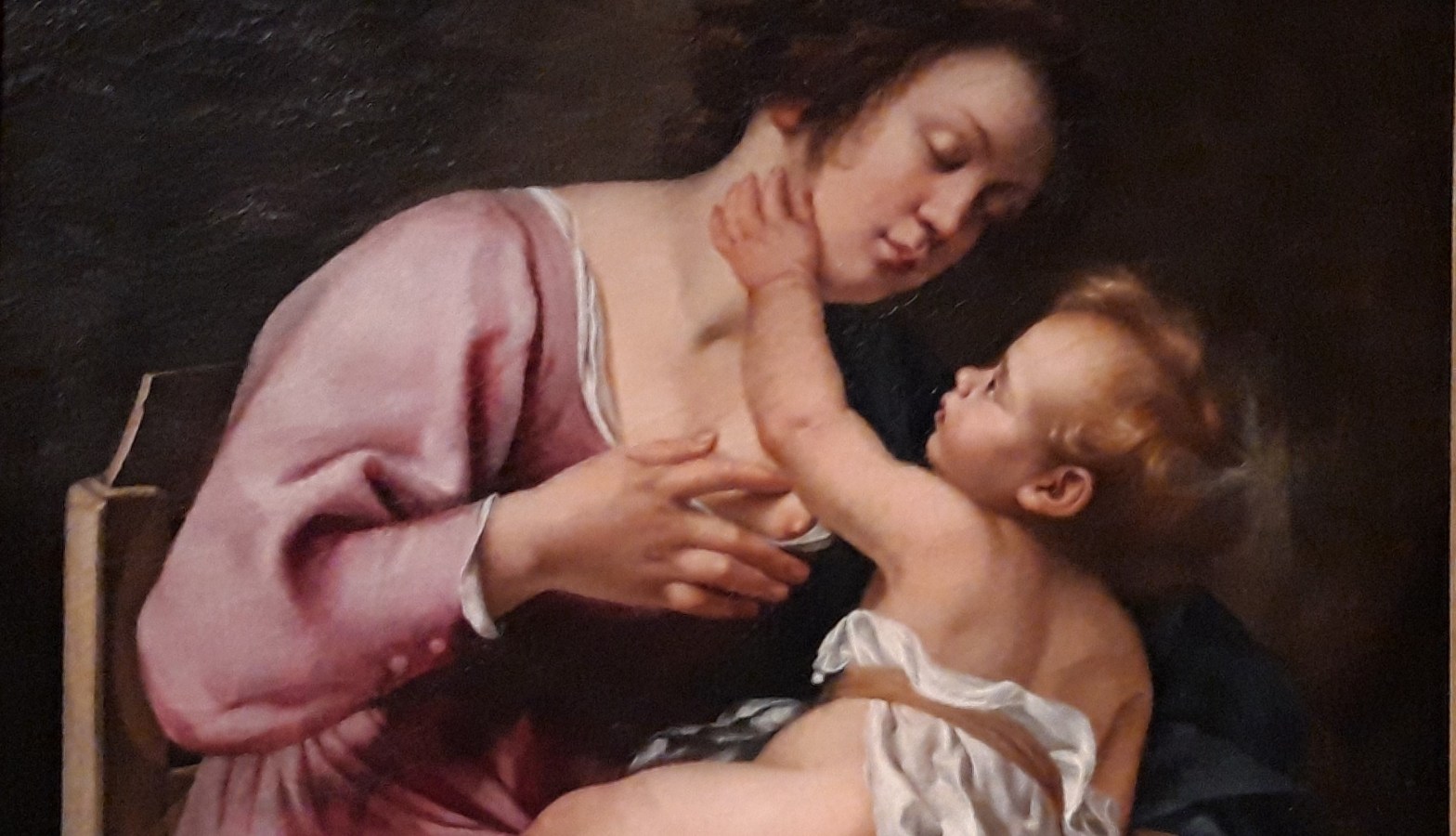
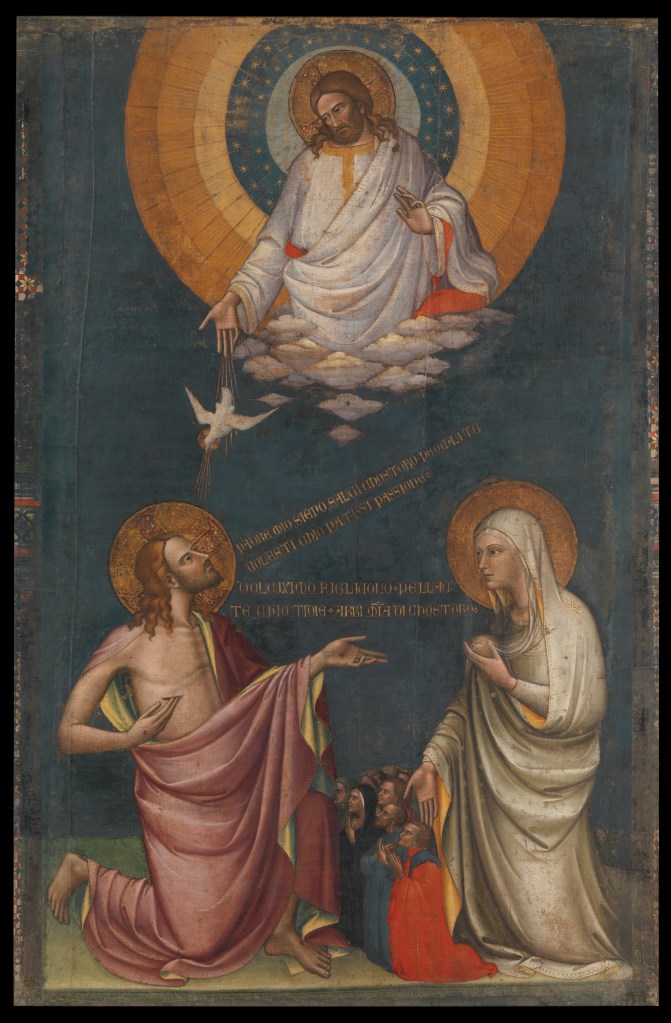
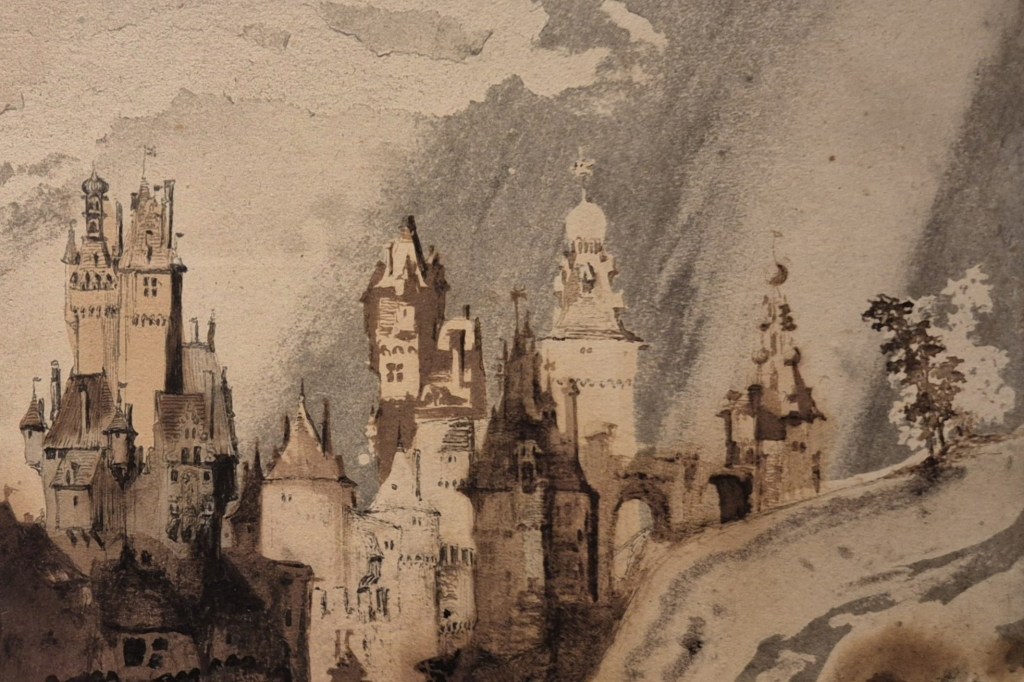
I will complete my series of talks relating to the National Gallery’s truly glorious exhibition Siena: The Rise of Painting this Monday, 31 March with Ambrogio Lorenzetti. I always thought I knew his work, but there is so much more than I imagined – although his masterpiece, The Allegory of Good and Bad Government in the Palazzo Pubblico, does loom large: we will look at it in depth on Monday. However, today I want to have a look at a painting which is in the exhibition, the Madonna del Latte, bearing in mind that this Tuesday (25 March) was the Feast of the Annunciation. The painting belongs to the Museo Diocesano in Siena, a museum I have never visited. However, I am hoping to get there next year as part of a visit to Siena with Artemisia. We will also go on a daytrip to Massa Marittima to see the painting I posted last week. We’re still very much in the planning stages, but if you are interested at all, contact Charlie Winton via the Artemisia website and she will get in touch when the plans are more secure.
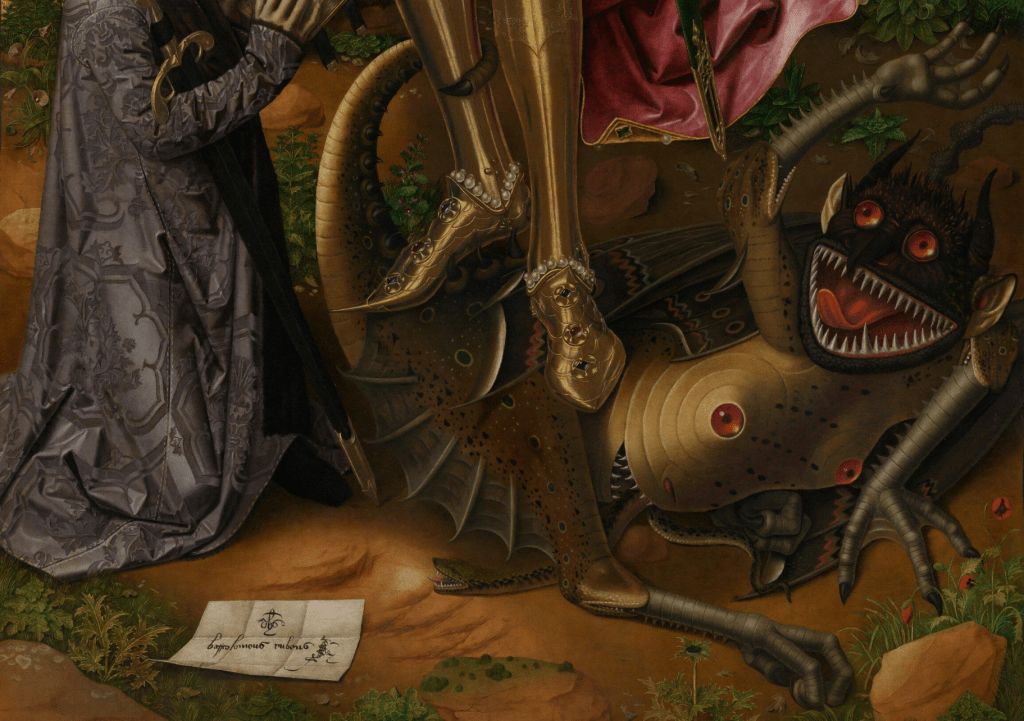
If you’ve missed my talks in this series, I am repeating them in an edited form for ARTscapades, combining my five talks into a two-part short course, Four Sienese Artists. I delivered part one, about Duccio and Pietro Lorenzetti, on Tuesday, but it was recorded and will be available on catch up for a month. Part two, Simone Martini and Ambrogio Lorenzetti, will follow next Tuesday, 1 April – you can book them separately via those links.

After Siena, April will be taken up with talks based on exhibitions in London, introducing shows at The Courtauld, the National Portrait Gallery, and the Guildhall Art Gallery. They are, respectively, Goya to Impressionism (7 April), Edvard Munch Portraits (21 April), and Evelyn de Morgan: The Modern Painter in Victorian London (28 April). I plan to dedicate May to German art – but more news about that soon. Of course, you can always check on the diary! But for now, back to Ambrogio Lorenzetti.

The painting is called the Madonna del Latte – a literal translation would be ‘Madonna of the Milk’ – i.e. the breastfeeding Madonna. It is a subject that was relatively common in medieval and renaissance art, stressing the humanity of the holy mother and child, something which is also clear from the child wriggling in its mother’s firm grasp, and distracted from feeding by something over our left shoulders. At the same time as making the figures entirely human, Lorenzetti assures us of their sanctity through the prominent inclusion of richly tooled haloes. These touch the gabled frame at top left and middle right, ensuring that we focus on the couple and nothing else. The composition is beautifully rigorous, with Mary leaning to our left, so that her elbow (and, almost, Christ’s right toes) are effectively touching the frame, while the hem of her cloak, which hangs down from her left hand, leads down to the bottom right corner. The flat gold background is delicately tooled around its edges, and is surrounded by a red-brown painted frame. The base of the outer, wooden frame of the triangular gable is slightly narrower than the rectangular base on which it rests. It forms an equilateral triangle, triggering thoughts of the Holy Trinity: Father, Son, and Holy Spirit, and the realisation that God the Son is now also a man, sprawling in his mother’s arms. Whether or not the triangular form of the gable does refer to the Trinity, its combination with the lower, rectangular shape seems to imply something more about this painting, an idea confirmed by comparison with Ambrogio Lorenzetti’s earliest known work, the Madonna di Vico l’Abate, painted in 1319 and currently in the Museo di Casciano in Val di Pesa, about 19km outside of Florence.

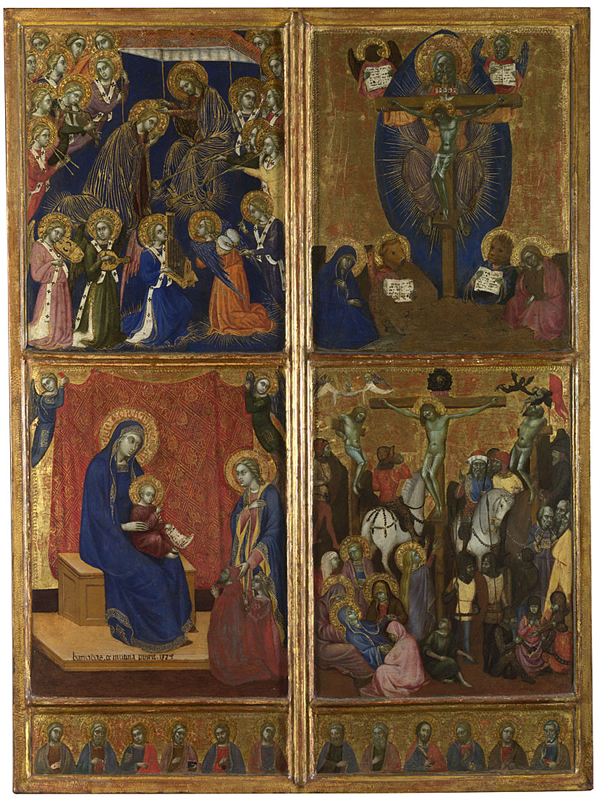
The rigid and sculptural qualities of the earlier Madonna (on the right) echo not only the paintings of Giotto, but also the sculptures of Arnolfo di Cambio, reminding us that Ambrogio, like his elder brother Pietro, spent a considerable time in Florence in his early years. That the later work is more fluid, and lyrical, suggests a return to the ethos of Siena, even if we don’t know the original location of the Madonna del Latte. However, by this stage he had been painting frescoes alongside Pietro in the Chapter House of San Francesco in Siena, which we will look at on Monday. The main point of this comparison, though, is not necessarily to point out Ambrogio’s stylistic development, but to explain the shape of the frame. The earlier work, named after the town for which it was painted, has a similar shape, although the triangular gable is narrower in relation to the rectangular section below. The shape of the painting is defined by the shape of the throne on which Mary is seated. Its arms are depicted in an early form of perspective, with the result that the nearer, splayed ends are cut off by the frame of the painting. Nevertheless, the inlaid panel behind Mary’s legs fits the width of the picture surface perfectly, while the equivalent panel behind her back is further away, and so appears narrower, allowing it space for a flat, fictive frame of its own. This upper inlaid panel is equivalent to the flat gold background of the Madonna del Latte, while the framing element, painted as if made of a pale wood, is replaced by the red-brown frame in today’s painting. When we look at the panel of the Madonna del Latte what we see is actually the throne itself, with Mary and Jesus painted in front of it. By doing this, Ambrogio presents mother and child with an unparalleled immediacy – not unlike the image of Christ in his brother Pietro’s Cut-out Crucifix.

Mary’s apparent proximity is enhanced by the layering of forms: her halo is in front of the painted frame, and her head is in front of the halo, thus pushing her closer to us. I can’t be certain how the red-brown frame was made, and I don’t have access to any technical reports, but if you look in the corners where the halo touches the wooden frame, there are small patches where the colouring seems to have flaked off, revealing gold. I am fairly sure that the painted frame is a rich, reddish, translucent paint applied over tooled gold leaf – but don’t quote me on that! You can see the gold through the paint, which creates a slightly unusual effect, almost like tooled and gilded leather. The asymmetry of the placement of Mary’s head – with the halo covering the painted frame on the left, but clear of the delicate tooling along the edge of the flat gold background on the right – emphasizes the way she is leaning back to get a better look at her son. Her gaze is incredibly subtle, but I can’t help seeing a contained, inner radiance, a subtle look of profound love combined with awe, and the slightest hint of a smile on her pink lips.

Jesus does not return this gaze, but looks out beyond us, his tiny hands firmly clasping Mary’s breast. Admittedly Ambrogio wins no prizes for anatomy here, but there is the possibility that he was trying not to be too explicit – or naturalistic. The Madonna Lactans – the Latin term for the genre of breastfeeding Madonnas – fell out of popularity in the second half of the 16th Century, a victim to the Counter Reformation, which considered it ‘inappropriate’ – in a somewhat 21st century way. The decorated pattern at the end of Mary’s white veil curves around the breast, and the veil hangs down in narrow, wrinkled folds, implying that it is made of the thinnest and most delicate of fabrics. Ripples of the hem frame Mary’s face, and the veil is twisted, rope-like, as it curves across her chest and under her blue cloak, which appears to be turned back near her left shoulder to reveal a green lining.

The same green appears as a belt around Mary’s waist, gathering her dress which is a bright, un-patterned red. Jesus has got himself into one of those awkward positions in which babies excel, wriggling so much that Mary looks in danger of losing her grasp. His left foot is lifted, and rests in the crook of her right elbow, while the right foot hangs down by her side. Ambrogio has tried to emulate the folds of flesh in a chubby baby’s limbs and stomach with curving lines which I suspect were more subtle, and less evident, when the painting was first completed. Their curves clearly show us the three-dimensional forms of his body. I am intrigued by the pink swaddling cloth in which Jesus is wrapped. It is not the usual white, which so often looks forward to the shroud, and I am not aware of an others of this colour (although it could be that I have simply not registered them). It may relate to the red loin cloths with which Jesus was painted in Crucifixions of the late 13th Century (and also, later, by Raphael, in the Mond Crucifixion), a reference to Christ’s royalty – but that might be an interpretive step too far. What is clear is that Ambrogio has thought very carefully about the way it hangs: notice the folds that are pinched up by Mary’s right forefinger, and the sagging of the drapery behind the child’s back, held up by the middle finger.

The same is true for her left hand, where her fourth and fifth fingers pull up curves of drapery, marked by little pools of shadow ringed by highlights above. The flat back of her hand is strongly marked by shadow, and separated from the light on her fingers by the knuckles. The pink cloth curves over the thumb and forefinger, falling down to the left and right, hemmed by the thinnest of black lines. The gold hem of her cloak cuts between the pink cloth and the back of her hand with an almost abstract geometry. This photographic detail was taken from a different file to the others, and dates from before the recent conservation. It still shows signs of woodworm in the panel – the tiny black holes in Jesus’s forehead, for example. But it also shows clearly the delicacy of the tooling of the halo, a splayed cross-shape marked out to remind us that this is indeed Christ, created with a variety of tools. There are smaller and larger rings, dots, and a stippling between the shapes in the one arm of the ‘cross’ that we can see clearly. The leaf-like forms were probably ‘drawn’ into the gold leaf with a stylus after the gold had been burnished. The rings would have been made then too, using a tiny tube tapped onto the gold with a hammer. After this, a thin stylus would have been repeatedly pressed onto the gold to make the stippling which fills the gaps in between.

I took this detail at an angle from below in order to catch the reflection of the light. Up close you can see how egg tempera is applied, with small, unblended brush strokes in different colours. From a distance they combine to create the overall effect. The brush strokes themselves help to define the form of the jaw and chin, modelling the contours, and creating shadows as more dark strokes are introduced. The thicker black lines along the nose and the profile cut the face away from the veil which hangs behind, thus making the head look more sculptural. The veil itself hangs in thin folds in front of Mary’s forehead, and faintly reveals the hair underneath. But the point of the photograph was really to look at the intricacy of the tooling. The halo is defined by the thinnest of circular guidelines, created with a sharp stylus and a pair of compasses. There are eight of these, and going in from the outside, between the third and fourth is a circle of rings containing dots. Between the fifth and a sixth guidelines, letters were incised in the burnished gold and surrounded by stippling. Further in still is another circle of dots, but without the rings. This is hidden at a point in front of Mary’s forehead by the veil, enhancing the sense that all this is real and solid. As for the letters, they can be read more easily where the light is reflecting from the gold, but if you move your head as you look at the painting itself you can read quite easily the words of the angelic salutation:

AVE · MARIA · GRATIA · PLENA · DOMINUS · TECUM · BENE

‘Hail Mary, full of grace, the Lord is with thee’. The ‘BENE’ is cut off, but is the beginning of the next phrase ‘benedicta tu in mulieribus’ – ‘blessed are you among women’. This is a quotation from Luke 1:28 in the Vulgate, the official Roman Catholic version of the bible. In this context, ‘grace’ refers to acceptance and goodwill, regardless of whether or not it is deserved. Another term would be ‘favour’ – which is why the King James Version renders the phrase as ‘Hail, thou that art highly favoured, the Lord is with thee: blessed art thou among women’ – Mary’s name is not included in either translation, but it becomes an essential part of the one of Christianity’s most essential prayers – the ‘Ave Maria’, or ‘Hail Mary’.
Ambrogio’s inclusion of this prayer in Mary’s halo is a first, and the combination of word and image would become one of his areas of expertise. We will certainly see it as vital to the interpretation of the Allegory of Good and Bad Government on Monday. For now, though, the inscription in the halo is a fitting reminder that the good news brought to the Virgin on the Feast of the Annunciation – celebrated on Tuesday – was fulfilled by the birth of Christ. Full of grace, Mary now holds Salvation in her arms.

Revisiting the Virtues in Colour

Ambrogio Lorenzetti, Maestà, c. 1335. Museo di Arte Sacra, Massa Marittima.

Siena: The Rise of Painting 1300-1350 at the National Gallery is undoubtedly the most beautiful exhibition I have seen for many years, and I can’t wait to tell you all about it this coming Monday, 24 March at 6pm. It charts, as the title suggests, the rise of painting to become ‘top art form’, taking over from the work of goldsmiths and enamellers which had flourished in the 13th century. As my recent talks have outlined, the exhibition ‘stars’ four main artists: Duccio, Simone Martini, and the brothers Pietro and Ambrogio Lorenzetti, although the exhibition includes much more besides. I will cover as much as I can this Monday, and then the following week (31 March) I will come back to Ambrogio Lorenzetti. As yet, I haven’t dedicated an individual talk just to him. Details about the subsequent talks, introducing exhibitions at the Courtauld (From Goya to Impressionism) and the National Portrait Gallery (Edvard Munch) will be posted soon in the diary.
To make up for the delay in talking about Ambrogio, I’m going to have a look at one of his paintings today. It is not in the exhibition, but I do hope to go and see it in Massa Marittima with Artemisia next year, as a daytrip during a visit to Siena itself. This is actually an entry I first posted back in 2021, about a year into the blog. As it happens, the fifth anniversary of the first post was yesterday.

Evidence about the two Lorenzetti brothers is scarce, although both were, in all probability, born in Siena (Pietro around 1280, and Ambrogio about a decade later). It is possible – but by no means certain – that they both trained with Duccio. Ambrogio spent some time in Florence, as did Pietro, who also worked in Cortona, Assisi, and Arezzo. It may well have been in Florence that they became familiar with the work of Giotto, whose naturalism and solid humanity influenced both brothers, although neither ever let go of the lyricism inherent in Sienese practice. They worked alongside one another on the façade of the Hospital opposite Siena Cathedral (although sadly these frescoes have not survived), and each painted an altarpiece for the cathedral as part of the elaboration of the themes of Duccio’s Maestà.  As there is no mention of either brother after 1347 it seems likely that both died during the Black Death. Today, I would like to look at the Maestà which Ambrogio painted for one of the churches in Massa Marittima, famous enough to have been mentioned by Vasari, but lost for centuries. It turned up in 1867 in the attic of the Convent of Sant’Agostino, where it had been split into 5 sections, and, although some of the altarpiece has probably been lost, to look at it today you would never know that for a while the panels were used as a bin used to clear ashes from a fireplace.

Maestà means, quite simply, ‘Majesty’, and as the title for a painting it implies the full majesty and splendour of the Madonna and Child enthroned in the Court of Heaven. Ambrogio pulls out all the stops, packing the firmament with more saints than you will ever have seen, and, for that matter, more than you could identify, or even count. They are arranged in three ranks, although precisely how this works physically is by no means clear. It could simply be that all the saints at the bottom are really short, although there could be three platforms on which they stand. However, apart from the six angelic musicians – three on either side – who are clearly kneeling, or the three figures sitting on the steps, it is not at all obvious what is supporting any of these people. But then, they are souls in heaven, so the question is immaterial, in more senses than one. You can see the front row of each of the ‘ranks’ of saints quite clearly, and this disguises the number of people who are present – until you look closer.

You might start to see that the halos overlap like waves, each ‘rank’ of saints being three or four deep. You might also realise that there is, actually, no throne. The steps are the only solid element. The cushion on which Mary is seated is actually supported by a pair of angels, whose inner wings are raised. The stone-grey feathers suggest the back of a throne – but there is nothing there. It is a matter of faith: you know there must be a throne, and so you believe it. At the very top, another pair of angels is preparing to scatter flowers in celebration of the Virgin, who is herself associated with so many different flowers, although the splendour and majesty is subtly undermined by the oh-so-human affection demonstrated by mother and child. They bump noses, slightly cross-eyed, and yet maintain what is, under the circumstances, an almost comical gravity. This is God made Man in a very real sense, and a detail to the left suggests that Jesus has only just been born: as yet, nothing has happened to write about.

John the Evangelist stands in the position of honour at the right hand of the throne (that is, on our left – although on the right of this detail). He is poised to write the opening of his gospel, ‘In the beginning was the Word’ –  but as yet the page is blank, apart from the illuminated initial ‘I’. His quill is held delicately between thumb and forefinger, all of the feathery bits removed as was the practice at the time. The beautiful and elaborate illumination is made up of scrolling leaf-like forms reaching down the left hand side of the left hand page of the otherwise empty spread, looking for all the world like the sort of decorated paper you can still buy in Tuscany today. Standing next to him is St Peter, with the keys to the Kingdom of Heaven, and then St Paul, sword held informally over his shoulder. Although the halos are gold leaf (would it be possible to count them?) his sword was silver, but it has tarnished to black. Behind and below these three most of the saints cannot be seen, let alone identified, but at the bottom left is St Catherine of Alexandria (see the full painting above for her wheel), and next to her, St Francis, in the brown Franciscan habit.

In the foreground, and forming the foundations and support of the spiritual throne, are three steps, each of which is a different colour, with a figure dressed in the same colour sitting on it. The white, green and red steps are labelled ‘FIDES’, ‘SPES’, and ‘CARITAS’ respectively – Faith, Hope and Charity. The three figures are personifications of the three ‘Theological Virtues’ which I first discussed back in April [2020] (see Day 42 – Some Virtues and Day 45 – Virtues, again…). The relevant biblical text is, of course, the first epistle of St Paul to the Corinthians, chapter 13, which ends with verse 13:

And now abideth faith, hope, charity, these three; but the greatest of these is charity.

Faith sit on the lowest step and holds her left hand to her chest while looking at a painting – or a decorated shield, perhaps? – on which we can see two faces looking left and right, both bearded, the former with a shorter beard. What we can’t see, hovering above the heads, is a dove – the Holy Spirit – but technical analysis must confirm that it was there, as this is identified as an image of the Holy Trinity, the very thing in which Faith believes. She wears a gorgeously fashionable, beautifully painted semi-transparent wimple, held in place with a crown. She also has gold work on her bodice for which the gold leaf was applied, then tooled (circular ‘punches’ of different sizes have been pressed, or tapped, onto the gold leaf to create indentations) and then, in part, painted. A pair of wings spreads out behind her, crossing the top, red step, which is delicately decorated. This is another way of using gold. In this case the leaf was applied to the panel, and the red painted over it. Much of the decoration you can see – including the ‘TAS’ of ‘CARITAS’ – was revealed by scratching away the red paint to reveal the gold underneath, a technique known as sgraffito – which, like modern-day ‘graffiti’, means ‘scratched’ (even if today graffiti is applied with a spray can).

Hope sits on the middle, green step. Unfortunately her robe has discoloured, and looks more brown than green now. Usually we would expect her to look up towards heaven, hands joined in prayer, but here she supports a tower, representing the Church. The image of the Virtues in this painting is derived from a 12th Century French theologian called Peter the Chanter.  Faith forms the foundation of the Church, Hope lifts it towards Heaven, and Charity, which St Paul says is ‘the greatest of these’, sits at the top, expressing the burning passion of the unqualified love of – and for – God.

An ethereal pink, rather than the richer vermillion of the step, Charity has a more spiritual feel than the other two, partly because she is all but monochrome, and partly because she lacks the naturalistic, contemporary dress of her companions. In her right hand she holds an arrow, or dart – more like the pagan Cupid, perhaps – and in her left, a heart, just as Giotto’s Charity does in the Scrovegni chapel (See Day 45) .

Colour symbolism is notoriously unreliable in art, but the common understanding that white, green and red stand for Faith, Hope and Charity is given its fullest and clearest exposition in this painting. It was this symbolism which led the colour combination to be so widely used – by the Medici in Florence, the Gonzaga in Mantua and the Este in Ferrara, for example. Raphael’s portrait of Pope Julius II (in the National Gallery) also uses precisely these colours: so many virtuous people. As for modern Italy – well, the tricolore was inspired by the French tricolore (different pronunciation!) Apparently the Italian press (or equivalent) had mis-reported the French Revolutionary colours as red, white and green (rather than blue), and the Italian nationalists adopted these instead – and stuck with them. Subsequently they have become associated with the Theological Virtues, although that was not the original intention. However it would have been driven home by reference to the Divine Comedy, for centuries the second most widely-read book in Italy. When Dante first encounters the semi-divine Beatrice, to him the paragon of virtue, towards the end of the Purgatory (Canto XXX, 28-33), she wears precisely these colours:

within a cloud of flowers which rose from the angels’ hands within and without, a lady appeared to me, girt with olive over a white veil, clothed, under a green mantle, with the colour of living flame’.

I can’t help thinking that, in Ambrogio’s Maestà, Charity looks like a ‘living flame’ – and that the angels at the very top of the painting scatter flowers in much the manner that Dante describes. Between Dante and Peter the Chanter, much of the imagery of this altarpiece can be explained. But how much of this would Lorenzetti have known? In 1347 he appeared before the Council of Siena and impressed them ‘with his words of wisdom’. So he must have been learned, a reputation which lasted long enough for Vasari to mention it in the 16th Century. But someone else must have suggested the elements to be included – and in particular, precisely which saints he should paint – although by no means all of them would ever have been identified. As yet, we do not know who that was. I shall leave you with one more saint, though, as it is one you have probably never seen before – and may never encounter again.

On the far right of the painting is a bishop in black. It is San Cerbone, the patron saint of Massa Marittima, and dedicatee of their cathedral: he is believed to have been the bishop in the middle of the sixth century. Once appointed to the diocese, his flock were soon disappointed because he always said mass at daybreak, which was far too early for most. After a while he was summoned to Rome to explain his behaviour to the Pope, and on the way he tamed a gaggle of wild geese with the sign of the cross. They followed him all the way to Rome, only flying off again when he made the sign of the cross a second time. He may have to do it again, though, as the geese have just rushed into the bottom right-hand corner of the painting. That’s how we know who this is.

This Monday, when I talk about the National Gallery’s glorious Siena exhibition, I will include the few images by Ambrogio Lorenzetti which are included, but will discuss his work as a whole – including his masterwork, the Allegory of Good and Bad Government – the week after. I do hope you can join me for either – or both – of these talks!

243 – Our most delightful Simone

Simone Martini, Christ discovered in the Temple, 1342. Walker Art Gallery, Liverpool.

As an undergraduate studying the History of Art, I and my fellow students held Simone Martini in especially high regard, finding our developing vocabulary inadequate to describe the ineffable beauty of his paintings. We were incredibly lucky to have a great, local treasure, the panels showing three saints and three angels in the Fitzwilliam, a public museum which belongs to the University of Cambridge. I will, of course, talk about these panels when I look at Simone‘s work this Monday, 3 March, the third in my series of lectures building up to the National Gallery’s Sienese exhibition, even though, sadly, they will not make the journey into London themselves. There will be no talks the following two weeks: I have regrettably had to reschedule the talk about the fourth artist, Ambrogio Lorenzetti, to 31 March – apologies to those who have been trying to book in the interim. So the fourth talk in the series will be the overview, Siena: The Rise of Painting, on Monday 24 March. To be honest, this won’t upset the flow of the series too much, as Ambrogio turns out to be the least well represented of the four main artists in the exhibition. His greatest work is undoubtedly a remarkable secular fresco cycle, the Allegory of Good and Bad Government in the Palazzo Pubblico in Siena. A thorough exploration of these paintings will be a fitting conclusion to the series, as the frescoes help to explain the ideology which made Siena such an important centre of the arts in the first half of the 14th century.

Having celebrated Simone Martini as a student, I have had little opportunity to talk about him since. Apart from anything else, none of his paintings have made their way to the National Gallery in London. However, I have now been in Merseyside for a year and have a new local treasure (which also happens to be one of the best): the so-called Christ discovered in the Temple at the Walker Art Gallery in Liverpool. Having said that, it hasn’t been there for the past four months and won’t be for the next four either: it has recently returned from New York and will shortly be going on show in the exhibition in London.

I say ‘so-called’ because there are no signs of the titular Temple. What we do see is the Holy Family – Jesus, Mary and Joseph – engaged in a conversation which looks all too familiar, and familial, but not entirely happy. The painting was clearly a luxury object, the elaborate, engaged frame being both gilded and painted, with the flat gold background delicately tooled to enhance the framing and to create the resplendent haloes. Mary is seated on a gold cushion, while Joseph stands, his left arm on Jesus’s shoulder, apparently presenting him to his mother. The boy stands with his arms crossed, looking for all the world like a contemporary teenager – with the exception, of course, that he is wearing what the 14th century considered to be standard biblical clothing. I don’t doubt that the subject of the painting is related to the incident in which Jesus was discovered talking to the Elders in the Temple, but it would be worthwhile revisiting that episode so that we can see exactly how it fits in. The story can be found in the Gospel according to St Luke, Chapter 1, verses 41 – 52:

Now his parents went to Jerusalem every year at the feast of the passover. 42 And when he was twelve years old, they went up to Jerusalem after the custom of the feast. 43 And when they had fulfilled the days, as they returned, the child Jesus tarried behind in Jerusalem; and Joseph and his mother knew not of it. 44 But they, supposing him to have been in the company, went a day’s journey; and they sought him among their kinsfolk and acquaintance. 45 And when they found him not, they turned back again to Jerusalem, seeking him. 46 And it came to pass, that after three days they found him in the temple, sitting in the midst of the doctors, both hearing them, and asking them questions. 47 And all that heard him were astonished at his understanding and answers. 48 And when they saw him, they were amazed: and his mother said unto him, Son, why hast thou thus dealt with us? behold, thy father and I have sought thee sorrowing. 49 And he said unto them, How is it that ye sought me? wist ye not that I must be about my Father’s business? 50 And they understood not the saying which he spake unto them. 51 And he went down with them, and came to Nazareth, and was subject unto them: but his mother kept all these sayings in her heart. 52 And Jesus increased in wisdom and stature, and in favour with God and man.

So – Jesus was 12, an age at which a child knows what’s what, although we still wouldn’t feel safe letting them travel to a nearby city on their own. Consequently, as far as I’m concerned, the idea of travelling for a day before realising that your son was not with you is (a) almost inexplicable and (b) surely terrifying. And then to go back and not find him for three days… I can’t imagine. This time-frame must be relevant, though – three days until he was seen again, as if he had died, and come back to life… It must look forward to the resurrection. Having finally found him, Mary attempts to get an explanation. “Son, why hast thou thus dealt with us? behold, thy father and I have sought thee sorrowing”. Is Jesus contrite, ashamed, or even apologetic? No! In one of those slightly insensitive statements which he very occasionally made, he replies, “How is it that ye sought me? wist ye not that I must be about my Father’s business?”. I’m using the King James Version (published 1611) as I usually do, and find it interesting that when Mary says ‘father’ she says it with a small ‘f’, whereas when Jesus say ‘Father’, it is capitalised. It’s not something that Mary and Joseph could have heard, and I’ve always thought it would have been a real slap in the face for poor Joseph, the loyal stepfather, caring for Mary and bringing up somebody else’s Son. I’m also a little surprised that Mary and Joseph “understood not the saying which he spake unto them”, given that Mary had experienced the Annunciation, and Joseph had been blessed with an equivalent dream. However, it is notable that from this point on Jesus “was subject to them” – he clearly did as he was told – and “increased in wisdom and stature.” He grew up, in other words, both physically and mentally, and he presumably learnt how to deal with problems with more sensitivity and greater compassion.

Having reminded ourselves of the story, let’s have another look at the painting.

This is undoubtedly the right situation, but not the setting suggested by the title of the painting. We are not in the temple, as I said earlier, but then, there is no evidence where we are. Mary is seated on a very expensive looking gold cushion, on a nondescript floor. I suspect that, by removing the specifics of time and place, the story becomes more universal – and I wouldn’t mind betting that we have all experienced a similar situation, either with our own parents, or with our children. Let’s have a closer look to see how the details help us to read the narrative.

There’s not a lot to go on in this detail, admittedly, but it does help us to appreciate the material qualities of the painting as an object. The precisely carved, engaged frame includes a number of differently shaped and decorated elements. From the outside, going in, there are two flat sections, wider and narrower, with the inner one being carved in greater depth. Both are tooled with a repeating sequence of round forms. The next section has an undulating, wave-like profile, and contains another flat area tooled with ovals which enclose quatrefoils. These are alternately painted in blue and red. A projecting element frames this coloured border, and this curves down to the flat picture surface, after one final, thin strip. Inset within the top of the rectangular frame is a semi-circular moulding forming an arch, which is itself inset with five more semicircles containing further tri-lobed arches, with finials in the form of fleur-de-lis. Could this complex sequence of arches represent the Temple, I wonder? The spandrels to the top left and right of the main, round arch are painted with seraphim: six-winged angels’ heads. The thin, transparent paint allows them to glow, the light reflecting from the gold on which they are painted, their ethereal forms probably rendered more ethereal by some thinning of the paint over time – although there is little about this painting that suggests wear and tear. The seraphim, looking down from above, remind us that we are looking at a religious scene. They could also imply that, while absent from his earthly family, Jesus was nevertheless under the protection of the Heavenly Host – present, as he was, in his Father’s house. Joseph’s concern is all too clear. The tilt of his head to our right, and his eyes, looking in the same direction, speak of the attention he is paying his stepson, while the furrowed brow tells us he is worried. The grey hair, beard and eyebrows speak of his maturity.

Seen in relationship to Jesus – and a little closer in – Joseph’s expression might read another way. Concern, yes, but possibly a little disappointment too. Maybe even a little anger – it depends which eye you look at (emotions are so complex). Meanwhile, Jesus’s expression is very hard to read. From this detail alone we wouldn’t know what was going on, but having already seen the painting as a whole, we know that he is looking towards his mother.

Whatever Joseph’s expression says to you – and I think we all read expressions differently – there can be no doubt that the delicate placing of his hand on Jesus’s shoulder implies tender care, and the raised tip of the thumb, at the base of Jesus’s halo, implies that the boy has not been hauled into the presence of his mother by brute force, nor is he in any danger of running away. I could elaborate all the different elements of these two haloes, but I will leave you to look at them, differentiate between the forms from which they are constructed, and wonder at the number of different tools which must have been used by a highly-skilled goldsmith to make them. What I will point out is the cross in Jesus’s halo, which is just one of the things that tells us that this is indeed the Son of God. The gold on the hems is stuck on rather than tooled – it’s called mordant gilding. I love the way in which the patterning around the hem of Joseph’s cloak starts in front of his chest, curves down and then up to our right around his neck, emerging to curve up further before swooping down again across his chest, and leading to Jesus’s halo. This spiralling form seems to express the complexity of the relationship between stepfather and -son, and they way they are bound together. It also delicately frames the hem of Joseph’s red robe.

Isn’t body language eloquent? On its own Jesus’s expression wasn’t saying much, but with the crossed arms it speaks of mute refusal to communicate. Joseph’s subtle sway says so much, his head focussed on Jesus, the torso leaning towards Mary, led by the open offering of the hand – a gesture suggesting an opportunity to talk. Mary looks directly and clearly at her son, and gestures towards him just as clearly and directly, as if to take a welcome explanation. The hands are so important – Joseph’s and Mary’s outlined against the flat gold background, hanging unanswered in space, Jesus’s tucked away, ineloquent (and yet saying so much), Mary’s, resting on the open pages of her book, the thumb indicating the first word of the text…

There is some distance between Mary and the men of the family – the gold, flat background seems to keep them apart. The men, on the other hand, are bound together not only by their physical proximity, and the way their forms overlap, but also by the echoing of their drapery. Jesus wears his traditional red cloak over a blue robe, while Joseph wears purple over vermillion. To my eye, the transition from vermillion to red, and purple to blue, results in a beautiful colour harmony. The lines, too, play their part: trace the patterns of the hems in your mind’s eye. The gold decoration falls along parallel, broken diagonals, and in both case the underside of the cloak, with no golden hem, hangs in a point at the bottom. The rise and fall of these fragments of golden embroidery remind me of a musical duet, with the melody rising and falling, shared between the two instruments – or the rhyming lines of a poem, perhaps. Maybe I am being overly imaginative, but Simone was friends with the poet Petrarch, who once described him as ‘our most delightful Simone’. He dedicated two of his verses to one of Simone’s portraits. I don’t think I’m going too far if I say that poetic beauty can be expressed in the fall of drapery or the echoing of hems. Simone also communicates through footwear, whether it is seen or unseen. Mary’s feet are completely hidden: she is a pure, respectable woman. Joseph, the most worldly of the three, wears ‘normal’ shoes, which are delicately hatched with the fine brushstrokes typical of egg tempera. Jesus, on the other hand, wears sandals. He would later tell his apostles to take no money with them on their travels, “Nor scrip for your journey, neither two coats, neither shoes, nor yet staves” (Matthew 10:10) – meaning no bag, no spare coat, no shoes and no walking stick. This text inspired the ‘unshod friars’ – members of a religious order who, following Christ’s exhortation, wore no shoes, or, at the most, only sandals. Even as a boy – who has, admittedly, just spent three days in his Father’s house – Jesus has already renounced contemporary footwear. At the bottom, running along the painted section of the frame, is the signature:

·SYMON·DE·SENIS·ME·PINXIT·SVE·A·D·M·CCC·XL·II·

“Simone of Siena painted me in the year of Our Lord 1342” – I can’t find any reference to the meaning of the letters ‘SVE’ though – if any of you are good at Latin (and in particular, medieval Latin inscriptions), what do you think?

What might seem to be most important for the understanding of this painting, though, is the book which Mary is holding, and what that text says.

Although worn, it is possible to read “fili quid fecisti nobis sic” which can be translated as, “Son, why hast thou thus dealt with us?” This is, of course, part of Luke 10:48, a quotation from the passage cited at the top of this essay. What we are witnessing is is undoubtedly the conversation arising from the discovery of Christ in the temple – but the biblical text only serves to confirm what we already knew. The sense of the painting, the ‘meaning’ of the narrative, is clear to the eye, given the eloquence of the imagery, the expressions, the body language… in many ways the image transcends the text. In one of his poems Petrarch said, ‘Simone must have been in Paradise…’ and at times, when he is not depicting a narrative, his heavenly style goes beyond words. No wonder our vocabularies failed us as students.

242 – Take a little space

Pietro Lorenzetti, Saint Sabinus before the Roman Governor of Tuscany, 1335-42. The National Gallery, London.

It’s not long until Siena: The Rise of Painting opens at the National Gallery. I’ve already talked about Duccio, and now, after a week’s break (please do check the dates of the talks you are booking for!) I will continue my series celebrating the four main artists who form the focus of the exhibition. This Monday, 24 February at 6pm it will be the turn of Pietro Lorenzetti, and the third talk, looking at the wonderful Simone Martini, will be one week later (3 March). The week after I’m heading off to follow The Piero della Francesca Trail once more, so Ambrogio Lorenzetti will follow after another week’s break on 17 March, by which time the exhibition will be open. To round the whole thing off, on 24 March I will introduce the exhibition itself, with a ‘virtual’ guided tour which could either prepare you for a potential visit, remind you of what you have already seen, or make up for the fact that you can’t get to London…. Siena: The Rise of Painting explores the development and influence of painting in Siena in the first half of the 14th Century, and also includes works in a wide range of other media by contemporaries of the four artists and by future generations. When seen all together we will be able to decide if the curators are right when they assert that some of the major developments in Western European painting originate in this time and place. Spoiler alert: today’s post will suggest that, in one way at least, they definitely are… more will follow!
I have a confession to make. I have worked at The National Gallery in one way or another for around three decades, but I have not previously looked at today’s painting in detail. I suspect that it has not been on display a great deal, or, if it has, it has been ‘outshone’ by the Duccios (which have almost always been accessible), or something as unique as the Wilton Diptych… Let’s face it, we are incredibly lucky to have such a rich collection of medieval art in the heart of London. One of the things I love about writing this blog is discovering something new, or getting to know something that has lurked in the corner of my eye – like this painting, for example – and finding out that it is truly remarkable. I suspect that one of the things that has kept it slightly out of reach is the obscurity of the subject matter, but, as ever, close looking makes everything clearer.

We are looking at a relatively small-scale painting (33.7 x 33.2 cm), which suggests that it was either made for private devotion, or was part of a larger ensemble. The painting is surrounded by a gold frame, which appears to be the same width at the left, top and bottom, but a bit narrower on the right. As the frame is clearly old, slightly battered and with traces of woodworm, it could well be original (…it is), and as the right section of the frame is narrower, it might have been cut down from something to the right (…it was). The perspective of the imagery also implies that we are seeing it from the right, and is another feature which suggests that this was just part of something else. But wait a moment: Brunelleschi discovered, devised or invented single vanishing point perspective around 1415, and Pietro Lorenzetti almost certainly died as a result of the Black Death some seven decades earlier in 1348… so is this really perspective? Well, yes, it is a form of perspective, an approximation to the way in which we experience space, and a way of representing three dimensions on a two-dimensional surface: the Sienese really were that innovative. The ‘space’ in this case is defined as a large room with a double-arched opening on our side, and three windows at the back. Through them we can see the flat gold background typical of paintings of the time. A number of people are standing in the room, gathered around a seated ruler – but who (or at least ‘what’) they are will become clearer if we get closer.

The three men on the left of this detail have haloes, so must be saints. The haloes are shown as flat circular disks of gold leaf, each punched with a ring of circles and stippled with small indentations to catch the flickering light of the candles that would have illuminated the painting. The man at the front wears a mitre, a two-pointed Bishop’s hat: this is St Sabinus, one of the four patron saints of Siena, who features in Duccio’s Maestà kneeling to our left of the central throne. He is believed to have baptised the first Christians in Siena way back at the beginning of the 4th Century. As well as his mitre he wears a cope – the semi-circular cape in a pink cloth of gold – which is fastened at the chest with a large, circular, gold morse. Both of these items confirm his status as a bishop, and, given that, back in the day, it was only bishops who baptised, this adds coherence to the story, even if Sabinus is supposed to have been beheaded in the year 304 at the tender age of 19. It should be pointed out, though, that ecclesiastical hierarchy and fashions were not the same in the year 304 as they would be a millennium later, but then Pietro Lorenzetti wanted to make this story comprehensible to his contemporaries. Behind Sabinus stand two deacons, named as Marcellus and Exuperantius. Deacons are minor church officials, ranking just below priests. The thick rings of hair around the bald crown suggest they have been tonsured (the hair on the top of the head has been shaved off), a sign that they have taken religious orders. Their robes are relatively simple in form, and have square-cut collars, which can be seen more clearly on the right – because the simple blue robe doesn’t have the rich patterning of the other (presumably worn by a more senior deacon – or one who was simply richer, or less humble). These are the robes worn by deacons. St Sabinus is slightly obscured by the slim column at the front of the room (Lorenzetti is trying to make this space look as ‘real’ as possible: it is almost as if we are chance observers of the narrative, physically present in the room). This colonette also hides his gesture: he is pointing back over his right shoulder with his right thumb, an unusual and seemingly very modern thing to do, but a gesture which the artist used often (as we will see on Monday). Sabinus is communicating something to the seated man, who leans forward, also gesturing with one hand. He is clearly interested in whatever Sabinus has to say, or trying to convince him of something. The seated man wears a red, fur-lined cloak (signs of royalty and of wealth respectively), and has a garland of golden leaves in his hair. Together with his seat, a gold, lion-headed faldstool, usually used to denote a ruler, we need have no doubt that this is the ‘Roman Governor of Tuscany’ mentioned in the title. He has his own bodyguard, standing to the far right of the image and partly obscured by the frame. The guard also wears red, which connects him to the ‘royal’ court, and also has a helmet and a mace – a heavy club with a spiked metal head – which he is clearly prepared to use. But what is Sabinus gesturing towards?

Another group of people enter from the left. One, with greying hair and beard, has his head covered with a shawl. He is carrying a white sculpture – presumably carved in marble – which depicts a woman carrying a golden, spherical object. He is not touching it though – his hands are covered by a white cloth, so that he does not sully what is clearly a revered object. This older man – some kind of priest, presumably – is flanked by two younger men each of whom carries a candle. Again, this shows us the regard in which the sculpture is held: we are witnessing a religious procession, of sorts. A fourth man follows, but we can only see the top of his head. Given that we are in Roman times we can assume that the sculpture represents a classical goddess. Lorenzetti has made the men treat it in the way that Christian priests might revere the consecrated host, but Christian priests did not dress like this, nor did they revere sculptures: that would be idolatry. This is Venus, goddess of love and beauty, holding the golden apple which Paris awarded her, thus recognising her as the most beautiful of the goddesses.

If we take a step back, the story might be a little clearer. Sabinus, looking suspiciously older than his supposed 19 years, has been arrested as a Christian, along with Marcellus and Exuperantius: the Edict of Milan, allowing freedom of worship, would not be issued until 313, 9 years after the traditional date for Sabinus’s martyrdom. According to legend, the Governor’s name was Venustianus. He gave Sabinus a choice: either prepare to die yourself, or sacrifice one of your people to the pagan gods. Accompanied by the two deacons Sabinus held off, and asked to have one of the ‘gods’ brought before them. Lorenzetti shows us the point at which the god – a sculpture of Venus – is brought into the audience chamber in procession. In the original story it was supposed to be Jupiter: Lorenzetti may simply be punning on the Governor’s name. This is as far in the story as the painting goes: we do not see what happened next. Sabinus and the deacons prayed, and then smashed the idol to pieces. Venustianus responded by torturing the deacons to death. Sabinus was allowed to live, though, and later was able to cure the governor of blindness. This inevitably led to the governor’s conversion, and, almost equally inevitably, to the martyrdom of both Sabinus and Venustianus. So, like all good stories, they both lived happily ever after – albeit in heaven.

What I find remarkable about this painting is the complexity of the space which Pietro has created to tell the story. We are excluded by the arcade made up of a pink pier on the left and a slender column in the middle which support two very shallow arches (there is just a sliver of a second capital supporting the arch at the far right). The spandrels (curved, almost-triangular shapes above the arches) have shallow recesses, with shadowed edges, and are inset with mosaics created from triangles and squares of black, white and brick-red stone. The procession enters through a door on the left, the entrance passageway topped by a coffered barrel vault, the like of which can still be seen in the Basilica of Maxentius in Rome, or, in Pietro’s day, in the bronze roof of the Pantheon’s portico (it would be several centuries before Bernini had that melted down, at Urban VIII’s suggestion, to make the Baldacchino in St Peter’s). On the other side of the entrance is another arcade, beyond which is an empty side aisle. We could be in a side aisle, too – with windows behind us – leaving Sabinus and the other men in a central ‘nave’. The bishop and the deacon in blue are directly between two identical slim columns, with the one at the back just to the left of an equivalent colonette in the middle of the middle window. You will realise that I am talking in terms of church architecture, and this clearly isn’t a church, but if it were, then the Governor would in the position of the high altar, up a few steps. But this is exactly the structure of a classical basilica (such as the Basilica of Maxentius I have already mentioned – check the ground plan on that link), which takes its name from the Greek basileus, meaning ‘king’ or ‘monarch’. A basilica was a building in which you would have an audience with the ruler, and it was the form adopted by early Christians for the house of the King – the King of Heaven, in this case. However, the early Christians took away the monarch’s throne (in this case, the golden faldstool) and replaced it with an altar. I get a strong sense that Pietro Lorenzetti really knew what he was doing.

He brings the edge of the relevant space – the ‘nave’ – right to the bottom of the painting, with the base of the pier on the left and the column in the middle all but touching the frame. Apart from this the foreground is empty – as if we could step through the arcade and join the gathered assembly. The governor’s dais takes up the right-hand side of the space, the corner of the lower step just touching the colonnette. However, this is not the only way in which the painting is asymmetrical. There is no pier on the right, and the bodyguard is trimmed in half, cut off by the frame. My initial thought was, ‘this is just a fragment: the painting must have been cut down’.

However, I checked the exhibition catalogue, and in the list of exhibited works at the back it tells us that Pietro Lorenzetti’s Saint Sabinus before the Roman Governor of Tuscany is ‘Tempera on poplar, 37.7 x 33.2 cm (with engaged frame)’. I’ve told you the measurements before, but not they include the frame: this really is a compact pictorial field. And I didn’t say that the frame is engaged, meaning that it was attached before painting began. This tells us that the painting surface has not been cut down, even if the frame has (as we said, it appears to have been trimmed on the right). This really sparked my interest. It was a deliberate choice to paint the narrative asymmetrically. This helped Pietro to create a far more naturalistic space, with bold framing at the top and to the left. I find the slab of pink wall at the left of the image truly surprising, a large area of flat, featureless painting at the very front of the pictorial space. In itself, it is devoid of interest, but it serves its function perfectly, helping to create the space behind it, and to reveal the movement of the procession arriving from the pronaos, or vestibule. Throughout this small image the architecture is an active agent in the narrative. Enclosing Sabinus and the right-hand deacon between the two colonettes helps to give a sense of their captivity. The bodyguard is upright, his stance defined by the frame, and parallel – and equivalent – to the pink wall on the left. From this we get an idea of his strength, but his posture also makes the governor’s forward lean, his interest in Sabinus, all the more marked. And being cut off by the frame we again get the sense that the guard is located within a real space outside which we are physically present.

In 1317, just six years after Duccio’s Maestà was completed, the Sienese started to build a new baptistery down the hill from the Cathedral, and the choir of the Cathedral was extended above it. In the early 15th century a new baptismal font was commissioned, decorated by some of the leading sculptors of the day. Donatello modelled a relief of the Feast of Herod, completed in 1427, which I have discussed in two separate posts (see 154 – A Feast for the eyes and 156 – Second Helpings at the Feast) – you can see it on the right here. This is often credited with a photographic, ‘snap-shot’ naturalism, because one of the figures – on the far right – is trimmed by the edge of the relief. But Pietro Lorenzetti had got there almost two centuries before with his own dramatic scene which also occupies a complex space built up from several other interlocking spaces. The empty surface of the floor, leading us in, also performs a similar function in both images. Given that Pietro’s small painting was upstairs from the Baptistery – in the Cathedral – maybe this is where Donatello got his ideas from – adding in single vanishing point perspective, which he would have learnt from his friend Brunelleschi. As for the ‘ensemble’ that today’s painting originally belonged to… well, you’ll have to wait until the talk on Monday to find out – but it is one of the greatest paintings in the exhibition!

Double Duccio

Duccio, The Virgin and Child with Saint Dominic and Saint Aurea, and Patriarchs and Prophets, about 1312-15 (?). The National Gallery, London.

I first posted today’s blog just before I gave my first independent Zoom talk four years ago, on 8 February. And here it is, back again, to announce the first of my series about the glories of Siena in the 14th Century, Duccio, this Monday, 10 February at 6pm. I’ve also managed to pin down the subsequent dates. The second talk, Pietro Lorenzetti, will follow on 24 February, and the third, Simone Martini, on 3 March. These three are all on sale. The next two, Ambrogio Lorenzetti and Siena: The Rise of Painting – an overview of the National Gallery’s forthcoming exhibition – will follow on 17 March and 24 March respectively, and I will put those on sale – and in the diary – soon.

It’s always worthwhile taking another look at Duccio’s glorious triptych. It is a small devotional panel that could have been kept in pride of place in a bedroom, study or cell, or, for that matter, given the right members of staff, carried from place to place. On arrival at your destination, miles away from those you knew and loved, you could put it on a table, open it up, and, looking at the picture in front of you, speak to someone a long way away. As video artist Bill Viola pointed out some years ago, this is not unlike turning up to a hotel room, getting out your laptop, opening it up, and skyping your nearest and dearest. To be honest, I don’t think he said ‘skype’ as I don’t think that had been invented back then. And in any case it’s more like zoom. We’re clearly on Active Speaker view, with the Madonna and Child holding court, and thumbnails of patriarchs and prophets, also present at the meeting, lined up above. OK, so the saints on either side don’t quite fit this layout (it’s more like ‘gallery view’ with a limited number of participants) but you get the idea. This painting is about communication, and allowing the viewer to communicate with characters in whom they would have believed 100%, and who they would have believed were actively present and listening intently.

Duccio, The Virgin and Child with Saints Dominic and Aurea, about 1312-15 (?). Egg tempera on wood, 61.4 x 39.3 cm Bought, 1857 NG566 https://www.nationalgallery.org.uk/paintings/NG566

That doesn’t get away from the fact that it is a luxury object of the highest order. It would first require a carpenter to create the panels. There are three here – one in the centre, and two attached by hinges (not the original hiinges in this case, though). The panels would have been made, smoothed down, and the framing elements attached before painting began. The vertical and horizontal elements are carved out of wood, while the curving arch is modelled from gesso (see below): you can read the full details of the painting’s construction in Dillian Gordon’s admirable catalogue entry, which the National Gallery has posted online. Duccio’s workshop would then have prepared the panel with size, an animal-based glue, to stop the paint soaking into the wood, and it was common practice to cover the panel with canvas as well. This was then painted with gesso, made of gypsum (calcium sulphate), a bit like plastering a wall to make it nice and smooth (in the north of Europe chalk – calcium carbonate – was used, the choice of material being related to availability). Many layers of increasingly fine gesso would be added, and sanded down, before starting to paint. And even before that, any areas to be gilded – and there are many – would also need to be prepared by painting bole – a red, clay-based paint, often containing some form of glue – onto the gesso. This would show through the translucent gold leaf to make it look even richer. And finally the painting. Don’t worry about the expense of the gold – that’s very thin – the blue itself would have been more expensive, as it is the finest ultramarine. Derived from the semi-precious stone lapis lazuli, which, at the time, was only known in one source (modern-day Afghanistan) it was imported along the silk route and then over the Mediterranean – hence the name ultramarine: ‘from over the sea’. However, this is not what you would see of the triptych (a three-panelled painting) most of the time, as most of the time it would have been shut. I’ve never seen what this looks like, but the Museum of Fine Art in Boston has a triptych with exactly the same structure, and it looks like this.

The arched gable at the top is an additional panel, stuck over the panel bearing the main image, to make sure that, when the wings are shut, the painting as a whole is more or less flat. As a result, even when shut, the painting on the gable is still visible. The Boston example shows Christ in a mandorla, possibly representing the Ascension of Christ (or the Second Coming?). The central image is of the Crucifixion, meaning that the scene in the gable follows that seen when the wings are opened. In London, though, the order is different.

The figures gathered around the top are the ‘Patriarchs and Prophets’ of the modern title. There are seven of them, six of whom have scrolls. This in itself is usually enough to tell you that they are prophets, as anyone from the New Testament is far more likely to hold more modern technology, the codex (i.e. a book with pages you can turn), as opposed to an old-fashioned scroll (a book with one page that gradually unrolls).  The first reference to a codex occurs in the 1st century, and by the 4th there were as many codices as scrolls. This development is associated with the growth of Christianity, and so the symbolic division of scroll and codex between old and new testaments is entirely apt. What are the prophets prophesying? Well, the Virgin Birth, and the arrival of the Messiah on earth, naturally enough: prophesies which are realised by opening the wings. This is an interactive work of art, and the act of opening it up fulfils the promise of the exterior. The central image is King David – the crown tells us as much, but then so does the fact that his name is written next to him (or was, at least – some of it has worn away). Notice that he wears the same gilded blue and red as Mary: in the bible Joseph is of the House of David, and, according to the Golden Legend, so is Mary.

When you approach a set of double doors, do you ever hesitate, wondering which one might open first? Clearly the owners of this triptych had a similar problem.

Reverse of: ‘The Virgin and Child with Saints Dominic and Aurea‘ Bought, 1857 NG566 https://www.nationalgallery.org.uk/paintings/NG566

This may seem an odd statement, but both the Boston and London paintings have the same cunning ‘device’ – although in London (at least) this may not have been original, as early in its history the outside of the triptych was extensively repainted, possibly at the behest of the second owners of the painting. Nevertheless, above you can see the ‘back’ of the London painting when it is open. Each wing is decorated with geometrical patterns, five versions of more-or-less the same motif, a single large lozenge with four more small ones, one at each corner. At first glance each panel looks the same – but look closer.

Do you notice that the lozenges on the right are interlinked, but those on the left are separate? Well, if you want to open the triptych, you have to start with the wing where the lozenges are apart, and if you want to close it, you would start with the one where they are together. There is a rebate on the right-hand wing (as seen from the back), over which an equivalent rebate on the left-hand wing will shut, thus keeping the triptych closed.

Once open, this is the glory you see: Mary, as Queen of Heaven, in heavenly blue, and as ‘Star of the Sea’ (Maris Stella) – in ultramarine – with stars on her shoulder and forehead. There is a naturalness in the interaction of mother and child, a humanity of emotion, which is not common in earlier art – even if the appearance is anything but naturalistic. We are in a world of elegance and delicacy: her long, slim fingers are rendered longer and slimmer than is humanly possible, devoid of skeleton and articulation, as these would only get in the way of the decorative line. Mother and Child look into each other’s eyes, joined by their mutual gaze, and linked by Mary’s white veil. Jesus holds one end in his left hand, and grasps the hem, higher up, with his right, the crook of his arm echoing the flow of the fabric. He wears an almost-transparent tunic – we need to see that this is God made flesh – with a pale-Imperial-purple cloth wrapped around it, hems picked out by the thinnest line of sinuous gold – as are the hems of Mary’s blue cloak.

The Virgin may look a little off colour. The green faces of trecento Madonnas are well known, but are not what the artists intended (trecento means ‘three hundred’, and is the Italian word for the 14th century – the ‘thirteen hundreds’, to use the ugly modern form). Flesh areas were underpainted with a pigment called terra verde – ‘green earth’ – so that, when the flesh tones were painted on top they would have depth and life. Unfortunately, though, the pinks of the flesh tones have a tendency to fade – thus revealing the green underneath. Nevertheless, it has its own familiar charm – for me, at least. On either side we see angels, looking on in adoration. One prays, one holds his hands over his chest, but two seem to hold objects. Time has worn them away, but originally they would have held thuribles – the metal censers on chains that are swung to create clouds of ethereal odour during worship. The problem here is that, although it is possible to paint on top of gold leaf, the paint doesn’t always stick. This could have been a problem with the identification of the saints on either side.

One is well known, the other quite obscure. On the left we see St Dominic, the founder of the Order of Preachers – or Dominicans – wearing the habit of the order – a white robe and tabard, with a black hooded cloak on top. He holds a book in his left hand, to which he gestures with his right: these are the scriptures, which are to be correctly understood. St Dominic was particularly concerned with orthodoxy – the right belief – and so, with the defeat of heresy. The small, red, starred circle just to the right of his head is a reference to his godmother, who, when he was baptised, saw a star on his forehead which appeared to illuminate the entire world. It is a common attribute of the saint, and it is not unusual to see paintings of St Dominic with this star still firmly in place on his forehead. As for his companion – well, a female saint holding a cross is hardly specific…

It is just as well that Duccio painted the names of both saints onto the background. Even though that of St Dominic has all but worn away, his habit and the star tells us who he is. The other saint’s name has gone entirely. However, in this case the paint does seem to have stuck, and when it was brushed off, however that happened, it took the gold with it. What we can see, therefore, is a gap in the gold, revealing the orange bole underneath, and the letters ‘Au’, which, as if by some Divine Revelation, is the chemical symbol for gold. The very absence tells you what has gone. This is no mere coincidence, for this is St Aurea, the golden girl of Ostia, the port of ancient Rome. Because she was a Christian she was exiled there from the nearby capital of the Empire in the middle of the third century. When she refused to worship pagan idols a stone was tied round her neck and she was thrown into the sea. Inevitably she became the patron saint of Ostia, with a church dedicated to her. In 1981 excavations nearby discovered an ancient inscription reading CHRYSE HIC DORMIT – ‘Chryse sleeps here’ – chrysós being the Greek word for ‘gold’.

In 1303 a Dominican, called Niccolò da Prato, was installed as the Cardinal Bishop of Ostia. It therefore seems possible – as both St Dominic (Niccolò was a Dominican) and Saint Aurea (the patron of Ostia) are in this painting – that he commissioned this triptych. Another of Niccolò’s titular churches was dedicated to St Clement, and as the Boston triptych shows St Nicholas (his name saint) and St Clement on either side of the Crucifixion, it seems likely that he owned that painting too. With the infant Christ in one, and the Crucifixion in the other, they could have been used during different celebrations in the church’s calendar. Niccolò’s will, which was written in 1321, the year of his death, specifes that ‘three painted panels to be put on altars’ should be left to the Church of San Domenico in his home town of Prato. These could have been two of them (I’ll leave you to look up the Boston triptych for yourselves).

Whatever the origins of this painting, there is no denying its beauty, nor the refinement of the application and decoration of the gold. I will include it, with many more treasures, in the talk about Duccio on Monday…