Revisiting the Virtues in Colour

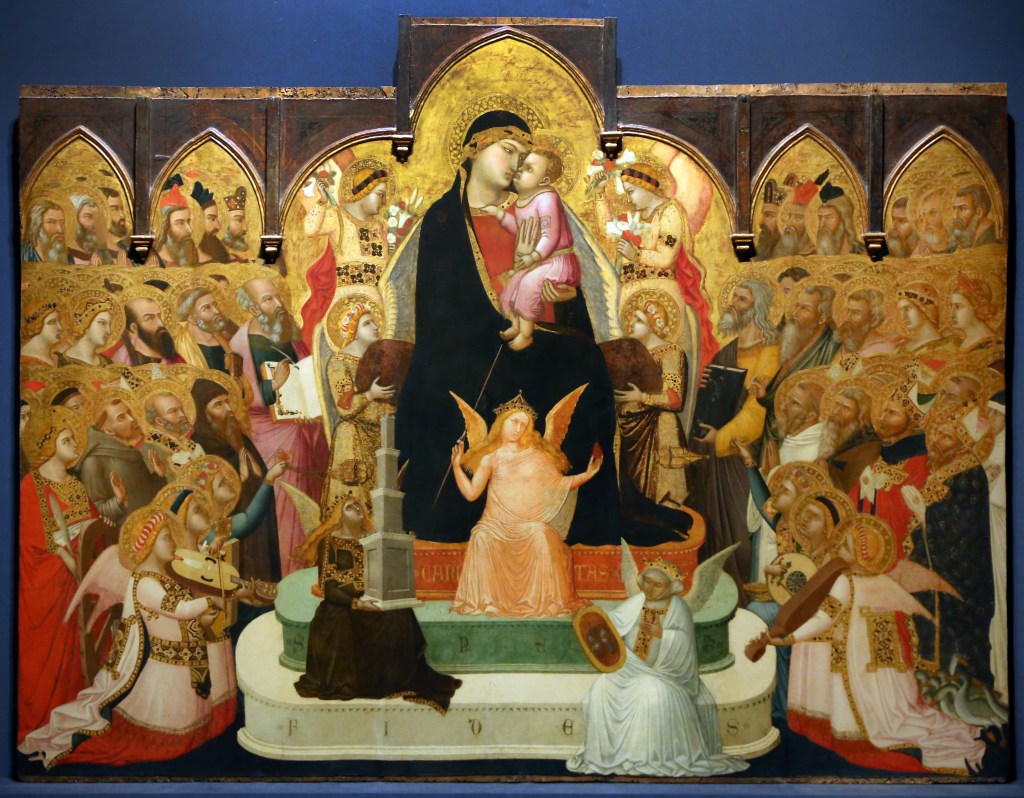
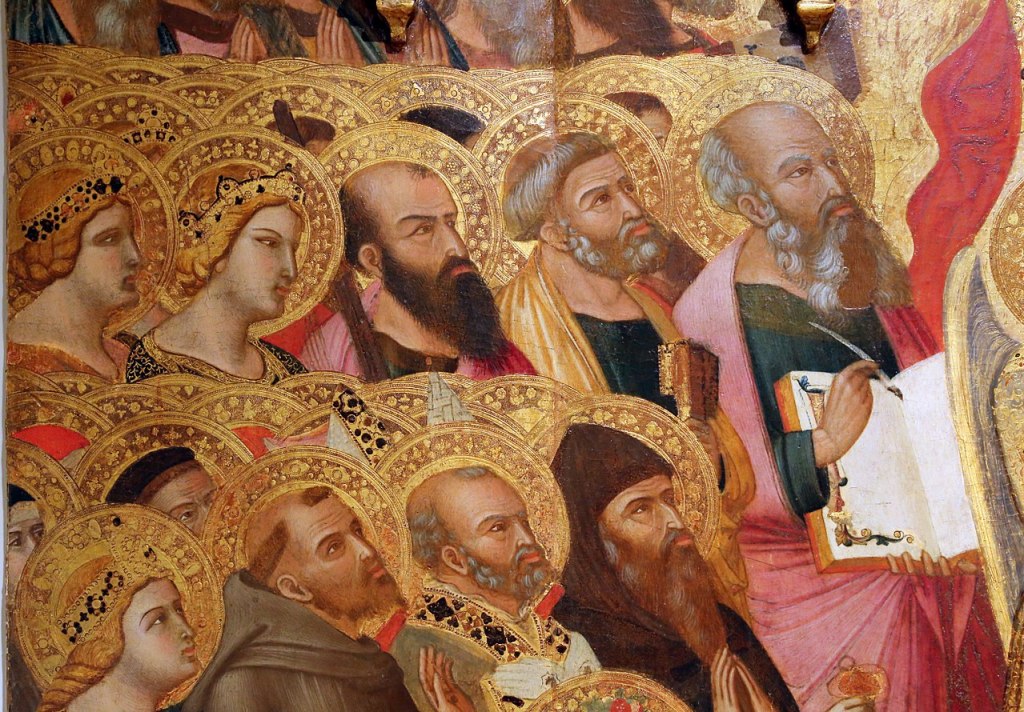
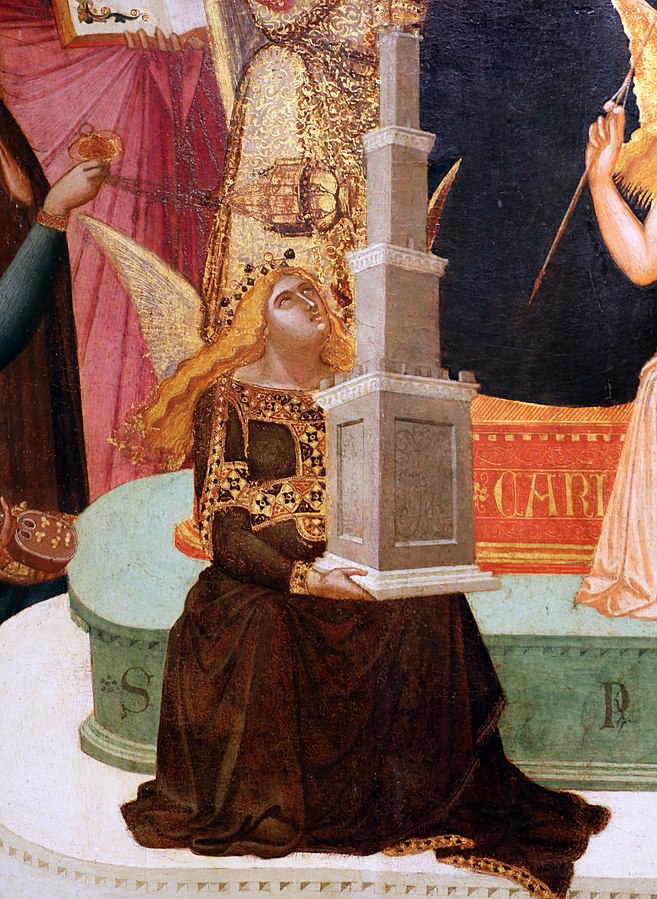
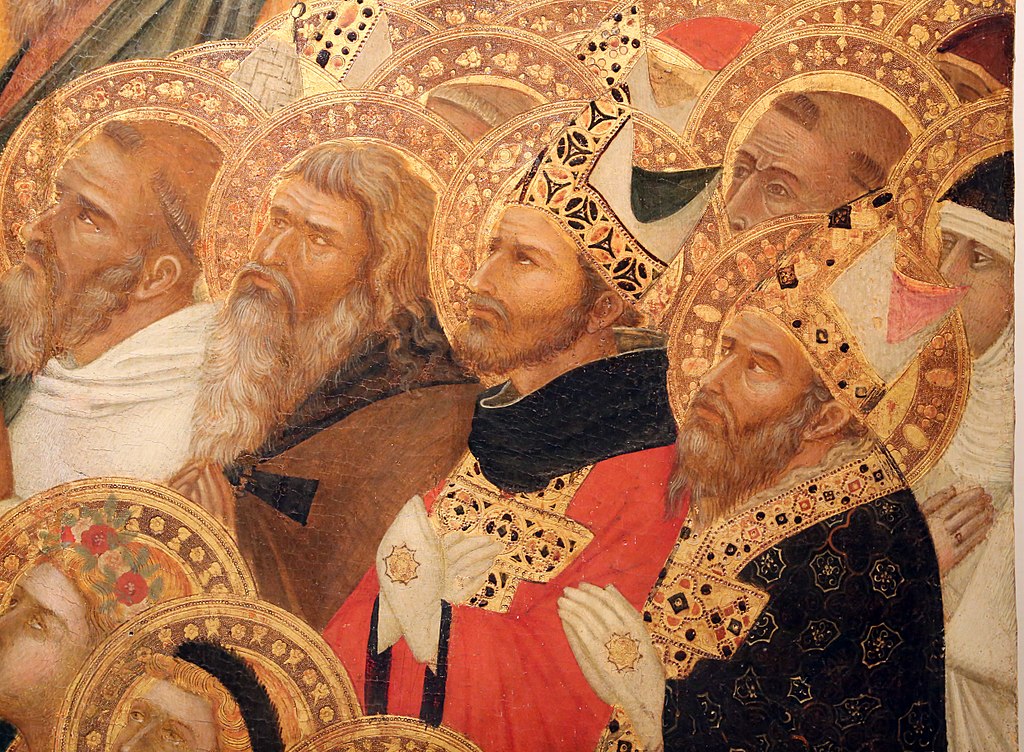
Ambrogio Lorenzetti, Maestà, c. 1335. Museo di Arte Sacra, Massa Marittima.

Siena: The Rise of Painting 1300-1350 at the National Gallery is undoubtedly the most beautiful exhibition I have seen for many years, and I can’t wait to tell you all about it this coming Monday, 24 March at 6pm. It charts, as the title suggests, the rise of painting to become ‘top art form’, taking over from the work of goldsmiths and enamellers which had flourished in the 13th century. As my recent talks have outlined, the exhibition ‘stars’ four main artists: Duccio, Simone Martini, and the brothers Pietro and Ambrogio Lorenzetti, although the exhibition includes much more besides. I will cover as much as I can this Monday, and then the following week (31 March) I will come back to Ambrogio Lorenzetti. As yet, I haven’t dedicated an individual talk just to him. Details about the subsequent talks, introducing exhibitions at the Courtauld (From Goya to Impressionism) and the National Portrait Gallery (Edvard Munch) will be posted soon in the diary.

To make up for the delay in talking about Ambrogio, I’m going to have a look at one of his paintings today. It is not in the exhibition, but I do hope to go and see it in Massa Marittima with Artemisia next year, as a daytrip during a visit to Siena itself. This is actually an entry I first posted back in 2021, about a year into the blog. As it happens, the fifth anniversary of the first post was yesterday.

Evidence about the two Lorenzetti brothers is scarce, although both were, in all probability, born in Siena (Pietro around 1280, and Ambrogio about a decade later). It is possible – but by no means certain – that they both trained with Duccio. Ambrogio spent some time in Florence, as did Pietro, who also worked in Cortona, Assisi, and Arezzo. It may well have been in Florence that they became familiar with the work of Giotto, whose naturalism and solid humanity influenced both brothers, although neither ever let go of the lyricism inherent in Sienese practice. They worked alongside one another on the façade of the Hospital opposite Siena Cathedral (although sadly these frescoes have not survived), and each painted an altarpiece for the cathedral as part of the elaboration of the themes of Duccio’s Maestà.  As there is no mention of either brother after 1347 it seems likely that both died during the Black Death. Today, I would like to look at the Maestà which Ambrogio painted for one of the churches in Massa Marittima, famous enough to have been mentioned by Vasari, but lost for centuries. It turned up in 1867 in the attic of the Convent of Sant’Agostino, where it had been split into 5 sections, and, although some of the altarpiece has probably been lost, to look at it today you would never know that for a while the panels were used as a bin used to clear ashes from a fireplace.

Maestà means, quite simply, ‘Majesty’, and as the title for a painting it implies the full majesty and splendour of the Madonna and Child enthroned in the Court of Heaven. Ambrogio pulls out all the stops, packing the firmament with more saints than you will ever have seen, and, for that matter, more than you could identify, or even count. They are arranged in three ranks, although precisely how this works physically is by no means clear. It could simply be that all the saints at the bottom are really short, although there could be three platforms on which they stand. However, apart from the six angelic musicians – three on either side – who are clearly kneeling, or the three figures sitting on the steps, it is not at all obvious what is supporting any of these people. But then, they are souls in heaven, so the question is immaterial, in more senses than one. You can see the front row of each of the ‘ranks’ of saints quite clearly, and this disguises the number of people who are present – until you look closer.

You might start to see that the halos overlap like waves, each ‘rank’ of saints being three or four deep. You might also realise that there is, actually, no throne. The steps are the only solid element. The cushion on which Mary is seated is actually supported by a pair of angels, whose inner wings are raised. The stone-grey feathers suggest the back of a throne – but there is nothing there. It is a matter of faith: you know there must be a throne, and so you believe it. At the very top, another pair of angels is preparing to scatter flowers in celebration of the Virgin, who is herself associated with so many different flowers, although the splendour and majesty is subtly undermined by the oh-so-human affection demonstrated by mother and child. They bump noses, slightly cross-eyed, and yet maintain what is, under the circumstances, an almost comical gravity. This is God made Man in a very real sense, and a detail to the left suggests that Jesus has only just been born: as yet, nothing has happened to write about.

John the Evangelist stands in the position of honour at the right hand of the throne (that is, on our left – although on the right of this detail). He is poised to write the opening of his gospel, ‘In the beginning was the Word’ –  but as yet the page is blank, apart from the illuminated initial ‘I’. His quill is held delicately between thumb and forefinger, all of the feathery bits removed as was the practice at the time. The beautiful and elaborate illumination is made up of scrolling leaf-like forms reaching down the left hand side of the left hand page of the otherwise empty spread, looking for all the world like the sort of decorated paper you can still buy in Tuscany today. Standing next to him is St Peter, with the keys to the Kingdom of Heaven, and then St Paul, sword held informally over his shoulder. Although the halos are gold leaf (would it be possible to count them?) his sword was silver, but it has tarnished to black. Behind and below these three most of the saints cannot be seen, let alone identified, but at the bottom left is St Catherine of Alexandria (see the full painting above for her wheel), and next to her, St Francis, in the brown Franciscan habit.

In the foreground, and forming the foundations and support of the spiritual throne, are three steps, each of which is a different colour, with a figure dressed in the same colour sitting on it. The white, green and red steps are labelled ‘FIDES’, ‘SPES’, and ‘CARITAS’ respectively – Faith, Hope and Charity. The three figures are personifications of the three ‘Theological Virtues’ which I first discussed back in April [2020] (see Day 42 – Some Virtues and Day 45 – Virtues, again…). The relevant biblical text is, of course, the first epistle of St Paul to the Corinthians, chapter 13, which ends with verse 13:

And now abideth faith, hope, charity, these three; but the greatest of these is charity.

Faith sit on the lowest step and holds her left hand to her chest while looking at a painting – or a decorated shield, perhaps? – on which we can see two faces looking left and right, both bearded, the former with a shorter beard. What we can’t see, hovering above the heads, is a dove – the Holy Spirit – but technical analysis must confirm that it was there, as this is identified as an image of the Holy Trinity, the very thing in which Faith believes. She wears a gorgeously fashionable, beautifully painted semi-transparent wimple, held in place with a crown. She also has gold work on her bodice for which the gold leaf was applied, then tooled (circular ‘punches’ of different sizes have been pressed, or tapped, onto the gold leaf to create indentations) and then, in part, painted. A pair of wings spreads out behind her, crossing the top, red step, which is delicately decorated. This is another way of using gold. In this case the leaf was applied to the panel, and the red painted over it. Much of the decoration you can see – including the ‘TAS’ of ‘CARITAS’ – was revealed by scratching away the red paint to reveal the gold underneath, a technique known as sgraffito – which, like modern-day ‘graffiti’, means ‘scratched’ (even if today graffiti is applied with a spray can).

Hope sits on the middle, green step. Unfortunately her robe has discoloured, and looks more brown than green now. Usually we would expect her to look up towards heaven, hands joined in prayer, but here she supports a tower, representing the Church. The image of the Virtues in this painting is derived from a 12th Century French theologian called Peter the Chanter.  Faith forms the foundation of the Church, Hope lifts it towards Heaven, and Charity, which St Paul says is ‘the greatest of these’, sits at the top, expressing the burning passion of the unqualified love of – and for – God.

An ethereal pink, rather than the richer vermillion of the step, Charity has a more spiritual feel than the other two, partly because she is all but monochrome, and partly because she lacks the naturalistic, contemporary dress of her companions. In her right hand she holds an arrow, or dart – more like the pagan Cupid, perhaps – and in her left, a heart, just as Giotto’s Charity does in the Scrovegni chapel (See Day 45) .

Colour symbolism is notoriously unreliable in art, but the common understanding that white, green and red stand for Faith, Hope and Charity is given its fullest and clearest exposition in this painting. It was this symbolism which led the colour combination to be so widely used – by the Medici in Florence, the Gonzaga in Mantua and the Este in Ferrara, for example. Raphael’s portrait of Pope Julius II (in the National Gallery) also uses precisely these colours: so many virtuous people. As for modern Italy – well, the tricolore was inspired by the French tricolore (different pronunciation!) Apparently the Italian press (or equivalent) had mis-reported the French Revolutionary colours as red, white and green (rather than blue), and the Italian nationalists adopted these instead – and stuck with them. Subsequently they have become associated with the Theological Virtues, although that was not the original intention. However it would have been driven home by reference to the Divine Comedy, for centuries the second most widely-read book in Italy. When Dante first encounters the semi-divine Beatrice, to him the paragon of virtue, towards the end of the Purgatory (Canto XXX, 28-33), she wears precisely these colours:

within a cloud of flowers which rose from the angels’ hands within and without, a lady appeared to me, girt with olive over a white veil, clothed, under a green mantle, with the colour of living flame’.

I can’t help thinking that, in Ambrogio’s Maestà, Charity looks like a ‘living flame’ – and that the angels at the very top of the painting scatter flowers in much the manner that Dante describes. Between Dante and Peter the Chanter, much of the imagery of this altarpiece can be explained. But how much of this would Lorenzetti have known? In 1347 he appeared before the Council of Siena and impressed them ‘with his words of wisdom’. So he must have been learned, a reputation which lasted long enough for Vasari to mention it in the 16th Century. But someone else must have suggested the elements to be included – and in particular, precisely which saints he should paint – although by no means all of them would ever have been identified. As yet, we do not know who that was. I shall leave you with one more saint, though, as it is one you have probably never seen before – and may never encounter again.

On the far right of the painting is a bishop in black. It is San Cerbone, the patron saint of Massa Marittima, and dedicatee of their cathedral: he is believed to have been the bishop in the middle of the sixth century. Once appointed to the diocese, his flock were soon disappointed because he always said mass at daybreak, which was far too early for most. After a while he was summoned to Rome to explain his behaviour to the Pope, and on the way he tamed a gaggle of wild geese with the sign of the cross. They followed him all the way to Rome, only flying off again when he made the sign of the cross a second time. He may have to do it again, though, as the geese have just rushed into the bottom right-hand corner of the painting. That’s how we know who this is.

This Monday, when I talk about the National Gallery’s glorious Siena exhibition, I will include the few images by Ambrogio Lorenzetti which are included, but will discuss his work as a whole – including his masterwork, the Allegory of Good and Bad Government – the week after. I do hope you can join me for either – or both – of these talks!

243 – Our most delightful Simone

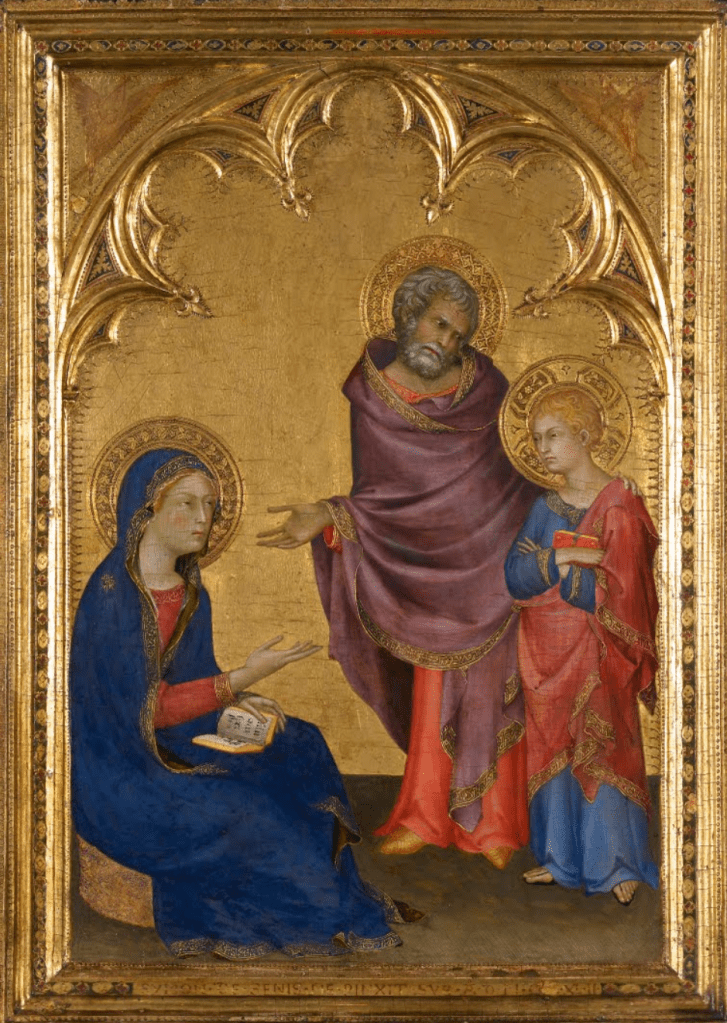
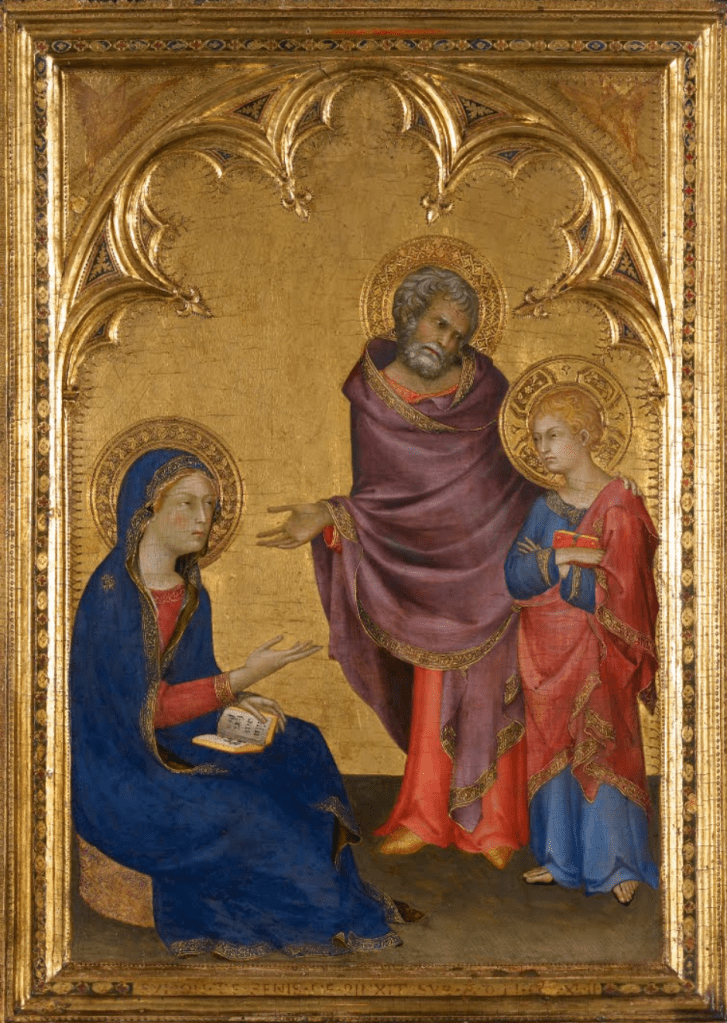
Simone Martini, Christ discovered in the Temple, 1342. Walker Art Gallery, Liverpool.

As an undergraduate studying the History of Art, I and my fellow students held Simone Martini in especially high regard, finding our developing vocabulary inadequate to describe the ineffable beauty of his paintings. We were incredibly lucky to have a great, local treasure, the panels showing three saints and three angels in the Fitzwilliam, a public museum which belongs to the University of Cambridge. I will, of course, talk about these panels when I look at Simone‘s work this Monday, 3 March, the third in my series of lectures building up to the National Gallery’s Sienese exhibition, even though, sadly, they will not make the journey into London themselves. There will be no talks the following two weeks: I have regrettably had to reschedule the talk about the fourth artist, Ambrogio Lorenzetti, to 31 March – apologies to those who have been trying to book in the interim. So the fourth talk in the series will be the overview, Siena: The Rise of Painting, on Monday 24 March. To be honest, this won’t upset the flow of the series too much, as Ambrogio turns out to be the least well represented of the four main artists in the exhibition. His greatest work is undoubtedly a remarkable secular fresco cycle, the Allegory of Good and Bad Government in the Palazzo Pubblico in Siena. A thorough exploration of these paintings will be a fitting conclusion to the series, as the frescoes help to explain the ideology which made Siena such an important centre of the arts in the first half of the 14th century.

Having celebrated Simone Martini as a student, I have had little opportunity to talk about him since. Apart from anything else, none of his paintings have made their way to the National Gallery in London. However, I have now been in Merseyside for a year and have a new local treasure (which also happens to be one of the best): the so-called Christ discovered in the Temple at the Walker Art Gallery in Liverpool. Having said that, it hasn’t been there for the past four months and won’t be for the next four either: it has recently returned from New York and will shortly be going on show in the exhibition in London.

I say ‘so-called’ because there are no signs of the titular Temple. What we do see is the Holy Family – Jesus, Mary and Joseph – engaged in a conversation which looks all too familiar, and familial, but not entirely happy. The painting was clearly a luxury object, the elaborate, engaged frame being both gilded and painted, with the flat gold background delicately tooled to enhance the framing and to create the resplendent haloes. Mary is seated on a gold cushion, while Joseph stands, his left arm on Jesus’s shoulder, apparently presenting him to his mother. The boy stands with his arms crossed, looking for all the world like a contemporary teenager – with the exception, of course, that he is wearing what the 14th century considered to be standard biblical clothing. I don’t doubt that the subject of the painting is related to the incident in which Jesus was discovered talking to the Elders in the Temple, but it would be worthwhile revisiting that episode so that we can see exactly how it fits in. The story can be found in the Gospel according to St Luke, Chapter 1, verses 41 – 52:

Now his parents went to Jerusalem every year at the feast of the passover. 42 And when he was twelve years old, they went up to Jerusalem after the custom of the feast. 43 And when they had fulfilled the days, as they returned, the child Jesus tarried behind in Jerusalem; and Joseph and his mother knew not of it. 44 But they, supposing him to have been in the company, went a day’s journey; and they sought him among their kinsfolk and acquaintance. 45 And when they found him not, they turned back again to Jerusalem, seeking him. 46 And it came to pass, that after three days they found him in the temple, sitting in the midst of the doctors, both hearing them, and asking them questions. 47 And all that heard him were astonished at his understanding and answers. 48 And when they saw him, they were amazed: and his mother said unto him, Son, why hast thou thus dealt with us? behold, thy father and I have sought thee sorrowing. 49 And he said unto them, How is it that ye sought me? wist ye not that I must be about my Father’s business? 50 And they understood not the saying which he spake unto them. 51 And he went down with them, and came to Nazareth, and was subject unto them: but his mother kept all these sayings in her heart. 52 And Jesus increased in wisdom and stature, and in favour with God and man.

So – Jesus was 12, an age at which a child knows what’s what, although we still wouldn’t feel safe letting them travel to a nearby city on their own. Consequently, as far as I’m concerned, the idea of travelling for a day before realising that your son was not with you is (a) almost inexplicable and (b) surely terrifying. And then to go back and not find him for three days… I can’t imagine. This time-frame must be relevant, though – three days until he was seen again, as if he had died, and come back to life… It must look forward to the resurrection. Having finally found him, Mary attempts to get an explanation. “Son, why hast thou thus dealt with us? behold, thy father and I have sought thee sorrowing”. Is Jesus contrite, ashamed, or even apologetic? No! In one of those slightly insensitive statements which he very occasionally made, he replies, “How is it that ye sought me? wist ye not that I must be about my Father’s business?”. I’m using the King James Version (published 1611) as I usually do, and find it interesting that when Mary says ‘father’ she says it with a small ‘f’, whereas when Jesus say ‘Father’, it is capitalised. It’s not something that Mary and Joseph could have heard, and I’ve always thought it would have been a real slap in the face for poor Joseph, the loyal stepfather, caring for Mary and bringing up somebody else’s Son. I’m also a little surprised that Mary and Joseph “understood not the saying which he spake unto them”, given that Mary had experienced the Annunciation, and Joseph had been blessed with an equivalent dream. However, it is notable that from this point on Jesus “was subject to them” – he clearly did as he was told – and “increased in wisdom and stature.” He grew up, in other words, both physically and mentally, and he presumably learnt how to deal with problems with more sensitivity and greater compassion.

Having reminded ourselves of the story, let’s have another look at the painting.

This is undoubtedly the right situation, but not the setting suggested by the title of the painting. We are not in the temple, as I said earlier, but then, there is no evidence where we are. Mary is seated on a very expensive looking gold cushion, on a nondescript floor. I suspect that, by removing the specifics of time and place, the story becomes more universal – and I wouldn’t mind betting that we have all experienced a similar situation, either with our own parents, or with our children. Let’s have a closer look to see how the details help us to read the narrative.
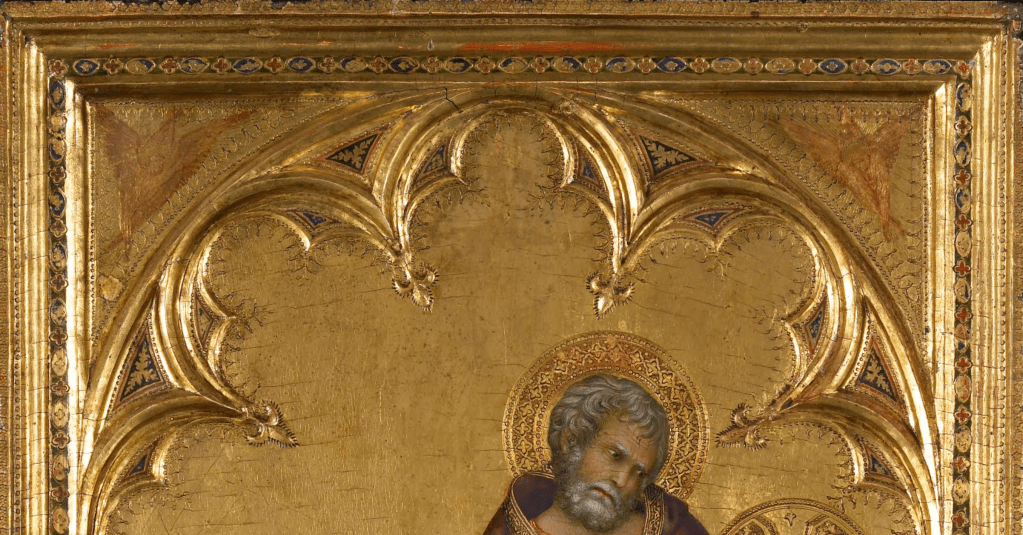
There’s not a lot to go on in this detail, admittedly, but it does help us to appreciate the material qualities of the painting as an object. The precisely carved, engaged frame includes a number of differently shaped and decorated elements. From the outside, going in, there are two flat sections, wider and narrower, with the inner one being carved in greater depth. Both are tooled with a repeating sequence of round forms. The next section has an undulating, wave-like profile, and contains another flat area tooled with ovals which enclose quatrefoils. These are alternately painted in blue and red. A projecting element frames this coloured border, and this curves down to the flat picture surface, after one final, thin strip. Inset within the top of the rectangular frame is a semi-circular moulding forming an arch, which is itself inset with five more semicircles containing further tri-lobed arches, with finials in the form of fleur-de-lis. Could this complex sequence of arches represent the Temple, I wonder? The spandrels to the top left and right of the main, round arch are painted with seraphim: six-winged angels’ heads. The thin, transparent paint allows them to glow, the light reflecting from the gold on which they are painted, their ethereal forms probably rendered more ethereal by some thinning of the paint over time – although there is little about this painting that suggests wear and tear. The seraphim, looking down from above, remind us that we are looking at a religious scene. They could also imply that, while absent from his earthly family, Jesus was nevertheless under the protection of the Heavenly Host – present, as he was, in his Father’s house. Joseph’s concern is all too clear. The tilt of his head to our right, and his eyes, looking in the same direction, speak of the attention he is paying his stepson, while the furrowed brow tells us he is worried. The grey hair, beard and eyebrows speak of his maturity.

Seen in relationship to Jesus – and a little closer in – Joseph’s expression might read another way. Concern, yes, but possibly a little disappointment too. Maybe even a little anger – it depends which eye you look at (emotions are so complex). Meanwhile, Jesus’s expression is very hard to read. From this detail alone we wouldn’t know what was going on, but having already seen the painting as a whole, we know that he is looking towards his mother.

Whatever Joseph’s expression says to you – and I think we all read expressions differently – there can be no doubt that the delicate placing of his hand on Jesus’s shoulder implies tender care, and the raised tip of the thumb, at the base of Jesus’s halo, implies that the boy has not been hauled into the presence of his mother by brute force, nor is he in any danger of running away. I could elaborate all the different elements of these two haloes, but I will leave you to look at them, differentiate between the forms from which they are constructed, and wonder at the number of different tools which must have been used by a highly-skilled goldsmith to make them. What I will point out is the cross in Jesus’s halo, which is just one of the things that tells us that this is indeed the Son of God. The gold on the hems is stuck on rather than tooled – it’s called mordant gilding. I love the way in which the patterning around the hem of Joseph’s cloak starts in front of his chest, curves down and then up to our right around his neck, emerging to curve up further before swooping down again across his chest, and leading to Jesus’s halo. This spiralling form seems to express the complexity of the relationship between stepfather and -son, and they way they are bound together. It also delicately frames the hem of Joseph’s red robe.

Isn’t body language eloquent? On its own Jesus’s expression wasn’t saying much, but with the crossed arms it speaks of mute refusal to communicate. Joseph’s subtle sway says so much, his head focussed on Jesus, the torso leaning towards Mary, led by the open offering of the hand – a gesture suggesting an opportunity to talk. Mary looks directly and clearly at her son, and gestures towards him just as clearly and directly, as if to take a welcome explanation. The hands are so important – Joseph’s and Mary’s outlined against the flat gold background, hanging unanswered in space, Jesus’s tucked away, ineloquent (and yet saying so much), Mary’s, resting on the open pages of her book, the thumb indicating the first word of the text…

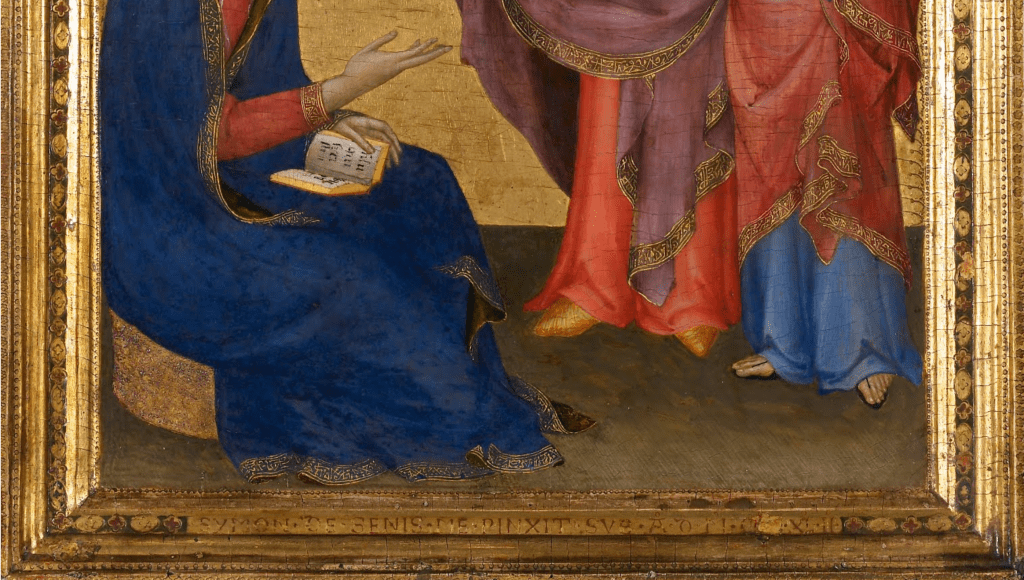
There is some distance between Mary and the men of the family – the gold, flat background seems to keep them apart. The men, on the other hand, are bound together not only by their physical proximity, and the way their forms overlap, but also by the echoing of their drapery. Jesus wears his traditional red cloak over a blue robe, while Joseph wears purple over vermillion. To my eye, the transition from vermillion to red, and purple to blue, results in a beautiful colour harmony. The lines, too, play their part: trace the patterns of the hems in your mind’s eye. The gold decoration falls along parallel, broken diagonals, and in both case the underside of the cloak, with no golden hem, hangs in a point at the bottom. The rise and fall of these fragments of golden embroidery remind me of a musical duet, with the melody rising and falling, shared between the two instruments – or the rhyming lines of a poem, perhaps. Maybe I am being overly imaginative, but Simone was friends with the poet Petrarch, who once described him as ‘our most delightful Simone’. He dedicated two of his verses to one of Simone’s portraits. I don’t think I’m going too far if I say that poetic beauty can be expressed in the fall of drapery or the echoing of hems. Simone also communicates through footwear, whether it is seen or unseen. Mary’s feet are completely hidden: she is a pure, respectable woman. Joseph, the most worldly of the three, wears ‘normal’ shoes, which are delicately hatched with the fine brushstrokes typical of egg tempera. Jesus, on the other hand, wears sandals. He would later tell his apostles to take no money with them on their travels, “Nor scrip for your journey, neither two coats, neither shoes, nor yet staves” (Matthew 10:10) – meaning no bag, no spare coat, no shoes and no walking stick. This text inspired the ‘unshod friars’ – members of a religious order who, following Christ’s exhortation, wore no shoes, or, at the most, only sandals. Even as a boy – who has, admittedly, just spent three days in his Father’s house – Jesus has already renounced contemporary footwear. At the bottom, running along the painted section of the frame, is the signature:

·SYMON·DE·SENIS·ME·PINXIT·SVE·A·D·M·CCC·XL·II·

“Simone of Siena painted me in the year of Our Lord 1342” – I can’t find any reference to the meaning of the letters ‘SVE’ though – if any of you are good at Latin (and in particular, medieval Latin inscriptions), what do you think?

What might seem to be most important for the understanding of this painting, though, is the book which Mary is holding, and what that text says.

Although worn, it is possible to read “fili quid fecisti nobis sic” which can be translated as, “Son, why hast thou thus dealt with us?” This is, of course, part of Luke 10:48, a quotation from the passage cited at the top of this essay. What we are witnessing is is undoubtedly the conversation arising from the discovery of Christ in the temple – but the biblical text only serves to confirm what we already knew. The sense of the painting, the ‘meaning’ of the narrative, is clear to the eye, given the eloquence of the imagery, the expressions, the body language… in many ways the image transcends the text. In one of his poems Petrarch said, ‘Simone must have been in Paradise…’ and at times, when he is not depicting a narrative, his heavenly style goes beyond words. No wonder our vocabularies failed us as students.

242 – Take a little space

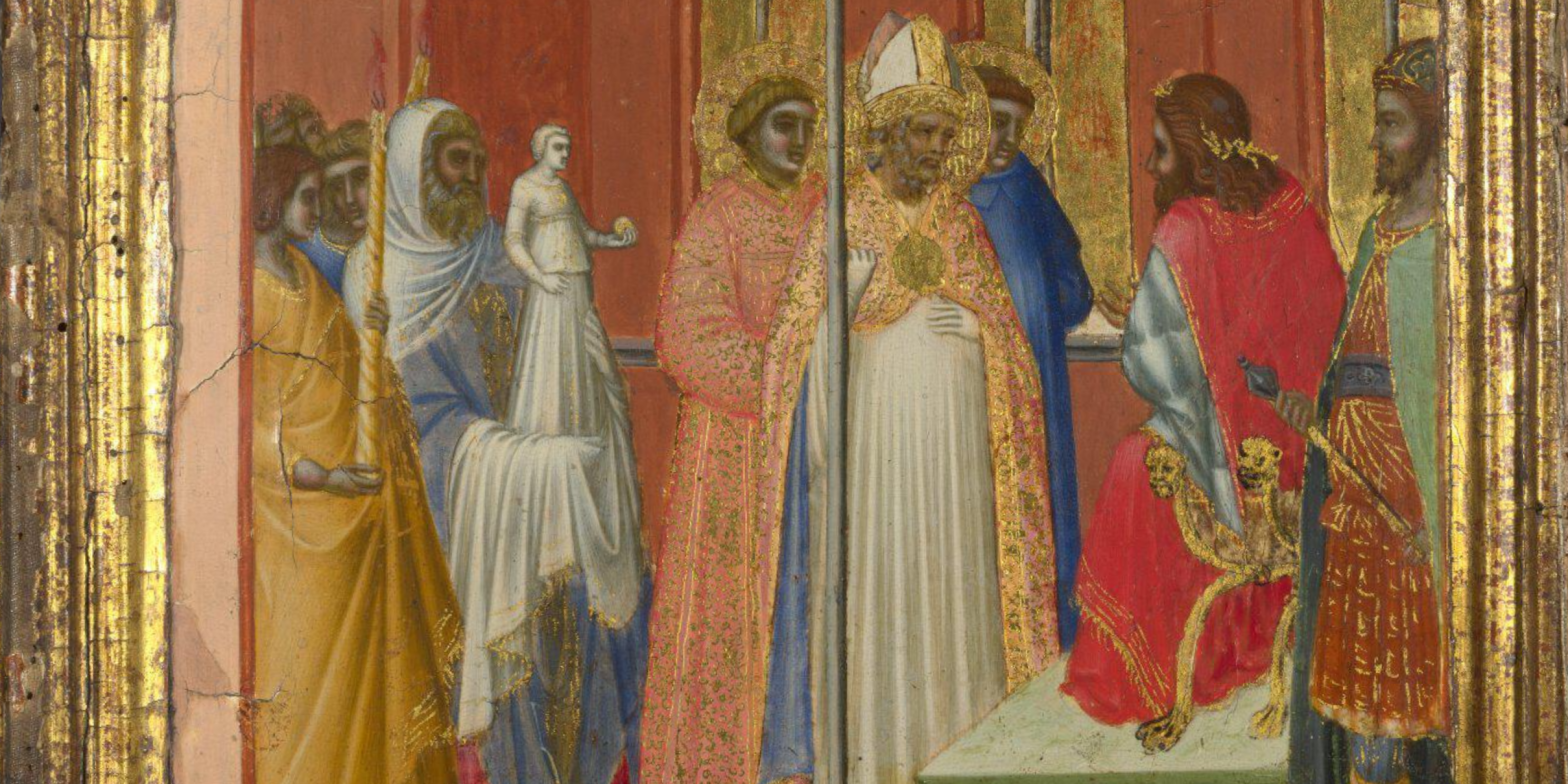
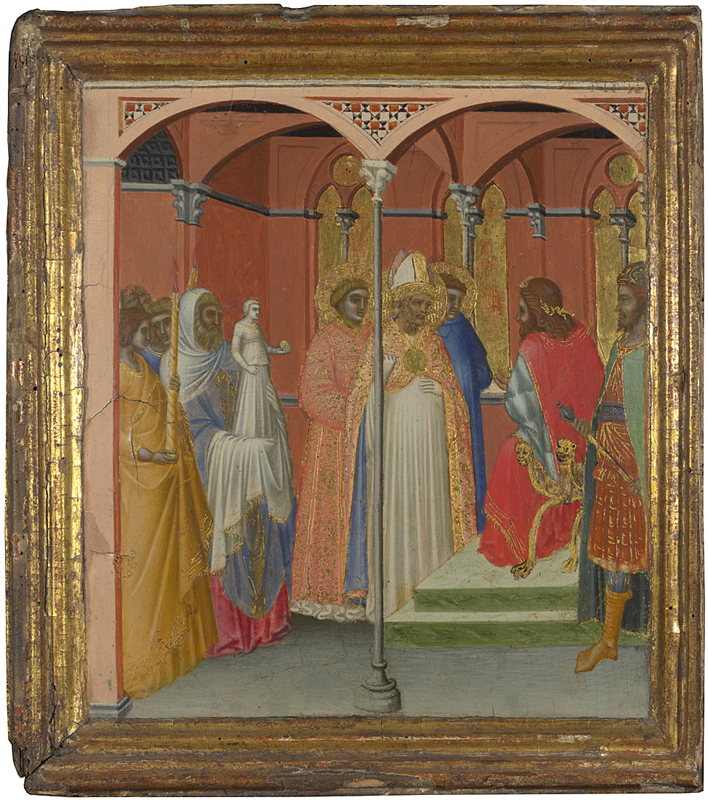
Pietro Lorenzetti, Saint Sabinus before the Roman Governor of Tuscany, 1335-42. The National Gallery, London.

It’s not long until Siena: The Rise of Painting opens at the National Gallery. I’ve already talked about Duccio, and now, after a week’s break (please do check the dates of the talks you are booking for!) I will continue my series celebrating the four main artists who form the focus of the exhibition. This Monday, 24 February at 6pm it will be the turn of Pietro Lorenzetti, and the third talk, looking at the wonderful Simone Martini, will be one week later (3 March). The week after I’m heading off to follow The Piero della Francesca Trail once more, so Ambrogio Lorenzetti will follow after another week’s break on 17 March, by which time the exhibition will be open. To round the whole thing off, on 24 March I will introduce the exhibition itself, with a ‘virtual’ guided tour which could either prepare you for a potential visit, remind you of what you have already seen, or make up for the fact that you can’t get to London…. Siena: The Rise of Painting explores the development and influence of painting in Siena in the first half of the 14th Century, and also includes works in a wide range of other media by contemporaries of the four artists and by future generations. When seen all together we will be able to decide if the curators are right when they assert that some of the major developments in Western European painting originate in this time and place. Spoiler alert: today’s post will suggest that, in one way at least, they definitely are… more will follow!

I have a confession to make. I have worked at The National Gallery in one way or another for around three decades, but I have not previously looked at today’s painting in detail. I suspect that it has not been on display a great deal, or, if it has, it has been ‘outshone’ by the Duccios (which have almost always been accessible), or something as unique as the Wilton Diptych… Let’s face it, we are incredibly lucky to have such a rich collection of medieval art in the heart of London. One of the things I love about writing this blog is discovering something new, or getting to know something that has lurked in the corner of my eye – like this painting, for example – and finding out that it is truly remarkable. I suspect that one of the things that has kept it slightly out of reach is the obscurity of the subject matter, but, as ever, close looking makes everything clearer.

We are looking at a relatively small-scale painting (33.7 x 33.2 cm), which suggests that it was either made for private devotion, or was part of a larger ensemble. The painting is surrounded by a gold frame, which appears to be the same width at the left, top and bottom, but a bit narrower on the right. As the frame is clearly old, slightly battered and with traces of woodworm, it could well be original (…it is), and as the right section of the frame is narrower, it might have been cut down from something to the right (…it was). The perspective of the imagery also implies that we are seeing it from the right, and is another feature which suggests that this was just part of something else. But wait a moment: Brunelleschi discovered, devised or invented single vanishing point perspective around 1415, and Pietro Lorenzetti almost certainly died as a result of the Black Death some seven decades earlier in 1348… so is this really perspective? Well, yes, it is a form of perspective, an approximation to the way in which we experience space, and a way of representing three dimensions on a two-dimensional surface: the Sienese really were that innovative. The ‘space’ in this case is defined as a large room with a double-arched opening on our side, and three windows at the back. Through them we can see the flat gold background typical of paintings of the time. A number of people are standing in the room, gathered around a seated ruler – but who (or at least ‘what’) they are will become clearer if we get closer.

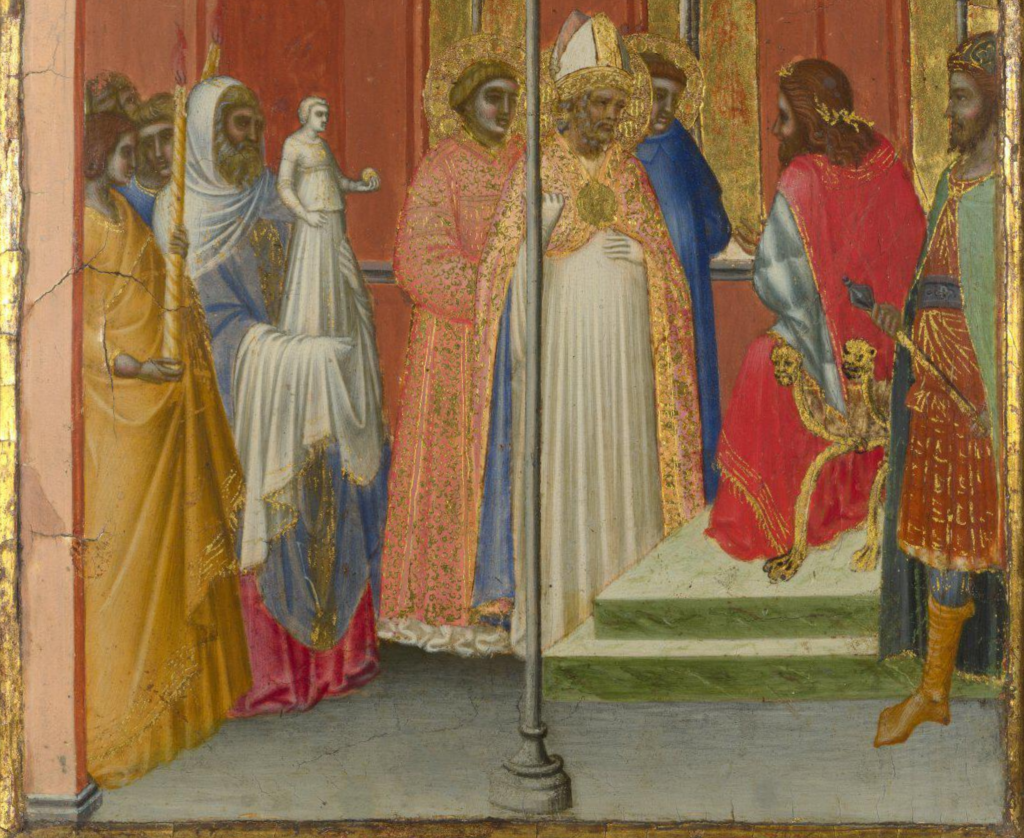
The three men on the left of this detail have haloes, so must be saints. The haloes are shown as flat circular disks of gold leaf, each punched with a ring of circles and stippled with small indentations to catch the flickering light of the candles that would have illuminated the painting. The man at the front wears a mitre, a two-pointed Bishop’s hat: this is St Sabinus, one of the four patron saints of Siena, who features in Duccio’s Maestà kneeling to our left of the central throne. He is believed to have baptised the first Christians in Siena way back at the beginning of the 4th Century. As well as his mitre he wears a cope – the semi-circular cape in a pink cloth of gold – which is fastened at the chest with a large, circular, gold morse. Both of these items confirm his status as a bishop, and, given that, back in the day, it was only bishops who baptised, this adds coherence to the story, even if Sabinus is supposed to have been beheaded in the year 304 at the tender age of 19. It should be pointed out, though, that ecclesiastical hierarchy and fashions were not the same in the year 304 as they would be a millennium later, but then Pietro Lorenzetti wanted to make this story comprehensible to his contemporaries. Behind Sabinus stand two deacons, named as Marcellus and Exuperantius. Deacons are minor church officials, ranking just below priests. The thick rings of hair around the bald crown suggest they have been tonsured (the hair on the top of the head has been shaved off), a sign that they have taken religious orders. Their robes are relatively simple in form, and have square-cut collars, which can be seen more clearly on the right – because the simple blue robe doesn’t have the rich patterning of the other (presumably worn by a more senior deacon – or one who was simply richer, or less humble). These are the robes worn by deacons. St Sabinus is slightly obscured by the slim column at the front of the room (Lorenzetti is trying to make this space look as ‘real’ as possible: it is almost as if we are chance observers of the narrative, physically present in the room). This colonette also hides his gesture: he is pointing back over his right shoulder with his right thumb, an unusual and seemingly very modern thing to do, but a gesture which the artist used often (as we will see on Monday). Sabinus is communicating something to the seated man, who leans forward, also gesturing with one hand. He is clearly interested in whatever Sabinus has to say, or trying to convince him of something. The seated man wears a red, fur-lined cloak (signs of royalty and of wealth respectively), and has a garland of golden leaves in his hair. Together with his seat, a gold, lion-headed faldstool, usually used to denote a ruler, we need have no doubt that this is the ‘Roman Governor of Tuscany’ mentioned in the title. He has his own bodyguard, standing to the far right of the image and partly obscured by the frame. The guard also wears red, which connects him to the ‘royal’ court, and also has a helmet and a mace – a heavy club with a spiked metal head – which he is clearly prepared to use. But what is Sabinus gesturing towards?

Another group of people enter from the left. One, with greying hair and beard, has his head covered with a shawl. He is carrying a white sculpture – presumably carved in marble – which depicts a woman carrying a golden, spherical object. He is not touching it though – his hands are covered by a white cloth, so that he does not sully what is clearly a revered object. This older man – some kind of priest, presumably – is flanked by two younger men each of whom carries a candle. Again, this shows us the regard in which the sculpture is held: we are witnessing a religious procession, of sorts. A fourth man follows, but we can only see the top of his head. Given that we are in Roman times we can assume that the sculpture represents a classical goddess. Lorenzetti has made the men treat it in the way that Christian priests might revere the consecrated host, but Christian priests did not dress like this, nor did they revere sculptures: that would be idolatry. This is Venus, goddess of love and beauty, holding the golden apple which Paris awarded her, thus recognising her as the most beautiful of the goddesses.

If we take a step back, the story might be a little clearer. Sabinus, looking suspiciously older than his supposed 19 years, has been arrested as a Christian, along with Marcellus and Exuperantius: the Edict of Milan, allowing freedom of worship, would not be issued until 313, 9 years after the traditional date for Sabinus’s martyrdom. According to legend, the Governor’s name was Venustianus. He gave Sabinus a choice: either prepare to die yourself, or sacrifice one of your people to the pagan gods. Accompanied by the two deacons Sabinus held off, and asked to have one of the ‘gods’ brought before them. Lorenzetti shows us the point at which the god – a sculpture of Venus – is brought into the audience chamber in procession. In the original story it was supposed to be Jupiter: Lorenzetti may simply be punning on the Governor’s name. This is as far in the story as the painting goes: we do not see what happened next. Sabinus and the deacons prayed, and then smashed the idol to pieces. Venustianus responded by torturing the deacons to death. Sabinus was allowed to live, though, and later was able to cure the governor of blindness. This inevitably led to the governor’s conversion, and, almost equally inevitably, to the martyrdom of both Sabinus and Venustianus. So, like all good stories, they both lived happily ever after – albeit in heaven.

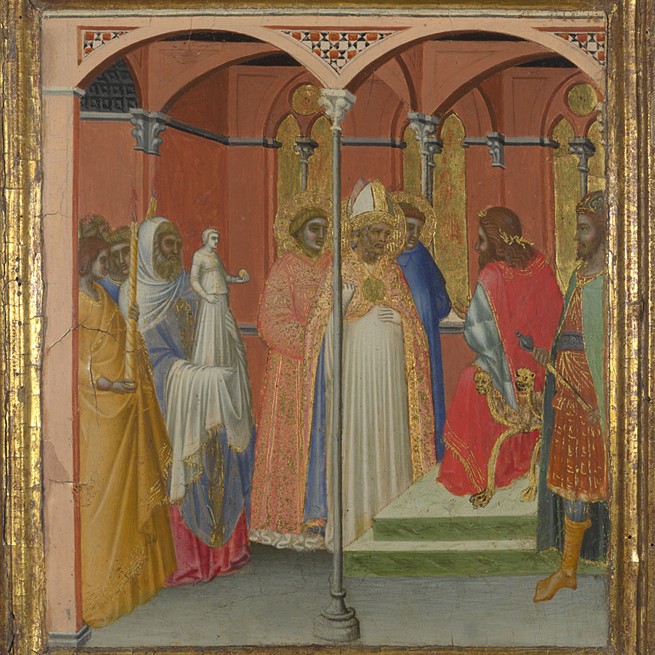
What I find remarkable about this painting is the complexity of the space which Pietro has created to tell the story. We are excluded by the arcade made up of a pink pier on the left and a slender column in the middle which support two very shallow arches (there is just a sliver of a second capital supporting the arch at the far right). The spandrels (curved, almost-triangular shapes above the arches) have shallow recesses, with shadowed edges, and are inset with mosaics created from triangles and squares of black, white and brick-red stone. The procession enters through a door on the left, the entrance passageway topped by a coffered barrel vault, the like of which can still be seen in the Basilica of Maxentius in Rome, or, in Pietro’s day, in the bronze roof of the Pantheon’s portico (it would be several centuries before Bernini had that melted down, at Urban VIII’s suggestion, to make the Baldacchino in St Peter’s). On the other side of the entrance is another arcade, beyond which is an empty side aisle. We could be in a side aisle, too – with windows behind us – leaving Sabinus and the other men in a central ‘nave’. The bishop and the deacon in blue are directly between two identical slim columns, with the one at the back just to the left of an equivalent colonette in the middle of the middle window. You will realise that I am talking in terms of church architecture, and this clearly isn’t a church, but if it were, then the Governor would in the position of the high altar, up a few steps. But this is exactly the structure of a classical basilica (such as the Basilica of Maxentius I have already mentioned – check the ground plan on that link), which takes its name from the Greek basileus, meaning ‘king’ or ‘monarch’. A basilica was a building in which you would have an audience with the ruler, and it was the form adopted by early Christians for the house of the King – the King of Heaven, in this case. However, the early Christians took away the monarch’s throne (in this case, the golden faldstool) and replaced it with an altar. I get a strong sense that Pietro Lorenzetti really knew what he was doing.

He brings the edge of the relevant space – the ‘nave’ – right to the bottom of the painting, with the base of the pier on the left and the column in the middle all but touching the frame. Apart from this the foreground is empty – as if we could step through the arcade and join the gathered assembly. The governor’s dais takes up the right-hand side of the space, the corner of the lower step just touching the colonnette. However, this is not the only way in which the painting is asymmetrical. There is no pier on the right, and the bodyguard is trimmed in half, cut off by the frame. My initial thought was, ‘this is just a fragment: the painting must have been cut down’.

However, I checked the exhibition catalogue, and in the list of exhibited works at the back it tells us that Pietro Lorenzetti’s Saint Sabinus before the Roman Governor of Tuscany is ‘Tempera on poplar, 37.7 x 33.2 cm (with engaged frame)’. I’ve told you the measurements before, but not they include the frame: this really is a compact pictorial field. And I didn’t say that the frame is engaged, meaning that it was attached before painting began. This tells us that the painting surface has not been cut down, even if the frame has (as we said, it appears to have been trimmed on the right). This really sparked my interest. It was a deliberate choice to paint the narrative asymmetrically. This helped Pietro to create a far more naturalistic space, with bold framing at the top and to the left. I find the slab of pink wall at the left of the image truly surprising, a large area of flat, featureless painting at the very front of the pictorial space. In itself, it is devoid of interest, but it serves its function perfectly, helping to create the space behind it, and to reveal the movement of the procession arriving from the pronaos, or vestibule. Throughout this small image the architecture is an active agent in the narrative. Enclosing Sabinus and the right-hand deacon between the two colonettes helps to give a sense of their captivity. The bodyguard is upright, his stance defined by the frame, and parallel – and equivalent – to the pink wall on the left. From this we get an idea of his strength, but his posture also makes the governor’s forward lean, his interest in Sabinus, all the more marked. And being cut off by the frame we again get the sense that the guard is located within a real space outside which we are physically present.

In 1317, just six years after Duccio’s Maestà was completed, the Sienese started to build a new baptistery down the hill from the Cathedral, and the choir of the Cathedral was extended above it. In the early 15th century a new baptismal font was commissioned, decorated by some of the leading sculptors of the day. Donatello modelled a relief of the Feast of Herod, completed in 1427, which I have discussed in two separate posts (see 154 – A Feast for the eyes and 156 – Second Helpings at the Feast) – you can see it on the right here. This is often credited with a photographic, ‘snap-shot’ naturalism, because one of the figures – on the far right – is trimmed by the edge of the relief. But Pietro Lorenzetti had got there almost two centuries before with his own dramatic scene which also occupies a complex space built up from several other interlocking spaces. The empty surface of the floor, leading us in, also performs a similar function in both images. Given that Pietro’s small painting was upstairs from the Baptistery – in the Cathedral – maybe this is where Donatello got his ideas from – adding in single vanishing point perspective, which he would have learnt from his friend Brunelleschi. As for the ‘ensemble’ that today’s painting originally belonged to… well, you’ll have to wait until the talk on Monday to find out – but it is one of the greatest paintings in the exhibition!

Double Duccio

Duccio, The Virgin and Child with Saint Dominic and Saint Aurea, and Patriarchs and Prophets, about 1312-15 (?). The National Gallery, London.

I first posted today’s blog just before I gave my first independent Zoom talk four years ago, on 8 February. And here it is, back again, to announce the first of my series about the glories of Siena in the 14th Century, Duccio, this Monday, 10 February at 6pm. I’ve also managed to pin down the subsequent dates. The second talk, Pietro Lorenzetti, will follow on 24 February, and the third, Simone Martini, on 3 March. These three are all on sale. The next two, Ambrogio Lorenzetti and Siena: The Rise of Painting – an overview of the National Gallery’s forthcoming exhibition – will follow on 17 March and 24 March respectively, and I will put those on sale – and in the diary – soon.

It’s always worthwhile taking another look at Duccio’s glorious triptych. It is a small devotional panel that could have been kept in pride of place in a bedroom, study or cell, or, for that matter, given the right members of staff, carried from place to place. On arrival at your destination, miles away from those you knew and loved, you could put it on a table, open it up, and, looking at the picture in front of you, speak to someone a long way away. As video artist Bill Viola pointed out some years ago, this is not unlike turning up to a hotel room, getting out your laptop, opening it up, and skyping your nearest and dearest. To be honest, I don’t think he said ‘skype’ as I don’t think that had been invented back then. And in any case it’s more like zoom. We’re clearly on Active Speaker view, with the Madonna and Child holding court, and thumbnails of patriarchs and prophets, also present at the meeting, lined up above. OK, so the saints on either side don’t quite fit this layout (it’s more like ‘gallery view’ with a limited number of participants) but you get the idea. This painting is about communication, and allowing the viewer to communicate with characters in whom they would have believed 100%, and who they would have believed were actively present and listening intently.

Duccio, The Virgin and Child with Saints Dominic and Aurea, about 1312-15 (?). Egg tempera on wood, 61.4 x 39.3 cm Bought, 1857 NG566 https://www.nationalgallery.org.uk/paintings/NG566

That doesn’t get away from the fact that it is a luxury object of the highest order. It would first require a carpenter to create the panels. There are three here – one in the centre, and two attached by hinges (not the original hiinges in this case, though). The panels would have been made, smoothed down, and the framing elements attached before painting began. The vertical and horizontal elements are carved out of wood, while the curving arch is modelled from gesso (see below): you can read the full details of the painting’s construction in Dillian Gordon’s admirable catalogue entry, which the National Gallery has posted online. Duccio’s workshop would then have prepared the panel with size, an animal-based glue, to stop the paint soaking into the wood, and it was common practice to cover the panel with canvas as well. This was then painted with gesso, made of gypsum (calcium sulphate), a bit like plastering a wall to make it nice and smooth (in the north of Europe chalk – calcium carbonate – was used, the choice of material being related to availability). Many layers of increasingly fine gesso would be added, and sanded down, before starting to paint. And even before that, any areas to be gilded – and there are many – would also need to be prepared by painting bole – a red, clay-based paint, often containing some form of glue – onto the gesso. This would show through the translucent gold leaf to make it look even richer. And finally the painting. Don’t worry about the expense of the gold – that’s very thin – the blue itself would have been more expensive, as it is the finest ultramarine. Derived from the semi-precious stone lapis lazuli, which, at the time, was only known in one source (modern-day Afghanistan) it was imported along the silk route and then over the Mediterranean – hence the name ultramarine: ‘from over the sea’. However, this is not what you would see of the triptych (a three-panelled painting) most of the time, as most of the time it would have been shut. I’ve never seen what this looks like, but the Museum of Fine Art in Boston has a triptych with exactly the same structure, and it looks like this.

The arched gable at the top is an additional panel, stuck over the panel bearing the main image, to make sure that, when the wings are shut, the painting as a whole is more or less flat. As a result, even when shut, the painting on the gable is still visible. The Boston example shows Christ in a mandorla, possibly representing the Ascension of Christ (or the Second Coming?). The central image is of the Crucifixion, meaning that the scene in the gable follows that seen when the wings are opened. In London, though, the order is different.

The figures gathered around the top are the ‘Patriarchs and Prophets’ of the modern title. There are seven of them, six of whom have scrolls. This in itself is usually enough to tell you that they are prophets, as anyone from the New Testament is far more likely to hold more modern technology, the codex (i.e. a book with pages you can turn), as opposed to an old-fashioned scroll (a book with one page that gradually unrolls).  The first reference to a codex occurs in the 1st century, and by the 4th there were as many codices as scrolls. This development is associated with the growth of Christianity, and so the symbolic division of scroll and codex between old and new testaments is entirely apt. What are the prophets prophesying? Well, the Virgin Birth, and the arrival of the Messiah on earth, naturally enough: prophesies which are realised by opening the wings. This is an interactive work of art, and the act of opening it up fulfils the promise of the exterior. The central image is King David – the crown tells us as much, but then so does the fact that his name is written next to him (or was, at least – some of it has worn away). Notice that he wears the same gilded blue and red as Mary: in the bible Joseph is of the House of David, and, according to the Golden Legend, so is Mary.

When you approach a set of double doors, do you ever hesitate, wondering which one might open first? Clearly the owners of this triptych had a similar problem.

Reverse of: ‘The Virgin and Child with Saints Dominic and Aurea‘ Bought, 1857 NG566 https://www.nationalgallery.org.uk/paintings/NG566

This may seem an odd statement, but both the Boston and London paintings have the same cunning ‘device’ – although in London (at least) this may not have been original, as early in its history the outside of the triptych was extensively repainted, possibly at the behest of the second owners of the painting. Nevertheless, above you can see the ‘back’ of the London painting when it is open. Each wing is decorated with geometrical patterns, five versions of more-or-less the same motif, a single large lozenge with four more small ones, one at each corner. At first glance each panel looks the same – but look closer.

Do you notice that the lozenges on the right are interlinked, but those on the left are separate? Well, if you want to open the triptych, you have to start with the wing where the lozenges are apart, and if you want to close it, you would start with the one where they are together. There is a rebate on the right-hand wing (as seen from the back), over which an equivalent rebate on the left-hand wing will shut, thus keeping the triptych closed.

Once open, this is the glory you see: Mary, as Queen of Heaven, in heavenly blue, and as ‘Star of the Sea’ (Maris Stella) – in ultramarine – with stars on her shoulder and forehead. There is a naturalness in the interaction of mother and child, a humanity of emotion, which is not common in earlier art – even if the appearance is anything but naturalistic. We are in a world of elegance and delicacy: her long, slim fingers are rendered longer and slimmer than is humanly possible, devoid of skeleton and articulation, as these would only get in the way of the decorative line. Mother and Child look into each other’s eyes, joined by their mutual gaze, and linked by Mary’s white veil. Jesus holds one end in his left hand, and grasps the hem, higher up, with his right, the crook of his arm echoing the flow of the fabric. He wears an almost-transparent tunic – we need to see that this is God made flesh – with a pale-Imperial-purple cloth wrapped around it, hems picked out by the thinnest line of sinuous gold – as are the hems of Mary’s blue cloak.

The Virgin may look a little off colour. The green faces of trecento Madonnas are well known, but are not what the artists intended (trecento means ‘three hundred’, and is the Italian word for the 14th century – the ‘thirteen hundreds’, to use the ugly modern form). Flesh areas were underpainted with a pigment called terra verde – ‘green earth’ – so that, when the flesh tones were painted on top they would have depth and life. Unfortunately, though, the pinks of the flesh tones have a tendency to fade – thus revealing the green underneath. Nevertheless, it has its own familiar charm – for me, at least. On either side we see angels, looking on in adoration. One prays, one holds his hands over his chest, but two seem to hold objects. Time has worn them away, but originally they would have held thuribles – the metal censers on chains that are swung to create clouds of ethereal odour during worship. The problem here is that, although it is possible to paint on top of gold leaf, the paint doesn’t always stick. This could have been a problem with the identification of the saints on either side.

One is well known, the other quite obscure. On the left we see St Dominic, the founder of the Order of Preachers – or Dominicans – wearing the habit of the order – a white robe and tabard, with a black hooded cloak on top. He holds a book in his left hand, to which he gestures with his right: these are the scriptures, which are to be correctly understood. St Dominic was particularly concerned with orthodoxy – the right belief – and so, with the defeat of heresy. The small, red, starred circle just to the right of his head is a reference to his godmother, who, when he was baptised, saw a star on his forehead which appeared to illuminate the entire world. It is a common attribute of the saint, and it is not unusual to see paintings of St Dominic with this star still firmly in place on his forehead. As for his companion – well, a female saint holding a cross is hardly specific…

It is just as well that Duccio painted the names of both saints onto the background. Even though that of St Dominic has all but worn away, his habit and the star tells us who he is. The other saint’s name has gone entirely. However, in this case the paint does seem to have stuck, and when it was brushed off, however that happened, it took the gold with it. What we can see, therefore, is a gap in the gold, revealing the orange bole underneath, and the letters ‘Au’, which, as if by some Divine Revelation, is the chemical symbol for gold. The very absence tells you what has gone. This is no mere coincidence, for this is St Aurea, the golden girl of Ostia, the port of ancient Rome. Because she was a Christian she was exiled there from the nearby capital of the Empire in the middle of the third century. When she refused to worship pagan idols a stone was tied round her neck and she was thrown into the sea. Inevitably she became the patron saint of Ostia, with a church dedicated to her. In 1981 excavations nearby discovered an ancient inscription reading CHRYSE HIC DORMIT – ‘Chryse sleeps here’ – chrysós being the Greek word for ‘gold’.

In 1303 a Dominican, called Niccolò da Prato, was installed as the Cardinal Bishop of Ostia. It therefore seems possible – as both St Dominic (Niccolò was a Dominican) and Saint Aurea (the patron of Ostia) are in this painting – that he commissioned this triptych. Another of Niccolò’s titular churches was dedicated to St Clement, and as the Boston triptych shows St Nicholas (his name saint) and St Clement on either side of the Crucifixion, it seems likely that he owned that painting too. With the infant Christ in one, and the Crucifixion in the other, they could have been used during different celebrations in the church’s calendar. Niccolò’s will, which was written in 1321, the year of his death, specifes that ‘three painted panels to be put on altars’ should be left to the Church of San Domenico in his home town of Prato. These could have been two of them (I’ll leave you to look up the Boston triptych for yourselves).

Whatever the origins of this painting, there is no denying its beauty, nor the refinement of the application and decoration of the gold. I will include it, with many more treasures, in the talk about Duccio on Monday…

241 – Vasari vs Veracity

Amanzio Cattaneo, Parmigianino surprised by landsknechts in his studio, 1854. Galleria Nazionale di Parma.

I am reaching the end of my series of talks examining all aspects of The National Gallery’s The Vision of Saint Jerome, and will conclude with a talk about The Sack of Rome this Monday, 3 February at 6pm. To tie in with this I want to look at a painting which has been used to illustrate the most dramatic moment in the painting’s history, when its completion was interrupted by German soldiers who broke into Parmigianino’s workshop in 1527. The talk will be subtitled Politics and Painting – and will cover both of those topics in precisely that order: what were the politics of the day which led to this devastating event, and how did it affect the history and art of Western Europe? As this concludes my Renaissance series – a re-birth for the new year – a new series will follow. I will take a step back to the middle ages, and revel in the unparalleled art of Siena in the fourteenth century, celebrating the National Gallery’s much-heralded exhibition: Siena: The Rise of Painting, which opens on 8 March. I will give individual talks dedicated to Duccio (10 February), Pietro Lorenzetti, Simone Martini, and Ambrogio Lorenzetti, and then bring these all together with an introduction to the exhibition as a whole, including the wonderful art and artefacts by other artists which will also be on show. I will post the dates as and when they are settled. Of course, you can always check on the diary

Back to today – or rather, the middle of the 19th century, which is when Cattaneo painted his typically romanticizing view of Vasari’s account of the events of 1527. We can see the artist himself seated in front of his tall, narrow painting. Girolamo Francesco Maria Mazzola (1503-40) became known as Parmigianino because he was the little artist of the family, the grandson, son, and nephew of a family of artists from Parma. However, Vasari always refers to him as Francesco. In the left foreground a woman in a red skirt and white headscarf holds a baby, and to the right a group of soldiers has entered the room in haste. The leader of the group, in the centre of the painting, holds back the others as they take stock of what they see. Parmigianino, who sits calmly in his chair, looks over his shoulder towards them. On breaking in they seem to have knocked over a stool – a sign, perhaps, of their haste – which has toppled onto a portfolio from which project a few sheets of paper – preparatory drawings, presumably. A curtain divides the main body of the room from what could be an entrance hall or lobby. The curtain is held back by another soldier, and there is more activity in the shadows. How well does this coincide with Vasari’s account?

If you didn’t know, it is possible to find the whole text of Vasari’s Lives of the Most Eminent Painters Sculptors and Artists online. This link will take you to the translation by Gaston de Vere which was published by Macmillan between 1912 and 1914, and specifically to the Life of Francesco Mazzuoli [Parmigiano]  – the spelling of his various names has developed over time. Vasari starts this anecdote by telling us that Francesco (Parmigianino) had been commissioned to paint a panel for ‘Madonna Maria Bufalini of Città di Castello’,

But he was prevented from bringing this work to completion by the ruin and sack of Rome in 1527, which was the reason not only that the arts were banished for a time, but also that many craftsmen lost their lives. And Francesco, also, came within a hair’s breadth of losing his, seeing that at the beginning of the sack he was so intent on his work, that, when the soldiers were entering the houses, and some Germans were already in his, he did not move from his painting for all the uproar that they were making; but when they came upon him and saw him working, they were so struck with astonishment at the work, that, like the gentlemen that they must have been, they let him go on.

This is exactly what Cattaneo has painted: the artist has not moved from his painting even given ‘all the uproar that they were making’. Although it is shadowy, you can see that there are at least three soldiers in the lobby – one, fully armoured, is crouching down, while others move around, perhaps searching for what they can loot. One figure either wears, or carries, a flowing red fabric, which could be seen as evoking the flames which were engulfing buildings elsewhere in the Eternal City. But that is all just noise in the background. Closer to us, one soldier is pushing back the curtain to enter from the lobby, and five are already present. One, with a helmet, shoulder pauldrons, and a breast plate covered by a slashed red doublet, is being held back by the man on the left of the group. This less impulsive man wears the same armour, but with a yellow sash rather than a red doublet, which may indicate some kind of authority. He has red breeches, and mustard- or buff-coloured hose. His sword is held up in his right hand in front of his chest – an almost involuntary gesture of surprise – while his left hand is extended to hold back the energetic man in red. The colour is telling – not only is the doublet red, but so are the breeches and hose. This is the colour of danger, impetuous anger, and blood. He reaches to draw his sword with his right hand, while his left holds onto its scabbard. My feeling is that it is he who has knocked over the stool, which lies with its red top towards us: the two are linked together by colour. Two more men wear helmets. One, in full armour, stands at the far right, wielding his sword low in his right hand as if to swing it, while another peers through the gap between the leader and the man in red. The fifth member of this group is little more than a boy, with a full head of hair, no beard, and no armour – although he does hold a pike in his left hand. He reaches through the gap between the two foremost men as if to touch the painting – or, maybe, to take the leader’s sword. It looks as if Parmigianino has only just realised they are there, so intent was he on his painting. He turns round and rests his left arm on the back of his chair, holding his palette, brushes, and a mahlstick in his left hand. His sleeve is green – notably, the complementary contrast to the red worn by the soldiers, so potentially illustrating that they have opposing views. The artist seems barely perturbed that these soldiers are there. They are called ‘landsknechts’ in the title – so what was a ‘landsknecht’?

This is an etching by Daniel Hopfer from the Art Institute of Chicago. Made around 1530 – three years after the Sack of Rome – it shows a group of Landsknechte. If anything, their dress is more outlandish that that painted by Cattaneo, although the puffing and slashing of the sleeves and breeches, and the double tying of the same, clearly has the same origin. The meaning of the word is confused by the ways it changed over time: it originally meant ‘servants of the land’ – they ‘served’ the land by fighting for it. But as pikes were one of their main weapons, it was sometimes written as ‘Lanzknechte’ – as in ‘lance’. Whichever way you interpret their name, practically speaking they were well-trained, well-armed and experienced mercenary soldiers, and the main force behind the Holy Roman Empire. If you know the Loggia dei Lanzi in Florence – right next to the Palazzo Vecchio – it took its current name from them: in the middle of the 16th Century Cosimo I had his German mercenaries stationed there. Their outlandish clothing was a ploy – apparently it was meant to strike fear into the hearts of their opponents!

So far, so good – Amanzio Cattaneo seems to have painted a convincing illustration of Vasari’s anecdote – which he could have heard first hand. Both Vasari and Parmigianino ended up in Bologna in 1530 (we’ll see why on Monday), and it seems likely that this account came straight from the horse’s mouth – along with everything else that Vasari wrote about ‘Francesco’. I must confess, though, I don’t know what interested Cattaneo in the story. He was born near Milan in 1828, and studied at the Accademia di Brera under Francesco Hayez. One Italian website implies that his work was made up of ‘historical subjects of a romantic stamp,’ and this painting certainly fits that description. However, that’s about as far as it goes – apart from the fact that he died in Genzano, about 30km southeast of Rome, in 1897. There is nothing else about him or his paintings on the internet – but he seems to have had no direct connection to Parma, or to Parmigianino. What is entirely clear, though, is that he had not seen Parmigianino’s painting.

Comparing his depiction of the work in progress with the painting itself, we can see that he has put the Virgin and Child at the top, with Jesus standing at Mary’s feet, and that there is a golden glow around the Virgin. However, it is she who holds the book – on her left knee – rather than Jesus (who rests it on her right), and the boy does not kick out one of his feet. At the bottom the two Saints are the wrong way round, but it’s not as if he’s been looking at a print, which would reverse the imagery. Both heads are at the same level and, even if Jerome has nodded off, with his head falling forward, he is certainly not lying down. While John the Baptist looks towards us and points up with his right hand, this is not Parmigianino’s elaborate invention. It’s not even as if we can blame Vasari’s description of the painting. When writing about the panel for ‘Madonna Maria Bufalini’ he says:

Francesco painted in it a Madonna in the sky, who is reading and has the Child between her knees, and on the earth he made a figure of S. John, kneeling on one knee in an attitude of extraordinary beauty, turning his body, and pointing to the Infant Christ; and lying asleep on the ground, in foreshortening, is a S. Jerome in Penitence.

What Cattaneo has painted is fine, and arguably a good interpretation of Vasari’s description – until it gets to Saint Jerome. Even if he is sleeping, there is no way the saint could be described as ‘lying asleep on the ground, in foreshortening’ – but, if you think about it, Parmigianino’s conception of St Jerome such an extraordinary idea that you really would have to see it to know what it looked like. And it certainly isn’t a ‘S. Jerome in Penitence’ as Vasari suggests. Cattaneo probably wanted to make sure that we could see the figure, and even identify him, given the red fabric propped up somehow behind him. However, aspects of the painting are right, even if not mentioned by Vasari: the golden glow surrounding the Virgin, and the clouds with which she is surrounded, for example. It is almost as if Cattaneo has read another description in addition to Vasari’s.

He does seem to have made a very specific choice about how he should represent Parmigianino himself. Cattaneo’s depiction of the artist looks remarkably like Parmigianino’s ‘Portrait of a Young Man’, which was acquired by the Uffizi in 1682. At the time it was identified as a self portrait, with the same identification appearing in print until 1773 at least. However, this idea has never really gone from the popular imagination, and it seems fair to suggest that Cattaneo held on to the traditional interpretation – with a slight trim to the beard, and a larger white collar to make the face stand out. Elsewhere, however, his romanticizing view of an artist’s practice in the 16th century is a little anachronistic.

Cattaneo implies that Parmigianino has painted the Virgin and Child from life models dressed in appropriate costume. The woman on the left wears a white headdress and blouse and a red skirt. Behind her, on the box or stool she is sitting on, is a mass of blue fabric. These colours are precisely those of the Virgin Mary in the painting on which the fictional Parmigianino is working. The model leans protectively towards a small child – a toddler – looking over her shoulder to keep an eye on the intruders and thus keep the baby safe. This little being looks helplessly over its right shoulder – not unlike the child looking over his left in Raphael’s Madonna della Seggiola. However, even in the 1520s it seems to have been remarkably rare for there to be female models – even if fully dressed – and it was even less likely that they would have been dressed in costume and posed with props (e.g. children) in the way that Cattaneo has suggested. This is far more redolent of 19th century practice, which serves as an important reminder that each painting is the product of its time. While the 19th century loved to romanticize the past, Parmigianino’s Vision of Saint Jerome really was created in the fervid period leading up to the Sack of Rome. But precisely why that happened, what happened, and what its consequences were will have to wait until Monday

240 – A mother’s grief

Raphael, The Deposition, 1507. Galleria Borghese, Rome.

I will be talking about Women as Patrons in the Renaissance this Monday, 27 January at 6pm, and so today I want to take a look at one of the most famous of the relatively few works of art which actually was commissioned by a woman. One of the things we will think about is why there were so few, the answer being, of course, ‘men’. It’s slightly more subtle than that, but not much. We will also consider how some women came to be in a position where they were able to act as patrons, and think about why they may have chosen to do so. The following week (3 February) I will talk about the origins and implications of The Sack of Rome in 1527, which had a lasting impact on the History of Art, not to mention Western European history. However, my diary still isn’t pinned down thereafter. What I want to do is to explore the remarkable artistic talent of 14th century Siena by dedicating individual talks to four of its greatest artists: Duccio, Pietro and Ambrogio Lorenzetti, and Simone Martini. This will lead up to an introduction to the National Gallery’s forthcoming exhibition Siena: The Rise of Painting which will open on 8 March. I may start this series on 10 February, but, if I’m honest, I’m so behind with everything at the moment I may leave it until later: keep an eye on the diary (or these posts).

The body of the dead Christ is carried by two men, its weight implied by the way they lean to left and right. Three other people look on behind, as if they want to help in this arduous task, but are unable to do so. To the right, three women look after a fourth, who has fainted. All this takes place against a delicate landscape, which includes a hill topped by three crosses to the right, a valley with a river and lakes in the middle, and a rocky outcrop at the left. The foreground is far more barren, when compared to the verdant pastures in the background. The complexity of the groupings, the subtle interactions of the figures, and variety of actions suggest that the traditional title of this painting – The Deposition – is not strong enough to bear the weight of everything that is going on.

The action is divided into two principal groupings. In the foreground, to the left of the painting, is the predominantly male group around the body. The corpse is, in itself, the single most important element of the painting. It is aligned along the foreground plane so that it is closest to us, and so that we can see its full length. Raphael has subtly contrived to have the two men bearing the weight standing behind it, with only their nearer arms crossing in front of it, and only a little, even then. The body is cradled on white fabric, which the backward lean of the bearers pulls taut, thus supporting the dead weight. The fabric continues over the left shoulder of the man in blue and billows out behind him, to our left. This extensive length of cloth will become the shroud in which Christ will be buried. On the far left is a dark cave in the rocky outcrop: this is the tomb which, according to the bible, belonged to Joseph of Arimathea. According to Mark 15:46, Joseph ‘bought fine linen, and took [Jesus] down, and wrapped him in the linen, and laid him in a sepulchre which was hewn out of a rock, and rolled a stone unto the door of the sepulchre.’ Steps lead up to the tomb, and the man in blue takes a tentative step back and up with his left foot, looking up as he does so, his face subtly showing the physical – and mental – strain of carrying the precious load. I have little doubt that Raphael had taken the idea of including steps from Michelangelo, who frequently used them to enhance the tension within the bodies he was depicting, creating more dynamic forms, and adding to the psychological complexity. There is also drama in the combination of the legs alone, enhanced by the rich and brilliant colours that surround them. From left to right we see red, blue, green and yellow. It is no coincidence that the right hand of Christ – with its dark red wound – hangs in front of a deep shadow where three of these colours coincide. A woman steps forward to get closer to the Saviour, her left hand supporting his left, and her right poised near his head. Her legs echo those of the weight-bearing figure on the right. He must be moving from right to left, towards the tomb, but has to lean back to support the weight – this contradictory movement helps to express the difficulty of the task. A man in green, with a yellow toga, steps up to the left, and at the top of the steps another stands, hands clasped, looking down at the body. We shall see who they are later.

On the right of the image, a little further away, is the group of women. One has fainted – she wears a purple dress and a blue cloak. It is, of course, the Virgin Mary, and while she is usually depicted in blue and red, Raphael often seems to have had his eye on some of the earliest images which survive. Mary was often depicted in purple – the colour of the emperors of Byzantium – up until the 13th century, and the use of purple here emphasizes her status. Later she was also depicted fainting, either on the Via Crucis – the road to the Crucifixion – or at the foot of the cross. This was known as Lo Spasimo, ‘the swooning’, and shows that she too, like Jesus, suffered for us, thus underlining her vital role in our salvation. Lo Spasimo is most beautifully and profoundly depicted by Rogier van der Weyden in his Descent from the Cross in the Prado. After the Counter Reformation the subject lost its currency, particularly given the statement in John 19:25, ‘Now there stood by the cross of Jesus his mother…’. She stood there, it says, she did not faint. The implication of Lo Spasimo was that Mary was neither mentally nor physically strong enough to bear the grief, and the Counter Reformation seems to have abhorred weakness: this episode is rarely depicted thereafter. Notice how one of the three women with the Virgin kneels on the ground, twisting at her waist to face the swooning Mary, thus adopting the spiralling form, or ‘figura serpentinata’ which became more common with the development of Mannerism. Again, only one artist could have inspired Raphael.

This is such a brilliant quotation it could easily be missed – if it weren’t so recognisable. In Michelangelo’s Doni Tondo the Virgin sits on the ground with her knees falling to her left, while she twists and reaches over her right shoulder to take the Christ Child from Joseph. Raphael’s figure is in a very similar position, although her arms are stretched out and up to take hold of the Virgin, and her hips are raised in accordance with this action. What I think is so brilliant about it is that Raphael has seen Michelangelo’s invention for the sculptural form that it is, and in his mind’s eye has taken a few steps around it and drawn it from a different angle. Michelangelo complained of Raphael that ‘everything he had in art he had from me’, but this shows that Raphael could use his own mind to complement, not just steal, Michelangelo’s vision. Intellectually this borrowing is also profound. In the Doni Tondo the Virgin reaches for the Redeemer, in the Deposition the woman reaches for the Co-Redemptrix (the feminine of co-redeemer). This was one of the many titles given to the Virgin, in this case stressing the vital role – already mentioned – which it is believed she had in our salvation. But who are the other women?

If we get closer we can see that all four have haloes – they are all holy – unlike the man who is carrying Christ, whose bright clothing and bold form grab our attention. We will come back to him, but for now it is worthwhile pointing out that his lean echoes Mary’s swoon, and that the green diagonal of his overshirt (which has an admittedly undefined relationship to the red robe) continues along the blue of Mary’s cloak, leading our eyes to her, and tying her into the composition. All four women are simply dressed, but dressed with great refinement – a sense of classic good taste. Well-cut clothes are complemented by minimal decoration in gold. The elaboration of the coiffures of the two on the right suggests that they have ample time on their hands, not to mention maids with nimble fingers. We are among the leading ladies of the society, and we’ll come back to that idea too. For now, it is worth quoting the whole of John 19:25 (I only included the first half of it above): ‘Now there stood by the cross of Jesus his mother, and his mother’s sister, Mary the wife of Cleophas, and Mary Magdalene.’ So, as well as the Virgin Mary, there was also her sister, Mary the wife of Cleophas. According to apocryphal sources, Mary Cleophas was actually the Virgin’s half-sister. Her mother Anne is supposed to have married three times, and to have had a daughter with each husband: the Virgin Mary, and two more daughters often known as Mary Cleophas and Mary Salome. But other Maries are also mentioned. Matthew 27:56 says that ‘Mary Magdalene, and Mary the mother of James and Joses, and the mother of Zebedees children’ visited Jesus’ tomb after his death. It would make sense that we are looking at these three women, given that the two mothers mentioned here are often identified as Mary Cleophas and Mary Salome. However, there is a slight problem…

The woman next to Christ with long, red hair flowing over her shoulder is undoubtedly Mary Magdalene (she too has a halo) – which makes the identity of one of the three women on the right uncertain. However, Luke 24:10 helps to resolve the problem. He explains that, ‘It was Mary Magdalene and Joanna, and Mary the mother of James, and other women that were with them, which told these things unto the apostles.’ So, it could be Joanna. Or one of the other women – Luke doesn’t specify how many there were: clearly quite a few. But what ‘things’ did they tell the apostles? Primarily, that Jesus had risen. I think this suggests that women were essential in conveying the message of Christianity… so why should there be any problem now with women priests? But let’s not get into that! At the ‘top’ of the grouping on the left is a young man with a halo, long hair and no beard – John the Evangelist, the youngest of the apostles, who had also been present at the foot of the cross according to the scriptures. Next to him in light green with a yellow toga is another saint (again, he has a halo). He is usually identified as Nicodemus, the man who brought precious spices to anoint Jesus’ body. However, it could equally well be Joseph of Arimathea, and some scholars suggest that it is. Nicodemus could be the man with the turban, although as he doesn’t have a halo, this seems unlikely… As so often, I need to do further research – but I suspect that it is not entirely clear anyway.

Jesus also has a halo – one that contains the shape of the cross, implied by the two curving forms at the crown of his head and by his right ear. A remarkable detail I had not noticed before is the pink colour of his loin cloth (but then, I don’t think I’ve seen the painting since it was conserved in 2019-20, and the colours of this photograph initially surprised me by their freshness). It reminds me of the Mond Crucifixion in the National Gallery, in which Jesus wears a red loin cloth – and again, Raphael was looking back to paintings from the late 13th Century, and making an allusion to the royalty of Christ as King of Heaven. The body shows the pallor of death, with the right hand hanging down – much as it does in Michelangelo’s Pietà. The left hand is supported by the Magdalene, and although the knees are bent, the feet do not hang lower – a sign of rigor mortis, perhaps? However, despite the pallor, I can’t help thinking that he looks asleep rather than dead. Of course, he will ‘awaken’. Images of the sleeping Christ Child remind us that he will wake up soon, and are symbolic of the later death and resurrection of the adult Christ. This is also hinted at in Michelangelo’s Pietà, which also has the head lolling back, the left shoulder tilted towards us and the left foot higher – thus making more of the body visible – so I can’t help but see Buonarroti as Raphael’s inspiration once more.

But who is the un-haloed bearer of Christ on the right? And what significance does the landscape have, if any? Well, ‘there is a green hill far away’ (to quote the hymn): Golgotha, on which stand three crosses. A ladder still leans against the one in the middle, and two centurions, one with a spear, stand there in contemplation and awe. But this painting is not a Deposition – the body must have been taken down some time ago. The crowds have dispersed and the body has been carried some considerable distance. It is also not quite an Entombment, as the group is not quite at the tomb. All present are lamenting, but it is not exactly a Lamentation either, in which the focus is on the dead body and the lamenting figures. It is, effectively, a combination of all three iconographies. The Galleria Borghese’s website even gives it an alternative title: ‘Deposition (The Carrying of the Dead Christ to the Sepulchre)’ a subject which is almost unprecedented. However, this is, more or less, the title of one of the National Gallery’s paintings by (surprise, surprise) Michelangelo: ‘The Entombment (or Christ being carried to his Tomb)’.

Whatever else it includes, today’s image is a painting of a dead man, and of a mother’s grief. That has led some people to identify the handsome youth bearing the body of Jesus as a portrait of Grifonetto Baglione, son of the patroness, Atalante. They were members of the family who ruled over Perugia, a city which tumbles across several hills high above the River Tiber, some way before it reaches Rome. And although the town perched on the hillside to the left of the young man’s head does not resemble any particular view of Perugia, it may well be intended to represent the city in some way. A track appears to lead from the brow of the young man, in between two ranks of trees, curving up the hill to the left, with a single traveller approaching the town below a prominent palace.

The story of the Baglione family is a complex one. Powerful and wealthy, it was not at peace within itself – and there were frequent struggles for dominance between two separate branches of the family. As well as being a member of the Baglione family by birth, Atalante was also the daughter of a countess, a remarkably high-ranking member of society – which may well have a bearing on the appearance of the Three Maries who accompany the Virgin. She married another member of the family, Grifone Baglione, who was killed in exile in 1477. Her son Federico, born shortly after his father’s death, took his nickname ‘Grifonetto’ from his father – ‘the little Grifone’ – and it is worthwhile bearing in mind that the griffin is one of the symbols of Perugia. As a young adult he was determined to take control from the more powerful branch of the family. According to the family chronicle, on 3 July 1500, together with other family members, he broke into one of the Baglione palaces to kill his cousin Giampaolo where he was sleeping. However, Giampaolo escaped, climbing out of the window and over the roof… On returning home Grifonetto’s mother Atalante refused him admission to the house, presumably angry and frustrated by the continuation of the feud. So he headed back into town – only to be killed by Giampaolo, or, others say, another cousin, Carlo. Grifonetto’s dead body was stripped naked and left on the street in full view of the people of Perugia, a sign of his ultimate humiliation. It was left to his mother, Atalante, and wife, Zenobia, to have him buried. He was only 23, but prior to his death he had gained burial rights in a chapel dedicated to St Matthew in the Perugian church of San Francesco al Prato. However, when Atalante came to commission an altarpiece for the chapel from Raphael some years later, she did not choose a subject relevant to St Matthew, but one telling the story of a mother accompanying the naked body of her dead son on the way to his burial – the relevance is only too clear. Originally there were also three predella panels showing the theological virtues, Faith, Hope and Charity, which are now in the Vatican Museum, and a painting above the main panel with God the Father blessing, which is still in Perugia, in the Galleria Nazionale dell’Umbria. All in all, the horrendous story is rendered acceptable to God, and the mother’s unimaginable grief – and guilt, having turned her son away from home – resulted in great beauty. But the criminal origins of the painting were followed – coincidentally, surely – in a criminal ‘coda’. Contrasting the way this is explained by the Galleria Borghese and Wikipedia is intriguing, I think. According to the museum, “The work remained in the Umbrian city for a hundred years, until one night, with the complicity of the friars, it was secretly smuggled out and sent to Rome to Pope Paul V, who gifted it to his nephew Scipione Borghese (1608).” However, Wikipedia suggests that, “The painting remained in its location until, in 1608, it was forcibly removed by a gang working for Cardinal Scipione Borghese, nephew of Pope Paul V.” Either way, I think it’s fair to say it was stolen to order…

At the bottom left of the painting we can see Raphael’s signature, ‘RAPHAEL · URBINAS · MCVII’ – ‘Raphael from Urbino, 1507’. This is inscribed next to the seed head of a dandelion. While the juice of the plant itself was used for its healing properties – a ‘salve’ that became symbolic of ‘salvation’ – all seeds resemble dead things. When planted, though, they give rise to new life. The seeds contain the promise of the resurrection of the body, not just for Jesus, but also, ultimately, Grifonetto – which, for his grieving mother, Atalante, must itself have been some kind of ‘salve’. I have said nothing as yet about how Atalante came to be a patroness, but I’m afraid I’ll have to leave that until the talk on Monday.

Bringing ‘The Resurrection’ back to life

Donatello, The Resurrection, c. 1460-65. San Lorenzo, Florence.

On Monday 20 January at 6pm I am going to try and answer the question What is Mannerism?. I hope this will put Parmigianino’s masterpiece, which I discussed earlier in the week, into a broader artistic context. However, it’s been one of those weeks, and as there hasn’t been enough time to write something new, so I’m bringing back a post from Easter 2020 when we were three weeks into lockdown. I’ll leave it exactly as it was (unless there are any typos), but will explain why I am re-posting this in particular at the end. The following week, as I continue to explore the world of Parmigianino’s The Vision of Saint Jerome, I will talk about Women as Patrons in the Renaissance, starting with the patron of The Vision, Maria Bufalini. We will consider what stopped women from commissioning more works of art and architecture, find out the situations in which they could, and try and work out if female patronage resulted in any specific qualities… The following week, 3 February, I am planning to talk about The Sack of Rome – but I’m going to wait until I know I am definitely free on that day until I put that on sale. As ever, keep your eye on the diary for that – and also for information about a second trip to see the Fra Angelico exhibition in Florence for anyone who found out that the first one is full.

Day 25 – Donatello, The Resurrection, c. 1460-65, San Lorenzo, Florence.

Happy Easter! And to celebrate: my favourite image of ‘The Resurrection’. Why this one, of all the possible examples? Quite simply, because it’s not easy: this is a hard won victory. And because it breaks all the rules.

Most versions of the Resurrection make it look effortless. Jesus springs forth without a care in the world, just like all good comic book escapes: ‘in one bound he was free’. Here again is Andrea Bonaiuti’s version, which I ended with yesterday (#POTD 24 [see also Easter! as I focussed on this painting the following year]).

CF541C The Resurrection, by Andrea di Bonaiuto, 1365-1367, Spanish Chapel, Basilica of Santa Maria Novella, Florence Italy

Two angels sit serenely on either side of the empty tomb, the soldiers sleep just as serenely on the floor, while the lid of the tomb looks as if it has toppled off, and is now lying where it fell, just behind the sarcophagus. Jesus floats effortlessly in the sky, the Flag of Christ Triumphant over his shoulder: it’s a red cross on a white background. No, he wasn’t English – but I’ll tell you about that another day. In other examples, the Resurrection is more explosive, with fragments of tomb flying in all directions. In yet more, Jesus appears above the still-closed tomb, apparently without even lifting the lid or disturbing its structure. Donatello sees it differently. This is hard work. He drags himself out, one foot on the edge of the tomb, grasping the standard with both hands as if he is going to use it to push himself up in that one final effort to escape the horrors of hell. He is still almost entirely wrapped in his shroud. Look back again at the Bonaiuti: as so often the shroud has been nonchalantly thrown round his shoulders as an improvised toga. For Donatello it clings to his limbs, wraps tight around his face, and slips off the shoulder with no hint of sensuality and every sign of inconvenience. And his face – this is the face of exhaustion – the face of someone at the end of their abilities. The suffering he asked his Father to free him from in the Garden of Gethsemane less than three days before is not yet over. One last push. Meanwhile, the soldiers sprawl on the ground, uncomfortable and unaware.

Like the pictures I’ve shown you over the past couple of days [back in 2020…], it is part of a larger whole. It is just one image on a pulpit which was erected for the first time in 1515, some fifty years after Donatello died. Even then it didn’t take the form in which we see it today. There are actually two pulpits in San Lorenzo, both of which were constructed out of incomplete elements left behind at Donatello’s death in 1466. They were finished by his assistant, Bertoldo di Giovanni. If we’re honest, we don’t know what these reliefs were intended for. They are probably connected to Donatello’s great patron, Cosimo de’ Medici – not the Grand Duke of Tuscany I mentioned yesterday, but the man who cemented the power of the dynasty in the 15th Century. He was awarded the title of  ‘Pater Patriae’ – Father of the Fatherland. This is the old Cosimo – Cosimo il Vecchio. He and Donatello grew old together, and, some say, they became friends. Cosimo is supposed to have commissioned work from Donatello to keep him busy in his old age, although he himself died two years before the sculptor. Cosimo was involved in a complete re-building of the local church, San Lorenzo, and was buried directly in front of the high altar. The theme of death and resurrection seen in the pulpits would be ideal for a tomb, and one suggestion is that these bronze reliefs were commissioned for Cosimo’s own funerary monument. Another suggestion is that there was a plan for the church which involved two pulpits from the outset. However, even though the pulpits have been given the same form, the shape and format of the imagery is different on each, and gaps have been made up with later work: they were not meant to be part of structures quite like this.

This scarcely matters for the consideration of this picture though. As you can see from the figure standing on the left, it is the continuation of a story – as it happens, the same story that we saw yesterday, ‘The Harrowing of Hell’ (#POTD 24). You might even recognise the figure on the right, with his camel skin and his long, messy hair and beard: St John the Baptist.

He is reaching out to Jesus, who is struggling through the souls in hell. Working his way across the space, flag already over his shoulder, Jesus will get there. He grasps the hands of one of the souls, while others reach out to him. There is none of the orderly waiting we saw yesterday: it really is hell in here, with people reaching, grasping, striving, each with their own particular need. And Jesus keeps wading through the dead. John the Baptist reaches out to give him a helping hand, to pull him on, towards the gate on the far side of hell, opposite the one through which he entered. Donatello uses four buttresses to structure the narratives on this panel, which now makes up one side of the pulpit. There is one at either end, and two in the middle, dividing the surface into three: John the Baptist stands in front of the second from the left. These buttresses are shown in a rough perspective, as if our attention were focussed on the centre, on the Resurrection. 

Going from left to right the first three buttresses all have apertures in them, presumably doors. Jesus drags his way through hell, where he will step through the door behind John the Baptist. It is from this door that he hauls himself up, out of hell and onto the sarcophagus. Or rather, he will – he hasn’t done it yet. The perspective of the buttresses is centred, and implies that the focus of the relief is in the middle of the sarcophagus, where the two arches meet. This point is marked by a trophy, made up of a shield, two spears and two helmets, the sort of trophy used, typically, in monuments celebrating a victory. Jesus hasn’t got there yet. He won’t truly triumph over death until he makes it up onto the tomb, and stands, full height, in the centre of this relief. He’s nearly there.

That’s what I love about this version: it’s so original. So unexpected. Not only that: it goes against every single idea we have about this era. The Renaissance, or at least the Early Renaissance, developed a sense of order, clarity, and balance, making images that look more like the world we live in and experience, with accurate anatomy, naturalistic scale and a measured perspective. In relief carving – or modelling like this – this was achieved by giving the foreground figures higher relief than those further back, the relief gradually getting flatter as things get further away, with some details in the background being effectively drawn in. In all cases, the space depicted is imaginary, not real. But not here! We can see this clearly in the next story that Donatello has included: the Ascension. This bit of the narrative won’t happen for another 40 days – but nevertheless, here it is.

Jesus is in a tightly crowded space, surrounded by thirteen other people. The Virgin Mary, with her head covered, is just to the right of him, and to the left of her is probably John the Evangelist: young, and beardless, with flowing hair. And the other 11? Well, the remaining Apostles, although by this stage Judas was dead. The new 12th Apostle was St Matthias, and he must be here, even though, according to the Bible, he wasn’t appointed until just after the Ascension. The figures are corralled in by a fence, which stands free of the rest of the sculpture – you can see its shadow cast on the figures behind. This isn’t imaginary space Donatello has created, this is real space, and there are far too many people crowded into it: no order, no rationale, but, instead, expression. Indeed, you wouldn’t really get anything else quite as ‘expressionistic’ as Donatello’s late style until the early 20th Century. Not only are the figures crowded too closely together, but it is also hard to see their relationship to the floor of the room. Donatello is manipulating the space, and manipulating the movement of the people in it. As they gather around Jesus, they emphasize his upward movement, while also making way so that we can see more of him, from his knees to his halo. Tiny angels help him upwards – another unprecedented feature: in most versions he can do this on his own. As it happens, he cannot leave any other way: the buttress on the far right is the only one of the four with no way out. As we saw yesterday, the only way is up. 

He is so much larger than the other figures. So much for proportion and perspective! In this case, size doesn’t tell us where he is, but how important he is. Donatello has returned to a medieval hierarchy of scale, where size is equivalent to status. And not only that, on his way to Heaven, Jesus is physically leaving the picture space, head and shoulders above the frieze marking the top of the wall, his head and halo standing free from the background, solid and sculptural. Look back at the Resurrection, though: this escape from the bounds of the picture frame started there.

As Jesus progresses from left to right, from the ‘Harrowing of Hell’, through ‘The Resurrection’ to ‘The Ascension’, he gets bigger, and higher, and the relief gets increasingly deep. In ‘The Resurrection’ his head is already above the arches, with his halo in front of the circles of the frieze. And by the time he gets to the Ascension, both head and halo are clear of the frieze altogether. Jesus has left the building. Or he will do, in forty days.

In the meantime, Happy Easter! We are still in the middle of it all. Maybe we are not yet quite in the middle, we’re still waiting, but we’re getting there. It’s not easy, the last step – and who knows when the last step will be? But we will get there, and before too long we will also be able to go out. That might even be within the next forty days.

[Reading this again, it is clear that we really were still in the early days of Covid. This was Picture of the Day 25, the end of the third week of lockdown. By the time I got to POTD 100 museums were starting to open up – but they hadn’t in time for the Feast of the Ascension that year.

But why repost this now? Well, as I said, the bronze reliefs, whatever they were for, were finally erected as pulpits in 1515. No one had ever seen the like before – and they seem to have had a profound effect on the artists of the time. It has been suggested they are one of the sources of the overpopulation of imagery which is one of the key features of Mannerist art – but we’ll think about that more thoroughly on Monday.]

239 – Saint Christina of Bolsena!

Luca Signorelli, Virgin and Child with Saints, 1515. The National Gallery, London.

This Monday, 13 January I will be talking about the National Gallery’s superb, small-scale exhibition Parmigianino: The Vision of Saint Jerome, expanding on what is on display with reference to the superb and thoroughly researched catalogue. Earlier this week, while talking about the history of images of The Virgin and Child, I briefly mentioned how the format of a painting has an effect on its composition. While I was trying hard not to discuss every illustration in detail (and apologies to those of you whose questions I did not have time to answer) I made the mistake of trying to identify all the saints in an altarpiece in the National Gallery which I don’t know very well – and failed. Thank you to all those of you who ventured valid suggestions, but it turns out to have been a saint I don’t remember having heard of before: Christina of Bolsena. This has prompted me to get to know the painting better today – giving a few hints as to its relevance for the Parmigianino on Monday. The following week (20 January) I will pick up on the style of The Vision of Saint Jerome by asking the question What is Mannerism? and on 27 January I will pick up on its patronage by taking a closer look at Women as Patrons in the Renaissance. I’m fairly sure that the week after I will talk about the origins and implications of the Sack of Rome – which is directly relevant to Parmigianino and his masterpiece – but I might change my mind: keep an eye on the diary!

Today’s altarpiece was painted by Luca Signorelli, and is of a format which became popular in the second half of the 15th century – the pala, which is a single, large painting on a unified field, and therefore different from a polyptych, an altarpiece made up of many different panels, each surrounded by a framing element. The name is derived from the Latin word for ‘cloak’, pallium, and is related to the various fabric drapes with which altars were adorned at different points in the church’s history. The simplest description of the subject matter of Signorelli’s painting would be ‘The Virgin and Child with Saints’ – like so many others – but the 16th century became increasingly inventive with the distribution of the figures across the pictorial field. One of the reasons behind this can be explained by comparing Signorelli’s pala with one of my all-time favourites, Bellini’s San Zaccaria Altarpiece, which is still in the eponymous church for which is was painted.

Both show the Virgin and Child with four saints, and both are examples of renaissance naturalism. While Signorelli locates his figures in the countryside, Bellini’s stand in a form of projecting loggia, roofed, but open to the air on either side. Our eye-level, as defined by the horizon, is about one third of the way up the painting in each, and both altarpieces have saints at far left and right standing on the ground. Indeed, all of Bellini’s saints are at the bottom of the painting, with the Madonna and Child enthroned in the middle, the throne raised on several steps, with the horizon (our eye level) coinciding with the position of Mary’s feet: we look up to her. Nevertheless, the top half of the painting is occupied by architecture, with little or no narrative or religious content. This is nevertheless an important aspect of the painting. Seen in situ, the frame of the altarpiece has the same architecture as that depicted in the painting: the arches you can see receding to the back wall theoretically spring from the entablature which also supports the arch of the frame. It makes it look as if the sacra conversazione (‘holy conversation’) is taking place in a chapel built out from the church, implying that we are in an adjoining space. It helps to make the characters look more real and immediate, thus making it more easy for us to believe in them. However, arranging them like this does limit the scale of the figures: Bellini has to fit five human figures across the width of the painting with the result that they take up about two fifths of its height (40%).

Signorelli, on the other hand, does not have all of his figures standing on the ground. Two do, and another two are poised on clouds, framing the Madonna, who is also seen in the sky. As a result, the figures can be broader, and, keeping them in proportion, also taller: they occupy about half the height of the painting (50%). Signorelli was not the only artist to do this. One result of the use of perspective – whether it is the linear, single vanishing point version employed by Bellini, or the atmospheric version out in the countryside of Signorelli – is that people, restricted to the ground, will leave the top of a portrait-format painting empty. By accepting that holy figures are not necessarily earthbound, artists could either make the saints bigger or include more of them. Parmigianino was given a more extreme challenge when commissioned to paint an altarpiece which was not only tall (nearly 3.5 m), but also relatively narrow (1.5m) – and we’ll see how he dealt with that on Monday. But how does Signorelli resolve the challenges of his commission?

Two of the saints stand on the ground, as we have said. On the left is St Jerome – there is no lion, I know, but he is dressed (anachronistically, as it happens) as a cardinal, with a long, red, hooded robe and a book resting open on his right hand. There is also a piece of paper in his left. He was known as a scholar, the translator of the bible from its various languages into what became known as the Vulgate, and the author of many essays as well as a regular correspondent – as a cardinal with a book and (probably) a letter, we don’t need to doubt that this is him. On the other side is a bishop. He is wearing a mitre (a hat with two points, effectively) and a cope (a large cloak) which is clasped below the neck with a morse. He carries a crozier, derived from a shepherd’s crook, which symbolises his care for his flock. He also carries a book, presumably also the bible, which does not necessarily help us to identify which bishop saint this is.

However, at his feet are three gold balls, representing the gold which St Nicholas of Bari threw through the window of an impoverished nobleman’s house as each of his three daughters reached marriageable age. This provided them with dowry, allowing them a respectable marriage, and meant that they would not have to resort to prostitution. St Nicholas, of course, eventually became Santa Claus, who is also associated with gift giving… To the left of this detail we see St Jerome’s broad-brimmed red cardinal’s hat, complete with its long tassels. Seen in this detail, it is more obvious that Signorelli has made the hem of his red cloak, falling across the ground, echo the disc-like form of the hat. In between these two attributes is a lengthy inscription, telling us, roughly speaking, that,

The outstanding work that you see was commissioned by the master doctor Aloysius from France and his wife Tomasina, as a result of their devotion, and at their own expense, from Luca Signorelli of Cortona, a famous painter, who brought forth these forms in the year 1515

The patron ‘Aloysius’ was indeed a French doctor, Louis de Rodez, and one of the terms of the contract was that Signorelli and his family would receive free medical services whenever – and wherever – necessary. Apart from this, the artist was not paid. The altarpiece was painted for a chapel dedicated to St Christina of Bolsena in the church of St Francis in the Umbrian town of Montone.  This explains why one of the saints depicted is the relatively obscure (as far as I am concerned) Christina… but we’ll come back to her. Let’s keep our feet on the ground for the time being.

With two saints on the ground, standing to the left and right, it leaves Signorelli space for a fantastic landscape in the middle – and the details are truly delightful. To the right we see the edge of St Nicholas’s robes, and in particular one end of his embroidered stole. It is patterned with a series of niches occupied by standing saints. In the one we see here the knife in the man’s hand tells us that this is St Bartholomew. I’m guessing that all the others are apostles too, as St Peter, holding the keys of heaven, is at Nicholas’s left shoulder, partially hidden by the crozier. In the landscape we can see a broad meadow leading down to a lake. There is one walled town to the right, next to the lake, and two more on the left, each one smaller and fainter according to their distance. At the bottom of this detail are two Franciscans in their typical brown habits who appear to have taken a stroll, to appreciate the wonder of God’s creation, and to contemplate in relative solitude. Either that, or they are travelling from one preaching opportunity to another. They have both hitched up their skirts (Signorelli painted the altarpiece over two summer months – it would have been hot) and one has sat down. Both have large red books – the bible, or a prayer book, presumably. Their inclusion is undoubtedly related to the dedication of the church in which the altarpiece was located: St Francis. Maybe they are on their way to Montone. That is not the town represented, which is on a hilltop, but the lake might invoke Lake Trasimeno, which is not so far away. Well, it’s in the same part of the world (Umbria) but it is 33km away from Montone, over the hills….  It’s far more likely to be the Lago di Bolsena – Lake Bolsena – with the town on the waterfront representing Bolsena itself. This would partly explain why Signorelli has included this landscape. However, this naturalistic feature might also reflect Signorelli’s renewed interest in the paintings of Perugino and Pinturicchio which he would have seen in this area, and is also a result the renaissance interest in the world we live in and see all around us. It constitutes one of the ways of keeping us involved with the painting. If viewers can see and recognise the different elements of the landscape, it will draw them in, and help them to believe that the saints, too, are equally real. Above the head of the standing Franciscan are two women fighting, with a man who seems to be disclaiming any responsibility for their behaviour, and on the other side of the trees two groups make their way across the meadow on horseback. There is really no ‘significance’ to any of these details: they are entirely whimsical, but do keep us looking. The lake, however, is significant, and not only because Bolsena was the location of Christina’s major shrine.

The saint herself is one of the two standing on clouds on either side of the Virgin – who herself is standing on the heads of cherubim and seraphim peering down from similar clouds. Christina has long, blond hair falling down the back of her neck, but no headdress, which tells us she must be a virgin, and relatively young. She wears a green dress and a red cloak – which might be what originally confused me: she could have been a young, beardless St John the Evangelist, who often wears these colours, and can be shown with similar hair (and no headdress). However, she is holding an arrow in her right hand, and a millstone is tied around her neck, almost as if it is slung over her left shoulder like a broad-brimmed hat. The historical record of Christina’s life is remarkably blank, but devotion to her is rooted in the early church. Legend suggests she was born in the 3rd century in Tyre in modern-day Lebanon, although others suggest she was a native of Bolsena, where she is supposed to have died. Nearby, early Christian remains include the tomb of a woman with a name like Christina, and an associated shrine. She was clearly revered by the 6th century, when she is included in the procession of virgin saints in the mosaics at Sant’Apollinare Nuovo in Ravenna. The legends that grew up around her suggest that, born into a pagan community, she was told about Christianity by an angel. To cut a long story short, this led to numerous tortures, until, according to the 2004 Catholic Martyrology, she was ‘thrown into the lake with a great weight of stone, but was saved by an angel’ – and this is the relevance of the lake. After enduring yet more tortures, ‘she completed the course of her martyrdom … being pierced with arrows’ – both the single arrow and the millstone are explained. If you are aware of The Mass at Bolsena – as depicted by Raphael – that too has a tangential connection, given that the miraculous event took place in the Basilica of Santa Christina in Bolsena, the location of her shrine.

The arrow which she holds, and the fact that she survived several attempts to kill her, makes her the perfect partner for St Sebastian. Although pierced with many arrows he was not killed at this attempt, but later succumbed to death by stoning. The light, falling from the left, glances across his torso, mapping the musculature of his svelte form. He stands with his legs straight and feet apart, not unlike Donatello’s St George (which Signorelli had probably seen when in Florence), or more relevantly, just like several of the figures in the artist’s fresco of The Resurrection of the Flesh in Orvieto Cathedral. It is not necessarily a coincidence that this building also contains the relic of the Miracle of Bolsena, as it could have informed Signorelli’s understanding of Christina’s story. The various stages of her martyrdom are, of course, recounted in The Golden Legend, and some were included in the predella of today’s altarpiece, which survives in the Louvre.

As so often, Mary is shown as personifying a number of distinct aspects of her character. The two angels each have one hand on a crown, which they hold above her head as the sign that she is Queen of Heaven. Each also holds a white lily in their other hand, reminding us of her purity and virginity. Meanwhile, as Theotokos – Mother of God – she holds the Christ Child effortlessly and, were we dealing with mere mortals, impossibly poised on her left hand.

Two last details: the child holds a sphere, patterned with blue and green forms. In the words of the spiritual, ‘He’s got the whole world in his hands’, even if we don’t recognise the individual land masses depicted. Christ is not just King of Heaven, but also Pantokrator – ‘Almighty’ or ‘ruler of all’. Mary, on the other hand, has what might appear to be a form of saddlebag. Two straps curl around her fingers, with a rectangular panel of brown fabric attached to each. This is a scapular, worn by specific groups of the devout as a sign of that very devotion. It’s not entirely unlike a tabard, with the two straps going over the shoulders, and the rectangles hanging over the back and chest. This is a brown scapular, which was particularly associated with the Carmelite Order, which does not seem to relate to the painting’s origins in a church dedicated to St Francis. It is not mentioned in the contract for the payment, nor in subsequent records which survive in the archives. But then – and I managed to get into the National Gallery’s library yesterday – it looks like it was added some time after the painting’s completion. When seen close to, the area around the scapular looks worn, as if it had been prepared for this additional detail to be painted on top of the original work. It has been done expertly: the way in which it loops around Mary’s hand looks entirely natural. However, without it we could see far more clearly how Mary’s left forefinger touches her son’s extended right foot with an extreme delicacy, which again gives a sense of his supernatural weightlessness. Although not original, it does remind us of the many roles played by the Virgin Mary. Of course, we’ll see more of these in Parmigianino’s Vision of Saint Jerome on Monday.

238 – Following the Magi

Masaccio, The Adoration of the Magi, 1426. Gemäldegalerie, Staatliche Museen zu Berlin.

Happy New Year! And as Monday will be the Feast of the Epiphany, I thought that it would be a good idea to talk about a painting of The Adoration of the Magi today. I have chosen Masaccio’s version rather than any of the many other alternatives because it originally sat underneath the National Gallery’s Pisa Madonna, which will play an important role in the talk on Monday, 6 January at 6pm (which is Epiphany) The Virgin and Child (a brief history). Starting from the earliest examples, I will go as far as Parmigianino: The Vision of Saint Jerome, which will be the subject of my talk on the following week, Monday 13 January. As Parmigianino was one of the leading Mannerist painters, I will attempt to answer the question What is Mannerism? a week later (20 January), and, given that The Vision of Saint Jerome was commissioned by Maria Buffalini, on 27 January I will discuss Women as Patrons in the Renaissance. I have yet to decide what will happen in February, but in March I will be off on The Piero della Francesca Trail with Artemisia – there are details of that and other trips I will make this year towards the bottom of the diary page on my website.

Even without knowing the dimensions of this painting (21 x 61cm, just so you know), its slim proportions might suggest to you that it once formed part of a predella panel (the row of paintings which decorated the box supporting the main panel of an Italian altarpiece), and you would be right. This is the central section from the predella of the polyptych which Masaccio painted in 1426 for Santa Maria del Carmine in Pisa – better known today as ‘The Pisa Altarpiece’. It shows The Adoration of the Magi, the episode in the Christmas story when the three wise men, having followed a star from the East, pay homage to the boy born to be king, and present him with their gifts of gold, frankincense and myrrh. The stable is at the left, home to the ox and the ass, and at the right are the horses belonging to the Magi and their entourage. The human drama is therefore framed by animals. Those on the left can be given a sacred interpretation, while those on the right are profane. The Magi are central and are accompanied by their servants, as well as two men in black whose sober dress makes them stand out from the other characters. This all takes place in a stark landscape, with the broad, rounded forms of the Tuscan hills in the background: as so often, the location in which the work was painted is shown to be a place worthy of God’s presence. The light comes from the left, and casts long shadows across the ground – as if the sun has just risen on a new era for humanity.

The light does not come specifically from Jesus, though – he and Mary appear to be shaded by the stable. Nevertheless, Masaccio uses artistic licence to allow him to paint the light falling across the ox’s back, delineating its spinal column and defining the ribs on its right flank – he was the very first to paint a single, coherent light source, even if he does bend the rules from time to time. Outside the stable two forms of seat are contrasted: the saddle of the donkey, and the gold faldstool. As well as reminding us of the journey from Nazareth to Bethlehem, the former also symbolises Christ’s humble birth, while the latter – as the type of throne used by medieval kings in their peripatetic courts – takes us back to the kings’ epiphany, the revelation that this is the boy born to be king. The gold leaf links the faldstool to the haloes of the Holy Family, and to the eldest Magus’s crown, taken off and placed on the ground – as if under Mary’s foot – as a sign of his humility in the presence of God and King (and Queen) of Heaven. It also echoes the gift of gold – usually interpreted as a symbol of Christ’s royalty – which has been given to Jesus by the Magus and is now held by Joseph. There is also a gold star on Mary’s shoulder. This evokes the medieval canticle Ave Maris Stella  – ‘Hail, Star of the sea’ – which compares Mary to the North star, our guiding light. The word maris, which means ‘of the sea’, is also a play on the Virgin’s name, Maria.

With the eldest Magus kneeling at Christ’s feet, the next two follow, approaching from the right – all three hold their hands as if in prayer. As the second is further back in the space, he catches the morning light fully as it falls behind the stable. His crown has been removed, and is held by the servant behind him, who is wearing a scarlet jerkin. The third and youngest magus is still standing, although his crown is being removed by a servant in black in preparation for his obeisance. Further back another servant, in scarlet like the middle king’s page, holds a second gift. The third is not visible. There are also the two men dressed very soberly in black cloaks and black hats. The older, on our left, wears black hose, the younger wears scarlet – the same as the youngest magus. Already, by the 1420s it seems, red tights were the must-have fashion item for the well-to-do man. The contemporary appearance of these two – contemporary to the 1420s, that is – suggests that they are the patrons of the altarpiece. The older man is Giuliano di Colino degli Scarsi da San Giusto, a wealthy notary from Pisa, and the younger is Marco, his nephew (well, first cousin once removed), who was also a notary. By placing themselves here, they not only suggest that their devotion is such that they too would have travelled far to see the infant Christ, but they also make their presence felt as patrons of the altarpiece: they are both wealthy and devout. However, given that they are in the predella, rather than the main panel of the altarpiece, their choice also suggests a certain degree of humility, as does their position on a level with the servants, rather than next to the Magi themselves.

Having said that, it is possible that they too, like the Magi, have arrived on horseback. There are a least five horses visible: three white, one brown and one black, and they are tended to by three, or possibly four grooms – as far as we can see here. The implication is that the servants would have been walking – but this was standard practice. In Benozzo Gozzoli’s Procession of the Magi in the chapel of the Medici Palace in Florence, the three Magi ride on horseback, as do the ‘important’ members of the entourage (including the Medici themselves), while servants, courtiers and younger members of the ruling family are on foot. It would appear, therefore, that the two donors have travelled with the Magi, and, like them, have dismounted to pay homage to the Baby Jesus. Not so humble after all, even if they are holding back. But it is just the Christ Child they are here to revere? A comparison of this panel with the image which would originally have been directly above it is informative.

Notice the position of the Virgin and Child in the two images. In both, Mary is enthroned – on the left, on a gold faldstool, on the right on a stone throne. Her back is bent as she curves forward over her child, who sits on her lap with his right foot lowered and the left higher up, as his left knee is more bent. This allows the eldest Magus to kiss his right foot. There is no Magus in the image on the right. However, it just happens to be the first surviving panel painting to use a coherent single vanishing point perspective. The vanishing point is theoretically our eye-level – our most logical focus of interest – and in this painting it is located in exactly the same position as Christ’s right foot. Our eyes are therefore imagined as being on a level with the child’s foot – just like the Magus. The predella panel tells us how to behave: remove your headgear, kneel down and kiss this foot. You are in the presence of God made Man – and, by arranging the perspective this way, Masaccio makes sure that we are suitably humble in our approach.

If we look back to see all three Magi together, it becomes clear that the instructions on how to behave are complete – we just have to follow them. The youngest Magus approaches with dignity, but in all humility, hands joined in prayer, while his crown is removed. The middle-aged Magus is kneeling, bareheaded, and is still praying. The eldest, also kneeling, also praying, has bent lower to kiss the Christ Child’s foot. Curiously, nature does the same. Above the head of the third Magus a light, distant mountain almost reaches the top of the painting. To our left of that, there is a lower, darker hill, whose fissures echo the sleeves of the second king – hill and Magus kneel together. And above the eldest is a space, a gap, which emphasizes the distance between the worldly supplicants and the Holy Family. The view the eldest Magus has of mother and child is directly equivalent to the way in which we see these two in the main panel of the altarpiece. The behaviour of the Magi models ours, effectively an animation of what we should do in front of an image of the Virgin and Child. Having realised this, it is always worthwhile asking yourself, when looking at any depiction of The Adoration of the Magi, whether they are approaching the Madonna and Child themselves, or are they praying in front of an image? Let’s see how many similar examples we can find on Monday!

237 – Monet, looking at London

Claude Monet, The Thames below Westminster, about 1871. The National Gallery, London.

Keep looking – that’s the most important thing. If you keep looking you keep learning. I certainly do: it’s one of the things I most enjoy about writing this blog. But then, check that what you’ve learnt from what you see is correct – if you can. Maybe this all comes from my background as a scientist: make an observation, draw an inference, test the hypothesis. I’ve just done that with today’s painting and… I’ve thrown out a long-held (and oft-suggested) idea. We’ll get to that. Monet looked. He looked and looked again, and painted each different idea as he saw it – and then painted again later, as he remembered what he’d seen. It is this practice which is the foundation of The Courtauld’s sold-out exhibition, Monet and London: Views of the Thames which I will talk about this Monday, 23 December at 6pm. I thought a splash of colour in mid-winter would get us through the cold and the dark – although it is still oddly mild in the UK, and apparently will remain so until Christmas. At least Monet made the best of it, and enjoyed the bad weather. For that matter, he also enjoyed the pollution: every cloud has a silver lining, I suppose. In some cases, for Monet, that lining was rarely silver, though. Sometimes it was golden, purple, green or (in one instance) even yellow and pink… but more of that on Monday.

There will then be a break for the Twelve Days of Christmas. I’ll be back on the Feast of the Epiphany (6 January) for The Virgin and Child (a brief history). As a short introduction I will start with early Christian examples and some paintings from Byzantium and the Orthodox Church, before exploring the development of the idea in the Western European tradition, using examples from the National Gallery’s collection as a starting point. I will go as far as the High Renaissance, culminating with a painting by Parmigianino. This, in its turn, will be the subject of the following week’s talk. Parmigianino: The Vision of Saint Jerome (13 January) will introduce and expand on the National Gallery’s small exhibition about this recently restored treasure, one of the highlights of Mannerism. In case it’s not clear what this term means, the following week (20 January) I want to ask the question ‘What is Mannerism?’, and, as Parmigianino’s painting was commissioned by a woman, we will then think about Women as Patrons in the Renaissance on 27 January. I’ll put the last two onto the diary as soon as I can. Meanwhile, there’s a lovely, select exhibition of terracotta sculptures dating across three millennia at Colnaghi until mid-January, and I’d love to talk about it. I might just sneak in an extra mid-week talk at some point, and I’ll let you know if I can find a time – but don’t miss it if you have a spare hour in London: they are very close to the Royal Academy.

This view is, for most of us I suspect, quite familiar. Even if we are not inhabitants of, or frequent visitors to London, the Houses of Parliament – seen on the right of the image – are so regularly featured in films, documentaries and the news that we recognise them instantly. Their fairy-tale appearance, speaking of an age-old presence, evokes a nostalgic view of times gone by, a mood that is enhanced by Monet’s choice of palette, which has the almost-monochrome appearance of a black and white photograph. The steamboats chugging along the Thames and the manual labourers on the Embankment, which is itself free from today’s heavy traffic, add to this sense that the painting belongs to ‘the good old days’. But this interpretation of the painting shows how flawed our contemporary vision can be if we don’t look from a historical perspective. Not only is it flawed, but it couldn’t be further from Monet’s intentions. For him, this was a painting of modernity.

The artist came to London in late 1870, although it is not clear exactly when he arrived. Most commentators would suggest September, but he might not have got here until November. The Franco-Prussian war had broken out on 15 July (Monet was on his honeymoon in Trouville at the time), and it looks like he fled France, with Madame Monet, to avoid the draft. Since my school days the dates ‘1870-71’ have been fixed in my mind: the Franco-Prussian war, one of the things that led up to the First World War. Since my early days as an art historian I’ve known that Monet was in London during those precise years. As a result, I’ve always assumed that he was in London for nearly two years. However, one of the things I’ve learnt writing this post is that by 2 June 1871 he was in Holland, so at the very most he was only in London for nine months, although there is every possibility that it was little more than six. In that time he painted (among other things) five views of the city – two of the Pool of London, two of parks, and this. He also met his colleague Daubigny. They are supposed to have bumped into each other when both were out painting on the banks of the Thames. Daubigny then introduced Monet to the dealer Paul Durand-Ruel, who exhibited Monet’s work in the short-lived London gallery, before purchasing many of his paintings back in Paris in the early days of Impressionism. Even before the name had been adopted for this disparate group of avant-garde artists, one of their main aims was to paint modern life. Three years before the ‘first Impressionist exhibition’ of 1874 (150 years ago…) that was precisely what Monet was doing in London.

The tree at the far right of this detail marks the edge of the painting. The structures in the distance behind it belong to Westminster Abbey, adjacent to the Houses of Parliament – just over the road, in fact. From this point of view the front right corner of the Palace of Westminster (as it is also known) is marked by what is probably also its the most famous element. Known almost universally as Big Ben, after the main bell which tolls the hours, this was originally called St Stephen’s Tower, but was officially renamed Elizabeth Tower in 2012 to mark the late queen’s Diamond Jubilee. To the left of that, at a ‘medium’ height in the painting, is the Victoria Tower, which is actually the tallest part of the palace. It is at the far end of the building from the Elizabeth Tower and includes The Sovereign’s Entrance at its base. To the left again is an octagonal tower with a spire which rises above the Central Lobby at the centre of the building. Unimaginatively, it is named the Central Tower. The mass of buildings to the left are the House of Commons and the House of Lords – closer to us, and further away respectively.

These buildings have stood for our entire lifetimes, and also those of our grandparents. They are all we have ever known, but they are not really that old. There was a disastrous fire on 16 September 1834 which all but destroyed the muddle of medieval buildings which had originally been the royal court, before they evolved into the seat of Parliament. When it came to rebuilding, there was a debate as to whether the new palace should be neo-classical – looking back to England’s Roman past – or the relatively new neo-gothic style. The latter was chosen as representing England’s medieval history – the point at which it became itself. I say England, knowing full well that the United Kingdom contains other nations – but like so many decisions of national importance this was considered purely in terms of the South East. The first stone was laid in 1840, and the Victoria Tower was completed twenty years later. However, construction did not finally end for another ten years – meaning that the building was only completed in 1870, the year that Monet arrived in London. He was painting a brand new building.

He was certainly painting what he saw, but he was also painting what he wanted to see – making the towers, spires and pinnacles taller and thinner than they are in real life. The effect is to make it look even more like a fairy-tale gothic castle – not unlike the Disney Castle, which was first sketched in 1953, based on the castle included in Cinderella (1950). That was based on Neuschwanstein, built for the Bavarian king Ludwig II, with the foundation stone laid on 5 September 1869 – far too late for Monet to have known anything about it. Admittedly there is also an influence from the third Hohenzollern Castle (1846-67) – but I still think that’s too late, or too distant… I’ve always thought that Monet was inspired as much as anything by something like the town hall at Calais. This idea was based on what must have been a brief, but strong impression I had when passing through the town after disembarking from the cross-channel ferry some years before the opening of the tunnel (1994). However, I looked it up this morning and found out that the current town hall was built between 1912 and 1925… so that’s that theory out of the window. However, it is safe to say that Monet was looking at the Houses of Parliament – and using artistic licence.

On the grey water of the River Thames a number of steamboats go about their business, their dark colours subdued in the distance by the intervening mists. Of the two closer to us, the one on the right has red paint at the water line – a nod back to Constable’s practice of adding flashes of red to make his landscapes look greener, even if there is no green here. Behind them, Westminster Bridge spans the Thames between Parliament and the low, broad mass of St Thomas’s Hospital, visible behind the bridge at the left edge of the painting. Again, all of these would appear to be features of London whose origins are lost in the mists of time – but that is only because they are gradually being lost in the mist. As well as the palace, the fire of 1834 also seriously damaged Westminster Bridge, which consequently also had to be rebuilt. The current bridge, the one seen in the painting, was designed by Thomas Page, and opened on 24 May 1862. That was only 8 years before Monet painted it – still relatively recent. St Thomas’s Hospital did not open until 21 June 1871, by which time Monet had been in Holland for about three weeks. Surely the steamboats were old? As far as we are concerned today, they are, of their very essence, ‘old fashioned’. Well, yes, the idea was older: the first steam-powered ship was launched in 1783, so they had been around for nearly 90 years. But they still hadn’t completely taken over. There are no sail boats visible in this painting, even though there would have been some on the Thames at the time: have a look at Monet’s contemporary Boats in the Pool of London (1871), from Amgueddfa Cymru – Museum Wales, if you want to be sure. His choice not to include any in The Thames below Westminster suggests that he was focussing on what’s new – although admittedly there might not have been any sailing vessels on this stretch of the river at the time he was painting.

Monet’s viewpoint for The Thames is above the level of the river, and some way in from the river bank – so we must assume that, while painting, he was standing on a jetty not unlike the one depicted in the foreground. There are men working on this jetty, and below them a number of planks, or logs, are floating on the surface of the water, each grey-brown ripple of which is marked out with a separate brushstroke. Under the trees at the far right another plank slopes down from the jetty to the embankment, looking as if it would get in the way of the pedestrians who are walking towards, or away from, Parliament. The embankment is a vital part of the composition. The wall meets the water snugly in the bottom right corner of the painting, and together with the horizontal elements making up the architectonic structure of the embankment wall, the line where it meets the water leads our eyes along a diagonal into the painting, pulling our attention towards the Palace of Westminster. It takes us past the dark skeleton of the jetty – which gets in the way, but which, in the process of doing so, helps to measure the depth of the painting. Of course, this is not any old embankment. It is The Embankment, designed by Joseph Bazalgette to contain London’s much-needed sewers, with architectural elements designed by Charles Henry Driver. Construction started in 1862, and it was officially opened by the Prince of Wales (later King Edward VII) and one of his younger sisters, Princess Louise, on 13 July 1870. Like the Palace of Westminster, Monet is painting a very recent feature of the London landscape. Indeed, it is often said that the workmen on the jetty are removing some of the scaffolding after the Embankment’s completion… although it would have been left in place for six months or more after the opening if that is true.

One of the problems, though, is that we don’t know exactly when this was painted. Yes, you can see the signature in the bottom right corner of the painting, and it definitely says ‘Claude Monet 71’. And so we could assume it was painted some time between January and May, given that it would have taken him a couple of days to get to Holland for 2 June. However, it’s never that simple. The National Gallery currently dates the painting ‘about 1871’. Monet had an annoying habit – for the literally-minded like me, at least – of adding dates later. He might have started it in 1871, but he could have got to work immediately after his arrival in 1870. However, he might have taken it with him to Holland and finished it later, although it was certainly finished by, or during, 1872, when he sold it to Durand-Ruel. Indeed, most of the paintings we will see on Monday are dated two, three or even four years after Monet visited London to paint them. But as far as this painting is concerned that is really unimportant, compared to the fact that the Palace of Westminster and the Embankment were both completed in the year that Monet arrived in London, and St Thomas’s Hospital did not open until after he had left: this is a modern painting for modern times. The freedom of handling of the water in this detail, with its dabs and dashes of paint, and the surprising variety and richness of the colours – including some unexpected splashes of royal blue – tell us as much. And remember, this was three years before the ‘first Impressionist exhibition’.

As a whole, The Thames below Westminster is far more rigorously constructed than the apparent spontaneity we tend to attribute to Impressionism might suggest. Built up from a combination of horizontals and verticals, the only diagonal is the line of the Embankment, which thrusts into the painting and leads us to the point where the base of Big Ben meets the extrapolation of Westminster Bridge. Bristling along with the tower are the spires and the pinnacles of the palace, the funnels of the boats and the verticals of the jetty. The combination of these last posts with the jetty’s horizontals – the platform the workers are standing on and the binding elements below – makes this structure resemble nothing so much as the skeletons of Mondrian’s abstract compositions from the 1920s and 30s, while the long, low stretch of the bridge seems to keep the painting calm and grounded. The cool, almost featureless grey of the sky suggests to many that Monet had managed to see the earliest Nocturnes by Whistler – although there is no concrete evidence that they met either in Paris or in London before they became good friends in the 1880s. The subtle pink glow around the Palace of Westminster – which is far easier to see in the original – speaks of the presence of the sun behind the mist, fog and clouds. We are looking more or less due South, as it happens, which would suggest that this is more or less midday, and with the sun low in the sky it must have been early in the year. But, as with Monet’s painting, we can’t be too precise. That would take the edge off things. Nevertheless people do try to be too precise – I’ll give you an example on Monday. Some of the paintings have even been given a precise date and time according to where the sun is in the sky (if the sun can be seen)… which fails to take into account that these paintings are not documentary evidence, they are works of art. Maybe Monet put the sun where it looked best. In this painting there is no sun – but there are those tall, aspiring towers, and a warm glow surrounding the Palace of Westminster that suggests this really is a powerhouse… The painting is entirely real, and true, and historically accurate. But it is also a wonderful example of the power of the imagination.