223 – FLY

Yoko Ono, FLY, 1996. Richmond, Virginia.

As I post this I’m on my way home, having talked to a group of Tate sponsors – a well-established firm of lawyers – about the exhibition Yoko Ono: Music of the Mind. I will repeat this talk for a potentially more discerning group (you) this Monday 27 June at 6pm. Having said that, they were great audience, and, from what they said, minds (and maybe even hearts) were opened. Much fascinating conversation ensued, albeit with the inevitable legal exactitude which requires that the precise meaning of each term be made clear. So, to practice my precision, I will focus today on just one word. Next week I will talk about Michelangelo (the first of at least three talks I will be giving about the Renaissance giant this year), and will introduce the British Museum’s beautiful and elegant exhibition Michelangelo: the last decades. The rest of June (on Mondays at least) will be given over to women – starting with a forgotten late-baroque master, Giulia Lama, and continuing with the British artists from 1520-1920 who can be seen at Tate Britain – more about them soon (it should be in the diary by Monday). But now for that word: FLY.

Those of you familiar with my posts will now be wondering what I can possibly say about this image. What I would usually do with a painting or sculpture is, quite simply, to look at it and write about what I see, exploring the full content of the image by picking out relevant details and considering each one in depth. But what details could I possibly select from this photograph? It is a billboard, somewhere in or around Richmond, Virginia, with a single word in bold capital letters – and a short word at that: FLY. What could there be to say? First of all, I would ask you to think to yourself, ‘What was the first thing I thought when I saw this word?’ What does it mean? And not only what does it mean generally, but what does it mean specifically to you, personally? And how many different meanings could the one word FLY possibly have? Well, quite a few, as it happens. First of all, is this a noun or a verb? Or for that matter, could it be an adjective? Well yes, it could. If you want many of the possibly uses of the word you could do worse than look at the entry on the Merriam-Webster Dictionary website.

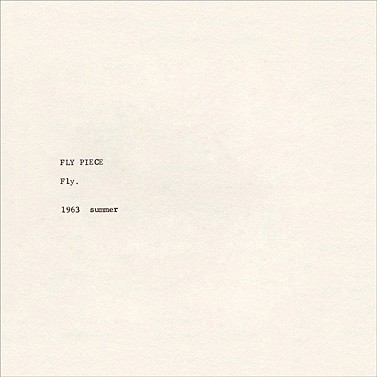
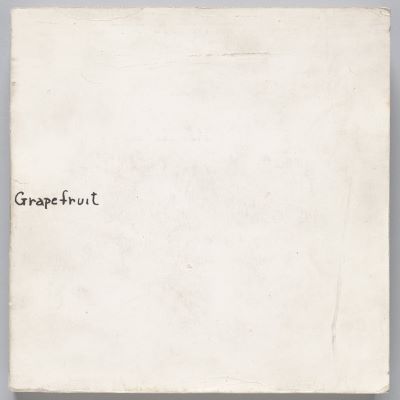
Of course, in terms of meaning, context is everything, and so to understand this billboard it would really help to remember that it is a work by Yoko Ono: it would be worthwhile using her output as the context. Her first use of the word, as far as I can see (but trust me, this is by no means an exhaustive survey) dates back to 1963. It is a work called FLY PIECE which was published the following year (1964) in her book Grapefruit. Here is the work, together with the cover of the book.

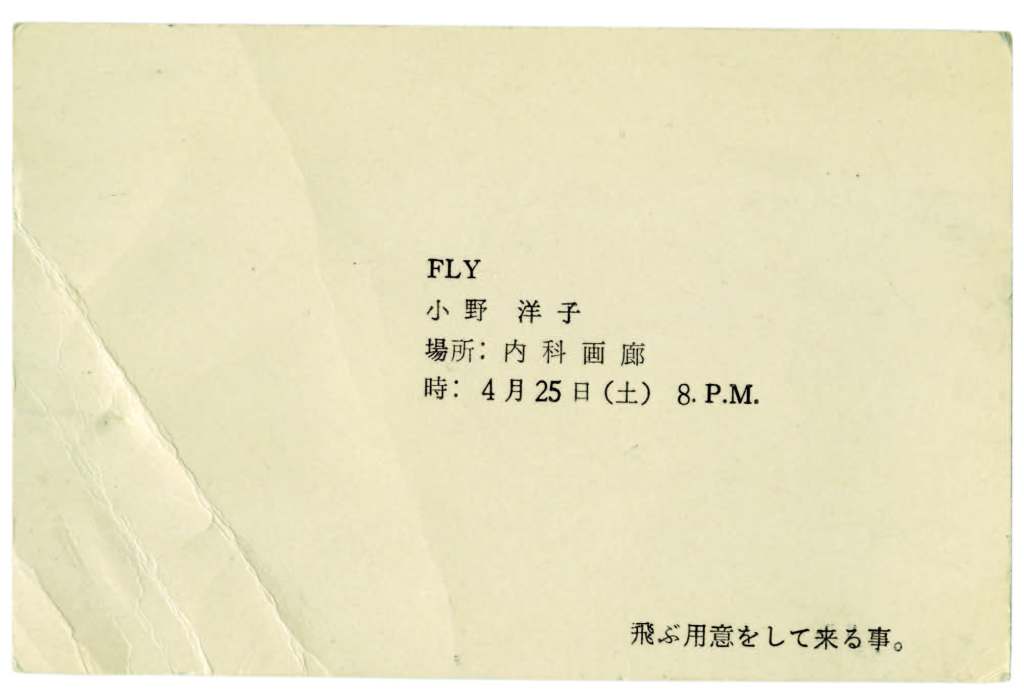
Again, it is a work of apparently utter simplicity – the title (FLY PIECE), the word ‘Fly.’ (with a full stop) and the date, ‘1963 summer’. Grapefruit included over 200 of what are known as her ‘instruction pieces’, which are suggestions for works of art which she, or someone else (including you), might make. Ono was at the very forefront of conceptual art (which I will talk about more fully on Monday), and these instructions include suggestions for paintings and actions which may or may not be made or performed – but whether they are or not, the ideas – the concepts – now exist. The work is out there in the world, even if it is only in peoples’ minds and imaginations. As far as this particular work is concerned, though, if this is an ‘instruction’, that would imply that ‘Fly’ is a verb, something to do. We are being invited to fly. You can imagine for yourselves how you might achieve that. One of the suggested possibilities came the year after the original concept, the year in which it was published. Here is the announcement of an event which took place in Japan on 25 April 1964.

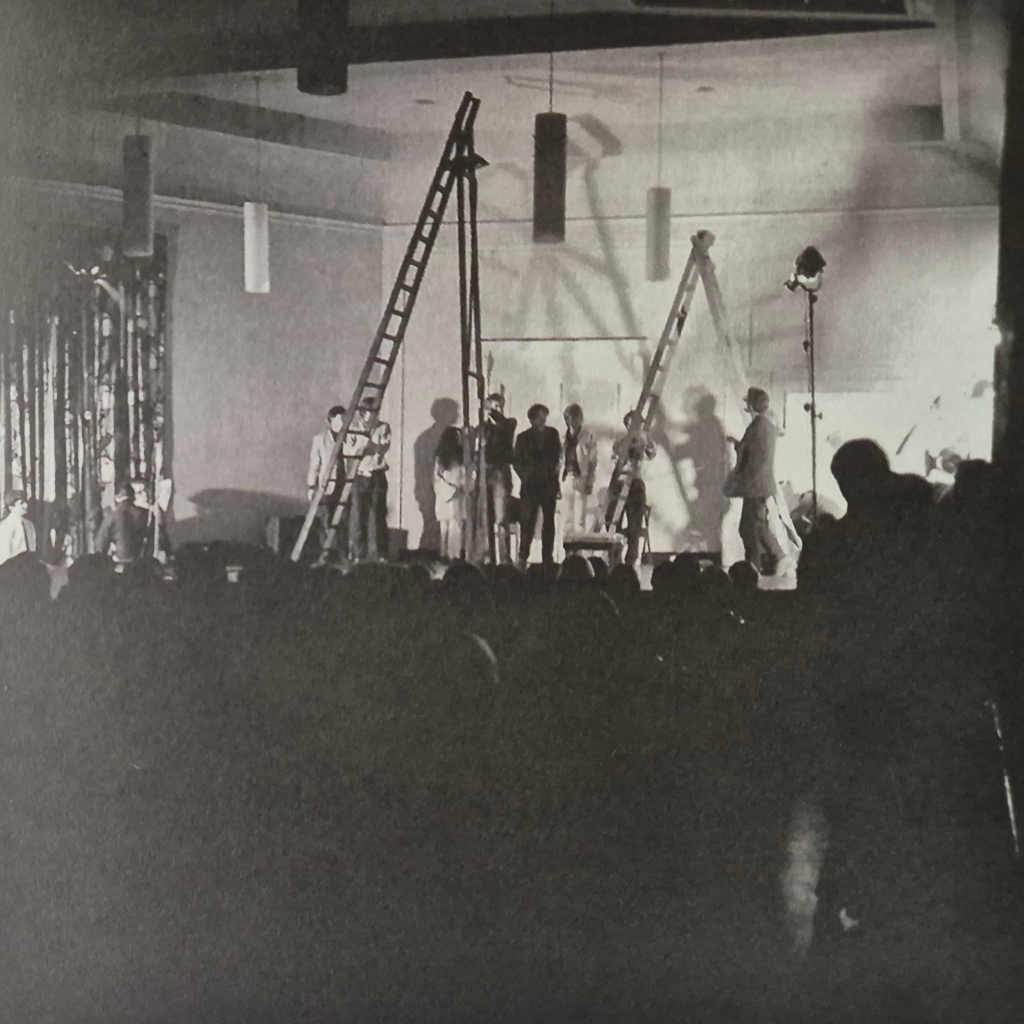
In between the Japanese symbols you may be able to pick out the numbers ‘4’ and ‘25’ – 25 April – and the time, ‘8. P.M.’ The title of the event is clearly printed in English: ‘FLY’. The only photograph I can find of this Japanese performance is almost illegible, but in England it was repeated more than once – both at the Jeanetta Cochrane Theatre in London, and then at Bluecoat in Liverpool, in 1967. This is a photograph from the latter.

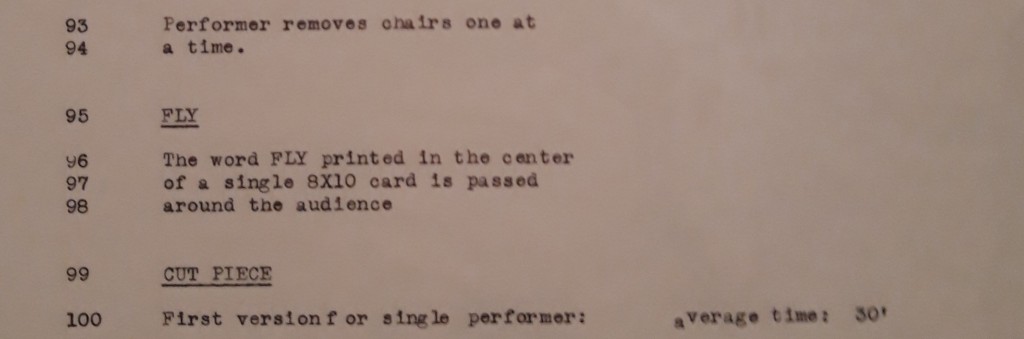
Members of the audience were invited to come up onto the stage, climb as far up the ladders as they liked, and then leap off – to experience, however briefly, the freedom of flight. Yoko Ono’s work has always been open – open to interpretation, open to collaboration – and incomplete. It is waiting to be completed by the active participation of the audience, of the viewer, of you. A few months after the original performance in Japan, FLY PIECE was followed by the Yoko Ono Farewell Concert. August 1964 marked the end of a two-year extended visit to Japan (the country of her birth), and this performance was, as the title suggested, her Farewell before she headed back to New York. The Concert included one of her most important works, CUT PIECE. The script – or score – of the concert was published two years later, in 1966, and, as you can see, CUT PIECE was preceded by another version of FLY which is worthwhile considering.

In this case it was a piece of card handed around the audience which bore the same instruction – the same invitation – to FLY. To let yourself go, I suppose, to free yourself from whatever is holding you back. Thirty-two years later, the billboard must have had the same intention. You could even argue that it is the same work, with a billboard better able to communicate to a wide audience than a single, relatively small card. However, the tone shifts – along with the meaning of the word – in 1968. In that year she published Thirteen Film Scores by Yoko Ono, London ’68, which included the score for Fly (Film No. 13).

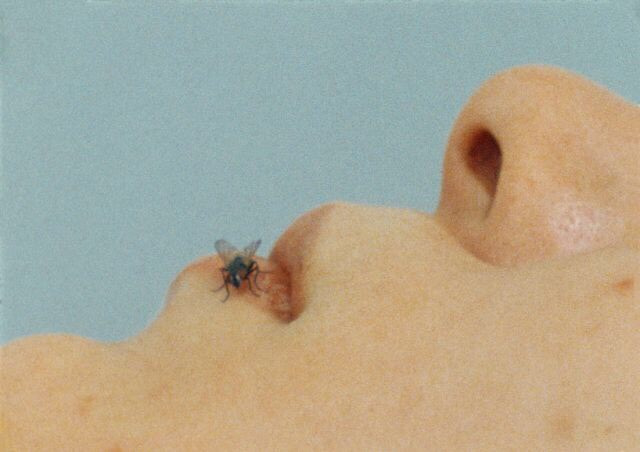
The words are quite simple, although you have to question how, as a filmmaker, you could make a fly follow instructions. But why publish a score (I’ll talk about her use of the term on Monday) rather than just making the film? Well, Ono had prefaced an earlier collection of film scores – published as part of Grapefruit – with the following explanation – or suggestion: ‘These scores were printed and made available to whoever was interested at the time or thereafter in making their own version of the films, since these films, by their nature, became a reality only when they were repeated and realized by other film-makers.’ As it happens Fly (Film No. 13) was made a few years later (1970-71) by Yoko Ono herself, in collaboration with John Lennon. They both directed, with Lennon also acting as cameraman. He also played guitar on the soundtrack (which was released later in 1971 as one of the tracks on the album, Fly). The film lasts 25 minutes, and is being continuously screened as part of Yoko Ono: Music of the Mind at Tate Modern. Here is a still as a taster.

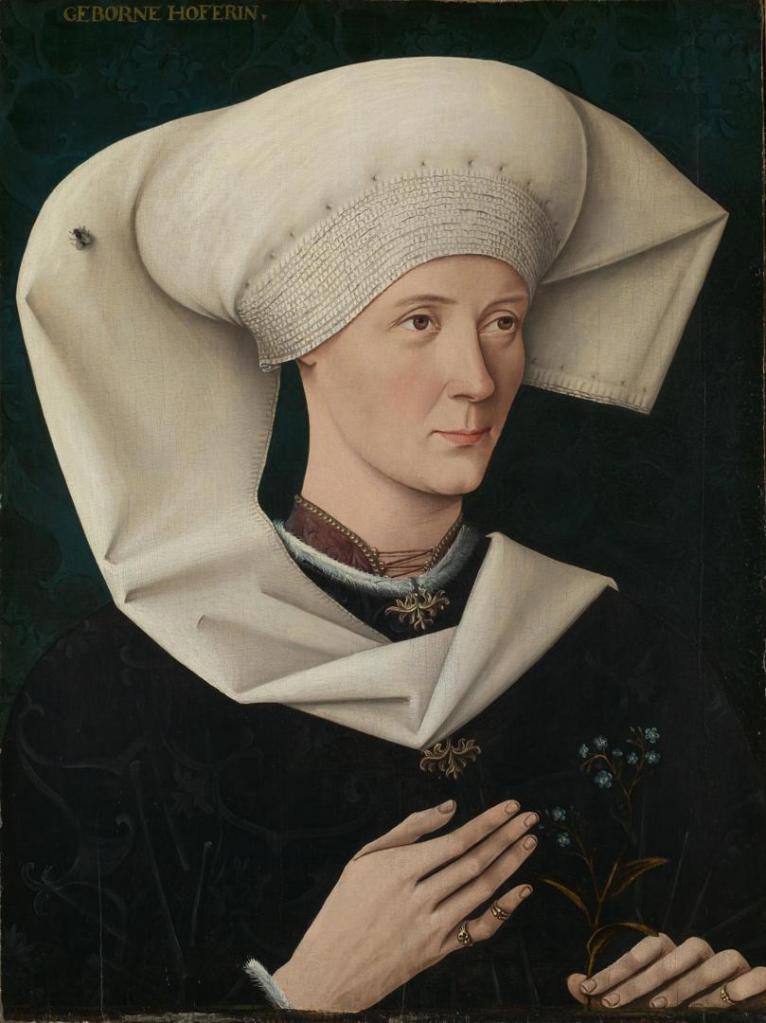
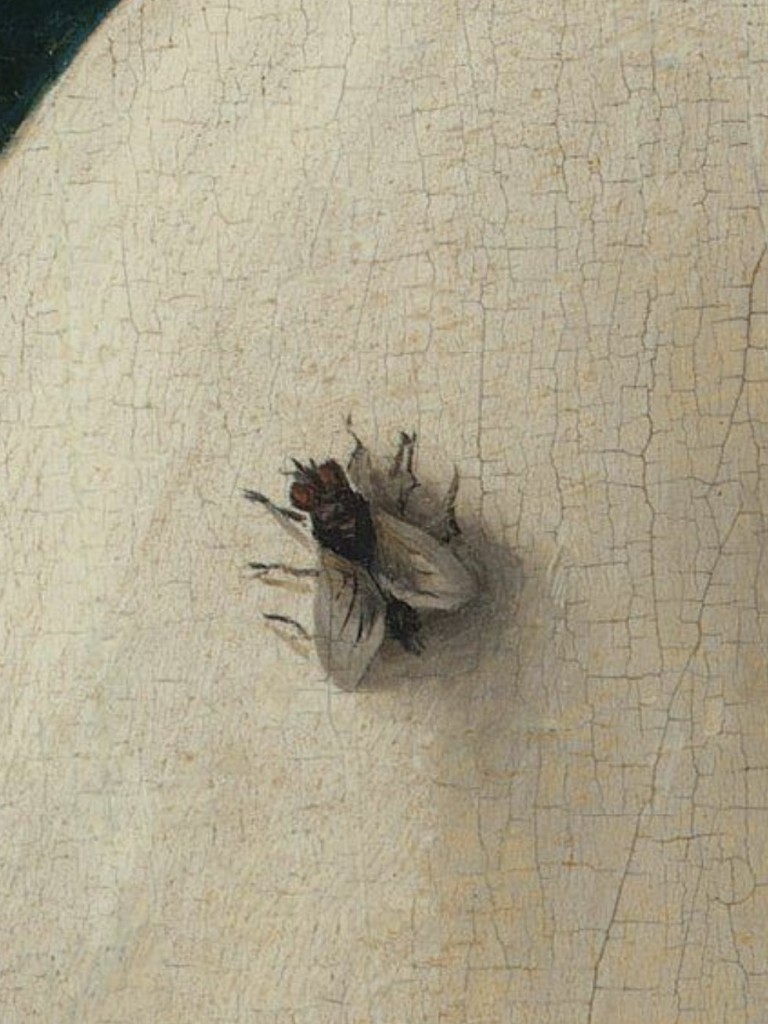
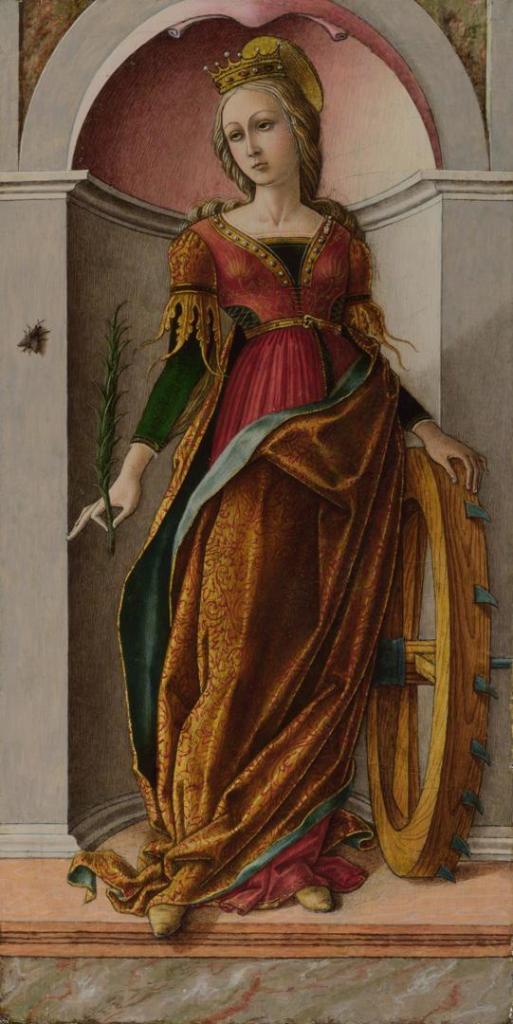
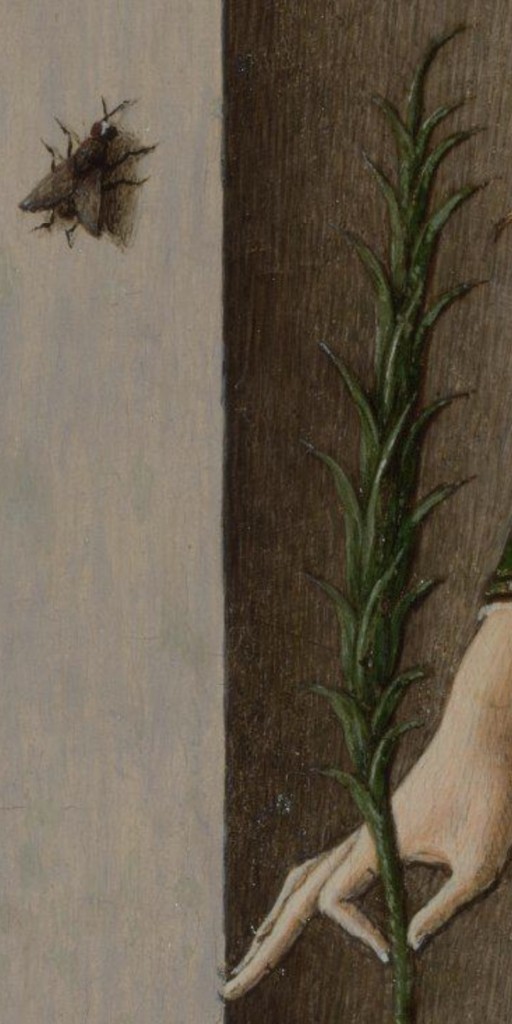
Suddenly the concept of flying free becomes less… acceptable, maybe even gross, particularly given that the score was not followed to the letter. For one thing, there were a multitude of flies, apparently credited as ‘supplied by New York city’, crawling over the supine, passive, and naked body of actor Virginia Lust. This might, perhaps, come as something of a surprise. However, it would be worthwhile remembering that flies have featured in art for centuries. Here, for example, are two paintings from the National Gallery, together with relevant details. The first is a Portrait of a Woman of the Hofer Family (about 1470) by an unknown Swabian artist, the second, Carlo Crivelli’s St Catherine of Alexandria (probably about 1491-4)) – a panel from one of the pilasters of a dismembered altarpiece.

In both paintings the fly could be seen as a memento mori – a reminder of death – and so also of the transience of life. This is not only because flies themselves do not live so terribly long, but also because they are often associated with dead meat. With St Catherine this would serve as a reminder to be good Christians, so that after death – which is inevitable – the viewer would rejoice in an eternity in paradise. The equivalent meaning could also be true for the unknown member of the Hofer family (who was presumably supposed to be a good Christian), but it could also be a reminder that, although the subject of the portrait is long gone, her memory lives on. This would make the painting an embodiment of the popular Renaissance motto ars longa vita brevis – which can be translated as ‘life is short, but art will endure’. The suggestion that the fly might be related to artistic rather than moral or religious values gains support if you stop and wonder where the fly is actually standing. Has it really alighted on the woman’s headdress, for example, or on the architectural surround of St Catherine’s niche? Or, in each case, is it actually supposed to be standing on the surface of the painting itself? The idea that the artists are trying to suggest that a real fly has landed on top of their paintings is perhaps more relevant for the Crivelli, where the fly is apparently larger than St Catherine’s thumb. Either it is out of proportion, or it is not part of the same visual world. In both cases, though, the fly can be seen as a form of trompe l’oeil.
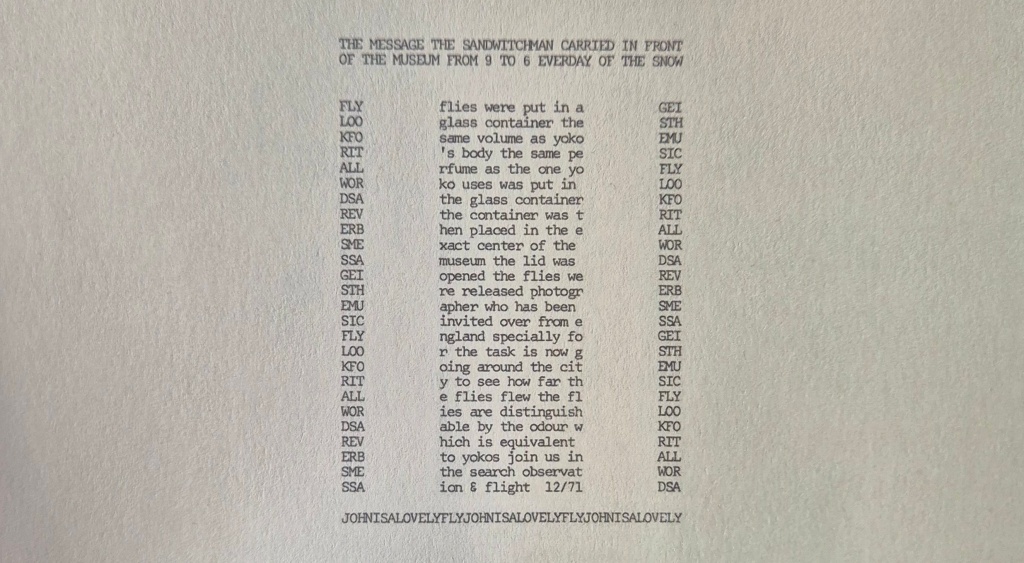
I’m not trying to suggest that there was any similar trickery in Ono and Lennon’s film: the flies were definitely there. I’m just pointing out that flies have a long history in art, and so the film does have a connection with the Western European tradition. The sense of transience is undoubtedly important. Earlier films by Yoko Ono slowed down simple actions to make us aware of the passage of time, and therefore of the transience of human existence. The stillness of the model in Fly also gives us a sense that time has slowed down for her – even if it hasn’t for the ever-active flies. The wording of the original score is also important, though: the fly was supposed to ‘fly out the window’. It finds its freedom. As I’ve said, Lennon played guitar on the film’s soundtrack. However, the vocals were supplied by Ono. While doing this, she imagined herself as the fly – indeed, she has suggested that both human and insect were effectively self portraits. In Cut Piece she sat passively while allowing members of the audience (mainly male, at the time) to take what they wanted, cutting away sections of her clothing with a pair of scissors left in front of her. This, together with the passivity of the female form in Fly, can be read as a critique of the role that ‘society’ (for which read, ‘mainly men’) required of women. So should we read the flies as the men, crawling all over her? Inevitably, it’s not as simple as that, as the fly eventually soars free – or at least it is supposed to, according to the score. Also, as it happens, she was not entirely against flies. The following is a page from the self-published exhibition catalogue for her irreverently entitled Museum of Modern [F]art – a solo show which (surprise, surprise) was not staged at the (almost) eponymous New York institution in 1971 – even if actions, and photographs, for the exhibition do appear to have taken place there.

To make things easier, here is a transcription of the central section of the script:

flies were put in a glass container the same volume as yoko’s body the same perfume as the one yoko uses was put in the glass container the container was then placed in the exact center of the museum the lid was opened the flies were released photographer who has been invited over from england specially for the task is now going around the city to see how far the flies flew the flies are distinguishable by the odour which is equivalent to yokos join us in the search observation & flight 12/71

Whether or not this actually happened is irrelevant: she has created the situation, told you the story, and now it exists in your mind, whether it happened or not. The words in the left and right columns are also important. In capital letters, but without gaps, is the repeated phrase,

FLY LOOK FOR IT ALL WORDS ARE VERBS MESSAGE IS THE MUSIC

So – we are being invited to look for the fly. However, if ‘all words are verbs’, we are also being invited to fly and look for it. We are being provoked into action, into ‘doing’ – and so we are encouraged to take flight, to be free. Across the bottom of the invitation is the repeated assertion,

JOHN IS A LOVELY FLY JOHN IS A LOVELY FLY JOHN IS A LOVELY FLY

It seems unlikely that she associated her husband with carrion. However, he was undoubtedly a free spirit – just like a fly.

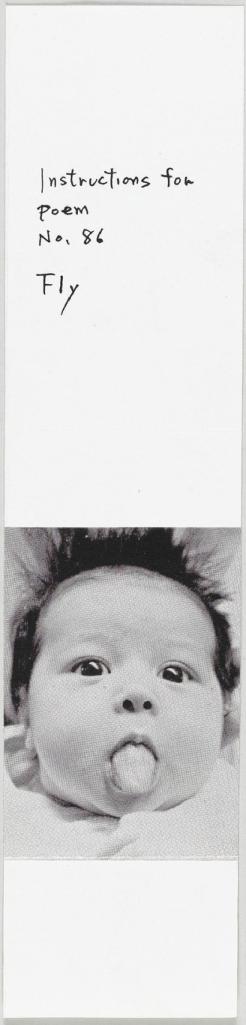
I have one last image for you, which not only adds to our understanding of the billboard (I hope), but also, like the title of the above exhibition, reminds us that Yoko Ono does have a sense of humour. It is her Poem No. 86 – which was published with the announcement of the birth of her first child, back in 1963. The Instructions for Poem No. 86 are quite simple. What does she wish for her child? A long life, happiness, and success, presumably. But how does she put that? How do you encourage people to reach their full potential, to achieve the most, and to reach the heights? If you are being optimistic (and Ono is nothing if not optimistic) what do you suggest they do? Here’s wishing you may do the same.

A Second Storm

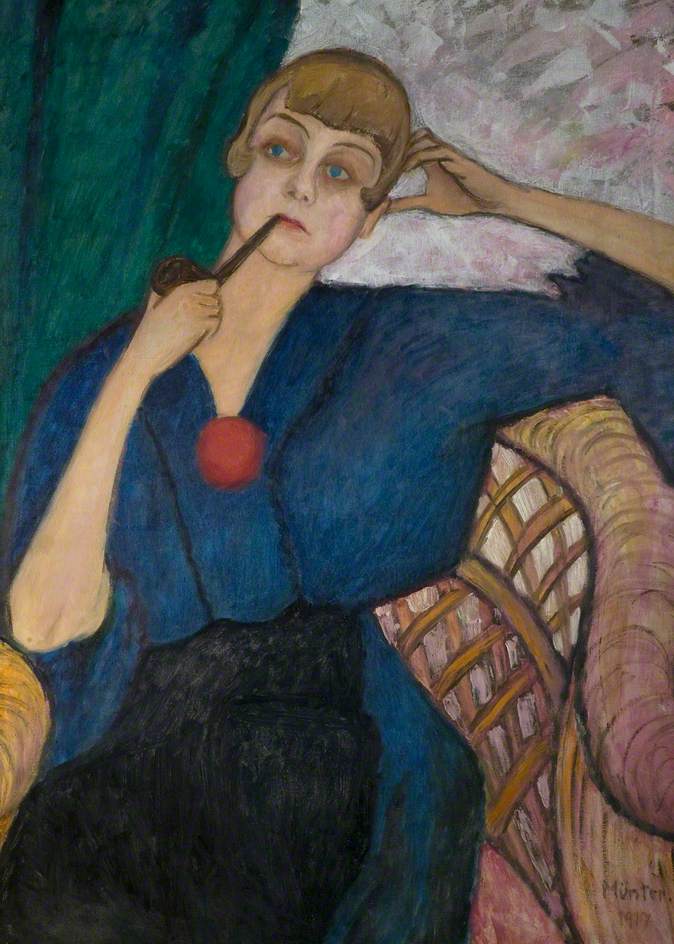
Gabriele Münter, Portrait of Anna Roslund, 1917. New Walk Museum and Art Gallery, Leicester.

I’m looking forward to talking about the Expressionists exhibition at Tate Modern this Monday, 20 May at 6pm, but as I’m currently in Delft with Artemisia I’m going to re-post something I wrote for Making Modernism, the Royal Academy’s 2022 exhibition focussing on four women who were themselves Expressionists. Two of them feature in the current show – Gabriele Münter and Marianne von Werefkin – and both are superbly represented. A couple of paintings are the same, but on they whole the exhibition features works I have never seen before, including several I really wanted to see as a result of the RA show, together with paintings by Kandinksy, Marc and Macke, the last of whom I am especially enjoying. The following week I will look at another redoubtable woman, Yoko Ono, also on show at Tate Modern, and then (although it’s not on sale yet) Michelangelo: The Last Decades, introducing the recently-opened exhibition at the British Museum which must be the must-see show for the summer. Beautifully selected and curated, it is also designed with great clarity and a wonderful understanding. Keep your eye on the diary for that.

There are still places for some of the last of this season’s In Person Tours:
Monday 17 June at 11:00am: NG05 – Siena in the Fifteenth Century
Tuesday 18 June at 2:30pm: NG07 – Perugino and Raphael (afternoon)
The day after, on 19 June at 1pm, I will be lecturing at the Wallace Collection. The talk is free, and you can either attend in person, or online, but I would love it if you could come and pack out the room: I would finally get to see you all! Entitled Getting Carried Away with Michelangelo and Ganymede it will explore the relationship between Michelangelo and the young nobleman Tommaso de’ Cavalieri, and will look at the refined drawings, heartfelt letters and complex poems which passed between the two. If you’re coming in person you can just turn up on the day, but for online viewing you should book a ticket via the blue links above. It will also be recorded, apparently, and available to view for the following week or so.

Meanwhile, today I want to look at the ‘Poster Woman’ of Making Modernism, Anna Roslund, as painted by Gabriele Münter. I would say ‘Poster Girl’, but shortly before I wrote this post back in November 2022 I had had my wrist slapped for my careless use of language…

Munter, Gabriele; Anna Roslund (1891-1941); Leicester Museums and Galleries; http://www.artuk.org/artworks/anna-roslund-18911941-80902

I’m afraid I can tell you relatively little about Anna Roslund herself, but we get a strong sense of her character just by looking at this portrait. Apart from anything else, how many women have you ever seen smoking a pipe? I know there are some famous examples in history, but I can’t for the life of me remember who they are. ‘Women smoking’ is something one didn’t used to see ‘back in the day’ (i.e. a long, long time ago), and ‘women smoking a pipe’ make up an even smaller sub-group.  This bold gesture is combined with an open pose, left arm resting on the arm of the chair, with her head resting on her left hand. The right arm is tucked in, holding the pipe to the mouth. Add to that the strong, bold colours of the outfit, royal blue and black, heightened by the bright red of the pom-pom (?) in front of her chest, and you have a strong sense of individuality, the image of self-confidence.

Anna Roslund has the clearest, light-blue, piercing eyes, and a stylish haircut, apparently bobbed with a fringe (although we can’t see what it’s like behind), which makes me think more of the 1920s than 1917. She is clearly a serious, thoughtful woman, her head tilted to one side and her eyes gazing into the middle distance some way above our left shoulders. Like Rodin’s Thinker, with his chin on his fist, or Dalí’s Narcissus, who we saw a while back, his chin on his knee, the head leaning on the hand adds to the sense of contemplation, albeit in a different way. Each finger is clearly demarcated (although the little finger is oddly truncated – I don’t know whether that was an anatomical fact, or an artistic abbreviation), and there is a clear space through to the light background. Presumably, given the curtain, this is a view through a window, with broad, light brushstrokes of white and pink over a darker ground, giving an idea of a light, but cloudy sky. The curtain itself, in a deep turquoise, is angled parallel to the tilt of the head, and completes the ‘virtual’ pyramid which gives this composition – and Anna Roslund – stability, and strength of presence. Another note of stability is the horizontal of the arm, marked strongly by the contrast between the upper edge of the blue sleeve and the light background (and notice how the thumb and fingers echo shapes of the arm and head).

Roslund is clearly comfortable in this chair, and I love the way in which the curve of her right shoulder, clad in blue and enhanced by a subtle black outline, echoes the curve of the left arm of the chair – it is as if she is a completion of the chair on that side. The chair itself, with the yellow arm given texture and form by the darker brushstrokes, is painted in a similar technique and colour to Van Gogh’s more famous example, a symbolic self portrait (having said that, now that I have posted the pictures the chair looks more violet than it did in the file on my laptop!). Indeed, Münter was an admirer of the Dutchman’s work, even naming her home in the country ‘The Yellow House’, as a nod to his home in Arles.

The arms of the chair curve round and in before flaring out again, as if hugging the sitter. The right arm (seen on our left) is more brightly illuminated, and, as a result, appears to be a different colour (but with colour, everything is relative – see above). The left arm (on our right) reminds me of the roads you see in some Dutch landscape paintings, which start in the bottom corner of the painting, and lead you into the middle ground, as if the artist is expecting you to go on a journey with him (I don’t think there was a woman who painted landscapes in the Dutch Golden Age). I think the same is true here: Münter is using these arms, particular the one on our right, to lead our eye into the painting – and also, as the corners of the pyramidal composition.

I’m not an expert on women’s dress (nor on men’s, for that matter), but the blue top appears to continue as an open overskirt, framing the sleeker black skirt. Either that, or she is sitting on a blue cushion of the same hue as her blouse. Whatever it is, this blue, and the uncovered section of the seat of the chair, both form triangles pointing up towards Roslund’s face. Her left leg is crossed over her right – again, a confidence in her body language which we might not think of as ‘lady-like’ for the first half of the 20th Century.  The black outlines to the blue blouse might relate to the clothing itself, or they may be the result of Münter’s interest in Bavarian folk art, particular reverse glass painting (painted on one side of the glass, to be seen from the other), which often had rich, jewel-like colours separated by black outlines, a cloisonné effect not unlike stained glass windows.

Munter, Gabriele; Anna Roslund (1891-1941); Leicester Museums and Galleries; http://www.artuk.org/artworks/anna-roslund-18911941-80902

So who was this remarkable, stylish, self-confident, thoughtful woman? Well, a musician and author at the forefront of the Danish Avant Garde, but that is as far as I can get, I’m afraid. Münter met her while living in Copenhagen during the First World War. However, I can tell you that Anna Roslund had a sister called Nell, who was an artist, and who married a man called Herwath Walden in 1912. And it is this that made the portrait a key image for Making Modernism, one theme of which is the nature of artistic communities and the resulting dissemination of ideas. From 1910 Walden published a weekly journal dedicated to modern art (monthly from 1914-1924). It was called Der Sturm – ‘The Storm’ – the title expressing Walden’s conviction that that was how modern art was going to take Germany. His focus was on Cubism and Futurism (he effectively introduced these movements to the German public) and also on the burgeoning German Expressionist movement. In 1912, the year in which he and Nell Roslund married, they opened an art gallery in Berlin under the same name. Both Gabriele Münter and Marianne Werefkin, stars of Expressionists at Tate Modern, were exhibited regularly. Münter’s introduction to today’s sitter came via her gallerist, effectively. It might even have been this connection that took her to Copenhagen.

One question remains: if these artists were so successful when they were alive, why is their work so little known today? One reason, for the British at least – apart from the fact that the men they were associated with took all the limelight – is that there is very little of their work in public collections. This portrait is one of the few which was borrowed for Making Modernism from a British institution. It forms part of Leicester’s notable collection of German Expressionism, one of the rich seams of great art which, when you find them, are a surprising, but rewarding, feature of our regional museums. The same is true of Expressionists: one reason for Tate Modern’s thematic hang when it opened back in the year 2000 was that the first three decades of the 20th century are notoriously underrepresented, and in a chronological hang the first few rooms would be sparse indeed: just one early Kandinsky, and a scattering of Picassos. This current exhibition provides an ideal opportunity to get to know some truly great, truly influential artists – and to re-balance the view that it was the men who were coming up with all the ideas.

222 – Potentially singing

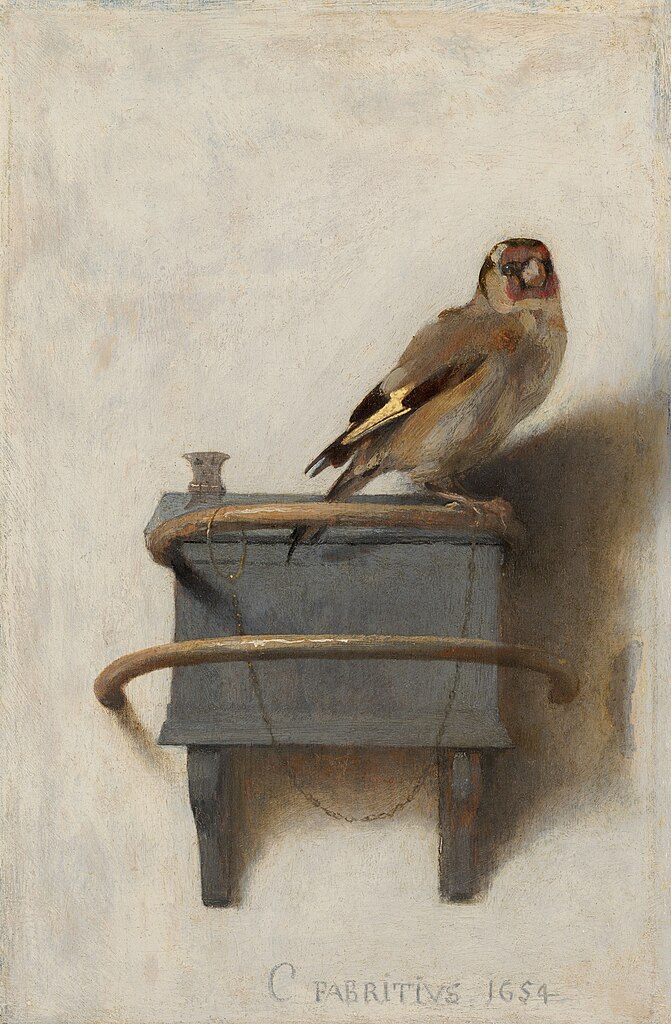
Carel Fabritius, The Goldfinch, 1654. Mauritshuis, The Hague.

Some paintings are so simple they seem obvious, while others simply defy explanation. I feel certain that today’s painting falls somewhere between the two: a painting of a bird that has somehow become an international celebrity, with an expression as inscrutable as the Mona Lisa, or, closer to home, The Girl with the Pearl Earring. Indeed, the subjects of these two Dutch paintings glance over their shoulders to look at each other from the opposite sides of the room. Or at least, they did ten years ago when I last saw them together, and I presume they still do: I’ll find out within days. However, despite the fame of the avian protagonist, the artist responsible remains relatively unknown. But then, he did die tragically young. I want to celebrate him this week, on Monday 6 May at 6pm, when I will talk about Carel Fabritius and the Art of Delft – making it clear that it is Not Just The Goldfinch. I’ve realised that there won’t be a huge amount of ‘Delft’, to be honest, as Fabritius’ works, however few, are so interesting that I will spend most of the time with them. While we’re about it I can recommend Laura Cumming’s Thunderclap most highly. It is a personal memoir about growing up with art, and its value for our lives, framed by encounters with the Dutch master’s paintings.

The week after Not Just The Goldfinch I will be in Delft – but the following Monday, 20 May, I will talk about Tate Modern’s powerful, colourful exhibition Expressionists. This will be followed (27 May) by another Tate exhibition, looking at the tireless, totally committed, and sadly misunderstood Yoko Ono. I’ve also set up the next set of In Person Tours of the National Gallery, which will be the last ones before a summer break:
Monday 17 June at 11:00am: NG05 – Siena in the Fifteenth Century
Monday 17 June at 2:30pm: NG06 – Piero and the Court of Urbino
Tuesday 18 June at 11:00am: NG07 – Perugino and Raphael (morning)
Tuesday 18 June at 2:30pm: NG07 – Perugino and Raphael (afternoon)

If you missed The Last Caravaggio I will repeat it next week, on Thursday 9 May at 6pm, for ARTscapades. And if you’re not free then, unlike me they have the personnel to post a recording online – so you can catch up with it within the following fortnight or so. Any other events will eventually get posted on the diary – although admittedly I have been known to forget things (as indeed I did for next week’s talk). But now: The Goldfinch.

A description of this painting could be so simple: a bird stands on a semi-circular perch – the upper one of two – its body facing to our right, while its head is turned to look over its shoulder, almost as if it is turning to look at us. The two perches curve around a grey box, which is supported by two similarly grey brackets against a cream coloured wall. The bird is evidently captive: a ring is threaded around the top perch, with one end of a chain attached to it. The other end secures the goldfinch. The chain hangs behind the lower perch, and loops down between the two brackets. The red colouration of the bird’s face, and the golden flash on its wing, tell us it is a goldfinch.

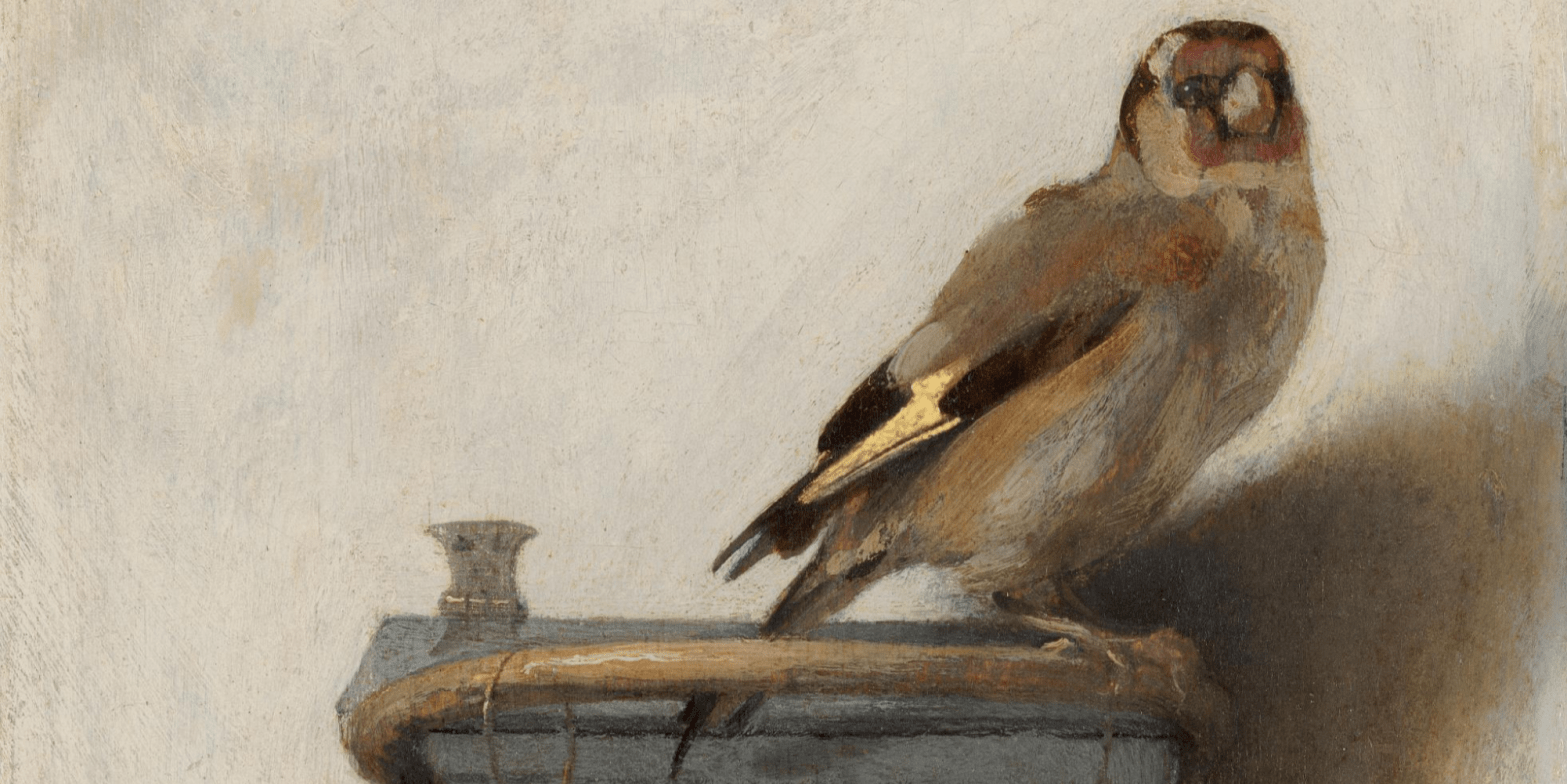
Each separate colour of the plumage is applied with distinct brushstrokes, which are carefully, and on the whole thinly, applied. The exception is perhaps in the yellow of the wings, which seems to have been built up more thickly, an effect known as impasto. Elsewhere the thin strokes do not entirely cover the layers of paint which had been applied earlier, leaving gaps which help us to build up a history of their application. Somehow this technique adds to the feathery texture. At times the strokes were applied ‘wet on wet’ – and the brush has picked up the earlier paints to create streaks of colour – a ‘feathering’ of different paints particularly clear in the buttery brown brushstroke just under the top of the black section of wing, which continues down to the shadow created by the raised yellow feathers. The way in which the paint has been applied suggests that the brush was stroked and dabbed onto the painting to fill in areas of colour with the required subtlety and delicacy – although there is never any attempt to pretend that this is not a painting. On this small scale it looks remarkably painterly. We see the materials involved and the manner of their application, unlike the work of a slightly older artist, also a student of Rembrandt, Gerrit Dou, who is known as a fijnschilder – a ‘fine painter’. His works barely hint at being paintings, their making disguised in a bravura display of what we would now see, anachronistically, as photographic: a highly detailed naturalism. Not that Fabritius shies away from illusion. Look at the thin, gently undulating lines on the perch, strokes with tiny brushes that span the gap between the ring and the goldfinch’s tail, which show the light glinting off the perch. Above and to the left of the ring three small strokes likewise glint off the joint of a hinge: the grey box has a lid which is attached to the wall, and could be lifted up – presumably by the goldfinch itself, looking for food, or maybe water. The Dutch title for this painting is Het puttertje. De put means ‘the well’, and de putter ‘the water drawer’ – someone who draws water from a well. The last syllable, ‘-je’ is a diminutive – ‘the little water drawer’. In the Dutch Republic, goldfinches were trained to pull up water from a bowl in tiny thimble-like buckets. Maybe it’s the protestant work ethic.

What is the point of this detail, you might ask? There is no more information than in the last one – less, if anything, as we can see neither the perch nor the chain. But we can see the background – and there is a lot of it, compared to the size of the Goldfinch. Fabritius was a master of painting walls, creating the texture of the rough plaster with scumbled layers of closely matched paints. He was also a master of negative space: he does not focus in on his subject, as others might, framing them tightly and pushing them forward. Nor does he proclaim the goldfinch’s importance by placing it top centre of the visual field. It is some way down the painting, and off to the right – which only serves to make it seem more real. This is the full width of the top of the painting – which shows you how much space there is to make the goldfinch stand out, to convey its diminutive size, and also, perhaps, its vulnerability. If you look carefully around the edges – at the top, left and right – there seems to be a narrow border which has been painted over. This is part of the original setting of the painting, but I’m afraid I don’t have the space to go into that today: I’ll have to leave it until Monday. It is particularly relevant to Delft! The light comes from the top left, from over our left shoulders – you can see that from the bird’s shadow, below it and to the right.

The direction of the light is confirmed by the shadows of the perches, the upper one cast on the grey box, the lower one onto the wall. And while the shadow to the right of the box may seem to contradict this – the angle goes up to the right – this is the result of the scalloping of the bracket, curving from thin to thick as it goes up. Notice how both perches look as if they curve up from the wall on either side. I have little doubt that they were, in fact, horizontal – this is just a clue that we are looking up. The goldfinch is perched above our heads. To the right of the lower perch, a small area of paint has flaked away, revealing grey plaster underneath. To the right of this there is a clear vertical line which is another remnant of the original setting – which must, as we have just seen, have been high up. However painterly the style – look, for example, at the single, vertical stroke at the top of the right bracket, disguising the brown layer beneath, but barely hiding it – the chain itself is exquisitely delicate, every single link traced onto the surface, with those at the top left glinting in the light, as does the ring which allows the goldfinch a limited freedom of movement, flying back and forth in a prescribed arc, with barely enough space to flap.

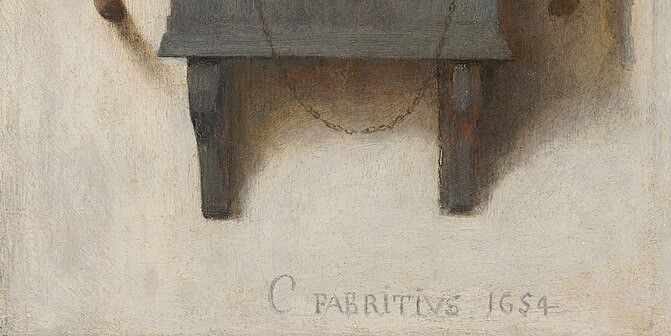
There is yet more space at the bottom of the painting, again allowing the subject to be seen and understood. Space can be a luxury, and here it adds status: in the middle of this pictorial void is something that deserves to be seen. At the bottom (which is closer to our eyeline, if we are looking up at the painting) is the signature, carefully inscribed in capital letters on top of areas of re-worked paint as if it were drawn on the rough surface of the wall itself. It was 1654, the year in which Fabritius would die at the age of 32.

As I suggested above, his few remaining paintings (thirteen are generally accepted) reveal that Fabritius had a truly original sense of composition. The painting is by no means symmetrical: we have already seen how the goldfinch is on the right. However, the box and the perches are placed exactly symmetrically on the central vertical axis, while the top perch skims the central horizontal: underneath the apparent freedom is a rigid geometry. The bottom of the chain hangs to the right of centre though, implying the movement of the bird, which just happens to stand with its body lined up along the diagonal from top right to bottom left: nature organised by art, a celebration of illusion. There is also a sense of trickery. The shadow of the bird, and of the two perches, assure us that the light comes from the top left. And yet, the shape of the brackets, and the positioning of the bird, make the shadow of the box look as if the light is coming from the bottom left – but this is just Fabritius playing with our expectations, I think: the shadow is entirely logical, even if it is unexpected.

What does this all add up to? Art historians have struggled to interpret the painting: what does it mean? Or is this the wrong question? Does it mean anything at all? Or is it pure observation? And if so, why was it painted? Why this particular subject? None of the answers are entirely satisfactory, and we fall, as I said at the beginning, between unnervingly simple, and enigmatically sublime. One thing, though, is certain. If you have ever felt sorry for the goldfinch, trapped in its limited world, don’t worry – because there is no goldfinch. There is only paint. We can see how the paint was applied. We can see the layers, and the way the colours blend. We are also told, in a tract of painting that is – not coincidentally, I’m sure – exactly the same width as the distance between the outside edges of the brackets, the name of the man who painted this, and when he did it. So we can have no doubt that this was made. It is a fabrication. Fabritius was a man who made things. And yet, we believe in the goldfinch. One of the things that this painting is about – and there could be many – is the magic of art, and our willing suspension of disbelief that turns a mixture of oil and dirt into a delicate creature, living and breathing – and potentially, even, singing – just above our heads.

221 – Caravaggio: the witness witnessed

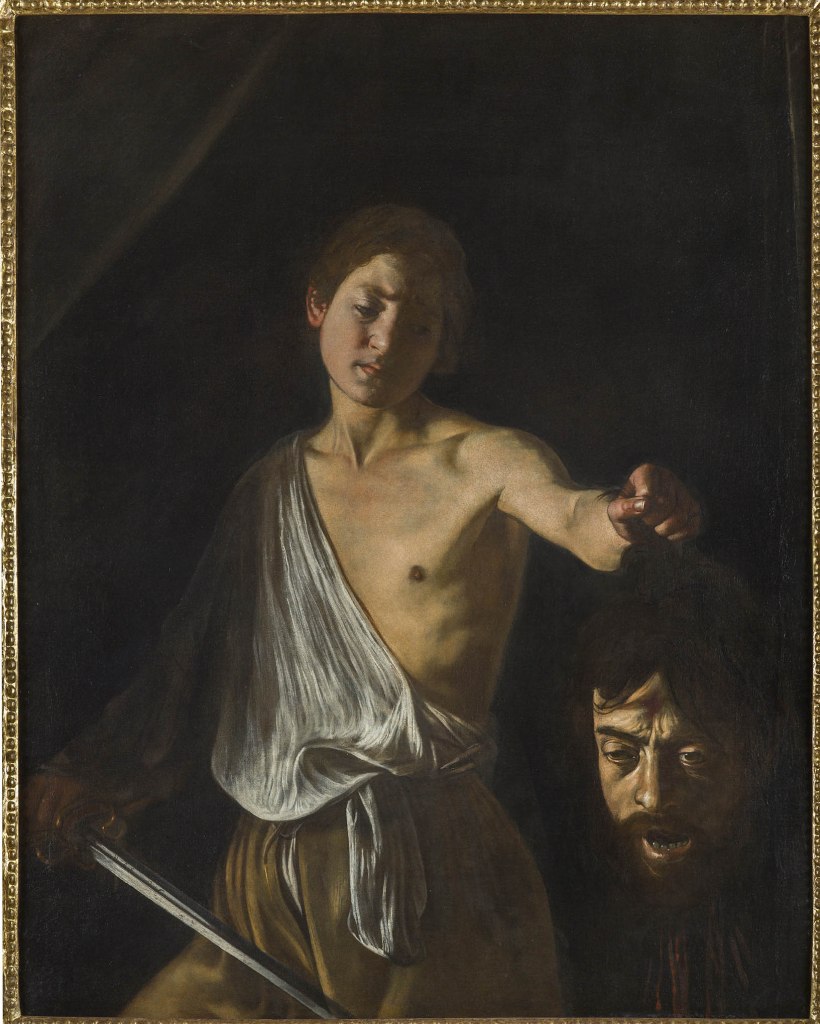
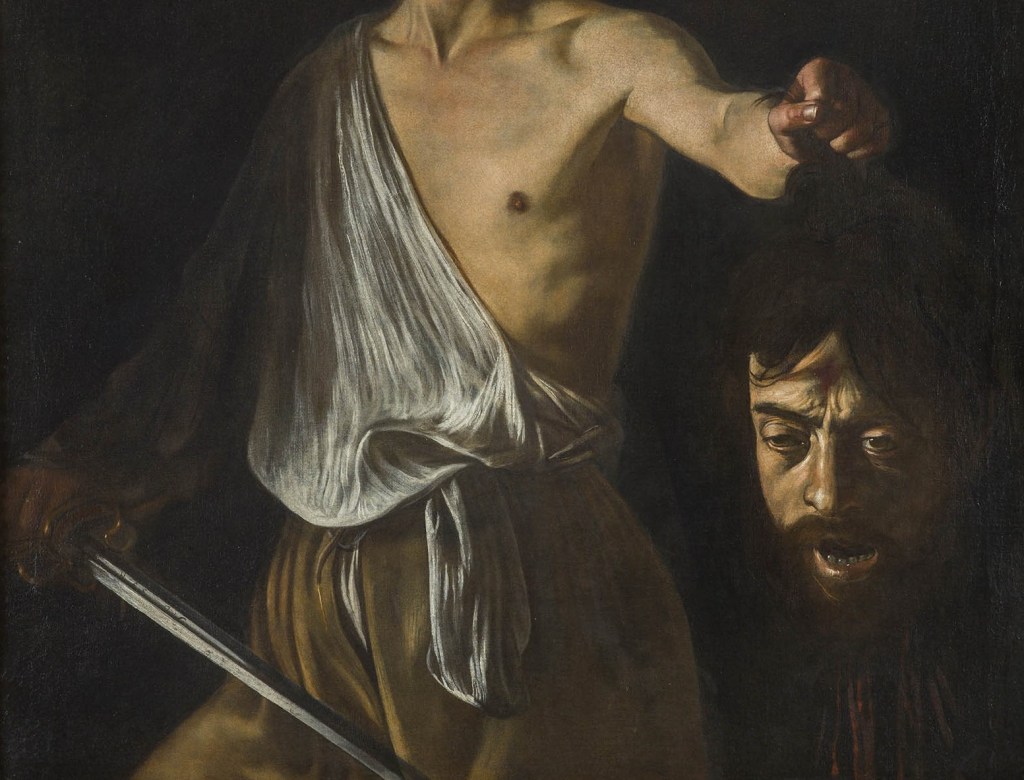
Michelangelo Merisi da Caravaggio, David with the Head of Goliath, 1606-07 or 1609-10. Galleria Borghese, Rome.

I was very lucky to be able to get into the National Gallery before opening time last week, and had the unequalled opportunity to see The Last Caravaggio on my own. In terms of the National Gallery’s ‘small and perfectly formed’ Room 46 exhibitions, this is undoubtedly the smallest – there are two paintings, two books and a letter. Of course, it is a ‘must’ for any lover of Caravaggio’s work, but by 10:30 a small queue had formed. At eleven it had stretched across the landing, and by 12 it continued downstairs and across the Annenberg Court – just so that you know. The exhibition is free, but they can only fit 39 people into the room. I will talk about The Last Caravaggio on Monday, 29 April at 6pm, looking at both of the paintings in the exhibition in detail, explaining the significance of the books and letter, and putting it all into the context of Caravaggio’s life as a whole. The following week, on 6 May, I want to think about another artist who died even younger than Caravaggio, and whose early death has denied him the fame he undoubtedly deserves – even though his masterpiece is, in itself, one of the celebrities of the art world. The talk will explore Carel Fabritius and the Art of Delft – making it clear that this is Not Just The Goldfinch. Thereafter, I will introduce two exhibitions at Tate Modern, which look at the Expressionists (20 May) and Yoko Ono (27 May). As ever, keep your eye on the diary for more information.

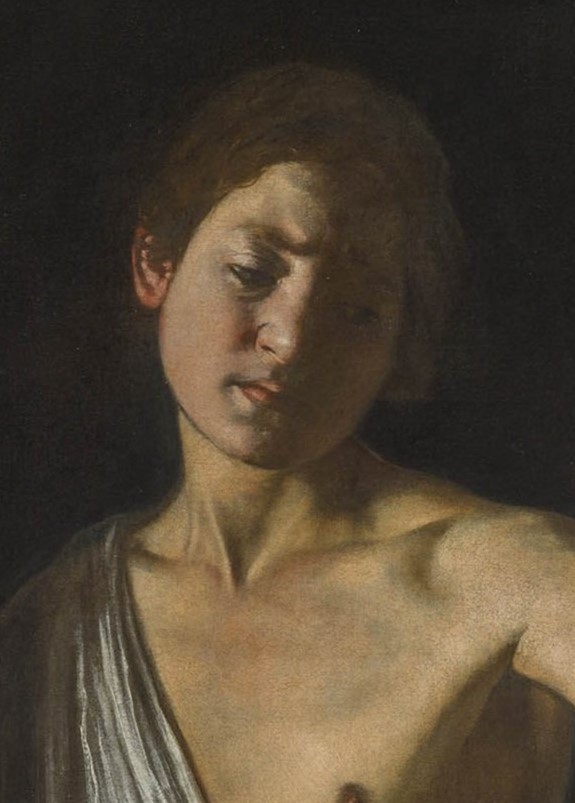
I have discussed the story of David and Goliath before, when I looked at Bernini’s sculpture (see 132 – Giant, or Giant Slayer?). In that post I used Caravaggio’s painting as a comparative illustration: both are in the same collection in Rome, although they are in different rooms. I also discussed the story at length when talking about the Pesellino painting, The Story of David and Goliath, as part of the National Gallery’s recent exhibition. But, long story short (as if you didn’t know it), David was a shepherd boy who took up the giant Goliath’s challenge of one-to-one combat to resolve the war between the Israelites and the Philistines. With God on his side, David triumphed, using nothing but a slingshot and a stone, which hit the Giant’s forehead and knocked him dead. The boy didn’t even have a sword – so he took Goliath’s, severed the head, and returned to King Saul in Triumph – the subject of a second painting by Pesellino. Caravaggio depicts a moment just after the climax of the story, with David looking down at the severed head, the sword still in his hand.

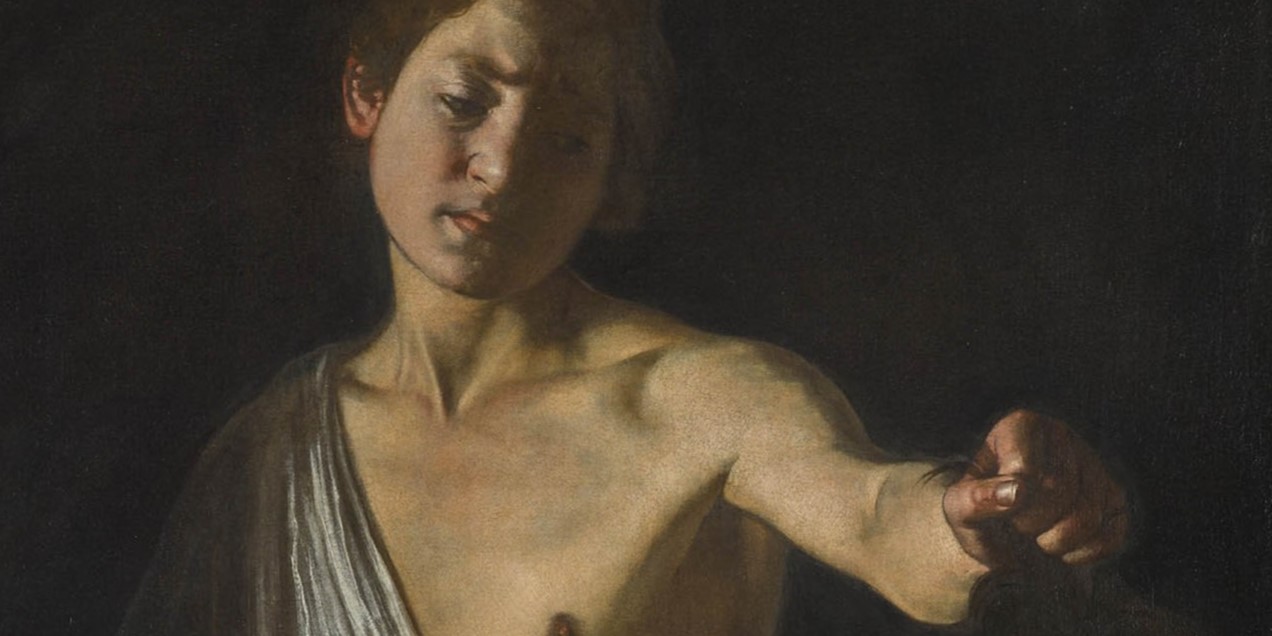
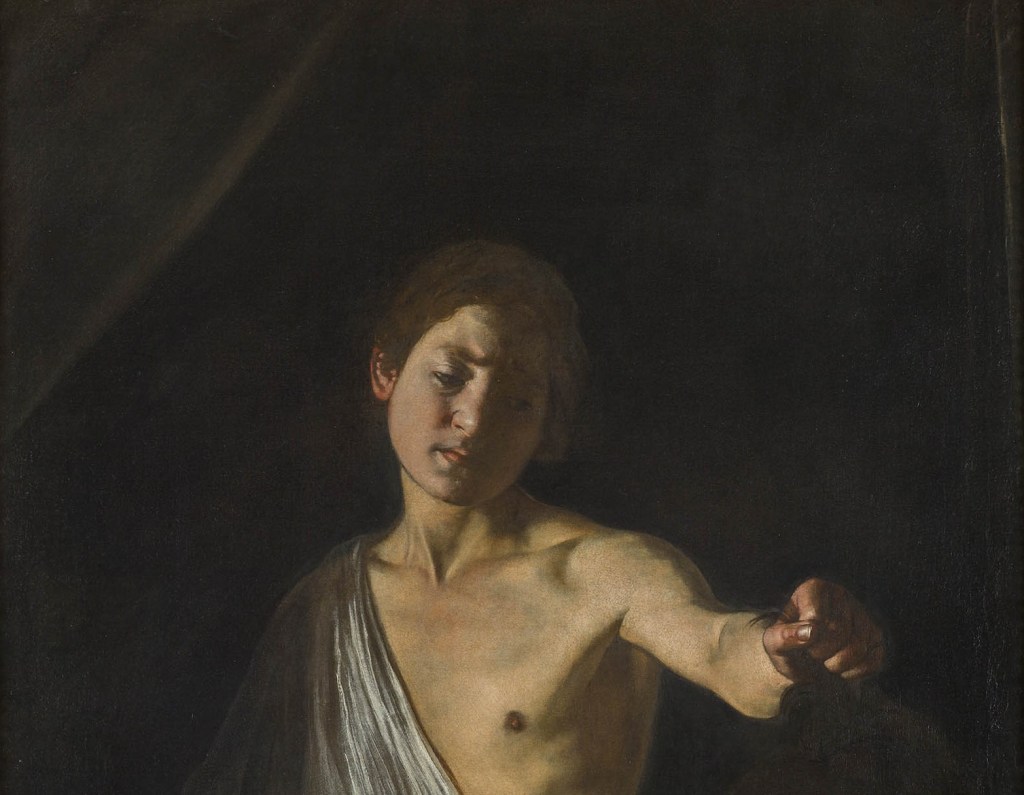
Caravaggio’s early works were richly coloured, using widely ranging palettes and a detailed depiction of form and texture. As his all-too-brief career progressed, the palette simplified, the colour drained out and the darkness crept in. There is no implication in the biblical narrative that this story would have happened at night, nor would it make any sense: battles almost inevitably happened during the light of day. How else could you see who you were fighting, or know where to aim? It is so dark here though, that it cannot be anything other than night, which of course adds to the drama of the depiction. However, there is just the vaguest hint that David is not exactly ‘outside’. The top left corner of the painting is cut off by a diagonal that can be read as the dark, olive green flap of a tent, and another piece of fabric hangs almost vertically down the right side of the painting. A strong light shines from the left, almost on a horizontal: the boy’s face is in shadow on our right, the line between light and dark being as vertical as possible given the forms of the facial features. There must be a bright lantern hanging by the ‘door’ of this tent. We can see the taut tendons in the neck, and the clavicles at the top of his sternum, tense as a result of the extended left arm, which is raised and strongly foreshortened: the direction of the light means that the arm is brilliantly illuminated along its full length.

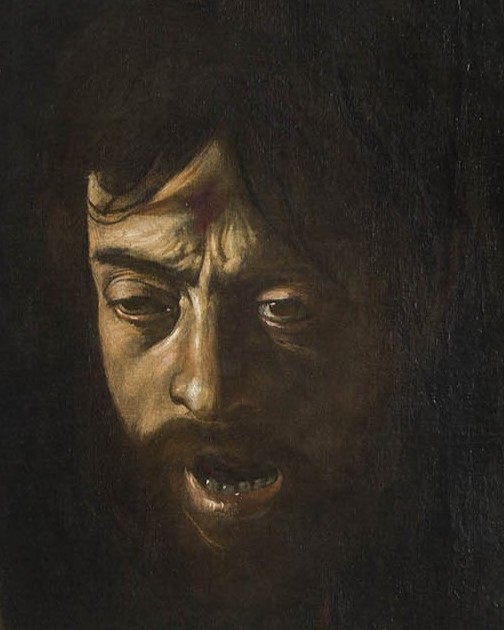
This arm thrusts the severed head towards us, blood pouring down below it, but not in an overly shocking way – it is too dark to cause much concern. Caravaggio brilliantly captures the moment of surprise as the apparently invincible giant realises that he will be defeated by an innocent child, this fleeting thought captured on his face by the sudden, unexpected death, so recent that the eyes are still crystal clear. It is as if he is still alive, still thinking and feeling, the brow crumpled in thought. The small, bloody wound in his forehead caused by the shepherd boy’s stone is hidden by the shadow from a lock of hair. The right eyelid droops, the eye unfocussed and clearly no longer seeing, even if the lively glint in the left eye contradicts our understanding of the situation. The mouth is open – the last breath was a gasp – the lower lip glistens and the peg-like teeth catch the light.

David is dressed unusually – he seems to have taken his left arm out of the sleeve of his shirt and tucked it in into the belt of his tan-coloured britches. Maybe that is some of the sleeve hanging down in front. The rest of the shirt – if that is what it is – is worn over his shadowed right shoulder. The right arm is all but hidden in the profound darkness. He still holds the sword, the point lowered and out of the picture, its angle being parallel to the thrust of the arm – on the surface of the painting, at least, although not in the imagined depth of the space.

The position in which the sword is held is hard to explain, pressed as it is against his thigh, putting pressure on the britches, and inflecting the lines of the folds. The angle of the sword, and its position, right next to the groin, has led to lurid speculation – especially as the britches are not fully fastened: we can see the shirt where it has been tucked in. Almost inevitably with Caravaggio, these speculations are related to the artist’s own sexuality, something I have no particular interest in, if I’m honest, but we might come back to it. However, the sword includes a detail which might give us a better lead concerning Caravaggio’s line of thought. It is inscribed with the letters ‘H.AS O S’, usually interpreted as an abbreviation of Humilitas Occidit Superbiam – meaning ‘humility kills pride’. This is a quotation from one of St Augustine’s commentaries on the Psalms, and the relevant the full passage can be translated thus:

David is as a figure of Christ, just as Goliath is as a figure of the devil. And because David laid Goliath low, Christ is the one who has slain the devil. But what does it mean that Christ is the one who has slain the devil? Humility has slain pride. Since I cite the example of Christ, my brothers, humility is commended to us par excellence. For he has made a path for us through humility. Since through pride we had retreated from God, we were not able to return to him except through humility, and we did not have anyone to hold before ourselves for our imitation.

We will certainly come back to this!

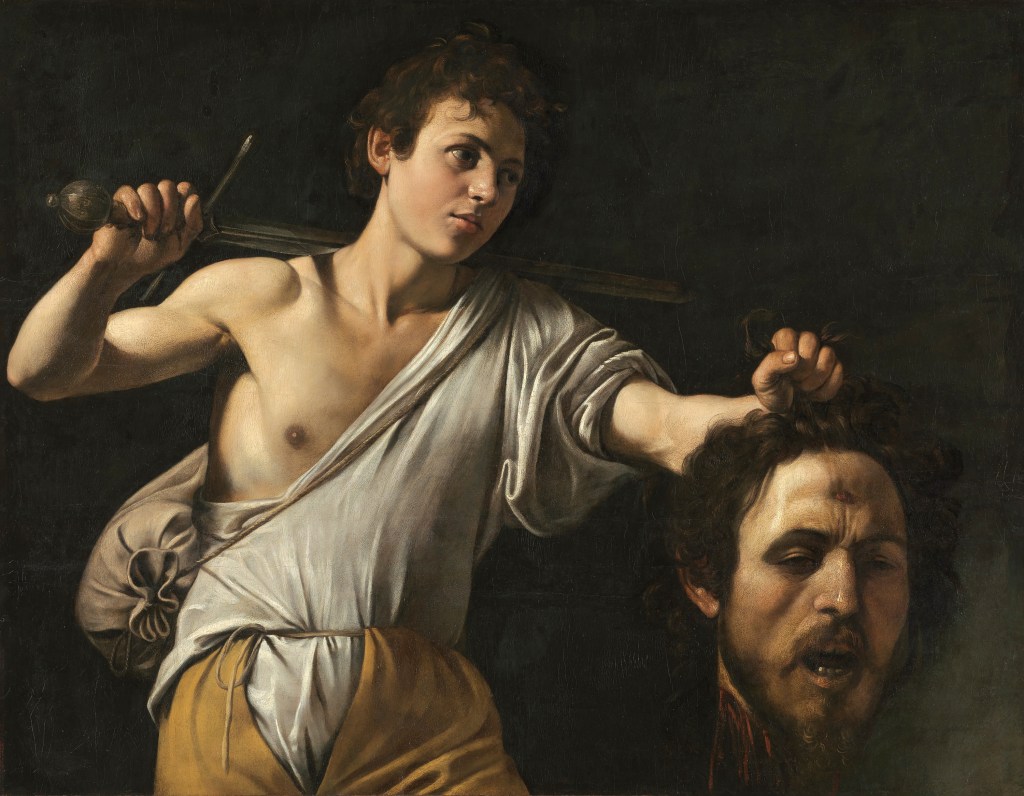
The darkness visible through the shirt tells us that this is certainly a late painting: look at the wonderful freedom with which it is painted. A number of long, rapid, loosely-painted brushstrokes flow diagonally from the shadowed shoulder across the otherwise naked torso. The shirt is thin, judging by the amount it has wrinkled, and yet it does not appear to be translucent. We don’t see the light flesh tones of the chest or stomach through it, but the darkness. The white paint was applied directly onto a dark ground. This technique was first fully explored by Tintoretto in the 16th century, and is a great time saver for artists painting nocturnal scenes. Rather than working your way down from light to shadow as you would have to on a white background, here you work your way from darkness up to the light. However, the shadowed edges of forms do not need to be painted at all, as we fill them in with our imagination. Here, the shadows caused by the wrinkling of the fine cotton are an absence of overpaint, rather than an application of a darker hue. But then the dark ground seeps through the flesh tones as well. The outline of David’s back – to our right of his body – is defined by what appears to be light reflecting onto the torso at the edge of the shadowed rib cage. But this is artistic license – there is nothing in the painting to explain what the light could be reflecting from. The thinness and transparency of the white paint is a common feature of the late work – a development which reaches unprecedented extremes in The Last Caravaggio – all of which suggests the usual date given for the execution of this painting: about 1610, the year of the artist’s death at the age of 38. However, the Galleria Borghese, in whose collection the painting has resided for over 400 years, now suggests the date given at the top: 1606-07 or 1609-10. To understand why this might be the case, we should question the assumptions we have made about who is looking at whom. But just to point out the difference between a ‘mature’ painting and a ‘late’ one (though how can it be ‘late’ at the age of 38?), here is an earlier version of the same subject in the Kunsthistorisches Museum in Vienna, which they date to ‘around 1600/01’.

So much is similar between the two paintings. Both are nocturnal, with a bright light coming horizontally from the left. The sword is held in David’s right hand, with the head in his left, thrust towards us by the strongly foreshortened arm. The costume is also the same: tan coloured britches and a white shirt tucked in at the waist, hanging over one shoulder, with an arm withdrawn. The head looks surprised, the mouth gapes, and blood pours down in the shadows below the severed neck. Stylistically though they are rather different. In the earlier work the forms are fuller, and more clearly defined. Although it was also painted on a dark ground, the darkness is not nearly so visible through the flesh, or, for that matter, the shirt. In this painting it is more obvious that one of the arms has been taken out from its sleeve – the cuff is clearly visible tied just above David’s right hip. However, in this earlier painting it is the right arm which is bare, which makes more sense: he holds the sword in his right hand, the same hand that would have swung the sling. Freeing this arm from the clothing would have allowed him greater freedom of movement, a greater swing. In the later painting the unclothed left arm associates this freedom of movement with the head, thus bringing the relationship between victor and victim closer. There are a least three other notable differences, quite aside from the format of the painting (landscape in Vienna and portrait in Rome). First is the position of the sword, held nonchalantly over David’s shoulder. This may be a relaxed pose, but it still allows him to swing the blade again. A second difference is in his state of dress: the britches are more obviously gaping. This might be a reference to the biblical account. Saul was worried about the young boy’s ability to defend himself, ‘And Saul armed David with his armour’ (1 Samuel 17:38). However, David had never worn armour – he hadn’t ‘proved’ it, meaning that it was not tried and tested – ‘And David said unto Saul, I cannot go with these; for I have not proved them. And David put them off’ (1 Samuel 17:39). He ‘put off’ the armour – but the bible doesn’t suggest that he ‘put off’ all of his clothes – as the sculptures of Donatello and Michelangelo might suggest. In Caravaggio’s paintings David wears down to earth clothing, over which armour could have been worn. The sloppy garb of the young boy might simply result from the removal of ill-fitting armour, and could even suggest a lack of concern about his appearance in the face of God’s enemy. A final difference between the two paintings is the direction in which the boy is looking. In the earlier version his gaze is directed towards our right, into the shadows, and his expression is contained and in control – potentially proud, perhaps, and, I would say, on the verge of a smile.

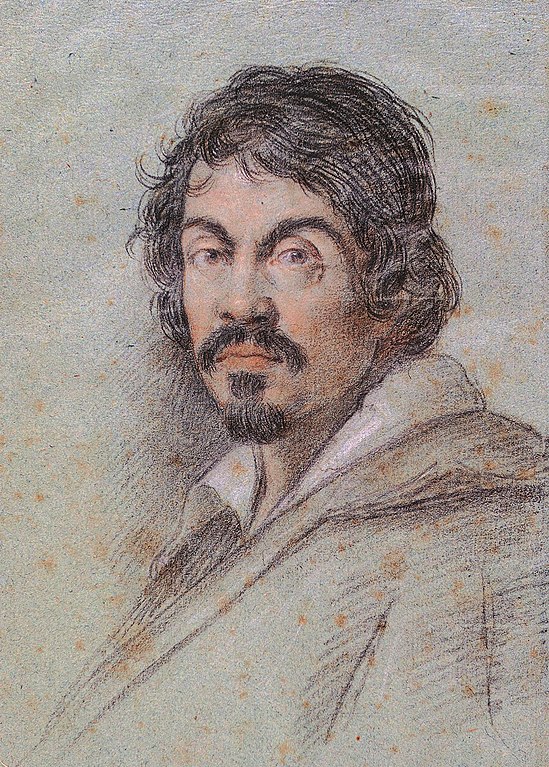
The expression of the Galleria Borghese David is strikingly different – and unlike that of any other David that I know. His head is tilted, and the raking light casts most of the face into deep shadow. Rather than the potentially proud and imminently smiling figure, here his look is downcast, his lips pursed, his brow furrowed. There is a sense of deep regret – even sorrow – at what he has had to do. He even seems sad for the death of Goliath. Why should this be? It might help to look again at the face of the giant, and compare it with a portrait of Caravaggio himself, by Ottavio Leoni, which is now in the Biblioteca Marucelliana in Florence.

Although usually dated around 1621, eleven years after Caravaggio died, no one has ever doubted the authenticity of this chalk drawing, presumably copied from an earlier sketch.  It reveals an interesting aspect to the painting: Goliath is a self portrait – suggesting that Caravaggio saw himself as a slain giant. In terms of the subject generally, St Augustine’s interpretation of the story – in Christian terms – that it represents the triumph of Christ over the devil, (or, if we take it more generally, of good over evil), was one which was understood through the ages. But how does this apply to the famous painter? If his is the slain pride, someone must have humility, and that would also be the artist himself, presumably. He could be saying that he has – finally – found the humility to overcome his own pride.

The painting entered the Borghese collection as early as 1613, and records suggest that it was in Naples in 1610. An early biography implies that it was painted for Cardinal Scipio Borghese in 1606, though… However, given the existence of two other Davids by Caravaggio – the one above, in Vienna, and an earlier work in the Prado, in which David crouches over the prostrate body of the giant – it is not entirely clear which, if any, of the paintings the sources refer too: there could have been others which are now lost. However, 1606 was a significant date. It was the year in which Caravaggio murdered Ranuccio Tomassoni, and fled from Rome. After this there was a price on his head, quite literally: a reward for killing him, which in this painting David seem to have done. On leaving Rome his first lengthy stop was in Naples. His guilt at the murder, and his worry that it had potentially ended his own life, could be expressed in the downcast glance of the shepherd boy. From the moment he fled Caravaggio sought pardon from the Pope, Paul V: born Camillo Borghese, he was the uncle of Cardinal Scipio. If not painted during his first stay in Naples, from 1606-07, he might have painted it on his return from 1609-10 – hence the dates the Galleria Borghese gives for the painting. Throughout his flight he continued to ask the Pope for forgiveness, which would allow him to return to Rome. This painting was, in all probability, his way of asserting the fact that he had learnt his lesson: humility had finally conquered his own pride. However, there is another possibility.

It has been suggested that this painting is actually a double self portrait. If Goliath looks older than the man we see in the Leoni portrait, the idea would be that David is a younger version of the same person. This would be poetically beautiful, as we would be seeing the young Caravaggio looking with regret at his future self, although I can’t convince myself that this really is him a second time. However, what I have no doubt about is that one of the witnesses of the Martyrdom of St LucyThe Last Caravaggio – seen on the right, below, is none other than Michelangelo Merisi da Caravaggio.

However wild and unruly his life, he was a profoundly religious man, and regularly portrayed himself as a witness to the miracles he painted. There are a number of suggestions for the identity of the model for the young David. These include one of Caravaggio’s assistants, a contemporary artist, or the the artists’ ‘obsession of the day’ who did not requite his love (hence the sense of being ‘slain’). And, as I mentioned above, it has also been suggested that it is the young Caravaggio himself. But whoever it was, it is clear the man who portrayed himself so often as a witness is here being witnessed, and that what is seen causes sorrow. He died two months short of his 39th birthday, and as we always do, we inevitably end up wondering what he would he have gone on to do had he lived. Given the development of his work up to this point, it seems hard to avoid the conclusion that all that was left for him was darkness.

220 – At the end of the day

Frederic Leighton, The Garden of the Hesperides, c.1892. Lady Lever Art Gallery, Port Sunlight.

After some delay I will be very happy to talk about Frederic Leighton and Flaming June at last – this Monday, 22 April at 6pm. This is a superb opportunity to focus on a painting which is widely recognised as the masterpiece of a former President of the Royal Academy, especially as its usual home, in Puerto Rico, is not exactly on everyone’s doorstep. The following week, 29 April, I will look at The Last Caravaggio, putting the National Gallery’s two-painting exhibition into the context of the artist’s life as a whole. On 6 May I will look at one of Delft’s leading artists, Carel Fabritius – making it clear that his work was Not Just The Goldfinch. This will be followed by Expressionists (20 May) and Yoko Ono (29 May), which will both be introductions to exhibitions at Tate Modern: keep your eye on the diary, as they will go on sale as soon as I can get myself together. The May In Person Tours are selling fast, but there are still a few tickets left for each:
Wednesday, 8 May at 11:00am NG04 – Florence: The Next Generation
Wednesday, 8 May at 2:30pm NG05 – Siena in the Fifteenth Century
Thursday, 9 May at 11:00am NG06 – Piero and the Court of Urbino (morning)
Thursday, 9 May at 2:30pm NG06 – Piero and the Court of Urbino (afternoon)

But for now, rather than Flaming June, I would like to talk about a different painting by Frederic Leighton.

When I started writing this post a few weeks back I was sitting more or less directly underneath it, as I was in the café of the Lady Lever Art Gallery. I was sitting there because (a) I wanted to have another look at the painting, (b) they do great scones, and (c) they have WiFi, and at the time I didn’t, which is why Monday’s talk was postponed. The Garden of the Hesperides was first exhibited at the Royal Academy Summer Exhibition in 1892 – which is what gives it the date ‘c. 1892’. However, it is neither signed, nor dated, so we don’t know exactly when it was finished: it could have been completed the previous year, given that many artists built up their annual submissions to the Summer Exhibition gradually, in between shows. Indeed, it might even have been started before the 1891 exhibition. Leighton’s paintings, like those of many artists of the time, function as a sort of ‘stylistic chain’, with ideas developing from one painting to the next. In each case he would make choices to resolve the problems arising from the chosen subject, and the alternative solutions to these compositional concerns often inspired subsequent works. The importance of The Garden of the Hesperides for the development of Flaming June is the reason I chose to write about it today – even before I realised that it was just around the corner at the Lady Lever: it’s only a quarter of an hour’s stroll, so even closer than the Walker.

Before we go any further, it would be good to clarify who the Hesperides were – but it’s really not that simple. If you want all of the suggestions about them (at least, I assume they are all there) you could do worse than look at the Wikipedia page, but the Encyclopedia Britannica entry is undoubtedly clearer – if less detailed. Suffice it to say that the many and varied classical sources suggest there were anywhere between three and seven of them (although a chest designed by Edward Burne-Jones in the Birmingham Museum and Art Gallery only includes two), and they were blessed with a large number of possible names. Leighton settles on three, which was the ‘original’ number, and the most commonly accepted. Hesperos means ‘west’, with Hesperus as one of the names for the evening star, which is seen in the west, and associated with the setting sun. As a result it was often assumed that the Hesperides lived on an island to the ‘west’ of the known world, just off the coast of Spain. I’ll feed in more information about them as we explore the painting.

If we were talking about a renaissance work of art we would call this a tondo, a circular painting. It is displayed in the original frame designed by Leighton himself. The three Hesperides are sitting in the shade of a tree, which has a massive and gnarled trunk growing from bottom left to top right, the branches forming a canopy across the top of the tondo. The main role of the Hesperides was to tend their garden and guard this tree with its golden apples. The fruits were highly prized, and feature in a number of myths: The Judgement of Paris, Hippomenes and Atalanta and the 11th Labour of Hercules to name but three. The tree was a gift from Gaia, goddess of the Earth, to Hera on the occasion of her marriage to the ‘King’ of the Gods, Zeus. If you’re more familiar with the Roman names, that would be the wedding of Juno and Jupiter.

The three women sit – or sprawl – in relaxed poses, their heads lolling to one side, their eyelids drooping. It is sunset, after all (look at the orange glow on the horizon), and they appear to be in a state of eternal drowsiness. I spent a long time trying to find a good, high-resolution image of this painting to pick out some details, but they all seemed to be slightly out of focus. Finally I realised that they are out of focus. However crisp the intricate folds of the central light orange dress might appear, the faces are all slightly blurred, and that was Leighton’s intent: this is a painting of drowsiness. If I’m honest, they all look just how I feel when I’m nodding off to sleep in an armchair after a rather good lunch. We see different aspects of the three maidens: on the left, in profile; in the centre, facing towards us; and on the right, at an angle. They all rest on the trunk of the tree alongside another, unmissable presence: the serpent Ladon, who helps them keep guard, and who, I would suggest, is the only one lively enough to do so.

The Hesperides were described by Hesiod as being ‘clear voiced’, while Euripides called them ‘minstrel maids’ – apparently they delighted in song. The nymph on the left is indeed strumming at a lyre, her lips parted, as if she is singing. Her brilliantly coloured dress would suggest that she is Erytheia – ‘the red one’. She leans back against the trunk of the tree, with her torso at the same angle, and her head tilted back. Her profile stands out clearly against the pale, evening sky, and the sharply defined line of the sea on the horizon almost cuts into her throat as she sings. Her right arm, shadowed and relaxed as it nonchalantly plucks at the strings of the lyre, stands out against the brilliantly lit trees growing by the sandy beach at the water’s edge. She sits on a red cloth only a shade deeper than the deep orange (rather than red, if I look again) of her dress. This is precisely the exploration of close shades of similar colours which interests Leighton in Flaming June. This nymph also has similar, exaggerated bodily proportions to those seen in the later painting. Compare the length of her torso, from shoulder to hip, as she leans against the trunk, to her thigh, from hip to knee. The latter is enormously elongated, adding to the sense of drawn out drowsiness. This lengthened thigh becomes one of the central features of Flaming June. The lower leg – from knee to foot – is relatively short by comparison. The angle of her right leg reveals the sole of her right foot, while the left foot, propped up on the flexed toes, shows the only tension in her body. In my mind this is an echo of the right foot of the right hand angel in Michelangelo’s Manchester Madonna – but I could easily be wrong.

The central figure wears a light orange robe – I suppose it could be described as ‘peach’, or a light ‘salmon’. This may be Leighton’s representation of Hesperia, whose name means ‘sunset glow’. Her figure epitomises the contrast between crisp focus – seen in the clear definition of the legs beneath the skirts, and the multitude of rippling folds in the thin drapery which surrounds them – and the lassitudinous blur of the face, lolling to one side in the shade of the tree. Seen closer, this detail reveals that none of the three nymphs are actually resting against the bark itself: they are using the serpent Ladon’s long sinuous flank as their pillow. The loops and curves of his form are not easy to trace, but there is just a hint of the metallic sheen of the scales to the left of the tree at the top of this detail, and lower down it curves behind the heads of the three Hesperides. Ladon also encircles Hesperia, wrapping around her shins and across her waist, where the light touch of her right hand tells us that this is in no way stressful – it could even be comforting. The thinner form of the creature leaves the detail on the right, almost as if leading on from Hesperia’s gesture. The nymph’s right knee is tightly bent, the left knee less so – a posture which goes back to the Torso Belvedere, which was much favoured by Michelangelo. A variation of this composition, with the foot of the fully flexed leg tucked under the more open knee, is also adopted by Flaming June: we will look at its origins in more depth on Monday. Also derived from Michelangelo is the ruching of the fabric around an element which binds the form. Here Ladon causes the bunching of the fabric, whereas in the paintings and sculptures of Michelangelo it is often a belt or ribbon.

If we are following the most ‘popular’ sources, the name of the third nymph should be Aigle, but as this means ‘dazzling light’ I can’t see that this was necessarily Leighton’s intention. This painting adopts a palette which was one of his favourites in the 1890s, exploring the ways in which colours are affected by the light. Here the olive green of the robe is inflected by the warm glow of sunset. It could be catching light reflected from Hesperia’s dress, or it could be a shot silk, with warp and weft made of green and orange threads. While the back of her head lies on Ladon’s flank, this third nymph also leans on her sister’s arm. She holds a dish on her lap, and lazily fingers its contents – but it is hard to tell what they are: a pot-pourri of sweet smelling petals, perhaps?

This is a truly sensuous painting, with references to all the senses. Sight is primary: we are looking at the painting after all, but we also hear the sound of the lyre. Whatever is in this bowl, it is being touched, and if it is not also sweet-smelling in itself, we will see later that a beguiling scent is essential to the meaning of the painting. But how about taste? We will get to the ‘golden apples’ on the tree later, but to our right of ‘Aigle’ is a ceramic jar, which may contain wine. Behind it are pink flowers, which again allow the possibility of fragrance. However, in this detail, it is really Ladon who stands out, his head bold against the glistening sea. His role, as I have said, was to help the Hesperides guard the golden apples, and he certainly seems to be the most alert of those present. In one version of the myth of Hercules, his 11th labour involved stealing one of the golden apples – he slayed Ladon and took the apple from under the noses of the nymphs. In another version, while Hercules held up the sky for Atlas, Atlas was able to get into the garden easily: he was commonly believed to be the father of the Hesperides.

Looking back to the three nymphs I can’t help but admire Leighton’s composition and colour. He has painted three women who are similar enough to be sisters, but in three different poses, all of which are relaxed and sensuous, using a harmonious palette which speaks of the dusk, and of the sun setting over nature. I am also intrigued by the way he varies the focus on the figures, and creates different depths of form, almost like a sculptor. If you imagine the three women as if they were carvings against a painted backdrop, Hesperia is in the highest relief and her dress in the sharpest detail. Erytheia and Aigle would be carved in a lower relief, with Erytheia perhaps the flattest of all. It strikes me that this is precisely how Michelangelo worked in the Taddei Tondo – which was acquired by the RA in 1829, and so would have been well-known to Leighton. The most ‘finished’ part of the carving is the most important – the baby Jesus, who is in the deepest relief at the centre of the sculpture – a tondo. Even though it is a painting, the same is true of the Manchester Madonna (which was acquired by the National Gallery in 1870, and so easily accessible). The Madonna herself is in the centre in ‘high relief’, with the angels flanking her further back – much as Hesperia is flanked by Erytheia and Aigle. Leighton’s admiration of Michelangelo’s work is widely acknowledged, and is revealed by contemporary photographs of his studio, in which he displayed black and white photographs of the Italian master’s sculptures (I’ll try and hunt some out for Monday). But there is, of course, more to this painting than just the three clear-voiced maidens.

At the top we see the canopy of the tree spreading below the curving frame. The broad, scaly flanks of the serpent loop around the massive trunk, with a last loop and the tip of the tail hanging from one of the slimmer branches on the left. Against the pale sky, which is streaked with clouds coloured a mid-blue in the dull light of dusk, we can see one branch thickly laden with fruit, and there is another, brighter, and clearer, in the foreground at the top right.

If we hadn’t noticed before we can see here that Leighton has accepted the relatively modern interpretation of the ‘Golden Apples’ of the Hesperides which suggests that they were, in fact, oranges. This is clear not only from the shape and colour of the fruits, but also from the leaves, typical of the long, pointed forms of citruses generally. This identification is also true for the garland which circles the frame, made up of bound branches of fruits, leaves and flowers: as ever I am grateful to the Ecologist, who has confirmed that they are accurate depictions of orange blossoms. In the corners of the frame are stylised shells, set against a waving pattern – together these features must surely refer to the island setting of the garden and its surrounding sea.

The bottom of the painting also reveals a watery setting – although this must be an inland freshwater pond. Two egrets perch in an oleander bush, one resting, the other alert, with one wing raised, and its neck arched as it scans the water for fish. The still, flat surface of the pond is dark and mysterious, but reveals reflections of the draperies of the Hesperides, interrupted by a few petals of one of the blossoms which are floating just to the right of centre. Aigle’s green drapery falls over a rock which projects out over the water casting a deep shadow. I can’t help seeing an echo of Leonardo’s Virgin of the Rocks here – the drop at the front of the renaissance painting is rarely commented on, but have another look. This might just be my renaissance ‘heritage’ being over-active, but given the references to Michelangelo, it is not impossible. The Virgin of the Rocks was bought by the Gallery in 1880 and so it is more than likely that Leighton would have known it, particularly given his interest in the art of the time.  

In terms of the impact of the painting, the detail at the bottom left is one of the most important. Egrets may be an increasingly common feature of the British landscape, but back in 1892 they would have struck an exotic note. Admittedly, it would probably have been read as ‘oriental’, even if the Hesperides were inhabitants of the occident, towards the setting sun – but it would certainly have served to locate the image as being ‘other’. The implications of the oleander might also be unfamiliar – but, within certain circles, it was a notable feature of the artistic culture of the late 19th Century. Among other references, in 1881 Oscar Wilde opened his poem By the Arno with the lines,

The oleander on the wall
Grows crimson in the dawning light.

In 1865 Matthew Arnold, a friend of Leighton’s, had written Thyrsis, a Monody, which Wilde could well have known: the setting is the same. The poem deals with the premature death and burial of a young poet – a friend of the author’s – in the Arno valley:

(For there thine earth forgetting eyelids keep
The morningless and unawakening sleep
Under the flowery oleanders pale)

The connection between overpowering scents, sleep and death, might change our thoughts about this remarkably sensuous, even decadent painting. The air is heavy with languorous music, the taste of rich wine and somniferous odours: a beautiful and compelling decadence. This aspect of the work is explored more fully in the catalogue of the Leighton House Museum’s 2016-17 exhibition Flaming June: The Making of an Icon, which cites the two poems I have mentioned above – and more. Along with the miniature display currently at the museum, and the Royal Academy’s larger (but still modest) exhibition, the catalogue will be an essential source for my talk on Monday. At the end of the day, though, the most important thing is the painting: Flaming June. Don’t miss this opportunity to see it.

Transfigured (and Repeated)

Apse Mosaic, c. 549. Sant’Apollinare in Classe, Ravenna.

This coming Monday, 8 April, at 6pm, I will be Revealing Ravenna – or at least, talking about the remarkable mosaics, putting them in their historical and religious context, and explaining why the best Byzantine art is in Italy, rather than Istanbul. The following week I will be lucky enough to visit them in person. But seeing that not all of you can come with me, and not all of you will be free on Monday, I thought I would re-post a blog about one of the mosaics today – particularly as this one will not really get much of a look in, because it is some way out of Ravenna. The week after I get back I will finally be able to talk about Frederic Leighton and Flaming June. The talk has been rescheduled to 22 April as a result of technical issues (which, I am relieved to say, were finally resolved yesterday). The last talk in April, on Monday 29, will also be about a last – an introduction to the National Gallery’s small-scale exhibition, The Last Caravaggio.

There are still a few places left for some of next week’s In Person Tours – with the best availability on Tuesday 9 April at 11:00am for NG03 – The Northern Renaissance, looking at works by Jan van Eyck, Hans Memling and Dirk Bouts: do come along, as it will be the last time I will lead this tour. Information about the others can be found in the diary, of course. The next set of ‘IPTs’ will be in May, as follows:
Wednesday, 8 May at 11:00am NG04 – Florence: The Next Generation
Wednesday, 8 May at 2:30pm NG05 – Siena in the Fifteenth Century
Thursday, 9 May at 11:00am NG06 – Piero and the Court of Urbino (morning)
Thursday, 9 May at 2:30pm NG06 – Piero and the Court of Urbino (afternoon)
Shortly after this I will head off to Delft with Artemisia, and there are still one or two places left if you are a fan of Vermeer, or have always wanted to see The Goldfinch, and would like to spend a few days in an idyllic, thoroughly Dutch city. Meanwhile, back to Ravenna.

I have not often visited the church of Sant’Apollinare in Classe for the simple reason that it is a little out of the way – although maybe not as far as I used to think. Classe (two syllables, clas-sé) is now effectively a suburb of Ravenna, but it was originally the port of the Roman city, its name coming from the Latin for ‘fleet’ – classis ­– and it was about 4km away. Each time I go, I am struck by the simple majesty of the building, although this is the result of complex historical processes which, it turns out, are not simple at all. The church itself has a standard ‘basilica’ structure, with a central nave and two side aisles, separated by arcades, which lead to three apsidal endings. Originally the walls of the nave would have been covered with mosaics, but these have been lost. They were replaced with frescoes in the 18th Century, of which only the roundels with portraits of the bishops of Ravenna have survived, just above the arcades. The upper part of the walls, and the walls of the side aisles, have been stripped back to bare brick – wonderfully evocative, but decidedly modern in ethos. But at least they do not distract from the central apse, which is the true treasure of the church.

The basilica was dedicated to St Apollinare (five syllables – A-pol-lin-ar-é) in 549 – which gives us the approximate date for the mosaic within the apse. It was founded by Ursicinus, bishop from 533-536, and was dedicated by Maximian, who had managed to get a promotion. Ravenna became an archdiocese, and so Maximian was Archbishop from 546-556. Apollinare himself was said to have been the first bishop, having been converted to Christianity by none other than St Peter, although the ‘life’ which reports his deeds and martyrdom was, in all probability, written by Maurus, Archbishop from 642-71. There is no concrete historical evidence that Apollinare ever existed, if we’re honest, and Maurus almost certainly wrote his ‘life’ to make the diocese of Ravenna look more important, and to emphasize its apostolic origin. Indeed, one of the major subjects of the mosaics is the apostolic succession.

In the semi-dome of the apse we see Apollinare, dressed as a bishop, with his arms raised. This is the attitude taken by an orant – someone at prayer – a common image in early Christian art. Walking towards him are a number of sheep: six on each side, making twelve in total, like Jesus’s apostles. But why are they sheep? Well, the earliest images of Jesus show him as ‘the Good Shepherd’, and indeed, priests and vicars today still refer to their congregation as their ‘flock’. Here Apollinare’s flock is the same size as Jesus’s. Apollinare therefore stands in for Jesus. If not Christ’s vicar on Earth, he is at least Christ’s vicar in Ravenna – and this is precisely what the apostolic succession is all about. In John, Chapter 21, Jesus appears to his followers after the Crucifixion and asks Peter the same question three times. This is the last of the three (John 21:17):

He saith unto him the third time, Simon, son of Jonas, lovest thou me? Peter was grieved because he said unto him the third time, Lovest thou me? And he said unto him, Lord, thou knowest all things; thou knowest that I love thee. Jesus saith unto him, Feed my sheep.

He has already, in Matthew 16:18-19, told Peter that he will give him the keys of the kingdom of heaven:

And I say also unto thee, That thou art Peter, and upon this rock I will build my church; and the gates of hell shall not prevail against it. And I will give unto thee the keys of the kingdom of heaven: and whatsoever thou shalt bind on earth shall be bound in heaven: and whatsoever thou shalt loose on earth shall be loosed in heaven.

Either of these quotations, taken separately, would serve to affirm Peter’s position as the first leader of the church after Jesus. Together, the message is reinforced. Peter takes Jesus’s place, and then, according to the belief current in Ravenna, Peter both converted Apollinare and appointed him bishop: so Apollinare takes Peter’s place, in Ravenna at least. In the mosaic he leads 12 sheep as Jesus led the 12 apostles. Above his head is a blue circle, set with stars and a jewelled cross. Three more sheep stand on the ground, two people appear in the golden sky, and a hand appears from the clouds. But I’ll come back to these details later.

About 120 years after its dedication, the church was partially remodelled, and additions were made to the mosaics above the arch of the apse. We see Christ blessing in the centre, surrounded by the symbols of the four evangelists. On the left the eagle stands for St John, the angel is the symbol of St Matthew, and the lion – as anyone familiar with Venice will know – is St Mark. This leaves the ox to represent St Luke. The most handy mnemonic to remember these is the plant which makes such good hand cream – the ALOE. If the letters stand for Angel, Lion, Ox and Eagle they are in the right order for the canonical arrangement of the gospels – Matthew, Mark, Luke and John. Below these symbolic beasts, and once more against a golden sky, twelve sheep have left the gates of two jewelled cities – Bethlehem and Jerusalem – processing towards Jesus in the same way that their equivalents do towards Apollinare just below.

Further down, below Apollinare, there are four figures depicted in the mosaics between the windows. They are all bishops, all of whom were Apollinare’s successors. In traditional accounts, he was the first Bishop of Ravenna, his episcopacy lasting until his martyrdom in 79 CE. From left to right the first of the chosen few is Ecclesius, the 24th Bishop, in position from 522-532, who founded the church of San Vitale (home to some of the glorious mosaics I will discuss on Monday). He is followed by St Severus (c. 308-c. 348), the 12th bishop; Bishop Lacuna (dates unclear); and Ursicinus (533-536), 25th Bishop and the founder of this particular church. OK, so there never was a Bishop Lacuna, it’s just that I can’t get a good enough detail to be able to read his name and tell you who he is [I have looked it up online again, three years after I originally wrote the post: it is Bishop Ursus, whose episcopacy was either 370-396 or 405-431 (it was a long time ago, and the historians are still arguing about it) – he founded the cathedral in Ravenna]. These four bishops show us, in abbreviated form, how the apostolic succession continues – Jesus appointed Peter, Peter appointed Apollinare, and he is followed by a number of successors in turn, down to the present incumbent. But what exactly is going on above Apollinare’s head?

Most striking is the jewelled cross in the blue circle. In the apse mosaic of San Vitale, Jesus sits atop a similar blue circle: it can be seen to embody the cosmos, over which he rules. The cross needs no explanation, although the jewels with which it is embossed express its value, as they do for the cities seen on either side of the mosaic in the additions. There are twenty of them in the cross: four on either arm (reminding us, perhaps, of the four evangelists), leaving 12 going from top to bottom – a reference, perhaps, to the 12 sheep, and so to the apostles. In the very centre we see, as an apparently minute depiction, the face of Christ. To the left and right of the cross are the letters alpha and omega, the beginning and the end of the Greek alphabet, as God proclaims more than once in the Book of Revelation. This is chapter 1 verse 8:

I am Alpha and Omega, the beginning and the ending, saith the Lord, which is, and which was, and which is to come, the Almighty.

Underneath the cross are the words SALVS MVNDI – ‘the health of the world’ – or, to put it more explicitly, ‘salvation’ – and above we see (although not very clearly) ἸΧΘΥϹ – ‘ichthys’, the Greek word for ‘fish’. The fish was one of the earliest symbols for Jesus, and is derived from an acronym. The letters stand for the Greek words meaning ‘Jesus Christ, Son of God, Saviour’. Nowhere in this image is Jesus explicitly named, nor, with the exception of the tiny image of his face, is he visible. But what of the three sheep, and the two people in the sky? Should we see the sheep as three of the apostles, by comparison with the others below? And if so, who are they? They are not named. However, the two half figures in the sky are. The one top left is labelled ‘Moyses’ – or Moses. The top right inscription is harder to read, but it is Elijah. The presence of these two Old Testament prophets is the key to understanding the mosaic. Here is Matthew 17:1-3 (it helps to know that ‘Elias’ is a version of ‘Elijah’):

And after six days Jesus taketh Peter, James, and John his brother, and bringeth them up into an high mountain apart, And was transfigured before them: and his face did shine as the sun, and his raiment was white as the light. And, behold, there appeared unto them Moses and Elias talking with him.

This is The Transfiguration, itself transfigured. The three sheep represent Peter, James and John. Matthew says that ‘his face did shine as the sun, and his raiment was white as the light’, but in this mosaic Jesus is transfigured into pure symbol, whether as the cross, or as the words: ‘alpha and omega, salus mundi’, and ‘ichthus’. Too perfect to represent, Jesus becomes entirely transcendent. Later on (17:5) Matthew tells us that, ‘a bright cloud overshadowed them: and behold a voice out of the cloud, which said, This is my beloved Son, in whom I am well pleased’. The disembodied hand is that of God himself, and is the visual equivalent of the ‘voice out of the cloud’. And how better to represent ‘a bright cloud’ than with the light reflecting from a gold mosaic?

In the context of the church the meaning of the mosaic becomes clear. At the top, Jesus is seen as if in Heaven, blessing the congregation. His word is conveyed by the four evangelists beside him, and preached by the twelve apostles who process towards him – albeit in ovine form – from Bethlehem and Jerusalem. Below, in the apse – on Earth – he is transfigured. Seen in the presence of Moses and Elijah, and witnessed by Peter, James and John, this is the Son of God. In a direct line below him, Apollinare takes his place, having been appointed by St Peter, where, praying, he leads his own flock. His role is then taken by successive Bishops and Archbishops, whose throne would originally have been in the apse, directly behind where we now see the relatively modern altar (the same was true for all churches, although the only English cathedral to have its cathedra in this original position is Norwich). Everything – the mosaics, the architecture and the original fixtures and fittings – would have combined to say that the apostolic succession continues to this day.

The steps leading up to the altar date from the restructuring of the church in the 670s. By raising the floor a crypt could be created beneath the high altar for the display of the relics of Sant’Apollinare, allowing pilgrims to pay homage without disturbing the celebration of the mass. In the mosaic, Apollinare appears directly above his own relics, as well as directly above the modern-day Bishop, who would be, in a more worldly and less symbolic way, presiding over his own flock. There should be no doubt as to the authority of this man: it descends from Christ, is justified by his suffering on the cross, and has been passed down from the first Bishop, himself installed by St Peter.

By the 9th Century the harbour silted up and the importance of Classe diminished. Not only that: pirates patrolled the nearby coast, and they would not be cowed even by the direct display of God’s authority. To protect Apollinare’s relics from the raids, they were moved to a church in the centre of Ravenna. Built as the chapel of the palace of King Theoderic, and dedicated to Christ the Redeemer in 504, in around 540 it was re-dedicated to St Martin and then, in 856, it was re-dedicated a second time, to Sant’Apollinare. Today it is known as ‘the New Sant’Apollinare’, or Sant’Apollinare Nuovo. The changes of dedication are reflected in subtle changes to the mosaics, which take on an added complexity. But that’s one of the things I’ll be talking about on Monday.

A Second Helping of ‘The Last Supper’

Tilman Riemenschneider, The Last Supper, 1499-1505, St. Jacobskirche, Rothenburg ob der Tauber

I’m so sorry, I won’t be able to talk about Flaming June on Monday, 1 April – you can blame a combination of TalkTalk and Openreach. We’ve finally made it to Merseyside, and should have been connected to the internet on Monday, but instead they sent an engineer on Tuesday. The WiFi worked for two hours, but hasn’t done since. The online ‘bots’ are always useless, and the online chatlines drawn out – and useless. So far they have done nothing to help. There is no guarantee it will be up and running by Monday. I would head to London, but there are engineering works on the line to London so the journey would take twice as long, and, as an extra insult, cost four times as a much. Still, it’ll be Easter Monday, so maybe a break would be a good idea.

The following week I will be in London. My talk Ravenna Revealed, on 8 April at 6pm, will look at the Italian city’s glorious mosaics, some of the best Byzantine art that has come down to us. For me this will be preparation for a visit to the town itself with Artemisia, the ‘adult’ branch of Art History Abroad. That trip has been full for a long time, but there are still a few places available if you fancy joining me in Delft in May – especially if you’re a fan of Vermeer or missed the big exhibition last year. It’s a beautiful, small town, far more truly Dutch than Amsterdam, with picturesque views, fine churches, a great museum and impressive restaurants. We will have a day trip to The Hague to visit the Mauritshuis (with three Vermeers – including The Girl with the Pearl Earring and the View of Delft – not to mention Fabritius’ The Goldfinch), and on the way back to the airport we will stop off at the Rijksmuseum to see their four Vermeers (including The Milkmaid), among other treasures. So that’s a fifth of Vermeer’s surviving works! Full details are given on the blue link above, or here: it would be lovely to see you (please mention my name if you do book – thank you).

There are also still a few spaces left for the next In Person Tours of the National Gallery on 9 and 11 April, looking at Jan van Eyck and the northern renaissance, the second generation of Florentine renaissance artists, and the fifteenth century in Siena – for links to those, giving full details, it would be best to check the diary. I have rescheduled Frederic Leighton and Flaming June to Monday 22 April, just after I have returned from Delft (if you have booked for that already, you should have had a least one email detailing the change of date, and offering alternatives should you not be available). I will follow that up on Monday 29 April with an introduction to the National Gallery’s upcoming exhibition, The Last Caravaggio, which is due to open on 18 April. For now, though, as it’s Maundy Thursday (Maundy: from the Latin mandatum, ‘command’, referring to the instruction that Christ gave to his Apostles to love one another), I thought it would be good to think about The Last Supper. This turns out to be the very first post I wrote specifically for this website, as you’ll see below. The first three weeks of the blog were posted on my Facebook Page, and started just before lockdown. It was only at the beginning of the fourth week that I managed to find this, a better forum. I have edited the text as little as possible to hold onto the very specific feeling of that peculiar time.

Day 22 – Tilman Riemenschneider, The Last Supper, 1499-1505, St. Jacobskirche, Rothenburg ob der Tauber.

It is the beginning of Week 4 of #pictureoftheday and I bring you a whole new innovation: I finally have my own website, and if you want to, you can head to the ‘home’ page and subscribe to my blog:

http://www.drrichardstemp.com

Alternatively, of course, you can just keep reading it here. But if you know anyone who might like it, who is not on social media, please do tell them!

On with today’s picture! We are continuing, really, from #POTD 18, where I talked about Christ’s Entry into Jerusalem, a relief carving on the left wing of Tilman Riemenschneider’s Holy Blood Altar. The Last Supper here is another detail from this remarkable structure, which is enormous, and quite hard to understand from a photograph. Nevertheless, you can see one view of the whole thing here: 

As with most carved altarpieces like this the most important part is the central section, with carved wooden sculptures encased in what is effectively a box.  This section is called the ‘corpus’, as it is the main ‘body’ of the altar. This can be shut away with the two wings, which are hinged like doors. The wings were never decorated as richly as the corpus – sometimes they were just painted, a far cheaper form of decoration than carving, whatever the relative values are now, and sometimes, as here, they were carved, but in low relief. The wings would be kept closed to protect the corpus from dust, and opened during the Mass, or on special feast days. In particular, they would usually be kept closed during lent, a period of calm, quiet contemplation, where any notion of celebration or of excess is supposedly put away. However, as the corpus of the Holy Blood Altar illustrates The Last Supper, which takes place towards the end of Lent, it might not make sense to close it off. In addition to this, the physical structure of the piece – the carpentry as much as the sculpture – implies that it might not have been possible to close it anyway.

The corpus is raised above the altar by what is often called a ‘predella’. In a painted altarpiece this would be a strip of pictures on the box which supports the main panel, but in this case it is more of an open framework designed to house a small crucifix, and two adoring angels. It was at the Crucifixion that Christ’s blood was shed. This is, of course, of huge importance given the name of the altar. The church of St James boasted a relic of the Holy Blood, and the altar was designed as an enormous reliquary. Above the corpus, effectively standing on the roof of the Upper Room where the Last Supper is taking place, there are two kneeling angels holding another cross. There is no figure of Jesus here, but there doesn’t need to be, as it is this cross which contains the precious relic: Jesus (or at least, his blood) is actually there. On either side we see the Annunciation. The Angel Gabriel, standing on the right, announces to the Virgin Mary that she will be the mother of God. But he announces the coming of the Messiah across the relic of the Holy Blood – so with the news of Jesus’ birth comes the inevitability of his future death. At the very summit of the filigree work decorating the superstructure is one last sculpture – Jesus himself, as the Man of Sorrows. He is dressed in a loincloth and wears the Crown of Thorns. He points to the wound in his chest from which the blood flowed. As he is directly above the relic, it is as if the blood flows down into the reliquary cross – and on, downwards, into the chalice at the Last Supper. Or it would, if we could see a chalice.

That is the point of this sculpture: it was at the Last Supper that Christ instituted the Eucharist. According to Mathew (26:26-28):

‘And as they were eating, Jesus took bread, and blessed it, and brake it, and gave it to the disciples, and said, Take, eat; this is my body. And he took the cup, and gave thanks, and gave it to them, saying, Drink ye all of it; For this is my blood of the new testament, which is shed for many for the remission of sins’.

Before the 10th plague of Egypt (see #POTD 21, yesterday), the houses of the Israelites were marked with the blood of a spring lamb, which was sacrificed and then eaten. The blood on the door told the avenging angel not to kill the firstborn of that household – the Jews would be saved. Jesus takes this symbolism for himself, and becomes, as John the Baptist announced, the Lamb of God, who takes away the sins of the world. In the Eucharist, the bread and wine become his body and blood. In Christian belief, Jesus becomes the Passover lamb, and his blood means that Christians will be saved.

Nevertheless, we are witnessing a slightly different point in the drama, just before the institution of the Eucharist. Jesus has announced that one of the number would betray him – and some of them are still discussing which one it will be. The man on the far right appears to be accusing his neighbour, who points to himself as if to say, ‘No, not me guv’nor’. The three above them are looking confused – and maybe a little guilty. The implication is that, whenever anyone does anything wrong, they are effectively betraying Jesus. However, they seem to be unaware that we have already reached the denouement. Judas has stood up and is ready to leave, clutching a moneybag containing the thirty pieces of silver – the blood money – in his left hand. He gets a fantastically central position – but not, apparently, a chair. Maybe he has kicked it away, and it has fallen out of the frame. 

Actually, it’s better than that. The whole sculpture is carved out of several different blocks of wood, all fitted together – and Judas is carved out of a block on his own. Look at the structure of the woodwork making up the floor of the room: can you see that his feet rest on a separate plank? Well, the whole figure can be removed, and tonight, in St Jacobskirche, maybe it will be. Judas will leave the building. This would then allow a better view of the youngest of the Apostles, John the Evangelist, asleep on Jesus’s lap. And a clearer view of Christ’s right hand, withdrawn, almost limp, as even he appears to be wary of blessing Judas.

This really is the perfect piece of drama. Looking again at the overall structure of the altarpiece, we see the Entry into Jerusalem in the left wing (#POTD 18), and, as I suggested then, the fact that you can only see the shoe on the donkey’s foot from the left-hand side implies we should be with the Apostles, following Jesus, through the gate and into the city. This takes us into the Upper Room, depicted in the corpus, where we see Jesus and the Apostles at the Last Supper. From here, Judas heads off to the high priests – and to the arresting soldiers – while Jesus goes to the garden of Gethsemane, depicted in the right-hand wing of the altarpiece. The drama continues from left to right, taking us ever closer to the point where blood – the Holy Blood – is actually shed.

Even within the Last Supper, the drama is palpable throughout the day. On Sunday I showed a picture of the windows of the Upper Room seen from behind the altarpiece – they let light in from the windows of the church itself. The biblical characters are illuminated with the same light as we are, they are in the same world as us, and we become part of their narrative. I had wanted to see this, Riemenschneider’s masterpiece, for thirty years, and I finally saw it for the first time last December. I was lucky enough to spend the whole morning with it. It was a beautiful, crisp, winter’s day, with milky sunshine and a blue sky. Sitting in front of the altar, it was at first evenly lit by a diffuse light. As the Earth revolved the sunlight fell first onto Christ’s hand – the one that had shared food with Judas, the one that appears unable to bless the departing traitor – and then, it fell onto Judas himself. He appears almost blinded by the light… and makes to leave.

Another task for Mary

Dirk Bouts, The Virgin and Child, c. 1465. The National Gallery, London.

On Monday 18 March I will reach the third leg of my Stroll around the Walker, and will look at the beautiful and varied images of Mary and Jesus in the Liverpool collection in a talk entitled The Virgin and Child… and other relatives. Not only is this one of the themes of their new display, Renaissance Rediscovered, but other paintings in the Walker (which I have not yet discussed) remind us that this subject matter is endlessly diverse, while yet more can also add to our knowledge of the complex relationships within the extended holy family – as understood by the medieval church. Sadly I don’t have time to write about any of the Walker’s own paintings this week (I’m busy in London with In Person Tours), so I’ll leave that until Monday and re-post a blog, originally title Mary, multi-tasking, about a painting in the National Gallery. I fell in love with it when it was exhibited at the Dulwich Picture Gallery in the exhibition Reframed: The Woman in the Window. There won’t be a talk the following week, as I will finally be settling in to the new home (hoorah!), but I’ll be back on Monday 1 April to talk about the Royal Academy’s unheralded display looking at Frederic Leighton and Flaming June. The week after (8 April), I will be Revealing Ravenna, exploring the city’s history via its art and architecture – and most importantly, the stunning mosaics. The next group of In Person Tours will follow this. On Tuesday 9 April at 11am I will repeat NG03 The Northern Renaissance, and that afternoon, Tuesday 9 April at 2.30pm, I will continue with NG04 Florence: The Next Generation. On Thursday 11 April I will move on to a new session at 11am with NG05 Siena in the Fifteenth Century (Morning) and repeat it at 2:30pm for NG05 Siena in the Fifteenth Century (Afternoon). Details of the tours can be found via these links on Eventbrite, and in the diary. For now, though, let’s look at this wonderful painting by Dirk Bouts.

Dirk Bouts, The Virgin and Child, about 1465. Oil with egg tempera on oak, 37.1 x 27.6 cm. https://www.nationalgallery.org.uk/paintings/NG2595

What better choice for an exhibition entitled The Woman in the Window? After all, The Virgin and Child appear to us through one window, and there is a second in the background – an idea which is elucidated, along with so much else, in the exhibition’s thoroughly researched and brilliantly written catalogue by curator Jennifer Sliwka. The Christ Child sits on a cushion on the window sill, supported by his mother’s left hand, his legs and back echoing the horizontal sill and vertical frame respectively. Mary proffers her breast for him to feed, and looks down tenderly, swathed in her traditional blue mantle. A red cloth of gold hangs over the wall on the right, and on the left the second window looks out on the surrounding countryside, and a not-too-distant city.

What role does Mary fulfil in this painting? Primarily, of course, she is the mother of Jesus – or, to give her the title bestowed unequivocally by the Council of Ephesus in 431, Theotokos, the Mother of God. This not only defines Mary’s status, but also confirms Jesus’s divinity. Her role as mother is demonstrated through her act of feeding, although, given that it was common for members of the moneyed classes to employ wet nurses to suckle their babies, Mary’s nurturing and care of her own child would have been doubly significant. Her ‘sacrifice’ in this regard also became equated with Jesus’s care for us. In the same way that Mary fed Christ from her breast, the wound in his side, from which blood and water flowed when pierced with a spear at the crucifixion (John 19:34), feeds us spiritually.

As well as Mother of God, Bouts also shows Mary as Queen of Heaven. The red cloth in the background is the same as that hung behind her when enthroned. It is a cloth of honour, used to enhance the status of medieval monarchs and serving to emphasize their physical position while holding court. It can also include a canopy, or baldachin, which effectively crowns the throne, as it does in the National Gallery’s Donne Triptych by Hans Memling. However, when ‘used’ as the cloth of honour, the fabric would be directly behind the monarch. Here it is hung to one side, suggesting that ‘Queen of Heaven’ is just one of several roles that Mary performs. The green trim with which the cloth is hemmed hangs on the central axis of the painting, implying that the cloth takes up half of the background – but notice that the framing is not symmetrical. In the foreground the light comes into the window from above and from the left: the inner face of the window frame on the right is well lit. The joints between the stones from which it is constructed are angled differently, telling us that Bouts had a good sense of spatial recession, even if this isn’t a geometrically consistent perspectival system. Nevertheless, these lines lead our eye into the painting, and into a space made holy by the presence of mother and child. The underside of the frame at the top, and the inner side on the left, are both in shadow. On the left there is less of the frame visible than on the right, suggesting that our view point is to the left of centre, as if we are directly in front of Mary, who is likewise positioned slightly to the left.

The window at the back is also important. The inside of the frame and its tracery are in shadow (which is not surprising, given that they are ‘inside’). I can’t help myself seeing the shape of the cross in those dark lines. The light would appear to come from the right here, but we can’t see the other side of the tracery to see if it is lighter or darker, so it is not necessarily inconsistent. As so often in paintings of this time (and so, one would assume, contemporary houses) there is glass in the upper sections of the window, but not in the lower (see, for example, the Arnolfini Portrait). The shutters are perfectly defined, and you can even tell that, in bad weather, the lower shutters would be closed first, and then the upper ones shut over them, if you wanted to keep out the light as well as the cold and rain. Rust streaks down from the iron nails in the lower panels. This detail is, I suspect, purely naturalistic, and helps up to believe in the setting. The glass too, is an example of naturalism, but it is also symbolic: light passes through glass without the glass breaking. In the same way, Jesus, both God and Man, passed through Mary, and she remained virgo intacta – intact, unbroken. Glass, and light passing through glass, is symbolic of Mary’s virginity. One of the many epithets applied to her was fenestra crystallina – ‘the crystal clear window’. Placing her blue mantle next to the (anachronistic) church tower, blue as a result of atmospheric perspective, and reaching up to the deeper blue of the zenith, helps to emphasize Mary’s role as Queen of Heaven. But it also, perhaps, suggests another role – Ecclesia, a personification of The Church.

Bouts was not stupid. He painted the blue with the most expensive pigment, ultramarine, but he didn’t waste it. He painted it over a ground layer of azurite, a far cheaper form of blue. This was standard practice, to make the painting look good, but not to be too costly. And he didn’t use gold for the cloth of gold, although this was as much a display of painterly skill as anything else. I can see four different colours there: a ground layer of brown, and then, over the stylised leaves, cross-hatching of a creamy-butterscotch colour. The fruits are stylised pomegranates – I know, they really don’t look much like pomegranates, but comparison with other painted fabrics – not to mention real fabrics – shows different degrees of stylisation. They appear to have been woven in a different way to the leaves, and rather than cross hatching Bouts has applied texture with dots, both orangey-brown and a light cream. Seen this close up the vertical line of light cream dots looks unconvincing – but seen from a distance it becomes clear that here, as across the whole surface, the fabric is creased by careful, regular folds. Elsewhere, as below the line of dots, it is the contrast of light and dark which defines the folding.

Jesus is not sitting directly on the cushion, but on a white cloth, held next to his hip by Mary’s hand. This may well be his swaddling, but it is inevitably reminiscent of the shroud to come. That’s the third reference to his death, by the way. The first was Mary’s breast, with its echo of Jesus’s wound, the second was the cross formed by the transom of the rear window. And there is a fourth. Look at the delicate way in which Bouts has painted the creases of the baby’s hands and feet. In 33 years – more or less – they will be pierced with nails. Even as an infant he is showing us his hands much as he will as in some versions of the Man of Sorrows which show his wounds post-crucifixion. We are never allowed to forget why this fragile infant has come to earth. And yet, I find his expression in this painting delightful, if not entirely easy to define. Is he slightly sleepy? And content, maybe, having eaten? I can almost imagine a gurgle.

The light coming from the left casts a shadow of Jesus on the inside of the front right window frame – the edge of his head and his elbow – and indeed, the light on his body is beautifully painted. Look at the way his left hand stands out against the fully illuminated arm behind it, for example, or the light reflected from the window frame which edges his left arm and elbow, making them stand out from Mary’s dark cloak. There are also the subtly varied shadows on the different joints of the fingers of his right hand. Look, too, at the gentle pressure applied by Mary’s fingers on his stomach, and on her own breast, which even wrinkles slightly – such delicacy of depiction!

Dirk Bouts, Portrait of a Man (Jan van Winckele?), 1462. https://www.nationalgallery.org.uk/paintings/NG943

The composition of The Virgin and Child is not unlike a standard formulation for portraiture. Here is Bouts’ own Portrait of a Man from 1462 (the date is ‘carved’ into the wall at the top right) also in the National Gallery. His arms are firmly placed on a window sill, although in this case there is no surface visible: it would have been represented by the original frame of the painting, which no longer survives. We know that he is at a window, though, as the light casts a shadow of his head on the back wall – in the same way that Jesus’s shadow is cast onto the frame in today’s painting. There is also a window in the background, with a similar view, apart from having a distant town, rather than nearby city. However, this window has no tracery. It is more modest than that at the back of Mary’s house, although similar, perhaps, to the foreground window through which we see her. By painting The Virgin and Child with the same formulation as a portrait, Bouts makes them, too, look like they are sitting for a portrait, thus making them look more ‘real’. Not only are they appearing to us in the window, but they are very much a part of our world, the world we live in and see around us. But why did Bouts feel compelled to paint the window frame, when the picture frame could have fulfilled the same function – as it would have done in the Portrait of a Man?

This is not the original frame – although it is a style that was common for paintings of this period. However, we don’t know if the original frame was painted: many were (for example, the Portrait of a Man by Jan van Eyck in the National Gallery). And if it was, it makes sense that, rather than being cut off by the frame, the white cloth hanging below Jesus may have hung over the frame – as if it were a physical connection between us and the divine.

Mary is seen as the Mother of God, the Crystal Clear Window, Ecclesia, and the Queen of Heaven – the last role emphasized by the cloth of honour hanging in the background. Jesus sits on a green cloth of gold cushion, the underside of which is red – the same red as the cloth of honour. But then, the green of the cushion is the same colour as the green trim of the cloth, centrally located and seen only at the very top of the painting, where it leads our eye back down and connects to the cushion. If Mary is Queen of Heaven, Jesus, sitting on inversely coloured fabric, is its King, making Mary the Sponsa Christi or Bride of Christ. This is a title now commonly given to consecrated women whose life is dedicated to Jesus, but it also relates to the interpretation of that most intriguing of Jewish texts, the Song of Songs, or Song of Solomon, long seen by Christian theologians as an allegory of the love of the Church for Christ – or, for that matter, of the mystical marriage of Christ and the Virgin, as King and Queen of Heaven. In that light, Chapter 2, verse 9 is of particular interest:

My beloved is like a roe or a young hart: behold, he standeth behind our wall, he looketh forth at the windows, shewing himself through the lattice.

Admittedly the rich language of the King James Version is not at its clearest here, but the implication is that the bridegroom (Christ, in the Christian interpretation) is outside, and looking in at the bride (‘Mary’) through the window. This is one of the origins of an idea which culminates, poetically at least, with Petrarch (as quoted by Sliwka in the catalogue cited above). In the third verse of his ‘song’ Vergine bella, che di sol vestita (‘Beautiful Virgin, who is dressed by the sun’) is the phrase ‘o fenestra del ciel lucente altera’ –  ‘o noble and bright window of heaven’. As well as fenestra crystallina – ‘the crystal clear window’ – Mary was also seen as fenestra coeli, ‘the window of heaven’. It is through her that we can heaven’s beauty and truth. The window frame through which The Virgin and Child appear to us is a symbol of that concept, and represents yet another of the many roles that the Virgin adopted for the medieval and renaissance church. That is presumably why Bouts wanted to paint the whole stone frame, rather than relying on the painting’s wooden surround.

The images of the Virgin and Child from the Walker Art Gallery which I will talk about on Monday are perhaps not as complex as this one, but each reveals a different facet of Mary’s character as it was built up by the Church over the centuries, and adds to our understanding of her importance for artists in medieval, renaissance and baroque art. There are some remarkably beautiful and unexpected paintings, worth looking at whatever the different messages they convey, so I do hope you can join me.

Back to the Crossroads

Angelica Kauffman, Self Portrait at the Crossroads between the Arts of Music and Painting, 1794. National Trust Collections, Nostell Priory, West Yorkshire.

This Monday, 11 March, I will talk about the Royal Academy’s long-awaited exhibition Angelica Kauffman. And to introduce that, I am re-posting an entry from the early days of this blog – ‘day 14’ to be precise. I know that, because it says so. I started posting on my Facebook Page (and still do…), but then transferred it onto WordPress (which is why I gave the original date of posting). I’ve posted about Kauffman since, but wanted to re-visit this particular entry because at the time I was already looking forward to this exhibition. My attitude is a reminder of just how optimistic – or maybe naïve – we all were that a global pandemic might easily blow over in a couple of months. I would write about this painting differently now – but have left the text as it was, although with the addition of some more details of the painting (easier to format with WordPress than Facebook…). In the heading above I have used the title for the painting which is used in the exhibition, Self Portraint at the Crossroads Between the Arts of Music and Painting, although four years ago it was called Self Portrait Hesitating Between the Arts of Music and Painting – you’ll be able to see why it has changed below. The following week (18 March) I will continue my Stroll around the Walker with a talk entitled The Virgin and Child… and other relatives, before taking a week out to move. I hope I’ll be moving then, it’s still not 100% certain. On Monday 1 April (four years after today’s post was originally published) I will talk about Frederic Leighton and Flaming June – currently the focus of two small, free, but un-heralded displays at the Royal Academy and Leighton House. Two In Person Tours next week have one place available each as a result of cancelations – see the diary – and soon I will also post details of the May IPTs… Meanwhile, let’s see how positive I was being when we were a mere ten days into lockdown (the blog having started four days before that).

‘day 14’

Originally posted on 1 April 2020

Two weeks of #pictureoftheday already! Thank you so much for all your ‘likes’, comments, queries, requests, and ‘shares’ – yes! Especially for the ‘shares’, keep on doing that, I’d be so happy if even more people could get to read these ramblings. And if there’s anything you’d like me to cover, please ask!

That’s what I’m doing today – a request – for art by a woman. It shouldn’t be a request, I know. I should have done it already, and will do more in the future! And yes, I know I could have jumped straight in with Artemisia, but by now everyone knows about her (that won’t stop me in future, though), and it is really sad that the opening of the National Gallery’s exhibition has been delayed: let’s just hope it doesn’t get cancelled altogether. Another exhibition I’m really looking forward to is Angelica Kauffman at the Royal Academy. As it’s due to open on 27 June [2020], I suppose there is still some hope it could open on time.

Kauffman was a wonderful artist, as I hope today’s painting shows, and a very clever woman – which I hope you will understand by the time I’ve finished. She was born in Chur, in Switzerland, which a Swiss friend of mine once spent a very long time trying to persuade me not to visit. I went all the same, and it wasn’t that bad, to be honest, but I probably wouldn’t rush back. I do want to go at some point, though, as their museum was being refurbished, and I missed the Kauffmans. Kauffmen? Not that there should be that many there – the family moved to Morbegno (in Italy) when she was one, and then moved again (to Como) ten years later. She was trained by her father, and assisted him from the age of 12. She moved to London in 1764, by which time she was 23. She rapidly became a hugely successful portraitist, and in 1768 was one of only two women to be founder members of the Royal Academy. But she was not just a painter of pretty faces – she spoke German, Italian, French and English, and the subject matter of today’s painting shows she was well educated in other ways too.

It shows her, as the title tells us, ‘hesitating between the Arts of Music and Painting’. She is central, in white, with her body facing towards us. Not only is she making sure we do not miss her by taking up as much of the painting as she can, with her shoulders full width across the surface, and her gestures taking up just a little bit more space, but the white makes her figure ring out from the darker background and the rich colours of the allegorical characters. It also gives her a higher moral status – white makes her look virtuous – while unifying the composition by matching the white of Music’s chemise and the off-white of the score on her lap, together with the headdress of Painting. One of the techniques used to balance Music and Painting on either side of Ms Kauffman is dressing them both – at least partially – in red. 

Music is relaxed, and seated, looking towards the artist with a winning gaze, which is returned. She pulls the artist’s right hand – the hand Kauffman paints with – towards her. Meanwhile, Painting looks concerned, almost anxious. She points towards a temple atop a steep hill in the top right-hand corner of the painting. If you look back to Music, you will realise that the diagonal of the hill, and the pointing arm, actually starts in the score, undulating across Music’s knees and echoed by Kauffman’s right arm. 

The artist’s left hand points towards the palette, which has four dabs of paint on it – there’s not a lot there, as if work has only just begun. We see mustard yellow, ochre, red, and – a dark burgundy? The mustard yellow and red seem to be the colours of Painting’s clothes – the darker versions for the shadows maybe – with the hint that Painting herself has only just begun: there is more work still to do. Painting is not finished. What is missing from the palette, then, is the blue of her dress. Is it fanciful to imagine that she wears this blue robe in the same way that Mary does in so much Christian art – because it was the most expensive pigment and became associated with the most important person in the painting? What is certainly true is that Painting is wearing red, yellow and blue – the three primary colours – everything that painting is made of. But is she the most important? Or, of the two arts, is she more important than Music? We know the choice Kauffman would make, as we know her as an artist. She knows it too, and so, I think, does Music. Why else would she clasp that right hand so tightly, while Kauffman gestures to the palette with a look of compassionate regret on her face? Music is being rejected.

A lovely idea, but it’s cleverer than that. It is a direct reference to classical mythology, and particularly to a subject called Hercules at the Crossroads: here is Annibale Carracci’s painting of the subject from 1596.

Xenophon of Athens, writing some time in the 4th century BCE, tells us that, as a young man, Hercules was faced with a choice between Virtue and Vice – should he take the hard, upward road, a life of toil and responsibility which would eventually lead to glory, or should he opt for an easy life of pleasure and enjoyment (i.e. going to the theatre and listening to music with a woman in a see-through skirt, by the look of it). Shakespeare was clearly aware of this parable, and, changing the context, gives the following words to Ophelia, after her brother Laertes has told her to be virtuous:

Do not, as some ungracious pastors do,
Show me the steep and thorny way to heaven,
Whiles, like a puffed and reckless libertine,
Himself the primrose path of dalliance treads…

The parable was well known in 18th century England. Kauffman’s great friend was Joshua Reynolds, first president of the Royal Academy (was her admission a rare case of Jobs for the Girls?) and he had adapted it in 1760-61 for his portrait showing David Garrick between Tragedy and Comedy.

Reynolds, Joshua; David Garrick between Tragedy and Comedy; Samuel Johnson Birthplace Museum; http://www.artuk.org/artworks/david-garrick-between-tragedy-and-comedy-19617

For Garrick, the implication is that Tragedy is hard, but leads to glory, whereas comedy is easy (well, look at her), and fun. This was painted a few years before Kauffman arrived in London, but she may well have seen it – after all, the first of her portraits to be exhibited in London was of Garrick (see below). This idea, with the sitter peering over the back of a chair, was invented by Frans Hals [yes, I’ve edited this sentence], and would be picked up later by Reynolds – presumably inspired by Kauffman. Many years later, a more extreme version would be used in a photograph of Christine Keeler.

Despite all of this, Angelica’s self portrait is not drawn directly from Reynolds. Look at Painting’s hand pointing up to the Temple of Art, and compare it with Virtue’s right hand in the Carracci – it’s far more like that.

Hercules at the Crossroads comes from the Farnese Collection in Rome, but it was moved to Parma in 1662, so even though Kauffman moved to Rome in 1782, 12 years before painting her self portrait, she probably hadn’t seen the Carracci first hand [I could well have been wrong back in 2020, though – the Farnese collection was moved again, to Naples, in 1736. Even though she settled in Rome in 1782, she was invited south to Naples that same year by Queen Maria Carolina (Marie Antoinette’s sister), where she painted an enormous Portrait of Ferdinand IV of Naples and his Family. She may well have taken that opportunity to see the King’s collection. However, be that as it may…] Given that Virtue and Painting are on opposite sides of their respective images, I wonder if she had taken the idea from a print, where the gesture would have been reversed? This does not imply that she lacked invention – quoting from the work of others was a way of signalling that you knew about their art, acknowledged it, and, if you did it well, ‘owned’ it. You were part of that world. As Picasso is supposed to have said (though I doubt that he did), ‘Good artists copy. Great artists steal’. Wherever she got that gesture, she is saying one thing, and saying it rather clearly at that. As far as she is concerned music comes easily to her, and, much as she liked ‘her’, for Angelica it was a case of ‘I’m sorry, it’s not you, it’s me…’ So Music is deserted in favour of Painting. Painting is hard, but painting is rewarding, and painting will win her a place in the Temple of Art. A little bit of false modesty perhaps, but being an artist was never easy, and even harder – especially hard – if you were a woman. She had to fight for everything she could get. Women were denied an artistic training because it was thought they didn’t have the necessary intellect, let alone the necessary education. It really helped having a father who was an artist, but even with that training she still goes all out to say, ‘Not only can I do this, but I do know the Classics, and I also know about European art’. She definitely deserves her place in the Temple of Art – let’s just hope we get to see that exhibition!

[When the exhibition was cancelled – rather than postponed – a few months later, it seemed likely that it would never see the light of day. However, four years after I posted this, the RA is finally paying an appropriate tribute to one of its founder members. Trust me, it was worth the wait: I do hope you can join me on Monday. As a post script, here is Kauffman’s signature, painted on her own belt.]

219 – Sargent and sprezzatura

John Singer Sargent, Lady Agnew of Lochnaw (Gertrude Vernon), 1892. National Galleries of Scotland.

Don’t believe what the critics say. And for the same reason, you shouldn’t believe what I say. No one can be expected to know everything. Critics very often have no time to think about what they’ve seen, and they could be having a bad day anyway. At least one of the reviews of Sargent and Fashion at Tate Britain (which I will be talking about this Monday, 4 March at 6pm) was excoriating, complaining that there were dresses in the way of the paintings. That man is an idiot. Most critics seem to want every exhibition to be old-fashioned, uninspired, ‘this is the artist and everything he stood for and certainly in chronological order’ type affairs (and yes, I used ‘he’ deliberately). There is still value in ‘dare to be square’ displays – I love them – but there is also enormous value in looking at things from different points of view. This is an exhibition about the relationship between John Singer Sargent and fashion. It does what it says on the packet. It never claims that it represents everything that could be said about Sargent, nor would that be possible in one exhibition. Just reading one or two of the labels is enough to convince you that (a) the curators know what they are talking about and (b) fashion is a quintessential feature of Sargent’s practice. So why would you complain about the dresses? Rant over, but just in case you’re worried, on Monday not only will I show you some glorious painting but also some wonderful clothes.

Until recently I hadn’t realised that Sargent and Fashion was originally supposed to open in Boston in 2020, and then transfer to Tate Britain in 2021, but of course… global pandemic. The same is true of Angelica Kauffman, which did successfully open in Germany in 2020, but failed to make it to the Royal Academy. At the time it seemed like it had been lost for ever, but it opens in London today (2 March), and will be the subject of my next talk, on 11 March. That will be followed by The Virgin and Child… and other relatives, the third leg of my Stroll around the Walker. I’ve timetabled it for 18 March even if the following week, 25 March (the Feast of the Annunciation), might have been more appropriate. However, it looks like I might finally be moving into the new Liverpool home that week, and it would probably be an idea to settle in and make sure the WiFi is working before I plan any more talks! For anything else, including the last couple of places on the March In Person Tours (there will be more in April) see the diary.

This has long been one of my favourite paintings by Sargent, and I stop by to look at it whenever I am in Edinburgh. Why do I like it so much? Well, I think it looks fantastic. Sometimes even art historians have to admit that personal taste feeds into things, and whatever I do to understand a work of art and what makes it tick, on occasion pure aesthetics take over. That certainly happens here: I’d be happy to stop at this point, and invite you to sit and look at this photograph for the next five minutes instead of reading – but of course you’d do far better to go and see the object itself. I love the colours – the pale blue of the back cloth, subtly shifting tone as it undulates around the off-centre chair, the ivory dress, rendered opaque or semi-transparent according to its location, and especially the lilac sash wound around the waist and trailing off to the bottom right. I also love the sitter’s commanding gaze, and her relaxed pose – although, as so often with Sargent, she may not be quite so relaxed as you might, at first glance, suppose.

I’m using a different digital file for the details – the previous image is truer to colour, as far as I can remember, but not particularly high resolution, so from now on the colours will be slightly subdued. The photographs (and details) in the Tate Britain catalogue are fantastic, by the way, and allow you to see Sargent’s technique superbly. The different essays and articles are also superb, although, as so often, I’ve spent most of my time just looking at the pictures.

The subject of today’s painting is Lady Agnew of Lochnaw. Born Gertrude Vernon in 1864, she married Sir Andrew Noel Agnew, 9th Baronet of Lochnaw, at the age of 25. Three years later, in 1882, Sir Noel commissioned this painting, and it was completed in the same year after just six sittings – which was very few, for Sargent. It was exhibited at the Royal Academy Summer Exhibition in 1893, and is the painting which did more than any other to make Sargent successful in Britain. He had settled definitively in England in 1886, but the ‘locals’ were initially wary of commissioning portraits from someone whose somewhat scandalous reputation had followed him from Paris, and who might paint them in too damnably French a manner. It’s said that Lady Agnew was recovering from flu when she first arrived at Sargent’s studio, and the first thing she did was to slump into a chair – so he painted her just like that. I doubt it somehow: his work shows a very practiced nonchalance, what the 16th century Italian author of The Book of the Courtier, Baldassare Castiglione, called sprezzatura – the ability to perform a complicated act with apparently little effort. The ‘apparently’ is important here: every brushstroke looks easy, but would be impossible without years of experience – and enormous talent.

The chair, and its precise position, are very important. It is pushed to the left of the painting, and angled out towards our right. Seating Lady Agnew in the back corner puts her face right in the middle of the painting. A pale blue Chinese silk hangs behind the chair (it looks sadly drab in this detail, but see above), and hangs very close – as if the chair has been pushed back into it (see the way it is shadowed on the left of the image), or even hung over the chair like a canopy – as if this were, in fact, a throne. This is perhaps overstating Lady Agnew’s status – baronets are at a level just below the five ranks of the British nobility. The signature is at the top left of the painting (‘John S. Sargent’), and orangey-yellow Chinese symbols can be seen in vertical columns, most clearly on the right of the painting.

I’ve described Lady Agnew’s gaze as ‘commanding’ – but it is not directed towards us. She looks over our head – which implies that she was not actually looking at Sargent during the sitting. Her right eyebrow is slightly raised, and there is an intriguing echo between her two eyebrows and the two curving elements of the chair frame which spring from a central feature. This is typically rococo furniture, and genuine at that, dating back to the 18th century. As one of Sargent’s studio props it features in more than one painting – including another in the exhibition which I will show you on Monday of a far plainer woman, who, even so, is quite brilliantly painted. Or, at least, her dress is… The patterned upholstery is suggested by free brushstrokes, each short, broad mark implying the petal of a flower, or a leaf. There are also some longer, thinner cream brushstrokes, running vertically, which tell us that the fabric had a sheen. Lady Agnew wears a pendant on a thin, gold chain, the rectangular, facet-cut stone held in a gold mount. In other photographs – and the painting itself – the lilac colour makes me think it was an amethyst.

It took some time – as it often did – to decide what Lady Agnew would wear. In the end, they settled on a relatively simple white dress, accessorized with a lilac sash at the waist and matching ribbon in the sleeves. The choice of white was probably deliberate. When he was a student in Paris Sargent had got to know Whistler, who later would be one of the people who suggested he would do well to settle in England. He needed a studio and, not coincidentally, took one recently vacated by Whistler himself at 31-33 Tite Street. Oscar Wilde lived at No. 34 – not directly opposite, as a result of the vagaries of British numbering of houses (and the numbers have changed since the 19th century), but a little further along the road. Back to the point: maybe Sargent and Lady Agnew chose a white dress in homage to Whistler’s ‘Symphonies in White’. It’s important to remember that every portrait is a form of collaboration between the artist and their subject. Like all paintings, a portrait is a form of conversation, or negotiation, allowing both sides to get what they want. Quite apart from the subject’s appearance, there is the correct representation of status and character, or, for the artist, the chance for a bravura display of painterly skill. As often as not, though, Sargent’s subjects would come up with a number of alternative outfits and he would choose the one that he wanted. As often as not, he went for one of the simpler choices in black or white.

There is so much going on in this detail – a wonderful confluence of colour and forms all apparently licked onto the canvas with freedom and expertise – exactly that ‘bravura display of painterly skill’ I mentioned above. The broad sash encircles Lady Agnew’s waist, and is tied in a bow above her left hip. The edges of the sash catch the light, while a deep shadow is cast between the bow and the arm of the chair. The ribbon in her left sleeve bunches the fabric together: above the ribbon it is semi-transparent, and we see the flesh tones through it, while below it is the same opaque creamy ivory as the rest of the dress. Lower down we see the arm clearly, the flesh tones no longer modified by the fabric. However, her arm falls behind the arm of the chair, which casts shadow onto the flesh – and as a result, not so much of it can be seen after all. Her right wrist is also partially hidden – in this case, thanks to the rise of the left leg, which is crossed over her right. We can just see the ‘heel’ of her thumb, and the beginning of her index finger holding a magnolia blossom. The broad, looping petals which fall away from the central cluster on either side are typical of this flower. The curve of the petals is not unlike the exaggerated curve at the end of the arm of the chair.

Some artists excel in the painting of white – Raphael, for example, and Sargent’s contemporary (and friend) Sorolla. The skirt is one of the passages which exemplify this, and reminds us that white rarely looks purely white. Here it moves between ivory and cream, with broad, bold, lighter highlights. There are also grey shadows which convey the almost metallic sheen of the fabric. Some of the ‘white’ is also lilac, coloured along the right of the legs by light reflecting from the sash. The sash itself flows in long fluid strokes towards the bottom right, creating pools of shadow in its dialogue with the skirt, while the forms of Lady Agnew’s left arm continues their conversation with the arm of the chair.

I started by saying that I love the colours in this painting – and I do – but I also love the complexity of forms. The previous detail (which overlaps with the one just above) demonstrates this, but it is seen at its best here. The sash forms a continuous, steep diagonal flowing from the waist to the bottom of the painting, folding over the seat of the chair, but otherwise with simple, strong lines. On either side are the ‘dialogues’ and ‘conversations’ I’ve just mentioned, a syncopation of forms created by the edge of the skirt as it folds into shadow, and the curves of the arm of the chair with their rococo combination of broad and tightly inflected curves. Lady Agnew’s left arm hangs down, brilliantly illuminated between the shadow cast on the blue, Chinese fabric and the dark space between her arm and that of the chair. The light on the chair arm is enhanced by a lick of creamy paint just next to her sparkling gold bracelet. The bow in the sash is level with the ribbon in her sleeve, and with the bunching of the sleeve which the latter causes, each of these features getting paler as you move to the right. The shadows in the grooved folds of the bunched, lower section of the sleeve echo those in the moulding of the kink in the arm of the chair just below. This kink hides part of her arm, and casts shadow onto it, while lower down her hand hides the bottom part of the moulding. Her thumb and forefinger echo and frame the curve of this moulding at its lowest extremity. The extension of her arm, and the way in which she is grasping the chair, suggests to me that she was maybe not quite as relaxed as her overall pose might suggest. There is a tension here which matches that in her raised right eyebrow.

If we look back at the painting as a whole we can see that everything is very carefully placed. The forms flow down from the waist, with the legs leading to the bottom left corner, and the sash spreading in the opposite direction. Her torso, central, is entirely upright. The extended left arm frames the right edge of the painting, a role performed on the left by the side of the chair. As I said above, seated in the back corner of the chair Lady Agnew’s face is in the middle of the painting – but it’s more specific than that. Her right eye, the pendant, and the magnolia all lie on the central vertical axis, a geometrical rigor belied by the apparently spontaneous pose. Sargent is in total control, while making everything look entirely natural, free, and even improvised. This is sprezzatura – and, as we shall see on Monday, it was a practiced nonchalance that he had perfected by the time he completed his very earliest paintings.