201 – The Presence of Absence

Gwen John, A Corner of the Artist’s Room in Paris, c. 1907-9. Sheffield Museums Trust.

When I saw the subject of today’s post in the exhibition Gwen John: Art and Life in London and Paris (about which I will be talking this Monday, 14 August at 6pm), it seemed remarkably familiar to me – there was a feeling in the back of my mind that I had lived with it for some long time. And yet, the label of the painting told me that it belonged to the Sheffield Museums, and although I have been to Sheffield, and have visited one of the museums, I can’t say I remember seeing Gwen John’s work. So I want to look at this painting today not only because I think it’s beautiful, but also because its familiarity is something of a mystery. Maybe the ‘familiarity’ is part of the painting itself. The talk will be the second in my series An Elemental August: different vistas. As I said on Monday, in trying to slot these four artists into my Art Historian’s title, I have finally decided that Lucie Rie should be associated with Fire – because of the kiln – and that Gwen John will represent Air – there is certainly an ethereal, airy quality about today’s work. They will be followed by Evelyn de Morgan on 21 August, who I’m associating with Water, because of the fluidity of her style, and then, to close the series, Paula Rego (28 August). The National Gallery’s small exhibition, which opened recently, is a celebration of her mural Crivelli’s Garden – and ‘garden’ implies Earth. This has both practical and metaphorical senses, I think: major themes of the mural are nurturing and nourishing. As ever, you can find more details via these blue links or in the diary.

There isn’t much to this painting, you might think – a chair and a table next to a window in an otherwise empty room. But I should remind you – and I know that you know this – that the experience of seeing a painting in real life is very different to what you see in a reproduction. On your screen it might look like an illustration to a blog post, but when seen in the flesh it is very different. Not a large painting, but almost certainly larger than you will see it now (31.7 x 26.7 cm – a bit larger than an A4 sheet of paper), it is far more subtle than colour reproduction allows. It has a mesmerising presence, almost hypnotic.

Gwen John had an uncanny knack for painting the everyday world. Everything seems normal, everything seems real, and yet her perceptive gaze and her focussed sense of composition, combined with an ability to identify and reproduce subtle differences in tone and colour, render the banal significant. For all the world this looks as if we have opened the door to her room and found it empty, the chair, table, and associated objects exactly where they had been left by chance. But, of course, nothing could be further from the truth. In the brilliantly researched, written and readable book which accompanies the exhibition, author and curator Alicia Foster quotes Ida Nettleship, John’s friend and soon-to-be sister-in-law, writing to her mother in 1898, the year they both graduated from the Slade School of Art: ‘Gwen John is sitting before a mirror carefully posing herself. She has been at it for half an hour. It is for an “interior”’. If she could spend at least half an hour posing herself, how long would she take arranging the furniture? This may be an Interior, and yet it takes on the qualities of a Still Life – while still looking entirely spontaneous.

As far as I can tell – judging from the digital file on the Sheffield Museums’ website at least – this is, almost exactly, the top half of the painting. This ‘half’ is divided in two again, with the vertical between ceiling/wall and window cutting the painting more or less down the central axis. This is a dormer window: we are in the attic, which might have a connection to the romantic notion of starving artists eking out a meagre existence, especially as we are in Paris, if it weren’t for the fact that, even in this apparently empty detail, there is no evidence of poverty. All is clean and tidy, whether it is the cream-coloured wallpaper or the crisp, white curtains. Seen like this, the top half of the Interior could almost be an abstract in its own right, with one rectangle divided by a diagonal line into darker and lighter quadrilaterals, and another, equally sized rectangle, divided further into four equal rectangles in various shades of pale grey. However, this is, of course, a window, with a net curtain acting as a veil, while still revealing the buildings opposite. The muted, mottled greys, so close in tone as to be almost indistinguishable, are reminiscent of the work of Vilhelm Hammershøi, sometimes called ‘the Danish Vermeer’, and it is indeed possible that John was familiar with his work. The Nettleships – Ida’s family – knew the artist himself, and saw him when he came to London. As Gwen kept up her acquaintance with the rest of the family even after Ida’s untimely death in 1907, it is just about possible that she too might have met him.

You could argue that there is far more to look at in the bottom half of the painting – although there’s still not much. A wicker chair with the palest of pink cushions is subtly angled away from a small side table. A parasol leans against the arm of the chair, next to some blue fabric, which is presumably some form of garment – although the blue shape seems more important that what it actually represents. A lightweight jacket, maybe, to be worn in the sun, when heading out with the parasol? On the table is a small vase containing blue, yellow and pink flowers, and a few fresh green leaves. The floor appears to be made of hexagonal brick-red tiles.

The flowers form the brightest patch of colour in the painting. If you really wanted to, you could suggest that the rose pink, primrose yellow and sky blue flowers represent highly unsaturated versions of the three primary colours, red, yellow and blue, and as such might speak of the art of painting itself – but I think that this is is coincidental. What I do find interesting, though, is that the vase is placed, as everything else appears to be, haphazardly. It sits above the central drawer, halfway between the knob and the drawer’s left edge. Hammershøi, in a painting included in the Pallant House exhibition (which I will show you on Monday), depicts a more formal interior, with everything arranged symmetrically. His is just one of several paintings chosen to illustrate the work of artists with whom Gwen John had interests in common. I may be biased, but John always seems to come out of the comparison well, her paintings far ‘better’ than those of her more famous (male) contemporaries in my opinion (although the Hammershøi is superb).

I really enjoy her use of negative space in the detail above. The wicker chair is placed so that one of its legs lines up with the two left legs of the side table, the three feet being equally spaced along a diagonal. The arm of the chair scoops under the sloping ceiling, and then the leg curves down towards the table, leaving the cream- or even butter-coloured eaves projecting at a right angle into the space between the table and chair: conversations like this between the elements of a composition always please me.

Returning to the picture as a whole, the table and chair look far smaller in their context: this is a large room, rather than a cramped attic (if one were making assumptions). The light from the window brightens the floor, which is cast into shadow around, and especially under, the chair. This broad, lighter area of flooring makes clear something which we might not otherwise have registered explicitly: there is nobody there. The light bounces off the pale cushion making it clearly visible, thus making an equivalent statement: no one is sitting down. Nor is anyone holding the equally visible, light parasol – there is not even anyone to pick it up. The chair has been turned out to face the empty space, and under the table we see the net curtains, which fall to the ground and part in the centre. Being able to see them clearly like this reminds us yet again that no one is getting in the way. This is absence made present. The lack of a humanity might imply that this is a sad painting, speaking of loneliness and isolation, but not so: the bright, clear, fresh colours of the flowers and the light from the window – the luminous curtains – lift the mood towards an enlightened clarity, and purposeful simplicity, a life that is ordered, balanced, and in control. Notice how the diagonal of the parasol mirrors the downward angle of the ceiling, with the diamonds formed by the overlapping diagonals of the wickerwork echoing this theme. Gwen John is showing us her room, the room in which she was free to do whatsoever she pleased, where she could entertain whomsoever she liked, without criticism, and where she could relax and be herself after the everyday performance of appearing in public. As Virginia Woolf would write in her influential book, A Room of One’s Own was what a woman needed to become a writer. That was published in 1929, but two decades earlier, when this Interior was painted, Gwen John already knew what she needed to be a painter. She is not cut off from the outside world, though – the curtains may be a veil, but the world is still visible, and the parasol and flowers tell us that she both goes out and comes back in. Far from being the shrinking violet of myth, she was a determined woman who knew what she needed in order to succeed in her chosen profession.

However, none of this explains why this painting should have seemed so familiar to me. I suspect that it could be a feature of the painting itself. The naturalistic, and yet unnervingly perceptive observation of everyday details that gives you a direct connection to what you see means that it is already ‘familiar’, while the subtle shifts of tone and colour which make the different parts of the composition look like the others, and yet not quite the same, must add towards this sense. The echoes of forms, and angles, and lines work like rhymes in poetry: when they hit home it feels like you have arrived, and, although unaware of the fact, give you the sense that you always knew where you were going. I suspect it is something akin to déjà vu. You see something, and it instantly forms a memory. But you are still looking, and so already what you see is familiar, yet the memory was formed so quickly that you can’t pin it down, and it seems like it has always been with you. It’s either that, or something more personal.

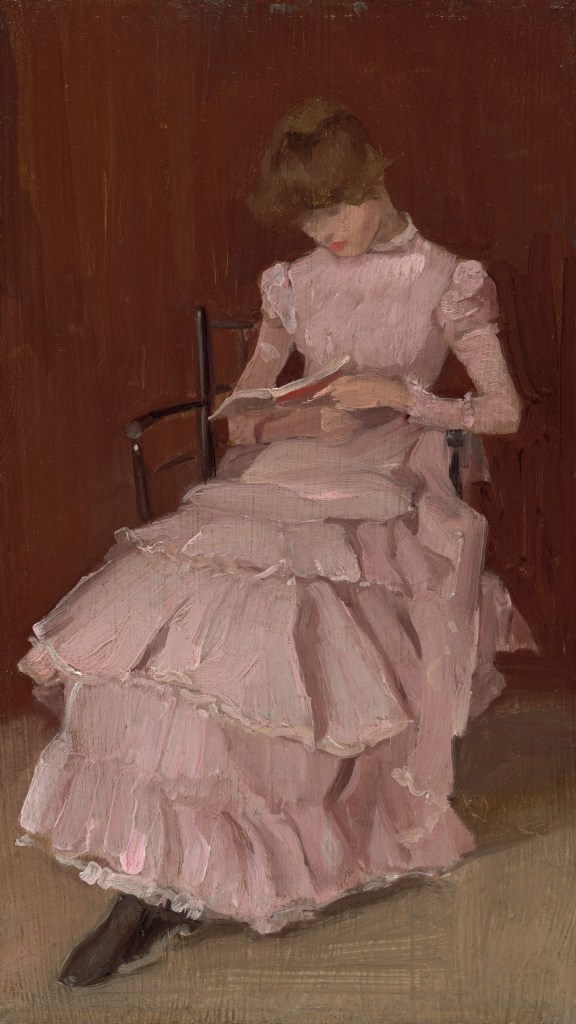
Last week I mentioned that I had originally planned on becoming a theoretical physicist, but in my second year as an undergraduate my focus turned to geology. By my third year, I had realised that I wasn’t going to be a scientist at all, and should try something new. That is when I stumbled upon the History of Art. As a hungry student of a new subject I was influenced by Jim Ede and Kettle’s Yard, not only developing an admiration of Lucie Rie, but also trying to live as Ede had done, including placing images in interesting and unexpected places. For a year or so one of those images was a postcard from the Fitzwilliam Museum of a painting by an artist a friend had spoken enthusiastically about, the older sister of a reprobate brute of a painter. The sister’s work was far superior, I was told, and showed far great delicacy and artistry. It was, of course, Gwen John, and my thoughts about her and her brother Augustus have not really changed much in the ensuing decades (an idea I will illustrate – briefly – on Monday). My post card lay flat on a small, circular table given to me by my sister. It showed a woman seated in the same wickerwork chair next to a low circular table on which were placed a brown teapot and a rose-pink teacup – the same technique of lifting the whole mood of a painting with a little hint of clear, bright colour. Next to the post card I had a small vase made by the same potter as the dish I mentioned last week, in which I arranged flowers – pinks – of exactly the same hue as the teacup in the painting. I was lucky enough to be living in the Old Court of Clare College, Cambridge, and visible above the other side of the courtyard was the roof of King’s College Chapel. Being on the top floor, in order to see it I had to look out through a dormer window. In Pallant House the painting I had a post card of – The Convalescent – is currently displayed not far from today’s Interior, but it turns out that I didn’t know the Interior at all. It just reminded me of my own room.

200 – Ede and Rie and Kettle’s Yard

Lucie Rie, Bowl (brown and white inlaid line), 1974. Kettle’s Yard, Cambridge.

I first fell in love with the work of Lucie Rie when I was a student working as a volunteer at Kettle’s Yard, the inspirational home of Jim and Helen Ede, and now one of the University of Cambridge Museums – but more about that later. However, it was there that I saw the touring exhibition Lucie Rie: The Adventure of Pottery which I will be talking about this Monday, 7 August at 6pm. The exhibition has now moved on to the Holburne Museum in Bath, where you can catch it until 7 January, overlapping with either Painted Love or Gwen John, depending on when you go. This talk is the first in my ‘occasional’ series An Elemental August – different vistas, and will be followed on the three successive Mondays by Gwen John, Evelyn de Morgan, and Paula Rego. You can find more information via these links or in the diary. And if you fancy spending more time with great artists, there are still a couple of spaces available on the trip to Glasgow which I am leading for Artemisia, if you happen to be free 17-21 September and would like to join me (please mention my name!). But back to Lucie Rie, and inspiration…

This is how you would see the subject of today’s post in a catalogue – almost like one of the ‘usual suspects’, a police record of a potential criminal. The best of such photographs – like those in the book published to accompany the exhibition – can show the true beauty of the object, and when the objects in question are the delicate, sensitive creations of Lucie Rie their exquisite sensibilities are plain for all to see. But they lack a context – so the remainder of the photographs I am using today are ones that I took myself when I re-visited Kettle’s Yard some forty years after I moved in over the road, during the second year of my undergraduate degree. I was studying Natural Sciences at the time, and although I had ‘gone up’ with the intention of becoming a theoretical physicist and working at CERN, by this point I had realised that I couldn’t do the maths, and instead was intent on becoming a geologist. I confess that I can’t remember if I visited the house while I was so close, but I may well have done. As a young scientist, I was fairly arty.

This is how you would first encounter the bowl in Kettle’s Yard. Jim Ede had been a curator at The Tate Gallery (as it was then known) and had put together a collection bought from – or given by – artists with whom he had become friends. He also also had a wide range of furniture, and a multitude of objets trouvés – pebbles and dried flowers feature significantly, for example. He and his wife Helen had sought somewhere to house the collection, and settled on four small cottages in Cambridge, which they knocked together to form a single home. A modernist extension was added later, initially for temporary exhibitions. Eventually the collection was gifted to the University, which continued Ede’s practice of holding a regular ‘open house’. Every afternoon, from two to four, you could ring on the bell and be let in. By my third year as an undergraduate I had realised that I wasn’t going to be a scientist, and embraced the History of Art, still unsure what I would be ‘when I grew up’. I’m still not sure, to be honest. For that matter, I’m not sure if I’ve ‘grown up’ either. For a couple of years in the 1980s – as an under- and postgraduate, I think – I was one of the people who would be ‘at home’ – opening the door and welcoming the visitors, or on hand around the house to answer any questions. Since then a couple more extensions have been added, to allow for exhibitions (the original extension had become part of the ‘house’) and to provide better facilities for visitors – including, I was surprised to find this year, a rather good café.

I’ve always thought that the house unfolds rather like a snail shell, starting with a small entrance vestibule, where the coats of the relatively few visitors would be hung, and bags left beneath the stairs (things have changed now – there are lockers at the ticket desk in the gallery along the passage before you get to the house). From the vestibule you pass through slightly larger (but still small) downstairs rooms, a larger upstairs room, and then cross a ‘bridge’ to the fourth cottage and the extension. You can see the space and light opening out to the right in the photograph above. There is an even larger room below, with a double-height space created by a rectangular, U-shaped balcony and the white wall hung with a Kilim visible at the very top right corner of the picture.

If you pass the bowl and look back this is what you will see – the steps leading down from the ‘bridge’ are at the bottom left. Ede must have regularly rearranged his collection, but by the time I was getting to know it, the bowl was already exhibited alongside a marble sculpture by Japanese artist Kenji Umeda called Spirality, carved, it seems (although oddly they’re not sure), in the first half of the 1970s. Umeda had studied at Cambridge in the 1960s, and used to help the Edes with the cleaning of Kettle’s Yard. He started his artistic life as a painter but switched to sculpture after a visit to the Carrara marble quarry. Ede had a particular sensitivity to form, colour and tone, and everything had its place – even if, as I suspect, that place changed from time to time. It is no coincidence that the interior of Rie’s bowl, using the deep, rich, red-brown manganese glaze of which she was so fond, harmonizes with the dark wood and semi-circular form of the table. Placed just under the window, Umeda’s sculpture catches the light and shows off the marble at its translucent best, a light, convex contrast to the darkness of the bowl’s concave interior.

Going back and looking down into the bowl you can see that it appears to be etched with very fine lines. This is one of two related, but opposite, techniques which Rie used often. It is sometimes hard to distinguish between the two. This is sgraffito – an Italian word which is the etymology of ‘graffiti’, meaning ‘scratched’. Artistically it can refer to a number of different techniques in different media, but in this case it implies scratching through the glaze. The manganese glaze was applied evenly across the bowl’s interior, and then, with a fine stylus, Rie scratched through it to reveal the clay underneath before firing. Each line was scratched by hand, without the use of a ruler, and this explains the slight unevenness of the lines, quivering, and with irregular spacing, all of which brings the bowl to life: it is not a machine-made object but is subject to human frailty. For me it speaks of great focus, and yet fragility, created by a hand that is undoubtedly in control, but with nerves and blood vessels pulsing through it. The paintings of Agnes Martin hold a similar fascination for me. Although frequently grouped with the Minimalists, she was closer to the Abstract Expressionists, like a Rothko with finer sensibilities: I far prefer her work to his. Like this bowl, some of Martin’s paintings have long, hand-drawn pencil lines which don’t quite reach the edge of the canvas, creating a form of aura, even a sense of longing, or absence, which only adds to their appeal.

If you were now to crouch down to look at the side of the bowl (Jim Ede might have invited you to hold it, but, however tempting, please don’t – you might trust yourself, but I don’t trust the person coming down the steps beside you: they will probably be marvelling at the beauty of the space and light, and not looking where you’re standing…) – but if you were to crouch down, you would see the same effect, but in reverse: fine, dark, living lines against a light background. These are inlaid. After the bowl was thrown, Rie would have scratched thin lines into the exterior of the bowl, then applied a glaze over the whole surface. She would then have wiped off the excess glaze, leaving some of it in the grooves created by the scratching. Sgraffito and inlay look pretty much the same, and occasionally people fail to distinguish – not that it really matters. However, the piece is officially catalogued as ‘Bowl (brown and white inlaid line), 1974’, whereas a caption in the book The Adventure of Pottery describes it as ‘sgraffito bowl, 1974’. These descriptions are not entirely wrong, but they are not entirely accurate either. However, as I said, that doesn’t really matter: the bowl is still just as delicate – both physically and decoratively – and, to my eye, beautiful.

I love the way that the bowl and Spirality are reflected in the varnished tabletop, with the bowl’s reflection almost more like a shadow – the light form somehow looks dark. I also enjoy the echoes of the grain of the wood in the lines on the bowl – whether sgraffito or inlay. The contrast of light and dark is an essential feature of Ede’s arrangement here – a contrast which continues above the table.

Hanging just above and to the right of the sculpture is a painting: William Scott’s Bowl (White on Grey), of 1962. The whiteness of the painted Bowl not only ties in with the exterior of Rie’s ceramic, but also inverts the curving top of Umeda’s marble. This attention to detail recurs across the whole museum, in every room – as I said, Ede had a remarkable eye. The house is a work of art in its own right, constructed from numerous objects, whether ‘art’ or ‘other’, all of which are given more or less equal status. These include four pieces by Lucie Rie, as it happens. Ede and Rie had a regular correspondence, and once, after she had visited the house, she wrote describing it as ‘a unique experience… I shall never forget’. When I visited earlier this year I realised what an inspiration it had been. At home I have transparent and translucent objects of different colours on windowsills, all very carefully arranged to catch the light: woe betide anyone who leaves something in the wrong place. I thought this was my own idea, but it must have been a subconscious memory of the light flowing through glassware and around sculpture not far from where Rie’s bowl is exhibited. I’m not pretending that my home is anything like Kettle’s yard – there’s not nearly so much space, for one thing, not nearly as much art, and far more clutter. However, most of what there is was made by friends, which adds to its value for me. Sadly I don’t own a Lucie Rie – let alone four – although I do have a dish I bought as a 21st birthday present to myself from Primavera, the ‘arty’ shop on King’s Parade in Cambridge, even if I can never remember the name of the potter… It came as a great surprise to learn that that Rie’s work had been sold in the same shop. Primavera was set up by Henry Rothschild (like Rie, a Jewish refugee), and it was he who organised the exhibitions of ceramics in Kettle’s Yard which led to Ede’s acquisition of his four pieces. It’s a tenuous link, perhaps. Nevertheless, one of the results of my afternoons in Kettle’s Yard was the fascination with this wonderful ceramicist, whose work – like that of textile artist Anni Albers – persuades me that the distinction between ‘art’ and ‘craft’ is sometimes an unnecessary distraction: a thing of beauty is a joy forever. I do hope I can share my enthusiasm and fascination with you on Monday.

Day 54 – Psyche V: ‘Reawakening’

Anthony van Dyck, Cupid and Psyche, 1639-40, Royal Collection Trust.

This is another re-post, but somehow, and I really don’t know how, I managed to delete the original quite a long time ago. I was probably on a train with dodgy WiFi, and maybe even using my phone, all of which would generally result in technological incompetence on my part. But, as it is the only one of the original 100 Pictures Of The Day that hasn’t survived online, it really is time to get it back up there. It also fills in a gap in my telling of the story of Cupid and Psyche, which will be the subject of the second half of Tuesday’s talk, Myth, Allegory, or Simple Story? which concludes the series Classical Mythology in European Art. Details can be found via those links, or in the diary. Then, after ten days or so in Scotland, I will return to Monday evenings for An Elemental August, looking at four women from the late-19th to the 21st Centuries, all of whom had different vistas (the subtitle of the series), as they all spent much of their lives in countries other than the ones in which they were born. The first two – Lucie Rie (7 August at 6pm) and Gwen John (14 August) are already on sale, and the final two (Evelyn de Morgan and Paula Rego) will appear next week. Again, see the diary for more information.

As I finished Picture of the Day 53 back in May 2020, Psyche had performed the last of her tasks for Venus, in an attempt to appease the angry goddess, and win her help in getting Cupid back… Venus, more intent on killing Psyche than helping her, had asked her to go to the Underworld to collect a vial of Persephone’s ‘Beauty’. It’s as if Persephone, like so many celebrities today, had released her own fragrance – and if she had, it would have been called Everlasting Sleep. Psyche had been told that on no account should she open the vial – but what does anybody do under those circumstances? Of course, she opened it, breathed in, and fell asleep, potentially forever… at this point I’ll jump to what I wrote on the next day – this was originally posted on 11 May 2020:

Well, I couldn’t just leave her lying there, eternally asleep… To be honest, according to Apuleius, Psyche thought she was collecting Persephone’s ‘Beauty’ to take to Venus, and that is what she wanted to see – but it turned out to be ‘Everlasting Sleep’ after all. And Cupid, who had been at home all the time, recovering from the wound of the burning oil, finally crept out, only to find her, as if dead, on the road.

And that is precisely how Anthony van Dyck painted her – she could only look more dead if she were paler, I suspect. This painting is not what we, in the UK, expect from Van Dyck – he was, after all, one of the great portraitists. What our ancestors wanted from him was his ability to make them look grander, nobler and more beautiful than perhaps they really were. I say our ancestors – not mine – I’m not that posh. And so this is the only mythological painting that survives from his time as a court artist for King Charles I. It may have been part of a series of paintings illustrating the story of Cupid and Psyche, to which Rubens and Jordaens would also have contributed. The series was commissioned for the Queen’s House in Greenwich, but was never completed. It might have been painted for something else, though, but whatever the purpose, it is a fantastic painting, and should be better known. It is also potentially one of the most outrageous paintings you’ll see, but we’ll come to that later. At first glance, it is a straightforward telling of the story, even if, like Claude (POTD 46), it is almost more of a landscape painting. It’s a curious format – almost square, but marginally taller than it is wide. This shape might be related to its intended location, but as we don’t know what that was, we’re left in the dark. Nevertheless, more than half of the painted surface is taken up with trees and sky. Again, like Claude, these trees are helping to tell the story. One is entirely alive, just like Cupid, towards whom it leans, while the other is profoundly dead, positioned as if emerging from Psyche’s body. Whereas she is all stillness and weight, he is fleeting and light, flying in to find her, his foot barely touching the ground. It is a wonderful painting of contrasts.

Psyche lies on the road, with a gold casket (rather than the white vase we saw yesterday) resting under her right hand, open and empty. This used to contain ‘Sleep’. Her left hand rests on her thigh, holding down the white cloth essential to stop this sensuous image descending to the obscene. Her sky-blue robe (or cloak? – it’s not entirely clear what this is) acts as a blanket beneath her. It is clasped in an entirely blatant failure to cover her breasts, and is painted with van Dyck’s very best silk technique, shiny and slick and airy. ‘Psyche’ means ‘soul’ in Greek, by the way – I don’t think I’ve mentioned that before – so airiness is apt.

Cupid, on the other hand, is entirely concerned with love – or lust – represented by the colour red, just like Charity (see 120 – The Colour of Virtue). Hence the colour of the cloth he is ‘wearing’, every bit as alive as he – while hers is equally dead. In his left hand Cupid holds his bow, although he has abandoned his quiver, full of arrows, on the floor. His nudity is surprising – it is not what we expect from van Dyck (after all, the portraits of the great and the good show the sitters in all their finery– you should see the ones he painted in Genoa!) but it exhibits a remarkable ability on van Dyck’s part to paint the human body. And this particular subject does allow him – given that he has taken some license – to show off both male and female nudes. Having said that, Cupid’s ‘modesty’ is miraculous – the red drapery flies out behind him, curving down, away from the wings, with a splendidly sculptural flourish, then wraps around his body to cover his left thigh, only to appear behind his legs, the final flourish backwards echoing his extended right leg. And yet, there is no hint how it’s held up.

He tilts slightly away from us, so that his right shoulder obscures his chin – but we see his mouth, just open in awe, and his look of love and concern. The curls of his blond hair flick back in the breeze caused by his descent. His wings, emerging delicately from his back, have the whitest of feathers, which fade away with a magical translucency. There are those who say that this painting was never finished. They may well be right, but the delicacy of Van Dyck’s touch is superb here.

And yet, let’s think about this again. Cupid’s right hand reaches out towards Psyche with a gesture, which, if this were a Renaissance painting, would look like a greeting. The Renaissance is relevant here, given his debt to Titian – just look at her legs and that white drapery. But in a Renaissance context, how would you interpret this image? It could so easily be something different. A man with wings has flown in to greet a beautiful woman in blue and white. If it weren’t for the nudity, and were she not asleep, this could be an Annunciation. And of course Charles I – one of the greatest collectors of art, with a Roman Catholic wife – must have known that. To paint Cupid and Psyche as if they were Gabriel and Mary would make a sensuous story blasphemously titillating. And my suspicion is that that would suit Charles I down to the ground. It’s entirely outrageous!

Earlier, I said that the tree behind Psyche is ‘profoundly dead’. However, there is something growing from its base. New life. Maybe all is not lost. Looking back to Giulio Romano’s image with which I finished yesterday, you might be able to see that Cupid is holding one of his arrows in his left hand, and he looks as if he is about to tap Psyche on the back with it. ‘Eternal Sleep’ is not something that a deity would have to worry about – it is a supernatural quality after all. On seeing his love lying there, as if dead, he forgave her, gathered up the ‘Sleep’, put it back in the box and shut the lid. Don’t ask me how. Then he tapped her on the back with his arrow and woke her up – which of course meant that her love for him was renewed. But will they live happily ever after? Not if mum – Venus – gets her way… 

If you want to find out what happens next, I have three suggestions. You could read the original in Apuleius‘ own words (albeit in translation). You could click on the ‘Psyche’ archive link at the bottom of this post to try and locate the next part of the story – Psyche VI (well, that’s a link to it – otherwise I’m afraid the WordPress archives aren’t the easiest to navigate). Or – and this is my preferred option – you could join me on Tuesday, 18 July at 5.30pm, when we will assess whether the story of Cupid and Psyche is Myth, Allegory, or Simple Story? There will be other stories (or myths, or allegories…) in part 1 as well, of course!

Re-telling the tale (Spinning a Yarn)

Diego Velázquez, ‘Las Hilanderas’, 1655-60, The Prado, Madrid.

Another ‘re-post’ today, as I am currently in Glasgow researching a trip which is coming up in September for Artemisia, details of which can be found in the diary (along with everything else, of course). It looks at a painting which concerns the maltreatment of a human by a deity, a theme that is perfectly summed up by Gloucester, in Shakespeare’s King Lear (Act 4, Scene 1): ‘As flies to wanton boys are we to the gods: They kill us for their sport’. It is one of the main themes of my talk on Tuesday, 11 July, 5.30-730pmHeroes and Humans in which today’s painting will feature. The concluding Week 3 of the course Classical Mythology in European Art will follow on Wednesday 12 July. As well as telling some more great tales, we will think about what the pagan myths meant to the predominantly Christian audience who commissioned the paintings and sculptures we will be looking at. After a short summer holiday I will be back on Monday 7 August at 6pm for an Elemental August – starting with the sublime potter Lucie Rie, who manages to cover earth, air, fire and water. Gwen John, Paula Rego and Evelyn de Morgan will follow on the successive Mondays. I’ll have more news about that next week, so watch this space… or the diary.

My lock down project back in 2020 – writing about a Picture Of The Day every day for 100 days – should have ended with today’s painting, for reasons of symmetry. However, day 100 turned out to be a Saturday, and I had developed a tradition of talking about Giotto’s Scrovegni Chapel on Saturdays… so this was the first painting I wrote about after my daily ritual had ended, at which point we were finally started to come out of lockdown. That context might explain some of what I said back then – but, then again, possibly not!

This painting is, I suspect, almost as complex in its ambitions and implications as the far more famous Las Meninas. Like it’s illustrious predecessor (this is probably one of the last paintings that Velázquez completed) it is very much about the nature and power of art. I’m using the Spanish title, simply because Las Hilanderas sounds so much better than ‘The Spinners’ – and also because it doesn’t put me in mind of a 1960s folk group. There is another title – The Fable of Arachne – but neither really explains what is going on, nor is either entirely accurate. There is, after all, only one person spinning: the old woman at the front left. 

As it happens, Velázquez has illustrated three stages in the production of thread. The woman in the centre, wearing the red skirt, is reaching down to the ground for a ‘clump’ of wool. In her left hand is a carder – not unlike the working end of a broom, but with metal spikes. Carding wool is the process of separating the fibres, and lining them up.  Once done, the carded wool would be handed to the woman on the left, who attaches it to the distaff, which is leaning against her left shoulder. She is pulling out separate fibres with her left hand, and feeding them onto a thread on the spinning wheel, spinning them together to create an even, strong yarn, which will then be wound onto a reel. The woman on the right is then winding the spun yarn from a reel, or skeiner, onto a ball. It’s not clear what the girl on the far right is doing – possibly taking the wound balls of wool elsewhere, or bringing the un-carded wool for the start of the process.  The woman on the far left is pulling back a curtain. At first glance it is not clear why – but I shall come back to her later! There is also a cat, playing with one of the balls of wool, probably because that is one of the essential functions of a ball of wool – to be played with by a cat (I think that’s what’s called a circular argument). [Re-visiting this post, I wonder if the cat also represents the way in which the gods treat humans – ‘as flies to wanton boys’ – or, ‘as wool to playful cats’: a mouse would have driven the message home, but might not have been as picturesque].

Being brilliant, Velázquez manages to show us these stages in wool production while also creating a wonderfully balanced composition – with an old woman spinning on the left facing front, and a young woman winding on the right facing back. They are framed by younger women leaning in on either side, and in their turn, they frame the woman facing towards us, about to start carding the wool, in the centre. Even for Velázquez’ late style this central woman is remarkably freely painted, her face little more than a blur or blob. It’s intriguing to realise that one Spanish word for blob, blot, stain, or mark is borrón, whereas borra can be the sort of rough wool you would use as stuffing. As borrón can be used for the very painterly brushstrokes that Velázquez uses I would love to think – as several scholars have – that this is a deliberate pun.

Meanwhile, in the background, we have moved from raw material to finished product. The wool has been woven into tapestries, which hang on the walls of a brightly lit adjoining room, up a couple of steps almost as if it is a stage. The scalloped edges at the top confirm that these images are fabric, hanging from the walls, and tell us that they are held up in the corners of the room and half way across the walls. As many tapestries do, they have decorative borders and a pictorial centre. There are five people in this room, who in some way seem to echo the five women in the foreground.

The two who frame the group on the left and right look into and out of this subsidiary scene respectively, with the woman on the far right apparently aware of our presence: she looks out at us as we look in at her, past the women in the foreground. She is rather like Alberti’s ‘chorus’ figure who we have seen several times before (e.g. POTD 37), inviting us in, or warning us off. A woman in a blue dress and red shawl has her back to us, while the woman in the centre faces front. She is standing with her back to the tapestry, gesturing to a person wearing armour – a helmet and breastplate – and holding a shield. This is Minerva – Goddess of War and Wisdom – or Athena, if you prefer the Greek names. But as this is a tale from Ovid’s Metamorphoses, and he was Roman, I will stick with the Latin. In her role as Goddess of Wisdom, Minerva was also inspiratrix of the arts, and, as it happens, a dab hand at weaving. But then, so was Arachne – the woman gesturing towards her. In fact, Arachne was so good that she even boasted that she was probably better than Minerva – she certainly claimed all the credit for herself, and denied that she owed anything to the goddess. Minerva was clearly not going to be happy about this, and, disguising herself as an old woman, came down from Mount Olympus (where the gods lived) and challenged Arachne to a competition. They both wove tapestries. Minerva’s showed the twelve Olympian gods enthroned in their palace, with examples of the gods’ punishment of overreaching mortals as a warning to the presumptuous Arachne in the corners. Arachne, on the other hand, wove the loves of the gods – notably the many examples of Jupiter’s infidelities and dalliances with mortals. This angered Minerva, but she could not fault the craftsmanship, and while she appreciated Arachne’s work, she was also envious of her talent. She was, as people might say nowadays, conflicted. And this made her even more angry – she shredded the tapestry and attacked Arachne with her shuttle. The poor girl couldn’t cope with this, took a rope, tied it into a noose and tried to hang herself. But Minerva prevented her – she grabbed the rope, with Arachne hanging from it, and transformed her into a spider – an arachnid, of course – hanging from its thread, destined to spin forever.

It has been suggested that the two most important characters in the foreground – the old woman spinning and the young woman winding – are in fact Minerva and Arachne. However, I don’t think that this is necessarily the case – they could easily be contemporary workers whose activities are effectively ennobled by comparison with ancient myth. Nevertheless, the links between the foreground and background are clear, and Velázquez cleverly charts the development from fluffy lumps of wool (or was that blots, or blobs of paint?) through carding, spinning and winding, to the end product, a glorious, faultless work of art, both appreciated and abhorred by none other than Minerva. The process of moving from craft to concept, from technical skill to intellectual complexity, was one of the major developments in art during the Italian Renaissance. However, in Spain, artists had never really had the same respect. As with Las Meninas, Velázquez is making great claims for his art, the art of painting, in this particular work. From mere blobs of paint he can tell a tale – or, to put it another way, spin a yarn – which shows how dangerous art can be. It can rouse great emotions, it can teach us who we are and what we are capable of, it can stop us being complacent – which is why so many regimes have sought to bend it to their own will. I will leave you to contemplate our present government, and its current dealings with the arts.

But, of course, there is more to it than that. There’s a girl pulling back a curtain, for a start. I can’t see that the curtain has any real function in this space, so what is she doing it for? I’m sure it relates to the tale, told by Pliny the Elder in his Natural History, about the competition between Zeuxis and Parrhasius, to determine who was the best painter. The rules were simple – each paints a painting, and then they decide which one is better. Once the works were completed, they went first to Zeuxis’ studio, where his painting was displayed behind a curtain. He had painted some grapes, and they were so good that when the curtain was drawn back birds flew down to peck at them – what could Parrhasius do that would be better than that? They headed off to Parrhasius’ studio, and he invited Zeuxis to go over and have a look. So Zeuxis went over to draw back the curtain, only to find out that it was a painting of a curtain. Zeuxis may have fooled the birds, but Parrhasius had fooled a person – and an artist at that. And Velázquez has done the same to us. Why is the girl pulling back the curtain? Well, she isn’t. There is no curtain. There is no girl, for that matter, it’s just a painting. But he’s so good that we end up talking about these things as if they are real. Did he know the story? Oh yes. All artists did by the 17th Century. I can’t help thinking that by pulling back the curtain, the girl is referring to the competition between Zeuxis and Parrhasius in order to reveal the story of another competition, the one between Minerva and Arachne – so are we to assume that Velázquez was also in competition with someone? Before I answer that question, let’s stick with the fabric. Surely there is also a comparison between the plain fabric of the curtain, and the elaborately pictorial fabric of the tapestries. And, if we wanted to take it even further, we could even stop and think about the fabric on which this is all painted – the canvas – once plain and flat, now richly decorated with unimaginable depths…

In another section of the Natural History Pliny praises a work by the artist Antiphilus called, ‘the Spinning-room, in which women are working with great speed at their duties.’ You could argue that Velázquez was trying to recreate this fabled image with Las Hilanderas – he is putting himself into competition with Antiphilus. Pliny was making the point that it takes great skill to recreate the sensation of movement in paint. He also refers to a painting of a four-horse chariot by Aristides, in which the horses were running. Inevitably, although Pliny doesn’t mention the fact, the wheels would have been spinning – and this is undoubtedly the effect that Velázquez is trying to achieve with the spinning wheel in his own work, the blurred, concentric lines creating the sensation of movement. By including the references to Pliny, and illustrating one of Ovid’s tales, Velázquez places his own work, in terms of craft and of concept, in relationship to the art of the ancients – but would he, like Arachne, be daring enough to challenge the gods? I’m just going to quote eight lines of the wonderful 18th Century translation of the Metamorphoses which I referred to when talking about Boucher’s Pygmalion (POTD 79) – and here is a link to a contemporary translation as well. We are a little way into Book VI, where Ovid describes Arachne’s tapestry:

Arachne drew the fam'd intrigues of Jove, 
Chang'd to a bull to gratify his love; 
How thro' the briny tide all foaming hoar, 
Lovely Europa on his back he bore. 
The sea seem'd waving, and the trembling maid 
Shrunk up her tender feet, as if afraid; 
And, looking back on the forsaken strand, 
To her companions wafts her distant hand. 

The first of Jupiter’s exploits woven by Arachne which Ovid mentions is the Rape of Europa, and if we look at the tapestry as painted by Velázquez, the version that Arachne has woven is the one painted by Titian for Philip II – which suggests that he was putting himself in competition with Titian as well. The Titian, now owned by the Isabella Stewart Gardner museum in Boston, and [at the time I first posted this] in the exhibition just about to re-open at the National Gallery, was copied by Rubens. Rubens’s version is displayed next to Las Hilanderas in the Prado, just to make the point. Rubens’s own painting of The Fable of Arachne – in which he too quoted Titian’s Rape of Europa – can be seen in the shadows on the back wall in Las Meninas – with the added justification that a copy of it, by Velázquez’ son-in-law Mazo, was actually in the room in which Las Meninas is set.

Not only can Velázquez chart the development from raw material to finished product, from unformed wool to refined tapestry – using blobs of paint to spin his yarn – but he can also acknowledge and recreate the works of the classical masters, while putting himself in the same tradition as Titian and Rubens – his own ‘gods’ of painting. Like Arachne, he challenges the gods, but unlike Arachne, he wins. From a purely personal point of view, I now relish the fact that the work that he quoted is a painting by Titian which I saw just a few days before lockdown. It was one of the last paintings that I saw – and it will be one of the first that I see when the National Gallery re-opens this week. It was, as you may recall, Picture Of The Day 1.

Titian, The Rape of Europa, 1562, Isabella Stewart Gardner Museum, Boston.

Venus reborn

Alessandro Botticelli, The Birth of Venus, c. 1485, The Uffizi, Florence.

I want to look back to Botticelli’s Birth of Venus today as she is one of the Gods and Goddesses I will be talking about this Tuesday, 4 July (5:30-7:30pm) in the first of my three talks covering Classical Mythology in European Art. On Tuesday 11 July I will move on to Heroes and Humans, and the last talk in the series (18 July) will consider whether what we are looking at is Myth, Allegory or Simple Story? Details are in the diary, which will soon include information about talks in August – on Mondays again – about Lucie Rie, Gwen John, Paula Rego, and, possibly, Evelyn de Morgan (although not necessarily in that order). I’m still thinking about them though.

Today, though, The Birth of Venus – a post which goes so far back that it was originally uploaded to Facebook before I’d even set up this blog. I wrote it on 26 March 2020, less than a week into lockdown. At the time I was asking friends what they wanted me to talk about – and still am, to be honest: let me know if there’s anything that interests you (although, as you’ll have realised, everything now is usually connected to the talk I am just about to give). I can’t for the life of me remember who asked for this particular theme. But thank you, whoever you were. And apologies for the rant about people getting it wrong about artists getting it wrong. This is what I said, when we still all thought the pandemic would be over by Christmas… which was nine months away:

The request I’m following up today is ‘wonky people in early paintings’, and although 1485 is not terribly early from my point of view, a discussion ensued about Botticelli – and as I mentioned Venus yesterday, and talked about the idea of ‘tradition’, this seemed the perfect choice, because there simply was no precedent. When asked to paint The Birth of Venus Botticelli had absolutely nothing to go on, as no one had painted it before. In the terms of yesterday’s Picture Of The Day, no words, no melody, and especially, no ‘backing track’. How did he decide what to do?

The first choice, I suppose, would be to read the original sources, although all artists, in a situation like this, would also have received a huge amount of advice. Whoever commissioned the painting would know what they wanted, in the same way that, if you commissioned an architect to design you a house, you would tell them how many bedrooms and bathrooms there should be, and possibly even how you would like them to be arranged. Very often, the patron would also be getting advice. In this case, the patron was a member of the Medici family: the painting is first mentioned in the middle of the 16th Century, when it was in one of the Medici villas just outside Florence. This leads to the assumption that the idea for the subject matter was suggested by Agnolo Poliziano, a leading thinker of the day, and the man appointed by Lorenzo de’ Medici to be tutor to his children. Poliziano certainly wrote poetry that includes a description of the birth of Venus, including how she was ‘wafted to shore by playful zephyrs’, her hand ‘covering… her sweet mound of flesh’ while ‘the Hours’ are  ‘treading the beach in white garments, the breeze curling their loosened and flowing hair.’ You can read more about that connection here:

http://employees.oneonta.edu/farberas/arth/Arth213/botticelli_poliziano_birth_venus.htm

Botticelli’s painting is not an illustration of Poliziano’s description though – there are too many differences. Even from the extracts above you will realise that there is only one of the ‘Hours’ present (the Hours, or Horae, were goddesses of the seasons, and so of periods of time). In another section of the poem Poliziano also mentions Venus ‘pressing her hair with her right hand’ which Botticelli doesn’t show. Titian does, as it happens, although his Venus isn’t worried about ‘covering… her sweet mound’. What this suggests is that Poliziano, who may well have advised the Medici on what paintings they should have to decorate their villa, and may well have gone on to advise Botticelli how to paint it, provided only one of the sources for this particular image. 

Another source – for both Poliziano and Botticelli as it happens – was almost certainly a classical sculpture known as the Venus Pudica – the bashful, or modest, Venus. The one I’m showing you is called the Medici Venus, because it was in their collection, although it is not know when this particular example was discovered. Either this, or an equivalent sculpture, must have been around quite early, because Giovanni Pisano used it somewhere between 1302 and 1310 for his figure of Prudence on the pulpit he carved in Pisa cathedral. You can see her in the photograph here alongside Fortitude, who is shown in full ‘trophy hunter’ mode.

In neither the classical original nor Botticelli’s painting is Venus either bashful or modest. She may be pretending to cover herself up, but fails completely. What she is actually doing is pointing and saying ‘Look at this, boys!’ Or girls, for that matter. Let’s not be too heteronormative about it. Whatever she is doing, though, the Venus Pudica was undoubtedly another one of Botticelli’s sources, even if the sculpture doesn’t have the strands of hair blowing in the breeze that we can see in the painting. 

For these, we must turn to one of the most important renaissance texts on painting, called, conveniently, On Painting. It was written in Latin in 1435 by Leon Battista Alberti for Gianfrancesco Gonzaga, Marquis of Mantua. Alberti describes not only how to go about being a painter (although he doesn’t discuss practical technique), but also why you should be a painter, and how you can make yourself look better. It must have occurred almost immediately that artists themselves would appreciate this advice, and the following year (1436) Alberti translated the book into Italian as Della Pittura. Many artists read it, and in some cases they transcribed what they had read in the book – often Alberti’s observations on what he had seen and liked – directly onto their paintings. Take, for example, his thoughts on movement: ‘I am delighted to see some movement in hair… where part of it turns in spirals as if wishing to knot itself, waves in the air like flames, twines around itself like a serpent’. Surely that is exactly what Venus’s hair is doing in Botticelli’s painting?

Alberti does find a problem in showing this movement, though, which he explains while talking about fabrics: ‘However, where we should wish to find movement in the draperies, cloth is by nature heavy and falls to the earth’. The solution? It is one of his most bizarre ideas, and goes against the logic, the rationality and the clarity of the rest of the book. No artist in their right mind would dream of doing it – you’d have to be mad: ‘For this reason it would be well to place in the picture the face of the wind Zephyrus or Austrus who blows from the clouds making the draperies flow in the wind’. And again, that is exactly what Botticelli does. Here it is not madness, though, but an essential part of the original narrative. However, at least one other artist – Paolo Uccello – did include both Zephyrus and Austrus in one of his paintings. Admittedly, Vasari did think he was a bit bonkers.

So, there we have it – at least four sources: the original myth, Poliziano’s interpretation of it, the Venus pudica and Alberti’s On Painting. But although that might explain what he’s painted, it does not explain how it’s arranged. There was no precedent. What model could he possibly use? Someone naked in the water, someone on shore leaning over, a couple of people flying around? Surely no one had ever painted anything like this before? Again (see Picture Of The Day 4) the credit goes to Ernst Gombrich, who pointed out that the model was actually the Baptism of Christ, with Jesus wearing nothing but a loin cloth in the river Jordan, John the Baptist on the shore leaning over to baptise him, and two angels, with wings, who attend on the other side. I’ve chosen the one illustrated here because it is in the Uffizi, and not so very far from the Botticelli – even if the angels don’t have wings. It was painted by Verrocchio and Leonardo, among others. 

At this point the Renaissance has truly arrived: no longer is Christian art and architecture drawing on the classical past for inspiration, but a classical subject is drawing on Christian influence. In other words, a Christian subject is wearing classical clothes, rather than the other way around.

The more astute among you will have noticed that I’ve got this far without even mentioning ‘wonky people’, but we’ve been looking at them all the time. Botticelli is a wonderful artist, his figures are elegant, his paintings inspired. But he was rubbish at anatomy. If he was trying to paint an anatomically correct painting, then he ‘got it wrong’. At this point I would like it to be known in no uncertain terms that that is my least favourite phrase spoken about art. ‘He got that wrong’. What does it mean? In order to know if someone ‘got that wrong’ you have to know what they were trying to achieve, and in this instance, anatomical accuracy would have been inimical to Botticelli’s purpose. ‘But’, you say, ‘look at Venus’s right ankle – she has dislocated her foot!’ However, it does create a wonderful, extended, elegant, line, continuing the almost balletic pose of the right leg. Feet and ankles are rarely elegant (although, as so often, I do have a nomination for ‘Best Foot’), and were her foot at the usual angle to the shin, it would jut out abruptly, poking towards us and disrupting the stylised distancing of this deity which Botticelli creates to keep us slightly in awe of her. We don’t need to stop at her ankle. She has no shoulders, and, like almost every figure by Botticelli, one eye is higher than the other. Picasso could do it, so why shouldn’t Botticelli? It is these peculiarities, these awkwardnesses, these quirks, which make the painting so strange and elegiac – it is poetry, not prose, and like poetry the syntax is stretched, the meaning is moved. It is more beautiful than true, perhaps. Or, to put it another way, ‘Beauty is truth, truth beauty’ – in the words of the poet. That’s all you need to know. 

199 – The One that Got Away

Hans Holbein the Younger, Christina of Denmark, Duchess of Milan, 1538. The National Gallery, London.

The subject of today’s portrait, Christina of Denmark, Duchess of Milan, appears in one of the paintings in the Holburne Museum’s gem of an exhibition, Painted Love: Renaissance Marriage Portraits, which, if you’re interested, I will tell you about on Monday 26 June at 6pm. Today’s painting isn’t included – but Christina is… more of that below, though. In the following weeks I will switch to Tuesdays, for three two-hour talks about Classical Myth in European Art, covering Gods and Goddesses (4 July, 5.30-7.30), Heroes and Humans (11 July), and Allegory, Myth or Simple Story? (18 July, tickets will go on sale after the first talk). Then – I’m going on holiday, so keep your eye on the diary (or the blogs) for news of what comes next… As ever, if there is anything you would particularly like me to talk about, please do let me know via the contact page. Meanwhile, let’s look at a painting which I have enjoyed for many years, partly for its sheer beauty, and partly because it is not as simple as it might initially appear.

At first glance it is ‘just’ a painting of a woman. Commanding, elegant, and serene, she stands on a tawny-coloured floor in front of a dark turquoise wall, brilliantly illuminated by sunlight. The wall is cast into shadow down the right edge of the painting, so she must be standing at a large, open door, or floor-to-ceiling window. The subject herself casts a shadow to our left: the sun is in front of the painting, above it, and to our right, somewhere above and behind our right shoulders. She looks deep into our eyes, her hands held in front of her waist. Apart from her face and a tiny amount of her neck, they are only parts of her body we can see. Other than that, she is clad in black from head to foot.

Her hat, dress and coat are all black. Just visible, but prominent because of its pristine whiteness, is the scalloped hem of the collar of a chemise, peeping out above the high neckline of her dress. The other ‘non-black’ element is the brown fur lining of her coat, rich, and soft, and opulent. It speaks of great wealth, and great warmth. Given that the sun is shining so brightly, I have always imagined that it must be the winter, or maybe early spring: a sunny, but brisk day. Before now though, for some reason, I have never stopped to pin down the date, but it turns out that I was right: it is what we would now class as towards the end of winter. Holbein made the drawings for this painting on the afternoon of 12 March, 1538.

Have a look at her face. What is her expression? I confess I’m not entirely sure… She has a clear, light complexion, evenly almond-shaped brown eyes, the shadows at the corners of which seem to go up just like the corners of her mouth. There is some hint of a smile, perhaps, and yet also a feeling of great solemnity. I would be hard pressed to guess how old she is. She looks mature, and yet not old, serious, and yet somehow fresh. The portraitist’s tendency to flatter might have come into play, though.

The solemnity is undoubtedly the result of being in mourning. It’s hard to see the dress itself in this detail: it is such a pure black that it is almost imperceptible. The dark space where it must be is framed by the fur lining of the coat, which can be seen all the way to the ground, even if it is far less evident than on the luxuriant collar. The coat itself is gloriously painted, with the black satin glinting and glowing in the sunlight, and spreading across the floor in waves. Towards the top of the detail there are some horizontal marks, running in parallel, which I take to be the remains of some folds. Another assumption of mine is that this coat was stored folded up, rather than hanging somewhere, but I could easily be wrong – the lines might be part of the structure of the satin itself (I’m not an expert in fabrics, let alone historical wardrobe practice…).

There is far more material than is actually needed for a coat. Apart from the excess fabric spreading across the floor, the sleeves are puffed to give a greater sense of grandeur and – I have to use this word again – opulence. The sleeves of the dress protrude beyond the fur trim of the shorter coat sleeves, and look softer, and even warmer than the satin: velvet, presumably. The dress has a high, black belt, and the cuffs of the chemise are clearly visible, fuller than the trim collar, framing, and giving prominence to, the hands. Christina is holding her gloves, which were a sign of elegance and sophistication. By removing them, not only do we see them – and recognise her elegance and sophistication – but we also get to see her hands, which were, apparently, famed for their beauty: delicate, pale, with long slim fingers, and without a mark. She was not a working woman. She was, however, married – there is a ring on the fourth finger of her left hand. Or rather, she had been married. It’s not a wedding ring, but a mourning ring – they were worn quite commonly between the 14th and 19th centuries: some are mentioned in Shakespeare’s will, for example.

This, as we know from the title of the painting, is Christina of Denmark, Duchess of Milan. And she was sixteen years old when this was painted. A widow at sixteen – but then (as Shakespeare has already come in to play), in Romeo and Juliet, talking of the heroine when told that she was not yet fourteen, Paris (her intended) says, ‘Younger than she are happy mothers made’. Christina was even younger. In September 1533, a couple of months before her twelfth birthday, Christina of Denmark was married by proxy to Francesco II Sforza, Duke of Milan. He was 28. She finally made it to Milan the following May, and in November 1535, by which time she was nearly 14, he died. Let’s have a look at that expression again.

I have to be honest: she doesn’t look that upset. OK, so it’s 16 months later, but, while she is dutifully dressed in mourning, there is that barely suppressed smile. It’s almost like that situation when you want to laugh but mustn’t – there’s a real sense of control, gritted teeth. She was young, single, and fairly well off – enough to be happy, and, of course, entirely eligible. And – of course – there was someone in Europe looking for an eligible young woman at the time. He often was. He got through five in the end (the sixth, famously, surviving). Jane Seymour, the third wife of Henry VIII, had died in October 1537, and in March 1538 Hans Holbein was packed off to Brussels to paint Christina of Denmark, the widowed Duchess of Milan. He only got three hours with her – between one o’clock and four o’clock in the afternoon – before heading back to England. He would have made sketches, and, in all probability, a coloured chalk drawing with annotations, which sadly no longer survives. Many others like it do, though, and one is in the Holburne’s exhibition (I will show it to you on Monday). Holbein completed some sort of finished image, if not this full-length painting, fairly quickly, and Henry VIII was enormously pleased, ‘in better humour than he ever was, making musicians play on their instruments all day long’ (Shakespeare again: ‘If music be the food of love…’). He proposed marriage: which eligible young woman could refuse? However, Christina is supposed to have replied, ‘If I had two heads I would happily put one at the disposal of the King of England’. I so wish she had said that, but I’m afraid I can’t believe it. Let’s face it, Henry had only had one of his wives beheaded at this point (the first wedding had been annulled, and the third bride died) – so it was hardly a reputation. Still, she didn’t marry him. In 1541 she married Francis, Duke of Bar instead. He succeeded his father as Duke of Lorraine three years later (so Christina became the Duchess of Lorraine), and then died the following year. Christina basically went on to live happily ever after, reaching the ripe old age of 69, having been widowed twice with a total of less than six years married.

After a long-drawn-out diplomatic failure, Henry eventually gave up on Christina, and fell for another portrait, that of Anne of Cleves – who, in one of those bizarre twists of diplomatic fate, was betrothed to Francis, Duke of Bar. The King of England was a better catch though, so Anne married him, thus leaving Francis unexpectedly available… and free to marry Christina. In person, though, Anne didn’t live up to Holbein’s artistry, with Henry famously calling her ‘a Flanders Mare’ (or ‘Belgian horse’, in modern terms – although that’s another one of ‘those stories’, this one dating to the 17th Century). Luckily for her she was divorced fairly quickly, and, as a result, like Christina, she also lived happily ever after.

Painted Lovethe Holburne’s exhibition – revolves around the portraits of eligible youths and maidens, of potential matches like Christina, of happy brides and grooms, and of the desired result: heirs, and even spares. And even if Holbein’s Christina of Denmark hasn’t made it to Bath, Christina herself has. One of the paintings, lent by His Majesty King Charles III, was painted by Jan Gossaert (artist of The Adoration of the Kings which I discussed detail by detail during Advent a few years back). Dating to 1526, it is entitled The Three Children of Christian III of Denmark, and the four-year-old Christina is on the right. You can never tell how someone will turn out.

Saint Francis, re-framed

Giovanni Bellini, St Francis in the Desert, c. 1476-78, Frick Collection, New York.

The National Gallery’s exhibition, Saint Francis of Assisi, which I will talk about this Monday, 19 June at 6pm, is refreshingly beautiful. It includes a superb and eclectic choice of objects which are beautifully hung and expertly curated to tell a clear story that is simple in its complexity – just like the painting I want to look at (again) today, and just like St Francis himself. Although you could argue that he was complex in his simplicity – if that makes any sense. OK, so there is at least one painting that I hope never to see again, but more of that on Monday. The following week I will look at a delightful gem, Painted Love: Renaissance Marriage Portraits, which has recently opened at the Holburne Museum in Bath. In July I will end the ‘Summer Term’ with a three week course on the influence of Classical Mythology in European Art. In Week 1, on Tuesday 4 July from 5.30-7.30pm, we will meet The Gods and Goddesses and the following Tuesday, Heroes and Humans. These two are already on sale, and the third talk, Myth, Allegory or Simple Story? will go on sale after the first talk. Details are, of course, in the diary.

Today I want to re-visit a post about a painting which really should be in Saint Francis of Assisi – indeed, there is a reproduction of it in the first surprising, and (for me, at least) rather exciting room. But, apart from the legal injunction on the Frick Collection not to lend its works (which they managed to side-step for Vermeer), the 21st Century, unlike the 19th, with its greater technical awareness, knows that this painting is too large, and too fragile, to journey back across the Atlantic. Given the wealth of material to talk about in the exhibition itself, it therefore makes sense to have a thorough look at it today (and, yes, let’s be honest, I’ve run out of time to write about something new…). Bellini’s St Francis in the Desert was originally ‘Day 29’ of my Picture Of The Day series, written as long ago as 16 April 2020: we were not even a month into Lockdown. Looking back, we were all in some kind of desert, and some of us in an involuntary solitary retreat. I was very lucky to find myself in Durham, in company, and close to nature. All this will become apparent from my original, unedited, text:

The sun is still shining outside my window, as it is in this fabulous painting. It captures that wonderful sense of release you get when you’ve been cooped up inside all day, and finally step out into the fresh air, take a deep breath, and enjoy the world around you. This is how I feel each day as I head out for my daily walk, especially when the sky is blue, and particularly now that the traffic has dropped and the air is wonderfully clear.  St Francis has stepped barefoot into the light, holds his arms out as if to embrace it fully, and looks up to the sky.

He is not so very far away from civilisation: there is a walled town on the next hill, just on the other side of a river, but he is in a deserted place. On retreat from the world, he has constructed a study from the trunks of three types of tree – the colour of each is different – and a vine, which meanders upwards and forms a canopy of leaves over the top. A plank of wood projects from a low garden wall as a seat, and a lectern has been constructed with minimum care for joinery: a few 2x2s nailed together at right angles.  On the desk is a book, and a skull. Like any scholar of his day, St Francis meditates on death. But here, now, he is glorying in life.

There are signs of life throughout the painting. His raised garden bed grows medicinal plants. Behind the bench you can see iris leaves, and then the tall, pointed Great Mullein – or Aaron’s Rod (Verbascum thapsus – thanks, as ever, to the Ecologist) among others. There is also a fig tree starting to grow in the foreground, and plantains are taking root in the bare earth.

In the middle distance you can see a donkey, and a grey heron, ever vigilant. Just beyond them is a shepherd – the only other human in the painting – leading his flock just this side of the river. And most charming of all, underneath Francis’s right hand – a small rabbit, poking its head out of the burrow.

You can see the stigmata in Francis’s palms. It was said that, as a result of his special devotion to the Crucified Christ, one day he returned from his private devotions with an image of the cross – not painted on panel, or carved in wood, but in his own body. This is part of the account of the event given by St Bonaventure:

‘…as he was praying in a secret and solitary place on the mountain, Saint Francis beheld a seraph with six wings all afire, descending to him from the heights of heaven. As the seraph flew with great swiftness towards the man of God, there appeared amid the wings the form of one crucified, with his hands and feet stretched out and fixed to the cross. Two wings rose above the head, two were stretched forth in flight, and two veiled the whole body…

The vision, disappearing, left behind it a marvellous fire in the heart of Saint Francis, and no less wonderful token impressed on his flesh. For there began immediately to appear in his hands and in his feet something like nails as he had just seen them in the vision of the Crucified…. On the right side, as if it had been pierced by a lance, was the mark of a red wound, from which blood often flowed and stained his tunic.’

One interpretation of this painting is that it represents the Stigmatisation of St Francis – but as it is so completely different to every other depiction of the story, it can’t be that simple. In every other painted version St Francis is kneeling, one of his followers, Brother Leo, is present, and the seraph can be seen in the sky. Admittedly, this panel has been cut down, so there might once have been a seraph, which got lost in the process. However, to make the narrative clearer, beams of light usually stretch between the protagonists, and even if the seraph had gone, the beams would still be visible. Not only that, but there is no stigma on Francis’s one visible foot, and no wound in his chest.

St Francis founded the Order of Friars Minor, a group of mendicants who, it was intended, would live outside of towns and rely on the charity of others (I mentioned the other main mendicant order, the Dominicans, in Day 24 – The Devils). Following Christ’s exhortation to the Apostles not to worry about clothes or shoes, Francis wanted his followers to be similarly unconcerned about appearances, and to dress with utmost simplicity – effectively in sackcloth with a rope belt. The three knots you can see in the end of the rope stand for the three chief virtues of the order – chastity, poverty and obedience. And there are no shoes – although he does have some simple sandals which he has left under the desk.

He also has a piece of paper tucked into his belt. There is no way of knowing what this is, but it could easily be one of his own writings. One of the most famous texts is the Canticle of the Sun – also known as the Canticle of the Creatures. Here are two short excerpts:

Be praised, my Lord, through all your creatures, 
especially through my lord Brother Sun, 
who brings the day; and you give light through him. 
And he is beautiful and radiant in all his splendour! 
Of you, Most High, he bears the likeness.
Praised be You, my Lord, through Sister Mother Earth, 
who sustains us and governs us and who produces 
varied fruits with coloured flowers and herbs.

A second interpretation of the painting is that it is an illustration of this canticle – Francis has his mouth open, after all, and could easily be singing. He is also clearly enjoying the light of Brother Sun, while surrounded by ‘coloured flowers and herbs’. However, if Bellini had wanted the canticle to be the main subject of the painting, he would surely have included far more of the ‘creatures’ Francis wrote about: many are missing.

Yet another interpretation comes from the way that the Franciscans themselves saw their spiritual leader. As a result of his stigmatisation, and given that he had sought to follow Christ’s teaching, initially taking a group of 12 followers, he was given the title Alter Christus – ‘another Christ’. But Jesus himself, as the leader of the disciples, was associated with Moses, the leader of the Jews. It followed on that Francis was also associated with Moses. And here we see him in the desert – just as Moses had taken the tribes of Israel through the desert – and, as God told Moses, he has constructed himself a tabernacle out of the branches and boughs of trees. Francis did live with the other members of the order, but would regularly go on private retreats. It was on one of these, on Mount La Verna in the Apennines, that he saw the Seraph, in much the same way that Moses saw God in a burning bush on Mount Horeb. Moses realised he was on holy ground, and took off his shoes – and Francis has done the same. But there is no Seraph here – is this interpretation really relevant to this painting? 

No Seraph, no – but there is tree in the top left-hand corner which almost seems to be bending towards Francis, its fresh, Spring leaves almost supernaturally illuminated. Could this be Francis’s version of the burning bush? He opens his body towards the tree – although his eye line is directly upwards, towards Heaven. 

The waterspout that you can see in the bottom left is another possible connection. At one point, in the wilderness, the tribes of Israel had no water. God told Moses to strike a rock with his staff, and when he did, water gushed forth. Directly below the spout there is a kingfisher, although you might be able to see it because it is so dark. And further down, to the right, you can see Bellini’s signature, painted on a trompe l’oeil strip of paper that looks as if it has been attached to the branches of a barren tree.

If Moses had a staff, so does St Francis, in the form of a walking stick, which he has left behind in the study. There are many stories told about this remarkable man. In one of them, his love for all God’s creatures led him to admire a tree – which bent over to greet him. That seems to be happening here. And in another, he struck his walking stick on the ground, and it took root and grew there. For many years, the resulting tree marked the spot. The stump of that tree still exists, apparently, although the Franciscans who will show it to you are fully aware that this is ‘just a legend’. They live on the Island of San Francesco del Deserto in the Venetian lagoon, where St Francis is supposed to have stopped off on his way back from visiting the Sultan of Egypt. The church on the island is, in all probability, the location for which this complex image was painted.

When interpreting art, we tend to ask the question, ‘what does it mean?’ and often there isn’t one, simple answer. Bellini would have taken advice from the patron, and from the Franciscans on the island – he might have had many ideas in mind. When the church was rebuilt in the second half of the 15th Century it was called ‘San Francesco delle Stimmate’ – so the stigmatisation must be part of the meaning. The saint’s joy in creation, as made clear in the Canticle of the Sun, is another. And so are the parallels between the saint and Moses in the wilderness. Bellini is clearly not representing the setting of the actual church: this is not an island in the Venetian lagoon. Having said that, the rocky outcrop on which Francis stands is like an island, surrounded by a sea of green grass. If anything, his retreat looks more like Mount La Verna, even if the walled town is the sort you’d seen in the Veneto – where Bellini was painting – rather than in Umbria, where St Francis settled. 

All of the possible interpretations of this painting are worth thinking about. Bellini may well have been hinting at them all, attempting a poetic evocation of the many rich threads that are woven through Francis’s life. I suspect there is yet one more way of thinking about it, though. This does overlap with the others. It comes from the name of the island: San Francesco del Deserto. Not ‘St Francis in the Desert’, like the name of the painting, but ‘St Francis of the Desert’. He is part of it, part of the desert, and is depicted in the middle of it. It is around him and in him. He is part of creation. And like St Francis back then, we are socially distanced now. We might even be self isolating. But we are not on our own, however lonely it might be at times: we are still part of a whole – part of the main, as John Donne said. No man is an island.

198 – Looking beneath the surface

Johannes Vermeer, Woman Writing a Letter, with her Maid, c. 1670. National Gallery of Ireland, Dublin.

Today’s painting was my real ‘discovery’ of the Rijksmuseum’s Vermeer, a painting I hardly knew, and might not even have seen before. I think I had been to the National Gallery of Ireland twice, very briefly, before my recent visit, and most of my time was taken up with Caravaggio. Of course when I was there a couple of weeks ago this painting wasn’t – but it will return soon. Vermeer ends this Sunday, and I will celebrate its enormous success the following day, 5 June at 6.00pm, by talking about The ‘Other’ Vermeers, the nine paintings which were not included in the exhibition. I will put them in the context of all the others – so you will see the entire known oeuvre, even if the 28 I discussed before (because they were in the exhibition) will flash past fairly quickly! In case I’ve never mentioned it before, the best resource for anything related to ‘the Sphinx of Delft’ is Essential Vermeer – a website that literally (and pictorially) covers everything: it is an extraordinary act of dedication. After Vermeer I’m having a week off, then on 19 July I will talk about the National Gallery’s rich and rewarding Saint Francis of Assisi, before figuratively heading off to the Holburne Museum in Bath on 26 July to talk about the recently-opened exhibition, Painted Love: Renaissance Marriage Portraits. And for those of you who really like to plan, in July I have carelessly booked my Monday afternoons without time for a breather before 6pm, so will give a series of three talks on Tuesday evenings… There is more information about them, and about a short course for the Wallace Collection, and visits to Glasgow and Hamburg with Art History Abroad, in the diary.

So why was this painting such a ‘discovery’? At first glance it is a ‘typical’ Vermeer, set in the usual corner of the usual room, with a standard selection of his repertoire of decorative elements: a large painting hanging on the back wall; shut windows with a geometric pattern of leading; white and black marble floor tiles on a diagonal; a chair with its back to us; a table covered in a rug; a lady writing a letter; a maid looking out of the window. Nothing remarkable there. But as ever with Vermeer the normal, everyday scene has been stripped down to its essentials, no surplus details, nothing that allows it to sit in the mundane, and yet it manages to remain ‘everyday’. As ever, it is quiet, calm and still. And yet, underneath the surface… well, we’ll get to that.

Vermeer has the remarkable ability to make even the banal appear sublimely beautiful. There is a long, green curtain in the foreground. It’s not clear what the function of this curtain is, but it goes from top to bottom of the painting, and implies, apart from anything else, that this is a room with a very high ceiling – we can’t see the top of the curtain. It may serve to partition off the back of the room, but it has been drawn aside to allow us to see the maid and her mistress. There must be another window closer to us, as the green curtain is lit from the front left, the highlights defining the folds in the fabric, one of which has a noticeable kink, making it look just that little bit more real. Of course, judging by at least one other Vermeer, and a number of paintings by his contemporaries, this might represent a curtain in front of the painting itself – a trompe l’oeil trick to impress us with Vermeer’s mimetic skills. Not that we need that. The white curtain (which is definitely in the room) is enough to assure us of his technical ability. It hangs from its unseen rail just off the vertical, falling over the lower part of the casement window which pushes it in a little. Outside the window a lower shutter is closed, and so no light enters. At the top the curtain is luminous as a result of the transmitted light, some of which seeps through at the level of the horizontal of the casement, but it is dark below: a beautiful contrast. However, the edge of the curtain folds back from the window, and reflects the light entering the left-hand pane – so he shows us the effects of transmitted and reflected light on one piece of fabric. Light reflecting back from the white walls also picks up the crests of the vertical, shadowed folds, making them stand out from the rest of the drape. In the central section of window’s pattern of straight and curved leads – a variant of a type that occurs in several of the paintings I will show you on Monday – there is a stained-glass coat of arms: we are in a noble household. We might have known that, though, from the height of the ceiling.

If Vermeer paints square floor tiles they are always on a diagonal – De Hooch often painted them parallel to the walls. Like the high ceiling and the coat of arms, the black and white ‘marble’ also implies wealth and sophistication. A row of blue and white Delft tiles makes up the wainscotting, but the imagery is not really legible. Unlike other paintings, the tiles do not appear to convey any of the meaning, but sweep our eye into the depth of the room. The chair, angled away from us, and parallel to the diagonal tiles, also directs our attention inwards, although the objects lying on the floor beside it might hold our attention for a while.

NGI 4535

There must be a reason for these things to be there, because, unlike some of his contemporaries, Vermeer seems to have striven to eliminate the anecdotal and unnecessary. The small red disk is a wax seal from a letter, which seems to have been opened, read, and discarded. To the right of it, and a little closer to us, is a dark stick of something, presumably sealing wax, which will have to be retrieved when the lady has finished writing. And then, of course, there is the discarded letter itself. Or maybe it’s just the crumpled ‘wrapper’ – the equivalent of an envelope – and more paper. There is actually a considerable amount of paper, which could either be a very long letter, or a rather short book: both have been suggested. If it is a book, it could be one of the several guides to letter writing that circulated in Dutch Republic in the 17th Century, some of which included templates for set letters, ‘insert name as appropriate’.

Our attention is focussed on the lady writing the letter. With the right, lower shutter closed, the back wall is in shadow. Her white puffed sleeves and headdress catch the brilliant light from the un-shuttered window, and she shines out against the dark wall and the lower part of the picture frame. However, the light does reach the back wall to our right, and the shadow on that side of her headdress and her left shoulder makes her form stand out boldly there too. The quill pen in her right hand also catches the light, while her foreshortened right arm and the left arm parallel to the picture plane both lead our eyes towards the letter. She looks down at it with intense focus, her face framed by two pearl earrings. There is another jewel, glinting on her bodice, and her chemise is elegantly tucked behind it. The bodice itself is a delicate light jade in colour, while the headdress, apparently simple, has elements of lace or an embroidered decoration. This makes it clear that she is the lady of the house, as it contrasts with the darker, more homely garb of the maid, which is more simply cut and has no jewellery or decoration. The maid looks to our left, while her blue apron is swept to the right, drawing our attention back to the table just where the white pattern in the cloth catches the sunlight. The maid’s shoulders are framed by the broad, dark picture frame, and her head sits comfortably in front of the bottom left corner of the painting: the maid and the painting are connected in some way, if only visually. Vermeer was always obsessively concerned with the precise positioning of every element of his compositions, so that we can see everything we need to clearly, and with the right emphasis. Conversely, if it’s better that we don’t see something, or if it will add to the mystery, he will hide it.

How would you interpret the maid’s mood? I am constantly astonished by the variety of readings any one image can get. I have read – somewhere, I can’t remember where – that the maid is smiling. I cannot see that. Her arms are crossed – either with patience, or the opposite, almost clinging on because of the tension. She looks through the window towards the outside world, the source of the discarded letter, and the destination of the reply which she will have to deliver. Even an unchaperoned lady could receive letters, which is precisely what made them so dangerous, and the maid is there to do her mistress’s bidding – even if it goes against the strictly appropriate. Meanwhile, the lady continues to write with quiet determination. I cannot see it any other way.

I mentioned the Delft tiles leading our eye into the depths of the room: the sunlit top of the windowsill, the dark bars of the window frame and the leading do the same. One of the most commonly asked questions about Vermeer’s technique concerns the camera obscura. Forget it, he might have borrowed some visual effects from it, but his paintings were constructed using a pragmatic, practical perspective. For about half of his paintings its clear that he stuck a pin into the vanishing point, and then stretched a string covered in chalk or charcoal across the painting. He then ‘plucked’ it, like a guitar string, snapping it back against the canvas to draw a line – although no trace of this last step remains. We can tell from the windows and the tiles where the vanishing point is, though, even without the ‘snapped’ lines, and the occasional pinprick in the canvas. It sits next to the lady’s left eye, close to the brilliantly-lit bridge of her nose. The vanishing point is theoretically what we are looking at, and so our attention is drawn towards the lady and the fact that she is looking at something, towards her focus on the letter she is writing. Just above is the painting, hanging on the back wall. Although it is not especially clear, it is possible to make out two figures who appear to be naked. One, on the left, sits near to the maid, her legs not visible. Another sits, higher up, above the lady’s head, one of her feet drawn up. She is looking at a lady holding a baby. We can’t see the woman on the left’s legs because she is sitting on the bank of a river, and her feet are in the water. The other naked woman has lifted one of her feet to dry it, as she, too, has been in the river. They were rescuing the baby, who was caught in the reeds in a Moses basket. The basket gets its name from the baby, though, rather than the other way round: this is a painting of The Finding of Moses.

Unlike some other paintings in the background of Vermeer’s works we do not know who painted this one, although it could be part of the collection which his mother-in-law, Maria Thins, had inherited. It has been suggested that the artist might have been by Peter Lely, known as a portraitist for both Charles I and II of England and Scotland, but who was Dutch in origin. He trained in Haarlem, before coming to London in the 1640s. Here is a detail from the Vermeer, and another from a Finding of Moses by Lely which was sold by Christie’s in 2006: you can decide for yourselves if the style, if not the exact composition, is similar, and, therefore, if Lely might have painted Vermeer’s lost original.

The same image also occurs – although on a far smaller scale – in the background of The Astronomer in the Louvre (which we will look at on Monday). The scale is not important, though, apart from reminding us that Vermeer was not painting exactly what he saw. He was making it up, based on things he could see, or had seen, changing the scale to suit the situation, and changing the floor, the windows, the shutters, the curtains, like a designer dressing the stage for a drama as it unfolds before our eyes.

The Finding of Moses probably has a different implication in each of Vermeer’s paintings. Moses was popular with the Dutch in the 17th century, as they associated themselves with the Israelites in Egypt. In the same way that Moses led them out of captivity and on towards the Promised Land, the Dutch had thrown off the shackles of oppressive rulers – in their case, the Spanish – with the added advantage that, according to them, they were already in the Promised Land: the Dutch Republic. However, here I think the aspect of story in question is very different. Moses was, in some ways, a miraculous baby, found floating among the bullrushes – an unexpected baby, if you like, adopted by the daughter of the Pharoah. How could that possibly be relevant to Vermeer’s painting though? Let’s have another look at it, but with an added line. It becomes blatantly clear that the ‘unexpected baby’ is directly above the head of the lady writing the letter, and the line, drawn from the baby and through the vanishing point of the perspective – the theoretical focus of our attention – continues down through the lady’s hand and the chair leg to the discarded letter, and what is, potentially, a letter-writing manual.

What is the connection between the unexpected baby, the woman, and the letter on the floor? And what situation might a standard template for a love letter not suit? Or maybe I am directing your attention too specifically, and we should consider a different aspect of the Moses story? Should we be thinking about his discovery as a precursor of the miraculous birth of Jesus? That’s up to you: you’ve got all of the elements now, you can write your own story. That’s precisely what Vermeer does. He shows you everything you need, but doesn’t tell you what to think. That is why his paintings are so vital: they are profoundly beautiful, and intriguingly enigmatic. As far as I am concerned, though, the calm, ordered surface of this painting is revealed as a fiction – there is a repressed storm of emotion which is only just being held in check – and that was what I had not expected to see, my ‘discovery’, if you like. I suspect that the maid is even more aware of it than her mistress. But look at them again, and decide for yourselves.

197 – Lavinia, Mary and Margaret

Lavinia Fontana, The Holy Family with Saints Margaret and Francis, 1578. Davis Museum at Wellesley College, Wellesley, MA.

It is very rare that a museum can present an exhibition of the work of an artist who is not only very good, but also relatively unknown – especially when they lived in the 16th Century. But the National Gallery of Ireland has achieved just that with a superb exhibition entitled Lavinia Fontana: Trailblazer, Rule Breaker which I will be introducing this Monday, 29 May at 6.00pm. I understand the title, although I’m not sure I entirely agree with it. Did she break any rules? Part of me suspects that, because she truly was a trailblazer, she got there so early that the rules she is supposed to have broken hadn’t yet been written. I’ll explain what I mean on Monday! The following week (5 June) I will return to that quiet, undemanding genius of 17th Century Delft, Johannes Vermeer, to talk about the paintings which were not included in the Rijksmuseum’s exhibition. Not only will we get to see them, but we will also find out what they can tell us about the paintings which are (or were, for one final week) on show in Amsterdam. Then a week off! I’ll be back on 19 June to look at the National Gallery’s intriguing Saint Francis of Assisi, with its wonderful and entirely apt combination of art both ancient and modern. Today, though, I would like to talk about a superb painting which has somehow found its way into Aoife Brady’s superb catalogue, but, for whatever reason, has not made it to Dublin (there are always complications when dealing with so many different institutions spread across the world). Having written what follows, I realise that the painting is even more complex and rewarding than I had realised when I chose it – both visually and iconographically. A true masterpiece – and I use the term ‘master’ deliberately.

It is always worthwhile remembering that the names we give to paintings today are usually relatively recent in date, and that they are not necessarily a reflection of what the artist originally intended. Very often they are simply descriptions of what can be seen, and Holy Family with Saints Margaret and Francis tells us accurately enough what is in this painting. However, I’m not entirely convinced that this title really conveys what the painting is actually ‘about’. The Holy Family are certainly there – Jesus, Mary and Joseph – but, as so often, poor Joseph is left in the shadows, and on the outside. He is also fairly small, thanks to the perspective – he is some way behind the Virgin, and it is only his left hand, resting on the stick, that thrusts into the foreground. Rather than ‘The Holy Family’ it is more like ‘The Virgin and Child with St Joseph’. Jesus is right in the centre, with his Mother supporting him to the right, and they both glow against the dark background as if lit by an evenly distributed spotlight. But then, the female Saint, St Margaret (we know it’s her from the title if from nothing else), is also well lit, and closer to Mother and Child than either of the men. This implies that she is more important, and so far more a part of what the painting is ‘about’. Maybe we should go for ‘The Virgin, Child and St Margaret with Sts Francis and Joseph’. I’ve suggested naming Francis before Joseph because he is at Jesus’s right hand, in what is generally called the ‘position of honour’. All this quibbling about the title is quite petty, you might think, but we too often take the written word as given, an un-questioned truth, whereas we should really be thinking about what we can see – and we can see the Virgin, Child and St Margaret very clearly, while Francis and Joseph both recede into the shadows, and into the background.

The men are in supporting roles, and help to direct our attention to what is important. We know this is St Joseph because of the role he has adopted: supporting his wife and her Son, but not pushing himself forward. Not only this, but he was traditionally seen as an elderly man, hence he is grey and balding. Nevertheless, he walked to Bethlehem and then on to Egypt while his wife rode on a donkey, which is why he has a walking stick. Added to this, he quite often wears yellow. At a certain point he also became associated with curtains, partly because they were hung on beds, and Joseph was often seen asleep. This was not just because he was old, and prone to nod off, but also because in the bible he had four significant dreams. As it happens, the curtains in the background of this painting turn out to be quite important for the composition, and not just as a backdrop.

Opposite Joseph is St Francis. Not only does he wear the brown habit of the Franciscans, the order he himself founded, but he also has the stigmata, the wounds of Christ. The mark of the nail through the left hand is clearly visible, thanks to the light, and even if the wound in the right hand is not so easily seen, being shaded, it is there. Francis had a particular devotion to Christ’s greatest moments of humanity – his birth and death – so the fact that he is holding a crucifix while looking at the baby Jesus is entirely appropriate (I will discuss his life and legacy more thoroughly on 19 June, of course). Not only do the two male Saints frame the central figures, but their gazes also help to direct our attention. Joseph looks across to the Crucifix, aware that this baby will die too soon, and we follow his gaze. Francis looks past the crucified Christ towards the living infant, thus drawing our attention towards him. The curtain also serves to frame and focus our attention. A lit fold in the material leads from the top right corner of the painting towards St Joseph’s head, and then his gaze takes us on to the crucifix. The two fringed edges of the curtains, right and left, lead vertically down to the Child’s head, and diagonally to the cross respectively. From the latter, the diagonal continues along the crucifix, past Francis’s left hand, to Margaret’s modestly inclined head. Francis’s right hand serves to introduce her, even recommend her, to Jesus, much as a patron would promote a kneeling donor. A stronger diagonal is created by the alignment of heads from top right to bottom left – Joseph, Mary, Jesus, Margaret, with both Mother and Child looking down at the deferential Margaret: in many ways, she is the ultimate focus of attention.

If Margaret is the focus of attention, that does not take away from the fact that Jesus is at the centre. Behind him the curtains are open, revealing nothing but darkness, but serving to make him stand out more clearly, his cruciform halo identifying him as the Saviour. With his right hand raised to bless the kneeling Saint, and his left arm behind his Mother’s neck, he echoes the position of his future self upon the cross. Mary supports his left leg, and we see the sole of his foot, while Margaret’s face, wherever she is looking (and I suspect she is deep in contemplation, and looking with the mind’s eye), is close to his right foot: in her humility she could be on the verge of kissing it. However, given Francis’s stigmata, and the proximity of the crucifix, we are reminded that these delicate feet will one day have nails driven through them. As if that intimation of suffering and mortality were not enough, the cradle echoes details from a sarcophagus, and the table on which it stands is not unlike an altar, a place of sacrifice. The bright, richly coloured figures of Mary, Jesus and Margaret (and they are more richly coloured in the original than this reproduction suggests) stand out clearly in the foreground of the painting, with the two women wearing matching pinks: the relationship between them must be significant.

And then, at the bottom, a touch of the absurd – a monstrous mouth yawning wide, for all the world looking as if it wanted to swallow the altar in one gulp. Its curving tongue lines up with the golden hem of the upper green cloth, and just above that golden hem is the artist’s signature: LAVINIA FONTANA DE ZAPPIS FACIEBAT MDLXXVIII – ‘Lavinia Fontana de Zappi made this 1578’. Fontana, born in 1552, had married Gian Paolo Zappi at the age of 25, the year before this was painted. The marriage negotiations were specific and astute, and we know that because the contract survives: you can see the real thing in the exhibition, and I’ll show you a photo of it on Monday. Zappi was, according to the catalogue, ‘of good social standing but with little potential for earning’. The unconventional contract specifies that he was to move in to Lavinia’s father’s house to live with her, and had to allow her to continue in her chosen profession. This was clearly in his favour, as he had been advised that she was talented, and had the potential to earn good money – which turned out to be true. In many ways he was being invited to take the role of St Joseph: there to support his wife, provide her with legitimacy in the eyes of the public, allow her do what she had to do, and not to get in the way. But why the monster?

According to The Golden Legend, St Margaret, a fourth century martyr, was imprisoned and tortured because she was a Christian. This is what happened next, according to the English edition printed by William Caxton in 1483:

And there appeared an horrible dragon and assailed her and would have devoured her. But she made the sign of the cross and anon he vanished away. In another place it is said that he swallowed her in his belly, she making the sign of the cross, and the belly brake asunder and so she issued out all whole and sound.

At this point, even Jacobo da Voragine, author of The Golden Legend, had his doubts, although he does keep his options open. The next sentence reads, ‘This swallowing and breaking of the belly of the dragon is said that it is apocryphal’.

Now, given that the dragon’s ‘belly brake asunder’ and St Margaret ‘issued out all whole and sound’ it is not entirely surprising that the Saint became the patroness of pregnant women and childbirth. I’m sure it is also the source of the story of Little Red Riding Hood. More to the point, Lavinia Fontana had married the year before this was painted, and in the very year it was painted her first child was born. She went on to have ten more children, although sadly only four would survive to adolescence. Given that the painting measures 127 x 104.1 cm, it is probably too small to have been an altarpiece, particularly if you bear in mind the size of contemporary altarpieces: there are three in the exhibition, all of which are more than two and a half metres tall. They are large paintings: we foolishly assume that women only painted small and delicate works. In all probability this is a private devotional image, the sort of thing that might have been gifted to a pregnant woman, or to one who had recently given birth. We do not know who the patron was, but could Lavinia Fontana possibly have painted it for herself? It does seem entirely appropriate: she would have known how relevant the invocation of St Margaret would be during her future married life. As it happens, Zappi fulfilled all the stipulations of the marriage contract, and was a supportive husband – not unlike St Joseph. St Francis, whose life and religious order were given over to Poverty, Chastity and Obedience, reminds us that, in all humility, we are born to die – although death is, in Christian belief, a joyous rebirth into a new and eternal life. This is pure hypothesis, I know, but it would make sense if this beautiful painting, intricate in appearance and meaning, had been painted for the earthly family of the artist herself. And it would also make sense if we were to call it The Virgin and Child with St Margaret and attendant Saints. Credit where credit is due – and especially to the artist, Lavinia Fontana, who deserves to be better known.

196 – How to Sleep like a Princess

Vittore Carpaccio, The Dream of St Ursula, 1495. Gallerie Accademia, Venice.

I was in Venice recently for my birthday, and swore I wouldn’t do any ‘work’. It was to be pure pleasure and relaxation. But of course, I’m very lucky, my work is pleasure, and how could I miss an important exhibition like Vittore Carpaccio: Paintings and Drawings in the Doge’s Palace? Added to that, the cycles of paintings that Carpaccio made for different Scuole in the city are some of the greatest pleasures – so I took notes, bought the catalogue, and will report back this Monday, 22 May at 6.00pm. As well as introducing the exhibition, I will also cover other works by Carpaccio that you will be able to see in La Serenissima even after the exhibition has closed. The following week I’ll talk about Lavinia Fontana – there is a superb exhibition at the National Gallery of Ireland – and then The ‘Other’ Vermeers, celebrating the success of the Rijksmuseum’s exhibition (which, by then, will have closed) by looking at the paintings that they could not include. And if you missed my talk on The Ugly Duchess, if you’re quick you could sign up with ARTscapades for the live talk tomorrow (Thursday, 18 May at 6pm), or to catch up with their recording later.

At first glance, this is an image of calm repose. After further investigation, though, it is a little more disquieting, but only until a final analysis does promise peace – a gradual unveiling of depths of meaning which demonstrates Carpaccio’s genius as a storyteller.

We are in a well-appointed if not overly elaborate room, high-ceilinged, well-proportioned, and brightly illuminated. The front wall has been cut away, revealing a rug lying in front of a four-poster bed, which has a single, sleeping occupant. The shutters and doors are open, and a second character enters the room, together with what we can only assume is the light of a fresh dawn, illuminating the floor and brightening the opposite wall.

The ceiling is coffered, with square frames of wood projecting below flat fields which have been painted blue, as if it were the sky seen through a trellis. The back and right walls both have circular windows set into them, and we can see that the one ‘opposite’ uses bullseye glass – the central sections of hand-spun sheets of glass – which allow for illumination but not clear vision. At that height it would not be important to see out anyway. The circular window to the right has light shining through it from below. The exact angle could easily be measured from the way it lights up a section of the ceiling. The precision with which it illuminates two of the coffers – no more, no less – suggests to me that Carpaccio was thinking of some kind of order, presumably divine. The angle of the light confirms the suspicion that the sun is low, and that this is early in the morning (unless, of course, the princess has taken an afternoon nap). There is a certain symmetry in the arrangement of the walls, although it is hard to tell how similar they actually are. However, we can see that each wall has a door with a statue above it, and a pair of windows, the frames made up of green marble columns supporting semi-circular arched tops. The lower, rectangular sections have shutters, which are open, and there is more bullseye glass in the semicircles formed by the round arches. The bedhead also has a semi-circular top – a segmental pediment above an entablature, an idea derived, like the frames of the windows, from the classical language of architecture. The canopy of the bed is covered with a red cloth, fringed with rounded and be-tasselled pennants. It is like the canopy you would find above a throne, and speaks of the royalty of the bed’s occupant. In other ways it is not perfect as a four-poster bed: there are no curtains to provide privacy or maintain warmth. Its design is presumably intended more for clarity, and to allow our understanding of the room and its contents. It certainly allows us to see the door at the back of the room, and the wall to the left.

The door frame is carved with elaborate detail, speaking of considerable wealth. Through it we see a smaller room, with another open window. It is a dressing room or similar, presumably. Above the door is a sculpture of a naked man carrying something. Undoubtedly, like the architectural elements, this is another classical reference. It is usually identified as representing Hercules: that could be a tail projecting to the right, which would belong to the skin of the Nemean lion – but this is by no means certain. What can be identified, although not seen clearly, is the subject of the painting on the left wall. It has a gold frame, and a gold background, and depicts a blue form which takes up most of the picture, although a little less towards the top: it is the Virgin Mary. Despite the pagan references, we are in a Christian household. A lit candle, which has presumably been burning all night, stands in front of the painting on a projecting candelabrum, and a bowl hangs below. The object projecting from it is presumably an aspergillum, the object used to sprinkle holy water: this is a sacred space.

The sanctity of the scene is confirmed by the nature of the visitor – the winged visitor – an angel. As he steps through the door the light also enters the room, spreading out across the floor as far as the doorway at the back left. He looks towards the princess in the bed, sleeping soundly, who lies on her back with her feet towards the door, effectively aligned with her heavenly guest. The room has a high wainscot, topped by a classical cornice, and hung with a pea-green cloth.

In the back right corner the green hanging has been lifted to reveal a cupboard with open doors, containing books and a candlestick. On a table just in front of it are further appurtenances of a scholar: more books, an hourglass, and the thin white curve of a quill pen sitting in an ink well. It seems odd that the cupboards would usually be hidden behind a cloth, but perhaps this is because the implied level of scholarship would not normally be expected of a young lady. But then, she is no normal young lady. There are apparently more books resting on the cornice behind the angel’s head, and, to our right of the door, the cornice closer to us projects over the brightly lit doorframe, pointing to the angel, and framing his wings, at roughly the level where the light catches the golden hair at the back of his head. Light streams through the door behind him, yes, but it also emanates from a patch on his chest, glowing white through the blue of his tunic, drawing our attention towards – as if we hadn’t noticed it before – the palm leaf he is holding in his right hand. The palm is a symbol of victory, and here it is a symbol of victory over death. The princess is Saint Ursula, Virgin Martyr, and she is destined to die: she is currently dreaming of her death.

Only those of the highest status would have a carpet on the floor – with the exception of the Arnolfini, who have bold pretensions – and it is most commonly seen in paintings under the feet of the Virgin Mary, in front of her throne as Queen of Heaven, on occasions when she is sitting under a canopy very much like the one above this bed. With both canopy and carpet, Ursula is depicted as a Virgin Princess of Heaven. As a good girl, she has taken off her slippers – they are blue – and has left them on the carpet in front of the bed. As a good princess, she has taken off her crown, and set it on the step at the foot of the bed. Her cat sits nearby. Or is it a dog? There are similar dogs in other paintings by Carpaccio. It’s hard to tell, the painting is sadly worn – another victim being the small cartellino, the scrap of paper above the pet, which originally bore Carpaccio’s signature. In the background we see the light from the door on the right reaching through the door at the back left. But… wait a moment…

The light from the door on the right emerges from behind the red bedspread and crosses the threshold of the back room. In that room another window is open, or it could be a door, with a step leading out. There is light shining through that open door or window, and it is shining from left to right. The light which enters with the angel shines from right to left. Only one of these can be the light of the sun, and, let’s face it, it must be the light in the back room. The low angled light on the ceiling, the light which announces the angle, and flows into the room with him, must be the Light of God. Ursula will awake to a new day, yes, and it is the light in the back room which shows us that. The light in the foreground also signals a new dawn – a symbolic one – which is also a new life. The princess is dreaming of her death, and yet she sleeps with perfect repose, calm and untroubled, her cheek nestled in her right palm. There is no peace for the wicked, it is said, but her peace is perfect: she is as far from wicked as you can get. Why should she be troubled? Why should the news of her death concern her? She knows that she is going to Heaven, and will go straight there: the palm of victory over death is hers for the taking. Her crown, the crown she has placed so carefully at the foot of the bed, sits precisely between her and the angel: the God-given crown of her father’s earthly kingdom (if we believe, as people did, in the Divine Right of Kings) is also her heavenly crown.

Remarkable as the intricacy and complexity of the storytelling is in The Dream of St Ursula, this is only one of the paintings from a cycle dedicated to her life, and that is only one of the cycles which Carpaccio painted, either on his own (if with the collaboration of his workshop), or as part of another team. There are also drawings associated with it, and with the myriad of other paintings which stood alone. We will look at the very best of it on Monday.