The Annunciation, again (again)

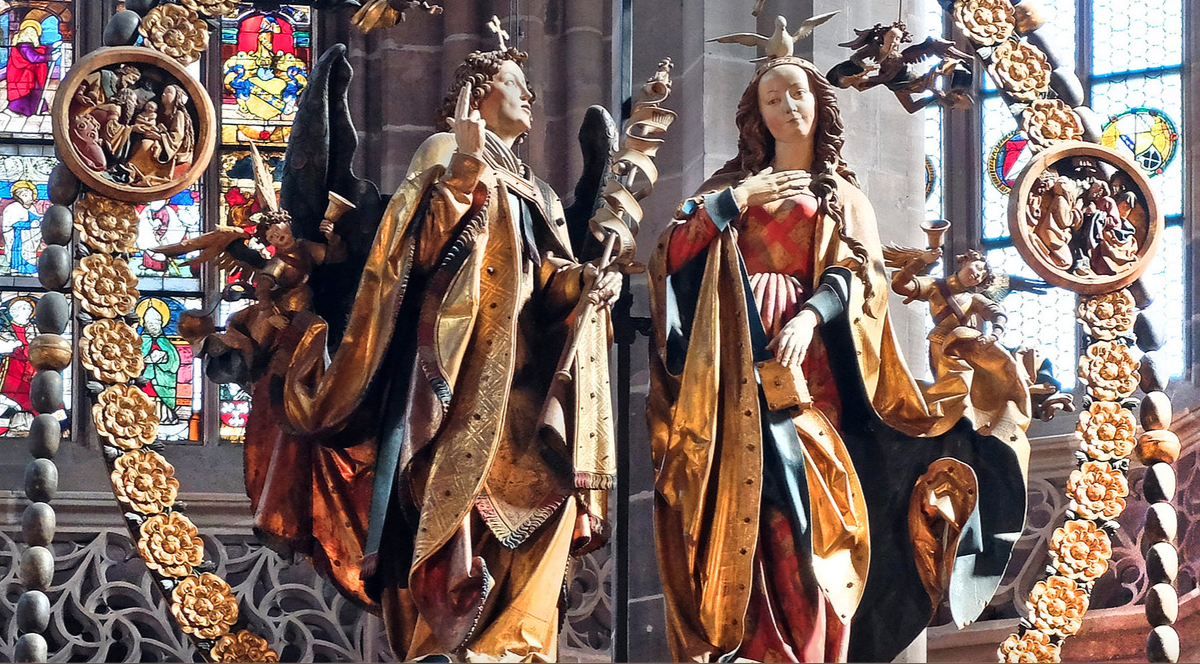
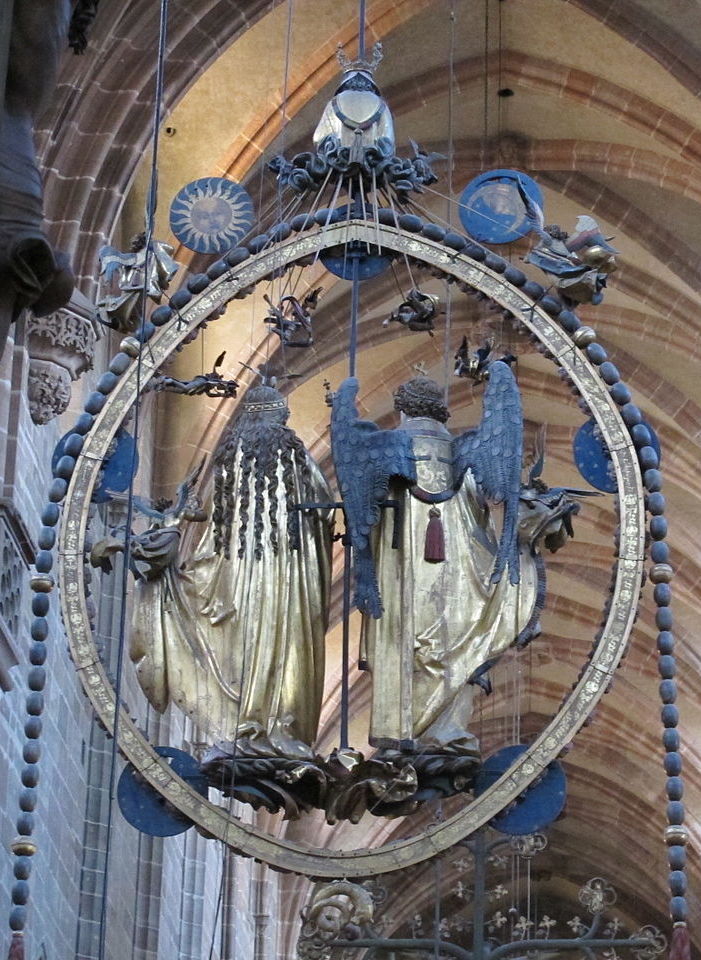
Veit Stoss, The Annunciation, 1517-18, St Lorenzkirche, Nuremberg.

Another repost, as I’m on holiday in Shetland (although for obvious reasons I wrote this before I left home). As my talk, this Monday 4 August at 6pm, will be particularly concerned with Duccio’s Annunciation, I thought I’d look back to a far different version of the narrative – as some of the ideas will inevitably be the same. The talk is a repeat of the lunchtime lecture I gave at the National Gallery a while back, and I’m repeating it online because so many of you are nowhere near London. Entitled Seeing the Light: the art of looking in and around Duccio’s Maestà, we will look at the painting as a whole, consider its context within the Cathedral for which it was painted, together with the paintings which were commissioned later to enhance its meaning. We will also look at some of the details which confirm, for me, that Duccio really was a genius! After that talk I’ll be off acting for a bit, before taking the fifth in my very occasional series of Strolls around the Walker – the Walker Art Gallery in Liverpool. By now I have got to The 18th Century, and I’ll talk about that on Monday 25 August. The subsequent talk, as far as I can tell, will be on Monday 15 September, as on the previous Monday I will be in Chantilly see the Très Riches Heures du Duc de Berry, one of the world’s most spectacular – and famous – illuminated manuscripts. I never imagined I would get to see it in the flesh, so I thought I’d better tell you all about it when I get home. That is over a month away, though, so there’ll be more news about it as soon as I’ve got some (do check the diary!)

When I first wrote this post, it had been over two months since I had previously discussed The Annunciation. Back then it was the calm, rational, yet mystical version by Piero della Francesca, which is at the heart of his True Cross cycle (Picture Of The Day 7). I’m surprised I haven’t talked about more versions, there are so many. But on the Sunday before, I was talking about Mercury’s caduceus – his staff of office (POTD 67) – and I said that the Archangel Gabriel used to have one too – a staff of office, that is, not a caduceus. As far as I’m aware, Mercury is the only person to have one of those. From classical to medieval times – and beyond – messengers showed their authority to convey messages by carrying a staff or rod, and this is what Gabriel holds in early representations of the Annunciation [including the version by Duccio which we will see on Monday]. He still does in Veit Stoss’s magical polychrome sculpture in the Church of St Laurence – the Lorenzkirche – in Nuremberg, even though that doesn’t really class as ‘early’.

The sculpture hangs from the vaulted ceiling on a chain, and has done almost constantly since it was completed in 1518. At one point there was a petition to replace the chain with a hemp rope, as that would be cheaper, but, although the petition was successful, the rope broke. It was also taken down and stored during the Second World War, which was just as well, given that the church was completely gutted. The ceiling you see here dates from the 1950s, but gives an entirely convincing sense of the lofty heights of the brilliantly illuminated medieval church. The stained glass is also original – like the Annunciation it was removed and preserved – as was the elaborate candelabrum to the right of the image, which is topped by a small sculpture of the Virgin Mary. The candelabrum was commissioned at the same time as the Annunciation, and was intended to illuminate it. The patron was a local businessman – and council member – Anton Tucher, who had a particular devotion to the rosary. The candelabrum was there so that people could see the Annunciation in the hope that it would facilitate their prayers.

The dedication to the rosary explains the structure of the ensemble, which is made up of many different sculptures. Gabriel and Mary are central, perhaps a little too close for comfort given the nature of their exchange, and they stand not on the floor, but on the outstretched cloak of an angel. They are surrounded by a rosary, which is made up of a ring of small, stylised roses, with five circles arranged around it. There are another two of the roundels top left and right, with everything overseen by God the Father, perched on a cloud. Hanging from the bottom is a serpent, an apple in its mouth. Closest to the devout, this would be a constant reminder about the need for prayer. Hanging around the rosary is another string of prayer beads: seven gold beads punctuate sequences of black: there are three of the latter at either end, and then six sets of ten black beads. A rosary would usually have six sets like this, although only one would hang free, with the other five sets looped together. The same structure is replicated by the ring of roses. Although you can only see eight of these in between the roundels, if you look from the back, there are in fact ten – it’s just that each roundel hides two of them. This is a real sign that this is a devotional work, as there is nowhere where you could see the two hidden roses clearly. You say – or ‘tell’ – the rosary by running it through your fingers and saying a prayer on each bead. On each of the large beads (represented by the gold ones on the hanging chain, or by the roundels) you would say the Lord’s Prayer (“Our Father…”), and on each of the smaller ones, a “Hail Mary” – which is a version of the angelic salutation to the Virgin Mary, the very reason why the Annunciation is the central image. While saying the “Our Father” you should meditate on one of the mysteries – but I’ll tell you what those are later. Despite my frequent exhortations to ‘go round the back’ of sculptures (e.g. POTD 68), there is relatively little to be learnt here – although if you move from side to side at the ‘front’ – the full 180˚ – the relationship between Gabriel and Mary will constantly change.

Gabriel looks a little duller here, because this photo was taken before a relatively recent cleaning – and yes, the sculpture has been cleaned and restored numerous times: it would have to be. You will know from your own homes how soon the dust settles. And given that there is a candelabrum that used to be piled high with candles not so far away, it would also have been covered in soot. But all that aside, it is in a remarkably good condition, because from the very beginning the sculpture had its own big, green bag which was only taken off during Mass and on special feast days. The process was expensive, and as a result the frequency with which this happened gradually decreased. And then in 1525 Nuremberg became Protestant, just seven years after the sculpture was completed, so it’s surprising that it survived at all. However, rather than destroy it, they just left it in its bag. It’s only relatively recently that it has been on display all the time. 

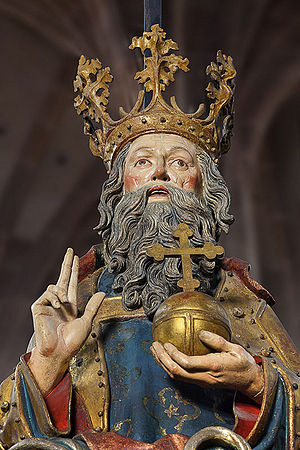
The angel Gabriel comes as a messenger from God the Father, who sits atop the sculpture, symbolically outside the world, above the clouds, in heaven. He blesses with his right hand, and holds an orb in his left. The orb represents the world, divided by a loop around the centre (the equator, effectively), and with an additional loop going round the bottom (usually, though, it goes across the top). Thus the globe is divided into three – Europa, Africa and Asia, the three known continents. OK, by the time Stoss carved it, the Americas had been ‘discovered’, but no one ever thought to change the orb. The cross on top represents God’s dominion over the world. When the orb is held by a monarch, it stands for that monarch’s dominion over their particular part of the globe on God’s behalf. Beams of heavenly light radiate out below God, but we can’t see those in this detail. Gabriel is mid-proclamation, his lips open, and a look of awe in his eyes – Mary truly is as beautiful as he had been told. His right hand points up, symbolically, towards God, and he holds his staff of office in his left. This really is a staff of office – there is no hint that it might be even slightly like a lily. Around it is wrapped a scroll, bearing the angelic salutation in full – ‘Ave gratia plena dominus tecum etc.’ – ‘Hail, full of grace, the Lord is with thee’. The ‘Mary’ was added later for the prayer, and for the sake of clarity.

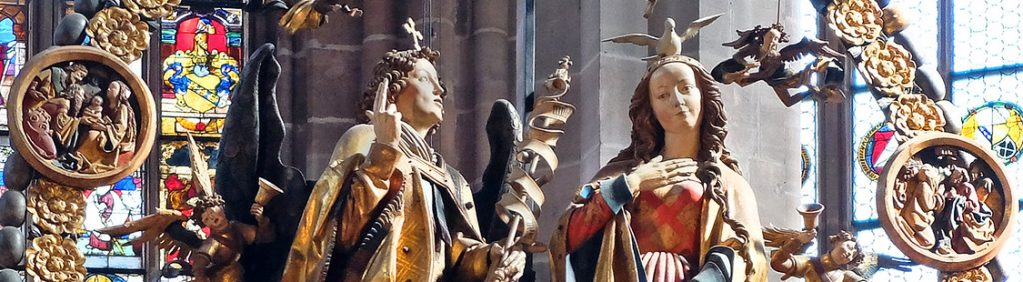
Gabriel and Mary don’t exactly look at each other – a bit like a skype call or Zoom, they appear to be on the same screen, and yet in different places. They are not quite looking at each other – or the camera. Despite their physical proximity, they should be imagined as being further apart, and facing towards each other – Stoss has abbreviated the space as a result of the requirements of the ensemble. On hearing the greeting – or, given that Gabriel is still speaking, while listening to him – Mary appears duly humble. Her left hand holds the book she was reading – the Jewish scriptures – against her lap, and it presses on the blue lining of her gold cloak, although I can’t help thinking that, with the surprise, she is letting it slip to the ground. Her right hand goes towards her chest as a sign of her humility, although it hasn’t got there yet – it stands free of her torso, a fantastic piece of carving. In all of the ensemble the the wood is carved deeply, notably around the draperies where corners always stand free, looking almost paper thin. To prevent the cloaks falling over the rosary, they are held up by angels, who are multi-tasking: they also ring bells in celebration. This is quite a noisy sculpture. The Holy Spirit has landed on Mary’s head, almost like Philip Larkin’s ‘faint hint of the absurd’. I’m not sure why Stoss chose to do this: he is happy for angels to be mounted on rods, why shouldn’t the dove do the same? It could well be a sign that, as the dove has landed, this is the very moment of conception. The roundels are, I hope, clear enough to read here. They are relief carvings of scenes from the lives of Mary and Jesus, arranged in a sequence starting at the bottom left, just below Gabriel’s feet.

On the left we see the Nativity, with the baby Jesus lying on the floor, in between Mary and Joseph, both kneeling and praying.  On the right, Mary and St Peter kneel on either side, with others in the background. The Holy Spirit flies, wings outstretched, at the top of the image – this is Pentecost, when the Holy Spirit descended and the Apostles went out to preach to the world (POTD 58 – we’ll hear more about it on Sunday – POTD 74). 

On the left, after the Nativity, comes the Adoration of the Magi. The eldest magus kneels and hands the gift of Gold to Jesus, who sits on Mary’s lap and leans over to touch it. The other two Magi stand behind – the middle-aged one bends over from the left, and the young, black king looks out above Jesus’ head. As well as the three ages of man, the Magi also came to represent the three continents – thus linking to the orb above. To the right we see the Ascension of Christ (POTD 64), which precedes Pentecost by ten days. Mary and Peter kneel on the ground looking up as Christ’s feet, and the hem of his robe disappear behind the top of the roundel.

Finally, at the top, we have the Resurrection (POTD 25) – which completes the cycle. Or rather, it links the images on the left and right, a clockwise narrative, from the Nativity and the Adoration of the Magi, through the Resurrection and on to the Ascension and Pentecost. The two additional scenes continue the story of Mary, with the Death of the Virgin (often referred to as the ‘Dormition’ – as she didn’t so much die as go to sleep – more of that another day), and then, in the top right, an image which combines several different ideas. Mary and Jesus are both crowned as Queen and King of Heaven, with swirling blue around them. Within this is the notion of Mary’s Assumption into heaven, and her subsequent Coronation. There are also angels with a viol and a lute – more music to add to the bells. 

Almost all of these roundels are taken from the ‘mysteries’, those events that should be contemplated while saying an “Our Father” on the larger beads. There were, traditionally, three sets of ‘mysteries’, although Pope John Paul II added a fourth. I’ll just list the traditional three, which were the Joyful, the Sorrowful, and the Glorious Mysteries:

Joyful: the Annunciation; the Visitation; the Nativity; the Presentation at the Temple and the Finding of Jesus in the Temple.

Sorrowful: the Agony in the Garden; the Flagellation; the Crowning with Thorns; the Carrying of the Cross and the Crucifixion and Death of Christ.

Glorious: the Resurrection; the Ascension; the Descent of the Holy Spirit (Pentecost); the Assumption of the Virgin and the Coronation of the Virgin.

Notice, however, that the Adoration of the Magi doesn’t actually feature in these lists – so, although all of the other roundels represent ‘mysteries’ of the Rosary, this should really be elided with the Nativity.

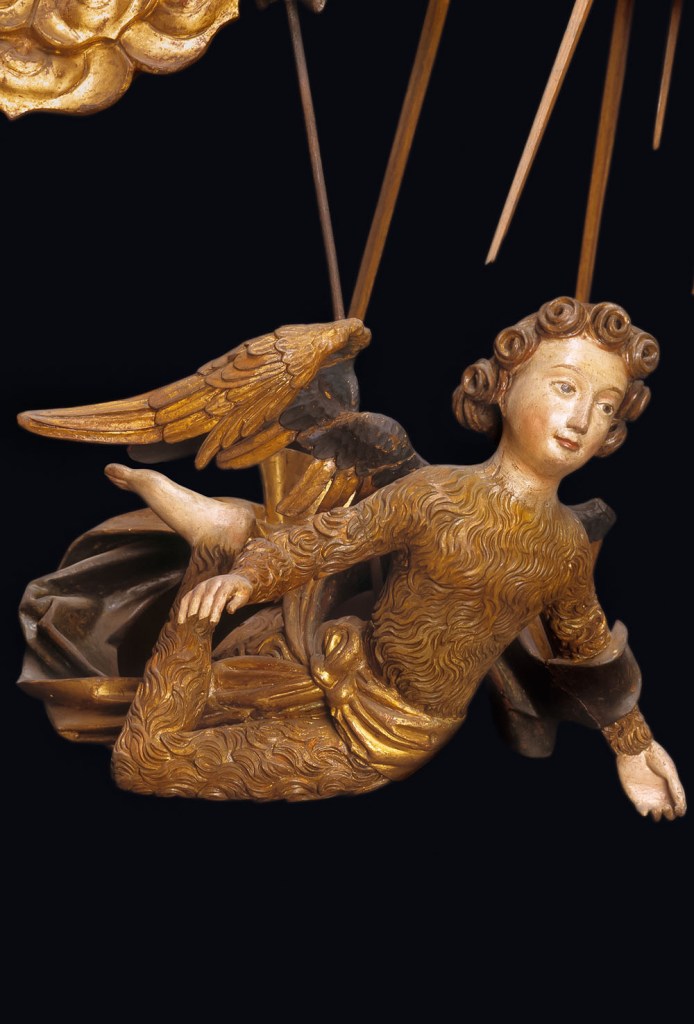
Having said that, listing the mysteries does make this sculpture seem more academic than it really is. What comes across more than any thing else, given the rich colours and the flights of angels, the clanging of bells and sweet angelic music, is that The Annunciation is a truly joyous event. The ‘sorrowful mysteries’ are completely omitted and there is the recognition that, with the Annunciation, Salvation is on its way. So let’s finish with some entirely joyous angels – and then, on Monday, we can see what else Duccio can add to the mix!

Still Triumphing…

Bartolomé Bermejo, St Michael Triumphs over the Devil, 1468. The National Gallery, London

Today I’m reposting something from the early days of this Blog. It was written on the very first day of Lockdown 1 – the day that everyone in the UK was told to stay at home. I’ve gone back to this one because the painting I was writing about will feature in my talk this Monday, 14 July at 6pmSainsbury Story 3: In Church and at Home. It is hung in one of the National Gallery’s new thematic rooms, this one dedicated to Gold and its use in European art from 1260-1550, thus spanning the entire range of dates included in the new hang of the Sainsbury Wing. I’m then off on holiday, but back on Monday 4 August to repeat my National Gallery lunchtime talk Seeing the Light: the art of looking in and around Duccio’s Maestà. I’ll then be acting for a few weeks – appearing in Dial M for Murder and See How they Run! at the Manor Pavilion Theatre in Sidmouth. But I will return to the wonderful Walker Art Gallery on Monday 25 August for A stroll around the Walker V: The 18th Century. By then – but not much before – I’ll know what I’m doing next. Do keep your eye on the diary though, just in case something spontaneous comes up!

I’ve left this post pretty much as it was, although I have improved the images. We had nothing to do, and the few people who’d found the blog by then (at this point still on my Facebook Page) were being very active asking questions and making suggestions for what they would like me to talk about next (I still welcome suggestions, by the way, if anyone has any). The last comment is very much of its time – and relates to the instructions we had been given about not passing on the virus. If only we’d known then that it was primarily airborne.

Originally posted on 23 March 2020:

Thank you all for all your thoughts, suggestions and queries. I’m building up quite a backlog of material, whether it’s the vengeance of the vegetables, or the continued presence of deceased dogs in art… but today I’m going to reply to a question arising from yesterday’s painting, which was  ‘Why such feminine attributes on archangel Raphael? The ballet feet, long hair tied back, beautiful soft face?’ It reminded me of today’s painting, Bermejo’s St Michael Triumphs over the Devil, which I also thought about yesterday because of its connection with Superman.

The connection might at first sight seem obvious – a Superhero has come to the rescue, after all, but that’s not what I was thinking about. Nevertheless, it bears consideration. The Superhero in this case is the Archangel Michael, whose various responsibilities include weighing the souls at the Last Judgement, and defeating the Devil. He is in command of God’s army in the Book of Revelation, making sure all the rebellious angels are vanquished. Rather than the ‘S’ of Superman, Michael has the Heavenly Jerusalem reflected in his golden breastplate.

Even if gold would not in any way be effective as armour, it doesn’t tarnish, so it is pure and unchanging, just like God: it is a symbol of his divine authority. It also reflects beautifully, allowing Bermejo to show off his brilliance as a painter – just look at the way the red of the lining of the cloak is reflected in his calves (in the next detail down).

Unlike Superman (or St Michael’s close equivalent, St George) there is no damsel in distress (not that St George’s damsel was especially distressed – but that’s another story). In this case it is a man, whose kneeling position in this instance tells us he is a normal, everyday human, adopting a position of humility. This is the position adopted by most donors – i.e. the people who gave money for the painting – in religious works. Also know as the patrons, these are the people who commissioned the works of art. The donor of this work was Antonio Juan, Lord of Tous, not so terribly far from Valencia in Spain. He kneels down leafing through his book of psalms, and has carefully held it open at two pages, Psalms 51 and 130. The first of these starts, ‘Have mercy upon me, O God, according to thy loving kindness’ – so he’s clearly worried that he might have done something wrong – while the second says, ‘Out of the depths have I cried unto thee, O Lord’. It must have been this ‘cry’ that Michael has responded to.

What does he need saving from? Well, the Devil, naturally, which is fashioned here out of everything most unpleasant. It always reminds me of one of the monsters made by Sid Philips, the psychopath neighbour in Toy Story.

It has at least four eyes – two in its face and two on its nipples. They are red, and with the black pupils they echo the poppies, which are symbols of sleep, and therefore also death. It also has two mouths. The one in its stomach has a snake for a tongue. Lizard mouths form the elbow joints, and the rest is a combination of bat wings, claws, spikes and scales, everything generally unpleasant. And yet, to my eyes, it remains faintly absurd, even comical. There is no doubt to me that he will be defeated. Michael holds his rock crystal shield in his left hand, and raises his right over his head, ready to strike. I suspect that, once his arm has swung round, the head of the Devil will be sliced straight off.

Michael has certainly not wasted any time: he’s only just landed. Look at his cloak (this is the real connection with Superman) – it’s still floating up in the air, and at any moment, it will come swishing down by his side, in the same way that Superman’s cloak flows out behind him in flight, and then, as he lands, falls down heavily and wraps around him. Or maybe I’m just imagining that.

But what of the femininity? Compare the details of the faces. Antonio Juan has wrinkles in the corners of his eyes, is dark and swarthy (he was a Spaniard, after all), has hollow cheeks, a slightly hooked nose and more than a hint of five-o’clock shadow – he hasn’t shaved for a day or two.

Michael on the other hand is blond and blemish free, with a perfect complexion, a high forehead, arched eyebrows, a long, straight nose, red, almost cupid’s-bow lips and a rounded, dimpled chin. In fact, he has all the marks of perfect female beauty as described by François Villon (1431-63?) in Le Testament:

…that smooth forehead,
that fair hair,
those arched eyebrows, 
those well-spaced eyes,
that fine straight nose, 
neither large nor small,
those dainty little ears,
that dimpled chin,
the curve of those bright cheeks,
and those beautiful red lips.

(This quotation is from the Penguin Book of French Verse, I, and is quoted in Lorne Campbell’s superb entry on The Arnolfini Portrait in his catalogue of Fifteenth Century Netherlandish Paintings in the National Gallery)

But why should these ideal feminine features apply to a man called Michael? Are we talking Renaissance gender fluidity here? Not necessarily. After all, he’s not a man, he’s an angel, and unlike us, he hasn’t fallen – he’s in a state of Grace, without Original Sin. It’s only the sinful who, at a certain point, would continue to grow old, get ill and die… Antonio Juan needs help because he is sinful, the marks of that being the swarthiness, the stubble and the wrinkles. And yet – you might still be asking – does Michael have to look so girly? Just think about Shakespeare. Quite apart from the fact that all the girls were played by boys, more than one character talks about young men as if they were girls, with no beard and high voices, and before they have a beard they are clearly not enough of a man to be a lover. This is also Flute’s complaint in A Midsummer Night’s Dream: ‘Let me not play a woman. I have a beard coming’. Curiously perhaps (and yet, in another way, it is obvious) these features are shared, so often, with those of the Virgin Mary. Like the Archangel Michael she is free from Original Sin, and, as a result, in Roman Catholic belief, she never died. She watches over us, a mother to us all. The fact that Michael has these features (as do other angels – we saw Raphael yesterday) shows us that he is pure, and perfect, and that with him, we are in very safe hands. I’m assuming that those hands are very clean.

253 – A vision, closer than you think

Carlo Crivelli, The Vision of the Blessed Gabriele, probably about 1489. The National Gallery, London.

One of the most dramatic vistas I’ve ever seen in a museum is new – and it is one of the splendours of the new hang of the Sainsbury Wing of the National Gallery in London. Indeed, I’ve been using a photograph of it to advertise my talk this Monday, 7 July at 6pm, the Second Sainsbury Story, At home in the Church. We will look at the ways in which the arrangement of the paintings can help us to understand the context in which they would have been seen when first painted. We will also discover the ingenious ways in which one room is linked to the next. The work I want to explore today is part of the progression through this series of rooms, and it responds to the Crucifix hanging from the ceiling with a vision of the Virgin and Child which can appear to be – if you look at it the right way – in our own space. You’ll have to trust me on that – or read on, to find out what I mean. The third ‘story’ will look at paintings from across the Italian peninsular which were made either for domestic spaces – and these could be religious or secular paintings – or for churches. Sometimes it’s hard to tell the difference, but join me on 14 July for Sainsbury Story 3: In Church and at Home for a few pointers. As an example of this idea we’ll start (probably) with Piero della Francesca, who painted a Nativity for his own domestic devotions. After that I’ll be on holiday for two weeks, returning for Seeing the Light: the art of looking in and around Duccio’s Maestà on 4 August. I’ll then be acting in Sidmouth for a couple of weeks, but plan to give a talk on 25 August, the next in my (very) occasional series A stroll around the Walker, looking at works in my ‘local’ museum, The Walker Art Gallery in Liverpool. This will be my fifth visit, and will focus on the 18th Century, and I will post more information about this in the diary by Monday evening.

We see a Franciscan friar kneeling on barren, stony ground in the left foreground of the painting. He looks up to the right, towards a vision of the Virgin and Child, who are apparently hovering in the top right corner. A garland of fruit is slung across the top of the painting, although it is not at all clear how the garland is attached. On the left the landscape rises up as a steep cliff of red, curving rocks, balanced on the right by a renaissance-style building with a dome on the higher section and semi-dome on what could be an apse. This is Crivelli’s representation of San Francesco ad Alto, which in ‘real life’ was – and is – a substantially larger structure, originally in the countryside outside the city walls of Ancona in the Marche. Apart from the fact that the city has expanded, so that the building is now in the suburbs, the church was secularised in 1863 and what was the priory is now home to a military base. However, its origins are are supposed to go back to the founder of the Franciscan order, St Francis himself. He is believed to have designated the site of the priory in 1219 when he was passing through Ancona, using the port as a point of departure for his pilgrimage to Egypt (we’ll see Sassetta’s painting of what happened when he got there on Monday). Gabriele Ferretti – the subject of today’s painting – was the Superior of the priory for three years, starting in 1449, and continued to live there until his death in 1456. Like St Francis he came from a wealthy family, but gave up that wealth to join the Church. He became renowned for the sanctity of his life, and for his regular retreats to the woodland surrounding the priory to pray and to meditate (much as St Francis had done). It was there that he experienced visions of the Virgin and Child. After his death his family sought to have him canonised (recognised as a Saint), but the miracles were never forthcoming. However, he did get as far as being beatified – the first step on the road to Sainthood – although that didn’t happen until 1753. Initially buried in a simple grave outside the church, in 1489 his body was transferred to a marble tomb monument (commissioned by his sister Paolina, one of the rare examples of female patronage) with today’s painting hung above the effigy of the deceased.

I wanted to start by getting in close to give you a sense of where we are. The strength of Ferretti’s devotion is made clear by his bright, wide-open eyes, apparently looking directly upwards. They shine with bright catchlights, which make him look both alert and fervent. His mouth is open with a sense of dumb-struck awe, which helps to convince us about his feelings on seeing the divine vision. In the very top left corner of this detail a few golden beams are visible, radiating from his head. These are often given to the beatified in advance of their full canonisation, at which point they would get a full halo. However, Crivelli has included this beatific radiance some 160 years before he achieved the relevant states – but this was something he did at the family’s request, and with the permission of the Franciscan order: they too would have welcomed a newly canonised Saint among their number. Crivelli’s clear understanding of the structure of the Franciscan habit is marked by the precise delineation of a seam between the neckline and Ferretti’s praying hands, as well as another at the top of his right sleeve: delicate details which add to the image’s authenticity. Just to the right of his fingers – and some distance away – we see a walled city. This is a stylised representation of Ancona, suggesting that we are out in the countryside, some way from the city walls. This makes sense, as this is exactly the sort of place where St Francis wanted his followers to live – and where the priory was in any case located. Further away we see the sea and the coastline, with hills forming promontories reaching out into the blue water. This is a fairly accurate evocation of the coastline of the Marche: we are looking northwards, towards Rimini, Ravenna, and eventually Venice. There are people chatting to one another on the road which winds its way through the sparse trees of the wood, while others come and go, to and from the city, their size dependent on their distance.

If we take a step back we can see that the priory is next to this road. The cave on the left of this detail may have been intended to stress Ferretti’s humility – as if it were an even humbler place to retreat – while the perspective of the church leads our eyes towards the holy man. As he looks up a line of birds flies on a similar diagonal to his gaze. Stepping back further, we would see how this could lead our eyes to the vision. Just beyond Ferretti’s left elbow is the hooded head of another Franciscan, included to enhance the connection between the subject of the painting and the order’s founder. No one had painted The Vision of the Blessed Gabriele before, so how was Crivelli supposed to know how to do it? Presumably by looking at a similar subject. He seems to have based his composition on another which was far more common: The Stigmatisation of St Francis. Here’s a comparison with Sassetta’s version of the Stigmatisation (which will also find its way into Monday’s talk).

Francis has gone out into the countryside to pray, and sees a vision of a winged seraph. One of his followers, a Brother Leo, has accompanied him, and although reports suggest that he did not see the vision, he is often included in the paintings anyway. Usually, though, he is some way off, and often on the other side of a stream. However, Sassetta makes him far more prominent. As well as going out into the countryside to pray – and experience a vision – Gabriele Ferretti, like St Francis, has also been accompanied by one of the other brothers, although we can only see his head. This stress on the similarities between the two may well have been suggested by the Ferretti family, the patrons of the painting, or by the Franciscans of the priory, in the hope that this would speed up the process of canonisation. Francis’s followers named him Alter Christus – another Christ – and in this painting Crivelli shows us Gabriele Ferretti as Alter Franciscus.

The artist encourages us to believe what we are seeing by including some highly realistic details, which not only catch our attention but also draw us in. In the left foreground is the edge of a stream, or just conceivably a pond. We could think about the water of life, or baptism, I suppose – the religious setting would favour such an interpretation – but it is more important for the beautifully painted detail of the duck and duckling, with an excellent distinction between the mature feathers of the former and soft, fluffy down of the latter. The delight we might take at the accuracy of their depiction helps to pull us into the space of the painting, keeping us involved and maybe even encouraging us to seek out other such details. They also help us to trust anything else we see as real. For example, there is a rubricated prayer book (some of the pages are written in red) lying open in front of the kneeling friar. Next to it, the artist’s signature is foreshortened, as if lying on the ground: OPUS KAROLI CRIVELLI VENETI – the work of Carlo Crivelli from Venice. Although Venice played a relatively little part in his career, it was a good place to come from as an artist: a mark of his superior status. Behind Ferretti’s feet are his sandals. Like Moses before the burning bush (Exodus 3:5) he has taken off his footwear because he is on holy ground.

When we look up, following his gaze – and the line of birds – we can see why he considered it to be holy. Just above the church there is a mandorla. The word means ‘almond’, but is used to describe the geometric form which so often surrounds figures appearing in visions – in part, because this was the shape of the structure on which actors would appear (or disappear) when representing holy figures in religious dramas. The arrival of the Archangel Gabriel at the Annunciation, for example, or the Ascension of Christ or Assumption of the Virgin would all use such mechanisms.

The mandorla itself is at an angle – which is unusual. Every other one that I can think of is placed frontally – a formal arrangement which makes it clear that the vision is intended for us, the viewers of the work of art. However here the vision is the Blessed Gabriele’s, and the Virgin and Child are angled towards him. Indeed, Mary holds the child high in front of her chest as if she is about to hand the baby to Ferretti, offering him the chance to hold the divine. Mary and Jesus both have haloes, as do the winged heads of the red seraphim whhich surround not only the mother and child, but also the mandorla, supporting it on its miraculous descent from heaven. The religious figures are radiant with applied gold, and beams of light shine out on all sides, equivalent to Gabriele’s own radiance. This rich and detailed use of gold helps to make the vision stand out from the background, with its sky streaked by numerous clouds in shades of white and grey. The mandorla is neatly framed by the bunches of fruit which make up the garland. The stalks of some of the fruits are tied with pink ribbons, which hang from something unseen at the top of the painting. The mandorla is balanced on the left side of the painting by a tree which reaches more or less the same height. Notice how remarkably horizontal two of the branches are – one reaching to the left, and another to the right – while a third branch rises almost vertically. It is no coincidence that this tree has taken on the shape of the cross: the bird, sitting with its back to us, confirms that this was the intention.

Admittedly it’s not that easy to see, even in this detail, but it has flashes of yellow on its wings, and a splash of red on its head: this is a goldfinch. Jesus was grasping one upside down in last week’s painting, the newly acquired Netherlandish or French Virgin and Child with Saints Louis and Margaret. According to legend, the red colour came from the blood of Christ, which dripped onto the head of one of the ancestors of this little bird when it plucked a thorn from Jesus’s forehead on the way to Calvary. The goldfinch is a symbol of Christ’s Passion – and confirms that the cross shape evoked by the branches of the tree do indeed refer to the crucifixion. But there’s something more surprising than that here. At the top of this detail you can see some of leaves of the fruits, and the ends of one of the ribbons with which they are tied – and they do something unexpected: they cast shadows on the sky. Of course, they are not casting shadows on the sky, they are casting shadows on the painting – of which they themselves are a part. Crivelli is suggesting that this image is so important – given that Ferretti himself was – that it has been decorated, with the garland intended to honour the Blessed Gabriele. It is a remarkable trompe l’oeil invention which shows us how sophisticated the artist was, despite his apparently retardataire (i.e. old fashioned) use of gold. But that’s not all.

Some of the golden beams of light which emanate from the mandorla on the right seem to pass in front of the shadows. And if the shadows are cast on the painting, then the vision, with the mandorla at an angle and the Virgin and Child sculpturally in front of it, must be in front of the painting. Jesus and Mary are painted as if physically in our space. This illusion – with part of the imagery apparently in front of the painted space – would probably have been more convincing when the work was in its original location which, even during the day, would have been the fairly dark interior of a church.

On entering San Francesco ad Alto, the painting would have been in a corner, opposite the door through which the worshipper would enter, but to the left. It hung above the effigy of the deceased lying on his sarcophagus (this section the monument survives in the Diocesan Museum in Ancona). As a result we would have seen the painting, initially at least, from the bottom right. This is why the signature is foreshortened as it is, and would have emphasized the way in which the book leads us into the space. The top of the painting would have been fairly high, and what little light there was would have caught two parts of the image in particular, the two areas which were gilded: the Blessed Gabriele’s radiance, and the rich glory covering and surrounding the Virgin and Child. With the vision glowing in the darkness in front of the grey cloudy sky, it would surely have enhanced the sensation that the mandorla was floating above the deceased, in our space, and that the Virgin and Child were watching over the carved effigy as much as the painted image. If they turned their heads to their left, they would have seen us standing there too. Given this, the new placement of the painting in the Sainsbury Wing is especially brilliant.

Hung like this, we approach with the painting on our left, as we should. Gabriele Ferretti kneels in prayer in front of the miraculous vision, which hovers in the space of the Sainsbury Wing about a quarter of the way between the revered Franciscan and Segna di Bonaventura’s Crucifix hanging from the ceiling of the adjacent room. It really helps to enhance the apparent solidity of the mandorla, and of the Virgin and Child. This is the sort of connection within the rooms and from one room to another which I will be discussing on Monday. Having said all of that, I might have been getting carried away the last time I saw the Crivelli. I couldn’t help but marvel at his skill, and his remarkable ability to create the most unbelievable sense of three-dimensional illusion. It even looked as if he had gone so far as to evoke a genuine Franciscan stepping forward to greet the Blessed Gabriele in front of the painting.

252 – Beauty and the Beast

Netherlandish or French, The Madonna and Child with Saints Louis and Margaret, about 1510. The National Gallery, London.

My first talk about the newly refurbished Sainsbury wing, this Monday, 30 June at 6pm, is entitled Opening up the North. There are various reasons for choosing this title, which I will discuss during the talk itself. If you click on either of those two links you can book for that talk on its own. However, up until 6pm on Monday you will still be able to book, on the next two links, for all three of the Three Sainsbury Stories at a reduced rate – which admittedly equates to what has been the price up until now. The other two talks will be At home in the Church on Monday 7 July, and In Church and at Home the following week. I shall then head off to the northern extremities of the British Isles for a holiday, before returning to revisit Duccio’s Maestà with a repeat of my National Gallery ‘in-person’ lecture, Seeing the Light – which I will expand a little – on 4 August. For any other dates which might arise, do keep an eye on the diary – although I might add that, by 4 August, I will already be in rehearsal for two plays at the Sidmouth Summer Play Festival, which seem to confirm my type-casting as either a police detective or a vicar… But before we get there, let’s think about Opening up the North – one of the things that the National Gallery’s latest acquisition certainly does. Have a good look at it before reading further! I make no apologies for this being one of the longest posts I have ever written, it’s that intriguing, and I’m indebted to the entry on the National Gallery’s website, which says some of the following far more concisely!

I was first alerted to the NG’s acquisition of the painting by one of you, wanting to know more about it: thank you! That’s one of the reasons why I’m writing about it today. Well, that, and the fact that, initially, I was equally baffled! However, the more I have looked, the more I have become intrigued, the more I appreciate the acquisition – and the more I like the painting. I don’t know what first grabs your attention, but I was initially shocked by some of the awkwardness, ugliness and crudity – and that is precisely what I have come to love about it. It’s not what I expect of the Northern European Renaissance, and that is exactly why I think it is such a good acquisition: it opens up our idea of what the artists could do. Maybe, at first glance, you realised what an entirely traditional painting it is: a Madonna and Child Enthroned with two angels (one on either side) and two saints (one on either side). Within an open loggia, with a row of square columns on either side, a richly embroidered cloth of gold is hung to create a canopy which defines Mary’s seat as a throne, and therefore confirms her status as Queen of Heaven. Although seated, she is higher than the other characters, and steps lead up to the throne. However, the steps are mere wood, and there is what is probably the most grotesque monster I have ever seen lurking front and centre.

However, at the top of the painting everything appears calm, even placid. Mary sits formally, facing front, a flower between left thumb and forefinger, and the Christ Child sat naked on her right knee, supported by her right hand. He looks towards our left, either at the angel doing something strange with its mouth, or the royal figure who looks across the pictorial field, almost as if he is unaware of being in the presence of God. On the right a woman has her hands joined in prayer, holding a cross, with a dove sat calmly on her shoulder, for all the world like the holy antithesis of Long John Silver and his parrot. Behind her an angel holds a book. The colonnades stretch back into the space, with the capitals – or are they mini-entablatures? – carved in high relief, and forming diagonals which lead our eyes towards the Virgin’s face.

That face has the most perfect complexion, pale, as it was believed befitted someone pure, and without blemish: immaculate, like the Virgin herself. I know, the proportions are slight odd, but a high forehead was considered beautiful – so this must be the most beautiful – as was a long, slim nose with a petite rounded end, and a narrow, cupid’s bow mouth. The light falls from above and from the right, although Mary’s right jaw (on our left) is also illuminated by reflected light. It can only have come from her son. Her eyes are lowered, solemn, as she is aware of what will pass after another three decades or so: his crucifixion, references to which abound in the painting. The cloth of honour is one of the most delicately embroidered I have seen, with stylised flowers, leaves and stems, and a pair of double-headed eagles in roundels, one on either side. They bring to mind the Hapsburgs and the Holy Roman Empire. A pole spans the gap between two of the columns, and the cloth of honour has been hung over it. There must be another pole further forward from which the fringed end of the fabric hangs, thus making a canopy appropriate for the royal presence. We can’t quite see where it is hanging though, which might suggest that the painting has been cut down – but apparently not: underneath the frame there is unpainted wood on all four sides of the image: this is the full extent of the painting. The result is that the canopy is pushed forward towards us, thus bringing us closer to the holy figures. The detailing is so precise that we can see folds in the fabric – a horizontal at the level of Mary’s eyes, and a vertical on either side of her head, going down to her shoulders. They make a cross on both sides – which reminds me of the two thieves crucified on either side of Jesus. The horizontal fold also connects two of the relief carvings: people in prayer, looking up to God, on our left, and the back of a naked boy looking down on our right.

I have suggested that these might be capitals, but the more I look the more I realise that they are not high enough up the columns to be capitals. Each column is treated as a pier (a supportive mass of masonry) with its own entablature, which suggests that the reliefs are remarkably short friezes below the cornice. Each is intriguing, and some can be easily interpreted. Naked boys are playing on the far left – one is blindfold, two others hug or fight. On the next column the friezes focus on grapes. On the side facing us is the Drunkeness of Noah. The one good man survived the deluge (with his family), grew vines, made wine, got drunk and revealed his nakedness: one of his sons lifts his elbow above his father’s head and covers his eyes to avoid seeing the paternal shame. The implication of this story is that even the one good man was still in need of redemption. The side which faces into the space shows two men carrying a pole from which is hung the most enormous bunch of grapes. These are the Grapes of Canaan – a story from Numbers 13:21-24 in which Moses sent spies into Canaan. It truly was a fertile place, and the grapes were just some of the evidence that this, a land that ‘floweth with milk and honey’, really was the promised land.

On the other side, Adam and Eve stand under the Tree of the Knowledge of Good and Evil, with the serpent snaking up between them: The Fall. Further forward, a man lifts something while another cowers beneath: Adam and Eve’s sons, Cain and Abel, and the former killing the latter. And if these two scenes didn’t persuade you that mankind was in need of redemption, the last will: a group of naked boys are playing around in a barren tree, with one of them bending over and peering between his knees to show you his bottom. Two of his friends are pointing at it. This is not what I meant by ‘crudity’, when I used the word before, but it is remarkably rude. It reminds me of some of the grotesque and low-comedy carvings you get on misericords, the underside of fold-up chairs that monks and priests could perch on in many European churches and cathedrals during the long religious services. I think that it is there as light relief after the murder of Abel – something we can snigger at, perhaps, but learning through laughter. It belittles those who misbehave, whilst our enjoyment of it might also bring us up short in the presence of God, guilty about our own enjoyment of the bawdiness. Before we move on, just look at the stonework above these friezes, with the careful, insistent diagonals showing us how the masons finished the blocks at the top of the columns, rougher than the more smoothly dressed surfaces below – but don’t forget that we are in need of redemption.

After all, redemption is what the painting is about. The Christ Child may be distracted by the curious behaviour of the angel on the left, but that wouldn’t seem to excuse his cruel treatment of the bird he is holding. However, you have probably seen this bird in other paintings: it is a goldfinch. The red patch on its head is supposed to have come from Jesus’s blood, when one of the birds either ate a thorn from the Crown of Thorns – or, in another version of the story, pulled one of the thorns from Jesus’s forehead. It is a symbol of Christ’s passion, and in this painting Jesus manages to show that, far from fearing his own death, he has it in hand – quite literally. He can take our sin upon himself and can even turn his own death on its head. Notice how the bird casts a dark shadow on his thigh, with another shadow – that of Jesus’s own right arm – forming a diagonal which leads to the goldfinch’s head. Another reminder that this painting is about redemption is the flower which the Virgin holds. The Ecologist has let me know that it could be Honesty or a single Stock (i.e. not the horticultural ‘double’ variety), but whatever it is, the flower is white – a symbol of purity – and cruciform. This means, basically, that it has four petals in a cross formation. There are no prizes for guessing the symbolism.

The angel on the right holds an open book – a music book – and although the music looks accurate – with the correct symbols and staves for music of the time – it is not a transcription of anything known. However, the words are. This is a medieval hymn, Ave Regina Caelorum, Mater regis angelorum (‘Hail, Queen of Heaven, Mother of the King of Angels’). The music is, of course, a clue as to what the other angel is doing.

He’s playing a musical instrument, a mouth harp, or jaw harp (you might know it as a Jew’s harp, although the term has fallen out of favour because there doesn’t seem to be any connection with either the religion or the people – the instrument originated in China). To quote one website I have found, “To play, position it between your slightly parted teeth and lips, ensuring the tongue [of the instrument!] is free to vibrate. Pluck it gently with your finger while shaping your mouth cavity to control pitch and tone. Your mouth acts as a resonator, so subtle breath control and movements of the tongue, cheeks, and throat help create varied sounds.” It is remarkably rare to see one in the world of art, although it is played by an angelic musician on the mid-14th century minstrels’ gallery in Exeter Cathedral, and by one of Dirck van Baburen’s ‘young men‘, in a painting from 1621 in Utrecht.

Jesus appears to have been distracted by the curious twanging sounds it makes, and this has stopped him torturing the goldfinch, or paying attention to the two visitors to his court – or us, for that matter. He sits on a white cloth, which is undoubtedly a reference to the shroud: notice how the shadows of Christ’s legs fall over the extended folds of the cloth. It is also reminiscent of the white cloth spread over the altar during mass, or for that matter, the corporal, another white cloth, which is also placed on the altar, as a fitting place for the chalice (containing the wine, the blood of Christ) and the paten (with the host, the body of Christ). In this painting Christ’s body and blood are also set on a white cloth – in the person of Christ himself…

On the left, the specific details of the man’s face suggest that this could be a portrait – but if it is, the subject appears in disguise as a saint. Although there are no haloes – and the angels have no wings – we need not doubt that they are all holy. Why else would they be there? He is a king – a fact emphasised not only by his crown and sceptre, but also by the ermine cape around his shoulders. His deep blue robes are embroidered with gold thread to form a pattern of large fleur-de-lis. The robes have the colours and emblem of France. This is St Louis – but not the Franciscan St Louis of Toulouse, who would only have dressed like this had he not abdicated the throne of Naples to become a Franciscan (in which case he may well not have become a saint): there is no evidence of the Franciscan order here. This is St Louis of France, King Louis IX (1214-1270), collector of relics such as the Crown of Thorns, which he housed in the Sainte Chappelle in Paris, built specifically for this purpose. More relevant is the fact that he granted the Premonstratensian order the right to use his fleur-de-lis in their coat of arms: it is no coincidence that this altarpiece was first recorded in the Premonstratensian Abbey in Ghent in 1602. We don’t know that it was painted for this Abbey, but it seems highly likely. Apart from anything else, Holy Roman Emperor Charles V was born in Ghent in 1500. At the time his grandfather, Maximilian I, was Emperor, and Maximilian was the one who really cemented the use of the double-headed eagle as a symbol of the empire – which could explain its presence on the cloth of honour. The painting was probably painted around 1510: there are very specific features which help to restrict the image to what is admittedly quite a broad range of dates.

St Louis is wearing the French Order of St Michael. The badge hanging from it shows St Michael himself defeating the devil. The Book of Revelation 12:7 says that ‘Michael and his angels fought against the dragon’ – who is then identified in 12:9, as ‘that old serpent, called the Devil, and Satan, which deceiveth the whole world’. The chain, which has double knots on it, was altered by Francis I in 1516 – suggesting a date before this for the painting. In addition, dendrochronology tells us that the panels on which it was painted date, at the earliest, from 1483. It’s a 33-year timespan, which isn’t very specific, but stylistically 1510 makes sense. However, we have no clue as to who might have painted it. Some of the stylistic features are French, whereas the panels are made of Baltic oak, used by Netherlandish artists (the French used locally sourced oak) – and this does seem to have come from Ghent – so ‘Netherlandish’ seems more likely.

While the depiction of the chain and medal – the ‘collar’ of the order – is highly accurate, the sceptre which St Louis is holding appears to be entirely original. There are lots of figures squirming around, and the best suggestion so far is that it represents a detail from the Last Judgement. This would make sense next to St Michael defeating ‘the dragon’, as St Michael is supposed to weigh the souls of the dead at this time. Again, it brings us back to the need for redemption. Without it, we would be one of these squirming figures being dragged down to hell. The collar and sceptre are entirely fitting for St Louis, King of France, but as yet there are few clues as to the identity of the woman on the other side of the painting. She holds a cross, yes, but then all female saints could. And she has a dove on her shoulder – which I’ve never seen before – but then so many of the saints were inspired by the Holy Spirit. The real clue is at the bottom of the painting.

This is undoubtedly the most hideous monster I have ever seen in any painting. Most devils end up looking cute and endearing (check out Bermejo’s, in Picture of the Day 5, or Andrea Bonaiuti’s in POTD 24), whereas this one is truly scary. It’s the teeth, I think, with three fangs coming down from the top and four from below, interlocking like some destructive machine. The teeth themselves are black and brown with dirt and decay, and emerge from raw, red gums. Even if it’s not clear on this detail, they are also strung across with streaks of saliva, which in the flesh (if not on a screen) are truly repulsive. And then there are the bloodshot eyes, the weirdly shaped ears and the pointy head. Even the neckless way the head joins the torso is unpleasant, with a scaly carapace and spotted wings adding to the effect. It creates such a contrast with the beautiful, and beautifully depicted, brocade of the woman’s cloak which falls across its wing, and even seems to emerge, just below her bent knee, from the monster’s back. But this is the clue! This is St Margaret of Antioch, a Christian martyr who was thrown into prison, and subjected to many hideous tortures. According to the Golden Legend, which I’m quoting here in William Caxton’s version from 1483,

And whilst she was in prison, she prayed our Lord that the fiend that had fought with her, he would visibly show him unto her. And then appeared a horrible dragon and assailed her, and would have devoured her, but she made the sign of the cross, and anon he vanished away. And in another place it is said that he swallowed her into his belly, she making the sign of the cross. And the belly brake asunder, and so she issued out all whole and sound. This swallowing and breaking of the belly of the dragon is said that it is apocryphal.

It may well be ‘said that it is apocryphal’, and yet artists loved to paint it! She very often holds a cross, as if she has cut her way out with it, and she certainly holds one here. But what about the dove? Well, that’s there in the Golden Legend too, though this is the only time I’ve seen it. After the dragon, Margaret was subjected to even forms of torture,

And after that, they put her in a great vessel full of water, fast bounden, that by changing of the torments, the sorrow and feeling of the pain should be the more. But suddenly the earth trembled, and the air was hideous, and the blessed virgin without any hurt issued out of the water, saying to our Lord: “I beseech thee, my Lord, that this water may be to me the font of baptism to everlasting life.” And anon there was heard great thunder, and a dove descended from heaven, and set a golden crown on her head.

The dove has remained, but the ‘golden crown’ is not what you might have thought – at least, not in the painting.

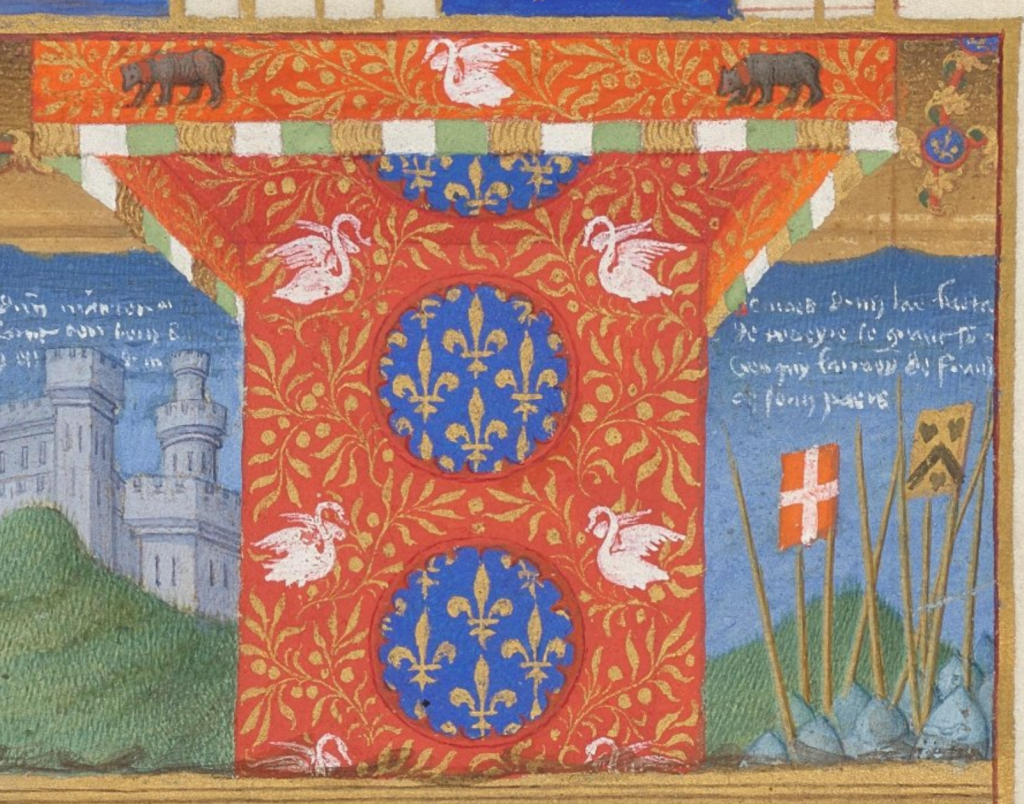
Margaret’s hair has been plaited together with threads strung with gold sequins, and the plaits piled on and around her head. There is also a garland of flowers, including daisies, placed delicately round her coiffeur. In French, daisies are marguerites – no doubt a pun on her name. Above the dove’s head, to the right of Margaret’s piled up hair, the column is decorated with a red panel with white relief sculptures – what is known as a candelabrum. At the very top are two swans with their necks intertwined. Given that the main feature of the Ghent abbey’s coat of arms was a swan, this would seem to confirm that the painting originated there. At the left of this detail you can also see the beautifully embroidered (for which read ‘painted’) double-headed eagle.

So the dove confirms that this is St Margaret, although the dragon would have been enough. I wanted to return to this detail, though, to think about the steps of the throne: another ‘I have never’. In this case, I have never seen steps to Mary’s throne made from ‘raw’ planks of wood. Sometimes the steps might have been wooden, I suppose, but painted to look like marble, but in this case, as a royal throne, the steps are remarkable crude in their construction. Unpainted, undressed (there is no rich fabric laid over them), and with simple nails driven into them, there is no attempt to disguise the simplicity of the making. Three nails are visible on the lower step, and two (one partially hidden) on the upper. This basic construction might be a symbol of humility, but there is an unmistakable reference to the crucifixion too. In the open, well-lit space beneath Jesus, the reference is not only to the making of the cross, but also to the three nails driven through his hands (one nail for each) and feet (one nail for both). The contrast with the ermine and royal blue of Louis’ cloak couldn’t be more striking. Again, we are right there, so close to the image, given that the bottom of the cloak, of the central step, and of the dragon are cut off by the frame. Again, like the canopy at the top, this is the original extent of the painting. We are pushed close to these holy figures – and to the most unholy – so that there is no possibility of escape. The threat of damnation, and the possibility of redemption, are opened up to us as the unknown artist of this remarkable painting expands our expectations of what the art of Northern Europe can be.

251 – Heaven brought down to earth

Cimabue, The Virgin and Child with Two Angels, about 1280-85. The National Gallery, London.

I confess that I have always been slightly dubious about the status of ‘Cimabue’ in the History of Art. After all, only one of his works is documented, and that is a mosaic: how can you establish an artist’s oeuvre on that basis? As a result I am especially glad to be Revisiting Cimabue this Monday, 23 June at 6pm, having seen the superb exhibition at the Louvre with a very similar title. The exhibition started – as my talk will – with an exploration of the very mythology which surrounds this supposedly foundational artist, the mythology of which I have always been wary. It then looked at his work in the context of his predecessors and contemporaries, before examining his impact on and significance for both contemporaries and successors – an exemplary display which I’m sorry I couldn’t get to earlier.

The week after I will start my exploration of the new hang of the National Gallery’s collection – or at least, of the Sainsbury Wing – with Three Sainsbury Stories, on Mondays 30 June, 7 and 14 July. Click on either of those links if you want to book for all three talks at a slightly reduced rate. Alternatively, you can book the talks individually on the following links – the titles being Opening up the North (30 June), At home in the Church (7 July) and In Church and at Home (14 July). A description of each can be found on the relevant link. At that point I was going to stop for the summer, but have realised I am free on the evening of 4 August – which gives me a chance to repeat this week’s National Gallery lunchtime lecture, Seeing the Light: the art of looking in and around Duccio’s ‘Maestà’, as I realise not all of you would have been able to get to London. It also gives me the chance to talk about some of the ideas in greater depth. It was great to see so many of you there – and especially the visitors from Edinburgh, Italy and even America! Thank you so much for coming. Meanwhile, I’m going to look back before Duccio’s career had started to explore the National Gallery’s small painting by Cimabue.

At first glance this might appear to be an entirely traditional image, if not rather ‘old fashioned’. As a genre, The Virgin and Child is rich and varied, and, even if it doesn’t represent a specific biblical narrative, it expresses so much about these two characters, their relationship, and their importance for the Church – the ‘Church’ in question being Catholic (the term ‘Roman Catholic’ didn’t come into being until about 300 years after Cimabue was painting). It could almost equally have come from the Eastern Orthodox Church – but not quite, and that is what makes this particular image so important. Mary sits on a blue cushion against a red cloth of honour, both of which are set on an elaborate throne. Her right leg is lowered, with her foot on the second of three steps, and Jesus sits on her raised left knee. They are flanked by two angels. Nothing unusual about this, you might think, but it is worthwhile comparing it with an earlier version of the same subject which is also in the National Gallery’s collection, from Margarito d’Arezzo’s The Virgin and Child Enthroned with narrative scenes from about 1263-64.

Margarito’s version is far closer to Byzantine art, or the art of the Orthodox Church. Neither Mary nor Jesus seem as ‘human’ as Cimabue paints them. Rather than a baby, Jesus is like a little emperor. Both figures sit upright, with their shoulders flat against the flat gold background. There is no sense that they are moving in the space which we inhabit, and as a result they are slightly abstracted from reality. But then, Orthodox icons are meant to show us a sanctity which is not seen in the down-to-earth world in which we live and breathe. Icons represent something which is more perfect – and as a result, something we can only imagine, unlike what we are actually familiar with. Nevertheless, there are similarities. For example, in both examples the Virgin wears a red robe with a blue cloak, and sits on a cushion. Notice also that in both images Mary’s right foot is on the central axis, directly under her head: it is with the feet that we will start.

Most obvious are the feet of the angels. On the left we see both feet, balletic, but not turned out enough for second position, almost as if the angel is on tip toe – the usual description for Byzantine imagery after it had evolved away from the naturalism of late Roman art. On the right we can only see one foot: the other must be behind the throne, or behind the steps leading up to it. This in itself helps to create a sense of space, and of three dimensions: the holy beings are in the same space as us, thus making the image appear more ‘real’. Both angels wear red stockings and delicate black shoes, or slippers. It could be that Mary is wearing the same, although we can only see the toes peeping out beneath the hem of her red skirt. Her right foot (on our left) is on the second step up, and her left is one step higher. The centrality of the lower foot, and its ‘proximity’ on the lower step, might encourage us to lean forward and kiss it, a sign of our humility.

A semi-transparent veil hangs over the seat of the throne and behind Mary’s legs. It falls over the upper step, and her left foot is resting on it. The steps themselves appear to be at an angle, as does the throne: this suggests that it is a three-dimensional structure, again implying the real presence of Mary and Jesus in our space. To me, the steps look as if they could be removed, with the throne only accessible when they are there: they would only be put in place for the right person, of course. To the far left and right of the detail above are the ends of the angels’ wings. Their purple cloaks hang down, and the points almost coincide with a row of fine dots tooled into the gold leaf background which, as we shall see, frame the entire image.

Moving up, we can see these tooled dots disappear behind the left angel’s robes only to reappear at waist level. This angel holds the back corner of the throne, while his companion on our right holds the cushion, which curves up on either side, giving us a sense of Mary’s weight – another subtle naturalistic observation, reminding us that Mary has a real physical presence. The semi-transparent veil falls over the cushion: it has been suggested that it is not unlike an altar cloth, spread over the altar to receive the consecrated host – which, in Catholic belief is the actual body of Christ – during the Mass. Indeed, the body of Christ is there, seated on Mary’s raised left knee. He is barefoot, with the left foot hanging down and the right raised. Given his angled position, the right foot falls roughly above Mary’s. This reminds me – at an admittedly distant remove – of Caravaggio’s Palafrenieri Madonna, in which Jesus’s foot rests on Mary’s, helping her to trample the serpent underfoot – as ‘prophesied’ in Genesis 3:15.

Mary and the angel to our left both seem to look straight into our eyes – and thus into our soul. The delicate tilt of their heads implies sympathy and a willingness to listen. Even as divine, or semi-divine beings, they are both sympathetic and approachable. The angel on our right looks over to the left, while Jesus’s gaze is turned further away – but in a naturalistic way. I don’t think there is a theological meaning to his apparent distraction. He is definitely a child, unlike Margarito’s little emperor, and his tiny hands hold onto his Mother’s. Her right hand gestures towards him, much as it would in an Orthodox Hodegetria – in which Mary shows us ‘the way’ – and, almost as if a demonstration of his humanity, Jesus has taken this opportunity to grab a finger and wrist, the comparison between the sizes of the hands giving us a sense of his fragility. Once again, heaven has been brought down to earth. Both angels lean in towards the throne, their innermost hands resting on its back (the fingertips of the left-hand angel are only just visible) – which in itself beautifully frames Mary’s shoulders. All four figures have haloes demarcated with more tiny tooled dots. Mary’s has a double ring, and Jesus’s shows a hint of the cross with which it is usually marked.

Stepping back we can see the continuation of the tooled dots which frame the image leading up from the angels’ wings and across the top of the flat gold field. And we can also see the golden space – the divine light of heaven – against which the heads of the three upper figures stand out. This space at the top of the painting contrasts with the bottom of the image, where the steps of the throne are almost touching the frame – or rather, what we might assume would have been the frame. It’s at this point that I should let you know that I was extremely frustrated by the digital file the National Gallery has posted on their website – the one I used at the top of this post. It doesn’t show you the whole picture – which would tell you more about the painting. I popped into the Sainsbury Wing after lunch today to take the following photo, and have used details from it for the details above.

It’s pretty much the same, you might think, if a bit brighter (the NG’s file is oddly dark, but that’s not the problem). If compare the left and right edges you will see that they are different, as are the top and bottom – but you might have noticed that from the details already. Both the left and top edges are framed by a thin strip of wood, and the gilded, or painted surface of the pictorial field curves up slightly towards the edge – a lip, or bur, which denotes that the image was painted on a wooden panel with an engaged frame. This means that the frame had already been attached before either the painting or gilding took place. As part of the process of painting, the right-angled join between the frame and the flat panel would then have been filled in slightly with gesso and then paint, or gold leaf. This ‘infill’ has survived even after the removal of the original frame. The right and bottom edges, on the other hand, have a painted red border. There is no sense that there was an engaged frame on these two sides – which implies that this little image was originally part of a larger panel. It was probably not unlike this painting by Barnaba da Modena, painted in 1374, which also belongs to the National Gallery.

This still has its engaged frame. A similar, three-dimensional element also divides the separate images on the panel – whereas the Cimabue panel used the red borders to divide the different images. The photographic file for the Barnaba da Modena gives the painting a better idea of its structure as a solid object, and even has a thin white border, although you can’t see that against the white background. However, the file for the Cimabue (at the very top of the post) has been trimmed to make a nice tidy picture without any asymmetry or rough edges, implying that the Virgin and Child was painted as an image in and of itself, which it was not: it was part of something else. With the top and left edges being framed, it must have been at the top left corner of a panel – in the equivalent position to Barnaba’s Coronation of the Virgin at the top left of his panel. As it happens, two other sections of Cimabue’s panel have survived and one of them was recently acquisition by the Louvre. This was one of the reasons why they staged their exhibition this year: it was the first time it had been exhibited publicly. However, if you’d like to know more about the other two paintings, and how they fit together, you will have to join me on Monday!

Take two: remarkable women

Artemisia Gentileschi, Madonna and Child, c. 1613-14. Galleria Spada, Rome.

Artemisia Gentileschi truly was a remarkable woman, and a great artist. When I first posted this blog (in the Autumn of 2020) I had already written about her twice (Picture Of The Day 17 and POTD 69), but she is always worth coming back to. And, given her current fame, curators like to do just that. There is still time to catch the exhibition Artemisia, Heroine of Art at the Musée Jacquemart-André, which I will be talking about this Monday 16 June, for example. Her strength of character is well known, and frequently discussed. The fortitude and determination of the women she paints is also rightly celebrated, notably in a number of images of Judith and Holofernes. But amidst the focus on her personal life and misfortunes, on her strength and on the strength of her subjects, and on her genuine understanding of the plight of women which was born of personal experience (something which no male artist could possibly have had), I can’t help thinking that today’s painting has not received the attention it deserves. Apart from anything else, I think it is a wonderfully beautiful image, its delicacy, and the affection it depicts, matched by a beautifully conceived composition.

On Tuesday 17 June at 1pm (the day after my talk about Artemisia) I will be giving a FREE lunchtime talk at the newly refurbished lecture theatre in the newly refurbished Sainsbury Wing of the National Gallery: Seeing the Light: the Art of Looking in and around Duccio’s ‘Maestà’ – please do come if you can! Apologies for those of you who can’t get to London – but as it won’t be streamed or recorded, I have realised that I will be able to repeat it online on a Monday I wasn’t expecting to be free – Monday 4 August at 6pm. Before then, though, I will be talking about the major influence on Duccio: on 23 June, I will be Revisiting Cimabue, looking back to an exhibition which was at the Louvre, but sadly has already closed.

After over four years of giving these Zoom talks the time has finally come for me to put up my prices: from now on each talk will be £12 (bearing in mind that some organisations were charging more even back in 2020). However, I’m holding them at £10 each if you book for all three of my Three Sainsbury Stories together – which you can do on that link. Alternatively, you can book them individually. More information is on the following links: Opening up the North (30 June), At home in the Church (7 July) and Across Italy… (14 July). Enough plans for now – but keep an eye on the diary in case there are any more!

There really aren’t any good photos of this painting… but I have replaced the one I used years back here and at the end as it gives a better sense of the colours as I remember seeing them – most recently in the exhibition in Paris. The Madonna fills the full space of the painting, bringing her closer to us, and making the subjects more immediate, more ‘present’. The Christ Child sits on her lap in a position more sophisticated than we would expect for a toddler – but then, this is the Son of God.

She sits on a low chair, and in order to prevent her son from slipping off her lap, her feet are tucked to one side, so her right thigh remains horizontal. Her left knee is not so strongly bent, allowing the child to lean on her left thigh, which is slightly higher. The overlapping zig-zags of her legs – one in dark shadow, and another in brilliant light (the chiaroscuro developed by the recently-deceased Caravaggio being used to full advantage) is then echoed by the ‘v’ of her blue cloak, lying over the seat of the chair, swept back by her leg, and curving out and around, a fuller expression of the folds seen in the pink robe. She is seated on this cloak, and we see it again tucked around her left arm, framing the leg in the dark shadows, and enclosing the form of the child. Her left arm supports him, but doesn’t hold him – almost as if she is wary of the touch – and the gap between her thumb and forefinger opens up to reveal a deeply shadowed hollow, allowing the brilliant white fabric loosely held around Jesus – a hint of the shroud to come, perhaps? – to shine out.

There is another deep void between them, a dark shadow that makes them look entirely sculptural, and seems to represent the gap in their respective experience – she would have been little more than a girl, whereas he is the Son of God. And it is he who bridges the divide, his left arm reaching up to touch her neck with delicacy and with concern, as he looks into her eyes with ineffable love. There is a sense of divine understanding in this look, and in this gesture, which, like the elegant way in which he reclines, is far beyond his human years. Mary looks down with humility, as she offers her breast between her middle- and forefingers. The thin, white hem of her chemise, seen again at her wrist, create another link to her son, as this hint of whiteness echoes the white fabric which enfolds him.

The dark space between them forms a diagonal which reaches to the top right corner of the painting. Their torsos and her legs are roughly parallel to this line, while his arm, and the gaze between the two, follow an opposing diagonal. That this was a hard-won composition can be seen from the numerous pentimenti – or changes – which are now visible: a phantom elbow and some transparent drapery curving out from her waist can be seen against the back of the simple chair, and the dark background around their heads appears to be filled with other ghostly presences, almost as if adding to their sanctity, which is defined by their haloes, hers almost solid, his, an undefinable glow.

Hard-won, yes, but not entirely original, as it happens. Ultimately it is derived from a print attributed to the School of Marcantonio Raimondi, the first engraver to base his works on other people’s paintings (and usually, on Raphael’s). It shouldn’t surprise us that Artemisia was inspired by a print. The painting is dated ‘About 1613-14’ in the catalogue of the National Gallery’s 2020 exhibition, and 1612 in the catalogue from the Jacquemart-André. However, some authorities date it earlier – around 1609 – when Artemisia would have been 16. I don’t doubt the NG’s later date. Apparently, X-rays of this painting suggest that, as well as the Raimondi engraving, a later painting which she would have seen in Florence was probably another source for this image, and she didn’t get to Florence until late 1612 or early 1613. But something that is worth bearing in mind is that, as a woman, she would not have been able to move freely through the city, and certainly, as a girl, she would not have been allowed out on her own. So her first knowledge of art would have come directly from her father, Orazio, who trained her, and from small, portable works of art – such as prints – which could have been owned, or borrowed, by the family. But she has not simply copied the print. Apart from the obvious omission of Joseph, she extends the reach of the child to touch his mother’s neck, tucks his right elbow within her enfolding arm, and ensures that they look at each other. Artemisia alone is responsible for the intimacy, and for the love between mother and son, that are such important features of the composition.

Why these changes? Should we read something about Artemisia’s own life from them, as people tend to with so many of her paintings? Probably not. Dating from her early years in Florence, shortly after she married and moved away from Rome, her experience as a mother at this stage was short-lived and harsh. She had five children, but only two of them survived infancy, and only one reached adulthood. The first, Giovanni Battista, was born in September 1613, but lived little more than a week. The second, Agnola, arrived in December of the following year, but died before she could be baptised. This means that by the time the Madonna was painted, Artemisia would have had next to no personal knowledge of breastfeeding. Of love, and of loss, on the other hand, she was only too aware.

The subject itself is more common than you might realise: the Madonna Lactans – the Madonna breastfeeding, or about to feed. It was popular in medieval times, and survived into the 16th Century for a number of reasons. One, which seems oddly contemporary, is that some were aware of the benefits of maternal breastfeeding, and were concerned that aristocratic women were all too willing to hand their babies over to wet nurses. But that is probably irrelevant here. The genre is one of the ways in which Mary could be shown as a good role model for all women: a good mother, not only pure, but also willing to stay at home and look after her baby. However, feeding the infant Christ can also be seen as the source of some of her influence. I’ve always been fascinated by a rather unusual painting attributed to Lorenzo Monaco (I have no doubts about the attribution – I can’t imagine who else could have painted it) which is currently in the Cloisters in New York, but which was originally painted for Florence Cathedral.

The painting shows the Holy Trinity, with God the Father at top centre, gesturing towards God the Son at bottom left, the Holy Spirit flying between, as if released from the Father’s right hand. Christ gestures to the wound in his chest, while indicating his mother, who holds something in her left hand, and gestures to a group of diminutive individuals kneeling in prayer before Jesus. The gestures tell us they are interceding with the Father, asking him to be merciful to us mere mortals. Jesus asks him something, referring to the wound, and to his mother, in support of his request, while Mary’s concern is for the people. The text, written onto the background, makes everything clear.

“My Father, let those be saved for whom you wished me to suffer the Passion,” says Jesus, as Mary addresses him: “Dearest son, because of the milk that I gave you, have mercy on them.” Even from the detail above it might not be entirely obvious that Mary is displaying her right breast. For one thing, accuracy when depicting human anatomy was never Lorenzo’s concern, and for another, it is not something you would expect to see in a church. But what the painting really makes clear is that Mary’s physical nourishment of Jesus with the milk from her breast was seen as equivalent to the way in which Jesus nourishes us spiritually with the blood and water that flowed mingled down from the wound in his chest. She shares his role in our redemption, and as such, was given a wonderful title, Co-Redemptrix, which went out of fashion in the 16th Century. I’m not at all sure that Artemisia would have been aware of any of this as she painted her Madonna, though. For her, and for her audience, the intimacy between mother and son, and the devotional nature of the image, would have been its chief charms. More abstruse elements of theology are all very well and good in a church, but wouldn’t make art sellable to the great and the good of 17th Century Florence, Artemisia’s target audience. Nevertheless, the theology of the Madonna Lactans hovers somewhere in the background of this beautiful image, which, I can safely say, is one of my favourites. To find out the others – which are not necessarily so endearing – why not join me on Monday?

250 – What’s in a name?

Victor Hugo, The Cheerful Castle, c. 1847. Maisons de Victor Hugo Paris/Guernsey.

This week – Monday 2 June at 6pm, to be precise – I am looking forward to talking about the truly astonishing drawings by Victor Hugo in the Royal Academy’s aptly named exhibition Astonishing Things. If I’m honest, I went to see it because I had to (well, I had been asked to take a private group round), but came out wishing I’d got there earlier. I also realised that I should encourage you all to go as well: it’s fantastic! Some of the exhibits are simply good observational drawings – and well worth seeing as a result. Others are so totally original that they look 60 or even 100 years ahead of their time. The techniques employed are both fascinating and original, and while the complex mind of the master novelist can be traced in the story-like elements of some, others are so remarkable and so baffling that even the curators of the exhibition can’t fully explain them – so do please join me if you can, and we can marvel together! Today, as an introduction, I’m going to concentrate on three of the simpler examples.

A prior booking has stopped me talking the following Monday, but then, on 16 June, I will introduce the Artemisia Gentileschi  exhibition which is at the Jacquemart-André in Paris until 3 August. The day after that, 17 June at 1pm, I am giving a FREE lunchtime talk at the newly refurbished lecture theatre in the newly refurbished Sainsbury Wing of the National Gallery: Seeing the Light: the Art of Looking in and around Duccio’s ‘Maestà’ – please do come if you can! Then, on 23 June, we will be Revisiting Cimabue, looking back to an exhibition which was at the Louvre, but sadly has already closed.

After over four years of giving these Zoom talks the time has finally come for me to put up my prices: from now on each talk will be £12 (bearing in mind that some organisations were charging more even back in 2020!). However, I’m holding them at £10 each if you book for all three of my Three Sainsbury Stories together – which you can do on that link. Alternately, you can book them individually. More information is on the following links: Opening up the North (30 June), At home in the Church (7 July) and Across Italy… (14 July). Enough plans for now – but keep an eye on the diary in case there are any more!

I would always encourage you, when in a museum, art gallery or exhibition, to look at the art rather than read the label. We seem to be a profoundly verbal culture, and people always spend more time reading the labels than looking at the art: they could have stayed home and read a book! But in this case, although I was instantly attracted to this drawing by its delicacy and refinement, the atmosphere it captures, and the bravura technique, it was the title that really grabbed my attention: The Cheerful Castle. What a delightful idea! Who imagined that a Castle could be Cheerful? Well, a fantastic storyteller, for one. But how would you go about showing that ‘cheer’ in a drawing?

The eponymous edifice is situated upon an uneven, rocky ridge, which slopes slowly down from right to left, before plummeting into a ravine. The background is light and airy, but undefined. White clouds, totally unthreatening, are hovering in the sky. Behind them blocky forms and vague diagonals suggest that maybe we are only someway up a mountain range: there may still be peaks high above our point of view. The castle itself has many turrets and towers, with a wide assortment of differently shaped rooves, finials and oriels, battlements and crenelations. There is no sense that we are looking at a real building, something that Victor Hugo saw in real life: this is an invention, an elaborate dream summoned from his imagination.

If we were to approach the castle from the bottom of the hill on the left, we would first have to cross a bridge which passes over a valley – or maybe moat. A guard house rises to the right of it, with a pitched roof and two chimneys. It could be a barbican: to the right there is a sloping line of crenelations leading to the main body of the building. The drawing here is at its darkest, a sense of threat and foreboding, perhaps, which might help to keep intruders at bay. The forms are smudged in part – Hugo liked to experiment with technique, and here he has wet the drawing to create an atmospheric mist around the edges of the darkest walls. Just visible is a flight of steps coming down towards us on this side of the building, to the left of a large, light, open niche, which is defined by dark shadows, suggesting that it is very deep. Above it the ink is at its blackest, marking ivy, or other vegetation, which is growing over these rocks, or lower walls. In contrast to all this darkness, the castle rises, as in a fantasy, all lightness and specific detail above the dark imprecision of its foundations. This lightness – and the detail – are the first things which convey cheerfulness.

Most of the structure is light, and delicately drawn. With the exception of a massive square tower built on a steep slope, sunlight seems to capture every varied surface. The darker forms serve as a foil, a dark repoussoir encouraging our eyes to look towards the light, and so further into the space of the drawing. Another bridge leads over two arches to a more elaborate guard house on the far right, a pale tower with a tall, spire-like roof, topped with an onion dome and a weathervane. Windows project from the spire, the gradually shifting slope of its sides mapped out by the most delicately delineated rows of tiles. Elsewhere the tiny touches of the pen pick out lines of bricks, small apertures, more crenelations, machicolations, cantilevered projections and a wide variety of flat and curved walls; rough and smooth surfaces; conical or flat, sloping rooves; belfries, flags and chimneys. What we see is plentiful and varied, light and delightful against the barely darker background – a miraculous, fairy-tale vision. This visual playfulness and jokey profusion is surely the essence of Cheerful. The role this delicacy plays becomes clearer if we compare our first castle to a second, from another drawing.

Compared to the wealth of detail and the precision with which The Cheerful Castle is articulated, this second fortress is far more moody, a looming presence emerging from the clouds, big, bold and blocky, more ruinous, crumbling even, and scarcely habitable. It has a far more aged air, and the weather is foreboding. Diagonal lines going from top right to bottom left suggest that rain could be lashing down, although the strong contrast of light and shade on the walls implies that the sun is breaking through gaps in the turbulent clouds. Like a flash of lightening, this creates a sense of revelation, as if we can finally see the true state of affairs: this is what the castle has come to. However, we should remember that in each case we are only looking at part of the image. Here is a second detail of the drawing from which this gloomy fortress is taken.

You can just see the castle looming on the left – but bottom right the atmosphere is altogether different. In both drawings Hugo has used black and brown ink and wash – which means that he has covered some the paper with a thin layer of colour (i.e. ink) using a brush, but without leaving any brushstrokes. In this second drawing there are also watercolours, which pick out the delicate leaves and petals of plants and flowers. They wind their way around a block of stone on which is carved an angel in high relief. Its wings are wrapped around its feet and shoulders, but folded high above its head. It looks down, arms crossed and resting on… a cross? Or the hilt of a sword? It could be either… or both. Is this a fragment of decoration from the ruined castle, or something else? Seeing the drawing as a whole might help.

The plant – a sort of imaginary vine or ivy with unexpected flowers – borders the drawing at the bottom and on the right, and thus frames the vision of the distant castle. The angel, in sharper focus – perhaps because it is closer, and not wrapped around with clouds – does not share the colours of the plants. It uses the same palette as the castle, implying that it belongs to the same world: a fragment then – of the castle’s story, if not of its structure. This is The Castle with the Angel of about 1863, and although I described the first drawing as showing a fairy-tale castle, this drawing is itself more like a fairy tale, I think. The colourful flowers around a desolate castle are reminiscent – to my mind at least – of the impenetrable screen of roses which grew around Sleeping Beauty. The angel is melancholy: could this be a memorial sculpture? Or does it give us a clue about what has happened to the castle? Could it even be some kind of guardian spirit who has been turned into stone? However verbose he might have been, Victor Hugo didn’t always explain what he was about, and some of the drawings remain especially obscure. Nevertheless, the author of Les Misérables and Notre Dame de Paris (which Anglophones know better as The Hunchback of Notre Dame – a title the author detested) clearly knew how to tell a story, and he could do it with images as well as words.

If I wanted to be especially fanciful, I could see these two drawings as being part of the same fable. The Cheerful Castle could be a nostalgic look back to the good old days, with The Castle with the Angel showing the lamentable state we are in now, waiting for the heroine or hero to rescue us. Or it could be the other way round: once the foe has been vanquished, and the gloom banished, The Cheerful Castle could be the Happy Ever After. However, given that the two drawings were created about 16 years apart, I think it is safe to say that neither was Hugo’s intention. I do want to compare The Cheerful Castle to a third drawing, though.

It has a completely different feel to it, I think. Even in this detail you get a sense that you know where you are: on a broad river, or lake, in a deep valley cut through the hills. It doesn’t show a ‘castle’ as such, although there is a ruined tower on an island, its form, features and the fall of light perfectly reflected in the mirror-like surface of the water. Another structure – which could be the ruins of a castle – stands on the slope rising up to the right. The two buildings are defined differently. The tower has sharp edges, clearly defined detail, and shading mapping out the three-dimensional structure. The castle, on the other hand, is only defined as an area of dark grey, its form defined by ‘colour’ rather than line. It is further away, and in the shadows – effectively just a silhouette. The light, coming from the top right, and some way behind us, brilliantly illuminates the escarpment on the other side of the water. Between the tower and the right bank, a sailboat sits becalmed, its sail slack, curving down towards the deck. Dark streaks come down from the top of the detail.

In context we can see that these streaks are a sign that the weather is taking a turn for the worse – they are dark clouds and distant downpours. It is an extensive landscape, much of which is actually water. The top of the brightly-lit escarpment is especially dark and cloudy. This is another example of Hugo’s technical brilliance. Having wet the paper, the ink spreads freely, and yet he only allows that to happen at the top of the distant slopes – not too much is left to chance. A different technique creates the streaking clouds: he has dragged dark ink down the page with a piece of fabric, creating this remarkable, atmospheric effect. The drawing, dating to 1847, is called La Tour des Rats. It’s a real place, and one which Hugo had seen: a tower on the Rhine which inspired poems by Robert Southey and, as ‘The Mouse Tower’, Henry Wadsworth Longfellow. It is a place of myth and fable, involving a bishop being eaten by rats (or mice) which have swum over the river to get him. And yet, of the three drawings, it has a greater sense of ‘fact’ about it – quite simply because Hugo had actually been there. It is a highly romanticised view, admittedly, but it is real.

The three drawings could be seen as representatives of three different modes of drawing – or three different moods. The Cheerful Castle shows many of the features of ‘The Picturesque’. According to 18th Century theory, this term was used to describe landscapes which appear naturalistic, and include irregular forms, variety in texture and detail, and which often featured ruins – they delight the eye, and are pleasurable in their diversity. ‘The Picturesque’ was differentiated from ‘The Sublime,’ which shows grandeur and provokes awe, reminding us how small we are compared to the enormity of the natural world: there is often a real sense of danger. In some ways, La Tour des Rats is closer to the Sublime, given the size and scale of the valley, the dark threatening quality of the weather and the ominous presence of the ruins. For the 18th Century, ‘The Beautiful’ would be a third category – with calmer, smoother, rounded surfaces, relaxing and welcoming. None of these three drawings really match that, though. However, I would suggest that The Castle with the Angel is ‘fabulous’ – in its original sense, that is, meaning that it is related to fables. The curling, coloured foliage and flowers are more alive than the monochrome castle and angel – as if the stones are asleep in the past. It is a highly ‘illustrative’ drawing – although it is left up to us to decide which narrative is being illustrated. This freedom of interpretation just makes the imagery richer, though.

All three drawings show castles, of a sort, and yet all three are different. ‘What’s in a name?’, as Juliet asks. ‘That which we call a rose by any other name would smell as sweet’. And while this may be true, after centuries of horticulture, roses may small as sweet, but they don’t all smell the same. It seems that something similar is true for castles. It will be interesting to see how many other genres of drawing – and castles – Victor Hugo’s work can encompass when we discover it on Monday.

249 – Rushing to the wrong conclusion (or, How to Look at Sculpture)

Ernst Barlach, The Avenger, 1922. Ernst Barlach Haus, Hamburg.

I can’t remember when I fell in love with the work of Ernst Barlach, about whom I will be talking on Monday 26 May. It could have been soon after the opening of Tate Modern, 25 years ago, when I included a version of today’s work in my schools’ workshops, but I’m sure he was familiar even then. On Monday, as well as Barlach, I want to sneak in the drawings currently on show at The Courtauld in the small exhibition With Graphic Intent (which is open until 22 June) as these will give us different ideas about German Expressionism. Given that we tend to look at, and talk about, paintings far more than sculptures, as well as writing about one of Barlach’s most famous works today, I also want to give you some hints about how to look at sculpture in general. But we’ll get to that shortly.

Monday’s talk will conclude my May series about German art, which I will follow with three talks related to Paris in different ways. On 2 June I will explore the remarkable mind of Victor Hugo, whose drawings are currently exhibited in the Royal Academy. As the title of the exhibition suggests, they truly are Astonishing Things – I haven’t seen anything quite like them, and many are 60 years, or even 100 years before their time. And yes, this week I have actually included the right link for the talk! Having discussed someone from Paris, I will move on to an exhibition which is currently in Paris, a wonderful and rich exploration of the works of Artemisia Gentileschi, whom the Jacquemart-André Museum describes as the Heroïne de l’art. That will be on 16 June. The day after, for the first time in seven or eight years, I will give a free lunchtime talk at the National Gallery, Seeing the Light: the Art of Looking in and around Duccio’s ‘Maestà’. It would be great if you could all be there (apologies to all those of you who are not in London). However, the following week (23 June) I will be Revisiting Cimabue – looking back before Duccio, and to an exhibition at the Louvre which has sadly already closed. Thereafter my last three talks this summer will explore the new hang of the National Gallery’s Sainsbury wing – but keep your eye on the diary for more information about them.

When looking at paintings we tend to think about colour and composition, tone (light and dark), mood and meaning. Or rather, unless it is an abstract painting, we start by identifying what is depicted – the people, places and things. Looking at sculpture is no different. In this case, a man is running, and running at speed. This sense of movement is created in a number of ways. His right leg is bent, with the foot resting on the ground. As far as we can tell, the left leg is straight, and held out directly behind: either he is running, or has a remarkable sense of balance. Admittedly the human body is usually more upright when running, maybe leaning forward a little, but not on a complete horizontal like this. Clearly, however recognisable the forms, this is not an entirely naturalistic depiction. It is stylised, with the stylisation used to express a mood or sensation. This figure is so entirely intent on moving forwards that this very intent, ‘to move forward,’ has effectively become personified. Not only is the left leg trailing, but the left elbow projects forward, pointing the way. The chin and the nose also jut forward. The left hand is held behind the head (from our point of view), and the fingers of the right hand can just be seen clasping the handle of a long, curving knife, or sword – a sabre, or scimitar, maybe. This trails behind the head, as if it has been left behind in the impetus to move forward. The figure is wearing a long robe which also flies out behind him, as if blown backwards by the slipstream caused by the rapid movement. Two long, continuous folds develop from the arm and continue, almost parallel, to end above the heel of the raised left foot. Another emerges from below the arm and trails back to a kink in the hem of the robe. Other, shorter folds flow back from the hip and the knee, the latter fold joining the hem which then continues back before curving up towards the foot. The ground is represented by a sloping wedge, which itself adds to the impetus of the figure’s movement. A block of material fills the space between the ground and the robe, but this is purely practical: it would be difficult to support the balanced mass of this figure on the slim ankle of the right foot. The sword, and the urgency of the forward movement, imply that the figure is on the attack, a violence enhanced by the angular forms and folds, and by the jutting anatomical details. This reading of what we have seen is confirmed by comparison with the title of the piece, The Avenger (or, in the original German, Der Rächer). But what is he avenging? The date of the piece might help us to understand the artist’s meaning – but 1922 doesn’t mean anything significant to me. So how much more can we say?

Well, a fair amount. After all, this is a sculpture: we have hardly begun to look (and, in truth, we haven’t looked at it at all: we are looking at a photograph). With a painting you can stand closer, or further away – and both are useful. Close up, you can see the details, understand the structure of the paint, and pick out the different brush strokes. Further away it is easier to understand the composition, how the image is balanced (or not), and how the colours are distributed. But, in a museum (with obvious exceptions), you only get to see one side of a painting. This is a sculpture, so another thing to consider is the format: what type of sculpture is it? Is it a relief? In which case is it high or low relief? What would the best viewpoint be? Would it look better placed high up, or low down, for example, or on the left or right side of a wall? Or is it a sculpture carved fully in the round? In which case, is it equally interesting from all points of view? Or does it have a predominant, primary viewpoint? To work that out, you’re going to have to walk round it. Ay, there’s the rub. With most sculptures, in a book or on a website, you will only get one photograph. And that’s why we don’t look at sculptures nearly as much as paintings: we are never given the right tools in reproduction, so we don’t know how to look at them in the flesh. Having said that, I am incredibly grateful to the Barlach Haus Museum in Hamburg who have published numerous photos of this work. Let’s take a stroll around it.

If we take just a step to our right, it really becomes obvious how much the left elbow is projecting – how much of the forward movement this conveys – and also how strongly the arm wraps around the head. It is also clear to me that the left foot stands out against the apparently darker background, a smooth, curving space which is an abstraction of the ‘underneath’ or ‘inside’ of the flowing robe. This gives us a couple more ideas of what to look for in a sculpture. How is it carved to receive the light? Are areas designed to create shadows, for example, as they are across the Virgin’s lap in Michelangelo’s Pietà? Or are they there to catch the light (like this foot)? Is the artist more interested in surface or volume? Are we looking at the mass of the material, or the space that is occupied? This sculpture is a solid volume, defined by the surface of the sculpture, with its energy expressed through line. The only place where the solid is perforated is underneath the sword, reminding us that this weapon is not part of the whole, and that the ultimate aim of the figure’s movement is to swing the sword away from the body with all the energy wound up in the spring of the arms, which will be added to the forward momentum of the charging body.

This is the only photograph of this point of view that I could find on the internet – and I wasn’t sure, initially, if I could believe it. Why are there no others? Well, let’s face it, it isn’t very interesting: just the stylised closure of the bottom of the robe, with a naturalistic foot projecting from it. It seems evident to me that Barlach never imagined anyone looking from this point of view – we are encouraged to keep walking round, so let’s keep moving.

A few more steps, and the figure begins to emerge again. What we can now see is how extremely the right arm is bent, folded back at the elbow like a hairpin.

Yet more steps and we find ourselves on the opposite side of the sculpture from our starting point. Of interest here are the long lines flowing back from the profile of the figure, which again speak of speed and energy. We also become aware of the power of the hands clenched around the handle of the sword, and their proximity to one another, implying that a focussed, driving force will be unleashed when the slashing blow is finally struck. But we cannot see the head of the protagonist, let alone the face, so we are not entirely involved with the figure. I don’t think this view of the figure is by any means as captivating as our starting point.

However, another step or two around and new features start to emerge. Both the elbows are pointing forward, and their joint silhouettes create a counterpoint with the jutting chin, the pointed nose, the angled forehead and the pursed lips.

Further round still, and we become the focus of The Avenger’s intent – or maybe he is focussed on something just over our right shoulders. We see more than before how tightly the left arm is wrapped around the chin, and notice that the forms of the chin and elbow echo one another. We can also see how close the sword is held to the head. Fabric flares out from the projecting knee, and there is almost a sense of weightlessness: there is no evidence – from this viewpoint, at least – of the left leg.

If we step closer now – and yes, like paintings, sculptures benefit from being seen close to, or further away – we get more detail. Apart from anything else, we can see stippling in the surface – not brushstrokes, but small chisel marks, which were used to refine the detail while also retaining a hand-made feel: it has not been polished smooth – the sculpture is not meant to be that ‘slick’. However, given the stylisation seen overall, the accuracy in the depiction of the tendons and the articulation of the wrist and knuckles might be surprising. The bulge formed by the pressure of the palm of the hand against the end of the handle is especially well observed. The brows slant down from the top of the nose, as do the wrinkles from the nostrils to either side of the mouth. The pursed lips are almost pouting. Is this conviction or concern? Is The Avenger really that confident? In a way, that’s up to you to decide, but Barlach really does focus on this expression. The sabre wraps round over the head, the arm wraps round underneath it, and a fold curves up from the figure’s left shoulder (on our right) to form a peak somewhere along its length, that peak echoed by the termination of the fold further away at the hem. The way in which the head is surrounded by these elements was entirely deliberate – the face is something that Barlach wanted us to see.

Having wandered around the sculpture, we are now back to the starting point. Is this a sculpture ‘fully in the round’? Yes. Is it equally interesting from all points of view? Well, my personal opinion is ‘no’. But you might think differently. However, if you google ‘Ernst Barlach The Avenger’ – or ‘Der Rächer’ – the most common photograph you will find is this one. It is undoubtedly the primary or principal viewpoint, and it was where Barlach started. I have only been able to find one example of preparatory material for the sculpture, and it is a charcoal drawing dated 1914 on the website of the Landschaftsverband Westfalen-Lippe.

Der Rächer: 1914, Kohlezeichnung von Ernst Barlach

I think the photograph has been cropped – most of the drawings on the LWL website seem to have suffered in the same way – but maybe this is all of the drawing that survives. The basic ideas are there, though, with the forward movement to our left, the thrusting elbow, the trailing leg, the scimitar wrapped around the head and held over the back. The long, linear folds of the robe are also there, although not in the same orientations. The ground is not sloping, although the long, continuous horizontal lines do imply rapid movement. And the date is informative: 1914. This was the start of the First World War, the ‘war to end all wars’, ‘The Great War’. Like so many people, Ernst Barlach was initially enthusiastic, and this sculpture was designed to express that conviction. He described The Avenger as ‘the crystalized essence of war’, the unstoppable force of the German army, charging forward to cleanse the world in order to leave space for a new and better future. Inevitably, his opinions changed. Having created the initial version of this work from clay and plaster in 1914, this sculpture was carved in wood in 1922. In the process the facial expression changed – from outright conviction to something more ambiguous. By this stage he saw The Avenger as ‘a hammer-wielding butcher’, charging with fury, but without thought, mindlessly swinging out to uphold discredited ideas – as happens all too often after many forms of conflict. It is important to remember, if you ever ask ‘but what does it mean’, that a work of art can change its meaning. Context is so important. Donatello’s Judith and Holofernes is a perfect example of this: what was originally intended as a celebration of the liberty of the people of Florence became a warning to potential despots.

The drawing may show the principal viewpoint, but, as we have seen, it isn’t the only one. Once the initial idea was translated into three dimensions there are many more. And while the Barlach Haus Museum provides a wonderful array of images, they all have one thing in common: they are all taken from the same level, looking horizontally towards the sculpture. But humanity is not that consistent. We are all different heights, and so we all see sculpture differently: from below, from above, from somewhere in between. I have not found a single image of the top of this sculpture. A very few on the internet look down onto it at a slight angle – but none show us The Avenger’s back… The next time I come across the sculpture I’m going to try and see what that looks like. Certain sculptures were undoubtedly intended to be seen from every conceivable point of view, including from above. I’d suggest that Antonio del Pollaiuolo’s Hercules and Antaeus was one of them, but I’ll leave you to look it up. However, the Barlach Haus Museum does have one more image I can show you.

Clearly Barlach never intended the sculpture to be seen from this point of view. It certainly isn’t aesthetically pleasing, even if it is a good, technical photograph. It is useful for research, but maybe not much more. Nevertheless, it is revealing: the base, and so maybe the sculpture as a whole, appears to have been made from more than one piece of wood. That might explain the surface treatment. On the museum’s website it is described as ‘Holz (Linde) mit getöntem Überzug’ – i.e. ‘Wood (lime) with tinted coating’ – and this coating might be there to hide any damage and mending that occurred during the making.

There is always more to say – and we still haven’t finished looking at the sculpture as a whole. If you do google The Avenger, what you see won’t always look the same. We should think about colour and tone again, just like in painting. Not to mention the materials from which the sculpture is made. Compare these three images, for example.

The first image is the 1922 version, carved in wood. However, it is also painted with a ‘tinted coating’, as mentioned above. The second image is from the Harvard Art Museums. It is far darker, and catches the light in different ways: it shines, reflecting light. According to the Museums’ website, ‘an edition of ten numbered bronzes were produced, eight of which were completed before 1934’. They date their version ‘1914 (cast before 1934)’. The third image above, from the Detroit Institute of Arts, is dated ‘1914, cast in 1930’ on the DIA website. It is also bronze – but it looks greener, rather than ‘bronze coloured’. In the same way that, in painting, paints can be treated differently – or can have different media (oil, tempera, or water for example) – sculptures can be treated in many different ways. Wood can be painted, bronze can be polished (in which case it would look ‘gold’ and shiny) – but it is more often given a patina. This is a way of treating the surface to make the bronze respond in different ways, oxidising the surface, for example. It can help to cover faults in the bronze casting process, or it can create an entirely different appearance. The green colour here relates to the copper in the bronze: the patina has encouraged the development of verdigris, which, chemically speaking, is copper ethanoate (or copper acetate as it is still often known). Why would you do this? It’s a matter of personal taste. However, most versions of this sculpture I’ve seen (and there are more than ten) have the more usual dark brown ‘bronze’ look.

The above three examples all use the the ‘principal viewpoint’ – although the Harvard Museum version does have alternative views on its website. However, none of the photographs we have seen is my favourite. That accolade goes to the photographer of the version in the Buffalo AKG Art Museum, who has, I think, a really good eye.

A bronze cast ‘after World War II’ – so not authorised by the artist, who died in 1938. However, it would have been authorised by the estate – altogether I think there are about 21 examples. It is a good cast, I’m sure, but I especially like the photograph: it is lit brilliantly, which always helps, and from a superb angle. The arm, the elbows, the drapery around the forward leg and the face all catch the light. The folds flow along from the left arm, and seem to spiral out from the heart of the sculpture, the doubtful, yet determined face framed by the blockish forms of the sword and the bent left arm. As far as I am concerned it is the photograph which best expresses what the sculpture, for me, is about: a headlong rush to reach the wrong conclusion.

248 – More value than many sparrows

Max Liebermann, Free Time in the Amsterdam Orphanage, 1881-82. Städel Museum, Frankfurt.

German Impressionism – the subject of my talk on Monday, 19 May – was not a direct rejection of the pristine surfaces and clear, crisp colours of the Nazarenes, who I talked about earlier this week, but it so easily could have been. With Max Liebermann’s paintings, one of which I will be writing about today, we are instantly into the world of rich colour and spontaneous brushstrokes, with all the evidence of capturing the moment and self-conscious making of art that French Impressionism entails. However, we are in a rather different world. During the talk we will look at the way that Liebermann and his contemporaries used the lessons of French Impressionism to take their work in a different direction, and to create paintings which had fundamentally different ideas. The following week (26 May) we will look at the wonderfully emotive sculptures of Ernst Barlach, and use them to think about the nature of Expressionism. I’ve then changed my plans – but fortunately before I’d put anything else online. I was so bowled away earlier this week by the remarkable, inventive, intricate and even surreal drawings by novelist and poet Victor Hugo that I want to have a good look at them while there is still time for you to get to the exhibition at the Royal Academy – it closes on 29 June) – so I will introduce that on 2 June. Many of the drawings belong to the Maison Victor Hugo in Paris, where another private residence, now the Musée Jacquemart-André, is hosting an Artemisia Gentileschi exhibition which runs until 3 August – so there’s a while for you to plan a little jaunt to Paris should it take your fancy! I will talk about that on 16 June, and then on 23 June I will look back to Cimabue – and this is ‘looking back’ in more ways than one. First, I’m afraid that the exhibition at the Louvre (which I saw last week) has already closed – but the talk will give us a chance to reconsider what was there. Second, it looks back before Duccio. Had I managed to time things better, the Louvre’s exhibition would have been a perfect introduction to Siena: The Rise of Painting – which you can still see at the National Gallery. Following on from Cimabue (or even, starting with him) I will end my ‘summer season’ with three talks about the new hang of the Sainsbury Wing in the National Gallery. Keep an eye on the diary for more information!

A large number of girls are gathered in a courtyard, wearing a uniform that is almost identical throughout: a long dress with short sleeves, red on the left and black on the right; a white headdress; and, for most, a white apron. The building is formal, with bold, brick pilasters framing large windows. A sweeping perspective pulls the eye towards the far wall of the yard, and a doorway framed in the same colour as the windows. On the left, the composition is closed by a line of trees, under which some of the girls chat. The leaves are light green, and sunlight passes through them to creates mottled pools of light on the floor and on the wall.

In the foreground on the right a group of eight girls are busy sewing. They are so focussed on their work that we could imagine there is total silence here. Some seem to be sat on the base of the architecture, and one is partially hidden by the strongly projecting pilaster in the foreground. With her left hand she lifts some white fabric, which is indistinguishable from her apron, if she is wearing one, while her right hand pulls back a needle, the thread just visible. Next to her another girl – who clearly is wearing an apron – reaches down to pick up some of the white material, with a third girl sitting on the ground in front of her looking down at her own work. Another girl sits sewing behind the one who is bending over, with a fifth peering down to see what she is doing. Two more sit in the next bay, between two of the pilasters, one of whom is more involved in sewing, while the other seems slightly distracted. However, she is still more involved in her work than the girl who is standing, framed by the pilaster which is second in from the front. She stands upright, her white cloth held with both hands in front of her waist, looking down over her right shoulder as if considering something on the floor – maybe the dappled pools of light. Further back the light falling through the trees hits the wall, and seems to take on the red of the girls’ uniforms. It also falls on the apron of the only girl I can see who is wearing an apron, or smock, hanging full-length from her shoulders, who is precariously perched on the base of one of the pilasters. Behind her another girl, half hidden, reaches up.

This girl is actually reaching up to pump water, the spout projecting horizontally to the left just above her waist. The jet of water that results is disguised, as it follows the outline of her skirt, but it must be there as you can see splashes of water above the broad, low basin on the ground: they are caught in the sunlight. Further back more girls sit and sew, while others stand and chat to them. Elsewhere there is more activity, with one girl running from right to left, the foot of another, curved up in a similar way, just visible: they are chasing one another. There also seems to be more conversation taking place in front of the doorway in the distance. Maybe some sound will reach us from the far side of the courtyard: a buzz of conversation, the footfall of the running girls, maybe the occasionally shout, the splash of water. Nearer to us, on the left, two girls walk arm in arm, and others turn to each other in conversation. High up on the right, attached to one of the pilasters, is the curved bracket of a lamp, the sunlight glinting from the glass of the lantern. The top left of the painting is filled with the trunks, branches and bright green leaves of the trees, their light colour enhanced by the sunlight, yes, but also suggesting that we are probably some way into spring, but by no means at the full height of summer, by which time they would be darker. This precision of detail, the spontaneity of the movement, and the accuracy of the interactions and of the intense focus on the needlework suggests that the artist, Max Liebermann, was there, capturing the essence of the scene as he saw it – but this is all artistry. It might come as quite a surprise to learn that the trees were not there.

This is a sketch of the courtyard – and of the girls – which Liebermann made when he was in Amsterdam in 1876. This was the year of the second Impressionist exhibition in Paris – the first had been in 1874. Like one of his French contemporaries, he was painting ‘en plein air’ in front of the ‘motif’. Or, to put it another way, he was outside painting what he saw, capturing the moment. Born in Berlin in 1847 (he was seven years younger than Monet, so of the same generation), he went to art school in Weimar at the age of 22, and travelled widely, often to the Netherlands. In 1873 he moved to Paris, and spent the summer of 1874 in Barbizon, which could be considered the ‘capital’ of of plein air painting… He was in the right place at the right time, you would think. However, his art continued to align itself more with Realism – effectively painting the things that concern real people, rather than saints or deities, miracles or myths. He made return visits to the Netherlands in 1875 (when he spent a long time inspired by the broad brushstrokes of Frans Hals) and 1876 (when he visited the orphanage in Amsterdam), and settled in Munich in 1878 after meeting a group of German artists in Venice. However, it wasn’t really until 1880 that his style shifted towards Impressionism. In Amsterdam once more, he visited the Oudemannenhuis (the ‘Old Man’s House’), where the men, dressed in black, were sitting in the garden, and light was filtering through the trees. The effects of this light were a revelation, and Liebermann later said that it felt “…as if someone were walking on a level path and suddenly stepped on a spiral spring that sprang up.” It was this that inspired him to paint what became known as “Liebermann’s sunspots” – like the ones we can see in today’s painting. The difference in style is clear, especially when compared to the sketch.

The finished work has tall trees on the left of the path, with bright sunshine filtering through to create sunspots on the floor, on the walls and on the girls’ dresses and aprons. The sketch, from the Kunsthalle, Bremen, does not have these sunspots – but then, there are no trees in the sketch for the light to filter through, just a couple of bushes. It doesn’t even look like a sunny day. Quite the opposite, in fact – it could be grey and overcast. The sketch is signed, and clearly dated 1881 – but Liebermann must have painted it in 1876, when he was there. By 1881, when the finished painting was started (in his studio in Munich) his style had changed substantially – but for whatever reason, that was the date he gave to the sketch. Over the years he based a number of works on the sketches he had made in 1876. In many ways, therefore, he wasn’t an Impressionist at all, trying to capture the ‘sensation’ he first had on witnessing this scene. He may have painted preparatory sketches en plein air, but he developed them later, back in the studio, adding trees, changing the weather, inventing the dappled sunlight… Having said that, the French Impressionists weren’t always as spontaneous as you may have thought – just think of Monet, completing his Thames views during the three or four years after he had visited London. Is has been said, with some degree of justification, that some of the artists (Degas, for example), rarely, if ever painted outside anyway. This is art, though – does it really matter? And even if he invented the trees, and the sunlight, Liebermann’s depiction of the building itself was entirely accurate. We can tell that because it’s still there: here it is with a detail of Liebermann’s painting.

The Amsterdam orphanage – the Burgerwaisenhaus – had its origins in 1520, and moved to this location sixty years later. The ‘Burger’ is important here. It wasn’t an orphanage for the poor, nor were there any foundlings. These were the children of citizens who had been orphaned – effectively the children of the middle-classes – and there were boys as well as girls: we just happen to be in the girls’ courtyard. Plagues and epidemics in 1602, 1617 and 1622-28 had substantially increased the number of orphans, and 1634 the orphanage – which was originally housed in a medieval monastery – was enlarged. This building was probably designed by Jacob van Campen, who was also responsible for Amsterdam Town Hall (now the Royal Palace), and the Mauritshuis in The Hague, among other notable buildings. When Liebermann visited in 1876 the children still wore these uniforms in black and red – the colours of the Amsterdam coat of arms – and would continue to do so until 1919. The orphanage itself staid put until 1960, at which point it was transferred to a new building, which is said to be a modernist design classic. Since 1975 the 17th century building has been the home of the Amsterdam Museum, with the adjoining boys’ courtyard now used as an open-air café.

I’d like to finish by returning to one of the details of the painting: the one distracted girl in the right foreground.

It wouldn’t be true to say that any of the girls here look happy, but they do at least look engaged. All of them, that is, apart from the one standing up. She holds her fabric to her stomach and looks down over her shoulder. To my eye she looks unequivocally Dutch, but I’m probably relying on broad-brushstroke stereotypes. However, she does look melancholy: what is prompting this reflection? What is she looking at?

The direction of her gaze isn’t entirely clear, to be honest, and it could be that she isn’t looking at anything at all, just lost in her thoughts. But if she is looking at the floor, then maybe she is mesmerised by the sunspots, created in the painting with thickly impasto-ed strokes of white and cream-coloured paint. Or maybe she is fascinated by the sparrows, pecking away at whatever they can find, gleaning a meagre existence from anything that has fallen from the trees, or has been dropped by the children. There is no evidence of them in Liebermann’s sketch: were they really there? Or is he trying to say something allegorical about the situation of the orphans, gleaning a meagre existence from the charity of others? Being who I am, my mind instantly turns to two passages from the Gospel according to St Matthew. Chapter 6, verse 26 says, “Behold the fowls of the air: for they sow not, neither do they reap, nor gather into barns; yet your heavenly Father feedeth them. Are ye not much better than they?” Meanwhile, in Chapter 10, verses 29-31, we read, “Are not two sparrows sold for a farthing? and one of them shall not fall on the ground without your Father. But the very hairs of your head are all numbered. Fear ye not therefore, ye are of more value than many sparrows.”

It’s possible that these verses are relevant, although it is worth noting that Liebermann was Jewish. Given the increase in secularism over the 19th Century, the gospels were probably not standard reading for many artists at the time, and it would have been even less likely for Liebermann. However, he had painted two versions of The Twelve-Year-Old Jesus in the Temple just a couple of years before: such situations are never as straightforward as you might think. Changes in the Prussian law regarding Jews benefitted him as a child, but as an old man he suffered professionally – as so many did – with the rise to power of the National Socialists. However, his death in 1935 – at the age of 88, and from natural causes – meant that, although a broken man, he was not a victim of their worst atrocities. Inevitably we will touch on this on Monday, although the majority of the time will be spent looking at his paintings, and those of his fellow German Impressionists, as we discover what the implications of that term really were.

247 – In the midst of the doctors?

Marie Ellenrieder, Christ in the Temple, 1849. Royal Collection Trust.

My next stop on the journey through early modern German art will be The Nazarenes, this Monday, 12 May at 6pm. If you’ve never heard of them, don’t worry, but they are rather wonderful and should be known! Nevertheless, a striking feature of the History of Art is its ability to forget artists who were, in their day, remarkably successful. And the Nazarenes really were successful – especially in Britain. It’s just that very few paintings have made their way into public collections anywhere outside Germany. Not only that, but tastes changed very quickly after their initial success. John Ruskin’s Modern Painters would turn out to be an enormously important and influential book: amongst other things it includes an early defence of the paintings of Turner. However, when the first volume was initially sent to the publishers – the prestigious John Murray – it was turned down: apparently Murray said that they might have been more interested if it had been written about the Nazarenes. As Ruskin was concerned with nature, God and society, he would surely have been interested in their work, as they ticked at least two of these three boxes – God and society.  They would also turn out to be an important influence on British art, as we shall see on Monday. Apart from anything else, their clear, crisp colours and strong simple outlines are a balm for troubled eyes – and trust me, I should know. I must apologise for this post being rather late. I got back from Paris on Thursday, and meant to finish writing it yesterday. However, I went out for an hour or so to have an eye test and order some new glasses, but only got home some 10 hours, four nurses and three doctors later after minor laser eye surgery. I’m fine, it was a precautionary measure, but I lost a day’s work unexpectedly.

Today I want to write about Marie Ellenrieder. Strictly speaking, she wasn’t one of the Nazarenes, who, like the Pre-Raphaelites, were effectively a ‘Brotherhood’. However, she knew them, and her work is strongly influenced by theirs. I’ll go into more detail on Monday, of course. The following week (19 May) I will move onto German Impressionism, and then, to conclude this series, on 26 May I’m looking forward to enjoying the sculptures of Ernst Barlach – whose work will be the main Aspect of Expressionism I will be discussing. In Paris I saw two superb exhibitions dedicated to Cimabue and Artemisia Gentileschi, and I’ll be talking about them in June: do keep your eye on the diary for more details.

In light, crisp, clear colours Marie Ellenrieder is depicting a story whose consequences I discussed just a month or so ago, looking at Simone Martini’s Christ discovered in the Temple. As I said in that post, I think Martini was painting what happened next – after Mary and Joseph had found Jesus. When he was 12, according to the Gospel of St Luke, the family went to celebrate the Passover in Jerusalem. On the way home Mary and Joseph realised that Jesus was not with the rest of the group – so they returned to the city, and eventually, after three days, they found him in the temple, ‘sitting in the midst of the doctors, both hearing them, and asking them questions. And all that heard him were astonished at his understanding and answers’ (Luke 2:46-47). Ellenrieder has a very particular take on the story, and one that differs from the medieval and renaissance versions. Unlike ‘traditional’ images she does not show the moment of discovery, with Mary and Joseph to the side, or in the background, nor does she show a large group of doctors – there are usually at least four, or how could Jesus appear ‘in the midst’ of them? In Ellenrieder’s version he isn’t even in between the two who are present, one of whom isn’t paying him any attention anyway. In a similar way to Simone Martini, I think she is extending the range of the narrative, but whereas he takes the story beyond the moment of ‘discovery’, Ellenrieder has arrived to witness a scene beforehand. Jesus is only really communicating with one of the doctors, which makes me wonder if he has only recently entered the Temple. Let’s see if that makes sense!

The interaction between the old man and the 12-year-old boy is very direct, and very personal. It could be a scene of one-on-one tuition, although one in which the tables are turning. The man, with his long, white beard, is assumed to be both old and wise. On his lap rests a hefty tome with his right hand lying on top, the forefinger tucked into one of the pages to keep his place (there is also a bookmark ribbon marking another page). He looks towards Jesus, his left hand raised to emphasize a point in his argument. Jesus looks up towards him, holding an unrolled scroll, pointing towards the text with his right forefinger. His sanctity is evident – a simple gold ring circles his head as a halo – and his Christianity is subtly alluded to. Whereas the older man has his head covered by a russet-red hood, Jesus’s centrally parted and neatly combed hair is there for all to see. I don’t know when the tradition started – but long before Ellenrieder was alive – but Jewish boys would often start to wear a yarmulka (or kippah, or skull cap) at the age of three. Jesus is twelve – admittedly not yet thirteen, when he would be obligated to follow the commandments of the Torah, but the point is clearly made. In medieval and renaissance iconography, scrolls are usually used by characters from the Old Testament – i.e. Jews – whereas codices (books with pages that turn, rather than unroll) were not developed until the 2nd or 3rd century, and so are associated with Christianity. With Jesus pointing to a scroll, Ellenrieder could be implying that he has a profound understanding of the Old Order from an original text, rather than a ‘modern’ commentary. The glance that passes between the two suggests that this is the case. The old man’s head is tilted, and, to me at least, his gaze seems to imply a sense of doubt, with an idea coming into his head that had not been there before. The tentative positioning of his left hand is similarly not decisive – it is not the bold statement of an unequivocal truth, or the secure gesture of a well-practiced argument. The Doctor’s face is pale, his cheeks hollowed, and there are a few dignified wrinkles (the Nazarenes were not too worried about excessive lifelike veracity, but were more interested in communicating an idea as simply and directly as possible). Jesus has a perfect, porcelain complexion, unmarked but glowing with health – and youth. He looks up into the old man’s eyes with just a hint of a smile, showing conviction, understanding, and even love. His hand casts a shadow on the scroll: it is illuminated from above, as if by his Father in heaven. However, the words on the scroll are not legible. They are neither Latin nor Hebrew characters, but I suspect Ellenrieder is painting something ‘other’ to suggest the latter. Jesus wears a simple red robe, as was traditional, although it is not yet covered with a blue cloak. Perhaps that is because he has not yet formally begun his teaching – and wouldn’t, until after the Baptism. The old man, on the other hand, wears a subtle range of colours – russet, yellow, pale blue, orange and green.

Sometimes I find details in a painting a marvel in and of themselves – and this is one such detail. Above all, I love the poise of the man’s hand directly in front of his beard so that its insecurity is framed by his age and experience. The subtle articulation of the fingers, each one different – with the index finger opening out and the ring finger curling in – surely creates the sense of hesitation. And then there are the colours – the pale lemon yellow of the tabard, which is buttoned on both sides along the shoulders, and the way that this colour is picked up in the patterning of the Wedgwood-blue sleeves. There is a similar pattern on the tabard in a more muted, neutral colour. Above all, though, it is the expression, as if asking ‘how is this possible, from someone so young?’ But then, as it says in Psalm 8, verse 2, ‘Out of the mouth of babes and sucklings hast though ordained strength…’ Maybe that’s the verse that Jesus is pointing at. He would certainly know this text later – in Matthew 21:16 he says ‘have ye never read, Out of the mouth of babes and sucklings thou hast perfected praise?’ He could even be asking that now.

The bottom of the painting has some further, subtle pointers to Jesus’s status – and more delicate detailing. Notice how he wears no shoes, whereas the Doctor has delicate yellow pumps, the same colour as the tabard and with similar decoration. The blue/yellow colour chord is there, as it the contrast between the green cloak and its deep amber lining. Jesus being unshod is presumably a reference to Luke 10:4, in which he instructs his followers ‘Carry neither purse, nor scrip, nor shoes’. I quoted an equivalent text (Matthew 10:10) when talking about Martini’s painting, in which the 12-year-old wears sandals (‘nor shoes’ does not necessarily proscribe other footwear…). In the same painting, Simone’s Joseph, like Ellenrieder’s old man, also happens to wear yellow(ish) shoes.

Being younger than the Doctor, Jesus’s legs are shorter, and rest on a higher step. The Doctor’s feet are split between two lower levels. Oddly, perhaps, the old man is on a slightly higher level of the bench or parapet on which both are seated: it does not appear to be continuous. I don’t think there’s a meaning to this, though, and I’m also not entirely sure that it was a deliberate choice on the part of the artist. What was intentional, though, is the lighting. Not only does it shine from above, brilliantly illuminating the scroll and Jesus’s pointing right hand, but it also leads our eyes into the painting, going from the lit floor at the bottom right and up the steps which lead toward Jesus himself, as does the diagonal arrangement of the feet.

But what of the man in the background? He is also Jewish – his head is covered – and although he is not, seemingly, an ‘elder’, as his beard is relatively short and dark, he is clearly a mature man who is focussed on scripture. His right hand is raised ready to point to an unclear word, or to keep his place in case he is distracted. Has he turned away, or has he not yet become interested in the prodigy? It would be impossible to say, without the artist’s explicit statement, and I’m not sure to what extent Ellenrieder explained her own work. He is clearly significant, though, and is neatly framed by the architectonic elements – which give him prominence, whilst also asking their own questions.

Where, exactly, are we? The biblical text suggests we are in the ‘temple’ – but this looks for all the world like a gothic church with pointed arches and ribbed vaulting. It is, admittedly, an unusual form of architecture, as the columns have no capitals, but that’s not unknown, and anyway, maybe Ellenrieder was using her imagination, and seeking something simple. We are looking from the right of centre of one particular arch – columns frame the painting at the left and right. A lantern hangs in between them, to the left of the point of a blind arch on the back wall. The lantern – exquisitely formed – is presumably hanging from the centre of the vaulting in this particular bay. However, medieval paintings – notably medieval Flemish paintings – tended to show the temple with romanesque architecture, acknowledging some form of time frame: Romanesque was ‘old’ (so implied the Old Order), Gothic was ‘new’ (and was used for the New). So why did Ellenrieder choose Gothic? Is it simply, as in other choices here, that she wasn’t too bothered about medieval tradition? This would go against the Nazarene’s ideas: they were interested in the supposed purity and faith of medieval artists, as we shall see on Monday. Maybe she had something else in mind – and of course, I suspect that she did. I’ve talked about this painting more than once in a number of series about women artists, and it’s always reminded me of something, but until recently I couldn’t remember what that was. The cool grey stone and the lighter grey walls are reminiscent of the architecture of Brunelleschi in Florence, but translated into Gothic (curiously, Brunelleschi’s ‘Renaissance’ was doing was neo-Romanesque, rather than neo-Roman, but let’s not go into that right now). But I have seen this architecture somewhere before.

I first came across Marie Ellenrieder in Konstanz, in South-West Germany, which, for four years, was the location of my ‘country house’. She was born there in 1791. At the age of 22 she started her studies at the Academy of Fine Arts in Munich – and was, as it happens, the first woman to be admitted to any German academy. Nine years later she went to Rome, a study trip which lasted more or less two years, until 1824. It was there that she met the Nazarenes, becoming especially influenced by the founder of the group, Johann Friedrich Overbeck. After other travels she returned to Konstanz in the 1840s, where she continued to paint, and teach, until her death in 1863. This particular painting dates to 1849, and so must have been painted in Konstanz. It was bought that year by Prince Albert, and Queen Victoria bought another of her paintings at the same time: both can be seen in Osborne House, the royal residence on the Isle of Wight. Albert’s interest was not explicitly because she was German – he had come across her on one of his visits to Rome – but he presumably got to know her work through the German artists there in whom he was interested and who were, after all, his contemporaries. If it was painted in Konstanz, I’m not sure how it got to Rome – but that is by the by… Konstanz is the clue.
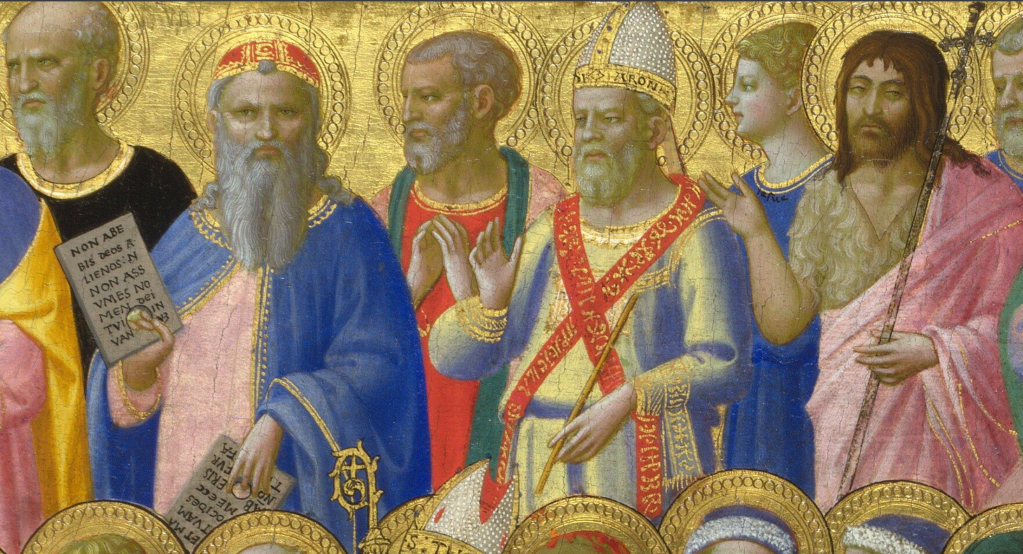
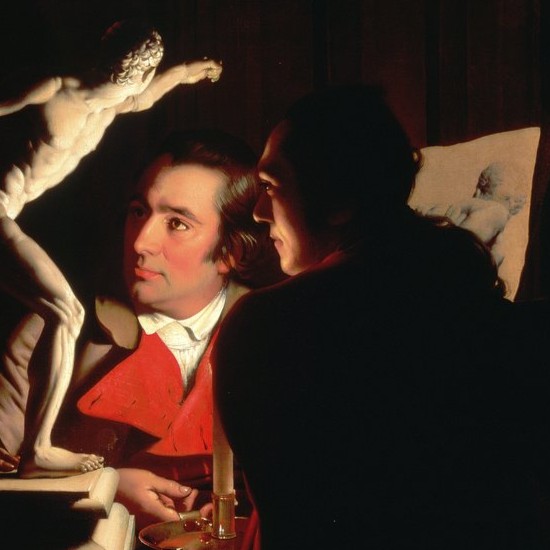
Medieval Konstanz was a very important diocese, and the only place in Germany which has ever hosted a Papal Conclave – back in 1417. The diocese included most of present-day Switzerland – stretching as far as St Gottard in the South, but also going as far North in Germany as Stuttgart. It also stretched from Bern in the West to Ulm in the East… Its Cathedral – now a Minster – was (and remains) magnificent, even though Konstanz ceased to be a Bishopric in 1821. Somewhere along the line the cloister lost two of its wings. The remaining two flank the church and chapter house in an L-shape, and frame one corner of the town’s main square. Here is a photo of the interior, together with a slightly truncated version of Ellenrieder’s Christ in the Temple:

Notice the gothic arches, and the bench running along the back, at the base of a blind arcade. Notice also the way in which the ribs of the vault overlap, the spaces they create, and their cool, grey colouring. But more than anything else, look at the columns: it’s clear to me that there are no capitals. This is a section of the cloister which is deeper than others, hence the free-standing column on the right of the photo – elsewhere it is only one bay deep – not unlike the painting. I can’t help thinking that Jesus and the Doctor are in this cloister, seated in one of the arches that lead into the open space in the middle, and imagined as seated on a similar bench to the one which runs along the back wall. This is Ellenrieder’s ‘mother church’, still a cathedral while she was growing up. What better place to imagine as the Temple than the oldest and most majestic building in the city of her birth? Admittedly she has slightly changed the profile of the arch, and includes a different transition from column to ribs – but I think these are small details. Her imagination has taken her to Jesus’s arrival in the Temple, having left his earthly step-father to ‘be about [his] Father’s business’. This could be the first interaction with one of the people there. The old man might then alert the younger man, and they could then summon others, who will be ‘astonished at his understanding and answers’. Eventually, when Mary and Joseph arrive, they will find Jesus ‘sitting in the midst of the doctors’. At least, that’s what I think is happening.