Easter!

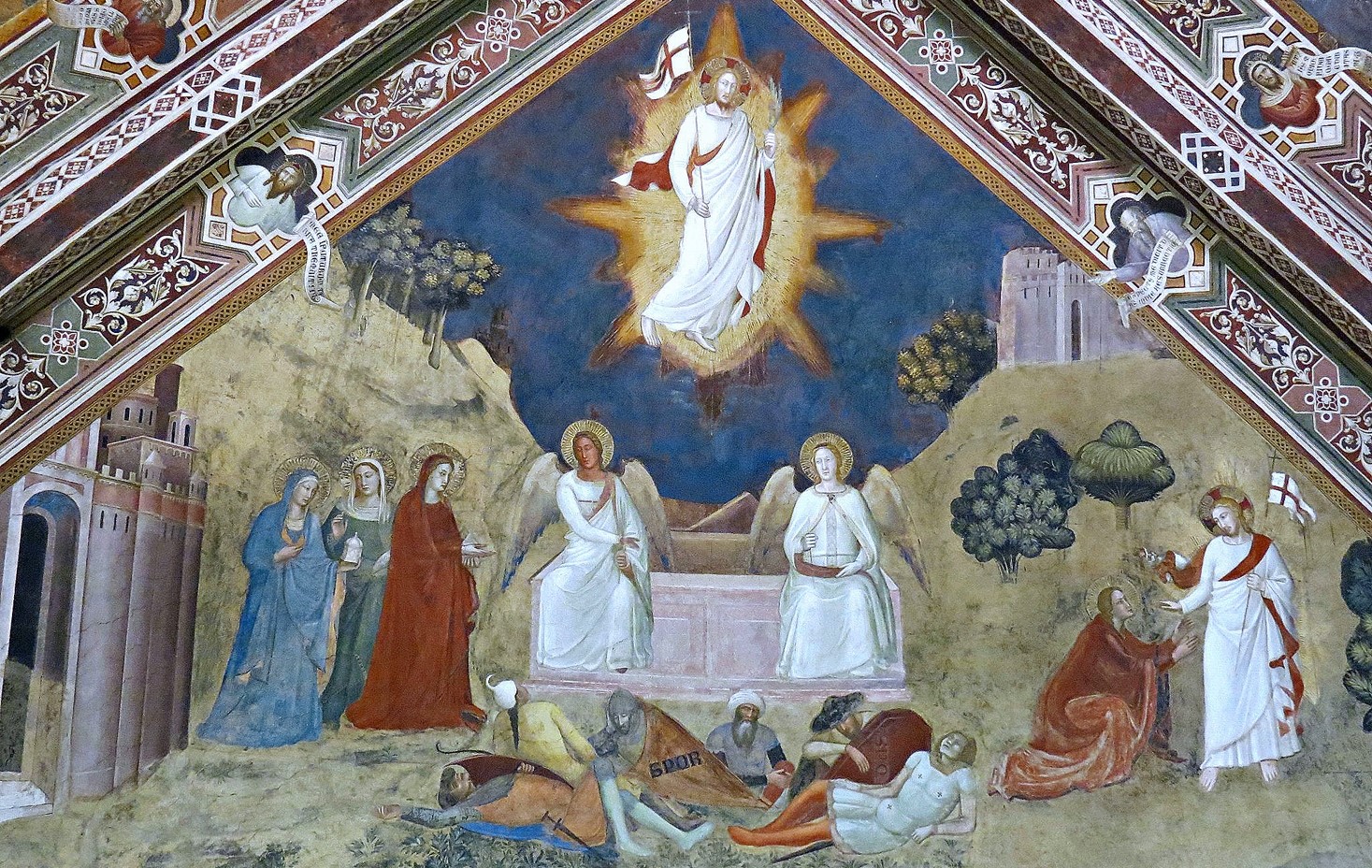
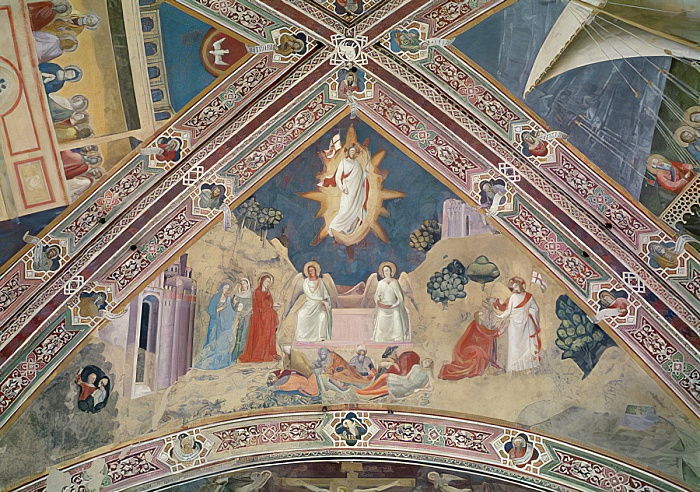
Andrea Bonaiuti, The Resurrection, 1365-8. The Spanish Chapel, Santa Maria Novella, Florence.

Happy Easter! Yesterday I referred to last year’s blog on The Devils in Andrea Bonaiuti’s Harrowing of Hell – and then I thought I ought to read it through, just in case there were any embarrassing typos. I’m glad to say that there weren’t, but I was surprised to see how much of yesterday’s material I had already covered. The focus changed, I suppose, from putting the Harrowing of Hell in context, to using the Crucifixion as a focus. I will do the same today, as last year I included this painting of the resurrection when talking about The Devils, and also referred back to it on Easter Day itself, when I talked about Donatello’s relief in San Lorenzo, which still continues to astonish me (see Day 25 – The Resurrection).

We have already explored the frescoes on this wall, starting at the bottom left, outside the walls of Jerusalem, then looking up to Calvary, and back down again to hell on the right, the position of the narrative on the wall effectively mapping, in relative terms, the supposed geographical locations of the settings. But for the resurrection, where should be go? Clearly, from hell, we must look up, and then look higher still than the Crucifixion: up onto the ceiling.

Once more I think that the use of the available space is remarkable – the resurrection, the culmination of the Easter story, and the confirmation of Christ’s triumph over death, is at the very top of the decoration of the chapel, as close to the apex of the ceiling as is possible. We can see the edges of the other images on the quadripartite vaulting, but we’ll talk about them another day.

Three Maries approach the empty tomb from the left, the soldiers still fast asleep in front of it, two of them with shields labelled SPQR (although the inscription on the red shield is hard to see). Two angels sit on the edge of the open sarcophagus, the lid having been tipped off to the back – you can see one corner of it next to the right angel’s wing. Christ is resplendent – and glorious – up above. There is no description in the bible of how Jesus emerged from the tomb, but what we see here is a combination of elements derived from all four gospels. Mark 16:1 says,

And when the sabbath was past, Mary Magdalene, and Mary the mother of James, and Salome, had bought sweet spices, that they might come and anoint him.

So – these are the three woman we see to the left of the image. All four gospels say that the stone covering the tomb had been taken away, and most say it had been rolled. The bible implies that Joseph of Arimathea’s tomb had been cut into a rock like a cave, with a stone rolled in front to close it. However, medieval artists knew that people were buried in sarcophagi, and that was what they were going to paint. By the time Bonaiuti was at work in the 1360s, this image was entirely traditional. Mark 16:5-6 goes on to say,

And entering into the sepulchre, they saw a young man sitting on the right side, clothed in a long white garment; and they were affrighted. And he saith unto them, Be not affrighted: Ye seek Jesus of Nazareth, which was crucified: he is risen; he is not here: behold the place where they laid him.

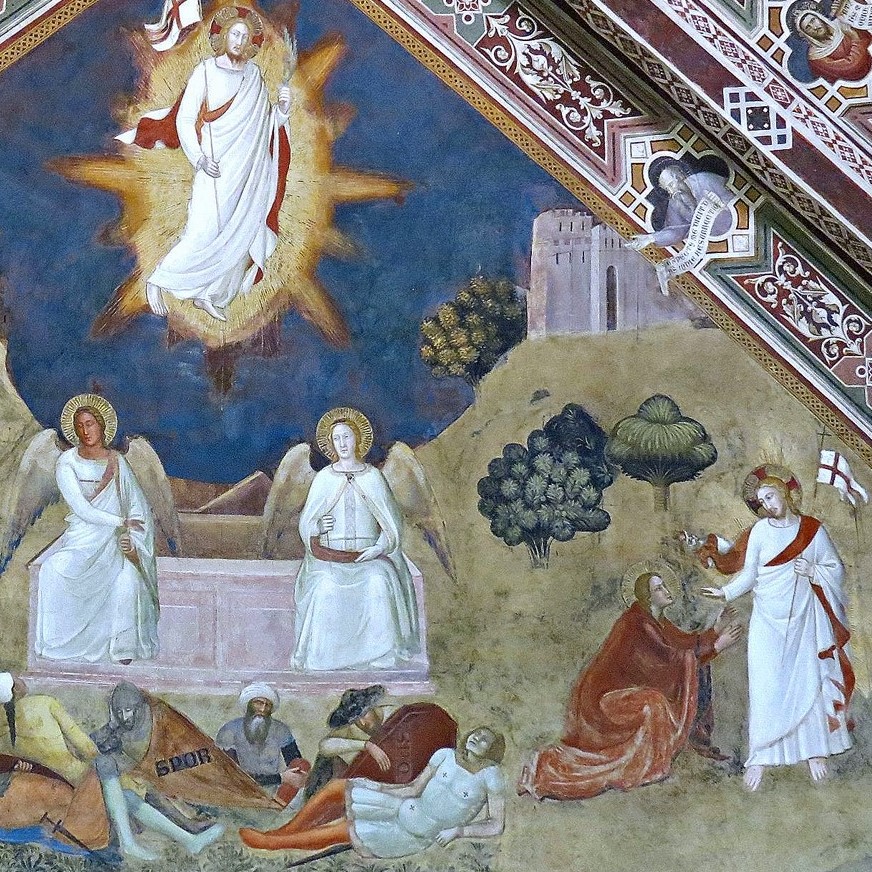
The angel who is gesturing, as if to say ‘behold the place where they laid him,’ is indeed on Christ’s right side, even if (1) Jesus is way above them, and (2) there are two ‘men’ in the painting, not just the one referred to by Mark. Matthew 28:3 also mentions only one angel, saying, ‘His countenance was like lightning, and his raiment white as snow.‘ However, Luke 24:4 says, ‘two men stood by them in shining garments.’ Bonaiuti draws on all of these accounts – the white clothes, which do indeed shine out against the relatively dull background; the gesture towards ‘the place where they laid him’; and, from Luke, the fact that there are two of them. But that is not the only source for this image. Compare these two details:

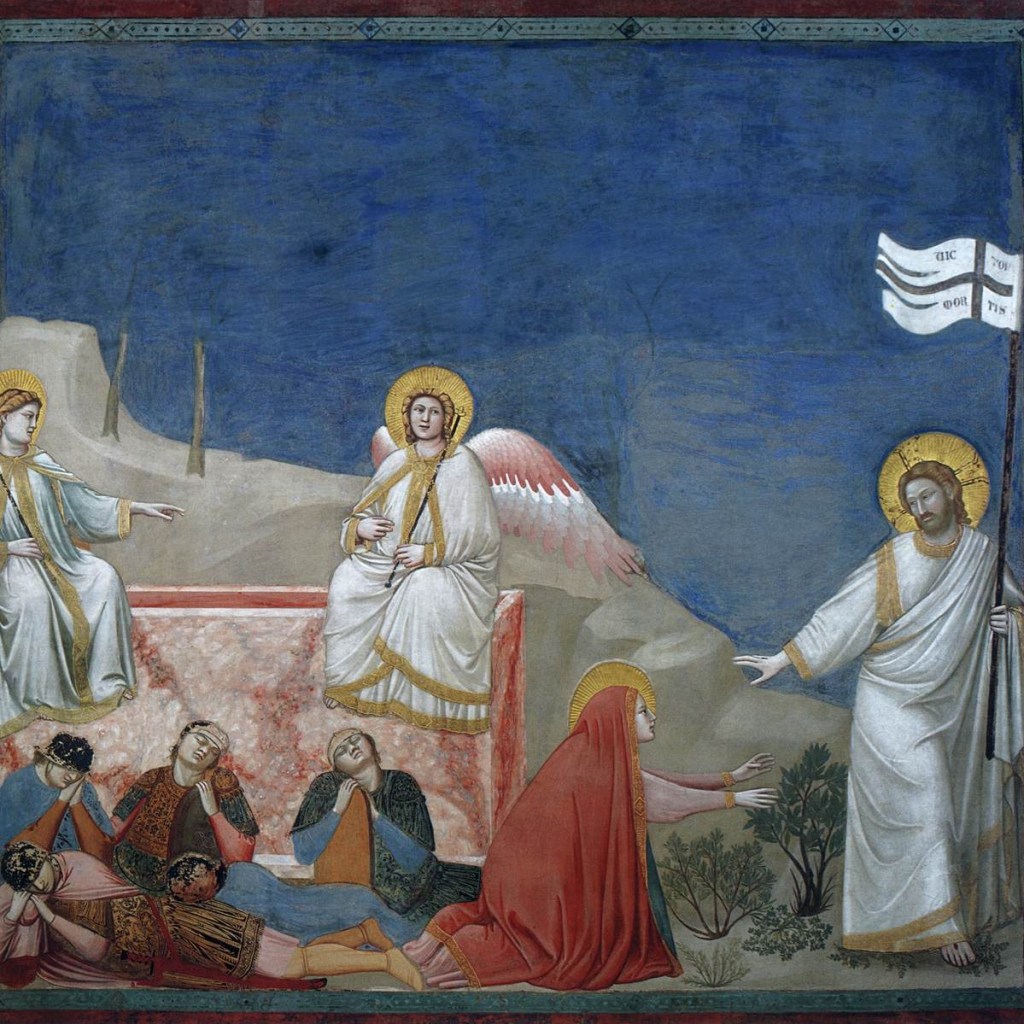
On the right is Giotto’s Resurrection from the Scrovegni Chapel, painted some 60 years before Bonaiuti’s version. I made the mistake last week of saying to a group that Bonaiuti had worked in the Scrovegni Chapel: I was thinking of Giusto da Menabuoi, another Florentine artist, and similarly on the edge of being considered obscure. But I can see why I made the mistake. It does look as if Bonaiuti had seen Giotto’s painting, as he combines the same elements. Both images show two angels sitting on the tomb, with the one on our left pointing to the risen Christ, at whose feet kneels Mary Magdalene. The pointing hand, illustrating the phrase ‘behold the place where they laid him’ could equally well, in the Bonaiuti, illustrate the phrase ‘he is risen,’ which is used in all three of the synoptic gospels. Giotto is being remarkably clever, combing the resurrection with the Noli me tangere (more of that later). It is almost as if, for Giotto, the two angels sitting on the tomb are a ‘flashback’, or as if they are talking to the three Maries who are ‘off screen’, as it were – as indeed they are in the detail I have taken from the Bonaiuti.

I have written about the episode traditionally called the Noli me tangere before, when I discussed Galizia Fede’s version (see 104 – Don’t touch!), not to mention Giotto’s painting in the Scrovegni which we see here (109 – Death and Resurrection). The title itself comes from John 20:17, and means ‘touch me not.’ According to John, Mary Magdalene finds the tomb open, and so goes to tell Peter and John, who run there only to find it empty, before heading back home.  John 20:11-12 then says,

But Mary stood without at the sepulchre weeping: and as she wept, she stooped down, and looked into the sepulchre, And seeth two angels in white sitting, the one at the head, and the other at the feet, where the body of Jesus had lain.

It seems clear that, however much Giotto and Bonaiuti drew from the synoptic gospels, everything they needed is here. In John’s account Mary then turns away from the tomb and sees the risen Christ, but does not know it is him. At the end of John 19 we were told that the tomb was located in a garden, which could explain what happens next in John 20:15-17,

Jesus saith unto her, Woman, why weepest thou? whom seekest thou? She, supposing him to be the gardener, saith unto him, Sir, if thou have borne him hence, tell me where thou hast laid him, and I will take him away. Jesus saith unto her, Mary. She turned herself, and saith unto him, Rabboni; which is to say, Master. Jesus saith unto her, Touch me not; for I am not yet ascended to my Father: but go to my brethren, and say unto them, I ascend unto my Father, and your Father; and to my God, and your God.

Notice that Mary Magdalene is the first witness of the resurrection. Notice, too, that Jesus instructs her to bear that witness to the apostles. Now, given these two observations, I really don’t understand the objection to having women in the priesthood. In fact, in all of the gospels it is the women who are told to tell the apostles that Christ is risen, although in Matthew, Mark and Luke it is the angels who give this instruction. So, if this ministry was valid, what is the problem now? But I’ll get off my soapbox and move on.
In both of the details, and in Bonaiuti’s image of the resurrected Christ above the tomb, Jesus carries the Cross of Christ Triumphant: the red of his suffering, in the shape of the cross, against the white of his purity. He also, in both appearances in Bonaiuti’s fresco, wears red and white, as do the angels sitting on the tomb: these are the colours of the resurrection. Bonaiuti shows the resurrected Christ carrying the flag in his right hand, with, in his left, a palm leaf, denoting his victory over death. In the Giotto, it is the flag itself which gives us this message. Written in the four white corner sections are the letters ‘VIC’, ‘TOR’, ‘MOR’ and ‘TIS’ – or Victor Mortis, ‘victor over death’. I was asked about this on Thursday, but couldn’t get back to the relevant slide to try and read it: thank you to the person who did!

In Bonaiuti’s telling of the story the resurrection seems effortless (especially when compared to Donatello’s version which I mentioned above). Christ floats in the sky, drapery only slightly ruffled by the breeze, a glorious mandorla of light around him which illuminates, ever so slightly, the trees growing on either side. The hills slope down towards the tomb, leaving Jesus beautifully framed in the middle of the blue sky, the apex of a triangle whose base is formed by the sleeping soldiers and sides by the attendant angels. He is at the very top, a joyous triumph at the end of the long, slow period of reflection that is Lent, and the unimaginable suffering of the Passion. A Happy Easter, indeed!
No more to say for now. I look forward to talking to some of you tomorrow, when we will be Getting Carried Away with Michelangelo at 2pm and 6pm, but after that I will take a break for a while, before my next blog… which, almost inevitably, will be about something from the 18th Century. But before then, I do hope you enjoy the rest of the long weekend, both today and tomorrow. Happy Easter!

Lent 46

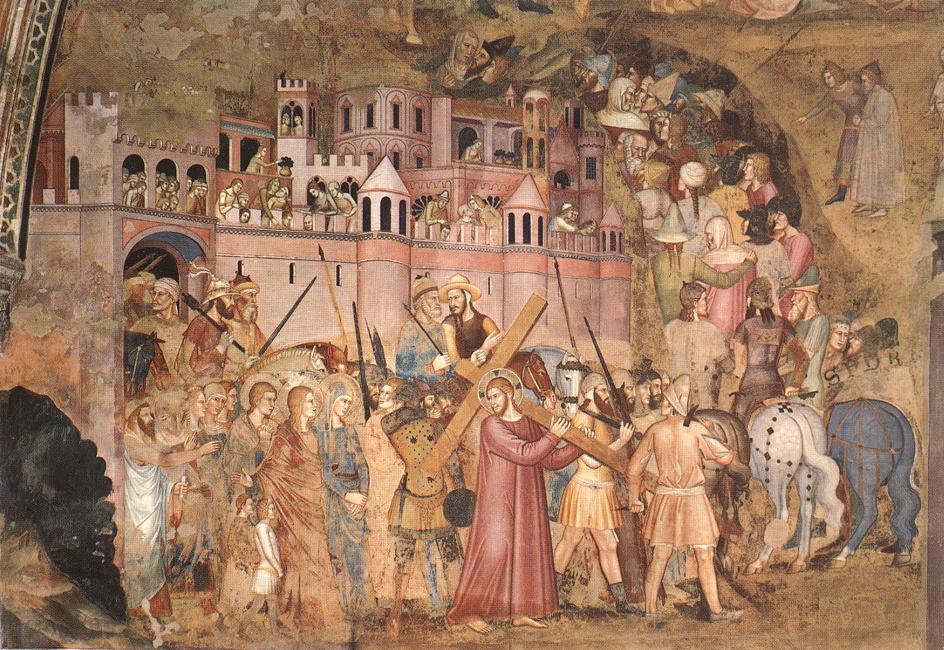
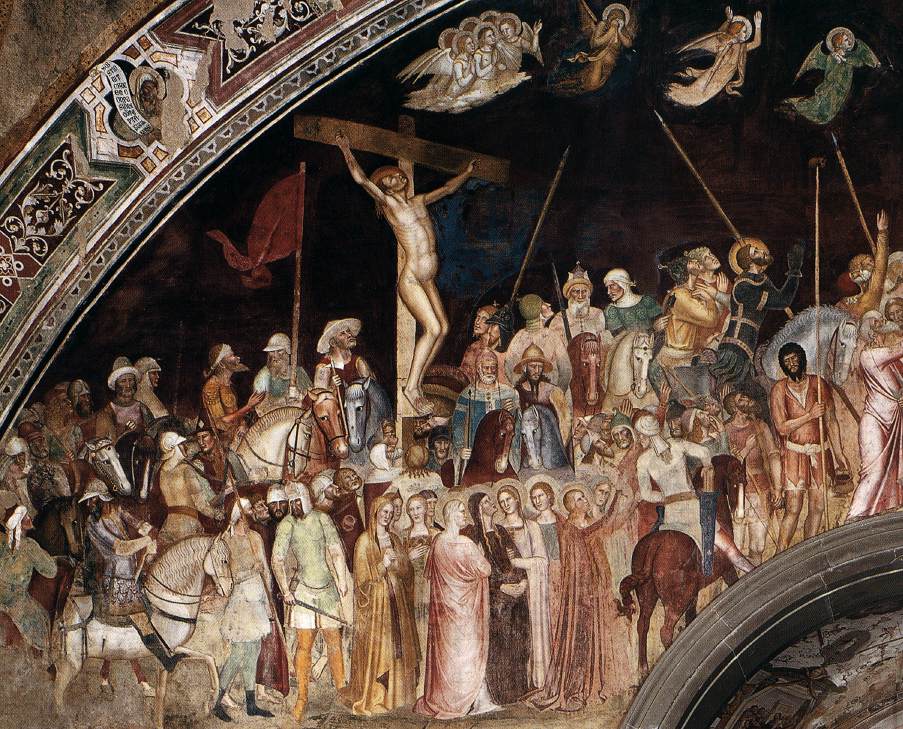
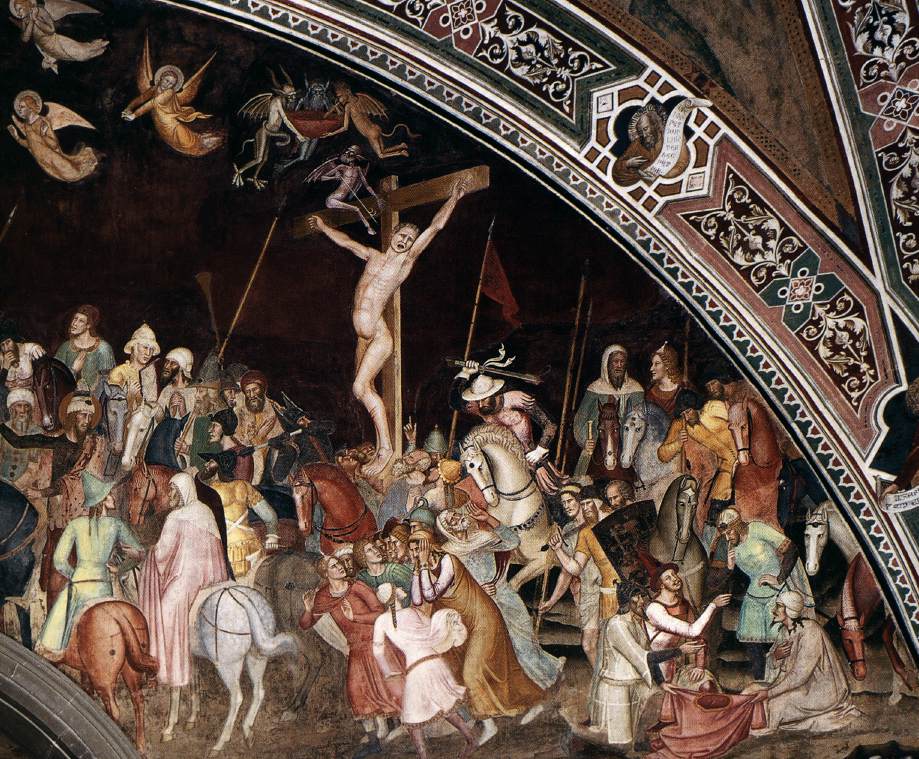
Andrea Bonaiuti, The Crucifixion, 1365-68. The Spanish Chapel, Santa Maria Novella, Florence.

As I said on Thursday, the Master of Delft does not take us any further than Good Friday, and so, for the final day of Lent we will leave the Netherlands and head down to Italy, and to Florence, to consider one of the city’s rich array of decorative schemes which doesn’t receive nearly as much attention as it should. One corollary of this is that the available images are not the best, and most of these are pre-restoration – my apologies, but they should still all be legible. Now the paintings are clearer, and brighter, after the removal of layers of dust and soot, and the careful and subtle reintegration of small areas of loss. We are in Santa Maria Novella, the chief Dominican church of the city, or rather, in the monastery of which the church forms a part. If we have arrived by train we won’t have to go far – the station is ‘Firenze SMN’ – taking its name from the church, and directly opposite the ecclesiastical East End. Nowadays, you enter the complex through the side towards the station, as most of the buildings are now part of an extended museum, even though the Dominicans are still, somewhere, in residence. The room we are visiting is called The Spanish Chapel, as it was here that the Spanish community in Florence used to worship in the sixteenth century. They arrived in the retinue of Eleonora da Toledo, daughter of the Viceroy of Naples, who married Cosimo de’ Medici, the second Duke of Florence and later first Grand Duke of Tuscany, in 1539. However, originally it was the chapter house of the monastery, where the Friars would meet every day to read a chapter from the Rule of St Dominic. This part of the building was completed in 1355, and the frescoes were painted between 1365 and 1368 by Andrea Bonaiuti – although the ‘chancel’, a chapel dedicated to the Holy Sacrament, was redecorated in the 18th Century, which is when the stone arch that you can see in this detail was made. However, there would have been something similar in the 14th Century, as there are frescoed statues peeking out from behind the later arch.

Bonaiuti had a difficult challenge – to fit his fresco around the arch – and that is why I wanted to talk about this image today: to see how well he succeeded. The whole painting is surrounded by a decorative border, which unifies all of the imagery in this remarkable space (more of that another day). In between the patterns made up of stylised vegetation – recognisable to contemporary tourists from the Florentine ‘handmade’ paper available from shops on almost every street – we see prophets emerging holding scrolls, foretelling the coming of the Messiah and his inevitable suffering and death. At the very top you may just be able to pick out a bird on its nest – the Pelican in her Piety. It was believed that the pelican would peck at its own breast to feed its young with its flesh and blood (presumably a misunderstanding of the act of regurgitation), and the Christological significance is clear: in Christian terms Jesus feeds us with the sacrifice of his own body, and notably, the wound in his chest, from which, like the pelican in this symbolic image, the blood flows.

The fresco on this particular wall is, in essence, another Crucifixion. We see Christ, top centre, on his cross, facing forward, flat against the picture plane in much the same way as the Master of Delft was to paint it later: this is entirely traditional. So too are the two thieves, whose crosses are again angled, although both are turned inwards, so that the arms of the crosses lead our eye into the painting and towards the image of Jesus. They are surrounded by a vast multitude, too many to number or name – but let’s see what we can do! We shall start at the bottom left of the image.

You should recognise this, from the Master of Delft, as the Via Crucis, ‘the Way of the Cross’. It is also known as the Via Dolorosa, or ‘the Sorrowful Way’, or, more prosaically perhaps, the Road to Calvary. We see Jesus, in his red robe, though stripped of his blue cloak, carrying his cross and heading off to our right. He looks over his shoulder towards the only three people the crowd who have halos. Prominent in the foreground is Mary Magdalene, her head uncovered, but with her full-length red cloak covering her hair as it goes over her shoulders. To one side of her we see Mary, the mother of Jesus, in blue, and to the other side, St John the Evangelist. Behind them are some other women, presumably the ‘Daughters of Jerusalem’ Jesus speaks to, or some of the ‘many’ who followed him from Galilee. Next to the Magdalene are two small boys, one wearing white, with curly blonde hair, another, in darker clothes, sadly damaged, wearing a cap. We have seen them before, depicted several times by the Master of Delft, and we will see them again. The crowds have left the city gate, and so are now ‘without a city wall’, and they are turning to their left and walking up the ‘green hill’. Bonaiuti imagines the crucifixion as an important event in the life of the city, and the crenellations of the walls, the towers and loggias of the city, even the lookout from the barbican of the city gate, are crowded with the curious. Public executions would always bring out the crowds.

If we follow them up the road, we arrive first at the good thief’s cross. He faces inwards, and up. A small group of five angels, just above his left hand, accompany a sixth person in white, who is praying. The angel on our right gestures upwards, and looks back at the central, praying figure. This is the soul of the good thief, being accompanied to heaven. Below the cross we see the ‘Good’. On the right Mary Magdalene reaches up to Jesus on the cross. Next to her, St John the Evangelist looks back to the Virgin, supported by Mary Zebedee and Mary Salome, and they are accompanied by more of the female followers of Christ. The boys are nowhere to be seen. Amongst this mass of soldiers, many on horseback, the women, and John, look vulnerable, and indeed, a man on a lively brown horse, perched on the edge of the chancel arch, looks down at them as if they are a threat. Just to the right of the horse’s head is a man poorly clad in a pinkish-brown, with a pot in his left hand and a long pole in his right: he has offered the sponge soaked in vinegar to the thirsty Christ. A white horse looks over his shoulder. This steed bears a soldier in dark grey armour, looking up to the cross, hands raised in prayer. He has a halo, and a spear. This is the centurion who declared ‘Truly this man was the Son of God’ (Mark 15:39), here identified as St Longinus, the soldier who pierced Christ’s side with a spear.

When we turn our attention to the centre of the image, we can see that Longinus and the sponge-bearer are at the foot of the cross. This is topped by the titulus, and surrounded by mourning angels. To the right, one of the shields bears an inscription which should read ‘S.P.Q.R.’, although whichever member of the workshop painted this detail, they couldn’t fit it all in, leaving out the ‘Q’. Mind you, this is a good choice for the omission, as it only stands for ‘and’.  The initials are short for Senatus Populusque Romanus, ‘the Senate and People of Rome,’ referring to the ancient Roman Republic, although its use continued throughout the Empire until the reign of Constantine I. However, it was revived, and is still in use today. It can be found, among other places, on the drain covers of roman streets and pavements. Nowadays, however, Italians from other regions have realised that it actually stands for Sono Pazzi Questi Romani – ‘These Romans are bonkers’. At the foot of the cross stand two boys, one wearing white, with curly blonde hair, another, in red, wearing a cap. They have pushed their way to the front, as boys will. These children, present at the crucifixion, appear more and more from the 13th Century onwards, apparently, and, from imagery elsewhere in the Spanish Chapel, have been identified as the Jews and Moslems who would be converted to Christianity – even if Islam did not exist at the time of the crucifixion.

There is only threat and violence on the side of the bad thief. A soldier on horseback wields his club towards a group of onlookers who are fleeing towards the chancel arch. To the left of the bad thief’s legs another soldier, on a brown horse, also wields a club. The thief’s shins are bloodied, following the text in John 19:31-34. It is a result of crucifixion on the eve of the sabbath, and the need to get the bodies down before sunset:

The Jews therefore, because it was the preparation, that the bodies should not remain upon the cross on the sabbath day, (for that sabbath day was an high day,) besought Pilate that their legs might be broken, and that they might be taken away. Then came the soldiers, and brake the legs of the first, and of the other which was crucified with him. But when they came to Jesus, and saw that he was dead already, they brake not his legs: But one of the soldiers with a spear pierced his side, and forthwith came there out blood and water.

At the bottom right some of the men have taken hold of Jesus’s red robe, and stretch it out between them. The one on the left holds out a dice to his companion. Like the breaking of the thieves’ legs, this episode is not represented by the Master of Delft, but is recounted earlier, in John 19:23-24,

Then the soldiers, when they had crucified Jesus, took his garments, and made four parts, to every soldier a part; and also his coat: now the coat was without seam, woven from the top throughout. They said therefore among themselves, Let us not rend it, but cast lots for it, whose it shall be: that the scripture might be fulfilled, which saith, They parted my raiment among them, and for my vesture they did cast lots. These things therefore the soldiers did.

The ‘scripture’ here is Psalm 22:18, ‘They part my garments among them, and cast lots upon my vesture.’

If the good thief has angels to carry his soul away, the bad thief is tormented by devils. One sits astride the cross, threatening him with a barbed spear, while three more bring a large bowl, presumably containing something else with which to torture him, or simply to carry him away – down – to hell. Which is where we shall go next – down to hell.

The Apostles’ Creed states quite clearly that Christ, ‘was crucified, dead and buried, he descended into hell. On the third day he rose again from the dead.’ So what was he doing in hell? The painting does make it quite clear, but, as I talked about this at length last year on the equivalent day (though not the same date – Easter is a moveable feast), I am just going to direct you towards Day 24 – The Devils, while also pointing to the painted statue on the chancel arch which looks down from the top left of this post-restoration detail.

What I love about this fresco is the way that Bonaiuti uses the space available to him. Christ leaves Jerusalem at the bottom left, and follows the procession up the wall, and up the hill of Calvary, where his is crucified at its summit, just visible on either side of the 18th Century keystone. Way below his left hand is hell, as it will be at the Last Judgement, and this is where he now descends. It is a remarkably good use of the awkward format, and entirely appropriate, placing his body on the cross directly above the altar, where mass would take place, and the bread would become the body of Christ, as if lowered down from the cross. Good Friday was the first day, today, Easter Saturday is the second, so tomorrow is the third day, and ‘On the third day he rose again from the dead’. But what space has Bonaiuti left for the resurrection? Maybe we will find out tomorrow.

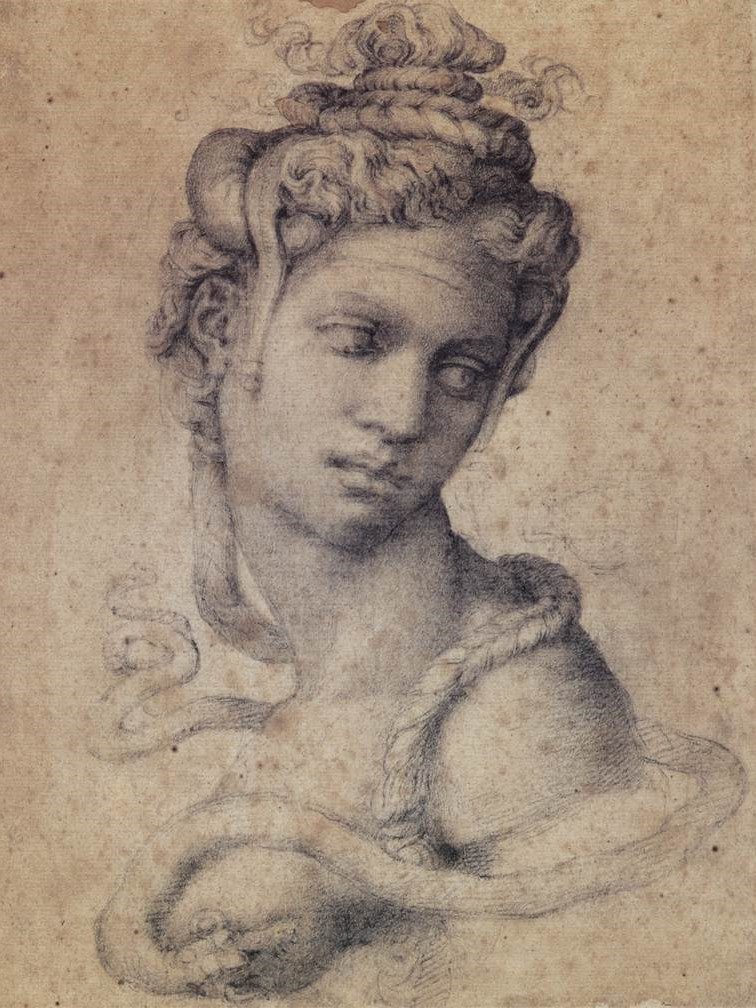
Looking forward, beyond Lent, and beyond Easter, things will get a little less godly (I’m afraid/I’m glad to say/neither of the above/delete as appropriate). On Easter Monday I will be talking about Michelangelo in love, and the fruits of his infatuation: some of his most beautiful drawings and poems. If you are interested, there is still time to book for Michelangelo Matters 3: Getting Carried Away at both 2pm and 6pm. The following series of talks, Three Women in the 18th Century, is also on sale, and you can find more details, together with links to Tixoom to book, on the diary page. Thank you, as ever, for all of your support. Until tomorrow, have a peaceful day.

Lent 44

On the right hand panel of the triptych, Christ is taken down from the cross. The stark, empty form appears against the sky, which is partially clouded, as we witness the gradual emptying of the top half of the painting. A ladder leans against the cross, one man climbing down, lowering the lifeless form as he goes. Another, probably Joseph of Arimathea, holds the body, as if he is showing it to us, like a monstrance but with the body itself rather than the consecrated host (which is, of course believed by some to be the body itself). At Jesus’s feet Mary Magdalene and another man, probably Nicodemus, play their part. The Virgin Mary kneels at the foot of the ladder. On reflection I have little doubt about this. The other day I forgot to mention that, in the foreground, we can see that Mary does wear a red/pink dress under her blue – which would explain the pink sleeves, not seen elsewhere, but which are revealed at the foot of the ladder.

From this point a diagonal sweeps downwards towards the holy woman who is reaching out to Jesus, a gesture which seems to beseech, to indicate and to welcome. It is as if she is inviting the kneeling Virgin to join them in their sorrow, which indeed she has.  Kneeling down at the same angle as this woman, John tilts his head towards the other representation of the Mother of Christ, who here is helpless in her grief. A woman, in white, but wrapped in rich red, angled outwards, a little like the donor, puts her hand to her chest, .

To me – and this is pure hypothesis – the striking downward diagonal of the composition suggests the continued movement of Jesus’s body towards the beseeching arms of the holy woman. There is a little space at the Virgin’s feet. Maybe we are supposed to imagine his body being carried there, and placed before the mourners, allowing the lamentation to continue as in many other paintings and sculptures. Maybe we are then supposed to imagine it being lowered, still further, into the hands of the priest who has elevated the host during the Mass, and will then turn to the congregation with the body of Christ – the consecrated host, the body itself – as part of the liturgy.

But this is as far as it goes. One of the curious features of this painting, as far as I am concerned, is that there is no image of the resurrection, no hint, even, of the tomb, empty or otherwise. I can only suppose that, elsewhere in the convent, nearby, there was another altarpiece dealing with the entombment, the resurrection and the subsequent events leading up to the ascension of Christ, and to Pentecost. What little has been attributed to the Master of Delft, though, doesn’t include these later episodes, so it probably wasn’t by him. However, I will include some of them, as painted by Giotto, in a free talk entitled Painting the Passion with Passion, which I am delivering for the Churches Conservation Trust at 1pm today, Thursday 1 April. It will be on their Facebook page, and a recording will be posted later on their YouTube channel – I’ll let you know about that when it happens. But as it is not yet Easter, I will continue this Lenten series on Saturday in Florence. No words tomorrow – just images. I do hope you have a calm and peaceful day.

Lent 43

The central panel of the triptych shows The Crucifixion. Christ appears at the top centre of the painting, outlined against the sky, the weather deteriorating from the clear blue we saw yesterday as we move from left to right. He is presented formally to us, an icon outside of the worldly clamour all around. The good and bad thieves are seen to the left and right, their crosses angled and so reaching in and out of the space inhabited by the other characters. Seen together, the individual details we have looked at over the past six weeks take on their full meaning, as their context become clear. The patron, possible Herman van Rossum (Lent 25) kneels, anachronistically, in the bottom left hand corner, next to the Virgin Mary, angled slightly outwards. In context it is clearer that he is not looking at anything depicted in the painting – but he must be contemplating it nevertheless.

The Master of Delft, The Crucifixion, about 1510. National Gallery, London.

I do not know of a painting that is better at illustrating the difference between the good and bad thieves – although I know there are many which match this. The good thief is on Christ’s right hand (on our left), the side of The Blessed at the Last Judgement. His cross rises up behind the group of ‘The Good’ – the Virgin, St John the Evangelist, the Holy Women and the donor. In the background he is flanked by Jesus carrying his own cross, the New Church of Delft, and Judas, hanging on the tree. He faces forwards, towards us, like Christ, and upwards, towards heaven.

The cross of the bad thief, on the other hand, emerges from behind ‘The Bad’ – Pilate on his white horse, the chief priests, and disreputable soldiers. His back is turned, away from us, and away from Jesus, and his head lolls as he looks down to Hell. The painting is, roughly, symmetrical, and in the same way that Jesus appears to the left of the good thief’s feet, he also appears to the right of the bad thief, where he is already suffering the mental anguish of the Agony in the Garden. This is the one point of the triptych in which the narrative does not follow from left to right – it is the earliest episode depicted. But Christ’s sorrow and Judas’s betrayal are associated with the bad thief as much as the Church is associated with his repentant companion. Also next to the bad thief’s feet are the soldiers – the rabble of reprobates who have come to arrest Jesus. And then, there is the weather: the good thief has good weather, the bad thief, bad. It is nearly the sixth hour (Matthew 27:45) –

Now from the sixth hour there was darkness over all the land unto the ninth hour

If you want to know what ‘the sixth hour’ means – and were thinking that I sometimes get a little too detailed with biblical exegesis – why not read What is the sixth hour in John 19:14? on thebiblemadeplain.com

Meanwhile, in the foreground two boys choose where they want to be in the world.

Lent 42

It is Holy Week, and for the remaining days of Lent, I will say relatively little (apart, maybe, from Saturday), but leave you with the painting itself to explore. By now, if you have a good memory, you should find almost all of it familiar, although I am imagining that, if you haven’t located the painting before now, then it would be quite hard to work out, from the details themselves, where everything belongs. And if you did not know this picture previously… well, I am really not surprised! If anything, I have been impressed by the number of people that found it, a few in the first week, and several more during the second. It really is not well known.

The Master of Delft, Christ presented to the People, about 1510. National Gallery, London.

This is the left hand panel, known as Christ presented to the People. In its overall composition, it takes the form of an Ecce Homo. After the arrest, Christ is taken to Annas, and then to Caiaphas, and then to Pilate. He is sent to Herod (we haven’t even mentioned him), and back again to Pilate. Once it is decided that Barabbas will be freed, Jesus is first whipped, and then dressed in purple, crowned with thorns, and mocked a second time. John 19:4-5 tells us what happens next:

Pilate therefore went forth again, and saith unto them, Behold, I bring him forth to you, that ye may know that I find no fault in him. Then came Jesus forth, wearing the crown of thorns, and the purple robe. And Pilate saith unto them, Behold the man!

Behold the man!‘ – or Ecce Homo – is the name given to images like this. However, the narrative has gone a little further, as he no longer wears the purple robe. An ensuing discussion – with the mob heavily influenced by the chief priests – determines that Jesus will be crucified. And Pilate, against his will, submits to this. Although other gospels tell us that the purple robe was removed, and replaced with ‘his own clothes’, John omits this detail. Nevertheless, the precise moment that is painted by the Master of Delft is, I believe, that in John 19:16-17, who tells us what Pilate did next:

Then delivered he him therefore unto them to be crucified. And they took Jesus, and led him away. And he bearing his cross went forth into a place called the place of a skull, which is called in the Hebrew Golgotha

We see the beginning of this progress towards Calvary, with the movement determined in the composition by two overlapping diagonals. Jesus is at the top of the few steps which constitute the Scala Santa, with Pilate looking down at him from his place in the shadows, just above and to the left. The Palace looms above him, and the sculpted archer at the top, when seen in context, seems to be taking direct aim at the Roman prefect himself. The tall, shadowy arcade looks rather oppressive, despite the appearance of the bright yellow sleeve and red hat of the black trumpeter appearing from one of the further arches.  Jesus, and the guard behind him, who holds up Jesus’s robe so he doesn’t fall down the steps, both look down, and their gaze directs us along the diagonal formed by the rope held in the hands of the soldier wearing a pink jacket, behind whom a man crouches to mock Jesus. The rope leads our eye to the cross. This could have already grabbed our attention, as it projects into our space, leading our eyes into the painting, and up to the right – the second diagonal. It is framed by the legs of the carpenter, whose rear side forms the lightest area in the foreground, and claims attention for itself, thus undermining any dignity his profession might have. The carpenter reaches down to reach his auger to make holes to guide the nails. The line of his back, of the auger, and of the cross lead us past the weeping woman and her two children, past the soldier with the full, silvery sleeves, to the two thieves, about to head out through the city gate and turn right to the green hill without the city wall. The weather is lovely. The grass and the trees are green, the sky is blue – and so are the distant hills.

Lent 41

This is the same painting – although you would be forgiven for not recognising it. The work is a triptych – a painting on three panels – and for most of the time it would have been closed, only to be opened when mass was celebrated at the altar on which it was originally found. The ability to close altarpieces like this served several purposes, and one was purely practical: to keep dust off the richly coloured surface. The exterior panels were almost always far less colourful, and here, as so often, they are painted in grisaille – from gris, or ‘grey’, in French – a term for monochrome painting, which is usually intended to look like sculpture.  As such, the exteriors of triptychs are not attention grabbing. When opened, the far richer colours would then draw people to the altar where mass was being celebrated, and conversely, when closed, the colour would be removed – ideal for a season so focussed on withdrawal and contemplation as Lent. This, of course, creates ambivalence. The richly coloured surface we have been contemplating throughout Lent should not have been visible. But by the time it could be opened – on Easter Sunday – then everything that has gone before is all but irrelevant, perhaps, as that is the day to celebrate the joy of the resurrection.

So what do we see here? There are four figures, conceived as stone sculptures, standing on irregular hexagonal plinths, casting shadows onto the backs of the niches in which they stand. The right side of each niche is more brightly lit than the left, which suggests that the main light in the chapel where this painting was originally located came from a window on the worshipper’s left. The ‘sculptures’ represent the Virgin and Child and St Augustine of Hippo on the left wing, and on the right are Sts Peter and Mary Magdalene. St Augustine can be identified because he is a bishop: he wears a mitre – the hat with two points – and carries a crozier, an episcopal equivalent of a shepherd’s crook, which indicates the care of his flock – all of the Christian souls in his diocese. He also wears a cope – the ceremonial cloak, or cape – which is fastened with an elaborate clasp, called a morse. But there have been many holy bishops. It is the heart that tells us this is St Augustine. It relates to a quotation from the the Book of Proverbs (23:26) in the Old Testament:

My son, give me thine heart, and let thine eyes observe my ways.

In a commentary on this text Augustine wrote,

“He says, give me. Give me what? Son, your heart. When it stays with you, it will go ill. You will be drawn to toys and to lascivious and harmful loves. Give me, he says, your heart. Let it be mine, and it will not perish.”

And this is precisely what Augustine is doing in this image – giving his heart to Jesus. Hence the presence of the Virgin and Child, as if any reason were needed. But why did the patron choose St Augustine to go on the outside of this painting? Quite simply because the Premonstratensians followed the Augustinian rule (see Lent 25).

The presence of St Peter, identified by the key he is carrying, one of the keys to the Kingdom of Heaven, is not so obvious, despite the fact that he was the first head of the Church after Christ. Nevertheless, his presence would remind the members of the convent that, after their allegiance to St Augustine, their ultimate responsibility (on Earth) was to the Pope. Also, given his status, Peter is hardly present on the inside of the altar, apart from a brief appearance, asleep, in the Garden of Gethsemane (Lent 10), so a dominant presence here is perhaps to be expected. The Magdalene, dressed differently compared to the interior scenes, but still holding her jar of precious ointment, clearly has a far more central role in the Easter story. She is, in some ways, the closest to Christ in the Master of Delft’s account. She is in the centre of the painting, at Jesus’s feet during the Crucifixion (Lent 32), and then again at the Deposition from the Cross (Lent 39). Given that many of the Canonesses would have been members of aristocratic families, being there against their will might, in some instances, have meant that their repentance from the ‘error of their ways’ would have been constantly required. Her strong female presence, opposite that of the Virgin Mary, would also have been relevant to all members of the convent, though. As for Mary, she too is central at the Crucifixion and the Deposition, serving to remind the Canonesses of their diverse losses, perhaps, and of the Christian endurance necessary to overcome them. Although ‘useful’ as a recipient of St Augustine’s heart, the Christ Child is also present simply to identify the Virgin: he is her chief attribute, or symbol. Indeed, many paintings called ‘Madonna and Child’ are, in truth, predominantly paintings of the Virgin, and Jesus is really there so that we know which female Saint we are looking at.

As for Lent itself – well, I hope you’re learning as much as I am! Cards on the table: I thought, ‘What painting is complex enough to cover the forty days of Lent,’ and this was the answer I came up with. So, on the first two days I planned all forty details. And then I gradually realised that it wasn’t going to stretch all the way to Easter, which, I must admit, was initially confusing. But why should it be ‘forty days’ in any case? Well, as a period of quiet and contemplation, it was made to commemorate Christ’s retirement to the wilderness for forty days. Admittedly, this was immediately after he had been baptised, so approximately three years before the crucifixion, but that is irrelevant. As a period of restraint – and of avoiding temptation – it is entirely appropriate. However, given that every Sunday is effectively a celebration of Christ’s resurrection, it was not deemed appropriate that these should form part of this period of sacrifice. So the Sundays between Ash Wednesday and Easter are theoretically not part of Lent… which is why Lent lasts 46 days rather than 40. And while we’re talking about it the name itself, ‘Lent,’ comes from an Old English word for the ‘Spring season’, which may itself derive from the idea that the days lengthen. And indeed they have – we have entered daylight saving – British Summer Time – and, as of today, we in England no longer have to stay at home. I, however, have planned a week which means I probably won’t leave the flat until Friday! I do hope that some of you are free to join me for some of this – starting with The Sistine Chapel, from ‘Beginning’ to ‘End’ today at 2pm and 6pm – BST! And tomorrow – back to the painting. Somehow.

Lent 40

If I have cliff-hangers, I left you with one yesterday. Admittedly, it would have left you hanging at the edge of a very low curb, but there you go. At least none of you would have had a sleepless night, especially good as, thanks to daylight saving, we in the UK – and Europe as a whole, I believe – have had one hour’s less sleep. But at the end of yesterday’s blog I asked ‘who are the two mourning women? And, for that matter, the third, whose head appears at the bottom right? I think we will have to leave them all until tomorrow…’ It is now ‘tomorrow’, so what is the answer? Well, I hate to disappoint you, but I don’t know. But I do have an idea…

The two we have seen before are dressed much as we would have expected from the details we saw yesterday. The woman with outstretched arms at the left wears a cloth of gold gown, with very full, dark blue sleeves. She has a fur-lined green overdress, which is wrapped up and tucked into her belt to reveal both the fur lining, and the gold brocade of the dress underneath. Her companion at the top right reaches down towards the Virgin, dabbing tears from her face with her green cloak. Her dress is a relatively subdued light brown, although again it is fur-lined, worn over a simple black-sleeved bodice. Her hat is lilac, encased in what looks like a scimitar, beaten into a ploughshare, and then wrought further to become millinery. It is definitely meant to imply the exotic. Standing on the far right is the woman whose head we saw yesterday. She wears a white overdress, which to me looks a bit starchy, an impression belied by the cloth of gold over which it is worn, with similar brocade trims at the cuffs and lowest hem of the white dress. These additions, my sister informs me (thank you, Jane) were added because these were the parts of the dress which would be most likely to get dirty, and so could be easily replaced. Yet, however practical this might appear, the fact that this supposedly ‘disposable’ fabric was also of the most expensive, suggests a considerable amount of disposable income. This woman also wears a white headdress, or veil, including a bib tied around her neck – it is, effectively, a wimple, covering both her hair and her neck. Over all of this she wears a scarlet cloak, which would, in itself, have been a very expensive garment (if I haven’t said this before, although blue is famed as the most expensive pigment for painting, red was far more expensive than blue as a fabric). In her left hand she holds some sort of handled pot, or jar.

When seen up close, she is far older than any of the other women we have seen, with a wrinkled forehead, a pinched mouth and loose skin around her neck. She is pale with age, and indoor seclusion (the fate of many medieval and renaissance women), and also, undoubtedly, with grief. Not as pale, perhaps, as the Virgin, but then, not as grief stricken. The older woman holds her hand across her chest, a sign of her care and devotion, and her arm casts a shadow on her white overdress. She looks towards the Virgin, who looks out to us, much as she did in Lent 28, inviting our compassion – our ‘suffering with her’. She is cared for, as before, by St John the Evangelist, who rests his left hand on her shoulder, and holds out his right, an offer of further support. The four hands form a wonderful knot of sorrow and caring. His head is tilted at just the right angle to show us that he is genuinely moved, and exhibits true sympathy. As if to express this, the crook of his neck and the flick of the corner of her cloak almost interlock.

But who is the woman on the right? Well, let me quote from the National Gallery’s website:

‘Saint John and the Virgin appear in the foreground, surrounded by four women. If they are the same women who surrounded the Virgin in the foreground of the centre panel, they are wearing different clothes. The older woman on our right carries a small jar, the significance of which has not been explained.’

So, I was right. I don’t know, and neither does the gallery. They could be the same Holy Women, with different clothes – we have seen this before – but they could be others. After all, Mark 15:41 mentions ‘many other women which came up with him unto Jerusalem,’ and maybe these are some of them. But why include so many? And why are they so richly dressed? Is it, simply, that Luke 2:2-3 says that there were ‘certain women’ such as Mary Magdalene, Joanna, Susanna, ‘and many others, which ministered unto him of their substance?’ Maybe. But why the interest in them, in this particular altarpiece? As I said, I have an idea. It is mere hypothesis at the moment, but let’s see what you think. I have only said a limited amount about this altarpiece – but then, only a limited amount is known. It was commissioned by a Premonstratensian Canon, possibly Herman van Rossum, as we saw in Lent 25. He kneels in his white habit, facing right, just next to the Virgin Mary. The identification of the patron relies on the fact that he was the provost of the Koningsveld Convent, just on the edge of Delft, at the time that this altarpiece was made for it. Yes, it was made for a convent, full of the daughters of the great and the good who were ‘ministering unto [Jesus] of their substance’, and who would have had an especial devotion – and so care for – the Virgin Mary. But why would women ‘of substance’ be in a convent in the first place? Well, because of dowry inflation. The role of men in a large families is well known: the first son inherits, the second goes into the military, the third into law, and the fourth, the church. The options for women were different. The eldest would have a dowry, and so would find a husband more easily, but after that it became progressively more difficult, and many aristocratic women ended up in convents not because of a calling, but as a result of parental necessity. And while their fathers might not be able to afford a good dowry, they would have been well-dressed – like the women in this painting. There were – and are – Premonstratensian Canonesses, although they are often called Norbertine Nuns, after St Norbert who founded the Premonstratensian Order. For a while there were even mixed houses, with Canons and Canonesses in adjacent cloisters.

I can’t help noticing that the woman on the right is wearing a white dress and wimple, and faces to the left. In some way she balances the donor. Could she, perhaps, be a donatrix, or female donor? I do hope so! Maybe she is the abbess? I need to do more research, clearly, but abbesses could reach a high status, and at least one, the Blessed Gertrude of Aldenburg (d. 1297) was beatified (as her title suggests!) As for the ‘small jar’, I think the significance is quite clear, contrary to what the National Gallery says. After the crucifixion, when the body was laid in the tomb, Luke 23:55-56 tells us,

And the women also, which came with him from Galilee, followed after, and beheld the sepulchre, and how his body was laid. And they returned, and prepared spices and ointments; and rested the sabbath day according to the commandment.

I would suggest that the ‘small jar’ contains these spices and ointments.

I must also hypothesize about what the group as a whole are doing here. They do appear in much the same way as they did at the foot of the cross, and the Virgin appears, once more, to be on the verge of fainting. This ties into an idea that had great currency in medieval and renaissance thought, but which did not, with a few notable exceptions, outlive the Counter Reformation: lo spasimo della Vergine, as it is called in Italian, or, less poetically, ‘the swoon of the Virgin’. Although not mentioned in the gospels, the Gospel of Nicodemus, which I have referred to a couple of times already, includes references to Mary swooning during the crucifixion. In art this can be shown on the Via Crucis, at the foot of the cross during the Crucifixion, during the Deposition from the Cross or the Entombment of Christ. Two of those are included in this painting. I should discuss this at length another time, but the Counter Reformation saw this weakness in the Virgin as suggesting a lack of faith in the resurrection, and also, as John 19:25 explicitly states, ‘Now there stood by the cross of Jesus his mother,’ the idea of her not standing was seen as contradicting the biblical evidence… so the depiction of lo spasimo was discouraged. Not so, during the period in which our work was painted. But how do we account for Mary kneeling at the foot of the cross during the Deposition, but also swooning in the foreground? Well, here’s another idea. Because of the short course I am teaching for the Wallace Collection this week (see the diary), I have been looking at Dürer’s Small Passion series – and then decided to compare it to the Great Passion. Here are his versions of The Crucifixion, The Lamentation over the Dead Christ and The Burial of Christ, which are dated 1497-8, from the Great Passion.

The composition of The Crucifixion is similar to that envisaged by the Master of Delft – and it could be that the latter was influenced by it, although this is quite a common form. But note how Mary swoons a second time at The Burial of Christ. To me, the group at the bottom of our painting looks for all the world like a Lamentation – but without the actual body of Christ. Maybe, this was to be imagined. Maybe there simply wasn’t the space for it, or it was deemed unnecessary, given the presence of the body in the Deposition. But whatever it is, it gives the artist another chance to invite us to share in the Virgin’s grief, and to show the women of substance caring for her, something with which the occupants of the convent could associate. And at their feet – well, at their feet on the right we see the plantain, strawberry and violet we saw in Lent 2, and on the left is the aquilegia which was the subject of the very first of these Lent posts. We are back where we started. Which must mean that we have seen the whole painting. Or have we? After all, it is only Palm Sunday: there is still a week until Easter, and six more days of Lent.

Lent 39

While there might still be some doubt that it is the Virgin who kneels near the foot of the ladder, there is none that the Magdalene finds her place once more at Christ’s feet, her preferred position, as was mentioned in Lent 32. Unlike other characters, whose costumes change, hers is the same. A red overdress, over a rich cloth of gold brocade, her headdress topped with a white veil, which, although wrapped loosely around her head, no longer flutters in the breeze. Her long red hair still falls on either side of her face, which is pale with sorrow.

Both the Magdalene and Nicodemus were associated with precious ointments, and both were reported as taking them to Christ’s tomb – a piece of circumstantial evidence which I would like to put forward as supporting my identification of the man with his back to us as Nicodemus: the two people who both bring ointments also share a task, and help in carrying Christ’s legs. When seen in this detail, there is a greater idea of the effort involved than was evident before. We can see that Nicodemus’ left leg is braced to take the strain, and his right might also be bent. The extension of the left leg also adds to the movement and structure of this detail, and shows us one of the ways in which the Master of Delft keeps our eyes moving around the painting. Nicodemus’ leg – and indeed his belt – are both angled in roughly the same direction, although by no means on the same alignment, as the diagonal created by Christ’s body. It is probably not a coincidence that his left foot is placed next to the hands of the woman at the bottom left – on the surface of the painting, at least, because, of course, she is considerably closer to us: the visual proximity of her hands and his foot is one of the links the artist makes to direct our attention.

Another way of looking at it is to see her outstretched arms, and her gaze, directed up to the right, as leading our attention into the painting, and towards the lifeless corpse. This line is subtly enhanced by the shadows of Nicodemus’ leg, and then of his body. Were we there in the picture, we could also follow the path alongside him to stand close to Christ: this path, in between the grassy knolls, is part of the same structural element. The other mourning woman, whose head appeared yesterday, looks down – her face pointing downwards along the diagonal described above, while her eyes are at a steeper angle, looking towards what is, undoubtedly, the head of the Virgin Mary. This is why I queried her position at the foot of the ladder: although we know that this is a continuous narrative, for some reason it surprises me that she should be represented twice at this point in the narrative – the Deposition from the Cross, in the first case, and then… well, I suppose we will see tomorrow. And who are the two mourning women? Or, for that matter, the third, whose head appears at the bottom right? I think we will have to leave them all until tomorrow as well.

Lent 38

Not far from the foot of the ladder which has been lent up against the cross is a woman kneeling in prayer. There is very little to tell us who she is, and yet, for anyone familiar with Western European painting, her identity is probably clear. We can also see feet descending the ladder, and the two men standing, holding the dead body, who we discussed yesterday. There is also another, mourning, woman, who we have not yet met. The first woman looks up towards Jesus, her hands clasped together, close to her face, and, given the tilt backwards of her neck, they are held rather high. She has pink sleeves, folded back at the cuff to reveal a grey lining, and what looks like the cuff of a black undergarment. She wears a blue cloak, which covers her head, and is folded back over the brow to reveal a white headscarf.

This combination of blue cloak over a red/pink dress will be familiar to most, if not all, as the clothes so often worn by the Virgin Mary. And yet this is not what we have seen in the other depictions of her which have occurred so far – but then, she has only appeared twice, in Lent 24 and Lent 28. Even though the view is very distant for the first of these, it is clear from both that she is wearing a blue dress, with a blue cloak. She does wear a white head covering in both, and in the latter we can see that at least one of the sleeves has a grey lining. But no red, and no sign of a dark undergarment in either. So maybe this is not the Virgin? But then, who else would it be? As we have seen, the clothes that some of the characters wear changes from one appearance to another, maybe this is another example. After all, the two thieves are dressed in different ways for each of their three appearances.

However, this detail does make me think about the presence of the Virgin at the crucifixion, thoughts which were prompted further by an admirable – and detailed – email which I received this morning. A big ‘Thank you’ to the sender, who pointed out – and the relevant texts have been quoted here previously, without me drawing the same conclusion – that in the synoptic gospels the Holy Women watch from ‘afar off’ whereas in the Gospel according to St John, Mary and John are stood at the foot of the Cross (see Lent 28). In fact, on re-reading the synoptic accounts, I realise that the Virgin is not even mentioned as present, contrary to what I said in Lent 28. This point was made in the email, as was the fact that the apostles are nowhere to be seen, with the exception of John, in the eponymous gospel. However, from the earliest days, it seems to have been John’s account that prevailed. The synoptic gospels mention Simon of Cyrene carrying the cross, but that is not what we saw in Lent 22, and Jesus can be seen carrying his own cross as early as the 5th century. Here are two panels from a casket, dating from the 420s, in the collection of the British Museum – and thanks again to my correspondent for reminding me about this wonderful artefact. In the first, we see Christ carrying his own cross, combined with scenes not included by the Master of Delft: Pilate washing his hands of Jesus’s death, and Peter’s denial of Christ, illustrated by the cockerel at the top right of the image, and a woman pointing at the cowering Peter.

The second shows the crucifixion next to the suicide of Judas (Lent 13), with the thirty pieces of silver scattered on the ground beneath him. Longinus stands under the left hand of Christ, his lance lifted in his right hand to pierce the left side of Jesus’s chest (another theological debate, but one I don’t have the energy for, I’m afraid), and the Virgin Mary and St John stand at his right hand – in a similar way to our painting. So she is there from the start. Jesus himself appears strong, and upright – triumphant over death, and over the possibility of death. This idea continued, in some examples, until the late thirteenth century. However, by that time, the image of the suffering Jesus, expressively slumped, and even, sometimes, clearly dead, had started to take over, as the onlooker was invited to empathize with him, and to understand how great was his sacrifice. Mary, too, is strong in this early image, but that would change – we saw her fainting in Lent 28, and I suspect we will again. So I will talk about that another day.