209 – Rubens: a nude, with nuance?

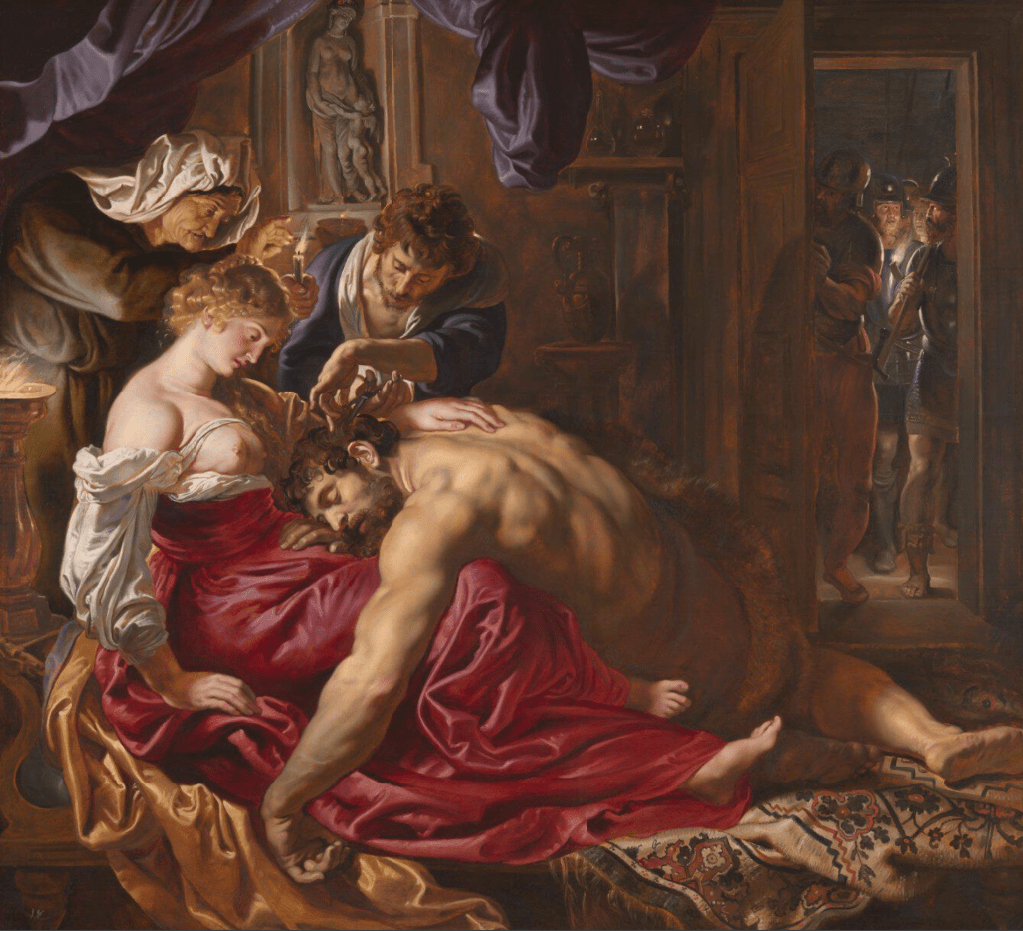
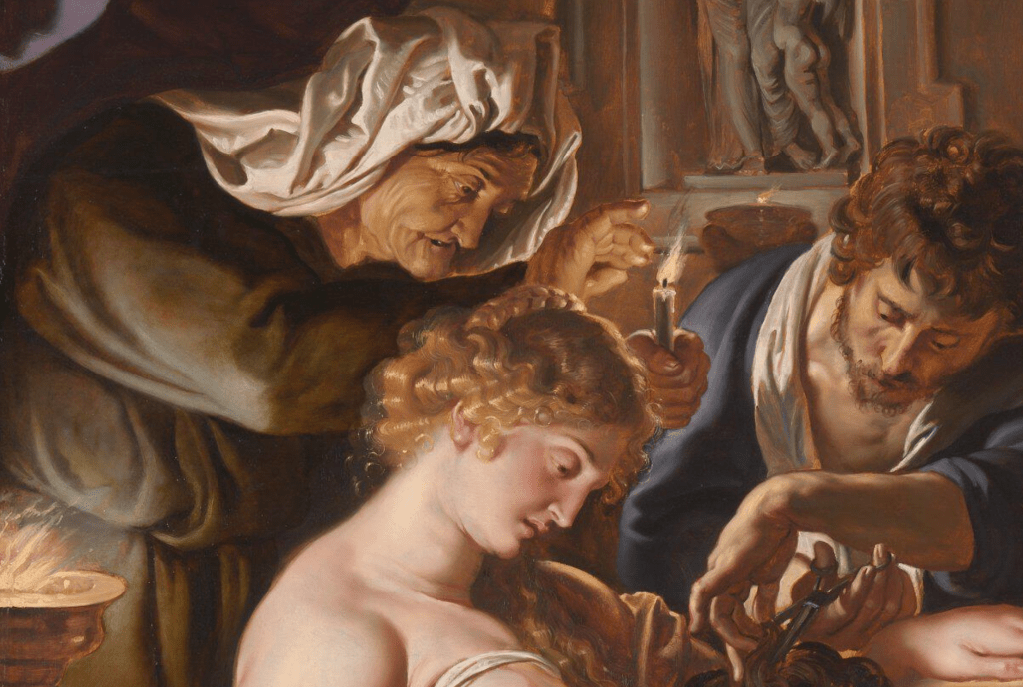
Peter Paul Rubens, Samson and Delilah, about 1609-10. The National Gallery, London.

Relatively few people get their own adjective, but as far as Rubens is concerned, that could be a good thing. ‘Rubenesque’ can be positive or negative, or an all-too-obvious attempt to be polite, I suppose, it depends on your attitude. A basic definition would probably be ‘curvaceous, womanly, voluptuous’, while it also implies the sexualisation of the fuller female figure. The curators of Rubens & Women at the Dulwich Picture Gallery – about which I will be talking this Monday, 23 October at 6pm – are aiming to find more nuance in the great Flemish master’s appreciation of the female form. Indeed, they successfully show that he did paint all aspects of womanhood (as I hope to explain) even if (as I shall also discuss) they have stretched their optimism a little far at times. I am currently in Hamburg, though, and have just seen Ingenious Women at the Bucerius Kunst Forum – it’s a superb exhibition, and, I think, a valuable contribution to the study of women as artists. It will be the subject of my talk on 6 November. The week after that I will head back to the National Portrait Gallery for part I of The Georgians. The autumn’s theme of portraiture will then continue with two talks dedicated to the Queen’s Gallery exhibition Holbein at the Tudor Court on Monday 20 and 27 November – they will go on sale soon (keep checking the diary). Both of my November in-person tours are full, I’m afraid (or rather, I’m glad to say…), but I’ll see how those go, plan accordingly, and let you know about future developments.

It’s such a pity that this painting is not in the exhibition in Dulwich – it may not have occurred to the curators, or they may not have been able to borrow it, or there may not have been space. But I really think it does have ‘nuance’ (even if I confess to being wary of the over-use of this increasingly nuance-free term). The story of Samson and Delilah is a complex one, but one of the things I have always admired about this painting – and about Rubens generally – is the brilliance and clarity of the story telling. Even if you don’t know it (and I’m going to pretend that we don’t), you can get a pretty good idea of what is happening just by looking. Before you read any further, have another look and ask yourself what is the first thing that you notice? What is the brightest part of the painting, for one thing?

Four people are gathered in a room, with soldiers just outside the door. It is night time – the sky is black, and there are numerous light sources, from the brazier on the far left to the torches held by the soldiers. A strong man, all but naked, is slumped over the lap of a young, blonde, fair-skinned woman, while an older woman leans over this couple and a second man attends to the hair of the first.

What is the brightest part of the painting? To my eye, it is the young woman’s flesh: her shoulder, neck, and the lower part of her face. And her breasts, of course, which are, for some reason, uncovered. She is reclining on a chaise longue in a flowing, rich red dress, with a similar golden-orange fabric hanging beneath. Above, a deep purple drape enhances the sense that this is a day bed – even at night. It is the brazier on the far left which illuminates the young woman’s flesh, and there is a warm, orange glow at the bottom of the painting, giving a warmth to the legs of the chaise longue, and to the man’s back where it would otherwise be in shadow.

Earlier I said that the soldiers were holding torches – plural. One is immediately apparent, held centrally in the doorway and reflecting off the armour and face of the man holding it. But over his shoulder is a younger man, with no beard, whose neck is illuminated – he must be holding another torch, hidden behind the first soldier. They are pushing their way into the room, the tentative gaze of the man on the left, who has his arm on the door, and the commanding stare of the man on the right – as if he is worried that the other is making too much noise – suggest that this is a form of ambush. To the left of the door a flagon casts a shadow onto a column which supports two glass vessels – decanters – which both reflect and refract the light. It shines on the surface of the glass and illuminates a patch of the wall at the back.

The details at the top of the painting tell us what the story is about. There is second brazier which illuminates the statue above it of an all-but naked woman holding the hands of a boy with wings – Venus and Cupid, the Roman gods of love. This tells us that we are in a pagan environment, and, although Rubens is giving us the wrong religion, we know that this is neither a Christian nor a Jewish household. The purple curtain hangs down, looking almost like over-ripe fruit, next to the glinting decanters, and to the right of them the soldiers appear at the door. This is a story about love (or is that lust?), about drink, and about the army. Meanwhile, the old woman shades her eyes from the glare of the candle so that she can see what is going on.

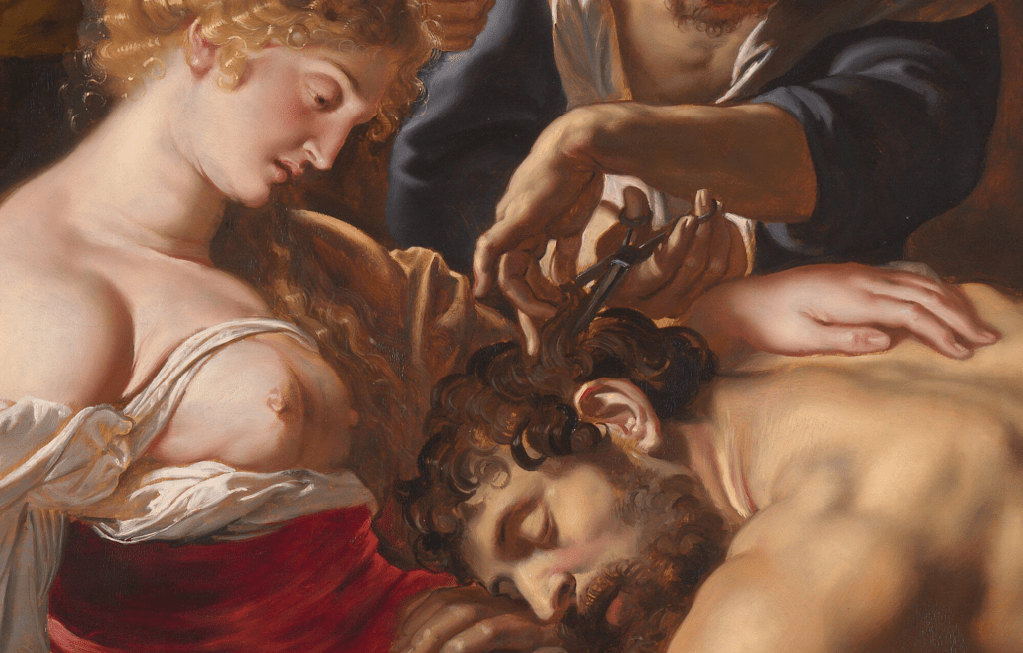
The light in this painting is playing so many roles. It highlights the details which Rubens has included in the background to tell us what the story is about, and it gives us a sense of character as well. It is the brazier on the far left which illuminates the young woman so brightly, after all. It also enhances her appearance: she is blonde and pale skinned, features which were celebrated as signs of beauty and of refinement throughout western European history. The man is darker skinned, and muscular: it is the fall of the light and the resulting shadows which tell us precisely how muscular he is. He appears to be fast asleep. The head resting on his right hand suggests as much, even if the hanging left arm might imply death (but if Rubens had wanted to show him dead, he would probably have painted him paler). And then there is the fact that his hair is being cut so cautiously: if you don’t want him to wake, you would need to be careful. Why worry how you do it if the man is dead? And while we’re at it, why is she topless? Why is he nearly naked? I’m sure you don’t need to ask: something has been going on… Or has it?

For those of you who don’t know the story, the account I am going to give you is not exactly what it says in the bible (the Book of Judges, Chapter 16) – but it is a version of the story which Rubens’s painting would allow, even if I am taking some licence. Samson was an Israelite hero, enemy of the Philistines (not Christian, not Jewish, but not Roman either, despite Venus and Cupid, but we’ll have to let that pass: the sculpture functions as a non-biblical ‘idol’ suggesting ‘love’ and a religion outside ‘the book’). The Philistines could not defeat Samson, and wanted to know his secret. He clearly liked the Philistine beauty Delilah, so they got her to find out. She invited him round, flirted with him, offered him drink, and implied she might offer him more. He seemed interested, so she offered him more drink, and asked him the secret of his strength. After more flirting, and quite a few more drinks, and, I suspect, a certain amount of pouting on both sides, Samson eventually confided that he had never had his hair cut, and that was where his strength lay. At that point he collapsed unconscious on her lap, she called in the barber – and her maid, it seems – and then summoned the soldiers. End of story – almost… You’ll have to look up what happened next.

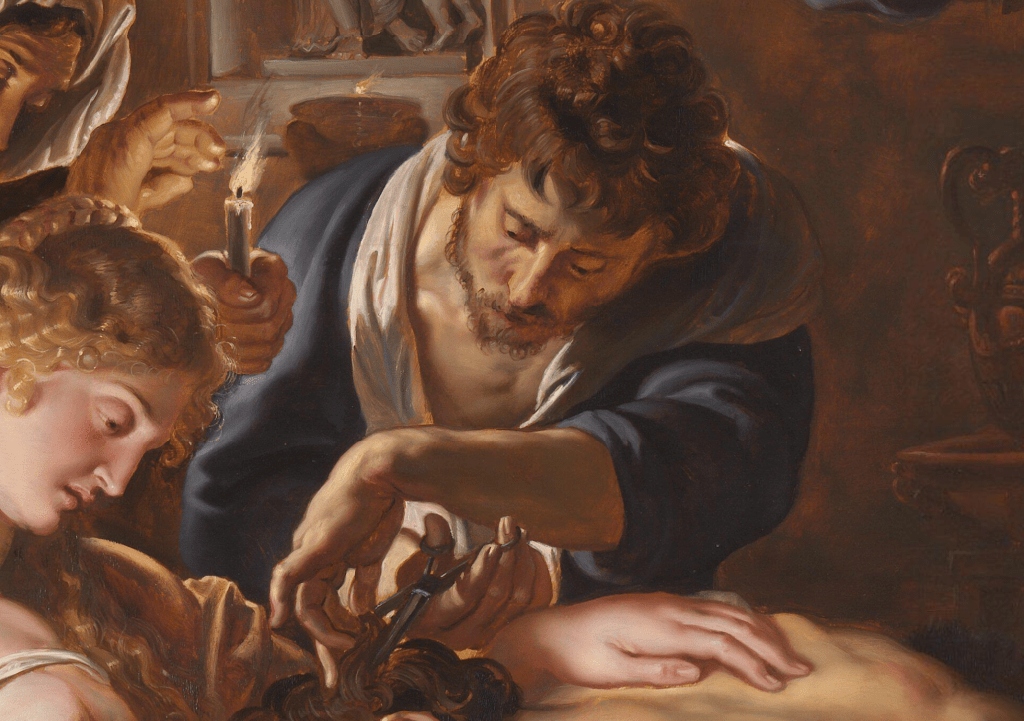
The barber does seem to be going about his job in an oddly complex, even awkward, way. OK, so this is a very strong man who doesn’t want a haircut, so you’d have to be careful, but crossing the hands over like this doesn’t seem to be entirely necessary. I can’t help thinking that Rubens was showing off how well he could paint hands: not everyone could. Not only that, but the fall of light is extraordinary. It’s not just the brilliant illumination of the back of the left hand which is holding the lock of hair, or the light glinting across the top of the left forearm, but especially – and remarkably – the shadows that the scissors cast on the forefinger of the right hand which is holding them.

But why is the maid there? She’s not mentioned in the bible. Admittedly, anyone as wealthy and refined as Delilah would be expected to have a maid. However, given the way that Delilah is dressed, and that she has a sculpture of Venus and Cupid in her room, together with the ‘over-ripe’ appearance of the purple curtain, maybe she isn’t really that refined after all. There are quite a few northern European paintings with an old woman watching over a young woman in a low-cut dress (admittedly lower than low-cut in this case), with a young, handsome man (who has been drinking) in attendance. The implication is that the younger woman is a prostitute, the older a procuress, and the man a client. Samson is visiting a prostitute. That’s hardly heroic, you might think, hardly biblical, but think again. Judges 16:1 says ‘Then went Samson to Gaza, and saw there an harlot, and went in unto her.’ However, that’s not Delilah. Verse 4 says, ‘And it came to pass afterward, that he loved a woman in the valley of Sorek, whose name was Delilah.’ Rubens is combining the two verses, and is doing it deliberately. What is the moral of the story, after all? It’s quite simply, ‘Don’t Trust Women’. They may be beautiful, but they will betray you, and hold a power over you which will unman you. It was a commonly told tale. In German this ‘trope’ is known as Weibermacht – the Power of Women. The story of Samson and Delilah is just one of the oft-cited examples. Others include Aristotle and Phyllis, and Hercules and Omphale, you’ll have to look them up. After all, it was the 17th Century, hardly an enlightened era, and this was painted by a man, for a man – Nikolaas Rockox, art collector, patron, and friend of Rubens who served as the Mayor of Antwerp on more than one occasion. He hung it over his fireplace, which explains the warm glow at the bottom of the painting and across Samson’s shadowed back (Rubens, being a brilliant artist, includes real light from outside the painting as part of the narrative, thus making his image look more ‘real’). Here’s a painting from the Alte Pinakothek in Munich by Frans Francken the Younger, painted around 1630-35. It’s called Supper at the House of Burgomaster Rockox, and it shows the painting in its original location.

So that sums it up. Painted by a man, for a man, and it’s the 17th Century, so what do you expect? It’s misogynistic, and Rubens ratchets up the misogyny by suggesting that Delilah was a prostitute – which is not what the bible says. Not much nuance there, really. And not only that.

Have another look at the old woman, and at Delilah. Look at their heads, and the angle of their heads to their shoulders, and the curve of their shoulders. Look at their profiles. This could be the same woman. Delilah may be beautiful now, but the older woman – that’s what you’d end up married to. Don’t trust physical beauty, it won’t last – you should rely on ‘inner beauty’, which she clearly doesn’t have, because she’s so deceitful.

However, let’s think again. Look at the expression on Delilah’s face – she’s not the evil, triumphant villainess, is she? And look at her left hand. Yes, it’s ‘too big’, but no! Rubens did not ‘get that wrong’ – I’ve ranted about his before. I get so annoyed when people get caught up in petty naturalism. This is art, it’s artifice, it’s not meant to be real, it’s meant to show us something beyond what looks ‘right’. And that over-sized hand tells us that she has power, yes, but she also has a care for him: that hand is not oppressing him, or containing him. It is a consoling hand, even if he cannot sense that, given that he’s asleep.

Any great work of art allows of more than one interpretation – just look at all the different interpretations of Shakespeare you’ve seen (well, I hope you’ve seen) – and I think the same is true of this painting. I’ve given you the standard interpretation, let’s call that the ‘Male Chauvinist’ interpretation. I’m using broad brushstrokes here (though sadly not with as much skill as Hals). And surely this interpretation is supported by the bible. Why is Delilah doing this, anyway? It say in Judges 16:5, ‘The rulers of the Philistines went to her and said, “See if you can lure him into showing you the secret of his great strength and how we can overpower him so we may tie him up and subdue him. Each one of us will give you eleven hundred shekels of silver.’ So she was doing it for the money. She was little better than a prostitute.

But did she have a choice? Let’s face it, the whole of the Philistine army is waiting outside the door – she had to do it. Interpretation 2: This is a woman being used as part of the men’s power struggle, a cog in the male machine, a victim of men’s needs. What choice does she have? I’m going to call this the ‘Old School Feminist Interpretation’. As I say, broad brushstrokes. Very broad.

But wait yet again – eleven hundred shekels of silver? Each? That’s a lot of money. And she has the means to get it. Try looking at it this way (interpretation 3): this is a woman using what she’s got to get what she can. She is entirely empowered. This would be the ‘Post Feminist’ interpretation. I used to call it the Spice Girls interpretation (‘I’ll tell you what I want’), but that only tells you how long I’ve been talking about it. I think the painting allows all three interpretations – but not just the first. Look at that hand, how softly it lies on his back, large as it is, and potentially damaging, and look at her face, the regret in her eyes, after she has betrayed him. That’s nuance.

208 – Some are born great

Frans Hals, Portrait of Catharina Hooft with her Nurse, 1619-20. Staatliche Museen zu Berlin, Gemäldegalerie.

I have rarely been so excited at an exhibition as I was when visiting Frans Hals at the National Gallery. I was excited to go, yes, but on seeing the first paintings, the thrill increased. I’ve seen quite a few of them before, and yet they seemed more brilliant than ever. His handling of paint is second to none – unprecedented in its freedom and apparent spontaneity – and his ability to capture both the appearance and character of his subjects is also unparalleled. I have no doubt that he was a better painter than Johannes Vermeer, but was he a better artist? Well, that depends on how you define artistry, and it also relies on personal taste. I certainly think people should be queuing round the block to see this exhibition, but perhaps the fact that Hals was far more productive than Vermeer means that it does not seem so ‘special’. Or maybe it’s because there are no novels or films inspired by his work… But you must go – you’re in for a treat! Either that, or sign up for my talk this Monday, 16 October at 6pm. The following week I will look at another of the 17th Century’s most dazzling artists, Peter Paul Rubens, whose output was even greater than that of Hals, but don’t let that blind you to his virtuosity and subtlety. In subsequent weeks I will introduce an intriguing exhibition currently in Hamburg, Ingenious Women, and return to the National Portrait Gallery for a third visit – looking at (some of) The Georgians. Before then, though, a new project: in-person tours. This is a trial, looking at the early Italian paintings in the National Gallery, which have been beautifully rehung and superbly lit in the lower galleries. I will give the same 90-minute tour twice, at 11:00am and 2:30pm on Thursday 9 November, and am limiting the numbers for a better experience. These links will take you to Eventbrite, which is better for in-person events than Tixoom, I believe.

This is a relatively early painting by Frans Hals, although he seems to have been a slow starter: he would have been about 37 or 8 when it was painted. Having said that, he was still working at the age of 80, so there was more than enough time for him to catch up. As an ‘early work’, though, there is absolutely no sense that he was still learning – it is a painting of the most profound brilliance, both in terms of its technique and its originality. The basic idea may seem quite simple, and yet it is entirely innovative. The rising merchant class of what would be recognised, about three decades after this was painted, as the Dutch Republic wanted you to know who they were, and so portraiture reached new heights. It was not only the pater familias who should be represented – and so commemorated for future generations – but also the lady of the house. She usually retained her own family’s name as a sign that she was from a background of equal status to that of her husband. And then there was the hope for the next generation, and the continuation of the greatness which husband and wife brought with them. Young Catharina Hooft is presented to us as the queen of the household, ruling over her domain, supported by her most loyal courtier, her nurse. And that is what is truly astonishing about this painting. In the tradition of family portraiture, which was still developing, boys were watched over by their fathers (to the right – our left – of the family), and were frequently shown learning what it was to be a man. On the left (our right), the girls are with their mothers, preparing to be good wives – and so, good mothers – with flowers (beauty), fruit (fertility) or dolls (maternity)… In this case, though, we have a servant, who receives almost as much attention as the young mistress. Portraits were usually of the great and the good, and servants, if included (and I can think of a couple of examples), tended to be in the background, or off to one side. Placing the nurse at the centre of attention is entirely unorthodox, but a stroke of genius.

Not much to see in this detail, you might think, and yet – Catharina’s dress takes up about one third of the surface of the portrait. Not a huge amount of fabric, admittedly, given the size of the subject, and yet, relative to the size of the subject no expense has been spared. Catharina Hooft was born on 28 December 1618, and would have been less than two – possibly less than one – when this was painted. To say that her skirts would reach to the floor implies that she was able to stand. They certainly allow for movement, as the dress is incredibly broad for her tiny frame. This wealth of material is overlaid by what appears to be a second, shorter overskirt attached to her bodice or jacket. Every square centimetre is richly embroidered – in gold – with stylised foliage and fruits, which not only emphasizes the enormous wealth of the family to which she belongs, but also the fact that the same wealth is reliant on her future fecundity for it to remain within the family down through the generations – not something that would have occurred to her just yet, I would imagine. She would marry at the age of 16, though.

As well as the overskirt, there are full-length embroidered sleeves and an embroidered cape attached across her shoulders, not to mention the most delicate starched lace cuffs and collar. She has multiple gold chains around her neck from which hangs a polished red jewel, as well as an equivalent gold bracelet and a gold belt (the last of these more subtle). The necklace frames a beautiful section in the lace panel which runs the length of her bodice, one of three octagonal details, the other two of which are disguised by the jewel and belt. In her left hand she is holding a rattle, with a teether that appears to be silver, set in a gold mount. However, it is more likely to be ivory (coral was another common material used for teething). There are also gold bells, which, as well as amusing the child, were also supposed to ward of evil spirits, as was coral, if used. The nurse is holding an apple, proffering it to her ward, and I can’t help seeing the apple and rattle as standing in for an orb and sceptre. In 1631 Velázquez would use this metaphor in a portrait of the young Balthasar Carlos, heir to the throne of Spain. The objects in question are held by one of the court dwarves, who stands in front of the Prince acting as a mock monarch. Hals, despite living in a republic which was in the process of freeing itself from Spanish rule, seems to have got there a decade earlier, and so Catharina appears as a proper little princess, heiress to the family fortunes.

Of course, the full force of the painting comes from the faces. Catharina is surprisingly self-possessed for one so young – but then, that was Hals’s great talent: the communication of character. She looks us straight in the eye, a pleasant smile on her face, her plump, pink cheeks glowing from her otherwise pale (and therefore, given the time, genteel) complexion. Her entirely delightful appearance is framed by a diadem-like lace fringe on her headdress, and the starched, lace-trimmed collar which we noted before. Light reflects from the collar onto the side of her cheek, helping to define the curve of her jaw. The nurse’s expression is more equivocal – a smile, yes, but one that speaks of duty and service. Her complexion is slightly swarthier – she is of humble origins, after all – and she does not look us fully in the eye: she has something on her mind, undoubtedly. Her headdress is not without ornament – thin bands of lace – and her simple ruff is fastened with a red ribbon, a hint of which can be seen where the collar parts at the front. And at this juncture is the most wonderful gesture, the action of a child who is not fully in command of their limbs, as Catherina reaches out to her nurse to touch, or hold, or show affection, or maybe distance – as if she were saying ‘don’t get too close – this is about me’. There are many elements which differentiate the status of the two subjects of this portrait, Catharina’s gesture being just one. The complexions, and the complexity of dress are two more, and there is also an interesting difference in the way the mouths are painted.

In both, the lips are divided by a simple painted line. For the nurse this is a particularly bold brushstroke, rough and ready like the woman herself. For Catharina it is far finer, and more delicate. But then, she is only one, or two at the most… It’s not a technique I noticed Hals using in the other portraits, but maybe I didn’t look closely enough, so I’m heading back in there now to check – I’ll let you know what I find on Monday. I’d love to tell you more about Catharina’s future – but I’ve said enough already. She does have a Wikipedia page of her own, though, so you can check there to see what happened next, and how she looked as a ‘grown up’. Well, at eighteen – but she’d been married for two years already by then, so…

Revisiting, too…

Sir Peter Lely, …the Virgin and Child, 1664. National Portrait Gallery, London.

I will be Revisiting the NPG for a second time this Monday, 9 October at 6:00pm, and in this instalment of the survey I will reach The Stuarts. To introduce that, I am also revisiting an old post: it was originally ‘Picture of the Day 61 – …the Virgin and Child‘, back in May 2020. I was delighted, if initially surprised, to see the painting take its place in the newly refurbished National Portrait Gallery next to a very imposing portrait of King Charles II. What is a religious work doing there? Isn’t this a ‘portrayal’ rather than a ‘portrait’? Well, read on…! (I get very exercised about the improper use of the word ‘portrait’, but more about that another day). I shall then break away from the NPG (returning in November with The Georgians), but continue with 17th Century portraiture: Frans Hals will be on 16 October. I saw the exhibition yesterday, and frankly it is the BEST exhibition this year. I enjoyed it more than Vermeer. Go and see it. On 23 October I will talk about Dulwich Picture Gallery’s Rubens & Women – which is also good, and includes some of the most impressive displays of artistry… but I’d advise you to take some of the texts with a pinch of salt (to find out why, sign up for the talk!). At the end of the month I’ll have a week off, coming back in November with some women (and their men), some Georgians, and two talks about Holbein – but keep your eyes on the diary for all that. Meanwhile, let’s see what I had to say about Sir Peter Lely’s act of devotion two months into lockdown:

“Last Monday we looked at Sir Anthony van Dyck’s Cupid and Psyche painted for Charles I [the one I accidentally erased, but then re-posted – see Day 54 – Psyche V], which I suggested was quite possibly more than a little sacrilegious from a Catholic point of view. My precise words were ‘It’s entirely outrageous’. So this Monday, I wanted to balance that outrage with something altogether more respectable from the Stuart Court, this painting of the Virgin and Child, glowing with health and happiness, by Sir Peter Lely. 

Like most great British artists of the time, Lely wasn’t British at all, having been born in the Netherlands in 1618. He trained in Haarlem, and was accepted as a Master of the Artists’ Guild there in 1637. It seems more than likely that he would have known Judith Leyster (POTD 34), who became a Master of the same guild four years earlier, when Lely would have been 15 and presumably already well into his apprenticeship. He arrived in London some time around 1643, and his talent meant that before long he was painting portraits for Charles I. Then, when Charles, for obvious historical reasons, had no head for portraits, he carried straight on painting Oliver Cromwell. With the Restoration in 1660 Charles II knew that, to be accepted as King, he had to look like a King, and people had to know what that looked like – so one of the first things he did on his return to England was to appoint two Royal Portraitists, including Lely, who became Principal Painter in Ordinary in 1661.

Painting the Virgin and Child seems like a curious choice for Lely, a Dutch artist, who grew up and trained in Protestant Haarlem, and who was now working in a Protestant court – even if both old king and new had Catholic wives. It’s an especially lush image, though, the rich blue of Mary’s cloak glowing with the clarity and wholesomeness of a Madonna by Sassoferrato, the Italian Baroque artist whose work constituted a Raphaelesque revival. The parallels with Raphael can be seen here too: the Madonna and Child lean towards each other, creating the pyramidal composition typical of the High Renaissance. This is strengthened at the base by the blue horizontal of the cloak, reaching from Mary’s knees to the folds by her hips. Her posture – upright back and horizontal left leg – echoes the verticality of the fluted classical column and the horizontal cornice or capital on which Jesus rests his feet. All of these compositional devices serve to frame him better. He must be supported by his Mother’s left hand, as his feet barely touch the surface. They reach towards each other with touching affection, but look out to us, subtle smiles on their lips – and maybe a slightly sleepy look in Mary’s eyes. Well, I’m sure that even holy babies can keep you awake.

I first saw the Virgin and Child at the end of January [2020] in the British Baroque exhibition at Tate Britain, which sadly closed a month before it was due to, for obvious reasons.  A pity – it was a revelation. The Lely was hung next to the painting on the right here, and not so far away from the one on the left. The latter is the not-so-obviously Catholic (from this portrait, anyway) Catherine of Braganza. She arrived from Portugal in 1662 to take up her position as Queen, and she and Charles were married twice – a secret, Catholic ceremony followed by a public, Protestant one. This might make it look as if Charles had appointed two Court artists before one wife, but the contract had already been signed the year before – not that she was present at the time. But then, negotiations had begun during the reign of Charles I: by the time he was beheaded in 1649 she was still only 10. When finally married, at the advanced age of 23, her dowry included Tangiers and what was then called ‘The Seven Islands of Bombay’ – the British Empire started here, effectively. She was allowed to practice Catholicism, and even had her own Chapel. She also had her own artist, Jacob Huysmans, who painted both of these portraits. Again, as a great British artist, he was Flemish – and so Catholic – having been born in Antwerp in 1633.

Catharine’s portrait shows her in that guise favoured by more than one Queen, the Shepherdess. After all, she would be able to look after her flock: Charles’s subjects were now her own. It was painted early in her reign, and is packed full of symbols of her hoped-for fecundity – the ducks in the bottom left, the lambs, the flowers carried by the cherub, the cherubs themselves (there are more in the background), and especially the orange blossom in her hair. She calmly strokes the head of a particularly docile lamb, the implication being that she is equally meek and mild: this sweet girl provides no militant Catholic threat. OK, so it’s a very low-cut dress, but her first official portrait was so square-laced it looked as if she would never fit into Charles II’s court.

But what is its relationship to the other painting? It depicts John the Baptist as a rather gawky teenager, complete with long, lustrous and above all healthy Stuart hair. You wouldn’t get hair like that on a diet of honey and locusts. He has the softest of camel skins wrapped around his right arm, with an off-the-shoulder blouse of the subtlest royal purple, matched with a pale pink cloak. In the crook of his left arm is a bamboo cross wrapped round with a small scroll bearing the greeting ‘Ecce Agnus Dei’ – ‘Behold the Lamb of God’ – with which John greeted Jesus. Another docile lamb (clearly one of Huysman’s specialities) sits cross-legged beside him. His right hand points, as if illustrating the word ‘Behold’, but he doesn’t seem to have the energy to lift it up high enough to point at the lamb. Typical teenager. Despite this diffidence, I suspect that somewhere in the background Huysman’s inspiration was Caravaggio. And however you interpret whatever I’ve just said, I do think it’s a rather elegant painting, and really rather surprising when you read what has been painted in the top left hand corner: ‘Duke of Monmouth’. Who was he? You may well ask. He was James Scott, and in case that doesn’t help, he was the son of Lucy Walter. Still not helping? He was the eldest illegitimate son of Charles II, and this was painted at the earliest in 1663 just after Charles had ennobled his son, and even gone as far as bestowing him with the Order of the Garter. Evil to him who evil thinks! From this point onwards he was regularly seen in the company of the King and Queen – a thorn in her side, perhaps, but it’s a very clever portrait. According to the Bible, John the Baptist was asked if he was the Messiah, to which he replied that he was a voice crying in the wilderness ‘Prepare ye the way of the Lord’. The relevance to the contemporary situation would have been clear: the Duke of Monmouth was not the King’s legitimate heir – but one was on the way, thanks to Catherine. Having him painted by Huysmans – her artist – makes it look like she was totally happy about it. Tragically, despite several pregnancies, none of Catherine’s children lived. She must have led a very difficult life.

But why did the curators of the British Baroque exhibition hang the portrait of Monmouth, dressed up as John the Baptist, next to Lely’s Virgin and Child? Is it simply to fulfil the promise of the scroll, ‘Behold the Lamb of God’ by putting a painting of Jesus next to it? Come to think of it, it is a little unusual for Jesus and Mary to have such dark shiny hair – unless you’re in Spain – you could even argue a family resemblance with John the Baptist, I suppose. Well, maybe I should give you the full title of this painting. Naughty of me not to have done so before, really:

Barbara Palmer (née Villiers), Duchess of Cleveland with her son, probably Charles FitzRoy, as the Virgin and Child

So yes, that’s the reason – like James, Duke of Monmouth, as St John the Baptist it is another portrait of someone playing a role, someone in fancy dress, a genre which was rather popular in portraiture during the Stuart dynasty. But who was Barbara Villiers? Well, she was the favourite mistress of Charles II in the 1660s. And Charles FitzRoy? Well, ‘Fitz’ comes from the French ‘Fils’ meaning ‘son’, and ‘Roy’ comes from ‘Roi’, meaning ‘King’ – Charles, son of the King. So this is the King’s favourite mistress, and one of his illegitimate sons (to be honest they don’t even know which one) dressed as the Virgin and Child. And if that’s not ‘entirely outrageous’ I don’t know what is.”

Revisiting this post has reaffirmed my conviction that the rehang of the NPG is a huge success. Even the one wall on which today’s painting can be seen says so much about the reign of King Charles II, but I will try and explain exactly what I mean by that on Monday. I’m not going to discuss the contemporary relevance of this painting under King Charles III though. You can do that for yourselves.

207 – Making a monarch, a mural, and more

Hans Holbein the Younger, King Henry VIII; King Henry VII, c. 1536-37. National Portrait Gallery, London.

This week I will start what might turn out to be an occasional survey of the recently refurbished, refocussed and reopened National Portrait Gallery in London (whether I get all the way through depends on what other ideas take my fancy after the first two weeks), and it would seem to make sense, as the song says, to ‘start at the very beginning’. Although not the earliest person represented in the collection, the earliest painting is an anonymous early-16th Century portrait of King Henry VII. However, given the motto, ‘like father, like son’, today I am going to write about two kings – if not three. Although titled The Tudors, my talk on Monday, 2 October will also include a brief history of the NPG, and the ‘new’ experience you would have if visiting (while I’m on the subject I’m thinking of starting some ‘in person’ tours of this and other museums – do let me know, preferably via the contact page, if you’d be interested). The following week I will carry on with The Stuarts, and, as with the first week, as well as the dynasty in question, I will also look at people other than royalty. The NPG is essentially a museum of British history rather than an art gallery, however much art it may appear to contain, and as well as kings and queens, that includes the great and the good, and increasingly, the normal and down to earth. After two weeks I’ll break off the survey (for now) as by then the autumn’s exhibitions will have bedded in, in my mind, if nowhere else. I will continue with portraiture, though, talking about Frans Hals (at the National Gallery) and Rubens (at the Dulwich picture gallery). I hope to have those on sale by Monday, but keep your eye on the diary just in case.

This image of Henry VIII is remarkably familiar, presumably from historical dramas and films. Holbein’s depiction of the monarch has often been used as a character note for any actor taking on the role of a man who is just beyond his prime, both in terms of physical fitness and ruling power, and in the first stages of a descent into morbidity. At this stage – in 1536-7 when the image was made – Henry was in his mid-forties, with a decade left to go. He adopts the ‘power stance’, which may be familiar given that it was revived by the Tory party from 2015 onwards to disastrous effect. It really doesn’t work if you don’t have the appropriate clothing. A tight skirt, rather than a pleated under-coat with britches, really gives the wrong impression (Theresa May), and, while your legs should be firmly planted, they really shouldn’t be too widely spread (George Osborne – check the link if you doubt me). If you really do have majesty, and gravitas – and the best portraitist of the day, let’s face it – then it works. It helps to wear the right layers: an overcoat with short, padded sleeves over a long-sleeved undercoat enhances the effect. Henry VIII had probably not reached the full degree of his ‘obesity’ at this stage. Remember that, as a young man, he was tall, fit and sporty. The appearance of ‘heft’ here is achieved by the layers of clothing which are hung from, and draped around, that broad, lofty frame.

The point is made clear by comparison with the image of his father, King Henry VII, founder of the Tudor dynasty. He appears far slimmer, with a narrower, taller hat (as opposed to his son’s broader, flatter headgear, just visible at the bottom of this detail). The hat alone adds to the sense of ‘tall and slim’, which is enhanced by the vertical fall of the collars of his two coats and the rest of his drapery, as we shall see below. Both monarchs – father and son – stand in front of an architectural setting, using the new (to England) classical language of architecture, with overlapping pilasters supporting an entablature consisting, it would seem, of only a frieze. While the pilasters (on the left side of the detail) are carved with decorative vases and flowers – a feature given the somewhat inaccurate term ‘candelabrum’ – the frieze shows two mythical creatures, a mermaid and merman, possibly, or what would be termed as ‘grotesques’ (the sort of decoration you would find in a grotto) with vegetal and animal forms morphing one into the other. These two hold a plaque, or shield, which is inscribed with two letters, and elaborately patterned. It reads ‘H & I’, which can be interpreted as ‘H & J’, given that the letters I & J were effectively interchangeable. The plaque celebrates the union of Henry VIII and his third wife, Jane Seymour, who is, nevertheless, nowhere to be seen. But then, the image has obviously been cut down: apart from anything else, Henry VII has lost his left elbow.

The contrast between father and son is most obvious here. Henry VIII’s ‘breadth’ is emphasized, not only by the flat, wide hat, but also the jewelled chain around his neck which stretches wide to rest on his wide, wide shoulders, themselves enhanced by the broad, fur-lined, turned-out collar and the padded short sleeves. Compare the number of horizontal, or near-horizontal lines used to depict the son with the preponderance of verticals used for the father. The materials depicted are also different. The royalty of Henry VII is emphasized by the use of ermine, a weasel-like creature with pure white fur and black tip to the tail, whose pelts were reserved for royalty. You can see it used for the collars and cuffs, and even for lining the sleeves of the overcoat. This is visible thanks to a rather large cut in the sleeves themselves, ‘slashing’, a fashion choice intended to display the structure of the garments and the layering and material value of the expensive fabrics being worn. Given that neither of his parents was a monarch – Henry VII seized the crown in 1485 – it was of vital importance to emphasize his royal status. However, as Henry VIII was the son of a king, he didn’t have to worry so much about his ‘royalty’. Instead it was power – and particularly power as expressed through wealth – that was important. Although the image I have chosen is monochrome, I can see numerous jewels – on chains, as pendants, and sewn into the fabric – and I am imagining materials in rich colours and cloth of gold.  ‘Unlike father, unlike son,’ you might think, unless you look at the right hands. Father holds onto his robes, and son to his right glove (a sign of elegance and sophistication, removed to reveal the powerful hand, with yet more jewellery), and yet the hands themselves are exactly the same. If we doubted Henry VIII’s potency, the codpiece reminds us of his manliness and vigour, which was far more of a concern for him than his royalty, as his first two wives had failed to give him a son.

The first detail I showed you might have suggested that Henry VII was considerably taller than his son, but clearly he was not – as you can see here, he is standing on a higher step. Rather than having his feet rest on the cold stone, a cloth is spread out to keep his shoes clean and his feet dry and warm. The cloth seems to pour over the step onto the lower level, and Henry VIII is also standing on it. This is just one of the details intended to promote the idea of the continuity of Tudor rule. Henry VIII’s feet are set wide apart (though not too wide), thus helping to create the stable pyramidal composition of which (as you’ll know) I am so fond, and this structure is enhanced by the spreading skirts of the coats above, which taper towards the waist. The under-skirts are short enough to reveal Henry’s knees, beneath which he wears garters holding up his short stockings. That on the left leg reveals him to be a member of the Order of the Garter, as every monarch since Edward III has been. It’s hard to read, but you might be able to make out the lettering ‘Y PENSE’, part of the order’s motto ‘honi soit qui mal y pense’, usually translated as ‘evil to him who evil thinks’.

The above description looks at the image as we see it, but doesn’t explain what’s going on at all. The reason for this is that Holbein never meant us to see it: it is a cartoon, a preparatory drawing the same size as the work for which it was prepared. I would show you the work itself, The Whitehall Mural, but that was painted onto a wall (which is, after all, the meaning of the word ‘mural’: think of ‘le mur’ in French, or ‘il muro’ in Italian: both mean ‘wall’). The wall in question was part of the Palace of Whitehall, which was all but completely destroyed by fire in 1698, during the reign of King William III. However, we know what the mural looked like from copies and engravings. Here is one currently on display in the NPG (I’ll explain where you can find it on Monday):

The engraving was made in 1743 and is attributed to ‘George Vertue (after Remigius van Leemput)’. It shows us that what we have been looking at is only about a third of the design as a whole. What we are missing is an altar-like plinth in the middle (meant to be a sarcophagus) bearing a lengthy inscription, and two women: Elizabeth of York, consort of Henry VII and mother of Henry VIII, and Jane Seymour, third wife of Henry VIII. We are also missing some of the architecture at the top. What I described as a frieze is actually an elaborately carved architrave. Above this there is a frieze – decorated and bulging – which is surmounted by a narrow cornice, and crossed by brackets supporting sculptures. We can now see that the cloth both Kings (and their consorts) are standing on is an elaborate rug. It’s worthwhile remembering that only people of the highest status would have a rug on the floor, as they were usually considered too expensive to tread on (an exception being the Arnolfini, who had pretensions above their station). The large, spreading rug assures us that the continuity of Tudor power which the mural was meant to promote was entirely royal. The painting was effectively a family tree. The union of Henry Tudor, a Lancastrian, and Elizabeth – of York – put an end to the Wars of the Roses and initiated the Tudor dynasty. Henry VIII and his wife Jane Seymour would strengthen the family’s rule, thanks to his potency, manliness and vigour, combined with her modest virtue (she holds her hands meekly in front of her body) and fidelity (she looks loyally towards her husband, and has a little dog at her feet).

But why did George Vertue rely on Remigius van Leemput for the design of this engraving, given that in 1743, when it was printed, the mural could still be seen?

The reason is simple enough: George Vertue was relying on a small-scale painted copy which already existed, and which would be far more convenient, given that he would not need to have access to the royal apartments. The Whitehall Mural had been copied by the Flemish artist Remigius van Leemput for King Charles II, who was, for obvious reasons (which we will discuss when we get to The Stuarts) all-too-conscious of the continuation (or otherwise) of the monarchy. In 1688 the painted copy, like the mural, was recorded as being in the Palace of Whitehall – so we are lucky that, unlike the mural, it has survived. Thanks to the subsequent continuity of the monarchy (give or take the odd ‘glorious’ revolution), it is part of the Royal Collection to this day. It reveals the rich colours and cloth of gold I had ‘imagined’ earlier, even if we can’t be sure of van Leemput’s accuracy. Nevertheless, the repeated use of full, rich reds, a colour associated with royal households, not to mention the gold, not only creates a suitably regal appearance, but also creates a visual relationship between the four characters, the implication being that this is a unified dynasty which will last. Apart from a slight difference in the proportions of the figures – hardly surprising given that a life-sized image has been reduced to a mere 88.9 x 99.2 cm (Henry VIII was probably 188 cm tall) – what we see is remarkably similar to the cartoon. However, there is at least one minor difference. Rather than being inscribed ‘H & I’, the plaque on the left says ‘An Do’, short for Anno Domini, or ‘the year of our Lord’. On the right the plaque reads ‘1537’ – thus confirming the date of the cartoon. Whether or not this minor difference was true to Holbein’s completed mural, it is certainly picked up by Vertue in the engraving. Vertue also adds the names of the characters in the string course which separates the architrave from the frieze, although the lettering is probably too small for you to read in this reproduction. But back to the cartoon – why was it made?

This is a detail of Henry VIII’s left hand, holding onto the cord from which his decorative dagger is hanging – more a statement of power than a declaration of violent intent. Drawn and painted with different sized brushes, ink and watercolour on paper, this cartoon is nearly 500 years old, and clearly fragile. Despite recent conservation, cracks and splits are visible, and, particularly along the top edge of the black sheath, there are small white dots which might suggest decay. However, I’m only really including this detail so you can see where the next detail comes from: it is the bottom jewel on the right side of the sleeve, just next to the hem, and above the white cuff of the undershirt.

Aside from wanting to point out the delicate patterning of the sleeve, and subtle shadows modelling the white undershirt as it emerges from the slashing, I am interested in the small dots – appearing either black, or white, or sometimes both – around the jewel, the shirt, the sleeve – indeed, around most of the outlines. They are black and white as they cast shadows, or catch the light, and they do that because they are three dimensional: they are holes in the cartoon, which has been ‘pricked for transfer’. The word ‘cartoon’ comes from the Italian carta, meaning ‘paper’, and specifically cartone, meaning ‘large sheet of paper’. This one is made up of a number of smaller sheets stuck together, as paper wasn’t available in large sizes in the 16th century. Having completed the design, the cartoon would have been placed on top of a blank sheet of paper of the same size, and all of the important outlines were pricked with a pin, the pin going through both sheets of paper. The plain paper, with pin pricks, would then have been held against the wall, and a bag containing soot, or crushed charcoal, would have been banged against it in a process known as ‘pouncing’. The black powder would pass through the loosely woven fabric of the bag, through the pin pricks, and onto the wall. To paint the mural all you would have to do then would be to join the dots, and colour it in – simple really. But if you did that, surely there would be little black dots all over the painting? Well, often they were painted over, so you can’t see them. But sometimes they weren’t. Here is a detail from Lorenzo Monaco’s Coronation of the Virgin with Adoring Saints in the National Gallery, dated 1407-9. This is from the right-hand panel: the blue and yellow robes are St Peter, the white is St Romuald.

The ‘black dots’, or spolvere as they are known (effectively meaning ‘sprinkled with dust’) can be seen quite clearly along the hems of St Romuald’s white robe. But it does make you wonder if the process wasn’t unnecessarily complicated (and wasteful), given the inclusion of the blank sheet of paper. If the cartoon was only a preparatory drawing, rather than a work of art in its own right, why bother? You could just prick the holes in the cartoon, and use that for the pouncing, surely? Well, not if you wanted to hold onto the cartoon.

It could be that the cartoon was saved as the basis for copies of the original design – and, as you can see, such copies were made. This portrait of Henry VIII, from the Workshop of Hans Holbein the Younger, is in the Walker Art Gallery in Liverpool, and you can see it in their newly opened display, ‘Renaissance Rediscovered’ in rooms 1-4 (despite the title, it also includes medieval and baroque works, and covers the 13th-18th Centuries). Like the NPG, this is the result of a three-year refurbishment. While portraits of Henry VIII would have been important across the realm, and throughout his reign, those of his parents and wife might not have been so vital. This might explain why only the left third of cartoon survives. The image of Henry VIII would go on to become the model for the very continuation of the Tudor dynasty which the mural had promoted, as embodied by Edward VI, the longed-for male heir to the English throne. This portrait – also in the NPG – truly is a case of ‘like father, like son’, with the young and sickly Edward being portrayed with the same manliness and vigour attributed to his father, the power of the image intended to counteract historical fact. But that’s another story, of course, and one I shall leave for Monday.

206 – ‘The cat will mew…’

Agnes Miller Parker, The Uncivilised Cat, 1930. The Fleming Collection.

My visit to Glasgow is rapidly drawing to a close, but my Scottish September still has one last blast: an introduction to the Fleming Collection’s rich and rewarding exhibition Scottish Women Artists: 250 Years of Challenging Perception, which you can catch at Dovecot Studios in Edinburgh until 6 January next year. The talk will be this Monday, 25 September at 6pm, after which October will be taken up with a focus on portraiture. The first two Mondays are potentially the start of a survey of the recently refreshed, refocussed and reopened National Portrait Gallery in London, looking at the Tudors and Stuarts on 2 and 9 October respectively. These will be followed by introductions to the Frans Hals and Peter Paul Rubens exhibitions opening soon at the National Gallery and Dulwich Picture Gallery. As ever, keep your eye on the diary for more.

I only became aware of the Fleming Collection relatively recently. It describes itself as a ‘Museum without Walls’, and started life as a collection for the investment bank Robert Fleming & Company, founded by the eponymous Dundonian back in 1873. When the bank was sold in 2000 the paintings came off the walls of the worldwide offices, and were vested in the Fleming-Wyfold Foundation, which now promotes Scottish art through partnerships with public museums, art galleries and other institutions. I saw an earlier version of Scottish Women Artists at the Sainsbury Centre in Norwich last year, but something about the arrangement of the spaces, or the nature of the hang, made me feel that I hadn’t understood it well enough to talk about it. In Edinburgh the collection is presented in a far more coherent way, I think, and the Fleming’s own works are also supplemented with loan paintings, not to mention tapestries and rugs woven and knotted at Dovecot Studios (who are hosting the exhibition) following designs by some of the same artists. Elsewhere in the building, at certain times of the day, you can access viewing platforms to see weavers at work on the latest tapestries, making a visit doubly worthwhile. Sadly there is no catalogue for the exhibition, but I can recommend Charlotte Rostek’s book Scottish Women Artists, published by the Fleming Collection, which draws on the same material. Their website is also a good place to go: it is incredibly thorough, with good images of all of the works in the collection (by male as well as female artists…), accessible via the ‘collection’ button.  There is such a wide variety of material on display that it was hard to choose what to write about today, but Agnes Miller Parker’s painting was the work which made the biggest impact which I saw it in Norwich. You could also argue that it is a summation of what the exhibition as a whole has to say.

The History of Art has saddled us with a number of fairly unhelpful terms. However, we seem to be obsessed with putting things into boxes, and these terms can sometimes be useful. In this case, though, to say that the painting is a ‘Still Life’ would tell us very little about it – it is more than usually active. And yet, if we consider why this term is inappropriate, it does help us to understand what the artist was doing. The French term nature morte, or ‘dead nature’ is just as unhelpful. But then, even for the Old Masters still lives were frequently in movement, and the dead nature was often alive. It wasn’t unusual for Rachel Ruysch to paint lizards eating butterflies, for example. In this case we see a cat running amok among what could have been a stylish, civilised, and calm Still Life. It has knocked over a vase of lilies, a small statuette, and a glass, and has torn into the pages of an open book. Meanwhile, in the background, a car is driving away at speed. Let’s try and focus in on the cat, though.

Miller Parker has woven such a taut composition that it is not possible to look at the creature on its own. Nevertheless, cropping the image closely does help us to see how brilliantly it is designed, and allows us to consider what gives the feline protagonist such tension. I’m going to ask you to draw some imaginary lines on the image. Start at the tip of the tail and trace the outline of the top of the form (with your eyes, or even a finger), going round the long arc of the tail that curves over the body beneath. The line curls round the rump, past the rear right leg and under the belly. If you carry on past the front right leg it continues in the boundary between the deep black of the flank and the lighter grey of the chest, until it reaches the muzzle: this is one broad curve. If you then start again and pick up the outline where the lower edge of the grey chest joins the front right leg, there is a second broad curve which stretches as far as the left ear (on our right) and beyond – across the top of the head, and round the face until it reaches the muzzle again. These two broad curves together form a spiral drawing us into the cat’s face, with its focus on the alert and intent emerald-green eyes. The cat is a wound spring.

The green eyes are the brightest and clearest greens of those which are distributed across the painting, and predominant in the lower half, seen here. Even if we cannot see the eyes in this detail their presence is strongly felt, not only across the table top, but also in the leaves of the lilies, the spine of one of the books, the print of the banknote under the cat’s paws, and the shadow on the side of the statuette.

Green shadows are, perhaps, a little unexpected. The Impressionists, aware that the sun is seen as ‘yellow’, and that purple is opposite yellow on the colour wheel, often painted purple or mauve shadows, given that shadow is the absence – or opposite – of light. In this case, where the statuette is brilliantly lit (on the left) it is actually shown as white. Nevertheless, conforming with Impressionist theory, the shadowed areas are purple. The greenish colour we see on the far right is not exactly shadow, but light reflected from the other green surfaces. Having said all of that, such a ‘logical’ explanation might not be relevant. As Cezanne discovered (and Matisse celebrated), we instinctively read the changing colours as a modulation of form, showing us the shape of the object in the three dimensions, and green just happens to be the colour which will create the best harmonies within the palette Miller Parker has chosen.

Whatever the colours used, the identification of the statuette itself is important. It is a reduced version of the famous Venus de Milo – the absence of arms tells us as much – and the toppling of the Roman goddess of love is surely relevant to the meaning of the painting. Can the same be said of the flowers? White lilies are often used as symbols of the Virgin Mary, expressing her purity and innocence, but for that it would be more conventional to depcit Madonna lilies (as the name suggests), Lilium candidum. These are Calla lilies (Zantedeschia aethiopica), and even though, in a strictly botanical sense, they are not actually lilies, they are still sometimes interpreted as symbols of purity, and of beauty, by association with Madonna lilies. However, it is worthwhile bearing in mind that a flower contains the plant’s sexual organs. For the Romans – and Freud, for that matter – the Calla lily was linked to human sexuality thanks to the phallic spadix, the yellow protuberance within the vase-like form. Indeed, one myth suggests that Venus cursed the lily for its beauty by adding the spadix in the midst of the pure white ‘petals’. As a result the Calla lily can be specifically associated with both lust and jealousy. The spadix is actually made up of a myriad of tiny flowers, and is what is known as an inflorescence, ‘the arrangement of the flowers on a plant’. What we see as the petals – the white, admittedly petal-like forms – are actually modified leaves. The pink interior that Miller Parker has given the ‘lilies’ adds to the less innocent reading. Both Venus, and sexuality, are overturned in this painting. Or perhaps it would be better to say that it is male stereotypes of sexuality, as represented by the statuette and lily, which are being toppled. Next to them is a red rectangle, with some writing and a black dot: a tram or bus ticket, presumably, suggesting the possibility of travel – and therefore, of escape.

In the lower right corner of the painting we can see a glass and some glasses. The spectacles are lying flat on the table, as are their ‘arms’ – it could be that they are broken, or simply that the stylisation of the forms has made them appear flat. Either way, the glasses are not being worn, which could imply that someone is not seeing clearly. Does the drinking glass have a specific meaning, or is it just another indicator of the havoc created by the cat? If it were either half full, or half empty, we might be able to discuss relative levels of optimism or pessimism, but as it happens, it is completely empty: things must have got pretty bad (if not exactly broken). The cat’s claws pin a pound note to the book – the detail on the lower corner of the note, from our point of view, clearly contains the number ‘1’. Believe it or not, there are also just enough letters in the book to identify it. Visible under the banknote are the letters ‘ION’ – the first two only just visible – and under the right paw we can see ‘TOPES’. We are looking at Love’s Creation by Marie Stopes, published in 1928, just two years before the picture was painted, and in the year in which women over 21 gained the right to vote. It is a novel dealing with concerns which Stopes encountered in her own life – sexual relations, female sexual fulfilment, and equality in marriage, among others. The following year (1829) Virginia Woolf published A Room of One’s Own, in which she famously stated that, in order to be a successful writer, a woman must have a room of her own – with a lock – and an income of £500 a year. In this light, the pound note could be read as a plea for women’s financial independence. In the detail above it is just possible to see the bottom of the spine of the green book – but not what it is.

A few details up I showed you the bottom half of the painting – this is the top half. The green book emerges from behind the torn pages of Love’s Creation, revealing it to be Robert Graves’ autobiography of 1929. I honestly can’t read that, but that’s what it says on the Fleming Collection’s website, which also describes the autobiography as talking about, ‘the change of society post WWI, involving the rise of atheism, feminism and socialism, as well as the changes to traditional marriage.’ Above the book is a bunch of daffodils. Given that the scientific name for them is Narcissus pseudonarcissus can we assume that one of Miller Parker’s concerns was narcissism? The brilliant yellow trumpets and pale yellow petals of the flowers are matched by the yellow of the road outside the window, which stretches to the horizon. Yellow and purple, as I mentioned earlier, are opposite each other on the colour wheel, and are described as complementary contrasts. At times artists have used such a contrast to contain, or frame, different elements of a painting, and in this case the daffodils appear to limit the power of all the purples in the lower half of the picture. Another complementary pair is formed by red and green: the red curtains not only frame the view through the window, but also act to contain the plethora of greens in the painting. In the same way, the small red book leans on the larger green one. I would love to believe that the former is A Room of One’s Own, but there is no evidence to support this identification. The curtains and red book also echo the red, cigar-shaped car. My choice of description – cigar-shaped – perhaps implies something masculine and dominant, even phallic… again. The small licks of colour trailing behind the lower edge of each of the visible wheels, and the cloud of smoke, or dust, trailing behind the car might also suggest male power and thrust. However, even if the generation older than me might still go on about ‘women drivers’, there have always been women drivers. We need look no further than artist Tamara de Lempicka, whose style is not so different from Agnes Miller Parker’s, a painterly version of art deco, ultimately derived from very diluted, but streamlined, elements of cubism. This is a detail from de Lempicka’s Self Portrait in the Green Bugatti of 1929, currently in a private collection. In both cases, rather than male power, the car could suggest female independence – and with de Lempicka that is a certainty.

To sum up – the cat has leapt onto Marie Stopes’ Love’s Creation, ripping a page in the process and grabbing the pound note. In doing so it has overturned Venus and the Calla lily and knocked over a glass. There is a tram ticket (the possibility of escape) and a car (definitely escaping) in the background. Maybe women will be able to make a go of it on their own, finally, now that they have the vote, if only they are not faced with the short-sighted approach of some of the more narcissistic men…

As far as I can see this is a plausible interpretation of the painting, but would it make sense for Agnes Miller Parker?

Scottish by birth, she studied at the Glasgow School of Art between 1911 and 1917, and then taught at the school, although only for a while. One of her fellow students, William McCance, was imprisoned as a pacifist during the war. He was released in 1919, they married and moved to London, where they fell in with Wyndham Lewis, foremost artist of the Vorticist movement – from which Miller Parker’s style in this painting is derived. It is, apparently, one of her few paintings: she became better known for her woodcuts and book illustrations. It seems likely that, a decade into married life, this painting expresses her frustrations. Marie Stopes might have been able to write about it, but for most women the practicalities of life in a predominantly male world were fraught with difficulty. Miller Parker and McCance separated in 1955, at which point she moved back to Glasgow. They finally divorced eight years later.

We cannot be certain how specific this painting is to her own life in 1930: it could be society as a whole that she is calling to account. What is clear, though, is that she has taken one of the established genres of painting – Still Life – and has set the cat among the pigeons, as it were. This Uncivilised Cat will not accept the status quo, and will overturn the accepted values of a patriarchal society. In Act V of Hamlet the protagonist opines, Let Hercules himself do what he may, The cat will mew, and dog will have his day. For Miller Parker, though, however much the men may bark, it is the cat who will have her day. Like so many of the women we will see on Monday, she was undoubtedly challenging perception.

205 – Coming to an arrangement

James Abbott McNeill Whistler, Arrangement in Grey and Black No. 2: Portrait of Thomas Carlyle, 1872-3. Kelvingrove Museum and Art Gallery, Glasgow.

Last year, in March, I wrote about Whistler’s Mother, and on Monday I will talk about Whistler’s Wife – Beatrix Birnie Philip. However, as the official title of the former is Arrangement in Black and Grey No. 1, today I thought it would be a good idea to talk about No. 2, currently to be found in the Kelvingrove Museum and Art Gallery in Glasgow. As it happens, the best collection of Beatrix Birnie Philip’s work is not far away, belonging as it does to the University of Glasgow, on the other side of Kelvingrove Park. That they can be found in the same city is not entirely coincidental, and yet not entirely connected. I will talk about Whistler – and his Wife this Monday, 11 September at 6pm, and the following week I will be in Glasgow itself. To end my somewhat Scottish September, on the Monday 25th I will introduce the Fleming Collection’s rewarding exhibition of Scottish Women Artists. Mondays in October will be dedicated to portraiture, and particularly that of the 17th Century. I will start by giving two talks dedicated to the recently refurbished and re-opened National Portrait Gallery in London, looking at the 16th and 17th Centuries respectively (later dates, looking at later dates, may follow), and continue with introductions to the Hals and Rubens exhibitions at the National and Dulwich Picture Galleries (the latter not entirely portraiture). Information about all of this will be added to the diary soon.

When I wrote about Arrangement in Black and Grey No. 1 (see 151 – Mommie dearest) I pointed out that the title of the painting makes no mention of it being a portrait. Regardless of the ‘subject’, it is, rather, an example of Whistler’s ongoing concern with ‘Art for Art’s sake’ – but more about that on Monday. The same is not true here. Although the painting was displayed under several different titles during Whistler’s lifetime (if you want a full list, go to the University of Glasgow’s encyclopaedic website), it is now generally given the full title Arrangement in Black and Grey No. 2: Portrait of Thomas Carlyle, and the fact that it was a portrait was acknowledged throughout its early history. Carlyle, the great Scottish essayist, historian and philosopher, had seen No. 1 in Whistler’s studio at 2 Lindsey Row, Chelsea (the address is now 96 Cheyne Walk). Carlyle lived just round the corner, at 24 Cheyne Row (you can visit on Wednesdays – Carlyle’s House is now owned by the National Trust), which Google Maps tells me is only 7 minutes’ walk from Whistler’s former studio.

Like Anna McNeill (Whistler’s mother), Thomas Carlyle sits in profile facing to our left, against the same grey wall with the same black wainscot, the same chair sitting on the same beige floor. However, there are notable differences. For a start, No. 1 is almost square, but subtly in landscape format, whereas the format for No. 2 is definitely ‘portrait’. Is this a statement of intent, or was it decided by the ‘necessity’ of the composition? I’m not sure we can say. An ‘oriental’ curtain hangs to the left in No. 1, which might reflect the everyday interior decoration: the critic William Michael Rossetti – brother of Dante Gabriel and Christina – said of 2 Lindsey Row that ‘Whistler has got up the rooms with many delightful Japanesisms’. However, the black drape, speckled with grey, does not make an appearance in No. 2: maybe it is, after all, more of a ‘portrait’ than an ‘arrangement’. There is one print visible on the wall in No. 1, with the edge of the frame of a second just visible behind Mother’s head. In No. 2 there are two prints, which help to balance the vertical of Carlyle’s torso on the other side of the composition.

I don’t know whether these two prints have been identified (the one hanging near Whistler’s mother has, see 151), but Whistler decided on the imagery early on. Prints with the same format, and apparently the same subject matter, appear in a study for Arrangement… No. 2 which is now in the Art Institute of Chicago (I’ll show you the study, and other preparatory material, on Monday). Top and bottom are in portrait and landscape format respectively, with the imagery in the top print apparently contained within an oval, with an inscription running along the bottom. The lower image is a dark rectangle, but with a horizon line above which a tower projects in the centre: it is clearly a topographical landscape. They might well be Whistler’s own prints, and it might be possible to identify them. Someone might have done so already, but I suspect the University of Glasgow’s website would include the relevant images if they had.

Carlyle himself appears rather sad. It has been suggested that he was still in mourning for his wife, Jane, who had died six years previously, in April 1866. He was certainly not a happy man at this time, writing in his journal, ‘More and more dreary, barren, base and ugly seem to me all the aspects of this poor diminishing quack world’ (which reads like a mangled version of Hamlet’s first soliloquy in Act 1, scene 2: ‘How weary, stale, flat and unprofitable, Seem to me all the uses of this world!’). The melancholy aspect of the figure was one of elements of the painting that Whistler himself appreciated, saying, nearly two decades after it had been completed, ‘He is a favourite of mine. I like the gentle sadness about him! – perhaps he was even sensitive – and even misunderstood – who knows!’

The background of the painting is taken up with three bands of colour. At the top is the cool grey of the wall, stretching a little more than half the height of painting. The beige floor (a carpet?) fills the bottom quarter, with the black wainscot taking up the remainder. A brown rug, or cape, falls over Carlyle’s knees – quite possibly related to the fact that he had not been well. His niece once contacted Whistler to say that he was too ill to attend that day’s sitting, but would be there the following week. But the rug, or cape, is also there for the composition, and for the colour and tonal harmony: Whistler’s mature works are all predicated on the balance, and the perception, of closely related tones (the scale from light to dark) and hues (colours). The brown of the cape, or rug, sits half-way between the colour of the floor and the black of Carlyle’s jacket, while the wall translates the floor’s beige to grey and provides a foil to the hair and beard. Having the extra fabric draped over his knees also strengthens the triangular composition of the figure as a whole.

The cape also harmonises with the gold frame of the lower print: these echoes are what makes Whistler’s work sing. Notice how a tiny, triangular patch of the seat is visible. In tone it matches Carlyle’s left hand, which is resting on his knee, perfectly, even if the hue is not exactly the same. There is a contrast between the hands – one visible, resting on his lap, the other gloved, holding his stick, the first light, the second dark. The un-gloved hand has the same hue and tone as the face, which is above the exposed area of the seat, creating a sense of stability: no slouching here! Balancing the un-gloved hand, on the horizontal, is Whistler’s ‘signature’: a butterfly with a sting. These four light ‘notes’ form an irregular diamond, again adding to the sense of stability. Carlyle’s hat rests on his knee – he is a visitor here, certainly not at home, and not entirely relaxed. The hat overlaps the lower picture frame, thus connecting the sitter to the print: does that have any significance for his life? Or character? Unless the print can be identified, we will never know.

Carlyle liked the painting, his niece writing, ‘even my uncle is beginning to be impressed with the portrait; he remarked to me when he returned from his last sitting “that he really couldn’t help observing that it was going to be very like him, and that there was a certain massive originality about the whole thing, which was rather impressive!”’ However, he wasn’t entirely happy about the process of sitting, commenting at one point that Whistler’s ‘anxiety seemed to be to get the coat painted to ideal perfection; the face went for little.’ This is confirmed by the painting itself. There are numerous layers and alterations making up the coat, whereas the face is painted relatively thinly.

This was not the first time that Carlyle had been the subject of art. Five years before the sittings for Whistler had begun, he was photographed by one of the great, early photographers, Julia Margaret Cameron. She was so determined to take his picture that she travelled all the way from her home on the Isle of Wight to London to meet him – with her camera. Cameras were not the easiest things to transport in the 1860s. One of the resulting portrait is below, on the left. She later wrote, ‘When I have had such men before my camera my whole soul has endeavored to do its duty towards them in recording the greatness of the inner as well as the features of the outer man. The photograph thus taken has been almost the embodiment of a prayer.’ Carlyle also appeared in Ford Madox Brown’s masterpiece, Work – although I’m assuming he didn’t pose for this. He appears in a detail on the right of the picture, and you can recognise him as much from the signature stick, on which he leans, as from the likeness (although as a portrait – or even a face – I think it is sadly lacking: possibly the poorest passage in the painting).

This is the second, smaller version of Work, owned by the Birmingham Museum and Art Gallery, and dated 1859-63. The idea was to encompass the whole of Victorian society, from the wealthy on horseback in the background, to the manual labourers, poor, and indigent in the foreground, the latter grouping chosen from types characterized in Henry Mayhew’s book London Labour and the London Poor (1840). Thomas Carlyle stands on the right of the painting next to F. D. Maurice, one of the founders of the Christian Socialism movement. Carlyle is included as a result of his book Past and Present (1843), in which he praised the work ethic, embodied in the line, ‘On the whole we do entirely agree with those old monks, LABORARE EST ORARE: Work is Worship’. Ironically it was ideas derived from Carlyle’s theories which led John Ruskin to condemn the high prices asked by Whistler, an outburst in print which led to a notorious libel case. I’ll try and cover that on Monday, too.

However much he liked the portrait, Carlyle did not buy it. Completed in 1873, it was finally purchased in 1891 by the Corporation of the City of Glasgow, at the behest of the Glasgow Boys. Not only were the Boys the leading artists in the Second City of Empire at the time, but some of them were also Whistler’s neighbours in Chelsea. Their insistence on this particular painting was related to Carlyle’s position as one of the leading thinkers in recent Scottish history. Whistler himself was also proud of his Scottish heritage: his mother Anna was a descendent of the McNeills of Barra. However, the history of the painting, and its purchase, are far too complicated to relate here, but again you can find the intricate details on the University of Glasgow’s website.

Arrangement in Black and Grey No. 2 was the first painting by Whistler to enter a British public collection – and notably, a Scottish one. In 1903 – the year of his death – he was to receive an honorary degree from the University of Glasgow. This may be the reason why, in 1936, his sister-in-law and heir, Rosalind Birnie Philip, bequeathed his estate to the University. Well, that and the fact that Whistler himself insisted that nothing be left to an English collection. This explains the University’s remarkable holdings of his – and of Beatrix’s – work. One of his paintings, for which Beatrix modelled, is entitled Harmony in Red: Lamplight (c. 1884-86). It is currently on show in the Hunterian Art Gallery, and you can see it below, on the left. Like Whistler’s Mother, there is no implication in the title that Whistler’s Wife is a portrait – although, having said that, they wouldn’t marry until 1888, two years after it was completed. On the right is a painting by Beatrix herself from the National Gallery of Art in Washington D.C. I chose this one because I am intrigued that the colour of the wall is so close to the palette of Whistler’s painting. It is entitled Peach Blossom, giving us no clue as to its meaning or content, nor even why it has that title – presumably the reference is to the colour of the dress. As we will see on Monday, they were clearly meant for each other.

204 – From May to September…

Margaret Macdonald Mackintosh, The May Queen, 1900. Kelvingrove Art Gallery and Museum, Glasgow.

My Elemental August is drawing to a close: thank you to all of you who attended the talks. I will miss that particular group of women with their resonances of time and place, training and travel, but it’s time to move on to what is proving to be a somewhat Scottish Summer. First up, this Monday, 4 September (and I will try to get the month right from now on) will be Two of The Four – looking at husband and wife team Charles Rennie Mackintosh and Margaret Macdonald, while also including the other two members of The Four, Margaret’s younger sister Frances, and her husband, James Herbert MacNair. The following week we will look at Whistler – and his Wife, Beatrix Birnie Philip, whose works, like those of The Four, are particularly well represented in the collections of the University of Glasgow (a small part of that talk will explain how this came about). To finish off the month, after a week in Glasgow itself, I will introduce a wonderfully rich exhibition which you can see in Edinburgh until January, Scottish Women Artists, a collaboration between the Fleming Collection and Dovecot Studios. As ever, keep checking the diary for anything new! Today, though, I want to look at one of the masterpieces of Margaret Macdonald.

The May Queen is a frieze made up of three almost square panels, painted on thick-weave hessian with gesso (effectively plaster), inlaid with twine and thread, glass beads, mother of pearl, and tin plate and painted in oils. The technique belongs to the world of the decorative arts, and indeed, this was made as part of the decoration of a very specific interior. However, when considering the art of Margaret Macdonald, or for that matter that of the Glasgow school around the end of the 19th century, and even more generally, trends in modern art at that time, it is important to remember that genres were opening out, and any technique or medium should really be seen as equivalent – and as important – as the Old Masters’ favourite, ‘oil on canvas’: you cannot consider the art of The Four without looking at their entire output.

The May Queen of the title is centrally placed, and flanked (framed, even) by four attendant maidens, symmetrically arranged with two on either side. They hold up garlands which surround the central figure and draw the entire group together.

Highly stylised, the Queen stands upright wearing a full dress which disguises her bodily form, falling steeply from the neck and reaching full width at about knee-level, where it curves in to a rounded base, hiding her feet, as if her body were made of a giant bud, or drop of water. She has dark, centrally parted hair, full on either side of her face, which then falls in long bunches of gradually diminishing width to a level just below her waist, where the two bunches join. This conjunction, and its positioning, may be intended to emphasize her sexuality. All of the preceding references to her anatomy are conjectural, though. There is actually no convincing evidence as to the nature – or position – of her body. The fastening of her clothing forms a vertical seam which runs the full length of the figure, not unlike the wing case of an insect. Overall there is the possibility of opening – of taking flight, if an insect, or of blossoming, if a bud. Inherent in this is a sense of the fertility of May, the promise of future growth, and of life.

She stands in front of a tree with a rounded canopy of leaves acting like an oversized green halo, with large pink forms of undefinable nature (but see below) framing her head, as does a series of symmetrically arranged, decorative, geometric lines. These have echoes of insects’ eyes, angular limbs, and potentially, even, a butterfly. Precisely what these elements represent is not clear, though, and indeed, one of the delights – and frustrations – of discussing the work of Margaret Macdonald and the other members of The Four is that they used a personal vocabulary of apparently secret symbolic forms which have never been fully explained. Aside from the bulging, fecund forms of the May Queen herself, the composition is defined by an insistent arrangement of horizontal and vertical elements. However, there is no danger of these looking mechanistic, as they curve, flow and flex, rather than maintaining a rigid structure. Three sets of unevenly horizontal lines scan the panel from top to bottom. A pair at the top define the Queen’s full height. At the level of her shoulders (does she actually have shoulders?) are the garlands held by the maidens on either side, and the ‘ground’ on which she stands is defined by three more lines, the upper one curving down under her feet (if she actually has feet).

If we look at the bottom section of this central panel we can see how sparse the imagery is overall – effectively a drawing made from coloured thread against the textured, buff-coloured hessian. There is no indication when looking at this detail on its own that we are looking at a human form, although there are signs of life. Along the bottom are patches of green from which the lines appear to grow. On either side of the central axis these patches are at their largest, like bulbs, or corms, from which a stem, or trunk, grows vertically. On either side there other plants which grow to the height of he broadest width of the May Queen’s skirts, each with one or two mother-of-pearl petals and sometimes a green leaf.

The focus of interest, though, is at the top centre, around the shoulders and head of the Queen. Flowers – roses, presumably – are set in her hair, and are scattered across the tree. The broad, pink, fruit-like forms are covered in other blossoms. The linear framing elements are at their densest and most complex, surrounding – and revealing – the simple, stylised, apparently innocent face, which has pale pink flesh and deeper pink, blossom-toned lips. It is entirely formal, frontally, even hieratically placed, implying that this is a figure of great importance: the Virgin Mary of medieval art is often presented in a similar way. The garlands held by the maidens are painted purple behind her, and purple and cream in front, and are strung with purple and pink blooms. The May Queen wears a pale lavender cape, reminiscent of insects’ wings, decorated around the hem with leaf- or petal-like pendants. The colour is almost all contained within the bounds of the garlands and the leaves of the tree, and the mass of lines makes it look as if she is trapped within a giant game of cat’s cradle. The increased intensity of colour and line here are what really create the May Queen’s status. At the level of the leaf-like forms the stems growing up from the central corms branch, continue their upwards growth, and become the pink shapes flanking the Queen – rose bushes, it would seem. However, some of the stems break off horizontally towards her head, where they form part of her elaborate coiffure: what initially appeared to be growing up now appears to be flowing down. She is part of the natural world, an emanation of May itself, the spirit of spring growth.

The attendant maidens are entirely symmetrically placed, although not rigidly so, and show considerable influence from the art of Japan, notably in the broad, flat areas of colour and bold outlines. Each pair shares a single green tree and paired rose bushes, if indeed that is what they are, and hold their garlands with a stilted, formalised gesture implying a dance or ritual. They have similar faces and hair to the Queen, but seen side-on do not have the same imposing demeanour. Their parted hair falls in bunches all the way to the ground, and doubles as the hem of their robes.

When looking at the top section of the left-hand panel (the same would be true on the right) two things become more evident. The first is the amount of space that Margaret Macdonald has given them: they occupy little more than the right half of the panel. The negative space to the left adds to the atmosphere by isolating the figures within a world that is clearly worthy of attention, and helps to create a sense of great calm. Also clearer here is the branching of the stems – especially that on the left, which would appear to confirm the identification of the pink forms as richly blossoming rose bushes: individual flowers are blooming along the subordinate stems. As in the central panel the vertical stems suddenly grow horizontally, even forming strict right angles. However close we are to nature, this is a formal garden, with espaliered trees and bushes.

The lower section of the right panel – symmetrical, of course, to that on the left – shows how the growing stems frame the central motif, and create the geometric, rectilinear structure of the composition as a whole. The closure at the bottom right corner is made up of the curving hem of the right-hand maiden’s robe, and a final plant, blooming with tin petals, at exactly the point where its stem becomes a tangent of the broad curve of the falling robe.

The frieze was created as part of the decoration of the White Room in the Ingram Street establishment of the doyenne of Glasgow tea rooms, Miss Kate Cranston. Charles Rennie Mackintosh was commissioned to design the room as a whole – including its furniture and decorations – but the finished product was very much a collaboration. Margaret Macdonald’s The May Queen was paired with an equivalent frieze by Mackintosh, The Wassail. For years I have been unable to distinguish the two stylistically, but writing the above description of Margaret’s work has opened my eyes and helped me to find some difference.

Mackintosh, Margaret Macdonald; The May Queen; Glasgow Museums.
Mackintosh, Charles Rennie; The Wassail; Glasgow Museums.

Aside from the obvious similarities (the three panels, with identical materials, comparable background trees and differently disposed, but nevertheless equivalent rose bushes) and the most evident difference (there are two central characters rather than just one), there are also ways to distinguish the two works stylistically. For Mackintosh the outlines of the figures are far freer, looping energetically around the maidens, as if he were doodling in space. There is no ‘ground’ for them to stand on, or to tie them together, nor any espalier branches containing them at the top. This makes their bodies even more immaterial than in The May Queen. However, the heads are positioned more subtly, and more specifically. Whereas for Macdonald the heads of each pair of maidens are almost exactly the same – at the same height and turned at the same angle – Mackintosh places the heads of the outer maidens higher. This creates a sense of perspective: the inner maidens are further away. The heads are also angled differently. The outer maidens are in strict profile, whereas their inner companions twist their heads towards us at the neck, and lean the top back towards the inner shoulder: they are more naturalistically positioned, and more three-dimensionally conceived. This contradicts the entirely immaterial nature of their bodies, creating a magical, almost hallucinatory effect.

Before the two friezes were installed in their intended location, they were exhibited publicly – but not in Glasgow. The Four were invited to participate in the 8th Secession Exhibition in Vienna, held between 3 November and 27 December 1900. In 1899, the year before, Frances Macdonald had married James Herbert McNair, and in the year of the exhibition itself Margaret Macdonald followed her sister up the aisle and became Mrs Mackintosh. Although all Four contributed works to the exhibition, it was the Mackintoshes who travelled to Vienna to install the material: some of the display can be seen in the photograph above. As a result, it seems, it was Charles and Margaret who received all the adulation, with Macdonald was the overall ‘star’. Glasgow was already a noted presence on the international art scene, thanks to the work of the Boys – now known as the Glasgow Boys – whose paintings were included in various exhibitions across Europe (including Vienna) from 1890 on. The success of The Four in Vienna in 1900 confirmed Glasgow’s status on the world scene. The fact that these artists did not just paint, but also designed furniture, interior decoration, and even buildings (Mackintosh and MacNair were both architects) was an ideal match to the ethos of the Viennese Secession, with its firm belief in the Gesamtkunstwerk – all the arts working together to form a coherent whole. Within a couple of years the Wiener Werkstatte (‘the Viennese Workshop’) was founded, a direct equivalent of the British Arts and Crafts movement, and explicitly inspired by The Four, with founders Josef Hoffman and Koloman Moser asking Mackintosh for advice. Even the first President of the Secession, Gustav Klimt, was impressed, not to mention influenced. In 1902, at the 14th Secession exhibition, he created the Beethoven Frieze – this is just one section:

The Beethoven Frieze, Detail: The Arts, Chorus of Paradise, Embrace, 1902. Wiener Secessionsgebäude.

Unlike the Macdonald/Mackintosh panels, this was a mural, painted onto the wall itself. This means that, like the panels, it painted on plaster. It also included three dimensional elements, gilding, and inserts: glass, as used by Macdonald, but also unexpected, ‘cheap’ materials, like curtain rings. The frieze was only supposed to last the duration of the exhibition: it’s a miracle that it has survived until now. It was explicitly, and undeniably an adoption of the techniques for which Margaret Macdonald was celebrated. It also has an equivalent use of negative space, with most of the frieze effectively ‘unpainted’ (this detail includes one of the densest areas of imagery). There are even ‘Glasgow roses’ growing on a bush surrounding the kissing couple here, with stems branching in an almost identical way to those in The May Queen.

The Four were far more important for the development of art in continental Europe than in Britain, and they were more widely celebrated away from home, however central they were to the art of Glasgow at the time. The influence on the work of Gustav Klimt is just one demonstration of this. However, precisely who was the major innovator of the group is still open to debate. If you want a better idea, I can recommend Roger Billcliffe’s Charles Rennie Mackintosh and the Art of The Four. As well as being a lecturer at Glasgow University, Billcliffe was also Assistant Keeper of the University Art Collection before moving on to become the Keeper of Fine Art at Glasgow Art Gallery – and so has first-hand experience of two of the best collections of their work. His book takes a careful, even forensic look at the evidence to hand – the paintings, drawings, prints and other materials – and has very specific, and well-reasoned opinions about the artists, which are not necessarily what you might expect. They are certainly are not what I had always thought. But if you want to know more about that – then sign up for the talk on Monday! I will try to make it as balanced as possible, and will also try to explain why it is hard to be more balanced. Then I’ll leave it up to you to decide what you think.

203 – Crivelli’s Original Garden

Carlo Crivelli, La Madonna della Rondine, after 1490. The National Gallery, London.

The National Gallery’s exhibition Paula Rego: Crivelli’s Garden, which I will be talking about this Monday, 28 August at 6pm, celebrates the painting which the late, great Portuguese-born artist created for the dining room in the Sainsbury Wing when it was opened back in 1991, a project relating to her position as the gallery’s first Associate Artist. I will discuss the painting in depth, looking at its origins and its relationship to both the National Gallery’s collection and to Rego’s life and work. Although influenced by many different paintings and life experiences, the composition, on three large-scale canvasses, was inspired by a very specific altarpiece by one of my favourite artists – or rather, by part of that painting – so I thought it would be a good idea to look it today. Paula Rego will bring my Elemental August to a close, giving way to what promises to be a somewhat Scottish September. This will start with A Couple of Couples: Charles Rennie and Margaret Macdonald Mackintosh on 4 September, and then James McNeill Whistler and Beatrix Birnie Philip on 11 September – the University of Glasgow has some of the best holdings of all four artists in their collection. The following week I will be in Scotland itself, visiting Glasgow for five days with Artemisia (there are still one or two places available if you’re interested: see the diary for more details, and please do mention me if you sign up), and the month will conclude on 25 September with The Fleming Collection’s superb exhibition Scottish Women Artists: 250 Years of Challenging Perception which I saw on Tuesday in Edinburgh – more details of that to follow soon. But today, as I said, we will look at Crivelli.

La Madonna della Rondine, or ‘The Madonna of the Swallow’, as it’s commonly known, has the distinction of being one of only two 15th Century Italian paintings in the National Gallery’s collection to still have its original frame. Renaissance architecture, based on Roman forms, frames the main panel, with carved, painted and gilded pilasters supporting an architrave. The two bases of the pilasters are painted, forming either end of the predella, the strip of paintings along the bottom which decorates the box-like structure which would originally have helped to support the painting on the altar for which it was commissioned. This was in the church of San Francesco dei Zoccolanti, Matelica, in the Marche, although as the building has since been restructured, the chapel is no longer there.

The swallow of the title is perched atop the back of Mary’s marble throne, its head all but silhouetted against the flat gold background. Unaware of migration, all people knew was that swallows went away in the autumn and came back in the spring. Inevitably their return became a symbol of new life, and so of Christ’s resurrection. The various fruits and flowers are also symbolic in a wide variety of ways, but, to counter my usual prolixity, I’m just going to say that I don’t have time to go into all of that right now. In this detail we see the heads of four people – the Madonna and Child, obviously (I’m assuming you know who they are), an old man with a long white beard wearing a broad-brimmed red hat, and a young man with long blonde hair (the style of the hair, and the fact that it is not dressed or covered, tell us that this is a man). All four have haloes, so we know that they are all holy. Jesus’s halo has a red cross on it, which is one of the ways we know that this is Jesus, rather than any other holy baby ,(which, in its turn is one of the ways we know that this is Mary, rather than any other holy woman…). Two of the haloes are shown as circles, flat against the picture plane, whereas the others float freely in space, foreshortened to make them look like solid, three-dimensional objects. I don’t think there is any particular meaning to this, it’s probably more of a practical consideration: I think Crivelli is simply making sure that the haloes don’t bump into the red hat and Mary’s crown. However, he often plays with real and imagined space in very sophisticated ways. Placing the bowls of fruit and flowers, which are clearly seen as if from below, against the flat gold background is just one example, the difference between the haloes is another.

The man on the left is St Jerome (c.343-47 – 420), an advisor to the Pope and so retrospectively made into a Cardinal of the church (a role which didn’t exist when he was alive). This explains the ecclesiastical robes, with broad-brimmed red hat, and red cloak. One of his major achievements was to gather all the biblical texts, learn the languages they had been written in originally, and then translate them into a coherent form of Latin, the translation we now know as the Vulgate. He was considered one of the four Fathers of the Church, along with Augustine, Ambrose and Gregory, which is why he is holding a model church. His translation of the bible, together with his other theological writings, help to illuminate God’s word – hence the tiny beams of golden light you might just be able to see shining out of the door of the church. You can read the two books in his right hand as the old and new testaments, if you like, or as the ‘original versions’ (in Hebrew, Aramaic, Greek and Latin) bound into one volume, and the translation (all Latin – the Vulgate).

On the other side is St Sebastian, a third century saint martyred as a Roman soldier who not only converted to Christianity, but who also encouraged fellow Christians to go to their deaths, and therefore, their salvation. You are probably more familiar with him looking like a human pin cushion, stripped to the waist and shot with arrows, but in the Marche he is more often shown fully dressed as a young aristocrat. He does, however, hold a single arrow, which is enough to tell us who he is.

At the bottom of the painting we see more symbolic fruit tied together with string to make a garland. The string itself is tied to a nail just below the golden hem of Mary’s cloak – to the left of the saggy knee of St Sebastian’s tights (or hose, if you want the proper name). The fact that the nail has been hammered in to the step of the throne suggests that it this step is not marble, but wood painted to look like marble. In the same way, the altarpiece is painted on a wooden panel – so this element of the composition is a wooden panel painted to look like a wooden panel made into a step: one more of the sophisticated games that Crivelli is playing about the nature of art and reality. Another is represented by the coat of arms at the bottom centre, which appears to be attached to the front of the step on which Jerome and Sebastian are standing. The front of the step is carved and gilded with decorative foliage, and below it the frame is gilded. Jerome’s red robe falls over the edge of the step, and Sebastian’s bow projects across it – into our space, apparently – and both cast shadows onto it. The coat of arms also casts shadows, and is clearly attached, if this detail is to be believed, in front of the painting and frame. Of course it’s not – this is all trompe l-oeil – tricking the eye. The coat of arms is that of the Ottoni, one of the leading families of Matelica, for whose chapel this painting was commissioned. There were two patrons though, one a man of the church, and another with military connections – hence their choice of Jerome and Sebastian, a Cardinal and a soldier, on either side of the throne. Jerome is at the right hand of Jesus, known as the ‘position of honour’. The church – within religious paintings at least – had the higher status in the church and state dichotomy. Like the fruit, the lion is also symbolic: it is far too small to be a real, fully grown lion. It has a long – and surprisingly neatly combed – mane, and so is clearly not a cub. Its presence confirms that this is St Jerome. In a story which is actually taken from the classical figure Androcles – there are always more stories, and yet they keep being re-used – Jerome removed a thorn from the lion’s foot, which is why it is holding up its front right paw. You might just be able to see the thorn. The lion was so grateful that it remained with the saint for the rest of the latter’s life. Below St Sebastian’s feet and bow, there is a piece of paper.

This is a cartellino, a small piece of paper (we saw one at Flora’s feet last week), bearing Crivelli’s signature. It is apparently attached to the surface of the painting itself, rather than being attached to the fictive, carved, and so three-dimensional step – another example of trompe l’oeil. I’m delighted to see that Crivelli didn’t ‘attach’ it on a level – the detail shows that it’s at a slight angle, which I hadn’t realised before, and suggests he wasn’t being overly careful when attaching it – he’s only human after all! The tilt makes it seem just a little bit more real, stuck on after everything else was finished, even if in reality he would have known it was going to be included from the outset. Enough of these cartellini are painted elsewhere (Bellini was especially fond of them) to suggest that many artists did indeed put their names onto pieces of paper and then attach them to their work with pins, or small blobs of red wax. They would have become detached very easily, which could account for the many unsigned paintings which survive – and for our ignorance about the identity of the artists who painted them. The inscriptions states

CAROLUS.CRIVELLVS.VENETVS.MILES.PINXIT.

As ‘MILES’ means ‘Knight’, this can be translated as ‘Painted by Sir Carlo Crivelli from Venice’, giving us a rough date for the painting. Crivelli was knighted (although we’re not entirely sure by whom, or why) in 1490, and died sometime around 1495 (in that year his wife was described as a widow). Below the main panel is the predella.

In the niche on the far left is St Catherine, holding the spiked wheel which formed one of the instruments of her torture. They tried to kill her by tying her up and scraping her to death with the sharp spikes, but God intervened and broke the wheel – one of the many stories (and there are always more) which are told in The Golden Legend, which I have mentioned often. Some paintings of this show fire coming down from heaven, and sparks flying from the wheel – hence the name of the Catherine Wheel, a type of spinning firework. She also holds Crivelli’s version of the palm of martyrdom, although his botanical accuracy leaves a lot to be desired. To the right of her is an image of St Jerome repenting in the wilderness, his red cardinal’s hat tied to a tree, and a full-sized lion lying down behind him. His study, a shack in the desert, can be seen in the background on the left. The dragon slinking away in the foreground on the right is interpreted as representing the sins of which he is repenting make a final, reluctant departure.

In the centre of the predella is the Nativity – the birth of Christ – set in a stable which is precariously constructed among ruins, and painted with strong foreshortening which pulls our eye towards the walls of Bethlehem in the background to the left. Through the archway on the right we can see the shepherds looking up – as are some of the sheep – towards the angels, who are holding a giant scroll and announcing the holy birth.

To the right of this we see the martyrdom of St Sebastian. He is more traditionally dressed in a loin cloth, strung up on a tree, with his executioners – who had previously been soldiers in his own troupe – shooting him with arrows (one of them, anachronistically, is wielding a cross bow). The tree grows out of a gap in the paved floor which has a bold, more-or-less central perspective. This leads our eye through an arcade to a city wall, presumably intended to represent Rome, in the far distance. On the far right is St George on a white horse with red trappings, subtly evoking the saint’s flag. It looks as if Jerome’s dragon has slinked its way through the Nativity and past St Sebastian – most of the way along the predella – only to meet its final come-uppance here. The choice of St George, paired with St Catherine at the other end of the predella, echoes the choice of Sebastian and Jerome in the main panel, and again relates to the vocations of the two patrons. The three narrative stories between the paired saints tell us more about the people above – Jerome’s penitence below the full-length St Jerome, the Nativity beneath the Virgin and Child, and the Martyrdom of St Sebastian below the clothed representation above. This was just one way of structuring a predella. An alternative was to tell several episodes from the life of most important saint in the altarpiece, usually the dedicatee of the chapel or altar itself, but there were other possibilities.

It was the predella which really caught Paula Rego’s attention. She imagined the possibility of entering the painting, looking round the corners of the buildings, and behind the columns which separate the images, and going as a far as the walls which close off the backgrounds in most of the images. Maybe they were all connected, she thought, and maybe there were other stories of other saints to be found there, hidden away. It was this, the strong perspectives and bold constructions, not to mention the all-but barren landscapes, which inspired her in the painting of Crivelli’s Garden. She combined this with a critique of the male-orientated vision of the vast majority of the paintings in the National Gallery’s collection – but more about that on Monday. Rego’s finished work has similar proportions to Crivelli’s predella, as it happens, albeit on a far larger scale – but I think that’s merely a coincidence.

There must be something about La Madonna della Rondine: Paula Rego was not the only Associate Artist at The National Gallery to be inspired by it. As the first Associate, she was resident in 1989-1990. The fourth, from 1997-99, was Ana Maria Pacheco, who painted Queen of Sheba and King Solomon in the Garden of Earthly Delights – but that’s another story. There are always other stories, and Crivelli’s Garden is full of them.

202 – Flora, from Florence

Evelyn De Morgan, Flora, 1894. De Morgan Collection.

There have been a plethora of exhibitions of the work of Evelyn De Morgan in the past few years, but I am only now in a position to dedicate an entire talk to her (on Monday 21 August at 6pm), thanks to the exhibition The Gold Drawings at Leighton House.  I first encountered her work at the exhibition Botticelli Reimagined at the Victoria and Albert Museum in 2016 – it was today’s painting which was exhibited – and then she resurfaced in the National Portrait Gallery’s Pre-Raphaelite Sisters in 2019: the catalogue of that exhibition includes what is probably the best writing about her. One of the stars of that show, as far as I was concerned, was Night and Sleep, about which I wrote on Day 41 back in April 2020. In my series An Elemental August: different vistas I am taking her to represent Water, because of the fluidity of her line – and there will appropriately water-themed works in Monday’s talk. But, apart from the four elements of the Greek cosmos, there is also her remarkable use of a very specific element – Gold – which will form the focus of the talk, with her intricate Gold drawings being put into the context of the rest of her output, not to mention her life. The week after, the final talk of the series will look at the National Gallery’s exhibition Paola Rego: Crivelli’s Garden (my rationale here being that Earth, as well as being essential for a garden, can also act as a metaphor for the fertile environment necessary to create art). The following two talks will look at artists whose work is well-represented in the Glasgow Collections, Charles Rennis Mackintosh and James McNeill Whistler, in preparation for my upcoming visit with Artemisia – but check out the diary for more information, including dates, and on-sale dates.

Flora, the Roman goddess of flowers, vegetation and fertility – and so effectively, also, of Spring – is shown full-length in a suitably floral dress, scattering blooms and standing on a lawn growing and strewn with yet more flowers. Behind her is a fruit-laden tree, dark against the clear blue sky, with just a hint of dusk on the horizon. She stands in classical contrapposto, with her weight on her left leg and her right lifting off the ground as if she were walking, or even, possibly, dancing. Over her shoulder is a blood-red shawl, and her hair flies freely in the breeze.

The tree is a loquat (Eriobotrya japonica), presumably chosen as it has the rare distinction of flowering in autumn or winter, so that it bears fruit as early as spring – an ideal demonstration of Flora’s fecundity (for this and all subsequent botanical identification I am, as ever, deeply indebted to the Ecologist, who has recently been offered a chair at Liverpool University, and from January will be Professor of Ecology: congratulations, and thank you!). The loquat has its origins in China, but was known to Europeans as early as the 16th century. It may even have arrived in Portugal back then. The silveriness on the underside of the leaves is diagnostic, apparently, and is one of the many features that De Morgan captures accurately. The full moon hovers in the dusk sky, and below it a goldfinch flaps its wings. Not only is the bird colouristically related to Flora – the red on its face matches that on her shawl – but its association with the Passion of Christ, and therefore Easter, also makes it appropriate for a spring painting, a natural resurrection following the death of winter.

Further down, a second goldfinch looks up towards its mate from the right of the painting, not far from the head of a siskin, whose pair can be seen on the left, just below Flora’s elbow. A third type of bird is shown on her red shawl: picked out in gold, there are stylised swallows. Even if ‘one swallow doesn’t make a spring’ the number represented suggest that the season is well advanced. Admittedly this particular saying is also applied to summer, but I should be able to explain this confusion later on. The red colour of the shawl itself is related to the rich red roses which Flora is clasping, along with the others she is scattering – a metaphor for the way in which the arriving spring brings with it flowers. I particularly like the flick of the beaded red shawl just above Flora’s right elbow which echoes not only the curls of her hair, but also the shapes of some of the leaves and the curve of the siskin’s back and tail.

De Morgan captures the fall of the scattered roses rather brilliantly. It is as if they are frozen in time. The swirls of drapery, on the other hand, seem to have a life of their own, clinging to her bent right knee and curling behind, almost as if they are growing. All over the dress – which is modulated from cream in the light to a buttery yellow in the shadow – we see pansies, apparently growing with their leaves, which are either embroidered or printed onto the fabric. The name ‘pansy’ is derived from the French pensée, or ‘thought’, although that probably has little relevance here. They are included, like so much else, as indicators of spring, even if developments in horticulture mean that there are now varieties which will bloom all the year round. They don’t withstand the heat of summer, which could be relevant: as we shall see, De Morgan was painting in Florence, where the heat can be unbearable.

By the time we hit the ground (a final pink rose can be seen falling from the top of this detail) there is an explosion of flora. In between the left border of the painting and the figure’s right toes is a cyclamen, and to the right of the same foot are two primroses (Primula vulgaris), one the more common yellow form, the other a pink variant. There are also pinkish daisies (Bellis perennis) mid-way between the feet and below Flora’s left heel, and below the latter daisies are the flowers of another cyclamen. The rest of the flowers – whether deep blue, light blue or pink – are florist’s cineraria (Pericalis x hybrida), with the exception of some tiny forget-me-nots (Myosotis) to the left of Flora’s right foot (above the cyclamen), and a periwinkle (Vinca) to the left of the second set of cyclamen flowers.

The bottom left of the painting shows the same species, although the deep pink flower at the very bottom left corner might be ‘new’. The periwinkles can be seen more clearly (to the left of the full cyclamen plant and above a yellow primrose), and there are more forget-me-nots in the bottom right corner of the detail.

The bottom right of the painting also has the same selection, with more scattered roses, but there are also what appear to be double flowering ranunculus blooms, with tightly-packed petals in either yellowy-orange or red. The ‘new’ flower in the previous detail might also be a ranunculus. In addition, there is a cartellino – a small piece of paper, or label – inscribed with a verse and, on the underside, curled round on the right, the signature: ‘E De M. Maggio 1894’ – Evelyn De Morgan, May 1894. May is the month of spring, even if nowadays we associate its arrival with March. The Romans celebrated Floralia – the festival in honour of Flora – from 28 April – 3 May, and in Britain these rites survived with the celebration of a May Queen well into the twentieth century (there was a maypole in our playground at school, although I don’t remember anyone ever dancing around it). This ‘traditional’ celebration of spring is followed close on its heels by the arrival of summer in June (optimistically speaking – it’s still raining here in August), with ‘Midsummer’ being 21 June. This might explain the confusion over which season is ‘made’ by the arrival of an appropriate number of swallows. From 1890 until 1914 Evelyn and her husband William De Morgan (renowned potter, some of whose work I will include in Monday’s talk) spent the winter months of every year in Florence – and in this particular case at least, that could continue through to May. It was in Florence that Flora was painted. As far as I can read it, I think this is a correct transcription of the verse, for the benefit of those of you who have some Italian:

   Io vengo da Fiorenza e sono Flora
Quella città dai fior prende nomanza
   Tra Fiori son nata ed or cambio dimora
   Fra I monti della Scozia avrò mia stanza
Accoglietemi ben e vi sia caro
   Nelle nordiche nebbie il mio tesoro.

It uses antiquated Italian – even for the late 19th Century – including the medieval form of the city’s name, Fiorenza, as opposed to the ‘modern’ version, Firenze. The medieval form (like the English) is closer to the Roman name ‘Florentia’ – the flourishing city – and so to Flora herself, but also ties in with the ‘Pre-Raphaelite’ ethos of the painting, influenced as it is by an artist born many years before Raphael. As a sophisticated group of cognoscenti you will have seen the parallels already, and I hinted as much when I said that I’d first seen the painting in the exhibition Botticelli Reimagined. Before we get to that, though, here is my translation of the verse (you will understand why I never became a poet). It is rough, I know, but I wanted to try and replicate the rhyme scheme, and allude to quaint archaic forms (or rather, in this case, Scots dialect – apologies to my Scottish readers).

   I come from Florence, and I am Flora –
That city from the flowers takes its name.
   Born among flowers I’m now an explorer:
   The hills of Scotland soon will be ‘ma hame’.
Welcome me well so that my treasure
   Amid the northern mists will give you pleasure.

The implication is that Evelyn De Morgan painted Flora for a Scottish patron, although precisely who that was remains unknown: the first recorded owner had no known connections north of the border. As for its visual origins, De Morgan’s love – and understanding – of the work of Botticelli must be clear. For one thing, Flora owes a great deal to her namesake in the Primavera, which De Morgan could easily have seen in the Uffizi (in Florence) during her regular winter sojourns.

Dressed as a Florentine bride, with jewelled belt and necklace turned into garlands of flowers, Botticelli’s Flora has a similar dress to that of De Morgan’s, with the draperies folding and flowing in equivalent ways, covered (whether embroidered or printed) with flowers growing complete with their leaves. Both figures also scatter roses. Botticelli associates her with the nymph Chloris, seen emerging from the right edge of the detail. According to Ovid, Chloris was captured and raped by Zephyr, the west wind. To atone for his misdeeds, Ovid tells us, Zephyr transformed Chloris into Flora – hence the flowers coming from Chloris’s mouth as she looks back up at Zephyr whose head is just visible in this detail. This myth explains the origin of spring, as the barren land is made fertile, so it was believed, by the arrival of the west wind. Flora’s dress is also exceedingly like the figure reaching over to clothe the newly born goddess in Botticelli’s Birth of Venus, which is also in the Uffizi.

De Morgan’s Flora has hair more reminiscent of Venus herself, though. The colour may be similar to that of this figure – reddish to fair – but the long curling locks blowing in the wind are closer to those of the goddess. I’ve cut Venus out from this detail for technical, WordPress related reasons, but you don’t need to take my word for it. We know that Evelyn de Morgan knew Botticelli’s painting: she copied a detail from The Birth of Venus, and her study has survived. Like today’s painting is owned by the De Morgan Collection.

In this small sketch De Morgan conveys the gilding which Botticelli used freely across his paintings with strokes of cream-coloured paint, but elsewhere – including in her painting of Flora – she picks out details in gold – real gold – just like her Florentine inspiration. She became especially interested in the use of this particular material, a metal, and an element in its own right, to the extent that she executed a considerable number of drawings using gold, and gold alone. It is a highly unconventional technique and one that was practiced by very few artists. As far as I know, she was the major exponent. But that’s the subject for Monday’s talk, so I shall leave further discussion of it until then. In the meantime, I’m hoping that this discussion of spring will finally herald the belated, and welcome arrival of summer.

201 – The Presence of Absence

Gwen John, A Corner of the Artist’s Room in Paris, c. 1907-9. Sheffield Museums Trust.

When I saw the subject of today’s post in the exhibition Gwen John: Art and Life in London and Paris (about which I will be talking this Monday, 14 August at 6pm), it seemed remarkably familiar to me – there was a feeling in the back of my mind that I had lived with it for some long time. And yet, the label of the painting told me that it belonged to the Sheffield Museums, and although I have been to Sheffield, and have visited one of the museums, I can’t say I remember seeing Gwen John’s work. So I want to look at this painting today not only because I think it’s beautiful, but also because its familiarity is something of a mystery. Maybe the ‘familiarity’ is part of the painting itself. The talk will be the second in my series An Elemental August: different vistas. As I said on Monday, in trying to slot these four artists into my Art Historian’s title, I have finally decided that Lucie Rie should be associated with Fire – because of the kiln – and that Gwen John will represent Air – there is certainly an ethereal, airy quality about today’s work. They will be followed by Evelyn de Morgan on 21 August, who I’m associating with Water, because of the fluidity of her style, and then, to close the series, Paula Rego (28 August). The National Gallery’s small exhibition, which opened recently, is a celebration of her mural Crivelli’s Garden – and ‘garden’ implies Earth. This has both practical and metaphorical senses, I think: major themes of the mural are nurturing and nourishing. As ever, you can find more details via these blue links or in the diary.

There isn’t much to this painting, you might think – a chair and a table next to a window in an otherwise empty room. But I should remind you – and I know that you know this – that the experience of seeing a painting in real life is very different to what you see in a reproduction. On your screen it might look like an illustration to a blog post, but when seen in the flesh it is very different. Not a large painting, but almost certainly larger than you will see it now (31.7 x 26.7 cm – a bit larger than an A4 sheet of paper), it is far more subtle than colour reproduction allows. It has a mesmerising presence, almost hypnotic.

Gwen John had an uncanny knack for painting the everyday world. Everything seems normal, everything seems real, and yet her perceptive gaze and her focussed sense of composition, combined with an ability to identify and reproduce subtle differences in tone and colour, render the banal significant. For all the world this looks as if we have opened the door to her room and found it empty, the chair, table, and associated objects exactly where they had been left by chance. But, of course, nothing could be further from the truth. In the brilliantly researched, written and readable book which accompanies the exhibition, author and curator Alicia Foster quotes Ida Nettleship, John’s friend and soon-to-be sister-in-law, writing to her mother in 1898, the year they both graduated from the Slade School of Art: ‘Gwen John is sitting before a mirror carefully posing herself. She has been at it for half an hour. It is for an “interior”’. If she could spend at least half an hour posing herself, how long would she take arranging the furniture? This may be an Interior, and yet it takes on the qualities of a Still Life – while still looking entirely spontaneous.

As far as I can tell – judging from the digital file on the Sheffield Museums’ website at least – this is, almost exactly, the top half of the painting. This ‘half’ is divided in two again, with the vertical between ceiling/wall and window cutting the painting more or less down the central axis. This is a dormer window: we are in the attic, which might have a connection to the romantic notion of starving artists eking out a meagre existence, especially as we are in Paris, if it weren’t for the fact that, even in this apparently empty detail, there is no evidence of poverty. All is clean and tidy, whether it is the cream-coloured wallpaper or the crisp, white curtains. Seen like this, the top half of the Interior could almost be an abstract in its own right, with one rectangle divided by a diagonal line into darker and lighter quadrilaterals, and another, equally sized rectangle, divided further into four equal rectangles in various shades of pale grey. However, this is, of course, a window, with a net curtain acting as a veil, while still revealing the buildings opposite. The muted, mottled greys, so close in tone as to be almost indistinguishable, are reminiscent of the work of Vilhelm Hammershøi, sometimes called ‘the Danish Vermeer’, and it is indeed possible that John was familiar with his work. The Nettleships – Ida’s family – knew the artist himself, and saw him when he came to London. As Gwen kept up her acquaintance with the rest of the family even after Ida’s untimely death in 1907, it is just about possible that she too might have met him.

You could argue that there is far more to look at in the bottom half of the painting – although there’s still not much. A wicker chair with the palest of pink cushions is subtly angled away from a small side table. A parasol leans against the arm of the chair, next to some blue fabric, which is presumably some form of garment – although the blue shape seems more important that what it actually represents. A lightweight jacket, maybe, to be worn in the sun, when heading out with the parasol? On the table is a small vase containing blue, yellow and pink flowers, and a few fresh green leaves. The floor appears to be made of hexagonal brick-red tiles.

The flowers form the brightest patch of colour in the painting. If you really wanted to, you could suggest that the rose pink, primrose yellow and sky blue flowers represent highly unsaturated versions of the three primary colours, red, yellow and blue, and as such might speak of the art of painting itself – but I think that this is is coincidental. What I do find interesting, though, is that the vase is placed, as everything else appears to be, haphazardly. It sits above the central drawer, halfway between the knob and the drawer’s left edge. Hammershøi, in a painting included in the Pallant House exhibition (which I will show you on Monday), depicts a more formal interior, with everything arranged symmetrically. His is just one of several paintings chosen to illustrate the work of artists with whom Gwen John had interests in common. I may be biased, but John always seems to come out of the comparison well, her paintings far ‘better’ than those of her more famous (male) contemporaries in my opinion (although the Hammershøi is superb).

I really enjoy her use of negative space in the detail above. The wicker chair is placed so that one of its legs lines up with the two left legs of the side table, the three feet being equally spaced along a diagonal. The arm of the chair scoops under the sloping ceiling, and then the leg curves down towards the table, leaving the cream- or even butter-coloured eaves projecting at a right angle into the space between the table and chair: conversations like this between the elements of a composition always please me.

Returning to the picture as a whole, the table and chair look far smaller in their context: this is a large room, rather than a cramped attic (if one were making assumptions). The light from the window brightens the floor, which is cast into shadow around, and especially under, the chair. This broad, lighter area of flooring makes clear something which we might not otherwise have registered explicitly: there is nobody there. The light bounces off the pale cushion making it clearly visible, thus making an equivalent statement: no one is sitting down. Nor is anyone holding the equally visible, light parasol – there is not even anyone to pick it up. The chair has been turned out to face the empty space, and under the table we see the net curtains, which fall to the ground and part in the centre. Being able to see them clearly like this reminds us yet again that no one is getting in the way. This is absence made present. The lack of a humanity might imply that this is a sad painting, speaking of loneliness and isolation, but not so: the bright, clear, fresh colours of the flowers and the light from the window – the luminous curtains – lift the mood towards an enlightened clarity, and purposeful simplicity, a life that is ordered, balanced, and in control. Notice how the diagonal of the parasol mirrors the downward angle of the ceiling, with the diamonds formed by the overlapping diagonals of the wickerwork echoing this theme. Gwen John is showing us her room, the room in which she was free to do whatsoever she pleased, where she could entertain whomsoever she liked, without criticism, and where she could relax and be herself after the everyday performance of appearing in public. As Virginia Woolf would write in her influential book, A Room of One’s Own was what a woman needed to become a writer. That was published in 1929, but two decades earlier, when this Interior was painted, Gwen John already knew what she needed to be a painter. She is not cut off from the outside world, though – the curtains may be a veil, but the world is still visible, and the parasol and flowers tell us that she both goes out and comes back in. Far from being the shrinking violet of myth, she was a determined woman who knew what she needed in order to succeed in her chosen profession.

However, none of this explains why this painting should have seemed so familiar to me. I suspect that it could be a feature of the painting itself. The naturalistic, and yet unnervingly perceptive observation of everyday details that gives you a direct connection to what you see means that it is already ‘familiar’, while the subtle shifts of tone and colour which make the different parts of the composition look like the others, and yet not quite the same, must add towards this sense. The echoes of forms, and angles, and lines work like rhymes in poetry: when they hit home it feels like you have arrived, and, although unaware of the fact, give you the sense that you always knew where you were going. I suspect it is something akin to déjà vu. You see something, and it instantly forms a memory. But you are still looking, and so already what you see is familiar, yet the memory was formed so quickly that you can’t pin it down, and it seems like it has always been with you. It’s either that, or something more personal.

Last week I mentioned that I had originally planned on becoming a theoretical physicist, but in my second year as an undergraduate my focus turned to geology. By my third year, I had realised that I wasn’t going to be a scientist at all, and should try something new. That is when I stumbled upon the History of Art. As a hungry student of a new subject I was influenced by Jim Ede and Kettle’s Yard, not only developing an admiration of Lucie Rie, but also trying to live as Ede had done, including placing images in interesting and unexpected places. For a year or so one of those images was a postcard from the Fitzwilliam Museum of a painting by an artist a friend had spoken enthusiastically about, the older sister of a reprobate brute of a painter. The sister’s work was far superior, I was told, and showed far great delicacy and artistry. It was, of course, Gwen John, and my thoughts about her and her brother Augustus have not really changed much in the ensuing decades (an idea I will illustrate – briefly – on Monday). My post card lay flat on a small, circular table given to me by my sister. It showed a woman seated in the same wickerwork chair next to a low circular table on which were placed a brown teapot and a rose-pink teacup – the same technique of lifting the whole mood of a painting with a little hint of clear, bright colour. Next to the post card I had a small vase made by the same potter as the dish I mentioned last week, in which I arranged flowers – pinks – of exactly the same hue as the teacup in the painting. I was lucky enough to be living in the Old Court of Clare College, Cambridge, and visible above the other side of the courtyard was the roof of King’s College Chapel. Being on the top floor, in order to see it I had to look out through a dormer window. In Pallant House the painting I had a post card of – The Convalescent – is currently displayed not far from today’s Interior, but it turns out that I didn’t know the Interior at all. It just reminded me of my own room.