Featured

264 Caravaggio: If music… (b).

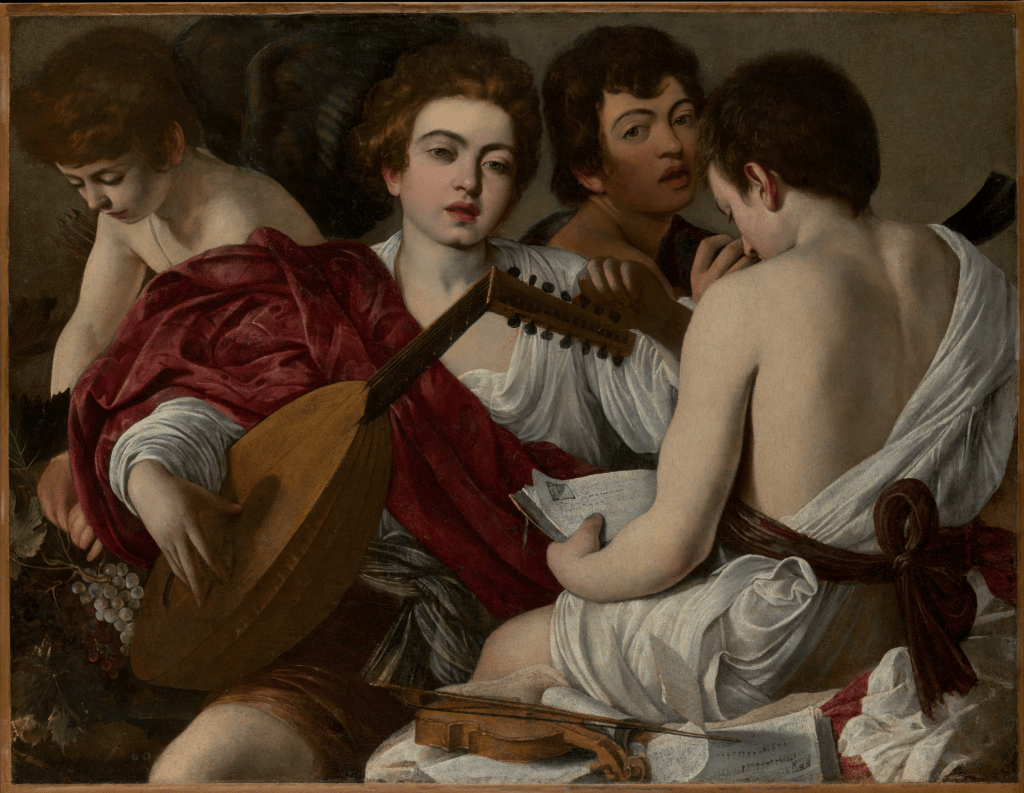
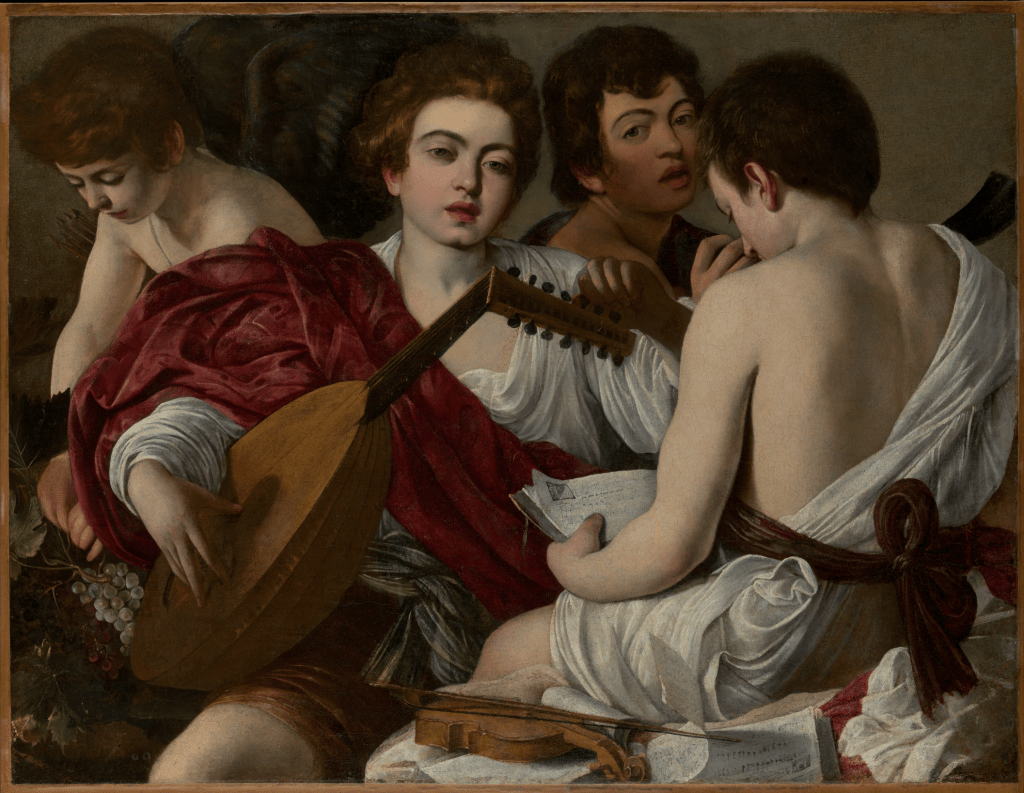
Michelangelo Merisi da Caravaggio, The Musicians, 1597. The Metropolitan Museum of Art, New York.

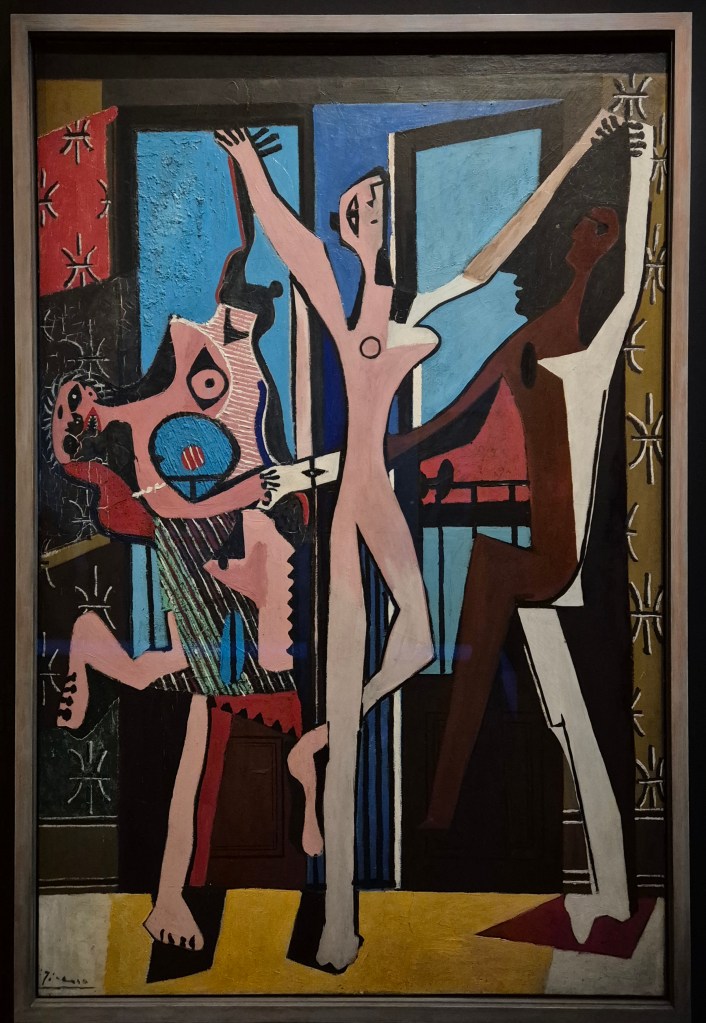
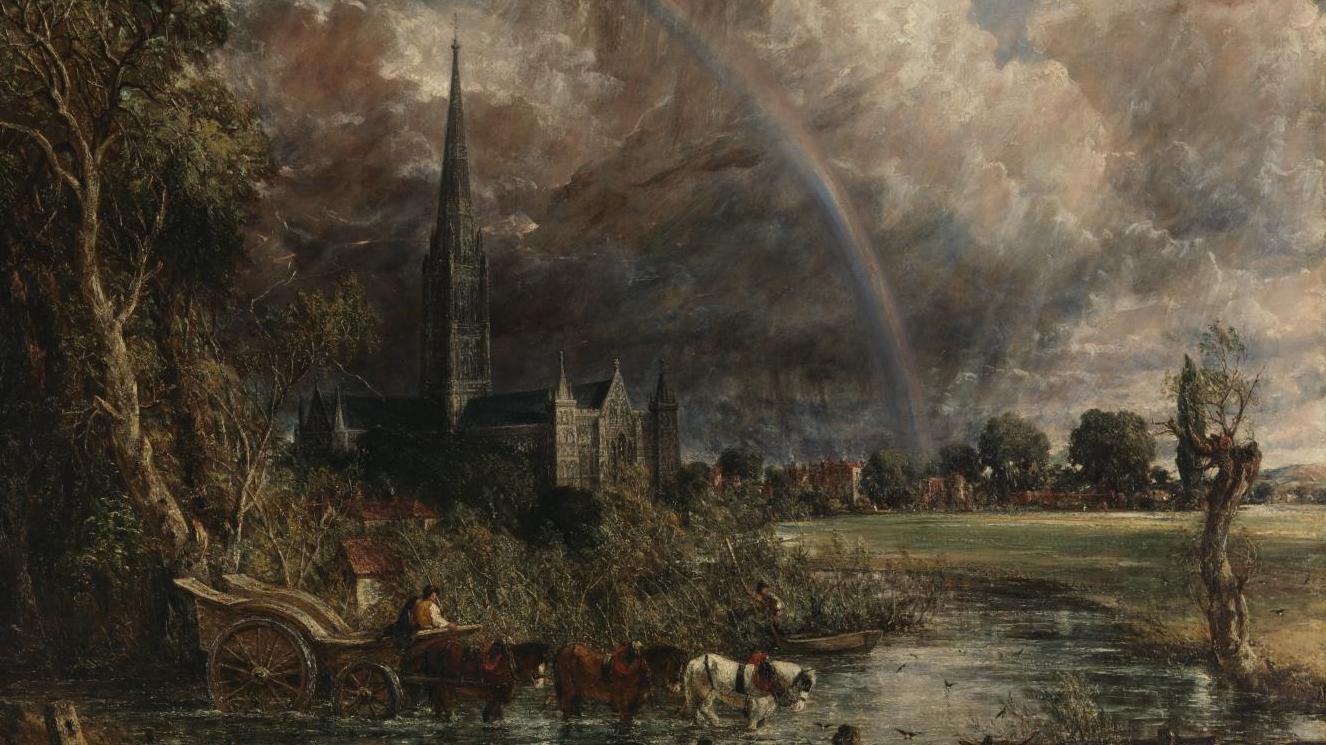
The two one-painting exhibitions in London at the moment have a lot in common, and so do the artists who are represented. Apart from anything else, music and love are major themes, and in my blog last week I quoted the opening of Shakespeare’s play Twelfth Night – ‘If music be the food of love…’ The same quotation is relevant today, so… play on! However, in Caravaggio’s Cupid, currently on show at the Wallace Collection (the subject of my talk this Monday 15 December at 6pm) love triumphs over music – and everything else, for that matter: omnia vincit amor. This is my last talk for 2025, but I’ll be back in the New Year to introduce Tate Britain’s superb show tracing the relationship and rivalry between Turner & Constable. That will be on Monday 5 January, and I’ll visit Tate Modern the following week (12 January) to explore Theatre Picasso. This truly lives up to its name: it is the most dramatically staged exhibition I have seen for years. I’ll be going to Hamburg shortly after to see the Kunsthalle’s exhibition dedicated to Swedish master Anders Zorn. He was one of a triumvirate of painterly, impressionist-inspired masters, perhaps not as well known as the other two, John Singer-Sargent and Joaquín Sorolla, but equally brilliant: I’m really looking forward to it, and to telling you all about it on 2 February. Before that, though, I want to look at another Scandinavian artist, Anna Ancher, to give you more of a chance to see her marvellous, calm and colourful paintings which are currently on show at the Dulwich Picture Gallery. I saw the exhibition earlier this week, and was completely won over. I will be talking about her on 26 January, and will get more information onto the diary as soon as I can!

Today’s painting is typical of Caravaggio’s early work, depicting half-length, contemporary figures clearly and crisply, using rich colours, and often including beautifully detailed still life elements. His subjects were cardsharps and fraudsters, fortune tellers and gullible youths, boys offering food and wine, performing or being out-manoeuvred: the vulnerable and the manipulative inhabitants of the low-life world he had come to occupy in Rome. He settled in the Eternal City in 1595 at the age of 24, having first arrived there a few years before. In this particular work there are four youths who seem more interested in us, or in what they are doing individually, than they are in each other. They are closely, almost claustrophobically arranged, a compact composition in which the figures overlap and interlock, thus making them, of necessity, a ‘group’, even if they are not currently interacting. This is demonstrated most clearly, I think, if we try and focus on the individuals. In the details that follow, I have cropped the image to include everything that we can see of each of the four figures – and have added other details in between.

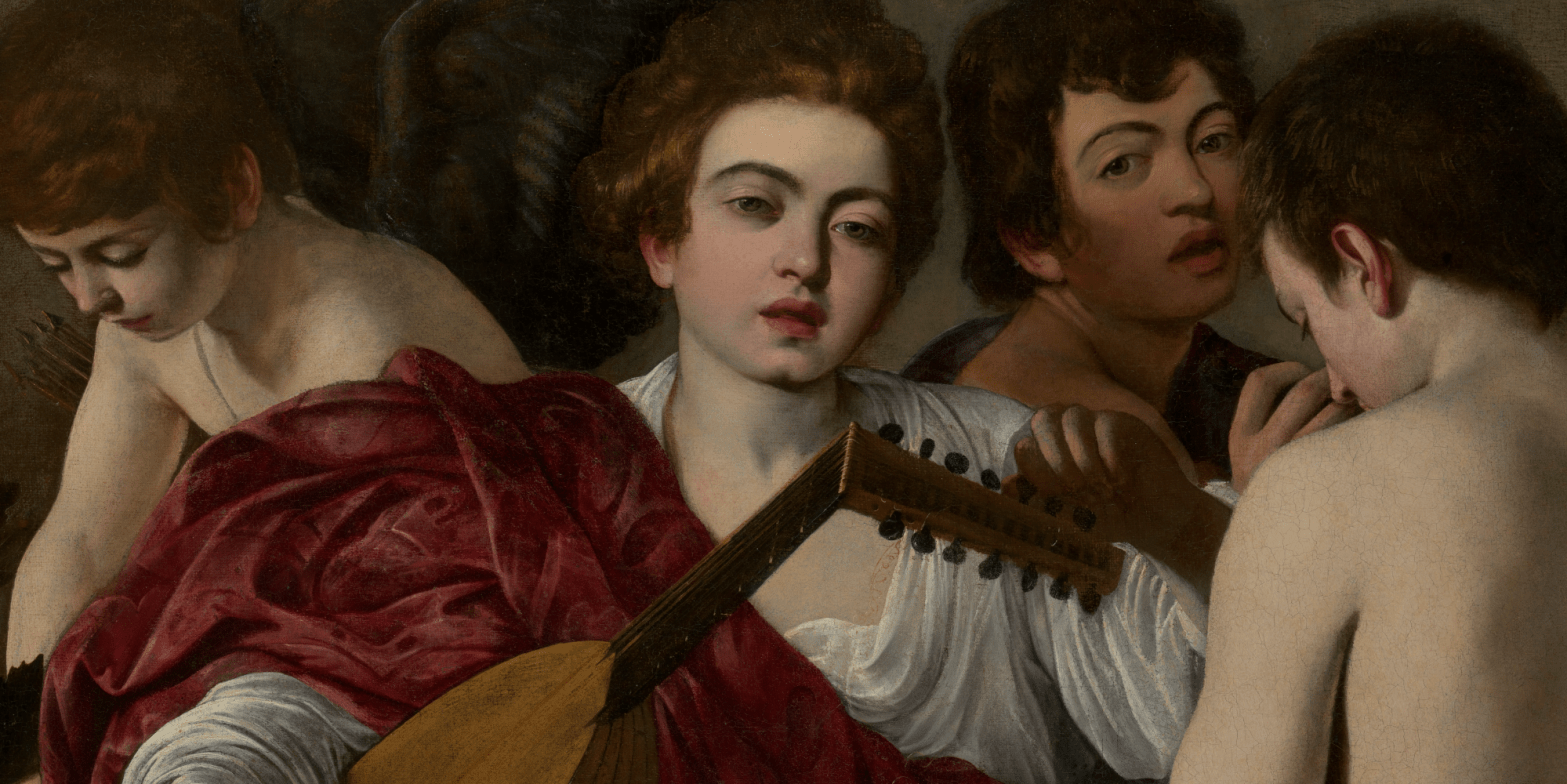
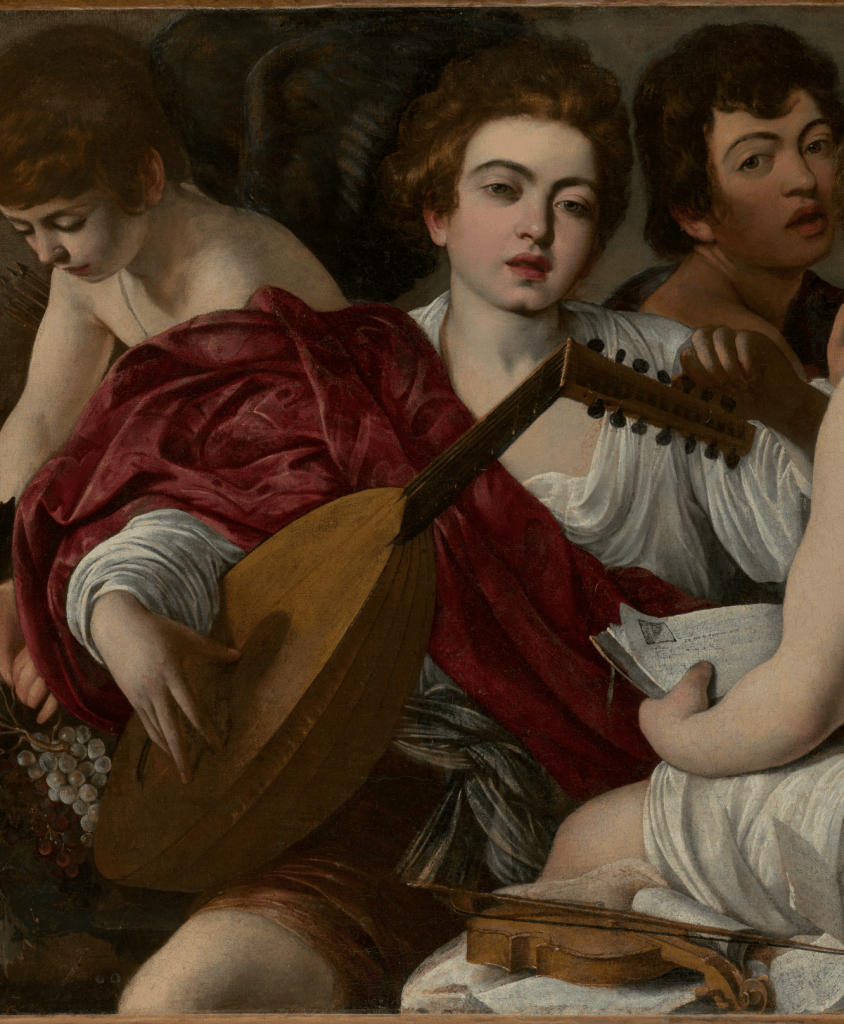
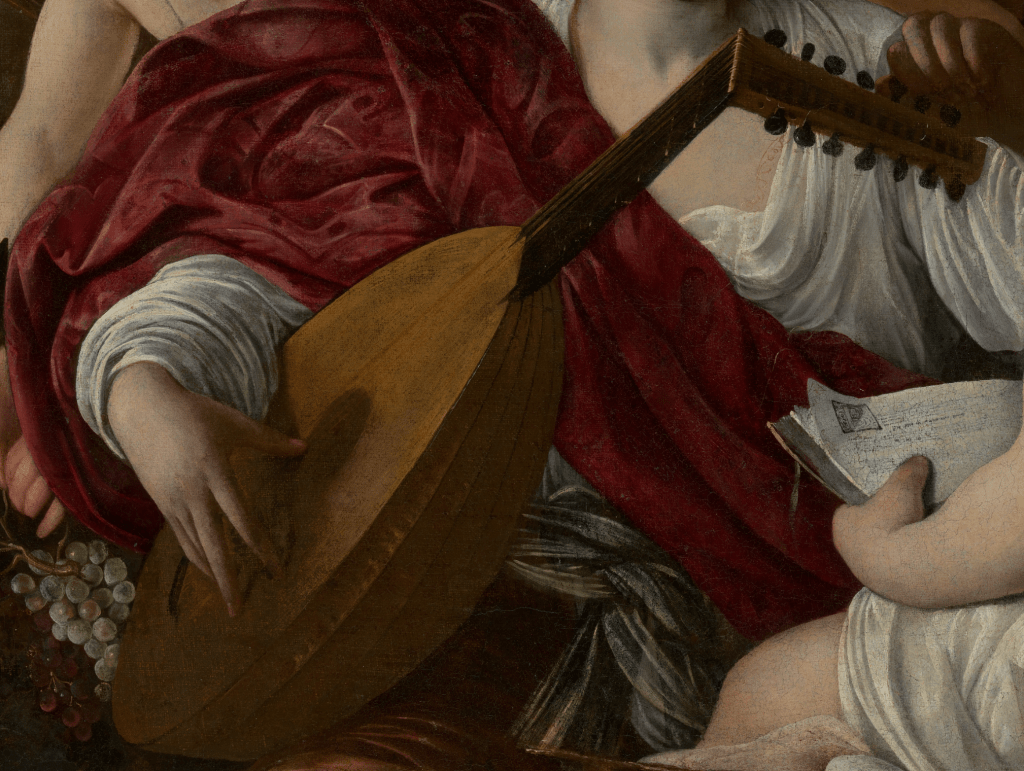
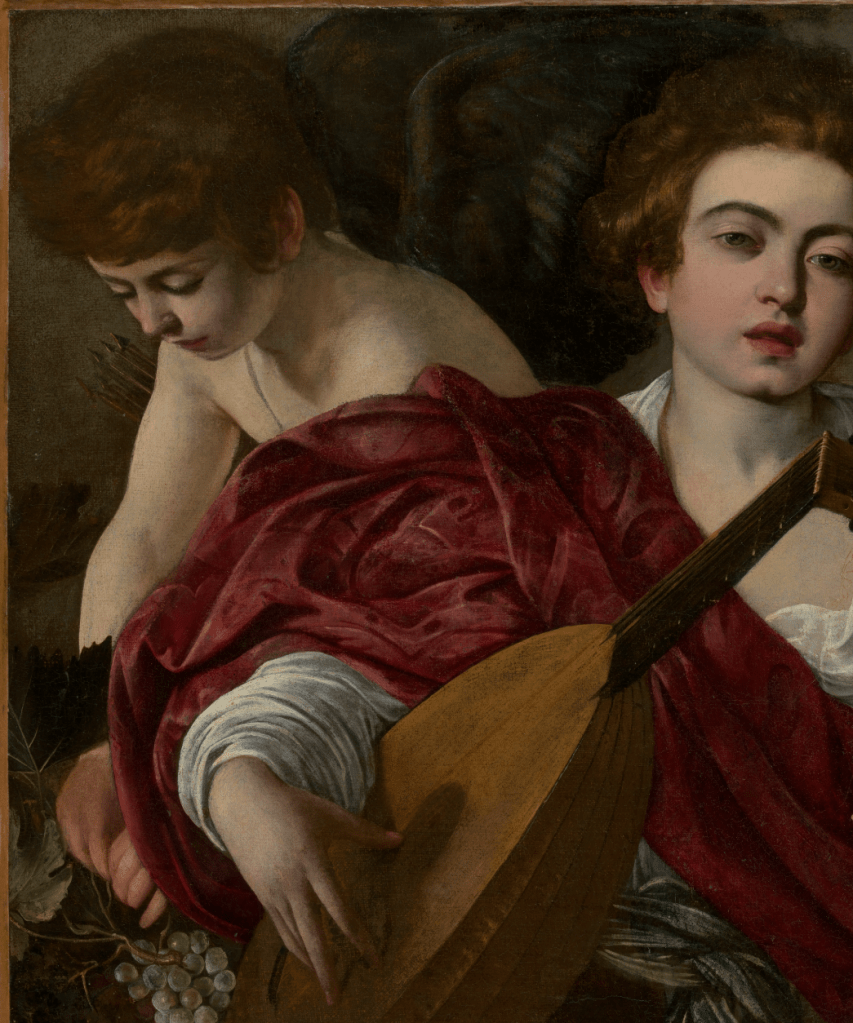
Most prominent is the lutenist. While music is clearly a major theme of the painting – these are, after all, The Musicians – no music is being played. This boy, or man – it is hard to pinpoint his age – is currently tuning his lute. His left hand turns one of the tuning pegs, while his right thumb plucks a string, the tips of his fingers resting on the teardrop-shaped soundboard. Rather than looking at his instrument, he gazes out towards the viewer – towards you – his eyes half closed and his mouth half open, a face that is totally relaxed, and either seduced or seducing. His auburn hair contrasts with dark, arching eyebrows, creating an appearance that is both unusual and arresting. We know that this is one of the first paintings – if not the first – that Caravaggio made for his patron and host the Cardinal del Monte when he became part of the prelate’s household, the Palazzo Madama, not far from the Piazza Navona. As well as being interested in the visual arts, del Monte was also an active patron of music, providing financial support for the training and performance of young castrati, the male sopranos who were an essential feature of the musical culture of the time. If this musician was one of their number, it might explain why his appearance is so arresting, and why his precise age is hard to pin down.

Technical analysis shows that his right arm was painted first, and then the full, red drapery which encompasses it was added on top. The brocade cloak, or shawl, flows over his elbow and frames his hand, its curve echoing the arch of his wrist. It fills out the figure, and broadens the form, and it is this, as much as anything else, that gives the lutenist his prominence. From his shoulder the brocade crosses his body on a diagonal, in opposition to the neck of the lute. Together they form an ‘X’ in front of his chest, the top ‘V’ of which helps to frame his sultry gaze. His left elbow is hidden behind the unclad arm of the boy on the right, while his head tilts towards that of the figure at the back.

The sculptural form of the lute is precisely defined. The soundboard catches the light entering the room from the top left, while the back, or shell of the instrument is cast into shadow, with the exception, perhaps, of the top ‘rib’. However, there is not much detail, and we can’t see all the strings. Sadly, despite its wonderful appearance, the painting is not in a very good condition. After the death of the Cardinal, the painting passed into the hands of a French collector, and was later briefly owned by another Cardinal, the famous (or infamous) Cardinal Richelieu. However, by 1675, we know it belonged to the Duchesse d’Aiguillon, as it is mentioned in an inventory of her collection. By then the canvas had been stuck to a wooden support, from which it was later removed. At either stage this may have resulted in losses to the surface, and could, consequently, explain the lack of detail in some parts of the painting (I’m indebted to Keith Christiansen’s 2017 catalogue entry for this painting on the Met’s website – you’ll have to scroll down and click on their ‘catalogue entry’ button – and, while I’m about it, I’d also recommend his Instagram feed: @keithartnature).

Despite the damage, details have survived – the subtle variation in the angles of of the fourteen pegs, and the light catching the strings passing over the end of the fingerboard, for example. There is even a beautiful and delicate arabesque formed by a long, untrimmed string, spiralling away from one of the pegs and over the lutenist’s brightly illuminated chest.

The figure at the back is also a musician: he holds a cornett, or cornetto. In case you are, like me, unfamiliar with this baroque instrument, I have included an image of a 17th century version – from the Museu de la Música in Barcelona – which I have rotated to be in a roughly equivalent position (however, they do come in many different lengths and forms). If you want to know how a cornett is played, and what it sounds like, there is a good video on YouTube made by The Academy of Ancient Music (apologies for the ad – you’ll be able to skip it after a few seconds).

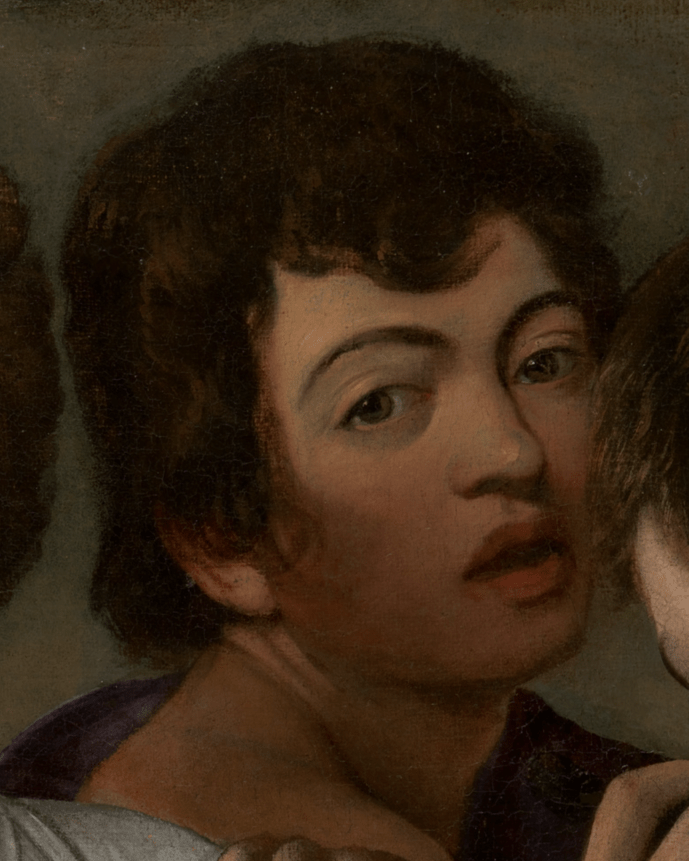
The cornett player in our painting, like the lutenist, looks out towards us with his mouth slightly open, and has similar dark, arched brows – although they are a better match with his hair. Being in the background he is also more in the shade – helping to create what limited depth in the painting there is. This is enhanced by the darkness of his hair, and the black fabric which is draped over his left shoulder (at the back) but not, it seems, his right (the shoulder closer to us). We can see the curve of this shoulder outlining the hand tuning the lute, not far from his own right hand, holding what must be a fairly short, so high-pitched, cornett. We also see the hint of a white sleeve – but that could be either around the cornett player’s right wrist, or the lutenist’s left forearm. This apparent elision of forms brings the two figures together, as does the mutual lean of their heads, tilting towards each other on the picture plane, even though one figure is closer to us than the other. The implication is that these people are in harmony with one another, even when they are not playing. I was about to say ‘even when they are not performing’, but they are definitely performing – either for us, or for Caravaggio – turning to to look at us with their mouths open and those ‘come hither’ eyes. They might conceivable be singing, but I think sighing would be more likely. Having said all of that, you may recognise the cornett player, as the same model occurs in paintings throughout Caravaggio’s career.

It is universally accepted as a self portrait. These two images may not look identical, but it’s worthwhile remembering that the artist was 26 when he painted the image on the left (although I can’t help thinking that he was flattering himself somewhat – making himself look more like ‘one of the boys’), whereas Ottavio Leoni’s drawing, a detail of which is on the right, dates from 1621, eleven years after Caravaggio’s premature death at the age of 39, when he had lived through at least a decade of difficulty. Why he should choose to put himself into this composition is not clear – although it would undoubtedly have placed him at the heart of the Cardinal del Monte’s establishment, thus making him look both cultured and sophisticated: he clearly knows about music… and love. You could even argue that he was trying to show us that he had risen above the low-life… although we know that he himself hadn’t, and wouldn’t. His paintings, however, did, becoming predominantly Christian in subject matter, and he would later show himself as an onlooker at many religious events, and even, sometimes, as a participant, as we saw last April with 221 – Caravaggio: the witness witnessed.

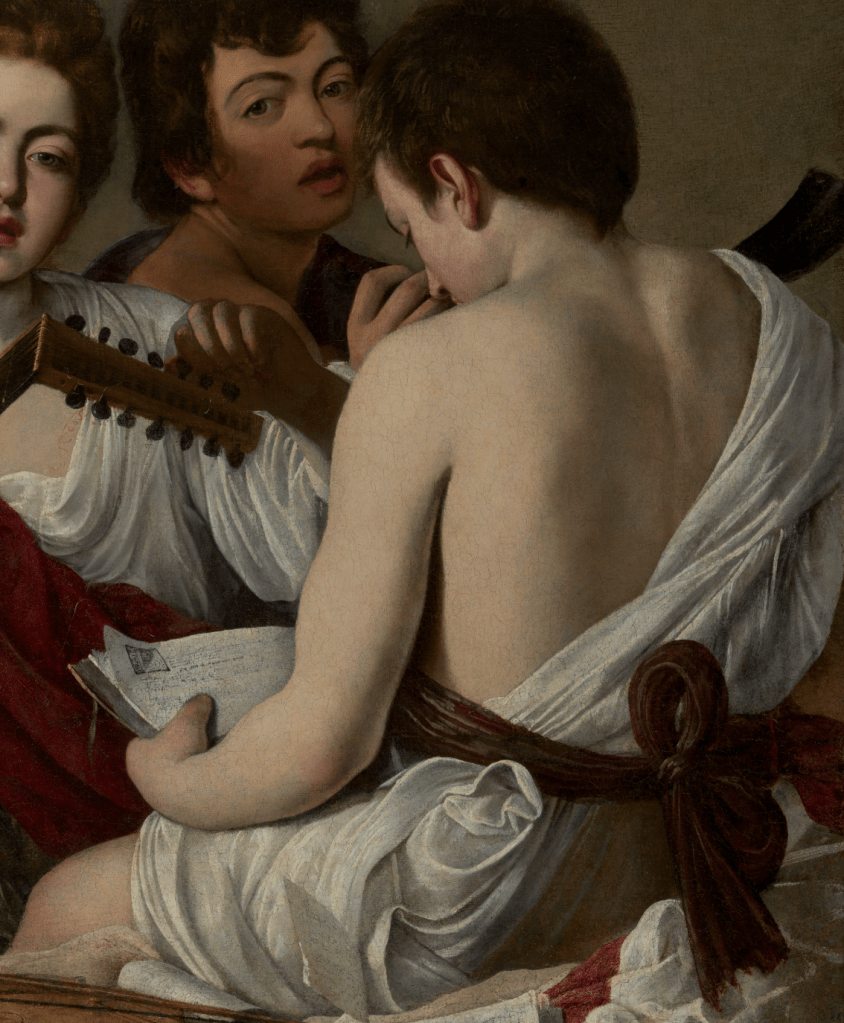
If we move on to the third character, the way in which all four are interlocked and indivisible is especially clear. Although I have cropped the detail to include everything we can see of this boy, and nothing more, we can still see all of the self portrait – cornett included – and half of the lutenist. Caravaggio painted directly onto the canvas from the live model, rather than relying on preparatory sketches, whether drawings or painted studies (none of either survive). This was one of his most remarkable innovations. However, it would be a mistake to think that he had all four people in front of him at the same time. They appear to have sat for him individually, and the precise, controlled composition slots them close together like a well-cut jigsaw. Precisely how these four figures could have occupied the three-dimensional space is not entirely clear: if this were a real space, there might not even be enough room for all of their limbs. However, until we start to question this, it is not a problem, especially given that the patterning of the surface is so good. In some ways, the composition is not unlike another form of composition: music. Primary and secondary themes play off one another, with melodies interlocking and interweaving just like these people. The character of each is distinct, although not necessarily thoroughly developed. This boy in particular is a bit of a mystery: we don’t know what he looks like, even if we can see ‘more’ of him: he appears to be wearing the fewest clothes. If we hadn’t realised before, what becomes clear from the figure in white is that, if this is a scene from contemporary life, then these models are in costume: no one has ever dressed quite like this in everyday life. He appears to have a sheet slung over his right shoulder, which crosses his otherwise naked back (which is accurately, subtly and brilliantly modelled) on a diagonal. It is tied around his waist with a thick, dark, plum-coloured sash. The boy is sitting on the edge of a box, or table, slightly higher than the lutenist, and looks down at a musical score in what I read as calm, focussed preparation.

However damaged the surface of the painting, we can tell how brilliantly crafted this manuscript was. The music cannot be read, but we can tell the difference between the thick, pinkish cover of the book and the darker edges of the pages, and then see the light catching the corners, where the top page has curled up, casting its own corner, decorated with a large letter ‘B’, into shadow.

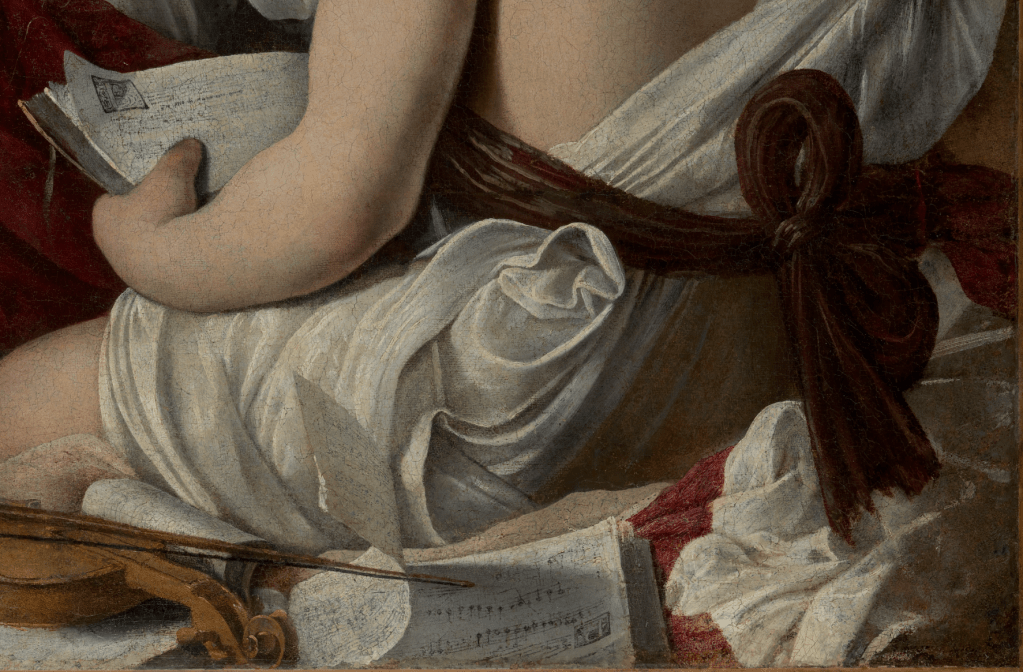
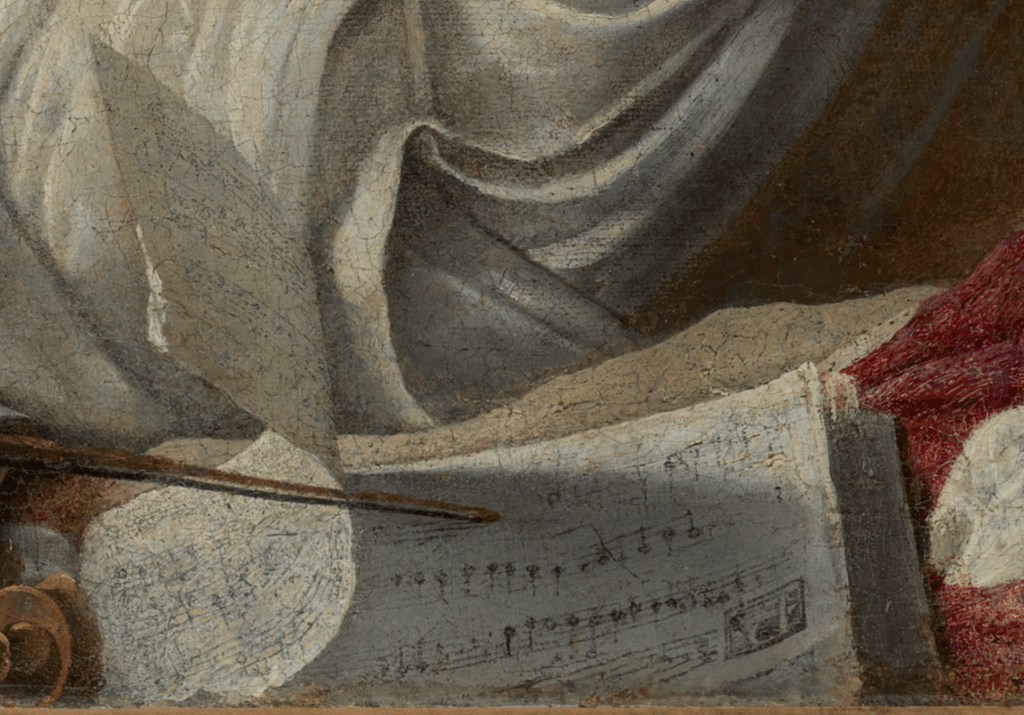
This book is just one of the still life elements in which Caravaggio both delighted and excelled in the earlier stages of his career. Another score sits on the table with a violin resting on it. They are so brilliantly conceived that I will show you more details below. The sash is tied in a bow, the ends of which appear to caress the white fabric beneath them. Bows like this occur more than once in Caravaggio’s oeuvre, and here, as in other places, it is as if we are being invited to tug on the end, and release the bow, or to toy with the loops, or the knot – but that’s probably an idea that I am transferring from another painting, Caravaggio’s voluptuous, seductive Bacchus in the Uffizi. If you don’t know it, click on that link! In our painting, the white drapery forms a turbulent swirl just beneath the belt, and wraps in numerous folds around the boy’s thigh. There is clearly enough fabric to cover his knee, but enough leg is visible to prove a point: these models are wearing less than they would normally.

This manuscript is an especially bravura piece of painting, with one page curled up, catching the light on one of the battered corners at the top, and casting shadow on the page beneath. The curl of the page mirrors the curl of the drapery next to it, and forms a counterpoint with the folds behind. Again, the music is illegible – which it may always have been – although this section was so badly damaged that a fair amount has had to be reconstructed, apparently.

The still life continues to the left with the violin – we have just seen its bow resting on the shadowed page. Caravaggio is known to have owned both a violin and a lute, and both appear in the Victorious Cupid currently on show at the Wallace Collection which we will be looking at on Monday. However, it seems too small to be a violin, certainly when compared to the lute. It could be a violino piccolo – a feature of baroque music – but it might simply be that, like the models, Caravaggio was looking at the instruments at different times, and adjusting the size according to what would work for the composition.

The still life extends to the bottom left corner of the painting, where we see vine leaves just catching the light, extending from the perfectly painted bunches of grapes above them. In between them and the end of the violin is the knee of the lutenist, who, like the boy with his back to us (is he the violinist? Or a singer?) has an uncovered knee, so close to the front of the painting that you might even think that it is in easy reach. Close to his hand resting on the soundboard – the hand that will pluck the strings – are two more hands plucking grapes.

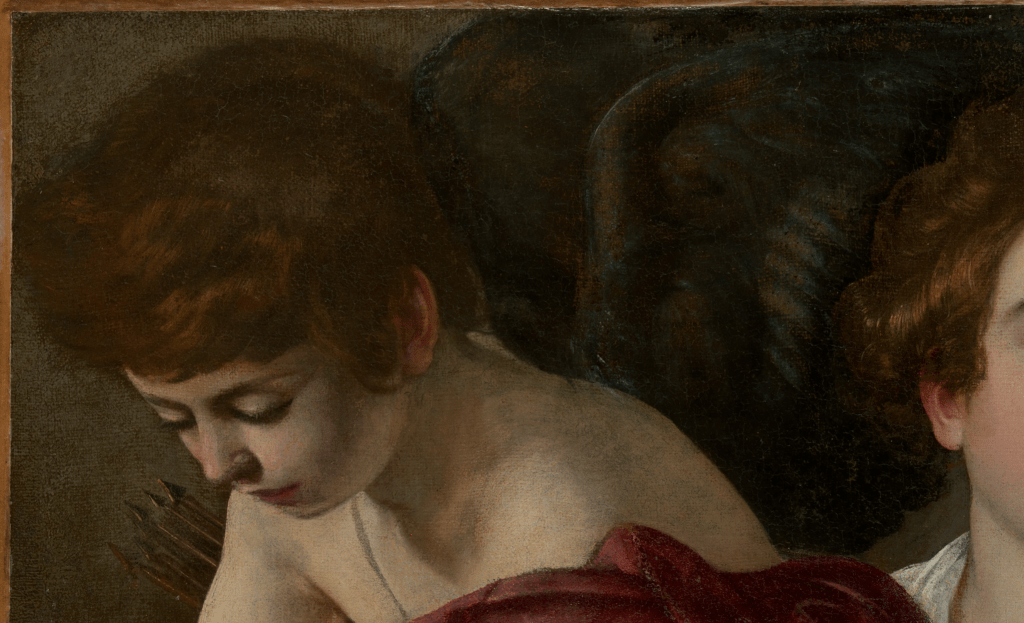
These belong to the figure who takes up the top left corner of the painting. We see almost the full length of his right arm – a vine leaf gets in the way of his wrist – and just the ends of his left fingers. We can also see his shoulders and some of his chest, but there is no evidence that he is wearing any clothes at all. But then he does have wings: is this Cupid, or another performer dressed up as Cupid? His quiver hangs over his right shoulder on a very thin thread, with the sharp points of five or six arrows projecting from behind his right arm. Apart from this very thin strap, there is no sign of any other attachments: he is not ‘wearing’ the wings, so they must be part of him. This tells us that it is the God of Love himself, Cupid. He echoes – and transposes – the pose of the figure on the right. One of them is turned towards us, the other is turned away, but each has an unclad arm fully visible, and both look down, intent on what they are doing. Both also convey a sense of innocence, in opposition to the open-mouthed worldliness of the companions they are framing.

But why grapes? One suggestion is that, if this is Cupid, then we are clearly in the world of allegory, and while the other three are musicians, they are also a representation of the idea of ‘Music’ – which is what an allegory is. Most artists at this time, when painting an allegory, would have turned to the textbook, Cesare Ripa’s Iconologia. Published first in Rome in 1593, I would suggest that this may just be too early for it to be entirely familiar in 1597. In 1603 a second edition included illustrations, which were often more influential – and we are definitely to early for that. As a feminine noun, La Musica, like so many other personifications, was seen by Ripa as a woman – but Caravaggio was never one to follow the party line. As it happens, Ripa does mention a lute and a viol (an early form of violin, which the latter ‘eclipsed’ in the 17th century) and an open score, but he also says that music should be shown with wine, ‘perche la musica fù ritrovata per tener gli animi allegri come fà il vino…’ (‘because music was found to keep the spirits cheerful like wine does’). Maybe we’re getting in there early with the grapes, which Cupid is plucking in preparation. This was Caravaggio’s first Cupid – young, innocent, busy. A few years later, and painting for Vincenzo Giustiniani, his next major patron (who lived just round the corner from del Monte), Caravaggio would produce a very different image, brash, bold, and inherently destructive. It is that Victorious Cupid which we will be talking about on Monday.

Featured

263 – Vermeer, playing with your imagination

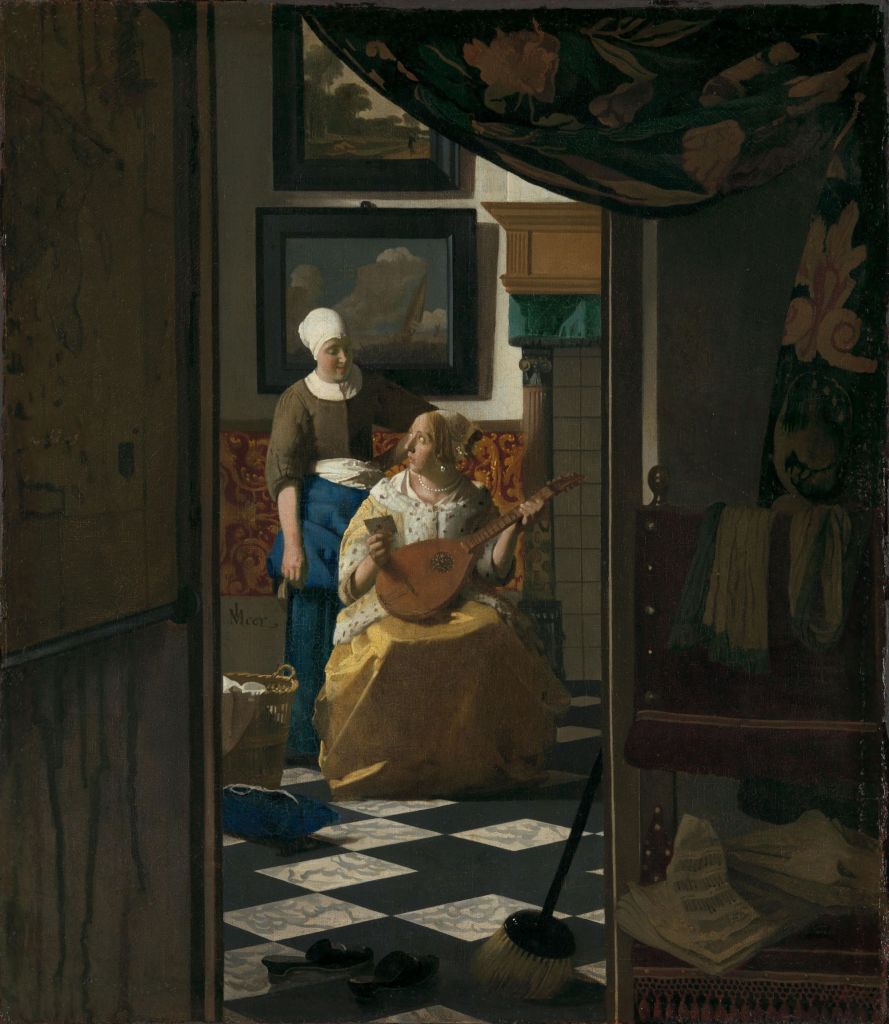
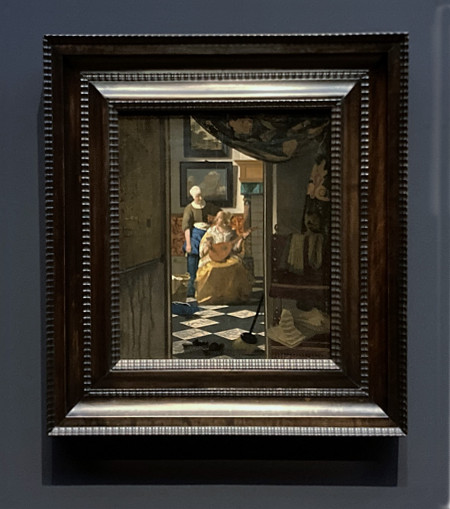
Johannes Vermeer, The Love Letter, about 1669-70. Rijksmuseum, Amsterdam.

My next two talks are dedicated to single works by two artists who had a lot in common – and yet were completely different: Vermeer and Caravaggio. They both worked in the 17th century painting religious subject matter and genre scenes, and both produced relatively few works. They died young, and were all but forgotten soon after their early deaths, only to be rediscovered in the 19th and 20th centuries, reaching an unparalleled level of popularity in the 21st. As a result, every painting by them is fascinating – and the arrival in London of even a single work associated with either of these masters is something to be celebrated. This Monday, 1 December (how is it December already?) we will start with Seeing Double: Vermeer at Kenwood. We will explore the Guitar Player in depth, taking it as a stepping-off point for a consideration of Vermeer’s career as a whole, and compare it to a remarkably similar, although by no means identical painting which is on loan to Kenwood House from the Philadelphia Museum of Art. Two weeks later, on 15 December, I will turn my attention to Caravaggio, as his remarkable Victorious Cupid will be on display at the Wallace Collection: it has never been shown in public in the UK before.

The New Year kicks off with talks introducing two Tate exhibitions, Turner & Constable at Tate Britain on 5 January and the following week (12 January), Theatre Picasso at Tate Modern. After that my sights will be set on Scandinavia, with the Dulwich Picture Gallery’s exploration of the richly coloured paintings of Danish artist Anna Ancher. At the moment I have this planned for 26 January. Just before then I’ll be heading to Hamburg to see an exhibition of the great Swedish artist, Anders Zorn. Despite giving a couple of talks about his work around five years ago, and a few visits to Stockholm, I’ve seen very few of his paintings – so I can’t wait! He was a contemporary of, and equivalent to, John Singer Sargent and Joaquín Sorolla. Like them, his works are highly painterly, with full, lush brushstrokes, and, like Anna Ancher, his paintings are vibrantly coloured with a richness that contradicts the dark and brooding notion of ‘Scandi Noir’. That talk should be on 2 February, but I’ll post more details in the diary in the New Year… if not before. Today, though, I want to look at a painting by Vermeer which has some features in common with Kenwood’s The Guitar Player. Music is one of its themes, and yet it goes by the name of The Love Letter.

Vermeer manages to give us the impression that we have stumbled on something we should not see. We’ve arrived at a doorway to witness a scene which appears to invert the standard social order – a maid lording it over her mistress. Not only that, but neither has been doing what they should, judging by the appearance of the outer room – dark, dirty and messy – not to mention the inner room, which may be well appointed, but is nevertheless showing signs of neglect.

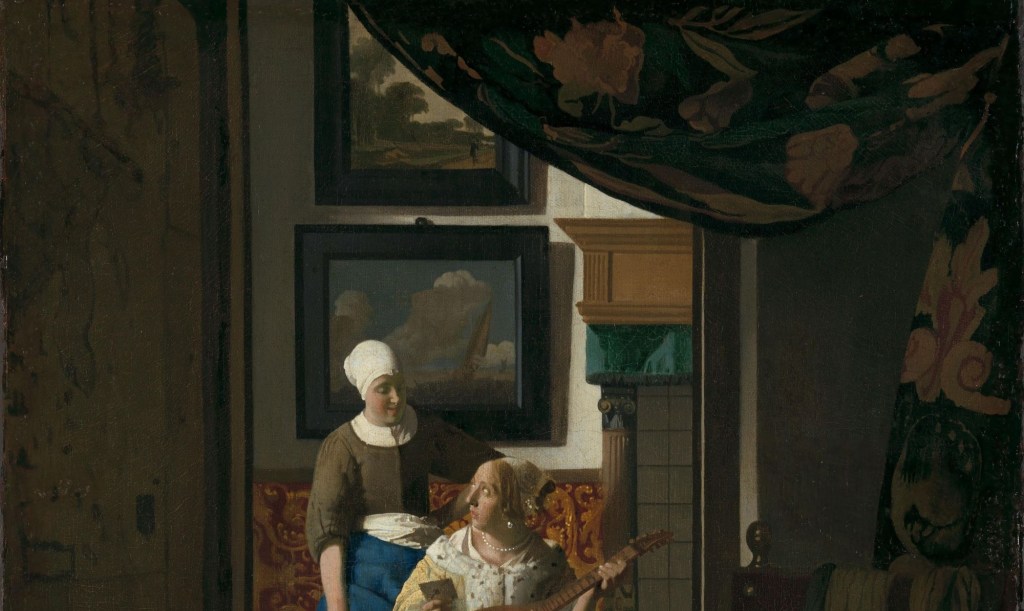
A curtain has been drawing back – and maybe it shouldn’t have been. There is a real sense of theatrical revelation though, a bit like someone sharing the gossip: ‘look what I’ve just seen…’. It is a curtain that very probably belonged to Vermeer, and he used it in other paintings, notably The Art of Painting. It’s also worthwhile remembering that some paintings were covered by curtains on rails – in part, to keep the dust off them – and sometimes artists even painted trompe l’oeil curtains to make what was being revealed appear more real, and to remind you that it was a valuable work of art by an esteemed artist. The curtain also has a classical reference, but I won’t go into that now. In this case, Vermeer is playing with both ideas – what is being revealed in the back room, and the suggestion that this is a painting that is worth looking after. On the left wall of the entrance hall – or whatever the room is – there is a map, a reference to the world outside this house. Vermeer may well have owned several maps (although I can’t see any in the inventory of his belongings), but he could equally well have borrowed them, choosing them sometimes for their significance, and sometimes, simply for their appearance. Here, I think it is a reminder that we are coming into the story from ‘elsewhere’, but also that whatever is going on in these rooms is in some way connected to the world outside this house – which is where the letter that the lady is holding must have come from.

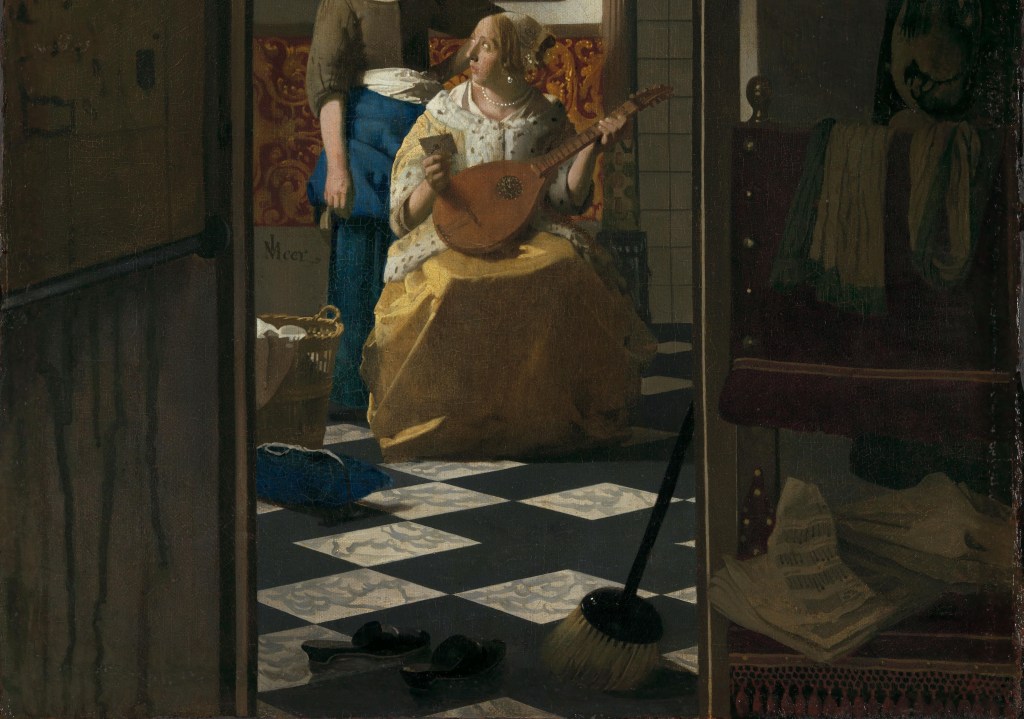
Although drawing back the curtain has revealed the inner room, the lower half of the painting is, in some ways, more revealing. For one thing, our point of view becomes apparent. On the right is a chair, upholstered in red velvet with gold trims. It is facing directly towards us, so that the front of the seat is parallel with the bottom of the painting. Our view is cut off just below the tassels along the front of the chair. The bottom of the painting probably coincides with the threshold of the adjacent room. This implies that our viewpoint is relatively high, with our supposed eye-level demonstrated by the perspective. The bottom edge of the map, and the diagonals of the diamond floor tiles, create orthogonals which continue to the vanishing point of the painting, just above and to the right of the brass ball on the chair back. Looking at the bottom of the map, though, what is most striking is the state of the wall – dark muddy drips staining the light paintwork. This is the only painting by Vermeer that I can think of in which something is actually dirty – and this is just one of the signs of neglect. The messy, crumpled paper on the chair itself, and the objects in the doorway, are others.

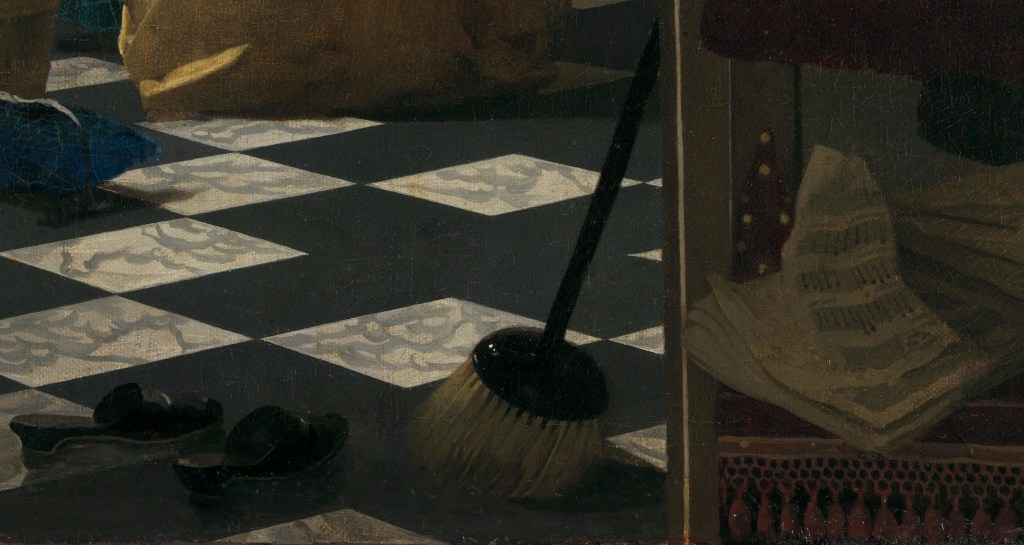
A broom leans against a wall behind the door, and two slippers are left on the floor. Between them they take up the full width of the doorway. They are not in their proper place, and nor are they put to their proper use. The household chores – and the management of the household – are apparently being neglected. The maid would be responsible for the former, and the lady of the house the latter. Maybe the lady of the house has other things on her mind… Not only that, but once you get close enough you can see that the crumpled paper on the chair is actually sheet music. Even though what is written makes no sense, musically speaking (Vermeer seems not to have been worried about that), the implication is that the harmony created by well-played music has been set aside. This might have a bearing on the state of the household: there may be discord, and disorder.

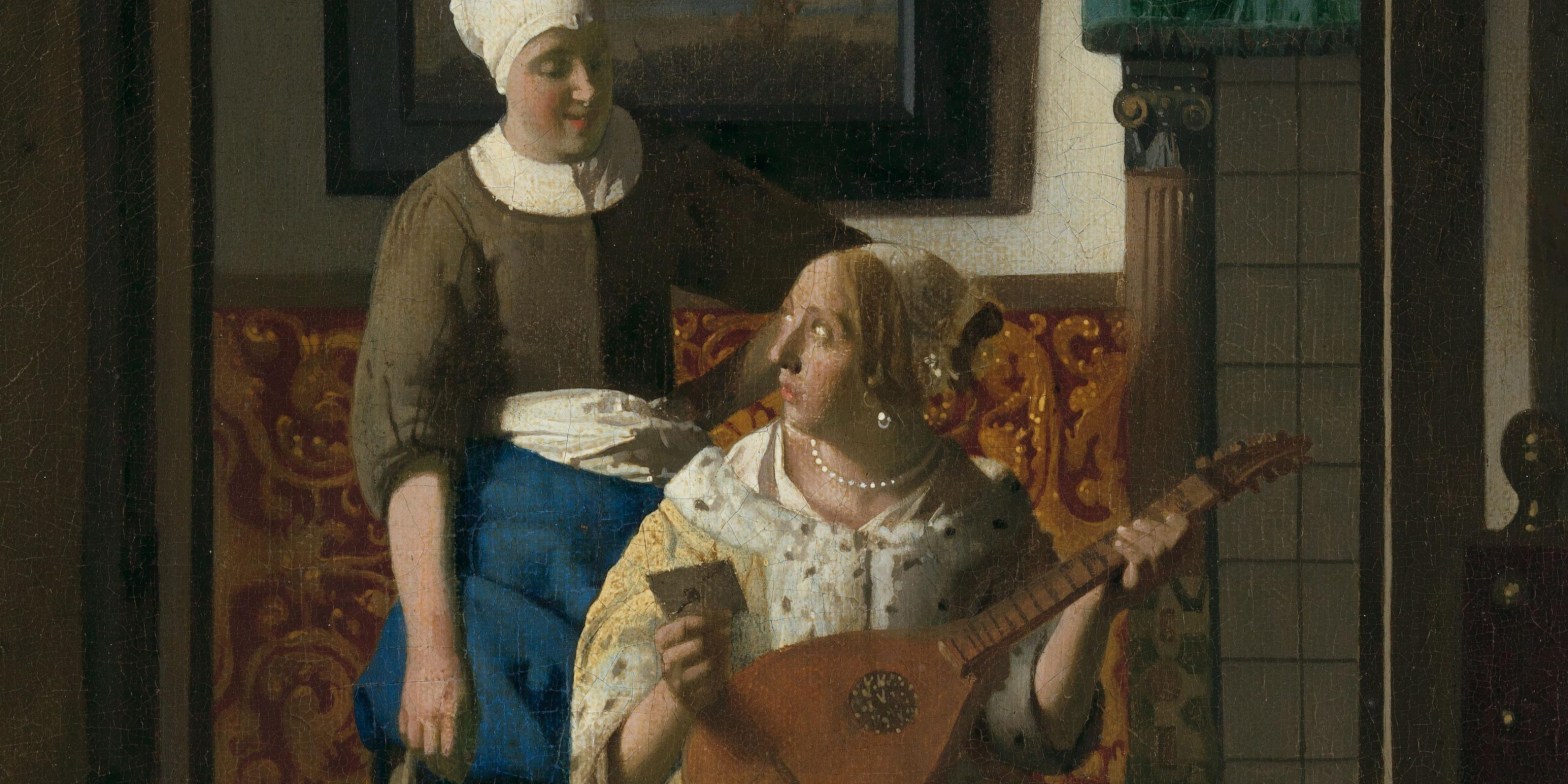
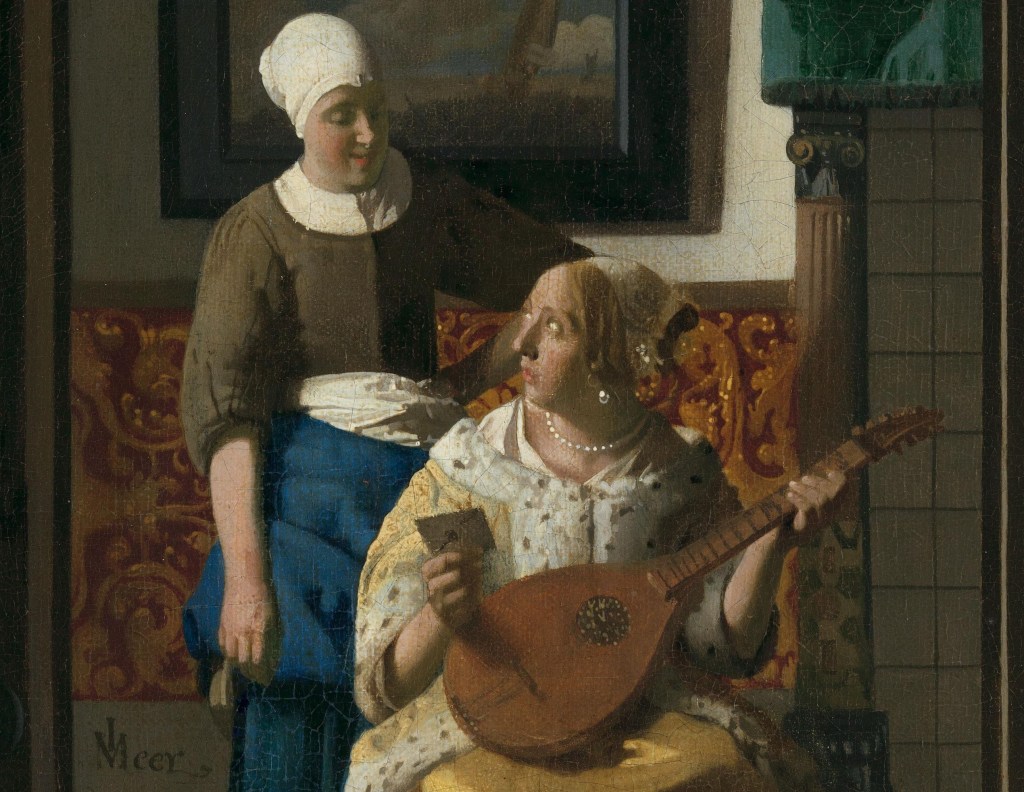
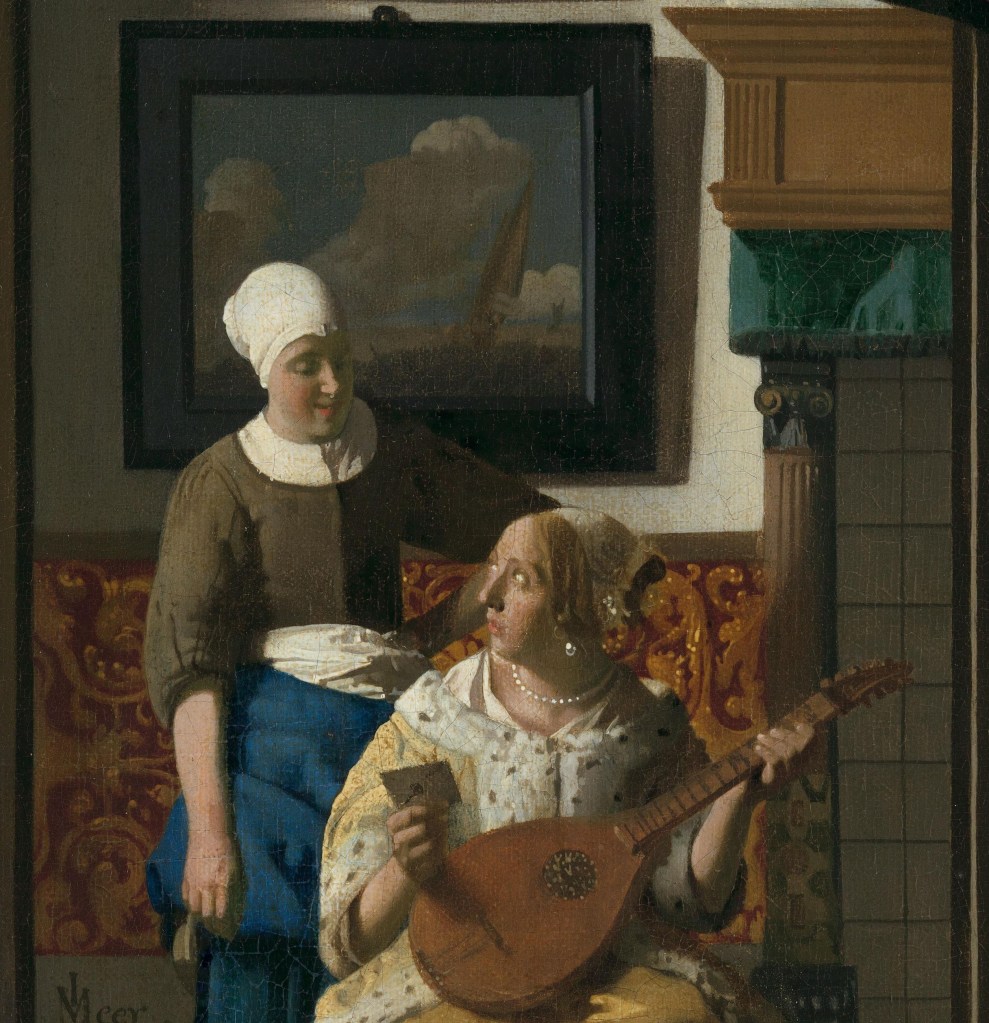
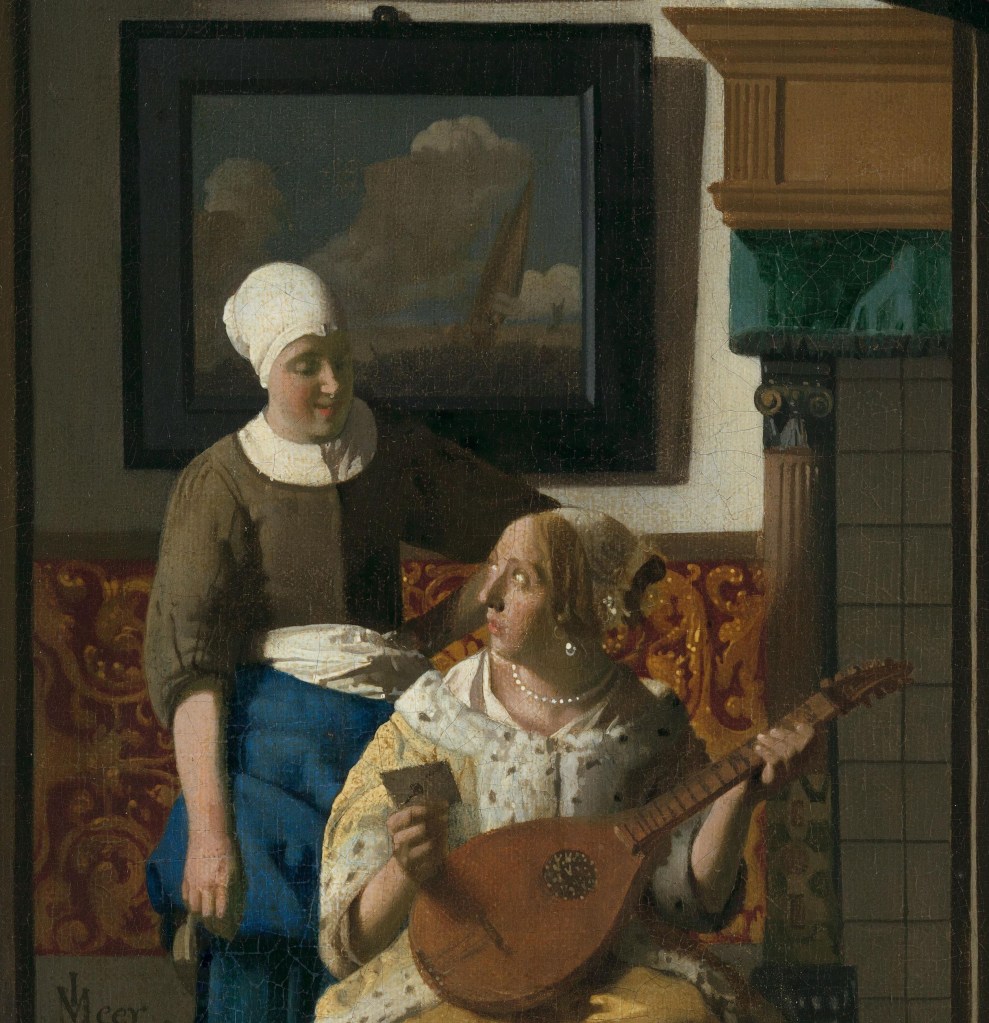
Having negotiated these obstacles to get into the room, we are in the presence of a finely dressed lady and a maid – presumably her maid. The difference in status is marked by their clothing. Whereas the lady wears a yellow satin jacket trimmed with broad bands of fur, as well as a pearl necklace and earrings, the maid has a plain brown top over a chemise, plain blue skirts, and no jewellery. However, the maid stands over her mistress, dominating her. Not only that, but her left arm is ‘akimbo’ – a pose almost always adopted in 17th century Dutch portraits by men rather than women (although there are a few exceptions). You could see this as an equivalent of contemporary ‘manspreading’, allowing the men to take up more space and so look more important. Not only that, but the maid’s headdress is quite tall, and catches the light brilliantly, thus enhancing her importance within our visual field. Nevertheless, there seems to be a good relationship between the two. We do not know what has happened – and that is one of the great strengths of Vermeer’s art. He gives us so much of the evidence we need to work out what is going on, but not everything: we can tell our own stories through his paintings, and they can all be different. The lady is holding a letter, which appears to be unopened. She looks round, and up, towards her maid – who has presumably given it to her (although we have no way of proving that she has) – and the maid looks back, her face slightly lowered, with the hint of a smile. The lady is clearly concerned, the maid, somewhat amused. Her stance is down to earth, matter of fact, though: whatever the contents of the letter (and how could she know?), it clearly isn’t going to affect her that much. However, the two are pictorially bound together. Quite apart from the fact that they are perfectly framed by the door, the top of the maid’s white apron, which we see above the blue overskirt which has been hitched up, continues along the line of the white fur trim of the lady’s jacket, tying them together visually. The upper edge of the brown sleeve on the maid’s left arm also leads to the top of the lady’s head, and the inside of the crook of her elbow is level with the top of the gilded leather panel we can see through her arm. Both coincide with the lady’s right eye: everything in Vermeer’s compositions was always very precisely planned, and extremely specific. Notice the placement of his signature at the bottom left of the detail above, for example – not stuck away in a corner at all, but conveniently close to the action.

Given the title the painting has now, how do we know it is a love letter that the lady is holding? The musical instrument is one of the clues – as is the crumpled music we have already seen.

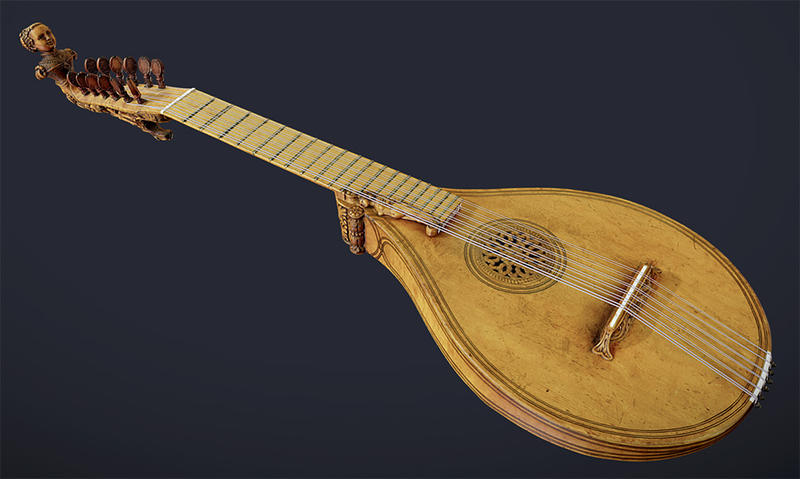
It is a cittern, as you can see by comparison with this example (from the Ashmolean Museum in Oxford), which was made in Italy around 1570, and is attributed to Girolamo Virchi. Citterns tend to have a flat back, as opposed to the rounded back of the lute, and the strings are made of metal, as opposed to the gut, which is used for lutes. As a result, they sound very different. In the interpretation of Dutch 17th century paintings this difference is important for a very specific reason: the Dutch word ‘luit’ was used as slang for the female genitalia – which can have implications for any woman holding a lute, or any man playing one anywhere near a woman… Nevertheless, the cittern is still a musical instrument, and given that we are in the 17th century, and that Shakespeare probably wrote Twelfth Night around 1601-02 at the beginning of the century, it is well worth remembering that the play opens with the lines,

If music be the food of love play on
Give me excess of it, that, surfeiting,
The appetite may sicken, and so die.

So, as likely as not, given that the woman is (or was) playing music, we are probably being invited to think that she is in love. The paintings in her room support this suggestion.

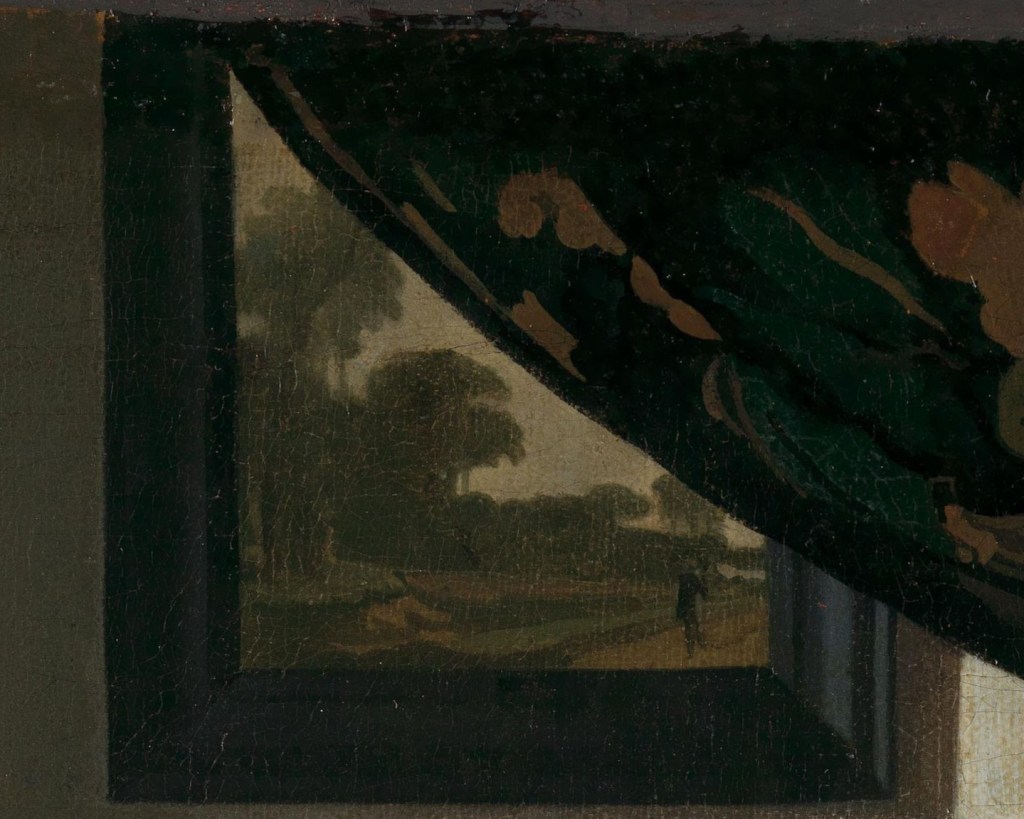
Not only has drawing back the curtain allowed us to see what is going on in the inner room, but, as this detail shows, it has also revealed most, but not all, of the upper of two paintings. I’m sure there’s not much we can’t see, as the curving line of the fabric traces the height of the distant trees: all that is hidden must be sky. This could be a version of a real painting. As we will see on Monday, it was quite common for Vermeer to use paintings he knew. Some were in his mother-in-law’s personal collection, some were by artistic associates – members of the Guild of St Luke in Delft – and some might have been passing through his hands as an art dealer. However, he would often edit them, taking just one detail, or changing their scale, according to the composition he was working on. I don’t know if anyone has ever found a source for this particular image, but I’m sure the trees have been edited to fit the curve of the curtain. It is a landscape (though in a portrait format, but this isn’t unusual), with a path or track leading towards us in the bottom right corner. There is a single figure, which I see as a man walking towards us – his two legs are distinct (a woman would be wearing a full-length skirt). I’m assuming he’s walking towards us as that was a reasonably common occurrence in Dutch landscape paintings. He is, arguably, the last thing to be revealed by drawing back the curtain, leading us to ‘dis-cover’ (quite literally) a man approaching us. This may well relate to the contents of the letter, which might inform the lady that a man is returning from the outside world.

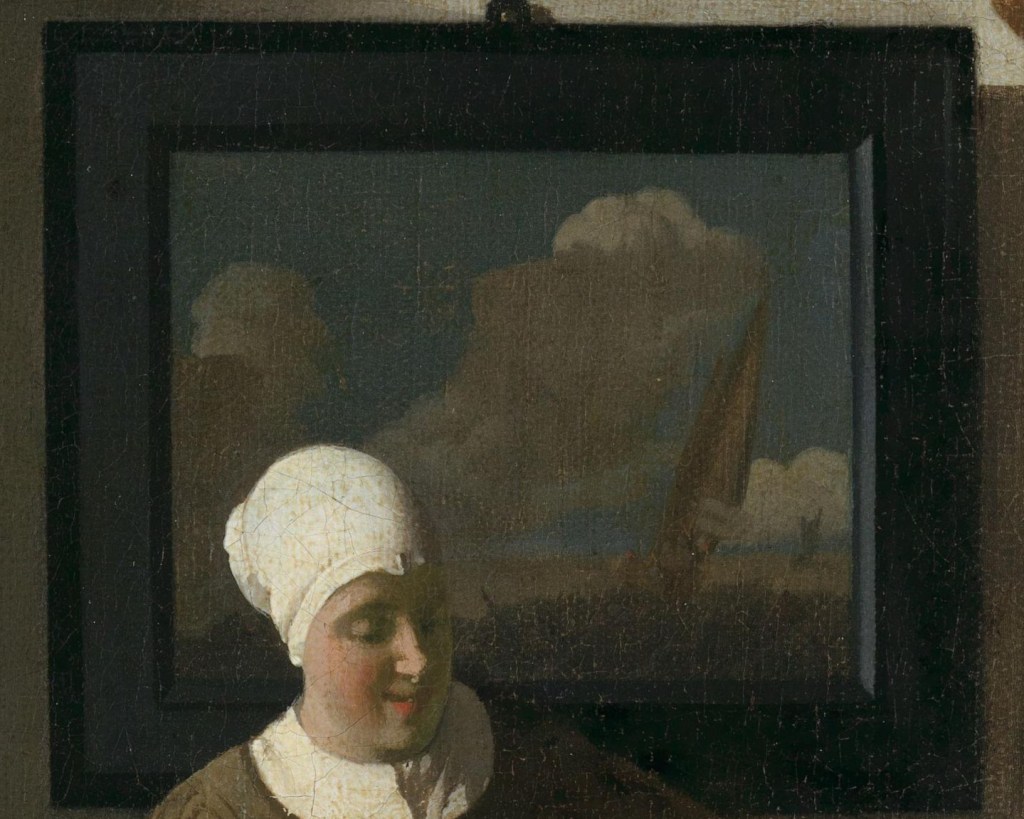
The lower painting is another common genre in Dutch 17th century painting: a seascape. Billowing clouds are seen against a clear blue sky, and are lit at the top by bright sunlight – fair weather, if windy. There is a single sailing ship approaching us, listing to port (OK, I don’t know ships well enough to tell if it is approaching us or going away – but it makes sense to me that it would be approaching, in which case I can at least tell it is listing to port… or, leaning towards the left in the direction of travel). Notice how the maid is so overtly associated with this painting: her shoulders are painted against the lower edge of the frame, so that her head is framed by the ebony surround. Her tall, rounded, white headdress catches the sunlight coming through the window of the inner room in the same way that the clouds catch the light in the painting.

Seascapes can refer to many different journeys – our journey through life, for example, or the status of a relationship: ‘Stormy weather, since my man and I ain’t together’, to quote Ted Koehler (1933). Here the sky is blue, the clouds are fluffy, and even if the sea must be rough because of the wind (the bottom of the painting is not at all clear) it does imply that the person on the ship is making a speedy journey. The two paintings suggest – to me at least – that someone is on their way home and making good time. I’m assuming it is the lady’s lover… It is not clear whether she is married or not, though. And is she really the lady of the house, or one of the daughters? Is this an accepted relationship, or a secret between her and her maid? Again, Vermeer gives us all of the clues – but doesn’t draw any conclusions. We are left to decide, and then, if we so choose, to moralise.

There is no doubt that this woman is a member of a wealthy household, though. It’s not the art – most members of the merchant classes in the Dutch Republic (who were, after all, the ruling classes in the 17th century) had paintings, and many paintings, on their walls. But the brilliant illumination implies large windows, which implies a lot of glass, which implies a lot of money. The gilded leather panel also suggests wealth, even if it wasn’t especially expensive: this example was one of Vermeer’s studio props, and also appears in his Allegory of Faith. The mantel piece was also a way of showing off your wealth, with carved columns supporting a projecting shelf. It could be carved from wood or stone, or, for the richest, fine marble. To be honest, it’s hard to tell what this one is made of – it could be painted wood, or it could be stone, but not, I think, marble: this isn’t the richest of houses. There is also a dark green satin pelmet around it to make it look more refined. One of the things that is not as expensive as it appears is the lady’s jacket, which is the same as the one worn by The Guitar Player. The original probably belonged to Vermeer’s wife, and is mentioned in the inventory drawn up in 1676, the year after the artist’s death: a ‘yellow satin mantle with white fur trimmings’ – it was kept in the ‘groote zael’, or great hall. For those of you familiar with ermine, the fur worn by members of royalty, you will realise that this doesn’t look quite right: the black spots are too large and irregular – and don’t look like the tips of tails. This is a cheaper white fur (possibly rabbit) which has been died with black spots – to look like ermine. This is the sort of information you can find in what is my go-to source for Vermeer – Essential Vermeer. People often ask me what books I recommend, but I think this website beats everything for the amount of information it covers, the detail it includes, and the number of different approaches to Vermeer and his art that it explores. I’ll see you in 2027 when you’ve finished reading it all…

Whatever its material, the mantelpiece is profoundly rectilinear, with the vertical column supporting a horizontal mantel. The paintings, too, emphasize horizontals and verticals, and are framed by the vertical door jambs. This allows us to measure the movement of mistress and maid – the former leaning to our right, the latter tilting her head to our left. Notice how these movements echo the forms of the two highest billowing clouds in the painting behind them, and how the lean of the lady echoes that of the ship, as if she too is listing in the wind.

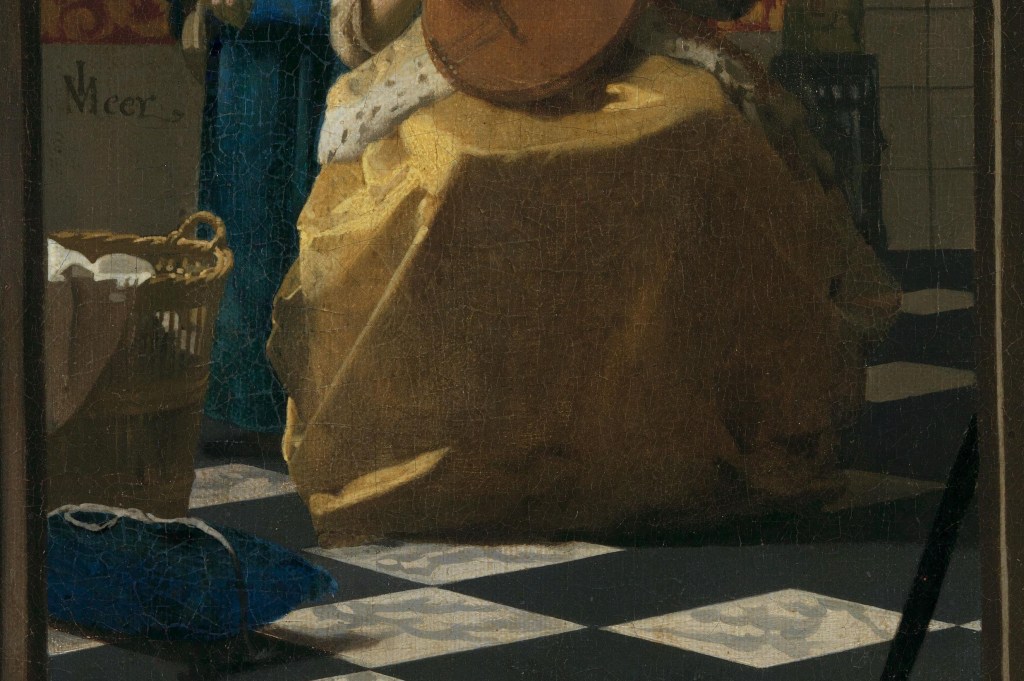
As I’ve already suggested, neither is doing what they probably should be doing. A laundry basket has been placed on the ground in what I presume is the groote zael of this house – which I imagine is not the right place for laundry. The maid could have plonked it there while delivering the letter. Next to it is a blue sewing cushion – and sewing, which implies occupying yourself in a focussed manner to put something right or to make something good, was commonly seen as indicating domestic virtue, something that every good woman should aspire to. And yet, the sewing cushion has been put aside, left on the floor (not even on a table), while the lady sits and strums. But then, If music be the food of love…

Despite the blue sky in the painting, maybe things are stormier than we think – it’s not plain sailing. The dark, dirty streaks on the wall beneath the map could have told us as much – and despite the brilliantly illuminated interior maybe the outlook is not as bright as it might appear: there could be clouds on teh horizon. But remember, this is just one interpretation – there are many others which could be equally (or more) valid. And, as we shall see on Monday, that is one of the things that keeps bringing us back to Vermeer.

Featured

262 – Stand well back

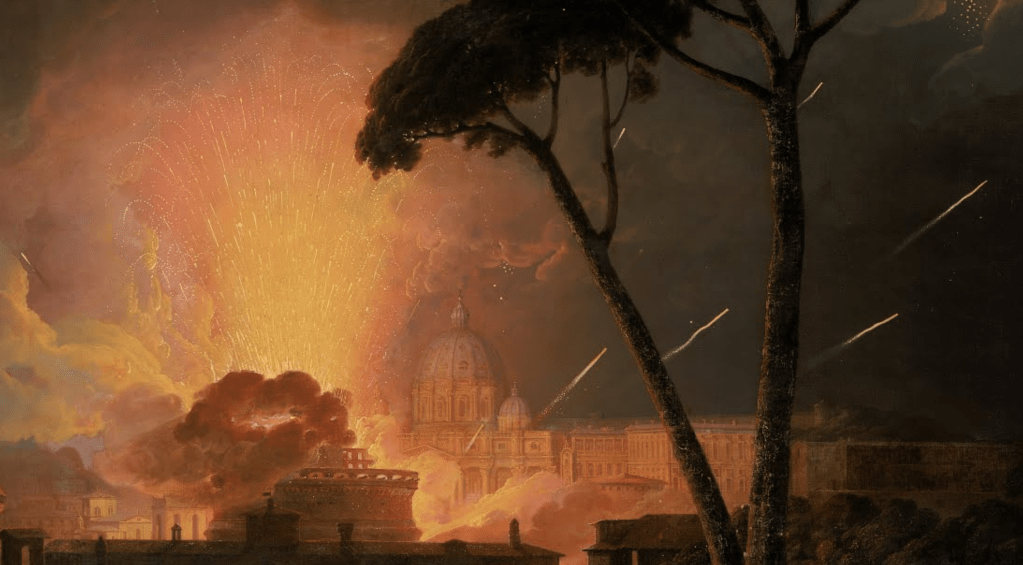
Joseph Wright of Derby, The Annual Girandola at the Castel Sant’Angelo, 1775-76. Walker Art Gallery, Liverpool.

Wright of Derby: From the Shadows – the exhibition at The National Gallery which I will be talking about this Monday, 24 November at 6pm – is one of those exhibitions which takes a small slice of an artist’s life and covers it both beautifully and thoroughly. It’s not a large exhibition, but it is very rich, and there is more than enough to look at and think about to make a visit to Trafalgar Square worthwhile even if you do nothing else. The paintings look superb, the design is perfect, and the lighting is both evocative and appropriate. To avoid cutting further into that ‘small slice’ – which in some ways I did in August with 254 – Joseph Wright, changing your point of view – today I will look at a superb painting by Wright which falls outside the range of the works in the exhibition. Nevertheless, it does use many of the techniques the artist had learnt from the ‘candlelights’ and ‘moonlights’ which are the subject of From the Shadows.

The following week, 1 December, my starting point will be the first of two exhibitions in London this winter which focus on one loaned painting, Double Vision: Vermeer at Kenwood. The second will follow two weeks later, on 15 December, when I will look at – and around – the Wallace Collection’s Caravaggio’s Cupid. These two talks will be followed in the New Year with two more which will introduce exhibitions at Tate – Turner and Constable (Tate Britain) on 5 January, and Theatre Picasso (Tate Modern) on 12 January. More news is bound to follow soon in the diary.

At first glance you might wonder if we are looking at a natural – or manmade – disaster. In the dark of night the most enormous explosion seems to have taken place, an eruption of fire amid sizeable buildings. Fortunately, though, we are at a safe remove, with two tall umbrella pines acting as a screen, letting us know how far away we are from the fire, the smoke and all the sparks: we are definitely standing well back. A dark row of buildings marks the edge of a town, or city, with the furthest building – as far as we can see so far – being a large church with a notable dome. To one side of it, palaces are lit up with the golden glow of the conflagration, and facing it a round building is all-but enveloped by smoke. Sparks fly up into the sky in all directions.

Looking closer, though, the sparks might seem a little too ‘tidy’ to result from an uncontrolled fire. It may have been obvious to you before, but all this heat and light is the result of a firework display. The concentrated energy of the upward motion of the sparks allows us to track their origin to what appears to be an open space in front of the church. As the sparks rise their colour shifts from yellow to orange as they lose their energy – both in terms of movement and heat – and their parabolic trajectory starts to be noticeable. However, there is more than one type of firework. The main column of sparks, which opens out rather like a display of tall flowers in a narrow vase, is clearly bursting up from the ground, but there are also rockets which, in this detail at least, shoot along diagonals behind the trunks of the pines. The smoke which envelops the circular building would also appear to have developed from the base of the firework display.  

Getting closer still another thing becomes more obvious (although to some, again, it may have been obvious before). We are in Rome – or near Rome, at least. The church is none other than St Peter’s, and the round building in front of it the Castel Sant’Angelo. To the right of St Peter’s is the ‘Loggia di Raffaelo’, decorated by the great renaissance master, but almost completely inaccessible to the public today.

The top floor is open, supported by a row of columns (although it has now been glazed, to protect the frescoes), whereas the floor below has an arcade, with each arch framed by pilasters. Compare and contrast the above: I think it’s fair to say that Joseph Wright has been pretty accurate in his depiction – although he has heightened the drum of Michelangelo’s dome.

Accurate, that is, until you think about the relative locations of St Peter’s and the Castel Sant’Angelo. The latter is far closer to us in the painting – so it should appear to be far larger, potentially even blocking our view of the basilica, given the distance between them. However, Wright clearly wants us to see both: he wants us to know where we are. Given the angle of the rockets, they would appear to be flying out from the Piazza San Pietro, inside the enclosing arms of Bernini’s colonnades. However, the title of the painting tells us that this is not the case – the girandola was taking place at the Castel Sant’Angelo. Apart from the rooves of this structure, and the land immediately around it, there wasn’t much more open space in this part of Rome in the 18th century: the dramatic avenue leading from the Castel Sant’Angelo to the Piazza San Pietro – the Via della Conciliazione – was only started in 1936 on the orders of Mussolini. It involved the destruction of a row of buildings between two narrower streets to create the impressive width of the avenue, which wasn’t completed until 1950. There is no evidence of these buildings, or of the distance between the castle and the basilica, in Wright’s painting, though: this is a topography that depends on the ‘symbolism’ of notable buildings rather than on geographical accuracy.

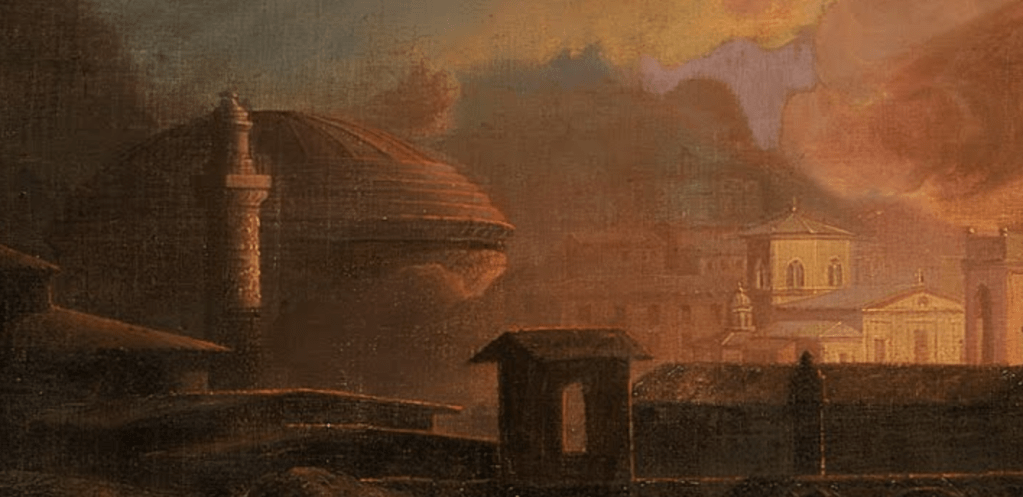
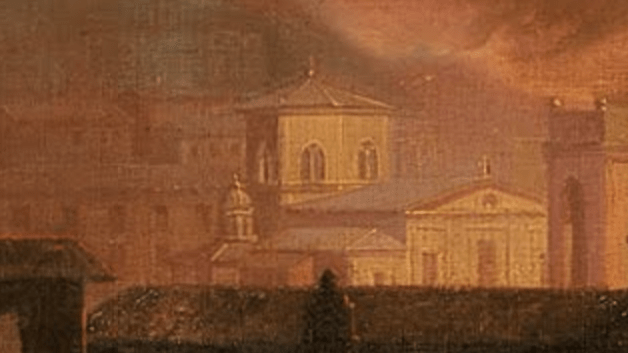
The same is true further to the left. What stands out is the dome of the Pantheon, resting on its cylindrical walls. Standing a little closer to us is a column, with specks of light reflecting from its surfaces, suggesting that they are highly decorated with sculpture. This must be one of the two columns in Rome with spiralling reliefs. The assumption, in the texts that I have read, is that it is Trajan’s Column, probably because it is the more famous of the two (just to make the point, there is a plaster cast of the entire thing in the Victoria and Albert Museum in London). However, the Column of Marcus Aurelius would make marginally more sense. Looking from the right place on the Pincian Hill the Castel Sant’Angelo would appear to be to the left of the façade of St Peter’s, and the Pantheon would be off to the left – but far further off than Wright has suggested. You might even be able to find a place where the Column of Marcus Aurelius appears in front of the Pantheon – but it wouldn’t be the same place: this may be an amalgam of different views from the Pincian, with the buildings out of scale to allow them to be identified, and visible. However, this suggestion is thrown out of kilter by a building that could be a church with an octagonal ‘dome’ – although the structure is really a broad lantern with sections of a sloping roof. I think this is the Ospedale di Santo Spirito in Sassia. Again, compare and contrast:

On the façade Wright has painted the standard tripartite division of a church, whereas the building is divided into four – an early Renaissance ‘error’ in the revival of classical architecture, perhaps. It could be that he was making assumptions about the way in which such a gable-ended building is usually structured. I don’t know any other buildings in Rome with this sort of octagonal lantern, although they may have been altered, or hidden, since the 18th century. The gothic tracery of windows of the Ospedale’s lantern do seem very close to what Wright has depicted. If this is the Ospedale, though, it is at the Tiber end of the Via della Conciliazione – Mussolini’s 1930s avenue – and so not far from the Castel Sant’Angelo. It is nowhere near the Pantheon or either of the two columns. What Wright has painted is not an accurate cityscape, but a genre of painting known as a Capriccio – an imaginary landscape (or cityscape) ‘cutting and pasting’ known buildings – or invented ones – into a ‘capricious’ arrangement. It is a fantasy, a scrapbook of known monuments. However, the occurrence he is depicting – La Girandola – was a matter of historical fact.  Here’s another, more topographically accurate version of a similar occasion – or possibly even the same one – that Wright painted at about the same time (1776), which is now in the Birmingham Museums and Art Gallery: Firework Display at the Castel Sant’Angelo.

The Girandola of the title was a mechanism for mounting fireworks. They were set into a circular structure, and aligned in such a way that the force of the rockets firing out of it caused the entire thing to revolve – like a Catherine wheel, or pin wheel firework, but on a far larger scale. It took place annually – as the title of the painting suggests – on Easter Monday, but there could also be a girandola to celebrate the inauguration of a new pope. Wright left England on his own version of the Grand Tour in 1773, and was in Rome from 1774 to 1775. He would have been there for the conclave which elected Pope Pius VI in February 1775, but it seems far more likely that he witnessed the girandola of Easter 1774. On returning to England he would have used sketches he made in Rome, together with his memories of the event, to complete the paintings, adding in more or less artistic license along the way.

In both cases – the paintings in Liverpool and Birmingham – he paired the image with an equivalent of Vesuvius erupting. Although he did travel south to Naples to see the volcano, which was going through what is termed an ‘eruptive sub-cycle’ in the 1770s, it is very unlikely that he witnessed a ‘major’ eruption – although you wouldn’t know that from the paintings. He was an artist, after all. The pairing was quite deliberate – fireworks from the earth compared with handmade eruptions, or, to put it in his own words, “The one the greatest effect of Nature, the other of Art that I suppose can be”. Both would have been considered manifestations of the Sublime, defined by Edmund Burke in 1757 as the experience of encountering something that inspires awe, terror, and astonishment, producing the strongest emotions the mind can feel, saying that ‘whatever is in any sort terrible or is conversant about terrible objects or operates in a manner analogous to terror, is a source of the sublime’.

Fireworks are, of course, dangerous, hence the instruction I remember from my childhood to ‘light blue touch paper and stand well back’. I suspect that the people operating the girandola may not have been given this luxury – nor was ‘health and safety’ a consideration for the people lowered by rope from the lantern of the dome of St Peter’s to light all the candles you can see illuminating it in the background of the Birmingham painting. The candlesticks are still there: you can see them if you look over the balcony of the lantern of St Peter’s to this day (but only on the side facing Rome).

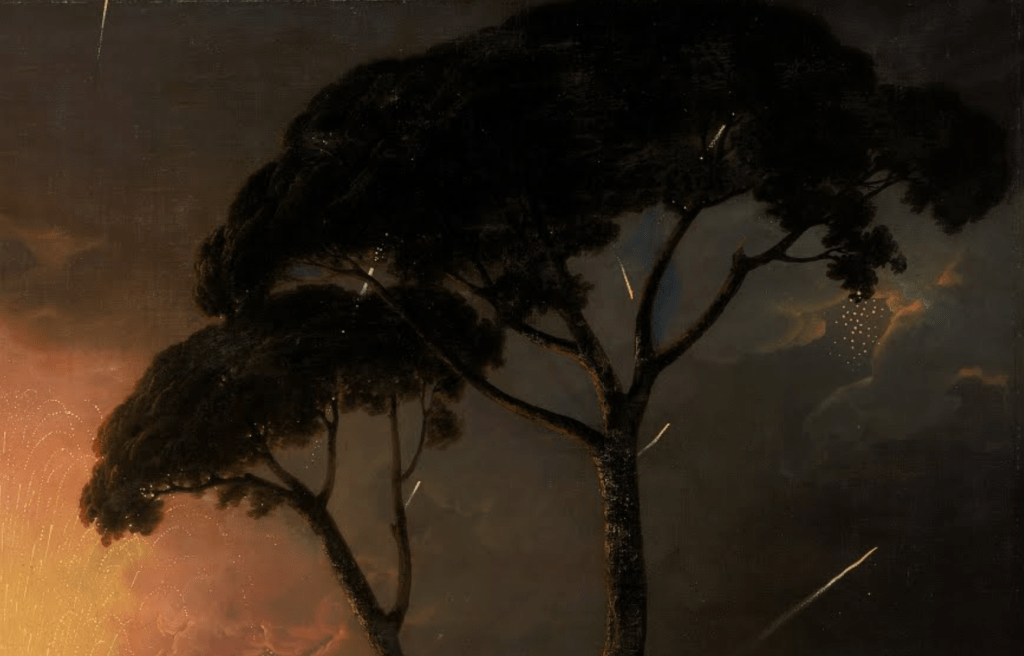
In both paintings, though, Wright clearly was standing well back. For the Liverpool version he imagined himself to be far enough away to allow him to include the two umbrella pines – even if experience would suggest that he probably invented the entire foreground landscape. As I said above, the pines create a dark screen against which the strength of the brilliant illuminations can be measured, and they also allow us to trace the almost random path of the rockets – one of which has exploded, illuminating the edges of nearby clouds. They also encourage us to look into the depth of the painting, thus acting as a form of repoussoir.

And yet – as this detail suggests – even this far away may not be far enough: a rocket is landing at the foot of the pines, in the foreground of the painting. This would surely induce anxiety in the minds of anyone physically present – but safe as we are at home, looking at our screens, or in the comfort of the art gallery, it need not concern us too much. This too is part of the experience of Burke’s ‘Sublime’ – the knowledge that such awe and terror exist, and yet, we need not be afraid: we get the thrill, but not the danger. It even allows us a space to enjoy the fear – not unlike watching a thriller on T.V. The British, in particular, seem to love a good murder – just think about Agatha Christie or Arthur Conan Doyle – maybe (just ‘maybe) this is the heritage of the Sublime gradually bubbling away… The paintings in From the Shadows are, on the whole, more domestic, and might not, at first glance, appear to produce that much of a threat. But the size and scale of the solar system, or the inevitability of death, are nevertheless bound to present an undeniable sense of awe… as we will find out on Monday.

Featured

261 – Joining the dots

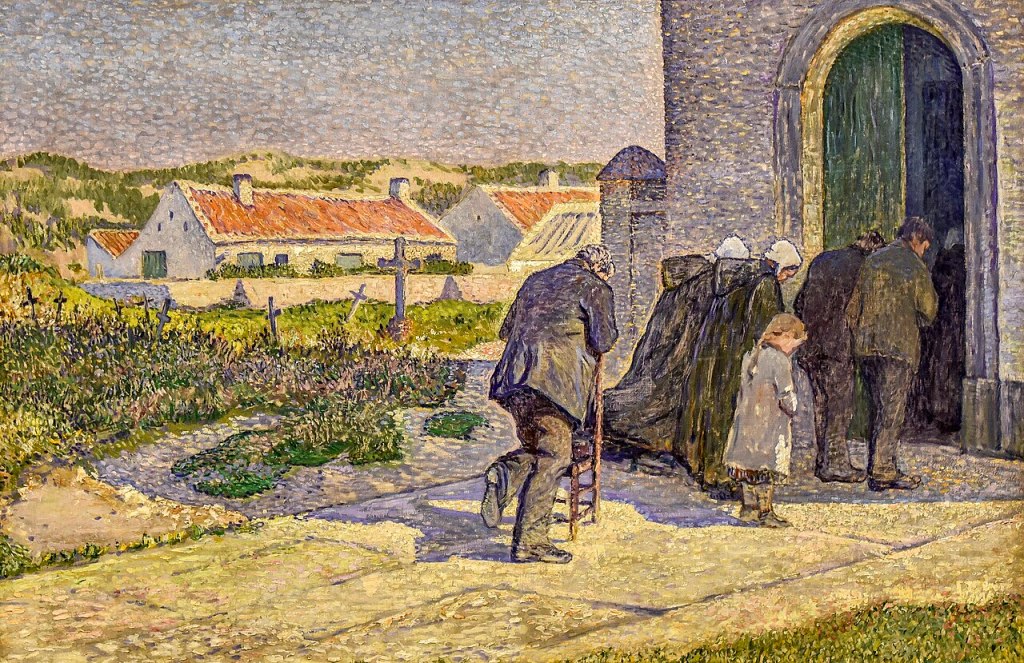
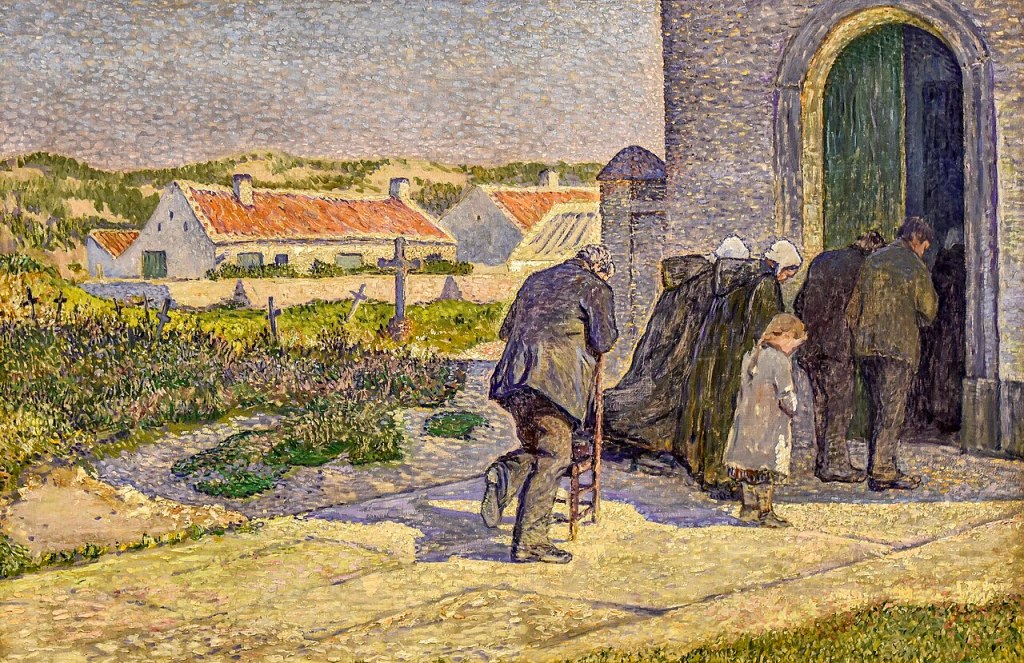
Anna Boch, During the Elevation, 1893. Mu.ZEE, Ostend.

I confess that I have never visited the Kröller-Müller Museum in Otterlo, despite the fact that it has the most extraordinary collection of paintings: before the opening of the Van Gogh Museum in Amsterdam, for example, this was the best collection of his work. The majority of the paintings in the National Gallery’s sparkling exhibition Radical Harmony: Helene Kröller-Müller’s Neo-Impressionists come from there, and have been loaned as the result of a major expansion. Having seen the exhibition – which I will be discussing this Monday, 17 November – I am keener than ever to go: a stunning building, in extensive parkland far from the madding crowds, with one of the best collections of early modernist paintings – I can’t think why I’ve waited so long! More of that on Monday, though. The following week, on 24 November, I will return to the National Gallery to see the truly illuminating (and beautifully lit) exhibition Wright of Derby: From the Shadows. This will conclude the first part of my 2 + 2 + 2 series – two talks about exhibitions at the National Gallery, two talks on exhibitions inspired by the loan of a single painting, and two on shows at Tate. Next up will be Double Vision: Vermeer at Kenwood on 1 December and Caravaggio’s Cupid (at the Wallace Collection) on 15 December. Tate Britain’s Turner and Constable and Tate Modern’s Picasso Theatre will follow in January – keep an eye on the diary for more information. Meanwhile, back to Radical Harmony.

It is a sunny day, with bright light flooding the path which leads from the bottom left corner of the painting to a shadowy building located in the top right, thus creating a diagonal which also draws our eye into the painting. The building, and the people outside it, cast purplish shadows along an opposite diagonal. These people appear to be approaching the large, half-open doorway with their heads bowed. As this is a painting they do not move, of course, but other details suggest that they are not moving anyway: a child has her feet placed firmly on the ground next to each other, and a man leans over a chair, his right knee resting on its seat. The heel of his right foot falls on the central vertical axis of the painting, and this, like the gentle diagonals, helps to create a sense of harmony and balance across the painting. This order is enhanced – subconsciously perhaps – by the placement of the building. The bottom of the wall is located roughly a third of the way up the right-hand edge, while the left side of the wall is just over a third of the way from right to left.

There is nothing about the architectural detailing to tell us that this is a church. The dappled walls are a purplish grey – not that dissimilar in hue to the shadows on the ground – while the inner edge of the door frame, which is catching the sunlight, is built up from dashes of a cream-coloured paint. There are flecks of this same light colour among the darker shades of the purple-grey walls. It is clearly a large building – the door is nearly twice the height of the people outside – but there is no decoration, no ‘symbolism’, to tell us that it is a church. So how do we know? In part, we rely on the behaviour of the people depicted: they bow their heads in reverence. Of course, the title also helps: During the Elevation. This is a key moment during the Mass: it is during the elevation of the host, when the priest ceremonially lifts the communion bread, or wafer, above the altar, that transubstantiation takes place. In Roman Catholic belief this means that the bread becomes the actual body of Christ. Hence the reverence: God is imminent, physically present among these people. So strong is the faith of this devout community that the church is full, and people remain outside. One of the large, green shutters of the door has been pushed open to reveal the shadowy interior, but all we can see is a dark grey rectangle, and the indistinct form of a woman near the door who is wearing what is presumably the same sort of dark, hooded cape and white headdress worn by the two women stood next to the child outside. It is not clear why the man at the back of the group has a chair – but maybe he cannot stand for the full duration of the Mass. Nevertheless, he is standing at this significant moment, having turned the chair around for support.

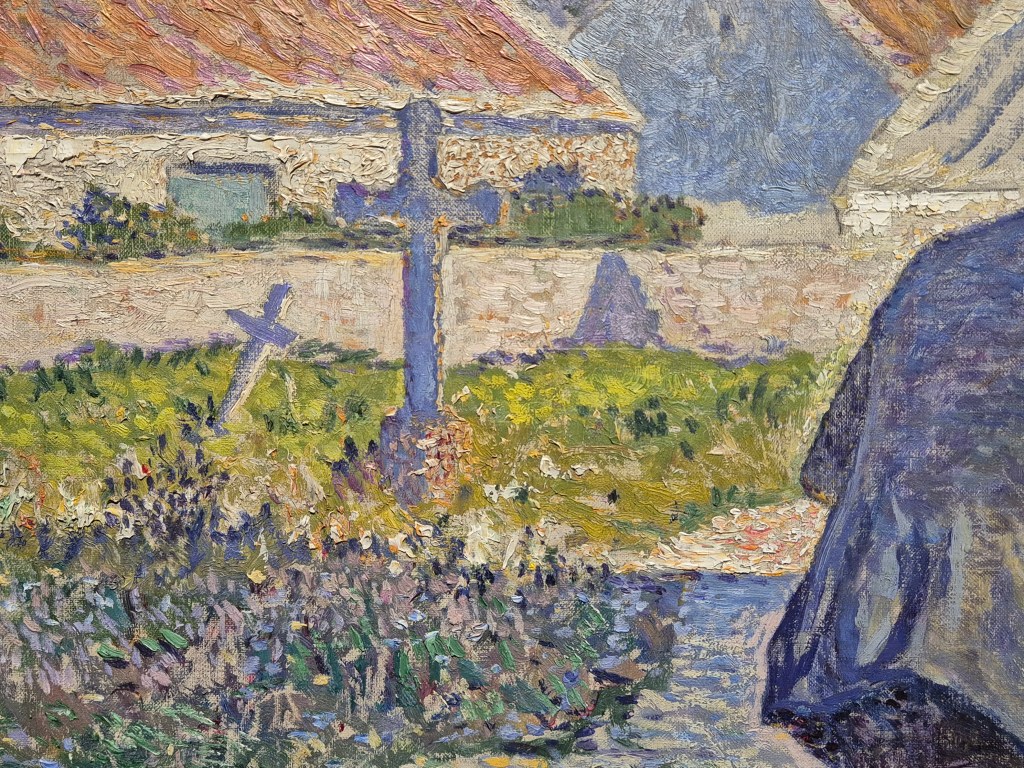
Behind him – or rather, to our left of him, on the picture surface – we see the clues which, even without the title, would have told us that this is some form of church, or chapel: crosses in a graveyard. The shadow of the church cuts a firm, straight line through the grass and plants, with both light and dark greens surrounding the two crosses we can see here. One tilts dramatically to the right, almost as if in reverence, just like the members of the congregation, but also implying that this is an old settlement, its fabric subject to decay. Both crosses appear to be the same purple as the shadow – and that is because the side we see is in the shade: only the right edges catch the sun.

There are maybe as many as eight more crosses visible here – one is cut off by the frame at the far left of this detail, and one is just a vertical stroke of paint (so might not be a cross at all). Again, a sense of history (or geographical insecurity?) is revealed by the various angles at which they lean. The shadow of the church does not create such a clear-cut line here, but that is presumably because the ground is not so flat, or the plants are growing more unevenly. The sun shines brightly on parts of the wall surrounding a building beyond the graveyard. It has an orange-red slated roof, and its gabled end is in shadow. Behind it are dunes, with patches of vegetation growing in the sand. We are on the edge of the sea, in a small fishing village in Belgium not far from Ostend.

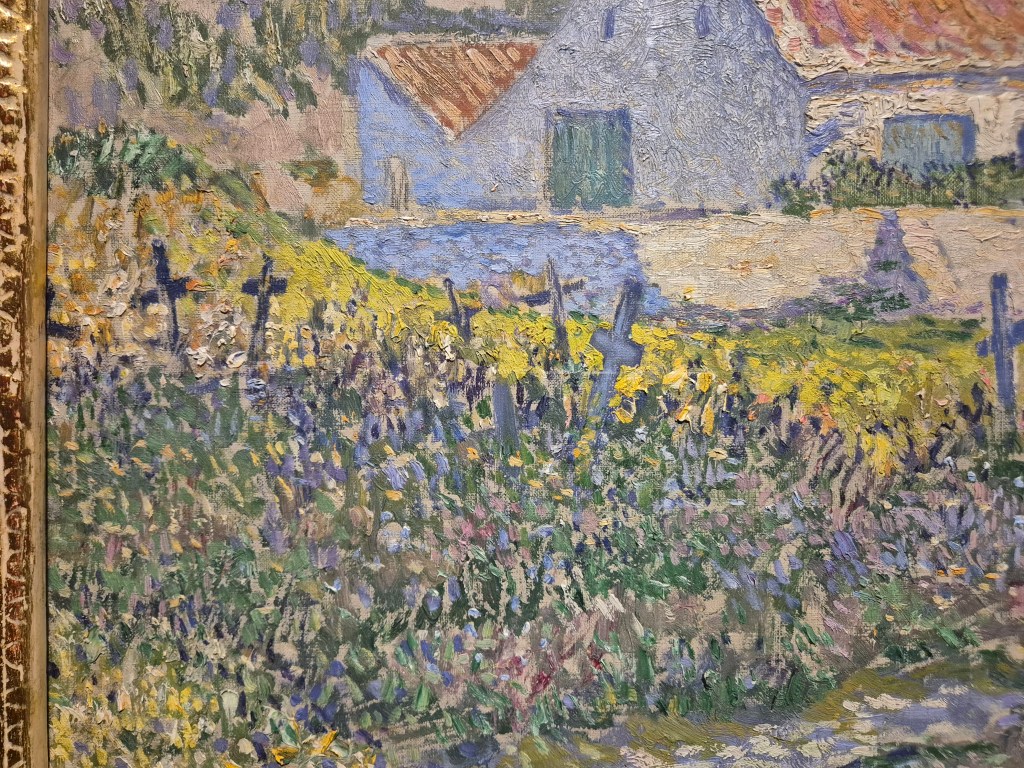
If we move down the left-hand side of the painting a little, we see a riot of different coloured brushstrokes. While the roof of the back section of the building has a series of parallel strokes, elsewhere the application of the paint is not directional. There are short flicks of the paint, dabs of light and shade, and small, luminous dots. The colours in the shadow are far more varied than they are in the sunlight, where there is a pale lime and a darker bottle green, almost as if the brilliance of the sun is bleaching some of the colour out. In the shadow we can see pale blues, lavenders, pinks and greens, and touches of black (or is that a very dark purple?). The crosses, on the whole, are built up from single bold strokes, although these are modulated somewhat according to what is growing around them. This variety of types of brushstroke really goes to show the problems with naming this style ‘Pointillism’. First, in English, the word ‘point’ has a slightly different meaning to the equivalent in French. The translation into English of the French word ‘point’ (pronounced ‘pwuh’) would be ‘dot’, whereas in English, the word ‘point’ suggests – to me at least – an almost infinitesimal, dimensionless mark. Even if we define ‘point’ as ‘dot’, this painting is not built up from dots. Yes, there are dots, but there are also dabs, dashes, flicks, and strokes, not to mention some broad areas of palin colour. A better name for the style might be ‘Divisionism’, a term which is often used. This is because the individual colours are divided into separate brushstrokes, rather than being blended together on the palette before being applied to the canvas. The reasoning behind this comes from Seurat, who thought that, when mixed on the palette, the colours lost their original brilliance. However, if applied separately, and in small brushstrokes, the original colours would blend in the eye, and not only would they maintain their luminosity, but they would also interact with one another to create an unparalleled freshness. This freshness, together with the liveliness of the painted surfaces, are just two of the most striking features of the National Gallery’s exhibition. However, the name which the artists themselves settled on was ‘Neo-Impressionism’. They saw themselves as taking a new approach to Impressionist ideas about light and colour, and the ways in which these technical means were used to say something about the contemporary world, while also giving their paintings a greater sense of permanence, harmony, and often, even, political relevance – which was, in its own way, radical.

Whatever the initial impulse, many artists adopted Seurat’s technique – but they all had their own way of doing it, in the same way that we all have different handwriting. The Belgian artist Théo van Rysselberghe was impressed by the paintings by Seurat and Signac which he saw at the eighth (and final) Impressionist exhibition in Paris in 1886. He invited them to contribute to the next outing of the Brussels-based group Les XX (Les Vingt – ‘the twenty’), of which he had been a founding member just three years before. The roll call of artists changed, inevitably, and as one moved on, another was invited to take their place. In 1885 they were joined by the only woman ever invited to become one of Les Vingt, Anna Boch – the artist of today’s painting.

She too had taken up the gauntlet thrown down by Seurat and Signac, and, like her male contemporaries, she did so in her own way. In the detail above, taken from the bottom left corner of the painting, we can see that she must have sketched the long, thin lines which define the flagstones of the path using the purple ‘shadow’ colour, before continuing with a variety of colours and strokes. The grass in the shadow is particularly dark here, but there are also some wonderfully rich buttery yellows along the edge of the path. The tendency with these paintings is to stand at a distance – to try and get the effect of the brushstrokes blending in the eye – and that is a good way to see them, but not the only way. The artists wanted to create optical vibrations, so it is also rewarding to get as close as you can to see how just how they managed this – if indeed they did – and precisely how they applied the paint. Just beyond the path Boch uses short, horizontal, apparently ‘painterly’ strokes (even if they are too short for this to be truly ‘painterly’, you can at least see the marks of the individual hairs of her brush, reminding us that this is indeed paint). Elsewhere there are flicks of colour, and tiny dots – notably in the lavender of the shadows at the top right.

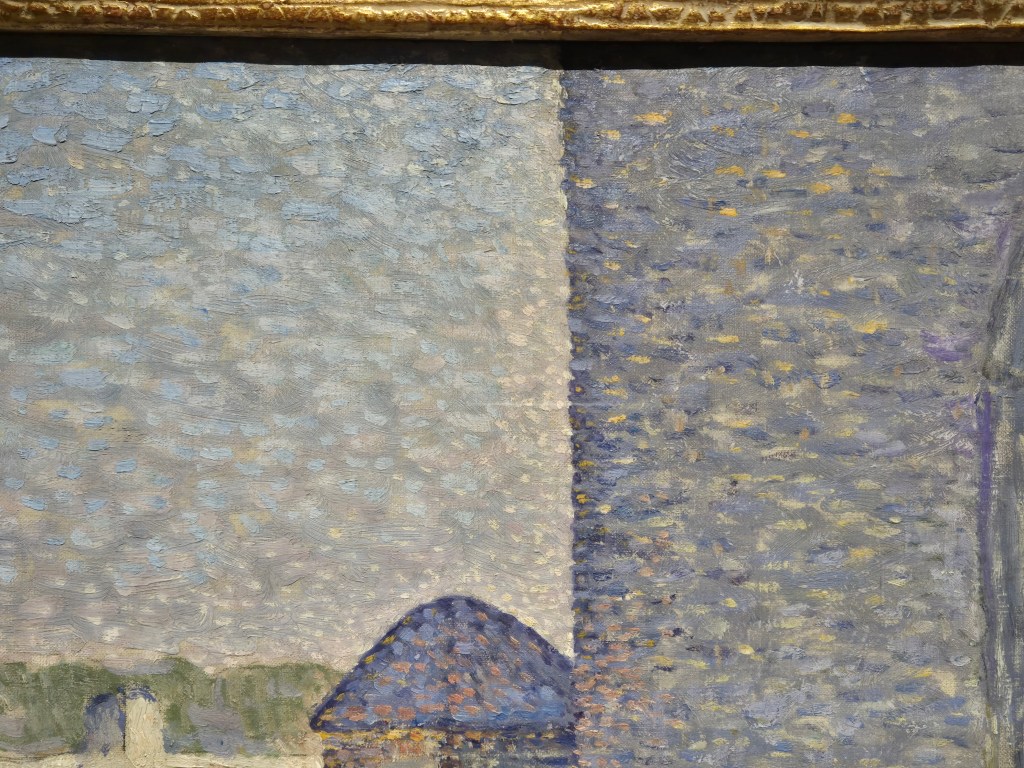
The dots are most evident, though, around the sharp edge at the front left corner of the church. Note especially the tiny off-white dots which come down in a band to the left of the wall and over the blunt pyramid on top of the feature projecting to our left of the church, the architectural function of which I can’t explain. These light dots contrast strongly with the dark corner of the wall itself, built up as the purple of the shadows increases in intensity as it gets closer to the edge. Most of the rest of the sky appears to consist of light, powder-blue dabs on top of a slightly greyer ground. The intention is to make the edge of the wall more vivid: boundaries are often a key feature of Neo-Impressionist paintings. There is a certain artificiality to many of them, and this was intentional: seeking geometrical forms, and simplifying what you see, as if trying to discern the Platonic ideals behind the vagaries of our worldly existence, while also creating harmony within contrasts. When thinking about Neo-Impressionism we tend to focus on colour, but tone – the variation of light and dark – was also fundamental to Neo-Impressionist thought. They were interested, whether they knew it or not, in abstract values, and their art turned out to be an important stage in the development of abstraction – not that this was a conscious goal. However, the idea that abstraction was on the horizon (a deliberate choice of word) is perhaps best illustrated in some of the later landscapes by Henry van de Velde – as we will see on Monday.

The extreme variation in brushstroke adopted by Anna Boch is best seen on the roof of the building to our left of the curious architectural form. The edges of the roof are defined by short, curved, brushstrokes of white paint, almost like the rectangular ‘tiles’ of the Impressionist tache, or ‘mark’, created with one short stroke of a flat brush. The roof itself, though, is made up of a series of long, parallel, diagonal strokes made with a fairly dry brush. This has left little paint behind, with the pale beige ground visible behind the broken, uneven strokes. This technique might remind you of another artist, one who is far more famous now than he was then. To my eye, this roof looks just like Van Gogh. The painting dates to 1893, whereas Vincent died in July, 1890. His work was still not well known to the general public – but Anna Boch was not the general public. Van Gogh’s reputation amongst his colleagues was running high, and in January 1890 – just six months before his death – he was invited to exhibit with Les XX. Six of his paintings were exhibited, and one of them, The Red Vineyard, was actually sold – the only one of his paintings sold from an exhibition during his lifetime. And yes, it was Anna Boch who bought it. Until recently, if she was known at all, she was known as the woman who bought a Van Gogh. Independently wealthy, she was able to pursue a career as an artist, and to collect the works of colleagues she admired. However, until recently her own paintings were relatively little known. An exhibition of her work staged at two venues, Ostend and Pont-Aven, took place between 2023 and 2024, and this has finally put her more firmly on the map. It has certainly led to her inclusion in Radical Harmony at the National Gallery, even though her work was not collected by Helene Kröller-Müller. We can’t be sure why not.

This detail is from a different digital file – most of the rest are my own photographs. I didn’t have this particular detail, or at least, I didn’t have it with this clarity. I’ve mentioned several times that the shadows are ‘purplish’. Here, admittedly, there is no ‘ish’ about it – purple, mauve, lavender, however you see this colour, that is what it is. This complements – optically – the colour of the path, a light, creamy yellow. Anna Boch, like the other Neo-Impressionists – and the Impressionists before them – is relying on a colour theory which, however much it must have been inherently understood by artists across the centuries, only dates in a systematic form to 1839, when Eugène Chevreul published On the Law of the Simultaneous Contrast of Colours. Simply put – and you know this already – the three primary colours red, yellow and blue can be mixed to make the three secondary colours green, purple and orange. In a colour wheel, the opposite colours are called ‘complementary’. This is a version published by Chevreul 25 years later which makes the point more subtly – and with 72 different hues.

Basically, we don’t see digitally, but by comparison. On entering a dark room we are first struck by the absence of light, but our eyes – and minds – soon get used to it. It is the same with colour. The absence of light is dark, and if the light is seen as yellow – as sunlight so often is – then the absence of that light will be the opposite of yellow on the colour wheel – purple. Hence the purple shadows in this painting. Not only that, but if painted next to each other, the yellow will make the purple look more purple, and vice versa – so if dots of these colours are intermingled, the surfaces will look all the more vibrant. This is the basis of the use of colour in Neo-Impressionism. The artists constantly sought harmony in contrast. They applied the same rules to colour, to light and dark, and, for that matter, to people. I’ve never seen anyone state it this explicitly – or simplistically – but we are all like the individual dots of colour. Each of us has our own character, and we all work together to build society. All you have to do is to join the dots, sharing different opinions to connect with the rest of your community with harmony – and preferably, with respect, just as Anna Boch paints her subjects here. Precisely how you interpret this idea is, like the way in which the different Neo-Impressionists applied their paint, completely up to you. We’ll look at the choices they made on Monday.

Featured

260 – Saints, Martyrs, and Saints in waiting (More of the ‘More things’)

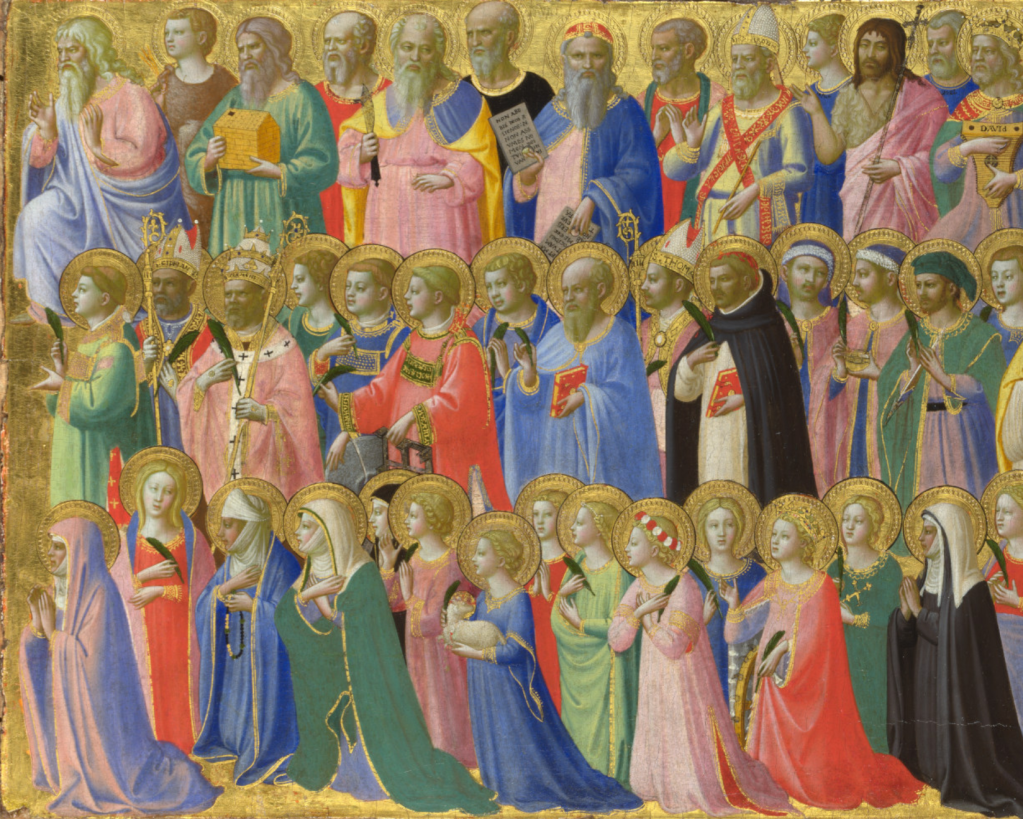
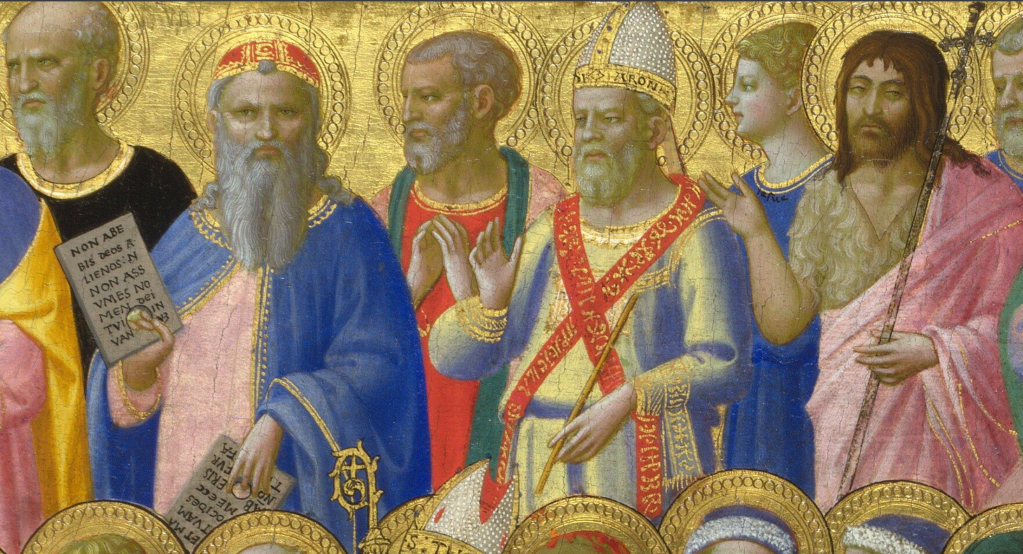
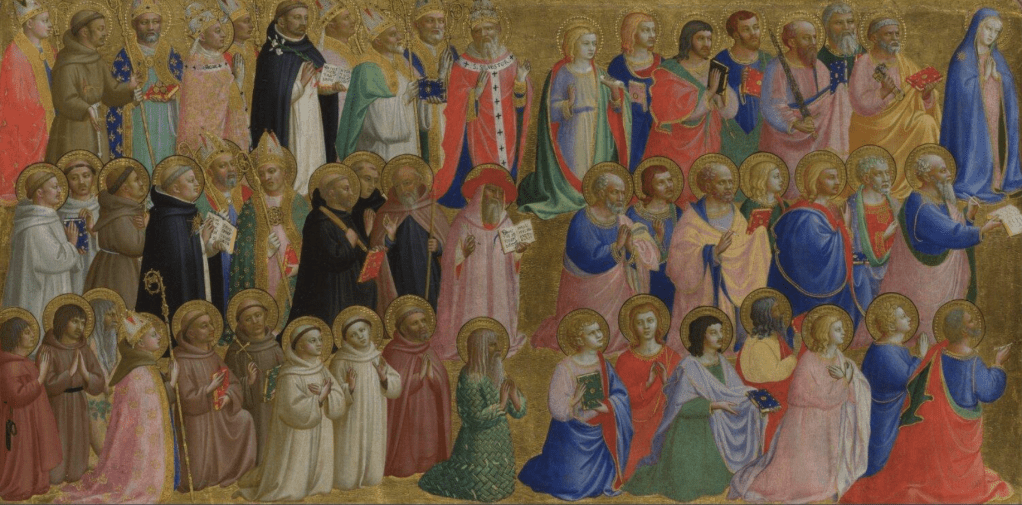
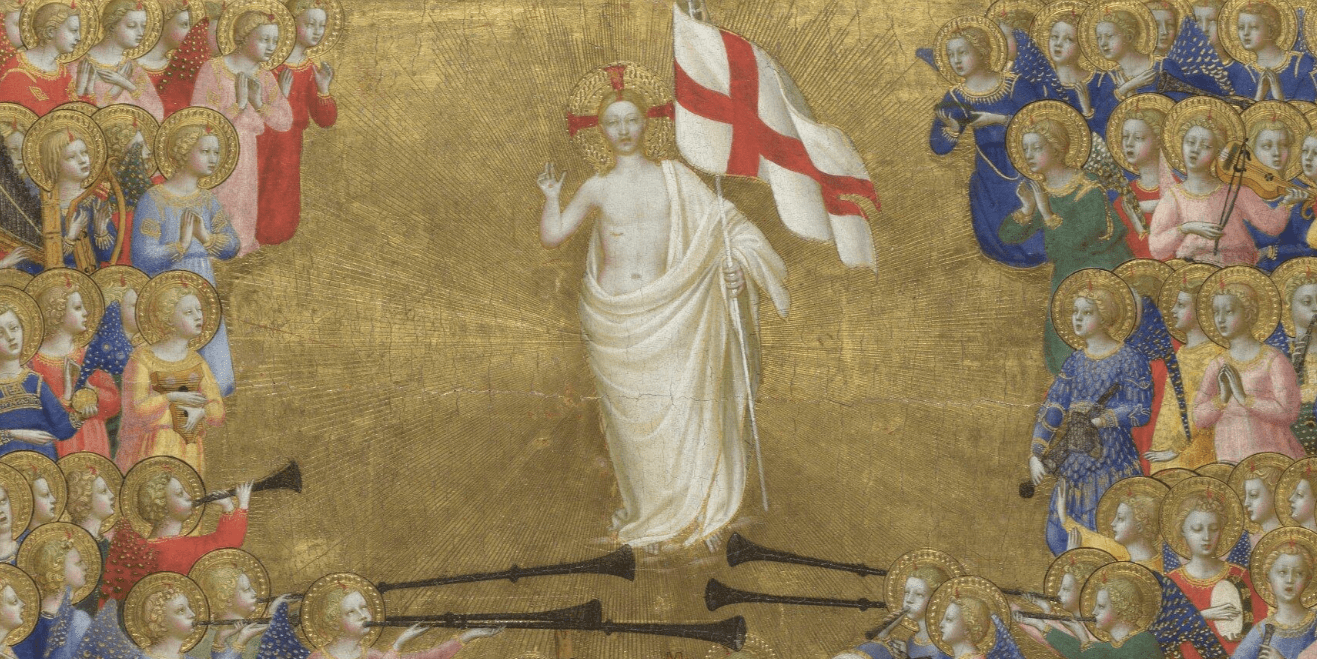
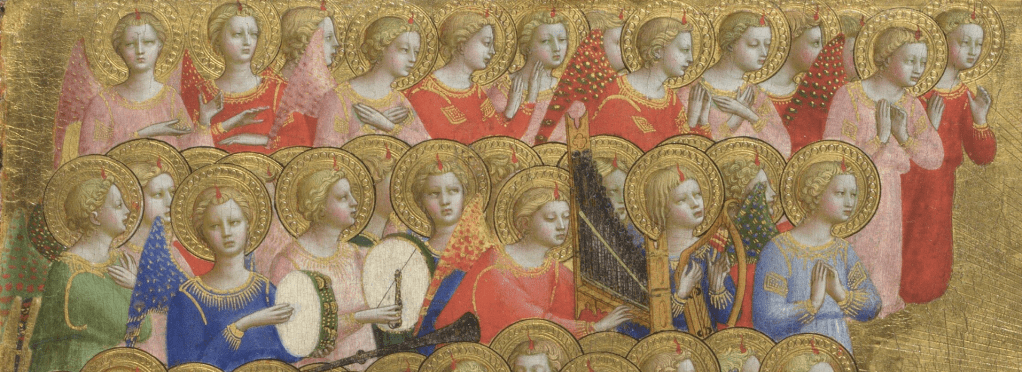
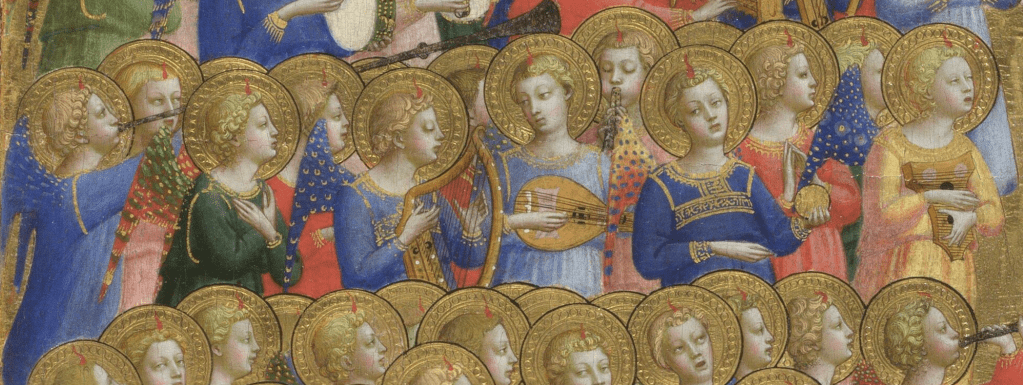
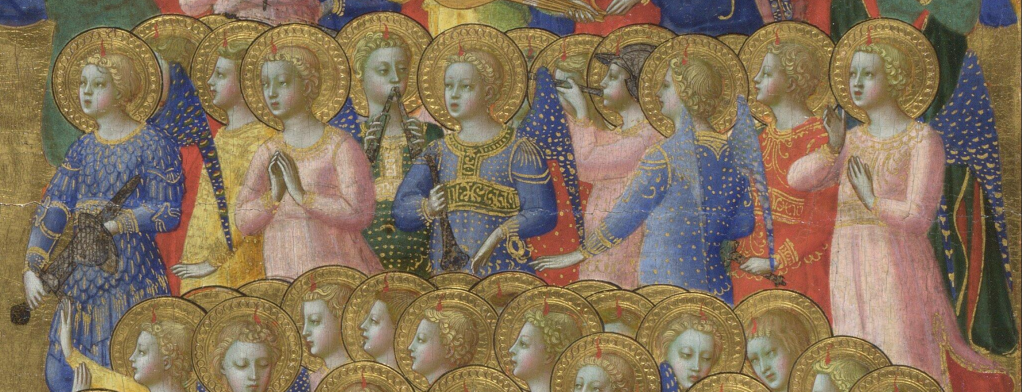
Fra Angelico, The Forerunners of Christ with Saints and Martyrs and The Dominican Blessed, about 1424-25. The National Gallery, London.

This week I reach the end of my exploration of the Fra Angelico exhibition in Florence, looking at his Students and Successors on Monday, 3 November at 6pm. This will include popping back into the Palazzo Strozzi to see the last section of the exhibition I haven’t covered, dealing with the work that he – and his workshop – carried out in Rome. It will also introduce the ‘School of San Marco’ with a rich array of paintings by artists who flourished in the 16th century whose work, like the work of Fra Angelico himself, can best be seen in San Marco itself. If you haven’t managed to catch all four of the talks, I did a slightly reduced version for ARTscapades, and they are still available as ‘catch up’ recordings of two study evenings which I named (slightly inaccurately it turns out) as ‘Origins’ and ‘Influence’.

After so much time among religious orders, I will take a week off before switching to political radicals, with the socially engaged and artistically engaging works of Seurat and his Neo-Impressionist circle. The talk, Radical Harmony, will introduce the National Gallery’s popular exhibition of Helene Kröller-Müller’s Neo-Impressionists on Monday 17 November. I will then move back a century, and to the Enlightenment, with another National Gallery exhibition, Wright of Derby: From the Shadows on 24 November. The last two talks this year will look at two single-painting exhibitions, Double Vision: Vermeer at Kenwood  (at Kenwood House, Hampstead) and Caravaggio’s Cupid (at the Wallace Collection), on 1 and 15 December respectively. They’ll go on sale soon, so keep your eye on the diary!

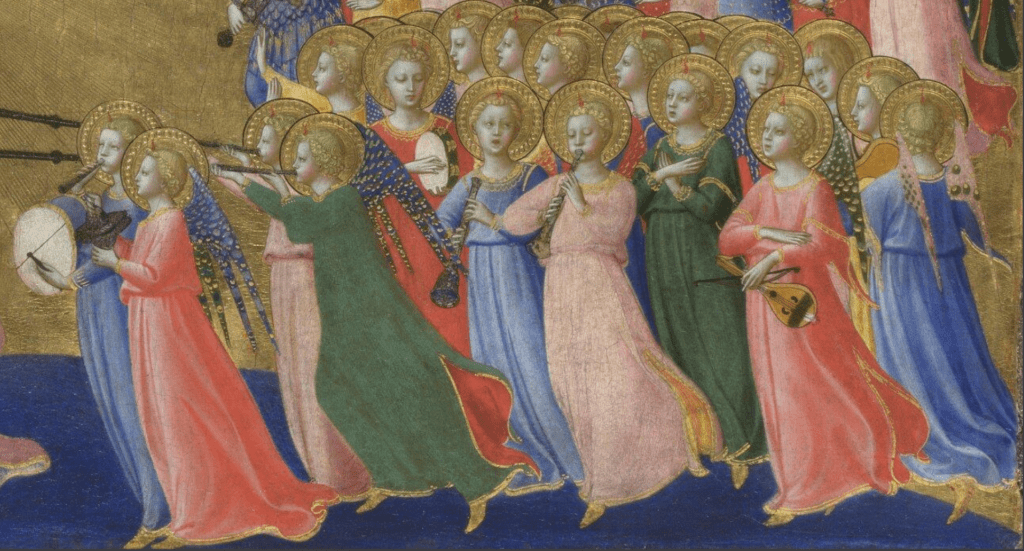
If you read last week’s post you’ll realise that I’m playing catch up. Last week I wanted to talk about all of this painting, the panel to the right of centre of the predella from Fra Angelico’s Fiesole Altarpiece, but I realised that there was just too much to say. So this week I will look at the rest of this panel, and cover the two outer panels as well – although maybe not in quite so much depth. Having talked about the top row of figures already – the forerunners of Christ – what remains are the Saints and Martyrs. I’ll start in the centre row, going from left to right, and then carry on with the bottom row from right to left… I’ve found a different digital file for this week – one which is embedded in the online catalogue entry by Dillian Gordon – and I’m using that here as it isn’t cropped as close as the other version available on the NG’s website. If you look closely you can see the wooden edge of the panel, and the barb where the engaged frame has been removed. Using this one allows you to see the figures round the edges more fully.

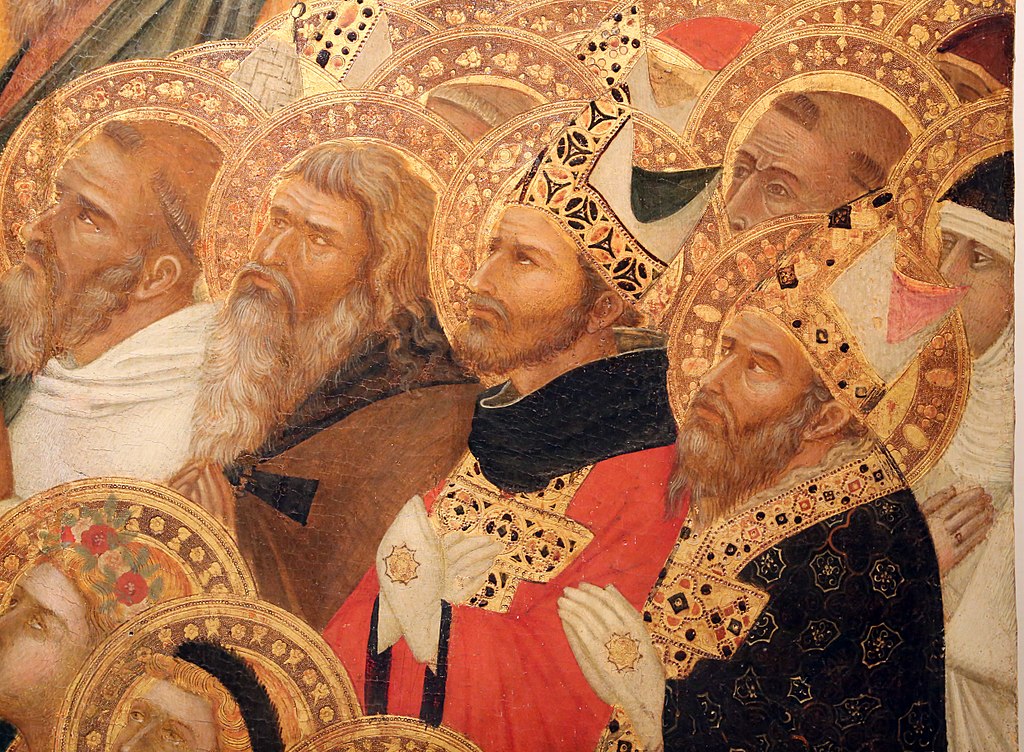
The five figures we can see clearly in this detail are all carrying palm leaves – a symbol of victory over death, and often held by angels who are about to hand them to someone who is being martyred: these people are all martyrs, they were all killed because of their beliefs. At the front of the group, on our left, is the protomartyr, the first person to be killed because he was Christian: St Stephen. His story is told in the Acts of the Apostles, Chapters 6 and 7. A deacon in the early church, he criticized the Sanhedrin for not following God’s law, and this led to him being being dragged out of the city of Jerusalem and stoned. He is often shown with a stone, or stones, resting on his head or shoulders, and there is one, looking like a small white blob, at the top of his back where the green robe joins his gold collar. Behind him are Sts Cyprian and Clement, a bishop and a pope respectively, whose names are written on the gold bands of their hats. The next two, in blue and red, have the same robes as St Stephen, with a small, patterned rectangle in front of their chests, apparently hung over their shoulders. They must also be deacons. One supports a millstone, and the other, a grill: the latter is perhaps one of the better known saints, St Lawrence. The other is St Vincent of Saragossa, who was thrown into the sea with this millstone tied around his neck. However, as so often in the attempt to murder Saints, this didn’t work: even tied to a millstone his body floated to the surface.

Moving further back the first two of of these martyrs cannot be identified, but they are followed by St Thomas Becket, Archbishop of Canterbury, whose name is on his mitre. He was a widely revered figure, and, with a feast day on 29 December, he was a regular part of the extended Christmas celebrations. There was a chapel dedicated to him in Santa Maria Novella, the mother church of San Domenico for which this predella was painted, which might explain his inclusion here. Next to him is the early Dominican martyr, St Peter, his head and shoulder red with the blood from wounds inflicted by the cleaver (head) and dagger (back) with which he was killed. The two men in pink, with blue hats (rather than the red, which becomes more common) are the brothers Cosmas and Damian, doctors, who are best known as patron saints of the Medici family because, unlike the Medici, they were actually medics. However, at the time this was painted the Medici had not yet attained the level of power, or patronage, for which they are now famous, and the inclusion of Cosmas and Damian in this image relates to their high status within the church from as early as the 4th century.

In this detail, the man holding an arrow at the far left is assumed to be St Sebastian – even though he is fully dressed. This seems unusual in Tuscany, where he is almost always depicted in little but a loin cloth (however, he is often shown as a young, well-dressed nobleman in the Marche – notably in paintings by Carlo Crivelli). It is not as if a saint couldn’t be shown nearly naked: the hermit Onuphrius on the opposite panel is wearing nothing but a garland of leaves around his waist, for example. The bishop saint, holding a heart with ‘yhs’ (an abbreviation of ‘Jesus’) inscribed on it many times is St Ignatius, Bishop of Antioch, and the soldier with a silver helmet could be St George – but there are plenty of other soldiers to choose from, if we’re honest, and without a dragon we can’t be sure. It is suggested that the man with blood round his forehead could be San Miniato – but he had his head chopped off at the neck, so this wound would seem irrelevant. St Nicasius of Rheims had the top of his head removed, but he doesn’t seem to have been revered much outside of France. However, his story is told in the Golden Legend, apparently – and as that was compiled by a Dominican, Jacopo da Voragine, it would have been well known among the Dominicans who commissioned (and painted) this altarpiece. The identification of St Christopher seems more secure, even if he doesn’t appear in the way you might expect (the Christ Child is not sitting on his shoulder). As a giant who acted as a ferryman across a deep river, he usually carries a staff, which, given his size, is often shown as an uprooted tree – and he is certainly carrying one here. Also, given that he was regularly striding through water, he tends to have bare legs. This figure is one of the four in the predella who are kneeling on one knee rather than two (I mentioned them last week), and this allows Fra Angelico to show that he does indeed have bare legs. Finally, we have Sts Sixtus II and St Erasmus, another pope and bishop, who once more are identified by the inscriptions on their hat bands. However, for three of the martyrs here there is no possibility of guessing who they are – which again begs the question: did Fra Angelico know? Given that there is no documentation for the altarpiece, it is very hard to say. In most commissions for altarpieces, or any church decoration, the patron would get advice from a religious figure, and usually someone from the church for which the work was being commissioned, to help in deciding who or what should be included, and this advisor could also make suggestions to the artist. But in this case, the artist was one of the patrons, as he was painting for his own church. He, and all of his fellow friars, were very well educated… so they could have discussed it amongst themselves. Alternatively, they could have turned to the prior – or some especially gifted theologian among their number – for advice. It seems likely that the Fiesole Altarpiece as a whole was one of the first paintings that Fra Angelico executed on taking the Dominican habit – and I wonder if he is including all of these saints, martyrs, and forerunners of Christ as part of his preparation, or as ‘revision’ of what he has learnt so far having joined the order? I even wonder if these are the ‘notes’ he is taking to visualise – and so learn – who all the saints and martyrs were.

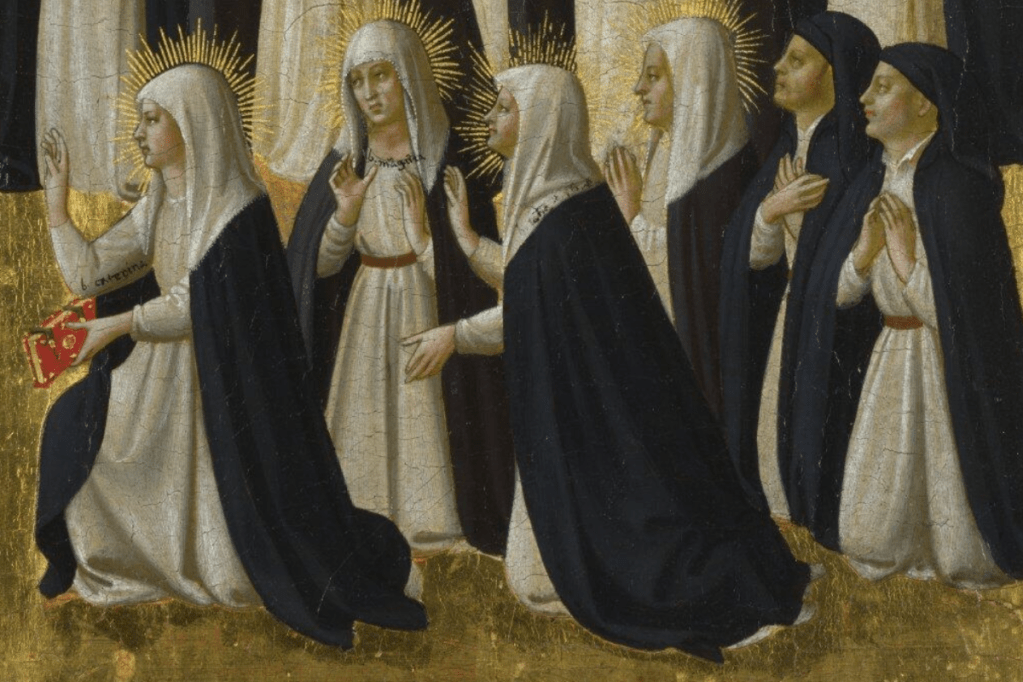
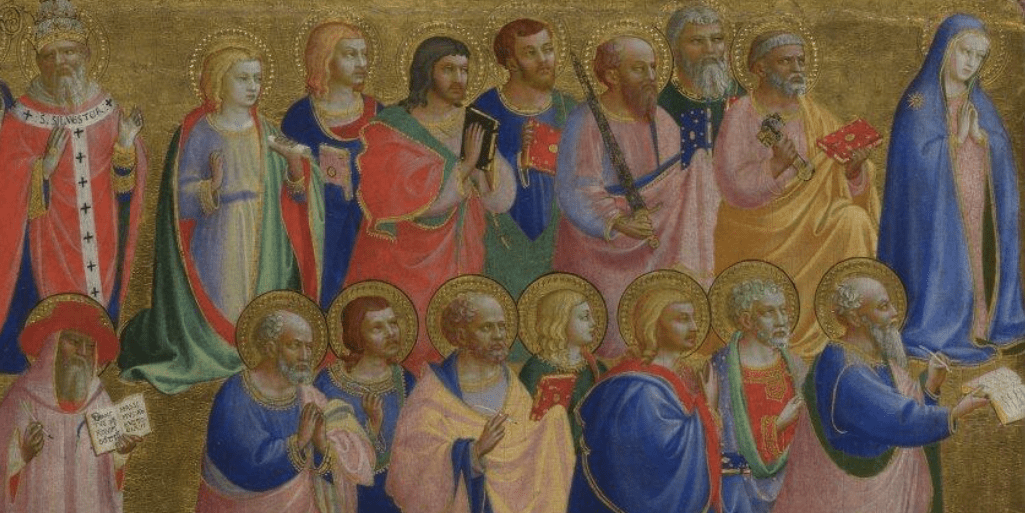
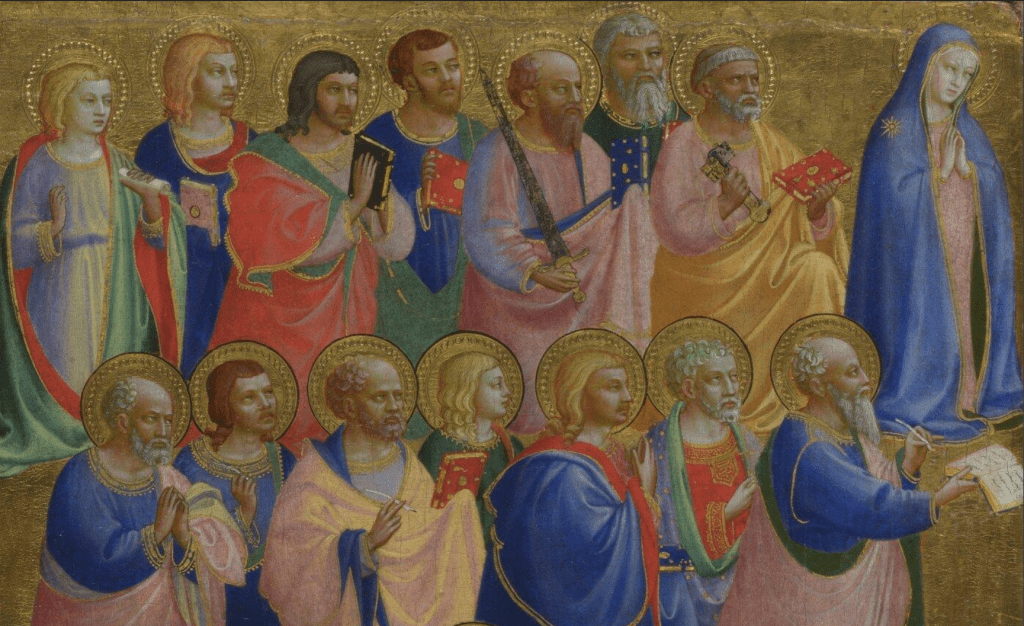
Apart from the Virgin Mary, in the position of honour at Christ’s right hand (at the top right of the left-hand panel), this is the first time we have seen any women. So here they are, finally, on ‘the distaff side’ – at the left hand of Jesus. Unfortunately, though, there is very little that is certain, and few clues to identify the paltry number of figures represented – but then, this was an all-male convent. The woman carrying the cross is St Helen, mother of the Emperor Constantine, who travelled to the Holy Land and discovered the True Cross – the Cross on which Jesus was crucified. Her name is also written on her crown: Sancta Lena. Behind her is a nun carrying a lighted candle. This is St Bridget of Sweden – who we will see on Monday in a later painting by Fra Angelico: the reason for the candle will become clear. Before founding her own order (the Bridgettines), she had been a Franciscan tertiary – one of whom is shown in the Franciscan habit, with a rope belt, just next to her… This could be one of her companions, I suppose, but there is nothing to say precisely who it is.

Again, with the exception of St Catherine, with her wheel, in the centre of this detail, it is hard to tell who any of the figures are – although the woman carrying a cross just next to her is probably St Margaret of Antioch. However, like St George, without her dragon we can’t be sure (there are some tentative suggestions for more of these saints in the catalogue entry, if you would like to follow them up). The fact is, although the names of many saints were known, it’s not as if anyone had researched them and their history. The Golden Legend, the collection of stories of the lives of the saints which I mentioned earlier, was gathered together in the 1260s by Jacopo da Voragine, a Dominican friar and later Archbishop of Genoa. The fact that he was a Dominican is probably not coincidental – but everyone knew the Golden Legend anyway: it was one of the texts which was used to teach people to read.

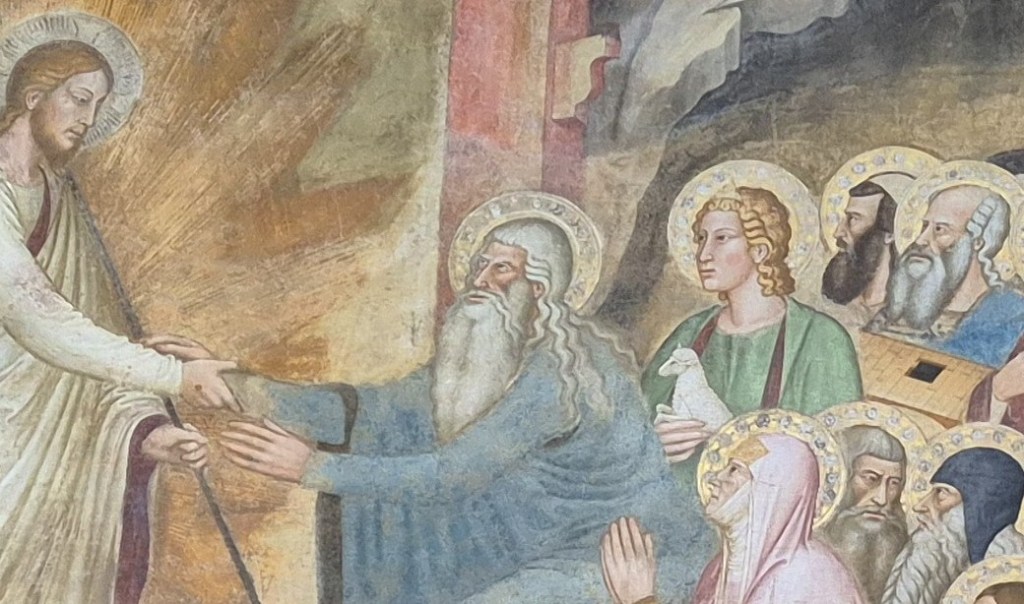
Even at the front of the group, closest to Jesus, the identification of these women is not obvious – with the exception of St Agnes. She is usually shown carrying a lamb (‘agnus’ in Latin), but here it has become, specifically, agnus dei, the Lamb of God, with the addition of a crossed halo and a red wound in the chest. This is relatively rare, but not unknown. Two of the women are not carrying palms leaves – so they must be saints who were not martyrs. The catalogue suggests they could be Mary and Martha – i.e. Mary Magdalene, identified since the time of Pope Gregory the Great as Martha’s sister – but I can’t see any signs or symbols which could confirm that. Neither is wearing red, nor are there signs of penitence, to imply that one of them could be the Magdalene. Nor is there a jar of precious ointment, which, with her long red hair, is her main attribute. Even the identity of the woman at the front of the group is not clear. She is not a martyr – unlike the woman in red next to her, who is holding a palm leaf. The first female martyr is said to be St Thecla, a follower of St Paul, although as her life is first reported in the apocryphal Acts of Paul and Thecla, dating to the second half of the second century, her feast day was removed from the General Roman Calendar in the 1960s. Nevertheless, she is still revered in some churches, and would have been, generally, in the 15th century. It would certainly make sense to have the female protomartyr just below St Stephen, her male equivalent. However, if this is her, this is the first time I have seen her in a painting. This leaves one last woman, the closest woman to Jesus after the Virgin Mary, but who would that be? The National Gallery catalogue states, quite simply, that it is ‘Saint Anne (diagonally opposite the Virgin)’. This would make sense, but there is no visual evidence to support the identification, nor have I ever come across ‘diagonally opposite’ as a category. Not only that, but I can’t think of another representation of St Anne by Fra Angelico, and I have a feeling that the Dominicans weren’t especially interested in the story of the Virgin’s origins. The Immaculate Conception was a specifically Franciscan doctrine, and the feast day was not approved for the church as a whole until 1476 – and that was by a Franciscan Pope, Sixtus IV. Not only this, but St Anne usually – but not always – wears red: this woman wears a cangiante blue/pink robe. You could argue, of course, that Fra Angelico doesn’t always use the ‘standard’ colours, and indeed, that these colours weren’t ‘official’ anyway. For example, he dresses St Peter in yellow and pink rather than yellow and blue, as we saw when we looked at the opposite panel a couple of weeks ago. However, the blue/pink colours of this woman’s robes are the same blue and pink as the clothes worn by Adam, two rows above her. If Adam leads the forerunners of Christ, who better to lead the only row of women than Eve? A comparison with Andrea Bonaiuti’s Harrowing of Hell (also known as The Descent into Limbo, by the way) might help here, as it did last week.

In Bonaiuti’s painting, Adam is wearing a long blue robe. At his left side (the ‘distaff side’) – just in front of him from our point of view – is a woman in pink. Who else would this be at the front of the gathering than Eve? Fra Angelico’s work for San Marco makes several references to paintings in Santa Maria Novella – most notably the Crucifixion – and I think this is another example. I’m sure that, in this predella panel, he is painting Eve – he’s even chosen to paint Adam and Eve in similar blues and pinks. Bonaiuti shows another woman, in red, in the top row, and this is a similar red to the one worn by St Anne in Masolino and Masaccio’s Virgin and Child with St Anne in the Uffizi. Having said that, I can’t see any reason why St Anne should be placed here in the crowd. At Noah’s left hand, this woman is far more likely to be Mrs Noah, who had a far greater presence in Christian mythology than she does in the Bible.

The remaining two panels include characters we have already met, and who we will meet again when we discuss the School of San Marco in the talk this coming Monday. Narrower than the other panels, they were placed at the base of the two pilasters on either side of the altarpiece. They frame the rest of the predella, and all of the people depicted have something in common: they are members of the Dominican Order, the Order of Preachers. You can see this clearly: they are all wearing the black and white habit – although, if you look closely, a few people are wearing minor variants, a result of their differing status within the order. They kneel in adoration of Jesus and of the heavenly host – which they frame – and, in doing this, they are effectively the predecessors of the Dominican intercessors who are present in the frescoes of Fra Angelico we saw in last Monday’s talk: people setting a good example which we should follow. And the people depicted here are especially good. All but two have beams of light radiating from their heads – and at this point in history, that means that they are on their way to Sainthood, but haven’t got there yet, so are not worthy of a full halo. They have been beatified as a result of their sanctity, but, as yet, no miracles have been performed in their name, so they have not yet been canonised as Saints – although after this image was painted, some were.

This is the bottom row on the left hand panel. The four women at the front wear a white tunic and scapular just like the men above them, but rather than the black, hooded, cappa they have a black cloak, and a black veil over their heads. They are Dominican nuns – considered the secondary order, with the friars as the primary order. Behind them is a man who appears to be one of the friars, but he is wearing a black scapular, rather than a white one. He is a member of the tertiary order – the third order of Dominicans. He follows the Rule of St Dominic, but does not live in the convent – he lives at home, and carries out the normal life of a layman, while remaining entirely devout.

On the other side there are four more women, but they have a white veil over their heads, rather than a black one. Rather than nuns, they are female tertiaries – who, like the male tertiaries, also live outside a convent while following the Rule. Behind them are two men dressed a bit like the others in black and white, but we can see their belts clearly: they are not wearing the scapular, and nor are they wearing the cappa. They wear a cloak without a hood, but they do have black hats. Also, unlike the others in these two panels, they do not have the radiance of the Blessed. In some way they must be related to the commission, they could even be the patrons of the altarpiece. As I’ve said before, though, the Fiesole Altarpiece was paid for by the bequest of Barnaba degli Agli (hence the appearance of St Barnabas, the ‘fourteenth apostle’, on the altarpiece and in the predella). These may be some of his relatives. Dillian Gordon suggests they could be Jacopo and Domenico, two of his sons, as he left his ‘right of patronage’ of the convent to them: their appearance here makes perfect sense. If you want to know more about the Blessed who can be identified it would be worthwhile consulting the catalogue yourselves, as I only want to mention three of them.

All are labelled, either in black or white script, and usually against their white or black clothing: the writing reflects their Dominican heritage. However, this man, in the top row, and closest to the centre on Jesus’s left – so the highest in status on this particular panel – has his name written on his open book. His mitre – the two-pointed hat – tells us he was a bishop, and the open book suggests he was either a preacher, or was learned (or both). That might not help much, as this is the Order of Preachers, so they all preached, and they all had to be learned in order to preach orthodox beliefs as part of their mission to combat heresy. However, they had to learn from someone. Even a scholar as great as St Thomas Aquinas had a master – and this is the man. The Blessed Albertus Magnus, as he is named here (c. 1200-1280), was a German Dominican who wanted to align Aristotelian philosophy with Christian belief, a task that St Thomas Aquinas perfected. He was finally canonised, as St Albert the Great, in 1931.

Two rows below him is the most important of the women in the right panel. She is named as ‘b. caterina’ – Beata (or Blessed) Catherine. Look at the delicacy with which she is painted – the tiny dots of white marking the fringing all around the hem of her headdress, for example, and the gilding of her bible, including the edges of the leaves of parchment. A Dominican tertiary who used her freedom to travel widely and speak truth to (male) power, in 1461 she was canonised as St Catherine of Siena (1347-80) by Pope Pius II – notably a Sienese pope. In 1939 she became co-patron of Italy (alongside St Francis, thus bridging the two major mendicant orders), and since 1999 she has also been one of the patrons of Europe. At the beginning of the 16th century a convent for nuns was dedicated to her on the opposite corner of the piazza from San Marco, and that is where the artist of the image on the right must have learnt to paint: Plautilla Nelli, some of whose works we will see on Monday.

And finally, on the left panel, in the second (or even third?) row down, and third from the right – so in no especially important place – is ‘.b.vi˜ce˜ti.’ – although the squiggles are above the vowels. They mark abbreviations: the Blessed Vincenzo (1350-1419), who was canonised as St Vincent Ferrer in 1455. Given that both St Catherine of Siena and St Vincent Ferrer are named among the Blessed, these names must have been written before 1455. As I said a couple of weeks ago, given that it would have been difficult to add names to the altarpiece after it had been completed – which would have involved either moving a sizeable, weighty altarpiece, or clambering over the altar with the black and white paint – it seems far more likely that these names, and those on the other panels, were part of the original conception of the predella. St Vincent Ferrer would later be painted by one of Fra Angelico’s successors as an ‘official’ Dominican artist, Fra Bartolomeo, and that’s St Vincent, above one of the cells of the extended convent of San Marco, in the detail on the right. We’ll talk about Fra Bartolomeo more on Monday, too – so I do hope you can join me.

If you got to the end of this excessively long post – congratulations! And if you’ve read all four – well, I just hope that they will encourage you to spend more time with the panels themselves the next time you can get to the National Gallery. Thank you!

Featured

259 – There are more things in Heaven and Earth…
Fra Angelico, The Forerunners of Christ with Saints and Martyrs, about 1423-4. The National Gallery, London.

So far I have discussed most of what can be seen in the glorious Fra Angelico exhibition/s in Florence, covering the first room in San Marco and most rooms in the Palazzo Strozzi. However, if you manage to get to Florence, there is always more to see, and that is the reasoning behind the third and fourth talks. This week, on Monday 27 October at 6pm, we will be At home in San Marco, even though Fra Angelico didn’t actually change his allegiance from his own ‘house’ as a friar, San Domenico, just outside Fiesole. He was certainly at home there, and I will start with the work he produced for that convent, before moving back down the hill to San Marco. The majority of the talk will be about the frescoes he and his workshop carried out in the cells and communal spaces there. The week after (3 November) we will will thinks about his Students and Successors, looking at the work he executed outside of Florence towards the end of his life – in Orvieto and Rome – and introducing some of the assistants who worked alongside him (including Benozzo Gozzoli and Zanobi Strozzi). The talk will also cover the so-called ‘School of San Marco’ – artists associated with the convent in the 16th Century who could, as both artists and Dominicans, be counted as Fra Angelico’s ‘successors’. These include Fra Bartolomeo, Fra Paolino, and Suor Plautilla – the first Florentine woman recognised as having had a successful career as an artist.

I’ll need a week off after that for a change of gear, with two talks about exhibitions at the National Gallery: Radical Harmony – Helene Kröller-Müller’s Neo-Impressionists on 17 November, and the week after (24 November), Wright of Derby: From the Shadows. I’ve nearly settled on the talks for December, but keep changing my mind – so keep your eyes on the diary for more information.

Today though, having talked about two of the panels from the predella of Fra Angelico’s first major altarpiece (or, at least, the first that survives) I will move on to a third – the one to the right of centre. I had originally intended to cover the whole panel, but there’s so much in it I’ve decided I’ll have to look at it in two posts. This week we’ll look at the top row of figures, with the others to follow next week – and I’ll add in the last two smaller panels at the far left and right as a coda. Trust me, with a couple of notable exceptions the people represented in them are really rather obscure – unless you are a Dominican historian.

At first glance, the structure of this panel looks much the same as the one I discussed last week. Apart from the fact that everyone is facing to our left (because they are looking towards Jesus in the centre of the predella) there are, again, three rows of holy figures kneeling in prayer or adoration. We know that they are all holy, as all have haloes, and, once you get closer, you will see that, as before, the haloes in the lower two rows are ringed with black, but in the top row they are not. However, if you look back at last week’s panel – The Virgin Mary with the Apostles and Other Saints – there is a difference. In that composition there was more space, with figures like the Virgin Mary, St Jerome, and St Paul the Hermit slightly isolated from the others. In this panel the composition is more crowded, and even though one or two figures stand out, on the whole they appear more tightly packed. Indeed, last week’s panel included 52 individuals. This week, there are 65… I can’t explain why this should be, apart from the fact that, in Hamlet’s words (Act 1 Scene 5) ‘There are more things in Heaven and Earth, Horatio, than are dreamt of in your philosophy’. OK, so Shakespeare had not been born when this was painted, but you get the idea – and that’s why I’ve decided to talk about the panel over two posts. The haloes tell us that these figures are holy, and the word ‘saint’ comes from the Latin ‘sanctus’, which also means ‘holy’. However, not all of these figures are Saints, in the traditional sense.
Unlike last week, when I started with the characters nearest to Jesus, who would therefore appear to be the most important, I want to start with those furthest away, at the top right. This will make it far easier to understand what they have in common, and so to work out who some of them are.

The ease of identification is the result – as it was for some of the otherwise obscure Saints last week – of having their names clearly painted on the panel. Two of the characters here have scrolls on which their names are inscribed – we would call them Zeccharia and Habakkuk. They are Old Testament prophets – people from the Jewish scriptures whose prophecies Christians interpret as referring to the coming of Jesus Christ. Even without their names, we would suspect that they are Old Testament prophets, as they hold scrolls. It’s not a hard and fast rule, but more often than not anyone holding a scroll comes from the Old Testament, and anyone with a Codex (a book with turnable pages, as opposed to one you unroll – basically what we would now call a ‘book’) is from the New. That’s quite simply because scrolls came before codices, the latter appearing in the 1st century, and developing to become more dominant by the 4th – thus paralleling the development of Christianity itself. Each of the two prophets points to his scroll, and looks at the other – but neither seems that happy. It could be that they disagree about what will come to pass, but I suspect it’s because they know that things will go badly before they get better: the Messiah will suffer before we are redeemed. The other two in this detail are also thought of as prophets – Daniel’s name is written just below the gold neckline of his robe, while Jonah’s is written on his book – the Book of Jonah (thus demonstrating that the scrolls vs. codices distinction is not clear cut). Why did Fra Angelico use their names rather than symbols to identify them? Well, he’s got to fit 65 people onto this panel, and there probably wasn’t space for a den of lions, let alone a whale.

More prophets in this detail: Joel has his name on his shirt, like Daniel, while Ezekiel’s is on his rather fancy hat. Isaiah and Jeremiah on the other hand have theirs on their scrolls. David’s is on his harp, which is odd, as it is unnecessary. He is wearing a crown, and and everyone here is a prophet. Only two Kings are thought of as prophets, David and Solomon, and David was the one who played the harp (he is believed to have written the Psalms). He would be instantly identifiable, even without the name. However, there are two more here who must remain anonymous: the men in yellow and black. With no name and no identifying features we would be guessing. Nevertheless, they have haloes – so must be ‘holy’. On reflection, this might appear odd. In the Catholic church such Old Testament figures were rarely given the title of ‘Saint’. However, in the Greek Orthodox faith they were – Agios Esaias would be St Isaiah, for example. Because of the close ties between Venice and Constantinople, this tendency crossed the Mediterranean, and there are churches in Venice dedicated to St Moses and St Job as a result. For Fra Angelico’s painting, it is clear that the forerunners of Christ are worthy of a place in heaven, and also that as holy men they should have haloes too.

Getting closer to the centre, and so to Jesus in the central panel, there are two more unidentified people, in black and red. The character in blue is Joshua – his name, written as ‘Jesue’, is on his blue robe (but I couldn’t read that until I found out what it said from Dillian Gordon’s catalogue entry!). The identity of the figure at the left of this detail should be straightforward: a man holding two stones slabs – which we tend to call ‘tablets’ – with writing on them. The one in his right hand is held up towards us, and is inscribed ‘NON ABEBIS DEOS ALIENOS’ – ‘you shall have no other gods’. This is the first of the ten commandments, held by Moses. His brother Aaron, the High Priest, is further to our right. Apart from the fact that the gold band around his hat is labelled ‘ARON’, this type of conical headgear – not unlike the papal triple tiara, but without the three crowns – was often used to represent the High Priest in Italian art. The crossed bands over his chest also suggest a priestly air, as does the otherworldliness of the blue/yellow cangiante robe, even if he is not wearing the breastplate of 12 precious stones with which he is often depicted. The final figure here might come as a bit of a surprise. It is, undoubtedly, St John the Baptist. He wears a camel skin robe under a pink cloak, and carries a staff topped with a cross, picked out in silver leaf. This is an entirely traditional way of representing him. He also looks out and gestures towards our left – so towards Jesus – as if to say ‘Behold the Lamb of God’, the words with which he recognised Jesus as the saviour. I’m not convinced he’s looking at us, though – he seems to be looking over my right shoulder. John the Baptist is an entirely New Testament character, even if he did quote Isaiah (‘I am a voice crying in the wilderness’) – but he was one of the forerunners of Christ. Indeed, because of the quotation from Isaiah 40:3 in John 1:23 he is often regarded as the last in the line of the Old Testament prophets, and is sometimes referred to as the Precursor – the man who came immediately before the Saviour – hence his place among the forerunners of Christ.

One last group – for today. The man in red remains unidentified but the others do not – even if there is some question as to who one of them is. On the right, holding a knife, the silver blade of which has largely worn away, is Abraham, prepared to sacrifice his son, Isaac (who is not seen). The colour combination of a pink robe covered by a blue cloak, lined with yellow, is especially attractive, I think. The man holding the house-shaped box is also well known, although it’s worthwhile bearing in mind that the object he holds is symbolic, or a model. Made up of small sections of light brown material, the ‘roof’ also has a series of dots. These are nails, hammering together planks of wood, and together they make the ark. This is Noah, although clearly you couldn’t get a pair of every animal into this tiny model. It has a hole in the roof – presumably for the raven and the dove to fly out, and for the dove to fly back in.

So, who are the last two? Who would be closest to Jesus in this image? An old man (he has long white hair, and a long white beard), wearing pink and pale blue. All of the people we have discussed so far are probably kneeling: we cannot know that for sure, as we cannot see as far down as their knees, but as the bottom row in this panel – and in the one we saw last week – are all kneeling on two knees, it seems likely. This figure is one of only four in the two panels who are kneeling on one knee, with the other raised (there was an unknown Franciscan and St Peter in last week’s panel, and we’ll get to the fourth next week). This makes him take up more space, and overall he also seems a little larger than the others, suggesting that he must be important in some way. Not only that, but we can see one of his feet – the only visible foot in this panel (and it may be relevant that he is not wearing shoes). It’s also worthwhile noting that, going from left to right, these characters are in the order they appear in the Old Testament – until you get to St John the Baptist, that is. Indeed, those with large, easily identifiable names or symbols are all in order – with the exception of Zechariah and Habakkuk… which might explain their debate. I did wonder if the small names in black could have been added later, but Dillian Gordon points out that, ‘The inscriptions identifying the figures, written in minute white letters on a black background or black letters on a white background, following the Dominican colours, are clearly contemporary. It would have been extremely difficult, not to say impossible, to add them neatly once the altarpiece was in situ’. I should have thought of that. It would have involved clambering over the altar – but I’ll come back to it next week! However given that the figures on the left – at least – are in ‘chronological order’, it would imply that the man on the far left of the panel should have come first – and indeed he did. This is Adam. I’ve always found it surprising that, in paintings of The Harrowing of Hell, the first person out is the first person in: Adam. Even the man responsible for the fall is forgiven, and enters heaven. So who is that who comes just after him? It’s interesting that Dillian Gordon isn’t sure – and I can see why. She suggests that it is either Eve, or Abel. My first response is that this figure has short hair, and so is probably male – but then, so do some of the female martyrs we will see next week. However, the hairstyle and the face look more like those of a young man to me – the cheeks have less of a rosy glow, and the hair doesn’t seem to have been ‘dressed’ in any way – unlike the women. Also, if Adam is fully dressed, in pink and blue, why would Eve be wearing animal skin? I’m sure it’s Abel, Adam’s able son.

However, he has three ears of wheat which appear to be tied to his right thumb (the left hand is covered by his animal skin: I wanted this pale area to be the lamb that he sacrificed, but you can see that it really isn’t, if you zoom in close enough on the National Gallery’s website). This doesn’t seem to make sense, as ‘Abel was a keeper of sheep, but Cain [his brother], was a tiller of the ground’ (Genesis 4:2). So it might make more sense if this were Cain holding wheat, although as Cain was the first murderer (a result of the first example of sibling rivalry) he seems even less likely to get into heaven. I am convinced that it is Abel. I do think Eve is in the painting, though, and we’ll come back to her next week, and I do have circumstantial evidence that this is Abel.

As I’ve said before, Fra Angelico’s Fiesole Altarpiece was painted for the high altar of the church of San Domenico, just outside of Fiesole. San Domenico was the second Dominican convent in the area of Florence, and was the ‘daughter house’ of the first, Santa Maria Novella. The detail above was painted between 1367 and 1369 by Andrea Bonaiuti in the Chapter House, now known as the ‘Spanish Chapel’, of Sant Maria Novella. I wrote about it over five years ago when discussing The Devils – although I have trimmed them off the right hand side of the image to make the remaining section clearer. Jesus has beaten down the gates of hell, crushing a devil beneath them, and has taken Adam by the hand to lead him out.

Immediately behind Adam is a young man in green carrying a lamb – surely Abel’s sacrificial lamb – and he is followed by Noah, clutching the model ark with a hole in the roof, not unlike the one we’ve seen before. This is effectively – with the exception of one unidentifiable figure – the same order as in Fra Angelico’s painting. This fresco could even have been his model. As the mother convent of his own, it is extremely likely that Fra Angelico would have been familiar with the Chapter House in Santa Maria Novella, and as an artist, he would have been especially interested in the work of his artistic forerunners. I can only assume that the three ears of wheat in the Fiesole predella panel are a reference to an obscure element of Dominican theology… unless you know otherwise?

Further back Aaron and Moses are standing next to David, and beneath the latter’s harp is St John the Baptist, who, as a relatively recent arrival, still appears to be making his way to the back, introducing the saviour to people who would never have seen Jesus in the flesh before. Again, the arrangement is not entirely dissimilar to Fra Angelico’s composition. I think Eve is also one of the number, as is Mary’s mother, St Anne – but not in this detail: I will come back to them next week. Before then, though, we will explore San Domenico, and it’s daughter house, San Marco, in the talk on Monday.

Featured

258 – Who’s Who in Heaven?

Fra Angelico, The Virgin Mary with the Apostles and Other Saints, about 1423-4. The National Gallery, London.

Greetings from Florence! I’m currently in the middle of introducing a second group to the delights of the first half of the 15th century, with a rich array of works related to the career of Guido di Pietro, who we now know as Fra Angelico. The day before I left home I talked about the earliest works in his career (as currently exhibited at the exhibition Fra Angelico in San Marco), and on Monday 20 October (the day after I get back) I will explore the superb range of paintings spanning the rest of his life As seen at Palazzo Strozzi.  We will return to the convent to think about Fra Angelico: At Home in San Marco on 27 October, exploring the frescoes he painted for the friars’ cells, and for the communal areas of the building, as well as a selection of manuscripts he made for the Dominican order. My last talk in this series (3 November) will introduce some of his Students and Successors, as well as discovering what remains of the artist’s work after he left Florence. We will also explore the ‘School of San Marco’: painters including Fra Bartolomeo, Fra Paolino and Plautilla Nelli – the first woman recognised as having a successful career as an artist in Florence – who were the most important Dominican artists of their day.

Subsequent talks will cover two exhibitions from the National Gallery, Radical Harmony on 17 November and Wright of Derby: Out of the Shadows on 24 November, and they will go on sale soon. In December I will probably be talking about Vermeer at Kenwood, the Barber Institute at the Courtauld, and Constable and Turner at Tate… Details will be in the diary before too long!

As a reminder, this is the predella of Fra Angelico’s first major altarpiece, originally painted for the high altar of San Domenico in Fiesole, the priory he joined sometime between 1418 and 1423. The convent (a term which can refer to the homes of either nuns or friars) remained his ‘House’ for the rest of his life, despite the widespread assumption that he moved to San Marco in Florence when the Dominicans took over that building in 1436. The church of San Domenico developed over the centuries, and the altarpiece was adapted by Lorenzo di Credi in 1501, changing it from a polyptych to a single-panelled pala. At some point in the 19th century the predella was removed from the convent, ending up in the hands of a dealer, and later, in 1860, it was acquired by the National Gallery. I talked about the central panel two weeks ago, so this week I will turn to the panel which has the next highest status – at Jesus’s right hand (or, from our point of view, to the left of centre).

Similarly to the way in which the angels are arranged in the central panel, there are three rows of figures in brightly coloured clothing. However, as you look from right to left (and so away from the centre of the altarpiece) there is a gradual decrease in colour, with more neutral hues and monochrome costumes. This is related to the decreasing status of the subjects the further away from the centre they are and, more specifically, who they are and why they wear those clothes. Even on this scale it is possible to see that all of the figures have circular gold haloes, and so they must all be saints. What you might not be able to see is that the haloes of the bottom two rows are ringed with black paint, just like the angels in the central panel, whereas those in the top row are not. However, you should be able to see that here.

Starting closest to the centre (on our right), no figure is closer to Jesus than the woman at the top right. Kneeling in prayer – as all the figures are – she wears a long blue cloak which also covers her head. This cloak has an olive green lining, and is trimmed with a gold hem. Her dress is pink. On her shoulder we see a star, derived in part from the medieval canticle Ave Maris Stella – ‘Hail, Star of the Sea’. In it, she is compared to the Pole Star, which sailors use to navigate, the implication being that we should use her example as our guide in life. The Latin for ‘of the Sea’ – Maris – was also a pun on her name: Mary. All Catholics are supposed to have a special devotion to the Virgin Mary, but for Dominicans she has a particular significance. In his superb book, Fra Angelico at San Marco, William Hood compares each convent to a beehive, and,  ‘…like a honeybee every friar had his place in the collective at whose heart was the Virgin Mary, the legal abbess of every Dominican convent, or by extending the metaphor one could even say its queen’. It is perhaps for this reason that Mary is seen not only closest to Jesus in the predella, but also separated from everybody else. Just below her is St John the Evangelist in his older embodiment as the author of the gospel, rather than being shown as the youngest of the apostles. His quill is held, rather curiously, in his left hand: I can only assume that this is for purely aesthetic reasons. But then, he is using his right hand to offer his gospel to Jesus, which might explain also explain it: holding the bible in his right hand might be seen as more suitable (everyone trustworthy was assumed to be right-handed, especially given that the Latin for ‘left’ is sinister). John’s arm is clad in the same rich blue worn by Mary, and this colouristic similarity creates an affinity between them – as does his pink cloak lined with green, colours which are also used for the Virgin’s clothing. Bizarrely, the open page of his bible is illegible, made up of scrawled lines, whereas elsewhere on the panel there is writing which can be read – but perhaps that is because the first verse of St John’s gospel is so well known ‘In the beginning was the word, and the word was with God, and the word was God’. His gesture is therefore important: the bible – the Word of God – is here being held towards Jesus – the Word of God…

The remainder of the figures in this detail (I’ve repeated the same one), have been identified as ‘apostles’, but that creates a bit of a problem. We ‘know’ there were twelve of them, but here there are fourteen. Even after Judas’s suicide there were twelve: the community gathered together to appoint a replacement, St Matthias (see Acts 1:15-26). Nevertheless, St Paul is often represented as one of the number, because, together with St Peter, he was seen as one of the first heads of the Church after Christ. Indeed, he is depicted in this panel. Just to our left of Mary there is a figure with short grey hair and a short grey beard carrying a pair of keys. These are the keys to the Kingdom of Heaven which Jesus said he would give to St Peter. Now, St Peter very often wears yellow and blue, but here he has yellow and pink. There is a real sense that Fra Angelico wanted Mary to stand out, and if Peter was also wearing blue that might not happen. However, given that he is wearing pink he is more closely associated with the man to our left of him, who has a longer, darker beard and a receding hairline. He carries a sword, which, like one of Peter’s keys, is picked out in silver leaf: this is St Paul. Consequently, the first two heads of the Church are in the top row, and are more-or-less the closest to Jesus after Mary. It’s only ‘more-or-less’ because there is another figure squeezed between Peter and Paul. He has white hair and a long white beard, and is wearing green – which is the most common way in which Italians represent St Andrew, the brother of St Peter. However, as yet we haven’t sorted out who all these people are. If we have St Paul and St Matthias numbered among the apostles, that would still only bring us up to thirteen. So – who is the fourteenth? This is what it says in Acts 14:13-14

Then the priest of Jupiter, which was before their city, brought oxen and garlands unto the gates, and would have done sacrifice with the people.
Which when the apostles Barnabas and Paul heard of, they rent their clothes, and ran in among the people…

So Barnabas – who travelled widely with St Paul and is mentioned more often that Matthias – also appears to be counted as one of the twelve. It’s clear, though, that the role of ‘apostle’ is not strictly limited to the number originally chosen by Jesus. Nevertheless, if we include Barnabas together with Matthias and Paul we have arrived at fourteen. However, although St Paul is clearly distinguishable, the others are not. Have a look, though, at one of the figures who stands out in the lower row in the detail above. He wears a cangiante pink and yellow cloak (see the previous post for an explanation), which in itself makes him more prominent. He also seems to take up a bit more space than anyone else in this row, with one elbow sticking out to our left, and the book held up to our right. Now compare him to the figure standing in the position of honour – at the right hand of the throne (i.e. on our left) – in the Fiesole Altarpiece. This part of the predella would have been directly below this Saint.

It is surely no coincidence that both have short grey curly hair and beard, and have a receding hairline. They wear cloaks which are mainly pink, but also include yellow, and their other clothes are blue. Both figures are carrying a red book. It is also no coincidence that the figure in the main panel is St Barnabas. He occupies the position of honour as he is the patron saint of the donor, Barnaba degli Agli, who died in 1418, twelve years after the convent had been founded. It took a long time to finish the building – partly, no doubt, because the Dominicans have a vow of poverty, and had run out of money. In his will Barnaba ‘left 6000 florins towards the completion of the church, as well as liturgical furnishings and chalices’ (quoting from Dillian Gordon’s superb catalogue entry, to which I am also indebted for many of the identifications below). This sum covered not only the completion of the church (which was consecrated in 1435) but also twenty cells for the friars.

It would be all but impossible to name all fourteen of the figures in the detail above, although that hasn’t stopped people trying. St John the Evangelist and St Matthew were both apostles and evangelists, and it is possible that St Matthew is the figure holding a quill to our left of St Barnabas. But then, St Barnabas has a quill as well, and he didn’t write any of the bible. Admittedly there is an apocryphal Epistle of St Barnabas, but no one after the fifth century or so seems to have considered it relevant.

There are even fewer certainties about the members of the group at the bottom right, although it may include the remaining two evangelists, Sts Mark and Luke. Three figures hold a book, and one, on the far right, a quill, so these attributes wouldn’t appear to help. However, it has been suggested that the saint at the bottom right is St Luke. He is closest to Jesus in this row, and as the patron saint of artists, he might have been granted a higher status by one of his own trade. Luke does often (but not always) wear red and blue.

The top row on the left of the panel has some figures who are more easy to recognise. Going from right to left (and so, theoretically, in decreasing order of importance) we can see St Silvester, an early pope, who can be identified quite simply because his name is painted across the white strip on his robes. Behind him are three bishop saints, each wearing a mitre – St Hilary, Bishop of Poitier (with his name on his blue cope), St Martin of Tours (the name is on his book), and another, who remains unidentified. If you can’t see the writing – or any of the other details – look up the panel on the National Gallery website and zoom in! The next figure stands out because he wears the black cappa and white tunic of the Dominican order. He is also wearing the white scapular, which hangs across the chest and down below the waist, although here the end is out of site, hidden behind the saints below. This is the founder of the order, St Dominic himself. The lily is a sign of his purity, while the star in his halo denotes his unquestioned sanctity. The book is open at a paraphrase of Psalm 37:30, ‘The mouth of the righteous speaketh wisdom, and his tongue talketh of judgement’ – which could be taken as expressing the Dominican mission to suppress heresy though preaching, their wisdom founded on a profound study of orthodox beliefs. Next to him is another unidentified bishop, and then St Gregory the Great. He was a pope – hence his ‘hat’, the triple tiara – and was considered to have been especially inspired by the Holy Spirit. Indeed, if you can see a small white blob on his halo in front of his forehead, it is a tiny representation of a dove speaking into his ear. Next to him is another bishop wearing a deep blue cope covered in what I would have assumed were fleur-de-lis – which might have led me to assume that this is St Louis of Toulouse. However, he doesn’t have a Franciscan habit under his cope. Instead, there are three golden balls resting on his bible: it is St Nicholas of Bari (aka Father Christmas – the gold is for giving). The saint to our left of him is wearing a Franciscan habit (brown, with a rope belt) quite simply because this is St Francis – he is holding his hands out to show the stigmata. The row is completed by (yet another) unidentified bishop.

In the middle row, again going from right to left, we can see St Jerome, in his red cardinal’s hat and, unusually, a pink robe, then St Anthony Abbot, with beard and staff. There are two Benedictines in black, one with a stick, St Benedict, and another, who might be one of his followers, St Maurus. The two bishops could be St Augustine and St Zenobius (one of the patrons of Florence), and then another Dominican. Slightly plump, with a star at his chest and a book, this is the great theologian Thomas Aquinas. Another Franciscan is followed by two monks in white. I realise I am in danger of merely listing, and it really is worthwhile looking closely at the details – so here is St Paul the Hermit, wearing something that looks surprisingly like a basket.

St Paul was said to be the first ever Christian hermit, living in the Egyptian desert for 97 years – dying at the age of 113. He lived near a spring of clear water, next to which grew a palm tree which provided not only his food, but also all the materials he needed for clothing – and the detail is fantastic. Look at the care with which every strand of the woven palm leaves is depicted – the frayed ends, the veins, the variations of light and shade, and even the projecting fronds at his right wrist, everything seems so delicately painted, and the figure can only be around ten centimetres high. Now have another look at the predella as a whole (either at the top or bottom of this post), and think about the level of detail which Fra Angelico has included in almost every figure, and you’ll realise that this painting is truly remarkable.

I think it’s rather charming that, as the first hermit, St Paul is shown suitably isolated. Behind him a monk in brown is followed by two Carmelites in white, and then St Giovanni Gualberto, founder of the Vallombrosan Order, with one of his companions. Usually they wear a greyish brown habit, often darker than this, and with far fuller sleeves, but here they really doesn’t look that different from the Franciscans – although there’s no rope belt. Next to them is a bishop saint with a Franciscan habit under his cope – so this is St Louis of Toulouse. The last three are St Onophrius, a hermit who wore nothing but leaves, and two other unidentified monastic figures.

There are several things I find remarkable about all of this. The first is that, although we can’t identify every figure now, Fra Angelico would have known who every single one was. The second is that he could characterise them all, and had designed every single figure – even though there must be a considerable contribution from the workshop. Having said that, the panel is too small for more than one person to be working on it at any one time – but the master could have handed it over to his assistants when he had done the most important parts. The next is that this is just one of five panels from the predella, which would have been on the high altar out of reach of everyone except the officiating Dominicans. Even then, how could they have stopped to look at the whole company of heaven during Mass? Or would they have returned later, individually, for prayer and contemplation, gradually working their way through, naming every figure and addressing a different, appropriate prayer to each individual saint? Or is this painting ‘simply’ an act of devotion, painting each figure to illustrate the respect due to them, even if no one subsequently bothered to address them individually? Or – and this may make more sense – is the fact that we know that the artist knew who they all were enough? This would mean that we know that they are all identified saints, which adds to our understanding of the power of Christianity, given that so many recognised figures witnessed their faith, and died in that faith (the saints who are called ‘confessors’) or died for that faith (the martyrs)? We don’t need to know who they all are, we just need to know that somebody did, and that there are so many of them. And remember, so far we have only seen two of the five panels of this astonishing predella. What we find in the remaining three is in some ways more surprising. But then, the remarkable richness of Fra Angelico’s work is surprising, and that is one of the things we will think about on Monday.

Featured

257 – Unite the Kingdom (of Heaven)

Fra Angelico, Christ Glorified in the Court of Heaven, about 1423-24. The National Gallery, London.

I have just returned from my first visit to the glorious exhibition Fra Angelico in Florence. Spread across two venues – Palazzo Strozzi and San Marco – it is the most comprehensive collection of works by this Dominican master that have ever been brought together. The curators want us to reassess the way we appreciate his works – and they are entirely successful. Since the 19th Century Fra Angelico has been seen as clinging on to the tails of the medieval (and, as a result, he was very much in vogue post-Pre-Raphaelites), but he now emerges as one of the great innovators of the Florentine Renaissance, up there with Masaccio who was, as it happens, slightly younger than him. To understand his work fully, and to put it in the appropriate contexts – both the artist’s life and faith (which were pretty much one and the same thing) and also the artistic developments of the time – I have planned four talks. The first, this Monday 6 October, is called The Melting Pot, and will reflect the remarkable range of styles and influences current in Florence in the first quarter of the fifteenth century. It will build, as much as anything, on the San Marco section of the exhibition, and on the first room in the Palazzo Strozzi. In addition to the earliest paintings by Fra Angelico, there will also be works by Ghiberti, Masaccio, and Gentile da Fabriano, not to mention an artist from another religious order, Lorenzo Monaco (the clue is in the name). After I’ve been back to Florence to see the exhibition again, I will return to continue the series with As seen in the Palazzo Strozzi (20 October), which will walk us around the remainder of this, the larger part of the exhibition. Fra Angelico 3: At Home in San Marco on 27 October (going on sale after the first talk, with a reduced price for those who have attended that one) will take us back to the Priory to look in detail at the many frescoes which the artist and his workshop carried out in the friars’ cells, and in the communal spaces. Finally, Fra Angelico 4: Students and Successors (3 November) will look at the artist’s work after he left Florence, and at his heritage. This will include not only the students and assistants with whom he worked, but also some ‘official’ Dominican artists from subsequent generations, including Fra Bartolomeo and Plautilla Nelli – arguably the first successful woman who worked as a painter in Florence.

Beyond that, I’m already looking to cover two exhibitions from the National Gallery (Neo-Impressionism and Joseph Wright of Derby), and three exhibitions of Loans to London (from the Barber, of a Vermeer, and a Caravaggio). But more news about them later – keep an eye on the diary, as I’m still juggling my dates! Today, though, I want to look at one of the National Gallery’s paintings by the hero of the moment.

There are actually eight paintings by Fra Angelico listed in the gallery’s catalogue, only one of which has made it to Florence. Five of them (see above) originally belonged together as the predella panel of one of his earliest surviving works: the San Domenico Altarpiece – painted for the high altar of the eponymous church in Fiesole, which is where Fra Angelico’s vocation and career are first recorded, and which remained his ‘house’ throughout his life. Because of its rich detailing, these five panels are hard to look at thoroughly in the National Gallery. It is, in its own way, encyclopaedic, and given that the individual figures are so small, it is all too easy to assess the amassed company of heaven, marvel at the multitudes, and move straight on without really looking. I’ve shown it to several groups, but don’t feel that I have ever done it justice. As a result, I think it’s time to slow down our looking, and look at each of the five sections individually. Well, one each for the first three weeks, and then two together for the fourth – using each text to introduce one of the talks. Although we read words from left to right it doesn’t make sense to approach the painting in this way. Instead, we will start in the middle this week, and then gradually work our way out.

The title of the central section could equally well be the title for the predella as a whole, Christ Glorified in the Court of Heaven – but that will become clear as we work our way through the panels over the next month or so. Starting from this point we see Jesus himself at the centre of the painting, splendidly isolated against a golden background. He wears something akin to a white toga, its colour barely distinguished from that of his skin, or for that matter, the background colour of the flag he is holding – white. The flag also has a red cross, as does his halo. He is surrounded, at a discreet distance, by a vast number of figures dressed in what at first glance appears to be a multitude of colours, but which could be broken down to red, pink, green and blue, with a hint of yellow here and there. Precisely who they are and what they are doing will become clearer as we get closer. Remembering that the best place to be is at the right hand of God – the position of honour – we will start by looking at the top left corner of the panel.

Every single figure has a halo, and every single figure has a pair of wings: these are just some of the angels. All of them also have a flame above their heads – something I would usually associate with Pentecost – which suggests to me that they are all inspired by the Holy Spirit. While there might not appear to be any way to distinguish these angels, the top row are all wearing red or pink, which implies that they are the Seraphim, the highest of the nine choirs of angels. Their name comes from the Hebrew word for ‘burning’, and they were considered by some authorities to be the only beings who could withstand the full glory of the deity. Isaiah describes them as being ‘above’ the throne of God, occupied in constant prayer and praising: ‘And one cried unto another, and said, Holy, holy, holy, is the Lord of hosts: the whole earth is full of his glory’ (Isaiah 6:3). Thomas Aquinas – a leading Dominican theologian – considered them to burn with the love of God, and as Fra Angelico himself was a Dominican this is surely relevant. Looking from right to left you can see how one has both hands raised, one has the palms of his hands pressed together, and a third crosses his hands over his chest. As you keep going along the line you will see that these gestures are repeated: they are all associated with prayer. Fra Angelico went as far as demonstrating these acts of devotion in frescoes for the novices’ cells at San Marco, as we shall see when we get to Fra Angelico 3. Having said that, the two Seraphim at the far left appear to be practicing the hand jive – but then, dance has often been considered an essential part of worship (the National Gallery’s catalogue entry, to which I am indebted, suggests that most of the angels are dancing – but I’m not sure that I would go that far). The second row down in this detail has a wider range of colours, with the addition of green and two shades of blue. Several of the angels play musical instruments. From left to right I can see a tambourine and a tabor, beaten with a drumstick. There is also a portative organ (i.e. a portable organ – the right hand plays the keys while the left hand pumps the bellows) and a harp. The angels at far left and right repeat some of the gestures of prayer we have already seen.

If it is ‘higher’ status to be at the right hand of God, it is not at all bad to be at his left hand: at least you are close – unless you are a soul at the Last Judgement, of course, in which case you be be heading down to hell. The second most important group, then, is made up of the angels at the top on our right. They are all clothed in a rich deep blue – the blue of heaven – and represent the Cherubim. Thomas Aquinas associated them with knowledge – and so in some way, they are the ‘head’ as opposed to the Seraphim who could be seen as the ‘heart’. Having said this, different theologians – and artists – had different ideas, and as a result the colours with which they are represented can also vary. In this case the Cherubim echo the Seraphim’s constant prayer and praising – including the dance-like gestures with one hand held to the chest, and another indicating Christ: this gesture is repeated in some of the larger-scale figures in other altarpieces. Many angels have their mouths open – they are singing – and one, on the far right, looks up towards God the Father in the highest firmament. I’d recommend taking this opportunity to look at each angel individually, as it’s hard to spend the time doing this when you’re surrounded by the general public – and when there are another 2000 or so other paintings to look at in the Gallery. In the second row the angels sport a similar colour palette to the figures on the opposite side, although there is a figure strumming a lute whose robe shifts from yellow to green. Just to our left of him one of the number plays a viol.

If we move back to the left of the painting, and down a tier, there is another colour shift in the figure on the far right. He is clasping a zither, and his robes are a combination of pink and yellow. This is a fabric in which the warp and weft are made from two different coloured threads – a shot silk, effectively – and the colour you see depends on the way the light is catching the fabric as you look at it. In paintings, this changing colour is described with the Italian word cangiante (‘changing’), and although it does exist down here on earth, in paintings it is especially associated with angels, as it tends to dematerialise the form and gives them an other-worldly air. Just to our left of this cangiante robe, one of the angels, wearing the deepest blue, holds an orb in his left hand. He could be a Dominion. According to the most common hierarchy, they were the fourth rank of angels – after Seraphim, Cherubim and Thrones – and they helped to maintain order in the universe. However, although the orb is a common symbol for the Dominions, and we have already seen the Seraphim and Cherubim, Fra Angelico doesn’t appear to be concerned with the enumeration of all of the nine choirs of angels, as described by a number of different theologians, not to mention Dante (who some considered was a theologian anyway). In this painting it would be difficult to point out the Virtues, Powers, and Principalities, for example, or to distinguish between an Archangel and an Angel. I’ll have to try and do that with another painting in another post on another day… There are more musicians here, though, with the angel on the far left blowing a long trumpet picked out in what is now tarnished silver leaf (the organ pipes in the row above were also made of silver). In the centre of this row the angels playing the harp and lute look at each other, as if to keep in time, but none of this row appears to be singing, as none has their mouth open – with the exception of the zither player on the far right, perhaps.

The equivalent, central row of angels on the right of the painting is similarly disposed. Two may be singing, most are praying, and three are instrumentalists. There is another long, silver trumpet – although most of this is hidden behind other angels. Nevertheless, a figure playing double pipes (also silver leaf) looks towards the trumpeter – who is wearing a helmet. It is possible that he represents one of the Powers, the fifth choir of angels, who are sometimes shown wearing armour. Just below the double-pipe player, a figure in blue holds what I take to be an angelic shawm. I say ‘angelic’, as shawms, which can be this shape (particularly if they are higher-pitched examples), tend to be made of wood, whereas this is clearly silver leaf, which I’m taking as being simply more heavenly. On the left of this choir is the only angel in the company that we can name.

In many ways he looks exactly like all the others – short, blonde, curly hair and an innocent face with a perfect complexion. These features remind us that the angels are in a state of grace – they have no taint of sin, and so are without mark or stain: they are immaculate. Like all the other angels (you can go back and check!) his halo is picked out with a black circular outline, and tooled with one circle just inside the black, and two more further in. In between these is a ring of small, circular marks each of which would have been made by tapping a small ring-shaped tool (basically a tiny tube) onto the burnished gold leaf, using a small hammer or mallet. His clothes and wings are all blue, but touched with gold, and while the feathers appear to continue across his clothing, if you look carefully at the gold trims at the shoulders, elbows, cuffs and skirt, you should be able to see that he is wearing blue armour – a different version of ‘heavenly’, perhaps. He also holds a silver shield and sword. This is St Michael, one of the archangels (the 8th choir, just higher in status than the ‘angels’ themselves), responsible for weighing the souls at the Last Judgement. He also defeated the dragon – “that old serpent, called the Devil and Satan” (Revelation 12:9) when some of the angels rebelled – and fell.

At the bottom left of the painting it is worthwhile noticing that relatively few of the figures are dressed in the deeper, richer tones – there are more light blues and pinks, a few yellows, and maybe as deep as a salmon pink and jade green – but this is partly to make a lighter, more ethereal contrast to the dark blue ‘ground’ which slopes up from the bottom left corner of the painting towards the right of this detail. On the right there are more trumpeters, and on the left, two viol players. Others sing, and even dance – there is a sense of movement from left to right, towards the centre of the image, and so towards Christ. All of the haloes are depicted in the same way as St Michael’s, although they overlap here more than anywhere else, telling us not only that the angels are several layers deep, but also that Fra Angelico already knew how to create imaginary space and depth on a two dimensional surface.

For whatever reason there is a greater preponderance of musical instruments at the bottom right: two more trumpets, a tabor, silver cymbals, two more shawms and two more viols (one of which is not being played). The angels on this side lean also lean towards the centre, and again they are layered several rows deep. They are also standing on the same sort of blue slope. On the far right, one of the angels appears to have turned away from us – but look how beautifully his wings are foreshortened, another indicator of Fra Angelico’s spatial awareness.

The blue base of the painting reaches a curved summit in the centre. It is the very top of a blue sphere, the vault of heaven, or, to put it another way, the sky. We are down on earth, in the middle of this, with the blue sky above and around us. Were we to penetrate this blue sphere – which surrounds us on every side – we would be in heaven. The medieval mindset saw the cosmos as being structured by a series of nine crystalline spheres, each of which was moved by one of the nine choirs of angels. Set in these were the sun, moon and five known planets (though not in that order), and the ‘fixed stars’. The blue of the sky – which we now know to be a result of the dispersal of sunlight – was seen as the last boundary between our ‘world’ and the golden light of heaven. The angels in this painting are therefore seen as dancing on the sky, or poised in the heavens above. In the centre of the painting here we see the full length of five silver trumpets, the cheeks of the angelic musicians puffed out as they look up towards Jesus – whose feet are just visible. Below him, two angels kneel playing portative organs, the one in pink again shown with the most brilliantly foreshortened wings, both of which come down on a slight diagonal. It is a beautifully conceived figure, I think, with the back of the head seen tilted subtly to the left, and a twist through the torso. The feet come back to our left, while the shoulders are facing more fully away from us. Even in this tiny detail the colour chords are superb – on the left, blue and gold wings with pale green robes lined with red, and a yellow underskirt. On the right the subtly modulated pink robe is lined with a violet blue, almost as if breathing in the sky beneath, and it is trimmed with the finest hem of gold.

Christ stands in the centre, made prominent not only by the golden radiance surrounding him, but also the white of his robes and flesh, as well as the brilliant red of the crosses on his flag and halo. The gold is incised regularly with lines which – as the word ‘radiance’ suggests – radiate from behind him, reaching slightly different distances into the burnished gold background. They would have been made using a ruler as a guide, and a stylus gently applied to indent the thin gold leaf without cutting through it. As candles flickered in front of this, the central panel of the predella, the glow around Jesus would have been modulated, reflecting the flickering of the candles, while the white of his robes would have maintained a more steady brightness. His right hand is raised in blessing, and shows the wound from one of the nails which held him to the cross. The wound in his chest, caused by a spear, is also visible. This is after the resurrection – indeed, it could be the resurrection itself. His white robe is effectively the shroud in which he was buried, now used as a form of toga, and the pallor of his skin reminds us that he was dead. He stands, as he does sometimes in the resurrection, on wispy white clouds. They are almost invisible now, as they were painted on top of the gold, in between the silver leaf of the trumpets, and much of the paint has worn away: it doesn’t adhere well to gold leaf. His halo is picked out, like those of the angels, with concentric circles, but there is more texturing: groups of four rings arranged in diamonds, and additional indents in the form of dots. His subtly rosy cheeks hint at his new life, and pick up on the red of the cross in his halo. And then there is the flag.

This is the flag of Christ Triumphant. It shows the red of his blood, and of his suffering, in the shape of the cross, the instrument of torture on which he was executed. The red stands out against the white of his purity and innocence. This is the flag he carries to mark his victory over death, and over sin, and he carries it, as often as not, at the resurrection. As a soldier fighting for good, and for God, it was adopted as a sign for St George, a figure shrouded in myth – but, as the first churches dedicated to him appear to date from the 4th century, it seems he was a very early Christian martyr. The dragon, of course, is just a symbol… His precise ‘nationality’ is by no means clear, but the most common belief is that he was from Cappadocia, in Turkey. As soldiers fighting for Christ – theoretically, at least – St George and his flag were adopted by the Crusaders, and finally, at some point in the late 1340s, he became one of the patron saints of England – gradually eclipsing St Edmund and St Edward the Confessor. He may have been born in Turkey, although some people think he may have come from Palestine, Syria, or even Israel. Let’s face it, he was not ‘English’ – even if he is now. Indeed, he is arguably England’s most successful immigrant. So the ignorance of people who have perverted this flag with their racist and xenophobic views appals me. As Jesus himself said (Matthew 25:35-36),

 35For I was an hungred, and ye gave me meat: I was thirsty, and ye gave me drink: I was a stranger, and ye took me in: 36Naked, and ye clothed me: I was sick, and ye visited me: I was in prison, and ye came unto me. 

If you’re doubting the ignorance of these people we may have a problem on our hands. I would go further: it is stupidity. If they are using the flag to support the notion of ‘uniting the Kingdom’ then they have the wrong flag. It is the United Kingdom of Great Britain and Northern Ireland (for the moment, at least), and, although England is a Kingdom, there is no United Kingdom of England. They should have the Union Flag – or at least a whole collection, including the saltire and dragon alongside the flag of Christ Triumphant.

Pardon the rant, but… But no, I stand by every word of it. However, on Monday I guarantee we will just look at the paintings, with not a word of politics. Well, that’s not true, of course. Art has always been about politics, and in this case there will be the politics of the Dominicans, and of Florence: the politics of the unelected Medici, for example. But that’s history, so it tends to be less divisive (with an emphasis on ‘tends to be’). The pictures are glorious, though – and we are free to make of them what we will. My aim is just to pick out the more relevant interpretations.

Featured

256 – Larger than last time

Jacquemart de Hesdin, Pseudo-Jacquemart, Master of Boucicault and Haincelin de Hagenau (Master of Bedford), Grandes Heures du Duc de Berry, fol. 96r., 1409. Bibliothèque nationale de France, Paris.

After last week’s saunter through the twelve calendar months of the Très Riches Heures du Duc de Berry, as currently exhibited at the Château de Chantilly, and the subsequent hurried leafing through the remainder of the manuscript, I am sure I will return to the book just before Christmas to look at the some of the remaining illuminations more thoroughly: they are really worthy of attention. Not only that, but it will be a treat – for myself, if no one else! This week, though (22 September), I am going to head back to Chantilly, stopping off at Saint-Denis on the way out of Paris, in order to think about The Duc de Berry: the man himself. Thereafter, as you’ll know, I’m heading to Italy and the Palazzo Strozzi’s much-heralded exhibition on Fra Angelico:

6 October, Fra Angelico 1: A Melting Pot
20 October, Fra Angelico 2: As seen at the Palazzo Strozzi
27 October, Fra Angelico 3: At home in San Marco
3 November, Fra Angelico 4: Students and Successors
(3 & 4 will go on sale on 6 October)

Subsequent talks will cover the National Gallery’s exhibitions Radical Harmony: Helene Kröller-Müller’s Neo-Impressionists and Wright of Derby: From the Shadows. They will probably be on 17 and 24 November – so there’s plenty of time before I need to post more details. Meanwhile, my next trips with Artemisia are already online – visiting Strasbourg and Colmar (to see the astonishing Isenheim Altarpiece) in June, returning to Liverpool in September and celebrating Siena in November. There is more information in the diary

Last week we enjoyed the Très Riches Heures. However beautiful – and rich – the manuscript is, had it been finished it would have been just one of the books of hours commissioned by the duke. His library consisted of around 300 books – a large number in the days when all books were written by hand. A hundred years later, Pope Julius II had 220 volumes, housed in the Stanza della Segnatura, famously decorated by Raphael – although the Vatican Library was larger, already numbering 3,500 manuscripts by the time of Julius II’s uncle, Sixtus IV. At around the same time, Federigo da Montefeltro, Duke of Urbino, had about 900 volumes… But still, 300 was a lot, and around 127 survive, with many of them in the exhibition we will explore on Monday. They give a remarkable sense of the man, his interests, and his personality. As well as books covering science, history, philosophy and theology, among the books dedicated to his personal faith he owned 6 psalters (books of psalms), 13 breviaries (containing the religious services for each day), and 18 books of hours (for prayer and devotion during the ‘canonical hours’, the regular cyclical of worship established for each day). Of the 18, he commissioned six of them himself. Several of them, like the Très Riches Heures, get their name from references in the inventory created after his death. To give a sense of scale, each folio of the Très Riches Heures measures 290 x 210 mm, whereas the page we are looking at today is a lot larger: 400 x 300 mm. It comes from a manuscript which would have been rather unwieldy for private devotion, which also takes its name from the inventory, which lists “les belles grandes Heures de monseigneur que on appelle les trés riches heures, garnies de fermoers et de pippe d’or et de pierrerie, qui sont en un estuy de cuir” – ‘the beautiful large Hours of monseigneur which are called the very rich hours, adorned with clasps and piping of gold and precious stones, which are in a leather case’. It might seem to be confusing, perhaps, that they were also referred to as ‘very rich’, but the size would have been most striking. Les Grandes Heures, is probably best translated as ‘The Great Hours’, as ‘great’ has far more grandeur than ‘large’…

The Grandes Heures was probably the most richly decorated of the books of hours to be completed during the Duc de Berry’s lifetime, although sadly it has not survived intact. It came into the possession of King Charles VIII by 1488 (we don’t know how), but by then it was already in need of repairs. Originally there were full-page illuminations by Jacquemart de Hesdin. These were cut out – to be exhibited, presumably – and only one has survived. Even that isn’t in a great condition. It is in the exhibition, though, and together with the one surviving full-page image, the Grandes Heures are displayed open at a single spread. This is, as ever, frustrating, but what else could they do? And there are, in any case, many more single spreads to enjoy, with some decorated on both folios. There may have been some double-page illuminations in the Grandes Heures – there are several in the Très Riches Heures – but if there were, they haven’t survived. So today, we are just looking at one page, folio 96 recto – the front of the 96th leaf.

Two columns of text are framed by filigree decorations which extend the full height and breadth of the folio at top, bottom and right, with a narrower version of the same motifs on the left and between the two columns of text. There are also four vignettes at the top and bottom, and three more of the same size on the right. Smaller vignettes are included in the decoration of the left margin and in the centre. A relatively large image is included at the top left, with an illuminated initial – the letter ‘D’ – just below it. What they all represent can be seen more easily if we get a little closer.

I admit that I find the text difficult to read. The vertical strokes use to create the letters ‘i’, ‘m’, ‘n’ and ‘u’ are all the same, so that when you get a word ending ‘-ium’, for example, you have a combination of six identical strokes. On top of this, some words spread from one line to the next with no hyphens. Fortunately, though, I could read ‘Deus in ad…’ in the very first line on this page, and typing this into google instantly suggested ‘Deus in adiutorum intende’. This is followed by ‘Domine, ad adiuvandum me festina’. Together, these form the first verse of Psalm 70 (69 in the Vulgate). In the King James Version of the bible this is translated as ‘Make haste, O God, to deliver me; make haste to help me, O Lord’. This verse is used as the introductory prayer to almost every ‘hour’ that is celebrated… which doesn’t help us much. However, I can see that this invocation is followed by the ‘Gloria’: ‘Glory be to the Father, and to the Son and to the Holy Spirit. As it was in the beginning, is now and ever shall be, Amen’. At the bottom of the left-hand column (not visible in this detail), the text then returns to the first verse of Psalm 70 – you can see the repeat of the word ‘festina’ at the very top of the right-hand column. This is then followed by verses 2-4 of Psalm 70, all of which are included in the detail above. It is a plea for God’s help, asking him to confound and confuse the enemies of the devout. As it says in verse 2:
Let them be ashamed and confounded that seek after my soul: let them be turned backward, and put to confusion, that desire my hurt.
However, the joyful nature of the decorations do not reflect this almost desperate sense of need. Perhaps this represents the security of the faithful (in this case, the Duc de Berry) that God will come to their aid.

All four of the vignettes in the top margin are quatrefoils – ‘four-leafed’ shapes, with points along the sides. Top left and right we see the gold fleur-de-lis on a blue ground that remind us that the Duc de Berry was a member of the royal family of France. The red border (called a bordure in heraldry), cusped and with points along the inside, tells us that he was not the eldest son of a king. Indeed, he was the third of John II’s four sons – the eldest son succeeding his father as King Charles V in 1364.

The second vignette from the left shows a swan, which first appeared as one of the dukes ‘devices’ or ‘emblems’ around 1377. Notice the red mark on its chest: it is wounded. In addition, the beak is open. Wounded, it is about to die, at which point (according to myth) swans are supposed to sing – quite literally, their ‘swansong’. In medieval chivalry this can be seen as bravery in the face of death. The wound in the heart could also be love, and the pure whiteness of the feathers, purity – in a Christian sense, the purity of love for Christ. However, the swan can also be interpreted as a symbol of romantic love: it was regularly associated with courtly love and fidelity. The myth of the Knight of the Swan was widespread across medieval Europe, and even as late as the 19th century it inspired Wagner’s opera Lohengrin (1850), not to mention the castles of Hohenschwangau (1836) and Neuschwanstein (1869). The great power of medieval and renaissance devices was that they could be susceptible to more than one interpretation, and the more meanings each had the better they were.

That is certainly true for the duke’s other main device, the bear, which he adopted before the swan. The first example dates back to 1364, and he continued to use it for the rest of his life – and even beyond. After his death in 1416 he was buried in the chapel of his château in Bourges (the capital of the Dukedom of Berry), and the heraldic beast at the feet of his effigy was a bear (we’ll see it on Monday). But what was the connection with the duke? He certainly kept bears, and, as we saw last week, he is wearing a bearskin hat in the depiction of January. But why? It helps to know the word in both English and French – and, for that matter, Latin. The French for ‘bear’ is ‘ours’, and that comes from the Latin ‘ursus’. It is not a coincidence that the first Bishop of Bourges – and indeed, the man who is supposed to have converted the town to Christianity – was St Ursinus. By choosing the bear, the duke acknowledged his devotion to this saint, and therefore also to the region of which he was made duke in 1360. In that same year, the Treaty of Brétigny was signed between the English and French, just one of the events of the Hundred Years’ War. The duke’s father, King Jean II, had been captured in 1356 at the Battle of Poitiers, and was still being held by the English four years later. By the terms of the Treaty, Edward III would renounce the title ‘King of France’, but still gained extensive territories in France. Meanwhile Jean II was held to ransom for 3 million écus, but was allowed to return home, with hostages used as a guarantee for the payment. In all around 63 men were sent to England, including two of the King’s four sons: Louis I of Anjou and Jean, now Duc de Berry. By the time Jean II died in 1464, the Duc de Berry had been in England for four years – and would remain for another five. It was at this time that his older brother became King Charles V, but 1464 was also when his use of the bear is first recorded. In the four years since he had arrived in England he must have learnt a lot of English. But then, as an educated man, he probably knew quite a bit before he went. He would certainly have known that the English for ‘ours’ is ‘bear’. And the English, who have always loved a pun (just think about Shakespeare), would surely have pointed out that, with his accent, it sounded like he was the Duke of Bear-y. And, believe it or not, most people think it’s that simple. It is worth pointing out that the bear often wears a collar, and sometimes it is also chained (it certainly is on his tomb): a captive bear, which perhaps also represents the duke’s captivity, the captivity of a strong and valiant warrior.

Some years after his death his great nephew, René d’Anjou, suggested that, in England, the duke had fallen for a woman called ‘Ursine’ – but my guess is that that is pure imagination… Given the homonym of ‘bear’ and ‘Berry’, and the existence of St Ursinus, we already have enough potential sources for his choice. In the vignette above, the bear carries a banner – red, with a white swan. Either the bear is one of the duke’s followers, or even, the duke himself: there is a strong sense of identification. Scattered about the margin in the detail above there are also a wren, a butterfly, what might be a thrush, and a pheasant – wonderful, naturalistic details, just for the joy of it, it would seem.

In the lower half of the page there are two more swans, and three more bears – one walking on the grass, another climbing a tree and a third wielding the duke’s royal standard, with its red bordure. There is also, at the bottom, a slim greenfinch and a large tortoiseshell butterfly. Another butterfly, a red admiral, can be seen above the swan in the left margin. At the top right there is a blue tit (I think – the colours are right, but it’s very long and slim) and further down, a beautifully delicate goldfinch. As elsewhere on the folio, the vignettes are joined by what appear to be the stems of the highly stylised vine, around each of which is wrapped a narrow scroll. To see what that is we will have to look closer.

It may still be too small to read, but each version of this scroll is inscribed with the same phrase twice: ‘le temps venra’. This is medieval French, meaning ‘the time will come’. Elsewhere the same idea is stated in a slightly different way: ‘le temps revient’ – ‘the time is coming back’. I’m intrigued by this, as the second version was one of the mottoes of Lorenzo the Magnificent of Florence – and he also used it in French, with a sense of medieval chivalry. The meaning is not entirely different from the soundtrack to Tony Blair’s New Labour: ‘Things can only get better’. The idea, in all cases, is that we are in good hands, that things will be managed well, and the time is coming that we can Make Berry, (or Florence, or the UK) Great Again. Enough said.

There is another ‘device’ or ‘emblem’ in this detail: the letters ‘EV’ written as a monogram – there are several examples on the page as a whole. The ‘V’ could be meant as a ‘U’ – they are often interchangeable. However, its meaning remains a mystery, even if there are several ideas. One suggestion is that, as a ‘U’, this could be an abbreviation of ‘UrsinE’ – the woman for whom the duke is supposed to have suffered love. I find this interpretation a little dubious. It could stand for Eveniet Tempus, Latin for ‘le temps venra’, while a third idea is that it stands for the words ‘En Vous’ – ‘in you’, as in ‘I believe in you’. This would be a sign of the Duc de Berry’s devotion to the Virgin Mary (with the ‘V’ also standing for ‘Virgin’). But, as I say, no one has been able to pin it down. Nevertheless, it is fair to say that the Duc de Berry was a religious man.

At the top of the folio we see him twice. He is in the centre of the illuminated capital ‘D’ of the word ‘Deus’ – God. In a pink, ermine-lined cloak he kneels at a prie-dieu covered in the fleur-de-lis and royal blue of the house of France. An angel puts one hand on his back and points up – towards heaven, or towards the image directly above, which might be the same thing. The duke looks in the same way while holding his hands aloft in prayer. To the left of this, in the margin, is a rather slim coal tit, and above it yet another bear which, like the duke, also appears to be praying.

In the larger image we see the duke again, this time wearing a red, fur-lined cloak, and holding a jewel which hangs from a thick gold chain round his neck. He is followed by a number of courtiers. More relevant, though, is the fact that his left wrist is being held by a man with short grey hair and a short grey beard who wears a blue cloak. He also has a halo and holds an enormous silver key in front of his shoulder: this is St Peter. A white dove descends from heaven, followed by diagonal beams of light: Peter is clearly inspired by the Holy Spirit, and stands in the round-topped entrance to what is otherwise an elaborate gothic porch with glazed windows. As St Peter is holding the key to the Kingdom of Heaven – as promised him by Jesus – I can only imagine that these are the very gates. In the smaller image Jean, Duc de Berry, humbly kneels in the first letter of the word ‘Deus’, and prays ‘Make haste, O God, to deliver me; make haste to help me, O Lord,’ while the angel is pointing him towards his reward: being led into Heaven by none other than St Peter himself. Judging by this manuscript – and everything else we will see on Monday – this would be a wonderful way to go.

Featured

255 – Come on in! Let the Good Times begin…

The Limbourg Brothers, January, from Les Très Riches Heures du Duc de Berry, 1411-16. Musée Condé, Chantilly.

After a wonderful week in Liverpool with Artemisia, I’ve just been to Chantilly, about half an hour by train from Paris, to see a remarkable exhibition developed around an even more remarkable manuscript: Les Très Riches Heures du Duc de Berry. This is all the more imporantant given that, when a facsimile was made in 1984 (current price €3000-€7000, apparently), it was stated that the manuscript would no longer be shown to anyone – not even specialists in the field. “Maybe a visiting head of state might be able to see it”, they said, with the implication that if they wanted to they’d have to ask nicely! Even before then it was probably only seen by 5 or 6 specialists each year… Although it has been seen once in public since then (about 20 years ago), the current exhibition gives unprecedented access, thanks to necessary work to conserve the fragile masterpiece: the 12 calendar pages are all on view, having been taken out of the binding. The Très Riches Heures are joined by as many books belonging to the Duc de Berry as could be located, illuminating (literally… and metaphorically, practically and pictorially) his life and times, his interests, and the role the Limbourg brothers played in the manuscript’s production and in the development of manuscript illumination generally. To give this exhibition the time it deserves I will be delivering two talks. As the title suggests, it is a very richly decorated book of hours: a prayer book related to the different religious church services which take place at different times of the day (the canonical hours) and of the year. The first talk will therefore be dedicated to Good Times: the book itself, and will be this Monday, 15 September, at 6pm. The following Monday, 22 September, I will talk about The Duc de Berry: the man himself – putting the Hours into the context explored by the rest of the exhibition.

After these talks, I will turn to another much-heralded exhibition which opens in Florence later this month: Fra Angelico at the Palazzo Strozzi and San Marco. I will give four talks relating to what promises to be the autumn’s ‘must-see’ blockbuster. The first two are on sale now, and the second two will go on sale after the first, with a reduction in price for those who have just seen it: 
6 October, Fra Angelico 1: A Melting Pot
20 October, Fra Angelico 2: As seen at the Palazzo Strozzi
27 October, Fra Angelico 3: At home in San Marco
3 November, Fra Angelico 4: Students and Successors

But for now, I’d like to start with the image that gets the good times rolling – the illustration for the month of January in the calendar at the beginning of the Très Riches Heures.

As I will be talking about the manuscript as a whole on Monday, I’m just going to focus on this particular image today. Painted on parchment with the richest of pigments in a medium of gum Arabic (or maybe tragacanth) mixed with water, the illuminations are also decorated with the finest gold leaf. The initial impact is of wealth and of profusion – these ‘heures’ really are ‘très riches’ – especially in this, the first image from the manuscript. It is an illustration of a regular event in the Duke of Berry’s life in the month of January. At the top is a semi-circle, with rich blues and golds, some figures and a latticework of gold lines. Below this is a depiction of a feast, in which some characters wear the same blues that are seen at the top. The Duke himself, seated behind the table on the right, is in this rich blue (and yes, it’s ultramarine), with the added expense of gold. Others are in reds, greens, and whites, and are gathered around the table, which is covered in a white cloth and laden with food. Yet more appear to enjoy the throng as they push their way in, and some even appear to be arriving on horseback (but don’t trust everything you see).

The top section of the imagery – the semicircle, or lunette – might not, at first glance, be easy to interpret, but it is what marks this out as a calendar. On one side a goat emerges from a shell and on the other a figure pours water. The location of these figures against a blue background covered in gold dots gives us an important clue: they are stars in the night sky. These are the constellations that cover the month of January. The first is Capricorn, which means ‘horned goat’, but is usually shown as a ‘sea goat’ with a curving fish’s tail. Here, rather than a tail, it has a seashell – or conceivably, and octopus’s tentacle. The second is the ‘water bearer’, Aquarius. In the Western astrological systems nowadays Capricorn has the dates 22 December – 19 January, while Aquarius covers 20 January – 18 February. However, this calendar tells us that these dates have not always been fixed. The ‘latticework’ is divided into 31 sections – because there are 31 days in January – and the division between Capricorn and Aquarius comes between what would be the 11th and 12th of January. In other months the dates, and the names of the constellations, are included in these white boxes, but not here: the calendar remained unfinished as a result of the death of the patron – and all three of the artists, Paul, Jean and Herman de Limbourg – in 1416, presumably as the result of plague. As we will see on Monday, the manuscript was completed – as far as it would ever be – by other artists. In the central section of this lunette a bright gold disk sheds light all around, but more so to the lower right. It appears above a form of chariot, pulled by horses with golden wings. This is the chariot of the sun, driven by Phoebus, whose name means ‘bright’: the name was an epithet used by Homer for Apollo, the god of the sun. As the sun crosses the sky, the days pass, and we go from the beginning to the end of the month.

Below the unfinished calendar, we see an image which is chosen to represent the month down on earth. We are in a large room in which the floor is covered with elaborately depicted rush matting. The room is heated by a monumental fireplace which dominates the top right of this detail. A trestle table covered with a white, patterned table cloth stretches two thirds of the width of the image, projecting beyond the picture field so that we cannot see how wide it is – but my guess would be that the Duc de Berry – whose blue and gold robe can be seen both above and below the table – is probably meant to be sitting in the middle. Notice how, at the very top of this detail, there is a sliver of red directly above his head: we will see what that is later. The table is laden with plates, and food, and on the left of the picture a credenza is piled high with golden vessels. People are holding cups and bowls, and there are flagons which presumably contain beer or wine. The man at the bottom left in the bright blue robe is holding both a bowl and a lidded cup: he may well be the Duke’s official cupbearer. This is clearly some form of celebration. January, the first month of the New Year, was associated with parties and gift giving. This could either be New Year’s Day itself, 1 January, or the Feast of the Epiphany on 6 January. Either would fit, but given that this is the Duc de Berry, we are witnessing the étrenne – an exchange of gifts celebrated on New Year’s day, a custom among the royal family of Valois (and elsewhere). Although you can’t see any gifts changing hands in the illumination, it would certainly be one of the ways in which the Duke had acquired so many gold vessels. One New Year the Limbourg Brothers gave the Duc de Berry a book. Only it wasn’t a book, it just looked like a book – a facsimile if you like – a block of wood carved and covered and painted to look exactly like a book. It was a form of trompe l’oeil – a clever work of art (a sculpture in this case) designed to trick the eye into thinking it really was a book. However, you couldn’t leaf through any pages, as there weren’t any. You couldn’t even get into it. As Michael Camille pointed out in a brilliant article published in 1990, this was exactly the experience everyone had of the Très Riches Heures after 1984 – until now, that is! At the top left of the detail above are the people I mentioned earlier who appear to be arriving on horseback – which seems highly inappropriate given the crowded nature of the interior.

The blue at the very top here is the bottom of the semicircular calendar. The gold horizontal feature, which is decorated, and curves away from us, is the ceiling of the room in which the feast is taking place. However, the golden brown colour appears to give way to a blue sky. Two details help us to interpret this. First, the top of the blue is scalloped, curving down and back up to and from specific points: this is a piece of fabric hanging from fixtures at the top of the wall. There are also three sets of four lines of white writing. On the far left, apparently above a gateway with a portcullis, the writing slopes down from left to right: the perspective suggests that this writing must be ‘written’ on the left wall of the room. What we are looking at is, in fact, a tapestry hanging from the top of the wall, and wrapped around the corner to hang in front of the left wall as well. It is long enough to hang down behind the people in the room, and, as the colours used for the real people and the people in the tapestry are the same, it is easy to confuse them. I’m sure this is a game the artists are playing – what is real and what is imaginary? In fact, the tapestry also hangs over the fireplace which projects into the room at the bottom right of this detail. There is a golden brown cornice above the blue headdresses of the two men at the bottom right, and the tapestry seems to be scrunched up over it, tumbling down to the left of the fireplace. Two ranks of foot soldiers, flags raised behind them, charge at each other with spears, while men on horseback, carrying the same flags as the men on the left, arrive from the gateway to support them. The words on the tapestry can be read, and at the top right of the illustration (to the right of this detail) are the words ‘de troyes le grant’, medieval French for ‘of Troy the great’: this is a tapestry depicting the Trojan War. The manuscript was being created during a civil war between two branches of the French Royal Family, the Bourguignons and the Armagnacs, which in itself impacted the 100 Years’ War with England – the tapestry of war might therefore be a very deliberate contrast to the amicable celebrations taking place in the foreground.

The gold-brown bar at the bottom of this detail is the top of the fireplace, whereas the line going up the right-hand side (and across to the left) is the ‘picture frame’: this is the top right corner of the image. The green hills, and, on the right, the helmets, pikes and flags are all part of the tapestry, with the second of the four lines on the right including the words ‘de troyes le grant’ – although it would take quite a while to get your eye in to be able to read that. The undulating profile at the bottom of the tapestry tells us that it has been bunched up over the mantelpiece. The tapestry clearly wasn’t designed for this room, but, like so many courtly luxuries, it could have been be packed up and transferred to any room in any palace – wherever it might be needed, according to the demands of ceremony or festivity. The bottom of the red fabric, which is hanging vertically in front of the tapestry, also seems to be piled up on the mantelpiece. It is topped with an equivalent canopy fringed in red, white and green. This is a throne canopy, with its cloth of state – the same as a cloth of honour you would see in paintings of the Virgin and Child. It tells us that the man sitting below is royalty, while the gold fleur de lis on the blue background tell us that he is a member of the royal family of France. The swans and bears (top left and right) were personal emblems of the Duc de Berry: this is precisely how the patronage of the Hours was identified when they were acquired by Henri d’Orléans, Duc d’Aumale, in 1856 – the date taken to mark the ‘rediscovery’ of the manuscript. Obviously I’ll talk more about the Duc de Berry – The Man Himself – the week after next, and we’ll see plenty more bears and swans then.

But how about the feast itself? The table may be laden with plates and dishes, but how many people are actually eating? Two men stand in front of the table, one of whom is wielding a knife. On the left a man in red and white also has a knife, and is cutting some of the food. They are the Duke’s carvers, responsible for cutting the meat into slices. Given that there are no knives and forks (they weren’t yet in common use) everything had to be finger food. There are more people standing behind the table, but, having eliminated all of them, you will realise that only two people are seated: the Duke, on the right, in blue, and a man wearing a red cloak over a white, hooded robe, on the left. He is identified by some as Martin Gouge, a canon from Bourges (where the Duc de Berry had one of his castles, and where he would be buried), who in 1402 became the Duke’s treasurer and, in 1406, the Bishop of Chartres. However, others suggest that this is Cardinal Alemanno Adimari, Archbishop of Pisa, who had been negotiating for a peace in the civil war between the Armagnacs and Bourguignons, and who was on his way to the Council of Constance. Given that he is dressed in red, it seems more likely that he is a Cardinal rather than a Bishop… Directly above him, two men are dressed in elaborate clothes, with richly coloured and decorated hats. Their arms are extended and their hands raised. At first it might look as if they are greeting the Duke. However, we should remember that it is January, and it is cold outside: they have only just arrived, and they are warming their hands at the fire. Behind them (to our left) are two other guests who are not dressed nearly so elaborately.

The first two men (with blue hats) sport the ‘must-have’ headgear of the day, known as a chaperon. These included three elements: a round bourrelet, a long ‘tail’, called the liripipe, and sort of cape or patte, which flopped over the head rather than the shoulders. The man with the lighter blue version has his liripipe, copiously fringed with gold, hanging over one shoulder, whereas the man next to him, with the brighter, richer blue, has wrapped it round his neck like a scarf: it clearly was cold outside. The artists emphasize the excessive amount of this bright blue material by making it hide the face of the man behind, who wears a far more modest black – and his headgear would appear to be just the bourrelet, without either patte or liripipe. He may have a small fur collar and cuffs, but there are none of the gold decorations which the two guests in front of him display. At the back of this group of four men, the last has far more ‘workaday’ headgear, a modest grey cap. It is baggy, perhaps, but not really tailored or decorated. This face appears in other works by the Limbourg Brothers – and it is usually assumed to be a self portrait by Paul. Yes, he has a bright blue collar, with gold decorations – but maybe this was a gift from the Duke, in recognition of his service? And am I wrong in seeing the letter ‘P’ embroidered on it? I suspect there’s another visual game going on here. If that is Paul, then who is the man in black? And why is his face hidden? Maybe it is another of the Limbourg brothers (Jean has been suggested), with the artist, Paul, rendering his brother ‘anonymous’ by covering his face (but beware of such identifications: the attribution of individual folios in the manuscript is strongly contested!)

Hats are often relevant – whether worn or not. The two young men in the foreground, and the usher in red behind the table, all have the ‘pudding bowl’ haircuts fashionable for young men at the time, with stubble and paler skin where the hair has been shaved from backs of their necks and above their ears. Their lack of headgear marks a lower status, however richly they are apparelled. The host himself wears a bearskin hat – a reminder of his emblem, and an indication that he is, himself, the ‘bear’ (more about that on 22 September, though). There is a small gold bear standing on the far end of the ship-shaped salt cellar at the far right, with a swan standing on the nearer end. Items such as this, and the damask tablecloth, are mentioned in the inventory made after the Duke’s death in 1416 – and this inventory is one of the exhibits currently on show in Chantilly! Also listed in it are “plusiers cayers d’unes très riches heures qui faisoient Pol et ses frères, très richement historiez et enluminez…” – or, ‘several gatherings of a very rich book of hours, richly historiated and illuminated, that Paul and his brothers made’. This entry, first identified in 1881, gives us the manuscript’s now-familiar name – Les Très Riches Heures – and tells us that it was, indeed, created by Paul, Jean and Herman de Limbourg.

The Duke sits by the fire in front of a circular firescreen, with sparks shooting up behind it. It is towards this that the new arrivals are holding up their hands on the left and right. It has exactly the same effect as the The Virgin and Child before a Firescreen, by a follower of Robert Campin, in the National Gallery, which was painted just a couple of decades later. The firescreen frames the Duke, thus emphasizing his presence and status. However, given its larger size, and the fact that the Duke is off-centre, it doesn’t look as much like a halo. The usher in red behind the table wears a very expensive gold collar and carries a staff of office. Above his head, in gold, are written the words ‘aproche, aproche’ – basically ‘come on in!’ He welcomes the new arrivals to the feast, and invites them to approach and greet the host. However, I’m sure these words are also encouraging us to enter the magical world of the book – this is the first page, after all. If you can make it to Chantilly before 5 October it really is worthwhile – and there may not be another chance in the next 20 years or more to see this masterpiece. However, if it’s just not possible, there are two websites where you can examine the manuscript in detail in the privacy of your own home:
Les très riches heures du Duc de Berry as part of the virtual library of medieval manuscripts.
Les Très Riches Heures on the Château de Chantilly website – with ‘turnable’ pages! I’d go for this one.

And of course, we will explore its riches as fully as possible on Monday, so please, ‘aproche, aproche!’ And in case you were wondering, this is what the illumination looks like when you turn the first page:

Featured

254 – Joseph Wright, changing your point of view

Joseph Wright of Derby, Three persons viewing The Gladiator by candle-light, 1765. Private Collection, on long term loan to The Walker Art Gallery, Liverpool.

As my next talk, on Monday 25 August at 6pm, will look at the 18th century art in the Walker Art Gallery I thought that today I would think about one of the paintings which is on long term loan to the Gallery, even though it isn’t currently on show there. That’s probably because I’m sure it will be included in the National Gallery’s exhibition Wright of Derby: From the Shadows which will open in November (it would certainly fit the title), and it may have gone for some preparatory checks. We’ll find out nearer the time, of course, and as I will be talking about the exhibition when it opens I’ll be able to let you know. The Walker has a great collection of Wright’s paintings of its own which are on view, though, as well as a representative selection of works by Stubbs, Hogarth, Gainsborough et al – not to mention a number of great works which are not British – and my fifth Stroll around the Walker will cover as many of these as I have time to include.

Down here in Sidmouth (and thanks to all those of you who have come to see the shows!) I have had time to timetable the six subsequent talks, four of which are already on sale. Rather than a description, here’s a list: I thought it would be clearer. You can find more information via these links, or from the diary.

15 September, Good Times – The ‘Très Riches Heures’
22 September, The Duc du Berry: the man himself
6 October, Fra Angelico 1: A Melting Pot
20 October, Fra Angelico 2: As seen at the Palazzo Strozzi

And on sale on 6 October will be
27 October, Fra Angelico 3: At home in San Marco
3 November, Fra Angelico 4: Students and Successors

But, as I always say, keep an eye on the diary for more… Meanwhile, back to Joseph Wright.

We can see the ‘Three persons’ of the title quite clearly, even though the room in which they are sitting is very dark – pitch black, even, in this reproduction. There is apparently only one light source – a candle – which illuminates the scene. The faces are seen from different points of view, and, given that the candle is in between them (although not central) each face is illuminated to a different degree and from a different angle. The Three persons are arranged around The Gladiator, a white sculpture of a man lunging forward on his right leg, with his left arm extended in front of him and his right held behind. On the right side of the painting is a piece of paper which includes an image – a drawing or print – which shows the sculpture from a slightly different point of view.

This is one of the first of Wright’s candlelight paintings, the genre which will form the subject of the National Gallery’s exhibition. The most famous examples are An Experiment on a Bird in the Air Pump of 1768, and A Philosopher giving that Lecture on the Orrery in which a lamp is put in place of the Sun, which was painted the following year. Today’s painting precedes them both by at least three years, as it was first exhibited in 1765. Although they all seem to be so obviously inspired by the work of Caravaggio, it is not entirely clear if Wright had seen the Italian artist’s work by the time these paintings were made: he didn’t travel to Italy until the end of 1773, some five years after the last was painted. He was in Rome from February 1774 to June 1775, and would finally have had ample opportunity to view the celebrated paintings by the master of chiaroscuro – ‘light and dark’. Previously, he may well have had access to prints – although they would have been monochrome – but he might also have been inspired by the work of Rembrandt (who never left the Netherlands) and the Utrecht Caravaggisti, the Dutch artists who travelled to Rome and studied the paintings of Caravaggio around the time of his death in 1610 and shortly after.

One of the problems of discussing this painting today is that it is very difficult to photograph – if you can capture the full depth of the darkness, as the above image does, you also lose some of the subtler details. So here’s a different photograph.

This one is far more obviously an image of a physical object – you can see light reflecting off the painting, revealing brushstrokes and the craquelure of the surface. The colours appear lighter, and brighter, which allows you to see details such as the lamp hanging from the ceiling more clearly. The lamp constitutes a second light source – but sheds so little light on the scene as to be all but irrelevant. However, it does help to remind us that these men are inside, in a room with a ceiling. However, the darkness was probably not originally quite so intense: while some pigments fade, others darken… In order to differentiate the details of the background, as well as comparing different photographs of the original, it can be helpful to look at a contemporary print.

This one comes from the collection of the Metropolitan Museum of Art in New York. It was published in 1769 (just four years after the painting was exhibited) by the engraver, William Pether. Often engravers would consult the artist to make sure they were getting the details right. Engraving can be very precise, and it would help the engravers to clarify areas which are far more atmospheric in the painted original. As a result, they are often nowhere near as evocative as the originals – although techniques were developing which could help to achieve similar effects. To be entirely accurate, this is a mezzotint, a technique developed in the 17th century precisely to try and achieve some of the subtlety of painting. The copper plate was first stippled with tiny dots using a metal tool called a ‘rocker’, and then areas which should be light (and so not pick up ink) would be burnished smooth. This technique enabled printmakers to achieve a far more subtle variation from light to dark, and, with fewer hard edges and firm outlines, approach the atmospheric blurring that can be achieved with oils.

The print is inscribed at the bottom ‘Done from a PAINTING of Mr Joseph Wright’s of DERBY, by his Oblig’d Friend & Humble Servant’ – which suggests that Pether had indeed been in discussion with Wright as to the nature of certain elements, and there are features in the background which are not visible in the painting. The older man on the left sits in front of a niche, while behind the two younger men on the right there is a door. I suspect that these details could be relevant to the meaning of the painting – but we’ll come back to that.

The sculpture which the men are viewing is a version of a marble known as The Borghese Gladiator. The original (on the right) is far larger than this painted version: at 173cm tall, it is effectively life-size (remembering that, were the man to stand up, the sculpture would be taller). Carved onto the tree-trunk is an inscription in Greek which translates as ‘Agasias, son of Dositheus, from the town of Ephesus’ – a sculptor who is otherwise unknown. It was found in 1611 in Nettuno, near Anzio, south of Rome, as the result of excavations commissioned by Cardinal Scipio Borghese. A later Prince Borghese was constrained to sell it to his brother-in-law – none other than Napoleon Bonaparte – which is why it is now housed in the Louvre. Despite being known – universally – as The Borghese Gladiator it is now known – universally – that the man was never intended to be a gladiator at all, but a warrior fighting someone on horseback – hence his upward gaze. The misidentification resulted in a number of ‘restorations’, adding some ‘missing’ details to make the subject clearer – but some of these (not the ones necessary for structural integrity) have since been removed. From the moment it was rediscovered the sculpture was immensely popular, praised for its anatomical accuracy, and for its dynamic pose. As a result, many reproductions were made for collectors around the known world: we appear to be looking at one of them here.

The man on the left has grey hair, and wears glasses, signs of increased age, but also symbols of wisdom and maturity. Notice the position of his hands: the right holds the edge of the table at the front, while the left rests on the plinth of the statue between the legs. The man’s arms are therefore around the sculpture, the implication being that he is presenting it, in some way, to the other two. Given the extent of the shadows the precise direction of his gaze is not entirely clear, but to my eye he seems to be looking slightly to the left of the sculpture. One of the ideas about this painting is that, like the Air Pump and the Orrery, there is some kind of lesson or explanation going on – his action is, in some way, didactic: this older man is passing on his learning to the younger pair. If this is the case, then I would suggest that the niche behind him represents a form of ‘container’ – the knowledge contained in his head for example. The closed door behind the younger men could represent the knowledge about to be opened up for them, in the same way that the light can represent enlightenment.

The detail above also demonstrates how Wright’s compositions could be extremely rigorous. The older man’s head is tilted on a diagonal from top left to bottom right, and the man who we see more or less full-face – the man with the bright red lapels – has his head tilted the other way. As well as opposing one another, these angles parallel the diagonals of the Gladiator’s legs and body. Between the legs, the arms of the men to the left and right form a ‘V’ (only just visible here), creating a diamond of dark, negative space between the sculpture’s legs. The forward thrust of the form, with the stretched arm and bent knee, frames the man in red’s face, as well as creating a counterpoint with his lapels, which are not only angular, but also, thanks to the deep shadows, incredibly sculptural.

It is this man – with the red lapels – who holds the candle stick. The candle itself is visible, but the flame is hidden by his companion’s shoulder: in true Caravaggesque fashion, you do not see the naked flame. The third man – presumably a fellow student – is actually a self portrait, while the model for the man in the centre was Paul Perez Burdett, a friend of Wright’s, and the man who persuaded him to go to Liverpool. Wright – or the character he represents – holds a drawing of The Gladiator. It is sometimes said to be a print, but it is worthwhile remembering that prints reproduce imagery in reverse, whereas here we clearly see that the figure is in the same orientation. Having said that, at least one 18th century engraver made sure that he reversed the image on the plate so that the print accurately reproduced the sculpture as reaching forward with its left arm. However, I don’t get the feeling that a plate has been applied to this piece of paper – there is no sense of an impression, or of a blank border around the image: I’m sure it is a drawing. Of course, I could be wrong! The sculpture has been drawn from a different point of view from the one we see, although if we were to sit at the front left of the table – just to the right of the older man – we would get more-or-less this point of view, with the back of the head partially hidden by the shoulder.

The different viewpoints are important: points of view – and how you see things and show things – constitute one of the major subjects of this painting. As I’ve already suggested, the candle and the light it sheds are commonly seen as symbols of knowledge and learning – and hence of the Enlightenment, that great intellectual development of the 18th century. But how is the older man enlightening his students? What knowledge could he be imparting? Some sense of the importance of Ancient Greek sculpture, which only began to be appreciated (or even distinguished from Roman) in the 18th century, perhaps? Or the ways in which you can appreciate sculpture. Viewing it by artificial light – lamps or candles – was often advocated, as this creates shadows, thus emphasizing the sculptural form. The tutor might be thinking about the qualities for which one could or should evaluate a work of sculpture – for example accuracy, simplicity, boldness, balance, energy, and ‘purity’ (the mistake was made that the whiteness of the marble should be equated with an ideal, as people had not realised that Greek sculpture was originally highly coloured). However, this man may well not be looking as far back as Ancient Greece. He might have been inspired by the Renaissance, and the debate known as the Paragone –the comparison of one art form with another. In this case, there is a comparison between three forms, sculpture, painting and drawing: what are the relevant values of each, and which is superior? We see a direct comparison in the painting between the sculpture and the drawing – which helps us to see different views of the sculpture itself. This could be seen as one of the strengths of painting, as the painting shows us both. A weakness of drawing, perhaps, is that it only gives us one view, whereas, if we were to walk around the sculpture, we would see many different views. Given that the sculpture is this size, we might not need to walk round it though. It is possible that the tutor is not just presenting it, but also turning it round. Of course, he might actually be evaluating the standard of draftsmanship: the way I see it, he appears to be looking at the drawing, rather than the sculpture, and the two ‘students’ are, I think, looking at him (oddly the direction of a gaze is one of the aspects of painting that different people seem to read differently: there is another example I’ve had to confront when talking about the Air Pump – but we’ll come back to that in November).

Whatever the men are looking at now, were they to look at the sculpture they would all see it from a different point of view, and the limbs of The Gladiator would create different patterns in space for each of them. In this way the painting reminds us of the strengths of sculpture as an art form. However, the painting has advantages over that. Quite apart from our view of teh sculpture, we see each of the men from a different point of view – right profile, three-quarter profile and left profile, roughly speaking – and we can see these points of view without even having to move. Not only that, but the painting, unlike either the sculpture or the drawing, shows us the real colours of things. The intellectual skill required to show a three-dimensional object on a flat surface was also highly valued, and thus considered (by some) to be a sign of a painter’s superiority when compared to a sculptor. And of course painting can also allow us to see something that isn’t there – and that might include the very reproduction of The Gladiator that these persons are viewing. Let’s have another look at the original sculpture.

The tree trunk is clearly not just a convenient surface for Agasius to inscribe his name: it is there to support the mass of marble. Not only would the legs be too thin to support the weight of the torso, but the trunk helps to anchor and balance the forward thrust of the sculpture as a whole. It wasn’t necessary to include the tree trunk in the replica depicted by Joseph Wright, as it is not as large, and so – quite simply – not as massive: there would be little or no chance of the legs crumbling. However, the majority of reproductions of the sculpture were made in bronze.

This is an example from Houghton Hall, the Norfolk house built in the 1720s for Britain’s first Prime Minister, Robert Walpole. The bronze is more-or-less the same size as the original, and was made by Hubert le Sueur some time before 1745 for the Earl of Pembroke. Originally intended for his home, Wilton House, it wasn’t long before he gave it to Walpole. Although life size there is no tree trunk, as bronze has a far greater tensile strength than marble, and can easily support its own weight. However, the reproduction does have a sword (gladius in Latin, hence Gladiator) and a shield – reflecting the 17th century ‘restorations’. Smaller reproductions were also usually made in bronze, as they would be far easier to reproduce – you can cast multiple examples from a single mold. I suspect that Wright chose a marble version because it looks better in the candlelight, and stands out more from the dark background than a bronze would. It would also lend itself to a discussion of the virtues of the pure white marble, thus adding to the meaning of the painting. However, that doesn’t mean that Wright had actually seen an example like this, even if there are quite a few marble copies – but if he did, the version he saw is not known.

It seems unlikely that Wright ever visited Houghton Hall, but if he had he would have seen the sculpture in an ideal setting: it is displayed on a pedestal in the centre of the Grand Staircase. To appreciate the sculpture fully you just need to climb the stairs, and then descend. You would start behind the pedestal, looking up and from the far side. You would then turn left and climb the flight of stairs on the left of this photograph, and then turn left again to get the present view, before walking along the landing on the right. Climbing the next flights of stairs you would see the same side of the sculpture as before, but from above. Going from bottom to top and then top to bottom the stairs take you round the sculpture twice, giving you not only a 360° view around a vertical axis, but also views from below and above. Not only can see it all the way round, but also from top to bottom – every available viewpoint. What could be better? Should you ever find yourself at Houghton Hall do try this – but please, also look where you’re going. I wouldn’t want you to end up in a crumpled heap appreciating the decoration of the ceiling.

Featured

The Annunciation, again (again)

Veit Stoss, The Annunciation, 1517-18, St Lorenzkirche, Nuremberg.

Another repost, as I’m on holiday in Shetland (although for obvious reasons I wrote this before I left home). As my talk, this Monday 4 August at 6pm, will be particularly concerned with Duccio’s Annunciation, I thought I’d look back to a far different version of the narrative – as some of the ideas will inevitably be the same. The talk is a repeat of the lunchtime lecture I gave at the National Gallery a while back, and I’m repeating it online because so many of you are nowhere near London. Entitled Seeing the Light: the art of looking in and around Duccio’s Maestà, we will look at the painting as a whole, consider its context within the Cathedral for which it was painted, together with the paintings which were commissioned later to enhance its meaning. We will also look at some of the details which confirm, for me, that Duccio really was a genius! After that talk I’ll be off acting for a bit, before taking the fifth in my very occasional series of Strolls around the Walker – the Walker Art Gallery in Liverpool. By now I have got to The 18th Century, and I’ll talk about that on Monday 25 August. The subsequent talk, as far as I can tell, will be on Monday 15 September, as on the previous Monday I will be in Chantilly see the Très Riches Heures du Duc de Berry, one of the world’s most spectacular – and famous – illuminated manuscripts. I never imagined I would get to see it in the flesh, so I thought I’d better tell you all about it when I get home. That is over a month away, though, so there’ll be more news about it as soon as I’ve got some (do check the diary!)

When I first wrote this post, it had been over two months since I had previously discussed The Annunciation. Back then it was the calm, rational, yet mystical version by Piero della Francesca, which is at the heart of his True Cross cycle (Picture Of The Day 7). I’m surprised I haven’t talked about more versions, there are so many. But on the Sunday before, I was talking about Mercury’s caduceus – his staff of office (POTD 67) – and I said that the Archangel Gabriel used to have one too – a staff of office, that is, not a caduceus. As far as I’m aware, Mercury is the only person to have one of those. From classical to medieval times – and beyond – messengers showed their authority to convey messages by carrying a staff or rod, and this is what Gabriel holds in early representations of the Annunciation [including the version by Duccio which we will see on Monday]. He still does in Veit Stoss’s magical polychrome sculpture in the Church of St Laurence – the Lorenzkirche – in Nuremberg, even though that doesn’t really class as ‘early’.

The sculpture hangs from the vaulted ceiling on a chain, and has done almost constantly since it was completed in 1518. At one point there was a petition to replace the chain with a hemp rope, as that would be cheaper, but, although the petition was successful, the rope broke. It was also taken down and stored during the Second World War, which was just as well, given that the church was completely gutted. The ceiling you see here dates from the 1950s, but gives an entirely convincing sense of the lofty heights of the brilliantly illuminated medieval church. The stained glass is also original – like the Annunciation it was removed and preserved – as was the elaborate candelabrum to the right of the image, which is topped by a small sculpture of the Virgin Mary. The candelabrum was commissioned at the same time as the Annunciation, and was intended to illuminate it. The patron was a local businessman – and council member – Anton Tucher, who had a particular devotion to the rosary. The candelabrum was there so that people could see the Annunciation in the hope that it would facilitate their prayers.

The dedication to the rosary explains the structure of the ensemble, which is made up of many different sculptures. Gabriel and Mary are central, perhaps a little too close for comfort given the nature of their exchange, and they stand not on the floor, but on the outstretched cloak of an angel. They are surrounded by a rosary, which is made up of a ring of small, stylised roses, with five circles arranged around it. There are another two of the roundels top left and right, with everything overseen by God the Father, perched on a cloud. Hanging from the bottom is a serpent, an apple in its mouth. Closest to the devout, this would be a constant reminder about the need for prayer. Hanging around the rosary is another string of prayer beads: seven gold beads punctuate sequences of black: there are three of the latter at either end, and then six sets of ten black beads. A rosary would usually have six sets like this, although only one would hang free, with the other five sets looped together. The same structure is replicated by the ring of roses. Although you can only see eight of these in between the roundels, if you look from the back, there are in fact ten – it’s just that each roundel hides two of them. This is a real sign that this is a devotional work, as there is nowhere where you could see the two hidden roses clearly. You say – or ‘tell’ – the rosary by running it through your fingers and saying a prayer on each bead. On each of the large beads (represented by the gold ones on the hanging chain, or by the roundels) you would say the Lord’s Prayer (“Our Father…”), and on each of the smaller ones, a “Hail Mary” – which is a version of the angelic salutation to the Virgin Mary, the very reason why the Annunciation is the central image. While saying the “Our Father” you should meditate on one of the mysteries – but I’ll tell you what those are later. Despite my frequent exhortations to ‘go round the back’ of sculptures (e.g. POTD 68), there is relatively little to be learnt here – although if you move from side to side at the ‘front’ – the full 180˚ – the relationship between Gabriel and Mary will constantly change.

Gabriel looks a little duller here, because this photo was taken before a relatively recent cleaning – and yes, the sculpture has been cleaned and restored numerous times: it would have to be. You will know from your own homes how soon the dust settles. And given that there is a candelabrum that used to be piled high with candles not so far away, it would also have been covered in soot. But all that aside, it is in a remarkably good condition, because from the very beginning the sculpture had its own big, green bag which was only taken off during Mass and on special feast days. The process was expensive, and as a result the frequency with which this happened gradually decreased. And then in 1525 Nuremberg became Protestant, just seven years after the sculpture was completed, so it’s surprising that it survived at all. However, rather than destroy it, they just left it in its bag. It’s only relatively recently that it has been on display all the time. 

The angel Gabriel comes as a messenger from God the Father, who sits atop the sculpture, symbolically outside the world, above the clouds, in heaven. He blesses with his right hand, and holds an orb in his left. The orb represents the world, divided by a loop around the centre (the equator, effectively), and with an additional loop going round the bottom (usually, though, it goes across the top). Thus the globe is divided into three – Europa, Africa and Asia, the three known continents. OK, by the time Stoss carved it, the Americas had been ‘discovered’, but no one ever thought to change the orb. The cross on top represents God’s dominion over the world. When the orb is held by a monarch, it stands for that monarch’s dominion over their particular part of the globe on God’s behalf. Beams of heavenly light radiate out below God, but we can’t see those in this detail. Gabriel is mid-proclamation, his lips open, and a look of awe in his eyes – Mary truly is as beautiful as he had been told. His right hand points up, symbolically, towards God, and he holds his staff of office in his left. This really is a staff of office – there is no hint that it might be even slightly like a lily. Around it is wrapped a scroll, bearing the angelic salutation in full – ‘Ave gratia plena dominus tecum etc.’ – ‘Hail, full of grace, the Lord is with thee’. The ‘Mary’ was added later for the prayer, and for the sake of clarity.

Gabriel and Mary don’t exactly look at each other – a bit like a skype call or Zoom, they appear to be on the same screen, and yet in different places. They are not quite looking at each other – or the camera. Despite their physical proximity, they should be imagined as being further apart, and facing towards each other – Stoss has abbreviated the space as a result of the requirements of the ensemble. On hearing the greeting – or, given that Gabriel is still speaking, while listening to him – Mary appears duly humble. Her left hand holds the book she was reading – the Jewish scriptures – against her lap, and it presses on the blue lining of her gold cloak, although I can’t help thinking that, with the surprise, she is letting it slip to the ground. Her right hand goes towards her chest as a sign of her humility, although it hasn’t got there yet – it stands free of her torso, a fantastic piece of carving. In all of the ensemble the the wood is carved deeply, notably around the draperies where corners always stand free, looking almost paper thin. To prevent the cloaks falling over the rosary, they are held up by angels, who are multi-tasking: they also ring bells in celebration. This is quite a noisy sculpture. The Holy Spirit has landed on Mary’s head, almost like Philip Larkin’s ‘faint hint of the absurd’. I’m not sure why Stoss chose to do this: he is happy for angels to be mounted on rods, why shouldn’t the dove do the same? It could well be a sign that, as the dove has landed, this is the very moment of conception. The roundels are, I hope, clear enough to read here. They are relief carvings of scenes from the lives of Mary and Jesus, arranged in a sequence starting at the bottom left, just below Gabriel’s feet.

On the left we see the Nativity, with the baby Jesus lying on the floor, in between Mary and Joseph, both kneeling and praying.  On the right, Mary and St Peter kneel on either side, with others in the background. The Holy Spirit flies, wings outstretched, at the top of the image – this is Pentecost, when the Holy Spirit descended and the Apostles went out to preach to the world (POTD 58 – we’ll hear more about it on Sunday – POTD 74). 

On the left, after the Nativity, comes the Adoration of the Magi. The eldest magus kneels and hands the gift of Gold to Jesus, who sits on Mary’s lap and leans over to touch it. The other two Magi stand behind – the middle-aged one bends over from the left, and the young, black king looks out above Jesus’ head. As well as the three ages of man, the Magi also came to represent the three continents – thus linking to the orb above. To the right we see the Ascension of Christ (POTD 64), which precedes Pentecost by ten days. Mary and Peter kneel on the ground looking up as Christ’s feet, and the hem of his robe disappear behind the top of the roundel.

Finally, at the top, we have the Resurrection (POTD 25) – which completes the cycle. Or rather, it links the images on the left and right, a clockwise narrative, from the Nativity and the Adoration of the Magi, through the Resurrection and on to the Ascension and Pentecost. The two additional scenes continue the story of Mary, with the Death of the Virgin (often referred to as the ‘Dormition’ – as she didn’t so much die as go to sleep – more of that another day), and then, in the top right, an image which combines several different ideas. Mary and Jesus are both crowned as Queen and King of Heaven, with swirling blue around them. Within this is the notion of Mary’s Assumption into heaven, and her subsequent Coronation. There are also angels with a viol and a lute – more music to add to the bells. 

Almost all of these roundels are taken from the ‘mysteries’, those events that should be contemplated while saying an “Our Father” on the larger beads. There were, traditionally, three sets of ‘mysteries’, although Pope John Paul II added a fourth. I’ll just list the traditional three, which were the Joyful, the Sorrowful, and the Glorious Mysteries:

Joyful: the Annunciation; the Visitation; the Nativity; the Presentation at the Temple and the Finding of Jesus in the Temple.

Sorrowful: the Agony in the Garden; the Flagellation; the Crowning with Thorns; the Carrying of the Cross and the Crucifixion and Death of Christ.

Glorious: the Resurrection; the Ascension; the Descent of the Holy Spirit (Pentecost); the Assumption of the Virgin and the Coronation of the Virgin.

Notice, however, that the Adoration of the Magi doesn’t actually feature in these lists – so, although all of the other roundels represent ‘mysteries’ of the Rosary, this should really be elided with the Nativity.

Having said that, listing the mysteries does make this sculpture seem more academic than it really is. What comes across more than any thing else, given the rich colours and the flights of angels, the clanging of bells and sweet angelic music, is that The Annunciation is a truly joyous event. The ‘sorrowful mysteries’ are completely omitted and there is the recognition that, with the Annunciation, Salvation is on its way. So let’s finish with some entirely joyous angels – and then, on Monday, we can see what else Duccio can add to the mix!

Featured

Still Triumphing…

Bartolomé Bermejo, St Michael Triumphs over the Devil, 1468. The National Gallery, London

Today I’m reposting something from the early days of this Blog. It was written on the very first day of Lockdown 1 – the day that everyone in the UK was told to stay at home. I’ve gone back to this one because the painting I was writing about will feature in my talk this Monday, 14 July at 6pmSainsbury Story 3: In Church and at Home. It is hung in one of the National Gallery’s new thematic rooms, this one dedicated to Gold and its use in European art from 1260-1550, thus spanning the entire range of dates included in the new hang of the Sainsbury Wing. I’m then off on holiday, but back on Monday 4 August to repeat my National Gallery lunchtime talk Seeing the Light: the art of looking in and around Duccio’s Maestà. I’ll then be acting for a few weeks – appearing in Dial M for Murder and See How they Run! at the Manor Pavilion Theatre in Sidmouth. But I will return to the wonderful Walker Art Gallery on Monday 25 August for A stroll around the Walker V: The 18th Century. By then – but not much before – I’ll know what I’m doing next. Do keep your eye on the diary though, just in case something spontaneous comes up!

I’ve left this post pretty much as it was, although I have improved the images. We had nothing to do, and the few people who’d found the blog by then (at this point still on my Facebook Page) were being very active asking questions and making suggestions for what they would like me to talk about next (I still welcome suggestions, by the way, if anyone has any). The last comment is very much of its time – and relates to the instructions we had been given about not passing on the virus. If only we’d known then that it was primarily airborne.

Originally posted on 23 March 2020:

Thank you all for all your thoughts, suggestions and queries. I’m building up quite a backlog of material, whether it’s the vengeance of the vegetables, or the continued presence of deceased dogs in art… but today I’m going to reply to a question arising from yesterday’s painting, which was  ‘Why such feminine attributes on archangel Raphael? The ballet feet, long hair tied back, beautiful soft face?’ It reminded me of today’s painting, Bermejo’s St Michael Triumphs over the Devil, which I also thought about yesterday because of its connection with Superman.

The connection might at first sight seem obvious – a Superhero has come to the rescue, after all, but that’s not what I was thinking about. Nevertheless, it bears consideration. The Superhero in this case is the Archangel Michael, whose various responsibilities include weighing the souls at the Last Judgement, and defeating the Devil. He is in command of God’s army in the Book of Revelation, making sure all the rebellious angels are vanquished. Rather than the ‘S’ of Superman, Michael has the Heavenly Jerusalem reflected in his golden breastplate.

Even if gold would not in any way be effective as armour, it doesn’t tarnish, so it is pure and unchanging, just like God: it is a symbol of his divine authority. It also reflects beautifully, allowing Bermejo to show off his brilliance as a painter – just look at the way the red of the lining of the cloak is reflected in his calves (in the next detail down).

Unlike Superman (or St Michael’s close equivalent, St George) there is no damsel in distress (not that St George’s damsel was especially distressed – but that’s another story). In this case it is a man, whose kneeling position in this instance tells us he is a normal, everyday human, adopting a position of humility. This is the position adopted by most donors – i.e. the people who gave money for the painting – in religious works. Also know as the patrons, these are the people who commissioned the works of art. The donor of this work was Antonio Juan, Lord of Tous, not so terribly far from Valencia in Spain. He kneels down leafing through his book of psalms, and has carefully held it open at two pages, Psalms 51 and 130. The first of these starts, ‘Have mercy upon me, O God, according to thy loving kindness’ – so he’s clearly worried that he might have done something wrong – while the second says, ‘Out of the depths have I cried unto thee, O Lord’. It must have been this ‘cry’ that Michael has responded to.

What does he need saving from? Well, the Devil, naturally, which is fashioned here out of everything most unpleasant. It always reminds me of one of the monsters made by Sid Philips, the psychopath neighbour in Toy Story.

It has at least four eyes – two in its face and two on its nipples. They are red, and with the black pupils they echo the poppies, which are symbols of sleep, and therefore also death. It also has two mouths. The one in its stomach has a snake for a tongue. Lizard mouths form the elbow joints, and the rest is a combination of bat wings, claws, spikes and scales, everything generally unpleasant. And yet, to my eyes, it remains faintly absurd, even comical. There is no doubt to me that he will be defeated. Michael holds his rock crystal shield in his left hand, and raises his right over his head, ready to strike. I suspect that, once his arm has swung round, the head of the Devil will be sliced straight off.

Michael has certainly not wasted any time: he’s only just landed. Look at his cloak (this is the real connection with Superman) – it’s still floating up in the air, and at any moment, it will come swishing down by his side, in the same way that Superman’s cloak flows out behind him in flight, and then, as he lands, falls down heavily and wraps around him. Or maybe I’m just imagining that.

But what of the femininity? Compare the details of the faces. Antonio Juan has wrinkles in the corners of his eyes, is dark and swarthy (he was a Spaniard, after all), has hollow cheeks, a slightly hooked nose and more than a hint of five-o’clock shadow – he hasn’t shaved for a day or two.

Michael on the other hand is blond and blemish free, with a perfect complexion, a high forehead, arched eyebrows, a long, straight nose, red, almost cupid’s-bow lips and a rounded, dimpled chin. In fact, he has all the marks of perfect female beauty as described by François Villon (1431-63?) in Le Testament:

…that smooth forehead,
that fair hair,
those arched eyebrows, 
those well-spaced eyes,
that fine straight nose, 
neither large nor small,
those dainty little ears,
that dimpled chin,
the curve of those bright cheeks,
and those beautiful red lips.

(This quotation is from the Penguin Book of French Verse, I, and is quoted in Lorne Campbell’s superb entry on The Arnolfini Portrait in his catalogue of Fifteenth Century Netherlandish Paintings in the National Gallery)

But why should these ideal feminine features apply to a man called Michael? Are we talking Renaissance gender fluidity here? Not necessarily. After all, he’s not a man, he’s an angel, and unlike us, he hasn’t fallen – he’s in a state of Grace, without Original Sin. It’s only the sinful who, at a certain point, would continue to grow old, get ill and die… Antonio Juan needs help because he is sinful, the marks of that being the swarthiness, the stubble and the wrinkles. And yet – you might still be asking – does Michael have to look so girly? Just think about Shakespeare. Quite apart from the fact that all the girls were played by boys, more than one character talks about young men as if they were girls, with no beard and high voices, and before they have a beard they are clearly not enough of a man to be a lover. This is also Flute’s complaint in A Midsummer Night’s Dream: ‘Let me not play a woman. I have a beard coming’. Curiously perhaps (and yet, in another way, it is obvious) these features are shared, so often, with those of the Virgin Mary. Like the Archangel Michael she is free from Original Sin, and, as a result, in Roman Catholic belief, she never died. She watches over us, a mother to us all. The fact that Michael has these features (as do other angels – we saw Raphael yesterday) shows us that he is pure, and perfect, and that with him, we are in very safe hands. I’m assuming that those hands are very clean.

Featured

253 – A vision, closer than you think

Carlo Crivelli, The Vision of the Blessed Gabriele, probably about 1489. The National Gallery, London.

One of the most dramatic vistas I’ve ever seen in a museum is new – and it is one of the splendours of the new hang of the Sainsbury Wing of the National Gallery in London. Indeed, I’ve been using a photograph of it to advertise my talk this Monday, 7 July at 6pm, the Second Sainsbury Story, At home in the Church. We will look at the ways in which the arrangement of the paintings can help us to understand the context in which they would have been seen when first painted. We will also discover the ingenious ways in which one room is linked to the next. The work I want to explore today is part of the progression through this series of rooms, and it responds to the Crucifix hanging from the ceiling with a vision of the Virgin and Child which can appear to be – if you look at it the right way – in our own space. You’ll have to trust me on that – or read on, to find out what I mean. The third ‘story’ will look at paintings from across the Italian peninsular which were made either for domestic spaces – and these could be religious or secular paintings – or for churches. Sometimes it’s hard to tell the difference, but join me on 14 July for Sainsbury Story 3: In Church and at Home for a few pointers. As an example of this idea we’ll start (probably) with Piero della Francesca, who painted a Nativity for his own domestic devotions. After that I’ll be on holiday for two weeks, returning for Seeing the Light: the art of looking in and around Duccio’s Maestà on 4 August. I’ll then be acting in Sidmouth for a couple of weeks, but plan to give a talk on 25 August, the next in my (very) occasional series A stroll around the Walker, looking at works in my ‘local’ museum, The Walker Art Gallery in Liverpool. This will be my fifth visit, and will focus on the 18th Century, and I will post more information about this in the diary by Monday evening.

We see a Franciscan friar kneeling on barren, stony ground in the left foreground of the painting. He looks up to the right, towards a vision of the Virgin and Child, who are apparently hovering in the top right corner. A garland of fruit is slung across the top of the painting, although it is not at all clear how the garland is attached. On the left the landscape rises up as a steep cliff of red, curving rocks, balanced on the right by a renaissance-style building with a dome on the higher section and semi-dome on what could be an apse. This is Crivelli’s representation of San Francesco ad Alto, which in ‘real life’ was – and is – a substantially larger structure, originally in the countryside outside the city walls of Ancona in the Marche. Apart from the fact that the city has expanded, so that the building is now in the suburbs, the church was secularised in 1863 and what was the priory is now home to a military base. However, its origins are are supposed to go back to the founder of the Franciscan order, St Francis himself. He is believed to have designated the site of the priory in 1219 when he was passing through Ancona, using the port as a point of departure for his pilgrimage to Egypt (we’ll see Sassetta’s painting of what happened when he got there on Monday). Gabriele Ferretti – the subject of today’s painting – was the Superior of the priory for three years, starting in 1449, and continued to live there until his death in 1456. Like St Francis he came from a wealthy family, but gave up that wealth to join the Church. He became renowned for the sanctity of his life, and for his regular retreats to the woodland surrounding the priory to pray and to meditate (much as St Francis had done). It was there that he experienced visions of the Virgin and Child. After his death his family sought to have him canonised (recognised as a Saint), but the miracles were never forthcoming. However, he did get as far as being beatified – the first step on the road to Sainthood – although that didn’t happen until 1753. Initially buried in a simple grave outside the church, in 1489 his body was transferred to a marble tomb monument (commissioned by his sister Paolina, one of the rare examples of female patronage) with today’s painting hung above the effigy of the deceased.

I wanted to start by getting in close to give you a sense of where we are. The strength of Ferretti’s devotion is made clear by his bright, wide-open eyes, apparently looking directly upwards. They shine with bright catchlights, which make him look both alert and fervent. His mouth is open with a sense of dumb-struck awe, which helps to convince us about his feelings on seeing the divine vision. In the very top left corner of this detail a few golden beams are visible, radiating from his head. These are often given to the beatified in advance of their full canonisation, at which point they would get a full halo. However, Crivelli has included this beatific radiance some 160 years before he achieved the relevant states – but this was something he did at the family’s request, and with the permission of the Franciscan order: they too would have welcomed a newly canonised Saint among their number. Crivelli’s clear understanding of the structure of the Franciscan habit is marked by the precise delineation of a seam between the neckline and Ferretti’s praying hands, as well as another at the top of his right sleeve: delicate details which add to the image’s authenticity. Just to the right of his fingers – and some distance away – we see a walled city. This is a stylised representation of Ancona, suggesting that we are out in the countryside, some way from the city walls. This makes sense, as this is exactly the sort of place where St Francis wanted his followers to live – and where the priory was in any case located. Further away we see the sea and the coastline, with hills forming promontories reaching out into the blue water. This is a fairly accurate evocation of the coastline of the Marche: we are looking northwards, towards Rimini, Ravenna, and eventually Venice. There are people chatting to one another on the road which winds its way through the sparse trees of the wood, while others come and go, to and from the city, their size dependent on their distance.

If we take a step back we can see that the priory is next to this road. The cave on the left of this detail may have been intended to stress Ferretti’s humility – as if it were an even humbler place to retreat – while the perspective of the church leads our eyes towards the holy man. As he looks up a line of birds flies on a similar diagonal to his gaze. Stepping back further, we would see how this could lead our eyes to the vision. Just beyond Ferretti’s left elbow is the hooded head of another Franciscan, included to enhance the connection between the subject of the painting and the order’s founder. No one had painted The Vision of the Blessed Gabriele before, so how was Crivelli supposed to know how to do it? Presumably by looking at a similar subject. He seems to have based his composition on another which was far more common: The Stigmatisation of St Francis. Here’s a comparison with Sassetta’s version of the Stigmatisation (which will also find its way into Monday’s talk).

Francis has gone out into the countryside to pray, and sees a vision of a winged seraph. One of his followers, a Brother Leo, has accompanied him, and although reports suggest that he did not see the vision, he is often included in the paintings anyway. Usually, though, he is some way off, and often on the other side of a stream. However, Sassetta makes him far more prominent. As well as going out into the countryside to pray – and experience a vision – Gabriele Ferretti, like St Francis, has also been accompanied by one of the other brothers, although we can only see his head. This stress on the similarities between the two may well have been suggested by the Ferretti family, the patrons of the painting, or by the Franciscans of the priory, in the hope that this would speed up the process of canonisation. Francis’s followers named him Alter Christus – another Christ – and in this painting Crivelli shows us Gabriele Ferretti as Alter Franciscus.

The artist encourages us to believe what we are seeing by including some highly realistic details, which not only catch our attention but also draw us in. In the left foreground is the edge of a stream, or just conceivably a pond. We could think about the water of life, or baptism, I suppose – the religious setting would favour such an interpretation – but it is more important for the beautifully painted detail of the duck and duckling, with an excellent distinction between the mature feathers of the former and soft, fluffy down of the latter. The delight we might take at the accuracy of their depiction helps to pull us into the space of the painting, keeping us involved and maybe even encouraging us to seek out other such details. They also help us to trust anything else we see as real. For example, there is a rubricated prayer book (some of the pages are written in red) lying open in front of the kneeling friar. Next to it, the artist’s signature is foreshortened, as if lying on the ground: OPUS KAROLI CRIVELLI VENETI – the work of Carlo Crivelli from Venice. Although Venice played a relatively little part in his career, it was a good place to come from as an artist: a mark of his superior status. Behind Ferretti’s feet are his sandals. Like Moses before the burning bush (Exodus 3:5) he has taken off his footwear because he is on holy ground.

When we look up, following his gaze – and the line of birds – we can see why he considered it to be holy. Just above the church there is a mandorla. The word means ‘almond’, but is used to describe the geometric form which so often surrounds figures appearing in visions – in part, because this was the shape of the structure on which actors would appear (or disappear) when representing holy figures in religious dramas. The arrival of the Archangel Gabriel at the Annunciation, for example, or the Ascension of Christ or Assumption of the Virgin would all use such mechanisms.

The mandorla itself is at an angle – which is unusual. Every other one that I can think of is placed frontally – a formal arrangement which makes it clear that the vision is intended for us, the viewers of the work of art. However here the vision is the Blessed Gabriele’s, and the Virgin and Child are angled towards him. Indeed, Mary holds the child high in front of her chest as if she is about to hand the baby to Ferretti, offering him the chance to hold the divine. Mary and Jesus both have haloes, as do the winged heads of the red seraphim whhich surround not only the mother and child, but also the mandorla, supporting it on its miraculous descent from heaven. The religious figures are radiant with applied gold, and beams of light shine out on all sides, equivalent to Gabriele’s own radiance. This rich and detailed use of gold helps to make the vision stand out from the background, with its sky streaked by numerous clouds in shades of white and grey. The mandorla is neatly framed by the bunches of fruit which make up the garland. The stalks of some of the fruits are tied with pink ribbons, which hang from something unseen at the top of the painting. The mandorla is balanced on the left side of the painting by a tree which reaches more or less the same height. Notice how remarkably horizontal two of the branches are – one reaching to the left, and another to the right – while a third branch rises almost vertically. It is no coincidence that this tree has taken on the shape of the cross: the bird, sitting with its back to us, confirms that this was the intention.

Admittedly it’s not that easy to see, even in this detail, but it has flashes of yellow on its wings, and a splash of red on its head: this is a goldfinch. Jesus was grasping one upside down in last week’s painting, the newly acquired Netherlandish or French Virgin and Child with Saints Louis and Margaret. According to legend, the red colour came from the blood of Christ, which dripped onto the head of one of the ancestors of this little bird when it plucked a thorn from Jesus’s forehead on the way to Calvary. The goldfinch is a symbol of Christ’s Passion – and confirms that the cross shape evoked by the branches of the tree do indeed refer to the crucifixion. But there’s something more surprising than that here. At the top of this detail you can see some of leaves of the fruits, and the ends of one of the ribbons with which they are tied – and they do something unexpected: they cast shadows on the sky. Of course, they are not casting shadows on the sky, they are casting shadows on the painting – of which they themselves are a part. Crivelli is suggesting that this image is so important – given that Ferretti himself was – that it has been decorated, with the garland intended to honour the Blessed Gabriele. It is a remarkable trompe l’oeil invention which shows us how sophisticated the artist was, despite his apparently retardataire (i.e. old fashioned) use of gold. But that’s not all.

Some of the golden beams of light which emanate from the mandorla on the right seem to pass in front of the shadows. And if the shadows are cast on the painting, then the vision, with the mandorla at an angle and the Virgin and Child sculpturally in front of it, must be in front of the painting. Jesus and Mary are painted as if physically in our space. This illusion – with part of the imagery apparently in front of the painted space – would probably have been more convincing when the work was in its original location which, even during the day, would have been the fairly dark interior of a church.

On entering San Francesco ad Alto, the painting would have been in a corner, opposite the door through which the worshipper would enter, but to the left. It hung above the effigy of the deceased lying on his sarcophagus (this section the monument survives in the Diocesan Museum in Ancona). As a result we would have seen the painting, initially at least, from the bottom right. This is why the signature is foreshortened as it is, and would have emphasized the way in which the book leads us into the space. The top of the painting would have been fairly high, and what little light there was would have caught two parts of the image in particular, the two areas which were gilded: the Blessed Gabriele’s radiance, and the rich glory covering and surrounding the Virgin and Child. With the vision glowing in the darkness in front of the grey cloudy sky, it would surely have enhanced the sensation that the mandorla was floating above the deceased, in our space, and that the Virgin and Child were watching over the carved effigy as much as the painted image. If they turned their heads to their left, they would have seen us standing there too. Given this, the new placement of the painting in the Sainsbury Wing is especially brilliant.

Hung like this, we approach with the painting on our left, as we should. Gabriele Ferretti kneels in prayer in front of the miraculous vision, which hovers in the space of the Sainsbury Wing about a quarter of the way between the revered Franciscan and Segna di Bonaventura’s Crucifix hanging from the ceiling of the adjacent room. It really helps to enhance the apparent solidity of the mandorla, and of the Virgin and Child. This is the sort of connection within the rooms and from one room to another which I will be discussing on Monday. Having said all of that, I might have been getting carried away the last time I saw the Crivelli. I couldn’t help but marvel at his skill, and his remarkable ability to create the most unbelievable sense of three-dimensional illusion. It even looked as if he had gone so far as to evoke a genuine Franciscan stepping forward to greet the Blessed Gabriele in front of the painting.

Featured

252 – Beauty and the Beast

Netherlandish or French, The Madonna and Child with Saints Louis and Margaret, about 1510. The National Gallery, London.

My first talk about the newly refurbished Sainsbury wing, this Monday, 30 June at 6pm, is entitled Opening up the North. There are various reasons for choosing this title, which I will discuss during the talk itself. If you click on either of those two links you can book for that talk on its own. However, up until 6pm on Monday you will still be able to book, on the next two links, for all three of the Three Sainsbury Stories at a reduced rate – which admittedly equates to what has been the price up until now. The other two talks will be At home in the Church on Monday 7 July, and In Church and at Home the following week. I shall then head off to the northern extremities of the British Isles for a holiday, before returning to revisit Duccio’s Maestà with a repeat of my National Gallery ‘in-person’ lecture, Seeing the Light – which I will expand a little – on 4 August. For any other dates which might arise, do keep an eye on the diary – although I might add that, by 4 August, I will already be in rehearsal for two plays at the Sidmouth Summer Play Festival, which seem to confirm my type-casting as either a police detective or a vicar… But before we get there, let’s think about Opening up the North – one of the things that the National Gallery’s latest acquisition certainly does. Have a good look at it before reading further! I make no apologies for this being one of the longest posts I have ever written, it’s that intriguing, and I’m indebted to the entry on the National Gallery’s website, which says some of the following far more concisely!

I was first alerted to the NG’s acquisition of the painting by one of you, wanting to know more about it: thank you! That’s one of the reasons why I’m writing about it today. Well, that, and the fact that, initially, I was equally baffled! However, the more I have looked, the more I have become intrigued, the more I appreciate the acquisition – and the more I like the painting. I don’t know what first grabs your attention, but I was initially shocked by some of the awkwardness, ugliness and crudity – and that is precisely what I have come to love about it. It’s not what I expect of the Northern European Renaissance, and that is exactly why I think it is such a good acquisition: it opens up our idea of what the artists could do. Maybe, at first glance, you realised what an entirely traditional painting it is: a Madonna and Child Enthroned with two angels (one on either side) and two saints (one on either side). Within an open loggia, with a row of square columns on either side, a richly embroidered cloth of gold is hung to create a canopy which defines Mary’s seat as a throne, and therefore confirms her status as Queen of Heaven. Although seated, she is higher than the other characters, and steps lead up to the throne. However, the steps are mere wood, and there is what is probably the most grotesque monster I have ever seen lurking front and centre.

However, at the top of the painting everything appears calm, even placid. Mary sits formally, facing front, a flower between left thumb and forefinger, and the Christ Child sat naked on her right knee, supported by her right hand. He looks towards our left, either at the angel doing something strange with its mouth, or the royal figure who looks across the pictorial field, almost as if he is unaware of being in the presence of God. On the right a woman has her hands joined in prayer, holding a cross, with a dove sat calmly on her shoulder, for all the world like the holy antithesis of Long John Silver and his parrot. Behind her an angel holds a book. The colonnades stretch back into the space, with the capitals – or are they mini-entablatures? – carved in high relief, and forming diagonals which lead our eyes towards the Virgin’s face.

That face has the most perfect complexion, pale, as it was believed befitted someone pure, and without blemish: immaculate, like the Virgin herself. I know, the proportions are slight odd, but a high forehead was considered beautiful – so this must be the most beautiful – as was a long, slim nose with a petite rounded end, and a narrow, cupid’s bow mouth. The light falls from above and from the right, although Mary’s right jaw (on our left) is also illuminated by reflected light. It can only have come from her son. Her eyes are lowered, solemn, as she is aware of what will pass after another three decades or so: his crucifixion, references to which abound in the painting. The cloth of honour is one of the most delicately embroidered I have seen, with stylised flowers, leaves and stems, and a pair of double-headed eagles in roundels, one on either side. They bring to mind the Hapsburgs and the Holy Roman Empire. A pole spans the gap between two of the columns, and the cloth of honour has been hung over it. There must be another pole further forward from which the fringed end of the fabric hangs, thus making a canopy appropriate for the royal presence. We can’t quite see where it is hanging though, which might suggest that the painting has been cut down – but apparently not: underneath the frame there is unpainted wood on all four sides of the image: this is the full extent of the painting. The result is that the canopy is pushed forward towards us, thus bringing us closer to the holy figures. The detailing is so precise that we can see folds in the fabric – a horizontal at the level of Mary’s eyes, and a vertical on either side of her head, going down to her shoulders. They make a cross on both sides – which reminds me of the two thieves crucified on either side of Jesus. The horizontal fold also connects two of the relief carvings: people in prayer, looking up to God, on our left, and the back of a naked boy looking down on our right.

I have suggested that these might be capitals, but the more I look the more I realise that they are not high enough up the columns to be capitals. Each column is treated as a pier (a supportive mass of masonry) with its own entablature, which suggests that the reliefs are remarkably short friezes below the cornice. Each is intriguing, and some can be easily interpreted. Naked boys are playing on the far left – one is blindfold, two others hug or fight. On the next column the friezes focus on grapes. On the side facing us is the Drunkeness of Noah. The one good man survived the deluge (with his family), grew vines, made wine, got drunk and revealed his nakedness: one of his sons lifts his elbow above his father’s head and covers his eyes to avoid seeing the paternal shame. The implication of this story is that even the one good man was still in need of redemption. The side which faces into the space shows two men carrying a pole from which is hung the most enormous bunch of grapes. These are the Grapes of Canaan – a story from Numbers 13:21-24 in which Moses sent spies into Canaan. It truly was a fertile place, and the grapes were just some of the evidence that this, a land that ‘floweth with milk and honey’, really was the promised land.

On the other side, Adam and Eve stand under the Tree of the Knowledge of Good and Evil, with the serpent snaking up between them: The Fall. Further forward, a man lifts something while another cowers beneath: Adam and Eve’s sons, Cain and Abel, and the former killing the latter. And if these two scenes didn’t persuade you that mankind was in need of redemption, the last will: a group of naked boys are playing around in a barren tree, with one of them bending over and peering between his knees to show you his bottom. Two of his friends are pointing at it. This is not what I meant by ‘crudity’, when I used the word before, but it is remarkably rude. It reminds me of some of the grotesque and low-comedy carvings you get on misericords, the underside of fold-up chairs that monks and priests could perch on in many European churches and cathedrals during the long religious services. I think that it is there as light relief after the murder of Abel – something we can snigger at, perhaps, but learning through laughter. It belittles those who misbehave, whilst our enjoyment of it might also bring us up short in the presence of God, guilty about our own enjoyment of the bawdiness. Before we move on, just look at the stonework above these friezes, with the careful, insistent diagonals showing us how the masons finished the blocks at the top of the columns, rougher than the more smoothly dressed surfaces below – but don’t forget that we are in need of redemption.

After all, redemption is what the painting is about. The Christ Child may be distracted by the curious behaviour of the angel on the left, but that wouldn’t seem to excuse his cruel treatment of the bird he is holding. However, you have probably seen this bird in other paintings: it is a goldfinch. The red patch on its head is supposed to have come from Jesus’s blood, when one of the birds either ate a thorn from the Crown of Thorns – or, in another version of the story, pulled one of the thorns from Jesus’s forehead. It is a symbol of Christ’s passion, and in this painting Jesus manages to show that, far from fearing his own death, he has it in hand – quite literally. He can take our sin upon himself and can even turn his own death on its head. Notice how the bird casts a dark shadow on his thigh, with another shadow – that of Jesus’s own right arm – forming a diagonal which leads to the goldfinch’s head. Another reminder that this painting is about redemption is the flower which the Virgin holds. The Ecologist has let me know that it could be Honesty or a single Stock (i.e. not the horticultural ‘double’ variety), but whatever it is, the flower is white – a symbol of purity – and cruciform. This means, basically, that it has four petals in a cross formation. There are no prizes for guessing the symbolism.

The angel on the right holds an open book – a music book – and although the music looks accurate – with the correct symbols and staves for music of the time – it is not a transcription of anything known. However, the words are. This is a medieval hymn, Ave Regina Caelorum, Mater regis angelorum (‘Hail, Queen of Heaven, Mother of the King of Angels’). The music is, of course, a clue as to what the other angel is doing.

He’s playing a musical instrument, a mouth harp, or jaw harp (you might know it as a Jew’s harp, although the term has fallen out of favour because there doesn’t seem to be any connection with either the religion or the people – the instrument originated in China). To quote one website I have found, “To play, position it between your slightly parted teeth and lips, ensuring the tongue [of the instrument!] is free to vibrate. Pluck it gently with your finger while shaping your mouth cavity to control pitch and tone. Your mouth acts as a resonator, so subtle breath control and movements of the tongue, cheeks, and throat help create varied sounds.” It is remarkably rare to see one in the world of art, although it is played by an angelic musician on the mid-14th century minstrels’ gallery in Exeter Cathedral, and by one of Dirck van Baburen’s ‘young men‘, in a painting from 1621 in Utrecht.

Jesus appears to have been distracted by the curious twanging sounds it makes, and this has stopped him torturing the goldfinch, or paying attention to the two visitors to his court – or us, for that matter. He sits on a white cloth, which is undoubtedly a reference to the shroud: notice how the shadows of Christ’s legs fall over the extended folds of the cloth. It is also reminiscent of the white cloth spread over the altar during mass, or for that matter, the corporal, another white cloth, which is also placed on the altar, as a fitting place for the chalice (containing the wine, the blood of Christ) and the paten (with the host, the body of Christ). In this painting Christ’s body and blood are also set on a white cloth – in the person of Christ himself…

On the left, the specific details of the man’s face suggest that this could be a portrait – but if it is, the subject appears in disguise as a saint. Although there are no haloes – and the angels have no wings – we need not doubt that they are all holy. Why else would they be there? He is a king – a fact emphasised not only by his crown and sceptre, but also by the ermine cape around his shoulders. His deep blue robes are embroidered with gold thread to form a pattern of large fleur-de-lis. The robes have the colours and emblem of France. This is St Louis – but not the Franciscan St Louis of Toulouse, who would only have dressed like this had he not abdicated the throne of Naples to become a Franciscan (in which case he may well not have become a saint): there is no evidence of the Franciscan order here. This is St Louis of France, King Louis IX (1214-1270), collector of relics such as the Crown of Thorns, which he housed in the Sainte Chappelle in Paris, built specifically for this purpose. More relevant is the fact that he granted the Premonstratensian order the right to use his fleur-de-lis in their coat of arms: it is no coincidence that this altarpiece was first recorded in the Premonstratensian Abbey in Ghent in 1602. We don’t know that it was painted for this Abbey, but it seems highly likely. Apart from anything else, Holy Roman Emperor Charles V was born in Ghent in 1500. At the time his grandfather, Maximilian I, was Emperor, and Maximilian was the one who really cemented the use of the double-headed eagle as a symbol of the empire – which could explain its presence on the cloth of honour. The painting was probably painted around 1510: there are very specific features which help to restrict the image to what is admittedly quite a broad range of dates.

St Louis is wearing the French Order of St Michael. The badge hanging from it shows St Michael himself defeating the devil. The Book of Revelation 12:7 says that ‘Michael and his angels fought against the dragon’ – who is then identified in 12:9, as ‘that old serpent, called the Devil, and Satan, which deceiveth the whole world’. The chain, which has double knots on it, was altered by Francis I in 1516 – suggesting a date before this for the painting. In addition, dendrochronology tells us that the panels on which it was painted date, at the earliest, from 1483. It’s a 33-year timespan, which isn’t very specific, but stylistically 1510 makes sense. However, we have no clue as to who might have painted it. Some of the stylistic features are French, whereas the panels are made of Baltic oak, used by Netherlandish artists (the French used locally sourced oak) – and this does seem to have come from Ghent – so ‘Netherlandish’ seems more likely.

While the depiction of the chain and medal – the ‘collar’ of the order – is highly accurate, the sceptre which St Louis is holding appears to be entirely original. There are lots of figures squirming around, and the best suggestion so far is that it represents a detail from the Last Judgement. This would make sense next to St Michael defeating ‘the dragon’, as St Michael is supposed to weigh the souls of the dead at this time. Again, it brings us back to the need for redemption. Without it, we would be one of these squirming figures being dragged down to hell. The collar and sceptre are entirely fitting for St Louis, King of France, but as yet there are few clues as to the identity of the woman on the other side of the painting. She holds a cross, yes, but then all female saints could. And she has a dove on her shoulder – which I’ve never seen before – but then so many of the saints were inspired by the Holy Spirit. The real clue is at the bottom of the painting.

This is undoubtedly the most hideous monster I have ever seen in any painting. Most devils end up looking cute and endearing (check out Bermejo’s, in Picture of the Day 5, or Andrea Bonaiuti’s in POTD 24), whereas this one is truly scary. It’s the teeth, I think, with three fangs coming down from the top and four from below, interlocking like some destructive machine. The teeth themselves are black and brown with dirt and decay, and emerge from raw, red gums. Even if it’s not clear on this detail, they are also strung across with streaks of saliva, which in the flesh (if not on a screen) are truly repulsive. And then there are the bloodshot eyes, the weirdly shaped ears and the pointy head. Even the neckless way the head joins the torso is unpleasant, with a scaly carapace and spotted wings adding to the effect. It creates such a contrast with the beautiful, and beautifully depicted, brocade of the woman’s cloak which falls across its wing, and even seems to emerge, just below her bent knee, from the monster’s back. But this is the clue! This is St Margaret of Antioch, a Christian martyr who was thrown into prison, and subjected to many hideous tortures. According to the Golden Legend, which I’m quoting here in William Caxton’s version from 1483,

And whilst she was in prison, she prayed our Lord that the fiend that had fought with her, he would visibly show him unto her. And then appeared a horrible dragon and assailed her, and would have devoured her, but she made the sign of the cross, and anon he vanished away. And in another place it is said that he swallowed her into his belly, she making the sign of the cross. And the belly brake asunder, and so she issued out all whole and sound. This swallowing and breaking of the belly of the dragon is said that it is apocryphal.

It may well be ‘said that it is apocryphal’, and yet artists loved to paint it! She very often holds a cross, as if she has cut her way out with it, and she certainly holds one here. But what about the dove? Well, that’s there in the Golden Legend too, though this is the only time I’ve seen it. After the dragon, Margaret was subjected to even forms of torture,

And after that, they put her in a great vessel full of water, fast bounden, that by changing of the torments, the sorrow and feeling of the pain should be the more. But suddenly the earth trembled, and the air was hideous, and the blessed virgin without any hurt issued out of the water, saying to our Lord: “I beseech thee, my Lord, that this water may be to me the font of baptism to everlasting life.” And anon there was heard great thunder, and a dove descended from heaven, and set a golden crown on her head.

The dove has remained, but the ‘golden crown’ is not what you might have thought – at least, not in the painting.

Margaret’s hair has been plaited together with threads strung with gold sequins, and the plaits piled on and around her head. There is also a garland of flowers, including daisies, placed delicately round her coiffeur. In French, daisies are marguerites – no doubt a pun on her name. Above the dove’s head, to the right of Margaret’s piled up hair, the column is decorated with a red panel with white relief sculptures – what is known as a candelabrum. At the very top are two swans with their necks intertwined. Given that the main feature of the Ghent abbey’s coat of arms was a swan, this would seem to confirm that the painting originated there. At the left of this detail you can also see the beautifully embroidered (for which read ‘painted’) double-headed eagle.

So the dove confirms that this is St Margaret, although the dragon would have been enough. I wanted to return to this detail, though, to think about the steps of the throne: another ‘I have never’. In this case, I have never seen steps to Mary’s throne made from ‘raw’ planks of wood. Sometimes the steps might have been wooden, I suppose, but painted to look like marble, but in this case, as a royal throne, the steps are remarkable crude in their construction. Unpainted, undressed (there is no rich fabric laid over them), and with simple nails driven into them, there is no attempt to disguise the simplicity of the making. Three nails are visible on the lower step, and two (one partially hidden) on the upper. This basic construction might be a symbol of humility, but there is an unmistakable reference to the crucifixion too. In the open, well-lit space beneath Jesus, the reference is not only to the making of the cross, but also to the three nails driven through his hands (one nail for each) and feet (one nail for both). The contrast with the ermine and royal blue of Louis’ cloak couldn’t be more striking. Again, we are right there, so close to the image, given that the bottom of the cloak, of the central step, and of the dragon are cut off by the frame. Again, like the canopy at the top, this is the original extent of the painting. We are pushed close to these holy figures – and to the most unholy – so that there is no possibility of escape. The threat of damnation, and the possibility of redemption, are opened up to us as the unknown artist of this remarkable painting expands our expectations of what the art of Northern Europe can be.

Featured

251 – Heaven brought down to earth

Cimabue, The Virgin and Child with Two Angels, about 1280-85. The National Gallery, London.

I confess that I have always been slightly dubious about the status of ‘Cimabue’ in the History of Art. After all, only one of his works is documented, and that is a mosaic: how can you establish an artist’s oeuvre on that basis? As a result I am especially glad to be Revisiting Cimabue this Monday, 23 June at 6pm, having seen the superb exhibition at the Louvre with a very similar title. The exhibition started – as my talk will – with an exploration of the very mythology which surrounds this supposedly foundational artist, the mythology of which I have always been wary. It then looked at his work in the context of his predecessors and contemporaries, before examining his impact on and significance for both contemporaries and successors – an exemplary display which I’m sorry I couldn’t get to earlier.

The week after I will start my exploration of the new hang of the National Gallery’s collection – or at least, of the Sainsbury Wing – with Three Sainsbury Stories, on Mondays 30 June, 7 and 14 July. Click on either of those links if you want to book for all three talks at a slightly reduced rate. Alternatively, you can book the talks individually on the following links – the titles being Opening up the North (30 June), At home in the Church (7 July) and In Church and at Home (14 July). A description of each can be found on the relevant link. At that point I was going to stop for the summer, but have realised I am free on the evening of 4 August – which gives me a chance to repeat this week’s National Gallery lunchtime lecture, Seeing the Light: the art of looking in and around Duccio’s ‘Maestà’, as I realise not all of you would have been able to get to London. It also gives me the chance to talk about some of the ideas in greater depth. It was great to see so many of you there – and especially the visitors from Edinburgh, Italy and even America! Thank you so much for coming. Meanwhile, I’m going to look back before Duccio’s career had started to explore the National Gallery’s small painting by Cimabue.

At first glance this might appear to be an entirely traditional image, if not rather ‘old fashioned’. As a genre, The Virgin and Child is rich and varied, and, even if it doesn’t represent a specific biblical narrative, it expresses so much about these two characters, their relationship, and their importance for the Church – the ‘Church’ in question being Catholic (the term ‘Roman Catholic’ didn’t come into being until about 300 years after Cimabue was painting). It could almost equally have come from the Eastern Orthodox Church – but not quite, and that is what makes this particular image so important. Mary sits on a blue cushion against a red cloth of honour, both of which are set on an elaborate throne. Her right leg is lowered, with her foot on the second of three steps, and Jesus sits on her raised left knee. They are flanked by two angels. Nothing unusual about this, you might think, but it is worthwhile comparing it with an earlier version of the same subject which is also in the National Gallery’s collection, from Margarito d’Arezzo’s The Virgin and Child Enthroned with narrative scenes from about 1263-64.

Margarito’s version is far closer to Byzantine art, or the art of the Orthodox Church. Neither Mary nor Jesus seem as ‘human’ as Cimabue paints them. Rather than a baby, Jesus is like a little emperor. Both figures sit upright, with their shoulders flat against the flat gold background. There is no sense that they are moving in the space which we inhabit, and as a result they are slightly abstracted from reality. But then, Orthodox icons are meant to show us a sanctity which is not seen in the down-to-earth world in which we live and breathe. Icons represent something which is more perfect – and as a result, something we can only imagine, unlike what we are actually familiar with. Nevertheless, there are similarities. For example, in both examples the Virgin wears a red robe with a blue cloak, and sits on a cushion. Notice also that in both images Mary’s right foot is on the central axis, directly under her head: it is with the feet that we will start.

Most obvious are the feet of the angels. On the left we see both feet, balletic, but not turned out enough for second position, almost as if the angel is on tip toe – the usual description for Byzantine imagery after it had evolved away from the naturalism of late Roman art. On the right we can only see one foot: the other must be behind the throne, or behind the steps leading up to it. This in itself helps to create a sense of space, and of three dimensions: the holy beings are in the same space as us, thus making the image appear more ‘real’. Both angels wear red stockings and delicate black shoes, or slippers. It could be that Mary is wearing the same, although we can only see the toes peeping out beneath the hem of her red skirt. Her right foot (on our left) is on the second step up, and her left is one step higher. The centrality of the lower foot, and its ‘proximity’ on the lower step, might encourage us to lean forward and kiss it, a sign of our humility.

A semi-transparent veil hangs over the seat of the throne and behind Mary’s legs. It falls over the upper step, and her left foot is resting on it. The steps themselves appear to be at an angle, as does the throne: this suggests that it is a three-dimensional structure, again implying the real presence of Mary and Jesus in our space. To me, the steps look as if they could be removed, with the throne only accessible when they are there: they would only be put in place for the right person, of course. To the far left and right of the detail above are the ends of the angels’ wings. Their purple cloaks hang down, and the points almost coincide with a row of fine dots tooled into the gold leaf background which, as we shall see, frame the entire image.

Moving up, we can see these tooled dots disappear behind the left angel’s robes only to reappear at waist level. This angel holds the back corner of the throne, while his companion on our right holds the cushion, which curves up on either side, giving us a sense of Mary’s weight – another subtle naturalistic observation, reminding us that Mary has a real physical presence. The semi-transparent veil falls over the cushion: it has been suggested that it is not unlike an altar cloth, spread over the altar to receive the consecrated host – which, in Catholic belief is the actual body of Christ – during the Mass. Indeed, the body of Christ is there, seated on Mary’s raised left knee. He is barefoot, with the left foot hanging down and the right raised. Given his angled position, the right foot falls roughly above Mary’s. This reminds me – at an admittedly distant remove – of Caravaggio’s Palafrenieri Madonna, in which Jesus’s foot rests on Mary’s, helping her to trample the serpent underfoot – as ‘prophesied’ in Genesis 3:15.

Mary and the angel to our left both seem to look straight into our eyes – and thus into our soul. The delicate tilt of their heads implies sympathy and a willingness to listen. Even as divine, or semi-divine beings, they are both sympathetic and approachable. The angel on our right looks over to the left, while Jesus’s gaze is turned further away – but in a naturalistic way. I don’t think there is a theological meaning to his apparent distraction. He is definitely a child, unlike Margarito’s little emperor, and his tiny hands hold onto his Mother’s. Her right hand gestures towards him, much as it would in an Orthodox Hodegetria – in which Mary shows us ‘the way’ – and, almost as if a demonstration of his humanity, Jesus has taken this opportunity to grab a finger and wrist, the comparison between the sizes of the hands giving us a sense of his fragility. Once again, heaven has been brought down to earth. Both angels lean in towards the throne, their innermost hands resting on its back (the fingertips of the left-hand angel are only just visible) – which in itself beautifully frames Mary’s shoulders. All four figures have haloes demarcated with more tiny tooled dots. Mary’s has a double ring, and Jesus’s shows a hint of the cross with which it is usually marked.

Stepping back we can see the continuation of the tooled dots which frame the image leading up from the angels’ wings and across the top of the flat gold field. And we can also see the golden space – the divine light of heaven – against which the heads of the three upper figures stand out. This space at the top of the painting contrasts with the bottom of the image, where the steps of the throne are almost touching the frame – or rather, what we might assume would have been the frame. It’s at this point that I should let you know that I was extremely frustrated by the digital file the National Gallery has posted on their website – the one I used at the top of this post. It doesn’t show you the whole picture – which would tell you more about the painting. I popped into the Sainsbury Wing after lunch today to take the following photo, and have used details from it for the details above.

It’s pretty much the same, you might think, if a bit brighter (the NG’s file is oddly dark, but that’s not the problem). If compare the left and right edges you will see that they are different, as are the top and bottom – but you might have noticed that from the details already. Both the left and top edges are framed by a thin strip of wood, and the gilded, or painted surface of the pictorial field curves up slightly towards the edge – a lip, or bur, which denotes that the image was painted on a wooden panel with an engaged frame. This means that the frame had already been attached before either the painting or gilding took place. As part of the process of painting, the right-angled join between the frame and the flat panel would then have been filled in slightly with gesso and then paint, or gold leaf. This ‘infill’ has survived even after the removal of the original frame. The right and bottom edges, on the other hand, have a painted red border. There is no sense that there was an engaged frame on these two sides – which implies that this little image was originally part of a larger panel. It was probably not unlike this painting by Barnaba da Modena, painted in 1374, which also belongs to the National Gallery.

This still has its engaged frame. A similar, three-dimensional element also divides the separate images on the panel – whereas the Cimabue panel used the red borders to divide the different images. The photographic file for the Barnaba da Modena gives the painting a better idea of its structure as a solid object, and even has a thin white border, although you can’t see that against the white background. However, the file for the Cimabue (at the very top of the post) has been trimmed to make a nice tidy picture without any asymmetry or rough edges, implying that the Virgin and Child was painted as an image in and of itself, which it was not: it was part of something else. With the top and left edges being framed, it must have been at the top left corner of a panel – in the equivalent position to Barnaba’s Coronation of the Virgin at the top left of his panel. As it happens, two other sections of Cimabue’s panel have survived and one of them was recently acquisition by the Louvre. This was one of the reasons why they staged their exhibition this year: it was the first time it had been exhibited publicly. However, if you’d like to know more about the other two paintings, and how they fit together, you will have to join me on Monday!

Featured

Take two: remarkable women

Artemisia Gentileschi, Madonna and Child, c. 1613-14. Galleria Spada, Rome.

Artemisia Gentileschi truly was a remarkable woman, and a great artist. When I first posted this blog (in the Autumn of 2020) I had already written about her twice (Picture Of The Day 17 and POTD 69), but she is always worth coming back to. And, given her current fame, curators like to do just that. There is still time to catch the exhibition Artemisia, Heroine of Art at the Musée Jacquemart-André, which I will be talking about this Monday 16 June, for example. Her strength of character is well known, and frequently discussed. The fortitude and determination of the women she paints is also rightly celebrated, notably in a number of images of Judith and Holofernes. But amidst the focus on her personal life and misfortunes, on her strength and on the strength of her subjects, and on her genuine understanding of the plight of women which was born of personal experience (something which no male artist could possibly have had), I can’t help thinking that today’s painting has not received the attention it deserves. Apart from anything else, I think it is a wonderfully beautiful image, its delicacy, and the affection it depicts, matched by a beautifully conceived composition.

On Tuesday 17 June at 1pm (the day after my talk about Artemisia) I will be giving a FREE lunchtime talk at the newly refurbished lecture theatre in the newly refurbished Sainsbury Wing of the National Gallery: Seeing the Light: the Art of Looking in and around Duccio’s ‘Maestà’ – please do come if you can! Apologies for those of you who can’t get to London – but as it won’t be streamed or recorded, I have realised that I will be able to repeat it online on a Monday I wasn’t expecting to be free – Monday 4 August at 6pm. Before then, though, I will be talking about the major influence on Duccio: on 23 June, I will be Revisiting Cimabue, looking back to an exhibition which was at the Louvre, but sadly has already closed.

After over four years of giving these Zoom talks the time has finally come for me to put up my prices: from now on each talk will be £12 (bearing in mind that some organisations were charging more even back in 2020). However, I’m holding them at £10 each if you book for all three of my Three Sainsbury Stories together – which you can do on that link. Alternatively, you can book them individually. More information is on the following links: Opening up the North (30 June), At home in the Church (7 July) and Across Italy… (14 July). Enough plans for now – but keep an eye on the diary in case there are any more!

There really aren’t any good photos of this painting… but I have replaced the one I used years back here and at the end as it gives a better sense of the colours as I remember seeing them – most recently in the exhibition in Paris. The Madonna fills the full space of the painting, bringing her closer to us, and making the subjects more immediate, more ‘present’. The Christ Child sits on her lap in a position more sophisticated than we would expect for a toddler – but then, this is the Son of God.

She sits on a low chair, and in order to prevent her son from slipping off her lap, her feet are tucked to one side, so her right thigh remains horizontal. Her left knee is not so strongly bent, allowing the child to lean on her left thigh, which is slightly higher. The overlapping zig-zags of her legs – one in dark shadow, and another in brilliant light (the chiaroscuro developed by the recently-deceased Caravaggio being used to full advantage) is then echoed by the ‘v’ of her blue cloak, lying over the seat of the chair, swept back by her leg, and curving out and around, a fuller expression of the folds seen in the pink robe. She is seated on this cloak, and we see it again tucked around her left arm, framing the leg in the dark shadows, and enclosing the form of the child. Her left arm supports him, but doesn’t hold him – almost as if she is wary of the touch – and the gap between her thumb and forefinger opens up to reveal a deeply shadowed hollow, allowing the brilliant white fabric loosely held around Jesus – a hint of the shroud to come, perhaps? – to shine out.

There is another deep void between them, a dark shadow that makes them look entirely sculptural, and seems to represent the gap in their respective experience – she would have been little more than a girl, whereas he is the Son of God. And it is he who bridges the divide, his left arm reaching up to touch her neck with delicacy and with concern, as he looks into her eyes with ineffable love. There is a sense of divine understanding in this look, and in this gesture, which, like the elegant way in which he reclines, is far beyond his human years. Mary looks down with humility, as she offers her breast between her middle- and forefingers. The thin, white hem of her chemise, seen again at her wrist, create another link to her son, as this hint of whiteness echoes the white fabric which enfolds him.

The dark space between them forms a diagonal which reaches to the top right corner of the painting. Their torsos and her legs are roughly parallel to this line, while his arm, and the gaze between the two, follow an opposing diagonal. That this was a hard-won composition can be seen from the numerous pentimenti – or changes – which are now visible: a phantom elbow and some transparent drapery curving out from her waist can be seen against the back of the simple chair, and the dark background around their heads appears to be filled with other ghostly presences, almost as if adding to their sanctity, which is defined by their haloes, hers almost solid, his, an undefinable glow.

Hard-won, yes, but not entirely original, as it happens. Ultimately it is derived from a print attributed to the School of Marcantonio Raimondi, the first engraver to base his works on other people’s paintings (and usually, on Raphael’s). It shouldn’t surprise us that Artemisia was inspired by a print. The painting is dated ‘About 1613-14’ in the catalogue of the National Gallery’s 2020 exhibition, and 1612 in the catalogue from the Jacquemart-André. However, some authorities date it earlier – around 1609 – when Artemisia would have been 16. I don’t doubt the NG’s later date. Apparently, X-rays of this painting suggest that, as well as the Raimondi engraving, a later painting which she would have seen in Florence was probably another source for this image, and she didn’t get to Florence until late 1612 or early 1613. But something that is worth bearing in mind is that, as a woman, she would not have been able to move freely through the city, and certainly, as a girl, she would not have been allowed out on her own. So her first knowledge of art would have come directly from her father, Orazio, who trained her, and from small, portable works of art – such as prints – which could have been owned, or borrowed, by the family. But she has not simply copied the print. Apart from the obvious omission of Joseph, she extends the reach of the child to touch his mother’s neck, tucks his right elbow within her enfolding arm, and ensures that they look at each other. Artemisia alone is responsible for the intimacy, and for the love between mother and son, that are such important features of the composition.

Why these changes? Should we read something about Artemisia’s own life from them, as people tend to with so many of her paintings? Probably not. Dating from her early years in Florence, shortly after she married and moved away from Rome, her experience as a mother at this stage was short-lived and harsh. She had five children, but only two of them survived infancy, and only one reached adulthood. The first, Giovanni Battista, was born in September 1613, but lived little more than a week. The second, Agnola, arrived in December of the following year, but died before she could be baptised. This means that by the time the Madonna was painted, Artemisia would have had next to no personal knowledge of breastfeeding. Of love, and of loss, on the other hand, she was only too aware.

The subject itself is more common than you might realise: the Madonna Lactans – the Madonna breastfeeding, or about to feed. It was popular in medieval times, and survived into the 16th Century for a number of reasons. One, which seems oddly contemporary, is that some were aware of the benefits of maternal breastfeeding, and were concerned that aristocratic women were all too willing to hand their babies over to wet nurses. But that is probably irrelevant here. The genre is one of the ways in which Mary could be shown as a good role model for all women: a good mother, not only pure, but also willing to stay at home and look after her baby. However, feeding the infant Christ can also be seen as the source of some of her influence. I’ve always been fascinated by a rather unusual painting attributed to Lorenzo Monaco (I have no doubts about the attribution – I can’t imagine who else could have painted it) which is currently in the Cloisters in New York, but which was originally painted for Florence Cathedral.

The painting shows the Holy Trinity, with God the Father at top centre, gesturing towards God the Son at bottom left, the Holy Spirit flying between, as if released from the Father’s right hand. Christ gestures to the wound in his chest, while indicating his mother, who holds something in her left hand, and gestures to a group of diminutive individuals kneeling in prayer before Jesus. The gestures tell us they are interceding with the Father, asking him to be merciful to us mere mortals. Jesus asks him something, referring to the wound, and to his mother, in support of his request, while Mary’s concern is for the people. The text, written onto the background, makes everything clear.

“My Father, let those be saved for whom you wished me to suffer the Passion,” says Jesus, as Mary addresses him: “Dearest son, because of the milk that I gave you, have mercy on them.” Even from the detail above it might not be entirely obvious that Mary is displaying her right breast. For one thing, accuracy when depicting human anatomy was never Lorenzo’s concern, and for another, it is not something you would expect to see in a church. But what the painting really makes clear is that Mary’s physical nourishment of Jesus with the milk from her breast was seen as equivalent to the way in which Jesus nourishes us spiritually with the blood and water that flowed mingled down from the wound in his chest. She shares his role in our redemption, and as such, was given a wonderful title, Co-Redemptrix, which went out of fashion in the 16th Century. I’m not at all sure that Artemisia would have been aware of any of this as she painted her Madonna, though. For her, and for her audience, the intimacy between mother and son, and the devotional nature of the image, would have been its chief charms. More abstruse elements of theology are all very well and good in a church, but wouldn’t make art sellable to the great and the good of 17th Century Florence, Artemisia’s target audience. Nevertheless, the theology of the Madonna Lactans hovers somewhere in the background of this beautiful image, which, I can safely say, is one of my favourites. To find out the others – which are not necessarily so endearing – why not join me on Monday?

Featured

250 – What’s in a name?

Victor Hugo, The Cheerful Castle, c. 1847. Maisons de Victor Hugo Paris/Guernsey.

This week – Monday 2 June at 6pm, to be precise – I am looking forward to talking about the truly astonishing drawings by Victor Hugo in the Royal Academy’s aptly named exhibition Astonishing Things. If I’m honest, I went to see it because I had to (well, I had been asked to take a private group round), but came out wishing I’d got there earlier. I also realised that I should encourage you all to go as well: it’s fantastic! Some of the exhibits are simply good observational drawings – and well worth seeing as a result. Others are so totally original that they look 60 or even 100 years ahead of their time. The techniques employed are both fascinating and original, and while the complex mind of the master novelist can be traced in the story-like elements of some, others are so remarkable and so baffling that even the curators of the exhibition can’t fully explain them – so do please join me if you can, and we can marvel together! Today, as an introduction, I’m going to concentrate on three of the simpler examples.

A prior booking has stopped me talking the following Monday, but then, on 16 June, I will introduce the Artemisia Gentileschi  exhibition which is at the Jacquemart-André in Paris until 3 August. The day after that, 17 June at 1pm, I am giving a FREE lunchtime talk at the newly refurbished lecture theatre in the newly refurbished Sainsbury Wing of the National Gallery: Seeing the Light: the Art of Looking in and around Duccio’s ‘Maestà’ – please do come if you can! Then, on 23 June, we will be Revisiting Cimabue, looking back to an exhibition which was at the Louvre, but sadly has already closed.

After over four years of giving these Zoom talks the time has finally come for me to put up my prices: from now on each talk will be £12 (bearing in mind that some organisations were charging more even back in 2020!). However, I’m holding them at £10 each if you book for all three of my Three Sainsbury Stories together – which you can do on that link. Alternately, you can book them individually. More information is on the following links: Opening up the North (30 June), At home in the Church (7 July) and Across Italy… (14 July). Enough plans for now – but keep an eye on the diary in case there are any more!

I would always encourage you, when in a museum, art gallery or exhibition, to look at the art rather than read the label. We seem to be a profoundly verbal culture, and people always spend more time reading the labels than looking at the art: they could have stayed home and read a book! But in this case, although I was instantly attracted to this drawing by its delicacy and refinement, the atmosphere it captures, and the bravura technique, it was the title that really grabbed my attention: The Cheerful Castle. What a delightful idea! Who imagined that a Castle could be Cheerful? Well, a fantastic storyteller, for one. But how would you go about showing that ‘cheer’ in a drawing?

The eponymous edifice is situated upon an uneven, rocky ridge, which slopes slowly down from right to left, before plummeting into a ravine. The background is light and airy, but undefined. White clouds, totally unthreatening, are hovering in the sky. Behind them blocky forms and vague diagonals suggest that maybe we are only someway up a mountain range: there may still be peaks high above our point of view. The castle itself has many turrets and towers, with a wide assortment of differently shaped rooves, finials and oriels, battlements and crenelations. There is no sense that we are looking at a real building, something that Victor Hugo saw in real life: this is an invention, an elaborate dream summoned from his imagination.

If we were to approach the castle from the bottom of the hill on the left, we would first have to cross a bridge which passes over a valley – or maybe moat. A guard house rises to the right of it, with a pitched roof and two chimneys. It could be a barbican: to the right there is a sloping line of crenelations leading to the main body of the building. The drawing here is at its darkest, a sense of threat and foreboding, perhaps, which might help to keep intruders at bay. The forms are smudged in part – Hugo liked to experiment with technique, and here he has wet the drawing to create an atmospheric mist around the edges of the darkest walls. Just visible is a flight of steps coming down towards us on this side of the building, to the left of a large, light, open niche, which is defined by dark shadows, suggesting that it is very deep. Above it the ink is at its blackest, marking ivy, or other vegetation, which is growing over these rocks, or lower walls. In contrast to all this darkness, the castle rises, as in a fantasy, all lightness and specific detail above the dark imprecision of its foundations. This lightness – and the detail – are the first things which convey cheerfulness.

Most of the structure is light, and delicately drawn. With the exception of a massive square tower built on a steep slope, sunlight seems to capture every varied surface. The darker forms serve as a foil, a dark repoussoir encouraging our eyes to look towards the light, and so further into the space of the drawing. Another bridge leads over two arches to a more elaborate guard house on the far right, a pale tower with a tall, spire-like roof, topped with an onion dome and a weathervane. Windows project from the spire, the gradually shifting slope of its sides mapped out by the most delicately delineated rows of tiles. Elsewhere the tiny touches of the pen pick out lines of bricks, small apertures, more crenelations, machicolations, cantilevered projections and a wide variety of flat and curved walls; rough and smooth surfaces; conical or flat, sloping rooves; belfries, flags and chimneys. What we see is plentiful and varied, light and delightful against the barely darker background – a miraculous, fairy-tale vision. This visual playfulness and jokey profusion is surely the essence of Cheerful. The role this delicacy plays becomes clearer if we compare our first castle to a second, from another drawing.

Compared to the wealth of detail and the precision with which The Cheerful Castle is articulated, this second fortress is far more moody, a looming presence emerging from the clouds, big, bold and blocky, more ruinous, crumbling even, and scarcely habitable. It has a far more aged air, and the weather is foreboding. Diagonal lines going from top right to bottom left suggest that rain could be lashing down, although the strong contrast of light and shade on the walls implies that the sun is breaking through gaps in the turbulent clouds. Like a flash of lightening, this creates a sense of revelation, as if we can finally see the true state of affairs: this is what the castle has come to. However, we should remember that in each case we are only looking at part of the image. Here is a second detail of the drawing from which this gloomy fortress is taken.

You can just see the castle looming on the left – but bottom right the atmosphere is altogether different. In both drawings Hugo has used black and brown ink and wash – which means that he has covered some the paper with a thin layer of colour (i.e. ink) using a brush, but without leaving any brushstrokes. In this second drawing there are also watercolours, which pick out the delicate leaves and petals of plants and flowers. They wind their way around a block of stone on which is carved an angel in high relief. Its wings are wrapped around its feet and shoulders, but folded high above its head. It looks down, arms crossed and resting on… a cross? Or the hilt of a sword? It could be either… or both. Is this a fragment of decoration from the ruined castle, or something else? Seeing the drawing as a whole might help.

The plant – a sort of imaginary vine or ivy with unexpected flowers – borders the drawing at the bottom and on the right, and thus frames the vision of the distant castle. The angel, in sharper focus – perhaps because it is closer, and not wrapped around with clouds – does not share the colours of the plants. It uses the same palette as the castle, implying that it belongs to the same world: a fragment then – of the castle’s story, if not of its structure. This is The Castle with the Angel of about 1863, and although I described the first drawing as showing a fairy-tale castle, this drawing is itself more like a fairy tale, I think. The colourful flowers around a desolate castle are reminiscent – to my mind at least – of the impenetrable screen of roses which grew around Sleeping Beauty. The angel is melancholy: could this be a memorial sculpture? Or does it give us a clue about what has happened to the castle? Could it even be some kind of guardian spirit who has been turned into stone? However verbose he might have been, Victor Hugo didn’t always explain what he was about, and some of the drawings remain especially obscure. Nevertheless, the author of Les Misérables and Notre Dame de Paris (which Anglophones know better as The Hunchback of Notre Dame – a title the author detested) clearly knew how to tell a story, and he could do it with images as well as words.

If I wanted to be especially fanciful, I could see these two drawings as being part of the same fable. The Cheerful Castle could be a nostalgic look back to the good old days, with The Castle with the Angel showing the lamentable state we are in now, waiting for the heroine or hero to rescue us. Or it could be the other way round: once the foe has been vanquished, and the gloom banished, The Cheerful Castle could be the Happy Ever After. However, given that the two drawings were created about 16 years apart, I think it is safe to say that neither was Hugo’s intention. I do want to compare The Cheerful Castle to a third drawing, though.

It has a completely different feel to it, I think. Even in this detail you get a sense that you know where you are: on a broad river, or lake, in a deep valley cut through the hills. It doesn’t show a ‘castle’ as such, although there is a ruined tower on an island, its form, features and the fall of light perfectly reflected in the mirror-like surface of the water. Another structure – which could be the ruins of a castle – stands on the slope rising up to the right. The two buildings are defined differently. The tower has sharp edges, clearly defined detail, and shading mapping out the three-dimensional structure. The castle, on the other hand, is only defined as an area of dark grey, its form defined by ‘colour’ rather than line. It is further away, and in the shadows – effectively just a silhouette. The light, coming from the top right, and some way behind us, brilliantly illuminates the escarpment on the other side of the water. Between the tower and the right bank, a sailboat sits becalmed, its sail slack, curving down towards the deck. Dark streaks come down from the top of the detail.

In context we can see that these streaks are a sign that the weather is taking a turn for the worse – they are dark clouds and distant downpours. It is an extensive landscape, much of which is actually water. The top of the brightly-lit escarpment is especially dark and cloudy. This is another example of Hugo’s technical brilliance. Having wet the paper, the ink spreads freely, and yet he only allows that to happen at the top of the distant slopes – not too much is left to chance. A different technique creates the streaking clouds: he has dragged dark ink down the page with a piece of fabric, creating this remarkable, atmospheric effect. The drawing, dating to 1847, is called La Tour des Rats. It’s a real place, and one which Hugo had seen: a tower on the Rhine which inspired poems by Robert Southey and, as ‘The Mouse Tower’, Henry Wadsworth Longfellow. It is a place of myth and fable, involving a bishop being eaten by rats (or mice) which have swum over the river to get him. And yet, of the three drawings, it has a greater sense of ‘fact’ about it – quite simply because Hugo had actually been there. It is a highly romanticised view, admittedly, but it is real.

The three drawings could be seen as representatives of three different modes of drawing – or three different moods. The Cheerful Castle shows many of the features of ‘The Picturesque’. According to 18th Century theory, this term was used to describe landscapes which appear naturalistic, and include irregular forms, variety in texture and detail, and which often featured ruins – they delight the eye, and are pleasurable in their diversity. ‘The Picturesque’ was differentiated from ‘The Sublime,’ which shows grandeur and provokes awe, reminding us how small we are compared to the enormity of the natural world: there is often a real sense of danger. In some ways, La Tour des Rats is closer to the Sublime, given the size and scale of the valley, the dark threatening quality of the weather and the ominous presence of the ruins. For the 18th Century, ‘The Beautiful’ would be a third category – with calmer, smoother, rounded surfaces, relaxing and welcoming. None of these three drawings really match that, though. However, I would suggest that The Castle with the Angel is ‘fabulous’ – in its original sense, that is, meaning that it is related to fables. The curling, coloured foliage and flowers are more alive than the monochrome castle and angel – as if the stones are asleep in the past. It is a highly ‘illustrative’ drawing – although it is left up to us to decide which narrative is being illustrated. This freedom of interpretation just makes the imagery richer, though.

All three drawings show castles, of a sort, and yet all three are different. ‘What’s in a name?’, as Juliet asks. ‘That which we call a rose by any other name would smell as sweet’. And while this may be true, after centuries of horticulture, roses may small as sweet, but they don’t all smell the same. It seems that something similar is true for castles. It will be interesting to see how many other genres of drawing – and castles – Victor Hugo’s work can encompass when we discover it on Monday.

Featured

249 – Rushing to the wrong conclusion (or, How to Look at Sculpture)

Ernst Barlach, The Avenger, 1922. Ernst Barlach Haus, Hamburg.

I can’t remember when I fell in love with the work of Ernst Barlach, about whom I will be talking on Monday 26 May. It could have been soon after the opening of Tate Modern, 25 years ago, when I included a version of today’s work in my schools’ workshops, but I’m sure he was familiar even then. On Monday, as well as Barlach, I want to sneak in the drawings currently on show at The Courtauld in the small exhibition With Graphic Intent (which is open until 22 June) as these will give us different ideas about German Expressionism. Given that we tend to look at, and talk about, paintings far more than sculptures, as well as writing about one of Barlach’s most famous works today, I also want to give you some hints about how to look at sculpture in general. But we’ll get to that shortly.

Monday’s talk will conclude my May series about German art, which I will follow with three talks related to Paris in different ways. On 2 June I will explore the remarkable mind of Victor Hugo, whose drawings are currently exhibited in the Royal Academy. As the title of the exhibition suggests, they truly are Astonishing Things – I haven’t seen anything quite like them, and many are 60 years, or even 100 years before their time. And yes, this week I have actually included the right link for the talk! Having discussed someone from Paris, I will move on to an exhibition which is currently in Paris, a wonderful and rich exploration of the works of Artemisia Gentileschi, whom the Jacquemart-André Museum describes as the Heroïne de l’art. That will be on 16 June. The day after, for the first time in seven or eight years, I will give a free lunchtime talk at the National Gallery, Seeing the Light: the Art of Looking in and around Duccio’s ‘Maestà’. It would be great if you could all be there (apologies to all those of you who are not in London). However, the following week (23 June) I will be Revisiting Cimabue – looking back before Duccio, and to an exhibition at the Louvre which has sadly already closed. Thereafter my last three talks this summer will explore the new hang of the National Gallery’s Sainsbury wing – but keep your eye on the diary for more information about them.

When looking at paintings we tend to think about colour and composition, tone (light and dark), mood and meaning. Or rather, unless it is an abstract painting, we start by identifying what is depicted – the people, places and things. Looking at sculpture is no different. In this case, a man is running, and running at speed. This sense of movement is created in a number of ways. His right leg is bent, with the foot resting on the ground. As far as we can tell, the left leg is straight, and held out directly behind: either he is running, or has a remarkable sense of balance. Admittedly the human body is usually more upright when running, maybe leaning forward a little, but not on a complete horizontal like this. Clearly, however recognisable the forms, this is not an entirely naturalistic depiction. It is stylised, with the stylisation used to express a mood or sensation. This figure is so entirely intent on moving forwards that this very intent, ‘to move forward,’ has effectively become personified. Not only is the left leg trailing, but the left elbow projects forward, pointing the way. The chin and the nose also jut forward. The left hand is held behind the head (from our point of view), and the fingers of the right hand can just be seen clasping the handle of a long, curving knife, or sword – a sabre, or scimitar, maybe. This trails behind the head, as if it has been left behind in the impetus to move forward. The figure is wearing a long robe which also flies out behind him, as if blown backwards by the slipstream caused by the rapid movement. Two long, continuous folds develop from the arm and continue, almost parallel, to end above the heel of the raised left foot. Another emerges from below the arm and trails back to a kink in the hem of the robe. Other, shorter folds flow back from the hip and the knee, the latter fold joining the hem which then continues back before curving up towards the foot. The ground is represented by a sloping wedge, which itself adds to the impetus of the figure’s movement. A block of material fills the space between the ground and the robe, but this is purely practical: it would be difficult to support the balanced mass of this figure on the slim ankle of the right foot. The sword, and the urgency of the forward movement, imply that the figure is on the attack, a violence enhanced by the angular forms and folds, and by the jutting anatomical details. This reading of what we have seen is confirmed by comparison with the title of the piece, The Avenger (or, in the original German, Der Rächer). But what is he avenging? The date of the piece might help us to understand the artist’s meaning – but 1922 doesn’t mean anything significant to me. So how much more can we say?

Well, a fair amount. After all, this is a sculpture: we have hardly begun to look (and, in truth, we haven’t looked at it at all: we are looking at a photograph). With a painting you can stand closer, or further away – and both are useful. Close up, you can see the details, understand the structure of the paint, and pick out the different brush strokes. Further away it is easier to understand the composition, how the image is balanced (or not), and how the colours are distributed. But, in a museum (with obvious exceptions), you only get to see one side of a painting. This is a sculpture, so another thing to consider is the format: what type of sculpture is it? Is it a relief? In which case is it high or low relief? What would the best viewpoint be? Would it look better placed high up, or low down, for example, or on the left or right side of a wall? Or is it a sculpture carved fully in the round? In which case, is it equally interesting from all points of view? Or does it have a predominant, primary viewpoint? To work that out, you’re going to have to walk round it. Ay, there’s the rub. With most sculptures, in a book or on a website, you will only get one photograph. And that’s why we don’t look at sculptures nearly as much as paintings: we are never given the right tools in reproduction, so we don’t know how to look at them in the flesh. Having said that, I am incredibly grateful to the Barlach Haus Museum in Hamburg who have published numerous photos of this work. Let’s take a stroll around it.

If we take just a step to our right, it really becomes obvious how much the left elbow is projecting – how much of the forward movement this conveys – and also how strongly the arm wraps around the head. It is also clear to me that the left foot stands out against the apparently darker background, a smooth, curving space which is an abstraction of the ‘underneath’ or ‘inside’ of the flowing robe. This gives us a couple more ideas of what to look for in a sculpture. How is it carved to receive the light? Are areas designed to create shadows, for example, as they are across the Virgin’s lap in Michelangelo’s Pietà? Or are they there to catch the light (like this foot)? Is the artist more interested in surface or volume? Are we looking at the mass of the material, or the space that is occupied? This sculpture is a solid volume, defined by the surface of the sculpture, with its energy expressed through line. The only place where the solid is perforated is underneath the sword, reminding us that this weapon is not part of the whole, and that the ultimate aim of the figure’s movement is to swing the sword away from the body with all the energy wound up in the spring of the arms, which will be added to the forward momentum of the charging body.

This is the only photograph of this point of view that I could find on the internet – and I wasn’t sure, initially, if I could believe it. Why are there no others? Well, let’s face it, it isn’t very interesting: just the stylised closure of the bottom of the robe, with a naturalistic foot projecting from it. It seems evident to me that Barlach never imagined anyone looking from this point of view – we are encouraged to keep walking round, so let’s keep moving.

A few more steps, and the figure begins to emerge again. What we can now see is how extremely the right arm is bent, folded back at the elbow like a hairpin.

Yet more steps and we find ourselves on the opposite side of the sculpture from our starting point. Of interest here are the long lines flowing back from the profile of the figure, which again speak of speed and energy. We also become aware of the power of the hands clenched around the handle of the sword, and their proximity to one another, implying that a focussed, driving force will be unleashed when the slashing blow is finally struck. But we cannot see the head of the protagonist, let alone the face, so we are not entirely involved with the figure. I don’t think this view of the figure is by any means as captivating as our starting point.

However, another step or two around and new features start to emerge. Both the elbows are pointing forward, and their joint silhouettes create a counterpoint with the jutting chin, the pointed nose, the angled forehead and the pursed lips.

Further round still, and we become the focus of The Avenger’s intent – or maybe he is focussed on something just over our right shoulders. We see more than before how tightly the left arm is wrapped around the chin, and notice that the forms of the chin and elbow echo one another. We can also see how close the sword is held to the head. Fabric flares out from the projecting knee, and there is almost a sense of weightlessness: there is no evidence – from this viewpoint, at least – of the left leg.

If we step closer now – and yes, like paintings, sculptures benefit from being seen close to, or further away – we get more detail. Apart from anything else, we can see stippling in the surface – not brushstrokes, but small chisel marks, which were used to refine the detail while also retaining a hand-made feel: it has not been polished smooth – the sculpture is not meant to be that ‘slick’. However, given the stylisation seen overall, the accuracy in the depiction of the tendons and the articulation of the wrist and knuckles might be surprising. The bulge formed by the pressure of the palm of the hand against the end of the handle is especially well observed. The brows slant down from the top of the nose, as do the wrinkles from the nostrils to either side of the mouth. The pursed lips are almost pouting. Is this conviction or concern? Is The Avenger really that confident? In a way, that’s up to you to decide, but Barlach really does focus on this expression. The sabre wraps round over the head, the arm wraps round underneath it, and a fold curves up from the figure’s left shoulder (on our right) to form a peak somewhere along its length, that peak echoed by the termination of the fold further away at the hem. The way in which the head is surrounded by these elements was entirely deliberate – the face is something that Barlach wanted us to see.

Having wandered around the sculpture, we are now back to the starting point. Is this a sculpture ‘fully in the round’? Yes. Is it equally interesting from all points of view? Well, my personal opinion is ‘no’. But you might think differently. However, if you google ‘Ernst Barlach The Avenger’ – or ‘Der Rächer’ – the most common photograph you will find is this one. It is undoubtedly the primary or principal viewpoint, and it was where Barlach started. I have only been able to find one example of preparatory material for the sculpture, and it is a charcoal drawing dated 1914 on the website of the Landschaftsverband Westfalen-Lippe.

Der Rächer: 1914, Kohlezeichnung von Ernst Barlach

I think the photograph has been cropped – most of the drawings on the LWL website seem to have suffered in the same way – but maybe this is all of the drawing that survives. The basic ideas are there, though, with the forward movement to our left, the thrusting elbow, the trailing leg, the scimitar wrapped around the head and held over the back. The long, linear folds of the robe are also there, although not in the same orientations. The ground is not sloping, although the long, continuous horizontal lines do imply rapid movement. And the date is informative: 1914. This was the start of the First World War, the ‘war to end all wars’, ‘The Great War’. Like so many people, Ernst Barlach was initially enthusiastic, and this sculpture was designed to express that conviction. He described The Avenger as ‘the crystalized essence of war’, the unstoppable force of the German army, charging forward to cleanse the world in order to leave space for a new and better future. Inevitably, his opinions changed. Having created the initial version of this work from clay and plaster in 1914, this sculpture was carved in wood in 1922. In the process the facial expression changed – from outright conviction to something more ambiguous. By this stage he saw The Avenger as ‘a hammer-wielding butcher’, charging with fury, but without thought, mindlessly swinging out to uphold discredited ideas – as happens all too often after many forms of conflict. It is important to remember, if you ever ask ‘but what does it mean’, that a work of art can change its meaning. Context is so important. Donatello’s Judith and Holofernes is a perfect example of this: what was originally intended as a celebration of the liberty of the people of Florence became a warning to potential despots.

The drawing may show the principal viewpoint, but, as we have seen, it isn’t the only one. Once the initial idea was translated into three dimensions there are many more. And while the Barlach Haus Museum provides a wonderful array of images, they all have one thing in common: they are all taken from the same level, looking horizontally towards the sculpture. But humanity is not that consistent. We are all different heights, and so we all see sculpture differently: from below, from above, from somewhere in between. I have not found a single image of the top of this sculpture. A very few on the internet look down onto it at a slight angle – but none show us The Avenger’s back… The next time I come across the sculpture I’m going to try and see what that looks like. Certain sculptures were undoubtedly intended to be seen from every conceivable point of view, including from above. I’d suggest that Antonio del Pollaiuolo’s Hercules and Antaeus was one of them, but I’ll leave you to look it up. However, the Barlach Haus Museum does have one more image I can show you.

Clearly Barlach never intended the sculpture to be seen from this point of view. It certainly isn’t aesthetically pleasing, even if it is a good, technical photograph. It is useful for research, but maybe not much more. Nevertheless, it is revealing: the base, and so maybe the sculpture as a whole, appears to have been made from more than one piece of wood. That might explain the surface treatment. On the museum’s website it is described as ‘Holz (Linde) mit getöntem Überzug’ – i.e. ‘Wood (lime) with tinted coating’ – and this coating might be there to hide any damage and mending that occurred during the making.

There is always more to say – and we still haven’t finished looking at the sculpture as a whole. If you do google The Avenger, what you see won’t always look the same. We should think about colour and tone again, just like in painting. Not to mention the materials from which the sculpture is made. Compare these three images, for example.

The first image is the 1922 version, carved in wood. However, it is also painted with a ‘tinted coating’, as mentioned above. The second image is from the Harvard Art Museums. It is far darker, and catches the light in different ways: it shines, reflecting light. According to the Museums’ website, ‘an edition of ten numbered bronzes were produced, eight of which were completed before 1934’. They date their version ‘1914 (cast before 1934)’. The third image above, from the Detroit Institute of Arts, is dated ‘1914, cast in 1930’ on the DIA website. It is also bronze – but it looks greener, rather than ‘bronze coloured’. In the same way that, in painting, paints can be treated differently – or can have different media (oil, tempera, or water for example) – sculptures can be treated in many different ways. Wood can be painted, bronze can be polished (in which case it would look ‘gold’ and shiny) – but it is more often given a patina. This is a way of treating the surface to make the bronze respond in different ways, oxidising the surface, for example. It can help to cover faults in the bronze casting process, or it can create an entirely different appearance. The green colour here relates to the copper in the bronze: the patina has encouraged the development of verdigris, which, chemically speaking, is copper ethanoate (or copper acetate as it is still often known). Why would you do this? It’s a matter of personal taste. However, most versions of this sculpture I’ve seen (and there are more than ten) have the more usual dark brown ‘bronze’ look.

The above three examples all use the the ‘principal viewpoint’ – although the Harvard Museum version does have alternative views on its website. However, none of the photographs we have seen is my favourite. That accolade goes to the photographer of the version in the Buffalo AKG Art Museum, who has, I think, a really good eye.

A bronze cast ‘after World War II’ – so not authorised by the artist, who died in 1938. However, it would have been authorised by the estate – altogether I think there are about 21 examples. It is a good cast, I’m sure, but I especially like the photograph: it is lit brilliantly, which always helps, and from a superb angle. The arm, the elbows, the drapery around the forward leg and the face all catch the light. The folds flow along from the left arm, and seem to spiral out from the heart of the sculpture, the doubtful, yet determined face framed by the blockish forms of the sword and the bent left arm. As far as I am concerned it is the photograph which best expresses what the sculpture, for me, is about: a headlong rush to reach the wrong conclusion.

Featured

248 – More value than many sparrows

Max Liebermann, Free Time in the Amsterdam Orphanage, 1881-82. Städel Museum, Frankfurt.

German Impressionism – the subject of my talk on Monday, 19 May – was not a direct rejection of the pristine surfaces and clear, crisp colours of the Nazarenes, who I talked about earlier this week, but it so easily could have been. With Max Liebermann’s paintings, one of which I will be writing about today, we are instantly into the world of rich colour and spontaneous brushstrokes, with all the evidence of capturing the moment and self-conscious making of art that French Impressionism entails. However, we are in a rather different world. During the talk we will look at the way that Liebermann and his contemporaries used the lessons of French Impressionism to take their work in a different direction, and to create paintings which had fundamentally different ideas. The following week (26 May) we will look at the wonderfully emotive sculptures of Ernst Barlach, and use them to think about the nature of Expressionism. I’ve then changed my plans – but fortunately before I’d put anything else online. I was so bowled away earlier this week by the remarkable, inventive, intricate and even surreal drawings by novelist and poet Victor Hugo that I want to have a good look at them while there is still time for you to get to the exhibition at the Royal Academy – it closes on 29 June) – so I will introduce that on 2 June. Many of the drawings belong to the Maison Victor Hugo in Paris, where another private residence, now the Musée Jacquemart-André, is hosting an Artemisia Gentileschi exhibition which runs until 3 August – so there’s a while for you to plan a little jaunt to Paris should it take your fancy! I will talk about that on 16 June, and then on 23 June I will look back to Cimabue – and this is ‘looking back’ in more ways than one. First, I’m afraid that the exhibition at the Louvre (which I saw last week) has already closed – but the talk will give us a chance to reconsider what was there. Second, it looks back before Duccio. Had I managed to time things better, the Louvre’s exhibition would have been a perfect introduction to Siena: The Rise of Painting – which you can still see at the National Gallery. Following on from Cimabue (or even, starting with him) I will end my ‘summer season’ with three talks about the new hang of the Sainsbury Wing in the National Gallery. Keep an eye on the diary for more information!

A large number of girls are gathered in a courtyard, wearing a uniform that is almost identical throughout: a long dress with short sleeves, red on the left and black on the right; a white headdress; and, for most, a white apron. The building is formal, with bold, brick pilasters framing large windows. A sweeping perspective pulls the eye towards the far wall of the yard, and a doorway framed in the same colour as the windows. On the left, the composition is closed by a line of trees, under which some of the girls chat. The leaves are light green, and sunlight passes through them to creates mottled pools of light on the floor and on the wall.

In the foreground on the right a group of eight girls are busy sewing. They are so focussed on their work that we could imagine there is total silence here. Some seem to be sat on the base of the architecture, and one is partially hidden by the strongly projecting pilaster in the foreground. With her left hand she lifts some white fabric, which is indistinguishable from her apron, if she is wearing one, while her right hand pulls back a needle, the thread just visible. Next to her another girl – who clearly is wearing an apron – reaches down to pick up some of the white material, with a third girl sitting on the ground in front of her looking down at her own work. Another girl sits sewing behind the one who is bending over, with a fifth peering down to see what she is doing. Two more sit in the next bay, between two of the pilasters, one of whom is more involved in sewing, while the other seems slightly distracted. However, she is still more involved in her work than the girl who is standing, framed by the pilaster which is second in from the front. She stands upright, her white cloth held with both hands in front of her waist, looking down over her right shoulder as if considering something on the floor – maybe the dappled pools of light. Further back the light falling through the trees hits the wall, and seems to take on the red of the girls’ uniforms. It also falls on the apron of the only girl I can see who is wearing an apron, or smock, hanging full-length from her shoulders, who is precariously perched on the base of one of the pilasters. Behind her another girl, half hidden, reaches up.

This girl is actually reaching up to pump water, the spout projecting horizontally to the left just above her waist. The jet of water that results is disguised, as it follows the outline of her skirt, but it must be there as you can see splashes of water above the broad, low basin on the ground: they are caught in the sunlight. Further back more girls sit and sew, while others stand and chat to them. Elsewhere there is more activity, with one girl running from right to left, the foot of another, curved up in a similar way, just visible: they are chasing one another. There also seems to be more conversation taking place in front of the doorway in the distance. Maybe some sound will reach us from the far side of the courtyard: a buzz of conversation, the footfall of the running girls, maybe the occasionally shout, the splash of water. Nearer to us, on the left, two girls walk arm in arm, and others turn to each other in conversation. High up on the right, attached to one of the pilasters, is the curved bracket of a lamp, the sunlight glinting from the glass of the lantern. The top left of the painting is filled with the trunks, branches and bright green leaves of the trees, their light colour enhanced by the sunlight, yes, but also suggesting that we are probably some way into spring, but by no means at the full height of summer, by which time they would be darker. This precision of detail, the spontaneity of the movement, and the accuracy of the interactions and of the intense focus on the needlework suggests that the artist, Max Liebermann, was there, capturing the essence of the scene as he saw it – but this is all artistry. It might come as quite a surprise to learn that the trees were not there.

This is a sketch of the courtyard – and of the girls – which Liebermann made when he was in Amsterdam in 1876. This was the year of the second Impressionist exhibition in Paris – the first had been in 1874. Like one of his French contemporaries, he was painting ‘en plein air’ in front of the ‘motif’. Or, to put it another way, he was outside painting what he saw, capturing the moment. Born in Berlin in 1847 (he was seven years younger than Monet, so of the same generation), he went to art school in Weimar at the age of 22, and travelled widely, often to the Netherlands. In 1873 he moved to Paris, and spent the summer of 1874 in Barbizon, which could be considered the ‘capital’ of of plein air painting… He was in the right place at the right time, you would think. However, his art continued to align itself more with Realism – effectively painting the things that concern real people, rather than saints or deities, miracles or myths. He made return visits to the Netherlands in 1875 (when he spent a long time inspired by the broad brushstrokes of Frans Hals) and 1876 (when he visited the orphanage in Amsterdam), and settled in Munich in 1878 after meeting a group of German artists in Venice. However, it wasn’t really until 1880 that his style shifted towards Impressionism. In Amsterdam once more, he visited the Oudemannenhuis (the ‘Old Man’s House’), where the men, dressed in black, were sitting in the garden, and light was filtering through the trees. The effects of this light were a revelation, and Liebermann later said that it felt “…as if someone were walking on a level path and suddenly stepped on a spiral spring that sprang up.” It was this that inspired him to paint what became known as “Liebermann’s sunspots” – like the ones we can see in today’s painting. The difference in style is clear, especially when compared to the sketch.

The finished work has tall trees on the left of the path, with bright sunshine filtering through to create sunspots on the floor, on the walls and on the girls’ dresses and aprons. The sketch, from the Kunsthalle, Bremen, does not have these sunspots – but then, there are no trees in the sketch for the light to filter through, just a couple of bushes. It doesn’t even look like a sunny day. Quite the opposite, in fact – it could be grey and overcast. The sketch is signed, and clearly dated 1881 – but Liebermann must have painted it in 1876, when he was there. By 1881, when the finished painting was started (in his studio in Munich) his style had changed substantially – but for whatever reason, that was the date he gave to the sketch. Over the years he based a number of works on the sketches he had made in 1876. In many ways, therefore, he wasn’t an Impressionist at all, trying to capture the ‘sensation’ he first had on witnessing this scene. He may have painted preparatory sketches en plein air, but he developed them later, back in the studio, adding trees, changing the weather, inventing the dappled sunlight… Having said that, the French Impressionists weren’t always as spontaneous as you may have thought – just think of Monet, completing his Thames views during the three or four years after he had visited London. Is has been said, with some degree of justification, that some of the artists (Degas, for example), rarely, if ever painted outside anyway. This is art, though – does it really matter? And even if he invented the trees, and the sunlight, Liebermann’s depiction of the building itself was entirely accurate. We can tell that because it’s still there: here it is with a detail of Liebermann’s painting.

The Amsterdam orphanage – the Burgerwaisenhaus – had its origins in 1520, and moved to this location sixty years later. The ‘Burger’ is important here. It wasn’t an orphanage for the poor, nor were there any foundlings. These were the children of citizens who had been orphaned – effectively the children of the middle-classes – and there were boys as well as girls: we just happen to be in the girls’ courtyard. Plagues and epidemics in 1602, 1617 and 1622-28 had substantially increased the number of orphans, and 1634 the orphanage – which was originally housed in a medieval monastery – was enlarged. This building was probably designed by Jacob van Campen, who was also responsible for Amsterdam Town Hall (now the Royal Palace), and the Mauritshuis in The Hague, among other notable buildings. When Liebermann visited in 1876 the children still wore these uniforms in black and red – the colours of the Amsterdam coat of arms – and would continue to do so until 1919. The orphanage itself staid put until 1960, at which point it was transferred to a new building, which is said to be a modernist design classic. Since 1975 the 17th century building has been the home of the Amsterdam Museum, with the adjoining boys’ courtyard now used as an open-air café.

I’d like to finish by returning to one of the details of the painting: the one distracted girl in the right foreground.

It wouldn’t be true to say that any of the girls here look happy, but they do at least look engaged. All of them, that is, apart from the one standing up. She holds her fabric to her stomach and looks down over her shoulder. To my eye she looks unequivocally Dutch, but I’m probably relying on broad-brushstroke stereotypes. However, she does look melancholy: what is prompting this reflection? What is she looking at?

The direction of her gaze isn’t entirely clear, to be honest, and it could be that she isn’t looking at anything at all, just lost in her thoughts. But if she is looking at the floor, then maybe she is mesmerised by the sunspots, created in the painting with thickly impasto-ed strokes of white and cream-coloured paint. Or maybe she is fascinated by the sparrows, pecking away at whatever they can find, gleaning a meagre existence from anything that has fallen from the trees, or has been dropped by the children. There is no evidence of them in Liebermann’s sketch: were they really there? Or is he trying to say something allegorical about the situation of the orphans, gleaning a meagre existence from the charity of others? Being who I am, my mind instantly turns to two passages from the Gospel according to St Matthew. Chapter 6, verse 26 says, “Behold the fowls of the air: for they sow not, neither do they reap, nor gather into barns; yet your heavenly Father feedeth them. Are ye not much better than they?” Meanwhile, in Chapter 10, verses 29-31, we read, “Are not two sparrows sold for a farthing? and one of them shall not fall on the ground without your Father. But the very hairs of your head are all numbered. Fear ye not therefore, ye are of more value than many sparrows.”

It’s possible that these verses are relevant, although it is worth noting that Liebermann was Jewish. Given the increase in secularism over the 19th Century, the gospels were probably not standard reading for many artists at the time, and it would have been even less likely for Liebermann. However, he had painted two versions of The Twelve-Year-Old Jesus in the Temple just a couple of years before: such situations are never as straightforward as you might think. Changes in the Prussian law regarding Jews benefitted him as a child, but as an old man he suffered professionally – as so many did – with the rise to power of the National Socialists. However, his death in 1935 – at the age of 88, and from natural causes – meant that, although a broken man, he was not a victim of their worst atrocities. Inevitably we will touch on this on Monday, although the majority of the time will be spent looking at his paintings, and those of his fellow German Impressionists, as we discover what the implications of that term really were.

Featured

247 – In the midst of the doctors?

Marie Ellenrieder, Christ in the Temple, 1849. Royal Collection Trust.

My next stop on the journey through early modern German art will be The Nazarenes, this Monday, 12 May at 6pm. If you’ve never heard of them, don’t worry, but they are rather wonderful and should be known! Nevertheless, a striking feature of the History of Art is its ability to forget artists who were, in their day, remarkably successful. And the Nazarenes really were successful – especially in Britain. It’s just that very few paintings have made their way into public collections anywhere outside Germany. Not only that, but tastes changed very quickly after their initial success. John Ruskin’s Modern Painters would turn out to be an enormously important and influential book: amongst other things it includes an early defence of the paintings of Turner. However, when the first volume was initially sent to the publishers – the prestigious John Murray – it was turned down: apparently Murray said that they might have been more interested if it had been written about the Nazarenes. As Ruskin was concerned with nature, God and society, he would surely have been interested in their work, as they ticked at least two of these three boxes – God and society.  They would also turn out to be an important influence on British art, as we shall see on Monday. Apart from anything else, their clear, crisp colours and strong simple outlines are a balm for troubled eyes – and trust me, I should know. I must apologise for this post being rather late. I got back from Paris on Thursday, and meant to finish writing it yesterday. However, I went out for an hour or so to have an eye test and order some new glasses, but only got home some 10 hours, four nurses and three doctors later after minor laser eye surgery. I’m fine, it was a precautionary measure, but I lost a day’s work unexpectedly.

Today I want to write about Marie Ellenrieder. Strictly speaking, she wasn’t one of the Nazarenes, who, like the Pre-Raphaelites, were effectively a ‘Brotherhood’. However, she knew them, and her work is strongly influenced by theirs. I’ll go into more detail on Monday, of course. The following week (19 May) I will move onto German Impressionism, and then, to conclude this series, on 26 May I’m looking forward to enjoying the sculptures of Ernst Barlach – whose work will be the main Aspect of Expressionism I will be discussing. In Paris I saw two superb exhibitions dedicated to Cimabue and Artemisia Gentileschi, and I’ll be talking about them in June: do keep your eye on the diary for more details.

In light, crisp, clear colours Marie Ellenrieder is depicting a story whose consequences I discussed just a month or so ago, looking at Simone Martini’s Christ discovered in the Temple. As I said in that post, I think Martini was painting what happened next – after Mary and Joseph had found Jesus. When he was 12, according to the Gospel of St Luke, the family went to celebrate the Passover in Jerusalem. On the way home Mary and Joseph realised that Jesus was not with the rest of the group – so they returned to the city, and eventually, after three days, they found him in the temple, ‘sitting in the midst of the doctors, both hearing them, and asking them questions. And all that heard him were astonished at his understanding and answers’ (Luke 2:46-47). Ellenrieder has a very particular take on the story, and one that differs from the medieval and renaissance versions. Unlike ‘traditional’ images she does not show the moment of discovery, with Mary and Joseph to the side, or in the background, nor does she show a large group of doctors – there are usually at least four, or how could Jesus appear ‘in the midst’ of them? In Ellenrieder’s version he isn’t even in between the two who are present, one of whom isn’t paying him any attention anyway. In a similar way to Simone Martini, I think she is extending the range of the narrative, but whereas he takes the story beyond the moment of ‘discovery’, Ellenrieder has arrived to witness a scene beforehand. Jesus is only really communicating with one of the doctors, which makes me wonder if he has only recently entered the Temple. Let’s see if that makes sense!

The interaction between the old man and the 12-year-old boy is very direct, and very personal. It could be a scene of one-on-one tuition, although one in which the tables are turning. The man, with his long, white beard, is assumed to be both old and wise. On his lap rests a hefty tome with his right hand lying on top, the forefinger tucked into one of the pages to keep his place (there is also a bookmark ribbon marking another page). He looks towards Jesus, his left hand raised to emphasize a point in his argument. Jesus looks up towards him, holding an unrolled scroll, pointing towards the text with his right forefinger. His sanctity is evident – a simple gold ring circles his head as a halo – and his Christianity is subtly alluded to. Whereas the older man has his head covered by a russet-red hood, Jesus’s centrally parted and neatly combed hair is there for all to see. I don’t know when the tradition started – but long before Ellenrieder was alive – but Jewish boys would often start to wear a yarmulka (or kippah, or skull cap) at the age of three. Jesus is twelve – admittedly not yet thirteen, when he would be obligated to follow the commandments of the Torah, but the point is clearly made. In medieval and renaissance iconography, scrolls are usually used by characters from the Old Testament – i.e. Jews – whereas codices (books with pages that turn, rather than unroll) were not developed until the 2nd or 3rd century, and so are associated with Christianity. With Jesus pointing to a scroll, Ellenrieder could be implying that he has a profound understanding of the Old Order from an original text, rather than a ‘modern’ commentary. The glance that passes between the two suggests that this is the case. The old man’s head is tilted, and, to me at least, his gaze seems to imply a sense of doubt, with an idea coming into his head that had not been there before. The tentative positioning of his left hand is similarly not decisive – it is not the bold statement of an unequivocal truth, or the secure gesture of a well-practiced argument. The Doctor’s face is pale, his cheeks hollowed, and there are a few dignified wrinkles (the Nazarenes were not too worried about excessive lifelike veracity, but were more interested in communicating an idea as simply and directly as possible). Jesus has a perfect, porcelain complexion, unmarked but glowing with health – and youth. He looks up into the old man’s eyes with just a hint of a smile, showing conviction, understanding, and even love. His hand casts a shadow on the scroll: it is illuminated from above, as if by his Father in heaven. However, the words on the scroll are not legible. They are neither Latin nor Hebrew characters, but I suspect Ellenrieder is painting something ‘other’ to suggest the latter. Jesus wears a simple red robe, as was traditional, although it is not yet covered with a blue cloak. Perhaps that is because he has not yet formally begun his teaching – and wouldn’t, until after the Baptism. The old man, on the other hand, wears a subtle range of colours – russet, yellow, pale blue, orange and green.

Sometimes I find details in a painting a marvel in and of themselves – and this is one such detail. Above all, I love the poise of the man’s hand directly in front of his beard so that its insecurity is framed by his age and experience. The subtle articulation of the fingers, each one different – with the index finger opening out and the ring finger curling in – surely creates the sense of hesitation. And then there are the colours – the pale lemon yellow of the tabard, which is buttoned on both sides along the shoulders, and the way that this colour is picked up in the patterning of the Wedgwood-blue sleeves. There is a similar pattern on the tabard in a more muted, neutral colour. Above all, though, it is the expression, as if asking ‘how is this possible, from someone so young?’ But then, as it says in Psalm 8, verse 2, ‘Out of the mouth of babes and sucklings hast though ordained strength…’ Maybe that’s the verse that Jesus is pointing at. He would certainly know this text later – in Matthew 21:16 he says ‘have ye never read, Out of the mouth of babes and sucklings thou hast perfected praise?’ He could even be asking that now.

The bottom of the painting has some further, subtle pointers to Jesus’s status – and more delicate detailing. Notice how he wears no shoes, whereas the Doctor has delicate yellow pumps, the same colour as the tabard and with similar decoration. The blue/yellow colour chord is there, as it the contrast between the green cloak and its deep amber lining. Jesus being unshod is presumably a reference to Luke 10:4, in which he instructs his followers ‘Carry neither purse, nor scrip, nor shoes’. I quoted an equivalent text (Matthew 10:10) when talking about Martini’s painting, in which the 12-year-old wears sandals (‘nor shoes’ does not necessarily proscribe other footwear…). In the same painting, Simone’s Joseph, like Ellenrieder’s old man, also happens to wear yellow(ish) shoes.

Being younger than the Doctor, Jesus’s legs are shorter, and rest on a higher step. The Doctor’s feet are split between two lower levels. Oddly, perhaps, the old man is on a slightly higher level of the bench or parapet on which both are seated: it does not appear to be continuous. I don’t think there’s a meaning to this, though, and I’m also not entirely sure that it was a deliberate choice on the part of the artist. What was intentional, though, is the lighting. Not only does it shine from above, brilliantly illuminating the scroll and Jesus’s pointing right hand, but it also leads our eyes into the painting, going from the lit floor at the bottom right and up the steps which lead toward Jesus himself, as does the diagonal arrangement of the feet.

But what of the man in the background? He is also Jewish – his head is covered – and although he is not, seemingly, an ‘elder’, as his beard is relatively short and dark, he is clearly a mature man who is focussed on scripture. His right hand is raised ready to point to an unclear word, or to keep his place in case he is distracted. Has he turned away, or has he not yet become interested in the prodigy? It would be impossible to say, without the artist’s explicit statement, and I’m not sure to what extent Ellenrieder explained her own work. He is clearly significant, though, and is neatly framed by the architectonic elements – which give him prominence, whilst also asking their own questions.

Where, exactly, are we? The biblical text suggests we are in the ‘temple’ – but this looks for all the world like a gothic church with pointed arches and ribbed vaulting. It is, admittedly, an unusual form of architecture, as the columns have no capitals, but that’s not unknown, and anyway, maybe Ellenrieder was using her imagination, and seeking something simple. We are looking from the right of centre of one particular arch – columns frame the painting at the left and right. A lantern hangs in between them, to the left of the point of a blind arch on the back wall. The lantern – exquisitely formed – is presumably hanging from the centre of the vaulting in this particular bay. However, medieval paintings – notably medieval Flemish paintings – tended to show the temple with romanesque architecture, acknowledging some form of time frame: Romanesque was ‘old’ (so implied the Old Order), Gothic was ‘new’ (and was used for the New). So why did Ellenrieder choose Gothic? Is it simply, as in other choices here, that she wasn’t too bothered about medieval tradition? This would go against the Nazarene’s ideas: they were interested in the supposed purity and faith of medieval artists, as we shall see on Monday. Maybe she had something else in mind – and of course, I suspect that she did. I’ve talked about this painting more than once in a number of series about women artists, and it’s always reminded me of something, but until recently I couldn’t remember what that was. The cool grey stone and the lighter grey walls are reminiscent of the architecture of Brunelleschi in Florence, but translated into Gothic (curiously, Brunelleschi’s ‘Renaissance’ was doing was neo-Romanesque, rather than neo-Roman, but let’s not go into that right now). But I have seen this architecture somewhere before.

I first came across Marie Ellenrieder in Konstanz, in South-West Germany, which, for four years, was the location of my ‘country house’. She was born there in 1791. At the age of 22 she started her studies at the Academy of Fine Arts in Munich – and was, as it happens, the first woman to be admitted to any German academy. Nine years later she went to Rome, a study trip which lasted more or less two years, until 1824. It was there that she met the Nazarenes, becoming especially influenced by the founder of the group, Johann Friedrich Overbeck. After other travels she returned to Konstanz in the 1840s, where she continued to paint, and teach, until her death in 1863. This particular painting dates to 1849, and so must have been painted in Konstanz. It was bought that year by Prince Albert, and Queen Victoria bought another of her paintings at the same time: both can be seen in Osborne House, the royal residence on the Isle of Wight. Albert’s interest was not explicitly because she was German – he had come across her on one of his visits to Rome – but he presumably got to know her work through the German artists there in whom he was interested and who were, after all, his contemporaries. If it was painted in Konstanz, I’m not sure how it got to Rome – but that is by the by… Konstanz is the clue.

Medieval Konstanz was a very important diocese, and the only place in Germany which has ever hosted a Papal Conclave – back in 1417. The diocese included most of present-day Switzerland – stretching as far as St Gottard in the South, but also going as far North in Germany as Stuttgart. It also stretched from Bern in the West to Ulm in the East… Its Cathedral – now a Minster – was (and remains) magnificent, even though Konstanz ceased to be a Bishopric in 1821. Somewhere along the line the cloister lost two of its wings. The remaining two flank the church and chapter house in an L-shape, and frame one corner of the town’s main square. Here is a photo of the interior, together with a slightly truncated version of Ellenrieder’s Christ in the Temple:

Notice the gothic arches, and the bench running along the back, at the base of a blind arcade. Notice also the way in which the ribs of the vault overlap, the spaces they create, and their cool, grey colouring. But more than anything else, look at the columns: it’s clear to me that there are no capitals. This is a section of the cloister which is deeper than others, hence the free-standing column on the right of the photo – elsewhere it is only one bay deep – not unlike the painting. I can’t help thinking that Jesus and the Doctor are in this cloister, seated in one of the arches that lead into the open space in the middle, and imagined as seated on a similar bench to the one which runs along the back wall. This is Ellenrieder’s ‘mother church’, still a cathedral while she was growing up. What better place to imagine as the Temple than the oldest and most majestic building in the city of her birth? Admittedly she has slightly changed the profile of the arch, and includes a different transition from column to ribs – but I think these are small details. Her imagination has taken her to Jesus’s arrival in the Temple, having left his earthly step-father to ‘be about [his] Father’s business’. This could be the first interaction with one of the people there. The old man might then alert the younger man, and they could then summon others, who will be ‘astonished at his understanding and answers’. Eventually, when Mary and Joseph arrive, they will find Jesus ‘sitting in the midst of the doctors’. At least, that’s what I think is happening.

Featured

246 – Lonely as a Cloud?

Caspar David Friedrich, Wanderer above the Sea of Fog, about 1817. Kunsthalle, Hamburg.

Caspar David Friedrich’s Wanderer above the Sea of Fog is one of the archetypal images of German Romanticismso what better painting to look at as an introduction to my eponymous talk this Monday, 5 May at 6pm? To be honest, I’m not sure if I’ve ever seen it in real life, as the last time I was in Hamburg (December 2023) they had moved it into an exhibition looking forward to the 250th anniversary of the artist’s birth (1774), which unfortunately didn’t open until the week after we’d left… Since then, different embodiments of the show have been seen in Dresden and Berlin, and it is currently at the Met in New York, marking over a year of celebrations. The American incarnation closes on 11 May, in case you are stateside and on the East Coast: the first half of Monday’s talk will effectively walk us through it. However, I’m hoping that the Wanderer will be back on the walls of the Kunsthalle in Hamburg by the time I get there on 29 May – who knows if I’ll be lucky? As well as Friedrich, Monday’s talk will also look at the intriguing and idiosyncratic paintings of Otto Philipp Runge, an acquaintance and colleague of Friedrich, and another of the leading Romantic artists. I shall try and include others when appropriate. In the weeks that follow I will gradually work my way through German art history, looking at The Nazarenes (12 May), German Impressionism (19 May), and Ernst Barlach (26 May). All of these talks are now on sale, and you can either click on these links or look in the diary for more information. In the midst of it all I am heading to Paris for two days to catch the exhibitions Revoir Cimabue (‘A New Look at Cimabue’) at the Louvre and Artemisia: Héroïne de l’art at the Musée Jacquemart André. I am hoping to give lectures on both in June. Meanwhile… Germany.

This is undoubtedly one of Western Art’s ‘iconic’ paintings – the sort that is widely recognised, and often quoted. Maybe it’s not as familiar as the Mona Lisa, Munch’s The Scream, or ‘Whistler’s Mother’, but it is up there somewhere. Like all of them, there is a single figure forming a bold silhouette, so that the composition makes a strong, initial impact. This is easily remembered, and so can be instantly recognised: the boldness creates a sense of familiarity. This painting has the added bonus of mystery: who is this man? We would not recognise him even if we met, as he stands with his back it to us. We cannot see what he is thinking, or guess how he feels. He stands atop a rock formation looking out over the title’s ‘sea of fog’ (‘das Nebelmeer’ in the original German), and over the mountaintops which project from it. He wears a dark green, well-tailored coat, knee-length and gathered at the waist, with matching trousers. The rocks on which he stands are as dark, although brown, while the fog ranges from white to bluish-grey, with hints of lavender and pink, colours which are echoed in the sky.

These colours, and the shapes they form, help us interpret the painting, I think. I don’t know how much time you spend looking at the sky, or thinking about what you see, or even where it is, but if you look directly upwards, you are looking at the part of the sky that is closest to you. The sky above the horizon, or just touching it, is furthest way. I know this is obvious, but it’s worth considering, and I suspect it is not something we often register explicitly. When painted, the sky acts as a sort of external ‘ceiling’, directly above an equivalent, perspectival floor, so that, at the top of the painting, the sky is in the foreground, and the lower down the painting it goes, the further away that section of the sky is: where it meets the horizon the sky is in the background. This is still really obvious, I know, but it’s worth clarifying. In this detail, which shows all of the sky above the distant mountains, the clouds at the top are turbulent, with puffs of strongly contrasted light and dark, whereas those below are calmer, with stable, horizontal streaks of similar, close-hued, light tones. This implies that the weather nearby is rougher than that in the distance. If we are travelling in that direction – as the gaze of the ‘Wanderer’ suggests – things are going to get better: we are looking towards the calm on the horizon, both visually and metaphorically.

However, it is not entirely clear where the Wanderer is standing: on top of some rocks, yes, but not quite at the very top. And we don’t really know where these rocks are. Placed against a backdrop of fog, and with other rocky peaks which seem to be lower, we inevitably assume that he is at the top of a mountain. However, as we see these rocks out of context, we have no way of telling how broad, or high, this mountain is, nor how close he is to any vegetation… or for that matter, civilisation. He seems to be alone in the world, and potentially on the edge of a precipice. Nevertheless, these rocks do create that archetypal artistic construction – a pyramid – and he is placed on top of it, the focus of the composition. His left foot is higher and placed at an angle. His right foot points directly into the painting, stable at the end of a straight, supporting leg. The left leg is bent. I have no doubt that he is poised, stationary, to contemplate the view – he has a walking stick which projects to the right, helping to create visual, as well as physical, stability. Nevertheless, there is still the possibility that he could straighten that bent left leg and take a step forward with his right, either onto the higher stone, or even over the brow of this particular peak. Is he content to reach this summit, or will he head on to the mountains in the distance?

To the left, the rocky peaks are broad, and rounded, and, like the foreground where he is standing, they are devoid of vegetation. To the right, a larger mass of stone is topped with trees, but trees which, thanks to their distance, appear quite tiny: each would easily fit, pictorially, into the gap formed by crook of his arm. But has Friedrich got the perspective ‘right’? The trees seem too small, making that distant outcrop seem even further away than the shapes made by the fog would suggest. Of course, there is no ‘right’ or ‘wrong’ about it: the artist is using our understanding of perspective to show us the size and scale of the world around us: the world is enormous, and we are tiny in comparison. The painting is an example of the ‘Sublime’ which, in philosophical terms, represents a greatness beyond all possibility of calculation, measurement, or imitation. It can be exciting, or terrifying, or even both. For observers of a painting it works particularly well, though, because we know that, how ever large and potentially dangerous the world is, we, at this moment, are safe in the comfort of our own home.

Having said that, this man does not appear to be ‘tiny’ in comparison to the world. By making the rocks on which he stands equivalent to those in the distance, and by showing him as so much larger than the trees, this man is made truly monumental – heroic, even. Indeed, he is the very essence of the Romantic hero. His head is of the same order of size – on the picture surface – as the rock formation to the right. This is actually a fairly accurate depiction of the Zirkelstein, a table mountain which overlooks the River Elbe about 50km South East of Dresden, where Friedrich lived and worked. I can’t help thinking that the mountain has a head and shoulders not unlike the ‘Wanderer’. He is part of nature, and yet separate from it – another essential Romantic idea. Nature seems to converge on him. Notice how, just below the Zirkelstein, the top of a long, gently-sloping hill emerges from the clouds, and leads down in a shallow diagonal from the right edge of the painting to the Wanderer’s right arm. Another hilltop leads down in a similar shallow diagonal from the left to his left arm. There are mountains visible on either side of the flared skirts of his coat, and, as we saw above, he stands on top of a pyramid of rocks – which could in themselves be the tip of a far larger mountain.

Our eye level should be where we see the horizon, which suggests that the distant mountain is higher than his current position: it looms above his head. The slopes are apparently less rocky, and we might assume that it would be relatively easy to climb – an uphill walk, maybe, arduous, given the scale, but not a scramble. Some people think this is either the Rosenberg, or the Kaltenberg, but I’m not sure that either has exactly the right profile – but again, that is immaterial. Friedrich went out into the countryside, made sketches, and later rearranged them and altered them according to what would work in the painting – ‘pictorial necessity’. Here it is notable that the right slope of this mountain leads down behind the man’s face: he is looking at this very slope, and the hills beyond.

However bold the composition as a whole, the details are remarkably delicate. Notice how the light catches his shirt collar on the left, and to a lesser extent, also on the right. If you look closely enough, you can also see that it glances over the outline of his left ear. His ginger hair blows in tufts in the breeze. Caspar David Friedrich had red hair, by the way. This could be him.

But what does it all add up to? Everything focusses on the Wanderer: the rocks in the foreground support him, the apex of a pyramid, and mountains frame him to the left and right. The tops of the hills slope down towards him on either side – as if pointing towards him – and a distant mountain even resembles him. He is also exactly in the middle of the painting, his body lined up with the central vertical axis. We are looking directly at him, and yet we cannot see his face. However, by painting him from behind – what the Germans would call a Rückenfigur (literally, ‘back-figure’) – we are invited to look at what he is seeing, the ultimate repoussoir. We are looking at the act of looking, and the implication is that we consider not only what we can see, but also, how that would make us feel. This is the very essence of Romanticism: a personal response to the world around us. The movement grew as a reaction against the Enlightenment, during which the world was explored, measured, evaluated and rationalised. Romanticism invites a more emotional response. Friedrich is not documenting a precise geographical location, telling us physically where he stands, but is provoking us into a metaphorical consideration: how do we feel about our place in the universe? However, he doesn’t tell us how to feel. As a result, the interpretations of this painting are many and varied. It has been suggested that Friedrich’s concerns were political – relating to German Nationalism, as a response to the final defeat of Napoleon in 1815, just two years before the painting was begun. Ironically, by occupying many of the small independent states that made up the fragmented political landscape of Germany, Napoleon’s actions provoked a greater sense of what it meant to be German. He therefore helped to promote unification (the same was true in Italy). Alternatively, the painting could be a religious statement, expressing awe at the majesty of God’s creation, with the rocks as a symbol of a secure Faith, standing strong and reaching to the firmament. Friedrich profoundly believed in God’s presence in nature, as we shall see on Monday. Or it could be a meditation on his own journey through life. Every peak of achievement can turn out to be the brink of a precipice. And even if that’s not the case, how can we ever know if we have reached the ‘top’? How many more mountains must we climb – metaphorically – before we can find the peace promised by the calmer skies and gentler slopes on the horizon? As far as Friedrich’s own life is concerned, is it a coincidence that not long after he began this painting he would get married?

However we see the painting, the formalised composition implies that there should be a metaphorical interpretation. The sense of life’s journey, and the Romantic notion of an individual’s response to the situation in which they find themselves, is expressed explicitly through the notion of the Wanderer himself, and the very idea of Wandering. You only have to remember what William Wordsworth was doing in the opening line of what is surely most famous poem by one of Britain’s most famous Romantic poets: ‘I wandered lonely as a cloud…’. Wandering – and the discoveries which result – is essentially Romantic. However, for Caspar David Friedrich – judging by this painting, if nothing else – clouds were anything but lonely.

Featured

Flora: a second bloom

Evelyn De Morgan, Flora, 1894. De Morgan Collection.

As I said when I originally posted this essay, ‘There have been a plethora of exhibitions of the work of Evelyn De Morgan in the past few years, but I am only now in a position to dedicate an entire talk to her’ – that was in August 2023, thanks to the exhibition The Gold Drawings at Leighton House. It was focussed on a very specific aspect of her work – and an especially refined, and elegant one at that. Now, with the exhibition Evelyn de Morgan: The Modern Artist in Victorian London at the Guildhall Art Gallery, I will give a more general introduction to her work (Monday, 28 April at 6:00pm). I saw the exhibition yesterday – and it’s a perfect opportunity to get to know a wonderful artist and remarkable woman. Not only that, but it’s free – so don’t miss it! I first encountered one of her paintings at the exhibition Botticelli Reimagined at the Victoria and Albert Museum in 2016 – it was today’s work which was exhibited – and then she resurfaced in the National Portrait Gallery’s Pre-Raphaelite Sisters in 2019: the catalogue of that exhibition includes what is probably the best writing about her that I know. One of the stars of that show, as far as I was concerned, was Night and Sleep, about which I wrote on Day 41 back in April 2020. This talk will conclude what has been a short series about exhibitions currently in London. After this, May will be devoted to German art, starting with German Romanticism on 5 May, and then, on 12 May, The Nazarenes. More will follow – but check out the diary for information about them, including dates, and on-sale dates.

Flora, the Roman goddess of flowers, vegetation and fertility – and so effectively, also, of Spring – is shown full-length in a suitably floral dress, scattering blooms and standing on a lawn growing and strewn with yet more flowers. Behind her is a fruit-laden tree, dark against the clear blue sky, with just a hint of dusk on the horizon. She stands in classical contrapposto, with her weight on her left leg and her right lifting off the ground as if she were walking, or even, possibly, dancing. Over her shoulder is a blood-red shawl, and her hair flies freely in the breeze.

The tree is a loquat (Eriobotrya japonica), presumably chosen as it has the rare distinction of flowering in autumn or winter, so that it bears fruit as early as spring – an ideal demonstration of Flora’s fecundity (for this and all subsequent botanical identification I am, as ever, deeply indebted to the Ecologist, now Professor of Ecology at the University of Liverpool: congratulations, and thank you!). The loquat has its origins in China, but was known to Europeans as early as the 16th century. It may even have arrived in Portugal back then. The silveriness on the underside of the leaves is diagnostic, apparently, and is one of the many features that De Morgan captures accurately. The full moon hovers in the dusk sky, and below it a goldfinch flaps its wings. Not only is the bird colouristically related to Flora – the red on its face matches that on her shawl – but its association with the Passion of Christ, and therefore Easter, also makes it appropriate for a spring painting, a natural resurrection following the death of winter.

Further down, a second goldfinch looks up towards its mate from the right of the painting, not far from the head of a siskin, whose pair can be seen on the left, just below Flora’s elbow. A third type of bird is shown on her red shawl: picked out in gold, there are stylised swallows. Even if ‘one swallow doesn’t make a spring’ the number represented suggest that the season is well advanced. Admittedly this particular saying is also applied to summer, but I should be able to explain this confusion later on. The red colour of the shawl itself is related to the rich red roses which Flora is clasping, along with the others she is scattering – a metaphor for the way in which the arriving spring brings with it flowers. I particularly like the flick of the beaded red shawl just above Flora’s right elbow which echoes not only the curls of her hair, but also the shapes of some of the leaves and the curve of the siskin’s back and tail.

De Morgan captures the fall of the scattered roses rather brilliantly. It is as if they are frozen in time. The swirls of drapery, on the other hand, seem to have a life of their own, clinging to her bent right knee and curling behind, almost as if they are growing. All over the dress – which is modulated from cream in the light to a buttery yellow in the shadow – we see pansies, apparently growing with their leaves, which are either embroidered or printed onto the fabric. The name ‘pansy’ is derived from the French pensée, or ‘thought’, although that probably has little relevance here. They are included, like so much else, as indicators of spring, even if developments in horticulture mean that there are now varieties which will bloom all the year round. They don’t withstand the heat of summer, which could be relevant: as we shall see, De Morgan was painting in Florence, where the heat can be unbearable.

By the time we hit the ground (a final pink rose can be seen falling from the top of this detail) there is an explosion of flora. In between the left border of the painting and the figure’s right toes is a cyclamen, and to the right of the same foot are two primroses (Primula vulgaris), one the more common yellow form, the other a pink variant. There are also pinkish daisies (Bellis perennis) mid-way between the feet and below Flora’s left heel, and below the latter daisies are the flowers of another cyclamen. The rest of the flowers – whether deep blue, light blue or pink – are florist’s cineraria (Pericalis x hybrida), with the exception of some tiny forget-me-nots (Myosotis) to the left of Flora’s right foot (above the cyclamen), and a periwinkle (Vinca) to the left of the second set of cyclamen flowers.

The bottom left of the painting shows the same species, although the deep pink flower at the very bottom left corner might be ‘new’. The periwinkles can be seen more clearly (to the left of the full cyclamen plant and above a yellow primrose), and there are more forget-me-nots in the bottom right corner of the detail.

The bottom right of the painting also has the same selection, with more scattered roses, but there are also what appear to be double flowering ranunculus blooms, with tightly-packed petals in either yellowy-orange or red. The ‘new’ flower in the previous detail might also be a ranunculus. In addition, there is a cartellino – a small piece of paper, or label – inscribed with a verse and, on the underside, curled round on the right, the signature: ‘E De M. Maggio 1894’ – Evelyn De Morgan, May 1894. May is the month of spring, even if nowadays we associate its arrival with March. The Romans celebrated Floralia – the festival in honour of Flora – from 28 April – 3 May, and in Britain these rites survived with the celebration of a May Queen well into the twentieth century (there was a maypole in our playground at school, although I don’t remember anyone ever dancing around it). This ‘traditional’ celebration of spring is followed close on its heels by the arrival of summer in June (optimistically speaking – it was still raining in August when I originally wrote this), with ‘Midsummer’ being 21 June. This might explain the confusion over which season is ‘made’ by the arrival of an appropriate number of swallows. From 1890 until 1914 Evelyn and her husband William De Morgan (renowned potter, some of whose work I will include in Monday’s talk) spent the winter months of every year in Florence – and in this particular case at least, that could continue through to May. It was in Florence that Flora was painted. As far as I can read it, I think this is a correct transcription of the verse, for the benefit of those of you who have some Italian:

   Io vengo da Fiorenza e sono Flora
Quella città dai fior prende nomanza
   Tra Fiori son nata ed or cambio dimora
   Fra I monti della Scozia avrò mia stanza
Accoglietemi ben e vi sia caro
   Nelle nordiche nebbie il mio tesoro.

It uses antiquated Italian – even for the late 19th Century – including the medieval form of the city’s name, Fiorenza, as opposed to the ‘modern’ version, Firenze. The medieval form (like the English) is closer to the Roman name ‘Florentia’ – the flourishing city – and so to Flora herself, but also ties in with the ‘Pre-Raphaelite’ ethos of the painting, influenced as it is by an artist born many years before Raphael. As a sophisticated group of cognoscenti you will have seen the parallels already, and I hinted as much when I said that I’d first seen the painting in the exhibition Botticelli Reimagined. Before we get to that, though, here is my translation of the verse (you will understand why I never became a poet). It is rough, I know, but I wanted to try and replicate the rhyme scheme, and allude to quaint archaic forms (or rather, in this case, Scots dialect – apologies to my Scottish readers).

   I come from Florence, and I am Flora –
That city from the flowers takes its name.
   Born among flowers I’m now an explorer:
   The hills of Scotland soon will be ‘ma hame’.
Welcome me well so that my treasure
   Amid the northern mists will give you pleasure.

The implication is that Evelyn De Morgan painted Flora for a Scottish patron, although precisely who that was remains unknown: the first recorded owner had no known connections north of the border. As for its visual origins, De Morgan’s love – and understanding – of the work of Botticelli must be clear. For one thing, Flora owes a great deal to her namesake in the Primavera, which De Morgan could easily have seen in the Uffizi (in Florence) during her regular winter sojourns.

Dressed as a Florentine bride, with jewelled belt and necklace turned into garlands of flowers, Botticelli’s Flora has a similar dress to that of De Morgan’s, with the draperies folding and flowing in equivalent ways, covered (whether embroidered or printed) with flowers growing complete with their leaves. Both figures also scatter roses. Botticelli associates her with the nymph Chloris, seen emerging from the right edge of the detail. According to Ovid, Chloris was captured and raped by Zephyr, the west wind. To atone for his misdeeds, Ovid tells us, Zephyr transformed Chloris into Flora – hence the flowers coming from Chloris’s mouth as she looks back up at Zephyr whose head is just visible in this detail. This myth explains the origin of spring, as the barren land is made fertile, so it was believed, by the arrival of the west wind. Flora’s dress is also exceedingly like the figure reaching over to clothe the newly born goddess in Botticelli’s Birth of Venus, which is also in the Uffizi.

De Morgan’s Flora has hair more reminiscent of Venus herself, though. The colour may be similar to that of the attendant – reddish to fair – but the long curling locks blowing in the wind are closer to those of the goddess. I’ve cut Venus out from this detail for technical, WordPress related reasons, but you don’t need to take my word for it. We know that Evelyn de Morgan knew Botticelli’s painting: she copied a detail from The Birth of Venus, and her study has survived. Like today’s painting is owned by the De Morgan Collection.

In this small sketch De Morgan conveys the gilding which Botticelli used freely across his paintings with strokes of cream-coloured paint, but elsewhere – including in her painting of Flora – she picks out details in gold – real gold – just like her Florentine inspiration. She became especially interested in the use of this particular material, a metal, and an element in its own right, to the extent that she executed a considerable number of drawings using gold, and gold alone. It is a highly unconventional technique and one that was practiced by very few artists. As far as I know, she was the major exponent. There are a few examples of this remarkable refined technique in the current exhibition, and I will include them in the talk on Monday. I will also be able to discuss the development of her career as a whole, thanks to the superb collection of paintings and drawings currently on display at the Guidlhall Art Gallery.

Featured

Asking again: painted by a madman?

Edvard Munch, The Scream, 1895. Private Collection.

If you think I’m being rude – or insensitive – I should point out that the title of today’s post is simply a quotation, in English, from the words that Edvard Munch himself wrote on the first (or second) version of The Scream. An infrared photo of the offending text is at the very bottom of the post, if you want to check it for yourself… There are several versions of today’s painting – two in paint, two in pastel, and a lithograph which survives in a number of different versions, some coloured, some not. I am reposting this entry today as an introduction to the talk I will be giving on Monday 21 April, Edvard Munch Portraits, introducing the eponymous exhibition at the National Portrait Gallery in London. Sadly the exhibition doesn’t include today’s work, even if you could argue (at a stretch) that it is a form of psychological portrait… but that’s not the point of the exhibition. The talk will be the second of three looking at exhibitions currently on show in London. The third will be Evelyn de Morgan: The Modern Painter in Victorian London (which has just opened at the Guidlhall Art Gallery) on 28 April. After this, I am devoting May to German art from the 19th and early 20th centuries, starting with German Romanticism (5 May), and then The Nazarenes (12 May). I will also cover German Impressionism (19 May) and the series will conclude with a talk focussing on the sculptor Ernst Barlach (details still to be defined) – but all that will find its way to the diary before too long.

The Scream is one of those images which needs no introduction, so familiar are we with it, and with all the versions, mainly satirical, that it has spawned. Let’s face it, it’s the only painting I can think of that has inspired an emoji 😱, and the film franchise, Scream, uses the protagonist’s face for the mask worn by the killer. Like the many pastiches of Munch’s masterpiece, this franchise is a ‘comedy’ hommage (French pronunciation) to the slasher genre it apes. I’m sure the irreverent approach is just a means to undermine the darker implications of the painting. It is so familiar, perhaps, that we no longer look at it properly. We think that we know what is there, and we just stop looking: familiarity breeds disregard. So let’s look again. I’m going to focus on Munch’s third version of the subject, the pastel painted in 1895, but will consider the development of the series (briefly) below.

When you look at this image (and try to look at it as if you’ve never seen it before), what is the first thing that you notice? My first response, when I started thinking about this post, was surprise at the brilliance of the colour. The colour is why I’ve chosen this particular version to focus on – the others have faded, or were, in any case, duller. The sky is an intense vermillion, the bold, wavy lines interspersed with buttercup yellow and a couple of bands of pale blue. It takes up just under a third of the height of the painting, with a clear horizontal line in a darker blue marking, as the adjective suggests, the horizon. The lowest band of the sky appears to be made up of undulations of this darker blue – although reference to other versions imply that these ‘undulations’ are based on distant hills, blue as a result of atmospheric perspective. The majority of the land and sea is formed from a mid-toned blue, although small amounts of the reds and yellows creep in, in the same way that there is some blue in the sky. Overall, therefore, we have warm colours in the sky and cold down on earth. This lower section is almost square in shape, cut across diagonally by a straight path, with a fence or railing running alongside it. The path is formed of a series of straight lines, individual strokes of the crayon, and the railing consists of three parallel bars. The lines of the path and the bars of the railing conform to a strict, if exaggerated, perspective, converging at a vanishing point on the horizon at the far left of the image. The depiction of the land and sea is all curves, contrasting with the rigid, linear depiction of the path – we are looking at geometric forms and abstract values, particularly contrasts: warm and cool colours, straight and curved lines, squares and triangles, horizontals and diagonals. These abstract values are given meaning by what is represented. The path is presumably a jetty, and we see the sea with a curving coastline forming a bay, and, judging by the greens interspersed on the right, some vegetation. There is an androgynous figure, just to the right of centre, cut off by the bottom of the image. Its mouth and eyes are wide open and its hands are clasped on either side of its face. Further away on the jetty two more figures – men, as they wear top hats and this is 1895 – are sketched out full length. There is a boat on the sea, and buildings on the land, just visible on the horizon.

Looking closer at the figure at the bottom we can see its alarm more clearly, although the precise nature of the expression of this skull-like face is not easy to define. What is the wraith-like figure actually doing? The body seems almost immaterial: it is wavy, rather than solidly vertical, and is made of strokes more like the sky than the earth, all of which gives it a sense of insecurity. Is this person screaming, or does the open mouth speak of surprise, shock or horror? And do the hands express surprise as well, or are they clasped over the ears to shut out sound? There seems to be an unbearable pressure here, either coming from within, or closing in from the outside. As suggested above, the perspective of the jetty is distorted. It seems to recede too quickly, or, rather than receding, it could be seen as rushing towards us, giving the impression that we are zooming in, focussing on a close-up of the protagonist in a moment of high drama. Even the vegetation pushes in, the curved lines echoing the bend of the inflected wrist, pressing claustrophobically on the fragile figure.

Compared to the heightened drama of the protagonist, the two characters in the background seem relaxed, nonchalant even. One walks away, another stops to lean on the railing. If there is an audible sound – a scream – they do not seem to hear it: they certainly do not appear to be reacting to it. The boat just off the shore is a common feature in Munch’s work, and may imply the possibility of escape – but this is a possibility that is all too distant.

The sky is searing, with rich and brilliant colours, although oddly only the yellows are reflected in the water. The railing along the jetty, and even some of the planks of the path do take on some of the reds, but the intense colour is really the preserve of the sky, and is its defining feature. However, the nonchalance of the two figures could suggest that there is nothing unusual about it. Or maybe it is simply that they do not see it – or, that they do not see it like this. But then, the character in the foreground is not looking at the sky: he (is it ‘he’?) may have turned away.

I think that everything I have said so far is visible in the painting, although I can’t help wondering that so much of what I ‘see’ is coloured (deliberate choice of word) by what I have always known. It seems like ‘always’, anyway. I can’t remember when I first became aware of Edvard Munch, let alone The Scream. However, although there are unanswered questions in the interpretation of the image, we do know what Munch himself thought about the painting, as he wrote about it on more than one occasion. His first account was written a year before he made the first image. In a diary entry dated 22 January 1891, he said,

I was walking along the road with two friends – the sun went down – I felt a gust of melancholy – suddenly the sky turned a bloody red. I stopped, leaned against the railing, tired to death – as the flaming skies hung like blood and sword over the blue-black fjord and the city – my friends went on – I stood there trembling with anxiety – and I felt a vast infinite scream through nature.

This makes considerable sense of the image: it is Munch and two friends. They have moved on, but he remains, ‘trembling with anxiety’. Maybe this explains the wavy forms of the torso, even if he is not now leaning against the railing. The sky is ‘bloody red’ and we get a sense of the ‘blue-black fjord and city’ even if the colour chosen is not quite as dark as that might imply. What is key here is the last phrase, ‘I felt a vast infinite scream through nature’. He is not screaming (it is ‘he’), but there is a scream, a scream that maybe he is trying to block out with his hands. However, this is problematic, as he doesn’t hear the scream, so he can’t silence it – he feels it. What is truly ground-breaking about this image is that it isn’t a picture of something seen, but of something felt. We are at the very beginnings of Expressionism.

The year after Munch had this experience he tried to capture it visually twice, once in pastel – which may have been the first version, it’s not entirely clear – and once in paint, using both oil and tempera, with pastels as well. These two are both in Oslo, and are owned by the Munch Museum and the National Gallery respectively. The reason for thinking that the pastel is the earlier of the two is that, although the basic ideas are sketched out, the details are absent – no boats, and no buildings – features which do appear in what is, presumably, the later version.

There were two more versions in 1895 – the pastel which I have discussed (the only one in which one of the ‘friends’ leans on the railing), and a lithograph. We don’t know how many prints were drawn from the original stone, but about 30 survive, some of which were hand coloured by Munch himself. They were published in Berlin, and bear the title Geshrei, i.e. ‘The Scream’ in German, although the literal translation of this would be ‘Screaming’ or ‘Shouting’, apparently (‘The Scream’ would be Der Shrei in German, or, in Norwegian, Skrik). There is also a phrase at the bottom right, ‘Ich fühlte das grosse Geschrei durch die Natur‘ (‘I felt the great screaming through nature’). Often the image has been trimmed down, effectively cutting it out of the original ‘page’, meaning that the words do not appear – even if they were clearly important to Munch. This particular version, in the Museum of Modern Art in New York, was signed by the artist in 1896.

A final version was painted in tempera in 1910. This, too, is in the Munch Museum in Oslo, and, like the others (with the exception of the lithographs), is on cardboard. The first version in paint (1893) is the one which bears an inscription. It says (in translation): ‘Could only have been painted by a madman!’ It is written in pencil on top of the paint, and recent analysis has confirmed that it is in Munch’s handwriting. It was probably his reaction – presumably ironic – to the public response to the painting when it was first exhibited in Norway in 1895. Typical of this was the comment of critic Henrik Grosch, who wrote that the painting was proof that you could not “consider Munch a serious man with a normal brain.”  The implications of this statement would have been more profound for the artist than Grosch would have realised – probably. I don’t know how aware he was of Munch’s family background. Born in 1863, Edvard was the second of five children. His mother died of tuberculosis when he was five, as did his elder sister when he was fourteen. He was a sickly child, and was often kept out of school, which created an enduring sense of isolation. One of his younger sisters was diagnosed with a mental health disorder at an early age, and by the time The Scream was exhibited, she was cared for in a local institution. For the rest of his life the artist was haunted by the possibility that he had inherited the same condition.

Somehow, through all of this, he seems to have captured the essence of what could be described as one of the defining features of the 20th and 21st Centuries: angst. A quick internet search defines this as ‘a feeling of deep anxiety or dread, typically an unfocused one about the human condition or the state of the world in general’. The painting would have been perfectly at home in Vienna at the time of Sigmund Freud, but it also appears to visualise the Existentialists’ post-war fear of ‘the Void’: if there is no God, what is the point? For that matter, it could be an expression of man’s inhumanity to man, as seen in the holocaust, or even the cold war fear of nuclear annihilation. It speaks of the inner horror of so many of Francis Bacon’s subjects – even if it isn’t one of the usually acknowledged sources – and, oddly perhaps, it seems to demand to be owned. Both paintings have been stolen – the 1893 version in 1994, and the later one ten years later. And in 2012 the 1895 pastel – the one we have looked at – was sold for $119,922,600 to a private buyer. That’s very nearly 120 million dollars, which at the time was the most ever paid for a single painting.

‘Could only have been painted by a madman!’? It was as much the fear of the implications of this phrase – even before he had written it – that must have inspired his initial experience, and the images that flowed from it. This total honesty is what people have found hard to face, and yet, at the same time, it is so totally compelling. What else can have made it an early modernist Mona Lisa, ubiquitous and instantly understood? It undoubtedly touches a nerve, triggering an understanding of the human psyche. And, as we shall see on Monday, it was Munch’s psychological perception that helped to make him such a great portraitist.

Featured

245 – Out of the Corner

Édouard Manet, Corner of a Café-Concert, probably 1878-80. The National Gallery, London.

This week, after the splendour of Siena in the 14th century, it is time to turn our attention to another flourishing city – Paris, in the second half of the 19th century – but we will look at it via Switzerland. Over several decades in the 20th century the Swiss businessman Oskar Reinhart acquired a remarkable collection of paintings and works on paper. These included an admirable selection of the Impressionists and Post Impressionists, some of which I will be talking about this Monday, 7 April at 6pm, as they have been lent – for the first time as a group – to The Courtauld, where they form the nucleus of their enormously successful exhibition, Goya to Impressionism. I want to lead into this by writing about a painting by Manet from the National Gallery, at the other end of the Strand in London. It is not in the exhibition, but it was, for a while, part of a painting that is. Two weeks later, on 21 April, I will look at the National Portrait Gallery’s exhibition of Edvard Munch Portraits – some of his finest work, frankly. And finally, for April, I want to go to one of London’s great, but under-visited, free museums, the Guildhall Art Gallery, to introduce their exhibition Evelyn de Morgan: The Modern Painter in Victorian London. I am planning to devote May to German art – but more news about that as the series develops: keep an eye on the diary!

The Café-Concert of the title would have been just one of at least 150 such establishments in Paris at the time this was painted. They varied in size and in the scale of their entertainment – from a piano in the corner to a full-sized orchestra – but the basic idea was the same: they provided musical entertainment and refreshment. However, up until 1867 they were strictly regulated: the performers were not allowed to wear costumes, being restricted to everyday ‘streetwear’, and no more than 40 songs could be performed in one evening. Even then, the entire programme had to be passed by the police to prevent any seditious material being heard. There was to be no dancing, no dialogue and no sets – the aim being to protect musical theatre. Theatre as a whole had long been under ‘royal’ control, but by 1867 Napoleon III’s popularity was waning, fifteen years into the ‘Second Empire’. The relaxation of the law in 1867 not only led to the flourishing of the Café-Concerts, but also helped just a little to keep the Emperor going – until France’s defeat in the Franco-Prussian War just four years later. The Café-Concerts, on the other hand, went from strength to strength, and, as a feature of contemporary society, they became a popular subject for avant-garde artists such as Manet, hailed as ‘the painter of modern life’. In the painting, we see members of the public seated at a table being served drinks. A waitress places one glass of beer on the table while holding two more in her left hand. She looks off to our right, perhaps checking for other customers in need of service, or reminding herself who ordered the drinks she is still holding. In the background we can see a singer, or dancer (or both) on stage, with an orchestra seated in front.

One of the reasons for the popularity of the Café-Concerts was probably because they were – like the ballet – some of the few places where you could see a woman’s legs in public. Indeed, the performer appears to be dressed for the ballet, wearing something like a tutu. She has a remarkable slim waist (and is presumably corseted), and sports a décolletage which is low-cut, even given the word’s definition, and held up by the slimmest of shoulder straps. Leaning forward with her arms flung out she could either be taking or bow, or maybe singing. The setting is non-specific, with just a hint of a pale château with a blue roof seen between trees, in the midst of a Renoir-like array of light turquoise and blue brushstrokes. The gilded curtain can be seen to the far right just inside the proscenium arch, which frames the stage. The orchestra is separated from the performer by a screen topped by a row of glowing footlights and what looks like a low fence.

The orchestra itself is painted remarkably freely. A trombonist sits on the left, his instrument stretching behind his head on a diagonal from bottom left to top right, and, neatly framing the grey hat, a tuba player sits behind him. Both instruments are only just sketched in with creamy yellow and blue dashes, a style of painting that would be more at home in a late Impressionist or a spontaneously Divisionist painting. But then the freedom with which Manet could deploy paint, yet still hold onto the essence of his subject, is demonstrated clearly by the dashes of colour with which the beer is painted, a slight head of foam visible through the glass, the waitress’s black dress seen through the beer, but broken up by the colour of the light which both illuminates the beer and reflects off the glasses. There’s a real sense of how much these drinks would weigh – and therefore of the waitress’s skill in delivering one drink whilst focussing elsewhere. Nearby, the man in the foreground holds a clay pipe, from which curls a puff of smoke. The stem of the pipe rests on his thumb and his forefinger is curled over it, clamping it onto the knuckles of the remaining three bent fingers.

The central ‘drama’ of the image is not whatever is happening on the stage, but the split focus of the two protagonists: the waitress looking to our right, the smoking man to our left. Both appear to be focussed on things beyond the frame: there are aspects of this Café-Concert that we will never know. This fragmentary depiction is one of the truly modern features of the painting: the artist is not showing us everything, but allowing us a glimpse of just one of the things which interests him, a moment of alienated interaction which suggests that these two people have no interest in each other. While we may not know everything that is going on, this impersonal interaction is one of the hallmarks of life in modern society: Manet is showing us not only what people look like, but also how they behave. He is also giving us a small cross-section of Parisian society. The smoker, in the customary workers’ blue – the Bleu de Travail – is wearing a black cap and smoking his pipe. Next to him another man wears a slightly smarter hat, like a taller version of a bowler hat, but in grey and with a broad back ribbon – I think it’s a tall crown bowler (or, for the Americans, a high crown derby). Beyond him, a woman turns away, her hair pulled back behind her ear and piled on top of her head, where it is dressed with yellow ribbons which merge, visually, with the brass of the trombone. Is she with the man in the grey hat? There is no evidence that she is, but could she be her on her own? It would seem unlikely, in the 1870s – unless she is there alone professionally… draw your own conclusions.

The Bleu de Travail is the dominant element in the foreground, baggy so as not to restrict movement at work, hardwearing and cheap. But it’s not evenly blue – a hard line cuts down the worker’s back directly below the two beers, lighter on the right and darker on the left. This is a sure sign that Manet extended the painting, adding a new section of canvas on the right. When originally completed it would presumably have looked more coherent, but as the new section was not prepared in the same way – the surface blue doesn’t have the same layers of paint underneath it – it has faded to reveal the addition. While we’re looking at this detail I’d like you to try and find something else. The beer is not necessarily for this worker – he has a dark brown drink in a tall glass in front of him. To the left of the top of this glass, just above the level of the liquid, is a tiny pink detail, at the bottom of a green drink that looks suspiciously like absinthe. This pink detail casts a shadow on the table beneath it – remember it, because I’ll come back to it later.

According to the art critic Théodore Duret, Manet was particularly impressed by the waitresses in the Brasserie de Reichshoffen, ‘who, while placing with one hand a glass on a table in front of a customer, were able to hold several more in the other, without spilling a drop.’ Manet asked one of these waitresses to pose for him, but she was reluctant, and said she would only agree if her ‘protector’ could be there too – and he would have to be paid as well. He is the worker in the foreground: the ‘alienation’ is a fiction, as they knew each other well. This may have allowed Manet to develop a particularly taut composition. The waitress’s left arm hangs down from her shoulder to her elbow and then up to her hand holding the beers, while the worker’s left arm goes down to the elbow, resting on the table, and up to his hand holding the pipe. The two hands, together with the beers, frame the worker’s head. The waitress’s right arm, clad in black, fills the gap between the worker’s brilliantly illuminated left forearm, and her white cuff meets his blue. Her hand remains hidden behind his arm, even though we can see the beer she has placed on the table. The far left and right of the composition are framed by the heads of the trombonist and a double bass player respectively, and also, on the right, by the proscenium arch. Its visibility on the right, but not the left, implies that the stage spreads far beyond the frame of the painting on the opposite side. Whatever the apparent spontaneity of the image (and remember, Manet never exhibited with the Impressionists – he wasn’t necessarily painting what he saw when he saw it) this is a rather brilliantly planned composition. However, it isn’t called Corner of the Brasserie Reichshoffen – we are in a Café-Concert, not a Brasserie. But then, Manet had changed his mind.

This is actually a screen shot taken from Monday’s talk. On the left is Manet’s Au Café (1878) from the Oskar Reinhart Collection – one of the paintings in the Courtauld’s exhibition. On the right is Corner of a Café-Concert. The painting of the Brasserie Reichshoffen was originally intended to be a reasonably sized composition, but Manet was unhappy with its progress, and cut it in two. Most accounts say he ‘cut it in half’ – but they are nowhere near equal ‘halves’. If you remove the addition from National Gallery’s painting, it is about half the width of its Swiss companion: he effectively cut a third from the original composition. Both were then re-worked into independent paintings, with the setting of the left section remaining securely in the Brasserie, while the other was transformed by the addition of a stage, a performer and an orchestra into a Café-Concert. All of these elements are far more freely painted, showing that the younger generation of Impressionists had a notable impact on their older mentor. I haven’t read a full account of the precise relationship between the two paintings (stuck in my study on the Wirral I don’t have access to the right libraries), but this is the best match I can come up with, the shadows of the drinks on the right matching those on the table on the left. Not only that, but the tiny pink detail at the bottom of the ‘absinthe’ is revealed to be the fingertips of the girl on the left. The Reinhart painting shows a more obviously respectable couple – a man in a top hat with a cane (of a ‘higher class’ than the men opposite him, clearly), with a woman modestly dressed in a beige-coloured coat and hat – who is probably his wife. The girl at the far end could even be their daughter, but she wouldn’t be drinking absinthe. Maybe that belongs to the unaccompanied woman at the end of the table who is turning away from us. [A few days after I wrote this I finally got round to reading Rachel Sloan’s entry about the Reinhart painting in The Courtauld’s catalogue – the re-working of the original painting was more complex than I had realised, and initially the canvas was cut between the man in the top hat and the ‘girl’ at the end of the table – who might originally have been a young man: look at the stiff white collar… That’ll teach me to research things properly!]

The additions to the Corner of the Café-Concert turn it into the very type of establishment mentioned in the title – a place of popular entertainment, which would in its turn evolve into the British Music Hall. By extending the canvas Manet also makes the waitress central, so that she becomes the real subject of the painting, rather than leaving her cornered. It does leave me wondering, though: if he hadn’t done this, how would he have painted her particular skill – delivering one drink while securely holding several more? Surely there would only have been just enough room for one glass of beer, if that. Maybe it was this that led to his dissatisfaction.

Featured

244 – Full of Grace

Ambrogio Lorenzetti, Madonna del Latte, about 1325. Museo Diocesano, Siena.

I will complete my series of talks relating to the National Gallery’s truly glorious exhibition Siena: The Rise of Painting this Monday, 31 March with Ambrogio Lorenzetti. I always thought I knew his work, but there is so much more than I imagined – although his masterpiece, The Allegory of Good and Bad Government in the Palazzo Pubblico, does loom large: we will look at it in depth on Monday. However, today I want to have a look at a painting which is in the exhibition, the Madonna del Latte, bearing in mind that this Tuesday (25 March) was the Feast of the Annunciation. The painting belongs to the Museo Diocesano in Siena, a museum I have never visited. However, I am hoping to get there next year as part of a visit to Siena with Artemisia. We will also go on a daytrip to Massa Marittima to see the painting I posted last week. We’re still very much in the planning stages, but if you are interested at all, contact Charlie Winton via the Artemisia website and she will get in touch when the plans are more secure.

If you’ve missed my talks in this series, I am repeating them in an edited form for ARTscapades, combining my five talks into a two-part short course, Four Sienese Artists. I delivered part one, about Duccio and Pietro Lorenzetti, on Tuesday, but it was recorded and will be available on catch up for a month. Part two, Simone Martini and Ambrogio Lorenzetti, will follow next Tuesday, 1 April – you can book them separately via those links.

After Siena, April will be taken up with talks based on exhibitions in London, introducing shows at The Courtauld, the National Portrait Gallery, and the Guildhall Art Gallery. They are, respectively, Goya to Impressionism (7 April), Edvard Munch Portraits (21 April), and Evelyn de Morgan: The Modern Painter in Victorian London (28 April). I plan to dedicate May to German art – but more news about that soon. Of course, you can always check on the diary! But for now, back to Ambrogio Lorenzetti.

The painting is called the Madonna del Latte – a literal translation would be ‘Madonna of the Milk’ – i.e. the breastfeeding Madonna. It is a subject that was relatively common in medieval and renaissance art, stressing the humanity of the holy mother and child, something which is also clear from the child wriggling in its mother’s firm grasp, and distracted from feeding by something over our left shoulders. At the same time as making the figures entirely human, Lorenzetti assures us of their sanctity through the prominent inclusion of richly tooled haloes. These touch the gabled frame at top left and middle right, ensuring that we focus on the couple and nothing else. The composition is beautifully rigorous, with Mary leaning to our left, so that her elbow (and, almost, Christ’s right toes) are effectively touching the frame, while the hem of her cloak, which hangs down from her left hand, leads down to the bottom right corner. The flat gold background is delicately tooled around its edges, and is surrounded by a red-brown painted frame. The base of the outer, wooden frame of the triangular gable is slightly narrower than the rectangular base on which it rests. It forms an equilateral triangle, triggering thoughts of the Holy Trinity: Father, Son, and Holy Spirit, and the realisation that God the Son is now also a man, sprawling in his mother’s arms. Whether or not the triangular form of the gable does refer to the Trinity, its combination with the lower, rectangular shape seems to imply something more about this painting, an idea confirmed by comparison with Ambrogio Lorenzetti’s earliest known work, the Madonna di Vico l’Abate, painted in 1319 and currently in the Museo di Casciano in Val di Pesa, about 19km outside of Florence.

The rigid and sculptural qualities of the earlier Madonna (on the right) echo not only the paintings of Giotto, but also the sculptures of Arnolfo di Cambio, reminding us that Ambrogio, like his elder brother Pietro, spent a considerable time in Florence in his early years. That the later work is more fluid, and lyrical, suggests a return to the ethos of Siena, even if we don’t know the original location of the Madonna del Latte. However, by this stage he had been painting frescoes alongside Pietro in the Chapter House of San Francesco in Siena, which we will look at on Monday. The main point of this comparison, though, is not necessarily to point out Ambrogio’s stylistic development, but to explain the shape of the frame. The earlier work, named after the town for which it was painted, has a similar shape, although the triangular gable is narrower in relation to the rectangular section below. The shape of the painting is defined by the shape of the throne on which Mary is seated. Its arms are depicted in an early form of perspective, with the result that the nearer, splayed ends are cut off by the frame of the painting. Nevertheless, the inlaid panel behind Mary’s legs fits the width of the picture surface perfectly, while the equivalent panel behind her back is further away, and so appears narrower, allowing it space for a flat, fictive frame of its own. This upper inlaid panel is equivalent to the flat gold background of the Madonna del Latte, while the framing element, painted as if made of a pale wood, is replaced by the red-brown frame in today’s painting. When we look at the panel of the Madonna del Latte what we see is actually the throne itself, with Mary and Jesus painted in front of it. By doing this, Ambrogio presents mother and child with an unparalleled immediacy – not unlike the image of Christ in his brother Pietro’s Cut-out Crucifix.

Mary’s apparent proximity is enhanced by the layering of forms: her halo is in front of the painted frame, and her head is in front of the halo, thus pushing her closer to us. I can’t be certain how the red-brown frame was made, and I don’t have access to any technical reports, but if you look in the corners where the halo touches the wooden frame, there are small patches where the colouring seems to have flaked off, revealing gold. I am fairly sure that the painted frame is a rich, reddish, translucent paint applied over tooled gold leaf – but don’t quote me on that! You can see the gold through the paint, which creates a slightly unusual effect, almost like tooled and gilded leather. The asymmetry of the placement of Mary’s head – with the halo covering the painted frame on the left, but clear of the delicate tooling along the edge of the flat gold background on the right – emphasizes the way she is leaning back to get a better look at her son. Her gaze is incredibly subtle, but I can’t help seeing a contained, inner radiance, a subtle look of profound love combined with awe, and the slightest hint of a smile on her pink lips.

Jesus does not return this gaze, but looks out beyond us, his tiny hands firmly clasping Mary’s breast. Admittedly Ambrogio wins no prizes for anatomy here, but there is the possibility that he was trying not to be too explicit – or naturalistic. The Madonna Lactans – the Latin term for the genre of breastfeeding Madonnas – fell out of popularity in the second half of the 16th Century, a victim to the Counter Reformation, which considered it ‘inappropriate’ – in a somewhat 21st century way. The decorated pattern at the end of Mary’s white veil curves around the breast, and the veil hangs down in narrow, wrinkled folds, implying that it is made of the thinnest and most delicate of fabrics. Ripples of the hem frame Mary’s face, and the veil is twisted, rope-like, as it curves across her chest and under her blue cloak, which appears to be turned back near her left shoulder to reveal a green lining.

The same green appears as a belt around Mary’s waist, gathering her dress which is a bright, un-patterned red. Jesus has got himself into one of those awkward positions in which babies excel, wriggling so much that Mary looks in danger of losing her grasp. His left foot is lifted, and rests in the crook of her right elbow, while the right foot hangs down by her side. Ambrogio has tried to emulate the folds of flesh in a chubby baby’s limbs and stomach with curving lines which I suspect were more subtle, and less evident, when the painting was first completed. Their curves clearly show us the three-dimensional forms of his body. I am intrigued by the pink swaddling cloth in which Jesus is wrapped. It is not the usual white, which so often looks forward to the shroud, and I am not aware of an others of this colour (although it could be that I have simply not registered them). It may relate to the red loin cloths with which Jesus was painted in Crucifixions of the late 13th Century (and also, later, by Raphael, in the Mond Crucifixion), a reference to Christ’s royalty – but that might be an interpretive step too far. What is clear is that Ambrogio has thought very carefully about the way it hangs: notice the folds that are pinched up by Mary’s right forefinger, and the sagging of the drapery behind the child’s back, held up by the middle finger.

The same is true for her left hand, where her fourth and fifth fingers pull up curves of drapery, marked by little pools of shadow ringed by highlights above. The flat back of her hand is strongly marked by shadow, and separated from the light on her fingers by the knuckles. The pink cloth curves over the thumb and forefinger, falling down to the left and right, hemmed by the thinnest of black lines. The gold hem of her cloak cuts between the pink cloth and the back of her hand with an almost abstract geometry. This photographic detail was taken from a different file to the others, and dates from before the recent conservation. It still shows signs of woodworm in the panel – the tiny black holes in Jesus’s forehead, for example. But it also shows clearly the delicacy of the tooling of the halo, a splayed cross-shape marked out to remind us that this is indeed Christ, created with a variety of tools. There are smaller and larger rings, dots, and a stippling between the shapes in the one arm of the ‘cross’ that we can see clearly. The leaf-like forms were probably ‘drawn’ into the gold leaf with a stylus after the gold had been burnished. The rings would have been made then too, using a tiny tube tapped onto the gold with a hammer. After this, a thin stylus would have been repeatedly pressed onto the gold to make the stippling which fills the gaps in between.

I took this detail at an angle from below in order to catch the reflection of the light. Up close you can see how egg tempera is applied, with small, unblended brush strokes in different colours. From a distance they combine to create the overall effect. The brush strokes themselves help to define the form of the jaw and chin, modelling the contours, and creating shadows as more dark strokes are introduced. The thicker black lines along the nose and the profile cut the face away from the veil which hangs behind, thus making the head look more sculptural. The veil itself hangs in thin folds in front of Mary’s forehead, and faintly reveals the hair underneath. But the point of the photograph was really to look at the intricacy of the tooling. The halo is defined by the thinnest of circular guidelines, created with a sharp stylus and a pair of compasses. There are eight of these, and going in from the outside, between the third and fourth is a circle of rings containing dots. Between the fifth and a sixth guidelines, letters were incised in the burnished gold and surrounded by stippling. Further in still is another circle of dots, but without the rings. This is hidden at a point in front of Mary’s forehead by the veil, enhancing the sense that all this is real and solid. As for the letters, they can be read more easily where the light is reflecting from the gold, but if you move your head as you look at the painting itself you can read quite easily the words of the angelic salutation:

AVE · MARIA · GRATIA · PLENA · DOMINUS · TECUM · BENE

‘Hail Mary, full of grace, the Lord is with thee’. The ‘BENE’ is cut off, but is the beginning of the next phrase ‘benedicta tu in mulieribus’ – ‘blessed are you among women’. This is a quotation from Luke 1:28 in the Vulgate, the official Roman Catholic version of the bible. In this context, ‘grace’ refers to acceptance and goodwill, regardless of whether or not it is deserved. Another term would be ‘favour’ – which is why the King James Version renders the phrase as ‘Hail, thou that art highly favoured, the Lord is with thee: blessed art thou among women’ – Mary’s name is not included in either translation, but it becomes an essential part of the one of Christianity’s most essential prayers – the ‘Ave Maria’, or ‘Hail Mary’.

Ambrogio’s inclusion of this prayer in Mary’s halo is a first, and the combination of word and image would become one of his areas of expertise. We will certainly see it as vital to the interpretation of the Allegory of Good and Bad Government on Monday. For now, though, the inscription in the halo is a fitting reminder that the good news brought to the Virgin on the Feast of the Annunciation – celebrated on Tuesday – was fulfilled by the birth of Christ. Full of grace, Mary now holds Salvation in her arms.

Featured

Revisiting the Virtues in Colour

Ambrogio Lorenzetti, Maestà, c. 1335. Museo di Arte Sacra, Massa Marittima.

Siena: The Rise of Painting 1300-1350 at the National Gallery is undoubtedly the most beautiful exhibition I have seen for many years, and I can’t wait to tell you all about it this coming Monday, 24 March at 6pm. It charts, as the title suggests, the rise of painting to become ‘top art form’, taking over from the work of goldsmiths and enamellers which had flourished in the 13th century. As my recent talks have outlined, the exhibition ‘stars’ four main artists: Duccio, Simone Martini, and the brothers Pietro and Ambrogio Lorenzetti, although the exhibition includes much more besides. I will cover as much as I can this Monday, and then the following week (31 March) I will come back to Ambrogio Lorenzetti. As yet, I haven’t dedicated an individual talk just to him. Details about the subsequent talks, introducing exhibitions at the Courtauld (From Goya to Impressionism) and the National Portrait Gallery (Edvard Munch) will be posted soon in the diary.

To make up for the delay in talking about Ambrogio, I’m going to have a look at one of his paintings today. It is not in the exhibition, but I do hope to go and see it in Massa Marittima with Artemisia next year, as a daytrip during a visit to Siena itself. This is actually an entry I first posted back in 2021, about a year into the blog. As it happens, the fifth anniversary of the first post was yesterday.

Evidence about the two Lorenzetti brothers is scarce, although both were, in all probability, born in Siena (Pietro around 1280, and Ambrogio about a decade later). It is possible – but by no means certain – that they both trained with Duccio. Ambrogio spent some time in Florence, as did Pietro, who also worked in Cortona, Assisi, and Arezzo. It may well have been in Florence that they became familiar with the work of Giotto, whose naturalism and solid humanity influenced both brothers, although neither ever let go of the lyricism inherent in Sienese practice. They worked alongside one another on the façade of the Hospital opposite Siena Cathedral (although sadly these frescoes have not survived), and each painted an altarpiece for the cathedral as part of the elaboration of the themes of Duccio’s Maestà.  As there is no mention of either brother after 1347 it seems likely that both died during the Black Death. Today, I would like to look at the Maestà which Ambrogio painted for one of the churches in Massa Marittima, famous enough to have been mentioned by Vasari, but lost for centuries. It turned up in 1867 in the attic of the Convent of Sant’Agostino, where it had been split into 5 sections, and, although some of the altarpiece has probably been lost, to look at it today you would never know that for a while the panels were used as a bin used to clear ashes from a fireplace.

Maestà means, quite simply, ‘Majesty’, and as the title for a painting it implies the full majesty and splendour of the Madonna and Child enthroned in the Court of Heaven. Ambrogio pulls out all the stops, packing the firmament with more saints than you will ever have seen, and, for that matter, more than you could identify, or even count. They are arranged in three ranks, although precisely how this works physically is by no means clear. It could simply be that all the saints at the bottom are really short, although there could be three platforms on which they stand. However, apart from the six angelic musicians – three on either side – who are clearly kneeling, or the three figures sitting on the steps, it is not at all obvious what is supporting any of these people. But then, they are souls in heaven, so the question is immaterial, in more senses than one. You can see the front row of each of the ‘ranks’ of saints quite clearly, and this disguises the number of people who are present – until you look closer.

You might start to see that the halos overlap like waves, each ‘rank’ of saints being three or four deep. You might also realise that there is, actually, no throne. The steps are the only solid element. The cushion on which Mary is seated is actually supported by a pair of angels, whose inner wings are raised. The stone-grey feathers suggest the back of a throne – but there is nothing there. It is a matter of faith: you know there must be a throne, and so you believe it. At the very top, another pair of angels is preparing to scatter flowers in celebration of the Virgin, who is herself associated with so many different flowers, although the splendour and majesty is subtly undermined by the oh-so-human affection demonstrated by mother and child. They bump noses, slightly cross-eyed, and yet maintain what is, under the circumstances, an almost comical gravity. This is God made Man in a very real sense, and a detail to the left suggests that Jesus has only just been born: as yet, nothing has happened to write about.

John the Evangelist stands in the position of honour at the right hand of the throne (that is, on our left – although on the right of this detail). He is poised to write the opening of his gospel, ‘In the beginning was the Word’ –  but as yet the page is blank, apart from the illuminated initial ‘I’. His quill is held delicately between thumb and forefinger, all of the feathery bits removed as was the practice at the time. The beautiful and elaborate illumination is made up of scrolling leaf-like forms reaching down the left hand side of the left hand page of the otherwise empty spread, looking for all the world like the sort of decorated paper you can still buy in Tuscany today. Standing next to him is St Peter, with the keys to the Kingdom of Heaven, and then St Paul, sword held informally over his shoulder. Although the halos are gold leaf (would it be possible to count them?) his sword was silver, but it has tarnished to black. Behind and below these three most of the saints cannot be seen, let alone identified, but at the bottom left is St Catherine of Alexandria (see the full painting above for her wheel), and next to her, St Francis, in the brown Franciscan habit.

In the foreground, and forming the foundations and support of the spiritual throne, are three steps, each of which is a different colour, with a figure dressed in the same colour sitting on it. The white, green and red steps are labelled ‘FIDES’, ‘SPES’, and ‘CARITAS’ respectively – Faith, Hope and Charity. The three figures are personifications of the three ‘Theological Virtues’ which I first discussed back in April [2020] (see Day 42 – Some Virtues and Day 45 – Virtues, again…). The relevant biblical text is, of course, the first epistle of St Paul to the Corinthians, chapter 13, which ends with verse 13:

And now abideth faith, hope, charity, these three; but the greatest of these is charity.

Faith sit on the lowest step and holds her left hand to her chest while looking at a painting – or a decorated shield, perhaps? – on which we can see two faces looking left and right, both bearded, the former with a shorter beard. What we can’t see, hovering above the heads, is a dove – the Holy Spirit – but technical analysis must confirm that it was there, as this is identified as an image of the Holy Trinity, the very thing in which Faith believes. She wears a gorgeously fashionable, beautifully painted semi-transparent wimple, held in place with a crown. She also has gold work on her bodice for which the gold leaf was applied, then tooled (circular ‘punches’ of different sizes have been pressed, or tapped, onto the gold leaf to create indentations) and then, in part, painted. A pair of wings spreads out behind her, crossing the top, red step, which is delicately decorated. This is another way of using gold. In this case the leaf was applied to the panel, and the red painted over it. Much of the decoration you can see – including the ‘TAS’ of ‘CARITAS’ – was revealed by scratching away the red paint to reveal the gold underneath, a technique known as sgraffito – which, like modern-day ‘graffiti’, means ‘scratched’ (even if today graffiti is applied with a spray can).

Hope sits on the middle, green step. Unfortunately her robe has discoloured, and looks more brown than green now. Usually we would expect her to look up towards heaven, hands joined in prayer, but here she supports a tower, representing the Church. The image of the Virtues in this painting is derived from a 12th Century French theologian called Peter the Chanter.  Faith forms the foundation of the Church, Hope lifts it towards Heaven, and Charity, which St Paul says is ‘the greatest of these’, sits at the top, expressing the burning passion of the unqualified love of – and for – God.

An ethereal pink, rather than the richer vermillion of the step, Charity has a more spiritual feel than the other two, partly because she is all but monochrome, and partly because she lacks the naturalistic, contemporary dress of her companions. In her right hand she holds an arrow, or dart – more like the pagan Cupid, perhaps – and in her left, a heart, just as Giotto’s Charity does in the Scrovegni chapel (See Day 45) .

Colour symbolism is notoriously unreliable in art, but the common understanding that white, green and red stand for Faith, Hope and Charity is given its fullest and clearest exposition in this painting. It was this symbolism which led the colour combination to be so widely used – by the Medici in Florence, the Gonzaga in Mantua and the Este in Ferrara, for example. Raphael’s portrait of Pope Julius II (in the National Gallery) also uses precisely these colours: so many virtuous people. As for modern Italy – well, the tricolore was inspired by the French tricolore (different pronunciation!) Apparently the Italian press (or equivalent) had mis-reported the French Revolutionary colours as red, white and green (rather than blue), and the Italian nationalists adopted these instead – and stuck with them. Subsequently they have become associated with the Theological Virtues, although that was not the original intention. However it would have been driven home by reference to the Divine Comedy, for centuries the second most widely-read book in Italy. When Dante first encounters the semi-divine Beatrice, to him the paragon of virtue, towards the end of the Purgatory (Canto XXX, 28-33), she wears precisely these colours:

within a cloud of flowers which rose from the angels’ hands within and without, a lady appeared to me, girt with olive over a white veil, clothed, under a green mantle, with the colour of living flame’.

I can’t help thinking that, in Ambrogio’s Maestà, Charity looks like a ‘living flame’ – and that the angels at the very top of the painting scatter flowers in much the manner that Dante describes. Between Dante and Peter the Chanter, much of the imagery of this altarpiece can be explained. But how much of this would Lorenzetti have known? In 1347 he appeared before the Council of Siena and impressed them ‘with his words of wisdom’. So he must have been learned, a reputation which lasted long enough for Vasari to mention it in the 16th Century. But someone else must have suggested the elements to be included – and in particular, precisely which saints he should paint – although by no means all of them would ever have been identified. As yet, we do not know who that was. I shall leave you with one more saint, though, as it is one you have probably never seen before – and may never encounter again.

On the far right of the painting is a bishop in black. It is San Cerbone, the patron saint of Massa Marittima, and dedicatee of their cathedral: he is believed to have been the bishop in the middle of the sixth century. Once appointed to the diocese, his flock were soon disappointed because he always said mass at daybreak, which was far too early for most. After a while he was summoned to Rome to explain his behaviour to the Pope, and on the way he tamed a gaggle of wild geese with the sign of the cross. They followed him all the way to Rome, only flying off again when he made the sign of the cross a second time. He may have to do it again, though, as the geese have just rushed into the bottom right-hand corner of the painting. That’s how we know who this is.

This Monday, when I talk about the National Gallery’s glorious Siena exhibition, I will include the few images by Ambrogio Lorenzetti which are included, but will discuss his work as a whole – including his masterwork, the Allegory of Good and Bad Government – the week after. I do hope you can join me for either – or both – of these talks!

Featured

243 – Our most delightful Simone

Simone Martini, Christ discovered in the Temple, 1342. Walker Art Gallery, Liverpool.

As an undergraduate studying the History of Art, I and my fellow students held Simone Martini in especially high regard, finding our developing vocabulary inadequate to describe the ineffable beauty of his paintings. We were incredibly lucky to have a great, local treasure, the panels showing three saints and three angels in the Fitzwilliam, a public museum which belongs to the University of Cambridge. I will, of course, talk about these panels when I look at Simone‘s work this Monday, 3 March, the third in my series of lectures building up to the National Gallery’s Sienese exhibition, even though, sadly, they will not make the journey into London themselves. There will be no talks the following two weeks: I have regrettably had to reschedule the talk about the fourth artist, Ambrogio Lorenzetti, to 31 March – apologies to those who have been trying to book in the interim. So the fourth talk in the series will be the overview, Siena: The Rise of Painting, on Monday 24 March. To be honest, this won’t upset the flow of the series too much, as Ambrogio turns out to be the least well represented of the four main artists in the exhibition. His greatest work is undoubtedly a remarkable secular fresco cycle, the Allegory of Good and Bad Government in the Palazzo Pubblico in Siena. A thorough exploration of these paintings will be a fitting conclusion to the series, as the frescoes help to explain the ideology which made Siena such an important centre of the arts in the first half of the 14th century.

Having celebrated Simone Martini as a student, I have had little opportunity to talk about him since. Apart from anything else, none of his paintings have made their way to the National Gallery in London. However, I have now been in Merseyside for a year and have a new local treasure (which also happens to be one of the best): the so-called Christ discovered in the Temple at the Walker Art Gallery in Liverpool. Having said that, it hasn’t been there for the past four months and won’t be for the next four either: it has recently returned from New York and will shortly be going on show in the exhibition in London.

I say ‘so-called’ because there are no signs of the titular Temple. What we do see is the Holy Family – Jesus, Mary and Joseph – engaged in a conversation which looks all too familiar, and familial, but not entirely happy. The painting was clearly a luxury object, the elaborate, engaged frame being both gilded and painted, with the flat gold background delicately tooled to enhance the framing and to create the resplendent haloes. Mary is seated on a gold cushion, while Joseph stands, his left arm on Jesus’s shoulder, apparently presenting him to his mother. The boy stands with his arms crossed, looking for all the world like a contemporary teenager – with the exception, of course, that he is wearing what the 14th century considered to be standard biblical clothing. I don’t doubt that the subject of the painting is related to the incident in which Jesus was discovered talking to the Elders in the Temple, but it would be worthwhile revisiting that episode so that we can see exactly how it fits in. The story can be found in the Gospel according to St Luke, Chapter 1, verses 41 – 52:

Now his parents went to Jerusalem every year at the feast of the passover. 42 And when he was twelve years old, they went up to Jerusalem after the custom of the feast. 43 And when they had fulfilled the days, as they returned, the child Jesus tarried behind in Jerusalem; and Joseph and his mother knew not of it. 44 But they, supposing him to have been in the company, went a day’s journey; and they sought him among their kinsfolk and acquaintance. 45 And when they found him not, they turned back again to Jerusalem, seeking him. 46 And it came to pass, that after three days they found him in the temple, sitting in the midst of the doctors, both hearing them, and asking them questions. 47 And all that heard him were astonished at his understanding and answers. 48 And when they saw him, they were amazed: and his mother said unto him, Son, why hast thou thus dealt with us? behold, thy father and I have sought thee sorrowing. 49 And he said unto them, How is it that ye sought me? wist ye not that I must be about my Father’s business? 50 And they understood not the saying which he spake unto them. 51 And he went down with them, and came to Nazareth, and was subject unto them: but his mother kept all these sayings in her heart. 52 And Jesus increased in wisdom and stature, and in favour with God and man.

So – Jesus was 12, an age at which a child knows what’s what, although we still wouldn’t feel safe letting them travel to a nearby city on their own. Consequently, as far as I’m concerned, the idea of travelling for a day before realising that your son was not with you is (a) almost inexplicable and (b) surely terrifying. And then to go back and not find him for three days… I can’t imagine. This time-frame must be relevant, though – three days until he was seen again, as if he had died, and come back to life… It must look forward to the resurrection. Having finally found him, Mary attempts to get an explanation. “Son, why hast thou thus dealt with us? behold, thy father and I have sought thee sorrowing”. Is Jesus contrite, ashamed, or even apologetic? No! In one of those slightly insensitive statements which he very occasionally made, he replies, “How is it that ye sought me? wist ye not that I must be about my Father’s business?”. I’m using the King James Version (published 1611) as I usually do, and find it interesting that when Mary says ‘father’ she says it with a small ‘f’, whereas when Jesus say ‘Father’, it is capitalised. It’s not something that Mary and Joseph could have heard, and I’ve always thought it would have been a real slap in the face for poor Joseph, the loyal stepfather, caring for Mary and bringing up somebody else’s Son. I’m also a little surprised that Mary and Joseph “understood not the saying which he spake unto them”, given that Mary had experienced the Annunciation, and Joseph had been blessed with an equivalent dream. However, it is notable that from this point on Jesus “was subject to them” – he clearly did as he was told – and “increased in wisdom and stature.” He grew up, in other words, both physically and mentally, and he presumably learnt how to deal with problems with more sensitivity and greater compassion.

Having reminded ourselves of the story, let’s have another look at the painting.

This is undoubtedly the right situation, but not the setting suggested by the title of the painting. We are not in the temple, as I said earlier, but then, there is no evidence where we are. Mary is seated on a very expensive looking gold cushion, on a nondescript floor. I suspect that, by removing the specifics of time and place, the story becomes more universal – and I wouldn’t mind betting that we have all experienced a similar situation, either with our own parents, or with our children. Let’s have a closer look to see how the details help us to read the narrative.

There’s not a lot to go on in this detail, admittedly, but it does help us to appreciate the material qualities of the painting as an object. The precisely carved, engaged frame includes a number of differently shaped and decorated elements. From the outside, going in, there are two flat sections, wider and narrower, with the inner one being carved in greater depth. Both are tooled with a repeating sequence of round forms. The next section has an undulating, wave-like profile, and contains another flat area tooled with ovals which enclose quatrefoils. These are alternately painted in blue and red. A projecting element frames this coloured border, and this curves down to the flat picture surface, after one final, thin strip. Inset within the top of the rectangular frame is a semi-circular moulding forming an arch, which is itself inset with five more semicircles containing further tri-lobed arches, with finials in the form of fleur-de-lis. Could this complex sequence of arches represent the Temple, I wonder? The spandrels to the top left and right of the main, round arch are painted with seraphim: six-winged angels’ heads. The thin, transparent paint allows them to glow, the light reflecting from the gold on which they are painted, their ethereal forms probably rendered more ethereal by some thinning of the paint over time – although there is little about this painting that suggests wear and tear. The seraphim, looking down from above, remind us that we are looking at a religious scene. They could also imply that, while absent from his earthly family, Jesus was nevertheless under the protection of the Heavenly Host – present, as he was, in his Father’s house. Joseph’s concern is all too clear. The tilt of his head to our right, and his eyes, looking in the same direction, speak of the attention he is paying his stepson, while the furrowed brow tells us he is worried. The grey hair, beard and eyebrows speak of his maturity.

Seen in relationship to Jesus – and a little closer in – Joseph’s expression might read another way. Concern, yes, but possibly a little disappointment too. Maybe even a little anger – it depends which eye you look at (emotions are so complex). Meanwhile, Jesus’s expression is very hard to read. From this detail alone we wouldn’t know what was going on, but having already seen the painting as a whole, we know that he is looking towards his mother.

Whatever Joseph’s expression says to you – and I think we all read expressions differently – there can be no doubt that the delicate placing of his hand on Jesus’s shoulder implies tender care, and the raised tip of the thumb, at the base of Jesus’s halo, implies that the boy has not been hauled into the presence of his mother by brute force, nor is he in any danger of running away. I could elaborate all the different elements of these two haloes, but I will leave you to look at them, differentiate between the forms from which they are constructed, and wonder at the number of different tools which must have been used by a highly-skilled goldsmith to make them. What I will point out is the cross in Jesus’s halo, which is just one of the things that tells us that this is indeed the Son of God. The gold on the hems is stuck on rather than tooled – it’s called mordant gilding. I love the way in which the patterning around the hem of Joseph’s cloak starts in front of his chest, curves down and then up to our right around his neck, emerging to curve up further before swooping down again across his chest, and leading to Jesus’s halo. This spiralling form seems to express the complexity of the relationship between stepfather and -son, and they way they are bound together. It also delicately frames the hem of Joseph’s red robe.

Isn’t body language eloquent? On its own Jesus’s expression wasn’t saying much, but with the crossed arms it speaks of mute refusal to communicate. Joseph’s subtle sway says so much, his head focussed on Jesus, the torso leaning towards Mary, led by the open offering of the hand – a gesture suggesting an opportunity to talk. Mary looks directly and clearly at her son, and gestures towards him just as clearly and directly, as if to take a welcome explanation. The hands are so important – Joseph’s and Mary’s outlined against the flat gold background, hanging unanswered in space, Jesus’s tucked away, ineloquent (and yet saying so much), Mary’s, resting on the open pages of her book, the thumb indicating the first word of the text…

There is some distance between Mary and the men of the family – the gold, flat background seems to keep them apart. The men, on the other hand, are bound together not only by their physical proximity, and the way their forms overlap, but also by the echoing of their drapery. Jesus wears his traditional red cloak over a blue robe, while Joseph wears purple over vermillion. To my eye, the transition from vermillion to red, and purple to blue, results in a beautiful colour harmony. The lines, too, play their part: trace the patterns of the hems in your mind’s eye. The gold decoration falls along parallel, broken diagonals, and in both case the underside of the cloak, with no golden hem, hangs in a point at the bottom. The rise and fall of these fragments of golden embroidery remind me of a musical duet, with the melody rising and falling, shared between the two instruments – or the rhyming lines of a poem, perhaps. Maybe I am being overly imaginative, but Simone was friends with the poet Petrarch, who once described him as ‘our most delightful Simone’. He dedicated two of his verses to one of Simone’s portraits. I don’t think I’m going too far if I say that poetic beauty can be expressed in the fall of drapery or the echoing of hems. Simone also communicates through footwear, whether it is seen or unseen. Mary’s feet are completely hidden: she is a pure, respectable woman. Joseph, the most worldly of the three, wears ‘normal’ shoes, which are delicately hatched with the fine brushstrokes typical of egg tempera. Jesus, on the other hand, wears sandals. He would later tell his apostles to take no money with them on their travels, “Nor scrip for your journey, neither two coats, neither shoes, nor yet staves” (Matthew 10:10) – meaning no bag, no spare coat, no shoes and no walking stick. This text inspired the ‘unshod friars’ – members of a religious order who, following Christ’s exhortation, wore no shoes, or, at the most, only sandals. Even as a boy – who has, admittedly, just spent three days in his Father’s house – Jesus has already renounced contemporary footwear. At the bottom, running along the painted section of the frame, is the signature:

·SYMON·DE·SENIS·ME·PINXIT·SVE·A·D·M·CCC·XL·II·

“Simone of Siena painted me in the year of Our Lord 1342” – I can’t find any reference to the meaning of the letters ‘SVE’ though – if any of you are good at Latin (and in particular, medieval Latin inscriptions), what do you think?

What might seem to be most important for the understanding of this painting, though, is the book which Mary is holding, and what that text says.

Although worn, it is possible to read “fili quid fecisti nobis sic” which can be translated as, “Son, why hast thou thus dealt with us?” This is, of course, part of Luke 10:48, a quotation from the passage cited at the top of this essay. What we are witnessing is is undoubtedly the conversation arising from the discovery of Christ in the temple – but the biblical text only serves to confirm what we already knew. The sense of the painting, the ‘meaning’ of the narrative, is clear to the eye, given the eloquence of the imagery, the expressions, the body language… in many ways the image transcends the text. In one of his poems Petrarch said, ‘Simone must have been in Paradise…’ and at times, when he is not depicting a narrative, his heavenly style goes beyond words. No wonder our vocabularies failed us as students.

Featured

242 – Take a little space

Pietro Lorenzetti, Saint Sabinus before the Roman Governor of Tuscany, 1335-42. The National Gallery, London.

It’s not long until Siena: The Rise of Painting opens at the National Gallery. I’ve already talked about Duccio, and now, after a week’s break (please do check the dates of the talks you are booking for!) I will continue my series celebrating the four main artists who form the focus of the exhibition. This Monday, 24 February at 6pm it will be the turn of Pietro Lorenzetti, and the third talk, looking at the wonderful Simone Martini, will be one week later (3 March). The week after I’m heading off to follow The Piero della Francesca Trail once more, so Ambrogio Lorenzetti will follow after another week’s break on 17 March, by which time the exhibition will be open. To round the whole thing off, on 24 March I will introduce the exhibition itself, with a ‘virtual’ guided tour which could either prepare you for a potential visit, remind you of what you have already seen, or make up for the fact that you can’t get to London…. Siena: The Rise of Painting explores the development and influence of painting in Siena in the first half of the 14th Century, and also includes works in a wide range of other media by contemporaries of the four artists and by future generations. When seen all together we will be able to decide if the curators are right when they assert that some of the major developments in Western European painting originate in this time and place. Spoiler alert: today’s post will suggest that, in one way at least, they definitely are… more will follow!

I have a confession to make. I have worked at The National Gallery in one way or another for around three decades, but I have not previously looked at today’s painting in detail. I suspect that it has not been on display a great deal, or, if it has, it has been ‘outshone’ by the Duccios (which have almost always been accessible), or something as unique as the Wilton Diptych… Let’s face it, we are incredibly lucky to have such a rich collection of medieval art in the heart of London. One of the things I love about writing this blog is discovering something new, or getting to know something that has lurked in the corner of my eye – like this painting, for example – and finding out that it is truly remarkable. I suspect that one of the things that has kept it slightly out of reach is the obscurity of the subject matter, but, as ever, close looking makes everything clearer.

We are looking at a relatively small-scale painting (33.7 x 33.2 cm), which suggests that it was either made for private devotion, or was part of a larger ensemble. The painting is surrounded by a gold frame, which appears to be the same width at the left, top and bottom, but a bit narrower on the right. As the frame is clearly old, slightly battered and with traces of woodworm, it could well be original (…it is), and as the right section of the frame is narrower, it might have been cut down from something to the right (…it was). The perspective of the imagery also implies that we are seeing it from the right, and is another feature which suggests that this was just part of something else. But wait a moment: Brunelleschi discovered, devised or invented single vanishing point perspective around 1415, and Pietro Lorenzetti almost certainly died as a result of the Black Death some seven decades earlier in 1348… so is this really perspective? Well, yes, it is a form of perspective, an approximation to the way in which we experience space, and a way of representing three dimensions on a two-dimensional surface: the Sienese really were that innovative. The ‘space’ in this case is defined as a large room with a double-arched opening on our side, and three windows at the back. Through them we can see the flat gold background typical of paintings of the time. A number of people are standing in the room, gathered around a seated ruler – but who (or at least ‘what’) they are will become clearer if we get closer.
The three men on the left of this detail have haloes, so must be saints. The haloes are shown as flat circular disks of gold leaf, each punched with a ring of circles and stippled with small indentations to catch the flickering light of the candles that would have illuminated the painting. The man at the front wears a mitre, a two-pointed Bishop’s hat: this is St Sabinus, one of the four patron saints of Siena, who features in Duccio’s Maestà kneeling to our left of the central throne. He is believed to have baptised the first Christians in Siena way back at the beginning of the 4th Century. As well as his mitre he wears a cope – the semi-circular cape in a pink cloth of gold – which is fastened at the chest with a large, circular, gold morse. Both of these items confirm his status as a bishop, and, given that, back in the day, it was only bishops who baptised, this adds coherence to the story, even if Sabinus is supposed to have been beheaded in the year 304 at the tender age of 19. It should be pointed out, though, that ecclesiastical hierarchy and fashions were not the same in the year 304 as they would be a millennium later, but then Pietro Lorenzetti wanted to make this story comprehensible to his contemporaries. Behind Sabinus stand two deacons, named as Marcellus and Exuperantius. Deacons are minor church officials, ranking just below priests. The thick rings of hair around the bald crown suggest they have been tonsured (the hair on the top of the head has been shaved off), a sign that they have taken religious orders. Their robes are relatively simple in form, and have square-cut collars, which can be seen more clearly on the right – because the simple blue robe doesn’t have the rich patterning of the other (presumably worn by a more senior deacon – or one who was simply richer, or less humble). These are the robes worn by deacons. St Sabinus is slightly obscured by the slim column at the front of the room (Lorenzetti is trying to make this space look as ‘real’ as possible: it is almost as if we are chance observers of the narrative, physically present in the room). This colonette also hides his gesture: he is pointing back over his right shoulder with his right thumb, an unusual and seemingly very modern thing to do, but a gesture which the artist used often (as we will see on Monday). Sabinus is communicating something to the seated man, who leans forward, also gesturing with one hand. He is clearly interested in whatever Sabinus has to say, or trying to convince him of something. The seated man wears a red, fur-lined cloak (signs of royalty and of wealth respectively), and has a garland of golden leaves in his hair. Together with his seat, a gold, lion-headed faldstool, usually used to denote a ruler, we need have no doubt that this is the ‘Roman Governor of Tuscany’ mentioned in the title. He has his own bodyguard, standing to the far right of the image and partly obscured by the frame. The guard also wears red, which connects him to the ‘royal’ court, and also has a helmet and a mace – a heavy club with a spiked metal head – which he is clearly prepared to use. But what is Sabinus gesturing towards?

Another group of people enter from the left. One, with greying hair and beard, has his head covered with a shawl. He is carrying a white sculpture – presumably carved in marble – which depicts a woman carrying a golden, spherical object. He is not touching it though – his hands are covered by a white cloth, so that he does not sully what is clearly a revered object. This older man – some kind of priest, presumably – is flanked by two younger men each of whom carries a candle. Again, this shows us the regard in which the sculpture is held: we are witnessing a religious procession, of sorts. A fourth man follows, but we can only see the top of his head. Given that we are in Roman times we can assume that the sculpture represents a classical goddess. Lorenzetti has made the men treat it in the way that Christian priests might revere the consecrated host, but Christian priests did not dress like this, nor did they revere sculptures: that would be idolatry. This is Venus, goddess of love and beauty, holding the golden apple which Paris awarded her, thus recognising her as the most beautiful of the goddesses.

If we take a step back, the story might be a little clearer. Sabinus, looking suspiciously older than his supposed 19 years, has been arrested as a Christian, along with Marcellus and Exuperantius: the Edict of Milan, allowing freedom of worship, would not be issued until 313, 9 years after the traditional date for Sabinus’s martyrdom. According to legend, the Governor’s name was Venustianus. He gave Sabinus a choice: either prepare to die yourself, or sacrifice one of your people to the pagan gods. Accompanied by the two deacons Sabinus held off, and asked to have one of the ‘gods’ brought before them. Lorenzetti shows us the point at which the god – a sculpture of Venus – is brought into the audience chamber in procession. In the original story it was supposed to be Jupiter: Lorenzetti may simply be punning on the Governor’s name. This is as far in the story as the painting goes: we do not see what happened next. Sabinus and the deacons prayed, and then smashed the idol to pieces. Venustianus responded by torturing the deacons to death. Sabinus was allowed to live, though, and later was able to cure the governor of blindness. This inevitably led to the governor’s conversion, and, almost equally inevitably, to the martyrdom of both Sabinus and Venustianus. So, like all good stories, they both lived happily ever after – albeit in heaven.

What I find remarkable about this painting is the complexity of the space which Pietro has created to tell the story. We are excluded by the arcade made up of a pink pier on the left and a slender column in the middle which support two very shallow arches (there is just a sliver of a second capital supporting the arch at the far right). The spandrels (curved, almost-triangular shapes above the arches) have shallow recesses, with shadowed edges, and are inset with mosaics created from triangles and squares of black, white and brick-red stone. The procession enters through a door on the left, the entrance passageway topped by a coffered barrel vault, the like of which can still be seen in the Basilica of Maxentius in Rome, or, in Pietro’s day, in the bronze roof of the Pantheon’s portico (it would be several centuries before Bernini had that melted down, at Urban VIII’s suggestion, to make the Baldacchino in St Peter’s). On the other side of the entrance is another arcade, beyond which is an empty side aisle. We could be in a side aisle, too – with windows behind us – leaving Sabinus and the other men in a central ‘nave’. The bishop and the deacon in blue are directly between two identical slim columns, with the one at the back just to the left of an equivalent colonette in the middle of the middle window. You will realise that I am talking in terms of church architecture, and this clearly isn’t a church, but if it were, then the Governor would in the position of the high altar, up a few steps. But this is exactly the structure of a classical basilica (such as the Basilica of Maxentius I have already mentioned – check the ground plan on that link), which takes its name from the Greek basileus, meaning ‘king’ or ‘monarch’. A basilica was a building in which you would have an audience with the ruler, and it was the form adopted by early Christians for the house of the King – the King of Heaven, in this case. However, the early Christians took away the monarch’s throne (in this case, the golden faldstool) and replaced it with an altar. I get a strong sense that Pietro Lorenzetti really knew what he was doing.

He brings the edge of the relevant space – the ‘nave’ – right to the bottom of the painting, with the base of the pier on the left and the column in the middle all but touching the frame. Apart from this the foreground is empty – as if we could step through the arcade and join the gathered assembly. The governor’s dais takes up the right-hand side of the space, the corner of the lower step just touching the colonnette. However, this is not the only way in which the painting is asymmetrical. There is no pier on the right, and the bodyguard is trimmed in half, cut off by the frame. My initial thought was, ‘this is just a fragment: the painting must have been cut down’.

However, I checked the exhibition catalogue, and in the list of exhibited works at the back it tells us that Pietro Lorenzetti’s Saint Sabinus before the Roman Governor of Tuscany is ‘Tempera on poplar, 37.7 x 33.2 cm (with engaged frame)’. I’ve told you the measurements before, but not they include the frame: this really is a compact pictorial field. And I didn’t say that the frame is engaged, meaning that it was attached before painting began. This tells us that the painting surface has not been cut down, even if the frame has (as we said, it appears to have been trimmed on the right). This really sparked my interest. It was a deliberate choice to paint the narrative asymmetrically. This helped Pietro to create a far more naturalistic space, with bold framing at the top and to the left. I find the slab of pink wall at the left of the image truly surprising, a large area of flat, featureless painting at the very front of the pictorial space. In itself, it is devoid of interest, but it serves its function perfectly, helping to create the space behind it, and to reveal the movement of the procession arriving from the pronaos, or vestibule. Throughout this small image the architecture is an active agent in the narrative. Enclosing Sabinus and the right-hand deacon between the two colonettes helps to give a sense of their captivity. The bodyguard is upright, his stance defined by the frame, and parallel – and equivalent – to the pink wall on the left. From this we get an idea of his strength, but his posture also makes the governor’s forward lean, his interest in Sabinus, all the more marked. And being cut off by the frame we again get the sense that the guard is located within a real space outside which we are physically present.

In 1317, just six years after Duccio’s Maestà was completed, the Sienese started to build a new baptistery down the hill from the Cathedral, and the choir of the Cathedral was extended above it. In the early 15th century a new baptismal font was commissioned, decorated by some of the leading sculptors of the day. Donatello modelled a relief of the Feast of Herod, completed in 1427, which I have discussed in two separate posts (see 154 – A Feast for the eyes and 156 – Second Helpings at the Feast) – you can see it on the right here. This is often credited with a photographic, ‘snap-shot’ naturalism, because one of the figures – on the far right – is trimmed by the edge of the relief. But Pietro Lorenzetti had got there almost two centuries before with his own dramatic scene which also occupies a complex space built up from several other interlocking spaces. The empty surface of the floor, leading us in, also performs a similar function in both images. Given that Pietro’s small painting was upstairs from the Baptistery – in the Cathedral – maybe this is where Donatello got his ideas from – adding in single vanishing point perspective, which he would have learnt from his friend Brunelleschi. As for the ‘ensemble’ that today’s painting originally belonged to… well, you’ll have to wait until the talk on Monday to find out – but it is one of the greatest paintings in the exhibition!

Featured

Double Duccio

Duccio, The Virgin and Child with Saint Dominic and Saint Aurea, and Patriarchs and Prophets, about 1312-15 (?). The National Gallery, London.

I first posted today’s blog just before I gave my first independent Zoom talk four years ago, on 8 February. And here it is, back again, to announce the first of my series about the glories of Siena in the 14th Century, Duccio, this Monday, 10 February at 6pm. I’ve also managed to pin down the subsequent dates. The second talk, Pietro Lorenzetti, will follow on 24 February, and the third, Simone Martini, on 3 March. These three are all on sale. The next two, Ambrogio Lorenzetti and Siena: The Rise of Painting – an overview of the National Gallery’s forthcoming exhibition – will follow on 17 March and 24 March respectively, and I will put those on sale – and in the diary – soon.

It’s always worthwhile taking another look at Duccio’s glorious triptych. It is a small devotional panel that could have been kept in pride of place in a bedroom, study or cell, or, for that matter, given the right members of staff, carried from place to place. On arrival at your destination, miles away from those you knew and loved, you could put it on a table, open it up, and, looking at the picture in front of you, speak to someone a long way away. As video artist Bill Viola pointed out some years ago, this is not unlike turning up to a hotel room, getting out your laptop, opening it up, and skyping your nearest and dearest. To be honest, I don’t think he said ‘skype’ as I don’t think that had been invented back then. And in any case it’s more like zoom. We’re clearly on Active Speaker view, with the Madonna and Child holding court, and thumbnails of patriarchs and prophets, also present at the meeting, lined up above. OK, so the saints on either side don’t quite fit this layout (it’s more like ‘gallery view’ with a limited number of participants) but you get the idea. This painting is about communication, and allowing the viewer to communicate with characters in whom they would have believed 100%, and who they would have believed were actively present and listening intently.

Duccio, The Virgin and Child with Saints Dominic and Aurea, about 1312-15 (?). Egg tempera on wood, 61.4 x 39.3 cm Bought, 1857 NG566 https://www.nationalgallery.org.uk/paintings/NG566

That doesn’t get away from the fact that it is a luxury object of the highest order. It would first require a carpenter to create the panels. There are three here – one in the centre, and two attached by hinges (not the original hiinges in this case, though). The panels would have been made, smoothed down, and the framing elements attached before painting began. The vertical and horizontal elements are carved out of wood, while the curving arch is modelled from gesso (see below): you can read the full details of the painting’s construction in Dillian Gordon’s admirable catalogue entry, which the National Gallery has posted online. Duccio’s workshop would then have prepared the panel with size, an animal-based glue, to stop the paint soaking into the wood, and it was common practice to cover the panel with canvas as well. This was then painted with gesso, made of gypsum (calcium sulphate), a bit like plastering a wall to make it nice and smooth (in the north of Europe chalk – calcium carbonate – was used, the choice of material being related to availability). Many layers of increasingly fine gesso would be added, and sanded down, before starting to paint. And even before that, any areas to be gilded – and there are many – would also need to be prepared by painting bole – a red, clay-based paint, often containing some form of glue – onto the gesso. This would show through the translucent gold leaf to make it look even richer. And finally the painting. Don’t worry about the expense of the gold – that’s very thin – the blue itself would have been more expensive, as it is the finest ultramarine. Derived from the semi-precious stone lapis lazuli, which, at the time, was only known in one source (modern-day Afghanistan) it was imported along the silk route and then over the Mediterranean – hence the name ultramarine: ‘from over the sea’. However, this is not what you would see of the triptych (a three-panelled painting) most of the time, as most of the time it would have been shut. I’ve never seen what this looks like, but the Museum of Fine Art in Boston has a triptych with exactly the same structure, and it looks like this.

The arched gable at the top is an additional panel, stuck over the panel bearing the main image, to make sure that, when the wings are shut, the painting as a whole is more or less flat. As a result, even when shut, the painting on the gable is still visible. The Boston example shows Christ in a mandorla, possibly representing the Ascension of Christ (or the Second Coming?). The central image is of the Crucifixion, meaning that the scene in the gable follows that seen when the wings are opened. In London, though, the order is different.

The figures gathered around the top are the ‘Patriarchs and Prophets’ of the modern title. There are seven of them, six of whom have scrolls. This in itself is usually enough to tell you that they are prophets, as anyone from the New Testament is far more likely to hold more modern technology, the codex (i.e. a book with pages you can turn), as opposed to an old-fashioned scroll (a book with one page that gradually unrolls).  The first reference to a codex occurs in the 1st century, and by the 4th there were as many codices as scrolls. This development is associated with the growth of Christianity, and so the symbolic division of scroll and codex between old and new testaments is entirely apt. What are the prophets prophesying? Well, the Virgin Birth, and the arrival of the Messiah on earth, naturally enough: prophesies which are realised by opening the wings. This is an interactive work of art, and the act of opening it up fulfils the promise of the exterior. The central image is King David – the crown tells us as much, but then so does the fact that his name is written next to him (or was, at least – some of it has worn away). Notice that he wears the same gilded blue and red as Mary: in the bible Joseph is of the House of David, and, according to the Golden Legend, so is Mary.

When you approach a set of double doors, do you ever hesitate, wondering which one might open first? Clearly the owners of this triptych had a similar problem.

Reverse of: ‘The Virgin and Child with Saints Dominic and Aurea‘ Bought, 1857 NG566 https://www.nationalgallery.org.uk/paintings/NG566

This may seem an odd statement, but both the Boston and London paintings have the same cunning ‘device’ – although in London (at least) this may not have been original, as early in its history the outside of the triptych was extensively repainted, possibly at the behest of the second owners of the painting. Nevertheless, above you can see the ‘back’ of the London painting when it is open. Each wing is decorated with geometrical patterns, five versions of more-or-less the same motif, a single large lozenge with four more small ones, one at each corner. At first glance each panel looks the same – but look closer.

Do you notice that the lozenges on the right are interlinked, but those on the left are separate? Well, if you want to open the triptych, you have to start with the wing where the lozenges are apart, and if you want to close it, you would start with the one where they are together. There is a rebate on the right-hand wing (as seen from the back), over which an equivalent rebate on the left-hand wing will shut, thus keeping the triptych closed.

Once open, this is the glory you see: Mary, as Queen of Heaven, in heavenly blue, and as ‘Star of the Sea’ (Maris Stella) – in ultramarine – with stars on her shoulder and forehead. There is a naturalness in the interaction of mother and child, a humanity of emotion, which is not common in earlier art – even if the appearance is anything but naturalistic. We are in a world of elegance and delicacy: her long, slim fingers are rendered longer and slimmer than is humanly possible, devoid of skeleton and articulation, as these would only get in the way of the decorative line. Mother and Child look into each other’s eyes, joined by their mutual gaze, and linked by Mary’s white veil. Jesus holds one end in his left hand, and grasps the hem, higher up, with his right, the crook of his arm echoing the flow of the fabric. He wears an almost-transparent tunic – we need to see that this is God made flesh – with a pale-Imperial-purple cloth wrapped around it, hems picked out by the thinnest line of sinuous gold – as are the hems of Mary’s blue cloak.

The Virgin may look a little off colour. The green faces of trecento Madonnas are well known, but are not what the artists intended (trecento means ‘three hundred’, and is the Italian word for the 14th century – the ‘thirteen hundreds’, to use the ugly modern form). Flesh areas were underpainted with a pigment called terra verde – ‘green earth’ – so that, when the flesh tones were painted on top they would have depth and life. Unfortunately, though, the pinks of the flesh tones have a tendency to fade – thus revealing the green underneath. Nevertheless, it has its own familiar charm – for me, at least. On either side we see angels, looking on in adoration. One prays, one holds his hands over his chest, but two seem to hold objects. Time has worn them away, but originally they would have held thuribles – the metal censers on chains that are swung to create clouds of ethereal odour during worship. The problem here is that, although it is possible to paint on top of gold leaf, the paint doesn’t always stick. This could have been a problem with the identification of the saints on either side.

One is well known, the other quite obscure. On the left we see St Dominic, the founder of the Order of Preachers – or Dominicans – wearing the habit of the order – a white robe and tabard, with a black hooded cloak on top. He holds a book in his left hand, to which he gestures with his right: these are the scriptures, which are to be correctly understood. St Dominic was particularly concerned with orthodoxy – the right belief – and so, with the defeat of heresy. The small, red, starred circle just to the right of his head is a reference to his godmother, who, when he was baptised, saw a star on his forehead which appeared to illuminate the entire world. It is a common attribute of the saint, and it is not unusual to see paintings of St Dominic with this star still firmly in place on his forehead. As for his companion – well, a female saint holding a cross is hardly specific…

It is just as well that Duccio painted the names of both saints onto the background. Even though that of St Dominic has all but worn away, his habit and the star tells us who he is. The other saint’s name has gone entirely. However, in this case the paint does seem to have stuck, and when it was brushed off, however that happened, it took the gold with it. What we can see, therefore, is a gap in the gold, revealing the orange bole underneath, and the letters ‘Au’, which, as if by some Divine Revelation, is the chemical symbol for gold. The very absence tells you what has gone. This is no mere coincidence, for this is St Aurea, the golden girl of Ostia, the port of ancient Rome. Because she was a Christian she was exiled there from the nearby capital of the Empire in the middle of the third century. When she refused to worship pagan idols a stone was tied round her neck and she was thrown into the sea. Inevitably she became the patron saint of Ostia, with a church dedicated to her. In 1981 excavations nearby discovered an ancient inscription reading CHRYSE HIC DORMIT – ‘Chryse sleeps here’ – chrysós being the Greek word for ‘gold’.

In 1303 a Dominican, called Niccolò da Prato, was installed as the Cardinal Bishop of Ostia. It therefore seems possible – as both St Dominic (Niccolò was a Dominican) and Saint Aurea (the patron of Ostia) are in this painting – that he commissioned this triptych. Another of Niccolò’s titular churches was dedicated to St Clement, and as the Boston triptych shows St Nicholas (his name saint) and St Clement on either side of the Crucifixion, it seems likely that he owned that painting too. With the infant Christ in one, and the Crucifixion in the other, they could have been used during different celebrations in the church’s calendar. Niccolò’s will, which was written in 1321, the year of his death, specifes that ‘three painted panels to be put on altars’ should be left to the Church of San Domenico in his home town of Prato. These could have been two of them (I’ll leave you to look up the Boston triptych for yourselves).

Whatever the origins of this painting, there is no denying its beauty, nor the refinement of the application and decoration of the gold. I will include it, with many more treasures, in the talk about Duccio on Monday…

Featured

241 – Vasari vs Veracity

Amanzio Cattaneo, Parmigianino surprised by landsknechts in his studio, 1854. Galleria Nazionale di Parma.

I am reaching the end of my series of talks examining all aspects of The National Gallery’s The Vision of Saint Jerome, and will conclude with a talk about The Sack of Rome this Monday, 3 February at 6pm. To tie in with this I want to look at a painting which has been used to illustrate the most dramatic moment in the painting’s history, when its completion was interrupted by German soldiers who broke into Parmigianino’s workshop in 1527. The talk will be subtitled Politics and Painting – and will cover both of those topics in precisely that order: what were the politics of the day which led to this devastating event, and how did it affect the history and art of Western Europe? As this concludes my Renaissance series – a re-birth for the new year – a new series will follow. I will take a step back to the middle ages, and revel in the unparalleled art of Siena in the fourteenth century, celebrating the National Gallery’s much-heralded exhibition: Siena: The Rise of Painting, which opens on 8 March. I will give individual talks dedicated to Duccio (10 February), Pietro Lorenzetti, Simone Martini, and Ambrogio Lorenzetti, and then bring these all together with an introduction to the exhibition as a whole, including the wonderful art and artefacts by other artists which will also be on show. I will post the dates as and when they are settled. Of course, you can always check on the diary

Back to today – or rather, the middle of the 19th century, which is when Cattaneo painted his typically romanticizing view of Vasari’s account of the events of 1527. We can see the artist himself seated in front of his tall, narrow painting. Girolamo Francesco Maria Mazzola (1503-40) became known as Parmigianino because he was the little artist of the family, the grandson, son, and nephew of a family of artists from Parma. However, Vasari always refers to him as Francesco. In the left foreground a woman in a red skirt and white headscarf holds a baby, and to the right a group of soldiers has entered the room in haste. The leader of the group, in the centre of the painting, holds back the others as they take stock of what they see. Parmigianino, who sits calmly in his chair, looks over his shoulder towards them. On breaking in they seem to have knocked over a stool – a sign, perhaps, of their haste – which has toppled onto a portfolio from which project a few sheets of paper – preparatory drawings, presumably. A curtain divides the main body of the room from what could be an entrance hall or lobby. The curtain is held back by another soldier, and there is more activity in the shadows. How well does this coincide with Vasari’s account?

If you didn’t know, it is possible to find the whole text of Vasari’s Lives of the Most Eminent Painters Sculptors and Artists online. This link will take you to the translation by Gaston de Vere which was published by Macmillan between 1912 and 1914, and specifically to the Life of Francesco Mazzuoli [Parmigiano]  – the spelling of his various names has developed over time. Vasari starts this anecdote by telling us that Francesco (Parmigianino) had been commissioned to paint a panel for ‘Madonna Maria Bufalini of Città di Castello’,

But he was prevented from bringing this work to completion by the ruin and sack of Rome in 1527, which was the reason not only that the arts were banished for a time, but also that many craftsmen lost their lives. And Francesco, also, came within a hair’s breadth of losing his, seeing that at the beginning of the sack he was so intent on his work, that, when the soldiers were entering the houses, and some Germans were already in his, he did not move from his painting for all the uproar that they were making; but when they came upon him and saw him working, they were so struck with astonishment at the work, that, like the gentlemen that they must have been, they let him go on.

This is exactly what Cattaneo has painted: the artist has not moved from his painting even given ‘all the uproar that they were making’. Although it is shadowy, you can see that there are at least three soldiers in the lobby – one, fully armoured, is crouching down, while others move around, perhaps searching for what they can loot. One figure either wears, or carries, a flowing red fabric, which could be seen as evoking the flames which were engulfing buildings elsewhere in the Eternal City. But that is all just noise in the background. Closer to us, one soldier is pushing back the curtain to enter from the lobby, and five are already present. One, with a helmet, shoulder pauldrons, and a breast plate covered by a slashed red doublet, is being held back by the man on the left of the group. This less impulsive man wears the same armour, but with a yellow sash rather than a red doublet, which may indicate some kind of authority. He has red breeches, and mustard- or buff-coloured hose. His sword is held up in his right hand in front of his chest – an almost involuntary gesture of surprise – while his left hand is extended to hold back the energetic man in red. The colour is telling – not only is the doublet red, but so are the breeches and hose. This is the colour of danger, impetuous anger, and blood. He reaches to draw his sword with his right hand, while his left holds onto its scabbard. My feeling is that it is he who has knocked over the stool, which lies with its red top towards us: the two are linked together by colour. Two more men wear helmets. One, in full armour, stands at the far right, wielding his sword low in his right hand as if to swing it, while another peers through the gap between the leader and the man in red. The fifth member of this group is little more than a boy, with a full head of hair, no beard, and no armour – although he does hold a pike in his left hand. He reaches through the gap between the two foremost men as if to touch the painting – or, maybe, to take the leader’s sword. It looks as if Parmigianino has only just realised they are there, so intent was he on his painting. He turns round and rests his left arm on the back of his chair, holding his palette, brushes, and a mahlstick in his left hand. His sleeve is green – notably, the complementary contrast to the red worn by the soldiers, so potentially illustrating that they have opposing views. The artist seems barely perturbed that these soldiers are there. They are called ‘landsknechts’ in the title – so what was a ‘landsknecht’?

This is an etching by Daniel Hopfer from the Art Institute of Chicago. Made around 1530 – three years after the Sack of Rome – it shows a group of Landsknechte. If anything, their dress is more outlandish that that painted by Cattaneo, although the puffing and slashing of the sleeves and breeches, and the double tying of the same, clearly has the same origin. The meaning of the word is confused by the ways it changed over time: it originally meant ‘servants of the land’ – they ‘served’ the land by fighting for it. But as pikes were one of their main weapons, it was sometimes written as ‘Lanzknechte’ – as in ‘lance’. Whichever way you interpret their name, practically speaking they were well-trained, well-armed and experienced mercenary soldiers, and the main force behind the Holy Roman Empire. If you know the Loggia dei Lanzi in Florence – right next to the Palazzo Vecchio – it took its current name from them: in the middle of the 16th Century Cosimo I had his German mercenaries stationed there. Their outlandish clothing was a ploy – apparently it was meant to strike fear into the hearts of their opponents!

So far, so good – Amanzio Cattaneo seems to have painted a convincing illustration of Vasari’s anecdote – which he could have heard first hand. Both Vasari and Parmigianino ended up in Bologna in 1530 (we’ll see why on Monday), and it seems likely that this account came straight from the horse’s mouth – along with everything else that Vasari wrote about ‘Francesco’. I must confess, though, I don’t know what interested Cattaneo in the story. He was born near Milan in 1828, and studied at the Accademia di Brera under Francesco Hayez. One Italian website implies that his work was made up of ‘historical subjects of a romantic stamp,’ and this painting certainly fits that description. However, that’s about as far as it goes – apart from the fact that he died in Genzano, about 30km southeast of Rome, in 1897. There is nothing else about him or his paintings on the internet – but he seems to have had no direct connection to Parma, or to Parmigianino. What is entirely clear, though, is that he had not seen Parmigianino’s painting.

Comparing his depiction of the work in progress with the painting itself, we can see that he has put the Virgin and Child at the top, with Jesus standing at Mary’s feet, and that there is a golden glow around the Virgin. However, it is she who holds the book – on her left knee – rather than Jesus (who rests it on her right), and the boy does not kick out one of his feet. At the bottom the two Saints are the wrong way round, but it’s not as if he’s been looking at a print, which would reverse the imagery. Both heads are at the same level and, even if Jerome has nodded off, with his head falling forward, he is certainly not lying down. While John the Baptist looks towards us and points up with his right hand, this is not Parmigianino’s elaborate invention. It’s not even as if we can blame Vasari’s description of the painting. When writing about the panel for ‘Madonna Maria Bufalini’ he says:

Francesco painted in it a Madonna in the sky, who is reading and has the Child between her knees, and on the earth he made a figure of S. John, kneeling on one knee in an attitude of extraordinary beauty, turning his body, and pointing to the Infant Christ; and lying asleep on the ground, in foreshortening, is a S. Jerome in Penitence.

What Cattaneo has painted is fine, and arguably a good interpretation of Vasari’s description – until it gets to Saint Jerome. Even if he is sleeping, there is no way the saint could be described as ‘lying asleep on the ground, in foreshortening’ – but, if you think about it, Parmigianino’s conception of St Jerome such an extraordinary idea that you really would have to see it to know what it looked like. And it certainly isn’t a ‘S. Jerome in Penitence’ as Vasari suggests. Cattaneo probably wanted to make sure that we could see the figure, and even identify him, given the red fabric propped up somehow behind him. However, aspects of the painting are right, even if not mentioned by Vasari: the golden glow surrounding the Virgin, and the clouds with which she is surrounded, for example. It is almost as if Cattaneo has read another description in addition to Vasari’s.

He does seem to have made a very specific choice about how he should represent Parmigianino himself. Cattaneo’s depiction of the artist looks remarkably like Parmigianino’s ‘Portrait of a Young Man’, which was acquired by the Uffizi in 1682. At the time it was identified as a self portrait, with the same identification appearing in print until 1773 at least. However, this idea has never really gone from the popular imagination, and it seems fair to suggest that Cattaneo held on to the traditional interpretation – with a slight trim to the beard, and a larger white collar to make the face stand out. Elsewhere, however, his romanticizing view of an artist’s practice in the 16th century is a little anachronistic.

Cattaneo implies that Parmigianino has painted the Virgin and Child from life models dressed in appropriate costume. The woman on the left wears a white headdress and blouse and a red skirt. Behind her, on the box or stool she is sitting on, is a mass of blue fabric. These colours are precisely those of the Virgin Mary in the painting on which the fictional Parmigianino is working. The model leans protectively towards a small child – a toddler – looking over her shoulder to keep an eye on the intruders and thus keep the baby safe. This little being looks helplessly over its right shoulder – not unlike the child looking over his left in Raphael’s Madonna della Seggiola. However, even in the 1520s it seems to have been remarkably rare for there to be female models – even if fully dressed – and it was even less likely that they would have been dressed in costume and posed with props (e.g. children) in the way that Cattaneo has suggested. This is far more redolent of 19th century practice, which serves as an important reminder that each painting is the product of its time. While the 19th century loved to romanticize the past, Parmigianino’s Vision of Saint Jerome really was created in the fervid period leading up to the Sack of Rome. But precisely why that happened, what happened, and what its consequences were will have to wait until Monday

Featured

240 – A mother’s grief

Raphael, The Deposition, 1507. Galleria Borghese, Rome.

I will be talking about Women as Patrons in the Renaissance this Monday, 27 January at 6pm, and so today I want to take a look at one of the most famous of the relatively few works of art which actually was commissioned by a woman. One of the things we will think about is why there were so few, the answer being, of course, ‘men’. It’s slightly more subtle than that, but not much. We will also consider how some women came to be in a position where they were able to act as patrons, and think about why they may have chosen to do so. The following week (3 February) I will talk about the origins and implications of The Sack of Rome in 1527, which had a lasting impact on the History of Art, not to mention Western European history. However, my diary still isn’t pinned down thereafter. What I want to do is to explore the remarkable artistic talent of 14th century Siena by dedicating individual talks to four of its greatest artists: Duccio, Pietro and Ambrogio Lorenzetti, and Simone Martini. This will lead up to an introduction to the National Gallery’s forthcoming exhibition Siena: The Rise of Painting which will open on 8 March. I may start this series on 10 February, but, if I’m honest, I’m so behind with everything at the moment I may leave it until later: keep an eye on the diary (or these posts).

The body of the dead Christ is carried by two men, its weight implied by the way they lean to left and right. Three other people look on behind, as if they want to help in this arduous task, but are unable to do so. To the right, three women look after a fourth, who has fainted. All this takes place against a delicate landscape, which includes a hill topped by three crosses to the right, a valley with a river and lakes in the middle, and a rocky outcrop at the left. The foreground is far more barren, when compared to the verdant pastures in the background. The complexity of the groupings, the subtle interactions of the figures, and variety of actions suggest that the traditional title of this painting – The Deposition – is not strong enough to bear the weight of everything that is going on.

The action is divided into two principal groupings. In the foreground, to the left of the painting, is the predominantly male group around the body. The corpse is, in itself, the single most important element of the painting. It is aligned along the foreground plane so that it is closest to us, and so that we can see its full length. Raphael has subtly contrived to have the two men bearing the weight standing behind it, with only their nearer arms crossing in front of it, and only a little, even then. The body is cradled on white fabric, which the backward lean of the bearers pulls taut, thus supporting the dead weight. The fabric continues over the left shoulder of the man in blue and billows out behind him, to our left. This extensive length of cloth will become the shroud in which Christ will be buried. On the far left is a dark cave in the rocky outcrop: this is the tomb which, according to the bible, belonged to Joseph of Arimathea. According to Mark 15:46, Joseph ‘bought fine linen, and took [Jesus] down, and wrapped him in the linen, and laid him in a sepulchre which was hewn out of a rock, and rolled a stone unto the door of the sepulchre.’ Steps lead up to the tomb, and the man in blue takes a tentative step back and up with his left foot, looking up as he does so, his face subtly showing the physical – and mental – strain of carrying the precious load. I have little doubt that Raphael had taken the idea of including steps from Michelangelo, who frequently used them to enhance the tension within the bodies he was depicting, creating more dynamic forms, and adding to the psychological complexity. There is also drama in the combination of the legs alone, enhanced by the rich and brilliant colours that surround them. From left to right we see red, blue, green and yellow. It is no coincidence that the right hand of Christ – with its dark red wound – hangs in front of a deep shadow where three of these colours coincide. A woman steps forward to get closer to the Saviour, her left hand supporting his left, and her right poised near his head. Her legs echo those of the weight-bearing figure on the right. He must be moving from right to left, towards the tomb, but has to lean back to support the weight – this contradictory movement helps to express the difficulty of the task. A man in green, with a yellow toga, steps up to the left, and at the top of the steps another stands, hands clasped, looking down at the body. We shall see who they are later.

On the right of the image, a little further away, is the group of women. One has fainted – she wears a purple dress and a blue cloak. It is, of course, the Virgin Mary, and while she is usually depicted in blue and red, Raphael often seems to have had his eye on some of the earliest images which survive. Mary was often depicted in purple – the colour of the emperors of Byzantium – up until the 13th century, and the use of purple here emphasizes her status. Later she was also depicted fainting, either on the Via Crucis – the road to the Crucifixion – or at the foot of the cross. This was known as Lo Spasimo, ‘the swooning’, and shows that she too, like Jesus, suffered for us, thus underlining her vital role in our salvation. Lo Spasimo is most beautifully and profoundly depicted by Rogier van der Weyden in his Descent from the Cross in the Prado. After the Counter Reformation the subject lost its currency, particularly given the statement in John 19:25, ‘Now there stood by the cross of Jesus his mother…’. She stood there, it says, she did not faint. The implication of Lo Spasimo was that Mary was neither mentally nor physically strong enough to bear the grief, and the Counter Reformation seems to have abhorred weakness: this episode is rarely depicted thereafter. Notice how one of the three women with the Virgin kneels on the ground, twisting at her waist to face the swooning Mary, thus adopting the spiralling form, or ‘figura serpentinata’ which became more common with the development of Mannerism. Again, only one artist could have inspired Raphael.

This is such a brilliant quotation it could easily be missed – if it weren’t so recognisable. In Michelangelo’s Doni Tondo the Virgin sits on the ground with her knees falling to her left, while she twists and reaches over her right shoulder to take the Christ Child from Joseph. Raphael’s figure is in a very similar position, although her arms are stretched out and up to take hold of the Virgin, and her hips are raised in accordance with this action. What I think is so brilliant about it is that Raphael has seen Michelangelo’s invention for the sculptural form that it is, and in his mind’s eye has taken a few steps around it and drawn it from a different angle. Michelangelo complained of Raphael that ‘everything he had in art he had from me’, but this shows that Raphael could use his own mind to complement, not just steal, Michelangelo’s vision. Intellectually this borrowing is also profound. In the Doni Tondo the Virgin reaches for the Redeemer, in the Deposition the woman reaches for the Co-Redemptrix (the feminine of co-redeemer). This was one of the many titles given to the Virgin, in this case stressing the vital role – already mentioned – which it is believed she had in our salvation. But who are the other women?

If we get closer we can see that all four have haloes – they are all holy – unlike the man who is carrying Christ, whose bright clothing and bold form grab our attention. We will come back to him, but for now it is worthwhile pointing out that his lean echoes Mary’s swoon, and that the green diagonal of his overshirt (which has an admittedly undefined relationship to the red robe) continues along the blue of Mary’s cloak, leading our eyes to her, and tying her into the composition. All four women are simply dressed, but dressed with great refinement – a sense of classic good taste. Well-cut clothes are complemented by minimal decoration in gold. The elaboration of the coiffures of the two on the right suggests that they have ample time on their hands, not to mention maids with nimble fingers. We are among the leading ladies of the society, and we’ll come back to that idea too. For now, it is worth quoting the whole of John 19:25 (I only included the first half of it above): ‘Now there stood by the cross of Jesus his mother, and his mother’s sister, Mary the wife of Cleophas, and Mary Magdalene.’ So, as well as the Virgin Mary, there was also her sister, Mary the wife of Cleophas. According to apocryphal sources, Mary Cleophas was actually the Virgin’s half-sister. Her mother Anne is supposed to have married three times, and to have had a daughter with each husband: the Virgin Mary, and two more daughters often known as Mary Cleophas and Mary Salome. But other Maries are also mentioned. Matthew 27:56 says that ‘Mary Magdalene, and Mary the mother of James and Joses, and the mother of Zebedees children’ visited Jesus’ tomb after his death. It would make sense that we are looking at these three women, given that the two mothers mentioned here are often identified as Mary Cleophas and Mary Salome. However, there is a slight problem…

The woman next to Christ with long, red hair flowing over her shoulder is undoubtedly Mary Magdalene (she too has a halo) – which makes the identity of one of the three women on the right uncertain. However, Luke 24:10 helps to resolve the problem. He explains that, ‘It was Mary Magdalene and Joanna, and Mary the mother of James, and other women that were with them, which told these things unto the apostles.’ So, it could be Joanna. Or one of the other women – Luke doesn’t specify how many there were: clearly quite a few. But what ‘things’ did they tell the apostles? Primarily, that Jesus had risen. I think this suggests that women were essential in conveying the message of Christianity… so why should there be any problem now with women priests? But let’s not get into that! At the ‘top’ of the grouping on the left is a young man with a halo, long hair and no beard – John the Evangelist, the youngest of the apostles, who had also been present at the foot of the cross according to the scriptures. Next to him in light green with a yellow toga is another saint (again, he has a halo). He is usually identified as Nicodemus, the man who brought precious spices to anoint Jesus’ body. However, it could equally well be Joseph of Arimathea, and some scholars suggest that it is. Nicodemus could be the man with the turban, although as he doesn’t have a halo, this seems unlikely… As so often, I need to do further research – but I suspect that it is not entirely clear anyway.

Jesus also has a halo – one that contains the shape of the cross, implied by the two curving forms at the crown of his head and by his right ear. A remarkable detail I had not noticed before is the pink colour of his loin cloth (but then, I don’t think I’ve seen the painting since it was conserved in 2019-20, and the colours of this photograph initially surprised me by their freshness). It reminds me of the Mond Crucifixion in the National Gallery, in which Jesus wears a red loin cloth – and again, Raphael was looking back to paintings from the late 13th Century, and making an allusion to the royalty of Christ as King of Heaven. The body shows the pallor of death, with the right hand hanging down – much as it does in Michelangelo’s Pietà. The left hand is supported by the Magdalene, and although the knees are bent, the feet do not hang lower – a sign of rigor mortis, perhaps? However, despite the pallor, I can’t help thinking that he looks asleep rather than dead. Of course, he will ‘awaken’. Images of the sleeping Christ Child remind us that he will wake up soon, and are symbolic of the later death and resurrection of the adult Christ. This is also hinted at in Michelangelo’s Pietà, which also has the head lolling back, the left shoulder tilted towards us and the left foot higher – thus making more of the body visible – so I can’t help but see Buonarroti as Raphael’s inspiration once more.

But who is the un-haloed bearer of Christ on the right? And what significance does the landscape have, if any? Well, ‘there is a green hill far away’ (to quote the hymn): Golgotha, on which stand three crosses. A ladder still leans against the one in the middle, and two centurions, one with a spear, stand there in contemplation and awe. But this painting is not a Deposition – the body must have been taken down some time ago. The crowds have dispersed and the body has been carried some considerable distance. It is also not quite an Entombment, as the group is not quite at the tomb. All present are lamenting, but it is not exactly a Lamentation either, in which the focus is on the dead body and the lamenting figures. It is, effectively, a combination of all three iconographies. The Galleria Borghese’s website even gives it an alternative title: ‘Deposition (The Carrying of the Dead Christ to the Sepulchre)’ a subject which is almost unprecedented. However, this is, more or less, the title of one of the National Gallery’s paintings by (surprise, surprise) Michelangelo: ‘The Entombment (or Christ being carried to his Tomb)’.

Whatever else it includes, today’s image is a painting of a dead man, and of a mother’s grief. That has led some people to identify the handsome youth bearing the body of Jesus as a portrait of Grifonetto Baglione, son of the patroness, Atalante. They were members of the family who ruled over Perugia, a city which tumbles across several hills high above the River Tiber, some way before it reaches Rome. And although the town perched on the hillside to the left of the young man’s head does not resemble any particular view of Perugia, it may well be intended to represent the city in some way. A track appears to lead from the brow of the young man, in between two ranks of trees, curving up the hill to the left, with a single traveller approaching the town below a prominent palace.

The story of the Baglione family is a complex one. Powerful and wealthy, it was not at peace within itself – and there were frequent struggles for dominance between two separate branches of the family. As well as being a member of the Baglione family by birth, Atalante was also the daughter of a countess, a remarkably high-ranking member of society – which may well have a bearing on the appearance of the Three Maries who accompany the Virgin. She married another member of the family, Grifone Baglione, who was killed in exile in 1477. Her son Federico, born shortly after his father’s death, took his nickname ‘Grifonetto’ from his father – ‘the little Grifone’ – and it is worthwhile bearing in mind that the griffin is one of the symbols of Perugia. As a young adult he was determined to take control from the more powerful branch of the family. According to the family chronicle, on 3 July 1500, together with other family members, he broke into one of the Baglione palaces to kill his cousin Giampaolo where he was sleeping. However, Giampaolo escaped, climbing out of the window and over the roof… On returning home Grifonetto’s mother Atalante refused him admission to the house, presumably angry and frustrated by the continuation of the feud. So he headed back into town – only to be killed by Giampaolo, or, others say, another cousin, Carlo. Grifonetto’s dead body was stripped naked and left on the street in full view of the people of Perugia, a sign of his ultimate humiliation. It was left to his mother, Atalante, and wife, Zenobia, to have him buried. He was only 23, but prior to his death he had gained burial rights in a chapel dedicated to St Matthew in the Perugian church of San Francesco al Prato. However, when Atalante came to commission an altarpiece for the chapel from Raphael some years later, she did not choose a subject relevant to St Matthew, but one telling the story of a mother accompanying the naked body of her dead son on the way to his burial – the relevance is only too clear. Originally there were also three predella panels showing the theological virtues, Faith, Hope and Charity, which are now in the Vatican Museum, and a painting above the main panel with God the Father blessing, which is still in Perugia, in the Galleria Nazionale dell’Umbria. All in all, the horrendous story is rendered acceptable to God, and the mother’s unimaginable grief – and guilt, having turned her son away from home – resulted in great beauty. But the criminal origins of the painting were followed – coincidentally, surely – in a criminal ‘coda’. Contrasting the way this is explained by the Galleria Borghese and Wikipedia is intriguing, I think. According to the museum, “The work remained in the Umbrian city for a hundred years, until one night, with the complicity of the friars, it was secretly smuggled out and sent to Rome to Pope Paul V, who gifted it to his nephew Scipione Borghese (1608).” However, Wikipedia suggests that, “The painting remained in its location until, in 1608, it was forcibly removed by a gang working for Cardinal Scipione Borghese, nephew of Pope Paul V.” Either way, I think it’s fair to say it was stolen to order…

At the bottom left of the painting we can see Raphael’s signature, ‘RAPHAEL · URBINAS · MCVII’ – ‘Raphael from Urbino, 1507’. This is inscribed next to the seed head of a dandelion. While the juice of the plant itself was used for its healing properties – a ‘salve’ that became symbolic of ‘salvation’ – all seeds resemble dead things. When planted, though, they give rise to new life. The seeds contain the promise of the resurrection of the body, not just for Jesus, but also, ultimately, Grifonetto – which, for his grieving mother, Atalante, must itself have been some kind of ‘salve’. I have said nothing as yet about how Atalante came to be a patroness, but I’m afraid I’ll have to leave that until the talk on Monday.

Featured

Bringing ‘The Resurrection’ back to life

Donatello, The Resurrection, c. 1460-65. San Lorenzo, Florence.

On Monday 20 January at 6pm I am going to try and answer the question What is Mannerism?. I hope this will put Parmigianino’s masterpiece, which I discussed earlier in the week, into a broader artistic context. However, it’s been one of those weeks, and as there hasn’t been enough time to write something new, so I’m bringing back a post from Easter 2020 when we were three weeks into lockdown. I’ll leave it exactly as it was (unless there are any typos), but will explain why I am re-posting this in particular at the end. The following week, as I continue to explore the world of Parmigianino’s The Vision of Saint Jerome, I will talk about Women as Patrons in the Renaissance, starting with the patron of The Vision, Maria Bufalini. We will consider what stopped women from commissioning more works of art and architecture, find out the situations in which they could, and try and work out if female patronage resulted in any specific qualities… The following week, 3 February, I am planning to talk about The Sack of Rome – but I’m going to wait until I know I am definitely free on that day until I put that on sale. As ever, keep your eye on the diary for that – and also for information about a second trip to see the Fra Angelico exhibition in Florence for anyone who found out that the first one is full.

Day 25 – Donatello, The Resurrection, c. 1460-65, San Lorenzo, Florence.

Happy Easter! And to celebrate: my favourite image of ‘The Resurrection’. Why this one, of all the possible examples? Quite simply, because it’s not easy: this is a hard won victory. And because it breaks all the rules.

Most versions of the Resurrection make it look effortless. Jesus springs forth without a care in the world, just like all good comic book escapes: ‘in one bound he was free’. Here again is Andrea Bonaiuti’s version, which I ended with yesterday (#POTD 24 [see also Easter! as I focussed on this painting the following year]).

CF541C The Resurrection, by Andrea di Bonaiuto, 1365-1367, Spanish Chapel, Basilica of Santa Maria Novella, Florence Italy

Two angels sit serenely on either side of the empty tomb, the soldiers sleep just as serenely on the floor, while the lid of the tomb looks as if it has toppled off, and is now lying where it fell, just behind the sarcophagus. Jesus floats effortlessly in the sky, the Flag of Christ Triumphant over his shoulder: it’s a red cross on a white background. No, he wasn’t English – but I’ll tell you about that another day. In other examples, the Resurrection is more explosive, with fragments of tomb flying in all directions. In yet more, Jesus appears above the still-closed tomb, apparently without even lifting the lid or disturbing its structure. Donatello sees it differently. This is hard work. He drags himself out, one foot on the edge of the tomb, grasping the standard with both hands as if he is going to use it to push himself up in that one final effort to escape the horrors of hell. He is still almost entirely wrapped in his shroud. Look back again at the Bonaiuti: as so often the shroud has been nonchalantly thrown round his shoulders as an improvised toga. For Donatello it clings to his limbs, wraps tight around his face, and slips off the shoulder with no hint of sensuality and every sign of inconvenience. And his face – this is the face of exhaustion – the face of someone at the end of their abilities. The suffering he asked his Father to free him from in the Garden of Gethsemane less than three days before is not yet over. One last push. Meanwhile, the soldiers sprawl on the ground, uncomfortable and unaware.

Like the pictures I’ve shown you over the past couple of days [back in 2020…], it is part of a larger whole. It is just one image on a pulpit which was erected for the first time in 1515, some fifty years after Donatello died. Even then it didn’t take the form in which we see it today. There are actually two pulpits in San Lorenzo, both of which were constructed out of incomplete elements left behind at Donatello’s death in 1466. They were finished by his assistant, Bertoldo di Giovanni. If we’re honest, we don’t know what these reliefs were intended for. They are probably connected to Donatello’s great patron, Cosimo de’ Medici – not the Grand Duke of Tuscany I mentioned yesterday, but the man who cemented the power of the dynasty in the 15th Century. He was awarded the title of  ‘Pater Patriae’ – Father of the Fatherland. This is the old Cosimo – Cosimo il Vecchio. He and Donatello grew old together, and, some say, they became friends. Cosimo is supposed to have commissioned work from Donatello to keep him busy in his old age, although he himself died two years before the sculptor. Cosimo was involved in a complete re-building of the local church, San Lorenzo, and was buried directly in front of the high altar. The theme of death and resurrection seen in the pulpits would be ideal for a tomb, and one suggestion is that these bronze reliefs were commissioned for Cosimo’s own funerary monument. Another suggestion is that there was a plan for the church which involved two pulpits from the outset. However, even though the pulpits have been given the same form, the shape and format of the imagery is different on each, and gaps have been made up with later work: they were not meant to be part of structures quite like this.

This scarcely matters for the consideration of this picture though. As you can see from the figure standing on the left, it is the continuation of a story – as it happens, the same story that we saw yesterday, ‘The Harrowing of Hell’ (#POTD 24). You might even recognise the figure on the right, with his camel skin and his long, messy hair and beard: St John the Baptist.

He is reaching out to Jesus, who is struggling through the souls in hell. Working his way across the space, flag already over his shoulder, Jesus will get there. He grasps the hands of one of the souls, while others reach out to him. There is none of the orderly waiting we saw yesterday: it really is hell in here, with people reaching, grasping, striving, each with their own particular need. And Jesus keeps wading through the dead. John the Baptist reaches out to give him a helping hand, to pull him on, towards the gate on the far side of hell, opposite the one through which he entered. Donatello uses four buttresses to structure the narratives on this panel, which now makes up one side of the pulpit. There is one at either end, and two in the middle, dividing the surface into three: John the Baptist stands in front of the second from the left. These buttresses are shown in a rough perspective, as if our attention were focussed on the centre, on the Resurrection. 

Going from left to right the first three buttresses all have apertures in them, presumably doors. Jesus drags his way through hell, where he will step through the door behind John the Baptist. It is from this door that he hauls himself up, out of hell and onto the sarcophagus. Or rather, he will – he hasn’t done it yet. The perspective of the buttresses is centred, and implies that the focus of the relief is in the middle of the sarcophagus, where the two arches meet. This point is marked by a trophy, made up of a shield, two spears and two helmets, the sort of trophy used, typically, in monuments celebrating a victory. Jesus hasn’t got there yet. He won’t truly triumph over death until he makes it up onto the tomb, and stands, full height, in the centre of this relief. He’s nearly there.

That’s what I love about this version: it’s so original. So unexpected. Not only that: it goes against every single idea we have about this era. The Renaissance, or at least the Early Renaissance, developed a sense of order, clarity, and balance, making images that look more like the world we live in and experience, with accurate anatomy, naturalistic scale and a measured perspective. In relief carving – or modelling like this – this was achieved by giving the foreground figures higher relief than those further back, the relief gradually getting flatter as things get further away, with some details in the background being effectively drawn in. In all cases, the space depicted is imaginary, not real. But not here! We can see this clearly in the next story that Donatello has included: the Ascension. This bit of the narrative won’t happen for another 40 days – but nevertheless, here it is.

Jesus is in a tightly crowded space, surrounded by thirteen other people. The Virgin Mary, with her head covered, is just to the right of him, and to the left of her is probably John the Evangelist: young, and beardless, with flowing hair. And the other 11? Well, the remaining Apostles, although by this stage Judas was dead. The new 12th Apostle was St Matthias, and he must be here, even though, according to the Bible, he wasn’t appointed until just after the Ascension. The figures are corralled in by a fence, which stands free of the rest of the sculpture – you can see its shadow cast on the figures behind. This isn’t imaginary space Donatello has created, this is real space, and there are far too many people crowded into it: no order, no rationale, but, instead, expression. Indeed, you wouldn’t really get anything else quite as ‘expressionistic’ as Donatello’s late style until the early 20th Century. Not only are the figures crowded too closely together, but it is also hard to see their relationship to the floor of the room. Donatello is manipulating the space, and manipulating the movement of the people in it. As they gather around Jesus, they emphasize his upward movement, while also making way so that we can see more of him, from his knees to his halo. Tiny angels help him upwards – another unprecedented feature: in most versions he can do this on his own. As it happens, he cannot leave any other way: the buttress on the far right is the only one of the four with no way out. As we saw yesterday, the only way is up. 

He is so much larger than the other figures. So much for proportion and perspective! In this case, size doesn’t tell us where he is, but how important he is. Donatello has returned to a medieval hierarchy of scale, where size is equivalent to status. And not only that, on his way to Heaven, Jesus is physically leaving the picture space, head and shoulders above the frieze marking the top of the wall, his head and halo standing free from the background, solid and sculptural. Look back at the Resurrection, though: this escape from the bounds of the picture frame started there.

As Jesus progresses from left to right, from the ‘Harrowing of Hell’, through ‘The Resurrection’ to ‘The Ascension’, he gets bigger, and higher, and the relief gets increasingly deep. In ‘The Resurrection’ his head is already above the arches, with his halo in front of the circles of the frieze. And by the time he gets to the Ascension, both head and halo are clear of the frieze altogether. Jesus has left the building. Or he will do, in forty days.

In the meantime, Happy Easter! We are still in the middle of it all. Maybe we are not yet quite in the middle, we’re still waiting, but we’re getting there. It’s not easy, the last step – and who knows when the last step will be? But we will get there, and before too long we will also be able to go out. That might even be within the next forty days.

[Reading this again, it is clear that we really were still in the early days of Covid. This was Picture of the Day 25, the end of the third week of lockdown. By the time I got to POTD 100 museums were starting to open up – but they hadn’t in time for the Feast of the Ascension that year.

But why repost this now? Well, as I said, the bronze reliefs, whatever they were for, were finally erected as pulpits in 1515. No one had ever seen the like before – and they seem to have had a profound effect on the artists of the time. It has been suggested they are one of the sources of the overpopulation of imagery which is one of the key features of Mannerist art – but we’ll think about that more thoroughly on Monday.]

Featured

239 – Saint Christina of Bolsena!

Luca Signorelli, Virgin and Child with Saints, 1515. The National Gallery, London.

This Monday, 13 January I will be talking about the National Gallery’s superb, small-scale exhibition Parmigianino: The Vision of Saint Jerome, expanding on what is on display with reference to the superb and thoroughly researched catalogue. Earlier this week, while talking about the history of images of The Virgin and Child, I briefly mentioned how the format of a painting has an effect on its composition. While I was trying hard not to discuss every illustration in detail (and apologies to those of you whose questions I did not have time to answer) I made the mistake of trying to identify all the saints in an altarpiece in the National Gallery which I don’t know very well – and failed. Thank you to all those of you who ventured valid suggestions, but it turns out to have been a saint I don’t remember having heard of before: Christina of Bolsena. This has prompted me to get to know the painting better today – giving a few hints as to its relevance for the Parmigianino on Monday. The following week (20 January) I will pick up on the style of The Vision of Saint Jerome by asking the question What is Mannerism? and on 27 January I will pick up on its patronage by taking a closer look at Women as Patrons in the Renaissance. I’m fairly sure that the week after I will talk about the origins and implications of the Sack of Rome – which is directly relevant to Parmigianino and his masterpiece – but I might change my mind: keep an eye on the diary!

Today’s altarpiece was painted by Luca Signorelli, and is of a format which became popular in the second half of the 15th century – the pala, which is a single, large painting on a unified field, and therefore different from a polyptych, an altarpiece made up of many different panels, each surrounded by a framing element. The name is derived from the Latin word for ‘cloak’, pallium, and is related to the various fabric drapes with which altars were adorned at different points in the church’s history. The simplest description of the subject matter of Signorelli’s painting would be ‘The Virgin and Child with Saints’ – like so many others – but the 16th century became increasingly inventive with the distribution of the figures across the pictorial field. One of the reasons behind this can be explained by comparing Signorelli’s pala with one of my all-time favourites, Bellini’s San Zaccaria Altarpiece, which is still in the eponymous church for which is was painted.

Both show the Virgin and Child with four saints, and both are examples of renaissance naturalism. While Signorelli locates his figures in the countryside, Bellini’s stand in a form of projecting loggia, roofed, but open to the air on either side. Our eye-level, as defined by the horizon, is about one third of the way up the painting in each, and both altarpieces have saints at far left and right standing on the ground. Indeed, all of Bellini’s saints are at the bottom of the painting, with the Madonna and Child enthroned in the middle, the throne raised on several steps, with the horizon (our eye level) coinciding with the position of Mary’s feet: we look up to her. Nevertheless, the top half of the painting is occupied by architecture, with little or no narrative or religious content. This is nevertheless an important aspect of the painting. Seen in situ, the frame of the altarpiece has the same architecture as that depicted in the painting: the arches you can see receding to the back wall theoretically spring from the entablature which also supports the arch of the frame. It makes it look as if the sacra conversazione (‘holy conversation’) is taking place in a chapel built out from the church, implying that we are in an adjoining space. It helps to make the characters look more real and immediate, thus making it more easy for us to believe in them. However, arranging them like this does limit the scale of the figures: Bellini has to fit five human figures across the width of the painting with the result that they take up about two fifths of its height (40%).

Signorelli, on the other hand, does not have all of his figures standing on the ground. Two do, and another two are poised on clouds, framing the Madonna, who is also seen in the sky. As a result, the figures can be broader, and, keeping them in proportion, also taller: they occupy about half the height of the painting (50%). Signorelli was not the only artist to do this. One result of the use of perspective – whether it is the linear, single vanishing point version employed by Bellini, or the atmospheric version out in the countryside of Signorelli – is that people, restricted to the ground, will leave the top of a portrait-format painting empty. By accepting that holy figures are not necessarily earthbound, artists could either make the saints bigger or include more of them. Parmigianino was given a more extreme challenge when commissioned to paint an altarpiece which was not only tall (nearly 3.5 m), but also relatively narrow (1.5m) – and we’ll see how he dealt with that on Monday. But how does Signorelli resolve the challenges of his commission?

Two of the saints stand on the ground, as we have said. On the left is St Jerome – there is no lion, I know, but he is dressed (anachronistically, as it happens) as a cardinal, with a long, red, hooded robe and a book resting open on his right hand. There is also a piece of paper in his left. He was known as a scholar, the translator of the bible from its various languages into what became known as the Vulgate, and the author of many essays as well as a regular correspondent – as a cardinal with a book and (probably) a letter, we don’t need to doubt that this is him. On the other side is a bishop. He is wearing a mitre (a hat with two points, effectively) and a cope (a large cloak) which is clasped below the neck with a morse. He carries a crozier, derived from a shepherd’s crook, which symbolises his care for his flock. He also carries a book, presumably also the bible, which does not necessarily help us to identify which bishop saint this is.

However, at his feet are three gold balls, representing the gold which St Nicholas of Bari threw through the window of an impoverished nobleman’s house as each of his three daughters reached marriageable age. This provided them with dowry, allowing them a respectable marriage, and meant that they would not have to resort to prostitution. St Nicholas, of course, eventually became Santa Claus, who is also associated with gift giving… To the left of this detail we see St Jerome’s broad-brimmed red cardinal’s hat, complete with its long tassels. Seen in this detail, it is more obvious that Signorelli has made the hem of his red cloak, falling across the ground, echo the disc-like form of the hat. In between these two attributes is a lengthy inscription, telling us, roughly speaking, that,

The outstanding work that you see was commissioned by the master doctor Aloysius from France and his wife Tomasina, as a result of their devotion, and at their own expense, from Luca Signorelli of Cortona, a famous painter, who brought forth these forms in the year 1515

The patron ‘Aloysius’ was indeed a French doctor, Louis de Rodez, and one of the terms of the contract was that Signorelli and his family would receive free medical services whenever – and wherever – necessary. Apart from this, the artist was not paid. The altarpiece was painted for a chapel dedicated to St Christina of Bolsena in the church of St Francis in the Umbrian town of Montone.  This explains why one of the saints depicted is the relatively obscure (as far as I am concerned) Christina… but we’ll come back to her. Let’s keep our feet on the ground for the time being.

With two saints on the ground, standing to the left and right, it leaves Signorelli space for a fantastic landscape in the middle – and the details are truly delightful. To the right we see the edge of St Nicholas’s robes, and in particular one end of his embroidered stole. It is patterned with a series of niches occupied by standing saints. In the one we see here the knife in the man’s hand tells us that this is St Bartholomew. I’m guessing that all the others are apostles too, as St Peter, holding the keys of heaven, is at Nicholas’s left shoulder, partially hidden by the crozier. In the landscape we can see a broad meadow leading down to a lake. There is one walled town to the right, next to the lake, and two more on the left, each one smaller and fainter according to their distance. At the bottom of this detail are two Franciscans in their typical brown habits who appear to have taken a stroll, to appreciate the wonder of God’s creation, and to contemplate in relative solitude. Either that, or they are travelling from one preaching opportunity to another. They have both hitched up their skirts (Signorelli painted the altarpiece over two summer months – it would have been hot) and one has sat down. Both have large red books – the bible, or a prayer book, presumably. Their inclusion is undoubtedly related to the dedication of the church in which the altarpiece was located: St Francis. Maybe they are on their way to Montone. That is not the town represented, which is on a hilltop, but the lake might invoke Lake Trasimeno, which is not so far away. Well, it’s in the same part of the world (Umbria) but it is 33km away from Montone, over the hills….  It’s far more likely to be the Lago di Bolsena – Lake Bolsena – with the town on the waterfront representing Bolsena itself. This would partly explain why Signorelli has included this landscape. However, this naturalistic feature might also reflect Signorelli’s renewed interest in the paintings of Perugino and Pinturicchio which he would have seen in this area, and is also a result the renaissance interest in the world we live in and see all around us. It constitutes one of the ways of keeping us involved with the painting. If viewers can see and recognise the different elements of the landscape, it will draw them in, and help them to believe that the saints, too, are equally real. Above the head of the standing Franciscan are two women fighting, with a man who seems to be disclaiming any responsibility for their behaviour, and on the other side of the trees two groups make their way across the meadow on horseback. There is really no ‘significance’ to any of these details: they are entirely whimsical, but do keep us looking. The lake, however, is significant, and not only because Bolsena was the location of Christina’s major shrine.

The saint herself is one of the two standing on clouds on either side of the Virgin – who herself is standing on the heads of cherubim and seraphim peering down from similar clouds. Christina has long, blond hair falling down the back of her neck, but no headdress, which tells us she must be a virgin, and relatively young. She wears a green dress and a red cloak – which might be what originally confused me: she could have been a young, beardless St John the Evangelist, who often wears these colours, and can be shown with similar hair (and no headdress). However, she is holding an arrow in her right hand, and a millstone is tied around her neck, almost as if it is slung over her left shoulder like a broad-brimmed hat. The historical record of Christina’s life is remarkably blank, but devotion to her is rooted in the early church. Legend suggests she was born in the 3rd century in Tyre in modern-day Lebanon, although others suggest she was a native of Bolsena, where she is supposed to have died. Nearby, early Christian remains include the tomb of a woman with a name like Christina, and an associated shrine. She was clearly revered by the 6th century, when she is included in the procession of virgin saints in the mosaics at Sant’Apollinare Nuovo in Ravenna. The legends that grew up around her suggest that, born into a pagan community, she was told about Christianity by an angel. To cut a long story short, this led to numerous tortures, until, according to the 2004 Catholic Martyrology, she was ‘thrown into the lake with a great weight of stone, but was saved by an angel’ – and this is the relevance of the lake. After enduring yet more tortures, ‘she completed the course of her martyrdom … being pierced with arrows’ – both the single arrow and the millstone are explained. If you are aware of The Mass at Bolsena – as depicted by Raphael – that too has a tangential connection, given that the miraculous event took place in the Basilica of Santa Christina in Bolsena, the location of her shrine.

The arrow which she holds, and the fact that she survived several attempts to kill her, makes her the perfect partner for St Sebastian. Although pierced with many arrows he was not killed at this attempt, but later succumbed to death by stoning. The light, falling from the left, glances across his torso, mapping the musculature of his svelte form. He stands with his legs straight and feet apart, not unlike Donatello’s St George (which Signorelli had probably seen when in Florence), or more relevantly, just like several of the figures in the artist’s fresco of The Resurrection of the Flesh in Orvieto Cathedral. It is not necessarily a coincidence that this building also contains the relic of the Miracle of Bolsena, as it could have informed Signorelli’s understanding of Christina’s story. The various stages of her martyrdom are, of course, recounted in The Golden Legend, and some were included in the predella of today’s altarpiece, which survives in the Louvre.

As so often, Mary is shown as personifying a number of distinct aspects of her character. The two angels each have one hand on a crown, which they hold above her head as the sign that she is Queen of Heaven. Each also holds a white lily in their other hand, reminding us of her purity and virginity. Meanwhile, as Theotokos – Mother of God – she holds the Christ Child effortlessly and, were we dealing with mere mortals, impossibly poised on her left hand.

Two last details: the child holds a sphere, patterned with blue and green forms. In the words of the spiritual, ‘He’s got the whole world in his hands’, even if we don’t recognise the individual land masses depicted. Christ is not just King of Heaven, but also Pantokrator – ‘Almighty’ or ‘ruler of all’. Mary, on the other hand, has what might appear to be a form of saddlebag. Two straps curl around her fingers, with a rectangular panel of brown fabric attached to each. This is a scapular, worn by specific groups of the devout as a sign of that very devotion. It’s not entirely unlike a tabard, with the two straps going over the shoulders, and the rectangles hanging over the back and chest. This is a brown scapular, which was particularly associated with the Carmelite Order, which does not seem to relate to the painting’s origins in a church dedicated to St Francis. It is not mentioned in the contract for the payment, nor in subsequent records which survive in the archives. But then – and I managed to get into the National Gallery’s library yesterday – it looks like it was added some time after the painting’s completion. When seen close to, the area around the scapular looks worn, as if it had been prepared for this additional detail to be painted on top of the original work. It has been done expertly: the way in which it loops around Mary’s hand looks entirely natural. However, without it we could see far more clearly how Mary’s left forefinger touches her son’s extended right foot with an extreme delicacy, which again gives a sense of his supernatural weightlessness. Although not original, it does remind us of the many roles played by the Virgin Mary. Of course, we’ll see more of these in Parmigianino’s Vision of Saint Jerome on Monday.

Featured

238 – Following the Magi

Masaccio, The Adoration of the Magi, 1426. Gemäldegalerie, Staatliche Museen zu Berlin.

Happy New Year! And as Monday will be the Feast of the Epiphany, I thought that it would be a good idea to talk about a painting of The Adoration of the Magi today. I have chosen Masaccio’s version rather than any of the many other alternatives because it originally sat underneath the National Gallery’s Pisa Madonna, which will play an important role in the talk on Monday, 6 January at 6pm (which is Epiphany) The Virgin and Child (a brief history). Starting from the earliest examples, I will go as far as Parmigianino: The Vision of Saint Jerome, which will be the subject of my talk on the following week, Monday 13 January. As Parmigianino was one of the leading Mannerist painters, I will attempt to answer the question What is Mannerism? a week later (20 January), and, given that The Vision of Saint Jerome was commissioned by Maria Buffalini, on 27 January I will discuss Women as Patrons in the Renaissance. I have yet to decide what will happen in February, but in March I will be off on The Piero della Francesca Trail with Artemisia – there are details of that and other trips I will make this year towards the bottom of the diary page on my website.

Even without knowing the dimensions of this painting (21 x 61cm, just so you know), its slim proportions might suggest to you that it once formed part of a predella panel (the row of paintings which decorated the box supporting the main panel of an Italian altarpiece), and you would be right. This is the central section from the predella of the polyptych which Masaccio painted in 1426 for Santa Maria del Carmine in Pisa – better known today as ‘The Pisa Altarpiece’. It shows The Adoration of the Magi, the episode in the Christmas story when the three wise men, having followed a star from the East, pay homage to the boy born to be king, and present him with their gifts of gold, frankincense and myrrh. The stable is at the left, home to the ox and the ass, and at the right are the horses belonging to the Magi and their entourage. The human drama is therefore framed by animals. Those on the left can be given a sacred interpretation, while those on the right are profane. The Magi are central and are accompanied by their servants, as well as two men in black whose sober dress makes them stand out from the other characters. This all takes place in a stark landscape, with the broad, rounded forms of the Tuscan hills in the background: as so often, the location in which the work was painted is shown to be a place worthy of God’s presence. The light comes from the left, and casts long shadows across the ground – as if the sun has just risen on a new era for humanity.

The light does not come specifically from Jesus, though – he and Mary appear to be shaded by the stable. Nevertheless, Masaccio uses artistic licence to allow him to paint the light falling across the ox’s back, delineating its spinal column and defining the ribs on its right flank – he was the very first to paint a single, coherent light source, even if he does bend the rules from time to time. Outside the stable two forms of seat are contrasted: the saddle of the donkey, and the gold faldstool. As well as reminding us of the journey from Nazareth to Bethlehem, the former also symbolises Christ’s humble birth, while the latter – as the type of throne used by medieval kings in their peripatetic courts – takes us back to the kings’ epiphany, the revelation that this is the boy born to be king. The gold leaf links the faldstool to the haloes of the Holy Family, and to the eldest Magus’s crown, taken off and placed on the ground – as if under Mary’s foot – as a sign of his humility in the presence of God and King (and Queen) of Heaven. It also echoes the gift of gold – usually interpreted as a symbol of Christ’s royalty – which has been given to Jesus by the Magus and is now held by Joseph. There is also a gold star on Mary’s shoulder. This evokes the medieval canticle Ave Maris Stella  – ‘Hail, Star of the sea’ – which compares Mary to the North star, our guiding light. The word maris, which means ‘of the sea’, is also a play on the Virgin’s name, Maria.

With the eldest Magus kneeling at Christ’s feet, the next two follow, approaching from the right – all three hold their hands as if in prayer. As the second is further back in the space, he catches the morning light fully as it falls behind the stable. His crown has been removed, and is held by the servant behind him, who is wearing a scarlet jerkin. The third and youngest magus is still standing, although his crown is being removed by a servant in black in preparation for his obeisance. Further back another servant, in scarlet like the middle king’s page, holds a second gift. The third is not visible. There are also the two men dressed very soberly in black cloaks and black hats. The older, on our left, wears black hose, the younger wears scarlet – the same as the youngest magus. Already, by the 1420s it seems, red tights were the must-have fashion item for the well-to-do man. The contemporary appearance of these two – contemporary to the 1420s, that is – suggests that they are the patrons of the altarpiece. The older man is Giuliano di Colino degli Scarsi da San Giusto, a wealthy notary from Pisa, and the younger is Marco, his nephew (well, first cousin once removed), who was also a notary. By placing themselves here, they not only suggest that their devotion is such that they too would have travelled far to see the infant Christ, but they also make their presence felt as patrons of the altarpiece: they are both wealthy and devout. However, given that they are in the predella, rather than the main panel of the altarpiece, their choice also suggests a certain degree of humility, as does their position on a level with the servants, rather than next to the Magi themselves.

Having said that, it is possible that they too, like the Magi, have arrived on horseback. There are a least five horses visible: three white, one brown and one black, and they are tended to by three, or possibly four grooms – as far as we can see here. The implication is that the servants would have been walking – but this was standard practice. In Benozzo Gozzoli’s Procession of the Magi in the chapel of the Medici Palace in Florence, the three Magi ride on horseback, as do the ‘important’ members of the entourage (including the Medici themselves), while servants, courtiers and younger members of the ruling family are on foot. It would appear, therefore, that the two donors have travelled with the Magi, and, like them, have dismounted to pay homage to the Baby Jesus. Not so humble after all, even if they are holding back. But it is just the Christ Child they are here to revere? A comparison of this panel with the image which would originally have been directly above it is informative.

Notice the position of the Virgin and Child in the two images. In both, Mary is enthroned – on the left, on a gold faldstool, on the right on a stone throne. Her back is bent as she curves forward over her child, who sits on her lap with his right foot lowered and the left higher up, as his left knee is more bent. This allows the eldest Magus to kiss his right foot. There is no Magus in the image on the right. However, it just happens to be the first surviving panel painting to use a coherent single vanishing point perspective. The vanishing point is theoretically our eye-level – our most logical focus of interest – and in this painting it is located in exactly the same position as Christ’s right foot. Our eyes are therefore imagined as being on a level with the child’s foot – just like the Magus. The predella panel tells us how to behave: remove your headgear, kneel down and kiss this foot. You are in the presence of God made Man – and, by arranging the perspective this way, Masaccio makes sure that we are suitably humble in our approach.

If we look back to see all three Magi together, it becomes clear that the instructions on how to behave are complete – we just have to follow them. The youngest Magus approaches with dignity, but in all humility, hands joined in prayer, while his crown is removed. The middle-aged Magus is kneeling, bareheaded, and is still praying. The eldest, also kneeling, also praying, has bent lower to kiss the Christ Child’s foot. Curiously, nature does the same. Above the head of the third Magus a light, distant mountain almost reaches the top of the painting. To our left of that, there is a lower, darker hill, whose fissures echo the sleeves of the second king – hill and Magus kneel together. And above the eldest is a space, a gap, which emphasizes the distance between the worldly supplicants and the Holy Family. The view the eldest Magus has of mother and child is directly equivalent to the way in which we see these two in the main panel of the altarpiece. The behaviour of the Magi models ours, effectively an animation of what we should do in front of an image of the Virgin and Child. Having realised this, it is always worthwhile asking yourself, when looking at any depiction of The Adoration of the Magi, whether they are approaching the Madonna and Child themselves, or are they praying in front of an image? Let’s see how many similar examples we can find on Monday!

Featured

237 – Monet, looking at London

Claude Monet, The Thames below Westminster, about 1871. The National Gallery, London.

Keep looking – that’s the most important thing. If you keep looking you keep learning. I certainly do: it’s one of the things I most enjoy about writing this blog. But then, check that what you’ve learnt from what you see is correct – if you can. Maybe this all comes from my background as a scientist: make an observation, draw an inference, test the hypothesis. I’ve just done that with today’s painting and… I’ve thrown out a long-held (and oft-suggested) idea. We’ll get to that. Monet looked. He looked and looked again, and painted each different idea as he saw it – and then painted again later, as he remembered what he’d seen. It is this practice which is the foundation of The Courtauld’s sold-out exhibition, Monet and London: Views of the Thames which I will talk about this Monday, 23 December at 6pm. I thought a splash of colour in mid-winter would get us through the cold and the dark – although it is still oddly mild in the UK, and apparently will remain so until Christmas. At least Monet made the best of it, and enjoyed the bad weather. For that matter, he also enjoyed the pollution: every cloud has a silver lining, I suppose. In some cases, for Monet, that lining was rarely silver, though. Sometimes it was golden, purple, green or (in one instance) even yellow and pink… but more of that on Monday.

There will then be a break for the Twelve Days of Christmas. I’ll be back on the Feast of the Epiphany (6 January) for The Virgin and Child (a brief history). As a short introduction I will start with early Christian examples and some paintings from Byzantium and the Orthodox Church, before exploring the development of the idea in the Western European tradition, using examples from the National Gallery’s collection as a starting point. I will go as far as the High Renaissance, culminating with a painting by Parmigianino. This, in its turn, will be the subject of the following week’s talk. Parmigianino: The Vision of Saint Jerome (13 January) will introduce and expand on the National Gallery’s small exhibition about this recently restored treasure, one of the highlights of Mannerism. In case it’s not clear what this term means, the following week (20 January) I want to ask the question ‘What is Mannerism?’, and, as Parmigianino’s painting was commissioned by a woman, we will then think about Women as Patrons in the Renaissance on 27 January. I’ll put the last two onto the diary as soon as I can. Meanwhile, there’s a lovely, select exhibition of terracotta sculptures dating across three millennia at Colnaghi until mid-January, and I’d love to talk about it. I might just sneak in an extra mid-week talk at some point, and I’ll let you know if I can find a time – but don’t miss it if you have a spare hour in London: they are very close to the Royal Academy.

This view is, for most of us I suspect, quite familiar. Even if we are not inhabitants of, or frequent visitors to London, the Houses of Parliament – seen on the right of the image – are so regularly featured in films, documentaries and the news that we recognise them instantly. Their fairy-tale appearance, speaking of an age-old presence, evokes a nostalgic view of times gone by, a mood that is enhanced by Monet’s choice of palette, which has the almost-monochrome appearance of a black and white photograph. The steamboats chugging along the Thames and the manual labourers on the Embankment, which is itself free from today’s heavy traffic, add to this sense that the painting belongs to ‘the good old days’. But this interpretation of the painting shows how flawed our contemporary vision can be if we don’t look from a historical perspective. Not only is it flawed, but it couldn’t be further from Monet’s intentions. For him, this was a painting of modernity.

The artist came to London in late 1870, although it is not clear exactly when he arrived. Most commentators would suggest September, but he might not have got here until November. The Franco-Prussian war had broken out on 15 July (Monet was on his honeymoon in Trouville at the time), and it looks like he fled France, with Madame Monet, to avoid the draft. Since my school days the dates ‘1870-71’ have been fixed in my mind: the Franco-Prussian war, one of the things that led up to the First World War. Since my early days as an art historian I’ve known that Monet was in London during those precise years. As a result, I’ve always assumed that he was in London for nearly two years. However, one of the things I’ve learnt writing this post is that by 2 June 1871 he was in Holland, so at the very most he was only in London for nine months, although there is every possibility that it was little more than six. In that time he painted (among other things) five views of the city – two of the Pool of London, two of parks, and this. He also met his colleague Daubigny. They are supposed to have bumped into each other when both were out painting on the banks of the Thames. Daubigny then introduced Monet to the dealer Paul Durand-Ruel, who exhibited Monet’s work in the short-lived London gallery, before purchasing many of his paintings back in Paris in the early days of Impressionism. Even before the name had been adopted for this disparate group of avant-garde artists, one of their main aims was to paint modern life. Three years before the ‘first Impressionist exhibition’ of 1874 (150 years ago…) that was precisely what Monet was doing in London.

The tree at the far right of this detail marks the edge of the painting. The structures in the distance behind it belong to Westminster Abbey, adjacent to the Houses of Parliament – just over the road, in fact. From this point of view the front right corner of the Palace of Westminster (as it is also known) is marked by what is probably also its the most famous element. Known almost universally as Big Ben, after the main bell which tolls the hours, this was originally called St Stephen’s Tower, but was officially renamed Elizabeth Tower in 2012 to mark the late queen’s Diamond Jubilee. To the left of that, at a ‘medium’ height in the painting, is the Victoria Tower, which is actually the tallest part of the palace. It is at the far end of the building from the Elizabeth Tower and includes The Sovereign’s Entrance at its base. To the left again is an octagonal tower with a spire which rises above the Central Lobby at the centre of the building. Unimaginatively, it is named the Central Tower. The mass of buildings to the left are the House of Commons and the House of Lords – closer to us, and further away respectively.

These buildings have stood for our entire lifetimes, and also those of our grandparents. They are all we have ever known, but they are not really that old. There was a disastrous fire on 16 September 1834 which all but destroyed the muddle of medieval buildings which had originally been the royal court, before they evolved into the seat of Parliament. When it came to rebuilding, there was a debate as to whether the new palace should be neo-classical – looking back to England’s Roman past – or the relatively new neo-gothic style. The latter was chosen as representing England’s medieval history – the point at which it became itself. I say England, knowing full well that the United Kingdom contains other nations – but like so many decisions of national importance this was considered purely in terms of the South East. The first stone was laid in 1840, and the Victoria Tower was completed twenty years later. However, construction did not finally end for another ten years – meaning that the building was only completed in 1870, the year that Monet arrived in London. He was painting a brand new building.

He was certainly painting what he saw, but he was also painting what he wanted to see – making the towers, spires and pinnacles taller and thinner than they are in real life. The effect is to make it look even more like a fairy-tale gothic castle – not unlike the Disney Castle, which was first sketched in 1953, based on the castle included in Cinderella (1950). That was based on Neuschwanstein, built for the Bavarian king Ludwig II, with the foundation stone laid on 5 September 1869 – far too late for Monet to have known anything about it. Admittedly there is also an influence from the third Hohenzollern Castle (1846-67) – but I still think that’s too late, or too distant… I’ve always thought that Monet was inspired as much as anything by something like the town hall at Calais. This idea was based on what must have been a brief, but strong impression I had when passing through the town after disembarking from the cross-channel ferry some years before the opening of the tunnel (1994). However, I looked it up this morning and found out that the current town hall was built between 1912 and 1925… so that’s that theory out of the window. However, it is safe to say that Monet was looking at the Houses of Parliament – and using artistic licence.

On the grey water of the River Thames a number of steamboats go about their business, their dark colours subdued in the distance by the intervening mists. Of the two closer to us, the one on the right has red paint at the water line – a nod back to Constable’s practice of adding flashes of red to make his landscapes look greener, even if there is no green here. Behind them, Westminster Bridge spans the Thames between Parliament and the low, broad mass of St Thomas’s Hospital, visible behind the bridge at the left edge of the painting. Again, all of these would appear to be features of London whose origins are lost in the mists of time – but that is only because they are gradually being lost in the mist. As well as the palace, the fire of 1834 also seriously damaged Westminster Bridge, which consequently also had to be rebuilt. The current bridge, the one seen in the painting, was designed by Thomas Page, and opened on 24 May 1862. That was only 8 years before Monet painted it – still relatively recent. St Thomas’s Hospital did not open until 21 June 1871, by which time Monet had been in Holland for about three weeks. Surely the steamboats were old? As far as we are concerned today, they are, of their very essence, ‘old fashioned’. Well, yes, the idea was older: the first steam-powered ship was launched in 1783, so they had been around for nearly 90 years. But they still hadn’t completely taken over. There are no sail boats visible in this painting, even though there would have been some on the Thames at the time: have a look at Monet’s contemporary Boats in the Pool of London (1871), from Amgueddfa Cymru – Museum Wales, if you want to be sure. His choice not to include any in The Thames below Westminster suggests that he was focussing on what’s new – although admittedly there might not have been any sailing vessels on this stretch of the river at the time he was painting.

Monet’s viewpoint for The Thames is above the level of the river, and some way in from the river bank – so we must assume that, while painting, he was standing on a jetty not unlike the one depicted in the foreground. There are men working on this jetty, and below them a number of planks, or logs, are floating on the surface of the water, each grey-brown ripple of which is marked out with a separate brushstroke. Under the trees at the far right another plank slopes down from the jetty to the embankment, looking as if it would get in the way of the pedestrians who are walking towards, or away from, Parliament. The embankment is a vital part of the composition. The wall meets the water snugly in the bottom right corner of the painting, and together with the horizontal elements making up the architectonic structure of the embankment wall, the line where it meets the water leads our eyes along a diagonal into the painting, pulling our attention towards the Palace of Westminster. It takes us past the dark skeleton of the jetty – which gets in the way, but which, in the process of doing so, helps to measure the depth of the painting. Of course, this is not any old embankment. It is The Embankment, designed by Joseph Bazalgette to contain London’s much-needed sewers, with architectural elements designed by Charles Henry Driver. Construction started in 1862, and it was officially opened by the Prince of Wales (later King Edward VII) and one of his younger sisters, Princess Louise, on 13 July 1870. Like the Palace of Westminster, Monet is painting a very recent feature of the London landscape. Indeed, it is often said that the workmen on the jetty are removing some of the scaffolding after the Embankment’s completion… although it would have been left in place for six months or more after the opening if that is true.

One of the problems, though, is that we don’t know exactly when this was painted. Yes, you can see the signature in the bottom right corner of the painting, and it definitely says ‘Claude Monet 71’. And so we could assume it was painted some time between January and May, given that it would have taken him a couple of days to get to Holland for 2 June. However, it’s never that simple. The National Gallery currently dates the painting ‘about 1871’. Monet had an annoying habit – for the literally-minded like me, at least – of adding dates later. He might have started it in 1871, but he could have got to work immediately after his arrival in 1870. However, he might have taken it with him to Holland and finished it later, although it was certainly finished by, or during, 1872, when he sold it to Durand-Ruel. Indeed, most of the paintings we will see on Monday are dated two, three or even four years after Monet visited London to paint them. But as far as this painting is concerned that is really unimportant, compared to the fact that the Palace of Westminster and the Embankment were both completed in the year that Monet arrived in London, and St Thomas’s Hospital did not open until after he had left: this is a modern painting for modern times. The freedom of handling of the water in this detail, with its dabs and dashes of paint, and the surprising variety and richness of the colours – including some unexpected splashes of royal blue – tell us as much. And remember, this was three years before the ‘first Impressionist exhibition’.

As a whole, The Thames below Westminster is far more rigorously constructed than the apparent spontaneity we tend to attribute to Impressionism might suggest. Built up from a combination of horizontals and verticals, the only diagonal is the line of the Embankment, which thrusts into the painting and leads us to the point where the base of Big Ben meets the extrapolation of Westminster Bridge. Bristling along with the tower are the spires and the pinnacles of the palace, the funnels of the boats and the verticals of the jetty. The combination of these last posts with the jetty’s horizontals – the platform the workers are standing on and the binding elements below – makes this structure resemble nothing so much as the skeletons of Mondrian’s abstract compositions from the 1920s and 30s, while the long, low stretch of the bridge seems to keep the painting calm and grounded. The cool, almost featureless grey of the sky suggests to many that Monet had managed to see the earliest Nocturnes by Whistler – although there is no concrete evidence that they met either in Paris or in London before they became good friends in the 1880s. The subtle pink glow around the Palace of Westminster – which is far easier to see in the original – speaks of the presence of the sun behind the mist, fog and clouds. We are looking more or less due South, as it happens, which would suggest that this is more or less midday, and with the sun low in the sky it must have been early in the year. But, as with Monet’s painting, we can’t be too precise. That would take the edge off things. Nevertheless people do try to be too precise – I’ll give you an example on Monday. Some of the paintings have even been given a precise date and time according to where the sun is in the sky (if the sun can be seen)… which fails to take into account that these paintings are not documentary evidence, they are works of art. Maybe Monet put the sun where it looked best. In this painting there is no sun – but there are those tall, aspiring towers, and a warm glow surrounding the Palace of Westminster that suggests this really is a powerhouse… The painting is entirely real, and true, and historically accurate. But it is also a wonderful example of the power of the imagination.

Featured

236 – Rubens, before Constable

Peter Paul Rubens, A View of Het Steen in the Early Morning, probably 1636. The National Gallery, London.

After five weeks talking about the Italian Renaissance I’m going to take a break and head forward to the 19th Century. There is a direct line to be drawn, I think, from Constable, via Monet, to Van Gogh – and as all three have exhibitions in London at the moment, it makes sense to draw the line somewhere… I started with Van Gogh, soon after that exhibition opened, back in October, and this Monday 16 December I will go back (in art historical time) to Discover Constable & The Hay Wain – an exhibition which sets out to clarify how radical the oh-so-familiar nostalgia-infused painting actually was. I’m not entirely convinced that the curators succeed in this aim, but that doesn’t stop it being a great painting, or a good exhibition. Like others in the relatively recent Discover series, it focusses on the titular painting, enlarging our knowledge and understanding of the work, and giving us a better sense of its relevance for the world in which it was created. The following week, 23 December, I will creep into the 20th Century, which is when the particular views The Courtauld are celebrating were painted. If you haven’t seen or booked for Monet and London: Views of the Thames, it is a jewel of an exhibition, but I’m afraid the whole run is now sold out – so maybe the talk would be your best chance to see something of it. I will return to the Renaissance with renewed energy in the New Year, looking first at The Virgin and Child (a brief history) on 6 January. Next is another small exhibition at back the National Gallery, Parmigianino: The Vision of Saint Jerome on 13 January. I’m planning to follow that by exploring Women Patrons in the Renaissance before asking What is Mannerism? All of this will gradually make its way on to the diary, of course. Meanwhile, to get us from the Renaissance to Romanticism I want to stop off in the 17th Century. Whether this is Baroque or not I will let you decide for yourselves.

We are looking at a landscape. A cart, enhanced with posts and slats so that it can carry more, splashes through shallow water as it is pulled by horses on a diagonal to our left. In addition to the horses there are two people. At the far left there is a house among the trees, with smoke coming from one of the chimneys. The trees fill a lot of the top left corner of the painting, although there is a clouded sky visible above them. The top right corner is given over to an expanse of open sky, with clouds lit by the sun. A man in the undergrowth is out looking for something to eat – if he can lay his hands on it – and beyond the fields stretch out into the distance.

I say, ‘we are looking at a landscape’ – but not the same one. I was actually looking at Constable’s The Hay Wain – but I’m assuming that you will have followed my description while looking at the picture I’ve posted of Rubens’ Het Steen. I’ll come back to this connection later – but first we should get to know the Rubens better (and of course I will spend more time with the Constable on Monday).

Het Steen can be translated, literally, as ‘the stone’, although it effectively means ‘the fortress’. It is the title of the large manor house at the top left of the painting. Rubens purchased it in 1635, thanks to his enormous wealth – the result of his successful career – and to the status which came from being knighted by both Philip IV of Spain and Charles I of England and Scotland. A person of lower rank would not have been allowed to buy such a grand building, and anyone with less money would not have been able to afford it. At the age of 58 Rubens was effectively retiring to the countryside, leaving behind a life of diplomacy and large scale public commissions in order to paint a few portraits and more landscapes – many of which, like this one, were done for his own pleasure. His grand new home bristles with battlements and is complete with a moat. Access to the front door is across a small bridge, from which a man can be seen fishing. Sunlight flashes off the windows, and a group of the nobility (among whom Rubens could count himself) are gathered outside. My guess is that they have been up all night. At the bottom of this detail a woman in a straw hat and red jacket can be seen.

She is the only person riding on the cart. As well as the red jacket she wears a blue skirt, and looped around her left elbow is a cord tied around a large copper jug – which I suspect contains milk. This rests on a barrel, in which there may be more milk (was milk ever kept in barrels?) – although it might contain beer. There is also a calf with bound legs lying on some straw, suggesting that this couple is heading of to sell the rich produce of Flanders at the nearest market. The cart is pulled by two yoked horses, which are steered and driven forward by a man riding the nearer of the two. He holds the reins with both hands, and also clasps a whip in his right. The white splashes of paint which streak back from the horses’ feet and from the wheels of the cart tell us that they are making their way through shallow water – a ford, or, more likely, a sizeable puddle in the dirt track leading away from the manor house.

Further to the right a man is hunting for his dinner… or something to sell. He crouches down, gun in hand, accompanied by a dog. He is hiding from some ducks in the adjacent field, clearly hoping to pot one or two of them, providing that they don’t all fly away at the first shot. He hides behind the hollow trunk of a blasted tree whose lower branches have survived and spread both left and right. This is just the first element in some form of hedge, which develops into a line of trees that stretches along a diagonal to the top right corner of this detail. The huntsman’s right leg, stretched out behind him, forms the beginning of this diagonal which is continued by his back. His gaze also leads our eyes into the distance. He could almost be the definition of the word repoussoir, pushing our eyes back into the depth of the painting. A brook cuts between the trees just beyond the ducks, but there is a precarious plank bridge crossing it. As with so many landscapes, we are invited to travel through this space in our imaginations, and both the obstructions to our journey, and the way to overcome them, are shown. If the trees – and the poacher’s gaze – lead our eye to the top right, the brook could distract us to look towards the top left. The curving, flooded track along which the cart is trundling follows parallel to the poacher’s back, then later curves round to the left, where it echoes the line of the brook before disappearing out of sight. We can still see where it is, though, as its route is measured out by the bases of the trees growing on the adjacent bank.

The line of trees – the continuation of the diagonal which starts at the huntsman’s right foot – gradually diminishes until it is terminated by another row parallel to the horizon – although that doesn’t stop our eye from following the now virtual line to the sun, glowing above the horizon. The painting of the sky is one of the true glories of this landscape, with areas of clear blue interspersed with the puffs and swirls and eddies of white clouds coloured yellow by the sun, with even, I want to believe, a slight blush of pink – although that might just be my imagination. The distant horizon is blue, as if the sky has got in its way. Rubens’ control of atmospheric perspective – the effect that the atmosphere has on the way we see objects at a distance – is nowhere more subtle.

A small city can be seen on the horizon, a church tower standing tall: the distance implies that this would be a mighty structure if seen up close. There is also a small town closer to us, and a little to the right, whose buildings also look blue to the eye. I’ve never been clear if these are real places. Het Steen is 16km north-east of Brussels, and 9km due south of Mechelen. Apparently you can see the horizon 9km away if you are at a height of 6 metres above ground – and so maybe this is, indeed, Mechelen: that is certainly what I have always assumed. Rubens could have been at this height looking out of one of the top windows of the mansion, or if he had climbed the tower which is visible just behind the right end of the house. This serves to point out a basic fact about the landscape: it has a very high, and presumably imaginary, viewpoint – there were no other large structures near by. It is a format sometimes known as a ‘world landscape’, from the German ‘weltlandschaft’ – because it allows you to see so much of the world. For Rubens, it served to show how far away from the common throng he now was – and how much land he had acquired. He also painted the view looking in the opposite direction in the Rainbow Landscape, which belongs to the Wallace Collection. I’ve always wondered which market the couple on the cart are going to. My instinct is that they are heading in the direction of Brussels – but that’s a long way to go in a cart.

We could tell that the sun is close to the horizon, even if it weren’t in the painting. The trees cast long shadows across the ground, telling us that the sun must be low, and they are lit from the side with a yellowish light. If there sun were higher they would just look green. But how can we tell that it is morning rather than evening? Sunrise rather than sunset? Yes, of course I trust the National Gallery and its titles implicitly (that’s not actually true, I’m afraid… too many titles are ‘traditional’ and unrelated to the artist’s intentions), but if that is Mechelen, then we are looking towards the north and the sun must therefore be rising, as it is in the east. Not only that, but markets took place from the early morning and were usually wrapped up by lunch time. As I said earlier, I suspect that the nobility by the mansion have been up all night, whereas the poacher has tried to get up before anyone else so as not to be seen. Not that I know anything about poaching. There is also the activity of the workers in the fields to bear in mind.

Towards the right edge of the painting, we can see birds gathering on the scrubby bushes in the foreground. One goldfinch flies in with wings spread, while another stands on a branch next to what looks a bit like a blackcap. There I also something coloured, but not shaped, like a kingfisher – so I’m not sure what that is. However, above them (in pictorial terms – actually some distance away in the adjacent field) there are some cows. There are also two humans. One is walking from right to left towards the herd, while another is seated beside one of the cows: she is milking. I once asked a group of school children what time of day you milked cows, and they looked at me baffled. I thought to myself, ‘Ah, they might not even be aware of the origin of milk, as it so obviously comes from plastic bottles in the supermarket’. So I carried on, as was my habit with this painting, ‘Well, it’s something that farmer’s always do first thing in the morning’. At which point they looked even more baffled, and even alarmed. Then several of them blurted out ‘but you’ve got to do it in the afternoon as well’ – at which point I remembered that they had come from a village school, and many of them must have grown up on a farm… They were initially baffled because surely everyone knew when you were supposed to milk cows. Of course, I knew it was something that was done in the early morning because I used to listen to The Archers. All this aside, I’m sure Rubens was using it as a typical, early morning activity.

The colour in the painting is quite remarkable, and serves so many different functions. Primarily it is descriptive, of course. Grass is green, the sky is blue, and jackets can be red, for example. But it also gives us a sense of the time of year: the leaves are both green and brown, so it is presumably late summer/early autumn, before all the leaves have changed or fallen. As well as the time of the year, there is also the time of day. Even without the sun the clouds and the sides of the trees are lit yellow… And then, it gives us a sense of distance – using the standard formula developed as early as the late 15th century that the foreground should be brown, the middle-ground green, and the distance blue, thus conforming to the conventions for depicting atmospheric perspective, which are employed in this painting, as I have said, at their most subtle and organic. This was one of the formulae of art that Constable rebelled against.

But what of the relationship between Het Steen and The Hay Wain? Is it coincidence that, apart from anything else, the woman on the cart in Het Steen wears red, the same colour as the saddles of the horses pulling The Hay Wain? This is yet another function of colour: the touches of red make the green of the landscape look more green – a trick which Constable learnt from Rubens as much as from anyone else. It just helps to make the landscape look fresher. But then, Constable admired 17th century landscapes generally – both Dutch and Flemish. This wasn’t the only connection, though. Het Steen entered the National Gallery as part of the Sir George Beaumont Gift, officially dated to 1823/8. Beaumont’s promise to leave his collection to the Nation in 1823 precipitated the foundation of The National Gallery 200 years ago. He died four years later, in 1827, which is why the gift didn’t materialise until 1828. As well as being a collector and amateur artist, Beaumont was also a great patron, and even mentor, of John Constable. As a result, the artist had frequent access to his collection, and would have known Het Steen well. His painting The Cornfield (which is also in the Discover exhibition which I will discuss on Monday) is based on another of Beaumont’s paintings, Claude’s Landscape with Hagar and the Angel. Constable even carried out ‘restoration’ work for Beaumont – and it has even been suggested that some of the clouds in Canaletto’s Stonemason’s Yard were actually painting by the British artist… but that’s another story. Whether Constable was consciously basing the composition and activities of The Hay Wain on Het Steen, or if it was the subconscious result of his through knowledge of the Flemish painting and his understanding of its composition, we will probably never know. But it is almost pure luck that they have ended up in the same collection, allowing us to see the relationship at first hand.

Featured

235 – Raphael, after himself

After four weeks talking about the Royal Academy’s superb exhibition celebrating the ‘chance’ encounters of Michelangelo, Leonardo and Raphael in Florence, it will be a pleasure to keep the momentum going this Monday, 9 December by including just a few of their works in my introduction the King’s Gallery exhibition Drawing the Italian Renaissance. There are so many glorious images to choose from that I’m now going through the difficult process of cutting my presentation down to a manageable size… and you probably know what that means. I will come back to the Renaissance in January, delving into A brief history of The Madonna and Child on 6 January (as it’s Epiphany I’m bound to include the odd Magus…), and then I will discuss the National Gallery’s exhibition dedicated to Parmigianino’s The Vision of St Jerome which opens today, and has already received brilliant reviews. However, before then, I will be thinking about colour, and landscape, and Romanticism, with the exhibitions dedicated to Constable (16 December) and Monet (23 December). All of this is in the diary, together with details of the trips I will be taking for Artemisia next year, along The Piero Trail, and to Hamburg, Liverpool, and Florence (…and if you’d like to come, please mention my name when booking, thank you).

One of the things I appreciate more and more is precisely how good Raphael’s drawings are, and how important they were to his process of creating art and disseminating ideas, which is why, even after posting about him for the past two weeks, I want to do so again today. This also happens to be a particularly rare type of drawing – although the reason why is not immediately apparent. We see a man on the far right pointing upwards, with a group of nine others approaching him in different attitudes, some gesturing, one starting to bow, hands in prayer, and one on his knees. We are left in no doubt as to his importance, even though there is nothing notable about his appearance – apart from the fact that he is not wearing any trousers, I suppose. This is clearly a preparatory drawing for a religious scene, but then we knew that from the title: Christ’s Charge to St Peter – but how did the people who gave the drawing that title know what was going on? After all, Jesus did not dress like this, nor was he associated with a group of nine men… However, people only kneel before people they respect or fear (or both), and there is no sense of any threat, even if one or two faces show a touch of concern. On the whole the image radiates calm, and compassion, and even communicates a sense of sanctity – but maybe that is the result of having read the title.

The protagonist wears a baggy shirt, with the sleeve of the right arm rolled to the elbow. The shirt is gathered at the waist with a belt, and its tails might be tied between his legs, or the man is wearing a pair of baggy underpants which are cut very high at the sides. Raphael seems to be particularly interested in the articulation of the model’s left hip, and the structure of the leg below it. Attention is also paid to the face, looking downwards with a sense of humility, although other details are only hinted at – the short, thinning hair, for example, and the right hand, which is apparently pointing. The left sleeve may not be rolled up – but we can’t be sure as most of the forearm and hand are not seen. This is either because the drawing has been damaged, and/or cut down, or because the paper Raphael was using was not large enough for the whole composition. Just looking at a photograph it is hard to tell, although the edges are very crisp for an old piece of paper, which suggests that it might have been trimmed. The four men visible on our left of the detail above are positioned in a falling diagonal. The man closest to the protagonist is kneeling, and the one behind him is bending over. His shadowed hands, raised in prayer, fall half-way between the two heads. The two men next to him have their heads tilted in different directions, towards us and away, and this is enough to start the curving diagonal which creates a clear space between the group and the protagonist. But then there is another negative space between the praying man and the man kneeling – the latter is singled out from the group: presumably he is the secondary subject of the narrative, St Peter.

I find the delicacy with which each individual face is drawn, and the subtlety of the emotions depicted, truly beautiful. And trust me, it is even more remarkable – and subtle – if you see the drawing in the flesh: there is a softness to the lines which is really very evocative. Notice how the light comes from the left, so that Jesus’s face (or at least, the face of the model who is in the position of Jesus) is the only one that is fully lit. Even there, the side of the cheek and neck are softly shadowed. The praying man’s hands are quite dark, apart from a couple of fingers which catch the light coming over his shoulder. The side of his face is also lit, as is the side of his neck and his back, and this brightness pushes him towards us, as does the light on his large, puffed, 16th century sleeve. He looks younger, and more innocent than the others here: maybe this is St John, the youngest of the apostles.

The kneeling man’s face is more deeply shadowed by close, insistent, parallel strokes which darken around his neck. His hands, clasped to his chest, are also in deep shadow. The light shines on the crown of his head, with short strokes of the chalk defining curling tufts of hair. He looks up with awe – and maybe even some slight concern.

Behind him, the three men we have discussed are divided from the remaining five, a connection between the two groups being made by the right arm of the man to the left of the gap, which crosses in front of the shoulder of the man who whose head is tilted slightly towards us. The man reaching forward looks back over his right shoulder, and this helps to unite the group of five with the rest of the composition. It is as if he is checking to see how they are reacting to the interaction between the protagonist and the kneeling man. The next person – the one closest to us, perhaps – clasps his hands to his chest, a sign of awe, or of devotion, while the character behind him leans forward, also placing his left hand, more crudely drawn that the others, on his chest. We only see the faces of the remaining two, but again each is individually characterised, with one turning in towards us, and the other in strict profile.

It is clear from the three figures on the right, if not the others in the group, that Raphael was using models. They could easily have been studio assistants. These three, who were wearing contemporary, 16th century clothing, have removed their breeches and hose so that Raphael could get understand the structure and articulation of the legs. He carefully demarcates the light and shade defining the forms of the muscles, bones and tendons. If the legs, whether standing or kneeling, are correctly positioned, then the rest of the body presumably follows suit. And if you know where the legs are, and so how the figure is positioned, it is easier to dress the figures, and to understand how and where the drapery will fall. The legs of the younger, praying man (on the left of the detail above) are more freely sketched in, but nevertheless we can see precisely how they work – and Raphael still pays considerable attention to this man’s right ankle, in the bottom left corner of the detail. Like the protagonist (the model standing in for Jesus), the kneeling figure wears a baggy shirt gathered at the waist, and some form of underclothing. Again Raphael looks at the structure of the hip joint, and also the curve of the buttock and thigh. He pays far less attention to what this man is clasping to his chest, but the forms projecting above his hands and hanging beneath his elbow can easily be read as a pair of keys – the keys that loose and bind. This is, of course, St Peter, and the reference is to St Matthew’s Gospel, Chapter 16, verse 9. These are Christ’s words to St Peter:

And I will give unto thee the keys of the kingdom of heaven: and whatsoever thou shalt bind on earth shall be bound in heaven: and whatsoever thou shalt loose on earth shall be loosed in heaven.

The legs of most of the remaining figures can be seen in the bottom left corner of the drawing – and here they appear to be clothed – although the forms of the legs can be seen through the fabric. Raphael fixed the position of the legs, and then drew drapery on top of them – precisely the method I suggested above. It would be very difficult to identify the form and style of this clothing, though, given the sketchy nature of its depiction. It is also difficult to know how many of these figures are based on models, or how many come from the artist’s imagination – his memory and experience. Would he really have grouped ten people together in the studio to draw them? Or did he build up the composition by posing one or two models in several different poses? There are a number of similar facial types and hairstyles, but these are things he could easily adjust. Having said that, Raphael is said to have had one of the largest workshops of his day, and it was reported he used to walk around Rome with a considerable group of his assistants and apprentices – so maybe it would have been possible to get a group of this size together. What I find most striking in this particular detail, though, is the insistent shading – shading which runs on diagonals at various angles from top left to bottom right, which, as I was saying only recently, is the sign of a left-handed artist – like Leonardo da Vinci. But Raphael was right-handed. It might be possible to work out what is going on if we think about what it is that we are actually looking at.

The drawing was made in preparation for one of the tapestries that Raphael had been commissioned to design for the Sistine Chapel: Christ’s Charge to St Peter. The keys that Peter holds refer to Matthew 16:19, but they are just there to identify the Saint. The incident depicted in the tapestry occurred later, after the resurrection, as you might be able to tell from the fact that Jesus is dressed in white, with ‘supernatural’ gold decorations. Rather than point up, as in the drawing, in the tapestry he points down to Peter with his right hand, and with his left he indicates a small flock of sheep. This is an illustration of John 21:15:

Jesus saith to Simon Peter, Simon, son of Jonas, lovest thou me more than these? He saith unto him, Yea, Lord; thou knowest that I love thee. He saith unto him, Feed my lambs.

This instruction is repeated again in each of the following two verses, and refers, of course, to Peter watching over his fellow Christians: to this day a priest’s congregation is referred to as his flock.

By comparing the drawing with the completed tapestry we can see a number of things. First, the nine men in the drawing are just missing two of the apostles. There were only 11 at the time, as this was after Judas’s suicide, and before St Mathias had been appointed. One was inserted behind and to our right of the young praying figure (who is, indeed, St John the Evangelist). This is presumably St Peter’s brother, St Andrew, usually depicted with a long white beard, who John’s gospel says was the first apostle to be called. The 11th was added at the far back of the group, to our left of the figure in profile. The other thing which you may not have noticed is that the compositions are fundamentally the same. However, they shouldn’t be: they should be the mirror image of each other. A tapestry is designed in much the same way as a painting, with preliminary drawings leading up to a full-scale cartoon. After this the process differs. The would be sent off to the tapestry weavers, who would cut it into sections, and work on the tapestry from behind. In the process, the orientation of the design is reversed. We can check this by comparing the drawing with the relevant cartoon – and that is possible, of course, because some of them have survived. They belong, like today’s drawing, to the Royal Collection, but are on long-term loan to the Victoria and Albert Museum.

And look – the drawing is the reverse of the cartoon. That’s because this is not actually a drawing: it is an offset. Having made a delicate red chalk drawing, a dampened piece of paper would have been placed over it and the two pieces of paper pressed together and rubbed. An offset is effectively a print of a drawing, and like other printing techniques results in the design being reversed. Three fragments of the original survive: there are two below, now joined together, which are in the National Gallery of Art in Washington. The third is the figure of ‘Christ’, which is in the Louvre. The second image below is a detail of the Royal Collection’s offset version, so you can see that they are, effectively, identical.

Why would Raphael have done this? Well, he was an incredibly accomplished and thorough artist. He wanted to know – before he went too far – that the composition he was designing would look alright once it was reversed in the tapestry – so he made the offset just to be sure. The reversal of the image explains why the right-handed Raphael was apparently drawing as if he were left-handed… it’s a result of the process. And maybe, as an offset, that is also why the ‘drawing’ has a softer appearance than many of the other marvellous examples in the King’s Gallery exhibition… if indeed it has. Why not join me on Monday to find out?

Featured

234 – Raphael, after Leonardo, and after Michelangelo

Raphael, St Catherine of Alexandria, about 1507. The National Gallery, London.

After discussing Michelangelo and Leonardo, I looked at Raphael on Monday, and so we are all set up for the last of my four talks relating to the Royal Academy’s ‘perfect’ exhibition, Michelangelo, Leonardo, Raphael: Florence c. 1504, this Monday 2 December. It will effectively be a virtual guided tour of the exhibition itself, looking at the connections between the three ‘titans of the Renaissance’, and the ways in which their work relates not only to that of the others, but also to the social, political and artistic life of Florence at the time. You could argue that the first three talks were artificial constructs, looking at individual artists with little or no reference to whatever else was going on around them – and, truth be told, most exhibitions are constructs of this type. This became all too clear on Monday while I was trying hard to talk about Raphael without mentioning the other artists who were in Florence at the same time. By the way, if you missed the Raphael talk, I will be repeating it, with some variation, for ARTscapades this Tuesday 3 December. The week after (9 December) I will introduce the other superb Renaissance exhibition with which London is currently graced, Drawing the Italian Renaissance at the King’s Gallery. The talk will, of necessity, be selective, as there is such a wealth of remarkable material – but I will choose the best, the most interesting, and, quite frankly, my favourites from among the treasure trove on display. I recommend going, getting your ticket stamped as a pass for the year, and then going back often! In the weeks after this I will return to the ‘colourful’ side of my Mono/Chrome series, by looking back from Vincent van Gogh (about whom I talked in October), to reconsider what I consider to be the later development of ‘romanticism’ in art, introducing first The National Gallery’s exhibition Discover Constable & The Hay Wain (16 December) and then Monet and London (23 December) at The Courtauld. Details are now online and on sale via those links, and can also be found on the diary.

Today, though, I want to think about a painting which is not in the Royal Academy’s exhibition, but which does date from Raphael’s time in Florence, and shows so much of what he learnt from the great masters who were also present in the Tuscan capital. It is not known for whom it was painted, but given the small to medium-sized format (it measures 72.2 x 55.7 cm) it was presumably made for private devotion – or even, just conceivably, as a work of art, something that was beautiful in and of itself. This was still a relatively new concept in 1507.

After her conversion to Christianity, the Emperor Maxentius tried to dissuade Catherine from her monotheistic ways, first by imprisoning her. In her captivity she was visited by the Emperor’s wife, whom she converted to Christianity, leading to the Empress’s immediate execution. Catherine had not been killed straight away, presumably because she was a virgin: the death of an ‘innocent’ was always frowned upon. The Emperor then sent 50 of his leading philosophers to persuade Catherine that she was wrong – but they failed. They were converted too, and likewise executed. She was then tortured with four spiked wheels, but God intervened and destroyed the wheels, so eventually the Emperor resorted to decapitation. Among other things Catherine is now the patron saint of philosophers (thankfully, as she could prove even them to be wrong), and her feast day is celebrated by various denominations of Christianity on either 24 or 25 November – so I’m a bit late for the festivities, but not by too much. Raphael gives us no sign of her imprisonment or suffering, although she does lean on a wheel, the instrument of her torture. She stands in a calm and peaceful landscape, with white, fluffy clouds floating in an otherwise clear blue sky, and she looks up over her right shoulder towards the sun shining at the top of the painting.

It was probably obvious earlier, but seen closer we can tell that this is not the sun, but the light of God shining down from above. Catherine’s sanctity is confirmed by the thin, gold ring of her halo which encircles her head. Similarly thins beam of light emanate from the golden glow in the top left corner – the love of God rewarding her devotion. The whites of her eyes show us that she is looking up and to our left, and we can see the underside of her chin, a result of the twist and tilt of her head as she looks towards the source of her inspiration. Her lips are slightly parted, as if she herself is inspiring, or ready to speak and witness to her faith. A small plait curves around a spiralling bunch of hair which is tied by a red ribbon as it curves around the back of her neck. At exactly the point where the lower edge reaches the flesh, a transparent veil emerges, its brightly lit hem curving over her shoulder and echoing the gleam of the foreshortened halo. The hem is also echoed by the concentric curve of the underlying bodice, and the golden yellow lining of her cloak which falls over her left shoulder. The top of her bodice appears to have a black trim – but chemical analysis shows this contains red and blue pigments, and was presumably intended to represent a purple velvet.

The buttercup yellow of the lining curves down and behind her waist at the level of a dark green belt, and then emerges under her right elbow, where it is illuminated by the light of God to appear a far paler yellow. The clouds, and the blue of the sky are reflected in the lake behind her, as are the freely painted trees and bushes. Buildings stand on either side, in front of distant, blue hills, and palings can be seen embedded in the lake, showing us, like the buildings, that this is a cultivated landscape. The cloak is a rich red, while her dress is lavender. Her right hand is held to her chest as a sign of her heartfelt devotion, and the fingers rest on the veil which crosses diagonally from her left shoulder down to the belt above her right hip.

The folds in the yellow lining of the cloak spiral around, looping down and across her right thigh and then up again to be held under her left hand. Her left elbow rests on the wheel, which appears to have been disarmed: rather than the sharp spikes, it has rounded bosses – a sign, perhaps, that her faith has rendered it harmless. Or maybe, Raphael wanted a far calmer image than the violence of sharp spikes would have suggested. However, maybe that violence is indicated by the colour of her cloak, the deep red flowing from beneath the golden lining at the level of her shoulders – not so far from her neck, which would be severed from her head. The red then pourss along her left arm, with folds of drapery lapping over the wheel at front and back, before continuing down her left thigh to her right. The deep blood-red is also visible in the shadows between the spokes of the wheel.

Naturalistic plants appear at the bottom of the image – most notably a dandelion seed head in the left corner. The dandelion is interpreted as a bitter herb which is often associated with the death for Christ. Its presence here reminds us of Catherine’s suffering, and of her faith. It is strangely truncated though, emerging from nowhere, and the figure too seems to terminate abruptly. As it happens the painting has been cut down on all four sides – but not by much. The top, left and right of the image have a ‘barbe’, a sort of lip, or ridge of paint, implying that it was painted with an engaged frame. However, as the barbe is still there, we know that none of the image has been removed on these sides: all that has gone is the frame itself and the unpainted wood under the frame. However, there is no barbe at the bottom, so some of the painted surface must also have been removed – but there is no way of knowing how much. There is a cartoon for this painting in the Louvre, but it doesn’t extend to the bottom of the image. It stops just below the fingers of Catherine’s left hand, and it’s not clear where the design of the legs comes from. Raphael might have improvised them on the panel itself, based on his earlier preparatory drawings. If you want more information about this you can find the whole, detailed catalogue entry on the National Gallery’s website.

The position St Catherine adopts – her hips twisted to our left, her shoulders to our right, and the head back to our left, with the added flow of the drapery wrapping around her form – is a superb example of a composition which was common in the 16th century. Known as a figura serpentinata  – a ‘serpentine figure’, it gives life and movement to the image, and, in a religious context such as this, can refer to the soul spiralling upwards towards God, almost like a flame. But where did Raphael get the ideas for this painting from? A couple of weeks ago I wrote about Leonardo’s drawings of Leda, at least one of which resulted in a painting, sadly now lost (see 233 – Leonardo, hatching ideas). I showed you a version of the one that he doesn’t seem to have painted. Today, as promised, I can show you the drawing Raphael made of the one that he did. Part of the Royal Collection, it is currently on view at the Royal Academy – this is just a detail.

The stance of the figures is remarkably similar, with the left shoulder of both figures angled away from us, and the right shoulder closer, and lower down. Each has a right hip which curves outwards, enveloped by another form – the gold lining for the Saint, and the wing for Leda. They both have a similar tilt of the neck to our left, but whereas St Catherine looks up, Leda looks out towards us.

Leonardo’s painting was last mentioned in 1625, when it was in the Château de Fontainebleau, not so very far from Paris. No one knows what happened to it, but it may well have been destroyed by someone who disapproved of the imagery and its implications. Nevertheless, it was popular in its day, and there are many copies of it – six or seven, at least, just counting the ones which survive. This version, from the Galleria Borghese in Rome, was painted by the Sienese artist Giovanni Antonio Bazzi, known as ‘Il Sodoma’. Raphael’s swan is, admittedly, more like a goose, and his Leda acknowledges us rather than looking bashfully to her progeny, but otherwise the relationship is clear. And it is not just the composition which his St Catherine owes to Leonardo, but the way in which so many details spiral – the plait, the hair around which the plait is wound, the curve of that hair around the neck, the folds of the golden lining of the cloak, not to mentioning the looping and flowing of the lining itself, and of the transparent veil. These are all things which obsessed Leonardo, and which he drew often. But Raphael’s observation of Leonardo’s work doesn’t explain everything – this is not just ‘Raphael, after Leonardo’. For the strong turn of St Catherine’s neck, for example, or the head foreshortened from below, we must look to Michelangelo. This is Raphael, after Leonardo, and after Michelangelo.

As the sculptor’s work on the David drew to a close, he was commissioned to carve a series of the Twelve Apostles for the cathedral of Florence. He was supposed to carve one a year, and he did at least get started on the St Matthew, but went no further – the unfinished sculpture is now in the Accademia in Florence, part of the avenue of unfinished works leading to the David. Eventually he managed to extricate himself from this commitment. Apart from anything else, Pope Julius II wanted a tomb – and then a ceiling – and then later Popes wanted other things: a façade, a funerary chapel, a library, a palace, a wall… Michelangelo always found it hard to argue with a Pope. We know that Raphael saw the unfinished St Matthew, because he drew it – and the drawing (above right) is now in the British Museum (but not in the RA exhibition). Raphael used this drawing for one of the figures in his Baglione Entombment, which was originally in Perugia, but stolen to order for Scipio Borghese, and so now in the Galleria Borghese, not far from the Leda above. But he also used the drawing for St Catherine.

Having clarified the anatomy and clothing of the St Matthew in his drawing, Raphael’s debt to the sculpture in the St Catherine is easier to see. The position of Catherine’s legs, with their exaggerated contrapposto, and the angle of her head, are clearly drawn from Michelangelo. Notice also how the strap across Matthew’s chest meets with one end of his belt, as Catherine’s veil does with hers. There is even a hint of Catherine’s belly button: St Matthew’s is seen clearly in the drawing. Raphael had come to Florence to learn, according to a much-disputed letter, and here we can seen him doing just that. This is really what the Royal Academy’s exhibition is about: precisely what drawing was ‘for’, whether it was used as a tool for learning, observing, or preparing, or as an art form in its own right. Raphael continued to learn when he got to Rome, to the extent that eventually Michelangelo complained in a letter that, “ciò che aveva dell’ arte, l’aveva da me” – ‘that which he had of art, he had from me’, to translate literally. This is clearly an exaggeration. Look at how much Raphael learnt from Leonardo, for example. Or from Perugino, before that. But then Raphael was a sponge: he saw, he absorbed, he learnt, and then he squeezed himself dry to produce something that was truly his own – always the sign of a great artist. And he gave to others in his turn. But he did learn a lot from Michelangelo. I even wonder if the left hand of St Catherine is actually derived from the Virgin’s hand in the Taddei Tondo – he certainly quoted that hand in another painting which I will show you on Monday. Maybe this is just a hand, though: I’ll let you compare and contrast, and decide for yourselves. As for the other lessons he learnt – and what Michelangelo and Leonardo shared with each other – well, that is what Monday‘s talk will be about.

And as we’ve been talking about Leda… I really would encourage you to go and see the Barbara Walker exhibition in Manchester! This is her large-scale drawing, The End of the Affair (2023). There’s nothing ‘bashful’ here – quite the opposite – but there is a soaking red…

Featured

Re-Announced

Raphael, The Annunciation, c. 1506-7. Nationalmuseum, Stockholm.

This week I had planned to write about a drawing by Raphael after a painting by Leonardo – but as predicted, I’ve run out of time. So instead, I will re-post an entry about a drawing by Raphael which may have been made for a painting by someone else… it’s not entirely clear. It comes from the period when the young artist was in Florence (c. 1504), and so is a perfect introduction to my talk this Monday 25 November at 6pm, covering the works by Raphael in the Royal Academy’s perfectly focussed exhibition, discussing them in the context of his early career. Next week I hope I will get to write about a painting he developed from the drawing I had wanted to talk about this week. As well as being inspired by Leonardo, the painting also took ideas from Michelangelo – thus making it the perfect introduction to the last talk in my series of four, Florence c. 1504, in which I will draw all of the ideas together and see how the works of all three artists relate to each other – and to the other paintings, books and ideas which are also exhibited at the RA. If you missed the first two talks (Michelangelo and Leonardo), I will be repeating them, in a slightly edited form, as a study evening for ARTscapades, on Tuesday 26 November, 5.00pm – 7.30pm. On 9 December I will introduce the other remarkable renaissance exhibition currently enriching the London scene – Drawing the Italian Renaissance at the King’s Gallery – details, as ever, are in the diary. If, rather than reading something old (today’s post was originally published in April 2022 as ‘Pre-Announced’), you would rather read something new, an entry I wrote for The Visual Commentary on Scripture is this week’s ‘Exhibition of the Week’. If you don’t know VCS, click on the link anyway: it’s a superb initiative, aiming to illustrate every section of the bible with a virtual, online exhibition.

The subject matter of today’s drawing is unsurprising, perhaps – The Annunciation – but what is remarkable is the quality of the drawing and the degree of finish. This is not a ‘sketch’, nor is it a working-through of ideas. It is a fully-fledged composition with almost every detail thoroughly considered and all the concomitant problems effectively resolved. What is surprising about that? Well, what is it a drawing for? Raphael made other drawings like this for altarpieces – but no such painting exists. In the catalogue of Raphael drawings, written by Paul Joannides (my PhD supervisor, as it happens), it is categorised as a ‘presentation drawing’, which can have two meanings, I suppose. Either it was made as a proposal for a project, and presented to a potential patron – effectively a way of saying ‘this is the work I could make for you’ – or as a drawing in its own right, to be given (i.e. presented, hence ‘presentation’) as an independent work of art. It was only during the Renaissance – at some point in the late 15th century – that drawing acquired this status. On the whole though, drawing was still used to make observations, to think through ideas, to develop forms, to plan compositions, and to transfer the ideas to the finished work.

There are other oddities. Usually the Annunciation takes place in a domestic setting – Mary’s room, usually her bedroom, or some private space where she has been contemplating the scriptures.  However, in this instance the characters appear to be in a large building, presumably a church – although as the events depicted took place nine months B.C., and churches wouldn’t be legal for another 313 years, that would be entirely anachronistic. So it could be a synagogue or temple, I suppose. The angel Gabriel kneels in humble reverence of God’s chosen vessel, holding the by-then (then being Raphael’s time) traditional lily, symbol of Mary’s purity, in his right hand. His left hand rests on his chest as a sign of his heartfelt awe in the face of such beauty and perfection. Mary turns to greet him, standing in a classical contrapposto with the weight on her left leg and the right leg bent, the drapery pulling tighter around her right knee, her thigh illuminated by the bright light shining down from above.

In between them we can see a large, semi-circular apse, the architectonic structure that makes this look like a church, which is exactly the place where we would expect to see an altar. However, there is none there. Nevertheless, directly behind Mary, and off-centre, there is a large flat block of stone (presumably) on slightly broader base. It is too tall to be an altar, and its function is not clear. This should make us realise that the drawing is not, perhaps, as fully resolved as we first thought. It could be the base of a large column, although there is no column there – which could be a metaphor for the promised arrival of the Messiah, a tower of strength, if not, exactly, a column. To the right of Mary you may just be able to make out the rising diagonal of a reading desk – the drapery falling from her left arm falls from it (and while we are there, notice how her left hand is on her breast, just like Gabriel’s). She has been kneeling there, reading, and presumably praying. When the angel appeared she stood and turned round to greet him – her body turning 90 degrees, with the head completing the full 180.

The shadowy depth of the apse is conveyed in two ways. To the left, above the angel’s head, there are vertical lines, and then, overlapping these, are slightly curving diagonal strokes which appear to link the two figures, almost as if this is the energy binding them together. The slight curve shows us the way they were drawn, with Raphael holding the quill (this is a pen and ink drawing) and making long strokes like a compass, with his elbow at the centre of a circle and his hand tracing arcs around it at the full length of his forearm. Try this yourself, and if you are right handed – like Raphael – you will make this sort of curve, with the lines going from top right to bottom left (for the left-handed Leonardo, the diagonals go the other way). The angel’s wings are just sketched in, the right one fully visible, with the other crossing behind his head, so that the foremost curving outline (do wings have ‘elbows’?) projects to the right of his nose. Notice how, despite the subtlety of the shading, none of the three hands in the detail above (or, for that matter, Gabriel’s right hand in the previous detail) is shaded. They are defined by outline alone, forming bright highlights, this clarity serving to make them more expressive.

The arched top of the drawing is very subtly sketched in, and perfectly frames God the Father, who looks down at the action below while surrounded by clouds and a small delegation of the heavenly host. Equally spaced are five tiny heads of cherubim and seraphim, creatures so holy they do not need a body but appear just as heads with wings. They are disposed symmetrically, with one each at top left and top right, two more towards the bottom left and right, and a fifth, bottom centre of this detail – although, if you wanted to read the loops of cloud as further cherubim, I wouldn’t disagree. Then there are four winged youths, evenly spaced in a rectangular formation, hands held in prayer or resting on chest or cloud, with the Father central. He looks down to Mary, his right hand raised in blessing, the fore- and middle fingers separated, and thumb held apart – so delicately defined, for such a tiny detail. The left hand seems to hover, as if to calm – to calm the angel, perhaps? It’s as if he was worried about getting the words wrong, but I suspect he is following the divine instructions well, and is being reassured from above. Or maybe, to calm Mary – who, nevertheless, does not appear to be especially troubled at the angel’s saying.

The Father hovers above the apse. It is almost as if the roof of the church – or temple – has dissolved as he manifests his presence. Yet more cherubim and seraphim solidify from the clouds below the previous group, and below them all, at the centre of the semi-dome of the apse (but some way in front of it) is the Holy Spirit, a tiny dove with a tinier dove-sized halo, appearing against another, larger halo, the same size as the Father’s, but flat against the surface of the drawing rather than angled in space. Of course, it is not there at all. There is a circle drawn by the pen – quite firmly, as the light catches indentations made on the paper – but the halo itself is not there. That is just blank paper. It is possible that details like this halo – the glow around the Holy Spirit – were drawn first with a ‘blind stylus’ – i.e. a pointed object without any ink. The outlines were indented in the paper in a way that is almost invisible – and then traced over with pen and ink if they are deemed to be in the right place.

Overall, the position of God the Father directly over the circle enclosing the Holy Spirit looks like a practice run for the Disputa, one of the frescoes Raphael would later paint in the Vatican Palace (if you don’t remember it, there is a detail below, and I will show a full image on Monday). The position of the dove is slightly unusual, to my mind. If proceeding from the Father, I would expect to see it in between the Father’s head and Mary’s. However, I suspect its position speaks of an absence – or rather, of a future presence. The apse should contain an altar, and on the altar, during the Mass, at the Elevation of the Host, the bread becomes (in Roman Catholic belief) the actual body of Christ. And so Christ would eventually be physically present directly underneath the dove, forming a vertical axis of Father, Son and Holy Spirit. Again, this is equivalent to the monstrance containing the consecrated Host in the Disputa. I hope these two details appear side by side for you:

The space between Gabriel and Mary is, after all, full of grace. These are the words Gabriel is speaking in Luke 1:28. In the Vulgate, the Latin is ‘ave gratia plena Dominus tecum’. The King James version gives us ‘Hail, though that art highly favoured, the Lord is with thee,’ or, in the Douay-Rheims 1899 American Edition, about which I know little but seems a more accurate, and poetic, translation than some, ‘Hail, full of grace, the Lord is with thee’. Imagine these words written on the curving lines between Gabriel and Mary, and you will realise that the space between them is sanctified – it is, in itself, ‘full of grace’. This is the place where the Mass will one day be celebrated, and so where the body of the announced Messiah will be shared. Raphael is imagining Jesus between Gabriel and Mary, I think.

As for the function of the drawing – well, however highly finished it is, I don’t think it’s quite finished enough to be a drawing in and of itself, a work of art in its own right. There are still ideas which aren’t clear enough. I’m fairly sure that it is the design for an altarpiece, in which anything that is not yet specific would be resolved by colour. So much survives by Raphael: he was remarkably productive given that he only lived 37 years. In part, that was because of his skills as a draughtsman, and because he was an incredibly generous man. For example, as a teenager he designed the frescoes which Pinturicchio painted in the Piccolomini Library in Siena Cathedral, and later he also drew The Holy Family with a Pomegranate, which was then painted by Domenico Alfani. We shouldn’t be surprised if other things haven’t survived. Nevertheless, it seems likely that Raphael’s renown would mean that we would know about any altarpieces he painted himself, even if, by now, some no longer exist. But if this drawing were used by another artist the painting would not have had the same reputation, and neither its existence, nor its loss, would have been recorded in the same way. On the other hand, it could simply be that it was a project for an altarpiece that, for one reason or another (for example, the unexpected death of the patron) was never executed.

I don’t know the answer to this problem – but I don’t really mind. It’s such a beautiful drawing that I’m not too worried about what it was ‘for’. And trust me, it is far more impressive than the photos I have shown you would suggest. When I first wrote about it, in April 2022, it was in the Raphael exhibition at the National Gallery – and by now it will have returned to its home in Sweden. Nevertheless, there are more delights currently on view at the Royal Academy, which I will talk about on Monday, and even more at the King’s Gallery… but we’ll leave those for another week!

Featured

233 – Leonardo, hatching ideas

As I said on Monday, when talking about Michelangelo, the Royal Academy’s Michelangelo, Leonardo, Raphael: Florence, c. 1504 constitutes, for me, the perfect exhibition. It is beautifully focussed, with great art, all of which has a reason for being there, and it elucidates with clarity a small moment in the History of Art which had an enormous impact. I will continue my exploration this Monday, 18 November at 6pm by looking in detail at the works of Leonardo da Vinci which are on display, putting them into the context of his career up to this date. By doing this for all three artists I am hoping that, by the time we get to week 4 (1504, 2 December) all of the connections between the three protagonists and the art of their time will fall neatly into place. By then, though, we will also have had the chance to see the masterful drawings and paintings by Raphael (25 November) in the exhibition – and which are so brilliantly hung that the relationship between the works and the interactions of the artists are clear to see. Details of these talks, and the first few of Artemisia’s tours for next year, are now on the diary (apologies if you looked last week: somehow my edits didn’t upload…)

No one has ever thought about saving the pieces of paper that sit on my desk, where I take notes and make the occasional doodle, and were you to see them you would know why. Thankfully, however, so many of Leonardo’s musings, doodles and scribbles have been saved – and they really are the feature of his output that makes him so truly fascinating. Having said that, I find people’s attitude to art can be surprisingly contradictory. So many people dismiss ‘modern’ art out of hand for its lack of ‘skill’ or ‘finish’ without even stopping to think about what they are looking at (or rather, what they have not even bothered to look at). On the other hand, we are drawn to a mess like this – an untidy page of preparatory scrawls which were never meant to be seen, covering two different ideas at least. The other side of the paper has nothing to do with art at all, although the insistent ideas seep through the page to confuse the appearance of the drawings we really want to look at.

Where does the fascination lie? Of course, even among the untidy mess, Leonardo’s innate talent remains unquestioned. I’m not sure that there is enough on this one piece of paper to qualify him as a ‘genius’, though – but we probably all realise that this page is just one of the facets of his remarkable creativity, all of which are expressions of his agile mind, which together add up to nothing less – genius. But is it ‘art’?

As far as I am concerned there are four main areas of interest on this page, which is catalogued in the Royal Collection as RCIN 912337r. The ‘r’ stands for ‘recto’, meaning it is the right way round, or, in other words, that this is the front of the paper. We will see the back (or ‘verso’ – ‘v’) later. Calling this ‘recto’ implies that this is where Leonardo started – or it could be that, when it was catalogued, this side was considered to be more important – probably because it has the artistic ideas. The four sections I am interested in show a rearing horse, at the top of the paper just to the right of centre, and then three sketches, unconnected to the horse, which all explore the same idea. They are lined up on a diagonal going from half way up the paper on the left, to the bottom of the page to the right of centre. However, I doubt this was the order in which the three sketches were drawn. I will start with the horse.

Standing on its hind legs, the horse rears up to our left. Leonardo has settled on the form of its torso, which is firmly outlined in a sharpened black chalk, with softer, broader strokes merging together to model its haunches, belly, flanks and shoulder (I know nothing about horses, but the Wikipedia entry on Equine anatomy might help). However, there is much for him still to decide – and that is the purpose of this drawing. While the position of the near hind leg (i.e. the left one, apparently) is fixed, the far one is shown in two different places – both further back and further forward than the left, with the former variation being sketched in at least two slightly different positions. The forelegs are not subject to this variation, but the far leg is only faintly delineated. Nevertheless, their position seems secure, even if they were not deemed important enough for the purposes of this study to draw them more strongly. Alternatively, it could be that the far foreleg is fainter in order to remind us that it is further away. The tail is only hinted at, with faint lines suggesting potential positions for its top and bottom. The same is true of the head: the position is apparently fixed, and it even has a slight tilt to the horse’s right, but Leonardo was not interested in the detail (there are other drawings which cover that). If you look just below the horse’s head – at the top of the neck – you may be able to pick out something else: the head of a rider, with the profile and a mop of hair sketched in, and an eye clearly marked with a couple of dark stabs of the chalk. This is Piergiampaolo Orsini, a captain of the Florentine army, and the drawing is related to Leonardo’s planned mural of The Battle of Anghiari – but as I will discuss that in detail on Monday I won’t go into it now. The sketched outline of Orsini’s back can be seen curving up from the horse’s, with the human shoulder just to the right of the equine neck. Orsini’s right arm is bent, and held behind him, while the left reaches down in front of the horse’s shoulder. Leonardo has decided how the rider will be sitting, but in this drawing he is still focussing on the precise forms of the horse. The writing, and scrawled, almost-parallel lines you can see around the horse are actually on the other side of the paper, so let’s not worry about them now. Instead, we will think about the gradual development of an idea which is completely unrelated to The Battle of Anghiari.

This is the faintest of the three sketches, the one towards the bottom of the page just to the right of centre. It looks as if it has been crossed out, but the rusty-looking diagonal lines which pass through it are the result of the iron gall ink seeping through from the other side of the paper. Although only a whisp of an idea, it is still possible to make out the form: a human figure kneeling on its right leg, the left knee bent, with the foot planted on the ground. The hips face outwards on a diagonal to our left, while the shoulders are twisted the other way, with the chest facing out and to our right. The head is tilted to one side, and the right arm crosses the torso. Together with the left arm, it gestures behind the figure. A small oval may indicate another form, and a curve to the right of the neck might imply another, lower position for the head, potentially looking at whatever the oval represents. There is also something else above the figure, to the left. At the bottom of this detail a line is marked with equally spaced dashes, which might allow for the sketch to be scaled up – although looking at the page as a whole, this scale appears to relate to a different idea, which is difficult to interpret.

The image on the far left – here seen at the same scale as the first – has been far more thoroughly worked. It is impossible to tell which of the two sketches came first, but this one clearly triggered more ideas than the one we have already seen. The drawing looks rather frantic, as if the figure is scrabbling around, trying to settle – and in a way, that is what Leonardo’s mind and hand are doing: scrabbling around, trying to settle on the right form – the best form – for this particular idea. This is a technique he would have learnt in the studio of Verrocchio: drawing different possibilities for the same image on the same piece of paper, gradually focussing in on the one that is most of interest (again, I will talk about this more on Monday).

Eventually the effect can become confusing, and there were at least two means of clarification. The first was to transfer the best idea – the most interesting lines – to a new piece of paper, either by putting the first drawing over a blank sheet and drawing over the lines you want to keep with a stylus, pressing hard, thus creating an indented but colourless line on both pieces of paper. Alternatively, you could prick the outlines on the top sheet with a pin: the holes in the blank piece of paper underneath would be enough to sketch the outline. Here, though, rather than transferring the drawing to a fresh page, he has decided to clarify the outlines with pen and ink – the only problem being that the idea has so much potential there are yet more confusing possibilities in ink. Nevertheless, what we are looking at is basically the same idea as in the first sketch. More obviously than before, it is a female figure: the breasts are clearly marked (and if you know where the drawing is going they are just visible in the previous sketch). She is still kneeling on her right knee and turning to her left, and has various other features drawn around her, although it is still not clear what they are. In the black chalk I can see at least four possible positions for the head, with a fifth picked out in ink, probably over a black chalk original. Leonardo has decided to focus his attention on a particular area of the composition, and has sketched a rectangular framing element in ink: this is the part of the drawing that he is interested in, leaving some of the roundish forms to the bottom left of this detail out of the picture – quite literally.

The same composition is repeated in the third sketch – the one in the middle of the three – which is also shown at the same scale here. Again there is a mass of chalk marks, which, if anything, are even vaguer, but the pen and ink outline settles the composition firmly and with greater clarity than before. As in the first sketch we can see that both arms reach back to another figure, a small child, or even baby – the circle with a line across it can be read as having two eyes, a nose and a mouth. There are two hemispherical forms below it. Other elements of the chalk drawing – a mad mass of hair, and undefined details to the left and right – have not been picked out in pen. To follow the idea further we have to switch to another drawing, dated c. 1505-07, in the Devonshire Collection at Chatsworth House.

The idea has evolved: there will have been other drawings we haven’t seen, and which may not have survived. Although she is still kneeling on her right knee, with the left knee raised, the woman is no longer turning to her left – thus taking out the twist in her torso. Instead, she faces towards us, her head tilted to one side, and she gestures towards not one, but four babies, all wriggling on the ground. Near them are a number of rounded forms, the development of the two hemispheres I mentioned above. The babies have just hatched from eggs, obviously… Well, it is obvious if you know the story, and realise that we are in the world of classical mythology where anything is possible. In addition, a new character has been introduced: a swan stands next to the woman, its left wing folded, its right protectively – or possessively – round her shoulders. It whispers sweet nothings into her ear – or nibbles her hair as if it were pond weed. This is, of course, Jupiter, King of the Gods, who has transformed himself into a swan in order to seduce Leda. The end result – pregnancy, inevitably – was followed by the safe delivery of two eggs. Each egg hatched a pair of twins. Castor and Pollux were in one. Associated with horses and war, they brought news of victory and defeat, as well as saving those in trouble at sea or danger in war. The other egg hatched to reveal Helen of Sparta – the most beautiful woman in the world, better known as Helen of Troy – and Clytemnestra, who murdered her husband Agamemnon because he had sacrificed their daughter Iphigenia… It’s a long story, and even telling in at greater length might not clarify the twins’ paternity. Let’s just focus on the drawing. It was one of two versions of Leda which Leonardo developed, but no paintings by him of the subject are known. He doesn’t seem to have painted this composition – but other people did.

This version is in the Gemäldegalerie Alte Meister in Kassel (central Germany). It was painted by an artist known as Giampetrino (probably Giovanni Pietro Rizzoli, but it’s not certain), who was active between 1495 and 1549, and a member of Leonardo’s circle in Milan. The idea is different again – so again there must have been more drawings. The swan is gone, and the twins are distributed on either side of Leda, with one of them held in her right arm. Raphael did paint a version of the other composition, although it hasn’t been seen since 1625, and may have been destroyed deliberately. I am hoping to write about it next week, but it looks like I’ll run out of time… However, I will eventually show you Raphael’s drawing of it – but not on Monday, when I will be focussing on Leonardo.

Oh, of course – I was going to show the other side of the drawing – the verso. Here Leonardo focusses on warfare, an expertise he had stressed when applying to work at the court in Milan back in 1482. The drawing has been given the title Mortars bombarding a fortress, and RCIN 912337v shows just that, with an all-out assault over the walls from mortars stationed just outside the building. Leonardo sketches the parabolic trajectory of the missiles with apparent ease, with explanations provided by neat, ordered notes in his idiosyncratic mirror writing: contained, controlled, inhuman. I’ll stick to the other side – even if the implications are inconceivable…

Featured

Michelangelo, Falling (in love again)

Michelangelo, The Fall of Phaethon, 1533. The Royal Collection/HM King Charles III.

I’m too busy seeing art this week to write about it now, I’m afraid! Yesterday I was lucky enough to get to a preview of the Royal Academy’s superb, focussed Michelangelo, Leonardo, Raphael: Florence c. 1504, and will head to Drawing the Italian Renaissance at the King’s Gallery today (I’ll be talking about that in the second week of December). So today I’m re-posting a blog about a drawing which might be in the exhibition I’m seeing today… If it weren’t for its date (1533) I could also include it this coming Monday, 11 November at 6pm in my talk about Michelangelo – which will be the first of four introducing and expanding on the Royal Academy exhibition, looking at the artist’s work leading up to, and immediately after, the key date of 1504. The next week, 18 November, it will be the turn of Leonardo, and Raphael will follow on 25 November – with these ideas drawn together to consider what we learn from the exhibition in the fourth talk on 2 December. The first two talks are on sale now, and the others will come online immediately after the first talk – with a discount for those who have attended Michelangelo. Details, and all the links, are included in the diary, of course. There are also details of next year’s Artemisia tours, as the trips for the first half of 2025 have recently been announced. I will be leading return visits to The Piero della Francesca Trail (9-16 March) and Hamburg (28 May – I June). As people have been asking, I should let you know that there is a lot of walking on both trips, with added hills for the first one – but if you are interested, please do mention my name when booking, thank you! But, as the exhibitions I am seeing this week are mainly about drawing, let’s look at a drawing!

There are many different types of drawing – preliminary sketches, compositional studies, detailed analyses of form, cartoons, and architectural plans to name the most important. But this – this is something else. All the other types of drawing listed are preparatory works, made to enable the completion of a painting, sculpture or building. This is not preparatory, it is a work of art in its own right, to be presented to someone as a completed project in and of itself. This puts it in a category of its own: a presentation drawing. The composition, on a sheet of paper in portrait format, is clearly divided into three main sections structured as a pyramid, with two elements – man and bird – at the apex, six in the centre, and seven or more at the base. We’ll start by looking at the central section, as it is this which gives the drawing its title.

We see a chariot – reduced to a simple box-like element with a wheel on either side – a male nude, and four horses in free fall. Given the small scale (the drawing is 23.4 cm wide) the detail is remarkable. The nude is Phaeton, and he is almost upside down, his left arm curled round his head, the right arm extended. There is a bend in his torso, stretching the skin over his left ribs, and creating folds to the right of his abdomen. The right leg is strongly bent at the knee, with the right foot just appearing behind the less-bent left knee. The left foot, more stretched out, can be seen in front of one of the wheels of the chariot. The horses seem to collide with one another, curling forward, or bending back, their legs flailing as they try to find some form of foothold, vainly seeking security. Each figure has a firm, but soft outline, and the shading is delicate, as if stippled. Individual details are sketched in with the greatest delicacy – tails, manes, facial features. And surrounding them all, there is an atmospheric haze, an indication of the horses’ trappings and clouds in the sky.

What can have happened? Well, if you’ve ever given your children driving lessons, look away now. The story is told in Ovid’s Metamorphoses, in which all shapes change: the poet’s message is that the world we live in, and everything in it, is in a state of flux. Phaeton was the son of Phoebus, God of the Sun (we tend to call him Apollo now) – although he grew up in ignorance of the fact. Long story short: he finds out, seeks out his father, and, to prove his paternity Phoebus offers his son anything he wants. Phaeton asks for the use of the chariot of the sun for a day, which would be a bit like driving a Ferrari at full speed over a revolving race track with no breaks, with the combined engine and steering wheel headstrong and out of control. Of course, despite his father’s warnings, Phaeton never had control, shot far too high, and then plummeted towards the earth, causing forests to burn and oceans to boil. Short story shorter: Jupiter was summoned, and solved the problem the only way possible, by blasting chariot and driver out of the sky with a thunderbolt.

At the very top we see Jupiter, unusually beardless, seated astride his familiar bird amidst the vaporous clouds. The eagle looks round to its master, its legs fully extended on either side – spread-eagled! – and firmly planted on a cloud as if it has slammed on the breaks having arrived at precisely the right point. Jupiter raises his right hand high, twisted 90˚at the waist – so that his shoulders are at right angles to his hips – this torsion giving him the full force necessary to fling the thunderbolt, shown as a suitably indistinct, but jagged, blur.

Down below, on the ground, we see distressed, lamenting figures. On the left is a river god, implacably and impossibly pouring the flowing waters of the river from a jug, as classical river gods always do. This is Erídanus, which Ovid describes as ‘the longest of rivers’, and which is now a southern constellation, one of the 48 listed by Ptolemy in the 2nd century. According to Ovid, after the thunderbolt struck, the river ‘received [Phaeton] and washed the smoke from his charred face’. That is where he was buried, and where his three sisters, the Héliades, mourned him. They spent four months in hopeless lamentation, wishing that the earth would just swallow them up, only to realise that they were indeed setting root. They were metamorphosed into poplar trees, and through it all their tears continued, now falling as drops of amber. Also present was Cycnus. ‘He was related to Phaeton through his mother, but feelings of friendship were stronger than kinship,’ Ovid tells us. A later writer, Servius, makes this more explicit – rather than ‘friend’ he uses the word ‘amator’, or lover. Basically, Phaeton’s boyfriend also mourned his death, and was transformed into a swan – Cygnus – another constellation. The quotations are from the Penguin Classics edition of Metamorphoses, but for something meatier, though not as detailed, Ted Hughes’ Tales from Ovid is more exciting.

The inclusion of Cycnus gives us a hint about the origins of this drawing, and about the person to whom it was presented. In 1532, at the age of 57, Michelangelo met the young nobleman Tommaso de’ Cavalieri, who was probably less than half his age, although his birthdate is unknown. The artist seems to have fallen hopelessly in love. We don’t really know what this meant for Michelangelo, as we know nothing of his relationships in physical terms, or even if there ever were ‘physical terms’ with anyone. However, a correspondence ensued, a number of remarkable poems were written, and several astonishing drawings ‘presented’. The two men remained friends for life, and Tommaso was one of the few people present at the artist’s death. This is just one of the drawings, and unlike the others made for Cavalieri, preparatory sketches for this one survive.

The Accademia in Venice has what is probably an initial idea (above), although the precise ordering of the drawings is not certain. Michelangelo may be rethinking the composition after initially sketching it all out. He is thinking about a more ordered composition here, with Jupiter dead centre, though in a very similar position to the drawing we have seen, at the top of an axis which passes vertically through Phaeton. The main focus is on the horses, though – they are the most highly finished. There are two on either side of a centrally-plummeting Phaeton, with the right-hand pair almost grabbing each other from fear. Phaeton falls headlong, his arms stretching out below him, legs bent above, with the carriage behind. I suspect this idea was rejected as being too neatly arranged given the apocalyptic events of the story. At the bottom the sisters, and possibly also the river, are just sketched in, apparently based, as so often, on male models.

This example is in the collection of the British Museum, and is closer to ours, though less highly finished. It is not so obviously pyramidal, even though Jupiter is still at the top, with the horses below in a different state of disarray, and Phaeton in a similar position. The major difference is down below. Erídanus and the Héliades are in more-or-less the same arrangement, with Cycnus wandering among them. But the sisters are already in a state of transformation, being or becoming trees, their hands close to their faces, or thrown out as branches, with shoots sprouting from their fingers. Unlike the other examples, you can see writing on this particular page, probably using the same piece of black chalk with which the image was drawn. It is quite legible, and can be translated. The name referred to is not the city, but Michelangelo’s assistant, and friend, Pietro Urbino. It was he who took Michelangelo’s sculpture of the Risen Christ to Rome, installed it, and even carved the final details. This is what the inscription says:

Mr Tommaso, if you don’t like this sketch, tell Urbino so that I have time to do another tomorrow evening as I promised, and if you like it, and would like me to finish it, send it back to me.

What did Tommaso think? We can’t be sure, but the Royal Collection version must be the final, finished work. Either the young man didn’t like it, and what we see is an ‘improvement’, or he did, and rather than finishing the BM’s drawing on the same sheet, Michelangelo made a fine copy, altering his ideas in the process. Both are superb, and I for one would be happy with either. It didn’t end there, though. The drawings Michelangelo sent to Tommaso were highly sought after among the cognoscenti in Rome, to the extent that a highly skilled craftsman, Giovanni Berardi, was commissioned to cut replicas of them in rock crystal. We know this, because Cavalieri wrote to Michelangelo to tell him about it. For now, though, I’ll finish by showing you one of the surviving examples in rock crystal, from the Walters Art Museum in Baltimore. The composition is different though (compare and contrast for yourselves) – maybe there was yet another version of the drawing which has subsequently been lost.

Featured

232 – ‘There’s so much more to say’

Barbara Walker, Vanishing Point 24 (Mignard), 2021. Pallant House Gallery, Chichester.

Barbara Walker is an artist I should have been aware of earlier: she has exhibited every year since she graduated from the University of Central England in 1996, and has built up a remarkable body of work, distinguished by its integrity, its compassion, and its intelligence – both emotional and intellectual – not to mention by her superb technique, which ranks among the very best. I will be talking about the first survey of her work, Barbara Walker: Being Here this Monday, 28 October at 6pm. The exhibition follows hot on the heels of her nomination for the Turner prize last year, and her election as a Royal Academician in December 2022. Although seen as a ‘retrospective’, looking back across her thirty-year career so far, Walker herself would prefer to see it differently, as she made clear in a recent interview in the Guardian: ‘It’s an introduction, so an audience can see how I’ve started … There’s so much more to say’.

After that, I’m taking a week out to see how the Ghent altarpiece is getting on, but then I will start a four-week exploration of the major offering from the Royal Academy this autumn, Michelangelo, Leonardo, Raphael: Florence, c. 1504. The first two talks, focussing on Michelangelo (11 November) and Leonardo (18 November) are on sale already, with the other two coming online just after the first talk, with a discount for anyone who was there. Given this exhibition, and the forthcoming one at the King’s Gallery, there will be a considerable focus on drawing over the next few weeks, and today is no exception. Although Walker trained as a painter (and, as you will see on Monday, her technique is exceptional), she has subsequently adopted drawing as her primary focus. As she has said, “Drawing is an accessible medium that is comfortable to work with. It’s very forgiving. It’s very flexible. It’s a medium that is easy to communicate with (and through).”

In the bottom left of a white sheet of paper, displayed in portrait format and measuring 89 x 74.6 cm – a relatively large size for a drawing – we see a detailed depiction of a girl holding some red coral and a seashell, smiling and looking up towards the top right. Her clothing is not contemporary, despite the date of this work (2021), and, given the historical dress, her hair is remarkably short. Her skirts extend to the bottom left corner of the paper, and she leans in on a diagonal which could easily form one side of a pyramidal composition. On the other side of the paper, more or less at a level with the girl’s head, are the intricately-drawn leaves of a rose bush, a couple of blooms visible, one of which is only sketched in outline. This section of drawing is marginally fainter than that of the girl, reminding us that she is the focus of interest. The two areas which are drawn serve to emphasize the void in between, an absence of form in which only a ghost remains, the seated figure of a woman with her arm around the girl. The woman’s head is at the apex of the implied pyramid, her sleeve and the outline of her dress completing its structure on the right.

Drawing is not the only technique employed here: it is combined with a form of printing which does not use ink: blind embossing. In order to do this, rather than preparing a plate, inking it, and pressing it evenly onto the paper, two metal dies are needed. One has a raised design, effectively a low-relief sculpture, while the other has a recessed version of the same image. By pressing the paper between them the image is embossed. It works better when the paper is not thin (as thin paper might rip) and it helps if the paper is damp, to make it more flexible. In this detail the die has picked out the hair, facial features, and clothes of the subject, leaving her flesh – the face and chest – flat. And white.

The whiteness, and the lack of visibility of this person, is not exactly the point of the image: it is more relevant that we are looking at a Black girl. Walker’s intentions might initially appear to be quite simple – and yet when considered in depth they are of course complex, profound and urgent. The point is that in Old Master Paintings people of colour are rarely represented, and when they are, as here, they are seen as servants or slaves – with the exception of the occasional magus, or king. But, given that viewers tend to concentrate on the ‘main subject’ of the painting, these ‘minor’ characters have often been overlooked. Art Historians in the past have usually done exactly that, and I did too in my initial description of the image – precisely to make this point.

Walker is primarily addressing the problem of the invisibility of people of colour in Western European art, but she is also pointing out the ways in which the Black presence in these paintings has often been ignored. Her work is, as much as anything, an act of re-balancing. Inevitably it goes further than that. I spent more than two decades taking school parties around the National Gallery, and I frequently worked with classes in which children of colour formed the majority. One argument for the value of art, and why it is important for us all, is that it can reveal universal truths – and this is where the problem lies. The children were usually delighted to learn that, given that this is the British National Gallery, and they are British, the paintings belong to them. But what universal truths could I show them? What role models are there to aspire to? What function do people like them play in the universal truths of the world of art? They are servants and slaves, mainly. One musician. And the occasional king. As a whole the collection states, quite loudly, that ‘this is not about you’. Or, if it is, ‘… so now you know your place’.

Let’s take a step back, for the moment, and take another look at the technique. It is superb, using ‘Graphite and coloured pencil on embossed paper’, according to Walker’s website. The complex folds of the dark dress and the white chemise are masterfully modelled in contrasting tones of the graphite, while the coral is delicately picked out in red pencil. Notice how the embossing of the drapery is expertly handled so that it neatly frames the area on which coral and shell are drawn. Not only does it frame these attributes (in the same way that the hand on the girl’s shoulder frames her) but it also leaves a flat area on which the important details can be drawn precisely, thus making them stand out clearly. The neckline of the bodice is low-cut, while the sleeves are mid-length, and gathered in the style of the late 17th century. The girl smiles as she looks upwards, wearing a single string of pearls around her neck. There are more pearls in the shell, which functions as a cup. She is offering the ‘absent’ women the treasures of the sea, the unrecognised, and unacknowledged irony being that she too is one of those ‘treasures’ – an African slave, traded across the sea and bringing great wealth. In classical mythology, coral formed after Perseus slew Medusa, and drops of the Gorgon’s blood petrified the seaweed and turned it red. It is not this girl who has blood on her hands, though.

Walker’s work is a version of a painting by Pierre Mignard which is in the National Portrait Gallery in London, Louise de Kéroualle, Duchess of Portsmouth with an unknown female attendant (1682). Kéroualle was French, and first came to England in 1670 as a maid of honour to Henrietta Anne, the sister of Charles II, who had grown up in France during the Commonwealth and married the Duke of Orleans. After this visit, Kéroualle returned to England in 1671, but this time as the King’s mistress: the French government was hoping it would make sense, diplomatically. She bore the king one son, and had some sway in court, but she wasn’t popular overall: neither her nationality, nor her position went down well – nor did her religion. Nell Gynn stigmatised her as Charles II’s ‘catholic whore’. The portrait was painted from life during a visit to Paris in 1682, nine years after Charles had made her, his mistress, Duchess of Portsmouth. It could be that her association with one of England’s major ports led Mignard to identify her as the sea nymph Thetis, one of the daughters of Neptune, and mother of Achilles: although there is nothing classicizing in the way she is depicted, we can at least see the sea in the background, and coral and pearls are relevant attributes. The National Gallery also has a portrait by Mignard, The Marquise de Seignelay and Two of her Sons. The late husband of the Marquise had been Secretary of State for the Navy in France, and in her portrait she too is identified as Thetis. One of her sons is dressed as Achilles, while another is cupid, wings and all, and like Kéroualle’s ‘maid’, he also bears an offering of coral and pearls in a seashell.

The fact is, we know a lot about Louise de Kéroualle, and about Mignard for that matter, but we know nothing about this girl. For the aristocracy servants were a fact of life, but it became fashionable to own Black slaves, who took the place of the servants. Pearls were highly prized for their rarity, and for their purity of shape and colour, which were seen as equivalents to the perfection and pallor of the complexions of the ruling classes. The slaves likewise functioned as an indicator of the wealth of their owners, but, unlike the pearls, they were used as a contrast, a foil to the prized pale skin. We do not know this girl’s name, nor for that matter, if this image is based on a real person: she could be just an imaginary ‘prop’, put there to heighten her supposed mistresses skin tones and to make her look richer. Real or imaginary, I’m not sure which is worse. ‘Real’, of course, but ‘imaginary’ speaks of the same inhumanity.

This is just one of a series of works given the overall title Vanishing Point. Taking its name, of course, from the standard perspectival construction, it plays on the idea of looking at things from a different perspective, while also considering the ways in which people of colour have ‘vanished’ from the history of art. Walker gives pride of place to these anonymous and often overlooked subjects in order to reclaim their lives and their dignity, and, in some way, to counter the historical injustice. As she herself has said in an interview for Art UK, ‘The girl is a possession, but she’s got this stoic look. It’s emotionally and psychologically disturbing, but as I draw, I imagine that I’m extracting and saving her.’  This is Vanishing Point 24 (Mignard), which is now part of the superb collection of 20th century works on paper by British artists at the Pallant House Gallery in Chichester. It is not, as it happens, in the exhibition at The Whitworth about which I will be speaking on Monday – but eleven others from the series are, a selection from just one of the ‘chapters’ in Walker’s work. So far there are 50 images in the Vanishing Point series, but it is ongoing – there will be more. For some artists individual works are best seen on their own, but for Barbara Walker’s work, seeing the images together is incredibly telling. With each repetition of what might seem like the same idea, but in a different form, the extent of marginalisation, of distancing, of covering up, of passing over and then forgetting becomes more obvious and more vital. This applies equally to each of the other ‘chapters’ into which her output can be divided, all of which are represented at The Whitworth: there’s so much more to say.

Featured

231 – in Waiting

Michael Craig-Martin, (title in waiting, read below), 2001. Gagosian.

I’m just back from a fantastic week in Italy following The Piero della Francesca Trail – and looking forward to doing it all again next March (go right to the bottom of the page). I’m also looking forward to picking up on Van Gogh’s idea of ‘a colourist such as there hasn’t been before’, a phrase I quoted in Monday’s talk, by jumping into the deep end, colouristically, with Michael Craig-Martin this Monday, 21 October at 6pm – the exhibition at the Royal Academy is superb. And talking of the Royal Academy, tomorrow I’m off to Manchester to see the Whitworth’s introduction to one of the most recently elected Royal Academicians, Barbara Walker – an artist who, as I keep saying, I think you should know, and whose work I think you will like. This exhibition will be the subject of my talk the following week, on 28 October.

In less than a month’s time, the Royal Academy will open this Autumn’s highlight, Michelangelo, Leonardo, Raphael: Florence, c. 1504, which will form the subject of my following four talks, from Monday 11 November to Monday 2 December. Not only will this tie into my Mono/Chrome season, but it will also form the start of a longer series of talks about the Italian Renaissance, about drawing, and about different ways of thinking about the Renaissance itself. The first two talks will focus on Michelangelo and Leonardo respectively, and are already on sale. The other two will come online on 11 November after the first talk, with a reduced price for those who have booked for Michelangelo. There is more information on the diary, and via the appropriate blue links. But now, as I mentioned different ways of thinking – which can imply different ways of looking – let’s look at one of the paintings by Michael Craig-Martin which I have most enjoyed discovering, and which has most intrigued me.

It would be easy to make the mistake that Michael Craig-Martin’s early work was highly cerebral – but that would be to deny its essential materiality, its solidity, and the implied drama inherent in its construction: so many things are only precariously secure. And in the same way, you could – and several critics do – deny that the later, highly coloured works are anything more than superficially decorative, given their saturated, attention-grabbing colour and commanding scale. But of course there is, as there always is, more to them than meets the eye. What we see in this painting is a collection of objects which may or may not be connected. Or rather, they are connected, if only because they all appear in the same painting – but is there anything else that unites them? Reading from left to right and top to bottom, we can see the back of a canvas, a mirror, a ladder, a fire extinguisher, a pair of sunglasses, a pencil sharpener and a belt. I have no doubt that these are the objects depicted in this painting, although art is subjective, and you might be seeing something else.

One of the ideas that fascinates Craig-Martin is the unavoidable fact that we do see these objects, and yet none of them are there. There is only a canvas covered with acrylic paint. Not only that, but we see solid objects, even if we know that this is a two-dimensional surface. We can identify the objects, if we are familiar with them, even though we know that they are not these colours, nor are they this size. The problem with size is a complex one, of course: everything is relative. In the painting the glasses appear far larger than the step ladder, which we know is not the case ‘in real life’. A fully grown adult could climb up that ladder wearing glasses, so they would have to be far smaller than we see them, surely? The canvas measures 274.3 x 223.5 cm, as if happens, which would make the pair of glasses more than a metre wide. However, being a sophisticated bunch of people, we read into the image the conventions of post-Renaissance painting. We know about perspective. We know that nearer things look larger, and further things smaller – so the glasses must be far closer than the ladder. They fill up about half the width of the painting, and must be hovering in front of our eyes.

Inevitably we try to make sense of what we are seeing. Indeed, we already have. I have suggested that the ladder is further away than the glasses, and that the latter are hovering. But that doesn’t make sense. Glasses don’t hover. We know, however, that artist’s make choices, and before long we ask ourselves ‘what does it mean?’. Now, Michael Craig-Martin has said, more than once and in different ways, that art should be experienced rather than interpreted, and I do hope that you can go and experience this superb exhibition in person. I say ‘superb exhibition’: it is, undoubtedly. It is a thorough display of Craig-Martin’s work, with good examples of his output representing all stages of his career from its beginning to the present day. It is well-presented, beautifully designed, and superbly interpreted. Most critics can’t get past the stage of wondering whether they like the art or not, nor are they sufficiently engaged to question whether or not it is a good exhibition of art that they do not actually like. Trust me, it is a good exhibition of Craig-Martin’s work, the best that you are ever likely to see. However, I can’t guarantee that you will like the art. I’m not even saying that it is good art (although I really do think that it is), but it is definitely a good exhibition of that art.

What Michael Craig-Martin has done is to depict a collection of objects which wouldn’t normally go together, in colours that they wouldn’t normally have, in an arrangement which might not initially appear to make any sense. And one of the results of this is that we start to ask ourselves why all of these unrelated objects are all depicted on the same canvas. He wants his art to be experienced, not interpreted, but we are hard-wired to try and interpret what we see. If we weren’t, humanity would have been killed by wild beasts in its earliest days, and we wouldn’t be able to go shopping now. The relationship between the word ‘milk’, an actual bottle of milk, and the arcane symbols £1.45 and 2.272L makes life possible: we grow up connecting the things that we see, making sense of them, and making decisions accordingly.

All the images appear in front of an intense, fuchsia-coloured background, which is undoubtedly flat, and with no spatial value – although we do see it as being ‘behind’ everything else. The objects ring out against this luscious, rich colour, putting each one into a form of splendid isolation. The image of the canvas, which I mentioned earlier, is possibly the only object that requires specialist knowledge. We see the stretcher, which is a wooden frame, usually rectangular in shape (as it appears to be here, but we can’t see it all), around which the canvas is stretched and then attached with tacks or nails along the edges. Although we can see the back of the canvas – it appears to be mauve – we cannot see it wrapping round the stretcher, nor can we see any tacks. We can however see the small wedges (red in this case) which help to keep the corners at right angles and which are used to adjust expandable stretcher frames. They are called tightening keys, corner keys, or corner wedges: they were developed in the mid-18th century. The mirror is of a type you would expect to find attached to a bathroom wall. Thanks to the criss-cross structure, it can be pulled out, or pushed back, and could presumably also be swivelled – which can be important if you’re shaving and want to catch the right light, or the right side of your face. It would also be useful when applying make-up, I would have thought. I don’t remember seeing a mirror like this in Craig-Martin’s other work, but I could easily be wrong: I haven’t seen it all. However, the back of the canvas and the step ladder feature regularly in his vocabulary. In the Royal Academy’s exhibition, the ladder appears as early as 1980 in a wall drawing entitled Reading with Globe, for example – it’ll be in Monday’s talk – while the painting appears first (in this exhibition at least) in 1990, as one of the objects in Order of Appearance (we’ll see that on Monday as well).

At the bottom of the painting the belt – a subdued dark teal with a brilliant yellow buckle – is another object I’m not familiar with from the rest of his oeuvre. The yellow of the buckle – unusually close to the gold-coloured material from which a buckle could be made – links it visually to the yellow frame of the painting on the opposite side of the painting, and also to the ladder at the top right. The other objects are in some ways contained by this yellow triangle. The three larger objects are more elements in Craig-Martin’s lexicon which feature regularly, although not necessarily before today’s work was painted.

The fire extinguisher occurs fairly often. In Alphabet, a painting from 2007 – six years after today’s work – a full 26-letter alphabet is overlaid with 26 objects. It formed part of an exhibition that year entitled A is for Umbrella. The fire extinguisher is associated with the letter ‘T’ – for no particular reason – although that is not the ‘meaning’ it carries here. It had already appeared in 1996 (five years earlier than today’s painting) with very similar colours in Innocence and experience (fire extinguisher), which is illustrated above right. Its appearance in the earlier work, alongside office lockers and a pair of handcuffs, implies a dramatic situation, or novelistic encounter, which we are effectively invited to reconstruct. Given the title, which of the objects would you say represent ‘innocence’, and which ‘experience’? Is there even a distinction?

There are glasses like the ones we are looking at today, as well as another ladder, in another of the wall drawings in the exhibition, Modern Dance (1981). Here is a photo I took earlier.

The appearance of the spectacles here suggests that they are not necessarily sunglasses, whatever I may have said earlier: the glass might be colourless, but is shown red anyway, in the same way that every other colour is different from ‘normal’. Or are they meant to be rose-tinted glasses? Does that help with the interpretation of the painting? Or is it a red herring? Colour often has a powerful metaphorical value…

The pencil sharpener might not be a frequent symbol, but it does occur in the exhibition on its own at an enormous scale. The canvas on the right, Sharpener (2002), measures 289.6 x 172.7 cm.

What does it all add up to? What is the relationship between these objects? What is it that brings them together on the same canvas? We have one further piece of evidence to bring in to play, which might just help: the title. I have omitted it at the top of the post, going against my usual convention. The painting is called Las Meninas II. Las Meninas I was painted in 2000, the year before this version. It is slightly smaller, but has a very similar composition, with the same objects in slightly different sizes but with very different colours. If you’re interested in the art market, it was sold by Christie’s in 2016 for £149,000. They are both, of course, transcriptions by Michael Craig-Martin of one of the world’s greatest works of art (I’m not alone in making this assertion), Las Meninas by Diego Velázquez.

As with other aspects of Michael Craig-Martin’s work, some of the connections between the two paintings are obvious, while other objects tantalise with their tangential relationship to the original. And what seems obvious to me might result from the assumption I am making that there is a 1:1 relationship between the objects in the two works – which, as will soon become clear, there is not. However, what is undoubtedly ‘obvious’ is that both paintings show the back of a the canvas on the left hand side. There are differences, though. Velázquez’ example has three cross bars arranged up the painting, as opposed to Craig-Martin’s one. Velázquez paints the edge of the canvas wrapped around the stretcher (you’d need a bigger image to see that, though), but not any tightening keys (but then, they hadn’t been invented yet).

In the background, the Queen’s chamberlain looks out towards us from a doorway, his feet on two different steps – and I have no problem in equating the stepladder with this short staircase. To our left of him hangs a mirror, reflecting both King and Queen as they watch Velázquez create his masterpiece. Or are they standing there as models, while the artist paints their image in the mirror? Whichever it is (it is both), we stand just to their right, our point of view being equivalent to the vanishing point of the painting, which is at the chamberlain’s raised elbow. To me, the connection between the mirror in both paintings seems clear. In the original canvas, Velázquez himself peers out from behind the work in progress. In the same way, the fire extinguisher could be described as peering out from behind Craig-Martin’s canvas, with its one yellow eye, and a hose which is not entirely unlike the Spanish master’s left arm. Why Craig-Martin should depict Velázquez as a fire extinguisher is not clear, but of all the possibilities that painting provides, of all the different flames of inspiration, this is the one that Velázquez has chosen, thus extinguishing all others. He has things under control, and has contained the burning need to paint. Or maybe this is Craig-Martin himself? What would that say?

And what of the glasses, the pencil sharpener and the belt? Given that there are seven more people in Las Meninas who are not, as yet, ‘represented’, is it possible that these things can stand in for more than one person each? I don’t think it is that simplistic. These three objects can be interpreted in whatever way you will – but then, so can the other four. However, I really want the belt to stand in for the dog, sprawled across the floor in a not entirely dissimilar way. After all, it’s not unlike a collar, or lead. In a similar way (and this really is what I want it to be, what suits me and my mood now), the pencil sharpener makes me look to one of the court dwarves, Maribárbola, a little taller than the Infanta, perhaps, but a fully grown woman. I’ve always assumed that she was a redoubtable character who would take no prisoners – and probably wouldn’t take any nonsense from the young Infanta either. She would keep everyone sharp. She was also one of the court jesters, and probably had a sharp tongue too.  Which leaves us the glasses.

Ah! The glasses! Probably my favourite detail. And they are my favourite because, as one object, they have to relate, somehow, to the six people we haven’t mentioned so far. Or to the paintings hanging on the walls, all of which can be identified by reference to inventories of the Royal Palace. Well, I can’t make them tie into all of this – but I’m sure they represent many different things. The interpretation of paintings is rarely ‘either/or’, but more frequently ‘maybe/and’. In this case, there are several ‘and’s. For a start, their size suggested earlier that they might be hovering in front of our eyes. Maybe they are actually standing in for our eyes, looking at the work, and trying to work out what is going on. They represent the act of looking itself, and our presence in front of the canvas.

Earlier I pointed out the implication that we are standing to the right of the King and Queen: maybe the glasses are also two royal lenses joined as one, the King and Queen, who watching the proceedings, watching Velázquez painting them watching as they are reflected in the mirror. But there are also Las Meninas, the eponymous ladies-in-waiting, standing on either side of the Infanta and watching over her, keeping a close eye, framing her so that we see her clearly, diminutive in the middle of this enormous painting. Maybe Craig-Martin has painted lenses-in-waiting, watching over a notable absence, the Infanta herself, the powerless hope for the future of the dynasty. I don’t know. But I want all of these interpretations to be true. However, I would also be very happy if you saw things differently: it depends on your point of view. Unless Michael Craig-Martin tells us exactly what he was thinking, we will never know. And I suspect he might not even have known himself: that is what makes him an artist, I suppose – or one of the many things. There are always different points of view, different ways of seeing. It depends how you focus your lens – so I’ll try and keep things focussed on Monday.

My work is simple and sophisticated at the same time….My picture of our society is that the things that unite us, at a very simple level, are the ordinary things we make to survive.
—Michael Craig-Martin

Featured

Sunflowers – a repetition

Vincent van Gogh, Sunflowers, 1888. National Gallery, London.

In 1924, a hundred years ago, The National Gallery acquired Vincent van Gogh’s Sunflowers. It was the centenary of their foundation. This year, the bicentenary, they are celebrating this acquisition – together with that of Van Gogh’s Chair, bought in the same year – with an exhibition dedicated to the time the Dutch master spent in the South of France. As far as I am concerned, this is also a very good excuse for me to re-post an entry from February 2022 which I wrote when the Courtauld staged Van Gogh Self Portraits. As I said then, “There can be few artists more famous or more popular these days than Vincent van Gogh, and I must confess that each time I hear about a new exhibition my heart sinks a little. But I’m glad to say, I am often wrong! The last one was Tate Britain’s Van Gogh and Britain which I thought would be completely pointless: he was hardly here, and wasn’t even an artist at the time. I was wrong about the former, and the latter didn’t matter – it was a brilliant exhibition, and I would still recommend the catalogue. As for the current one – well – that’s an exception. I knew it would be good.” And indeed, the Self Portraits exhibition at the Courtauld was superb. I wasn’t so sure when I heard about Van Gogh: Poets and Lovers. I confess this was partly because of the purple prose on the National Gallery’s website, which is why I have called my talk Vincent, speaking for himself…. On seeing the exhibition I was glad to realise that indeed he does, not only in the richness and brilliance of the painting, but also in some appropriate and well-chosen quotations from his ample correspondence. I’ll explain exactly what I mean if you can join me on Monday 14 October at 6pm. I’m glad to admit that yet again my initial fears have been proved wrong. Apart from anything else, there are some truly extraordinary paintings, many of which took me by surprise – and are still surprising me.

The following week, 21 October, I will continue with the element of colour, but with an artist whose work was initially fairly monochrome, yet with an unexpected depth. Michael Craig-Martin at the Royal Academy is a spectacular exhibition, a joy to wander through, or to contemplate at length, and at times a real challenge to our assumptions about what art can be. On 28 October I will move north, to Manchester, for an introduction to the recently elected Royal Academician and Turner Prize nominee Barbara Walker. As I said last week, if you don’t know who she is, you should! As ever, everything is in the diary… But for today, let’s look one of Vincent’s most famous paintings: Sunflowers. He painted several – there were four initially, and three repetitions – a word adopted by the experts because they weren’t exactly copies: he was restating the original idea, but with with a new intention. This is one from the first campaign.

One of the problems we have to confront when we look at this painting is that, by now, the image is so familiar that we recognise it instantly, we know that we know it, and we simply don’t look. To be honest, knowing anything about a painting is one of the first boundaries we all have to cross if we want to learn something new. So let’s just look at it. I have done this with a number of different audiences at different times – mainly school groups, often members of the general public, and occasionally on private tours. I would love to ask you a series of questions, but this is a blog and you can’t answer, so I will just give you the answers I get 99% of the time. Here are the questions:

  1. What is this a painting of?
  2. Where are the Sunflowers?
  3. Where is the vase?

The answer to no. 1, is obvious, really – Sunflowers, the clue is in the title – as is the next answer: in a vase. And the answer to question 3? On a table. It’s that simple. I get these answers every time. The only slight variation is in question three, and fair enough. A few people answer ‘on the floor’ – but very few people say that, simply because very few people have vases on the floor (as far as I’m aware). But, if I asked you to draw me a table, how would you do that? What does it need in order to be identified as a table? A table top, of course, but also legs. And van Gogh hasn’t given us any legs. So why do most people think this is a table? Well, because you tend to keep vases on tables or shelves, and this… well, it doesn’t look like a shelf to me. All this tells me two things. First, the human brain has a remarkable ability to fill in missing details. Second, van Gogh had a remarkable ability to abbreviate. How has he painted the table? With a change of colour and a blue line. There are relatively few artists who can convey so much with so little. Let’s face it – there is nothing about the painting of the table that suggests it is a horizontal surface. Imagine cutting out a section of the canvas, like this…

Please don’t actually try cutting out a section of the painting, it would be a rather expensive act of vandalism, and you would certainly get arrested. However, I have done it digitally, which is alright, and you can see that there is no shading, no perspective, nothing to say it is a horizontal, or even flat surface at all. In fact, there is nothing particularly remarkable about this bit of painting in any way, there is just the rough handling of the paint, with almost random brush strokes, used to fill up the space and little more. So we can move on to the next question: what shape is the vase? Or, to put it another way, if you were to take the flowers out and look at the top of the vase from above, what shape would you see?

The answer I always get is ‘a circle’. But how does Vincent tell us that? (I say ‘Vincent’ because that’s what it says on the painting.) There is barely any shading on the vase – OK, so the right side is lighter than the left, but it’s not exactly consistent, and it’s certainly not the subtle variation in tone to model the form in three dimensions that was perfected during the Renaissance. What really gives it the shape is a single line – the blue line curving down from one side of the vase and then up again on the other. This, and the slant of the word ‘Vincent’, together with the white blobs of paint. They are so obviously blobs of paint that quite a few people have asked me if the painting is damaged, or maybe unfinished. But no, blobs of white paint are exactly what Vincent wanted, and they represent a highlight reflecting off the vase, a highlight so bright that only white paint would do. It tells us (here’s the answer to the next question, which I shall therefore omit) that the vase is made of glazed ceramic. But wait a second. If there’s that much light reflecting off the front of the vase, what should we see, somehow, behind the vase? A shadow, surely? But no. No shadows. No shadows, no perspective… what else can he avoid using, I wonder? Well, we’ll have to go back to the painting as a whole in order to answer the next questions.

Pick a simple colour as an answer for every question. What colour is the wall? What colour are the flowers? What colour is the vase? What colour is the table? The answer to all of these questions should have been ‘yellow’. OK, so I know there are different shades of yellow, plus details in green and brown, and a couple of blue lines, but basically this is a painting of yellow flowers in a yellow vase on a yellow table against a yellow wall. It is almost – but not quite – monochrome, and the creation of a monochrome painting was incredibly original in 1888. I know that Degas painted Combing the Hair using only red, but that was about 8 years later, and, while we’re at the National Gallery, Théo van Rysselberghe used only blue (more or less) for his Coastal Scene. But that was in 1892 – a little closer to Sunflowers in date, perhaps, but still four years later. And it still shows that van Gogh’s work was far more innovative that you might have thought. OK, in a letter to his sister Willemien (see below) he cited Monticelli as a precedent, but Monticelli’s paintings aren’t exactly yellow… And we are left with the problem that, if Vincent’s painting is all yellow, then how does he make the vase visible?

It’s simple really, which is why it is so brilliant. The wall is lighter yellow than the table, and the top part of the vase is darker than the bottom. He places the dark of the vase against the light of the wall, and then, further down, the light against the dark. Economical, but telling.

And how does he depict the flowers themselves? At the bottom two droop down, balanced, but not exactly symmetrical. Each yellow petal, and each green section of the former bud, curves round in a single, curving brushstroke. One of the things that this painting makes clear is that van Gogh loved paint. He loved the feel of it, he loved the way it moved, and he loved applying it in different ways, with brushstrokes describing the qualities of his subject almost as much – if not more – than their colour and form do.

Just above the vase the composition is again balanced, but not symmetrical – with two thickly-painted seed heads in the centre, made up of thick blobs of glistening paint dabbed onto the canvas. To the left and right, and slightly higher up, are two more blooms with curling petals, tilted down, another tilted out. The petals here are fuller, and formed by a number of brushstrokes, each one with fairly thick paint in which we can see the lines formed by the separate hairs of the brush.

At the top we have a pyramid, with one, central, dominant flower. Admittedly it’s a very squat pyramid, but it focuses our attention on the centre of the image, leaving the top left and right as just ‘background’. Two flowers look out at us, one central, one on the far left, but both appear to be losing their petals, a little worse for wear. The one on the left even looks a little tipsy – but I probably shouldn’t anthropomorphise. The texture of the paint is fantastic. The large central flowers are built up of the blobs of paint, dabbed and pressed onto the surface with the tip of a brush held at right angles to the painting, I presume, while the pale yellow background is applied in short horizontal and vertical strokes, almost as if it were woven.

The ‘story’ of the painting is well known, I think, but just as a reminder, it was painted when van Gogh was about to be visited in Arles by his hero of the moment, Paul Gauguin. They had met in Paris in 1887, but they weren’t exactly friends, and Gauguin only went down south because Vincent’s brother Theo – an art dealer – promised to pay him: Gauguin was desperate to raise cash to escape from France. Around 18 August 1888, shortly before Gauguin arrived, Vincent wrote to artist Emile Bernard saying,

I am thinking of decorating my studio with half a dozen pictures of “Sunflowers,” a decoration in which the raw or broken chrome yellows will blaze forth on various backgrounds – blue, from the palest malachite green to royal blue, framed in thin strips of wood painted with orange lead. Effects like those of stained-glass windows in a Gothic church.

And then, about three days later, he wrote to his brother Theo:

I am hard at it, painting with the enthusiasm of a Marseillais eating bouillabaisse, which won’t surprise you when you know that what I’m at is the painting of some big sunflowers.

I have three canvases going – 1st, three huge flowers in a green vase, with a light background, a size 15 canvas; 2nd, three flowers, one gone to seed, having lost its petals, and one a bud against a royal-blue background, size 25 canvas; 3rd, twelve flowers and buds in a yellow vase

Our painting is the fourth… he mentions it in a letter to Theo written around 27 August:

I am now on the fourth picture of sunflowers. This fourth one is a bunch of 14 flowers, against a yellow background.

And he mentions it again in a letter to his sister, Willemien:

So I myself too have already finished a picture all in yellow – of sunflowers (fourteen flowers in a yellow vase and against a yellow background …).

… which is pretty much the way I have described it for years, even though I only read this letter today! (You can find all the correspondence here – linking first to the letter to Bernard, in a better translation than I’ve quoted). In the end, rather than using this painting for the studio, it was hung in the room which Gauguin would use. The time the two artists spent together is the stuff of legend by now, but if you don’t know the story it will have to wait for another time, I’m afraid. Vincent presumably wanted Gauguin to feel at home, to enjoy himself, and to want to stay, so no wonder he wanted to decorate his room with a painting ‘all in yellow’ – the colour of light, the colour of life. But is it a happy painting? I’ll let you decide.

One last question: why does he sign himself ‘Vincent’. Well, I can assure you I’ve spent hours with every Dutch visitor I’ve ever shown this painting to – including entire school groups from The Netherlands – trying to get them to help me to pronounce ‘Van Gogh’ correctly. So far I have failed. Most English go for ‘van Goff’ (‘van’ to rhyme with ‘can’ – it should be more like ‘von’), the French for a soft ‘van Gog’, the Germans ‘van Goch’ (with a gutteral ‘ch’), and the Americans for an insistent ‘van Go!’. It must have seemed far easier for him to stick to ‘Vincent’.

[Revisiting this post two and a half years later, I find that I could have been right. I was always semi-joking when I made this suggestion in the past, so you can imagine how pleased I was to hear Cornelia Homburg, the Dutch curator of Van Gogh: Poets and Lovers, make exactly the same point recently: Vincent was far easier for non-Dutch speakers to pronounce. I don’t suppose I’ll have got any closer to the correct pronunciation of ‘Van Gogh’ by Monday – Vincent will have to do.]

Featured

Piero’s ‘Annunciation’ four and a half years later…

Piero della Francesca, The Annunciation, c. 1455 San Francesco, Arezzo.

I’m re-posting this today, because of the date (25 September – two thirds of the way between the Feast of the Annunciation and Christmas), but also because tomorrow I will be on my way to Italy, to remind myself of a few steps on The Piero Trail, which I will be discussing this Monday, 30 September at 6pm. Put quite simply, The Piero Trail is an artistic pilgrimage through central/north Italy to see the works of the Renaissance master Piero della Francesca which are – more or less – still in the towns and cities for which they were painted. If you want to know more… see you on Monday! Two weeks after this (14 October) I will introduce the National Gallery’s fantastically well-reviewed exhibition Van Gogh: Poets and Lovers in a talk I have entitled Vincent, speaking for himself…

This autumn there are several exhibitions which really focus on colour, and others which, being predominantly drawings, will be notably monochrome – and so for the rest of the year (as far as I can see) the talks will come under the loose heading of Mono/Chrome – there is more information about this in the diary. I’ll start by looking at two contemporary artists who have exhibitions currently showing, or opening soon – Michael Craig-Martin (at the Royal Academy) on 21 October, and Barbara Walker (the Whitworth, Manchester) the following week. If you don’t know who she is, you really should – her work is both beautifully made and profoundly significant – so do join me on 28 October.

But for now, back to Piero. As you will see, it was originally ‘Picture Of The Day 8’ – only a week into this blog, before I even had a website. We were four days into lockdown. I have barely edited it at all, just adding in a detail of the painting to make something clearer. I wish I could get back to the wide-eyed innocence that I seem to have had at the beginning…

Day 7 – Piero della Francesca, The Annunciation, c. 1455, San Francesco, Arezzo.

Originally posted on 25 March 2020

Something to look forward to: it’s only NINE MONTHS to Christmas! And while we’re at it, I’d like to wish all you mothers out there a Belated Happy Mothers’ Day! The two are not unconnected. Admittedly, anyone reading this outside the UK will be going, ‘But it’s nowhere near Mothers’ Day’, because elsewhere it is celebrated in May… the month of Venus. Not that they are pagans. But then, the UK is officially a Protestant country, and yet we choose to celebrate Mothers’ Day as close as possible to Lady Day, or the Feast of the Annunciation, which, put like that, sounds rather Catholic. Thanks to endless Nativity Plays, and the Festival of Nine Lessons and Carols, we associate the Annunciation with Christmas. But it is when the Archangel Gabriel announces to the Virgin Mary that she will become the mother of Jesus, so it must be nine months before Christmas. It’s today!

So to celebrate, I have chosen an Annunciation by that most Renaissance of artists, Piero della Francesca. I’ve had a request for Piero from a rather fantastic author, who also happens to be a mother. This particular story also works well, as we have just looked at two other Archangels (see #POTD 4 & 5)

What makes Piero so ‘Renaissance’? Well, long story short, it is the way in which he grounds this most mystical of events in a rational, human world, imbuing it with order, clarity, and a due sense of proportion. That’s not to say that everything is ‘to scale’. Mary has a great sense of majesty and dignity by dint of her monumental appearance – she is far larger than Gabriel. Of course the bible does not give the heights of either of them. You would think that their appearance is a matter of artistic interpretation, but it is usually determined by tradition.

The aim of the painting is to tell the story, and for this story you need the Archangel Gabriel and the Virgin Mary. After that, anything else is optional. So how do artists know what to choose? Well, that’s where tradition is important. I’ve always thought of images like this a bit like cover versions of a song – the lyrics and melody remain the same, but the rhythms and the backing track are different. And very often, you like the one you knew first the best. 

Piero’s ‘backing track’ is a deceptively simple piece of architecture, highly decorated in specific places. Mary stands under a loggia supported by columns. She is in a ‘reserved’ area, her own sacred space, almost as if she is standing in a shrine. The angel steps forward, bowing slightly out of respect, the gesture of his right hand somewhere between greeting and blessing. In his left hand he holds a leaf – which might surprise you. You might have been expecting a lily, the symbol of Mary’s purity and virginity, part of the usual ‘backing track’.  However in this instance he is holding what is probably meant to be a palm leaf, usually held by martyrs to symbolise their victory over death. This might in itself be surprising, given that the Roman Catholic Church believes that Mary is without original sin, and as a result, she never died. So it must refer to the victory over death promised by the incarnation – God becoming man – which the angel is announcing now, as Christ would die to save mankind from its sins, and so triumph over death. This is relevant in this particular painting, as it is part of a cycle, a series telling a rather long and wonderful story, ‘The Legend of the True Cross’ (i.e. the very cross on which Jesus died).

Gabriel stands in front of a door, which has the most intricate and complex decorations – the paler ones include a circle containing three swirling leaf shapes, which, given that Gabriel is announcing the conception of the Son of God, probably refer to the Holy Trinity. The brilliance of the decoration also serves to emphasize the supernatural nature of his of greeting.  Mary also stands in front of a highly decorated panel, which is, in all probability, another door. Doors are very common in Annunciations, one of the regular elements of the ‘backing track’. They are usually shut, and refer to the ‘hortus conclusus’, or ‘closed garden’ mentioned in the Old Testament in the Song of Solomon. Early Christians interpreted this reference as foretelling Mary’s virginity: the garden is fertile, but it has not been entered – the door is shut.

In the top left of the painting we see God the Father, dressed in a traditional blue and red, with long white hair and beard. He is looking down at Mary from the clouds and holding his hands out towards her, as if he has just released the dove which represents the Holy Spirit. But you’ll be hard pressed to find the dove… It is just about visible, but easily mistaken for a small cloud (which would probably have been Piero’s intention). However, it is far less visible now than it would have been.

There is more than one way to paint on a wall. All wall paintings are murals, but not all murals are frescoes. A fresco is painted onto fresh – i.e. wet – plaster, and the paint bonds with the plaster as it dries, effectively becoming part of the wall. This is known as ‘buon fresco’, or ‘true fresco’. However, you could also paint once the plaster has dried – a technique called ‘a secco’ (i.e. on the dry plaster). The trouble with this is that the paint doesn’t bond with the plaster – and so is far more liker to wear off. A lot of the Holy Spirit seems to have been painted ‘a secco’. Either that, or he’s flown away.

Piero uses the architecture to structure the painting, but also to give it meaning. Each of the characters has its own space – God the Father up in the sky, Gabriel approaching in front of the wall, and Mary in her dedicated space. Various art historians have probably attributed ‘meaning’ to the window and wall at the top right, but I would be dubious about taking any complex suggestions too seriously. It does include features common to 15th century Italian houses, though, and ensures we know that the event is taking place on Earth, and somewhere that we recognise – this is our world. The wooden pole in front of the shuttered window would be used to hang out laundry, or to air rugs, for example. It also allows Piero to show off his ability with perspective, light, and shade, all of which are used to create three-dimensional form and space. The light is especially relevant here, as this is the point of the Christian story at which the Light of the World (Jesus) comes into the world.  However, in this painting, God is not the major source of light: notice how the column is lit from the right. This helps to make the column look more realistic for the any viewer in front of the fresco itself, as the main window in the chapel is just to the right of this painting (in the second image you can see the window, admittedly at night, behind the Crucifix which hangs above the High Altar of the church). Lighting the column from the right therefore makes it look as if the light on the column is coming from the window in the chapel – so the column appears to be real, and in the same space as us.

It is not just a column, though, it is a metaphor for Mary: it has the same proportions, for one thing. A column has three sections – a base, a shaft and a capital. A capital is the ‘head’, in this case scrolled and leafy, at the top of the column. The size of the capital compared to the full height of the column is exactly the same as the size of Mary’s head compared to her full height. Piero maps this out for us.

The column is supporting a beam-like structure called an entablature, which is in two sections, going left to right above Mary’s head, and diagonally backwards towards the second column. This diagonal section of the entablature is in line with God the Father – and especially with his hands. It would appear to mark the direction of travel of the Holy Spirit as it heads towards the Virgin, like a landing strip. It also connects the front column to Mary, showing us the similarity of their proportions. But what makes it a metaphor? In the same way that the column supports the building, Mary supports the Church – in its broadest sense – and for that matter the whole of God’s mission, through her acceptance of the responsibilities, joys and sufferings inherent in becoming the Mother of God.

For most other artists this would have been more than enough, but Piero’s brilliance means that there is even more to it. I think the architecture holds yet one more meaning. ‘The Annunciation’ stands out in this fresco cycle as the only story that is not part of ‘The Legend of the True Cross’. However, another part of the narrative is missing: the Crucifixion itself. I honestly can’t remember who came up with this idea, and it might even have been me  (but probably not!): the Crucifixion is not in the chapel itself. In the church as it is arranged today it seems to be represented by the far earlier painting hanging above the High Altar, a placement that surely, in some way, reflects the situation when Piero was working. In the narrative ‘The Annunciation’ leads up to this, of course (admittedly from the other end of Christ’s story), but it also performs another function. The bible tells us that Jesus was crucified alongside two thieves, and often all three are shown in a row, with Jesus in the centre. Not so here, you might think. But look at the second illustration again. To the right of the Crucifixion, the fresco shows the ‘Dream of Constantine’. The Emperor himself lies in a cylindrical tent with a conical roof, supported by a vertical pole. The pole takes an equivalent position to the column in the Annunciation. In the same way, the base of the roof of the tent, and the overlapping entablatures in the other fresco are also equivalent, and are placed at the same height in both frescoes – about 3/5 of the way up the painting. Seen this way, the compositions of both frescoes are based on the cross. ‘The Annunciation’ and ‘The Dream of Constantine’ sketch out the positions of the two thieves on either side of Christ. It may be nine months to Christmas, but we’re a lot closer to Easter.

Featured

230 – Mannerly devotion shows in this

Unknown artists, The Palmers’ Window, mid-15th century. St Lawrence’s Church, Ludlow.

In the three and a half years I’ve been writing this blog I have only talked about stained glass once (see Day 78 – St Petroc). However, given that this Monday, 16 September at 6pm I will be talking about some English saints, and that much of the art which depicted them has been destroyed, this is an ideal opportunity to look at some more. The saints I am interested in are Behind the King in the National Gallery’s splendid Wilton Diptych, and they are the subject of the second of my two talks wondering Who’s Who in Heaven? This week, as well as identifying the characters themselves, we will also think about why it is useful to know who they are: what does the choice of saints tell us about the patron, the original location of the painting, and the reasons why it was painted, for example? Two weeks later (30 September) we will set out on The Piero Trail, and after two more (14 October) we will head back to the National Gallery to rediscover Van Gogh in the National Gallery’s brilliantly reviewed exhibition, hoping that this is Vincent, speaking for himself… The details, and links to book, are also in the diary, of course.

There are many different ways of organizing a stained glass window, even more than the variations on the possibilities of an altarpiece, I suspect. It is quite common to have a whole series of individual saints in different lights (the section of a window which forms a single opening contained by the stone tracery), but it is also quite common to have a number of different, unrelated narrative scenes. In this case each light has a single episode from a longer story, like chapters in a book – or maybe paragraphs, as each episode is relatively short. Actually, it is two stories combined into one, but that turns out to be the whole point of the window. It hasn’t always looked like this, though, even if it probably did when it was first made in the middle of the 15th century. It was lucky to avoid the wide-spread bouts of iconoclasm that happened as a result of the reformation, both during the reign of King Edward VI, England’s first truly Protestant monarch, and the interregnum, with the Commonwealth headed by that notable killjoy Oliver Cromwell. The iconoclasts were sent far and wide to destroy what was considered to be idolatrous imagery, but they didn’t get everywhere. The majority of the glass in St Laurence’s Church in Ludlow survived, and it’s a real treasure trove. Glass survived more than sculptures and panel paintings as it happens, partly because it was harder to reach, and also for purely practical reasons: the iconoclasts didn’t necessarily want the churches to get cold or wet. However, it wasn’t just the iconoclasts who got to the windows. Churches were frequently rebuilt and redecorated for reasons of taste, or as the result of decay. By the 19th century several panels from this particular window had been moved, and were installed in the tracery of another, nearby window. By then, though, there was a considerable revival in the Church of England, and various waves of restoration ensued. This didn’t always return the material to its original state (often that just wasn’t possible), but to what the 19th century artists and designers thought that it should have looked like had the original makers done it properly. And if they didn’t know what that was – well, they just made it up. We shall see some evidence of that here… although thankfully, it seems, not too much. We will read the window as you should read any good book – in a European language, at least – from left to right and from top to bottom. For some of what follows, I’m indebted, among other things, to an agreeably thorough study by Professor Christian Liddy of Durham University in the Transactions of the Shropshire Archaeological and Historical Society, as well as to some superb photographs by @granpic on Flickr.

At the very top there are two coats of arms. On the left we can see a golden cross against a blue background (my apologies to anyone interested in heraldry, but I’m going to use the standard English terminology for colours, so that I and everyone else can understand). In each of the four corners of the cross, and underneath it, there is a golden bird with no legs, described as a martlet. These are attributed arms, which means they were effectively ‘invented’, a practice applied to members of the nobility who had lived before the age of heraldry. In this case they were the attributed arms of a king of England who was later canonized: Saint Edward the Confessor. His title implies that he lived a life of great sanctity, but rather than dying for his faith (which would have made him St Edward Martyr), he died in old age still confessing his faith. Historians might argue this fact about the man himself, but that is all but irrelevant to the beliefs of those who commissioned the window. Recently I realised that the same arms appear on the roof of Aberdeen Cathedral, where they are attributed to St Margaret, mother of King David I of Scotland. The arms to the right are those of the town itself, Ludlow, not far from the border between England and Wales. However, they might not be original: when the window was restored/reconstructed between 1875 and 1878 the firm responsible asked for confirmation of the appearance of the Ludlow Arms. This could suggest that originally the space was given over to something else, maybe the arms of the Palmers’ Guild, the patrons of the window. As we shall see, they claimed that their statutes had been authorised by none other than St Edward the Confessor, but that’s not possible: the guild wasn’t instituted until the 13th century, and he famously died in 1066.

Palmers were theoretically people who had travelled to the Holy Land, and come back with a palm leaf as evidence: to all extents and purposes the word ‘palmer’ was synonymous with ‘pilgrim’. I first came across it – as with so many great words – in the works of William Shakespeare. Romeo and Juliet can be quite tricky for the protagonists as we have to believe that they are truly and profoundly – and instantly – in love, and yet they are hardly ever on stage together. You’ll have to take my word for it: I played Romeo early in my career, and there are few lines to convey such intensity. But of course, as ever, Shakespeare helps you. The first words that the two lovers speak to each other form a perfect sonnet: fourteen lines, perfectly scanned, with an elegant rhyming structure to boot. If their ability to improvise one of the tightest verse structures as teenagers in the middle of a party to which one of them was definitely not invited is not a sign that they were made for each other, I don’t know what is. It’s Act 1, scene 5 and these are their very first shared words:

ROMEO
If I profane with my unworthiest hand
This holy shrine, the gentle sin is this:
My lips, two blushing pilgrims, ready stand
To smooth that rough touch with a tender kiss.
JULIET 
Good pilgrim, you do wrong your hand too much,
Which mannerly devotion shows in this;
For saints have hands that pilgrims’ hands do touch,
And palm to palm is holy palmers’ kiss.
ROMEO 
Have not saints lips, and holy palmers too?
JULIET 
Ay, pilgrim, lips that they must use in prayer.
ROMEO 
O then, dear saint, let lips do what hands do.
They pray: grant thou, lest faith turn to despair.
JULIET 
Saints do not move, though grant for prayers’ sake.
ROMEO 
Then move not while my prayer’s effect I take.

I rest my case. A bit of digression, I know, but… palmers are pilgrims.

So far we know that the window is in Ludlow, and dedicated to St Edward the Confessor. In the lights below the arms (see above) there are six blue arcs, framed by small sections of red and green glass, containing a series of blue circles. I’m sorry, but I’ve never seen anything like this before (I’m not actually a Window Historian), and can’t begin to explain the origins of this decoration. Maybe something to do with the vault of Heaven over the ensuing story which happens down on earth, but I couldn’t even tell you whether they are original to the 15th century design, or a 19th century invention.   

This is the upper tier of lights. At the top of each is a canopy, and the way they are designed helps to date the window to the mid-15th century, ‘three-sided structures decorated with turrets and pinnacles, with arches opening to reveal a vaulted roof’, according to Christian Liddy. The chapel containing the window was rebuilt between 1433 and 1471, which adds strength to the suggested date. In the left light we can see an English ship (the flag of St George is flying on the main mast), on which we can see a man in green and two in blue. The next two lights show more men in blue in the countryside, while yet more are gathered, in an interior setting, in the fourth light. It’ll be easier to understand with details. The majority of the story actually comes from the Golden Legend, which I have mentioned often, a collection of stories about the lives of the saints put together in the 1260s by a Dominican friar (who eventually became Bishop of Genoa) Jacobo da Voragine. However, the Life of St Edward the Confessor wasn’t included in the original version: it was one of several Lives of English saints which were added to an English translation of 1438. The so-called the Gilte Legend was probably the source for the Palmers’ Guild window, even if the story was also included in a subsequent translation which became far better known: the version by William Caxton. However, as that wasn’t published until 1483 it was too late for this window.

The man in green is holding the tiller, steering the ship across the sea, which is only just visible as white waves in the bottom right of this detail: it is barely more visible in the light as a whole. The precise, naturalistic lines of the tiller-man’s face, and the crisp, taught curls of his hair couldn’t be more 19th century. The same is true of the detailing of the ship itself. Indeed, this panel is the major area of ‘restoration’ – for which read, ‘reinvention’. Apart from the canopy above this scene, the whole light had been lost by the middle of the 19th century, whereas the glass in the rest of the window is original, according to a contemporary (i.e. Victorian) report. It is not entirely clear how accurate that was, though… The two men in blue at the brow of the ship – just next to the anchor – are praying ardently for God to protect them, and to bless their journey across the sea to foreign lands. Their hats are typical of those worn by pilgrims, even if there are no pilgrim badges attached. The hats, if not their gestures, tell us that they are two of the Palmers. This is not, strictly speaking, part of the story of St Edward, although it will become so. It gives us a hint that the Palmers were using the story for their own ends.

The story really starts in the second light, for which I’m afraid I don’t have a terribly good detail. I hope you can pick out, in the foreground, two men with long white beards – two old men. The one on the right is higher up and wears a blue cloak over a red robe. He has a broad white collar, or cape, flecked with black: ermine, a sign of royalty. But then he also has a sizable gold crown – he is a king. Indeed, he is King Edward. Saint Edward, even. The man on the left wears what appears to be a pale, possibly white cloak over a blue robe. His diminutive stature suggests that he might be kneeling, and his hands are reaching out towards the king, a gesture which the king himself reciprocates. One day when travelling, the Life of Saint Edward the Confessor tells us, King Edward met a poor beggar, who asked him for alms. The king responded, good and holy man that he was, with the gift of a precious ring. The importance of this ring is demonstrated in the third light: we can see it very clearly at the top, just above the trees. The beggar, now clad entirely in blue, but recognisable thanks to the same white, forked beard, hands the ring to one of the two Palmers.

When seen in close-up it becomes obvious how large this ring is – an enormous gold loop mounted with a precious stone which could even serve as a bracelet for the impossibly slim 15th century wrists of these figures. It is certainly far too large for their elegantly stylised fingers. Here the glass is original – apparently – but I’m fairly sure that the painted details of the trees are 19th century. It is exactly the sort of patterning you can find in Morris & Co. windows, even if the firm responsible here was Hardman’s of Birmingham. As it turns out (and doesn’t it always) the poor beggar wasn’t a poor beggar after all, but St John the Evangelist in disguise. Edward the Confessor was known to have had a particular devotion to the Evangelist, so it isn’t entirely surprising. St John revealed himself to some pilgrims in Jerusalem, telling them not only who he was, but giving them Edward’s ring, and asking them to return it to him. St John also asked them to tell Edward that they would soon be meeting each other – in Heaven – in a few months’ time. It was 1065.

In the fourth light (and apologies for the quality of this detail), the Palmers kneel before the king, who sits enthroned, holding the ring in his right hand. It is a similar size, but not as clear due to the condition of the glass and the quality of the detail. Courtiers in red gather around the king, standing and sitting, while the Palmers kneel. Together with the ring, the Palmers passed on St John’s message about the king’s imminent demise, and the rest is history – and the only date that the English are supposed to remember. The story of the ring was first written down around 1161, just under a century after the king’s death, in a Life of St Edward. It almost certainly derives from the fact that, when the tomb of the king was opened (for the first time) in 1102, there was indeed a ring on one of his fingers. This was later taken off when the body was moved (for the first time) in 1163. It became the symbol by which he was most commonly identified – his most important attribute. However, devotion to the saint had waned by the 15th century, when the window was made, as the immigrant St George had long before taken his job as the main patron of England. Edward’s relevance for the Palmers’ Guild was secure, though. The supposition, in the window, that the pilgrims who met St John in the Holy Land were members of the Palmers’ Guild is pure invention. However, the story that the window tells is about them, with St Edward the Confessor being relegated to the role of a supporting actor in their legend.

Christian Liddy has pointed out that in the 1st and 4th lights in the bottom tier the canopies precisely match those directly above them, whereas in the 2nd and 3rd lights they are reversed. It could easily be that, when the windows were replaced into the right tracery in the 19th century, the two central sections were inadvertently installed the wrong way round.

The lower four lights show the continuation of the Palmers’ version of the story: none of this occurs in any version of the Golden Legend. The scenes as now ordered alternate between external and internal locations, with grass and rocks in the first and third, and intricate tiling in the second and fourth – but we should remember that the 2nd and 3rd lights should be reversed, so the two external scenes would be followed by two interiors.

The first light show a procession of clerics led by one holding a processional cross, followed by others with candles, a bible and, I suspect, a thurible (an incense bearer), with the two Palmers further back. They are winding through the countryside towards a building, and might appear to be progressing towards the second light, in which king Edward sits enthroned. However, they should be processing towards the greeting in the third light, from which the right hand detail above is taken. This procession welcomes the Palmers back from the Holy Land, and when they arrive at the gates of Ludlow they are greeted by the chief magistrate, who we can see wearing red, on the left of the right hand detail, where he is embracing one of the Palmers (the other stands in the shadows on the right). Let us overlook the fact that this is supposedly 1065, and Ludlow didn’t exist then, and also the fact that it didn’t have impressive town gates like the one shown in the window until the 13th century. What is important is that the Palmers are being celebrated by the leading citizens of the town. Stylistically, to my eye, the two embracing figures have the most medieval-looking painted detail – slightly scratchy, as if worn with age, and in any case more spare. The same is not necessarily true of at least two of the figures in the background, whose eyes look just a little too naturalistic.

This detail, from what is now the second light at the bottom, shows the two Palmers kneeling before King Edward, their pilgrims’ hats tipped back off their heads as a sign of respect. We can see the intricate details of the king’s crown and ermine collar, which makes me think that even if the glass here is original, the painting of the details must be restoration: it is too specific, too precise, too clear – and too much like other Victorian neo-gothic windows – to be original. His left hand (with admittedly medieval-looking fingers) rests on a piece of paper, decorated with an intricate circular design, which is being taken by one of the two Palmers. Behind them a cardinal, dressed in red, with a broad-brimmed red hat, gestures towards the paper and its design. This represents the Founding Charter of the Palmers’ Guild, given to them, according to this window, by none other than St Edward the Confessor himself. However, as I’ve already said, this is impossible: his death resulted in the Battle of Hastings, which we all know happened in 1066. According to surviving records of the Palmers’ Guild from 1389, the guild itself had been founded in 1284. Historically speaking, though, it might actually have begun earlier, in 1248, when pilgrims – or rather crusaders – returned from the crusade of the French king, Louis IX (Saint Louis of France, in case you were wondering, or if you know your Caravaggio).

In the final light the Palmers, in their formal livery of long blue robes, but without their pilgrims’ hats – they have been replaced by fashionable, 15th century red chaperons – are celebrating with a guild feast. They join hands to express their ‘brotherhood’, and are entertained by a musician playing the harp: friendship and harmony are the order of the day. At the bottom of the light are the words ‘fenestram fieri fecerunt’. This inscription follows a blank space, and if you look back there are similar gaps at the bottom of the other lights, suggesting that this is only the end of a text. Comparison with equivalent inscriptions elsewhere suggests that, in full, it would have read something like, ‘Pray for the souls of the brothers and sisters of the Palmers’ Guild. Here they have had the window made’ – although the only words which survive are ‘have had the window made’. There is no little irony in the fact that none of the ‘sisters’ of the guild (and they are known to have existed) are represented in the window. Apart from this, the imagery is notable for the way in which the guild glorifies itself. In the upper tier it inserts itself into the story of St Edward the Confessor – or rather, it inserts the story of St Edward and the miracle of the ring into the guild’s own story. The miraculous events are framed by the idea that two of the Palmers travelled to the holy land, and returned to Ludlow: these scenes occur in the two left hand lights, one above the other. The two windows at the top right imply that it was these two Ludlow Palmers who were the pilgrims mentioned in the Life of St Edward – which is, of course, pure invention. The central two lights in the bottom tier then demonstrate how central the Palmer’s Guild was to the life and prosperity of the town itself, and also that their authority came from none other than royalty. They were lauded by both the leader of the town and the ruler of the country, and all this because they were trusted by saints. No wonder they felt the right to celebrate in the final window. All this is very useful as far as Monday‘s talk is concerned, as we will now be able to identify at least one of the saints Behind the King in the Wilton Diptych.

Featured

229 – Wise Men, Kings, Saints…

Jacopo di Cione and workshop, The Adoration of the Kings, 1370-71. The National Gallery, London.

I know, there are still 118 days to go before Christmas, but even so I have decided to look at a painting of the Three Wise Men. I’ve chosen this painting because the protagonists feature in Jacopo di Cione’s magisterial San Pier Maggiore Altarpiece, one of the National Gallery’s great unsung masterpieces, which will be the focus of my talk this Monday, 2 September at 6pm. Entitled Who’s Who in Heaven: 1. Around the Queen, it is the first of two talks dedicated to saints. The Queen in question is the Virgin Mary, the Queen of Heaven, and in the altarpiece she is surrounded by no fewer than 48. My intention had been to talk about all of them, but honestly, what was I thinking? Given that I would like to put them all into the context of early Italian painting, I clearly won’t be able to cover every one.  The talk will serve as an introduction to this fantastic polyptych, and will also be a reminder of what sorts of things we should look for – and why – when we are identifying the people represented in Christian art. Two weeks later, on 16 September, I will follow up with 2. Behind the King, taking the jewel-like Wilton Diptych as my starting point. We will look at the religious and political concerns of King Richard II, and use what we have learnt to draw some conclusions about the the importance of context when interpreting other religious art.

At the end of the month, on 30 September, we will take a virtual journey around The Piero Trail, and finally (for now) on 14 October, I will be introducing the National Gallery’s main offering for it’s bicentenary, Van Gogh: Poets and Lovers. However, rather than the purple prose on the Gallery’s website, I would like to think about what the paintings themselves tell us, hoping that this will be Vincent, Speaking for himself… Details, as ever, are in the diary.

The San Pier Maggiore Altarpiece is a remarkable survival: a four-tiered polyptych painted in 1370-71 for the eponymous Benedictine church in Florence. Its survival is remarkable for a number of reasons, the main one being that the church itself was destroyed in 1784. Even before that, the polyptych had been taken down from the high altar, and broken up because it was too large for the side chapel to which it was moved: the panels survive, but not the frame. The National Gallery has the three upper tiers of the polyptych. The predella, which originally formed the lowest tier, is elsewhere. Today we are looking at one of the panels from what would have been the third tier up, dedicated to a very abbreviated life of Christ, in six episodes. This the second of the six, The Adoration of the Kings. Having seen the star in the east, they have travelled to pay homage to the Boy Born to be King, and are gathered around him in the bottom half of the panel. He sits on the lap of his mother Mary, who stands out by virtue of her rich, deep blue cloak. This uses the highest grade of ultramarine, which would have been far more expensive than the gold leaf used for the sky.

The use of gold leaf was not profligate: it was beaten into such thin sheets that it was translucent – you could see light through it. If it had been stuck directly on to the white ground used for the rest of the painting, the white would have been visible through the gold, making it look rather dull. To avoid this, any area to be gilded would be prepared with a red, clay-based paint called bole, which, when seen ‘through’ the gold, made it look far richer – and far more ‘gold’. The bole can be seen around the gold at the top of the painting: they only gilded the section of the sky which would be visible once the panel was framed, for economic reasons. The shapes taken up by the gold and the painted hills on either side tell us the shape of the original frame.

There is a light brown hill on the left topped by a pale pink castle, with four trees growing further down the slope. On the right there is a taller grey-pink hill, with two trees growing as far up as we can see. There are two clefts coming down, one through the taller hill, and another between the brown and pink hills. From this cleft emerges the head of a horse, and below that we can see two camels, and several men. The entourages of the three kings are arriving from the valleys between the hills, which, in the painting, have been stylised into apparently impassable clefts: the painting is about storytelling rather than the depiction of naturalistic space. A thatched roof projects from a pink building on the right, and at its apex we can see a star – the star – which is precisely what has led the kings to this location. The thatched roof is part of the stable, which, as I’m sure you all know by now, is not actually mentioned in the bible.

Three men stand on the left, all fashionably dressed (for the 1370s, but not for the date of Christ’s birth), with the one we can see full-length wearing a short, striped, yellow tunic over the must-have item for well-to-do men: red hose. They are presumably the kings’ valets, or equivalent. The three kings kneel with different degrees of obeisance, the eldest bending the lowest. He has removed his crown and placed it on the ground in front of him as a sign of his humility, and he leans forward to kiss the child’s foot. Jesus hands the gift of gold to his stepfather Joseph, who is standing on the right of the picture. Below him is a gully, in which a pipe gushes water. It’s an odd detail which I’ve never seen mentioned anywhere, but I presume it is a reference to the coming of the Messiah, the Water of Life.

If we look closer at this scene, we can see how sophisticated the conception of the painting was, if not, maybe, the execution: this is why it is assumed that Jacope di Cione was assisted by his workshop. Well, that, and the fact that this was one of the largest altarpieces in Florence at the time, which would have required the collaboration of a numerous people anyway – carpenters, frame makers, assistants to mix the paints, goldsmiths to do the gilding, etc., etc. Delicately poised on his mother’s knee, the Christ Child lifts his right hand in blessing, while his supernaturally strong left hand holds the gift of gold at arm’s length. He reaches over Mary’s hand as he passes it to Joseph, who reaches behind the supporting strut of the thatched roof to take it. Joseph holds the hem of his cloak – lilac with an olive-green lining and gold trim – with his right hand. I’ve often imagined a whole pile of presents stacked behind the stable, but I probably shouldn’t be so frivolous. The folds of Jesus’s red cloak are picked out in gold, and the same fabric – red with gold highlights – is worn by the youngest king.

The age of the kings is clearly demarcated: the youngest has no facial hair and a pale complexion, a sure sign that he hasn’t been out in the world that long. He still wears his crown (knowing that he will be last in line to greet the infant) and holds his gift (myrrh) in his right hand, the left tucked under his right arm. Next to him, in green, the ‘middle’ king has a full head of hair (like his younger companion) but also a moustache and short beard of the same ginger. He gestures with his left hand, his elegant, slim fingers widely spaced, with the forefinger pointing up towards the star: he seems to be telling the youngster that they are definitely in the right place. He has already removed his crown – although it is not clear where he has put it. The eldest has white hair, with a receding hairline, and a long white beard. He holds the Child’s left foot delicately between thumb and forefinger. We will see a very similar gesture, and consider its implications, when we look at the Wilton Diptych in a couple of weeks’ time. Notice that there are six haloes. Obviously Jesus, Mary and Joseph are considered holy, but the three wise men also have the unmistakable signs of sanctity.

There are three main panels in the San Pier Maggiore altarpiece: the central one shows the Coronation of the Virgin, while the flanking panels each has a group of Adoring Saints – it is mainly these that I will be looking at on Monday. Above each panel is a pair of narrative images, and the two illustrated here sit above the left-hand group of Adoring Saints. The one on the left shows The Nativity, with the Annunciation to the Shepherds and the Adoration of the Shepherds. Mary sits in prayer, under the same thatched roof, in front of the same building, next to the new born infant, who is swaddled and lying in the manger. The Ox and the Ass are lying behind the manger, in adoration, just like the two shepherds to the left. Above the holy mother and child, a choir of angels sings and plays heavenly music. St Joseph, in the same clothes as in the other panel, sits at the bottom left of the image. What should be clear is that both events – The Nativity and The Adoration of the Kings – happen in the same place. It is easier to see that if we compare details, though.

We have the same two hills, topped by a castle and four trees on the left, and two trees on the right, but the colours are different. The hill on the left is far darker in the Nativity than it is in the Adoration, but that is because the former takes place at night time. It is actually one of the earliest nocturnal scenes in a panel painting, the darkness emphasised by the glow of divine light emanating from the angel who is announcing the good tidings of great joy to the shepherds. The supernatural light gives the hillside with its two trees, as well as two shepherds, four sheep and a rather forlorn looking dog, a warm yellow glow. All of these things have gone by the time the Magi arrive, leaving the star to hold its own in the daylight. One of the features that has always amused me is that the stable has a retractable roof. Like a skilled theatre designer, Cione must have realised that there wouldn’t be so much space on stage with three kings and their retinues, so he pushes the thatched roof out of the way.

Aside from the shifting roof, the stable looks pretty much the same, and the stage is indeed far more crowded. In the foreground the rocky ledge on which the stable has been constructed has exactly the same cracks and crevices in both paintings, and both have the same gully with the pipe spouting the same flow of water. However, by the time we get to Epiphany (6 January) a creature has arrived to drink. I’ve always assumed it is a beaver. I have never known what it is doing there, nor have I ever seen a reference to it. The same shepherds which were atop the hill, watching over their flocks by night, are now at the bottom of the valley in prayer, one, with red hair, with his hands pressed together, and another, with a medieval hoodie, crossing his hands over his chest – another early form of prayer. They do not have haloes. How come they are not considered holy, but the Magi are? Is there a class bias? Are the poor labourers not considered worthy? It could, potentially, be worse. As the shepherds were in the nearby fields they were seen as locals, whereas the kings were clearly outsiders. As such, the shepherds came to represent the Jews who converted to Christianity, while the kings represented the Gentiles. Is it antisemitism that has denied the shepherds their haloes? I doubt it: no one has doubted the sanctity of the apostles… I have never heard of any relics of the shepherds, though. The kings, on the other hand, have ended up in Cologne – having been stolen from Milan by Holy Roman Emperor Frederick I ‘Barbarossa’ in 1164 (they had been taken to Constantinople by the Empress Helena, where they were given as a gift – by her son, Constantine the Great – to the Bishop of Milan, in case you were wondering). They were highly revered in Florence, as it happens. This is a detail from the left panel of Adoring Saints.

It is a little confusing, as you can probably pick out four crowns. The one at the top left is a princess, though, a virgin martyr, presumably (she is carrying a lily), but I’m not sure if anyone has worked out which one. At the top right is the oldest king – usually given the name Caspar – with his receding hairline and long white beard, his gift of gold held proudly in front of him. At the top centre is the middle king (Balthasar, although the order of names was not fixed), with red hair, moustache and beard, also holding his gift. Directly below him, with his pale, beardless face, is the youngest, Melchior. Their appearance in the San Pier Maggiore Altarpiece reminds us that they were – and are – considered Saints by the Catholic Church (there was no other church in Western Europe at the time), but also that they were highly revered in Florence in particular. A religious confraternity, the Compagnia de’ Magi, was set up in their honour, and in the century after Cione painted his masterpiece many of the Medici family were members. Based at San Marco – the rebuilding of which was largely financed by Cosimo ‘il Vecchio’ de’ Medici – annual processions on the Feast of the Epiphany would pass along what is now the Via Cavour to get to the church. This is probably one of the reasons why the Medici built their ‘new’ palace in its prominent location on that street in the 1440s. It is also the reason why the chapel of the palace is decorated with Benozzo Gozzoli’s stunning Procession of the Magi, which winds its way around three of the four walls, with portraits of the Medici family included in the retinue behind the youngest king. Having said that, I would challenge anyone to pick out the three kings in the San Pier Maggiore altarpiece from a distance.

I’ve mentioned four of the Saints today – three kings and an anonymous princess (in the top left corner of the bottom left panel) – which only leaves 44 for Monday. Let’s see how many I can include…

Featured

228 – Curtains for My Parents

David Hockney, My Parents and Myself, 1976. The David Hockney Foundation.

David Hockney must surely be Britain’s most famous, and successful, living artist. He also happens to be one of those who is most interested in the art of the past, which is the point made by the National Gallery’s capsule exhibition, Hockney and Piero: A Longer Look which I will be talking about this Monday, 26 August at 6pm. In just three paintings, and some relevant documentation, it becomes clear that he has spent years enjoying the paintings in the National Gallery, and is intrigued by the many different ways we can interact with the art of the past. Today I would like to look at some paintings and drawings which don’t make it to this exhibition, nor for that matter the catalogue, but which are, nevertheless, entirely relevant. The following week (2 September) I will consider the question Who’s Who in Heaven? This is one of two talks, with the second following on 16 September. The first will look at the figures Around the Queen – focussing on Jacopo di Cione’s Coronation of the Virgin in the National Gallery, which includes as many as 48 different saints. In the second we will see who is Behind the King in the glorious Wilton Diptych. Two weeks later (30 September) I intend to take a quick tour around The Piero Trail – thus returning to Piero della Francesca, one of Hockney’s major sources of inspiration. But I’ll post that on the diary nearer the time.

There are only three paintings in the small exhibition, but they form a perfect triptych. Nevertheless, I won’t have time to cover all of the material related to them on Monday, so this is a somewhat convoluted exploration of the origins, and implications of just one of the three paintings, David Hockney’s My Parents (1977). Above is an earlier version, My Parents and Myself, which was started in 1975 while Hockney was living in Paris, but then abandoned – much to his parents’ distress. Unfinished, it languished for decades in his Los Angeles home until seen in public for the first time in 2020. Hockney’s mother and father are seated to our left and right respectively on what looks like a square platform, with curtains slung on a rail above as if they are on stage. In between them is a bright green cabinet with a vase of yellow tulips on one side, and a mirror, reflecting the face of the artist, on the other: this is a triple portrait.

The light brown lines you can see rising above Mrs Hockney’s head, above the tulips, and to the right of the mirror are remains of masking tape which was left in place when the painting was abandoned. I can’t for the life of me think what he would have been masking here, but he might have been planning to overpaint the background and leave a geometrical framework of the underlying layer: there is a similar geometric structure in another version of the painting there were three) which we will see later. I am especially interested in curtains at the top. They are not especially detailed, but then, this is an unfinished painting. As a result it is not at all clear how they are attached to the pole, which stretches from one side of the painting to the other with no visible means of support. The light brown colour suggests that it is made of wood, but given the weight of the curtains, and the slim profile of the pole, it is surprising that it does not bow in the middle. The curtains are a jade green, or very light turquoise, and serve to frame the images of mother and father below. The curtain on the right is slightly more open, with the lower end brought forward and slung over the back of the pole further to the right. The bottom edge and corner of the curtain are visible to the right of the other folds. It spreads further than its equivalent on the left, which is slung over the pole in a more compact way: it isn’t stretched out as much, and the lower end is hidden between the folds of the front and back sections. The curtains echo the placement of the figures.

Mrs Hockney faces directly towards us, her shoulders parallel to the picture plane, while her husband is at an angle, in three-quarter profile, with his body aligned on a diagonal from back right to front left. As a result, like the curtain above, he is more ‘spread out’, while Hockney’s mother is more contained. In a similar way, there seems to be an equivalence between the objects on the cabinet and the human figures. The vase has the same light colouration as Mrs Hockney’s hair, and both have swelling forms which narrow towards the bottom, with a neck and shoulders (or equivalent) at the top. The mirror is framed with wood, and could be swivelled, not entirely unlike the diagonals and verticals of Mr Hockney’s wooden chair (Mrs Hockney’s chair is only just sketched in, but looks as if it would have had a slim metal frame).

Mum’s feet are crossed over, while dad’s rest flat on the ground (I mention this as the finished painting of 1977 is different). They are on a mottled blue and red carpet, with a dark blue band at the front, one of the things which creates the sensation of them being on a platform or stage. In between them, the lower shelf of the bright green cabinet is stacked with books. A large, thick tome and several slimmer volumes of the same height lie horizontally on the left, while four smaller, light blue books stand upright, if slightly leaning, on the right.

The David Hockney Foundation has a study for My Parents and Myself which was drawn in coloured pencils in 1974. It shows that the original idea for the composition was fundamentally the same, with his mother on the left facing front with feet crossed, and his father on the right, at an angle. The green cabinet is there – though on wheels, and slightly angled – with the vase (which is darker) and mirror standing on it. Hockney’s reflection is there, although his face takes up more of the surface: the intention was definitely to have all three members of the family given an equivalent presence. The curtains are very different, though. They still hang from an apparently wooden pole, but have black curtain rings clearly visible. They are a yellowy-orange, and hang the full height of the back wall of the room. Why did he change the colour, and the way they hang?

A photograph of the sitting (also in the David Hockney Foundation) suggests that there weren’t any curtains there at all – although they are present in the painting which has been placed behind Mrs Hockney (this is clearly a highly staged photograph). The light vase contains the yellow tulips, and the mirror reflects the artist – though at a far smaller scale than in the Study, given his distance.  The reference to Old Master Painting should be clear. With a mirror, reflecting an otherwise unseen presence, seen between a married couple, one looking towards us, one at an angle, he can only have been thinking of the Arnolfini Portrait. In addition to Jan van Eyck, at least two other artists have influenced this painting. The books on the cabinet (which is nowhere near as brightly coloured as in the painting) are in a different arrangement. There are now five vertical blue books on the left, and fewer large, horizontal volumes to the right. The one at the top is clearly titled ‘Chardin’, and is a monographic study of the 18th Century French artist famed for his timeless still life and genre paintings. Both parents sit on the same type of chair – the wooden, angled form that the father uses in the unfinished painting – and they are both half on and half off a very specific rug.

It is a woven version of Piet Mondrian’s unfinished Victory Boogie Woogie (1942-44, Kunstmuseum, The Hague). Not an ‘old master’ perhaps, but another artistic reference, and also one which speaks of timelessness and balanced, careful composition.

I mentioned that there were three versions of the painting. Unlike the one we are looking at today (on the right) the version to the left was completed, and exhibited, but no longer exists: Hockney later destroyed it as being ‘too contrived’. This is the version I referred to which has a geometric structure, a triangle rather than the implied rectangle formed by the masking tape. The base cuts behind the heads of Mrs Hockney and her son (in the reflection), with the bottom right corner pointing toward Mr Hockney. It binds the family together. However, given my interests in religious art, and Mrs Hockney’s profound Christian faith, I wonder if there was something else? The relationship between Mother, Father and Son is clearly important, but is there also a nod towards the Holy Trinity? There is an implied reference in a painting seen in the third iteration of the composition – even if I’m not sure that Hockney would have been interested in that aspect of the work in question. Mrs Hockney seems to be sitting in a metal-framed chair – the one planned for the unfinished painting, perhaps – while Mr Hockney sits in the one seen in the pencil Study, rather than that in the photograph. The carpet stretches the full width of the painting, and the green cabinet, on wheels, is at a slight angle, as in the Study. There are no curtains.

The completed version was finished in 1977 after Hockney had returned to England. By now you can pick out the themes and variations for yourselves, but I will point out that the arrange of books is the same as in the photograph (although the Chardin monograph is now at the bottom of the pile, and there are six vertical books), and that the rug, scrubbed clean of the Mondrian, is neatly placed within the frame and on a wooden floor. As a result there is no sense that they are on a platform. The chairs, as in the photograph again, are half on and half off the rug, and it’s curtains for the curtains. Or is it? They are there, but hidden in plain sight. As you will have realised, there are a number of other differences. Mrs Hockney’s feet are not crossed, her husband’s are raised at the heels, and he bends over to look at a book lying on his lap. I’ll talk more about the relevance of these details on Monday. But something else is missing, which is reflected in this version’s title: My Parents, rather than My Parents and Myself. We do not see Hockney’s face in the mirror. However, he is reflected there, albeit symbolically.

Two images can be seen in the reflection. One is a print of Piero della Francesca’s Baptism of Christ – the painting exhibited alongside My Parents in the National Gallery’s Hockney and Piero. The other shows a green curtain. The catalogue entry on Tate’s website suggests that this is a reflection of Hockney’s Invented Man Revealing Still Life (1975, Nelson-Atkins Museum of Art, Kansas City) which I’ve illustrated on the right. However, the National Gallery’s catalogue for the current exhibition implies (but doesn’t state explicitly) that the curtains are those from the unfinished version of My Parents and Myself. What do you think? My personal feeling is that we are seeing a reflection of the unfinished painting. In any image of Invented Man… that I have come across, the curtain at the right (seen at the left of the reflection) is at the very edge of the painting, to the extent that it is slightly cropped in the image from the Hockney Foundation website I’ve used above. However, in My Parents and Myself there is a gap between the curtain and the side of the painting – as there is in the reflection. Not only that, but in Invented Man… we can see the black curtain hooks which Hockney had shown in the Study for My Parents which are not in the unfinished painting. They are not visible in the reflection – suggesting that it is My Parents and Myself, which must be propped against the back wall of Hockney’s studio in London. The National Gallery catalogue suggests that the reflection of the unfinished My Parents and Myself seen in the finished My Parents suggests an idea of spiritual renewal which is not entirely unlike the act of baptism. I would further suggest that the ‘missing’ figure in Piero’s Baptism – God the Father – would complete the Holy Trinity implicit in the figures of Jesus and the dove (the Holy Spirit). This would be the connection with the red triangle in the destroyed version of the painting. There is a profound sense, therefore, that Hockney is associating himself with Piero and his work. He is subtly making us aware of his heritage, as the product both of his parents, and of his artistic forefathers, his physical and artistic ‘families’.

However, none of this explains my interest in the curtains. Where do they come from? Somehow I know, but I don’t know how I know. I suspect that I’d have to read everything I’ve ever read about Hockney to find out, but I really can’t remember what that was. Nevertheless, have a look at the next two images.

The first is a detail from My Parents and Myself. The second has all the black curtain hooks in Invented Man… – and sketched in, even with different curtains, in the Study for My Parents and Myself. It also has the vertical support from which the un-bowed pole hangs in Invented Man… It is a detail from the predella panel of Fra Angelico’s San Marco Altarpiece, painted for the eponymous church in Florence and now in the eponymous museum. David Hockney discusses his love of Fra Angelico in an interview in the current National Gallery catalogue, and picks out the Annunciation frescoed at the top of the stairs in the former Dominican friary which now houses the Museo di San Marco. However, the borrowed curtains are not mentioned, so I’m very glad I remembered them [since writing this post I have found a reference to the Fra Angelico painting on the David Hockney Foundation website, on a page about the year 1975, when Invented Man Revealing Still Life was painted – but that’s not where I know it from…]. There are others references, too, adding up to an entire ethos. But that’s what I’ll be talking about on Monday.

Featured

227 – Another pearl

Gerard ter Borch, Woman Writing a Letter, 1655. Mauritshuis, The Hague.

In her beautifully written and wonderfully readable book Thunderclap, Laura Cumming leads us through her life with art and her experience of the works of the brilliant, but ill-fated Carel Fabritius. As she takes us on this journey we also encounter a number of other artists who mean a lot to her, and it is some of these that I will talk about this Monday, 19 August, at 6pm. Thunderclap: the ‘other’ artists will look at Rembrandt, Cuyp, ter Borch and Coorte – some of whom I have known for years, others who have become favourites more recently, thanks, in one case, to Cumming’s writing. I will write about one of them today (although without the same ease, I fear). The week after, I will introduce the National Gallery’s Hockney and Piero, and then, in September, it’s ‘back to school’. I thought it was time for a revision course on Who’s Who in Heaven? There are two talks: part 1, on 2 September is entitled Around the Queen, while part 2, two weeks later, is Behind the King. You can find more information via those links, or on the diary. And if anyone is interested in New Music, and just happens to be free next week, I will be narrating a couple of pieces in an informal, free concert at one of the city churches, St Vedast, Foster Lane, on Wednesday 21 August at 6.30pm: there’s no booking, so just drop in and say ‘hello’ afterwards!

A woman sits writing a letter. It’s a familiar idea, especially in Dutch art: Vermeer, among others, painted the subject more than once. But this is a first – the first in a series of women writing letters painted by Gerard ter Borch, and, it is said, the first by any Dutch artist. What was the fascination? We’ll get there. But first, let’s look. Unlike some other paintings of this subject that I know, there is no sense of urgency, worry or threat. It is calm, and relaxed, and the woman appears to be focussed: intent on her task and in control. There is a warmth, created by a variety of reds. The background is dominated by a deep red canopy bed (somewhere on its website the Mauritshuis describes this as a four poster, but I can’t see any evidence of any posts). A different shade – brick red? – can be seen in the carpet on the table, and the woman is sitting on a brilliant vermillion cushion. She herself wears a bodice which is a light red or pink, maybe salmon. The other colours blend in with these reds – the dark brown of the wall, and the lighter brown of the table on which the woman is resting.

The top 40% of the painting is given over to the ‘background’ – the dark grey-brown wall and the canopy hanging in front of it. There is also a rectilinear form at the top, just to the left of the canopy, which in the picture as a whole, if not this detail, reads as a painting, indistinct in the darkness at the back of the room. The canopy itself appears to be circular – although it could be oval – and hangs from the ceiling. At the top there is a red fabric sphere with a gold trim, and a black line rises above it out of the painting – a rope, or chord, which must be attached to the ceiling. To the right we can see the shadow of this sphere, and of the chord: the length of the shadow implies that the ceiling is some way above the picture frame: it is a large room, which tells us – as if the bed and the clothing didn’t – that this is a wealthy woman. Below the sphere a circular fringe crowns the conical top of the canopy. At the bottom of the cone the fabric hangs over a circular loop, with another fringe, forming a sort of pelmet. The curtains of the canopy are just open at the front. They are also trimmed with gold, and slightly parted to reveal a dark interior.

At the bottom of the painting is the table, which would normally have been completely covered by the carpet. Not only would this help to display the carpet – an expensive item of interior decoration – but it would also keep the table clean and free of dust for times when it is used. This is one of those times, and the carpet has been pushed back to provide a firm, flat surface on which to write. People often ask – when looking at a Vermeer, in particular – why is the carpet pushed back? This is why – so that part, at least, of the table can be used. And also, because it looks more interesting. There might be other implications, as well: something is not quite as ordered as it should be, perhaps. The table itself is elegantly carved but not overly elaborate. The flat surface is made up of two leaves: if this were a contemporary table I would say that it could be extended, but I’m not sure if that’s applicable to the 17th century. The leg that we can see is topped with a square section, fluted like a pilaster, and this is is supported by a round leg. It stands directly beneath the woman’s torso, visually (and perhaps, by implication morally) acting as a firm support. She holds her quill in her right hand, with her left lying on the bottom of the paper to keep it steady. Next to her writing hand is an open pewter ink well, and next to that is another pot, the function of which is not clear – perhaps powder, or sand, to dry the ink? I confess I don’t know the technicalities of 17th Century Dutch letter writing. The brilliant cushion is a surprising highlight – by far the brightest and most intense hue in the painting, which might suggest that there is more to this woman than meets the eye, something bold and daring. The vivid colouration is enhanced by the contrast with her dark skirt – which, at the other end of the visual spectrum – is quite possibly the darkest thing depicted, apart, perhaps, from the shadows. The contrast also serves to show us how caught up in her letter the woman is, as it helps us to see that she is leaning forward to write. The skirt flows back behind her before being tucked firmly under her thighs, which must be resting on the forward edge of the cushion.

The focus of the woman is complete. If we follow her gaze as she looks down at her writing, the diagonal from her eye to the page passes through the tip of her nose, the feathered end of the quill and then down to the black, ink-stained tip. The light from the window – which must be large, and behind our left shoulders – lights up both the letter and the woman’s flesh, making them equivalent in colour and intensity. Her forehead, the seat of memory, reason, and intellect, is the most brilliantly illuminated part of the painting. Her neck and shoulder are also bright, as is the pure white chemise which ruffles up underneath the well-tailored bodice, perfectly fitted to her form. Particularly brilliant, and even a little sensuous, is a dimple of shadow where the neckline passes around her right shoulder, the result of the right arm being brought forward to write. It marks the transition from the shoulder to the top of her breast, and carries the suggestion that the bodice might even fall off the shoulder. The slightly parted curtains disappear behind the back of her neck, the dark shadows contrasting with the brightly illuminated flesh.

The paper has already been folded, and yet she is still writing. I would assume you would write on a flat piece of paper, and fold it when you were finished. It has been suggested that she is correcting something, having noticed a mistake. Or she could be adding something, to make a point. She has only written on the top half of this page – although there is another sheet underneath. I particularly love the way in which the corner of the paper to our right curves up. A shadow is cast along the full length of the page, but this curl makes it more visible. It also allows us to see the shadowy underside of the paper, not to mention the thinnest line of its beautifully lit edge. While many of the forms are evocatively vague, in this case Ter Borch has shown us how skilled he was: he has painted the thickness of a sheet of paper.

The woman’s hair is clean and lustrous. It has been thoroughly combed and pulled back into a number of bunches. One is wound round the back of her head, while another – presumably two others, one on each side – is arranged at the side of her head, casting a shadow on her neck. Ringlets, formed from strands of hair which are too short to tie back, frame her forehead. And she has a pearl, but it is not an earring: it is hanging from a sky-blue ribbon. With the exception of some of the patterning in the rug, this is the only touch of blue in an otherwise red-brown painting. And rather than her ear, it is attached to one of the locks of her hair. You can see the strand being pulled down vertically by its weight. It’s not an earring – but then, it’s probably not a pearl. A pearl that size would have cost an enormous sum, well beyond the reach of an artist. It’s probably an imitation pearl: the Venetians were highly specialised at making them from glass. The same is true for The Girl with the ‘Pearl’ Earring, which currently hangs next to this painting in the Mauritshuis, a clever nod by the curators to the connections between these two works and their artists.

When we look back at the painting as a whole, it now seems ever clearer to me that the table leg is a support for the woman. Her left arm, on which she is leaning, rests on the table above it, and it is lined up so precisely with her torso. However, the opening of the canopy is slightly to the right of this vertical axis, which feels somewhat disjointed. The gap widens slightly as it falls from behind the pelmet down to the woman’s brilliantly illuminated back, and, if anything, lines up with the dark shadow to the right of the table leg, and the darkest of the woman’s skirts. The cushion pulls our eye in that direction, framing the darkness, and if I’m right that its glowing red suggests something unexpected about this woman, then maybe that would give us a clue about the content of her letter. But it can only be a clue – there are no legible words, no real evidence. As so often, our interest is aroused by the very lack of certainty. However, she is almost certainly writing about love – people in paintings almost always are.

This was the fascination behind women writing letters – or reading letters – or men writing letters, because women would read them (there’s a beautiful pendant pair of this last coupling by Gabriel Metsu in the National Gallery of Ireland). Young women of a certain class were not allowed out of the house unchaperoned, but were kept safe in their gilded cages. Only specified men could come calling. And yet letters could travel unobserved, especially if there was a pliable servant, or maid, or a window that could open. There were whole books containing model letters – what to write to [insert name here] if you wanted to tell him/her about [see list of concerns in index]. As ever, Shakespeare sums up the problem. In As You Like It, Rosalind is in disguise as Ganymede, and has promised to cure Orlando of his love for Rosalind by getting him to woo Ganymede, who is ‘pretending’ that he is Rosalind (…and the woke generation think they’re on to something new…). In Act IV, Scene I, Orlando, frustrated with Ganymede running rings around him (and Shakespeare is often aware that a lot of the women are smarter than a lot of the men), starts to despair, with the phrase, ‘O, but she is wise’. To which Rosalind (as Ganymede) replies, ‘Or else she [i.e. ‘I’] could not have the wit to do this’. He (she) continues:

The wiser, that waywarder. Make the doors upon a woman's wit, and it will out at the casement. Shut that, and 'twill out at the keyhole. Stop that, 'twill fly with the smoke out at the chimney.

Young women were not allowed out of the house unaccompanied – but letters could ‘out at the casement’ (i.e. go out the window), be slid under the door, or simply be carried to their destination by a maid. The more I look at this painting, the more the bed becomes a looming presence, with the spreading canopy linking the rucked-up carpet and the scarlet cushion, while the gradually parting curtains suggest where the story is going. Which makes me wonder about the model for this painting, and what she thought of it all. And the reason why I wonder is that, unlike so many others, we do know who she was: Gesina ter Borch, the artist’s half-sister, who was also an artist. I’ll show you some more pictures of her – and by her – on Monday.